“This referendum has the potential to rip our party apart,” said Missouri Republican Kenny Hulshof, speaking of a ballot measure that would constitutionally guarantee the right to conduct stem cell research.Footnote 1 The measure is strongly supported by the leading businesses and by their pro-business Republican allies. However, it is even more vehemently opposed by the social conservative wing of the Missouri Republican party, who regard stem cell research as tantamount to abortion.
Is this issue just a flash in the pan, or does it have long-term implications for the evolving identity of both the Republican and Democratic parties? An article by Miller and Schofield has argued that the two-dimensional nature of American politics guarantees long-run instability in the U.S. party system.Footnote 2
Any given winning coalitional basis for a party must inevitably generate possibilities for the losers, by appealing to pivotal groups on one dimension or another.
Americans have strong feelings about economic ideology—favorable toward business or else favorable toward the use of governmental power to shield consumers and labor from the market risks of monopoly, shoddy consumer products, and environmental degradation. While the particular issues on the agenda may vary, the shared ideological dimension allows for a degree of structure and predictability in policy. Knowing that a voter is a member of a labor union or an executive of a Fortune 500 company allows one to predict that voter's position on a consumer protection bill or a trade treaty. However, it does not necessarily allow one to predict that same voter's feelings about social policies—race, abortion, prayer in schools, or other traditional issues.
The independence of electoral perceptions on the policy dimensions is illustrated by the analysis of Schofield, Miller, and Martin, who examined National Election Survey Data for the U.S. elections of 1964 and 1980 and used factor analysis to produce two policy dimensions, one economic and one social.Footnote 3
The points in figure 1 for 1980 represented the ideal or most preferred points of the citizens who undertook the survey, while the candidate positions were obtained by maximum likelihood estimation, given the information from the survey about voter intentions. This analysis merely confirmed the previous results of Poole and RosenthalFootnote 4 on U.S. presidential elections. Poole and Rosenthal noted that there was no evidence of convergence to an electoral center, as suggested by the “mean voter theorem.”Footnote 5 Notice that the voter distribution in figure 1 is essentially normal, with little correlation between the two axes. This implies that these two dimensions of policy are statistically independent. A further finding of Poole and Rosenthal was that the statistical model was enhanced when intercept terms were added to the voter model. Schofield, Miller, and Martin argued that these intercept terms be interpreted as valence, as proposed by StokesFootnote 6 where the valence of a candidate should be regarded as the non-policy innate attractiveness or quality of the candidate, as judged by the average member of the electorate.Footnote 7
Voter distribution in the United States at the election of 1980

Poole and Rosenthal found that in 1980 these exogenous valence terms for Carter and Reagan were much higher than for the independent candidate Anderson. A recent formal analysis of the stochastic electoral model has shown why convergence to the electoral origin will generally not occur.Footnote 8 Because voter behavior is probabilistic, Schofield supposed that candidates adopt policy positions to maximize their expected vote share.Footnote 9 In fact, because a candidate's optimal position will depend on the opponent's position, it is necessary to use the concept of Nash equilibrium.Footnote 10 When the valence difference between the candidates is significant, then the lowest valence candidate, in equilibrium, must move away from the electoral origin in order to be positioned at an equilibrium, vote-maximizing position.Footnote 11 In response, the higher valence candidate will adopt a position “opposite” the lower valence candidate. In figure 1, the estimated cleavage line shows the set of voters who are indifferent between Reagan and Carter. This line goes through Carter's side of the origin, suggesting that Reagan not only had a higher valence than Carter, but had captured the center. The figure illustrates Schofield's theorem, since it is evident that neither candidate converged to the electoral center.
However, while this formal model provides some theoretical reason why candidates adopt opposed positions, it does not fully specify the equilibrium positions, other than requiring that they belong to a one-dimensional domain.Footnote 12 While it was once possible to speak one dimensionally of conservative and liberal candidates, it is now necessary to speak of social liberals, economic liberals, social conservatives, and economic conservatives, reflecting the fundamental fact that there are actually four quadrants of the policy space, as in figure 2.
Activist coalitions in the United States

Schofield also extended the suggestions of Miller and Schofield by proposing a model that endogenizes that component of valence that is affected by activist support. The model makes use of the fundamental two-dimensionality of the policy space. First, as argued by Miller and Schofield, economic conservatives, at R in figure 2, and social conservatives, at C, both have an incentive to provide resources to a Republican candidate. The contract curve between R and C is the set of bargains that R and C may negotiate, over the provision of resources to the Republican candidate. Thus there will be some point on this curve that maximizes the resources available to the Republican candidate, for use in an election effort. These resources enhance that component of valence that the candidate can influence through the media. This model is based on the presumption that candidates can affect the perceptions of the electorate by using resources appropriately, either to attack the opponent or to appeal to the electorate.Footnote 13
However, the point that maximizes a Republican candidate's resources will not, in general, be the best response to whatever position the Democrat candidate adopts. In general, activists desire policies that are far from the electoral center. Schofield obtained the first-order condition for a local Nash equilibrium to this vote-share maximizing game. This can be expressed as a balance condition for each candidate, where the gradients generated by the various potential activist groups are balanced by an electoral pull. The electoral pull is a gradient that points towards a weighted electoral mean for the candidate. Figure 3 presents this balance condition for a Republican candidate negotiating between two activist groups at R and C. The balance locus is the set of optimal positions of the candidate. The precise position will depend on the utility functions of the activist groups, as well as their resources, and the positions and preferences of the Democrat coalition.Footnote 14
The balance locus in the conservative quadrant

For example, if the innate, or exogenous, valence of a Republican candidate is low in contrast to an opponent, then the weighted electoral mean of this candidate will be far from the electoral origin. This implies that the activist effect will be more significant, and the balance locus for the candidate will be relatively far from the origin. Figure 2 uses this idea to suggest that the Goldwater balance locus in the 1964 election was far from the electoral origin, in contrast to the balance locus of Johnson, with his relatively high exogenous valence. The intuition behind this idea is that when the intrinsic, or exogenous, valence of a candidate is high, then the influence and effect of activists will be low, and vice versa.
The long-term consequence of both exogenous and activist valence on U.S. politics has been to generate a slow realignment of the party positions. The logic underlying figure 2 suggests by 1896 the Republican Party had slowly moved from a Civil War position, similar to S in the figure, to a pro-business position, denoted R*. We suggest that Republican candidates adopted a position close to R*, in the period from McKinley to Eisenhower. In contrast, by 1896 the Democratic Party had moved from its Civil War position at C, to the populist position denoted L*, and then by the 1939s to a position near L. In recent elections, Democratic candidates have adopted various positions in the upper left quadrant of figure 2, while Republicans have adopted positions in the lower right quadrant. The actual positioning, according to the model, will depend on a circumferential, or centrifugal effect, generated by the activist gradients, and a radial, or centripetal effect, generated by the electoral pull.Footnote 15 Equilibrium positions will then depend in a complex way on the relative intrinsic valences of the candidates, and the motivations and resources of activists. In figures 2 and 3 the activists are represented somewhat simply by points such as L, C, R, and S, and by the ratios of saliences—the eccentricity of the “ellipsoidal” utility functions of activists.Footnote 16 Saliences can change over time, thus affecting the contract curves.
The focus of this article is to use the formal model of activist valence in an attempt to clarify the complexities of current political reality in the United States.
First of all, the two factors, social and economic, appear to be a robust fact of U.S. politics, and this has a profound effect on elections. Table 1 suggests that “Low Income Moral Traditionalists” (voters with preferred points in the lower left quadrant of figure 2) have tended to change their allegiance from Democrat to Republican, while “High Income Social Liberals” (in the upper right quadrant) have switched in the opposite direction. Our contention is that this is the result of party repositioning. Of course, the sub-components that make up these two fundamental factors may slowly change with time, as a result of social events. For example, it is quite obvious that the attitudes with regard to “War against Terror” has become a significant component of the social factor. However, a change in such a sub-component cannot change the factor completely.
Percent voting for Democratic congressional candidates*

Definitions Low-income is defined as 16th percentile or below in annual income.
High-income is defined as 68% percentile or above in annual income
Moral traditionalist opposed abortion under any circumstances.
Social liberals support reproductive rights under any circumstances.
* Source: Smith (Reference Smith2005), Tables 11, 12.
One of the themes of this paper is that the slow transformation of the component sub-factors has led to a fragmentation of the potential activist groups for both parties. For convenience we can identify some activist groups with key political figures like John Danforth of Missouri, John McCain of Arizona, and Patrick Buchanan. Figure 4 gives a suggestion of the positions of potential presidential candidates, indicating how heterogeneous is the set of their supporting activist coalitions.Footnote 17
Potential presidential candidates in 2008

Secondly, there is the fundamental fact of the federal nature of the United States. The electorate in each state must surely be very different in the way policies are interpreted and candidates evaluated. Just as an indication, figures 5 and 6 show estimates of the sample electoral distribution in Massachusetts and Texas. (For convenience of presentation the figures are rotated, so dimension 2 is the social axis.) Clearly the distribution in Massachusetts is much more liberal on the social axis than in Texas, while the distribution on the economic axis appears more conservative in Massachusetts than in Texas.Footnote 18
The estimated voter distribution in Massachusetts

The estimated voter distribution in Texas

These various figures are intended as an indication of the complexities of U.S. politics. As figure 2 indicates, to win it is necessary to create a coalition of activists who may very well be enemies in some policy domains, but who may be able to agree to disagree on one dimension in order to prevail on the other. As saliences have diverged within the two classes of activist groups, the groups have become more heterogeneous and fragmented. The creation of the activist coalitions and the resolution of intra-party conflicts has become more difficult. The fact that the electoral distribution has come to vary dramatically in various parts of the country means that activist coalitions, ostensibly in support of one of the parties in one region, may conflict with activist groups for the same party, but in a different region.
Indeed, the changing frontiers between the preferred points of activist party coalitions may cause activist groups to change their affiliation. Because of the plurality nature of presidential and Congressional elections, activist coalitions must be aware that fragmentation creates losers. Thus there is a permanent tension between the desire to influence policy, and the requirement that policy differences be overcome in the creation of a winning coalition. This tension provides the energy that drives the constant transformation of politics in the United States.
Party Coalitions
The Creation and Dissolution of the New Deal Coalition
The classic example of an unnatural coalition of enemies was the New Deal coalition. We often forget, from the perspective of the twenty-first century, just how problematic the New Deal coalition was. Prior to Al Smith's presidential race in 1928, the Democratic Party had been a socially conservative, agrarian party that regularly lost presidential elections. William Jennings Bryan had been the party's nominee in 1896, where his radical populist stand won for the Democrats several western states that had tended Republican since the Civil War. However, this stance lost him the support of the increasingly urban states in the Northeast.Footnote 19
Al Smith's nomination in 1928 offered the hope that the Democrats could suppress the social differences between the urban, union immigrants of the North and the rural, Protestant, white nativist voters of the South. With the impetus provided by the Great Depression, Franklin Roosevelt was able to make this coalition work by emphasizing the anti-business, pro-government economic liberalism of both southern farmers and northern labor; but at the same time, he realized that social issues such as race had to be suppressed as far as possible—or they would split the New Deal Democratic coalition down the middle.
The ability to suppress divisive social issues reached its limits in 1948, when a fiery anti-segregation convention speech by Hubert Humphrey ignited northern liberals; it also led southern segregationists to walk out and form the States' Rights Democratic Party, nominating Strom Thurmond as their presidential candidate. Although Truman overcame this split to retain the White House, the frightening prospect of losing the Solid (Democratic) South forced Adlai Stevenson to relegate the race issue to the sidelines for two more elections, in hopes of keeping the New Deal coalition alive. The New Deal coalition limped into its third decade by suppressing social policy differences among economic liberals.Footnote 20
The tensions dividing the social liberal and social conservative wings of the Democratic Party could not survive the sixties, when the civil rights movement, the anti-war movement, urban riots, the rulings of a libertarian Supreme Court, and the women's movement all shifted social issues to the forefront. President Kennedy was in the uncomfortable position of being forced to choose between racial liberals and the traditional South—a choice he postponed making as long as possible. In June 1963, shortly after the Birmingham protests, Kennedy committed the Democratic Party to a strong civil rights bill—despite anticipating that the South's electoral votes would no longer go to the Democratic Party.
After the Civil Rights Act passed in 1964, Lyndon Johnson told an aide he was afraid that, in signing the bill, he had just given the South to the Republicans “for your lifetime and mine.”Footnote 21 The Voting Rights Act passed in August 1965, after the march in Selma, Alabama. Westen argues that Johnson's address to Congress invoked “emotions that moved a nation”.Footnote 22 However, after observing the Vietnam peace movement, urban riots, recreational drug use, sexually explicit television, and the women's liberation movement, millions of social conservatives never again voted Democratic, despite their history of support for the economic liberalism of the New Deal. Indeed, 1964 was the last presidential election in which the Democrats earned more than 50 percent of the white vote in the United States.
The Creation of the Republican Coalition
It was also in the 1964 election that the first tentative steps toward the current Republican coalition were made. Despite its alliance with the interests of American capital and manufacturing, the GOP had still regarded itself as the party of civil rights as late as 1956. Leading up to 1960, Nixon had hoped to build a coalition of “fiscal conservatives, educated suburbanites, and Negroes.”Footnote 23 Goldwater saw that opposition to the federal government was a concern shared by Republicans of the west and Southern opponents of civil rights. In a 1961 speech in Atlanta, he offered up states' rights as the basis for a coalition between anti-integration and anti-regulation forces. “We are not going to get the Negro vote as a bloc in 1964 and 1968, so we ought to go hunting where the ducks are…. [School integration is] the responsibility of the states. I would not like to see my party assume it is the role of the federal government to enforce integration in the schools.”Footnote 24
Goldwater followed through on this coalitional strategy (and made himself the first choice of the white South) by voting against the Civil Rights Act of that year, and by joining in the South's condemnation of the national government, hippies, Vietnam protestors, and do-gooders soft on communism. The Mississippi delegation walked out of the 1964 Democratic convention almost to a man, in favor of Goldwater.
As suggested by figure 2, Goldwater can be located in the center of the Conservative quadrant—conservative on both economic and social issues. By making social issues salient, Goldwater was able to attract many populists to his cause. In 1964, for the first time since Reconstruction, Mississippi, Alabama, Georgia, South Carolina, and Louisiana all cast their electoral college votes for the Republican Party.
By all accounts, the most able speech of the Goldwater campaign was given by Ronald Reagan, who had opposed the 1964 Civil Rights Act and would oppose the Voting Rights Act of 1965. This position helped cement the transformation of the GOP from the nationalist party of Lincoln to the party of states' rights—a transformation that made possible a coalition of business interests, western sagebrush rebels, and southern populists.
The election had implications for the long run, as was revealed by Goldwater's explicit courting of Strom Thurmond. As the segregationist States' Rights candidate in 1948, the author of the defiant Southern Manifesto and the filibusterer of both the 1957 Civil Rights Act and the 1964 Act, Thurmond had a great deal of influence with the white southern electorate. Goldwater not only talked Thurmond into supporting his presidential candidacy (which most politicians of the Deep South were doing that year), he also talked Thurmond into officially switching parties. Thurmond became the first of many successful southern legislators to make the switch, and in 1968, was in a position to help deliver the mid-South to Nixon.Footnote 25
In The Emerging Republican Majority, Footnote 26 Republican strategist Kevin Phillips analyzed the long-term implications of the new linkage between western civil libertarians and southern social conservatives. Phillips argued that a strong dose of southern populism would make the Republicans the majority party, by gaining the support of millions of voters, south and north, who felt threatened by the federal government and its sponsorship of civil rights and affirmative action programs. In a comment that rang as true in 2004 as 1969, Phillips noted that the newly “Populist” Republican Party could “hardly ask for a better target than a national Democratic Party aligned with Harvard, Boston, Manhattan's East Side, Harlem, the New York Times and the liberal Supreme Court.”Footnote 27
Thus, Phillips anticipated a strange resolution to one of the oldest feuds in American politics between agrarian populists (especially Southern agrarian populists) and Northeastern financial interests. Populists and big business had been at loggerheads at least since the time of Andrew Jackson. In 1896, Bryan's “Cross of Gold” speech symbolized the opposition of southern and Midwestern agriculture to eastern financial interests. Similarly, Bryan's fundamentalist attack on evolution at the Scopes trial symbolized the commitment to conservative social ideology among many of the populists.Footnote 28 If anyone had argued prior to 1960 that Wall Street and populists would happily join hands within the same political party, both sides would have laughed at the idea. But as Phillips foresaw, Republicans could (and did) form a marriage of convenience between populists and economic conservatives, in opposition to the federal government as sponsor of the social change catalyzed by the movements for civil rights, women's rights, consumer rights, and the environment.
Since Phillips wrote his book, and especially since the Reagan election of 1980, the Republican Party has managed to maintain a coalition that includes both Populists and pro-business interests—Bryan and McKinley. It has done so by simultaneously serving the economic interests of business while advancing the agenda of the social conservative wing of the party. Each new manifestation of social change—more sexually explicit movies, the issue of gay marriage, court limitations on prayer in schools—served to tighten the link between populists and the Republican Party.
At first, purely symbolic gestures were sufficient to keep social conservatives happy in the coalition; traditional pro-business Republicans had little real commitment to the social conservative agenda, and they were still in command. Reagan offered himself as a hero of social conservative values, but seemed to care a great deal more about dismantling the economic regulatory machinery of the New Deal than advancing family values. Conservative commentator David Frum complained that Reagan could have ended affirmative action programs “with a few signatures,” but never did.Footnote 29 Lasch has claimed that “Reagan made himself the champion of ‘traditional values’, but there is no evidence he regarded their restoration as a high priority. What he really cared about was the revival of the unregulated capitalism of the twenties: the repeal of the New Deal.”Footnote 30 George Bush the elder was especially suspect to social conservatives. He seemed to embody the tolerant cosmopolitanism of his father and other New England Republican liberals.
Bryan's populism did exhibit a degree of isolationalism, as illustrated by his resignation from the position of Secretary of State, in protest against President Woodrow Wilson's policies during the First World War. Gray has argued that both U.S. isolationism and interventionism have had a basis in evangelical beliefs, and quotes Woodrow Wilson's address to Congress in 1919 on the question of membership of the League of Nations.Footnote 31 Wilson declared that “nothing less depends upon this decision, nothing less than liberation and salvation of the world.” In recent years, this moral, evangelical interventionism has come to prominence in the Republican Party. This kind of interventionism appears immune to questions of rational, strategic calculation.Footnote 32 Today, the question has become, Who controls the Republican Party-social conservatives with their beliefs in moral interventionism, or the proponents of business?
Social Conservatives Ascendant in the GOP
The conventional view on party realignment is that it occurs suddenly in a “critical election,” in which the public responds dramatically to new issues. Our view is quite different. We believe that the critical element of partisan realignment is the repositioning of party candidates in response to party activists. Furthermore, this may occur over a period of many elections.
The reason such realignment is very slow to come into being is the power of party activists who support the existing realignment at a given time. Consider the persistence of the New Deal party alignment, emphasizing economic distinctions between the parties and suppressing social policy differences. It was eventually replaced, in the sixties and seventies, by a repositioning of the parties that left them more similar on economic policy and much more differentiated on social policy. The move away from the New Deal alignment only began in the election of 1964. It took decades for the Republican gains in presidential elections to be fully realized, and to spread down first to senatorial, then congressional and local elections. In short, party realignment takes time because the position of the party is not controlled just by vote-maximizing politicians. The party activists, who govern the party machinery, would rather lose a few elections than lose their positions of influence to activists of another stripe.
However, by the early nineties, social conservatives became more than a group of citizens to whom presidential candidates could appeal once every four years. Social conservative activists began to penetrate Republican state organizations, with or without an invitation from established party officials and candidates. Kansas is a case in point.
In 1991, an anti-abortion program called “Operation Rescue” temporarily closed down Wichita's abortion clinics. This energized social conservatives, who not only participated in larger and larger mass meetings, but also organized the take over of local politics by electing pro-lifers as precinct committeewomen and -men, by grabbing control of the local party machinery out of the hands of the established moderate forces.Footnote 33 They mobilized fundamentalist Christian churches, and turned out in unheard of numbers at Republican primaries. The Kansas state legislature went Republican in 1992, and moderate Republicans fought back with an organization called the Mainstream Coalition. The intra-party fight has continued until the present day.
Social conservatives succeeded in capturing much of the party machinery in other states as well, and they played a prominent role in the ranks of the Republican freshmen who helped capture Congress in 1994. This development was not met with glee by traditional big-business Republicans. Only a few months after the Republican victory in Congress, Fortune magazine ran a cover story reflecting big business's new sense of alienation from the GOP. The premise was that “corporate America [is] losing its party”—to social conservatives.Footnote 34Fortune interviewed corporate executives who expressed strong concern about the “growing clout of the Christian conservative movement within the GOP.” Fifty-nine percent of the CEOs agreed that “a woman should be able to get an abortion if she wants one, no matter what the reason.” Big business, especially eastern business, was run by a well-educated intelligentsia. They had little in common with the Christian evangelicals who were upset by issues such as prayer in schools, the teaching of evolution, and gay marriage. These economic conservatives saw the key positions in the House and Senate Republican leadership going, in the nineties, to southerners whose first loyalty was to social conservatism, and they foresaw a time when the economic agenda of the Republican Party would take second place to that of the social conservatives. Fortune wrote that “if the Republican National Committee published a tabloid newspaper, the headline heralding the dawn of the Newt Gingrich era might well blare: GOP TO BIG BUSINESS: DROP DEAD.”Footnote 35
Despite mounting tension, the Republican coalition seemed to find a way to reconcile the diverse interests of social and business conservatives. In 2000, the Bush campaign managed to mobilize both sides of the coalition once again. The big business community was happy with Bush's choice of Dick Cheney, who had been their first choice for president in 1996. They liked Cheney's inclusive procedure for setting the Bush energy policy. Pro-business Republicans might be alarmed by the growing power of the Christian right in the party, but they could live with it as long as they received the Bush tax cuts and the DeLay-sponsored loosening of business regulation. Most of the Christian right might not benefit by tax breaks for millionaires, but they could live with it as long as the Bush administration moved in the direction of an anti-abortion Supreme Court, with Bush himself leading the fight against gay marriage.
If we locate the parties in a two-dimensional policy space, then by 2006, the Republican Party would be positioned in the lower right of the space, espousing socially and economically conservative values, while opposing them are Democratic Party candidates in the upper left quadrant, espousing liberal values on both economic and social issues. Although Bush reflects McKinley's economic views, he is closer to William Jennings Bryan's social values. Notice, however, that whereas McKinley was reluctant to become engaged in the foreign adventure of the Spanish American War in 1898, Bush has been eager to engage U.S. forces in Afghanistan and Iraq.Footnote 36
Political Equilibrium
Stresses on the Republican Coalition of 2006
By 2006, however, the Republican Party faced some hard choices. With the wholesale political success of the Bush tax plan, and the recent appointment of two conservative judges to the Supreme Court, each segment of the Republican coalition has begun to ask, “But what have you done for me lately?” Further advances in the Republican agenda are going to be a lot more stressful for the Republican coalition, because both sides care about the same issues—and they don't agree.
Stem Cell Research
The most striking example of the instability of the Republican Party is a dramatic appeal by Republican John Danforth, retired U.S. Senator from Missouri, and advocate of stem cell research. Danforth warned that his Republican Party has been transformed into “the political arm of conservative Christians.”Footnote 37 For Danforth, the Terry Schiavo case was revealing. The extraordinary measures taken by Republicans in Congress in that case “can rightfully be interpreted as yielding to the pressure of religious power blocs.”Footnote 38
Danforth worried that, while he was in the U.S. Senate, there had been a consensus on key issues: “limited government, … keeping light the burden of taxation and regulation. We encouraged the private sector, so that a free economy might thrive…. We were internationalists who supported an engaged foreign policy, a strong national defense and free trade. These were principles shared by virtually all Republicans.”Footnote 39 And, he might have noted, these principles were the essential demands of the pro-business constituency of the party. Now, Danforth argued, this pro-business agenda has “become secondary to the agenda of Christian conservatives.”Footnote 40
Danforth has close ties to the educational and business elites in Missouri, who foresee immense advantage to stem cell research. Stem cell research promises to be a powerful engine for economic development in the very near future. Aging baby boomers are spending a lot of money on health care, and would be willing to spend a lot more for the potential treatments that might result from a decade of stem cell research. Pro-business Republicans, therefore, cannot afford to sit back and let the social conservative wing have its way. So Danforth's attack on the social conservative “control” of the Republican Party focused on that issue: “Republicans in the General Assembly have advanced legislation to criminalize stem cell research.”Footnote 41
The legislation is supported by Missouri Right to Life and opposed by the Missouri Chamber of Commerce and Industry. Senator Jim Talent was one of the prominent Republicans caught in the crossfire. He had originally supported a federal bill to oppose certain aspects of stem cell research, but then very publicly reversed himself. The reversal immediately led to an attack by the anti-abortion Republicans that Danforth found himself opposing.
Immigration
One might object that the disagreement over stem cell research is a crisis only among Republican elites, with Danforth against Buchanan. In contrast, the immigration issue has become increasingly important to the entire bloc of Republican voters. The Hispanic-American protests around the country on May 1, 2006, were front page news, and the latest round of anti-immigrant feeling stoked the fires of social conservatives. An Arizona Republican commented on the pro-immigrant protests: “I was outraged. You want to stay here and get an education, get benefits, and you still want to say ‘Viva Mexico’? It was a slap in the face.”Footnote 42
Most social conservatives in the country are wage-earners, so the economic impact of competing with Mexican immigrants was, no doubt, a factor in their hostility to immigrants as well. Said a construction worker, “They should all be ejected out of the country. They are in my country and they are on my job, and they are driving down wages.”Footnote 43
As an anti-immigrant backlash grew among social conservatives, dozens of Republican legislators promised to oppose the moderate temporary-worker measure in Congress. The authors of the temporary-worker measure, however, were also Republican—pro-business Republicans who felt that immigration kept America's businesses supplied with cheap labor. Their proposed plan was basically a version of the Reagan amnesty plan in 1986, and supported by the business community. Today, social conservatives regard the Reagan amnesty as a mistake. Senator John Cornyn of Texas was referring to the Reagan plan when he said, “This compromise would repeat the mistakes of the past, but on a much larger scale because 12 million illegal immigrants would still be placed on an easier path to citizenship.”Footnote 44
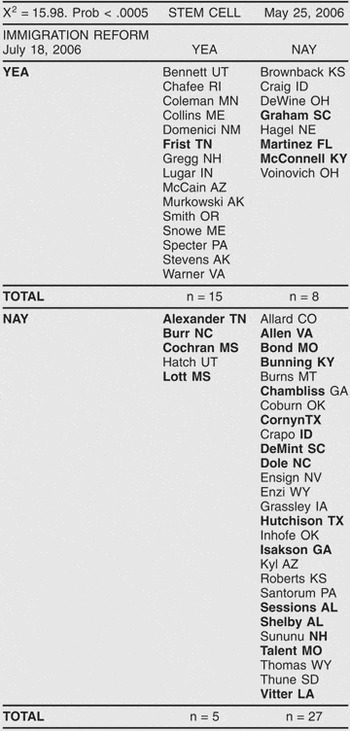
The much more widespread Republican opposition to a similar plan twenty years after the Reagan amnesty is evidence of the increased mobilization and influence of social conservative activists in the Republican Party. Both immigration and stem cell research point to the difficulties in maintaining the successful Republican coalition of recent decades. As table 2 indicates, Republican senatorial votes on Stem Cell Research and Immigration reform (on May 25 and July 18, 2006) reveal some strong clustering, with 15 economic conservatives voting in favor of both measures, and a larger cluster of 27 social conservatives (most of them southerners) voting against both measures.
Votes of Republican senators on immigration and stem cell research

* (Yea,Yea) = 15 pro-business, (Nay,Nay) = 28 social conservatives
* Names in bold from southern states.
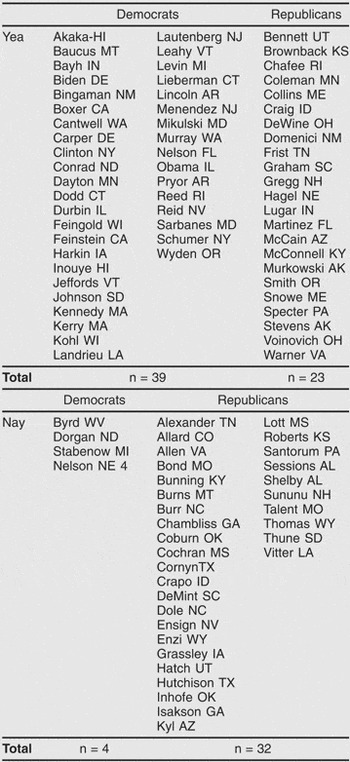
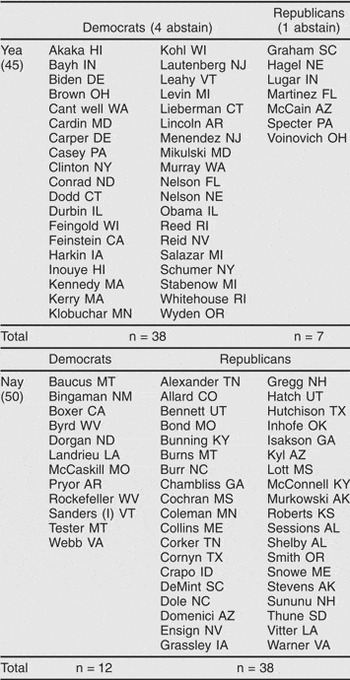
The 32 Republican nay voters were joined by 4 Democrats voting nay in the July 2006 roll call. On June 7, 2007, 38 Republicans were joined by 11 Democrats, and the independent, Sanders of Vermont, in voting against cloture (the cessation of discussion on the immigration bill which needed 60 yea votes). This vote was essentially repeated on June 28, killing the proposal until after 2008.Footnote 45
From our perspective, immigration reform involves both economic interests (pro-business) and the social axis (civil rights), and the policy proposals associated with the bill can be located in the upper right quadrant. This inference gives a rationale why the Republicans were overwhelmingly opposed, and were joined by a sufficient number of Democrats to kill the proposal.
The Best Response of the Democratic Party
As discussed in our opening, Schofield has shown that, given voters and activists with different preferences in a multi-dimensional policy space, there exists a Pure Strategy Nash Equilibrium (or PSNE) for vote-maximizing candidates. This simply means that, at any given time, each party candidate adopts a policy position to balance the centrifugal pull of party activists with the centripetal pull of the electorate, while also seeking a best response to the position adopted by the other party's candidate.
The location of the candidates in equilibrium is not exactly at the center of the electoral distribution, because of the need to seek resources from party activists, who generally are located far from the center. The more inherently likable a candidate is in the eyes of the public (i.e., the higher the candidate's valence), the less dependent is the candidate on the support of activists, and the closer, in equilibrium, to the electoral center can he locate himself. For example, in figure 2 the “balance locus” for Goldwater gives the possible set of policy positions that he could choose so as to maximize the electoral consequences of activist support from economic and social conservatives. Because Goldwater had a low valence due to the electoral perception of his extremism, his balance locus was far from the center, illustrating his need to get compensating activist support. Bush, on the other hand, has been seen in both election years as a personally attractive candidate. Consequently, he can afford to take a more centrist position, as shown in the “balance locus for Bush” in figure 2. The same factor would explain a more centrist balance locus for Clinton.
The “balance locus” for each Republican candidate can be represented as an arc, revealing possible tradeoffs between social and economic conservatives. As the proportion of resources from social activists increases relative to those from economic activists, candidates in equilibrium will move toward the axis of social activism. Just as Democratic candidates were pulled toward social liberal position (S in figure 2) during the tumult of the sixties and seventies, so Republican candidates have increasingly moved toward the social conservatives (position C) during the eighties and nineties. This kind of movement necessarily creates resentment between different factions of the party, especially in the face of issues like stem cell research and immigration.
What is the rational best response of Democrats to this movement in the Republican Party? Will the Democratic position in the PSNE adjust to Republican movement and strife?
Return to the New Deal Coalition
There have been several conflicting prescriptions for the Democratic Party, and recent events reveal which of these is most likely. The first prescription is a “Return to the New Deal,” emphasizing traditional economic liberalism, and the class differences between labor and business.Footnote 46 The problem with this strategy is that it is a losing strategy as long as the Republicans retain the votes of some of the populists of the lower-left quadrant in figure 2. It seems unlikely that social conservatives—now fully engaged on the issues of teaching of evolution, abortion, and immigration—are ever going to return to the party of civil rights, the Kennedy Immigration Reform of 1965, and Roe v. Wade. Without the populists, a return to the economic liberalism of the New Deal only isolates the “liberal” voters of the upper-left quadrant in figure 2.
Furthermore, while there is a great deal of lip service to the economic left in the contemporary Democratic Party, there is very little chance of a real move to the left. There is little possibility of reinventing the welfare system that Clinton ended in 1996 or of an expansion or reaffirmation of labor rights. Political pragmatism pulls Democrats to the center on economic policy, not to the left. Certain elements of the labor movement continue to have a strong hold on figures in the Democratic Party, but the recent immigration reform votes presented above in tables 3 and 4 gives striking evidence of the limits of labor influence. Ten or twenty years ago, a similar immigration bill would have been opposed by the majority of Democrats as a threat to labor and its wages. In 2006, on the other hand, Michigan's Senator Stabenow was the only Democratic senator to oppose the immigration bill on grounds that it would lower wages for labor. A very significant majority of Democratic senators voted for the bill despite the fact that it could induce a downward effect on wages.Footnote 47 They saw the bill as a civil rights measure and supported it, rather than opposing it on economic liberal grounds. At the same time, it is important to note that employers around the country strongly supported the bill. The vote on the immigration bill shows that the possibility that a Democrat move to the left on the economic dimension has been somewhat weakened.Footnote 48
Democratic and Republican senator votes on immigration reform 2006

Senate votes on immigration reform June 7 2007

Soften Social Liberalism
The second strategy is to soften Democratic social liberalism. There is something to be said for this argument, from an electoral perspective. As social policy has come to dominate partisan debate, a centrist position on social policy is theoretically the winning position. However, the party's position is the result of a balance between the centripetal pull of the electorate and the centrifugal tugs of activists who supply the resources necessary for an effective campaign. Moving too far toward the center on social policy runs the risk of losing the base of affirmative action supporters, gay rights supporters, women's lib supporters who have (since the sixties) replaced economic liberals as the primary activist support coalition for the party.
As mentioned earlier, the optimal balance for vote maximization depends on party activism (the marginal contribution rate) and on the non-policy attractiveness (or valence) of the candidate. A candidate with personally attractive qualities, such as integrity or charisma, can afford to move nearer the center of the electorate than a less attractive candidate. A candidate with lower valence is more dependent on the resources mustered by party activists, and consequently must move out from the center toward the more extreme policy positions advocated by those activists. So the ability of the Democrats to pick up votes by moving toward the social policy center is contingent on the candidate, and constrained by Democratic Party activists. These activists are increasingly motivated by social issues and the “war against terror.”
Flanking Maneuver that Pulls in Disaffected Republicans
The best Democratic response to the increasing power of social conservatives in the Republican Party must be to seek the support of the social liberals who are increasingly disaffected in the Republican Party. This involves a move toward the social liberal axis along what is marked as “the Clinton balance locus” or “Gore balance locus” in figure 2.
As Populists demonstrate that they are in the driver's seat in the Republican Party, cosmopolitan voters in the upper right hand quadrant become increasingly alienated. A vote-maximizing Democratic candidate will inevitably see the political advantage of picking up Republicans who believe in teaching evolution, agree with stem cell research, and have a relatively open policy toward immigrants.
Many Republican employers see immigration as being a constructive force in the American economy, and are opposed to the hard line taken by House Republicans. Further, GOP opposition to stem cell research will alienate millions of educated, economic conservatives who are personally concerned about the health benefits of stem cell research. Employers, stockholders in bioengineering, health care professionals are likely to be economic conservatives who have probably voted Republican all their life. What would it take to get them to vote Democratic? Perhaps not much, if social conservatives continue to be intransigent on issues like immigration and stem cell research. As we argue in the next section, an inevitable party dynamic will pull many of those voters into the Democratic Party, bringing activists and candidates along with them.
Party Dynamics
Whether undertaken as a consciously chosen strategy or not, the Democratic Party is going to move to the right, on the economic dimension, while staying strictly liberal on the social dimension. It will happen as a result of already-existing pressures driving socially liberal economic conservatives out of the Republican Party.
The public perception of each party is determined by the composition of each party's activists.Footnote 49 Voters for each party make decisions about whether to become activists based on the relative location of the two parties, as determined by the existing mass of activists. If moderate social liberals leave the Republican Party for the Democratic Party, then the social policy differences between the two parties becomes even more salient, and more motivating to social policy activists.
Furthermore, as social policy activists are sorted into the two parties, this has important implications for potential candidates. Party activists, for example, have enormous influence in primary elections, where they constitute a larger proportion of voters who actually turn out, and where they have a big impact on voter mobilization.
The increasing dominance of social conservatives in the GOP is best seen in the consequences of their influence on Republican Party primaries. One consequence will be challenges to Republican moderate (socially liberal) incumbents. A second consequence will be that Republican moderates who hope to hold office will simply switch to the Democratic Party. Both of these have the further effect of increasing the polarization of the two parties along the social dimension, while decreasing the economic policy differences between the two parties.
Party Challenges
While most models of party competition assume a monolithic party actor, the view presented here is that the party is composed of multiple groups—activists of different ideological stripes, and party candidates and leadership who would like to respond to the centripetal force of the electoral center. The primary task facing the Republican Party is the same as it is for every majority party under plurality rule—to keep the coalition together in the face of conflict among diverse supporters. Just as Lyndon Johnson confronted increasing conflict between civil rights supporters and the southern elite, Republicans face increasing conflict between moderate pro-business Republicans and hard-core social conservative activists. The outcome is likely to be as significant a transformation in the Republican Party as the one that occurred in the Democratic Party 40 years ago.
Republicans like Danforth call for the return of the Republican Party to its position in earlier decades: fiscally responsible, supportive of business (even in immigration policy), civil libertarian on issues like abortion. But “return” is something we never see in partisan realignments. One might as well call for a return to the Republican Party of Teddy Roosevelt or Lincoln. Social conservative activists, having captured the state and local machinery of the Republican Party, have no incentive to give it up, even in the interest of greater Republican success.
A case in point is Randy Graf, in Arizona's 8th district, which includes the relatively liberal voters of Tucson as well as the conservative ranchers of Cochise County. The seat had been held for 22 years by moderate Republican Jim Kolbe, until he announced his retirement in 2006. The 2006 election was recognized early on to be one in which the Democrats had an opportunity to take back the House; as a result, the Republican National Committee, hoped to keep this seat by running another moderate Republican—Steve Huffman. In fact, the RNC donated at least $122,000 to Huffman's campaign.
However, Randy Graf, a former golf pro, challenged the RNC's candidate. Graf was a founding member of the Minutemen, a conservative anti-immigration group whose members took it upon themselves to patrol the border. He was also anti-abortion and against same-sex marriage. While Huffman had the support of the national party, Graf had the whole-hearted support of the Minutemen and other social conservatives, who felt immigration was directly linked to crime, drugs, and the destruction of American identity. Graf claimed that there was “real fury with Washington,” and ran with the slogan, “change can't wait.” Graf's supporters called Huffman a RINO—Republican in Name Only, a favorite term used by social conservatives trying to drive social moderates out of the Republican Party. He angrily denounced the Republican Party for supporting his moderate opponent. He won the primary with 42 percent of the vote against Huffman's 38 percent.
In the general election, the Republican National Committee continued to worry about Graf's electability. In the face of polls indicating a large loss for Graf, the RNC canceled $1 million in financial support for Graf's ads. Democrat Gabrielle Giffords found it easy to stake out a centrist, winning position, and took the House seat away from the Republicans with a 54 percent to 42 percent vote.
This election illustrates that parties are not monolithic. Elements of the party—the candidates and the national committees—are more concerned about electability than ideological purity. The National Republican Party would rather support a Republican candidate who is close to his district's median voter than a social conservative who could lose a House seat for the party. However, warring activists of different stripes are not generally willing to make ideological sacrifices in the interest of their parties' candidates. At least in Tucson, the Republican Party moved incrementally toward the social conservatives, despite the leadership's attempts to apply the brakes.
Conflict within the party played a similar role in the defeat of Lincoln Chaffee. Chaffee is a fiscal conservative and social liberal in the mold of New England Republicans going back to the Civil War—much like Prescott Bush, one-time senator from the neighboring state of Connecticut. Chaffee was the only Republican senator to vote against the Bush tax cuts and against the Iraq war; he also let it be known he was going to write in the name of the president's father in protest against Bush's policies.
These actions invoked a conservative challenge in the Republican primary—from Stephen Laffey, Mayor of Cranston, and pro-lifer. In this case, Chaffee was able to beat back the conservative challenger, at some cost to his election resources. Alienating the conservative wing of the Republican Party left him more vulnerable to a popular Democrat. The Democrat, Sheldon Whitehouse, defeated Chaffee 53 to 47. The result was that senate Republicans became more homogeneously conservative on social issues; the prospect of the GOP “returning” to the Republicanism that Chaffee, Jeffords, and Danforth remember became even more remote.
In Rhode Island and Arizona, primary challenges by conservatives helped undermine the strategy of Republican Party leaders, who hoped to maintain control of Congress by offering strong, unified support for moderates in moderate districts. The challenges by Graf in Arizona and Laffey in Rhode Island illustrate in a striking way the increasing power of social conservatives as an autonomous force for repositioning the Republican Party.
Party Switches
As social conservatives come to dominate the machinery in a given state or electoral district, socially moderate Republican candidates may be forced into the Democratic Party simply because they can no longer hope to win a Republican primary. The normal ambition of politicians transforms socially liberal Republicans into moderate Democrats. And once again, the result is increased party polarization on the social dimension and decreased party differences on the economic dimension.
A case in point is John Moore, a long-time executive with Cessna Aircraft in Wichita; a pro-business conservative, he was nevertheless unlikely to win a Republican primary for any state-wide position due to his “softness” on social issues. He consequently converted in 2002, and was elected as the Democratic lieutenant governor.
Moore retired in 2006, and the open position brought about an even more dramatic development. Mark Parkinson officially switched parties in time to run for the lieutenant governor's position. Parkinson is a former Republican Party Chairman for the state of Kansas, and was elected lieutenant governor on the Democratic ticket. Others in Kansas are going the same route. In 2004, Republican Cindy Neighbor switched parties to run for the state legislature, opposed to a social conservative who had defeated her in the primary in 2004. She was elected in 2006.Footnote 50
Nor are these ballot box conversions limited to ambitious Kansas moderates. Perhaps the most striking and visible such conversion was that of Jim Webb of Virginia. Webb is a much-decorated Vietnam War veteran who had been Reagan's Secretary of the Navy. As recently as 2000, he supported Republican George Allen to be the U.S. Senator from Virginia. In 2006, he was a Democrat running against Allen. Traditional New Deal Democrats were aghast; but Webb defeated Allen, and his presence in the party moves the Democratic center of gravity to the right on economic policy.
Each such switch makes further switches more likely. While Kansas has been seen as a state in which the Democratic Party is all but defunct, the conversion of a small number of socially moderate Republicans to the Democratic Party could easily restore healthy two-party competition in Kansas. But in the process, each individual conversion changes what it means to be a Democrat. Increasingly, a Democrat is an economic moderate or conservative who is strongly liberal on social issues—not (as in the New Deal), a strong economic liberal whose Democratic affiliation is a response to class conflict.
These observations are not meant to advocate any particular strategy for either party. Rather, they suggest that partisan change continues to have a certain inevitability about it, despite the fond wishes of entrenched party activists. Each partisan realignment has occurred despite the opposition of existing party activists. Populist Democrats in the 1930s, who might have supported Bryan in the past, were suspicious of the industrial laborers that the New Deal brought into the party. In the same way, traditional Republican activists were aghast when their candidate Nelson Rockefeller was booed for criticizing Goldwater-style radicalism at the 1964 convention.Footnote 51
Partisan realignment is a dynamic process because of the destabilizing influence of vote-maximizing candidates who see opportunities to win elections even at the cost of generating some hostility within the ranks of the pre-existing activist cadres. As a result, partisan identities are always changing, even though we tend to see them as fixed and immutable. The Republican Party in 1868 was the post-civil war party of racial equality through strong national government. The Republican Party in 1948 was the party of the balanced budget and civil libertarianism. Neither of these identities proved to be immutable, and the current identities of both parties are again in flux.
The departure of even a small number of pro-business social liberals from the Republican Party—like James Jeffords of Vermont or Mark Parkinson in Kansas—has inevitable effects on both parties. Each such departure increases the proportion of social conservatives in the Republican Party, making it easier for social conservatives to dominate both the party primaries and the activists who give the Party its image to the nation. This in turn makes it even more difficult for social liberals to hope for a successful career within the GOP. Voters, as well as activists and candidates, adjust. If they are concerned about women's rights or the separation of church and state, they are less likely to vote as Republican and more likely to shift to independent or Democratic status.
At the same time, symmetrical adjustments are made in the Democratic Party. Just as Strom Thurmond's conversion to the Republican Party helped trigger a long list of similar conversions by socially conservative Democrats, so each socially liberal Republican who converts to the Democratic Party makes the social issue that triggered the conversion a more salient aspect of the Democratic identity. The Democratic Party and Republican Party become internally more homogeneous as regards economic policy, and more polarized with respect to social policy.
Thus, as social polarization increases between the parties, the economic differences will slowly disappear. As pro-business social liberals join the Democratic Party, it will become increasingly difficult to imagine that party going back to a New Deal identity. Just as the New Deal Democratic Party consisted of segregationists and labor unions united on an anti-business platform, the emerging Democratic Party will find itself united at a social liberal position, with a centrist position on economic policy. The proportion of Democrats who adopt a traditional anti-business stance will be reduced. A simple electoral calculus by candidates will tend to move them to a Clinton-style moderate position on economic policy—advocating (among other things), a more inclusive policy toward immigrants, and a more enthusiastic commitment to stem cell and related medical research.
Such a redefinition of the Democratic Party will serve as a catalyst for further change by the Republican Party. The potential for these transformations is suggested by table 3 above.
Concluding Remarks
William Jennings Bryan, of course, was an anti-business radical as well as a social conservative. Bryan's position on social policy issues is now ascendant in the Republican Party. Can we infer that the Republican Party will adopt Bryan's economic radicalism as well as his social conservatism?
In the short run, the move by pro-business social liberals from the Republican Party to the Democratic Party will make both parties look more moderate on economic policy. In the long-run, the same dynamic could actually make the Republican Party more blue-collar than the Democrats. Social conservatives in the Republican Party already insist that the Democratic Party is the party of privilege and elitism. The populist rhetoric adopted by the Republican Party has pictured the Democratic Party as the home of overpaid professors, bureaucrats, and social technicians. Democrats are seen as “limousine liberals” who want to indulge themselves in expensive pro-environmental policy, and who have nothing to lose when wages collapse to the levels of Third World countries.
If the Democratic Party continues to pick up social liberals like Jeffords and Parkinson (either by conscious strategy or just because they have nowhere else to go), then professionals and business leaders in the party will balance the beleaguered unions. These new elements of the party will be on the side of a balanced budget, open immigration, and accommodation with business (especially in the new computer and biotech industries). Most difficult for traditional Democrats will be the support for free trade among the new Democrats. The economic liberals in the Democratic Party will feel increasingly isolated and alienated. Listening to the populist rhetoric of Republican activists and politicians, blue-collar workers may come to expect the Republican Party to represent their economic interests, in addition to their social conservativism.
Some Republican politicians already accept the social values of blue collar workers and will decide to represent the economic aspirations of their constituents as well. Why not, if professional and business elites are already heading for the door? Indeed, the role model for the complete twenty-first century reincarnation of Bryan is possibly already visible in the form of Patrick Buchanan.
In “The Great Betrayal,” Buchanan sounds like the epitome of the anti-business populist. He blames the business elite for crucifying the working men and women of the country on a cross of free trade. NAFTA, signed by Clinton with Republican votes is not sustainable. “NAFTA puts U.S. blue-collar workers into competition for manufacturing jobs with Mexican workers who earn 10 percent of their wages … American employers now hang over the head of their workers this constant threat: accept reduced pay, or we go to Mexico!”Footnote 52
As Buchanan has demonstrated, it would be a simple matter to take up the populist economic policy along with the rhetoric. Buchanan does not hesitate to point to “corporate executives” as being complicit in “The Great Betrayal”: “Having declared free trade and open borders to be America's policy, why are we surprised that corporate executives padlocked their plants in the Rust Belt and moved overseas? Any wonder that Nike president Philip Knight is the fifth-richest man in America, with $5.2 billion, while his Indonesian workers make thirty-one cents an hour?”Footnote 53
Like Phillips in 1968, Buchanan sees the future of the Republican Party in “the new populism” with both an economic and social agenda: protectionist, anti-immigration, and anti-capitalist as well as anti-abortion. Buchanan is the model for the Republican incarnation of William Jennings Bryan.Footnote 54 In the long run, a Buchanan-style Republican could complete the cycle by forming a new “New Deal” between rural social conservatives and economic liberals.
Changes in party identity will not happen quickly or without a great deal of pain caused by the political dislocation. These transformations will not necessarily result in a single, realigning election. However, as long as Americans understand politics to consist of more than a single dimension generated by economic ideology, then no majority coalition in the U.S. polity can be immune from the kind of tension that will eventually lead to its replacement. A second dimension, revolving around race, ethnicity, immigration, and religious values, has always been latent, even when it was suppressed as during the New Deal. The multidimensionality of U.S. politics is now apparent in contemporary life. Everything we know about multidimensional two-party politics suggests that an inevitable dynamism accompanies American politics. Future decades will reveal the impact of today's ongoing transformation.
Postscript: The Primaries of 2008
The formal stochastic electoral model underlying our discussion emphasizes the effect that contributions made by activists to their chosen candidates has on the candidates' valence.Footnote 55 The connection between the campaign expenditures of the candidates and the electoral popularity in the 2008 primaries is shown in figures 7 and 8.
Democratic candidate spending and popularity, January 2008

Republica candidate spending and popularity, January 2008

Estimating the residuals between the linear regression line and the popularity level gives a way of obtaining the intrinsic valences of the various candidates. The figures suggest that both Clinton and Obama (among the Democrats) and Huckabee and McCain (among the Republicans) had relatively high valences. On January 3, 2008, Huckabee won the Iowa Republican caucus while Obama won the Democratic caucus (with 38 percent to Clinton's 29 percent). In the New Hampshire primary a few days later, Clinton was the Democrat winner with 39 percent to Obama's 36 percent while Huckabee only won 11 percent to McCain's 37 percent. In the South Carolina Democratic primary on January 26, Obama took 56 percent to Clinton's 26 percent. On January 29, McCain took about 5 percent more votes than Huckabee. After Super Tuesday on February 5, and the various contests leading to Pennsylvania on April 22, Clinton and Obama had won 1,204 and 1,273 delegates, respectively, while McCain dominated with 1,162 delegates to Huckabee's 262 and Romney's 142.
The final delegate counts were 1,640 for Clinton and 1,764 for Obama. Obama was declared the Democratic nominee.
During the race, Clinton raised about $194 million ($120,000/delegate), Obama $240 million ($140,000/delegate), McCain $66 million ($57,000/delegate), and Huckabee $13 million ($50,000/delegate). Finally Paul gained 5 delegates for $34 million, Giuliani spent $65 million for nothing, and Romney spent $110 million ($612,000/delegate). Both Romney and Giuliani left the race after February 6, while Huckabee conceded after McCain's successes on March 4. These expenditure figures give a fairly clear indication of the contenders' intrinsic valences.
The Republican Party uses a “first past the post” or plurality selection rule for delegates, whereas the Democratic Party uses a proportional rule. This accounts for McCain's early lead, while neither Clinton nor Obama were able to dominate in terms of delegates. It is plausible that the Republican rule causes activist groups to coalesce round the leader, whereas Democrat activist leaders perceive no clear winner. It was also fairly clear that the policy positions of Clinton and Obama were fairly similar, but their valences among different subgroups in the population were different. This would account for their slight changes in policy emphases during the course of the primary race.