


Introduction
Herbicide-resistant weeds pose a significant threat to crop production throughout the United States. Palmer amaranth (Amaranthus palmeri S. Wats.) and barnyardgrass [Echinochloa crus-galli (L.) Beauv.] are among the most troublesome weeds encountered in agricultural production in the midsouthern United States (Riar et al. Reference Riar, Norsworthy, Steckel, Stephenson and Bond2013b). These two weeds are particularly difficult to control due to the existence of biotypes that are resistant to multiple herbicide sites of action (SOA), including 5-enolpyruvylshikimate-3-phostphate and acetolactate synthase inhibitors (Heap Reference Heap2017). Diversifying management strategies to include multiple effective SOA is recommended to combat these herbicide-resistant weeds (Norsworthy et al. Reference Norsworthy, Ward, Shaw, Llewellyn, Nichols, Webster, Bradley, Frisvold, Powles, Burgos, Witt and Barrett2012). As part of this diversification, adoption of crops with resistance to a number of herbicides, including glufosinate, 2,4-D, dicamba, isoxafluotole, and mesotrione is expected to increase in the near future (Riar et al. Reference Riar, Norsworthy, Steckel, Stephenson and Bond2013a). With the expanding diversity of herbicides used, protecting sensitive crop species from off-target herbicide movement will become increasingly important. In Arkansas, both soybean and grain sorghum are important rotational crops and are often grown in close proximity to rice, cotton (Gossypium hirsutum L.), and other crops with herbicide-resistance traits. As a result, the potential exists for both crops to be exposed to applications of various herbicides via both physical and vapor drift. For example, in 2016, it was estimated that more than 120,000 ha of soybean across the Midsouth were damaged via dicamba drift.
Responses of both soybean and grain sorghum to herbicide drift events have been well documented and vary greatly depending upon herbicide and rate. To study crop response to drift, applications ranging from 1/10X to 1/100X of labeled rates are often made (Al-Katib et al. Reference Al-Khatib, Claassen, Stahlman, Geier, Regehr, Duncan and Heer2003; Roider et al. Reference Roider, Griffin, Harrison and Jones2007). According to Wolf et al. (Reference Wolf, Grover, Wallace, Shewchuk and Maybank1993), applications within these ranges are consistent with in-crop exposure to a drift event, allowing for estimations of crop response. Previous research has shown that grain sorghum exposure to 1/10X labeled rates of imazethapyr, glyphosate, and glufosinate can cause 20%, 78%, and 77% crop injury, respectively (Al-Khatib et al. Reference Al-Khatib, Claassen, Stahlman, Geier, Regehr, Duncan and Heer2003). Additionally, Ellis and Griffin (Reference Ellis and Griffin2002) showed that similar drift rates of glyphosate and glufosinate resulted in 29% and 40% crop injury in soybean. Injury response can differ greatly depending upon type of herbicide and can manifest itself in a number of ways, including stunting, chlorosis, and necrosis. These symptoms are sometimes transient in nature, but can greatly impact yields if injury is severe. As demonstrated by Al-Khatib and Peterson (Reference Al-Khatib and Peterson1999), soybean is capable of recovering from V2 to V3 applications of drift rates as high as 1/3X of labeled rates of both glyphosate and glufosinate by 30 d after application, but similar rates of dicamba, prosulfuron, rimsulfuron, and thifensulfuron cause prolonged injury, resulting in yield loss. In addition to type of herbicide and drift rate received, the growth stage of a crop during drift exposure can result in variations in yield response. Auch and Arnold (Reference Auch and Arnold1978) showed that exposure of soybean at vegetative growth stages to dicamba at 5.6 g ae ha−1 caused no reduction in yield, but applications of the same rate to reproductive growth stages resulted in yield loss. Due to the damage associated with drift events, methods for reducing the risk of crop damage could provide great benefits for growers in situations in which drift is a concern.
One area of interest that could significantly reduce the risk of off-target herbicide injury is the use of in-crop safeners. Safeners were discovered in the late 1940s and allow for reduced crop injury from herbicide applications, without sacrificing control of target weeds (Davies and Caseley Reference Davies and Caseley1999). The use of safening compounds has proven to be effective in a number of monocotyledonous crops such as corn (Zea mays L.), rice, and sorghum (Riechers et al. Reference Riechers, Kreuz and Zhang2010). Safeners are commonly used in grain sorghum production and can effectively reduce injury from applications of both PRE and POST herbicides (Barrett Reference Barrett1989; Spotanski and Burnside Reference Spotanski and Burnside1973). In contrast, the lack of success of herbicide safeners in dicot crops, such as soybean, has been noted (Hatzios Reference Hatzios1989; Riechers et al. Reference Riechers, Kreuz and Zhang2010). Continued research to expand the use of safeners may help broaden the number of herbicides available across crops, providing a valuable tool to help fight herbicide resistance and reduce economic loss associated with weed competition.
Recent research by Miller et al. (Reference Miller, Scott, Lorenz, Hardke and Norsworthy2016) showed evidence of a novel method of herbicide safening. Rice injury following early-season applications of drift rates of both glyphosate and imazethapyr were reduced through the use of the neonicotinoid insecticide seed treatment thiamethoxam. Neonicotinoids are the most common class of insecticides used globally, and a vast majority of applications come in the form of crop seed treatments that provide protection from insect pests lasting up to a few weeks after planting (Bailey et al. Reference Bailey, DiFonzo, Hodgson, Hunt, Jarvi, Jensen, Knodel, Koch, Krupke, McCornack, Michel, Peterson, Potter, Szczepaniec, Tilmon, Tooker and Zukoff2015; Douglas and Tooker Reference Douglas and Tooker2015). It is believed that the potential for insecticide seed treatments to safen against applications of certain herbicides may be limited to this coinciding time when insect pests are effectively controlled, due to the relatively high concentration of insecticide active ingredient present in the plants early in the season compared with later.
Neonicotinoid seed treatments are most commonly used in corn, soybean, and cotton, but are also used in rice, wheat (Triticum aestivum L.), and other cereals to a lesser extent (Douglas and Tooker Reference Douglas and Tooker2015). The positive impacts associated with these insecticide seed treatments, including improved early-season stand establishment and protection against a wide range of insect pests, can often provide growers with economic benefits when compared with planting nontreated seed (North et al. Reference North, Gore, Catchot, Stewart, Lorenz, Musser, Cook, Kerns and Dodds2016). Thanks in part to the agronomic and economic benefits of seed treatments, adoption in the state of Arkansas has also increased in recent years, with approximately 60% and 75% of grain sorghum and soybean, respectively, receiving insecticide seed treatments (GML, personal observations). With the widespread popularity of insecticide seed treatments, a large number of growers stand to benefit from potential safening effects associated with neonicotinoids. Although research has shown the potential for insecticides to reduce herbicide injury in both cotton (York et al. Reference York, Jordan and Frans1991) and rice, research on safening effects conferred via insecticide seed treatments in soybean and grain sorghum are lacking. Thus, the objectives of this research were to determine: (1) whether thiamethoxam or clothianidin seed treatments safen young soybean plants to low rates of dicamba, 2,4-D, glyphosate, glufosinate, halosulfuron, mesotrione, tembotrione, or propanil; and (2) whether thiamethoxam, clothianidin, or imidacloprid seed treatments safen young grain sorghum plants to low rates of glyphosate, imazethapyr, or quizalofop.
Materials and Methods
Soybean Field Study
A field study was conducted in 2015 at the Lon Mann Cotton Research Station (LMCRS) in Marianna, AR (34°43'44'' N, 90° 44'04'' W), to determine the feasibility of using insecticide seed treatments as herbicide safeners in soybean. Following the 2015 field trial, research was repeated in 2016 at the LMCRS and at the Pine Tree Research Station (PTRS) near Colt, AR (35°06'36'' N, 90°56'24'' W). According the Web Soil Survey website (USDA 2016), the soil series at these locations were: Convent silt loam (fine-silty, mixed, active thermic Typic Glossaqualf) at LMCRS, and Calhoun silt loam (Coarse-silty, mixed, superactive, nonacid, thermic Fluvaquentic Endoaquepts) at PTRS. At each location, UA-5213C, a non-STS, non–herbicide resistant soybean variety from the University of Arkansas, was planted at a seeding rate of 340,000 seeds ha−1 to a 2.5- to 3-cm depth. All plots consisted of four rows, 7.2 m in length, with row spacing of 96 cm at LMCRS and 76 cm at PTRS. Experiments were established as randomized complete block factorials with four replications and two factors: insecticide seed treatment and herbicide applied. Plots were managed using agronomic recommendations provided in the University of Arkansas Soybean Production Handbook (Purcell et al. Reference Purcell, Salmeron and Ashlock2014).
Before planting, seeds received a seed treatment with either no insecticide, thiamethoxam (Cruiser® 5FS, Syngenta Crop Protection, Greensboro, NC), or clothianidin (NipsIt Inside®, Valent U.S.A., Walnut Creek, CA) applied via a water-based slurry. Labeled use rates for soybean (0.5 g ai kg−1 seed) were used for both insecticides. Because insecticide seed treatments are rarely used without a co-application of fungicides, all treatments included the fungicide combination of mefenoxam, fludioxonil, and sedaxane (CruiserMaxx® Vibrance®, Syngenta Crop Protection) to protect against early-season diseases. Labeled use rates of mefenoxam at 0.075 g ai kg−1 seed, fludioxonil at 0.025 g ai kg−1 seed, and sedaxane at 0.025 g ai kg−1 seed were applied with the same procedure used to treat seeds with insecticide.
Eight herbicides that were deemed to pose a relatively large threat to soybean, via drift, in the Midsouth were applied at low rates. Dicamba (9 g ae ha−1), 2,4-D ester (84 g ae ha−1), glyphosate (126 g ae ha−1), glufosinate (61 g ai ha−1), halosulfuron (4 g ai ha−1), mesotrione (11 g ai ha−1), tembotrione (9 g ai ha−1), and propanil (560 g ai ha−1) were applied with a CO2-pressurized backpack sprayer calibrated to deliver a continuous carrier volume of 143 L ha−1 at 276 kPa using a 2.03-m boom, equipped with four TeeJet® 11015 XR nozzles (TeeJet Technologies, Springfield, IL). Rates corresponded to 1/10X labeled use rates for all herbicides, except for dicamba, which was applied at approximately 1/100X its labeled rate due to the high sensitivity of soybean to dicamba. Applications were made to the two center rows of each plot 3 wk after planting (WAP), corresponding to V2 or V3 soybean at all locations (Table 1). To maintain weed-free plots, a PRE application of flumioxazin at 71 g ai ha−1 (Valor® SX, Valent U.S.A.) was made, and late-season escapes were controlled by hand weeding.
General description of experimental sites.

a Abbreviations: LMCRS, Lon Mann Cotton Research Station in Marianna, AR; PTRS, Pine Tree Research Station near Colt, AR.
Visual crop injury ratings were taken weekly following application. Injury ratings were on a scale of 0% to 100%, where 0% equals no injury and 100% equals plant death. In 2015, crop height (cm) was taken before harvest by measuring the average of 5 representative plants from each four-row plot. In 2016, in an attempt to see variations in crop height closer to herbicide application, height measurements were taken 2 to 3 wk after application (WAA). Soybean yield data were collected by machine harvesting the two center rows of each plot and adjusting grain moisture to 13%.
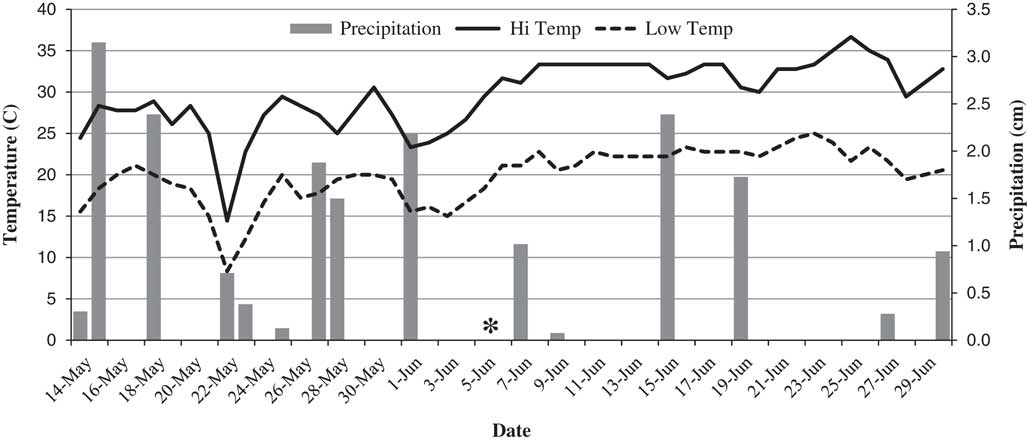
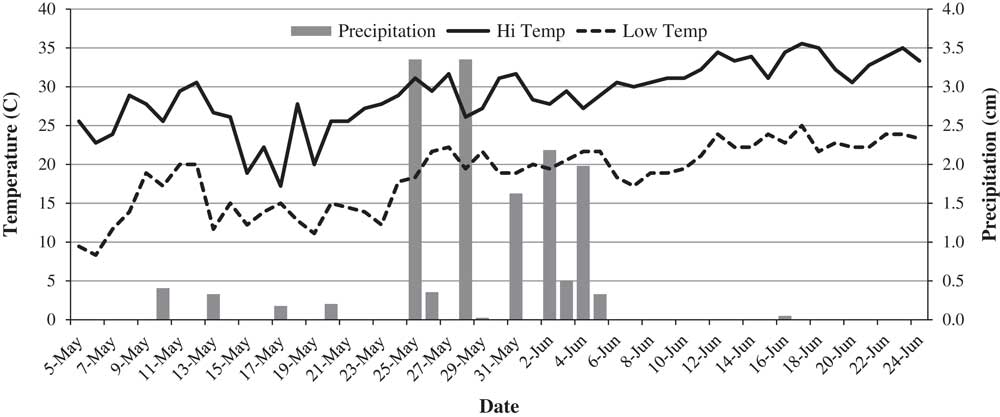
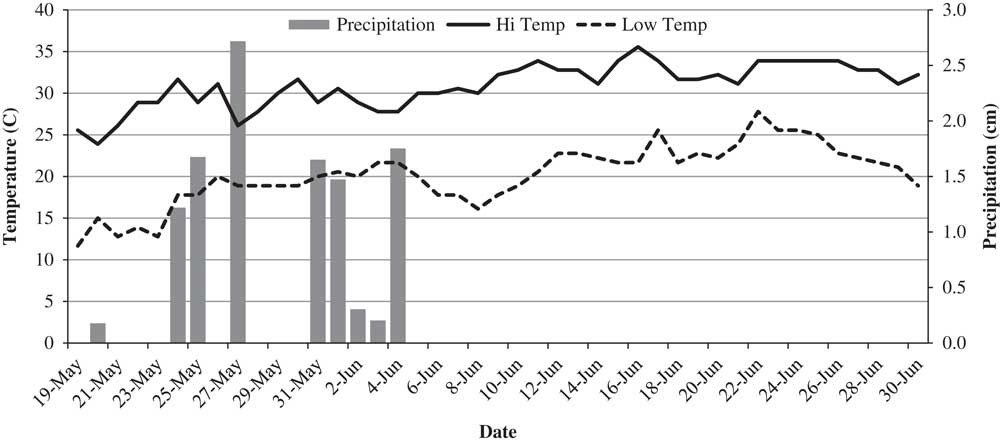
Data collected were subjected to two-way ANOVA using JMP (JMP Pro 12, SAS Institute, Cary, NC), with significant means separated using Fisher’s protected LSD (α=0.05). Site-years were analyzed separately due to considerable variation in environmental conditions at each location (Figures 1–3). For responses that did not produce a significant herbicide by insecticide seed treatment interaction, seed treatment main effects were evaluated. At evaluation timings when no measurable injury was observed for one or more herbicide treatments, the assumptions for ANOVA were not met. When either no interaction was identified, or the response did not meet the assumptions for ANOVA, t-tests were conducted to compare treatments with no insecticide with each insecticide seed treatment within a herbicide.
Environmental conditions at the Lon Mann Cotton Research Station in Marianna, AR, in 2015 beginning at planting (May 14), with herbicide application date marked with an asterisk.
Environmental conditions at the Lon Mann Cotton Research Station in Marianna, AR, in 2016 beginning at planting (May 5), with herbicide application date marked with an asterisk.
Environmental conditions at the Pine Tree Research Station near Colt, AR, in 2016 beginning at planting date (May 19), with herbicide application date marked with an asterisk.
Grain Sorghum Study
Similar to the soybean study, an experiment was conducted at the LMCRS in 2015, followed by additional studies at LMCRS and PTRS in 2016. ‘DeKalb DK-54-00’ grain sorghum (Monsanto Company, St. Louis, MO) was planted at a density of 222,000 seeds ha−1 at a 2.5-cm depth at all locations. All plots measured four rows by 7.2 m in length. Row spacing was 96 and 76 at LMCRS and PTRS, respectively. Similar to soybean trials, University of Arkansas agronomic recommendations for grain sorghum production were followed to maintain all plots (Espinosa and Kelley Reference Espinosa and Kelley2004).
Three insecticide seed treatments plus a nontreated check were included as part of a two-factor factorial (insecticide seed treatment by herbicide). Thiamethoxam, clothianidin, and imidacloprid (Gaucho®, Bayer CropScience, Research Triangle Park, NC) were applied via water-based slurry before planting at 2, 2, and 2.5 g ai kg−1 seed, respectively. Similar to soybean trials, all treatments contained fungicides commonly co-applied with insecticides. Combinations of the fungicides mefenoxam (Apron XL®, Syngenta Crop Protection), azostrobin (Dynasty®, Syngenta Crop Protection), and fludioxonil (Maxim® 4FS, Syngenta Crop Protection) were applied at 0.075, 0.02, and 0.05 g ai kg−1 seed, respectively.
Herbicides were applied as for soybean trials, using a backpack sprayer. Glyphosate (126 g ae ha−1), imazethapyr (17.5 g ai ha−1), and quizalofop (20 g ai ha−1) were chosen as three of the most important herbicide-drift concerns for midsouthern grain sorghum and were applied at sublethal rates 3 WAP, when sorghum plants were at the 3- to 4-leaf growth stage. These rates correspond to a 1/10X labeled rate for glyphosate and imazethapyr and a 1/4X rate for quizalofop. A broadcast application of S-metolachlor plus atrazine, at 1.06 and 1.12 kg ai ha−1, respectively, was made at planting to maintain weed-free conditions, and late-season weed escapes were removed by hand as needed.
Data-collection timings and analysis were the same as for the soybean experiment, with visual injury, crop height, and yield collected and subjected to ANOVA using JMP. For responses that did not produce a significant herbicide by insecticide seed treatment interaction, seed treatment main effects were evaluated. At evaluation timings when no measurable injury was observed for one or more herbicide treatments, the assumptions for ANOVA were not met. When either no interaction was identified or the response did not meet the assumptions for ANOVA, t-tests were conducted to compare treatments with no insecticide with each insecticide seed treatment within an herbicide.
Results and Discussion
Soybean Study
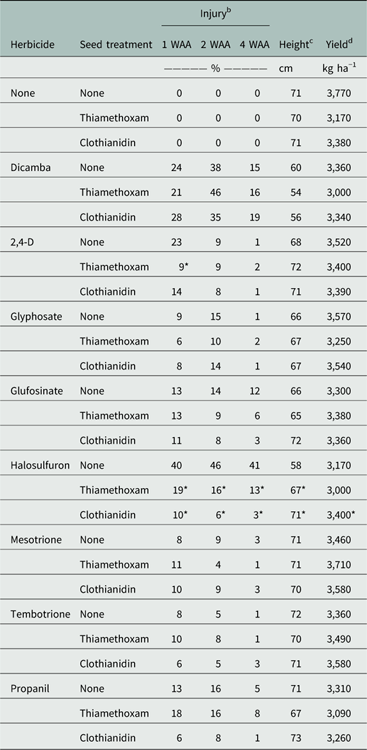
Significant injury reduction through the use of insecticide seed treatments was observed in at least 1 site-year for all herbicides evaluated, with the exception of propanil (Tables 2–4). Injury reduction from halosulfuron drift was the most successful, with safening effects seen at 2 of 3 site-years evaluated, indicated by significant (α=0.05) seed treatment by herbicide interactions. At LMCRS (2015), injury from halosulfuron was reduced at all evaluation timings by both insecticides (Table 2). Maximum halosulfuron injury reduction was seen at 4 WAA, where injury was reduced from 43% to 13% and 3% using thiamethoxam and clothianidin, respectively, with similar levels of safening seen at both 1 and 2 WAA (Table 2). The safening seen following halosulfuron applications at LMCRS in 2015 also caused a significant increase in soybean height in both seed treatments, and increased grain yield from 3,000 kg ha−1 in the no insecticide seed treatment plot to 3,400 kg ha−1 in the clothianidin treatment. At LMCRS (2016), injury from halosulfuron was reduced from 19% with no insecticide seed treatment to 6% in both clothianidin and thiamethoxam treatments, with the thiamethoxam treatment also resulting in increased crop height of 5 cm and a 640 kg ha−1 increase in yield, compared with the nontreated plot (Table 3).
Soybean injury, height, and yield at the Lon Mann Cotton Research Station in Marianna, AR, in 2015.Footnote a
a Abbreviations: NS, nonsignificant; WAA, weeks after application.
b Means followed by an asterisk indicate significant reduction in injury compared with no insecticide seed treatment within the same herbicide treatment according to Fisher’s protected LSD (α=0.05).
c Means followed by an asterisk indicate significant increase in crop height compared with no insecticide seed treatment within the same herbicide treatment according to Fisher’s protected LSD (α=0.05).
d No significant differences were seen among seed treatments within herbicide treatments according to Fisher’s protected LSD (α=0.05).
Soybean injury, height, and yield at the Lon Mann Cotton Research Station in Marianna, AR, in 2016.Footnote a
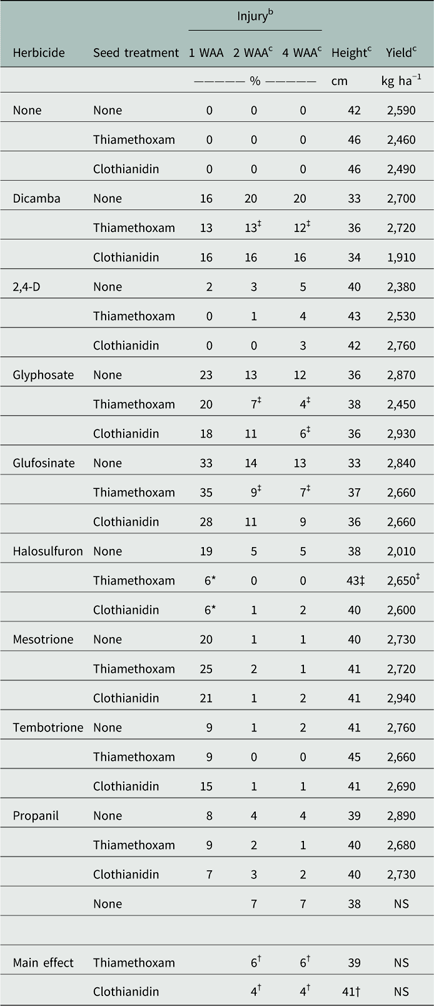
a Abbreviations: NS, nonsignificant; WAA, weeks after application.
b Means followed by an asterisk indicate significant reduction in injury compared with no insecticide seed treatment within the same herbicide treatment according to Fisher’s protected LSD (α=0.05). Means followed by a single dagger indicate a significant seed treatment main effect using the same criteria.
c For responses that did not produce a herbicide by insecticide seed treatment interaction, a t-test was conducted to compare treatments with no insecticide with each insecticide seed treatment within an herbicide. Where use of an insecticide seed treatment reduced injury or increased height or yield compared with no insecticide, means are marked with a double dagger (‡).
While halosulfuron injury was reduced at multiple locations, successful safening was observed at 1 or more of 3 site-years in each of the other herbicides evaluated besides propanil. Injury from both glyphosate and glufosinate was reduced via insecticide seed treatments at LMCRS in 2016 (Table 3). At LMCRS (2016), no significant two-way interaction was seen. However, when comparing treatments with and without seed treatments via individual t-tests, within herbicides, injury was reduced by using thiamethoxam at 2 and 4 WAA and by using clothianidin 4 WAA following an application of glyphosate (Table 3). At LMCRS (2016), injury 2 WAA was reduced from 13% to 7% using thiamethoxam, and injury 4 WAA was reduced from 12% to 4% and 6%, using thiamethoxam and clothianidin, respectively (Table 3). Following a low rate of glufosinate, no significant two-way interaction was seen; however, when subjected to individual t-tests, injury was reduced at LMCRS (2016) at 2 and 4 WAA and at PTRS 1 WAA. At PTRS, injury 1 WAA was reduced from 15% to 6% using thiamethoxam. For both glyphosate and glufosinate, height and yield were not improved as a result of the safening effects seen (Table 4).
Soybean injury, height, and yield at Pine Tree Research Station near Colt, AR, in 2016.Footnote a
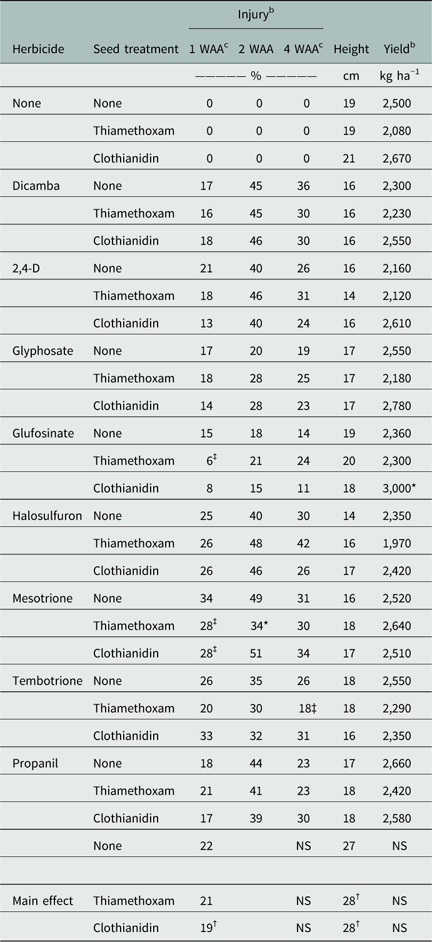
a Abbreviations: NS, nonsignificant; WAA, weeks after application.
b Means followed by an asterisk indicate significant reduction in injury compared with no insecticide seed treatment within the same herbicide treatment according to Fisher’s protected LSD (α=0.05). Means followed by a dagger indicate a significant seed treatment main effect using the same criteria.
d For responses that did not produce a herbicide by insecticide seed treatment interaction, a t-test was conducted to compare treatments with no insecticide with each insecticide seed treatment within an herbicide. Where use of an insecticide seed treatment reduced injury or increased height or yield compared with no insecticide, means are marked with a double dagger (‡).
In addition to glyphosate and glufosinate, 2,4-D, dicamba, mesotrione, and tembotrione all saw significant injury reductions at 1 of the site-years evaluated. With 2,4-D, injury 1 WAA at LMCRS (2015) was reduced from 23% to 9% when seed received a thiamethoxam treatment (Table 2). Following dicamba exposure, a significant reduction in injury both 2 and 4 WAA at LMCRS (2016) occurred. At 2 WAA, injury was reduced from 20% to 13% using thiamethoxam, and at 4 WAA, injury was reduced from 20% to 12% with the same seed treatment. In mesotrione treatments at PTRS, reduction in injury was seen at 1 and 2 WAA. Injury from mesotrione was reduced from 34% to 28% using both thiamethoxam and clothianidin at 1 WAA, and at 2 WAA, injury was reduced from 49% to 34% via a thiamethoxam seed treatment (Table 4). For tembotrione, injury at 4 WAA at PTRS was reduced 8 percentage points by the thiamethoxam seed treatment (Table 4).
Overall, this research indicates that safening soybean to herbicide drift may be possible through the use of both thiamethoxam and clothianidin seed treatments. Although, with the exception of halosulfuron, degrees of safening seen were not comparable to commercially available safeners in other crops, the possibility of successfully safening crop injury in soybean is a novel concept and would likely aid speed of recovery following a drift event. Likewise, any reduction in injury would also aid the ability of soybean to compete with weeds present within a field, a critical component of successful weed management. Examples of effective herbicide safening to sulfonylurea herbicides are documented in corn, rice, grain sorghum, and wheat, but not in any dicotyledonous species (Davies and Caseley Reference Davies and Caseley1999). More in-depth exploration of the safening effects seen in soybean in this study may prove that many potential safening options exist in dicots.
Due to the wide variation in consistency and degree of injury reduction among site-years, adoption of insecticide seed treatments solely as safeners in soybean is unlikely from a grower perspective. However, because insecticide seed treatments are used on a vast area, under differing environmental conditions, there is a high possibility that at least some of the producers who use them will see the benefits of potential safening. Injury reduction of 10% to 15% may seem negligible, but protecting seedling soybean is of vital importance. Reducing injury to seedlings decreases time to canopy closure, which in turn decreases weed interference, and can increase crop yields. Because insecticide seed treatments appear to be able to provide this benefit, in addition to protecting against early-season insect pests, adoption of insecticide seed treatments in the future is likely to increase among soybean growers.
Grain Sorghum Study
Compared with the results of the soybean study, use of insecticide seed treatments as safeners appears to have even more potential in grain sorghum. Of the three herbicides evaluated, all were effectively safened in at least 1 site-year. Injury from glyphosate, imazethapyr, and quizalofop were reduced at 2, 2, and 1 site-years, respectively. Following glyphosate exposure, a significant two-way interaction was present at both LMCRS (2016) and PTRS, showing a reduction in injury through the use of seed treatments. Glyphosate injury to grain sorghum was reduced at all evaluation timings at PTRS through the use of clothianidin and imidacloprid. The most effective instance of safening could be seen at 4 WAA, where injury was reduced from 48% to 28%, 5%, and 6% through the use of thiamethoxam, clothianidin, and imidacloprid, respectively (Table 5). These safening effects from all three insecticide seed treatments provided an increase in yield compared with the treatments with no insecticide following glyphosate exposure at PTRS. Yield increases of 2,620, 2,950, and 3,690 kg ha−1 were seen in the thiamethoxam, clothianidin, and imidacloprid plots, respectively (Table 5). At LMCRS (2016), injury was reduced at both the 2 and 4 WAA evaluation timing with thiamethoxam and imidacloprid. At 2 WAA, injury was reduced from 84% to 54% and 70% using thiamethoxam and imidacloprid, respectively, and similarly at 4 WAA, where injury was reduced from 86% to 48% and 65% (Table 6). Similar to results at PTRS, the safening seen at LMCRS (2016) resulted in increases in both crop height and yield compared with treatments with no insecticide seed treatment (Table 6). Plots with thiamethoxam and imidacloprid seed treatments were 18- and 6-cm taller and had yields 2,520 and 1,330 kg ha−1 higher, respectively, compared with the nontreated plot (Table 6).
Grain sorghum injury, height, and yield at Pine Tree Research Station near Colt, AR, in 2016.Footnote a
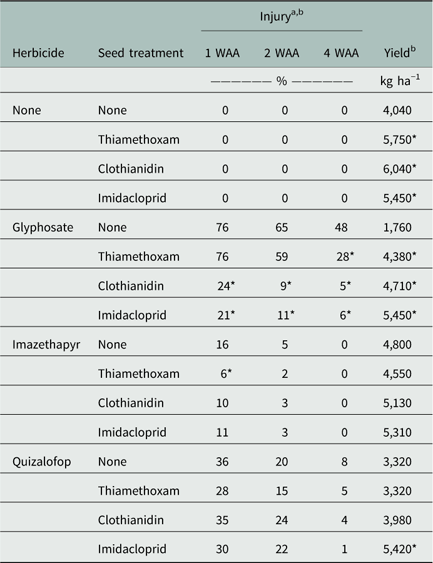
a Abbreviation: WAA, weeks after application
b Means followed by an asterisk indicate significant reduction in injury compared with no insecticide seed treatment within the same herbicide treatment according to Fisher’s protected LSD (α=0.05).
Grain sorghum injury, height, and yield at the Lon Mann Cotton Research Station in Marianna, AR, in 2016.
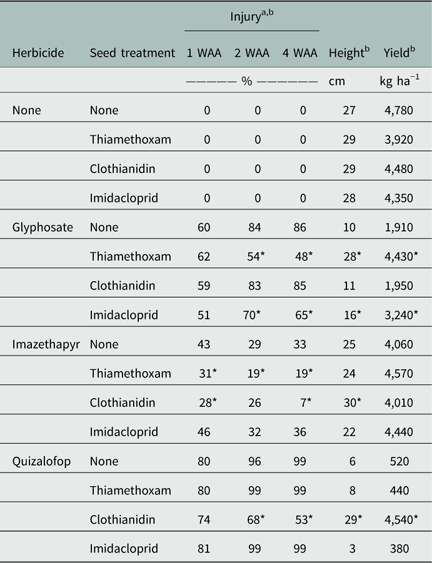
a Abbreviation: WAA, weeks after application.
b Means followed by an asterisk indicate significant reduction in injury compared with no insecticide seed treatment within the same herbicide treatment according to Fisher’s protected LSD (α=0.05).
Injury following exposure to imazethapyr was reduced at both LMCRS (2016) and PTRS via insecticide seed treatments. At LMCRS (2016), crop injury was reduced at all ratings using thiamethoxam, and at the 1 and 4 WAA timings using clothianidin. Injury at 4 WAA was reduced from 33% to 19% and 7% via thiamethoxam and clothianidin, respectively (Table 6). An increase in height was seen as a result of this safening, with clothianidin-treated plots being 5-cm taller compared with the nontreated plots; however, yield was not increased as a result of injury reduction. At PTRS, grain sorghum was safened against imazethapyr injury at 1 WAA using thiamethoxam, with injury reduced from 16% to 6% (Table 5). Unlike in instances of glyphosate safening, yields were not increased through the use of insecticide seed treatments following exposure to imazethapyr.
Of the three herbicides evaluated, quizalofop was the least successful in terms of safening observed, with only 1 site-year showing a reduction in injury through the use of insecticide seed treatments. Following exposure to drift rates of quizalofop, injury was reduced at 2 and 4 WAA at LMCRS (2016) using clothianidin. Maximum safening was seen at 4 WAA, where injury was reduced from 99% to 53% (Table 6). This drastic reduction in injury resulted in both increases in crop height (23 cm) and yield (4,020 kg ha−1) compared with the treatment with no insecticide that also received a low rate of quizalofop.
Results from the grain sorghum studies are similar to those seen by Miller et al. (Reference Miller, Scott, Lorenz, Hardke and Norsworthy2016) for rice, in which thiamethoxam seed treatments effectively reduced crop injury to low rates of glyphosate and imazethapyr. In addition to thiamethoxam, it appears that both clothianidin and imidacloprid provide similar safening benefits to seedling grass crops like grain sorghum. Because no herbicide-resistance traits are currently used in grain sorghum production, protecting seedlings from herbicide drift is particularly important. In the state of Arkansas, grain sorghum is often grown in close proximity to glyphosate-resistant soybean, corn, and cotton and imazethapyr-resistant rice. In addition, in 2018, quizalofop-resistant rice will be grown for the first time on widespread acreage. Fortunately for grain sorghum producers, incorporating seed treatments that include thiamethoxam, clothianidin, or imidacloprid may alleviate some of the concerns associated with drift of these herbicides.
Herbicide safening is a complex process and can occur through competitive inhibition of a target site, chemical antagonism, and increased herbicidal metabolism (Davies and Caseley Reference Davies and Caseley1999). Because the insecticides evaluated in this experiment were not analogous to herbicides applied, nor were they tank mixed with herbicides, the most likely explanation is that herbicide metabolism was increased at the time when safening effects were observed. Plant metabolism is a dynamic process primarily controlled by enzymatic function (Hatzios and Burgos Reference Hatzios and Burgos2004). The production of two of the most important enzymes involved in metabolism of xenobiotic compounds, cytochrome P450s (P450s) and glutathione S-transferases (GSTs), can be influenced by various environmental conditions (Droog Reference Droog1997; Marrs Reference Marrs1996). As such, temperature and rainfall likely played a significant role in variability of results from these studies. In this study, propanil was the only herbicide not safened in at least one location. Propanil is not metabolized via P450s or GSTs; rather, it is metabolized by aryl acylamidase in tolerant plants (Hoagland Reference Hoagland1987; Hoagland et al. Reference Hoagland, Norsworthy, Carey and Talbert2004). The fact that it was not safened through the use of these insecticide seed treatments, while other herbicides were, lends more credibility to the assumption that the safening effect is a result of increased production of P450s and GSTs.
Aside from traditionally understood herbicide safening, another possible explanation for injury reduction could be generalized increases in plant defense mechanisms caused by plant uptake of the insecticidal compounds. Research conducted by Ford et al. (Reference Ford, Casida, Chandran, Gulevich, Okrent, Durkin, Sarpong, Bunnelle and Wildermuth2010) showed that plant uptake of clothianidin and imidacloprid (both neonicotinoids) leads to production of salicylic acid (SA) and SA mimics. SA is an important activator molecule that triggers widespread plant defense mechanisms that allow plants to cope with both biotic and abiotic stresses (Durrant and Dong Reference Durrant and Dong2004; Ryals et al. Reference Ryals, Neuenschwander, Willits, Molina, Steiner and Hunt1996; Vlot et al. Reference Vlot, Dempsey and Klessig2009). These SA-triggered defense mechanisms are known to promote improved disease tolerance and increase vigor in plants, but the exact ways in which they could improve tolerance to herbicides is currently not well understood (Yuan and Lin Reference Yuan and Lin2007). A more detailed investigation of these processes could, however, show more promise for the potential exploitation of neonicotinoid insecticides as herbicide safeners.
Instances in which injury reduction was not seen may have been due to the fact that in-plant concentrations of insecticidal compounds were too low at the time of herbicide application to have an effect. According to Bailey et al. (Reference Bailey, DiFonzo, Hodgson, Hunt, Jarvi, Jensen, Knodel, Koch, Krupke, McCornack, Michel, Peterson, Potter, Szczepaniec, Tilmon, Tooker and Zukoff2015), the concentration of neonicotinoid insecticides present in a plant is greatly diminished at 3 WAP. Because of the short-lived presence of insecticides in crops, safening effects can only be expected for early-season drift events. Future research must account for this relatively small window for possible safening effects, and making herbicide applications earlier than 3 WAP may provide even stronger evidence of the utility of insecticide seed treatments as safeners. Aside from mitigating risks associated with herbicide drift, more research is needed to examine whether safening effects may be seen following applications of PRE herbicides where crop injury is a concern. In addition to research investigating the use of novel methods of herbicide safening, it is important to consider the importance of traditionally understood drift-management techniques when applying herbicides to minimize off-target crop injury. Coupling emerging innovation, such as insecticide seed treatments as safeners, with adherence to long-standing drift-reduction measures, such as proper nozzle selection, boom height, and environmental conditions, is likely to provide maximum benefit to growers.



