Introduction
Media, especially those accessed through information and communication technologies (ICT), are essential for participation in various social realms (Basu and Chakraborty, Reference Basu and Chakraborty2011), and their use exerts an impact on individual wellbeing (Lohmann and Zagheni, Reference Lohmann and Zagheni2020). In recent years, academic interest in older adults’ media use has been increasing constantly. This interest is fuelled by demographic forecasts claiming that the age 60+ sector is expected to grow dramatically throughout the 21st century (World Health Organization, 2015), as well as by statistical reports showing that older people adopt new technologies to a very large and rapidly growing extent (Schumacher and Kent, Reference Schumacher and Kent2020).
The literature on media use and wellbeing in later life emphasised several negative impacts such as technostress (Nimrod, Reference Nimrod2018b) or anxiety (Choi and DiNitto, Reference Choi and DiNitto2013a, Reference Choi and DiNitto2013b). Most research, however, demonstrated an overall positive association between internet use and wellbeing in old age and some (Cotten et al., Reference Cotten, Ford, Ford and Hale2014; Shapira et al., Reference Shapira, Barak and Gal2007) even indicated causality. New media offer older individuals effective means for coping with age-related issues such as retirement and health decline, frequently leading to improved subjective wellbeing (Chopik et al., Reference Chopik, Rikard and Cotten2017; Nimrod, Reference Nimrod2020), perceived social connectivity, mental health (Cotten et al., Reference Cotten, Anderson, McCullough, Bronswijk, Maas and Van Gassel2012) and family communication (Ivan and Fernández-Ardèvol, Reference Ivan and Fernández-Ardèvol2017). They contribute to a more efficient time use (Şar et al., Reference Şar, Göktürk, Tura and Kazaz2012), expansion of social circles (Loipha, Reference Loipha2014), decreased levels of loneliness, intensification of a sense of happiness (Lelkes, Reference Lelkes2013) and improvement of self-reported health (Hunsaker and Hargittai, Reference Hargittai, Piper and Morris2019). In sum, media may be described as essential to so-called ‘successful ageing’ (Peacock and Künemund, Reference Peacock and Künemund2007) in contemporary societies.
Nevertheless, not all older adults benefit equally from the use of various media platforms, as they reflect differential likelihood for technology adoption and use. There is a plethora of reasons for such disparity, including technical issues (e.g. costs and lack of knowledge), physical constraints, cognitive impairment, environmental conditions and psychological constraints (Nimrod, Reference Nimrod2018a; Quan-Haase et al., Reference Quan-Haase, Williams, Kicevski, Elueze and Wellman2018). The most commonly mentioned background characteristics differentiating older media adopters from non-adopters and distinguishing between lighter and heavier scope/frequency of use are relatively younger age and higher levels of education and income (Nimrod, Reference Nimrod2018a). Another socio-demographic characteristic – locality of residence – has been accorded far less academic attention than the other characteristics mentioned, limiting our understanding of its impact on older people's media use.
Research on digital inequality refers to two principal aspects of spatial issues: using residence (type of locality) as an independent variable when examining various media uses (Schradie, Reference Schradie2011; Campos-Castillo, Reference Campos-Castillo2015; Lissitsa and Chachashvili-Bolotin, Reference Lissitsa and Chachashvili-Bolotin2016) and focusing on specific features of media use in different types of localities, such as rural areas (Basu and Chakraborty, Reference Basu and Chakraborty2011; Warburton et al., Reference Warburton, Cowan and Bathgate2013, Reference Warburton, Cowan, Winterton and Hodgkins2014). Studies also tend to operationalise spatial variables in different ways, distinguishing between centre and periphery (Lissitsa and Chachashvili-Bolotin, Reference Lissitsa and Chachashvili-Bolotin2014, Reference Lissitsa and Chachashvili-Bolotin2016), urban and rural (Schradie, Reference Schradie2011; Campos-Castillo, Reference Campos-Castillo2015), or large and small (in terms of population size) localities (Rosenberg, Reference Rosenberg2019).
Previous studies on spatial inequality in media use typically tested the effect of spatial residence on either general or younger populations, while those examining older populations are rare (Calvert et al., Reference Calvert, Kaye, Leahy, Hexem and Carlson2009; Berner et al., Reference Berner, Rennemark, Jogréus, Anderberg, Sköldunger, Wahlberg, Elmstahl and Berglund2015) and somewhat limited. For example, a study by Calvert et al. (Reference Calvert, Kaye, Leahy, Hexem and Carlson2009) examined the oldest group only (85 years old and over), neglecting younger persons in the elderly cohort. A study by Berner et al. (Reference Berner, Rennemark, Jogréus, Anderberg, Sköldunger, Wahlberg, Elmstahl and Berglund2015), that focused on adults aged 59 and older, referred to internet use only and simultaneously addressed users and non–users, limiting its ability to differentiate between types of users and refer to a variety of media uses – an essential component of studies relevant to an era of high technology penetration rates among older adults (Nimrod, Reference Nimrod2018a). Finally, none of the above-mentioned studies incorporated type and size of locality in one explanatory variable, nor did they look into multinational samples. The current study was designed to fill these gaps.
Aiming at providing a deeper understanding of the association between locality and media use in later life, this study concentrates on spatial differences in variety and intensity of media use among older internet users – currently the majority of the older population in most Western countries (Schumacher and Kent, Reference Schumacher and Kent2020). We acknowledge that internet users differ from non-users in a plethora of socio-demographic parameters, including education and income. Therefore, we interpret our results with care. Referring to both type (urban/rural) and size of locality (large/small), the study explores three kinds of media uses: traditional media uses via traditional devices, traditional media uses via new devices and internet functions. Furthermore, it evaluates spatial differences in media use by older populations from a multinational perspective.
Understanding spatial inequality in later-life media use is of major importance. As the research shows, people residing in small or in rural or distant localities (SRLs) are initially disadvantaged in terms of media access and use, especially ICTs. The older population in such localities is especially disadvantaged compared with younger people and residents of large or urban localities, both because of their place of residence and their late adoption of new technologies (Mesch, Reference Mesch2012). Investigating this issue may thus assist in identifying means for mitigating the potential negative effect of SRL residence among older persons.
Literature review
Inequality in use of technology
The most common term used to describe disparate access and technology use because of the structural inequality in societies is ‘digital divide’ (Lissitsa, Reference Lissitsa2015) – a term that has undergone several transformations throughout the development of ICTs (Van Deursen and Van Dijk, Reference Van Deursen and Van Dijk2011). Early ICT studies tended to employ it to explain the differences between those with access to technology (computers and later the internet) and those without it (Mesch, Reference Mesch2012; Yu et al., Reference Yu, Ellison, McCammon and Langa2016; Francis et al., Reference Francis, Ball, Kadylak, Cotten, Barbosa Neves and Vetere2019), referring to what is known as the ‘first-level digital divide’ (Mesch, Reference Mesch2012). As internet penetration rates came close to the saturation point, studies shifted to investigation of the ‘second-level digital divide’, i.e. variations in uses (Mesch, Reference Mesch2012) and digital skills (Quan-Haase et al., Reference Quan-Haase, Williams, Kicevski, Elueze and Wellman2018). Recently, Van Deursen and Helsper (Reference Van Deursen, Helsper, Robinson, Cotten, Schulz, Hale and Williams2015) addressed a ‘third-level digital divide’, referring to inequality in benefits derived from ICT use.
The issue of a divide is of much less significance than it was earlier because of the high rates of internet penetration into societies. Freese et al. (Reference Freese, Rivas and Hargittai2006) suggested referring to ‘digital inequality’ instead, as this allows more nuanced understanding of internet use (Reisdorf and Groselj, Reference Reisdorf and Groselj2017). The concept of digital inequality incorporates various ‘dimensions and consequences of digital exclusion’ (Francis et al., Reference Francis, Ball, Kadylak, Cotten, Barbosa Neves and Vetere2019: 39). It suggests that even individuals who have equal access to ICT differ substantially in their uses (Lissitsa, Reference Lissitsa2015) and might not gain the same rewards from them (Van Deursen and Helsper, Reference Van Deursen, Helsper, Robinson, Cotten, Schulz, Hale and Williams2015).
Digital exclusion is highly relevant to the older population, as inequality in ICT access and use was also evident in this sector (Berner et al., Reference Berner, Rennemark, Jogréus, Anderberg, Sköldunger, Wahlberg, Elmstahl and Berglund2015), reflecting the so-called ‘grey divide’ (Nimrod, Reference Nimrod2018a; Quan-Haase et al., Reference Quan-Haase, Williams, Kicevski, Elueze and Wellman2018). Studies found that being male (Loipha, Reference Loipha2014), of younger age, with a higher level of education (Chopik et al., Reference Chopik, Rikard and Cotten2017) and higher income (Hargittai et al., Reference Hargittai, Piper and Morris2019) explain digital inequality among the older population. Residence locality was largely overlooked in these studies.
Theories of inequality in ICT use
The theoretical background explaining inequality in media use incorporates two principal theories with contradicting arguments. The first is the social stratification hypothesis (Mesch, Reference Mesch2012), based on traditional stratification approaches such as knowledge gap theory (Francis et al., Reference Francis, Ball, Kadylak, Cotten, Barbosa Neves and Vetere2019) or the Matthew effect (Yu et al., Reference Yu, Ellison, McCammon and Langa2016). It maintains that individuals from the more-privileged socio-demographic backgrounds will be the first to adopt and use new media, especially those accessed through ICT (Polat, Reference Polat2012); initially, such users will have better use skills and more opportunities to develop, thereby deriving more benefits than their less-privileged counterparts (Hargittai et al., Reference Hargittai, Piper and Morris2019). In support of this hypothesis, Rosenberg (Reference Rosenberg2019) found that Jewish, male, young and highly educated individuals in Israel were more likely to use e-government services than Arabs, females and older or less-educated internet users, respectively. Moreover, Van Deursen and Helsper (Reference Van Deursen, Helsper, Robinson, Cotten, Schulz, Hale and Williams2015) found that younger and more-educated people tend to enjoy better internet use outcomes than older and less-educated users.
The claim propounded by the second theoretical concept, the social diversification hypothesis, is the exact opposite of the first concept's contention, as it describes media and ICT as instruments for overcoming social inequalities. Accordingly, members of disadvantaged social groups are expected to use ICTs to help them improve their position in society. In support of this hypothesis, Mesch et al. (Reference Mesch, Mano and Tsamir2012) found that Arab internet users in Israel were more likely to search for health information online than Jewish users. In the same vein, Gonzales (Reference Gonzales2017) found that members of ethnic minorities in the United States of America are more likely than hegemonic racial groups to engage in interracial social interaction using the internet.
Although the theories described in this section were used primarily to test ethnic or racial inequality in media use for accumulation of social capital, they can be applied in explorations of all types of social inequalities, including those of a spatial nature.
Spatial inequalities in media use
When the internet was introduced in the mid-1990s, people believed that locality of residence would gradually lose its significance in numerous domains, including media use, until it made no difference whatsoever (Berner et al., Reference Berner, Rennemark, Jogréus, Anderberg, Sköldunger, Wahlberg, Elmstahl and Berglund2015). Surprisingly, this has still not become the case, as there is consistent empirical evidence of lower likelihood or scope of ICT use by residents of rural (Berner et al., Reference Berner, Rennemark, Jogréus, Anderberg, Sköldunger, Wahlberg, Elmstahl and Berglund2015), peripheral (Lissitsa and Chachashvili-Bolotin, Reference Lissitsa and Chachashvili-Bolotin2014) or small localities (Taipale, Reference Taipale2013; Rosenberg, Reference Rosenberg2019).
There are several explanations for these spatial differences. First, ICT companies tend to invest in areas with high anticipated returns (Polat, Reference Polat2012). In this respect, they perceive investment in rural areas to be of relatively low profitability, as they usually have fewer consumers than urban localities (Basu and Chakraborty, Reference Basu and Chakraborty2011) because of the higher costs of rural ICT infrastructure (Wang et al., Reference Wang, Bennett and Probst2011). Another explanation concerns variation among skills: whereas urban populations include numerous highly skilled and knowledgeable individuals who use ICT for a variety of educational, economic, social and recreational purposes (Schradie, Reference Schradie2011; Vicente and López, Reference Vicente and López2011; Polat, Reference Polat2012; Van Deursen and Van Dijk, Reference Van Deursen and Van Dijk2014), rural localities tend to be populated by less-educated residents (Hale et al., Reference Hale, Cotten, Drentea and Goldner2010). As such, although access to and use of media is increasing in all types of localities (Hale et al., Reference Hale, Cotten, Drentea and Goldner2010), rural areas still lag behind urban ones regarding likelihood of internet access (Wang et al., Reference Wang, Bennett and Probst2011; Campos-Castillo, Reference Campos-Castillo2015), frequency of use in general (Taipale, Reference Taipale2016; König et al., Reference König, Seifert and Doh2018) and of social media in particular (Perrin, Reference Perrin2015).
Grey spatial inequality
Spatial inequality is usually evident in the older population as well (Berner et al., Reference Berner, Rennemark, Jogréus, Anderberg, Sköldunger, Wahlberg, Elmstahl and Berglund2015), at times resulting in health inequality. Advanced health services tend to situate their facilities in major urban localities (Popper-Giveon and Keshet, Reference Popper-Giveon and Keshet2016), compelling SRL residents to travel further than others to receive health-care services (Hale et al., Reference Hale, Cotten, Drentea and Goldner2010). Considering the mobility challenges associated with advanced age, older SRL residents are thus more susceptible to poor health outcomes than their urban counterparts (Warburton et al., Reference Warburton, Cowan, Winterton and Hodgkins2014).
Another possible consequence is social exclusion: older people residing in SRLs are at greater risk of being socially excluded because such localities typically offer fewer opportunities for social and recreational activities (Warburton et al., Reference Warburton, Cowan, Winterton and Hodgkins2014). This risk increases in later life because of retirement from the workforce and loss of spouse and/or close friends (Lelkes, Reference Lelkes2013). Media, especially new ones, can thus be a valuable resource of (health) information and socialisation for rural or small locality older adults (Berner et al., Reference Berner, Rennemark, Jogréus, Anderberg, Sköldunger, Wahlberg, Elmstahl and Berglund2015), and may assist in enhancing their social bonds (Warburton et al., Reference Warburton, Cowan, Winterton and Hodgkins2014).
Grey spatial inequalities in ICT use
Unequal social and health-related outcomes between urban and rural older people are reflected in their media use. Previous research on spatial digital inequality and older adults supports both of the above-mentioned theoretical concepts. Older rural residents were found less likely to use the internet in general (Calvert et al., Reference Calvert, Kaye, Leahy, Hexem and Carlson2009; Berner et al., Reference Berner, Rennemark, Jogréus, Anderberg, Sköldunger, Wahlberg, Elmstahl and Berglund2015), to search for health information online (Hale et al., Reference Hale, Cotten, Drentea and Goldner2010) and use email (Calvert et al., Reference Calvert, Kaye, Leahy, Hexem and Carlson2009) in particular. These findings support the stratification hypothesis by reflecting the SRL residents’ poorer digital skills. Simultaneously, however, studies show that rural older adults take advantage of health status monitoring using media, thereby diminishing the influence of distance from health-care services (Berner et al., Reference Berner, Rennemark, Jogréus, Anderberg, Sköldunger, Wahlberg, Elmstahl and Berglund2015). In addition, media, especially new ones, offer them useful means for strengthening and expanding their social ties and increasing their sense of community (Warburton et al., Reference Warburton, Cowan and Bathgate2013). Such findings support the diversification approach by demonstrating how media may facilitate overcoming spatial issues (Francis et al., Reference Francis, Kadylak, Makki, Rikard and Cotten2018).
Media displacement among older users
ICTs not only offer their users a variety of new media practices (e.g. social networking services), but also provide digital equivalents of traditional mass media (e.g. online newspapers and television (TV)/radio broadcasts). The resulting media convergence enables users to fulfil their psycho-social needs through one screen medium. Older adults, however, appear to be the most loyal audience of traditional media (Depp et al., Reference Depp, Schkade, Thompson and Jeste2010; Nossek et al., Reference Nossek, Adoni and Nimrod2015; Nimrod, Reference Nimrod2017) and exhibit a low level of media displacement, namely increased use of traditional media via ICT that replaces or complements use of the same media via traditional devices.
Media displacement processes serve as mechanisms that regulate older adults’ media consumption in various socio-cultural environments. A study of older internet users from six European countries (Nimrod, Reference Nimrod2019) indicated a high media displacement with regard to newspapers and magazines, followed by book reading, with a relatively marginal transition to online TV and radio. Displacement levels varied among participating countries and were somewhat associated with gender, age, education and income. The most significant displacement predictor, however, was the users’ variety of online activities, leading to the suggestion that ‘older adults who reside in cyberspace also use it as a space for mass media consumption’ (Nimrod, Reference Nimrod2019: 1277). Although this study did not look into locality of residence, its findings suggest that when exploring digital inequalities among the older population, one cannot ignore the use of traditional media in both traditional and new formats. Accordingly, the present study aimed to answer two interrelated questions:
(1) Are there differences between older individuals residing in various types of localities regarding the variety and the intensity of their media use?
(2) If so, are these differences manifested in a similar manner in all media uses, including traditional media use via traditional devices, traditional media use via new devices and internet functions?
Taking the relevant literature into account, it was assumed that older people residing in large urban localities will have a greater media repertoire, use ICT more intensely and exhibit greater media displacement than their peers from smaller localities. We examine this hypothesis both directly and while controlling for socio-demographic background, as it is consistently associated with technology use (Taipale, Reference Taipale2013, Reference Taipale2016; Berner et al., Reference Berner, Rennemark, Jogréus, Anderberg, Sköldunger, Wahlberg, Elmstahl and Berglund2015; Rosenberg, Reference Rosenberg2019).
Methodology
Data and sample
The data used for the current study was drawn from the second wave of the Ageing + Communication + Technology (ACT) cross-national longitudinal study. Respondents were internet users aged 60 and over from seven countries (Austria, Canada, Finland, Israel, The Netherlands, Romania and Spain). Data were collected online, except in Romania, where the survey was conducted via the telephone due to the low rate of internet users among the older population. The samples were representative of the older online population in each country (for information, see Loos et al., Reference Loos, Nimrod and Fernández-Ardèvol2019).
The number of respondents who participated in the second wave of the survey was 7,927. Participants’ ages were 60–96, with a mean age of 68.92 (standard deviation = 5.93). Of these, 51.7 per cent were male, 69.2 per cent were married and 58.2 per cent had children. Thirty-seven per cent reported having an academic education, 45.6 per cent reported income higher than the average in their country and 15.3 per cent worked full- or part-time. The rest were predominantly retired (80.6%), unemployed (2%) or working in unpaid positions (2.1%).
Measurement
The study applied a questionnaire that was previously tested and validated in major cross-European audience research (Jensen and Helles, Reference Jensen and Helles2015), with validated translations into German and Hebrew available as well. Translations into Spanish, Romanian, French (for French-speaking Canadians), Dutch and Finnish were accomplished by the current research team. To validate the translations, native English-speaking persons re-translated them back into English. This process was repeated until the re-translations were identical to the original English version (Loos et al., Reference Loos, Nimrod and Fernández-Ardèvol2019).
The current investigation was based on a specific part of the data that explored the participants’ media use the day before they responded to the survey. Participants were asked to report how much time (in hours and minutes) they spent using various media on the previous day. This part of the questionnaire was split into two sections: the first related to traditional mass media (TV, radio, newspapers and books) and differentiated between old media and digital/internet-based use (via computer, mobile phone or digital reader), while the second considered various internet-based activities (e.g. using chat software, reading and writing entries in forums and blogs, and playing online games).
Two dependent variables were of interest in the current study. For variety of use, four continuous variables were computed by summarising the number of (a) traditional media uses via traditional devices (e.g. televised news via TV set or printed newspapers), ranging from zero (no uses) to four (used all); (b) traditional media uses via new devices (e.g. TV via mobile device, e-books) ranging from zero to seven; (c) internet functions (see examples above), ranging from zero to ten; and (d) the total of these uses, ranging from zero to 21. For intensity of use, four continuous variables were computed by summarising the duration of (a) traditional media use via traditional devices; (b) traditional media use via new devices; (c) internet uses; and (d) total media use.
The independent variable – locality – was assessed by two dummy variables computed using the original variable assessing the self-description of the participant's own residence according to five categories. As we referred simultaneously to type and size of localities, we created a categorical variable that incorporates both dimensions. As such, big cities represented large urban localities (hereinafter ‘large cities’), suburbs of large cities and towns or small cities represented small urban localities (hereinafter ‘small cities’) and the remainder, comprising a reference category, were termed ‘rural areas’. About 33 per cent of the sample reported living in large cities, about 47 per cent in small cities and the remainder in rural localities.
Covariates included several socio-demographic and health-related variables: gender was a dichotomous variable, with women as a reference category; age was measured continuously; education was a dichotomous variable, using people with non-academic education as a reference category; income was defined dichotomously, with persons having their countries’ average income or lower as a reference category; family status was measured dichotomously, with non-married persons as a reference category; having children was measured dichotomously, with respondents who do not have children as a reference category; occupational status was also a binary variable, with those who did not work either full- or part-time as a reference category; satisfaction with own health was measured continuously ranging from 1 (completely dissatisfied) to 10 (completely satisfied); finally, country of residence was recoded into a series of dummy variables, with Romania as a reference category.
Data analysis
Data were analysed using SPSS v.23 software. The first step was examining differences among the locality groups in the rate of use of each type of media using cross-tabulations and chi-square tests. The second step explored these differences more generally, by combining the number of uses of each type of media with total media use and applying one-way analysis of variance (ANOVA) and Bonferroni post hoc tests (Van Deursen and Van Dijk, Reference Van Deursen and Van Dijk2015). Next, a multiple linear regression explored the associations between residence locality and variety of use outcomes after controlling for background variables. The same procedure was repeated for intensity of use outcomes. As the countries involved in the study were not equally represented in the sample, weighting was applied to correct for over- or underrepresentation in all analyses except regressions. Romania was chosen as a reference country in the multivariate analysis because the distribution of its residents by type of locality resembles that of the total sample more than any of the other countries.
Findings
Locality of residence and media use variety
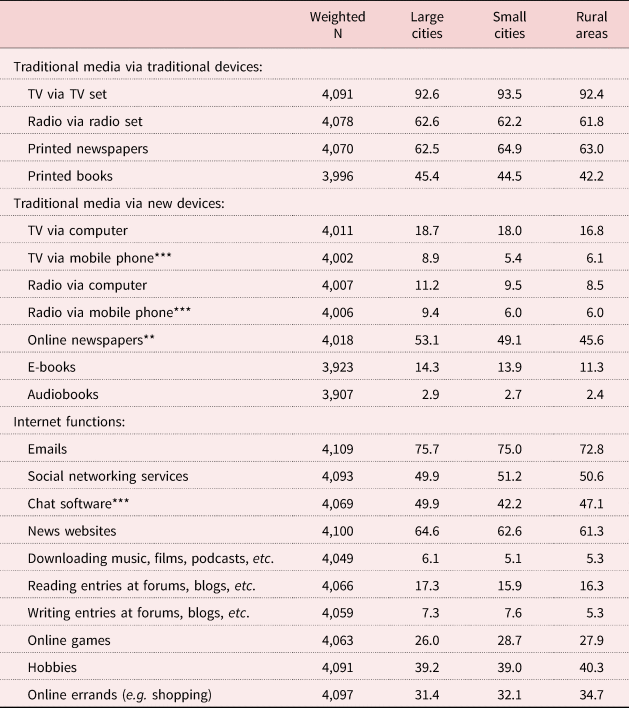
Examination of the percentages of users of the various media revealed few differences among individuals residing in various localities (Table 1). Significant differences were found primarily regarding traditional media uses via new devices. Online newspaper readers (χ2(2) = 12.31, p < 0.01) were more likely to reside in large cities than in small cities or rural localities and were more highly represented among residents of small cities than of rural areas. To a much smaller extent, residents of large cities were also more likely to watch TV or listen to the radio via mobile phone (χ2(2) = 16.46, p < 0.001 and χ2(2) = 15.63, p < 0.001, respectively) than their peers from other types of localities. The percentage of people who used TV via mobile phone in small cities was somewhat lower than in rural localities, while the proportion of those who listen to the radio via mobile phone was similar for these two types of localities. Significant differences were also found for one internet use: residents of large cities were more likely to use internet chat software (χ2(2) = 19.49, p < 0.001), followed by residents of rural areas. No differences were found in uses of traditional media via traditional devices, that appeared to be the most common uses.
Rates of media users by locality

Notes: Data represent percentage of users of total N in each locality category. Actual N = 7,927. TV: television.
Significance levels: Media demonstrating significant differences by locality according to chi-square tests are marked: ** p < 0.01, *** p < 0.001.
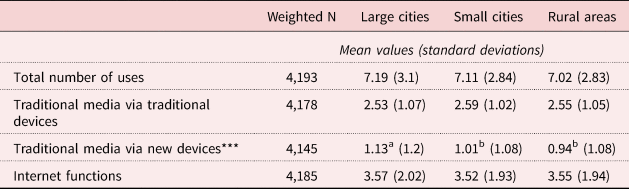
After combining the various media uses according to their type, analysis revealed only one significant difference among the groups (Table 2). On average, residents of large cities made more use of traditional media via new devices than residents of both small cities and rural areas (F(2, 4,142) = 8.65, p < 0.001). No significant difference was found between the latter two groups.
Means of the number of media uses by type of locality

Note: Actual N = 7,927.
Significance levels: Media demonstrating significant differences by locality according to one-way ANOVA and post hoc tests are marked: *** p < 0.001. a,bSignificant differences: mean marked ‘a’ is significantly higher than mean marked ‘b’.
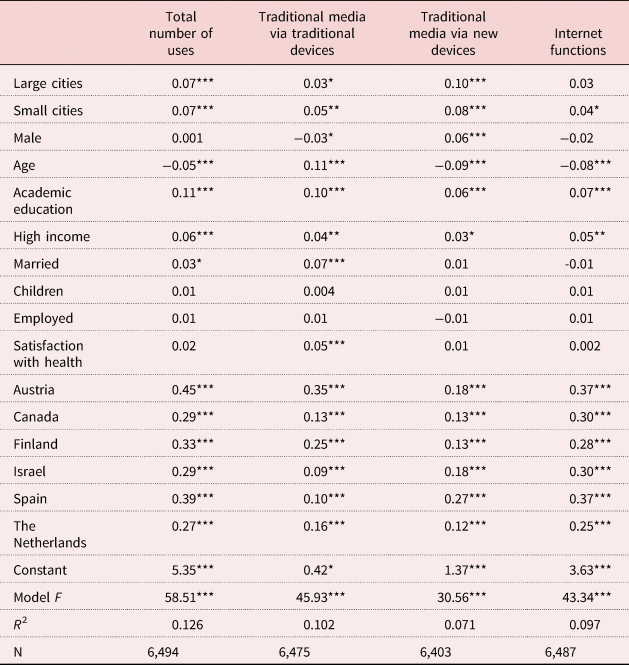
As the observed difference (and the lack of additional differences) could result from differences in background variables rather than residence locality, multivariate analysis was applied (Table 3). Controlling for background variables indeed suggested that locality represented a significant factor in all media types as well in the total number of uses. People residing in large cities were found to use more traditional media via traditional devices (b = 0.07, p < 0.05), more traditional media via new devices (b = 0.24, p < 0.001) and more media in general (b = 0.41, p < 0.001) than residents of rural areas. Similarly, residents of small cities reported more uses in all three types of media and consequently greater total use (b = 0.41, p < 0.001) than their peers in rural areas.
Standardised coefficients of the linear regression analysis predicting total number of media used

Note: Reference categories: rural areas, female, non-academic, average and low income, non-married, without children, not employed (including retired), Romania.
Significance levels: * p < 0.05, ** p < 0.01, *** p < 0.001.
Among the background variables, age, education and income were the most consistent predictors of media use. Older individuals made more use of traditional media via traditional devices (b = 0.02, p < 0.001) and less use of traditional media via new devices (b = −0.02, p < 0.001) and internet functions (b = −0.03, p < 0.001). Accordingly, their media repertoire was smaller than that of younger individuals (b = −0.02, p < 0.001). Persons with academic education and those with income higher than their respective national averages made more use of all three media types and consequently had greater media repertoires than those with non-academic education and below-average income, respectively.
Other variables were found to associate less consistently with media use. Men reported making less use of traditional media via traditional devices (b = −0.06, p < 0.05) and more through new devices (b = 0.13, p < 0.001) than women. Married individuals reported using more traditional media via traditional devices than non-married ones (b = 0.15, p < 0.001) and had greater total media repertoires (b = 0.16, p < 0.05). Ultimately, greater satisfaction with health was associated with more uses of traditional media via traditional devices (b = 0.02, p < 0.001).
Finally, significant differences were found among countries: in all models, residents of Romania were found to have fewer uses than residents of other countries. It should be noted, however, that the variance explained by the models was low, the highest among them explaining the total number of media uses (12.6%). Consequently, there are probably other factors that were not examined in the present study that may explain the older people's media repertoire better.
Locality of residence and media use intensity
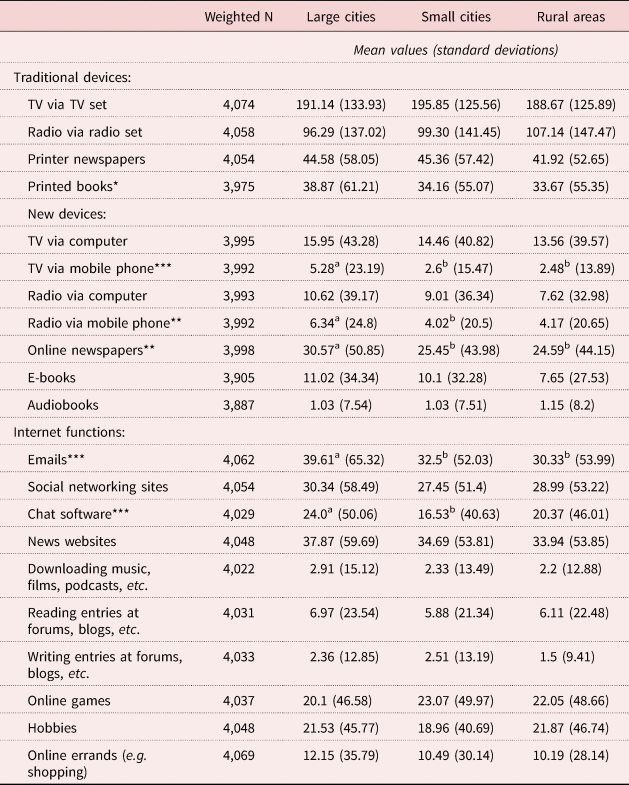
Differences in variety of media uses among people from various localities do not necessarily reflect differences in intensity of use. To explore differences in duration of media use by locality, one-way ANOVA tests were performed among users only (those who reported at least one minute of media use) (Table 4). Contrary to the general use rate assessment, a significant difference was found among the localities in duration of only one traditional media use via traditional devices – printed books (F(2, 3972) = 3.27, p < 0.05). As to traditional media use via new devices, significant differences were found in the duration of watching of TV via mobile phone (F(2, 3,988) = 10.07, p < 0.001), listening to the radio via mobile phone (F(2, 3,989) = 4.83, p < 0.01) and reading online newspapers (F(2, 3,994) = 6.19, p < 0.01). Significant differences in duration of internet uses were discerned regarding email (F(2, 4,058) = 8.89, p < 0.001) and chat software (F(2, 4,025) = 10.87, p < 0.001). Residents of large cities reported spending significantly more time reading and writing emails than they did for each of the other two categories (with no difference among the latter). Furthermore, they reported spending significantly more time chatting online than residents of other types of localities. Similar to findings on rate of chat users by locality, respondents residing in rural areas spent more time using chat software than residents of small urban areas. Note that traditional media uses, irrespective of device, had the longest reported use durations.
Means of durations of media use by locality

Note: Actual N = 7,927.
Significance levels: Media demonstrating significant differences by locality according to one-way ANOVA and post hoc tests are marked: * p < 0.05, ** p < 0.01, *** p < 0.001. a,bSignificant differences: mean marked ‘a’ is significantly higher than mean marked ‘b’.
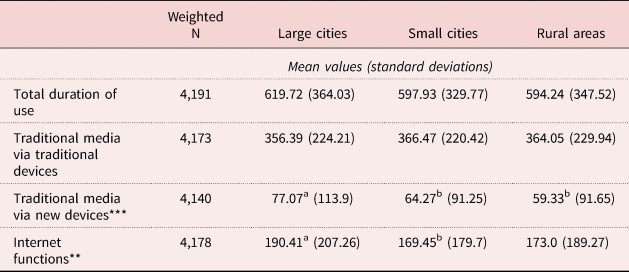
To maximise the number of valid cases, analysis of the combined use durations of each media type referred to the entire sample (Table 5). Non-users of a given medium were regarded as reporting zero minutes of use. Analysis identified significant differences among localities in traditional media use through new devices (F(2, 4,137) = 10.41, p < 0.001) and internet use (F(2, 4,175) = 5.23, p < 0.01). Residents of large cities reported spending significantly more time using traditional media via new devices than did those of each of the two remaining groups. They also reported spending significantly more time using the internet than their counterparts from small cities.
Means of total durations of media use by locality

Note: Actual N = 7,927.
Significance levels: Media demonstrating significant differences by locality according to one-way ANOVA and post hoc tests are marked: ** p < 0.01, *** p < 0.001. a a,bSignificant differences: mean marked ‘a’ is significantly higher than mean marked ‘b’.
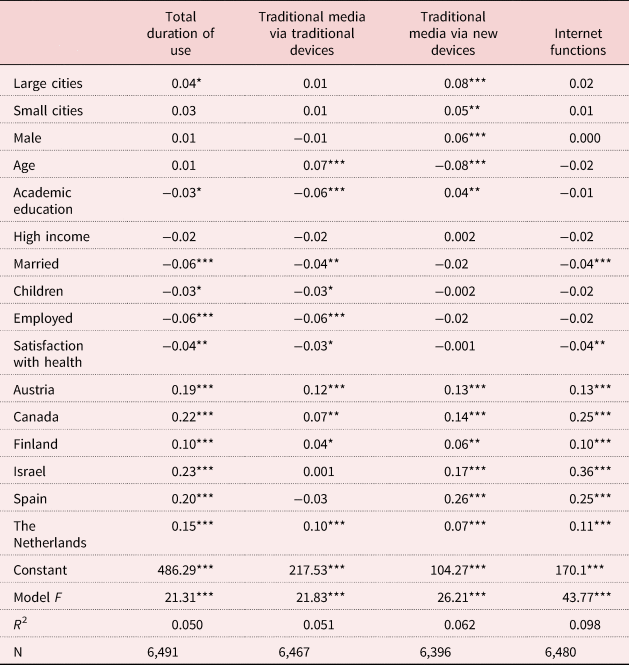
Finally, a series of regression analyses predicting the total duration of various media uses was performed to control for background variables (Table 6). Results indicated that residential locality was significant regarding duration of traditional media use via new devices and total use duration. Urban residence, in both large (b = 16.33, p < 0.001) and small (b = 10.47, p < 0.01) cities, was associated with longer duration of traditional media use via new devices than among residents of rural areas. Furthermore, residents of large cities displayed a significantly longer total media use than did rural dwellers (b = 27.62, p < 0.05).
Standardised coefficients of the linear regression analysis predicting durations of media use by type

Note: Reference categories: rural areas, female, non-academic, income average and lower, non-married, without children, not employed (including retired), Romania.
Significance levels: * p < 0.05, ** p < 0.01, *** p < 0.001.
The background variables most consistently associating with media use durations were education, family status and satisfaction with health. People with academic education reported using traditional media via traditional devices for a shorter time (b = −26.97, p < 0.001) but via new devices for a longer time (b = 8.84, p < 0.01) than individuals with non-academic education. Nevertheless, their total media use was briefer than that of their non-academic counterparts (b = −19.1, p < 0.05). Married individuals used traditional media via traditional devices (b = −20.29, p < 0.01), internet functions (b = −16.43, p < 0.001) and media in general (b = −39.02, p < 0.001) for a shorter duration than non-married persons. Finally, satisfaction with health was negatively associated with duration of traditional media use via traditional devices (b = −3.05, p < 0.05), internet use (b = −3.33, p < 0.01) and total media use (b = −6.28, p < 0.01).
Other variables displayed fewer associations. Older individuals reported longer use of traditional media via traditional devices (b = 2.58, p < 0.001) but traditional media via new devices for a shorter (b = −1.26, p < 0.001) duration than younger ones. Employed persons used traditional media via traditional devices (b = −37.8, p < 0.001) and total media use (b = −49.73, p < 0.001) for less time than their non-employed counterparts. Respondents who had children used traditional media via traditional devices (b = −12.3, p < 0.05) and media in general (b = −18.58, p < 0.05) for less time than respondents without children. Finally, men used traditional media via new devices for longer durations than women (b = 11.2, p < 0.001).
One principal tendency was discovered concerning the effect of countries. Except for traditional media use via traditional devices, residents of all countries in the sample had longer duration of media consumption than residents of Romania. Only residents of Israel and Spain did not differ from Romanians regarding the duration of traditional media use via traditional devices. Again, the variance explained by all four models was rather low, with the highest among them to be found in the model explaining internet use (9.8%).
Discussion
The purpose of this study was to understand the role played by locality in media use inequalities among older internet users. The study explored differences among types and sizes of locality with regard to two chief characteristics of media use – variety and intensity – and three types of media use: traditional media use via traditional devices, traditional media use via new devices and internet functions. As residents of large urban localities surpass their counterparts from smaller localities in both respects (Warburton et al., Reference Warburton, Cowan and Bathgate2013) because of better ICT infrastructure and more advanced digital skills (Vicente and López, Reference Vicente and López2011), they were expected to exhibit more media displacement.
The findings of the study mostly supported this hypothesis. Residents of large cities differed from their counterparts in smaller localities regarding both variety and intensity of use. Furthermore, the differences were reflected mostly in use of traditional media via new devices. Urban dwellers clearly demonstrated the anticipated higher level of media displacement. Their greater use of traditional media via new devices, however, did not appear to replace their use of traditional media via traditional means. This suggests that media displacement was functional rather than symmetrical: the new formats did not replace the old ones but complemented them (Newell et al., Reference Newell, Pilotta and Thomas2008).
Additional differences between residents of big cities and other study participants were found concerning use of various internet functions, possibly reflecting better digital skills, as does the greater use of traditional media via new devices as well (Yu et al., Reference Yu, Ellison, McCammon and Langa2016). Overall, these findings corresponded with previous research (e.g. Nishijima et al., Reference Nishijima, Ivanauskas and Sarti2017) and supported the arguments of Warburton et al. (Reference Warburton, Cowan, Winterton and Hodgkins2014) regarding the greater risk of digital exclusion in rural localities. Analysis also pointed at differences between residents of small cities and rural areas. After controlling for background variables, these differences were reflected in variety of use for all three media types and in intensity of traditional media use via new devices. Residents of small cities are thus situated between those of the other two types of localities with regard to accessibility and/or digital skills. These findings suggest that older people residing in small rural areas are at greater risk for digital exclusion than those living in small urban localities, confirming the need to account for both type and size in spatial difference studies.
Locality was generally a better predictor of variety than of use intensity, suggesting that when one is already using a new device and/or application, the locality effect somewhat decreases – a suggestion that actually highlights the need to address first-level digital divides among older adults. This argument is supported by the findings revealed in explorations of specific uses: spatial differences in variety were found for mobile TV, mobile radio, online newspapers and chats, whereas differences in intensity were evident regarding these uses, as well as use of printed books, email and online chatting. The more advanced digital skills manifested by residents of large cities may improve adjustment of their media use to their instrumental, informational and socio-psychological needs (Winstead et al., Reference Winstead, Anderson, Yost, Cotten, Warr and Berkowsky2013).
Overall, the findings support the stratification perspective, according to which individuals from more-privileged backgrounds – residents of large urban localities in this case, who have greater access to ICT (Stern, Reference Stern2008) and more advanced digital skills (Schradie, Reference Schradie2011; Polat, Reference Polat2012; Van Deursen and Van Dijk, Reference Van Deursen and Van Dijk2014) – are more skilled in using media, especially via new devices. This emphasises the rural disadvantage with regard to media use and serves as a call for policy-maker action. There is much less support for the diversification perspective. Older residents of rural areas are more likely than those of small cities to use chat software and dedicate more time to its use, possibly indicating some effort at using media to overcome spatial issues (Francis et al., Reference Francis, Kadylak, Makki, Rikard and Cotten2018). This exception, however, was reflected in a very uncommon media use.
Exploration of the most common media uses among study participants in terms of variety and intensity revealed that they were still heavy users of old media, as found in previous research on older audiences (Depp et al., Reference Depp, Schkade, Thompson and Jeste2010; Nossek et al., Reference Nossek, Adoni and Nimrod2015; Nimrod, Reference Nimrod2017). There was, however, great variance in media use according to background characteristics, generally supporting previous research indicating that media displacement among older adults is associated with gender, age, family status, education, income and country of residence (Nimrod, Reference Nimrod2019). Specifically, men were found more likely than women to use traditional media via new devices and to spend longer periods doing so, while older participants made more use of traditional media via traditional devices and less use of new devices and the internet than younger adults. Family status seemed to have a mixed impact: whereas being married was associated with using more traditional media via traditional devices and greater total media repertoires, having children was associated with less use of traditional media via traditional devices and media use duration in general. This may imply that whereas couples use media as shared leisure activity, interactions with family members (and possibly watching over grandchildren) reduce time spent on media use. Individuals with academic education reported greater use diversity, especially via new devices, corroborating our argument about digital skills. Furthermore, as in previous research (Van Deursen and Van Dijk, Reference Van Deursen and Van Dijk2014), they reported less use of traditional media and less intense use of all media. Income too was positively associated with the variety outcomes, while employment status correlated negatively with use duration, probably because employed individuals have less free time than the non-employed.
The negative associations between satisfaction with health and use duration may be explained by the tendency of older individuals with physical limitations to spend less time in active leisure such as sports than their healthy peers (Jenkin et al., Reference Jenkin, Eime, Westerbeek, O'Sullivan and Van Uffelen2017). As for the cross-national differences, the findings resemble previous research (Nimrod, Reference Nimrod2019) demonstrating high displacement levels in Spain and Israel, and support the notion of differences in access and proficiency with ICT (Stern, Reference Stern2010). Overall, however, they suggest that people in different socio-cultural contexts may have different psycho-social needs and adjust their media use accordingly.
Limitations and future research
The findings of the present study provide strong evidence of spatial differences in media use among older audiences. Nevertheless, the study has several limitations that should be acknowledged, including the focus on older internet users and the consequent avoidance of studying non-users. Furthermore, the sample was inevitably biased towards the more digitally literate seniors who can answer online surveys and the relatively low explained variance suggests that certain variables that were not examined in this study might provide a better explanation of variety and intensity of media use. In addition, residence size was measured according to one's perception of his or her place of residence rather than by exact size of the population. Finally, we recall that self-reported media use may be inaccurate. Future studies should thus employ more accurate measures of population size and media use, relate to media platforms and types of content consumed, as well as additional background characteristics (e.g. ethnicity, religiosity), lifestyle factors (e.g. social network composition and size, leisure activities, reasons for residence in a particular locality), as well as attitudes, values and beliefs (also regarding the media), that may better explain the variance in outcomes. Studies should also explore special differences in the benefits gained from each media use, testing policies and intervention techniques and determining their efficacy in reducing specific inequalities among the older generation.
Data
The data of this ongoing project are not yet available to the public.
Author contributions
DR performed the statistical analyses and wrote the entire manuscript. GN planned the study, co-ordinated the data collection, revised the manuscript and made necessary corrections.
Financial support
This work was supported by Ageing + Communication + Technologies (ACT), a research project funded by the Social Sciences and Humanities Research Council of Canada and housed at Concordia University in Montreal, Canada.
Conflict of interest
The authors declare no conflicts of interest.
Ethical standards
All partners involved secured ethics approval from their Institutional Review Boards (IRBs), except for Austria and the Netherlands, where there were no IRBs at the institutions involved. In Finland, in accordance with the standards of the Finnish National Board on Research Integrity, ethical review was not required. In the Netherlands, the head of department gave his ethical approval. Informed consent was not obtained from study participants as it is not required in anonymous surveys.