


1. Introduction
Consider the following versions of Judith Jarvis Thomson's (Reference Thomson, Humber and Almeder1976) classic trolley cases.
Switch. An empty trolley heads towards five innocents. A bystander (henceforth, ‘the agent’) has exactly two options.
1. Let the five innocents be killed by the trolley.
2. Throw a switch, sending the trolley onto a sidetrack where it will kill three other innocents but the original five will be saved.Footnote 1

Push. An empty trolley heads towards five innocents. A bystander has exactly two options.
1. Let the five innocents be killed by the trolley.
2. Push another innocent wearing a heavy backpack onto the tracks where he will be hit and killed by the trolley but the trolley will thereby be stopped and the five will be saved.

The ‘standard’ judgments about these cases are that it is permissible to switch in Switch, but not permissible to push in Push.Footnote 2 The trolley problem, as Thomson (Reference Thomson2008: 361) uses the phrase,Footnote 3 is to explain how both of these judgments can be correct.
This article is not about the trolley problem. Rather, it is about what happens when we combine Switch and Push to get a hybrid case:
Switch-or-Push. An empty trolley heads towards five innocents. A bystander has exactly three options.
1. Let the five innocents be killed by the trolley.
2. Throw a switch, sending the trolley onto a sidetrack where it will kill three other innocents but the original five will be saved.
3. Push a different innocent wearing a heavy backpack onto the tracks where he will be hit and killed by the trolley but the trolley will thereby be stopped and the original five will be saved.

Nearly thirty years ago, Peter Unger (Reference Unger1992) introduced the world to a similar hybrid trolley case.Footnote 4 The world was not impressed. With the exception of Frances Kamm (Reference Kamm1998) and (Reference Kamm2007), there are no published discussions of Unger's case.Footnote 5 Perhaps this is because Unger's case is comically complicated, involving five options rather than three,Footnote 6 three trolleys rather than one,Footnote 7 and a person on electric, remote-controlled roller skates rather than a person standing near the tracks who might be pushed. Or perhaps Unger's case was largely ignored because the particular use that Unger made of it was not very compelling.Footnote 8
In any event, the near total absence of any discussion of hybrid trolley cases – that is, cases that involve both ‘switch-like’ options and ‘push-like’ options – is unfortunate. My primary aim in this article is to (re)introduce philosophers to hybrid trolley cases, and to get them to see that such cases are worth discussing in their own right. As we'll see, interesting considerations arise when agents are presented with both switch-like and push-like options, and any moral theory that is silent about such considerations is incomplete. My secondary aim in this article is to argue that, somewhat surprisingly, it is permissible to push in Switch-or-Push.
Some will think this surprising conclusion cannot possibly be right. As long as we grant that it is wrong to push in Push – and I do so grant – then it may seem that it simply must also be wrong to push in Switch-or-Push. To think otherwise would seem to violate a highly plausible structural principle of morality. The principle says, roughly, that we cannot transform the impermissible into the permissible by simply adding more options. Let's give this principle a name and state it a bit more precisely.
Expansion Consistency. For any action A that is a member of a set of options S1, which is a subset of a set of options S2:
-
If A is impermissible when the available options are exactly those in S1, then, all else being equal, A is also impermissible when the available options are exactly those in S2.
-
For example, if A is impermissible when the available options are exactly {A,B}, then A is also impermissible when the available options are exactly {A,B,C}.
As far as I know, this principle has not been explicitly discussed in the ethics literature.Footnote 9 It is, however, similar to a principle from decision theory that Amartya Sen (Reference Sen1993) famously called ‘property alpha’, and which is sometimes described as an ‘expansion consistency’ principle. It is, moreover, a plausible moral principle, and it seems that people implicitly reason in accordance with it.Footnote 10
I will not deny Expansion Consistency here. I will, however, argue that it does not apply to our cases. I'll show that once an agent decides to switch in Switch-or-Push – something she may permissibly decide to do – she is now a threat to the three. She may then, I argue, redirect this threat away from the three and onto the one – that is, she may cause herself to push instead of switch. Such an agent pushes, not as a means to saving the five, but as a result of redirecting that which threatens three (herself) onto one. Thus, Switch-or-Push is no mere expansion of Push: the addition of the option to switch changes what it is to push, and hence the options in Switch-or-Push are not actually a superset of the options in Push.Footnote 11
The upshot of this article is that, even for non-consequentialists, it is a mistake to think that ‘push-like’ options are always impermissible: roughly,Footnote 12 they become permissible when we also have ‘switch-like’ options with worse consequences.
2. Cases vs principles
Before I begin, I must issue a disclaimer. One way to argue for the conclusion that it is permissible to push in Switch-or-Push would be by appeal to some moral principle. Ultimately, I think that such principles offer us additional insight into why it is permissible to push in Switch-or-Push. However, all such principles face serious objections; none of them has things exactly right. Hence, whenever one appeals to such a principle, there is no guarantee that one isn't appealing to it in one of the very places it gets things wrong.
My argument will thus proceed, not from principle, but from a series of cases. Structurally, I'll be assuming that it's permissible to do in A in B, and then I'll be arguing that if it's permissible to do A in B, then it is permissible to C in D, and if it's permissible to do C in D, then it's permissible to do E in F, and so on. Ultimately, we'll reach the conclusion that it is permissible to push in Switch-or-Push. If these conditionals – and my claim about what it's permissible to do in the first case – are true, then the conclusion follows.
3. The argument
I assume, without further comment, that it is permissible to switch in the original Switch case. Now consider the following case:
Two Trolleys. Trolley A heads towards no one. Trolley B is on a course to collide with trolley A. A bystander has exactly two options.
1. Let trolley B collide with trolley A, redirecting trolley A onto a sidetrack where it will three innocents.
2. Throw a switch, sending trolley B onto a (different) sidetrack where it will push a different innocent into the path of trolley A. This innocent will be killed when hit by trolley A, but trolley A will thereby be stopped and no one else will be killed.

Does Two Trolleys differ from Switch in a morally significant way? It is true that in Two Trolleys, the trolley that threatens three (trolley B) will kill the three by redirecting another trolley (trolley A) onto them. This is not how things work in the original Switch case. Still, this difference hardly seems to be a morally relevant difference. It is also true that in Two Trolleys, the threat (trolley B) will, if redirected, kill the one by pushing him into the path of another trolley, rather than, as in Switch, running directly over him. But again, that difference between Two Trolleys and Switch hardly seems like a morally relevant difference.
In both Two Trolleys and Switch, there is a trolley that threatens three that might be redirected so that it threatens one – the specific differences between Switch and Two Trolleys with respect to just how the trolley would kill the three (if one does nothing) or the one (if one switches) would seem to not make a moral difference to whether it is permissible to switch. Hence, since it is permissible to switch in Switch, it is also permissible to switch in Two Trolleys. I suspect this conclusion accords with most readers’ intuitions about Two Trolleys.
Now consider a slightly different case. This slightly different case will differ from Two Trolleys only in the presence of five additional innocents farther down trolley A's track. Given the set-up, these five are at no risk of being harmed no matter what the agent does. Let's call this
Two Trolleys Plus Five Innocents. Trolley A heads towards five innocents. Trolley B is on a course to collide with trolley A. A bystander has exactly two options, which are the same two options the bystander has in Two Trolleys.
1. Let trolley B collide with trolley A, redirecting trolley A onto a sidetrack where it will kill three innocents.
2. Throw a switch, sending trolley B onto a sidetrack where it will push a different innocent into the path of trolley A. This innocent will be killed when hit by trolley A, but trolley A will thereby be stopped and no one else will be killed.
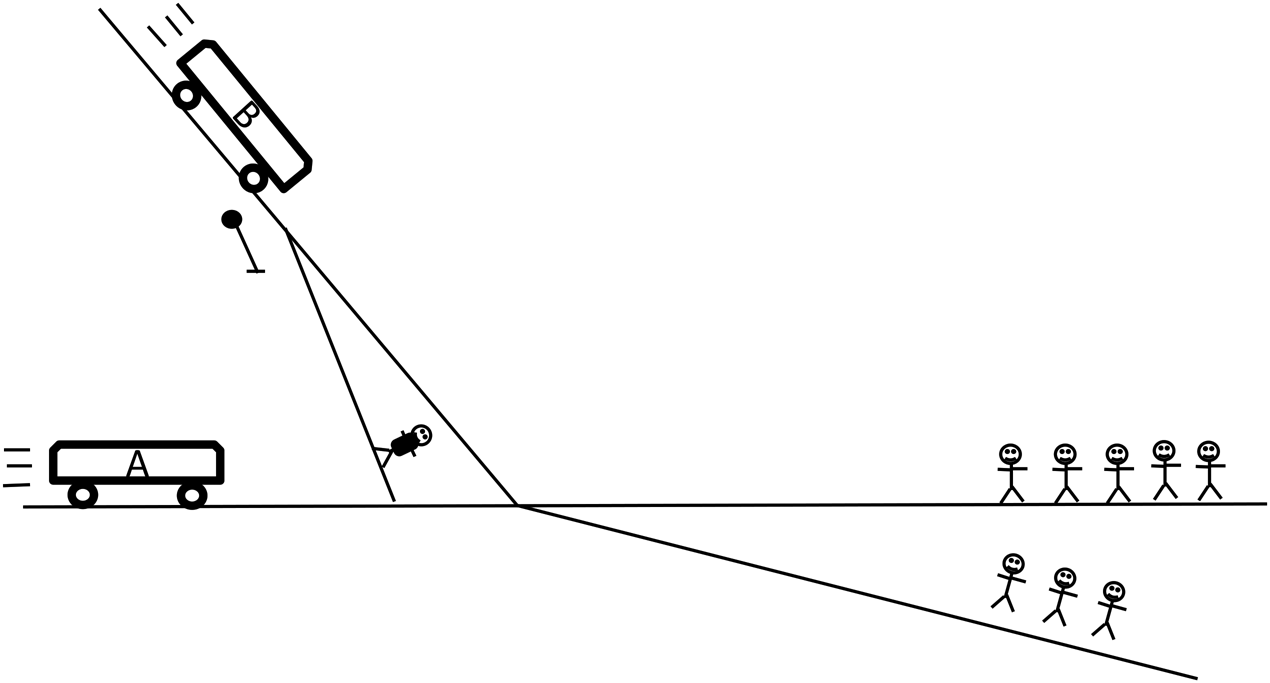
Two Trolleys Plus Five Innocents differs from Two Trolleys only in the presence of the five innocents. These five innocents are on the track along which trolley A travels, but are nonetheless in no danger. The agent has only two options: do nothing or throw the switch. If the agent does nothing, trolley A will be redirected by trolley B, and the five will not be harmed. If the agent throws the switch, trolley B will push another person into the path of trolley A, trolley A will be stopped short of the five, and again the five will not be harmed. Either way, the five will not be harmed.
Morally speaking, the agent in Two Trolleys Plus Five Innocents faces the same decision as the agent in Two Trolleys: either let trolley B collide with trolley A, sending trolley A onto three innocents, or throw the switch, sending trolley B onto the sidetrack where it will push a different innocent into the path of trolley A. Hence, since it is permissible for the agent to switch in Two Trolleys, it is also permissible for the agent to switch in Two Trolleys Plus Five Innocents. Again, I suspect that this conclusion accords with most readers’ intuitions.
First Kammian Interlude: Two Trolleys Plus Five Innocents vs Loop
Before moving on, it's worth thinking a bit more about Two Trolleys Plus Five Innocents. When viewed in a certain way, Two Trolleys Plus Five Innocents may start to seem a lot like Push: in both cases, there is the possibility of taking an action the result of which is one innocent ending up in the path of a trolley, stopping the trolley from hitting five other innocents. How, then, can it be permissible to switch in Two Trolleys Plus Five Innocents when it is not permissible to push in Push?
To approach this question, it will be useful to think about Frances Kamm's account of the famous Loop case from Thomson (Reference Thomson1985).
Loop. A trolley heads towards five innocents. A bystander has exactly two options.
1. Do nothing, allowing the trolley to hit and kill the five.
2. Throw a switch, sending the trolley onto a sidetrack where it will hit and kill a single innocent wearing a heavy backpack, thereby coming to a stop before it travels back onto the main track and kills the five.

Like others, Kamm (Reference Kamm2000) assumes that it is permissible to switch in Loop. She then gives an intriguing account of why. While I have reservations about Kamm's account of Loop – and, indeed, reservations about the assumption that it is permissible to switch in Loop – what Kamm has to say about Loop does, I think, help to illuminate why it is permissible to switch in Two Trolleys Plus Five Innocents.
At the heart of Kamm's account of Loop is the distinction between doing something in order to bring about a certain effect versus doing something because it will bring about a certain effect. Kamm claims that the agent who switches in Loop in order to save the five does not switch in order to get the trolley to hit the one, but merely because the trolley will hit the one. Allow me to explain.
On Kamm's view, the five in Loop face both a particular threat and a more general threat. The more general threat is that of being hit by the trolley. Let's call this ‘the trolley threat’. The particular threat is that of being hit by the trolley coming from the main track. Let's call this ‘the main-track-trolley threat’. The agent, Kamm claims, has not just reason to save the five from the trolley threat, but also has reason to save the five from the main-track-trolley threat. Moreover, the agent can, Kamm observes, save the five from the main-track-trolley threat, by simply switching the trolley onto the sidetrack. Now, there would be no use in saving the five from the main-track-trolley threat if they were only to die from the trolley threat anyway. However, the agent can see that, if she does save the five from the main-track-trolley threat – that is, if she switches – then the trolley will hit the one, and so come to a stop, and so the five will be saved from the trolley threat as well. Therefore, Kamm claims, the agent who switches in Loop for the sake of saving the five need not do so in order to get the trolley to hit the one, but merely because the trolley will hit the one.
Michael Otsuka (Reference Otsuka2008) offers what is, in my view, a persuasive criticism of Kamm's account of loop.Footnote 13 Otsuka does not deny the moral significance of the ‘because’ vs ‘in order to’ distinction. Rather, he denies Kamm's application of that distinction to Loop – specifically, he denies Kamm's claim that the agent who switches in Loop for the sake of saving the five does not do so in order to hit the one.
I would maintain that in [the] Loop Case, it is a mistake for Kamm to deny that you divert the trolley onto another track in order to make it come to a halt by hitting the one. This is a mistake because, when we abstract from the fact that it would come to a halt by hitting the one, you do not eliminate or lessen the threat that the trolley poses to the five by sending it down a looping track. The trolley poses just as grave a threat to the five whether it is coming towards them via the main track or via a looping track. Hence, you have no reason to divert the trolley down a particular looping track except in order to eliminate the threat it poses to the five by making it come to a halt by hitting the one. Its diversion down a looping track is valuable merely as a means to make it come to such a halt. (Otsuka Reference Otsuka2008: 100, emphasis added)
Crucially, Otsuka does not deny the moral importance of Kamm's ‘because’ vs ‘in order to’ distinction. To illustrate its importance, Otsuka has us consider a case he calls ‘Six Behind One’. Merely for the sake of keeping my numbers straight, I will call this case
Six Behind Three. An empty trolley heads towards five innocents. A bystander has exactly two options.
1. Let the five innocents be killed by the trolley.
2. Throw a switch, sending the trolley onto a sidetrack where it will kill three other innocents and thereby come to a stop before hitting six other innocents who are on the sidetrack behind these three.

Intuitively, it is permissible to switch in Six Behind Three. Otsuka persuasively argues that Kamm's because/in order to distinction helps us see why.
Unlike [in Loop], and as in [Switch], here the diversion of the trolley completely eliminates the threat of the trolley to the five on the main track, where this elimination is irrespective of the fact that the trolley will hit the [three]. The hitting of the [three] is therefore in no way a means to saving the five. But unlike [Switch], and like [Loop], the fact that the trolley will hit the [three] is a necessary condition of action – you would not have diverted the trolley if the [three] had not been there to stop it and the trolley would have carried on and hit and killed the six on this sidetrack.
If you divert the trolley onto the sidetrack in [Six Behind Three], must you do so in order to hit the [three]? Hitting the [three] could not serve your goal of saving the five on the main track. Rather, it could serve only the goal of preventing the six behind [the three] from being killed. Therefore, to say that you divert the trolley in order to hit the [three] would be tantamount to saying that you divert the trolley in service of your goal of preventing the bad consequences of this diversion that would have ensued if the [three] had not been there to shield the six from being killed. That would be an odd thing to say, as one does not do something in order to mitigate the bad consequences of the doing of that very thing. So you do not divert the trolley in order to hit the [three] in [Six Behind Three]. (Otsuka Reference Otsuka2008: 101, first emphasis in original, second emphasis added)
What does all of this have to do with Two Trolleys Plus Five Innocents? Exactly this: Otsuka's Kammian reasoning regarding Six Behind Three applies mutatis mutandis to Two Trolleys Plus Five Innocents. Here is that reasoning, mutatis mutandized:
In Two Trolleys Plus Five Innocents, the three on the sidetrack are under threat: if the agent does nothing, trolley B is going to knock trolley A onto the sidetrack where it will kill the three. Diverting trolley B onto its sidetrack completely removes this threat to the three. The pushing of the one into the path of trolley A is therefore in no way a means to saving the three. But the fact that the trolley will hit the one is a necessary condition of action – the agent who switches in order to save the three would not have switched if the one had not been there to be pushed and thus to shield the five.
Does such an agent switch in order to get the one hit by trolley A? Getting the one hit does not serve the goal of saving the three. It could serve only the goal of preventing the five on trolley A's main track from being killed. Therefore, to say that the agent switches in order to get the one hit by trolley A would be to say that the agent switches in service of their goal of preventing the bad consequences of this switching that would have ensued if the one had not been there to shield the five from being killed. But that would be an odd thing to say, as one does not do something in order to mitigate the bad consequences of the doing of that very thing. So the agent who switches in order to save the three does not switch in order to get the one hit.
This conclusion distinguishes Two Trolleys Plus Five Innocents from Push, since the agent who pushes in Push in order to save the five does so in order to get the one hit by the trolley.
I'll close this interlude by reemphasizing that I offer this Kammian analysis only to provide a bit of insight into how it could be permissible to switch in Two Trolleys Plus Five Innocents despite the fact that it is not permissible to push in Push. However, this is not my argument for the permissibility of switching in Two Trolleys Plus Five Innocents. In accordance with the disclaimer given in section 2, my argument for the permissibility of switching rests on the following conditional: if it is permissible to switch in Two Trolleys, then it is permissible to switch in Two Trolleys Plus Five Innocents. The argument for this conditional rests on the simple observation that the five innocents added to Two Trolleys to make it Two Trolleys Plus Five Innocents make no moral difference to the case, since those innocents are in no danger no matter which option the agent chooses.
End of First Kammian Interlude
Henceforth, I'll take it for granted that the agent may switch in Two Trolleys Plus Five Innocents. Now let's consider a case exactly like Two Trolleys Plus Five Innocents, except that the agent has one more option (option 3). The case is a bit complicated, but it will appear less so if one keeps in mind that it is just the previous case plus a bit of extra track and an accompanying option. I promise that this is as complicated as the cases will get.
Two Trolleys Three Options. Trolley A heads towards five innocents. Trolley B is on a course to collide with trolley A. A bystander has exactly three options.
1. Let trolley B collide with trolley A, redirecting trolley A onto a sidetrack where it will kill three innocents.
2. Throw a switch, sending trolley B onto a sidetrack where it will push a different innocent into the path of trolley A. This innocent will be killed when hit by trolley A, but trolley A will thereby be stopped and no one else will be killed.
3. Throw a different switch, sending trolley B onto a different sidetrack where it will come to a rest without hitting anyone. Trolley A will continue along its path and kill the five innocents.

To take option (3) would be to intervene in such a way that more, not fewer, people are killed. More precisely, to take option (3) would be to save three at the expense of removing that which protects five. I take it that, all else being equal, it is not permissible to remove that which protects five for the sake of saving three. So option (3) is not permissible.
With the new option – option (3) – off the table, Two Trolleys Three Options collapses back to Two Trolleys Plus Five Innocents. Hence, since it is permissible to switch the trolley onto one in Two Trolleys Plus Five Innocents, it is also permissible to switch the trolley onto one – option (2) – in Two Trolleys Three Options.
Let us now consider one last case. This case is just like Two Trolleys Three Options except for the following: where Two Trolleys Three Options has a redirectable trolley that is on a path towards redirecting another trolley, this new case has a redirectable person (Jacob) who is on a ‘path’ towards redirecting a trolley. The person who may do the redirecting is, however, the very person who may be redirected – that is, Jacob may redirect himself.
Jacob's Dilemma. Trolley A heads towards five innocents. Jacob (wearing a hat below) already intends to throw a switch that will redirect trolley A onto a sidetrack where it will, instead of killing the five, kill three other innocents. Jacob now has exactly three options.
1. Go through with his intention to throw the switch, sending trolley A onto the sidetrack where it will kill the three.
2. Instead of throwing the switch to redirect trolley A, push a single innocent into the path of trolley A. This innocent will be killed when hit by trolley A, but trolley A will thereby be stopped and no one else will be killed.
3. Instead of throwing the switch to redirect trolley A, do nothing, thus allowing trolley A to continue along its path and kill the five innocents.

If it is permissible for the agent to choose option (2) in Two Trolleys Three Options, then it is permissible, I contend, for Jacob to choose option (2) in Jacob's Dilemma. Let's consider the similarities between the cases.
First Similarity. In Two Trolleys Three Options, trolley B, heading along its main track, threatens the three. In Jacob's Dilemma, Jacob, intending to switch, threatens the three.
Second Similarity. In Two Trolleys Three Options, the threat to the three (trolley B) can be redirected so that it harms no one [option (3)]. In Jacob's Dilemma, the threat to the three (Jacob) can be redirected so that it harms no one [option (3)].
Third Similarity. In Two Trolleys Three Options, that which threatens the three (trolley B) is also that which protects the five. In Jacob's Dilemma, that which threatens the three (Jacob) is also that which protects the five.
Because it is impermissible to remove that which protects five merely to save three, the similarities imply that option (3) is off the table in Jacob's Dilemma, just as it is off the table in Two Trolleys Three Options. This gives us the
Fourth Similarity. In Two Trolleys Three Options, the agent is left with two options: either (1) let trolley B collide with trolley A, sending trolley A onto a sidetrack where it will kill three innocents, or (2) throw a switch, sending trolley B onto a sidetrack where it will push a different innocent into the path of trolley A. Here the agent faces a choice between letting that which threatens three (trolley B) kill three, on the one hand, and redirecting that which threatens three so that it kills one, on the other. Similarly, in Jacob's Dilemma, Jacob is left with two options: either (1) go through with his intention to throw the switch, sending trolley A onto the sidetrack where it will kill three, or (2) instead of throwing the switch, push a single innocent into the path of trolley A. Here Jacob faces a choice between letting that which threatens three (himself) kill three, on the one hand, and redirecting that which threatens three so that it kills one, on the other.
I contend that if it is permissible in Two Trolleys Three Options to redirect the threat (trolley B) from three onto one – because the threat can be redirected from three onto one while leaving the five protected – then it is also permissible in Jacob's Dilemma to redirect the threat (Jacob) – because the threat can be redirected from three onto one while leaving the five protected. Hence, just as it is permissible to take option (2) in Two Trolleys Three Options, it is also permissible to take option (2) in Jacob's Dilemma. In other words, it is permissible for Jacob to redirect himself – that is, to decide to now push rather than switch.
I sympathize with any reader who is not quite ready to accept the conclusion that Jacob may push. One source of resistance might be the following:
Difference. In both Two Trolleys Three Options and Jacob's Dilemma, if the agent/Jacob chooses option (2), he will push an innocent into the path of a trolley. But there is a difference here. In Two Trolleys Three Options, the agent would push his innocent by means of a trolley, whereas in Jacob's Dilemma, Jacob would push his innocent with his own hands.
Still, this difference can hardly make a moral difference.Footnote 14
Perhaps a more reasonable source of resistance concerns the argument's assumption that once a person forms an intention to act in a certain way, she is, in the relevant sense, on a ‘path’ towards acting that way. This assumption might seem implausible: in what sense is Jacob ‘on a path’ towards switching? Well, in what sense is the trolley, in the original Switch case, on a path towards hitting the five? The fact that the trolley is quite literally travelling along a path (tracks) is surely irrelevant. If we replace the trolley with a ticking time bomb set to explode to the right, where it will kill five, but which might instead be set to explode to the left, where it will three, our judgment about Switch remains unaffected. The relevant sense in which the trolley (the ticking time bomb) is ‘on a path’ towards killing five is just this: if nothing interferes with the chain of cause and effect already in place, the trolley (bomb) will kill the five. Jacob is on a path towards killing three in the same sense: if nothing interferes with the chain of cause and effect already in place, he will switch the trolley, killing three. What makes it hard to see Jacob as ‘an object on a path’, in the relevant sense, is that he is not literally traveling through space along a path, like the trolley in Switch. Rather, Jacob is more like the ticking time bomb: the chain of cause and effect is happening internal to the object that threatens the three – there is a process at work in Jacob's brain that will, if it isn't interfered with, lead to certain neurochemical signals travelling down his arm, which will in turn cause his muscles to contract, the switch to be pulled, the trolley redirected, and the three killed.
Second Kammian Interlude
We can perhaps see more clearly why Jacob may change his mind, deciding to push instead of switch, by recalling our Kammian account of Two Trolleys Plus Five Innocents. Recall what distinguishes Two Trolleys Plus Five Innocents from Push: in Push, the agent who pushes in order to save the five pushes in order to get the one hit by the trolley; by contrast, in Two Trolleys Plus Five Innocents, the agent who switches in order to save the three does not switch in order to get the one hit by the trolley. At most, such an agent switches merely ‘because’ the one will be hit by the trolley and thus the five, who otherwise would have been threatened by the agent's act of switching, will not be hit. Similarly, in Jacob's Dilemma, Jacob, should he redirect himself towards the one in order to save the three that he now threatens, need not redirect himself in order to get the one hit by the trolley. To say that Jacob redirects himself in order to get the one hit by the trolley would be to say that Jacob redirects himself in order to prevent the bad consequences of his redirecting himself. But, as Otsuka reminds us, ‘this would be an odd thing to say, as one does not do something in order to mitigate the bad consequences of the doing of that very thing’ (Reference Otsuka2008: 101).Footnote 15
End of Second Kammian Interlude
The reader will probably have noticed that the decision Jacob faces in Jacob's Dilemma is just the decision faced by an agent in Switch-or-Push who has decided to switch and is now wondering whether he should instead push or do nothing. I have argued that it is permissible for Jacob to change his mind, deciding to now push instead of switch. If correct, this establishes:
The Key Premise. It is permissible for an agent in Switch-or-Push who has decided to switch to decide to push instead.
The Key Premise does not quite entail that it is permissible to push in Switch-or-Push. To get that conclusion, we'll need
Auxiliary Premise One. It is permissible for the agent in Switch-or-Push to decide to switch.
Auxiliary Premise Two. If it is permissible for an agent to decide to do X in C and it is permissible for an agent who has decided to do X in C to decide to do Y in C instead, then it is permissible for an agent to do Y in C.
I won't argue for these auxiliary premises here, except to say this: anyone who accepts the permissibility of switching in Switch ought to accept Auxiliary Premise One,Footnote 16 and Auxiliary Premise Two is a plausible structural principle of morality. Together with these auxiliary premises, the Key Premise implies that it is permissible to push in Switch-or-Push.
4. A comparison with ‘Driver Topple’
Before concluding, it may be useful to compare Switch-or-Push to a case that Kamm (Reference Kamm2015: 16) uses to significant effect.Footnote 17 Kamm's case is just like Push, except that it is the driver of the trolley, and not a bystander, who may topple the innocent with the heavy backpack into the path of the trolley. She calls her case
Driver Topple. A trolley, set in motion by its driver, heads towards five innocents. The driver now has two options.
1. Allow the trolley to continue on its course and kill the five.
2. Push a button that will topple another innocent wearing a heavy backpack onto the tracks where he will be killed by the trolley but the trolley will thereby be stopped and the five will be saved.
Kamm introduced this case as a problem for Philippa Foot's (Reference Foot1967) thesis, recently endorsed by Judith Jarvis Thomson (Reference Thomson2008), that when faced with a forced choice between killing several and killing one, an agent may choose to kill one. Kamm claims that the driver in Driver Topple faces a forced choice between killing several and killing one: if the driver allows the trolley to continue on its course [option (1)], then it will be he who has killed the five, since it is he who set the trolley in motion; and if he chooses to push the button [option (2)], it will be he who killed the one. Hence, choosing option (1) is choosing to kill five and choosing option (2) is choosing to kill one. Nonetheless, Kamm claims, the driver may not choose option (2).
I agree that the driver may not choose option (2). But it may seem that my argument above implies that the driver may choose option (2). Like Jacob while he intends to switch, Kamm's driver is on a ‘path’ towards killing several – that is, if he does nothing to interfere with the process already in place, then he will kill several. Also, like Jacob, the driver has the option to intervene – to prevent himself from doing what he would otherwise do – in a way that instead kills one. I have said that Jacob may kill one instead. But I have agreed with Kamm that the driver may not kill one instead. What gives?
The difference between Jacob and Kamm's driver is this: Jacob, but not the driver, has permissible means of intervention. Jacob's means of preventing himself from doing what he is otherwise about to do is to decide to push instead of switch. By contrast, the trolley driver's means of preventing himself from doing what he is otherwise about to do is getting the one hit by the trolley. Crucially, it is not enough for the driver to form the intention to get the one hit by the trolley – he must get him hit. It is only once this one is hit by the trolley that the driver is no longer on a path towards killing the one.
Think of it this way. Suppose the driver were to decide to topple the one and then topple the one, but, during his toppling, the one were suddenly to be carried to safety by a strong breeze. In that case, the trolley, and so the driver, would still be on a path towards killing the five – in other words, the driver would not have prevented himself from killing the five. By contrast, suppose that Jacob were to decide to push the one and then push the one, but, during his falling, the one were to suddenly be carried to safety by a strong breeze. In that case, the trolley would continue on its course and the five on the main track would be killed, but Jacob would have successfully redirected himself away from killing the three. This suggests that whereas the driver's means of preventing himself from killing the five is (or at least involves) his getting the one hit by the trolley, Jacob's means of preventing himself from killing the three does not involve his getting the one hit by the trolley. The key thing to keep in mind is just that which I have been emphasizing all along: Jacob does not get the one hit in order to achieve some goal – he gets the one hit as a result of redirecting himself away from the three.
5. Conclusion
I have argued that although it is impermissible to push in Push, it is nonetheless permissible to push in Switch-or-Push. Of course, nothing in my argument hung on any special features of trolleys. Thus, we may conclude more generally that although it is not always permissible to choose ‘push-like’ options, it is permissible to choose such options provided that there is also available some alternative ‘switch-like’ option that would cause more harm than the push-like option.
This conclusion is, to my ear anyway, a bit surprising: it means that if only it is possible to redirect some threat so that it will cause less harm, it is then permissible to do what would otherwise amount to using some other individual to stop that threat, provided that by doing so we cause even less harm to that individual than what we would otherwise cause. Strictly speaking, this conclusion applies, as far as the argument of this article is concerned, only in cases where it is possible to first intend to perform the ‘switch-like’ option, and then change one's mind and perform the ‘push-like option’ instead. Even so, the conclusion is surprising enough. We arrive at this surprising conclusion by taking ourselves seriously, not just as agents of our actions, but as objects of them. We are sometimes, like runaway trolleys, threats that might be redirected towards lesser evils.
Acknowledgements
I owe special thanks to Alex Rajczi and two anonymous referees for this journal for their thoughtful comments on this article. The problems that remain should be blamed on no one but me, and perhaps Paul Hurley, who inspired me to try to write an article in ethics.


