Introduction
With the aim of appropriately recognizing and treating behavioral disturbances in AD patients, several researchers have grouped these symptoms into distinct syndromes using different methodological designs and based on various theoretical issues (Lyketsos et al., Reference Lyketsos, Lopez, Jones, Fitzpatrick, Breitner and DeKosky2002; Aalten et al., Reference Aalten2005; Dechamps et al., Reference Dechamps, Jutand, Onifade, Richard-Harston and Bourdel-Marchasson2008; Spalletta et al., Reference Spalletta2010; Lyketsos and Miller, Reference Lyketsos and Miller2012). For instance, the occurrence of overlapping symptoms among several syndromes is not uncommon. Although agitated behavior has been included in the “agitation syndrome,” this behavior may also be present also in “sleep disorders syndrome” or in “psychotic syndrome” (Aalten et al., Reference Aalten2008; Cummings et al., Reference Cummings, Jutand, Onifade, Richard-Harston and Bourdel-Marchasson2015). Apathetic symptoms have been classified as an “apathy syndrome,” characterized by loss of motivation related to reduced cognitive interest, diminished initiative, and emotional blunting; however, depending on particular features from the clinical profile or emotional suffering, these symptoms might be part of depression (Holthoff et al., Reference Holthoff2005; Robert et al., Reference Robert2009; Lyketsos et al., Reference Lyketsos2011; Chi et al., Reference Chi, Yub, Tanc and Tan2014; Cummings et al., Reference Cummings, Jutand, Onifade, Richard-Harston and Bourdel-Marchasson2015).
Authors have proposed different ways to classify neuropsychiatric symptoms of AD into selected syndromes such as mood, psychotic, and frontal manifestations (Frisoni et al., Reference Frisoni1999); hyperactivity, psychosis, anxiety, mood-excitement, and mood-depression-apathy (Spalletta et al., Reference Spalletta2004); affect, physical behavior, psychosis, and hypomania (Mirakhur et al., Reference Mirakhur, Craig, Hart, McLlroy and Passmore2004); as well as psychotic, affective, and behavior syndromes (Garre-Olmo et al., Reference Garre-Olmo, López-Pousa, Vilalta-Franch, De Gracia Blanco and Bulbena Vilarrasa2010), among others. However, a certain degree of concordance of correlated symptoms is required for feasible clustering neuropsychiatric symptoms into single syndromes. An investigation involving data from several studies used factor analysis to identify and group related neuropsychiatric symptoms into distinct syndromes, such as hyperactivity/agitation behaviors, psychosis, affective manifestations, and apathy. However, behaviors such as aberrant motor behavior and night-time disturbances have no sufficient methodological consistency to be categorized as a single syndrome (Aalten et al., Reference Aalten2005).
Other examples of grouping include delusions and hallucinations which have been regularly grouped under the label of “psychotic syndrome”; depression and anxiety in general have been grouped into “affective syndrome”; agitated behavior, aberrant motor behavior, and aggression have been reported as “hyperactivity” or “agitation syndrome”; sleep disorders and night-time behaviors have been considered as “sleep disorders syndrome” (Aalten et al., Reference Aalten2008; Garre-Olmo et al., Reference Garre-Olmo, López-Pousa, Vilalta-Franch, De Gracia Blanco and Bulbena Vilarrasa2010; Lyketsos and Miller, Reference Lyketsos and Miller2012).With the goal of better understanding, treating, or eventually preventing behavioral disturbances in dementia, an international consensus was led by C.G. Lyketsos and D.S. Miller for the Neuropsychiatric Syndromes Professional Interest Area of the International Society to Advance Alzheimer's Research and Treatment (Lyketsos and Miller, Reference Lyketsos and Miller2012). This consensus proposed specific recommendations for advances in research and improvement of neuropsychiatric symptoms detection, as well as dissemination of effective care for patients. This consensus also recommended grouping consistently correlated symptoms into distinct syndromes and that such grouping should be considered in research on and interventions for AD and other dementias.
Despite these efforts, associations between neuropsychiatric syndromes and global clinical deterioration according to severity levels of dementia represent an issue to be examined in AD patients. To address the methodological weaknesses in other studies which have attempted to group neuropsychiatric behavioral patterns of AD, our aim was to explore potential correlations of neuropsychiatric syndromes with global clinical deterioration, with particular concern regarding severity levels of dementia.
Methods
Patients
The study comprised 156 eligible AD patients aged 76.7 (±7.2) years, with 5.5 (±4.3) years of education on average. All patients were recruited from five Brazilian centers which regularly diagnose and treat people with dementia.
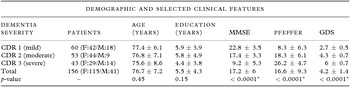
Probable AD was diagnosed according to the criteria established by the National Institute of Neurological and Communicative Disorders and Stroke-Alzheimer's Disease and Related Disorders Association (NINCDS-ADRDA) (McKhann et al., Reference McKhann, Drachman, Folstein, Katzman, Price and Stadlan1984). Clinical diagnosis of dementia included the criteria fulfillment recommended by the Diagnostic and Statistical Manual of Mental Disorders, 4th edition-revised (American Psychiatric Association, 2000). The raters determined the dementia severity using the Mini-Mental State Examination (MMSE; Folstein et al., Reference Folstein, Folstein and McHugh1975), the Clinical Dementia Rating (CDR; Hughes et al., Reference Hughes, Berg, Danziger, Coben and Martin1982), the Pfeffer Functional Activities Questionnaire (Pfeffer et al., Reference Pfeffer, Kurosaki, Harrah, Chance and Filos1982), and the GDS (Reisberg et al., Reference Reisberg, Ferris and De Leon1982). The GDS comprises behavioral characteristics manifested by patients at distinct levels of dementia severity (Reisberg et al., Reference Reisberg, Ferris and De Leon1982). The scales applied in the present study were already validated for the Brazilian community or have been extensively used in patients with dementia in our country. Table 1 summarizes demographic and selected clinical features.
Selected demographic and clinical variables that were compared with dementia severity levels using one-way ANOVA

CDR: Clinical dementia rating. *Significant differences at 1% of probability.
MMSE: Mini-Mental State Examination; Pfeffer: Pfeffer Functional Activities Questionnaire; GDS: Global Deterioration Scale; CDR: Clinical Dementia Rating; F: female; M: male.
The inclusion criteria were as follows: the presence of a knowledgeable informant (caregiver or family member) able to identify and describe neuropsychiatric symptoms in the patient occurring during the past month, as well as maintaining regular contact with the patient at least three times per week over the past three months.
Respective ethics review boards from each research center approved the study, and family members or legal representatives of patients signed written informed consent. The research was conducted according to the principals of the Helsinki Declaration.
Procedures
The patients were classified into mild (CDR 1, n = 60), moderate (CDR 2, n = 53), and severe (CDR 3, n = 43) dementia. To estimate neuropsychiatric syndromes, eligible clinician raters specifically trained to use the NPI-C (de Medeiros et al., Reference de Medeiros2010) interviewed each informant/patient dyad. The NPI-C was already validated for the Brazilian community. Methodological procedures comprised convergent validity to estimate correlations between NPI-C domains and selected scales that measure the same symptoms; these procedures also included inter-rater reliability since independent raters administered the scale (Stella et al., Reference Stella2013). To complete the NPI-C, the rater first asked caregivers or family members about the frequency and severity of each item in each domain and their distress level due to the patient's behavioral disturbances. When possible, the rater interacted with the patient to help the rater gain first-hand knowledge of the patient and his or her neuropsychiatric symptoms. Based on caregiver reports, patient interview or observation, and any additional information on clinically relevant data (for instance, a particular description from the patient record), the rater appropriately determined the final score for each symptom in each domain of the NPI-C. Afterwards, considering all available relevant information and according to his or her clinical judgment, the rater estimated the severity of each neuropsychiatric domain.
Classification of neuropsychiatric symptoms into distinct syndromes
In the present study, we used the classification of neuropsychiatric syndromes recommended by the Neuropsychiatric Syndromes Professional Interest Area of the Alzheimer's Association International Society to Advance Alzheimer's Research and Treatment (Lyketsos and Miller, Reference Lyketsos and Miller2012). This group proposed grouping neuropsychiatric symptoms observed in patients with AD or other dementias into five syndromes using NPI-C domains (listed within the parenthesis): (1) psychosis (delusions, hallucinations); (2) agitation (agitated behavior, aggression, disinhibition, irritability, euphoria, aberrant motor behavior, aberrant vocalizations); (3) affective disorder (depression, anxiety); (4) apathy (indifference, apathetic symptoms, appetite eating disorders); and (5) sleep disorders (night-time behavior disturbances). Overall, this approach provides a strong theoretical basis and methodological approach to better understanding neuropsychiatric symptoms.
Statistical analyses
Descriptive analyses were performed to determine the demographic and clinical features of patients. The conditions for the use of statistical analyses (normality, homoscedasticity, and independence) were preliminarily verified. Correlations were calculated (Pearson's correlation coefficient) between neuropsychiatric syndromes and GDS according to dementia severity levels (CDR 1, 2, and 3) and the significance of these correlations was verified (Student's t test). To analyze the association between neuropsychiatric syndromes and GDS scores in all of the patients together (n = 156), we applied the coefficient of multiple correlation (Ryy). To estimate if neuropsychiatric syndromes could interfere with GDS scores we used adjusted multiple linear regression, as well as the coefficient of determination (R2yx). The same procedure was applied to patients grouped by dementia severity levels (CDR 1, 2, and 3). To estimate if the variability of neuropsychiatric syndromes could significantly interfere with GDS scores, we used the Student's t test. We inserted additional analyses involving correlations of GDS scores with the Pfeffer Functional Activities Questionnaire and with demographic data. To compare the continuous variables of mean age, years of education, and clinical variables such as dementia severity levels according to the CDR, we applied one-way ANOVA. For variables with significant differences when compared by CDR levels, the Tukey's test was applied to calculate the degree of averages from each other. To complete the analyses of clinical variables, we compared the means of the MMSE to severity levels of dementia, and as expected, with significant differences (p < 0.0001) among CDR 1 versus CDR 2; CDR 1 versus CDR 3; and CDR 2 versus CDR 3. Likewise, we compared the means from the Pfeffer Functional Activities Questionnaire and GDS scores at distinct levels of the CDR, and we detected significant differences from each other (p < 0.0001). All statistical analyses were performed with significance level of p < 0.05.
Results
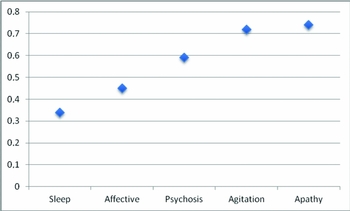
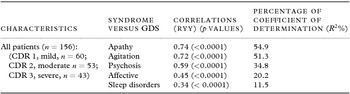
Figure 1 depicts the main correlations of neuropsychiatric syndromes with global deterioration according to the GDS scores for all patients. For the total sample, apathy and agitation syndromes were significantly correlated (respectively 0.74; 0.72; p < 0.0001) with clinical deterioration according to the GDS, followed by psychosis (0.59), affective syndromes (0.45), and subsequently by sleep disorders syndrome (0.34). (See Table 2).
Correlation of neuropsychiatric syndromes with GDS (total sample; n = 156). GDS: Global Deterioration Scale.

Significant correlations of selected neuropsychiatric syndromes with the global deterioration scale (GDS) from all patients (n = 156) (Student's t-test)

CDR: Clinical dementia rating; GDS: Global Deterioration Scale.
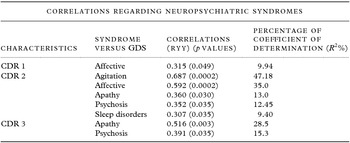
Summarizing the results, the agitation syndrome correlated with the GDS at CDR 1 (0.45), at CDR 2 (0.69), and at CDR 3 (0.43); the affective syndrome correlated with the GDS at CDR 2 (0.59); and the apathy syndrome correlated with the GDS at CDR 2 (0.52). (See Tables 2 and 3).
Significant correlations of selected neuropsychiatric syndromes with the global deterioration scale according to dementia severity, as well as other data

CDR: Clinical dementia rating; GDS: Global Deterioration Scale.
At moderate severity (CDR 2), the agitation syndrome (0.69) and affective syndrome (0.59) significantly interfered with GDS scores. Likely, the apathy syndrome contributed to high GDS scores from patients at severe dementia (CDR 3; 0.52). Table 3 displays these data. Analyses of other variables from all patients together showed high correlation of functional activities, measured by the Pfeffer questionnaire, with GDS scores (0.74; Ryy).
Discussion
It is generally accepted that individual symptoms tend to have intermittent course throughout the time and disease aggravation (Cerejeira et al., Reference Cerejeira, Lagarto and Mukaetova-Ladinska2012). Likewise, neuropsychiatric syndromes in AD follow a course of changing prevalence through the disease progression, particular psychosocial determinants, and specific neurobiological correlates (Robert et al., Reference Robert2005; Lyketsos et al., Reference Lyketsos2011). Furthermore, these syndromes in AD have received notable exploration by recent investigations (Gonfrier et al., Reference Gonfrier, Andrieu, Renaud, Vellas and Robert2012; Brodaty et al., Reference Brodaty, Connors, Xu, Woodward and Ames2015; Cummings et al., Reference Cummings, Jutand, Onifade, Richard-Harston and Bourdel-Marchasson2015), even in early stages of the disease (Van der Mussele et al., Reference Van der Mussele2015).
We examined whether five neuropsychiatric syndromes of AD patients were correlated with global clinical deterioration according to severe levels of dementia. Overall, our results show that the neuropsychiatric syndromes were closely related to global deterioration measurements. In fact, the agitation and apathy syndromes exhibited strong association with GDS scores. According to the dementia severity, the mild stage (CDR 1) moderately correlated with the agitation syndrome; at CDR 2, the agitation syndrome and the affective syndrome also showed moderate correlation. At CDR3, the apathy syndrome and agitation showed moderate correlation with GDS scores followed by the agitation syndrome. In summary, agitation, apathy, and affective were the neuropsychiatric syndromes with more substantial association with GDS scores although these correlations were moderate.
As noted earlier, the specific syndromes being tested in the current study separate sleep disturbances and apathy into two distinct syndromes. Sleep disturbances and apathy are very often disorders in AD patients (Robert et al., Reference Robert2005; David et al., Reference David2010), and deserve single classification as proposed by Lyketsos and Miller (Reference Lyketsos and Miller2012). For example, patients with MCI presenting night-time behaviors have an increased risk for progression to dementia (Peters et al., Reference Peters2013). While crucial aspects in this scenario still remain to be elucidated (e.g. overlapping psychopathological manifestations, neurobiological support for symptoms, the specific course across the disease progression, and pattern of treatment responses to specific interventions), it would not be possible to understand the potential link between MCI and progression into dementia without looking at sleep disturbances as a separate syndrome. Overall, the classification of psychopathological symptoms into distinct syndromes may provide methodological advantages for research designs on behavioral disturbances in AD.
Other important points to consider are the educational and cultural aspects of the population being studied. In Brazil, low educational levels require adjustments for cut-off points on the cognitive assessment of patients with dementia as reported by Brucki and Rocha (Reference Brucki and Rocha2004). In addition, cultural beliefs may interfere with the accuracy of the caregiver's report regarding specific syndromes experienced by the patient (e.g. depression or apathy). Frequently, caregivers might consider these psychopathological manifestations as part of “normal” aging (Stella et al., Reference Stella2015). In the present study, we used the NPI-C in order to solve potential biases as the final scoring in this scale depends on the clinician impression (de Medeiros et al., Reference de Medeiros2010).
We note that to use both instruments – the CDR and GDS – would appear to be repetitive (i.e. both measure dementia severity levels). However, we argue that it is important to analyze potential correlations between both scales and that such knowledge may bring a better acknowledgement of neuropsychiatric syndrome manifestations especially with regards to severity levels of dementia. More specifically, patients classified into mild dementia may exhibit some psychopathological symptoms as anxiety, apathy, or non-cooperative behavior closely related to cognitive and functional impairment (Di Iulio et al., Reference Di Iulio2010; Dillon et al., Reference Dillon, Serrano, Castro, Leguizamón, Heisecke and Taragano2013; Cerejeira et al., Reference Cerejeira, Lagarto and Mukaetova-Ladinska2012). At moderate and severe levels of dementia, patients in general have loss of spontaneous emotional reaction and diminished affective responsiveness to psychosocial situations, agitation, aggression, delusions and hallucinations, loss of communication, obsessive and repetitive behaviors, anxiety, sleep disorders, and important worsening of apathy (Di Iulio et al., Reference Di Iulio2010; Cerejeira et al., Reference Cerejeira, Lagarto and Mukaetova-Ladinska2012), as well as aberrant vocalizations (de Medeiros et al., Reference de Medeiros2010).
In summary, the association of neuropsychiatric symptoms with cognitive decline in AD remains a debatable subject. Some studies have detected correlations of behavioral disturbances with cognitive impairment across the course of dementia in AD (Zhang et al., Reference Zhang, Wang and Yu2012; Dillon et al., Reference Dillon, Serrano, Castro, Leguizamón, Heisecke and Taragano2013) while in others, changes in the behavioral profile of persons with AD were independent from decline of cognitive status suggesting partially independent mechanisms involving both conditions (Tractenberg et al., Reference Tractenberg, Weiner, Cummigns, Patterson and Thal2005). Some neuropsychiatric syndromes may worsen as the AD progresses, whereas others remain relatively stable even in severe stages of dementia, or exhibit fluctuating course throughout the disease deterioration. For instance, increasing severity levels of apathy have been detected over the progressive stages of AD (Gonfrier et al., Reference Gonfrier, Andrieu, Renaud, Vellas and Robert2012; Stella et al., Reference Stella2013). Likewise, a potential non-linear trajectory impairment of cognition and behavior remains a debatable issue and may imply independent pathophysiological pathways. This would suggest that cognitive decline and behavioral disturbances could be attributed to dysfunction of distinct brain mechanisms (D’Onofrio et al., Reference D’Onofrio2010; Ismail et al., Reference Ismail, Minh-Quan, Fischer, Schweizer, Mulsant and Mamo2011).
Moreover, to recognize particular phenotypic expressions and to highlight correlated brain regions underlying pathophysiological mechanisms or neural circuitry from neuropsychiatric syndromes in AD could provide more effective and safer pharmacological interventions for the clinical practice (Lyketsos et al., Reference Lyketsos2011; Bloniecki et al., Reference Bloniecki, Aarsland, Cummings, Blennow and Freund-Levi2015).
Conclusions
Apathy and agitation were the neuropsychiatric syndromes with the most consistent correlations with clinical global deterioration measured by the GDS. Neuropsychiatric syndromes in patients at moderate and severe levels of dementia were consistently correlated with higher GDS scores, suggesting an additional impact from these syndromes on clinical deterioration of AD.
Conflict of interest
None.
Description of authors’ roles
F. Stella, J. Laks, K. de Medeiros, and O.V. Forlenza contributed to the conception and design of the study, as well as to drafting the manuscript and revising it critically for intellectual content, and assisted with writing the paper. J.S. Govone contributed to the methodological design and undertook statistical analyses.
Acknowledgments
This study was supported by the Fundação de Amparo à Pesquisa do Estado de São Paulo (FAPESP – project nos. 2009/52825–8 and 2010/18999–6). Jerson Laks is supported by Conselho Nacional de Pesquisa (CNPq) as a researcher 2, by Fundação de Apoio à Pesquisa do Estado do Rio de Janeiro (FAPERJ), and by Fundação de Empreendimentos, Pesquisa e Desenvolvimento Institucional Científico e Tecnológico do Rio de Janeiro (FEMPTEC).