Introduction
The role of subjective memory complaints in cognitive health in aging has been recurrently debated. As an initial proposed criterion for mild cognitive impairment (MCI) (Petersen et al., Reference Petersen, Smith, Waring, Ivnik, Tangalos and Kokmen1999), in conjunction with memory deficits on objective assessments, some studies have reported that the subjective complaint component did not contribute to the diagnostic or prognostic value of MCI (Jungwirth et al., Reference Jungwirth, Fischer, Weissgram, Kirchmeyr, Bauer and Tragl2004; Lautenschlager, Flicker, Vasikaran, Leedman, & Almeida, Reference Lautenschlager, Flicker, Vasikaran, Leedman and Almeida2005; Lenehan, Klekociuk, & Summers, Reference Lenehan, Klekociuk and Summers2012; Mitchell, Reference Mitchell2008; Purser, Fillenbaum, & Wallace, Reference Purser, Fillenbaum and Wallace2006). In contrast, other studies have reported prognostic value of subjective complaints in MCI for subsequent clinical progression to more severe impairment (Lam, Lui, Tam, & Chiu, Reference Lam, Lui, Tam and Chiu2005; Mitchell & Shiri-Feshki, Reference Mitchell and Shiri-Feshki2009; Schofield et al., Reference Schofield, Marder, Dooneief, Jacobs, Sano and Stern1997). In the Alzheimer’s disease (AD) research community, the conceptual framework of “subjective cognitive decline” has emerged, which characterizes subjective cognitive concerns in the absence of objectively measured cognitive deficits as a putative pre-MCI clinical state, and potentially the first indicator of subsequent cognitive decline for some older individuals (Jessen et al., Reference Jessen, Amariglio, van Boxtel, Breteler, Ceccaldi, Chételat and van der Flier2014; Reisberg, Shulman, Torossian, Boksay, et al., Reference Reisberg, Shulman, Torossian, Boksay, Khan and Zhu2010).
It is clear from cross-sectional studies of non-demented older adults that, although objective memory (OM) and subjective memory (SM) deficits are associated with each other across groups, they are often incongruent within individuals. In a review by Mitchell (Reference Mitchell2008), SM complaints were present in only 38% of individuals with MCI defined via objective cognitive assessment. In contrast, studies of preclinical AD, especially those seeking to characterize biomarkers, often identify individuals with SM complaints but without OM deficits, as described above (Amariglio et al., Reference Amariglio, Becker, Carmasin, Wadsworth, Lorius, Sullivan and Sperling2012; Hafkemeijer et al., Reference Hafkemeijer, Altmann-Schneider, Oleksik, van de Wiel, Middelkoop, van Buchem and Rombouts2013; Jessen et al., Reference Jessen, Amariglio, van Boxtel, Breteler, Ceccaldi, Chételat and van der Flier2014; Rowe et al., Reference Rowe, Ellis, Rimajova, Bourgeat, Pike, Jones and Villemagne2010; Saykin et al., Reference Saykin, Wishart, Rabin, Santulli, Flashman, West and Mamourian2006). The question of which is the starting point for cognitive decline (or whether either may be) is best addressed in longitudinal studies.
From a theoretical standpoint, Herrmann (Reference Herrmann1982) in an early work noted that individual differences in subjective ratings of memory symptom severity may obscure cross-sectional relationships between subjective and objectively measured memory. Therefore, longitudinal change in both subjective and objective memory should yield higher associations, as each individual serves as his/her own “baseline” and reference point for change (Hertzog & Pearman, Reference Hertzog and Pearman2014). Other investigators have argued that non-cognitive factors, such as personality traits, depressive symptoms and socially determined self-perceived efficacy (Bandura, Reference Bandura1989; Perrig-Chiello, Perrig, & Stahelin, Reference Perrig-Chiello, Perrig and Stahelin2000) are more strongly predictive of subjective memory evaluation in aging than is objectively measured performance, and this explains the weak relationship.
Several longitudinal studies have investigated baseline SM predicting longitudinal change in OM (or more broadly measured cognitive decline), with mixed findings (Dik et al., Reference Dik, Jonker, Comijs, Bouter, Twisk, van Kamp and Deeg2001; Dufouil, Fuhrer, & Alpérovitch, Reference Dufouil, Fuhrer and Alpérovitch2005; Hohman, Beason-Held, Lamar, & Resnick, Reference Hohman, Beason-Held, Lamar and Resnick2011; Mol, van Boxtel, Willems, & Jolles, Reference Mol, van Boxtel, Willems and Jolles2006; Schofield et al., Reference Schofield, Marder, Dooneief, Jacobs, Sano and Stern1997; Wang et al., Reference Wang, van Belle, Crane, Kukull, Bowen, McCormick and Larson2004). Far fewer studies have included any measures of longitudinal change in SM. A small study of 100 healthy older participants found no change over 2.5 years on self-rated cognitive errors (Cognitive Failures Questionnaire) regardless of whether there was decline on objective memory testing, concluding a lack of correspondence between objective and subjective changes over time (Weaver Cargin, Collie, Masters, & Maruff, Reference Weaver Cargin, Collie, Masters and Maruff2008). In contrast, Parisi et al. (Reference Parisi, Gross, Rebok, Saczynski, Crowe, Cook and Unverzagt2011) used parallel process latent growth curve modeling with data from n=1301 healthy participants in the ACTIVE cognitive training intervention trial, observing that OM slope was associated with SM slope over 5 years. Zimprich, Martin, and Kliegel (Reference Zimprich, Martin and Kliegel2003) also reported an association between change in subjective cognitive complaints and change in OM over two measurement occasions over 4 years in n=442 participants from the German population-based Interdisciplinary Study on Life Development, using latent change score modeling. These two larger studies indicate significant associations between changes over time in SM to changes in OM; however, they did not specifically address questions of temporal sequence or direction of influence over time between the two constructs. Jorm et al. (Reference Jorm, Christensen, Korten, Jacomb and Henderson2001) addressed these questions using structural equation modeling in a community sample across a cognitive spectrum, including dementia, of n=331 over 3 waves and 7.6 years follow-up. Measuring OM and SM at each wave, they reported a significant OM to SM path, as well as an SM to OM path, across wave1 to 2, and wave 2 to 3. These results indicate cross-wave mutual influences of levels of OM and SM, respectively, on each other; of note, the model did not address questions of change, per se, in either SM or OM.
Building on results of these longitudinal studies, the aim of the present investigation was to model the temporal dynamics between SM and OM in a large population-based cohort of older adult over five annually spaced assessments. We used bivariate latent change score (LCS) models (Ferrer & McArdle, Reference Ferrer and McArdle2010; McArdle, Reference McArdle2009), to model change over time in OM and SM across waves, and to test four alternative hypotheses about possible temporal directions of mutual influence: (1) A “no-coupling” model represented the hypothesis of no relationship between changes in OM and SM. (2) An “OM single pathway” model represented objectively measured memory as a leading indicator of subjective memory, in that it precedes changes in subjective memory ratings. (3) An “SM single pathway” model represented subjectively reported memory as the leading indicator of objective memory, in that it precedes changes in objective memory performance. (4) A “dynamic coupling” hypothesis tested whether both kinds of memory outcomes show evidence of leading and lagging the other, such that levels of each variable influence subsequent changes in the other. The broader study goal was to better understand the interplay between subjective and objective cognition, and informing future refinement of assessment approaches for early detection of pathological cognitive aging.
Finally, we expanded the objective cognitive measurement to other domains beyond OM, including objective language (OL) and objective executive functions (OEF). The rationale for doing so included the clinical observation that older individuals often generically complain of “memory problems” but when probed describe language- or semantic-based symptoms, such as word-finding difficulties, or executive dysfunction, such as difficulty organizing one’s personal or financial affairs, working- or prospective memory failures, etc. (Burmester, Leathem, & Merrick, Reference Burmester, Leathem and Merrick2015).
Method
Study Site and Population
Our study cohort named the Monongahela-Youghiogheny Healthy Aging Team (MYHAT) is an age-stratified random population sample drawn from the publicly available voter registration lists for a small-town region of Pennsylvania (United States). Community outreach, recruitment, and assessment protocols were approved by the University of Pittsburgh Institutional Review Board for protection of human subjects. All participants provided written informed consent. Recruitment criteria were (1) age 65 years or older, (2) living within the selected towns, (3) not already in long-term care institutions. Individuals were ineligible if they (4) were too ill to participate, (5) had severe vision or hearing impairments, (6) were decisionally incapacitated. We recruited 2036 individuals over a 2-year period, and screened out 54 who at study entry exhibited moderate or severe cognitive impairment by scoring <21/30 on an age-education-corrected Mini-Mental State Exam (MMSE); (Folstein, Folstein, & McHugh, Reference Folstein, Folstein and McHugh1975; Mungas, Marshall, Weldon, Haan, & Reed, Reference Mungas, Marshall, Weldon, Haan and Reed1996). The remaining 1982 individuals underwent a detailed in-home assessment including, but not limited to, the elements below (Ganguli et al., Reference Ganguli, Snitz, Vander Bilt, Chang, Ganguli, Snitz and Chang2009).
Assessments
At baseline and at each annual data collection cycle, we assessed cognitive functioning with a comprehensive neuropsychological test battery tapping multiple cognitive domains including memory, attention/processing speed, visuospatial reasoning, language and executive functioning (Ganguli, Snitz, et al., Reference Ganguli, Snitz, Lee, Vanderbilt, Saxton and Chang2010). Objective memory tests included Wechsler Memory Scale-Revised Logical Memory and Visual Reproduction (Wechsler, Reference Wechsler1987), and the FULD Object Memory Evaluation (Fuld, Reference Fuld1981). Objective language tests included the Indiana University token test (Unverzagt et al., Reference Unverzagt, Morgan, Thesiger, Eldemire, Luseko, Pokuri and Hendrie1999), semantic fluency (animals), and the Boston Naming Test (Kaplan, Goodglass, & Weintraub, Reference Kaplan, Goodglass and Weintraub2001). Objective executive functions tests included Trail Making Part B (connections/second), clock drawing (Freedman et al., Reference Freedman, Leach, Kaplan, Winocur, Shulman and Delis1994), and phonemic fluency (FAS). We created composite scores for these three domains by averaging test Z-scores referenced to the cohort at baseline (higher Z indicates better test performance). Subjective memory was assessed a self-report measure of subjective cognitive complaints (Ganguli, Dodge, Shen, & DeKosky, Reference Ganguli, Dodge, Shen and DeKosky2004; Snitz et al., Reference Snitz, Yu, Crane, Chang, Hughes and Ganguli2012), 16 items of which related to memory complaints specifically (Supplementary Table 1). The sum of 16 items (each scored 0 vs. 1 for complaint absent/present) were Z-score transformed, referenced to the cohort at baseline for the present analysis, with higher scores representing greater number of complaints/memory symptoms endorsed.
Other assessments administered in annual cycles included the modified Center for Epidemiologic Studies Depression scale (mCESD) (Ganguli, Gilby, Seaberg, & Belle, Reference Ganguli, Gilby, Seaberg and Belle1995), the Clinical Dementia Rating (CDR) scale (Ganguli, Chang, et al., Reference Ganguli, Chang, Snitz, Saxton, Vanderbilt and Lee2010; Morris, Reference Morris1993), self-reported health history and medication count. Genotyping for APOE*4 allele was completed on a subset of n=1778 participants at baseline.
Data Analysis
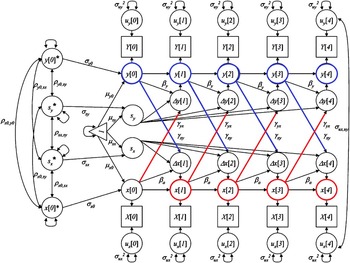
Analysis of the changes in subjective memory and objective cognitive measures took place in two stages. First, univariate latent change score models were applied to each variable to describe changes across the follow-up period (for reviews, see Ferrer & McArdle, Reference Ferrer and McArdle2010; McArdle, Reference McArdle2009). Next, we examined dynamic relationships between (1) SM and OM, (2) SM and OL, and (3) SM and OEF by fitting bivariate latent change score models. Figure 1 shows the path diagram for a prototypic model between an x variable (e.g., SM) and a y variable (e.g., OM). As a guide to these models, the latent difference scores (e.g., Δx[t]) are influenced by a constant component (i.e., sx), as well as changes that are related to prior level of performance (βx). In the dual coupling model, this latent difference score is also predicted by previous scores from the opposite variable through the use of a coupling parameter (e.g., γxy). The statistical significance of the coupling parameters indicates whether prior scores on one variable (e.g., y[0]) influences changes on the other (e.g., Δx[1]). Using these models, we examined changes in model fit (deviation in the -2LL, AIC, and BIC) across four sequential hypotheses that are tested for each objective domain: (a) no relationship between outcomes; (b) level of SM predicting subsequent change in objective cognition; (c) level of objective cognition predicting subsequent change in SM; and (d) dual coupling between the two outcomes (Small, Dixon, McArdle, & Grimm, Reference Small, Dixon, McArdle and Grimm2012). The convergence criterion for the dual coupling model between SM and OEF was constrained to 0.05 to account for high correlation between the temporal changes of the two cognitive functions. The convergence criterion for all other models was 0.00005.
Path diagram of dual latent change score model. X=Subjective memory; Y=Objective cognition [Objective memory (OM), Objective language (OL), & Objective executive functions (OEF), respectively]

For each outcome, scores were expressed as Z-scores based upon means and SDs at baseline. Covariates included were age at baseline (treated continuously), depression score at baseline (treated continuously), gender, and education (categorized at <HS; HS; >HS). Our goal for covariate selection was to control for potential demographic confounders of objective-subjective memory associations. We also included depressive symptoms as an established correlate of subjective memory complaints (Reid & Maclullich, Reference Reid and Maclullich2006). Analyses were completed with M-Plus (v.7.1; Muthen & Muthen, Reference Muthen and Muthen2010). All available data at each cycle were included in all models.
Results
Demographic and Clinical Characteristics
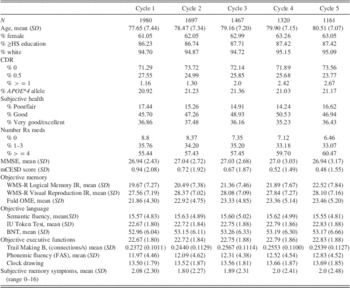
At baseline (study entry, cycle 1), the MYHAT cohort (N=1980) was representative of older adults in the targeted communities, with a mean (SD) age of 77.6 (7.4) years and a median educational level of high school graduate; 61.0% were women and 94.8% were of mixed European descent (Table 1). Regarding general health indicators, approximately 17% rated themselves as in only “fair” or “poor” health, and over half the cohort was taking at least four prescription medications. Of note, 71.3% were rated CDR=0 (no dementia), 27.6% CDR 0.5 (very mild/questionable dementia) and 1.2% were rated CDR=1 (mild dementia), so that by CDR a broad range of cognition was included (with moderate to severe impairment screened out at entry by the MMSE criterion of <21, age- and education-corrected). Over the first 5 years of the study, the cohort experienced 41.2% attrition as would be expected in an aging population-based cohort. Inspection of summary demographic and clinical variables, including CDR, MMSE, and APOE*4 allele status, across the five cycles suggest broadly comparable cohort characteristics despite the loss to follow-up.
Cohort characteristics (mean/SD or n/%) by annual assessment cycle

CDR=Clinical Dementia Rating scale; MMSE=Mini Mental State Exam; WMS-R=Wechsler Memory Scale – Revised; OME=Object Memory Evaluation; IU=Indiana University; BNT=Boston Naming Test. APOE*4=Apolipoprotein E gene, presence of at least one E*4 allele; mCESD=modified Center for Epidemiologic Studies Depression scale.
Univariate Latent Change Score Models
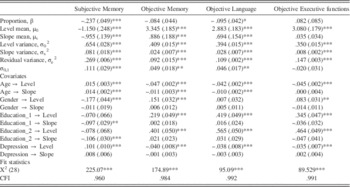
The estimated parameters for subjective memory, objective memory, objective language, and objective executive functions across the follow-up period are reported in Table 2. The results from these models indicate that statistical significant changes over time were observed, with declines in SM complaints and increases for OM and OL performance, independent of age at baseline, gender and years of education. Among the covariates, older age was associated with higher baseline SM complaint scores and increasing SM complaints over time. Older age was associated with lower scores in OM, OL, and OEF at baseline, as well as with decline in OM and OL across time. Female gender was associated with lower baseline SM complaints and higher baseline OM and OEF scores, but had no association with changes over time. Finally, more years of education was associated with decline in SM complaints over time, and with higher OM, OL, and OEF scores over time.
Univariate latent change score model results [estimates (se)] for subjective memory and objective memory, language & objective executive functions, with age, gender, education level, and baseline depression score as covariates

*p<.05.
**p<.01.
***p<.001.
CFI=comparative fit index.
Bivariate Latent Change Score Models
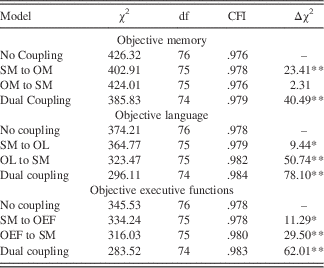
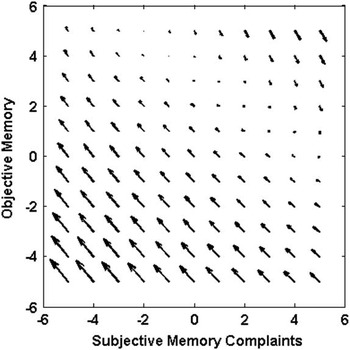
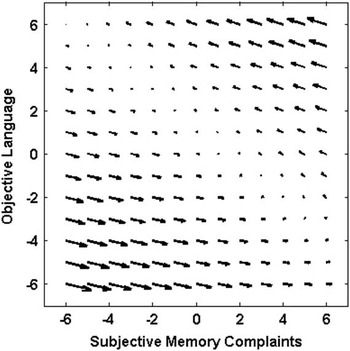
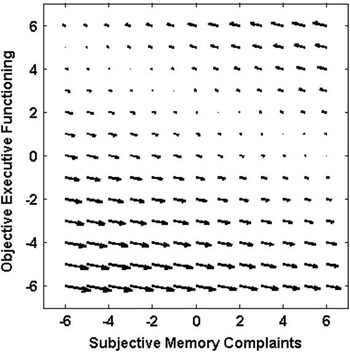
Table 3 displays a summary of the model fit indices for each of the four models that were evaluated concerning the relationships between changes in subjective memory and objective memory. As a guide to the table, the no-coupling model is the reference model; change in chi-square (Δχ2) allows us to evaluate whether any improvement in model fit is statistically significant relative to the number of parameters that were added to the model. Interpretation of the bivariate LCS model results are aided by vector field plots in the figure. These plots (Boker & McArdle, Reference Boker and McArdle1995; Small et al., Reference Small, Dixon, McArdle and Grimm2012) were constructed to illustrate the dynamic relationships between the paired variables. For a given pair of subjective and objective cognitive scores, the arrow indicates the expected changes in both subjective and objective cognition at the next measurement occasion. The direction of the arrows indicates whether future changes will be negative, positive, or neutral, and the relative size of the arrow relates to the relative size of predicted changes. Details of the results, as specifically reflected in the vector field plots, are presented separately by cognitive domain.
Bivariate latent change score summary results for subjective memory coupled with (1) objective memory, (2) objective language, and (3) objective executive functions

*p<.01.
**p<.001.
CFI=comparative fit index.
Subjective memory and objective memory
As compared to the no-coupling model, adding a unidirectional path from subjective memory to changes in objective memory improved the fit of the model. However, the inclusion of a unidirectional path from objective memory to changes in subjective memory did not fit the data better than the no-coupling model. Finally, the model that included both paths (dual coupling model) provided the best fit to the data. The parameter estimate for the subjective memory to objective memory relationship was −0.55 (SE=0.12; p<.001) and the path from objective memory to subjective memory was 0.65 (SE=0.17; p<.001). The negative parameter estimate for SM to OM indicates that fewer subjective memory complaints were related to greater improvement in objective memory performance; or, alternatively, that more subjective complaints predicted decline in objective memory scores. For the opposite path, worse objective memory was associated with greater decline in subjective memory complaints over time. These relationships are illustrated in Figure 2.
Vector field plot for subjective memory and objective memory. The plots illustrate the dynamic relationships between the paired variables. For a given pair of subjective and objective cognitive scores, the arrow indicates the expected changes in both subjective and objective cognition at the next measurement occasion. The direction of the arrows indicates whether future changes will be negative, positive, or neutral and the relative size of the arrow relates to the relative size of predicted changes.

Subjective memory and objective language
Relative to the no-coupling model, the dual coupling model provided the best fit to the data (see Table 3). The parameter estimate for the subjective memory to objective language pathway was 0.332 (SE 0.086; p<.001) and the path from OL to SM was −1.358 (SE 0.215; p<.001). The positive SM to OL estimate indicates fewer subjective memory complaints were associated with declines in objective language. The negative parameter estimate for OL to SM indicates worse objective language scores were associated with subsequent increase in subjective memory complaints, or alternatively, better OL scores associated with decline in SM complaints. Inspection of the vector field plot (Figure 3) suggests (1) that both these patterns are driving the negative OL to SM parameter estimate; and (2) that the OL to SM pathway is stronger than the SM to OL pathway, consistent with relative size of the estimates.
Vector field plot for subjective memory and objective language.

Subjective memory and objective executive functions
The model fit parameters for the SM and OEF models are shown in Table 3. Although the inclusion of the single pathways improved the fit of the model relative to the no-coupling model, the best fit was provided by the dual coupling model. Both of the parameter estimates were statistically significant (p<.001): the estimate for the subjective memory to objective executive functions pathway was 0.396 (SE 0.090), and the estimate for the OEF to SM pathway was −4.839 (SE 0.809). The positive parameter estimate indicated that fewer subjective memory complaints were associated with decreases in OEF performance. The negative estimates indicate that worse executive function scores are associated with subsequent increases in subjective memory complaints, or, that better executive functions scores are associated with decreases in subjective memory complaints. These relationships are illustrated in the Figure 4. As with OL-SM model, the vector field plot suggests that the objective to subjective pathway is the stronger one, consistent with the size of the estimates.
Vector field plot for subjective memory and objective executive functions.

Discussion
We sought to better understand the temporal dynamic relationships between subjectively perceived and objectively measured cognition over time, within a large, representative, population-based cohort of older adults. We applied bivariate latent change score modeling to data measured annually over 5 years and tested four competing models of change (within each of three domains). Results indicate that dual-pathway models best fit the data for all three cognitive domains. In all cases, the relationship between subjective memory ratings and objective cognitive performance represented a mutual influence of the two constructs on each other, with regard to sequential change over time. This study adds to a growing literature indicating that bi-directional influences are important in cognitive aging, including such paired constructs as cognition–activity level (Mousavi-Nasab, Kormi-Nouri, & Nilsson, Reference Mousavi-Nasab, Kormi-Nouri and Nilsson2014; Small et al., Reference Small, Dixon, McArdle and Grimm2012; Wilson, Segawa, Boyle, & Bennett, Reference Wilson, Segawa, Boyle and Bennett2012), cognition–physical functioning (Krall, Carlson, Fried, & Xue, Reference Krall, Carlson, Fried and Xue2014) and cognition–sense of well-being (Allerhand, Gale, & Deary, Reference Allerhand, Gale and Deary2014).
The directions of effects in the present study were complex and partly unexpected. With regard to the memory domain, low subjective complaint scores were associated with the most improvement (i.e., practice) on memory test performance. This relationship reflects a correspondence between subjective and objective measures of cognitive health and suggests good insight in this range of lower subjective memory complaints. The other pathway, however, indicated lower objective memory scores were associated with subsequent decline in subjective complaints, revealing a subjective–objective discordance. This pathway suggests poor insight in this range of lower objective memory scores, possibly consistent with anosognosia. Of interest, the pathway effects for both language and executive functions domains were opposite those for the memory domain. Lower objective language and executive function scores were associated with subsequent increases in subjective complaints, reflecting concordance in the outcomes. Among the three objective cognitive domains, memory uniquely reveals subjective–objective discordance at the poorer objective functioning range of the spectrum. This observation is consistent with the substantial literature on memory monitoring (meta-memory) deficits in clinical memory disorders, including amnestic MCI (Perrotin et al., Reference Perrotin, Desgranges, Duval, La Joie, Mézenge, Landeau and Eustache2011; Vogel et al., Reference Vogel, Stokholm, Gade, Andersen, Hejl and Waldemar2004), AD (Clare, Reference Clare2004; Harwood, Sultzer, & Wheatley, Reference Harwood, Sultzer and Wheatley2000; Lopez, Becker, Somsak, Dew, & DeKosky, Reference Lopez, Becker, Somsak, Dew and DeKosky1994; Mograbi, Brown, & Morris, Reference Mograbi, Brown and Morris2009), and Korsakoff syndrome (Pannu & Kaszniak, Reference Pannu and Kaszniak2005). Empirically, it is also consistent with studies showing objective episodic memory performance correlates with metamemory deficits (Shaked et al., Reference Shaked, Farrell, Huey, Metcalfe, Cines, Karlawish and Cosentino2014) and anosognosia (Orfei et al., Reference Orfei, Blundo, Celia, Casini, Caltagirone, Spalletta and Varsi2010) in MCI and AD. Some theoretical accounts, as well, highlight the centrality of episodic memory to cognitive mechanisms underlying anosognosia for memory impairment. For instance, in the Morris and Hannesdottir (Hannesdottir & Morris, Reference Hannesdottir and Morris2007, Morris and Hannesdottir, Reference Morris and Hannesdottir2004) Cognitive Awareness Models, a mnemonic sub-type of anosognosia in AD refers to failure to update a personal knowledge base of memory failures (or successes) over time, despite intact recognition of a memory failure at the time (i.e., intact error detection). This “forgetting I’ve forgotten” mechanism, theorized to be one route to anosognosia in clinical dementia, may be reflected in the population level by a subtler form of deficit awareness in the present results.
Our results are consistent with other studies using sensitive modeling techniques and showing associations between objective and subjective memory changes (slopes) over time (Parisi et al., Reference Parisi, Gross, Rebok, Saczynski, Crowe, Cook and Unverzagt2011; Zimprich et al., Reference Zimprich, Martin and Kliegel2003), as well as across-occasion correlations (Jorm et al., Reference Jorm, Christensen, Korten, Jacomb and Henderson2001). All of these studies indicate significant general associations between subjective and objective memory across time in older populations.
Building on the previous literature, this study modeled specific temporal dynamics of change over time, allowing us to address the question of sequential influences of one variable on the other. According to present findings, the question of which is the earlier indicator of cognitive decline is not simply answered but is multifaceted and cognitive-domain dependent, as well as clinical state-dependent. At lower objective memory performance level, the expected concordance between subjective and objective memory is obscured, presumably by impaired insight, and shows the opposite relationship. In contrast, at higher levels of subjective memory complaints, objective memory subsequently declines for high objective memory performers (but tends to increase for lower objective memory performers). These results validate clinical observations that the reliability of patient self-reporting on day-to-day memory functioning usually varies with degree of objective memory impairment, and reflects self-awareness. To our knowledge, this relationship has rarely been examined empirically at the population level. The observed subjective–objective memory discordances may help explain cross-study inconsistences in a large cross-sectional and longitudinal literature vis a vis subjective memory complaints as valid indicators or predictors of objective cognitive status (Crumley, Stetler, & Horhota, Reference Crumley, Stetler and Horhota2014; Reid & Maclullich, Reference Reid and Maclullich2006). For instance, studies reporting subjective memory concordantly associated (i.e., in the predicted direction) with objective memory or predictive of clinical decline on follow-up tend to include participants screened for healthy, unimpaired cognitive status at baseline (Geerlings, Jonker, Bouter, Ader, & Schmand, Reference Geerlings, Jonker, Bouter, Ader and Schmand1999; Jessen et al., Reference Jessen, Wiese, Bachmann, Eifflaender-Gorfer, Haller and Kolsch2010; Reisberg, Shulman, Torossian, Leng, et al., Reference Reisberg, Shulman, Torossian, Leng, Zhu, Reisberg and Zhu2010; St John & Montgomery, Reference St John and Montgomery2002; Wang et al., Reference Wang, van Belle, Crane, Kukull, Bowen, McCormick and Larson2004). On the other hand, studies reporting low subjective–objective memory associations or concordance tend to include a broader spectrum of participants or patients that includes some degree of clinical memory impairment (Grut et al., Reference Grut, Jorm, Fratiglioni, Forsell, Viitanen and Winblad1993; Jorm et al., Reference Jorm, Christensen, Korten, Henderson, Jacomb and Mackinnon1997; Jungwirth et al., Reference Jungwirth, Fischer, Weissgram, Kirchmeyr, Bauer and Tragl2004; Mitchell, Reference Mitchell2008; O’Connor, Pollitt, Roth, Brook, & Reiss, Reference O’Connor, Pollitt, Roth, Brook and Reiss1990; Purser et al., Reference Purser, Fillenbaum and Wallace2006; Roberts, Clare, & Woods, Reference Roberts, Clare and Woods2009). Baseline cognitive status is likely a significant moderating variable in understanding the subjective–objective memory literature and important to formerly evaluate in future meta-analytic work.
Subjective memory complaints were also influenced by—and in turn also influenced subsequent change in—objective language and objective executive functions. This is consistent with other reports of subjective memory ratings showing associations with objectively assessed domains beyond episodic memory (Benito-León, Mitchell, Vega, & Bermejo-Pareja, Reference Benito-León, Mitchell, Vega and Bermejo-Pareja2010; Minett, Dean, Firbank, English, & O’Brien, Reference Minett, Dean, Firbank, English and O’Brien2005; Snitz, Morrow, Rodriguez, Huber, & Saxton, Reference Snitz, Morrow, Rodriguez, Huber and Saxton2008). Thus, there is good evidence that subjective–objective cognitive associations are not specific to memory, even when the wording of subjective items are targeted toward memory. In the present study, subjective memory items (Supplementary Table 1) were culled from a larger scale based on their wording reflecting “memory” symptoms and face validity for episodic memory processes. Results nevertheless reinforce the observation that patients (or study participants) often think of extra-mnemonic processes in daily functioning, such word-finding or planning, sequencing, prospective memory, attentional control, and working memory (i.e., “multi-tasking”), as very much belonging to the collective subjective appraisal of one’s “memory.”
In contrast to the objective memory domain, objective language and objective executive functions show similar and more concordant patterns of temporal dynamics with subjective memory complaints, respectively. Although the dual-pathway model best fit the data in these non-memory domains, as well, inspection of the vector field plots suggest that a dominant pattern is one of lower objective cognition leading subsequent increases in subjective complaints. Few studies have examined predictors of change in subjective memory appraisal over time. Present results offer evidence of validity for measures of longitudinal change (e.g., increase) in subjective memory complaints vis a vis their associations with lower cognitive performance scores, specifically in non-memory domains.
Strengths of the present study include a large population-based cohort from small-town communities, five annual cycles of measurements, and relatively comprehensive and detailed neuropsychological assessments. The sample size and longitudinal follow-up period allows application of sophisticated modeling approaches of change in subjective and objective cognition. The random population sample strengthens the external validity of findings, often a limitation in cognitive aging studies with more selected volunteer-, patient-, or clinic-based samples.
Limitations of the study include the assumption in latent change score modeling that attrition is random. As well, re-test effects were observed for objective memory and language, masking absolute decline in these cognitive functions over time. Re-test effects are a challenging problem in cognitive aging research with little consensus regarding analytic approaches (Ghisletta & De Ribaupierre, Reference Ghisletta and De Ribaupierre2005; Hoffman, Hofer, & Sliwinski, Reference Hoffman, Hofer and Sliwinski2011; Salthouse, Schroeder, & Ferrer, Reference Salthouse, Schroeder and Ferrer2004). However, individual differences in the degree of re-test effects (i.e., practice gains) have been shown to be predictive of significant health-related outcomes such as dementia risk (Darby, Maruff, Collie, & McStephen, Reference Darby, Maruff, Collie and McStephen2002; Galvin et al., Reference Galvin, Powlishta, Wilkins, McKeel, Xiong, Grant and Morris2005) and terminal decline (Dodge, Wang, Chang, & Ganguli, Reference Dodge, Wang, Chang and Ganguli2011). Thus, although absolute decline in objective memory and language was not observed in univariate models adjusted for covariates, we believe the relative patterns of slope differences in these outcomes are meaningful with respect to the study questions. Finally, although the advantages of the representativeness of the cohort are noted above, the cohort was primarily of European descent, reflecting the elderly population of the southwest Pennsylvania study area.
In summary, we tested four competing models of mutual and sequential influence on change in subjective and objective cognition over time. The best fitting model was one in which subjective memory leads subsequent change in objective memory, and objective memory leads subsequent change in subjective memory. We found the same pattern of mutual influence over time for objective language and executive functions domains, as well. The temporal dynamic relationships between subjective and objective cognition are complex and can reveal discordant relationships, as we observed with subjective-objective memory dynamics, likely reflecting clinical changes in insight and self-awareness. With regard to the larger question of whether subjective memory complaints are a valid indicator of dysfunction, decline or disease, our study suggests that the answer is likely dependent on level of objective memory functioning, and that caution is warranted at the lower end of the spectrum.
Acknowledgments
This research has been supported by grants from the National Institute on Aging, U.S. Department of Health and Human Services (# R01 AG023651, K07 AG044395, K23AG083479). We gratefully acknowledge the staff and study participants of the MYHAT Project, without whose time and effort this work would not be possible. The authors report no conflicts of interest regarding this study.
Supplementary Material
To view supplementary material for this article, please visit http://dx.doi.org/10.1017/S1355617715000922