Introduction
Survival outcomes in laryngeal cancer, particularly early stage disease, compare well with many other malignancies. However, given that smoking remains the single biggest risk factor for laryngeal cancer, patients remain at risk of developing smoking-related synchronous and metachronous primary tumours during follow up (e.g. carcinoma of the lung). The prognosis for these second primary lung cancers is often much more guarded.
This study aimed to assess the incidence of second primary lung (SPLC) cancer following treatment for laryngeal cancer and examine the risk factors for its development.
Materials and methods
We undertook a retrospective review of a database comprising prospectively collected data for head and neck cancers in Northern Ireland. All adult patients who underwent treatment for squamous cell carcinoma (SCC) of the larynx over a four-year period, from 2007 to 2010, were included. Patients to whom palliative or best supportive care was offered were excluded, as were any patients with an antecedent history of lung cancer.
The patient records were examined for demographics, laryngeal tumour subsite, tumour–node–metastasis (TNM) stage, overall Union for International Cancer Control (‘UICC’) stage, locoregional recurrence, second primary lung cancer incidence, all-cause mortality, laryngeal cancer specific mortality and lung cancer specific mortality. Lung tumours were classified as true second primary lung cancer cases only after discussion at the regional lung cancer multidisciplinary meeting.
Statistical analysis was carried out using SPSS version 22 software (SPSS, Chicago, Illinois, USA). Survival outcomes were measured from the date of diagnosis, and were compared using the Kaplan–Meier method and log rank test. Risk factors for the development of second primary lung cancer were analysed by univariate and multivariate regressions, and using the Cox proportional hazards model. A p-value of less than 0.05 was considered statistically significant. This study was based on anonymised data from a retrospective chart review and so is exempt from formal ethical approval.
Results
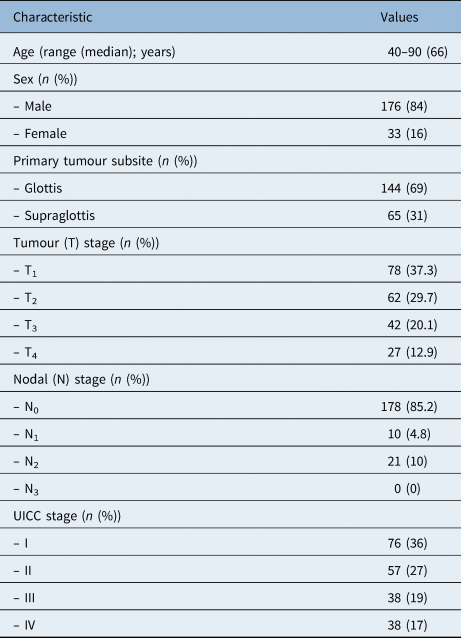
A total of 209 patients satisfied our selection criteria. The initial demographic and oncological characteristics of our cohort are summarised in Table 1. Mean age at diagnosis of laryngeal cancer was 65 years (median of 66 years, range of 40–90 years). Eighty-four per cent of patients (176 out of 209) were male and 16 per cent (33 out of 209) were female. Median follow-up duration was 48 months (mean of 45 months, range of 1–98 months). No patients were lost to follow up.
Baseline demographic and oncological characteristics

UICC = Union for International Cancer Control
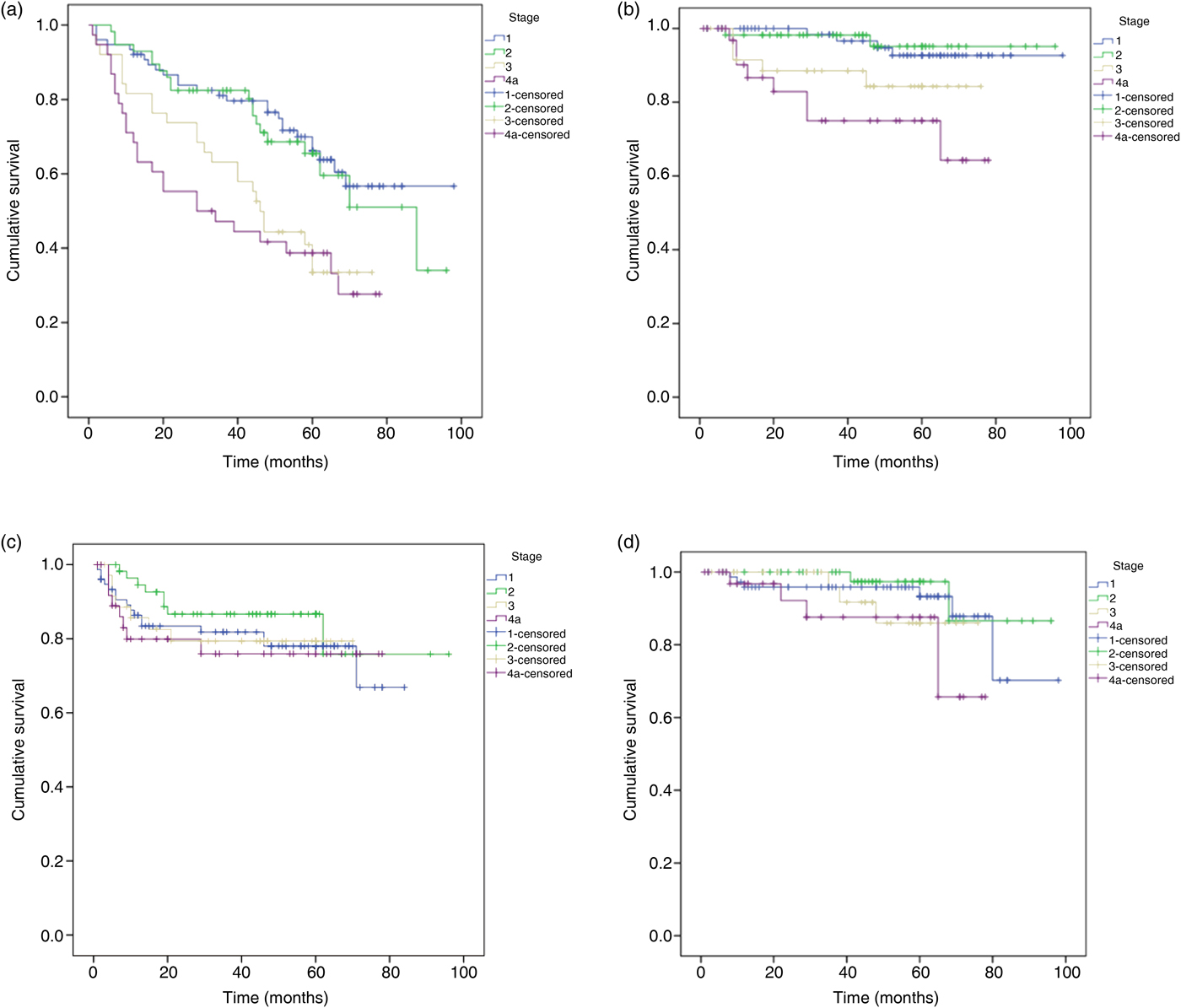
Oncological outcomes are summarised in Figure 1. The five-year overall survival rate for the entire cohort was 55 per cent (stage 1 = 70 per cent, stage 2 = 66 per cent, stage 3 = 41 per cent and stage 4a = 39 per cent). The laryngeal cancer disease-specific survival rate at five years calculated by the actuarial method was 89 per cent for the whole cohort (stage 1 = 93 per cent, stage 2 = 95 per cent, stage 3 = 84 per cent and stage 4a = 75 per cent). The locoregional recurrence-free survival rate was 80 per cent across all stages (stage 1 = 78 per cent, stage 2 = 87 per cent, stage 3 = 79 per cent and stage 4 = 76 per cent). The second primary lung tumour free survival rate was 93 per cent in stage I, 97 per cent in stage II, 86 per cent in stage 3 and 87 per cent in stage IV disease.
Cumulative survival curves, stratified by Union for International Cancer Control stage, for (a) overall survival, (b) disease-specific survival, (c) locoregional recurrence-free survival and (d) second primary lung cancer free survival.

Crude incidence of second primary lung cancer during follow up was 8 per cent (16 out of 209) as was the five-year cumulative rate. In 14 out of 16 cases, the diagnosis of second primary lung cancer was confirmed by biopsy; 8 of the 14 cases were SCC, 3 were adenocarcinoma and 3 were small cell carcinoma. Median survival following diagnosis of second primary lung cancer was 7 months (range of 0–18 months).
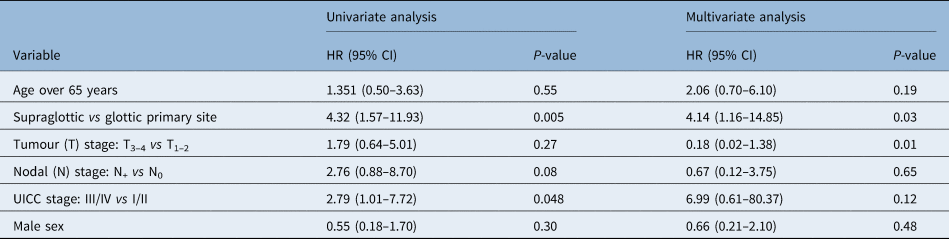
On univariate analysis, statistically significant associations were seen between the incidence of second primary lung tumour and: supraglottic primary site (p = 0.005), N+ tumours (p = 0.08), and Union for International Cancer Control stage III or IV disease (p = 0.048). On multivariate regression analysis, supraglottic subsite was associated with a significantly increased risk of second primary lung tumour (p < 0.03), whereas high T stage (T3 or T4) disease was associated with a significantly reduced risk of second primary lung tumour (hazard ratio = 0.18, p = 0.01). There were no statistically significant associations with N stage (p = 0.65), Union for International Cancer Control stage (p = 0.12), male sex (p = 0.48) or age over 65 years (p = 0.19) on multivariate analysis (Table 2).
Univariate and multivariate analyses of factors associated with second primary lung cancer development following laryngeal SCC treatment

SCC = squamous cell carcinoma; HR = hazard ratio; CI = confidence interval; UICC = Union for International Cancer Control
Discussion
Our actuarial five-year risk of second primary lung cancer was 8 per cent. This is comparable to other studies with similar follow-up durations,Reference Sjögren, Snijder, van Beekum and Baatenburg de Jong1,Reference Makeieff, Mercante, Jouzdani, Garrel, Crampette and Guerrier2 although five-year second primary lung cancer rates as high as 30 per cent have been reported even in early stage (T1 or T2) laryngeal disease.Reference Colosanto, Haffty and Wilson3
The follow-up regimen for patients following head and neck SCC treatment aims primarily to detect locoregional and/or distant recurrence, which is most common in the first three years.Reference Brandsorp-Boesen, Falk, Evensen, Boysen and Brøndbo4 The UK national guidelines reflect this, suggesting that reviews take place at least every two months for the first two years, and every three to six months in the subsequent years.Reference Paleri and Roland5 However, patients with a history of head and neck SCC remain at increased risk of death compared with controls well beyond this early post-treatment period.
A Surveillance, Epidemiology, and End Results (‘SEER’) database analysis of 35 958 head and neck SCC long-term (over three years) survivors showed that second primary malignancy remains the biggest cause of death in these patients (21 per cent), with the lung being by far the most common site of cancer (53 per cent).Reference Baxi, Pinheiro, Patil, Pfister, Oeffinger and Elkin6 In another large-scale population-based study, the risk of second primary lung cancer after head and neck SCC was reported to increase in a linear fashion up to 15 years after diagnosis.Reference Milano, Peterson, Zhang, Singh and Chen7 A study combining data from 13 different national cancer registries estimated the 20-year risk of second primary lung cancer after head and neck SCC to be as high as 13 per cent.Reference Chuang, Scelo, Tonita, Tamao, Jonasson and Kliewer8 The challenge for surgeons and oncologists who care for patients with head and neck SCC is therefore whether and how we can detect second primary lung cancer during follow up at an early enough stage to affect prognosis.
A recent study using the Surveillance, Epidemiology, and End Results database compared survival in early stage (1a–2a) lung cancer patients with and without a previous diagnosis of head and neck SCC.Reference Pagedar, Jayawardena, Charlton and Hoffman9 Five-year survival for patients with previous head and neck SCC was significantly worse than for those without (26 per cent vs 40 per cent, p < 0.0001). Statistically significant differences persisted in a subgroup analysis of lung adenocarcinomas only, and in patients whose second primary lung tumour was diagnosed more than two years after head and neck SCC. An attempt was made to mitigate against the potential confounding effect of pulmonary head and neck SCC metastases being misdiagnosed as true second primary lung cancer. These findings, and those of similar studies,Reference Jayaprakash, Cheng, Reid, Dexter, Nwogu and Hicks10,Reference Dhooge, De Vos and Van Cauwenberge11 are consistent with the very poor median survival of seven months following diagnosis of second primary lung tumour in our study.
Our series showed no statistically significant differences in second primary lung tumour rates in laryngeal cancer cases with a higher N stage (hazard ratio = 0.67, p = 0.65) or Union for International Cancer Control stage (hazard ratio = 6.99, p = 0.12). This may well be explained by the higher all-cause mortality in more advanced disease, with patients simply not surviving long enough to develop second primary lung cancer.
Screening
Given the poor prognosis of second primary lung cancer in our series and others, it is clear that efforts should be focused on early detection in this high-risk cohort. Furthermore, retrospective data suggest that patients with resectable second primary lung cancer have a similar prognosis to lung cancer patients with no previous history of head and neck SCC.Reference Koppe, Zoetmulder, van Zandewijk, Hart and Rutgers12
In patients who have undergone a previous total laryngectomy, the proximal tracheobronchial tree can be easily assessed at follow up by flexible endoscopy. A study of 30 such patients using white light and autofluorescence bronchoscopy detected pre-malignant lesions in 20 per cent of cases.Reference Cetinkaya, Veyseller, Yildirim, Aksoy, Ozgül and Gençoğlu13 Similar findings were reported in a study from the Netherlands, where autofluorescence bronchoscopy detected otherwise radiologically occult second primary lung cancers in 9 per cent of patients (5 out of 51) undergoing post-treatment surveillance of head and neck SCC.Reference Lee, de Bree, Brokx, Leemans, Postmus and Sutedja14
In one large retrospective series of 1086 patients, there was a small (four months) but statistically insignificant difference in median survival between patients whose second primary lung cancer was detected by routine screening chest X-ray versus those in whom symptoms prompted investigation of the chest.Reference Shah and Applebaum15 This no doubt reflects the relative insensitivity of plain X-ray in the detection of early lung cancer compared to computed tomography (CT). While some smaller studies from Japan and the Netherlands did show a modest survival advantage with annual chest X-ray, this could of course be attributable to lead time bias.Reference Shimizu, Ando, Teramoto, Moritani and Nishii16,Reference Engelen, Stalpers, Manni, Ruijs and van Daal17
Since 1993, the Early Lung Cancer Action Project has recruited more than 1000 asymptomatic smokers with at least 10 pack-years smoking history to assess the effectiveness of low-dose CT and plain chest X-ray as screening tools for lung cancer.Reference Henschke, McCauley, Yankelevitz, Naidich, McGuinness and Miettinen18 Lung cancer was detected on CT in 2.7 per cent of cases at initial screening, versus 0.4 per cent on plain X-ray. Stage I lung cancer was detected six times more frequently on low-dose CT when compared with plain X-ray, and was associated with a 10-year survival rate of 90 per cent.Reference Henschke, McCauley, Yankelevitz, Naidich, McGuinness and Miettinen18
Another landmark study in this area was the 2011 National Lung Cancer Screening Trial, which randomised more than 53 000 patients to receive either annual low-dose CT or plain X-ray over a three-year period.Reference Aberle, Adams, Berg, Black and Clapp19 The inclusion criteria were patients between 55 and 74 years of age, with at least a 30 pack-year smoking history, including ex-smokers who had quit within 15 years of the enrolment date. Five-year outcomes showed a 20 per cent (95 per cent confidence interval = 6.8–26.7, p < 0.004) reduction in lung cancer specific mortality in the CT group compared with the plain X-ray group, as well as a 6.7 per cent reduction in all-cause mortality because of the improved detection of other incidental chest diseases.Reference Aberle, Adams, Berg, Black and Clapp19 As a result, recent guidance from the National Comprehensive Cancer Network has suggested a role for CT screening for early lung cancer in patients who fulfil these criteria.20
Clearly, the potential exists for patients with laryngeal cancer to undergo some form of screening for second primary lung cancer. In Northern Ireland, follow-up assessment includes visualisation of the upper aerodigestive tract by flexible nasendoscopy; routine imaging of the chest is generally not carried out in asymptomatic patients. Our results showed that even in stage IVa laryngeal SCC, disease-specific and recurrence-free survival rates were 75 per cent and 76 per cent, respectively, at five years. There is a contrast therefore between the intensive surveillance of the primary site and the lack of routine attention paid to the chest, with its second primary lung cancer rate of 8 per cent and associated poor prognosis.
Diagnosis and prognosis
Any assessment of second primary lung cancer incidence will always incur some risk of misdiagnosing pulmonary metastatic disease as a true second primary lung cancer, and vice versa. Given that most laryngeal cancers are SCCs, the distinction is straightforward in cases where a different histological subtype is found in the chest (e.g. adenocarcinoma). In cases of a human papilloma virus (HPV)-positive oropharyngeal SCC, the detection of HPV DNA in any lung tumour may be of some value in making this distinction.Reference Bishop, Ogawa, Chang, Illei, Gabrielson and Pai21 However, there is some evidence to suggest that the surgical resection of limited pulmonary head and neck SCC metastases may confer some survival benefit. A small series of 36 patients from authors in the Netherlands compared outcomes following surgical resection in second primary lung cancer versus those with isolated pulmonary metastases from head and neck SCC. No significant difference was seen, with survival of roughly two years in both cohorts.Reference Geurts, Balm, van Velthuysen, van Tinteren, Burgers and van Zandwijk22
The poor prognosis for second primary lung cancer has been shown in large-scale observational studies, with reported median survival of less than one year.Reference Chen, Huang, Chan, Chen and Lee23 The finding persists even in patients with histologically discordant head and neck and lung cancers, suggesting the limited prognosis cannot be ascribed to the misdiagnosis of pulmonary metastases as second primary cancers.Reference Jayaprakash, Cheng, Reid, Dexter, Nwogu and Hicks10 This underlines the need for improved head and neck SCC follow-up regimens, which will maximise the chance of early second primary lung cancer detection. Some small case series have suggested an increasingly favourable outcome in second primary lung cancer as the time interval from index head and neck SCC increases.Reference Dequanter, Shahla, Lardinois, Gilbert, Hanquet and Tragas24 A recent meta-analysis looked at 13 studies dealing with pulmonary metastasectomy in the context of head and neck SCC primary cancer. This showed an overall five-year survival rate of 29.1 per cent. Poor prognostic factors included oral cavity and node-positive index tumours.
Risk factors
In our series, supraglottic versus glottic laryngeal SCC was associated with a significantly increased risk of second primary lung cancer (hazard ratio = 4.14, p = 0.03). This finding has been reported in several other series to date.Reference Milano, Peterson, Zhang, Singh and Chen7,Reference Silvestri, Bussani, Cosatti and Bosatra25 Other reported risk factors for SPLC include hypopharyngeal subsite, black race and male sex.Reference Milano, Peterson, Zhang, Singh and Chen7
The reasons for this increased second primary lung cancer risk in supraglottic SCC are unclear. The glottis and the lung are exposed almost exclusively to inhaled carcinogens in the form of tobacco smoke, whereas the supraglottis is to some degree also exposed to ingested carcinogens (e.g. alcohol). One might therefore expect a cohort of supraglottic cancer patients to have had relatively higher alcohol exposure than a similar cohort of glottic cancer patients, and conversely that a glottic cancer cohort would contain patients with relatively more tobacco but less alcohol exposure. If so, one might expect glottic cancers to present a higher risk of second primary lung cancer than other subsites. This is not borne out by current evidence, however. This may be explained by higher alcohol consumption being associated with corresponding higher tobacco exposure, and the known synergy of these two common carcinogens also clouds the picture somewhat.
Other evidence suggests that there may be a slight difference in patterns of second primary cancers with respect to index subsite, with more respiratory tract second primary cancer cases following laryngeal cancer and more digestive tract second primary cancer cases following hypopharyngeal cancer.Reference Lin, Patel, Chu, Matsuo, Singh and Wong26,Reference Chu, Chang, Huang and Tai27 This has obvious implications when considering follow-up strategies.
A Surveillance, Epidemiology, and End Results database study of more than 20 000 laryngeal cancer patients showed an overall second primary malignancy rate of 47 per cent at 20 years.Reference Gao, Fisher, Mohideen and Emami28 Among these second primary cancer cases, the lung was by far the most common anatomical site for synchronous or metachronous cancers (39 per cent). Interestingly, the study also suggested that the use of radiotherapy in laryngeal cancer treatment resulted in an 18 per cent increased relative risk of second primary lung cancer compared with the non-radiotherapy cohort. The extent to which one can infer a causal link, however, is limited as this study did not report on the use of chemotherapy, and conflicting findings have been reported by other, admittedly smaller, series.Reference Jones, Morar, Phillips, Field, Husbband and Helliwell29 There will of course be an association between radiotherapy and higher stage disease at presentation.
Study limitations
This study entailed a retrospective review of clinical records, and this invariably has the potential to adversely affect the quality and accuracy of the data. Unfortunately, during the time period in question, it was not our routine practice to record alcohol and smoking data routinely for all patients, and as such these potential variables could not be included in the analysis. These data are now included in the digital database for patients at first presentation to our regional head and neck multidisciplinary team, and we hope that this addition will improve the richness of data available for future studies in this and other areas.
• Patients treated for laryngeal cancer are at risk of developing second primary lung cancer during post-treatment surveillance (8 per cent over five years)
• Outcomes of second primary lung cancer are poor
• Patients with supraglottic cancers are at increased risk (vs glottic tumours) on multivariate analysis
• Consideration should be given to routine chest screening for earlier detection of second primary lung cancer
The relatively low number of events (i.e. cases of second primary lung cancer) in this study (n = 16) must be taken into account when interpreting the multivariate analysis findings. The traditional rule of thumb is that 10 or more events per variable are required to ensure a robust multivariate logistical regression. Clearly, at our second primary lung tumour rate of 8 per cent (16 out of 209 cases) over five years, this would require an analysis of many thousands of cases of primary laryngeal cancer, many more than exist in our regional database covering a population of around 1.8 million people. Nonetheless, a recent study from authors in the Netherlands has concluded that the evidence base supporting the need for 10 events per variable is weak, and that this area requires some re-assessment and further study.Reference van Smeden, de Groot, Moons, Collins, Altman and Eijkemans30
Conclusion
Laryngeal cancer survivors remain at significant risk of second primary lung tumour during follow up, with an actuarial rate of 8 per cent at five years in our cohort. Supraglottic versus glottic cancers appear to be associated with a statistically significant increase in the risk of a second primary lung tumour (p < 0.01). Data from the 2011 National Lung Cancer Screening Trial in the USA suggest there may be a significant advantage to routine chest screening with annual low-dose CT scanning in patients aged 55–74 years and with at least 30 pack-years smoking history, features which closely mirror any laryngeal cancer cohort. We suggest that routine annual CT scanning of the chest may have a role in the post-treatment follow up and surveillance of laryngeal cancer patients, particularly those with supraglottic tumours who appear to be at a significantly increased risk.
Acknowledgement
The authors would like to thank the Northern Ireland Cancer Registry (‘NICR’) for the provision of data.
Competing interests
None declared