They've gone into Hollywood and there discovered a great red plot. They have found dangerous radicals there, led by little Shirley Temple. Imagine the great committee raiding her nursery and seizing her dolls as evidence.
Harold Ickes.Footnote 1Perhaps it is fortunate that Shirley Temple was born an American citizen and that we will not have to debate the issue raised by the preposterous revelations of your committee in regard to this innocent and likeable child.
Frances Perkins.Footnote 2In August 1938, Secretary of the Interior Harold Ickes, and the first female Cabinet member and Secretary of Labor Frances Perkins, publicly attacked the recently formed Special House Committee on Un-American Activities and Propaganda, popularly known as the Dies Committee, after its chairman, Martin Dies, a Democratic Congressman from Texas.Footnote 3 Ickes and Perkins were the most senior, but not the only, Democrats to attack the committee's reliance on hearsay and guilt by association, which had linked Shirley Temple to Ce soir, alleged to be a French communist publication.Footnote 4 However, their criticisms drew particular attention to the intensely gendered and hostile nature of encounters between the Dies Committee and its opponents. In suggesting that the committee had resorted to searching the bedrooms of young, female movie stars, Ickes cast the committee's attempts to uncover communist conspiracies as both absurd and unmanly. In return, Dies chose an image of dangerous, authoritarian masculinity to attack Ickes and fellow New Dealers. Borrowing the idea of the all-American football team used by sports commentators, Dies suggested that Ickes would make it into his international football team of the world's all-time purveyors of hate, alongside other international villains: Works Progress Administration head Harry Hopkins, Hitler, Stalin and Mussolini.Footnote 5 But if male New Dealers such as Ickes and Hopkins were associated with dangerous authoritarianism, female New Dealers were a weak link in America's protective armour. At the same time as committee hearings were getting under way, Dies wrote a public letter to Perkins, charging her with failing to deport a suspected communist, Harry Bridges, a West Coast longshoreman union leader and Australian national.Footnote 6 In response, Perkins accused him of attempting to “usurp the functions and duties of the administrative branch.” Insisting that Dies possessed neither the authority nor “sufficient knowledge of the law” required to pass such judgements, Perkins publicly challenged Dies's attempt to claim an authoritative role as chair of the Special Committee on Un-American Activities and Propaganda.Footnote 7
The press war waged by Dies on senior New Deal Cabinet members outside the committee room was closely tied to and had important repercussions for the Committee's official hearings. This was particularly, though not exclusively, the case in their hearings on the Federal Theatre Project (FTP). Although the committee's search for communists covered a range of government agencies and departments, as well as labour unions and Hollywood, in their first session in the autumn of 1938 they paid particular attention to the FTP. The FTP was part of the Works Progress Administration (WPA). The largest and most ambitious New Deal agency, the WPA was a work relief programme that paid millions of unemployed Americans to work on public works programmes including the construction of public buildings and roads. The muscular, manly worker helping to build America became the poster boy for the New Deal and an iconic image in public memory.Footnote 8 Moreover, gender analysis of the New Deal has argued that many of its landmark social welfare reforms relied upon and reinscribed hegemonic notions of men as workers and women as dependents.Footnote 9 In this essay, however, I suggest that the Dies Committee hearings offer compelling testimony that for its opponents (and for some New Deal advocates) the WPA served as a symbol of the New Deal's potential to challenge gender hierarchies. Not only did women serve as high-ranking officials of WPA projects, but they made up 45 percent of the WPA workforce, a higher proportion than any other government agency, and considerably greater than the 15 percent figure for most executive departments.Footnote 10 However, as Woodward's biographer, Martha Swain, has argued, analysis of the WPA's impact on gender roles should not be limited to “tallying percentages of women on work relief or indicting WPA polices as discriminatory against women.”Footnote 11 Rather, it is important to consider how the WPA offered a challenge to the “gendered imagination” of the many lives and communities it touched.Footnote 12 The tone and tenor of the Dies Committee investigation into the WPA Arts Projects suggest that the “gendered imagination” of committee members (and perhaps, political opponents of the New Deal more broadly) was challenged, even threatened, by what the WPA had come to represent. The WPA supported not only manual work, but also cultural labour: among its many work relief programmes was a Federal Arts Programme that paid professional, unemployed artists to produce art, theatre, music and literature. Of the four art projects, the Federal Theatre Project was the most contentious. The four years of its operation, 1935 to 1939, coincided with a growing, bipartisan and increasingly hostile opposition to the New Deal: southern Democrats and Republicans were quick to find fault with a publicly funded theatre project which reached around 25 million Americans (approximately 20 percent of the population); refused to allow segregated audiences; and put on new plays which addressed labor, race and other social problems in America. That it was run by two well-respected female public officials who were close to WPA head Harry Hopkins, and that it was particularly prized by Eleanor Roosevelt, also made it a tempting target for opponents of the New Deal.
This essay examines the exchange that took place between Congressmen on the Dies Committee and two high-ranking female public officials who testified in defence of the FTP: Ellen Woodward, director of the Women's and Professional Projects, which included the FTP, and Hallie Flanagan, national director of the FTP. Before, during and after the hearings, members of the Dies Committee took considerable pains to present themselves as heroic public stewards, dedicated to unearthing those who would undermine the proper administration of American government. But in the course of the hearings on the Federal Theatre Project, the all-male committee saw their authority challenged by female public officials. In the ensuing conflict, Dies and his fellow Congressmen were forced to compete for the masculine-gendered role of public steward – a competition in which, I argue, they emerged on the losing side. Determined to renew their Congressional mandate and secure a larger appropriation, in January 1939 the committee issued its first report. Defensive in tone, the report represented the Dies committeemen as wounded, but not yet defeated, men whose rightful place and authority must be defended from un-American forces. Before turning to the hearings and the fallout of the first report, it is useful to situate them within the context of how historians have understood the gendering of opposition to the New Deal.
GENDER AND THE POLITICS OF NEW DEAL OPPOSITION
Although many recent accounts view the New Deal as reinforcing gender hierarchies, in the 1940s and 1950s many critics took quite the opposite view. Viewed through the lens of Cold Warriors, the New Deal tragically disrupted the gendered order. For example, Landon Storrs has demonstrated how in the 1940s and 1950s supporters of an extended welfare state were targeted as pink: not simply communist sympathisers, but feminine. Reconstructing the 1930s as an era of feminine values, where the state fostered dependency at the expense of rugged individualism, the gendered focus of postwar critiques was aimed both at the New Deal's supposedly “feminine” social welfare policies such as social security and national health insurance, and also at the powerful network of women public officials who promoted and administered them. In fact it was women's prominence as supporters of social welfare in the 1930s that later “enabled opponents to undermine popular support for those policies by feminizing them as ‘womb-to-tomb’ protections that would produce coddled dependents instead of self-reliant individuals.”Footnote 13 Postwar anticommunist attacks, as well as the more recent gendered critiques of the New Deal, are important in helping us understand how much is at stake in interpreting the New Deal's role in American life. Yet we must be wary of allowing either of these perspectives to eclipse the distinctive gender politics which shaped New Deal politics in the mid- to late 1930s. Women did play prominent and important roles in shaping New Deal politics and policy even as New Deal discourse privileged a particular and distinctive version of masculinity. In his analysis of New Deal and Popular Front rhetoric Philip Abbott suggests that the removal of the economic base of male authority, rather than undermining patriarchy, helped spawn its reinvention through the construction of “a new masculine public space.”Footnote 14 Much of this relied on a critique of the 1920s as reckless, decadent and unmanly. Risk, self-interest and competitiveness were no longer at the centre of a masculine world. They were replaced by responsibility, discipline and collective endeavour. In Abbott's words, “To be a man no longer depended on material acquisition but on public stewardship, no longer on speculation but on public adventure.”Footnote 15 Though Franklin Roosevelt was not the first to denounce the “feminized” consumption of the 1920s, Abbott argues that it was he who did most to discredit the 1920s in this way. In his speeches, FDR not only cast the 1920s obsession with consumption as unmanly, but invested manliness in the public steward who could best organize collective action for common goals, and thereby empower American manhood.Footnote 16 Skilled at employing a masculine rhetoric that affirmed vigour and vitality, the ability to perform an effective public masculinity was highly prized within the President's inner circle.Footnote 17
The gendered trope of the public steward offers a useful way of understanding the nature of the conflict that took place between anti-New Deal Congressmen on the Dies Committee and the female public officials they interrogated. Although New Deal programmes and administrators would later be attacked as effeminizing and effeminate (and consequently un-American), the 1938 Dies Committee hearings suggest that earlier opponents of New Deal programmes competed for, rather than tried to effeminize, the role of public steward celebrated in New Deal rhetoric. The rest of this essay examines what happened when women became competitors for this role. Both Ellen Woodward and Hallie Flanagan cloaked themselves in the masculine gendered role of public steward in order to defend their roles in government and women's role in public life more broadly. Their performance of this role infuriated Dies and fellow committeemen, because it was precisely the role that they, as New Deal opponents, were attempting to establish for themselves. Thwarted by the effective performances of female public officials, Dies and his fellow Congressman increasingly fused the rhetoric of anticommunism and un-Americanism with a wounded, displaced masculinity. Yet it was precisely this position of weakened masculinity which enabled them to launch a serious attack on powerful political women as the only means through which to redeem American manhood.
THE FEMALE LEADS: HUFFMAN, WOODWARD AND FLANAGAN
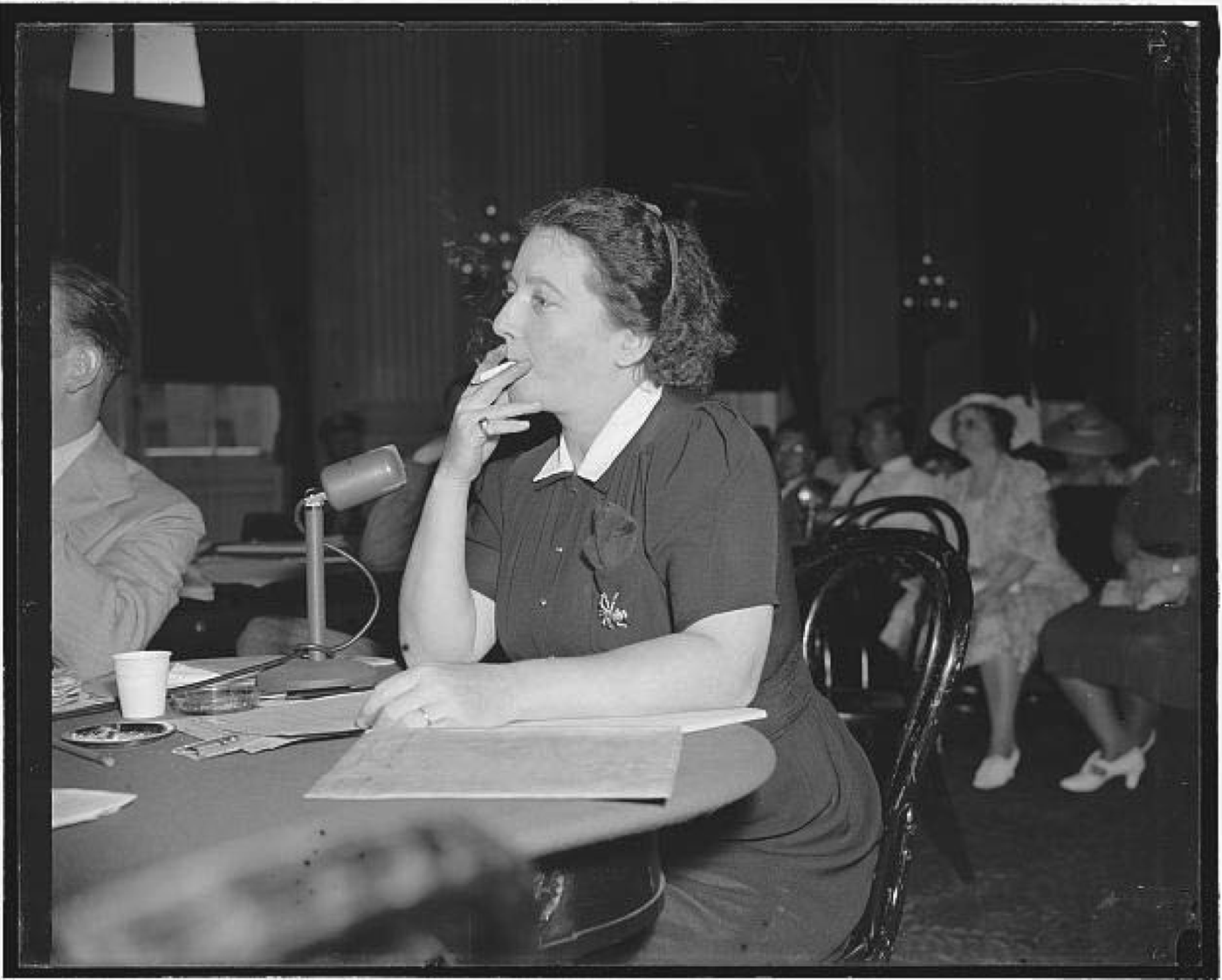
The first woman to testify on the Federal Theatre Project before the Committee could not have been further from the model of the public steward. Hazel Huffman was a WPA mail clerk who had never even worked on the FTP, but who claimed to be the representative of an unofficial group of disgruntled FTP employees who called themselves the Committee of Unemployed Theatrical Professionals.
Young, curvaceous and full of flattery for the committeemen, Huffman became a key witness in the case against the Federal Theatre. Taking up the best part of 19 August and over 150 pages of the published hearings, Huffman's mix of assertion, hearsay and speculation as to Federal Theatre employees’ political affiliations was accepted as evidence of un-American activity. At the heart of her testimony was the charge that Flanagan and her associates were sympathetic to communists, if not actually communists. Lacking substantive evidence, the case seemed to rest instead on Huffman's presentation of a list of twenty-six un-American plays which she claimed were propaganda for the communist cause. The list contained a significant proportion of Negro Unit productions, and evidence of a play's communist propaganda included “extreme anti-fascism,” “sympathetic portrayal of the workers,” and the use of “Negro songs of protest.”Footnote 18
Hazel Huffman testifying before the Dies Committee, c.1938. Library of Congress, Prints and Photographic Division.

The extensive involvement of African Americans in the Federal Theatre was frequently cited in friendly witness testimony as evidence of the project's communist tendencies.Footnote 19 Racial tolerance was so closely aligned in the minds of some committee members with communist activity that they even invited one friendly witness, Sallie Saunders, a white Austrian immigrant, to testify that she had been asked on a date by a fellow employee, who was African American. The “un-American” incident seemed to have occurred when Saunders complained to her supervisor. He apparently responded by saying he was in favour of social equality. Chairman Dies stated that the committee was not interested in the “racial question” except in so far as “it forms a vital part of communistic teachings” and was used to attract African Americans to the party. In allowing Saunders to testify that “social equality” was part of the communist programme and that racial mixing was encouraged by the Federal Theatre, the implication was that this constituted evidence that the Federal Theatre was in thrall to the communists.Footnote 20
Although this was the most explicit example of the committee's equation of racial integration with communist activity, it is indicative of the committee's broader attempts to uncover communists by revealing that “social equality” (code word for miscegenation) was a belief held, espoused and even practised by a majority of playwrights, actors, directors and administrators engaged on the FTP. It was also indicative of the often, but not always, coded way in which the committee promoted the idea that the Federal Theatre Project was a harbinger of communism, if for no other reason than because of its relatively progressive racial policies including integrated seating, even in the South, as well as interracial casting. Saunders's story was illustrative of the widely held belief that interracial mixing was only one step away from interracial sex. Communism was invading American bedrooms at taxpayers expense, and it might be wearing a black face.Footnote 21
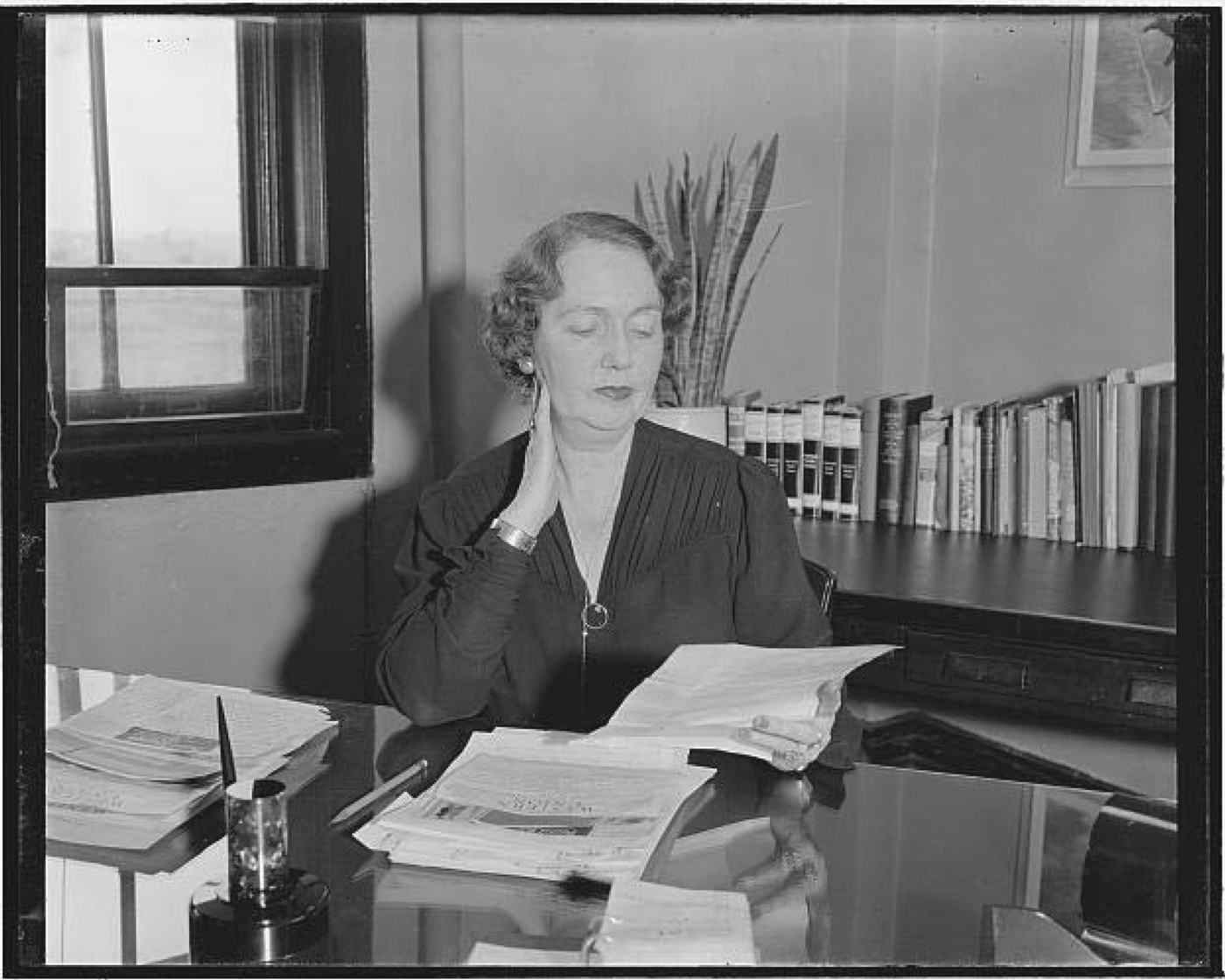
The outrageous, ill-informed and lengthy testimony offered by Huffman and Saunders prompted Hallie Flanagan and Ellen Woodward to demand they be allowed to defend the project. The national director of the Federal Theatre Project, Flanagan was a greatly respected figure in the noncommercial theatre world in her roles as Vassar Theatre Professor, playwright and experimental theatre director. Her boss, Ellen Woodward, was one of the most accomplished and high-ranking women in FDR's New Deal. Director of the Women's and Professional Projects, Woodward had responsibility for women's access to work relief programmes and was also the supervisor responsible for the four Federal Arts Projects – including the FTP. “A jealous votary of women's rights,” Woodward had a strong track record in promoting and defending women's right to relief work.Footnote 22 She also had the support of a tight network of professional women in federal government and the Democratic Party. This network boasted Secretary of Labor Frances Perkins and Congresswoman Caroline O'Day as its most prominent members, but also included high-ranking women in the State, Labor and Treasury Departments, as well as in government agencies and the Democratic Party. These women attained positions of unprecedented power during the New Deal and could count on Eleanor Roosevelt for support, influence and access to the President.Footnote 23 Woodward, then, was an important symbol of women's increased participation in formal politics and, alongside Perkins, the most prominent defender of women's right to work during the New Deal.Footnote 24
One month after the committee's investigation into un-American activity began, and frustrated that no WPA official had yet been called to defend the projects, Woodward wrote to Chairman Dies demanding that he hear testimony from well-informed public officials. Failure to do so, she informed him, would mean that the committee must “forfeit the right to any confidence” on the part of the American people in its proceedings.Footnote 25 Woodward was well versed in testifying before Congressional committees, though seldom such hostile ones. In January 1938 she had made her case before the House Appropriations Committee for sustaining funds for the Federal Arts Programmes (FAP) because of the “fresh current” they had brought to American life. With the FAP directors she testified before the House Committee on Patents who were examining a “joint resolution establishing a permanent cabinet-level Department of Science, Art and Literature.” She had also appeared before a subcommittee of the Committee on Labor and Education which was considering Florida Senator Claude Pepper's bill to establish a permanent Bureau of Fine Arts.Footnote 26 Though Woodward was experienced with Congressional committees, Flanagan was apparently surprised that as the director with intimate knowledge of the project she had not been called upon to defend it.Footnote 27 Historians have suggested that the choice of a Mississippian Democrat to defend the WPA was a tactical one, designed to placate, rather than challenge, the committee's gendered imagination. As Elsie George put it, “A gentlewoman of the old school from Mississippi, speaking in a pleasant voice with a Southern accent … does not conjure up visions of Communists and wild-eyed liberals.”Footnote 28 Moreover, in her biography of Woodward, Martha Swain suggests that Hopkins felt that Woodward, responsible for overall direction of the four programmes, would lack the detailed day-to-day knowledge of the programmes’ administration, thereby rendering her less vulnerable to attack from the committee.Footnote 29 But if Hopkins and his seniors hoped that Woodward would serve as a buffer between the Dies Committee and a direct assault on the New Deal they were mistaken. Rather, the tone and tenor of the committee's questions suggests that they saw Woodward not as a buffer, deflecting attention from Hopkins and the White House, but as symbolic of New Deal attitudes towards women and work.Footnote 30
Ellen Woodward, head of the Women's and Professional Projects, 22 December 1938. Library of Congress, Prints and Photographic Division.
Spanning 5 and 6 December, Woodward's testimony was an acrimonious affair. The New York Times reported that Woodward had “clashed heatedly” with Dies, describing the encounter as “a long wrangle,” while the Washington Post recorded a “tumultuous hearing.”Footnote 31 In her report on “Mississippians at the Capital,” for the Jackson Daily News, Kathleen Sexton recounted the intimidating atmosphere created by the Congressmen, who pointed “accusing fingers,” waved their cigars and thumped their papers. The tenor of these accounts suggests that reporters had witnessed a woman who refused to be intimidated, who, in Sexton's words was “in there battling to the end.”Footnote 32 The written record of proceedings supports these accounts: Congressmen Dies, Thomas and Starnes repeatedly interrupted Woodward and insisted she lacked detailed knowledge of the plays under discussion. As was customary, Woodward had brought with her a prepared statement which she expected to read. The Congressmen had different ideas. Thomas in particular was keen to engage Flanagan in battle and he repeatedly challenged Woodward's authority to testify, moving an early motion to dismiss Woodward in favour of Flanagan.Footnote 33 Dies rejected the suggestion, appearing, at least initially, to relish the challenged posed by Woodward.
As part of his strategy to undermine Woodward's authority, Dies attempted to present a picture of an administrator so overstretched, at such arm's length from the projects she supervised, that she was simply incapable of knowing of, much less preventing, communist activity in the FTP. To support this line of argument, Dies tried to insist that Woodward could only testify on events and meetings she had personally attended. This turned out not to be a useful principle for Dies's purposes, since Woodward used it to draw attention to the committee's own procedures: Dies had not himself attended the New York subcommittee which had been investigating the Federal Theatre in New York, yet he was prepared to accept and broadcast testimony given there. Woodward's challenge pushed Dies into a corner. As Woodward put it, “You cannot be present at everything, can you?”Footnote 34 It is unclear whether Woodward knew of, and was also alluding to, Dies's highly irregular and personal subcommittee, which had met just two days earlier. Consisting only of Dies, the “subcommittee” had received and released to the press evidence from professional anticommunist J. B. Matthews, before fellow committeemen had been granted the opportunity to review it.Footnote 35 In any case, Woodward's challenge put Dies on the back foot and cast doubt on the legitimacy of the committee's entire work to date when Dies conceded that the committee had previously received much “hearsay testimony and opinion evidence,” which, while useful, could not form the basis of their report.Footnote 36
While Woodward won an early battle, the committee refused to allow her to make progress with her statement. When she protested against the repeated interruptions to the Chair, Dies refused to uphold her complaint, insisting “that you continued to attack this committee in a very vicious way.” It is, he insists, incumbent on her to “be fair” and yield to interruptions because “we are going to permit you to make your attack on this committee.”Footnote 37 Unchastened by Dies's defensive assault, Woodward, who was finally allowed to return to reading her statement, instead used the opportunity to launch a full-frontal assault on the committee. Ignoring the Congressmen's warning that she “stick to your text,” Woodward challenged the committee's authority: “I must express my deep concern and disappointment over the very un-American way in which the Committee has handled charges made against this project under my jurisdiction.” Insisting that she and the WPA had been keen to cooperate from the outset, she continued,
I am here now only because we have repeatedly insisted upon and demanded the opportunity to be heard, and to establish the falsity of testimony of previous witnesses. Your committee, instead of hearing all available witnesses chose to limit its enquiry to the testimony of a few witnesses, most of whom were disqualified by their background to testify on the subject matter under investigation. I submit that this is hardly in keeping with the American tradition of fair play and unbiased investigation.Footnote 38
Woodward might have been referring to any number of individuals whose credentials as professional anticommunists had made them problematic witnesses.Footnote 39 Perhaps she had in mind Walter Steele, who had put himself forward to testify before the committee on behalf of a hundred “patriotic” organizations, and had accused the CIO, the ACLU and the Federal Theatre of being “Communist Front organizations.” As editor of the anti-Semitic National Republic, an official of the American Coalition of Patriotic Societies and a member of the pro-Nazi Paul Reveres, perhaps Steele's own activities should have been the subject of the Dies Committee investigation, whose remit included the investigation of fascist organizations.Footnote 40 Pressed for evidence from Dies to support her charge that the committee was un-American, Woodward again pointed to their reliance on biased and ill-informed witnesses, and insisted that the committee had, “by giving its implied approval of this testimony … jeopardized in my opinion the jobs and daily bread of thousands of these needy good American men and women.”Footnote 41
Woodward's charge that the committee represented an assault on American jobs allowed her to position herself as the heroic defender of the good and the needy. This stance led to several motions to dismiss her as a witness, which she survived. At this point in the proceedings, having condemned the entire committee, Woodward had little left to lose. When Congressman Starnes questioned her competency to testify on behalf of the FTP on account of having seen so few plays, Woodward responded casually that a similar ignorance had not prevented her interrogators from claiming authority over the meaning of these plays. Her response caused Starnes to explode,
You are not here to ask the committee questions. You are here to answer questions. You and every other witness are here to answer questions; not to ask them … I must insist that you be respectful to this committee … We were appointed to ask questions and to investigate, not to be investigated.Footnote 42
Shortly after Starnes lost his cool, and having repeatedly defended her competency to testify, Woodward finally stepped down to allow Hallie Flanagan to come to the stand. While other commentators have suggested that Woodward must have been “happy” to get off the stand after her ordeal at the hands of the committee, her assault on the methods of the committee and the coverage it received suggest that the joy at her departure was shared by her adversaries.Footnote 43 For her part, friends and colleagues congratulated Woodward on her “courage,” for showing herself “a real fighter,” while Flanagan described her efforts as “gallant.”Footnote 44
If the committee was relieved to get rid of Woodward, that relief was short-lived. When Flanagan was finally allowed to testify about the project she had directed since its inception in August 1935, she immediately challenged the very foundation of their investigation. Asked to describe her duties, Flanagan responded, “Since August 29, 1935, I have been concerned with combating un-American inactivity.” Clearly not listening very carefully, Chairman Dies attempted to stop her in her tracks: “No. We will get to that in a minute.” Flanagan, however, insisted he pay proper attention: “Please listen. I said I am combating un-American inactivity.” Un-American inactivity, she insisted, had shaped too many American lives, prior to the establishment of relief programmes such as hers.Footnote 45 Flanagan's canny wordplay attempted to reframe the debate into one about unemployment by focussing attention on what the New Deal had done to get Americans back to work. Un-American inactivity cast those southern Democrats and Republicans who sought to cut funding for New Deal relief programmes as un-American, in their preference for wasted, unproductive, idle lives. Employing the masculine discourse of the heroic administrator, Flanagan positioned herself not as a maternal, social welfare reformer, but as a responsible public steward who in implementing important work relief programmes had saved American lives.
Flanagan's seizing of both the agenda and the role of public steward was not quite what the committee had bargained for. Along with fellow Congressmen Starnes and Thomas, Dies repeatedly challenged Flanagan's claim to such a role, a role they sought for themselves, a role for men. To make this point they quickly turned the focus of their inquiry to Flanagan's personal and professional reputation prior to her role at the Federal Theatre. Keen to dismantle the notion of Flanagan as a public steward, Congressman Starnes tried to represent her rather as an intellectual and unusually erudite woman who had been the first female recipient of a Guggenheim scholarship. Having established that Flanagan was a graduate of Grinnell College and took a Master's degree at Radcliffe, Starnes cast doubt on her disciplinary credentials, inquiring, “your work at Vassar has been in the experimental field?” Flanagan made clear that she worked in the department of English, as a professor of English with responsibility for experimental theatre. Starnes's line of questioning appeared primed to establish that Flanagan's scholarly talents had been sadly misdirected towards Russian theatre. Pointing to the fact that Flanagan had spent three of her fourteen months’ travel funded by the Guggenheim studying the theatre of Russia, he attempted to paint a picture of a theatre practitioner whose academic interest and sympathies lay with Russian and workers’ theatre.Footnote 46
The battle around Flanagan's intellectual prowess and her scholarly publications grew in intensity as Starnes sought to depict Flanagan as a misguided, but potentially dangerous, leftist intellectual. Unfortunately for Starnes, it was a battle which culminated in his humiliation, as he sought, unsuccessfully, to outmanoeuvre Flanagan and assert his status before his fellow committeemen. Starnes's approach to cross-examining Flanagan was to fire a volley of questions and then interrupt before Flanagan had the chance to answer. His boorish behaviour prompted Congressmen Dempsey and Thomas to intercede on Flanagan's behalf. Instead of interrogating the supposedly Russophile academic, the committee soon became engaged in a protracted internal dispute as to whether Starnes's treatment of Flanagan constituted “correct procedure.”Footnote 47 The term “correct procedure” in this instance seemed to refer as much to the gendered codes governing appropriate behaviour towards women as to the loose and inconsistently applied committee rules. In fact, this irritable eruption signified a wider conflict over appropriate masculine behaviour as the Congressmen struggled to assert their authority over their female witness. Starnes's aggressive questioning of a woman would seem to suggest she was his equal, or, perhaps worse, his superior, as Starnes lost his composure during the exchange. In any case, Starnes's behaviour hardly represented the model of a heroic public steward poised to uphold and defend the gendered order.
That Starnes had failed to behave in a way appropriate to the gendered role of public steward is illustrated by his attempt to regain his authority over Flanagan and in the eyes of the committeemen:
I want to say this to the gentlemen on the committee and to the witness: I have no disposition to interrupt the witness in answering questions provided the answers are responsive to my questions … But when it is not responsive to the questions I reserve the privilege of calling the witness's attention to that fact and asking her to answer my questions.Footnote 48
Starnes's status before his fellow committeemen, however, appeared to have taken a hit. When Congressman Thomas accused Starnes of interrupting Flanagan whenever he did not like her answer, Dies attempted to mediate, explaining, “The correct procedure is that which is followed in court. The witness's testimony is supposed to be responsive; and then if the witness has any explanation to make, she may make it.” Congressman Dempsey, however, continued Thomas's attack: “The witness makes her statement and you don't let her finish it. You interrupt her, and I object to that.” A wounded Starnes responded, “I think such a remark is a little uncalled for.” Although the chairman tried to bring the dispute to a close, it was Flanagan's intervention that got the process moving along, with a suggestion: “Do you want me to continue with a discussion of the Russian theatre?”Footnote 49 Starnes did not, and although he attempted a further interrogation of Flanagan's visit to Russia, he did not recover his credibility. After only a brief pause, Starnes tried another approach. Quoting at length from a 1931 article Flanagan published in Theatre Arts Monthly on the development of the American workers’ theatre, Starnes suggested that Flanagan supported a radical theatre whose goal was to overthrow the American system. In spite of Flanagan's attempts to make a distinction between reporting on and advocating the views of others, Starnes insisted that she was not simply reporting, but rather wholeheartedly endorsing, the goals of the workers’ theatre. Starnes finally thought he had Flanagan when he quoted her description of the workers’ theatre goals:
Unlike any art form existing in America today, the workers’ theaters intend to shape the life of this country, socially, politically, and industrially. They intend to remake a social structure without the help of money – and this ambition alone invests their undertaking with a certain Marlowesque madness.
Attempting to paint Flanagan as an associate of communists, Starnes demanded to know, “You are quoting from this Marlowe. Is he a Communist?” With a theatrical politeness which only focussed more attention on Starnes's error, Flanagan apologized: “I am very sorry: I was quoting from Christopher Marlowe.” Starnes, now on the back foot, requested that Flanagan “Tell us who Marlowe is, so we can get the proper reference.” Without skipping a beat, Flanagan responded, “Put in the record that he was the greatest dramatist in the period of Shakespeare, immediately preceding Shakespeare.”Footnote 50 She might have added, “you have heard of him at least?”
Immortalized in Tim Robbins's 1999 film Cradle Will Rock, the Starnes–Flanagan battle was also a source of amusement to reporters at the time. Under the headline “A Congressman learns about Marlowe,” Life recounted Flanagan's dry response after being “barked at” by Congressman Starnes. Time magazine recorded a similar note of superiority, when it described how the FTP's national director “patiently” explained who Marlowe was to the unsuspecting Congressman.Footnote 51 Accounts both contemporaneous and much later have paid considerable attention to this incident, viewing it as indicative of the committee's dubious methods, in particular of guilt by association.Footnote 52 Yet Starnes's authority had already been damaged. Even before the Marlowe incident, Starnes had been challenged by his colleagues for his inappropriate and aggressive treatment of a woman. The bickering Congressmen were correct in fearing that such scenes would not play well: the New York Times described how committee members “heckled” Flanagan, as the “questions tumbled out so fast that sometimes she had to juggle with two or three at a time and was continually cut off from completing her sentences.”Footnote 53 Matters did not improve when Starnes finally handed over the baton to long-time public critic of the Federal Theatre Project, J. Parnell Thomas.
Republican Congressman for New Jersey, Thomas had been relishing this battle for some time. In September, Thomas had denounced the Federal Theatre Project in a public radio broadcast as a “veritable hotbed of un-American activity.” Although the committee was only one month into its investigation and had yet to hear from a single WPA official, Thomas was confident that the Federal Theatre would be found un-American: “because it produces communistic plays,” “because it favors giving jobs to radicals, and because it fosters New Deal propaganda.”Footnote 54 It had been Thomas who had repeatedly requested that Woodward be dismissed so he could get to Flanagan. That the Federal Theatre director had tripped up fellow committee member Starnes seemed only to whet his appetite. But, like Starnes, Thomas would allow Flanagan to get the better of him.
Thomas was keen to get Flanagan to denounce the Living Newspaper Injunction Granted, which included a representation of a real-life incident in which the Workers Alliance (the union for workers on relief programmes) invaded and staged a sit-in of the New Jersey State Legislature, Thomas's home state. Although Living Newspapers were documentaries based on published newspaper sources, Thomas insisted that Injunction Granted constituted “inappropriate propaganda” against an elected state legislature. When Flanagan declined to denounce the play, explaining that the Living Newspaper took no editorial position but simply dramatized events by quoting from actual news stories, Thomas seemed to implode:
I want an answer to my question specifically, and I want to say this also on that point, and that is that representatives of the Federal Theatre Project and the Art Project who have come before this committee – and this is my personal opinion – have evaded question after question. Instead of answering the question specifically, many of them – not all of them – have evaded the question.Footnote 55
Only minutes earlier Thomas had attacked fellow committee member Starnes for hectoring Flanagan and failing to listen to her answers. Now in charge of the questioning, Thomas was similarly defensive. Certainly Flanagan's theatrical expertise and tight grasp of FTP administration equipped her well for the battle with the Congressmen. Emmett Lavery, director of the FTP's play-reading department, described Flanagan's testimony as “probably the most brilliant exposition of American theatre that has ever appeared.”Footnote 56 Unable to compete with Flanagan in discussing a play's message and meaning, Thomas was forced to refocus his line of inquiry. He moved instead to an examination of the Federal Theatre Project's efficiency, an area which could have little to do with the committee's remit of “un-American activity and propaganda.”
Thomas sought to show, and have Flanagan account for, the Federal Theatre's long preparation time from planning to final production, particularly in comparison with commercial productions. In order to make his point he singled out the New York-based Sing for Your Supper, a musical comedy that had been in preparation for thirteen months, was subject to continued cast changes and had yet to open. Flanagan explained that Federal Theatre plays took longer because their wages were set by Congress, whereas Equity could set its own hours and wages to get shows to production more quickly. Moreover, one of the purposes of the Federal Theatre was to return unemployed actors to professional jobs, so Broadway agents were continually poaching the best talent from Federal Theatre plays. Finally, the Federal Theatre had far fewer options when it came to casting than a commercial producer. Compelled to use those actors who were eligible for relief, a period of retraining was often necessary. The back-and-forth between Flanagan and Thomas about the delayed opening of Sing for Your Supper finally provoked Starnes to intervene. With the shoe now on the other foot, Starnes attacked Thomas's line of questioning, suggesting that he had wandered “far afield” in focussing on purely administrative, rather than un-American, matters.Footnote 57
Starnes's intervention is important because it broke up the dialogue between Flanagan and Thomas, prompting Flanagan to inquire with mock innocence, “May I ask whether delays are un-American?”Footnote 58 Thomas was forced to concede that they were not. But in his defence he made an extraordinary attack on his own committee, pointing out that the committee had allowed a whole range of subjects that had little to do with un-American activity and reminding the committee that they earlier received the testimony of a witness who testified to the FTP's “inefficiency, extravagance and corruption.”Footnote 59 Thomas's continued attack on the FTP on grounds of inefficiency plunged the hearings into turmoil: Starnes denounced as irrelevant an attack on the federal theatre “that has absolutely nothing in the world to do with this [un-American activity]”, while Dies was forced to rule that the efficiency or otherwise of the FTP's administrative operations was not within the remit of the investigation. Dies's ruling and Thomas's insistence that much previous testimony had established the precedent of asking questions which had little to do with un-American activity cast doubt on the legitimacy of the committee's entire work to date.Footnote 60 In his detailed study of the Dies Committee hearings, August Raymond Ogden wondered why it was at this precise moment that a committee happy to accept a range of evidence in other cases “suddenly decided that questions of administration were beyond its ken.”Footnote 61 Although Flanagan was willing to respond to the charges of inefficiency and corruption, Dies prevented her from answering and Thomas's attack came to an end.
Both Starnes and Thomas were frustrated in their attempts to interrogate Flanagan: both attacked Flanagan (as they had Woodward) for failing to recognize their authority, and both turned on each other in their attempts to reestablish that authority. Martin Dies, however, was a more effective interrogator and he succeeded in putting Flanagan on the defensive in a discussion of propaganda plays. In his cross-examination he pushed Flanagan into a corner in her defence of Arthur Arent's 1937 Living Newspaper Power, which examined the efforts of another New Deal programme, the Tennessee Valley Authority (TVA). In face of great opposition from privately owned utility companies, and questions about its constitutionality, the TVA established a publicly owned utility company to provide cheap electricity to the poor. In January 1938, the Supreme Court had ruled that governments could provide assistance to municipal power plants. Nevertheless, in late 1938, the question of public ownership of a utility company was still a divisive one, and one which the Federal Theatre appeared to have come out firmly in favour of with productions of Power in New York City, Seattle and San Francisco.Footnote 62 Dies challenged the authority of the Federal Theatre, and Flanagan, as director, to make such decisions on important political issues. Where, he asked, would Flanagan draw the line? Would she sanction a play that advocated public ownership of all utilities? Flanagan sidestepped the question, explaining that the principle for the Federal Theatre in play selection must always be whether the play was a good play. If a play advocating public ownership of all utilities were a good play, she confirmed, the Federal Theatre would produce it. Finally Dies had Flanagan where he wanted her and presented her with the following challenge: “And if someone came with a play showing the public ownership of all the property in the United States, and it was a good play, you would also exhibit that, would you not?” Flanagan is forced to concede she would not, and that her principle of whether or not it was a good play would be secondary, because such a proposition would be tantamount to overthrowing the US government. Triumphant in his victory, Dies responded, “In other words, you would favor doing it by degrees, but not all at once. Isn't that right?”Footnote 63
Although Dies won a notable victory in regard to the discussion of Power and play selection, ultimately Flanagan was successful in challenging the authority of the committee. Flanagan was able to demonstrate that the committee was irresponsible and un-American in its reliance on hearsay and speculation in preference to substantiated evidence. Just like many of the witnesses who appeared before him, Dies was too quick to make unsupported assertions about communism and class conflict within Federal Theatre Plays. Repeatedly asserting that Federal Theatre plays were full of scenes of class conflict, Flanagan challenged him to name one.Footnote 64 Preferring the hypothetical, Dies could not. Though he had earlier used a hypothetical case to out manoeuvre Flanagan he could not compete with Flanagan when it came to a detailed grasp of the Federal Theatre. Nor it seemed, did he have a detailed grasp of his own committee hearings. In the final conflict between Flanagan and Dies, Flanagan demonstrated that it was he, rather than herself or Woodward, who was not in command of his brief. When Dies again insisted that the Federal Theatre Project was full of communist sympathizers, Flanagan again asked him to provide evidence. Believing that he had finally triumphed, Dies named a self-confessed communist who offered testimony before the committee. Alas, it turned out that the individual concerned was not in the Theatre Project, but on the Writers Project. Flanagan pointed out his error, soon after which this embarrassing mistake led the Congressmen to adjourn for lunch and marked the end of Flanagan's formal testimony.Footnote 65
WINNERS AND LOSERS?
In her account of the Dies Committee hearings in Arena, her 1940 book defending the legacy of the Federal Theatre, Flanagan evaluated her encounter with the Dies Committee in theatrical terms:
As the hearing broke up I thought suddenly of how much it all looked like a badly staged courtroom scene; it wasn't imposing enough for a congressional hearing on which the future of several thousand human beings depend. For any case on which the life and reputation of a single human being depended, even that of an accused murderer, we had an American system which demanded a judge trained in law, a defense lawyer, a carefully chosen jury, and above all the necessity of hearing all the evidence on both sides of the case. Yet here was a Committee which for months had been actually trying a case against Federal theatre, trying it behind closed doors, and giving one side only to the press.Footnote 66
Accused of presiding over poor -quality, un-American theatre at the expense of the taxpayer, Flanagan reversed the charge: the Dies Committee was bad theatre; lacking in masculine authority, it was not imposing enough; the Dies Committee was un-American in spirit and procedure; lacking basic standards for submissible evidence and trained officials, it sometimes heard evidence in private before only the committee chair. Reviewing the Dies Committee's performance as a theatre critic might, at the heart of Flanagan's critique was the fact that the Dies Committee's investigation was not even a good imitation of the real thing, the American courtroom. Relying on poor standards of evidence and manipulation of the press, the Committee set out, she believed, to “convict” the Federal Theatre Project, in the public's mind, of aiding communism, making it difficult for its supporters to defend it. Written in 1940, Flanagan's account appeared after the Dies Committee's “guilty verdict” had done enough to damage the FTP's reputation and ensure that neither Harry Hopkins nor the President could risk jeopardizing the entire WPA just to save the Federal Theatre when the WPA's appropriation came up for renewal in 1939.Yet just as Flanagan had refused to hand a victory to her adversaries in the Dies hearings, she resisted the notion that she had been on the losing side in the committee room. Recalling that her testimony had been prematurely terminated by the Congressmen's sudden desire for lunch, Flanagan remembered asking if she could finish her statement after the recess. The most outspoken critic of them all, J. Parnell Thomas, apparently responded, “We don't want you back.” He laughed, “you're a tough witness and we're all worn out.”Footnote 67
Beginning with Perkins's public condemnation of the committee and extending through the acrimonious testimony of Woodward and Flanagan, New Deal women played a central role in exposing the committee to ridicule. The effective performances of public steward by Woodward and Flanagan before the Dies Committee cast doubt on their opponents’ ability to perform an empowered public masculinity. Their criticisms of the committee's procedures were echoed in Congressional speeches and the editorial pages of liberal newspapers. Writing in the Washington Post, Richard L. Strout lamented Dies's fondness for headlines at the expense of investigative rigour and was particularly critical of the opportunity that Dies provided for embittered individuals to slur opponents who lacked the right of reply.Footnote 68 The editor of Christian Century suggested that Dies dismissed as un-American anything he did not like.Footnote 69 Though agreeing that the US should be protected from subversive activities, the New York Times “seriously doubted if the Dies Committee had shown itself to be an ideal instrument for accomplishing this purpose,” and suggested that the committee membership be shaken up.Footnote 70 In Congress, opposition to the Dies Committee again focussed most on its dangerous methods, and prominent figures associated with the committee were among the most outspoken critics. Congressman Dickstein, who had played a prominent role in earlier Congressional hearings and laboured to get the Dies Committee established, was a prominent critic, while Congressman Dempsey, Democratic member of the committee, agreed with Dickstein that “he could not find anything in the evidence that any court of law or even a justice of peace would permit.”Footnote 71
Polls, however, suggest that the Dies Committee had popular support. Conducted on 11 December, towards the end of the hearings and after Flanagan and Woodward had testified, a Gallup Poll revealed that 74 percent of voters supported continuing the investigations of the committee.Footnote 72 With public opinion on their side, but serious criticisms of the committee's procedures and personnel coming from the liberal press, from members of Congress and from senior New Dealers, Dies issued a report on the first session defending the committee's record. Published on 3 January 1939, Dies's first report struck an injured note. Ickes and Perkins are prominent offenders: “Certain cabinet officers,” he charged, “deliberately sought to discredit the investigation by ridicule and misrepresentation.”Footnote 73 Continuing this wounded tone, Dies listed his failed efforts to secure the loan of investigators to aid the committee: the Attorney General, the FBI, the Justice Department, and even the President were accused of deliberately attempting to “hamstring and discredit the investigation.”Footnote 74 In spite of injury and insult, the committee would not be deterred “from the fearless performance of its duty and function,” or from fulfilling “the solemn obligation to the people of this country to focus the spotlight of publicity upon every individual and organization engaged in subversive activities.”Footnote 75 According to the St. Louis Post-Dispatch the committee's report reflected the hearings themselves in that both were full of “distortions and fantasies,” while the New York Times wondered at the popular support the Committee commanded in spite of its “slipshod and biased nature.”Footnote 76 Newspapers that had long supported Dies, such as the Chicago Tribune, were sympathetic to the report and echoed Dies's defensive tone.Footnote 77
Just three weeks after Dies issued his report detailing how the investigation had been hamstrung by its powerful opponents, Dies Committee member and Republican Congressman J. Parnell Thomas introduced House Resolution 67, calling for the impeachment of Frances Perkins. As August Raymond Ogden pointed out in his study of the Dies Committee, though Thomas's resolution was not the work of the Dies Committee, it relied on evidence received by the committee and, as he put it, “was certainly nicely timed in view of the approaching debate on the continuation of the Committee.”Footnote 78 The Dies Committee therefore represented itself as under attack just as it was itself launching a powerful attack on the New Deal's most prominent female politician. Although impeachment proceedings against Perkins did not get far, the committee did succeed in making the Federal Theatre a political liability for the Democrats, and in June 1939 Congress voted for an immediate withdrawal of all funding. The Dies Committee, by contrast, had a longer life: its appropriation was immediately quadrupled and in 1945 it became a permanent standing committee, the House Committee on Un-American Activities (HUAC).Footnote 79
If the Dies Committee continued and the Federal Theatre shut down, what does it matter that two public female officials caused a handful of New Deal Congressional opponents to squabble, struggle and expose themselves to ridicule at a public hearing? The significance of Flanagan and Woodward's performances becomes clearer if we consider them in light of the performances of female witnesses in the late 1940s and 1950s. In their studies of Hollywood actresses and female public officials respectively, Molly Barringer and Landon Storrs have demonstrated that women summoned before HUAC as unfriendly witnesses and by Federal Loyalty Boards had open to them only a narrow range of feminine roles which required them to appear as scatty, flirtatious, forgetful or naive. The Cold War climate encouraged more intensely hostile attitudes towards women in government, making it extremely difficult for them to challenge their accusers and defend their jobs.Footnote 80 By contrast, Woodward and Flanagan were able to defend their public roles in terms which challenged presumptions of males’ exclusive right to these roles. Not only this, but they also forced Dies Committee members to defend their own gendered performances and claims to authority. In his analysis of the heroic masculine public steward, Philip Abbott allows that “the expansion of the public sector as a masculine project also certainly expanded the role of women in this sphere as well,” and acknowledges that Perkins, Flanagan and other women had status as “heroic administrators.” But to what extent, Abbott wonders, did they succeed in challenging the “dominant gendered model?”Footnote 81 As public officials, women like Woodward and Flanagan had to learn how to exploit and challenge gendered discourses in order to disable opposition to the New Deal and to the prominent role of women in it. By the time they appeared before the Dies Committee in December 1938 they had become adept at using the role of the masculine public steward for their own purposes. Their appearance before Dies, then, offered a very public platform for them both to demonstrate their abilities as public stewards and to defend their right to such roles. As such, their articulacy, refusal to be intimidated, and willingness to challenge the very foundations of the Dies investigation constituted an extraordinary challenge to the gendered order.
The squabbles, outbursts and concessions of Dies Committee Congressmen in response to the testimony offered by Flanagan and Woodward suggest that these women did challenge hegemonic gender models, and the gendered imagination of their interrogators. I do not offer up these performances in mitigation of New Deal legislation that privileged male workers and citizenship, nor do I suggest that the masculine politics of both New Dealers and New Deal opponents were not often harmful to women. Rather, the Dies Committee hearings into the Federal Theatre Project remind us that the role played by high-profile public female officials is central to our understanding of the evolution of the New Deal and of attempts to dismantle it. The political culture which shaped both the New Deal and the growing opposition to it in the late 1930s was a response not only to fears that the Depression had removed the economic base of male authority, but also to women's increasingly public, increasingly political and increasingly successful challenges to the gendered order that sustained male supremacy. The Dies Committee Hearings into the Federal Theatre Project offer insight into the distinctive gender discourses which shaped both the New Deal and opposition to it before the war and before anticommunism came to dominate American political culture. Understanding the gender discourses of anti-New Deal politics can also offer us a better understanding of the importance of gender in enabling un-Americanism to gain so strong a foothold in postwar America and paint a more complex picture of how it was resisted.