Introduction
Mean age at menarche (age at first menstruation) is considered to be an indicator of health and well-being at the population level, with lower age at menarche being associated with better population health (Sommer, Reference Sommer2013). In Europe, mean age at menarche has undergone a major decline over the past two centuries – from high values in the 15–16 year range in the early 19th century to low values in the 12–13 year range in the late 20th century (Tanner, Reference Tanner1973, Reference Tanner1981; Wyshak & Frisch, Reference Wyshak and Frisch1982). This transition is considered part of the overall health transition, and secular trends in age at menarche correlate with numerous long-term trends in health indicators (such as mortality and morbidity), nutritional status (weight and height) and ultimately with economic and social development (income, education). In particular, secular trends in age at menarche correlate well with secular trends in adult height (Onland-Moret et al., Reference Onland-Moret, Peeters, van Gils, Clavel-Chapelon, Key and Tjønneland2005).
Overall in the world, age at menarche varies between individuals and ranges between 10 and 20 years in most cases, with only very few women being outside this age range. Longitudinal studies indicate that about half of individual variation in age at menarche is hereditary (from mother to daughter), the remainder being due to a variety of environmental factors (Towne et al., Reference Towne, Czerwinski, Demerath, Blangero, Roche and Siervogel2005). Evidence from cross-sectional surveys indicates that anthropometry (weight, height, BMI) plays a large role in age at menarche, and girls who are taller and heavier (measured by weight-for-height) have earlier puberty (Karapanou & Papadimitriou, Reference Karapanou and Papadimitriou2010). Physical exercise also plays a role, and girls who exercise intensely (such as athletes) have a higher age at menarche than those who exercise moderately (Frisch, Reference Frisch1987). Age at menarche is also correlated with socioeconomic status, and girls from higher social class families usually have earlier menarche than girls of lower socioeconomic status (measured by household income, household wealth and parental level of education).
These relationships have been documented in early studies conducted in the 19th century in Europe, and confirmed by more recent studies (Brierre de Boismont, Reference Brierre de Boismont1842; Zacharias & Wurtman, Reference Zacharias and Wurtman1969; Gray, Reference Gray, Bulatao and Lee1983; Karapanou & Papadimitriou, 2006). Some of these relationships are inter-correlated, since girls of higher socioeconomic status tend to be taller, although not necessarily fatter or heavier. Some diseases are correlated with age at menarche, in particular auto-immune diseases (e.g. coeliac disease), type-1 diabetes and asthma, although the direction of causality remains unclear, since both could be due to underlying endocrine disruptors (Jacobson-Dickman & Lee, Reference Jacobson-Dickman and Lee2009). A comprehensive cohort study conducted in the United Kingdom identified other risk factors, including birth weight, age of mother at time of birth, sibship size, birth order, breastfeeding status and mother’s smoking status (Morris et al., Reference Morris, Jones, Schoemaker, Ashworth and Swerdlow2010). In rapidly changing societies, with changing nutrition, changing family composition and changing morbidity (disappearing or emerging diseases), these relationships might become more complex and subject to unexpected changes. In more advanced countries for instance, the correlation with socioeconomic status could reverse for a variety of reasons (physical exercise, obesity, stress, etc.). Let us also remember that early menarche is not necessarily beneficial for individuals: it seems to be associated with morbidity at later ages, such as diabetes, adult obesity and breast cancer (Morris et al., Reference Morris, Jones, Schoemaker, Ashworth and Swerdlow2010), as well as with risk-taking and substance abuse (Bellis et al., Reference Bellis, Downing and Ashton2006). Furthermore, in traditional African societies, first marriage often follows menarche by about a year, so early menarche could lead to early marriage and early childbearing, which could have deleterious effects for women (Woldemichael, Reference Woldemichael2010; Neal et al., Reference Neal, Matthews, Frost, Fogstad, Camacho and Laski2012).
In Africa, much less is known about age at menarche than elsewhere, and estimates of mean age at menarche range from low values (e.g. in urban high-status communities) to high values (e.g. in rural deprived communities) (Thomas et al., Reference Thomas, Renaud, Benefice, De Meeüs and Guegan2001). Nigeria appears to be an exception in Africa, with many studies available. A brief literature review gave some 20 studies published between 1950 and 2018 (Ellis, Reference Ellis1950; Tanner & O’Keeffe, Reference Tanner and O’Keeffe1962; Uche & Okorafo, Reference Uche and Okorafor1979; Fakeye & Fagbule, Reference Fakeye and Fagbule1990; Thomas et al., Reference Thomas, Okonofua and Chiboka1990; Dare et al., Reference Dare, Ogunniyi and Makinde1992; Rehan, Reference Rehan1994; Ekele, et al., Reference Ekele, Udoeyop and Otubu1996; Oduntan et al., 1996; Abioye-Kuteyi et al., Reference Abioye-Kuteyi, Ojofeitimi, Aina, Kio, Aluko and Mosuro1997; Goon et al., Reference Goon, Toriola, Uever, Wuam and Toriola2010; Tunau et al., Reference Tunau, Adamu, Hassan, Ahmed and Ekele2012; Anyanwu et al., Reference Anyanwu, Ibekwe, Nwokocha and Ibe2016; Nwokocha et al., Reference Nwokocha, Chinawa, Ubesie, Onukwuli and Manyike2016; Onyiriuka & Egbagbe, Reference Onyiriuka and Egbagbe2013). These studies addressed many of the issues commonly studied around the world, including average age and its variations, secular trends, socioeconomic, demographic and regional differentials and relationships with anthropometry. They usually confirmed results from studies conducted in other parts of the world, in particular the secular decline, the strong relationship with socioeconomic status and with anthropometry. Since school attendance is not universal in Africa, the schooling status of adolescent girls is another factor studied: girls in school tend to have earlier menarche than others, because of better socioeconomic status, better nutritional status and less physical exercise. Tropical diseases seem also to play a role, and in particular sickle-cell anaemia is often associated with later menarche (Modebe Reference Modebe1987). However, most of these studies were based on small, local or peculiar samples: school girls, girls in a narrow age range, urban girls, girls of specific socioeconomic status and so on. A recent survey, based on a representative sample of the population, found a higher mean age at menarche than other published studies (Fagbamigbe et al., Reference Fagbamigbe, Obiyan and Fawole2018).
The aim of this study was to provide an overview of age at menarche in Nigeria using data from large-scale demographic surveys, based on representative samples of the female population. This study focused firstly on levels and trends in mean age at menarche, and secondly on socioeconomic differentials and relationships with anthropometry at the individual level, all variables being available in demographic surveys. Finally, it also assessed correlations of secular trends with development indicators at the population level. The study was unique as it assessed trends from homogeneous sources of data based on representative samples of the female population, and combined several key risk factors, both socioeconomic and anthropometric.
Methods
Two types of data were used for the analysis of age at menarche in Nigeria. The first included retrospective data on age at menarche for women aged 15–49 who had already menstruated, collected in the 1982 World Fertility Survey (WFS). The analysis for this type of data and calculation of median, mean and standard deviations (SDs) of age at menarche was straightforward (Garenne, Reference Garenne2020). Since the age of women ranged from 15 to 49 years, data covered cohorts born between 1933 and 1967.
The second type of data were ‘current status’ data (also called statu quo method) for women under the age of 20 – whether women of a given age had already menstruated (V215=996 in the DHS dictionary). These data are available in the 1982 WFS and in six Demographic and Health Surveys (DHS), conducted in 1990, 1999, 2003, 2008, 2013 and 2018. Assuming a mean age at menarche of 15 years, they cover cohorts of women born between 1967 and 2003. Therefore, this study covered some 70 years altogether, allowing for the study of secular trends over more than two generations.
Current status data were analysed using a Logit-Linear model on P(x) (proportions of women who had ever menstruated by age x), because Logit(P(x) has a linear relationship with x between age 10 and age 19 in most populations. Let x be the age at which women first menstruated, such as α≤x≤β, and P(x) be the proportion of women of age x who had already menstruated, with α=8.0, β=25.0, P(α)≈0 and P(β)≈1. The basic model is:
 $${\rm{Logit }}(P(x)) = \ln (P(x)/(1 - P(x)) = a + b \times x,$$
where the Intercept is a<0 and Slope is b>0. The parameters a and b can be estimated by linear regression from empirical data. Since Median x is obtained for P(x)=0.5, that is Logit(P(x))=0:
 $${\rm{Mean }}\,x = {\rm{Median }}\,x = {\rm{Mode }}\,x = - a/b$$
Since Variance (Logit(P(x))=b2×Var(x), then:
 $$\eqalign{ {\rm{Variance}}\, (x) = {\rm{(}}{\pi ^{\rm{2}}}{\rm{/}}3 \times {b^{\rm{2}}}{\rm{)\, and}} \cr {\rm{Standard\, deviation (}}x{\rm{)}} \approx 1.8138/b{\rm{.}} \cr} $$
The basic model can be extended to a model with a time trend t and covariates Z i :
 $${\rm{Logit}}(P(x) = a + b \times {\rm{AGE}}(x) + c \times {\rm{COHORT}}(t) + \sum\nolimits_i {} {d_i} \times {Z_i}$$
The net effect of cohort trend and of covariates on mean age at menarche can be obtained similarly by adding its effect on the constant a. If a 0 is the value for baseline, and a 1 is the value with the covariate, then (a 1 −a 0 )/b is the net effect on mean age at menarche.
Age was used as a decimal variable (in years and months), cohort as an integer variable in years standardized with 0 for the 1990 cohort, and covariates either as dummy variables or as continuous variables, as needed. Covariates included socioeconomic, geographic and anthropometric variables. Socioeconomic status was assessed with three indicators: place of residence (urban/rural), level of education and household wealth. Level of education was calculated as the number of years of schooling, ranging from 0 to 16, with a mean of 6.53 (for details on this indicator, see Garenne, Reference Garenne2012). Household wealth was measured by an absolute Wealth Index counting the number of modern goods and amenities in the household, ranging from 0 to 20, with a mean of 5.55 (for details on the Wealth Index, see Garenne & Hohmann, Reference Garenne and Hohmann2003; Hohmann & Garenne, Reference Hohmann and Garenne2011). Geographical variations were studied for five large regions of Nigeria: North-West, North-East, Central, South-West and South-East. Since 2003, Nigeria has used another region (South-South), but this was not available in the earlier surveys. Anthropometry was available for a subsample of women in the five more recent surveys (1999–2018), and was used as weight (in kg), height (in cm) and BMI (in kg/m2). The net effect of each variable was estimated with the Linear-Logistic model. For dummy variables, the calculation of the effect was straightforward; for quantitative variables, the effect was estimated for 2 standard deviations (SDs) – a measure of the variation in the population. The Linear-Logistic model allows for easy statistical testing of the effect of each independent variable. Due to the large sample size when all seven surveys were combined (N=30,032), results were usually highly statistically significant; p-values below 0.000001 were given as p<10-6. All calculations were done with SPSS-17.
In addition, for the longitudinal analysis of correlates of secular trends at the macro level, other independent databases were used. Trends in income per capita (Gross Domestic Product in Purchasing Power Parity and Constant dollar – GDP-PPP) were derived from the Angus Maddison database (Maddison, Reference Maddison2010) and from the World Development Indicators (World Bank, 2019). Trends in demographic parameters (urbanization, mortality and fertility) were derived from the World Population Prospect database (UNPD, 2019).
Results
Levels and trends from retrospective data
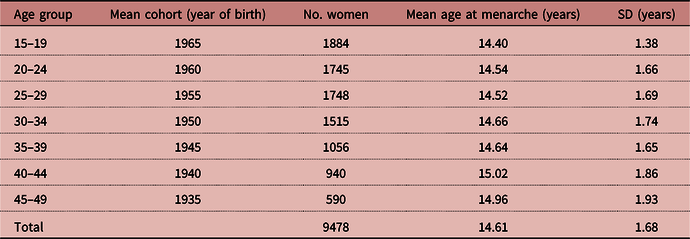
The 1982 retrospective data indicated a relatively high mean age at menarche (mean=14.61; SD=1.68), ranging from 15.02 to 14.40 years depending on age group and corresponding cohort. The time trend was highly significant (p<10-6) and the linear regression line indicated a decline from 15.05 years for women born in 1933 to 14.52 years for women born in 1967. The standard deviation was also reduced from 1.93 for the older cohorts to 1.66, indicating a narrowing range of ages at menarche, consistent with the decline in the mean age (Table 1).
Estimates of age at menarche from retrospective data, Nigeria, World Fertility Survey (1982), women aged 15–49

Raw values, unweighted.
Levels and trends from current status data
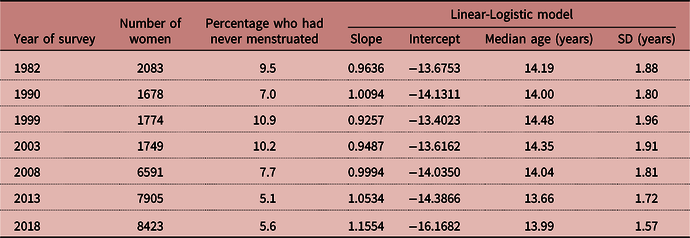
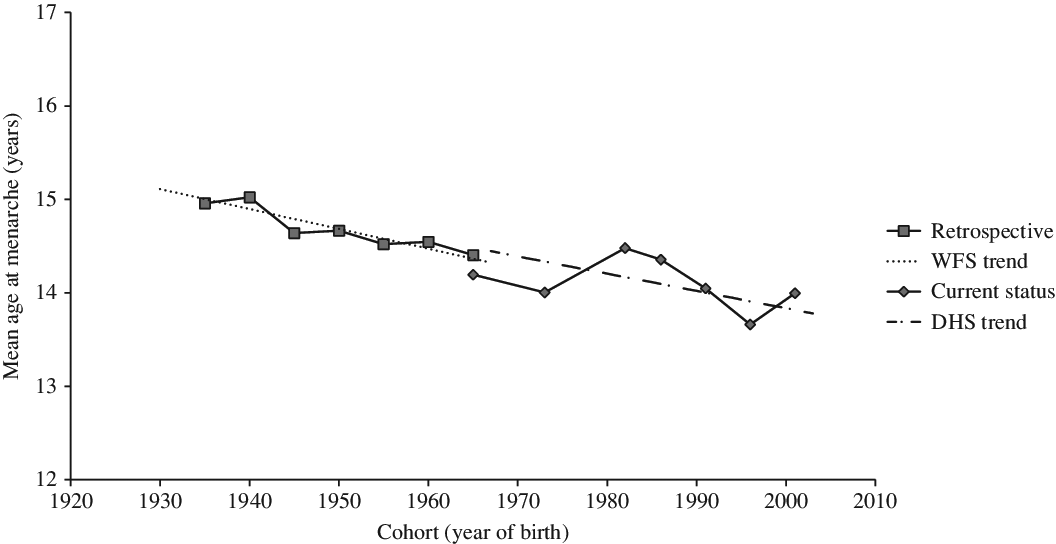
Levels and trends identified in the retrospective data were confirmed by current status data. The median age at menarche estimated from the seven surveys ranged from 14.48 (in 1999) to 13.66 (in 2013), and the SD from 1.57 (in 2018) to 1.96 (in 1999). The linear time trend indicated a decline in the median age at menarche from 14.45 for girls born in 1967 to 13.78 for girls born in 2003 (p<10-6). However, the time trend was not steady, and in particular girls born in the 1980s had a higher age at menarche (+0.49 years) than girls born before or after, the difference being statistically significant (p<10-6). The situation for girls born in the 1980s is explored below (Table 2, Figure 1).
Estimates of age at menarche from current status data, Nigeria, demographic surveys, women aged 15–19

Logit model: P(x)=a+b×AGE, where P(x)=proportion of women of age x who had already menstruated.
Secular trend in mean age at menarche, Nigeria.

Effects of socioeconomic status
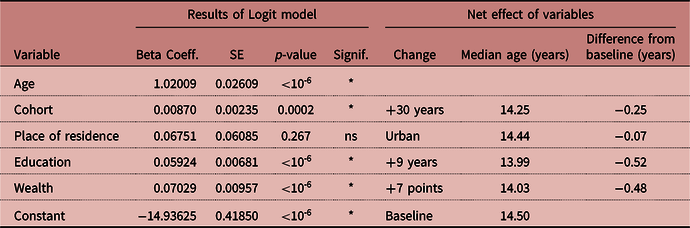
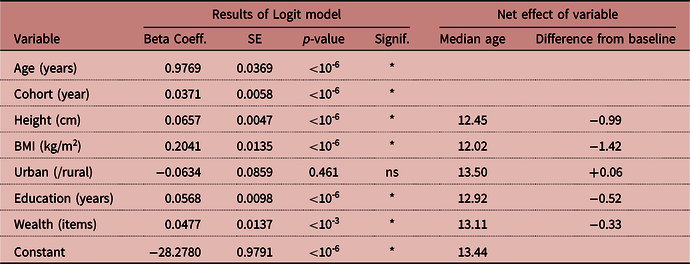
The effects of each of the three socioeconomic variables were in the expected direction (higher status associated with lower age at menarche) and statistically significant when taken one by one, but the effect of urban residence disappeared when level of education and household wealth were taken into account. Given the range of variations of mean age at menarche, the net effect of level of education was large and significant (p<10-6): compared with no schooling, 9 years of schooling (equivalent to a normal cursus at age 15) reduced mean age at menarche by −0.52 years. The net effect of household wealth was of the same magnitude and likewise significant (p<10-6): compared with absolute poverty, 7 points in the absolute Wealth Index reduced the mean age at menarche by −0.48 years (Table 3).
Socioeconomic correlates of age at menarche, women aged 15–19, Nigeria, demographic surveys, 1982–2018

Logit model: P(x)=a+b×AGE+c×COHORT+Σ id i×Z i, where P(x)=proportion of women of age x who had already menstruated. Standardized for cohort 1990 (women who had menarche in year 2000–2010). Reference category for place of residence is ‘rural’.
*p<0.05; ns: not significant. Net effects were computed medians according to the Logit model. Baseline was taken as the reference category (rural, no education, no wealth).
Region of residence
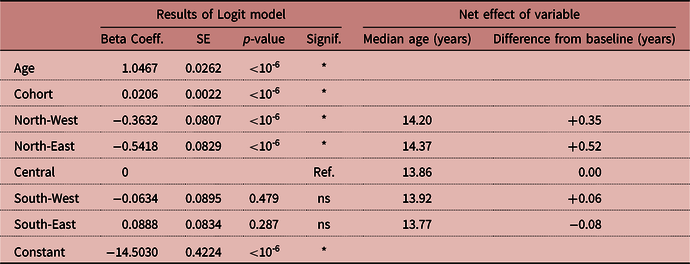
Nigeria has large geographical contrasts in socioeconomic variables (education, income, urbanization etc.), as well as in health and demographic variables (morbidity, mortality, fertility, anthropometry, etc.), with a major divide between the north and south in particular. The south is more advanced in any demographic and economic indicator: lower under-five mortality, lower fertility, less malnutrition, more urbanized, higher income, higher level of education (see DHS website for details; Garenne, Reference Garenne, Nwokocha and Fayehun2019). This divide was clearly reflected in the age at menarche. Taking the Central area as the reference category, the South-West and South-East were not different, but the two northern regions had higher age at menarche: +0.35 in the North-West (p<10-5) and +0.52 in the North-East (p<10-6) (Table 4). When socioeconomic variables were added in the same regression model, the net effect of the North-West region disappeared (p=0.219), but the effect of the North-East region was reduced only by half (+0.26) and remained significant (p=0.003).
Regional differences in age at menarche, women aged 15–19, Nigeria, 1982–2018

Logit model: P(x)=a+b×AGE+c×COHORT+Σ id i×Z i, where P(x)=proportion of women of age x who had already menstruated.
Anthropometry
Both height and BMI had large and independent effects on age at menarche at the individual level, both highly significant (p<10-6). An increase of 2 SDs (+14.8 cm) from the height average (156.2 cm) reduced the mean age at menarche by −1.10 years, and conversely a lower height of the same magnitude increased similarly the mean age at menarche, leading to a 2.20 year difference between the tallest and the shortest girls. The effect of BMI was even more pronounced: 2 SDs (+6.81 kg/m2) from the BMI average (20.93 kg/m2) reduced the mean age at menarche by −1.52 years, and conversely a lower BMI of the same magnitude increased similarly the mean age at menarche, leading to a 3.04 year difference between the fattest and the thinnest girls. When socioeconomic variables were included in the same regression model, the net effect of height and BMI remained virtually unchanged (−0.99 years for 2 SDs in height, and −1.42 years for 2 SDs in BMI). Likewise, the effect of 2 SDs in level of education was not changed (from −0.52 to −0.52 years) and the effect of 2 SDs in household wealth remained significant (p<10-3) and only moderately reduced from −0.44 to −0.33 years, indicating a large independence between anthropometry and socioeconomic variables (Table 5).
Effect of anthropometry and socioeconomic variables on age at menarche, women aged 15–19, Nigeria 1999–2018

Logit model: P(x)=a+b×AGE+c×COHORT+Σ id i×Z i, where P(x)=proportion of women of age x who had already menstruated.
Net effect on median age obtained from +2 SDs from the mean at baseline. Reference category for place of residence is ‘rural’. Education in number of years of schooling. Wealth in number of modern items in the household out a list of 20 items.
Sibship size
Sibship size has been found to be a risk factor for age at menarche in the UK (Morris et al., Reference Morris, Jones, Schoemaker, Ashworth and Swerdlow2010). Since DHS surveys sometimes provide this information, its effect was investigated in this study. Information on sibship size (number of brothers and sisters) was only available in the most recent three surveys (2008, 2013 and 2018). The effect of sibship size was statistically significant (p<10-6), with a +0.31 increase in mean age at menarche for five additional siblings (equal to 2 SDs) compared with none. This effect was reduced (+0.19 years) when anthropometry and education were included in the regression model, but remained statistically significant (p=0.006).
The case of girls born in the 1980s
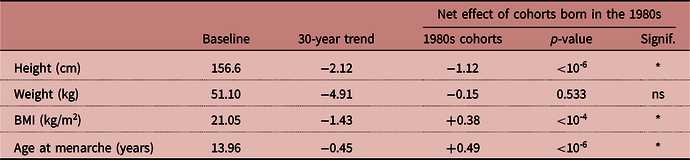
Girls born between 1980 and 1989 had a higher mean age at menarche than those born earlier or later. They also differed in anthropometric indicators. The average height of girls aged 15–19 tends to decline over time in Nigeria (p<10-6), as in many African countries (Garenne et al., Reference Garenne2011), and they lose about 2.12 cm on average over a 30-year period. But the average height of those born in the 1980s was 1.12 cm lower than indicated by the trend (p<10-6). The average weight of the 1980s girls was not different from that indicated by the trend, despite a declining trend of −4.91 kg over 30 years. As a consequence, the BMI of the 1980s girls was somewhat higher (+0.38 kg/m2) than that indicated by the trend. Furthermore, under-five mortality fluctuated in Nigeria between 1950 and 2018, and children born in the 1980s had significantly higher mortality than those born before or after (RR=1.06; p<10-6). So, compared with other cohorts, girls born in the 1980s suffered from both excess stunting and excess mortality, and both conditions could contribute to higher age at menarche (Table 6).
Effect of birth cohort (girls born in 1980–1989) on anthropometry and menarche, Nigeria, women aged 15–19, born between 1970 and 2003

Models: Y=a+b×AGE+c×COHORT+d×Dummy (for cohorts 1980–1989).
Correlation with development variables
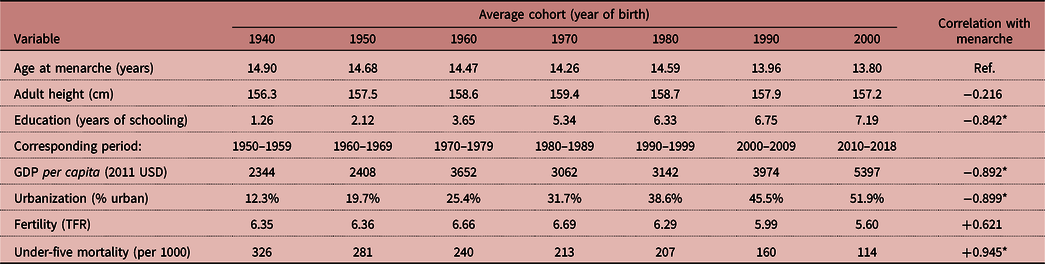
At the population level, the secular decline in age at menarche was correlated with numerous economic, demographic and health changes. Table 7 summarizes some of these associations for the same cohorts of girls born between 1940 and 2000. These cohorts underwent a steady increase in level of education, correlated with the trend in age at menarche (ρ=−0.842; p=0.018). Trends in adult height were divergent, with an increase until cohort 1967, followed by a decline, therefore poorly correlated with trends in age at menarche (ρ=−0.216; p=0.642) (Garenne, Reference Garenne2011).
Long-term trends in economic, health and demographic variables, Nigeria

Cohort trends estimated by regression from DHS surveys. Corresponding period during which the same girls experienced menarche. Correlations computed from the data presented over the seven periods.
Sources: Income data from World Bank Development Indicators (World Bank, 2019) and Maddison (Reference Maddison2010); urbanization, fertility and under-five mortality from United Nations, Population Division, 2019 revision (UNPD, 2019).
* p<0.05.
These cohorts experienced menarche 10–19 years after birth, and trends in age at menarche were also compared with conditions prevailing at the time when they experienced menarche. Income per capita has undergone serious fluctuations in Nigeria, with economic growth from 1950 to 1965, followed by a short recession during the civil war (1966–1968), then a new period of growth from 1969 to 1977, followed by a long recession (1978–1987), then a short-lived recovery (1987–1992), then again a stagnation (1993–1999) and finally rapid growth from 2000 to 2015 (Maddison, Reference Maddison2010; World Bank, 2019). These fluctuations are difficult to interpret, but it is possible that the long recession in 1978–1987 had an effect on child health, which could explain the increase in age at menarche for girls born during those years. It is also possible that the 1993–1999 stagnation had an additional effect on adolescent health for the same cohorts. Urbanization has been rapid and steady in Nigeria, but it was seen in multivariate analysis that this factor did not play an independent role in predicting age at menarche. Fertility underwent only minor changes over the period, unlikely to have much effect on sibship size, and the Total Fertility Rate (TFR) had an only modest correlation with age at menarche (ρ=+0.621; p=0.137). Lastly, the variable that had the strongest correlation with age at menarche was under-five mortality (ρ=+0.945, p=0.001). The mortality of young children had complex trends, following to a certain extent those of income per capita: rapid decline from 1950 to 1965, increase during the civil war, resumption of decline from 1969 to 1977, increase during the recession, slow decline after 1988–2000, followed by a more rapid decline in 2001–2010, and finally by a new stagnation in 2010–2015 (Garenne & Gakusi, Reference Garenne and Gakusi2005, Reference Garenne and Gakusi2006). Fluctuations in age at menarche seemed to follow to a certain extent those in income per capita and those in under-five mortality.
Discussion
With an average age at menarche estimated at about 14.5 years for girls born in 1990, who had their first menstruation in the years 2000–2009, Nigeria appears to be in the middle of the transition between high age at menarche (16.5 years), as found in 19th century Europe or in remote places in Africa, and low age at menarche (12.5 years), as found in USA since the 1960s (Wyshak & Frisch, Reference Wyshak and Frisch1982; Lee et al., Reference Lee, Guo and Kulin2001; Thomas et al., Reference Thomas, Renaud, Benefice, De Meeüs and Guegan2001).
Values found in the population-based surveys were consistent with another study also based on a representative sample of the Nigerian population, which estimated the mean age at menarche at 14.04 years in 2018 (Fagbamigbe et al., Reference Fagbamigbe, Obiyan and Fawole2018). Other studies, based on school girls or clinic patients, sometimes provided different values, ranging from 12.50 in the urban South-East region (Nwokocha et al., Reference Nwokocha, Chinawa, Ubesie, Onukwuli and Manyike2016) to 15.32 in rural Sokoto (Tunau et al., Reference Tunau, Adamu, Hassan, Ahmed and Ekele2012) in published studies. These discrepancies might be due to a variety of factors, in particular to selection biases: age selection (e.g. girls under 15, or girls in a given school grade), selection for menarche status (ignoring those who had never menstruated), socioeconomic selection (girls in better schools, girls of higher socioeconomic status), geographic selection (local pattern), for example, not counting sample size and confidence intervals. This study, on the contrary, is based on proper samples of the female population and includes girls who had never menstruated. Despite these discrepancies, the average age at menarche, calculated as the unweighted mean of all studies published between 1950 and 2018, was 13.81 years, again consistent with the average estimated from the national demographic surveys.
Age at menarche has been declining over the 70 years covered by the study, from 15.05 for girls born in 1933 to 13.78 for those born in 2003 – a speed of −0.54 years per generation of 30 years. This speed is consistent with that found in Europe (−0.54 in France between 1835 and 1994; Ducros & Pasquet, Reference Ducros and Pasquet1978; Shorter, Reference Shorter1981; De La Rochebrochard, Reference De La Rochebrochard2000; Gaudineau et al., Reference Gaudineau, Ehlinger, Vayssière, Jouret, Arnaud and Godeau2010) or in North America (−0.55 in USA from 1910 to 1965; MacMahon, Reference MacMahon1973).
However, the secular trend in age at menarche appears to be somewhat irregular in Nigeria. Unexpected trends in the transition, such as that of Nigerian girls born in the 1980s, have rarely been documented outside war or famine periods. Age at menarche has been little researched in Africa and in low-income countries, and it is possible that such irregularities also occur elsewhere. However, it should be noted that this irregularity was of small magnitude and short-lived, and probably with few health implications. It reveals once more the erratic pattern of health transitions in Africa (Garenne, Reference Garenne2007).
Socioeconomic differentials were similar to those noted repeatedly elsewhere, and similar to those already noted in France and elsewhere in Europe in the 19th century, and all over the world in the 20th century (Brierre de Boismont, Reference Brierre de Boismont1842; De Muinck Keizer-Schrama, Reference De Muinck Keizer-Schrama2001; Karapanou & Papadimitriou, Reference Karapanou and Papadimitriou2010). Large regional differences in demographic and health indicators is a feature of Nigeria, and the divide between north and south is well reflected in age at menarche (Garenne, Reference Garenne, Nwokocha and Fayehun2019).
The relationship between anthropometry and age at menarche at the individual level is consistent with other studies: this study found that both the height and BMI of girls are important predictors of age at menarche, and BMI appears to be more important than height (Gray, Reference Gray, Bulatao and Lee1983; Freedman et al., Reference Freedman, Khan, Serdula, Dietz, Srinivasan and Berenson2002; Onland-Moret et al., Reference Onland-Moret, Peeters, van Gils, Clavel-Chapelon, Key and Tjønneland2005).
The independence of the net effects of anthropometry and socioeconomic status at the individual level might seem surprising at first glance. In fact, anthropometry (height and BMI) at the same time reflects health status, nutritional status and physical exercise – all parameters directly linked to both age at menarche and socioeconomic status. This relative independence suggests that other factors may interplay, such as genetic, epigenetic, hereditary and environmental factors. A similar finding has been reported by other authors (Abioye-Kuteyi et al., Reference Abioye-Kuteyi, Ojofeitimi, Aina, Kio, Aluko and Mosuro1997).
The correlation between age at menarche and sibship size remained significant after controlling for anthropometry and socioeconomic status. This puzzling result calls for interpretations other than the straightforward effect of household size on access to food and anthropometry.
Seen in a broad health transition framework, the long-term trends in age at menarche appeared consistent with trends in income, household wealth, education, urbanization and child survival. In this respect, the most surprising finding of this study was the lack of correlation between trends in age at menarche and trends in adult height (Akachi & Canning, Reference Akachi and Canning2007; Moradi, Reference Moradi2010; Garenne, Reference Garenne2011). Since height played such a big role at individual level, one could have expected that the decline in adult height for girls born after 1968 induced an increase in age at menarche, but the opposite was found. This indicates that other factors interacted, and that the possible negative effect of declining height was compensated by other positive effects. This could be due to better control of infectious diseases, as seen in the strong correlation with mortality decline (Garenne & Gakusi, Reference Garenne and Gakusi2005, Reference Garenne and Gakusi2006).
The use of large-scale demographic surveys, based on representative samples, permitted a thorough investigation of age at menarche in Nigeria: precise estimates of levels and trends, and the assessment of the impact of covariates, correlations and independence between various factors. So far, these demographic surveys have rarely been used in developing countries for this purpose, while they have the potential to shed new light on the complex issues associated with age at menarche. Africa is undergoing complex changes in population health, and it is important to monitor these changes, their interactions and their rationales. Nigeria presents an interesting case: despite erratic economic development, the country is undergoing a fast health transition, with a rapid decline in age at menarche.
Acknowledgments
The author thanks the WFS programme, the DHS programme and the National Statistical Institutes for providing free access to survey data, and the two anonymous reviewers for numerous useful and precise comments.
Funding
This study was supported by Institut Pasteur, Paris, and IRD, Paris, without any external grant.
Conflicts of Interest
No potential conflict of interest is reported by the author.
Ethical Approval
The author asserts that all procedures contributing to this work comply with the ethical standards of the relevant national and institutional committees on human experimentation and with the Helsinki Declaration of 1975, as revised in 2008.