Introduction
Philip Priest's article ‘Playing by Ear: its Nature and Application to Instrumental Learning’, published by this journal in 1989, stressed the importance ‘for all musical playing to be viewed as “by ear” . . . so that the aural basis for musicianship is maintained’ (Priest, Reference PRIEST1989, p. 173). Priest proposed a model based on the interaction between three factors: playing by ear, imitation of a model and spontaneous invention, which he believed could enable instrumental teachers to use playing by ear in their everyday practice with the aim to empower their students with developing aural and creative skillsFootnote 1 . He also argued that playing by ear in groups, ‘when the groups are not reading and not directed’ can support a learning process that is more natural, enjoyable and valuable as the ‘responsibility for leadership, cooperation and decision-making is the pupils’ own’ (Priest, Reference PRIEST1989, p. 188).
This article explores how group playing by ear, or Group Ear Playing (GEP), through the imitation of recorded material and opportunities for inventive work during peer interaction supported first year undergraduate western classical music students’ aural, creative and improvisation skills. The approach to playing by ear adopted in this study is based on Lucy Green's (Reference GREEN2014) work on informal learning practices in formal music education. Green strongly advocates for the inclusion of playing by ear activities in secondary school classrooms (Green, Reference GREEN2005, Reference GREEN2008) and one-to-one instrumental lessons (Baker, Reference BAKER and Stakelum2013; Baker & Green, Reference BAKER and GREEN2013; Green, Reference GREEN, Vakeva and Karlsen2012a, Reference GREEN2012b; Varvarigou, Reference VARVARIGOU2014; Varvarigou & Green, Reference VARVARIGOU and GREEN2015), as they nurture numerous musical, social and personal skills in music learners of all ages and abilities.
The framework that emerged from the analysis of the data of the current study describes two routes taken by the students, whilst progressing from GEP to group improvisation. The article concludes with suggestions as to how these two routes could be used to scaffold the development of western classical musicians’ improvisation skills.
Priest's (Reference PRIEST1989) publication was presented in three parts under the headings Theory, Practice and Plan of Action. This article is structured under the same headings so that the connection between the two studies that emphasise the significance of playing by ear in the education and practice of musicians becomes clearer. Theory presents ‘the conceptual argument for playing by ear as central to musicianship’ (Reference PRIEST1989, p. 174) and contends that GEP should have a prominent place in western classical musicians’ education and practice in Higher Education, for it prepares musicians for the demands of portfolio careers. Practice presents a rich palette of strategies that eight groups of western classical musicians (46 in total) explored during GEP, the ways that these strategies supported group creativity and improvisation skills as well as the challenges that the groups faced. Finally, Plan of Action investigates how the framework describing the process from GEP to Group Improvisation could be used to encourage more western classical musicians to improvise in preparation for successful portfolio careers in performance, teaching and artistic leadership in different contexts (Smilde, Reference SMILDE2009).
Theory: Why use Group Playing by Ear in Higher Education
Playing by Ear has been defined as the process of playing music ‘without the aid of notation, without the visual stimulus of watching a live instrumental model, without verbal hints such as solfege’ (Musco, Reference MUSCO2010, p. 49) and through playing back from recordings (Green, Reference GREEN2012b; Varvarigou, Reference VARVARIGOU2014; Varvarigou & Green, Reference VARVARIGOU and GREEN2015). GEP is used in this study to describe the process of learning, within a group, through playing back from recordings, but it does not exclude the imitation of a model – seen and heard; or heard only (Priest, Reference PRIEST1989) as in the case of imitating peers’ practice, technique or interpretation.
Unlike traditional folk, jazz, pop, rock and ‘world’ musicians who regularly engage in playing by ear from recordings as a means of learning new repertoire and of creating new material either as improvisations or as compositions (Berliner, Reference BERLINER1994; Green, Reference GREEN2002; Nettl & Russell, Reference NETTL and RUSSELL1998) the training of western classical musicians does not usually include playing by ear as an equally valued and regular component of their training and practice. Early on during instrumental tuition young musicians are generally discouraged from learning melodies by ear and from ‘messing about’ when practising and during their instrumental lessons. Musco (Reference MUSCO2010, p. 51) very eloquently explains that this is probably due to some educators’ apprehension that playing by ear might demotivate students from learning to read music and that it will ‘impede the development of skills in music reading’. Other reasons include instrumental teachers’ perceived lack of skill in playing by ear, lack of time during weekly lessons and strong belief that ‘instruction should emphasise the development of skills in music reading over skills in playing by ear’ (p. 51).
Woody and Lehmann (Reference WOODY and LEHMANN2010) argued that playing by ear is largely absent from music education curricula, both in one-to-one instrumental settings and in group settings, despite the fact that it is a ‘foundational musical skill’ (p. 113) so closely linked with improvising, composing and arranging. Their study with 24 western classical music majors demonstrated that those with prior ‘vernacular music experience’ (i.e. playing songs from recordings, playing chord progressions on the piano, collaborating in groups to ‘work up a song’ [p. 111], improvising and composing music, ‘mess[ing] around’, improvising in a group, improvising solos to recorded accompaniments and composing original music) outperformed western classical musicians with no vernacular music experience on two playing-by-ear tasks – singing back and playing back on instruments. Whilst vernacular musicians had engaged in a variety of collaborative, exploratory and creative music-making throughout their instrumental tuition, the formal musicians, by comparison, had limited or non-existent prior experiences of such creative musical activities during their musical development.
Ironically, playing by ear has been identified as supporting the development of performing rehearsed music, playing from memory, sight reading and improvisation (McPherson, Bailey & Sinclair, Reference McPHERSON, BAILEY and SINCLAIR1997). These skills feature prominently in the training of western classical musicians (Williamon, Reference WILLIAMON2004). For instance, having the ability to ‘adapt constantly to changing [musical] environments’ (Thompson & Lehmann, Reference THOMPSON, LEHMANN and Williamon2004, p. 143) during improvisation and sight-reading, as well as responding to ‘moment-by-moment novelty . . . [by] accommodating a co-performer's sudden change of tempo or coping with a memory slip’ (Davidson & King, Reference DAVIDSON, KING and Williamon2004, p. 105) during ensemble practice, are musical skills that feature high on the agenda of HE institutions that prepare graduates for the music profession. Engaging in playing by ear activities allows the musicians not only to develop their aural and creative abilities to imitate sounds, but also to adapt and respond to changes in these sounds. These changes could be a result of a co-performer's musical interpretation, memory slip, or a response to an improvised phrase.
Developing classical musicians’ improvisation skills, in particular, is currently receiving attention within Higher Music Education (Benedek, Reference BENEDEK2015; Ilomäki, Reference ILOMÄKI, Gaunt and Westerlund2013; Reitan, Reference REITAN2015). An example that demonstrates the versatility and creativity that orchestral musicians of the 21st century need to possess in order to respond to the ever-changing challenges of the music profession is the audition process for an orchestra based in Belgium called the BOHO Players. According to its director David Ramael (Reference RAMAEL2015, p. 10), improvisation features as a central element of the audition process, for it helps him identify ‘open-minded, adventurous classical musicians’. These are the orchestral musicians that Ramael believes would be able to fulfil the new role of the orchestral ensemble in society; a role that includes ‘audience interaction, pedagogical mission, [a] cross-disciplinary and eclectic approach, [and performing in] non-traditional venues . . . ’ (Reference RAMAEL2015, p. 2). Ramael reported that, unsurprisingly, improvisation was the least preferred element of the entire audition and 60% of the musicians auditioned had not received training in improvisation during their studies.
In our rapidly changing cultural world many musicians will choose to follow a ‘portfolio career’ (Hallam & Gaunt, Reference HALLAM and GAUNT2012) and will be called upon to respond to new types of professional demands by demonstrating their creative and improvisation skills (Ramael, Reference RAMAEL2015; Smilde, Reference SMILDE2009); their knowledge of stylistic diversity, repertoire and performance practices across different musical genres (Benedek, Reference BENEDEK2015); and their collaborative skills and facility with different instruments and voice (Creech, Hallam, Varvarigou & McQueen, Reference CREECH, HALLAM, VARVARIGOU and McQUEEN2014). This study advocates that playing by ear in groups can develop skills in aural perception, understanding harmony and musical structure, collaborative, creative and improvisation skills and that it should be treated by teachers and learners alike as a skill worthwhile advancing during instrumentalists’ training and practice in Higher Education.
Practice: GEP with undergraduate western classical musicians
46 first-year undergraduate students took part in a five-week GEP segment of a HE Practical Musicianship module. The programme aimed at developing the students’ aural, creative musicianship and improvisation skills by encouraging them to play musical pieces from different musical genres (popular, classical and a piece of free choice) by ear in small groups of five to seven musicians. The term ‘improvisation’ is used here to describe the performance of music which is not written down, and which encompasses both variations in the interpretation of given musical material and the creation of new musical material that has been produced through creative decision making ‘within the real time of the performance’ (Hallam & Gaunt, Reference HALLAM and GAUNT2012, pp. 97–98). The student cohort was divided into eight groups. Each group engaged in GEP for approximately 40 minutes every week. There was no tutor present during the GEP sessions.
The students were asked to create freer renditions rather than accurate imitations of the original pieces copied. Moreover, they were encouraged to experiment with the musical material by making changes in the dynamics, tempo, rhythm, harmony and even the melody, and to create and add new material to the pieces copied as long as they kept the flow of the music. The students played their principal or second instrument. 43% (20/46) reported no prior experience in GEP as opposed to 31% (14/46) who reported having some experience and 26% (12/46) who did not respond. Data were collected through students’ individual Reflective Logs (RL) (n = 194), end-of-programme Feedback Forms (FF) (n = 36) and Interviews (I) (n = 4) (a detailed description of the programme can be found in Varvarigou, Reference VARVARIGOU2016; Varvarigou, Reference VARVARIGOU2017). Each student filled in a RL at the end of each session. The FF were collected at the end of the fifth session for each group and the interviews took place at the end of the academic year with four students (two males and two females). Three out of the four students selected received high marks for GEP but had reported in their FF that they had never engaged in playing by ear in a group before. The fourth student was selected because she indicated in her RL and FF that she found the programme ‘out of her comfort zone’ and non-enjoyable. All interviews were audio-recorded and transcribed verbatim for analysis. The audio material used for the first two stages of this GEP programme is available in the book Hear, Listen, Play (Green, Reference GREEN2014). The analysis of the data focused on thematic discovery from the transcripts and was achieved through open, axial and selective coding (Creswell, Reference CRESWELL2007).
Playing by ear vs. singing by ear
In this study all the participants had to play an instrument rather than sing during the process of playing by ear, group experimentation and improvisation. There were several reasons for this decision. Firstly, all instrumentalists and singers played more than one instrument; the second usually at an intermediate level. Given that the audio material was simple enough for such advanced musiciansFootnote 2 to work with, and that the task was to produce freer renditions of the pieces copied it was considered appropriate to ask all musicians to play an instrument and experience the process of GEP under the same terms. Secondly, the process of singing by ear poses fewer challenges to HE musicians than playing. This was highlighted in Woody and Lehmann's study (Reference WOODY and LEHMANN2010) when singing short melodies back correctly required fewer trials in contrast to playing short melodies of the same levels of difficulty. Thirdly, with reference to improvisation, Hargreaves (Reference HARGREAVES2012) and Pressing (Reference PRESSING and Sloboda1988) explain that improvising instrumentalists have more sources of feedback (aural, visual, proprioceptive and tactile) compared to vocalists who only use hearing and proprioception. This allows instrumentalists to generate creative ideas faster than vocalists. Fourthly, Priest (Reference PRIEST1989) advocates that creativity, contrary to most instrumental teachers’ assumption, does not necessarily require technical competence or proficiency with specific repertoire. Due to the fact that facility with an instrument and the voice are taken as given in professional musicians’ careers as educators, performers, composers and therapists, it was considered appropriate to ask all participant musicians to play an instrument regardless of whether they were first study instrumentalists or vocalists.
GEP strategies
I learnt more about distributing my attention to each part of the song. I think it was very interesting seeing how each section (e.g. chords bottom, [chords middle, bass] melody) can complete each other harmonically and rhythmically. I am definitely looking forward to the next session of ear playing (Heather, cello, RL 1).
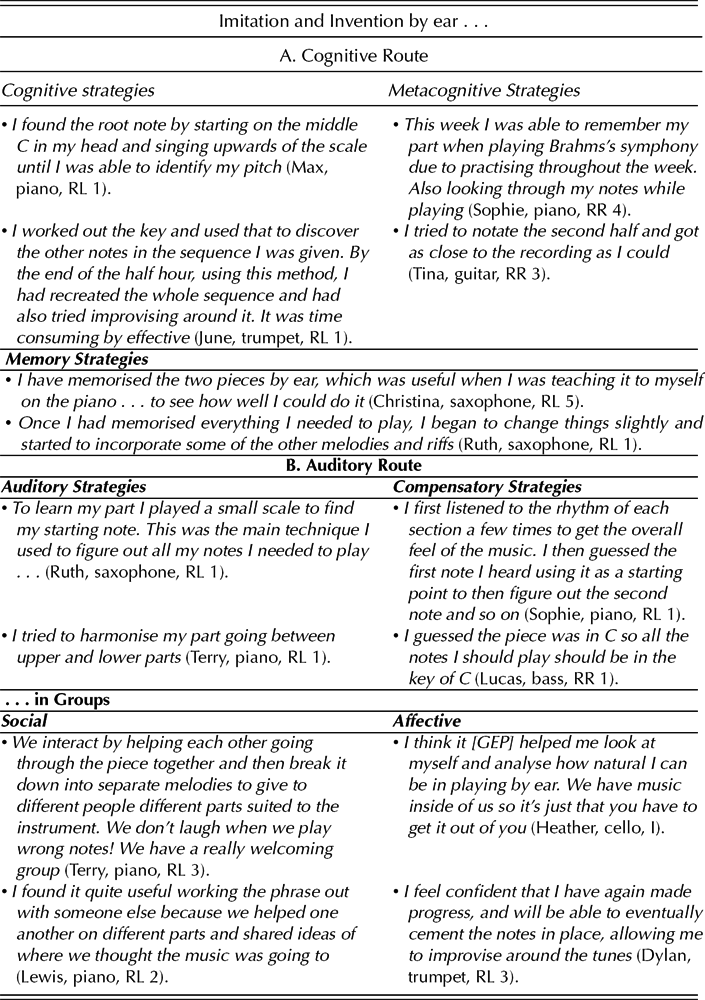
The students explored a variety of strategies whilst copying music by ear from recordings within each group. These strategies developed over time as the learners gained greater experience of playing by ear through practice (Varvarigou & Green, Reference VARVARIGOU and GREEN2015) and through observing and interacting with their peers. As demonstrated by the quotes provided in Table 1, the musicians engaged in creative musical interactions that allowed them to use their existing musical knowledge and skills whilst imitating musical material from different musical genres and by responding to fellow musicians’ ideas and ‘moment-by-moment novelty’ (Davidson & King, Reference DAVIDSON, KING and Williamon2004, p. 105). The framework used for the analysis of the learning strategies in GEP has also been used by Blix (Reference BLIX, Reitan, Bergby, Jakhelln, Shetelig and Øye2013) in her study on the learning strategies in ear training adopted by young instrumentalists.
Examples of GEP learning strategies reported by the students aligned with the concepts of imitation and invention by ear in groups (Priest, Reference PRIEST1989)

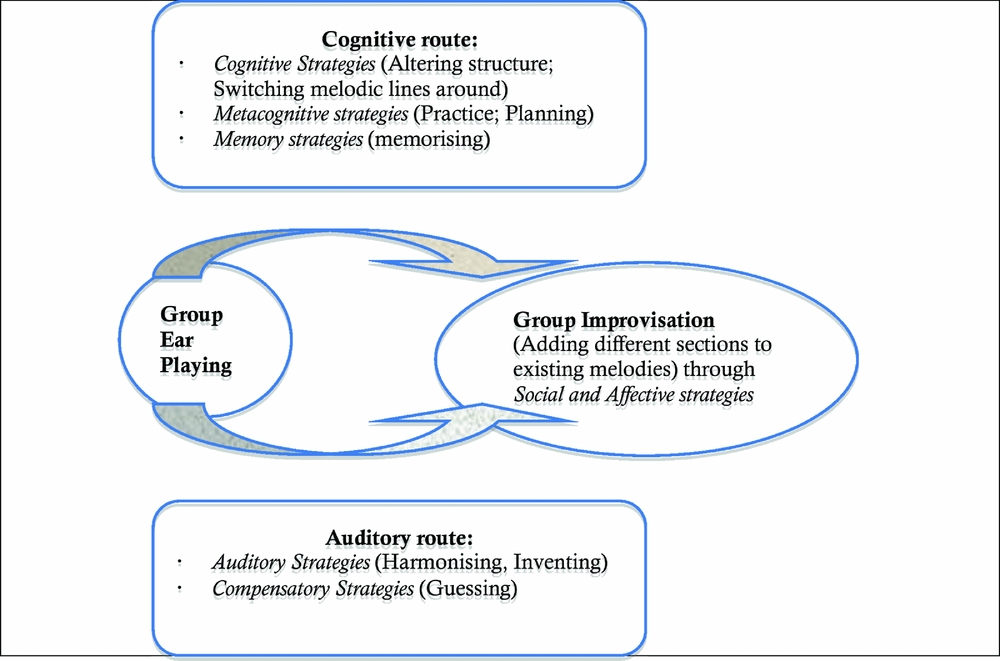
To begin with, for some of the western classical musicians of the study GEP seemed to involve a great deal of thinking. Cognitive strategies were employed when trying to combine existing musical knowledge with listening in order to identify the notes or the key of the riffs and the melodic lines of the pieces copied (See Table 1). Some groups also reported taking a cognitive approach to invention that led to improvisation (see Figure 1). In other words, the musicians sought after ‘clear temporal boundaries’ that ‘rendered the pieces memorable’ (Burnard, Reference BURNARD2000, p. 239). After the members of three groups had learned each part, the musicians started improvising by altering the structure of the pieces – different riffs or melodic lines comprised the introduction, ending and improvisation sections. This was achieved through switching different melodic lines around. Metacognitive strategies refer to strategies identified by the students as salient in improving their practice and performance of aural tasks. For example, some students made a practice plan before the next session that included breaking the melodies into sections and focusing on each section separately. Some students also reported playing without the recording or writing down the notes of the pieces played, as a way of memorising the music (memory strategies). In addition, the last session of GEP was referred to as a ‘clean up’ session where the students memorised their part and contributed more confidently to the musical experimentation through improvisation.
From group ear playing to group improvisation

Another approach to engaging in imitation was the auditory approach. This involved listening to the recording and playing extensively along with the recording. Individual strategies for finding the first note included playing a scale or playing random notes until they found one of the notes of the riff, which they then used as an anchor to develop the riff. Some musicians focused on imitating the rhythm first, some imitated the pitch and rhythm simultaneously, and one sang a scale to find the first note. During the process of invention that led to improvisation the musicians in five out of the eight groups listened to the pieces and allocated the different parts according to what they thought was the appropriate instrument. They then started harmonising the melodies played by their colleagues. Imitation and invention also encompassed guessing. This enabled them to compensate for limitations in understanding harmonic or melodic relations in the music or for limitations of experience of playing by ear (compensatory strategies).
Given that playing by ear took place in groups, social strategies were adopted from the beginning of the process of imitation and invention. The most powerful strategy was peer learning, which supported problem solving on harder parts, encouraged mentoring and co-teaching for less confident students, and nurtured a general atmosphere of playfulness and experimentation that was reportedly highly enjoyable. Many students talked about enjoying ‘playing with others and playing with music’ (Lindsay, clarinet, RL 5) and working as a team to ‘work out notes’. They also emphasised how through this group interaction they developed interpersonal and leadership skills such as taking others’ opinions on board, communicating within a group and building awareness in playing with others. Affective strategies were closely linked with social strategies and they described ways of projecting ‘positive feelings of musical flow or actively using music one likes’ (Blix, Reference BLIX, Reitan, Bergby, Jakhelln, Shetelig and Øye2013, p. 111). These strategies increased enjoyment and boosted students’ confidence in playing by ear and improvising.
Group imitation, invention and improvisation
-
• I've learnt that with a small group of musicians doing a task like this you can produce good, fast results whilst having lots of fun (Joshua, xylophone, FF).
-
• I most enjoyed putting all the parts together as a group and discussing how to change it (Dylan, euphonium, FF).
Group improvisation was instigated by the group members to ‘make the pieces sound more interesting’ (Eva, flute, RL 1). Jonathan's group initially followed the cognitive route to improvisation and in the quote below he talks about how altering the pieces’ structure was part of the group's creative experimentation with the given material, which made the pieces their own:
As we knew our parts we decided to improvise our piece to make it sound different. We improvised the structure making it into ternary form. We started with the bass on its own, then added piano chords. I then came in with the melody A, then we all dropped out and bass B and melody B played once they finished A came in again. In Link Up we came in one by one then split off into our groups in the form of ABA, we all then improvised on our parts (Jonathan, clarinet, RL 5).
Lucy's group followed the auditory route to group improvisation. In the quote below she describes how during the first week of GEP the group members used improvisation in order not only to play together but also to complement each other:
After we played through the piece a few times, we then started to play around with our own parts, improvising our melodic lines, whilst still harmonising our parts and keeping in time with each other. This gave the piece a feeling of freedom and more of a swing to it . . . It was important to listen to each others’ different parts, so we could keep time with each other and know when to come in with our own parts. And also to make sure every part could be heard individually during the piece, whilst keeping together and complementing each other (Lucy, piano, RL 1).
Both the ‘cognitive’ and the ‘auditory’ routes enabled the groups to progress from purely imitating the musical phrases to inventing answering phrases, extemporising new phrases, improvising by embellishing the melodic lines to creating new melodic lines that were added as different sections to the pieces copied. Each group's final performance after five weeks of GEP comprised variations of the pieces copied that were created on the spot and ‘new’ sections that were pre-composed but embellished on the spot. This suggests that GEP not only allowed the classical musicians to engage in spontaneous improvisation but also to explore ways of composing their own sections to the music copied by ear.
The challenges of group imitation and invention
Maggie is in the smoking room and we are still in the orchestra. I think we have gone to the wrong party . . . (Megan, violin, I).
Megan, a mature first-study singer, found playing by ear ‘out of her comfort zone’ and reported experiencing GEP like having gone to ‘the wrong party’. During her interview, she attributed the discomfort with GEP to two reasons: not having written notation in front of her and having to use her second study instrument, the violin, instead of her voice. Although, the lack of written notation caused Megan fear of the task, she advocated that playing by ear should start early in learners’ instrumental tuition.
I think it is essential to introduce ear playing at the earliest stage possible. Because if you are like me who has been trained to read music and who does not deviate from reading music when you are in a situation where you have to play by ear it makes it really difficult (Megan, violin, I).
What is more, Megan, recognised that peer learning and peer support offered her a way forward through GEP:
Chloe would help . . . [she] would say, ‘Right, you need to play that note; no, that's wrong; no, no sharp; flat . . . ‘ It was literally, ‘you need to play an E, you need to play an F. So, she was very good because I couldn't hear it . . . The other girls were very good, they were very encouraging . . . very supportive (Megan, violin, I).
Other challenges expressed by the students were related to the repertoire copied. The classical pieces were considered technically tricky to copy by ear because they had ‘complex harmony’ (Eva, xylophone, RL 2); ‘the extracts . . . were longer’ (Lindsay, clarinet, RL 2) and difficult to remember as opposed to the shorter riffs of the popular music track; ‘there wasn't as much to split out to’ (Esther, flute, RL 3), and because ‘it was difficult to improvise around famous [classical] melodies’ (Max, piano, RL 3). Some students talked about feeling uncomfortable playing and improvising in front of others. Others talked about the challenges of ‘get[ting] the group to focus’ (Veronica, guitar, FF); and of ‘trying to explain what you want from them but then allowing them to be natural, as well’ (Heather, cello, I). Finally, students recognised the challenge of working in mixed ability groups (‘It was also very difficult because we all have different starting points thus communication between one another is difficult’ (Nina, piano, RL 4). Many also recognised the challenge of arranging the pieces for the instruments available (‘the different instruments are difficult to put together due to the varying pitches and tones’ [Dylan, euphonium, RL 2]); ‘Because of the varied instruments in our group it did mean some such as the guitar may have been out of their “comfort zone” but everyone tackled the challenge positively and effectively’ (Billy, violin, RL 2).
In summary, although copying musical repertoire by ear in small groups posed several challenges for the classical musicians, it allowed them to develop their aural skills whilst imitating musical pieces, and whilst arranging them by altering their harmonies and musical structures. Furthermore, through GEP the musicians engaged in improvisation and the invention of new material through collaborative group processes that legitimated individual creativity and that nurtured group creativity (Hallam & Gaunt, Reference HALLAM and GAUNT2012). This was facilitated by peer support and playful experimentation and by repertoire in a variety of musical genres.
Plan of Action: Facilitating the transition from GEP to Group Improvisation through Cognitive and Auditory routes
-
• I learnt to improvise in a more classical style, which put me out of my comfort zone but has also helped me get a better understanding of certain classical structures (Max, piano, RL 5).
-
• Improvising is less scary than I have found it previously, which is a relief, and it is more fun. Though I do find that I don't necessarily remember my previous improvisation so it's all a bit different each time. I would recommend this type of practice to everyone – no matter ability or confident level (Miriam, violin, RL 3).
Encouraging imitation and invention through playing by ear in HE
The adoption of and experimentation with the Cognitive, Metacognitive, Compensatory, Memory, Auditory, Social and Affective strategies presented above allowed the eight groups of western classical musicians who participated in this study to progress from imitating the riffs and classical melodies by ear to inventing answering phrases, improvising embellishments to existing melodies and to creating their own renditions of the pieces copied. As the students reported, the process of moving from GEP to Group Improvisation was characterised by collaborative and peer learning and support, opportunities for exploration and ‘working up’ the pieces, all of which made the process both challenging and highly enjoyable.
Despite the fact that these musicians were technically advanced some groups appeared to experience the need to ‘understand’ the music through the use of cognitive and metacognitive strategies (Cognitive route) (see Figure 1) before responding to it in a more spontaneous fashion. This lack of spontaneity from some groups when asked to imitate musical material and to improvise, points to a lack of experience in playing by ear during the students’ instrumental tuition, which led Megan to feel ‘out of her comfort zone’ and like having ‘gone to the wrong party’. Megan stressed several times how salient it is for instrumental learners across all levels of training to be given ‘permission’ and encouragement to imitate musical material by ear during their instrumental lessons. This argument is supported by the literature cited earlier. Moreover, Burnard (Reference BURNARD2002, p. 169) underscores that ‘enabling participation that embraces individual spontaneity at all levels of skill and aptitude’ is vital in fostering young music learners’ engagement in creative activities such as improvisation.
In line with Priest's (Reference PRIEST1989) article, this study argues that playing by ear should be part of one-to-one instrumental tuition from the very early stages of one's instrumental learning (Harris, Reference HARRIS2008; Varvarigou, Reference VARVARIGOU2014) not least because it allows musicians to engage in imitation and experimentation with confidence. Within HE, imitation plays a significant role in classical musicians’ training in one-to-one lessons (Hallam & Gaunt, Reference HALLAM and GAUNT2012; Smilde, Reference SMILDE2009) often through the students’ imitation of ‘minute details [of] what the teacher does, how they play, sing, compose, even when this cannot all be physically seen or described in words’ (Hallam & Gaunt, Reference HALLAM and GAUNT2012, p. 76). Hence, it is paradoxical (and slightly disheartening), that such refined abilities to imitate someone else's performance have not been regularly utilised in activities such as playing by ear. GEP was used here to help undergraduate music students most of whom were pursuing a trajectory towards professional careers in music to develop aural, creative and improvisation skills through performance and exploration of musical repertoire from difference musical genres. These skills have been identified as essential in ‘just about any career in music’ (Hallam & Gaunt, Reference HALLAM and GAUNT2012, p. 178).
This approach to GEP based on Lucy Green's (Reference GREEN2008, Reference GREEN, Vakeva and Karlsen2012a, Reference GREEN2012b) work facilitated the students’ engagement in imitation and invention by providing them with real, whole pieces of musical repertoire in a variety of musical genres. The learners were encouraged initially to reproduce this material, which acted as a scaffold for the invention of answering phrases, embellishments and improvised new sections. Playing by ear activities with western classical musicians in HE could start with material that is organised in separate riffs and melodies that allows the musicians who are unfamiliar with the process of aural learning to create a bridge between cognitive strategies to auditory strategies that could lead to more spontaneous responses to music making.
Playing by ear in groups
Playing in small groups in the absence of a tutor granted the musicians autonomy in the way and the frequency of interaction with each other. GEP was facilitated through peer learning, which helped the musicians develop and refine their leadership, social awareness, teamwork and communication skills (Varvarigou, Reference VARVARIGOU2017) and to work for part of the programme on music that they chose as a group. This approach to facilitating creative interactions amongst groups of music learners resonates with Burnard's (Reference BURNARD2002) belief that the developmental value of group creative activities such as improvisation lies with supporting music learners’ collective decision-making; identity and relationship development; participation over competition; celebrating group risk-taking; and valuing musical collaboration and experimentation. Despite some technical challenges that emerged related to combining different instruments together as well as the challenge of fitting with everyone else musically and socially, GEP was reportedly hugely beneficial to the musicians’ aural skills, repertoire appreciation, ability to harmonise other melodies and their creativity during imitation, invention and improvisation that was not idiomatic to a particular genre.
Conclusion
Woody (Reference WOODY2012) stressed that in music, it is the ear that defines great musicianship. This study on GEP with undergraduate western classical musicians argued that young musicians in HE should learn to play by ear. The musicians’ responses demonstrated that this type of group music making brought about high levels of enjoyment and confidence in engaging in aural, creative and improvisatory music making. The two routes to group improvisation presented here could be used as the means of developing young western classical musicians’ skills from imitation (and free renditions) of musical material by ear to group improvisation that combines imitation with invention. Both routes could be pursued but importantly within a group setting, for peer interaction reportedly supported the development of students’ aural, creative and improvisation skills through collaborative and playful exploration and experimentation. After the five weeks of GEP and group improvisation, the groups of students could focus on the different routes with the intention of exploring issues related to the harmonic relations and musical structures of the pieces explored by ear (auditory route) or through transcriptions and notated music (also in Benedek, Reference BENEDEK2015; Ilomäki, Reference ILOMÄKI, Gaunt and Westerlund2013) in greater detail. Lastly, although there was no tutor involved in shaping or influencing the two routes to group improvisation, future programmes could feature specialised coaching that is idiomatic to a particular musical genre delivered by expert tutors.