Introduction
Early life adversity (ELA) involves negative environmental experiences that are likely to require significant adaptation by an average child, including experiences such as abuse, neglect, witnessing community violence, separation from caregivers, and low cognitive stimulation; these experiences have robust and enduring influences on child development (McLaughlin, Reference McLaughlin2016). ELA is common, impacting half of children in the United States (Green et al., Reference Green, McLaughlin, Berglund, Gruber, Sampson, Zaslavsky and Kessler2010). These experiences explain over a quarter of first-onset of psychiatric disorders in adolescence and almost half of all childhood-onset disorders (Green et al., Reference Green, McLaughlin, Berglund, Gruber, Sampson, Zaslavsky and Kessler2010; McLaughlin et al., Reference McLaughlin, Greif Green, Gruber, Sampson, Zaslavsky and Kessler2012). Children with ELA have increased risk for psychopathology across the lifespan including depression, anxiety, disruptive behaviors, and posttraumatic stress disorder (Alisic et al., Reference Alisic, Zalta, van Wesel, Larsen, Hafstad, Hassanpour and Smid2014; Carliner et al., Reference Carliner, Keyes, McLaughlin, Meyers, Dunn and Martins2016; McLaughlin, Conron, Koenen, & Gilman, Reference McLaughlin, Conron, Koenen and Gilman2010). Understanding the mechanisms that underlie the strong relationship between ELA and psychopathology is critical for developing targets for intervention. Here, we examine alterations in fear learning as a potential mechanism linking ELA with the emergence of psychopathology in youth.
The dimensional model of adversity has argued that while ELA is broadly associated with psychopathology, threat, and deprivation are associated with emotional development, cognitive development, physiology, and brain function in ways that are at least partially distinct (McLaughlin, Sheridan, & Lambert, Reference McLaughlin, Sheridan and Lambert2014; Sheridan & McLaughlin, Reference Sheridan and McLaughlin2014). Threat or childhood trauma, refers to experiences that involve harm or threat of harm to a child, such as physical abuse, sexual abuse, or witnessing domestic or community violence. Deprivation refers to reductions in expected cognitive and social inputs, which are common among children who experience neglect, lack of supervision, or material deprivation. Though deprivation and childhood trauma are each associated with psychopathology in youth (Henry et al., Reference Henry, Gracey, Shaffer, Ebert, Kuhn, Watson and Compas2021; Miller et al., Reference Miller, Sheridan, Hanson, McLaughlin, Bates, Lansford and Dodge2018; Miller, Machlin, McLaughlin, & Sheridan, Reference Miller, Machlin, McLaughlin and Sheridan2021; Milojevich, Norwalk, & Sheridan, Reference Milojevich, Norwalk and Sheridan2019), the model posits that childhood trauma and deprivation have different patterns of association with neurobiological processes that contribute to risk for psychopathology. Thus, deprivation and trauma may influence the emergence of mental health problems through shared and distinct mechanisms (McLaughlin, Reference McLaughlin2016).
Research to date has largely supported this hypothesis, demonstrating that childhood trauma and deprivation are associated with both shared and unique changes to brain and behavioral development. Children who experience greater deprivation, controlling for co-occurring threatening experiences, tend to exhibit reductions in executive functioning (Lambert, King, Monahan, & McLaughlin, Reference Lambert, King, Monahan and McLaughlin2017; Machlin, Miller, Snyder, McLaughlin, & Sheridan, Reference Machlin, Miller, Snyder, McLaughlin and Sheridan2019; Sheridan, Peverill, Finn, & McLaughlin, Reference Sheridan, Peverill, Finn and McLaughlin2017) and language abilities (Miller et al., Reference Miller, Sheridan, Hanson, McLaughlin, Bates, Lansford and Dodge2018, Reference Miller, Machlin, McLaughlin and Sheridan2021). Childhood trauma is associated with heightened emotional reactivity (Heleniak, Jenness, Stoep, McCauley, & McLaughlin, Reference Heleniak, Jenness, Stoep, McCauley and McLaughlin2016; Weissman et al., Reference Weissman, Bitran, Miller, Schaefer, Sheridan and McLaughlin2019), and difficulties with both explicit and implicit emotion regulation (Heleniak et al., Reference Heleniak, Jenness, Stoep, McCauley and McLaughlin2016; Kim, Weissman, Sheridan, & McLaughlin, Reference Kim, Weissman, Sheridan and McLaughlin2023; Lambert et al., Reference Lambert, King, Monahan and McLaughlin2017; Milojevich et al., Reference Milojevich, Norwalk and Sheridan2019) after controlling for co-occurring deprivation.
Childhood trauma is associated with differences in the salience network in response to emotional faces (Weissman et al., Reference Weissman, Bitran, Miller, Schaefer, Sheridan and McLaughlin2019), heightened amygdala reactivity to emotional cues (McLaughlin, Peverill, Gold, Alves, & Sheridan, Reference McLaughlin, Peverill, Gold, Alves and Sheridan2015; McLaughlin, Weissman, & Bitrán, Reference McLaughlin, Weissman and Bitrán2019; Puetz et al., Reference Puetz, Viding, Gerin, Pingault, Sethi, Knodt and McCrory2019), and increased responsiveness of brain regions related to affective stimuli, including the medial prefrontal cortex (Blair et al., Reference Blair, Aloi, Crum, Meffert, White, Taylor and Blair2019). Deprivation, including neglect, has been associated with reductions in cortical thickness or volume in the frontoparietal network, including the dorsolateral prefrontal cortex and superior parietal cortex (McLaughlin et al., Reference McLaughlin, Weissman and Bitrán2019) and reduced reward responsiveness (Blair et al., Reference Blair, Aloi, Bashford-Largo, Zhang, Elowsky, Lukoff and Blair2022; Goff et al., Reference Goff, Gee, Telzer, Humphreys, Gabard-Durnam, Flannery and Tottenham2013; Mehta et al., Reference Mehta, Golembo, Nosarti, Colvert, Mota, Williams and Sonuga-Barke2009).
While this research provides preliminary support for the dimensional model of adversity, the model specifically hypothesizes that childhood trauma alters the neural circuitry underlying fear learning based on animal models, including the amygdala, hippocampus, and ventromedial prefrontal cortex (McLaughlin et al., Reference McLaughlin, Sheridan and Lambert2014). Alterations to fear learning processes are hypothesized as a core developmental consequence associated with childhood trauma that may lead to downstream changes in the processing of emotional information (McLaughlin et al., Reference McLaughlin, Sheridan and Lambert2014; Sheridan & McLaughlin, Reference Sheridan and McLaughlin2014). Despite the centrality of fear learning to conceptual models of how childhood trauma influences neurodevelopment and psychopathology, there has been little consensus on the relationship between childhood trauma and fear learning in youth (DeCross, Sambrook, Sheridan, Tottenham, & McLaughlin, Reference DeCross, Sambrook, Sheridan, Tottenham and McLaughlin2022; France et al., Reference France, Reda, Marusak, Riser, Wiltshire, Davie and Jovanovic2022; Machlin et al., Reference Machlin, Miller, Snyder, McLaughlin and Sheridan2019; McLaughlin et al., Reference McLaughlin, Sheridan, Gold, Duys, Lambert, Peverill and Pine2016; Stenson et al., Reference Stenson, Nugent, van Rooij, Minton, Compton, Hinrichs and Jovanovic2021). Prior studies were conducted at different ages and have found differing patterns of results, although most studies have found altered patterns of fear learning associated with childhood trauma, but not experiences of deprivation.
Youth with childhood trauma showed a blunted differential skin conductance response (McLaughlin et al., Reference McLaughlin, Sheridan, Gold, Duys, Lambert, Peverill and Pine2016), and a blunted pattern of discrimination in amygdala response (DeCross et al., Reference DeCross, Sambrook, Sheridan, Tottenham and McLaughlin2022) to the threat v. safety cue during fear acquisition, suggesting reduced discrimination between threat and safety cues during fear learning. In contrast, another study showed no associations between childhood trauma and fear-potentiated startle to a threatening cue across multiple longitudinal visits of fear acquisition using latent growth curve models (Stenson et al., Reference Stenson, Nugent, van Rooij, Minton, Compton, Hinrichs and Jovanovic2021). In a study of preschool-age children, an interaction between childhood trauma and age demonstrated that young children who experienced more trauma exhibited greater discrimination between threat and safety cues during fear acquisition at earlier ages compared to children with fewer traumatic experiences (Machlin et al., Reference Machlin, Miller, Snyder, McLaughlin and Sheridan2019). These discrepant findings may be due to differences in the measurement and severity of childhood trauma across samples, the age of participants, or the measurement of fear learning through skin conductance compared to fear-potentiated startle. There is no evidence that deprivation is associated with fear learning in youth in fear acquisition or extinction.
During extinction, one study found no association between childhood trauma with extinction learning (McLaughlin et al., Reference McLaughlin, Sheridan, Gold, Duys, Lambert, Peverill and Pine2016). In other work, childhood trauma was not associated with extinction learning after controlling for parent emotion regulation (Milojevich, Machlin, & Sheridan, Reference Milojevich, Machlin and Sheridan2020) and trauma was only associated with enhanced extinction learning in youth with high resting respiratory sinus arrhythmia (Jenness, Miller, Rosen, & McLaughlin, Reference Jenness, Miller, Rosen and McLaughlin2019). These studies demonstrate little evidence for significant main effects between childhood trauma and extinction learning. In sum, there is consistent evidence that childhood trauma may influence fear acquisition, but the direction of effects has varied across studies; there is limited evidence for associations between childhood trauma and extinction learning.
Changes in fear learning may be a mechanism linking childhood trauma and psychopathology in youth. Prior work suggests that less differentiation between threat and safety cues during fear acquisition in childhood is associated with externalizing psychopathology, including aggressive behavior (Gao, Raine, Venables, Dawson, & Mednick, Reference Gao, Raine, Venables, Dawson and Mednick2010b), conduct problems (Fairchild, Stobbe, van Goozen, Calder, & Goodyer, Reference Fairchild, Stobbe, van Goozen, Calder and Goodyer2010; Fairchild, Van Goozen, Stollery, & Goodyer, Reference Fairchild, Van Goozen, Stollery and Goodyer2008), and criminal offending (Gao, Raine, Venables, Dawson, & Mednick, Reference Gao, Raine, Venables, Dawson and Mednick2010a). Worse discrimination between threat and safety cues mediated the association between childhood trauma and externalizing psychopathology in prior studies (DeCross et al., Reference DeCross, Sambrook, Sheridan, Tottenham and McLaughlin2022; McLaughlin et al., Reference McLaughlin, Sheridan, Gold, Duys, Lambert, Peverill and Pine2016).
There has been limited prior work on associations between fear learning and anxiety or PTSD in youth using longitudinal study designs. Many studies have found that anxious youth show greater physiological responses to the threat cue during fear acquisition and fear extinction (Craske et al., Reference Craske, Waters, Lindsey Bergman, Naliboff, Lipp, Negoro and Ornitz2008; Jovanovic et al., Reference Jovanovic, Nylocks, Gamwell, Smith, Davis, Norrholm and Bradley2014; Liberman, Lipp, Spence, & March, Reference Liberman, Lipp, Spence and March2006; Shechner et al., Reference Shechner, Britton, Ronkin, Jarcho, Mash, Michalska and Pine2015; Waters, Henry, & Neumann, Reference Waters, Henry and Neumann2009). Some research has found increases in physiological response to both threatening cues and safety cues for youth with anxiety during both fear acquisition and fear extinction (Abend et al., Reference Abend, Gold, Britton, Michalska, Shechner, Sachs and Pine2020; Jovanovic et al., Reference Jovanovic, Nylocks, Gamwell, Smith, Davis, Norrholm and Bradley2014; Waters et al., Reference Waters, Henry and Neumann2009). PTSD symptoms have been positively associated with physiological response to the threat cue (Gamwell et al., Reference Gamwell, Nylocks, Cross, Bradley, Norrholm and Jovanovic2015) and poor discrimination between threat and safety cues during fear acquisition (McLaughlin et al., Reference McLaughlin, Sheridan, Gold, Duys, Lambert, Peverill and Pine2016). Differences in physiological response between the threat cue and safety cue have also been used to predict PTSD hyperarousal symptoms after a potentially traumatic event, such as Hurricane Florence (Naudé, Machlin, Furlong, & Sheridan, Reference Naudé, Machlin, Furlong and Sheridan2022). In Syrian youth exposed to trauma, probable PTSD was associated with greater fear-potentiated startle to the threat cue during fear extinction (Grasser et al., Reference Grasser, Saad, Bazzi, Suhaiban, Mammo, Izar and Jovanovic2023). Given these patterns, it is possible that altered fear learning processes may also link childhood trauma and symptoms of anxiety and PTSD in youth.
In the current study, we examine associations of childhood trauma and deprivation with fear learning in a large longitudinal sample of early adolescents. Multi-informant reporting and utilization of self-report and interviewing facilitated collection of rich data spanning both childhood trauma and deprivation dimensions. We hypothesized that greater childhood trauma would be associated with poor discrimination between the threat cue and safety cue during early fear acquisition after controlling for experiences of deprivation. We also hypothesized that blunted differential fear learning would mediate the association between childhood trauma and prospective externalizing symptoms. We additionally evaluated whether alterations in fear learning processes mediated the prospective association between childhood trauma and symptoms of anxiety and PTSD. Finally, we examined associations of childhood trauma, deprivation, and fear extinction processes, although we hypothesized that we would not see significant relationships with fear extinction. The hypotheses, methods, and analytic plan were preregistered on Open Science Framework: https://osf.io/6ytfa/?view_only=77e2369bdfa94aad9bf4f27ab0627d72 (see online Supplement).
Materials and methods
Participants
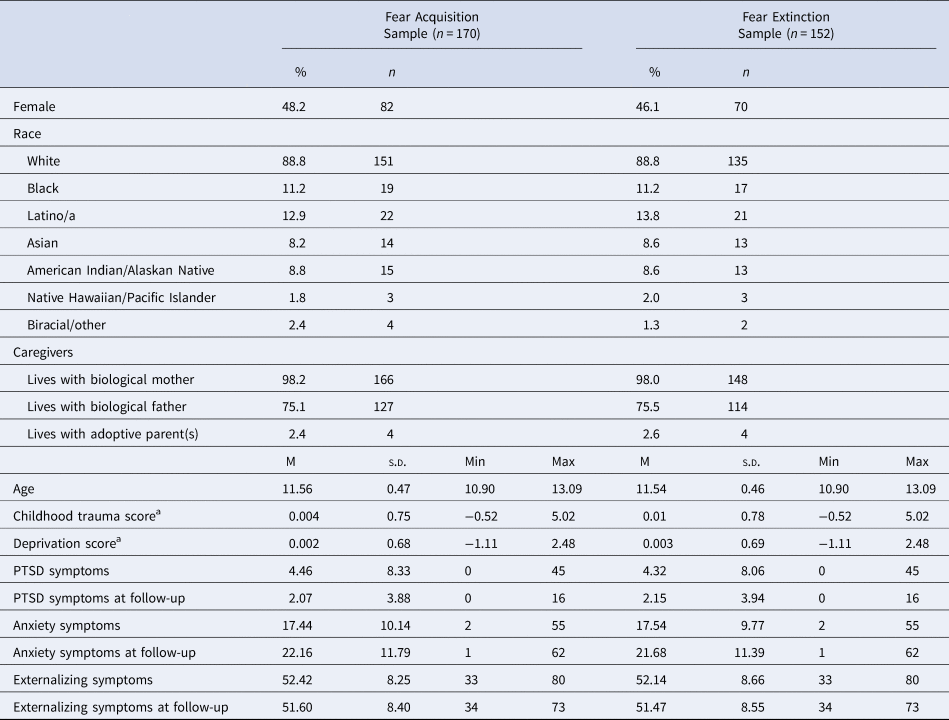
The sample was drawn from a longitudinal study of children in the Seattle area (N = 302) followed across numerous assessments in early and middle childhood (Lengua et al., Reference Lengua, Kiff, Moran, Zalewski, Thompson, Cortes and Ruberry2014, Reference Lengua, Thompson, Moran, Zalewski, Ruberry, Klein and Kiff2019). A subset of these participants returned for follow-up assessments when children were 10–13 years old. 227 youth were eligible and interested in participating in the present study. Of this sample, 215 participated in the fear learning paradigm, 211 participated in a follow-up assessment of psychopathology two years later. Participant demographic information is summarized in Table 1.
Demographics and psychopathology symptoms

a Trauma and deprivation scores are the average of z scores in the sample.
Procedure
At Session 1, parents and children completed questionnaires and interviews about children's psychopathology symptoms and ELA. At Session 2 approximately five weeks later (M = 5.37, s.d. = 8.26), children completed a fear conditioning and extinction paradigm described below. Children and parents completed questionnaires assessing symptoms of psychopathology again approximately two years later. All procedures for the first wave of data collection were approved by the institutional review board at the University of Washington, Seattle; procedures for the follow-up wave of data collection were approved by the institutional review board at Harvard University.
Measures
Childhood trauma
We constructed a childhood trauma experiences variable using three components, consistent with prior work in this sample that was preregistered (see Weissman et al., Reference Weissman, Rosen, Colich, Sambrook, Lengua, Sheridan and McLaughlin2022 and online Supplement). First, we used a count of exposure to five types of interpersonal violence: physical abuse, sexual abuse, domestic violence, witnessing a violent crime, or being the victim of a violent crime (Min = 0, Max = 5, M = 0.28, s.d. = 0.75). Each exposure was counted if endorsed by the parent or child on the UCLA PTSD Reaction Index (PTSD-RI). Physical abuse, sexual abuse, and domestic violence were also coded as present if endorsed by the child on the Child Experiences of Care and Abuse (CECA) Interview. Second, we summed the frequency of violence witnessed and experienced on the Violence Exposure Scale for Children-Revised (VEX-R) (Min = 0, Max = 27, M = 4.97, s.d. = 5.37). Third, we used the sum of the Childhood Trauma Questionnaire (CTQ) physical and sexual abuse subscales (Min = 10, Max = 35, M = 10.53, s.d. = 2.07). To create the overall continuous composite for childhood trauma, each of the three subscales was standardized using z scores and then averaged together. Higher scores indicate greater exposure to childhood trauma.
Deprivation
We constructed a deprivation experiences variable consistent with prior work in this sample (Weissman et al., Reference Weissman, Rosen, Colich, Sambrook, Lengua, Sheridan and McLaughlin2022) as a mean of three composite scores: cognitive deprivation, emotional deprivation, and physical deprivation. Higher scores indicate higher levels of deprivation experiences (see online Supplement).
Psychopathology
We assessed symptoms of psychopathology through the Youth Self Report (YSR), Child Behavior Checklist (CBCL), Screen for Child Anxiety Related Emotional Disorders (SCARED) Child Report, and the UCLA PTSD Reaction Index (PTSD-RI) Parent Report and Child Report (see online Supplement). For questionnaires with a parent report and child report (YSR/CBCL, PTSD-RI), we applied an ‘or’ rule commonly used in population-based studies of child psychopathology (Kessler et al., Reference Kessler, Avenevoli, Costello, Georgiades, Green, Gruber and Merikangas2012; Merikangas et al., Reference Merikangas, He, Burstein, Swanson, Avenevoli, Cui and Swendsen2010) such that the highest subscale score from either child or parent report was used to account for unique information provided by child and parent report (Cantwell, Lewinsohn, Rohde, & Seeley, Reference Cantwell, Lewinsohn, Rohde and Seeley1997). Psychopathology was assessed at the fear conditioning visit and approximately two years later (M = 25.38 months, s.d. = 3.61).
Fear conditioning task
The present study used a differential fear-conditioning paradigm, in which youth learn to associate an aversive unconditioned stimulus (US) with a reinforced conditioned stimulus (CS+), but not a non-reinforced conditioned stimulus (CS−) widely used in prior studies with children and unmodified in the present study (France et al., Reference France, Reda, Marusak, Riser, Wiltshire, Davie and Jovanovic2022; Jovanovic et al., Reference Jovanovic, Nylocks, Gamwell, Smith, Davis, Norrholm and Bradley2014, see online Supplement). The acquisition phase consisted of 3 blocks of each trial type. The extinction phase consisted of 4 blocks of each type.
Fear acquisition and extinction were measured through psychophysiological assessment using Biopac sampled at 1000 Hz. SCR was calculated following a standard procedure as the difference in amplitude from baseline to peak response 1–4 s following stimulus onset, with a minimum response of 0.02 microsiemens (μS). Skin conductance data was square-root transformed prior to data analysis. Outliers greater than three standard deviations above the mean were winsorized in analyses (Wilcox & Keselman, Reference Wilcox and Keselman2003) consistent with prior analyses of this sample (Colich et al., Reference Colich, Hanford, Weissman, Allen, Shirtcliff, Lengua and McLaughlin2023).
During fear acquisition, participants responded to questions about each CS (CS+, CS−) twice across habituation and each block of fear acquisition. Participants were asked to predict which CS would be followed by the US. Participants could answer yes, no, or that they did not know within 3 s. Questions were averaged across each block and across fear acquisition overall. The final sample consisted of 170 people in fear acquisition and 152 people in fear extinction with high-quality data (Table 1, see online Supplement). Of the final 170 participants, 162 completed follow-up questionnaires on psychopathology symptoms and thus, were included in mediation models.
Analysis methods
To test associations of childhood trauma and deprivation with fear learning during acquisition and extinction, we conducted a 4 × 2 repeated-measures Analysis of Variance (ANOVA) with Time (four blocks) and Stimulus (CS+, CS−) as within-subject factors and SCR as the dependent variable using SPSS. Childhood trauma was examined as the independent variable, and age, and sex were included as covariates in an initial model; deprivation was added as an additional covariate in a second model. The four time periods in the fear acquisition analysis included Pre-Acquisition, Acquisition Block 1, Acquisition Block 2, and Acquisition Block 3. During fear extinction, the four time periods consisted of Extinction Block 1, Extinction Block 2, Extinction Block 3, and Extinction Block 4.
To test associations of psychopathology symptoms two years later with fear learning, we ran three linear regression models predicting PTSD symptoms, anxiety symptoms, and externalizing symptoms at follow-up. Predictors included amplitude of SCR to CS+ during early fear conditioning, amplitude of SCR to the CS− during early fear conditioning, age, sex, and psychopathology symptoms at the time of the baseline visit (PTSD, anxiety, or externalizing symptoms). Regression models were evaluated for outliers and influential points.
We ran mediation models estimating the significance of the indirect effects of childhood trauma on psychopathology two years later through fear learning using a bootstrapping approach that provides bias-corrected confidence intervals controlling for age, sex, and baseline psychopathology symptoms (Preacher & Hayes, Reference Preacher and Hayes2008). Deprivation was added in a second model. Confidence intervals that do not include zero indicated a significant indirect effect. To minimize multiple comparisons, we selected mediation models to test based on initial investigation of associations of childhood trauma with fear learning for which a and b paths were statistically significant during Acquisition Block 1 when the largest differences between the CS+ and the CS− emerged.
Results
Fear learning
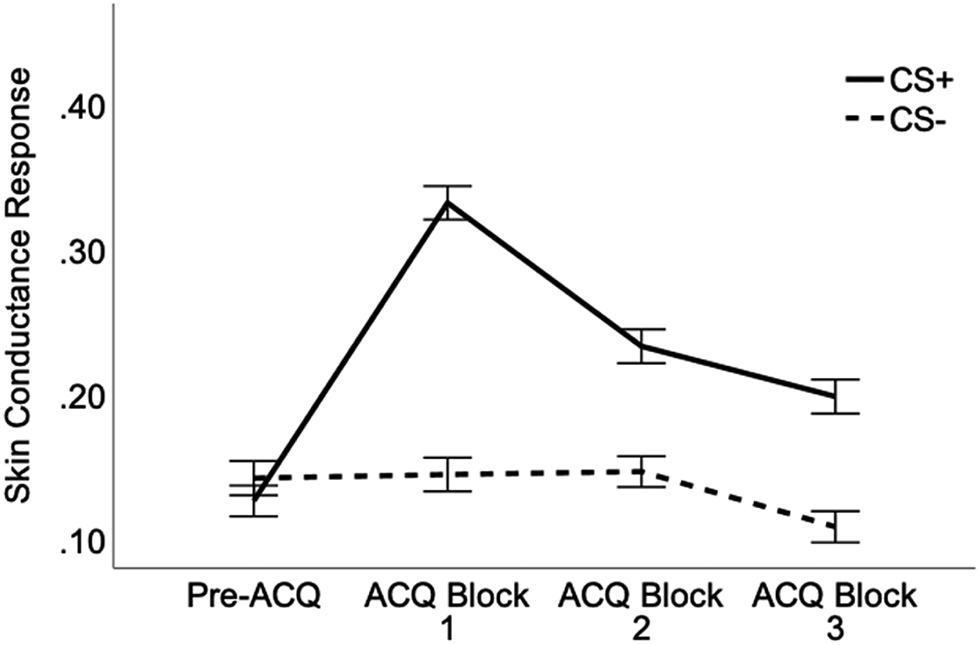
Evidence of fear learning as measured by SCR occurred in the sample. There were significant main effects of stimulus, F (1, 169) = 163.46, p < 0.001, with higher SCR to the CS+ than the CS−, Time, F (3, 507) = 60.59, p < 0.001, and a Stimulus by Time interaction F (3, 507) = 43.86, p < 0.001. There were significant differences between the CS+ and the CS− across Acquisition Blocks 1–3 (p < 0.001) with the greatest differences in Acquisition Block 1 (Fig. 1). In extinction, there was a significant main effect of Time F (3, 453) = 11.43, p < 0.001, but no main effects of Stimulus or Stimulus by Time interactions. SCR decreased across extinction for both the CS+ and the CS−, indicating successful fear extinction. Participants correctly identified the CS+ as predictive of the US 89.71% of the time across fear acquisition (Mean = 0.89, s.d. = 0.21).
Main effects of skin conductance response amplitude during fear acquisition.
Note: Skin conductance response (SCR) in μS during fear learning showed a stimulus by time interaction with significant differences between the threat cue (CS+) and the safety cue (CS−) across all fear acquisition (ACQ) blocks with the largest differences during early fear acquisition (ACQ Block 1). Error bars are ± 1 standard error.

Childhood trauma, deprivation, and fear learning
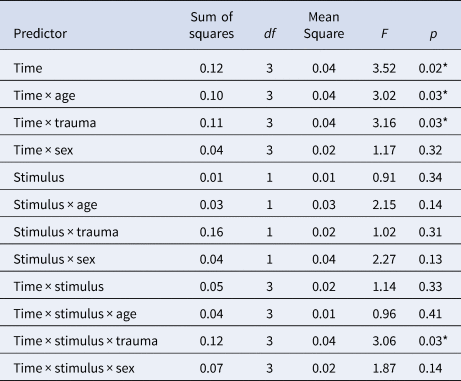
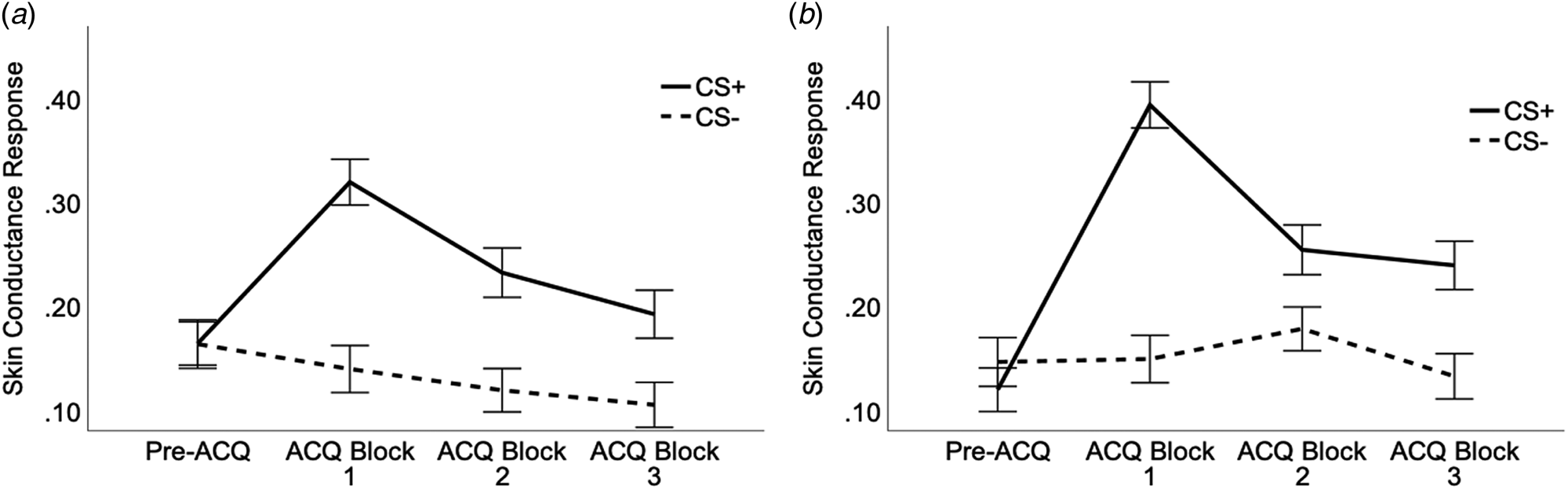
Childhood trauma associated with differential SCR responses during acquisition controlling for age and sex (Table 2). We observed a Time × Trauma interaction F (3, 498) = 3.16 p < 0.05, and a Time × Stimulus with Trauma interaction F (3, 498) = 3.06 p < 0.05. Greater experiences of childhood trauma were associated with higher SCR to the CS+ during Acquisition Block 1 (Fig. 2). When examining CS+ and CS− in separate models, childhood trauma was associated with changes across Time to the CS+ but not the CS−. Additionally, we observed a Time × Age interaction F (3, 498) = 3.02 p < 0.05 and an overall effect of age (F (1, 166) = 15.65, p < 0.001) indicating that younger participants in the sample exhibited larger SCR responses during fear acquisition.
4 × 2 Repeated-measures ANOVA of childhood trauma and fear learning controlling for age and biological sex with time (4 blocks) and stimulus (CS+, CS−)

*p < 0.05.
Skin conductance response amplitude by childhood trauma during fear acquisition.
Note: 1st quartile of childhood trauma shown in A compared to 4th quartile of childhood trauma in B. Quartiles are shown for visualization purposes only. Youth with more childhood trauma showed greater skin conductance response (SCR) in μS during fear learning to the threat cue (CS+) than the safety cue (CS−) during fear acquisition. The largest differences in childhood trauma occurred during early fear acquisition (ACQ Block 1). Error bars are ± 1 standard error.

When additionally controlling for deprivation, results were largely unchanged. The Time by Stimulus with Trauma interaction remained significant, F (3, 498) = 3.44 p < 0.05, with the same pattern of results. There was no association of deprivation with SCR responses during acquisition (online Supplementary Table S1).
There were no associations of childhood trauma or deprivation with SCR responses during fear extinction.
Psychopathology symptoms and fear learning
SCR to the CS+ during early fear learning was associated with PTSD symptoms at follow-up controlling for SCR to the CS−, age, sex, and current PTSD symptoms (β = 0.18, p < 0.05). There were no other significant associations of SCR to the CS+ with anxiety or externalizing symptoms at follow-up controlling for SCR to the CS−, age, sex, and baseline symptoms.
Childhood trauma, fear learning, and psychopathology symptoms
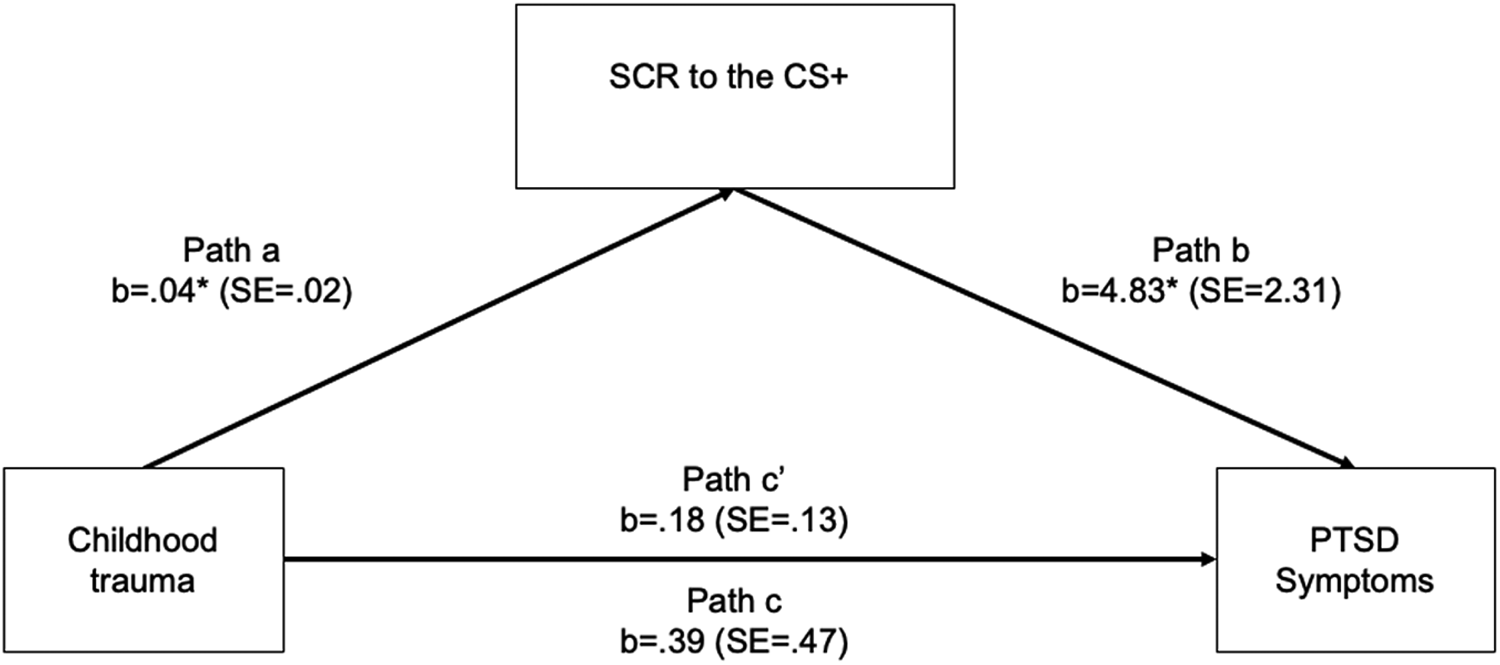
Based on the findings in the primary analyses, we examined whether SCR to the CS+ during Acquisition Block 1 mediated the relationship between childhood trauma and prospective PTSD symptoms, controlling for age, sex, SCR to the CS-, and current symptoms. A second model added deprivation as an additional covariate. A significant indirect effect of childhood trauma on prospective PTSD symptoms was observed through SCR during Acquisition Block 1 (β = 0.13, 95% CI 0.001–0.44, Fig. 3). When additionally controlling for deprivation, the same finding was observed (β = 0.18, 95% CI 0.02–0.54).
Skin conductance response to the threat cue during early fear learning mediates the relationship between childhood trauma and longitudinal PTSD symptoms. Reactivity measured by skin conductance response (SCR) to the threat cue (CS+) during early fear learning mediated the relationship between childhood trauma and prospective PTSD symptoms approximately two years later controlling for age, sex, SCR to the safety cue (CS−), and current PTSD symptoms controlling for experiences of deprivation. *p < 0.05.

Discussion
The current study examined associations of childhood trauma and deprivation with fear learning, and assessed fear learning as a potential mechanism underlying trauma-related psychopathology symptoms in a large longitudinal sample of early adolescents. We extend prior work by demonstrating associations of childhood trauma, but not deprivation, with greater discrimination between the threat and safety cue during early fear acquisition, driven by elevated response to the threat cue. Heightened response to the threat cue during early fear learning was associated with increases in PTSD symptoms over time and mediated the prospective association between experiences of trauma and later PTSD symptoms. Taken together, these findings indicate that altered fear acquisition may be one mechanism linking traumatic experiences with the emergence of PTSD symptoms during adolescence.
Youth with more childhood trauma showed greater skin conductance response to the threat relative to safety cue during early fear acquisition, even after controlling for deprivation. Consistent with prior studies (Machlin et al., Reference Machlin, Miller, Snyder, McLaughlin and Sheridan2019; McLaughlin et al., Reference McLaughlin, Sheridan, Gold, Duys, Lambert, Peverill and Pine2016), we observed no association between deprivation and fear learning. Prior research in preschool-age youth found that children with greater trauma experiences showed heightened physiological reactivity to the threat cue during fear acquisition after controlling for deprivation (Machlin et al., Reference Machlin, Miller, Snyder, McLaughlin and Sheridan2019). Here, we find similar results in a sample of early adolescents when childhood trauma is modelled dimensionally using multiple measures. Interestingly, the largest prior study examining childhood trauma and fear conditioning found that childhood trauma was associated with poor discrimination between the threat and safety cue during early fear conditioning in children 6 to 18 years old (McLaughlin et al., Reference McLaughlin, Sheridan, Gold, Duys, Lambert, Peverill and Pine2016). Differences in these patterns of results may be due to the severity of traumatic experiences where prior studies include youth with more physical and sexual abuse experiences on the sum of those subscales of the CTQ (DeCross et al., Reference DeCross, Sambrook, Sheridan, Tottenham and McLaughlin2022; McLaughlin et al., Reference McLaughlin, Sheridan, Gold, Duys, Lambert, Peverill and Pine2016). The prior studies therefore focused on children with relatively severe exposure to trauma, whereas the childhood trauma in the current sample included experiences of mild and moderate severity (e.g. harsh punishment, witnessing community violence). If severity of trauma accounts for these differences, it suggests that severity of trauma may be important in understanding how youth learn about new threatening stimuli. Differences in the pattern of results could also be due to differences in the age of the samples. Younger participants in the current study showed greater physiological reactivity to the threat and safety cue across fear acquisition, suggesting that physiological reactivity during fear learning may decline across development. Overall, the current study demonstrates associations between childhood trauma and heightened reactivity to the threat cue controlling for the safety cue in children 10 to 13 years old. This finding also contributes to an increasingly large body of evidence that childhood trauma, controlling for deprivation, is associated with altered fear learning as hypothesized by the dimensional model of adversity (McLaughlin et al., Reference McLaughlin, Sheridan and Lambert2014).
As predicted, childhood trauma was associated with physiological reactivity to the threat cue during fear acquisition, but not fear extinction. Prior work has identified that childhood trauma is not associated with physiological reactivity during fear extinction (France et al., Reference France, Reda, Marusak, Riser, Wiltshire, Davie and Jovanovic2022; Jovanovic et al., Reference Jovanovic, Nylocks, Gamwell, Smith, Davis, Norrholm and Bradley2014; Marusak et al., Reference Marusak, Hehr, Bhogal, Peters, Iadipaolo and Rabinak2021). This research suggests that youth with and without experiences of childhood trauma can learn new information about the safety of the threat cue during fear extinction. These results suggest differences in fear learning associated with childhood trauma may be mitigated by new safe experiences with a threat cue.
We also examined if fear learning mediated the relationship between childhood trauma and increases in psychopathology symptoms over time. We found that physiological reactivity to the threat cue during early fear acquisition mediated the relationship between trauma and increases in PTSD symptoms approximately two years later. Youth who have experienced more childhood trauma and show greater physiological response to the threat cue during fear learning had greater increases in PTSD symptoms at follow-up controlling for current symptoms. Conceptually, the finding suggests that youth who have had more traumatic experiences are more vigilant to potentially threatening stimuli or exhibit stronger emotional reactivity to potential threat, which may confer increased risk for PTSD symptoms. Another possible explanation is that youth who have experienced more childhood trauma show higher physiological reactivity to any emotional stimuli, such as trauma-related reminders, with recent work showing associations between childhood trauma and physiological reactivity during interviews about trauma (Grasser et al., Reference Grasser, Saad, Bazzi, Wanna, Abu Suhaiban, Mammo and Javanbakht2022.; Wiltshire et al., Reference Wiltshire, Wanna, Stenson, Minton, Reda, Davie and Jovanovic2022). Limited work has examined fear learning processes in relation to childhood PTSD symptoms. In one study, symptoms of PTSD were associated with elevated reactivity to the threat cue during fear learning (Gamwell et al., Reference Gamwell, Nylocks, Cross, Bradley, Norrholm and Jovanovic2015). Children with a PTSD diagnosis have additionally shown blunted reactivity to the threat cue compared to children without PTSD during fear acquisition (McLaughlin et al., Reference McLaughlin, Sheridan, Gold, Duys, Lambert, Peverill and Pine2016). Importantly, more work is needed to identify if fear learning may be one mechanism through which childhood trauma may increase the risk for PTSD symptoms in clinical samples and which PTSD symptom clusters may be influenced by changes in fear learning.
Contrary to initial hypotheses, fear learning did not mediate the relationship between childhood trauma and externalizing symptoms. Thus, disruptions in fear learning may confer a specific risk for PTSD symptoms in the current sample rather than psychopathology more broadly. Prior research demonstrated that poor discrimination between the threat and safety cue partially mediated the association of maltreatment exposure with externalizing psychopathology (Fairchild et al., Reference Fairchild, Van Goozen, Stollery and Goodyer2008; Gao et al., Reference Gao, Raine, Venables, Dawson and Mednick2010a; McLaughlin et al., Reference McLaughlin, Sheridan, Gold, Duys, Lambert, Peverill and Pine2016). However, these studies were primarily conducted in clinical samples, such as youth with a conduct disorder diagnosis (Fairchild et al., Reference Fairchild, Van Goozen, Stollery and Goodyer2008, Reference Fairchild, Stobbe, van Goozen, Calder and Goodyer2010; Gao et al., Reference Gao, Raine, Venables, Dawson and Mednick2010b). This work suggests that fear learning may not be a mechanism linking childhood trauma and externalizing symptoms in community samples like the present study. Future work is needed to determine how fear learning processes may link childhood trauma and psychopathology symptoms in clinical samples.
Consistent with hypotheses, fear learning did not mediate the relationship between childhood trauma and anxiety symptoms. While initial studies found that youth with anxiety showed greater reactivity to the threat cue during fear acquisition (Liberman et al., Reference Liberman, Lipp, Spence and March2006; Waters et al., Reference Waters, Henry and Neumann2009), more recent work has found no significant differences between anxious and health youth during fear learning (Dvir, Horovitz, Aderka, & Shechner, Reference Dvir, Horovitz, Aderka and Shechner2019), or heightened responses to both the threat and safety cue during fear learning (Jovanovic et al., Reference Jovanovic, Nylocks, Gamwell, Smith, Davis, Norrholm and Bradley2014). The only prior study assessing mediation identified no mediation effect, suggesting that differential fear learning may not constitute a mechanism linking childhood trauma with anxiety symptoms in youth. Future work may consider anxiety within the context of PTSD symptoms or fear learning paradigms that do not rely on differential fear conditioning as the primary outcome (Grasser & Jovanovic, Reference Grasser and Jovanovic2021).
The current study contributes to identifying how childhood trauma is associated with fear learning and how altered fear learning processes may be one mechanism linking childhood trauma and psychopathology symptoms. However, several limitations should be noted. First, data loss resulted in being unable to analyze the fear-potentiated startle data and resulted in different sample sizes across fear acquisition and extinction. Second, though the sample was selected for variability across socioeconomic status and allowed for variability in levels of ELA, the study did not recruit a clinical sample and psychopathology symptoms do not indicate a diagnosis or clinical levels of impairment. Therefore, this study should be replicated with a sample with higher levels of psychopathology to examine if the current findings would replicate in samples with a diagnosis of PTSD. However, the present study suggests that moderate experiences of trauma are associated with fear learning and these differences account for subthreshold symptoms. Finally, childhood trauma and deprivation were measured in early adolescence capturing lifetime experiences and were not reassessed at follow-up. The strongest test of the mediation model would include longitudinal measures of childhood trauma and deprivation in addition to longitudinal measures of psychopathology.
The present study adds to literature suggesting that childhood trauma, but not deprivation, is associated with altered patterns of fear learning in youth. Findings suggest that heightened discrimination between the threat and safety cue is associated with trauma in early adolescence and that greater discrimination between the threat and safety cue in youth with more traumatic experiences is associated with increases in PTSD symptoms over time. These findings highlight specific fear learning processes as a potential mechanism underlying the emergence of trauma-related psychopathology in adolescence. These findings have important implications for preventive interventions aimed at reducing trauma-related psychopathology, with interventions that target heightened vigilance or emotional reactivity to threatening stimuli as potentially promising avenues for preventing worsening PTSD symptoms.
Supplementary material
The supplementary material for this article can be found at https://doi.org/10.1017/S0033291724001569
Competing interests
The authors declare none.