
Introduction
Few scholars would dispute the importance of radiocarbon dating for our understanding of the rise of peer-polities in the eastern Carpathian Basin during the Bronze Age. These absolute dates demonstrate the contemporaneity and synchronicity of materials that previously had been considered chronologically separate (cf. Stockhammer et al. Reference Stockhammer, Massy, Knipper, Friedrich, Kromer, Lindauer, Radosavljević, Wittenborn, Krause and Biehl2015). Relieved of the burden of supplying dates, the material cultural assemblages can now be viewed more dynamically, allowing archaeologists to study the inner workings of these regional cultures and their patterns of interaction. Likewise, absolute dating has allowed archaeologists to link Bronze Age developments in the Carpathian Basin to concurrent developments across the wider European continent (Raczky et al. Reference Raczky, Hertelendi, Horváth and Meier-Arendt1992). While absolute dates allow cultural sequences to be fixed in real time and accurately scaled in terms of duration, the older relative chronologies based on metal and ceramic typologies continue to influence views of European prehistory. They are also still relied upon to provide the chronological assignment for many regional sites—particularly those represented solely by surface collections.
Archaeological research in many parts of the world continues to struggle with the problem of how to mesh advances in archaeological dating with ‘legacy’ relative dating systems and their associated terminologies. The very concept of a ‘Bronze Age’, for example, is based upon the use of technological change to create a chronological ordering (Kristiansen Reference Kristiansen1998: 24–26). For later prehistory in Europe, elaborate continent-wide relative chronologies have been constructed on the basis of observed changes in metal types. Yet, from the beginning, it was clear that these technology-based chronologies distort local realities. The advent of radiocarbon dating emphasised the disconnect still further by demonstrating that the archaeological sequence of the Early, Middle and Late Bronze Ages in Western Europe were out of synch with the chronology of Bronze Age developments in the Carpathian Basin (see Kristiansen Reference Kristiansen1998: 33–35). One response was to employ terms such as ‘Early’ or ‘Late’ Bronze Age to reference broader organisational changes in society. In Hungary, for example, the terminology was shifted to fit general cultural developments, with the effect that the Early Bronze Age in Western Europe is contemporaneous with the Middle Bronze Age in Hungary (cf. Bóna Reference Bóna and Meier-Arendt1992; Kiss Reference Kiss2012: 195–203). While local scholars fully understand this terminological fault line, it can confuse the unsuspecting outsider.
The widespread use of absolute dating provides a means to resolve these terminological issues and to allow researchers to synchronise cultural developments within their study regions and across Europe as a whole. This article presents a suite of new radiocarbon dates obtained from a series of archaeological sites associated with the Maros Group—a cultural entity that spanned the Early and Middle Bronze Ages, and its Late Bronze Age successors in the Tisza-Maros region of the Carpathian Basin. These dates permit further refinement of the regional chronology and the opportunity to assess the validity of a widely used local ceramic-based chronology.
The Maros Group and its chronology
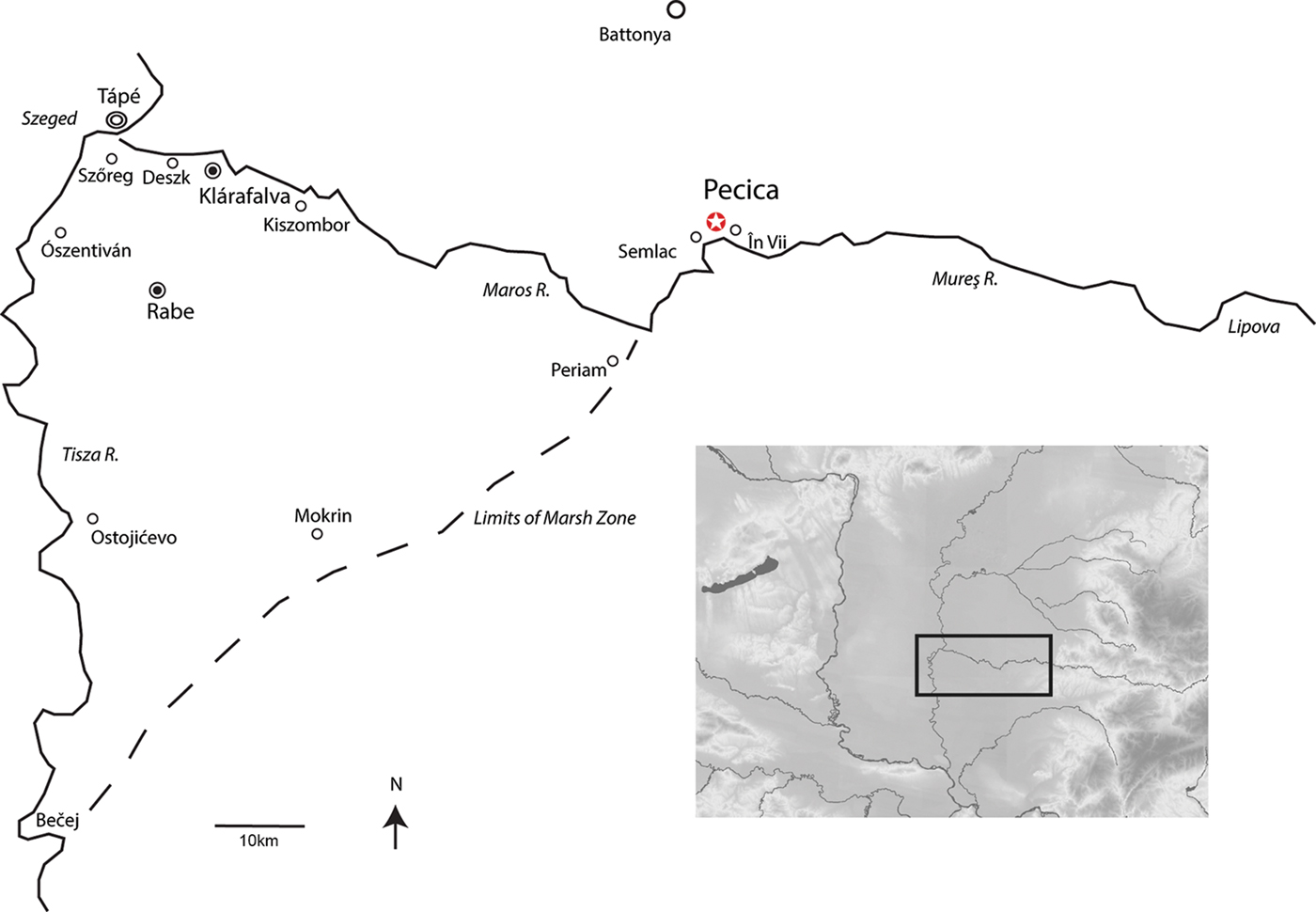
The Maros Group is an Early and Middle Bronze Age complex located in south-eastern Hungary, western Romania and northern Serbia (Bóna Reference Bóna1975; Girić Reference Girić and Tasić1984; Soroceanu Reference Soroceanu1991) (Figure 1). Maros Group sites are found along the River Maros (Mureş/Moriš) and along the east bank of the River Tisza (Tisa) from its confluence with the Maros (near present-day Szeged in Hungary) to the Danube. Sites associated with the Group reached their maximum regional extent during the Middle (or Classic) Phase, which corresponds roughly to the beginning of the Carpathian Basin Middle Bronze Age—c. 2000 BC (O'Shea Reference O'Shea1996). The Late Phase, which corresponds with the second half of the Middle Bronze Age (from c. 1850 BC), sees the intensification of metal production and long-distance trade, along with an increasing emphasis on horse rearing (Nicodemus Reference Nicodemus2011; Nicodemus et al. Reference Nicodemus, Motta and O'Shea2015). Concurrently, many settlements and cemeteries were abandoned, and populations consolidated into a smaller number of centralised sites. The Maros sequence ends relatively abruptly at c. 1500 BC. The following period, the early phase of the Late Bronze Age (1500/1450–1300 BC, after Fischl et al. Reference Fischl, Kiss, Kulcsár, Szeverényi, Meller, Bertemes, Bork and Risch2013), is traditionally defined as the ‘Tumulus Grave’ period (cf. Csányi Reference Csányi and Visy2003; Sánta Reference Sánta2010; Fischl et al. Reference Fischl, Kiss, Kulcsár, Szeverényi, Meller, Bertemes, Bork and Risch2013).
Distribution of major Maros settlements and cemeteries and the Late Bronze Age cemetery at Tápé. The inset shows the location of the Tisza-Maros region within the Carpathian Basin.

At the beginning of the twentieth century, two major tell settlements—Periam-Movila Șanțului (Perjámos-Sánchalom) (Roska Reference Roska1913, Reference Roska1914) and Pecica-Şanţul Mare (Pécska-Nagysánc) (Dömötör Reference Dömötör1902; Roska Reference Roska1912) had been excavated, which provided a stratigraphic sequence for the regional Bronze Age. Childe (Reference Childe1929: 219) recognised the chronological importance of these long-lived sites, which he termed the ‘Perjámos Culture’. Soon afterwards, a series of large inhumation cemeteries were excavated near the Tisza-Maros confluence, including Szőreg C, Deszk A and F, Ószentiván in Hungary and, more recently, at Mokrin and Ostojićevo in Serbia.
While the metal finds associated with the Maros sites permitted their general placement within the broader European chronological framework (Reinecke Reference Reinecke1965), they did not provide sufficient chronological resolution for more detailed local study. To obtain this finer degree of precision, Bóna (Reference Bóna1975) examined the extensive assemblage of ceramic vessels recovered from the Szőreg cemetery in order to devise a more refined local chronology. In 1941, Foltiny initially defined three ceramic phases at Szőreg, whereas Bóna (Reference Bóna1975) identified five distinct ceramic phases, which he linked to the stratigraphic levels delineated by Roska (Reference Roska1912) at Pecica-Şanţul Mare.
Bóna's chronological seriation of Szőreg ceramics has been widely adopted for Maros sites. While the classification could be directly applied to other funerary deposits, its reliance on complete vessels limits its applicability to other archaeological contexts, particularly those in which sherds rather than whole vessels are the norm, and where a greater range of domestic vessel forms are found. An added problem for Bóna's chronology is that many earlier vessel forms continued to be used, even as the later ‘baroque’ forms are introduced. While Bóna could control for this problem within individual grave assemblages, it posed a greater problem for graves that lacked diagnostically late vessels. The same mixing of styles has been observed in the excavation of stratified settlement deposits at, for example, Pecica-Şanţul Mare (Nicodemus & O'Shea Reference Nicodemus, O'Shea, Forţiu and Stavilă2015).
In the late 1980s, excavations at the Maros tells of Klárafalva and Kiszombor, along with a series of six radiocarbon dates from the Maros cemetery of Mokrin, provided the first absolute chronology for the Maros Group (O'Shea Reference O'Shea1992). More recently, a 10-year excavation programme at the Pecica-Şanţul Mare tell has generated a large set of dates associated with specific stratigraphic contexts and cultural events for the Maros Group (O'Shea et al. Reference O'Shea, Barker, Sherwood and Szentmiklosi2005, Reference O'Shea, Barker, Nicodemus, Sherwood and Szentmiklosi2006, Reference O'Shea, Barker, Motta and Szentmiklosi2011; Nicodemus et al. Reference Nicodemus, Motta and O'Shea2015). Unlike the samples from the 1980s excavations, the Pecica sequence has benefited from the use of AMS dating, which has significantly reduced the error margins associated with each date. From a culture-historical perspective, the most important outcome of this absolute dating is the accurate placement of the Maros Group within the larger chronology of the Carpathian Basin and the wider European Bronze Age. For the purposes of this article, the new Pecica absolute chronology provides the index against which developments at the other Maros settlements and cemeteries are compared.
Although the new settlement dates answer many questions, two chronological issues remain unresolved. The first concerns the Pecica aggregation event (O'Shea & Nicodemus Reference O'Shea, Nicodemus and Gyucha2019). The aggregation event sees a sudden, large-scale expansion of the Pecica settlement that seems to coincide with the abandonment of most other Maros settlements and cemeteries. The dating programme was designed to assess how closely the expansion of the Pecica settlement coincided with the abandonment of numerous Maros settlements and cemeteries. The second concerns the abrupt end of the Maros occupation and the nature of succeeding occupation in the Tisza-Maros region.
Interpretations concerning the end of the Middle Bronze Age—and the reasons behind it—have shifted significantly over recent decades. Early interpretations described the end of the tell-cultures as an abrupt change, linked to an invading population, which was conventionally known as the ‘Tumulus Culture’ (c.f. Mozsolics Reference Mozsolics1957; Bóna Reference Bóna1958). Although the ‘Tumulus Culture’ term persisted, more recent interpretations contemplate a longer, more complex process and emphasise—to varying degrees—the role of the indigenous Middle Bronze Age populations in the social transformations (e.g. Bóna Reference Bóna and Meier-Arendt1992; Szabó Reference Szabó1999; Csányi Reference Csányi and Visy2003; Sánta Reference Sánta2009; Hajdu Reference Hajdu2012; Fischl et al. Reference Fischl, Kiss, Kulcsár, Szeverényi, Meller, Bertemes, Bork and Risch2013). Despite the increasing interest in the Tisza-Maros region and the growing dataset (most recently Sava & Ignat Reference Sava, Ignat, Golgâltan and Cordoş2016), the nature of the transition, and the role of the Maros Groups’ descendants in the subsequent ‘Tumulus Culture era’, remains unclear (Szabó Reference Szabó1999: 62–66; see also Hajdu Reference Hajdu2012).
New dates for the cemeteries and settlements of the Tisza-Maros region
To address these questions, we present new dates from four cemeteries (three from the Maros Group and one local Late Bronze Age cemetery) and two Maros settlements (Figure 1).
Szőreg-C
The Szőreg cemetery is located in the village of Szőreg in south-eastern Hungary, and is the closest of the Maros cemeteries to the Tisza-Maros confluence. Excavated between 1928 and 1930 (Foltiny Reference Foltiny1941; O'Shea Reference O'Shea1996: 61–63), the site yielded approximately 230 graves and Foltiny (Reference Foltiny1941: 3) estimated that there might have been an additional 330–400 graves still to be recovered. The ceramics from Szőreg appear to span the entire Maros sequence, except for the earliest Early Bronze Age varieties observed at Pitvaros (Bóna Reference Bóna1965).
Ostojićevo-Stari Vinogradi
The Ostojićevo cemetery is located east of the River Tisza, approximately 40km south of the Tisza-Maros confluence and 20km west of the Mokrin cemetery (Girić Reference Girić1971; Milašinović Reference Milašinović2009). The site was excavated from 1981–1991, yielding approximately 285 graves. Chronologically, the site is important in that Ostojićevo, along with Szőreg C and Deszk A in Hungary, are the only Maros cemeteries that have yielded significant quantities of Late Maros-style ceramics (Girić Reference Girić and Tasić1984). Given that most Maros settlements and cemeteries were abandoned during this time (O'Shea & Nicodemus Reference O'Shea, Nicodemus and Gyucha2019), the persistent use of these sites is of particular importance.
Battonya-Vörös Október MTSZ
The Bronze Age cemetery of Battonya-Vörös Október MTSZ is located just north of the town of Battonya in Hungary, 17km north of Pecica-Şanţul Mare and 65km from the Tisza-Maros confluence. The cemetery was excavated between 1964 and 1966 and again between 1973 and 1979, yielding approximately 130 graves (A. Gazdapusztai Reference Gazdapusztai1968; Gy. Gazdapusztai Reference Gazdapusztai1968; Szabó Reference Szabó1999). Although the Maros cultural affiliation of the cemetery has been questioned (cf. O'Shea Reference O'Shea1996), it would represent the most easterly of the known Maros cemeteries; thus, its dating is of particular significance.
Tápé-Széntéglaégető
The cemetery of Tápé is located on the west side of the River Tisza at the Tisza-Maros confluence in Hungary. The site was excavated in the 1960s and yielded nearly 700 graves (Trogmayer Reference Trogmayer1975). Applying the conventional Reinecke seriation of common Bronze Age metal types (Reinecke Reference Reinecke1965), the cemetery was dated by the excavator to the very end of the Middle to early Late Bronze Age (Reinecke BB2–Reinecke BC, and potentially the beginning of Reinecke BD). As such, the site was interpreted as a Tumulus Culture cemetery (Trogmayer Reference Trogmayer1975). Subsequent disagreements have emerged concerning the potential use-life of the site (see Bösel Reference Bösel2008: 49). Alternate interpretations that minimise large-scale population change have also been presented (O'Shea Reference O'Shea1996: 368; Blischke Reference Blischke2002). This cemetery was included in the current dating programme to help clarify these relationships and to establish the absolute dates associated with the transition from the Middle to Late Bronze Age in the region.
Semlac-Livada lui Onea
The Semlac tell settlement is located on a bluff overlooking the Maros flood plain, approximately 1km west of Pecica-Şanţul Mare (Drașovean Reference Drașovean1999: 116–17). The site was initially tested by Popescu in 1943, and, later, by Gogâltan in 1994 (Popescu Reference Popescu1944; Gogâltan Reference Gogâltan and Tasic1996). The surface-roughened coarse wares and an absence of baroque-style ceramics at the site indicate an early Maros date (Nicodemus & O'Shea Reference Nicodemus, O'Shea, Forţiu and Stavilă2015). The charcoal samples analysed for the present study were recovered in 2007, when the still-exposed 1994 trench profile was cleaned and recorded.
Rabe-Anka Siget
The Anka Siget (Anka Sziget) site is a tell settlement located just south of the village of Rabe, in northern Serbia. The tell is located due south of the Deszk area cemeteries in Hungary and approximately 16km from the Tisza-Maros confluence. The site was first investigated archaeologically in 1891 (Reizner Reference Reizner1891). Since then, it has been the subject of periodic small-scale tests, but has never been extensively excavated (Grčki-Stanimirov & Stanimirov-Grčki Reference Grčki-Stanimirov and Sava Stanimirov-Grčki1998). The settlement is chronologically significant in that it has produced Late Maros-type, baroque-style ceramics—a distinction shared only with Pecica-Şanţul Mare and Klárafalva-Hajdova (O'Shea & Nicodemus Reference O'Shea, Nicodemus and Gyucha2019). The charcoal samples analysed for the present study were recovered during coring at the site in 2017.
Results
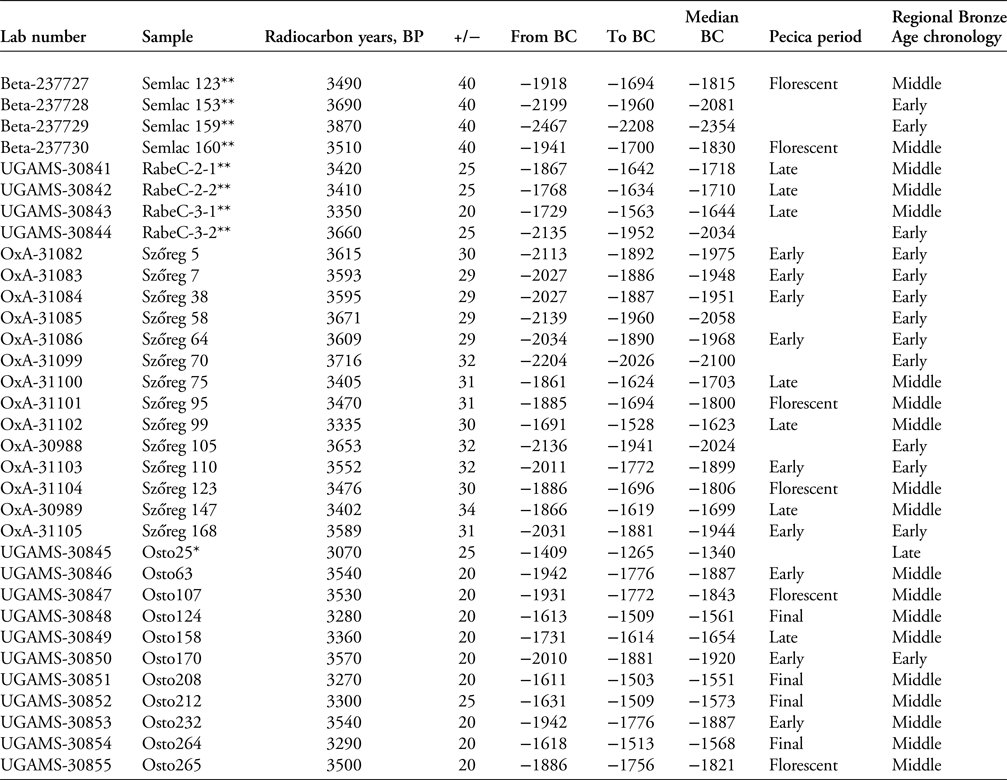
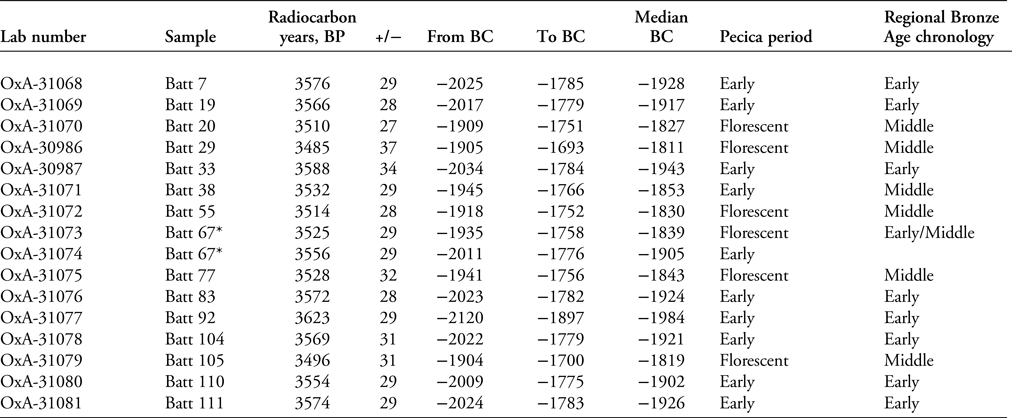
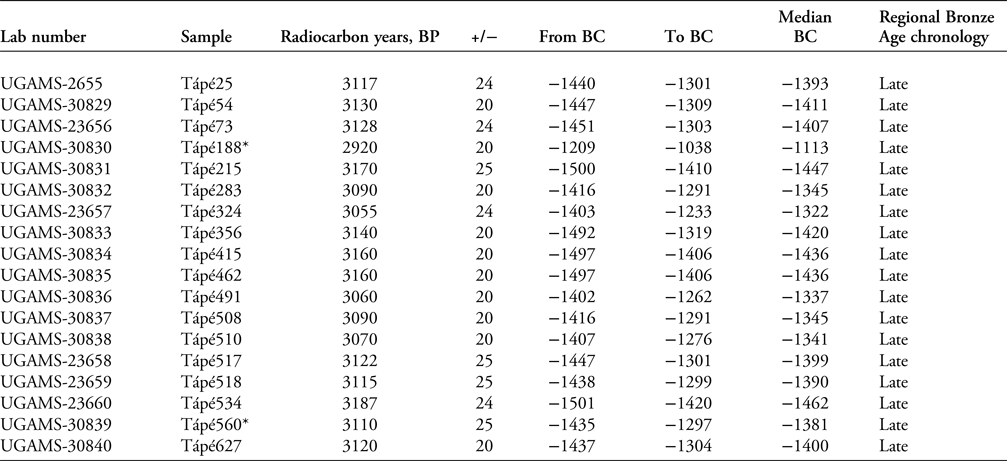
The new radiocarbon dates for the six sites are presented in Tables 1–3 and Figures 2–7. In addition to the raw and calibrated dates, Tables 1–3 also place the dates within the regional Bronze Age sequence, and within the site phases established for Pecica-Şanţul Mare (see O'Shea & Nicodemus Reference O'Shea, Nicodemus and Gyucha2019).
New radiocarbon dates for the Maros Group; calibrated date spans represent 95 per cent confidence. Most of the samples were unburned human bone; samples of different material are marked with an asterisks: * the dated material was cremated bone; ** the dated material was charcoal.

New radiocarbon dates for the Battonya cemetery; calibrated date spans represent 95 per cent confidence. The samples were unburned human bone; * the two dates are from the same sample.

New radiocarbon dates for the Tápé cemetery; calibrated date spans represent 95 per cent confidence. Most of the samples were unburned human bone; samples of cremated bone are marked with an asterisk.

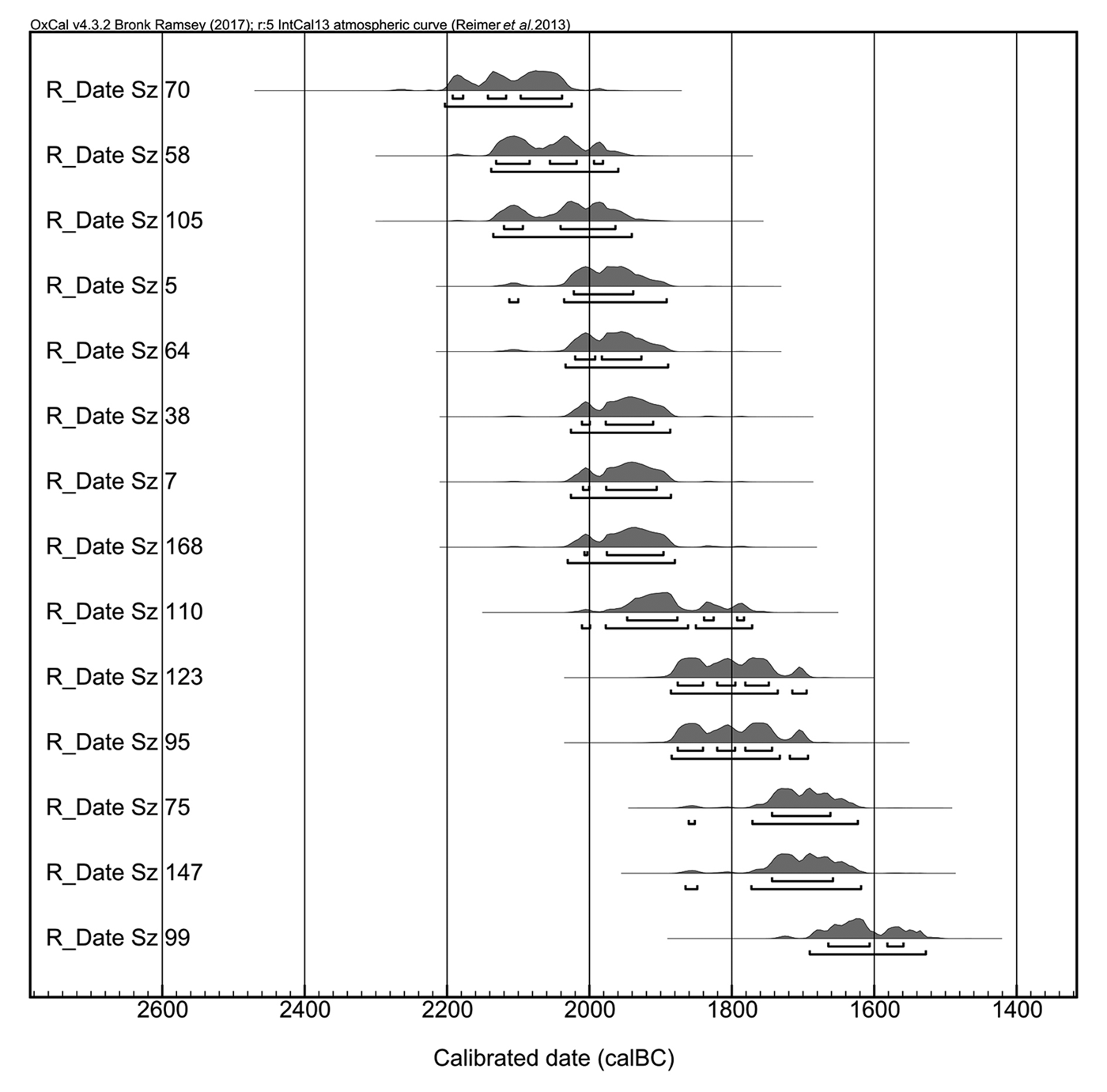
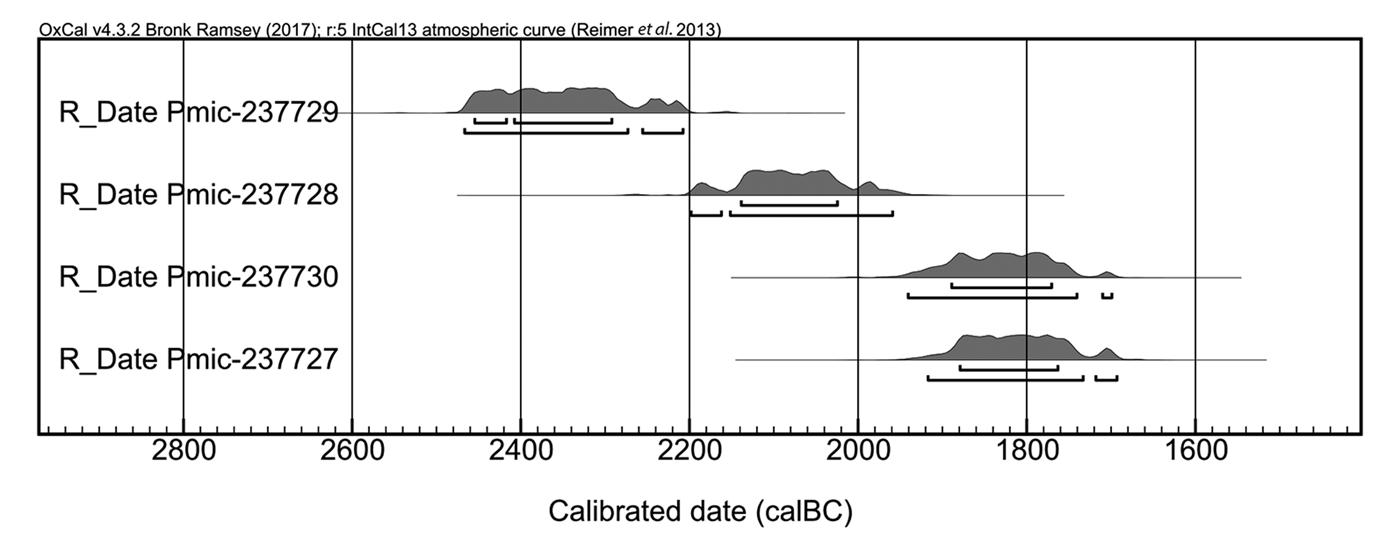
Calibrated dates and two-sigma range for the Szőreg cemetery samples. In this and the following figures, calibrations were performed using OxCal (Bronk Ramsey Reference Bronk Ramsey2009; Reimer et al. Reference Reimer2013).

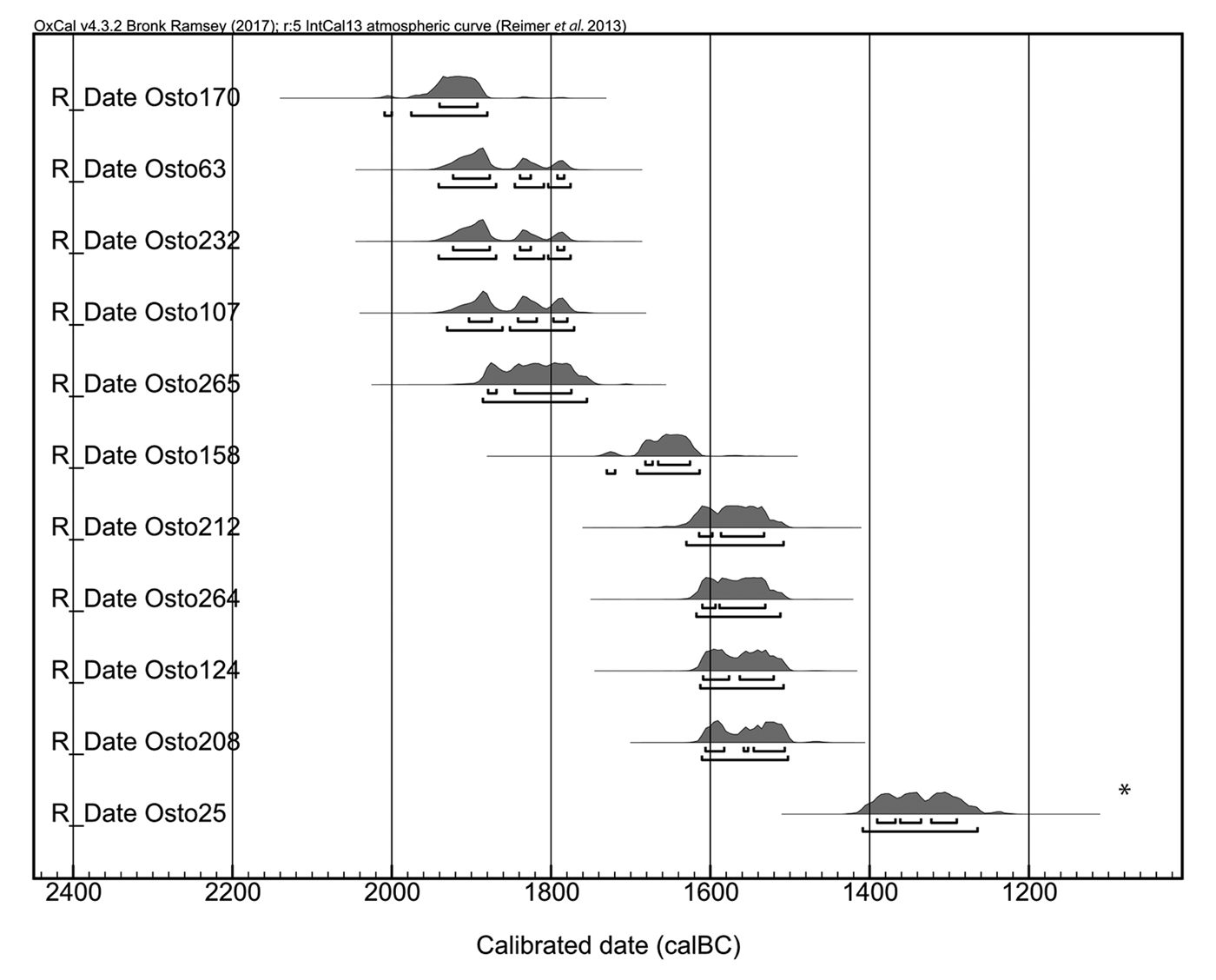
Calibrated dates and two-sigma range for the Ostojićevo cemetery samples; the asterisk denotes a cremated bone sample.

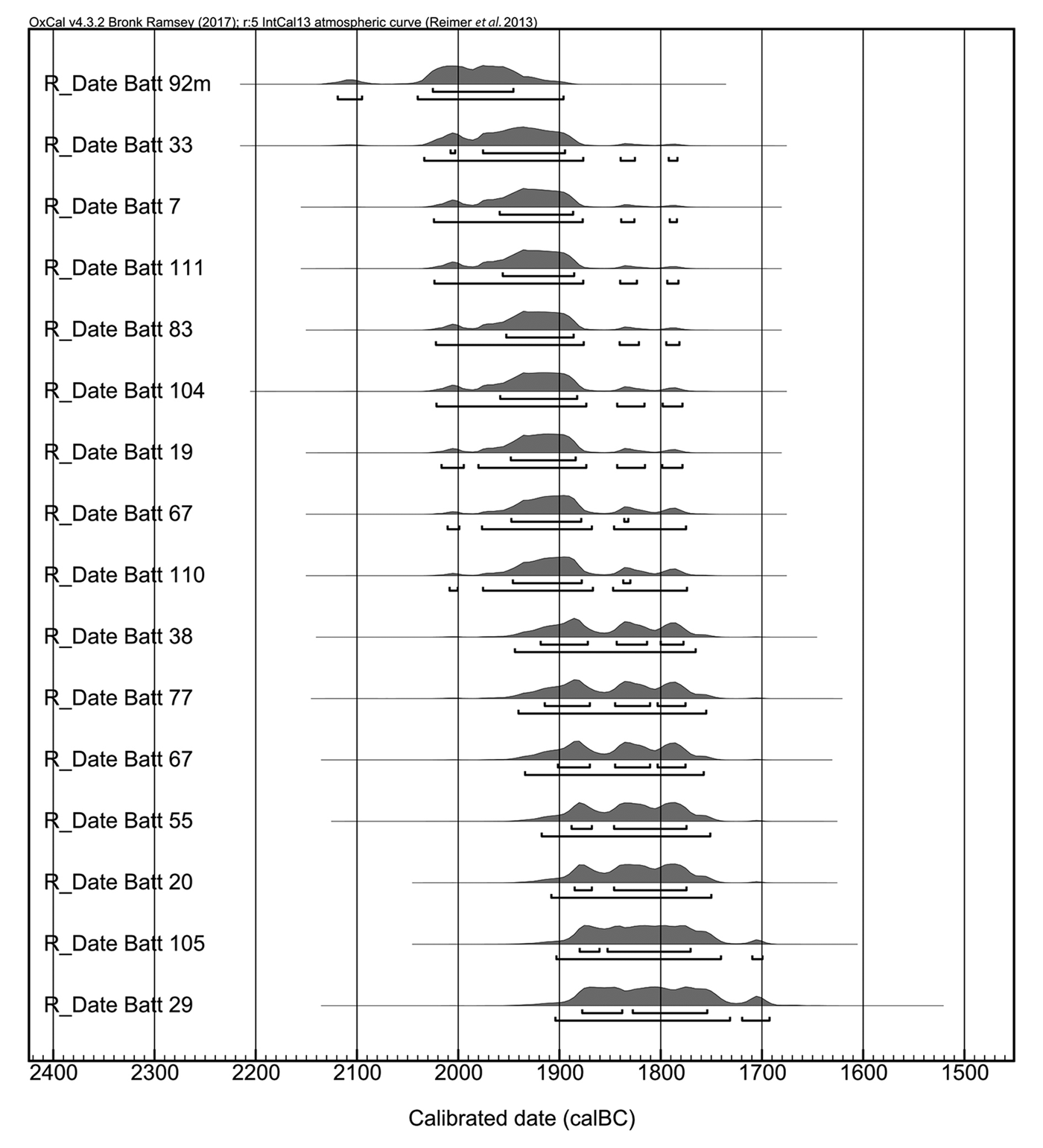
Calibrated dates and two-sigma range for the Battonya cemetery samples.

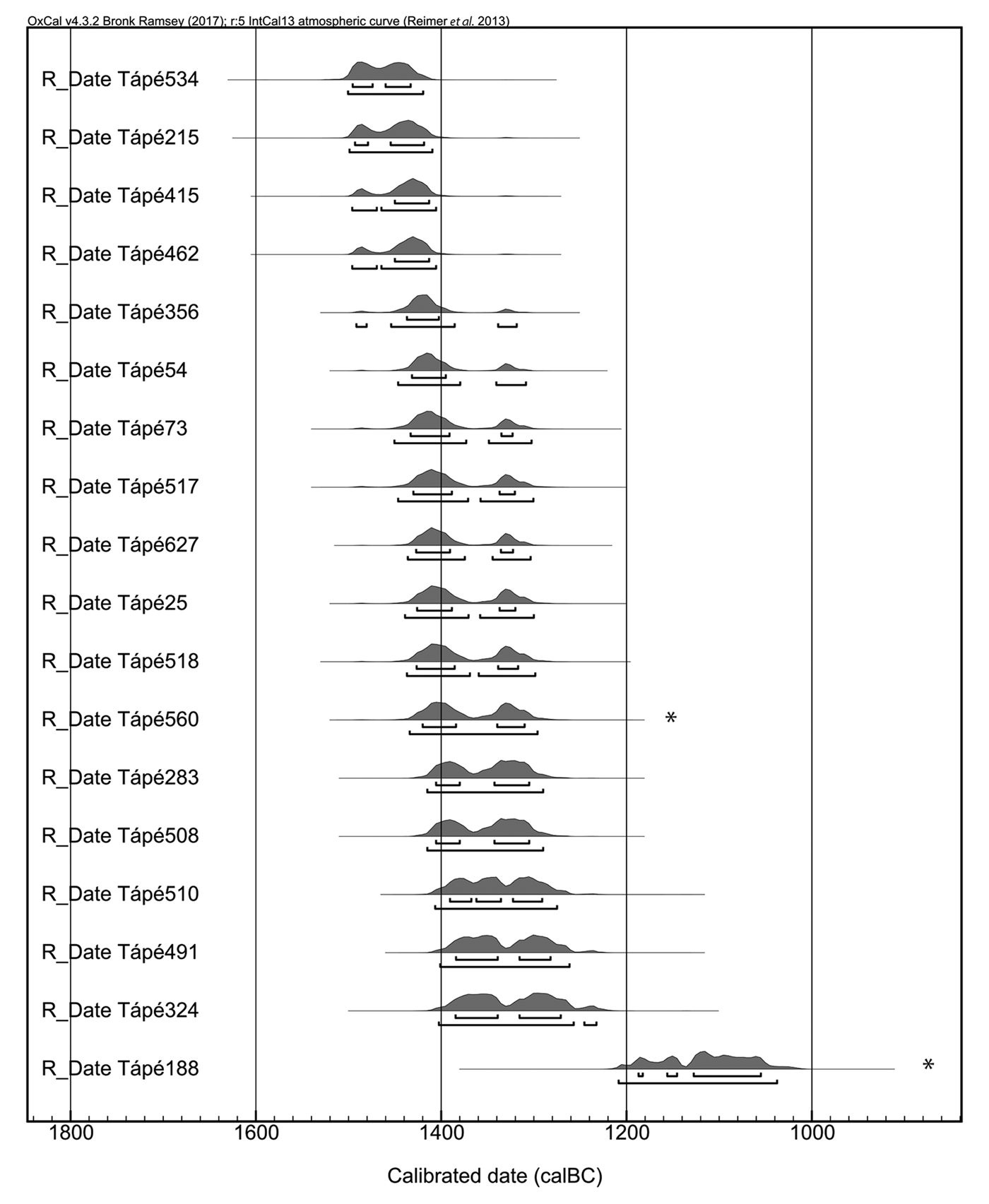
Calibrated dates and two-sigma range for the Tápé cemetery samples; the asterisks denote cremated bone samples.

Calibrated dates and two-sigma range for the Semlac tell samples.

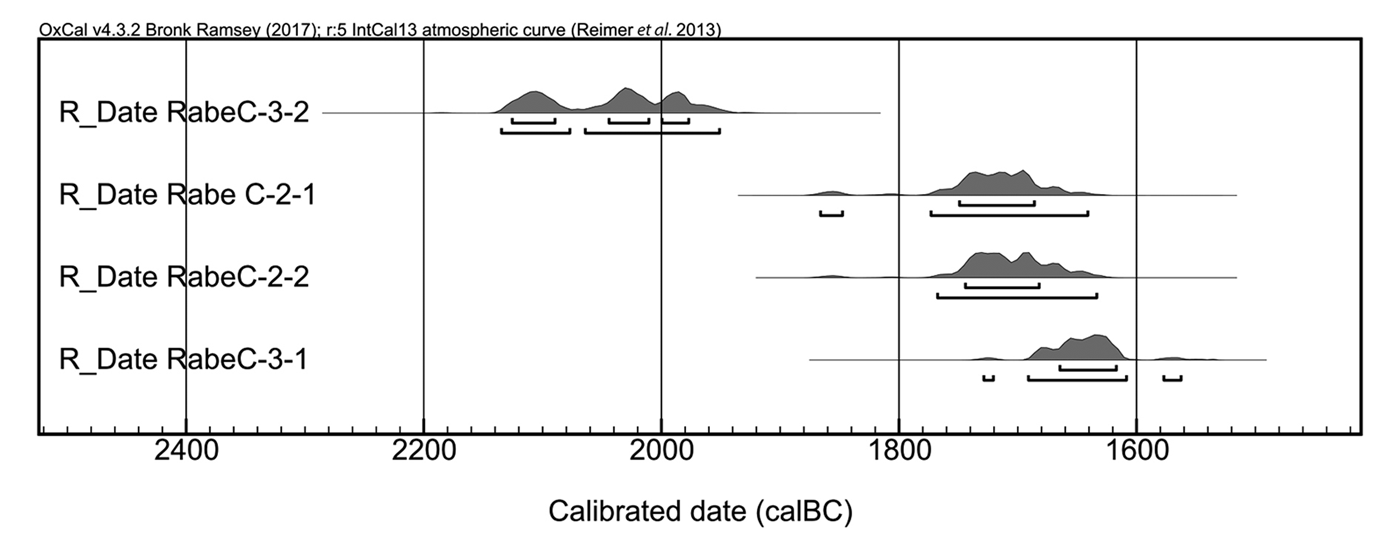
Calibrated dates and two-sigma range for the Rabe tell samples.

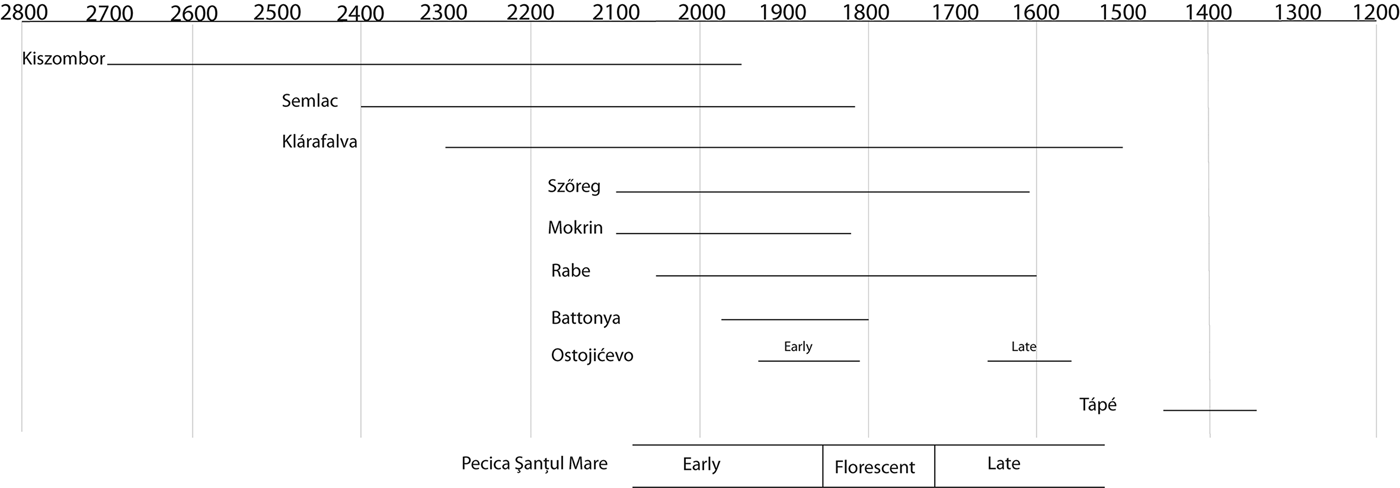
The Semlac tell site dates to the beginning of the Maros sequence (Figure 8)—a placement consistent with the ceramics recovered from the site (Nicodemus & O'Shea Reference Nicodemus, O'Shea, Forţiu and Stavilă2015). The site appears to have been established somewhat after Kiszombor—the earliest-dated Maros settlement (O’Shea Reference O'Shea1992)—but well before the establishment of Pecica. While the Semlac tell significantly overlaps in time with Pecica, it was abandoned by the time the Pecica polity was at its zenith during the population aggregation event. There is no evidence that any population returned to Semlac after the decline of the Pecica polity, in contrast to the re-occupation that may have occurred in the Ostojićevo locality (see below).
Age range comparison (cal BC) for all dated Maros settlements, cemeteries and the Tápé cemetery; age ranges are summarised using median values.

The dates from the Rabe tell suggest that the settlement was contemporaneous with Pecica-Şanţul Mare; both were founded at the same time and share a final date coinciding with the effective collapse of the complex polity (Figure 8). Although the dated samples from Rabe derive from a pair of cores taken in the central area of the tell, and therefore may not represent the site's entire occupation sequence, the dates are consistent with ceramics recovered from the site. The apparent synchronisation of events at Pecica and Rabe supports their linkage within the Maros regional system, with Rabe operating as a secondary centre to Pecica—as has been recently proposed (O'Shea & Nicodemus Reference O'Shea, Nicodemus and Gyucha2019). It will be interesting to see whether future investigations at Rabe reveal a pattern of rapid settlement aggregation during its peak, followed by abrupt abandonment—as observed at Pecica. The dating of the southern Maros cemeteries of Mokrin and Ostojićevo may support such a scenario (see below).
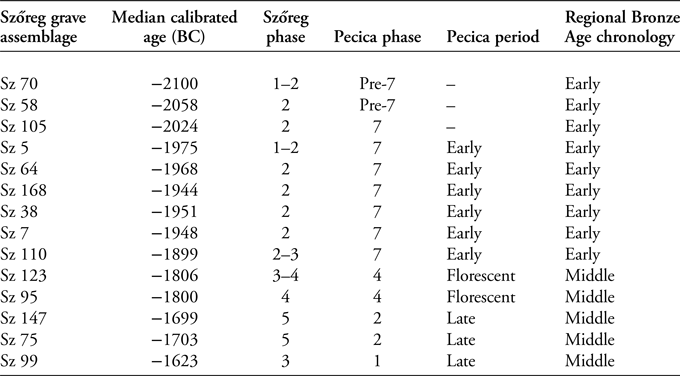
With the exception of six radiocarbon dates from the Mokrin cemetery (O'Shea Reference O'Shea1996: 37), none of the Maros cemeteries in the Tisza-Maros region have previously been dated using radiocarbon, despite the research attention concentrated on these cemeteries. For the Szőreg cemetery, the aims of the current dating programme were twofold: to determine the overall chronological span of the cemetery, and to assess the relative ceramic chronology previously developed for it. The new radiocarbon dates confirm that the cemetery was used throughout the Early and Middle Bronze Age portions of the Maros sequence. They also provide general support for Bóna's (Reference Bóna1975) five-phase relative chronology for the cemetery (Table 4).
Comparison of Szőreg calibrated dates and Bóna's (Reference Bóna1975) ceramic phases.

The dated samples from Szőreg confirm that the cemetery began its active use in the Early Bronze Age, during the earlier part of the Maros sequence. The earliest-dated graves pre-date the establishment of Pecica-Şanţul Mare, and are concurrent with the earliest radiocarbon dates for the Mokrin cemetery. Unlike the Mokrin cemetery, however, Szőreg's use continued through Pecica's Florescent period—a time when many other Maros settlements and cemeteries were abandoned—and into the later stages of the Maros occupation. Indeed, Szőreg post-dates the collapse of the Pecica polity. This chronology is important, as Szőreg is located at the opposite end of the Maros Group's geographic distribution to Pecica, although the two sites are still clearly interlinked.
The Szőreg dates also provide a useful test for the five-phase ceramic chronology proposed by Bóna for the site (Table 4). The attribution of the associated ceramics to a chronological period is based on Bóna's (Reference Bóna1975) published assessment. The relative ordering of the ceramics fits well with the ordering produced by radiometric dates, with Szőreg grave 99 producing the only clear outlier. Interestingly, ceramics from grave 99 are attributable to Bóna's problematic phase 3.
The Ostojićevo cemetery dates confirm that it was used during and after the Pecica Florescent period. Furthermore, the dates indicate that the site was founded several hundred years after the Mokrin cemetery. As such, Ostojićevo (and Battonya—see below) run counter to the pattern of Maros cemeteries being abandoned at the end of the Early Bronze Age. Instead, it seems that both cemeteries were established during the time that the Pecica site was rising to prominence.
The dates produced from the Ostojićevo cemetery may also suggest a hiatus in the site's use after c. 1800 BC, concurrent with the major aggregation event at Pecica, which drew populations away from surrounding settlements. It is possible that this hiatus of activity at Ostojićevo represents a similar event occurring in the south-western portion of the Maros territory—perhaps focused on aggregation at the Rabe tell. If so, then the resumption of site use after 1600 BC may represent a return to the locality as people dispersed from the central Maros tells.
Battonya is the final Early/Middle Bronze Age cemetery considered here. As noted previously, it is the most easterly of the Maros cemeteries and, given its weak adherence to the core Maros funerary programme and material culture, its link to the Maros Group has been questioned (O'Shea Reference O'Shea1996). These new radiocarbon dates indicate that the site began its use during the major expansion of the Maros Group and was roughly contemporaneous with the establishment of Pecica-Şanţul Mare. The site continued in use into the Pecica Florescent period, but was abandoned around the time of the Pecica aggregation event (c. 1800 BC). This abandonment corresponds to the cessation in use at Ostojićevo. Unlike at Ostojićevo, however, Battonya was not reused following the collapse of the Pecica polity.
The last set of radiocarbon dates derives from the Late Bronze Age cemetery at Tápé. The dates confirm that the cemetery was established immediately following the abandonment of the Middle Bronze Age Maros settlements and cemeteries. The dates also suggest that, despite its large size, the cemetery was used only for a short period (excluding the one anomalously late date from burial 188).
While the new dates confirm the general chronological placement of Tápé, and suggest that there was no significant gap between the end of the Middle Bronze Age regional cultures and the establishment of Tápé, they do not conclusively rule out either of the competing explanations for the site. The relatively large size and short use-life, however, may provide more support for a locally displaced population model as opposed to one driven by external migration.
Discussion
The new radiometric dates presented in this article expand our knowledge of the chronological span of the Maros Group—particularly the final stages of the Maros/Middle Bronze Age occupation—and help to establish the chronology for the succeeding period. The dates indicate a tight chronological synchronisation of the settlements and cemeteries of the lower and middle Maros regions, while confirming the usefulness of the relative chronological ordering based on fine-ware ceramics at the Szőreg cemetery. This refined chronological framework allows for a more accurate and less speculative description of the cultural processes of social formation and collapse represented at the Tisza-Maros Bronze Age sites. This, in turn, will provide a stronger basis for comparison with contemporaneous developments in the Carpathian Basin and across Europe.
The two outlier dates from cremated bone at Tápé and Ostojićevo warrant additional comment. There has been considerable debate concerning the accuracy of radiocarbon determinations from cremated bone samples (cf. Van Strydonck et al. Reference Van Strydonck, Boudin and Mulder2009; Zazzo et al. Reference Zazzo, Saliège, Lebon, Lepetz and Moreau2012; Chatters et al. Reference Chatters, Brown, Hackenberger, McCutcheon and Adler2017). While the two outliers in our sample can be distinguished by the incongruence with their associated material culture assemblages, it is not clear whether the radiocarbon determinations can be attributed simply to random error or to a systemic issue affecting cremated bone. Regardless, these results suggest that dates based on cremated bone need to be treated with caution.
Finally, the results presented here inevitably raise the question of whether the legacy Bronze Age terminology has outlived its usefulness. The large collection of high-precision radiocarbon dates now available provide a timeline for the major social transitions that occurred within the Maros Group; as such, is there still need for, or value in, attributing Early, Middle or Late distinctions to these developments? From a comparative perspective too, it makes much more sense to compare cultural developments and transitions in absolute time, rather than attempting to use the events in questions to synchronise time. Such systems of terminology may still be useful, but only if they are stripped of their chronological connotations and viewed as reflecting points when comparable kinds of cultural transitions occur.
Acknowledgements
The compilation of samples and dates reported in the article would not have been possible without the generous assistance of a number of institutions and projects. The authors wish to acknowledge and thank the National Museum of Kikinda (Serbia), the Arad County Museum (Romania), the Department of Biological Anthropology at the University of Szeged (Hungary), the Móra Ferenc Museum at Szeged and The RISE project at the University of Gothenburg. Funding for the dating was provided in part by the European Research Council (FP/2007–2013, grant 269442), the Museum of Anthropological Archaeology and the Department of Anthropology at the University of Michigan, and NSF awards BCS 0620147, BCS 1039380 and BCS 1264315. The authors also acknowledge Paul R. Duffy for selecting the samples from the Battonya and Szőreg cemeteries, in collaboration with The RISE Project, and two anonymous reviewers for their constructive comments on the paper.