Introduction
Opioids are commonly prescribed drugs for the management of chronic pain, especially in cancer patients. Based on prognosis and progression of the disease, the duration of intake of opioids may vary, resulting in exposure to both short-term and long-term adverse effects of opioids. Adrenal insufficiency is a rare but important and yet, underreported side effect of long-term usage of opioids, more so with usage of methadone (Donegan and Bancos, Reference Donegan and Bancos2018; Saeed et al., Reference Saeed, Khan and Taweesedt2019). Hypercalcemia can occur in a patient with cancer due to multiple etiologies, including adrenal insufficiency, hence presenting with a diagnostic and management dilemma (Caraceni et al., Reference Caraceni, Hanks and Kaasa2012). We report a case of hypercalcemia due to opioid (methadone)-induced secondary adrenal insufficiency.
Case presentation
A 31-year-old male patient suffering from carcinoma of buccal mucosa presented with recurrence post-surgery having undergone radiotherapy and chemotherapy 8 months prior. He presented to the pain clinic with complaints of pain, fever, and occasional bleeding from the raw area on neck and chest as a result of local skin necrosis after radiotherapy.
The patient described the area of maximum pain to be the left side of face, neck, and upper chest. Initially, the pain was reportedly mild with a numerical rating scale (NRS) of 3/10, dull aching in character at the angle of the jaw, inside of the mouth, and the chest area. The pain gradually increased for which he was prescribed oral morphine, paracetamol, and gabapentin. Treatment had been switched to oral methadone in the past two weeks in view of inadequate relief of neuropathic component of pain.
On his present visit, the patient reported NRS of 7/10, pain relief was inadequate even with strong opioid (Methadone 2.5 mg thrice daily), along with adjuvant analgesics and gastric ulcer prophylaxis. Other than pain, the patient also complained of occasional bouts of vomiting associated with loss of appetite and difficulty in eating and swallowing food which was managed with controlled by anti-emetics and liquid diet. The patient also complained of occasional bleeding from the necrotic wounds around the neck and chest that developed after radiotherapy.
On general physical examination, the patient was conscious and oriented, febrile, pale, and was lying in his bed in visible distress due to pain. The patient had a pulse rate of 92 beats per minute and blood pressure of 110/68 mmHg. The area over chest showed multiple pus-oozing dermis and muscle-deep wounds, widest measuring 5 cm × 4 cm, with multiple stages of healing and granulation tissue formation. The patient was admitted for management of pain and supportive care including wound care.
Investigations
Routine blood investigations including a complete hemogram, along with renal and liver function tests, were sent and an ECG of the patient was obtained. The ECG showed a QTc of 528 ms. The patient had received chemotherapy 8 months back and was not on any chronic medications other than methadone, paracetamol, and gabapentin for pain which could explain increased QTc, and hence, a decision to discontinue further methadone was taken in view of high risk of arrhythmia.
The blood workup showed hemoglobin of 11.5 gm%, platelet of 260,000/μL, and WBC count of 13,400/μL. The liver function test and renal function tests were within normal limits except incidental finding of severe hypercalcemia of 16.0 mg/dL (normal serum calcium range: 8.6–10.3 mg/dL). Such a high level of calcium, however, did not manifest in the patient with cardiovascular signs or symptoms. The subjective dysphagia that had been attributed to local oral malignant lesion and mucositis, may well have been a presentation of hypercalcemia.
Differential diagnosis of hypercalcemia due to opioid-induced adrenal insufficiency, primary parathyroid adenoma, or hypercalcemia of malignancy were made. Serum parathyroid hormone level came back within normal limits. Since PTHrp (Parathyroid Hormone-related protein) levels were not available, and oral cancer without any significant metastasis is less frequently associated with hypercalcemia of malignancy, a probable diagnosis of hypercalcemia due to opioid-induced adrenal insufficiency was made.
Treatment
Consequently, treatment was switched to weaker opioid Tramadol, with Paracetamol and Gabapentin along with Pantoprazole for expected dyspepsia and Metoclopramide for nausea and vomiting. Wound debridement and dressing were done, and the patient reported significant relief in pain. Dietician referral was obtained for semi-solid diet for the patient for easy palatability in view of recurrence of oral cancer. NSAIDs were prescribed for episodes of breakthrough pain or when baseline pain was not settled with the above analgesic regimen. The patient reported significant relief in pain, and the baseline NRS (Numerical Rating Score) was reported to be 2/10.
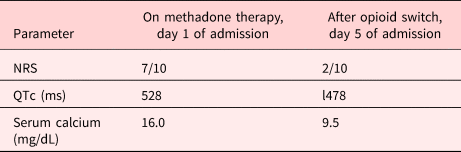
The incidental finding of hypercalcemia was managed with IV hydration (up to 3 L/day) crystalloids with output monitoring, T. Prednisolone 20 mg twice daily for three days followed by once daily for three days after that before discontinuation. A single-shot injection Calcitonin 100 IU SC was also administered on the first day of treatment of hypercalcemia. Serum calcium levels came down on serial monitoring in the subsequent days (15.0, 11.5, and 10.6 mg/dL on day 2, 3, and 4 of admission, respectively) before a reading of 9.5 mg/dL on day 5 of admission. Repeat ECG on the fifth day reported a QTc of 478 ms. A summary of the change in clinical and laboratory parameters is given in Table 1.
Comparison of clinical and laboratory parameters on day 1 and day 5 of hospital stay

Outcome and follow-up
The patient was discharged on oral analgesics (T. Tramadol 50 mg thrice daily, T. Paracetamol 500 mg thrice daily, and T. Gabapentin 300 mg thrice daily) after serial sterile wound dressings for six days and educating the patient and attendants how to perform dressing at home and when to seek medical help regarding symptoms.
Discussion
The use of strong opioids for the management of chronic cancer pain may be associated with significant side effects on quality of life (Caraceni et al., Reference Caraceni, Hanks and Kaasa2012; Garcia and Neto, Reference Garcia and Neto2020). Adrenal insufficiency is a relatively rare side effect of opioid usage, particularly methadone (Donegan and Bancos, Reference Donegan and Bancos2018; Saeed et al., Reference Saeed, Khan and Taweesedt2019). Usually, the effect of methadone on the cardiovascular system is monitored by regular ECG and QTc monitoring, but its effect on the hypothalamus-pituitary-adrenal (HPA) axis may go unnoticed (Ralston et al., Reference Ralston, Gallacher and Patel1990). A clinically important presentation of adrenal insufficiency is hypercalcemia, as it can have a profound clinical effect on a patient, ranging from debilitating musculoskeletal effects to potentially fatal cardiac arrest (Alinejad et al., Reference Alinejad, Kazemi and Zamani2015).
Hypercalcemia in a cancer patient can have multiple etiologies, like hypercalcemia of malignancy, a parathyroid functional tumor along with the primary malignancy, high intake of calcium tablets by physician or self-prescription with clinical or subclinical kidney damage, or opioid-induced primary adrenal insufficiency (Bajorunas, Reference Bajorunas1990).
Hypercalcemia of malignancy has a pathophysiology of increased levels of PTHrp and is more commonly seen in solid tumors of breast, prostate and lung, or hematological malignancies. Although PTHrp levels were not available for the patient, the differential was less likely since our patient was a case of relapsed case of oral cancer, which is not commonly known to be a source of PTHrp, and hence less likely to cause hypercalcemia of malignancy (Mundy and Martin, Reference Mundy and Martin1982).
There was no history of high calcium intake through calcium tablets by the patient, and the kidney functions (urea, creatinine, and urine output) were found to be within normal limits. For ruling out functional parathyroid adenoma, serum Parathormone levels were sought and found to be within normal limits in our case.
The temporal association of recent methadone usage for two weeks along with the clinical and biochemical presentation, and the significant QTc prolongation change in the ECG pointed toward side effects of high methadone levels in the patient. Prior to methadone usage, the patient had been on escalating doses of oral morphine for the past 6 months. Hence, with a background of significant long-term usage of opioids and recent switch to methadone demonstrating the significant effect on ECG, the probability of hypercalcemia due to methadone-induced adrenal insufficiency was considered as a diagnosis of exclusion.
Serum Cortisol levels, vitamin D levels, and tests for the Hypothalamic–Pituitary axis would have helped in verifying our clinical suspicions. However, in a setting of severe hypercalcemia in the patient, and due to the non-availability of certain biochemical tests and doubts regarding the safety of carrying out the HPA axis tests with respect to the condition of patient on admission, we could not verify our diagnosis, and we made an active decision regarding managing the patient based on symptoms and biochemical reports (Muls et al., Reference Muls, Bouillon and Boelaert1982).
Therefore, emergent management for hypercalcemia was started. The resolution of hypercalcemia through initial hydration, glucocorticoid replacement, switching to weaker opioid with multiple alternate mechanisms of action (tramadol) further supported our clinical suspicion. Furthermore, the resolution of the serum calcium levels after cessation of methadone, and the subsequent persistence of normocalcemia after cessation of steroid replacement affirmed the opioid linked and reversible nature of his disease.
The postulated mechanisms of adrenal insufficiency causing hypercalcemia is through (Willems et al., Reference Willems, Gillet and Cogan1991):
(i) increased calcium flux into the extracellular space;
(ii) reduced calcium renal excretion;
(iii) enhanced calcium mobilization from bone due to hypoadrenalism;
(iv) volume depletion in adrenal insufficiency can lead to decreased glomerular filtration resulting in a reduced filtered load of calcium and increased calcium renal reabsorption; and
(v) opioid-induced adrenal insufficiency can occur in both acute exposure to opioid as well in patients on chronic opioid therapy for pain or patients addicted to opioids.
Currently, there are no guidelines or advisories regarding prediction or identification of patients susceptible to adrenal insufficiency after short-term or long-term opioid usage following opioid exposure (Saeed et al., Reference Saeed, Khan and Taweesedt2019). There have been sporadic case reports and theoretical reviews regarding this clinical presentation, but we are of the opinion that opioid-induced secondary adrenal insufficiency may be more common than what is reported and can pose serious diagnostic and management dilemmas with possible worse outcomes in patients (Lee and Twigg, Reference Lee and Twigg2015). We suggest regular vigilance regarding this side effect in patients on opioid therapy, especially those on long-term opioids, with regular hormonal and metabolic blood workup and clinical picture. Steroid replacement, hydration, and timely switch or cessation of opioids seem to be appropriate steps of management for the same, provided the condition is diagnosed and managed well in time.
Funding
This research received no specific grant from any funding agency, commercial or not-for-profit sectors.
Conflicts of interest
The authors have no conflicts of interest.