1. Introduction
In both the generative and the typological literature, there has recently been a growing interest in agreement (e.g. Boeckx Reference Boeckx2006, Corbett Reference Corbett2006, Baker Reference Baker2008), on the one hand, and in coordination (e.g. Camacho Reference Camacho2003, Haspelmath Reference Haspelmath2004, te Velde Reference Velde2005), on the other. Naturally, there are also many works that deal with both agreement and coordination, including Corbett (Reference Corbett1983, Reference Corbett1991, Reference Corbett2006), Aoun, Benmamoun & Sportiche (Reference Aoun, Benmamoun and Sportiche1994, Reference Aoun, Benmamoun and Sportiche1999), Munn (Reference Munn1999), O'Grady & Yamashita (Reference O'Grady and Yamashita2002), Camacho (Reference Camacho2003), Ackema & Neeleman (Reference Ackema and Neeleman2004), Timmermans et al. (Reference Timmermans, Schriefers, Dijkstra and Haverkort2004), Lorimor (Reference Lorimor2007), and Bošković (Reference Bošković2009), and references therein, among others. Although their goals and frameworks differ, all the authors discuss agreement between a coordinated noun phrase and its predicate. That is, it is agreement outside coordination. In contrast, agreement within coordination seems to be quite rare. Lamaholot, an Austronesian language spoken in Flores, Indonesia, has just this kind of agreement:Footnote 2
(1)
(a) go k-o'on mo pana
I 1sg-and you walk
‘I and you walk.’
(b) mo m-o'on Bala pana
you 2sg-and Bala walk
‘You and Bala walk.’
(c) Bala n-o'on mo pana
Bala 3sg-and you walk
‘Bala and you walk.’
Note that the conjunction ‘and’ agrees with the first conjunct, whether it is a pronoun or a proper noun.
Conjunctive agreement is unusual typologically and has hitherto received little attention in the literature. However, Brown & Dryer (Reference Brown and Dryer2008) have recently shown that in Walman (spoken in Papua New Guinea), there is agreement within coordinated noun phrases:
(2) kon ngo-Ø [ru nyue w-aro-n ngan]
night one-f 3sg.f mother 3sg.f.subj-and-3sg.m.obj father
y-ekiel y-okorue-Ø pla lang …
3pl.subj-go.south 3pl.subj-dig-3sg.f.obj land orange
‘One night, [a mother and father] went (south) to dig the orange earth …’ (Brown & Dryer Reference Brown and Dryer2008, ex. (1))
Note that both the first and the second conjuncts induce agreement on the conjunction. This contrasts with Lamaholot, where only the first conjunct induces agreement. Although Lamaholot and Walman are genetically unrelated, they may well be areally related, and indeed, other languages in and off East Timor are also reported to have conjunctive agreement (see Hull Reference Hull2001 and van Engelenhoven Reference Engelenhoven2004).
Brown & Dryer (Reference Brown and Dryer2008) argue that the conjunctive word in Walman also functions as a verb. Whether or not this analysis is synchronically correct for (2), their insight that conjunctive agreement is related to verbal agreement is plausible, given the diachronic development of a conjunctive word from a comitative word observed cross-linguistically (see Lord Reference Lord1973, Reference Lord1993; Mithun Reference Mithun, Haiman and Thompson1988; Stassen Reference Stassen2000, Reference Stassen and Haspelmath2001; Heine & Kuteva Reference Heine and Kuteva2002; Haspelmath Reference Haspelmath2004). In Lamaholot, -o'on also has the comitative usage:
(3)
(a) go k-o'on Bala
I 1sg-with Bala
‘I am with Bala.’
(b) go pana k-o'on Bala
I walk 1sg-with Bala
‘I walk with Bala.’
In (3a), -o'on functions as a comitative predicate and in (3b) as a comitative adjunct, and the word agrees with the subject.Footnote 3
The purpose of this paper is to describe conjunctive agreement in Lamaholot and develop its theoretical analysis. First, in Section 2, I present general discussion on agreement and coordination in Lamaholot. Section 3 proposes a theoretical analysis of conjunctive agreement, where agreement is feature copying that is sensitive to case. Crucial is the fact that Lamaholot conjunctive agreement shows subject/object asymmetry: agreement is obligatory in coordinated subjects, but optional in coordinated objects. I argue that nominative is unmarked and accusative is marked, and feature copying is possible only with unmarked case. In Section 4, I discuss the differences in conjunctive agreement between Lamaholot and Walman. I show that grammaticalization from the comitative to the conjunction is more advanced in Lamaholot than in Walman syntactically, if not semantically.
2. Agreement and coordination in Lamaholot
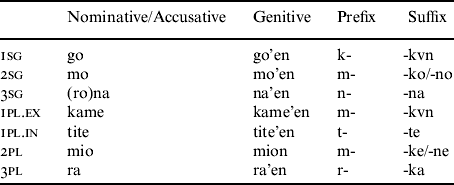
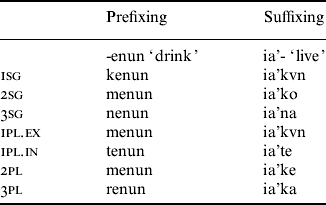
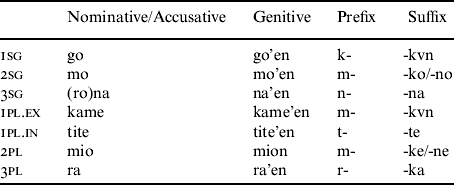
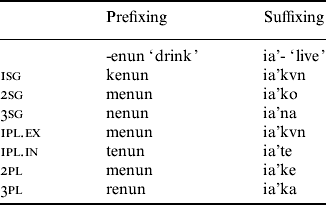
Tables 1 and 2 illustrate the pronominal system and sample agreeing verbs in Lamaholot. Not all verbs show agreement: there are many non-agreeing verbs (like pana ‘walk’ in (1)), and there are some 15 verbs that express agreement by a prefix (like -enun ‘drink’ in Table 2), and some 40 verbs that express agreement by a suffix. When a word can express agreement by a prefix, the prefix is obligatory. In contrast, suffixes are often optional, and they become preferred or obligatory depending on the verb, the pronoun, or context. All prefixing verbs are vowel-initial, but there are also vowel-initial verbs that do not agree. Suffixing verbs tend to be intransitive (or at least have intransitive usage), but there are also purely transitive verbs that express agreement by a suffix. Thus, although there seems to be some tendencies, whether a verb agrees or not and whether it expresses agreement by a prefix or a suffix seems to be a matter of lexical idiosyncrasy at best. See Nishiyama & Kelen (Reference Nishiyama and Kelen2007) for details.
The pronominal system in Lamaholot.
Sample agreeing verbs in Lamaholot.
Let us turn to coordination in Lamaholot. We saw in (1) that -o'on can conjoin noun phrases. -o'on can also conjoin predicates.Footnote 4
(4)
(a) go pi'in guru no'on tuan
I this teacher and priest
‘I am a teacher and a priest.’
(b) mo pe'en belv no'on ba'a
you the big and heavy
‘You are big and heavy.’
(c) tite tvkan wata no'on t-enun wai lvron gvtan
we.in eat rice and 1pl.in-drink water day all
‘We eat rice and drink water every day.’
Note that the conjunctions in (4) are invariably no'on. This form is identical to the one when the conjunction agrees with the third singular conjunct, as in (1c). However, since there is no third singular argument in the examples in (4), the form no'on is a default.
Default agreement is observed in other cases. Consider first the following:Footnote 5
(5)
(a) inamvlake-inamvlake svga-ka urin
man-red come-3pl late
‘Men came late.’
(b) wawe-wawe svga-na urin
pig-red come-3sg late
‘Pigs came late.’
(c) oto-oto me'envn weli<n>-na
car-red that expensive-3sg
‘Those cars are expensive.’
In all the examples above, the subject is plural. Only the human subject in (5a) triggers plural agreement on the verb. The subject in (5b), which refers to an animal, and the subject in (5c), which is inanimate, cannot trigger plural agreement, and the singular (or default) marker -na emerges instead.
As for the semantics, -o'on is a pure Boolean operator without any additional meanings like expectation, reasoning, or temporal sequence. Thus, when the relation of the two sentences (or predicates) is more specific, other connectives (e.g. nvkvn ‘but’, kvdin ‘then’, (opv)nvlv ‘so that’) are used:
(6)
(a) mo pe'en kvne'en dvra nvkvn pintar
you the small still but smart
‘You are still young but smart.’
(b) na kvrian kvdin turu
he work then sleep
‘He worked and then slept.’
(c) na pe'en tvnuen kae opvnvlv na noi a'a gvtan
he the old already so that he know things all
‘He is old so that he knows all things.’
(d) Bala gang wata nvkvn Lado gang uwe
Bala eat rice but Lado eat potato
‘Bala ate rice but Lado ate potato.’
The form no'on cannot be used in (6). When nvkvn in (6d) is replaced by kvdin ‘then’, the meaning is that Bala's eating is sequentially followed by Lado's eating. None of the connectors above agrees.
The disjunction ‘or’ is expressed by le. It conjoins nouns, predicates, and clauses:
(7)
(a) go le mo pana
I or you walk
‘I or you walk.’
(b) go murvn le nalan
I right or wrong
‘I am right or wrong.’
(c) mo svga le go ka'ikvn
you come or I go
‘You come or I go.’
Unlike the conjunctive -o'on, the disjunctive le does not show agreement. This might be because, unlike conjunctive -o'on, le does not have a verbal source as its origin. Alternatively, even if le originated as a verb, it might have been a non-agreeing verb, for there are many non-agreeing verbs in Lamaholot. The same conjecture holds for the connectives in (6).
3. An analysis
This section offers a theoretical analysis of conjunctive agreement. As it turns out, the analysis is compatible with either the theory of agreement couched in terms of the Spec–head relation, or the c-command relation under Agree. More important is the constraint on feature copying in agreement: copying is possible only when the agreement control bears unmarked case in the sense elaborated below.
3.1 Spec–head vs. c-command
In early Minimalism, agreement was captured as the Spec–head relation. In current Minimalism (Chomsky Reference Chomsky, Martin, Michaels and Uriagereka2000, Reference Chomsky and Kenstowicz2001), the Spec–head relation has been replaced by c-command under Agree. Despite this move, Spec–head agreement is still defended by several researchers (e.g. Carstens Reference Carstens2001, Koopman Reference Koopman and Boeckx2006).Footnote 6 Comparing the two hypotheses, the initial impression is that, as far as the analysis of Lamaholot conjunctive agreement is concerned, the Spec–head relation offers a simple and straightforward way to capture the agreement between the first conjunct and the conjunctive word as in the following structure:
(8)


This structure adopts the widely accepted hypothesis (cf. Kayne Reference Kayne1994, Johannessen Reference Johannessen1998 & Progovac Reference Progovac, Cheng and Sybesma2003, among others) that a coordinate phrase is the projection of the conjunctive word and the first conjunct is in the Spec of the projection.
As for the evidence that the first conjunct is structurally higher than the second conjunct, it is a common practice to resort to the Condition C effect. The following examples show that the test applies to Lamaholot:
(9)
(a) Bala bapa'-nvn n-o'on na pana
Bala father-his 3sg-and he walk
‘Bala's father and he walk.’
(b) ??na n-o'on Bala bapa'-nvn pana
he 3sg-and Bala father-his walk
‘He and Bala's father walk.’
With the structure in (8), (9b) can be ruled out because a referential expression (Bala) is bound.Footnote 7
By contrast, it is not straightforward how the Agree system can handle conjunctive agreement. Given that the Probe must c-command the Goal, and that Goal is the agreement control, namely the first conjunct in the case of conjunctive agreement, the system requires a functional projection above the coordinate phrase for the position of the Probe. See de Vries (Reference Vries2005: 91, note 7) for related discussion. Another possibility is that agreement can be obtained even in the reversed c-command relation – when the Goal c-commands the Probe (cf. Baker Reference Baker2008). The Spec–head account for conjunctive agreement requires neither of these stipulations.
Despite complications mentioned above, the c-command analysis of conjunctive agreement has some advantages that the Spec–head analysis lacks; the Spec–head analysis crucially relies on the &P hypothesis as in (8). It is true that many researchers adopt the hypothesis nowadays, but there are also researchers (e.g. Camacho Reference Camacho2003 and te Velde Reference Velde2005) who argue that the conjunction does not project and thus the first conjunct is not in the Spec position. It is beyond the scope of this paper to argue for a particular theory of coordination, but it is worth mentioning that in both Camacho's and te Velde's structures, the first conjunct is structurally higher. Thus, the c-command analysis of conjunctive agreement is compatible with Camacho's and te Velde's structures. Note also that the binding fact in (9) is compatible with the c-command hypothesis as well.
A related point is that, while the Spec–head analysis of conjunctive agreement only holds in (a particular version of) coordinate structures, the c-command analysis works even if the sentence involving conjunctive agreement actually has the comitative structure. As we will see in Section 4, Brown & Dryer (Reference Brown and Dryer2008) argue that the conjunctive word in Walman, which shows agreement, is a verb. Although I will provide evidence that the coordinate structure is more robust in Lamaholot, it is sometimes hard to distinguish between coordinate structures and comitative structures. If c-command between the first conjunct and the conjunctive word is all that is required, we can abstract away from the issue of the coordinate/comitative distinction.
To summarize, we have seen the pros and cons of the Spec–head analysis and the c-command analysis of conjunctive agreement. The Spec–head analysis does not require stipulations (such as an additional functional projection and/or reverse c-command) that the c-command analysis does. However, the c-command analysis is compatible with a wider range of analytical possibilities. I leave the ultimate choice between the two for future research. In what follows, I show that, whether the structure involves the Spec–head relation or c-command, there is a constraint on feature copying in Lamaholot conjunctive agreement, which can be accounted for with reference to Bobaljik's (Reference Bobaljik, Harbour, Adger and Béjar2008) view that agreement is sensitive to case.
3.2 Case-sensitive agreement
3.2.1 Subject–object asymmetries
In (1), repeated below, the coordinated noun phrase is a subject.
(1)
(a) go k-o'on mo pana
I 1sg-and you walk.
‘I and you walk.’
(b) mo m-o'on Bala pana
you 2sg-and Bala walk
‘You and Bala walk.’
(c) Bala n-o'on mo pana
Bala 3sg-and you walk
‘Bala and you walk.’
Here, canonical agreement on the conjunction is obligatory. In contrast, when the coordinate phrase is an object, conjunctive agreement is optional or preferably a default:
(10)
(a) Lado bvrin go n/?k-o'on mo
Lado hit me defl/1sg-and you
‘Lado hit me and you.’
(b) go pehen mo n/?m-o'on Bala
I touch you defl/2sg-and Bala
‘I touched you and Bala.’
The agreement marker n- is identical to the third person singular marker (see (1c)) and indicates a default marker. The interpretations are the same whether the agreement is canonical or a default. That is, in (10a), both markers are compatible with the single event reading (Lado hit me and you together) or the multiple event reading (Lado hit me and you separately).
In contrast, conjunctive agreement is obligatory in the subject position and the default form is ungrammatical:
(11)
(a) go k/*n-o'on mo bvrin Lado
I 1sg/defl-and you hit Lado
‘I and you hit Lado.’
(b) mo m/*n-o'on Bala pehen go
You 2sg/defl-and Bala touch me
‘You and Bala touched me.’
Indirect objects and objects of a preposition pattern with direct objects in that default agreement emerges:
(12)
(a) go nein mo n/m-o'on na bunga
I give you defl/2sg-and him flower
‘I give you and him flowers.’
(b) go nein bunga pe mo n/m-o'on na
I give flower to you defl/2sg -and him
‘I give flowers to you and him.’
In short, conjunctive agreement is obligatory in the subject position but is optional in the object position.Footnote 8 The next subsection offers an analysis for such asymmetries.
3.2.2 Feature copying due to unmarked case
For the analysis of the subject–object asymmetries described in the last subsection, I adopt Bobaljik's (Reference Bobaljik, Harbour, Adger and Béjar2008) view of agreement, because this will make the analysis simple and straightforward. Starting with the typological generalization that subject agreement is more common than object agreement, Bobaljik argues that this is because nominative is unmarked compared to accusative. Crucially, the asymmetry in agreement is captured not in terms of grammatical relations (like subject or object), but in terms of morphological case. One representative example to illustrate the point is the following Icelandic sentence:
(13) Jóni líkuÐu þessir sokkar
John.dat like.pl these socks.nom
‘Jon likes these socks.’ (Bobaljik, ex. (4a))
Although there is ample evidence that the dative argument is the subject in (13), it is the object ‘these socks’, not the subject, that induces agreement. According to Bobaljik, this is because nominative is the unmarked case, which induces agreement. In this account, nominative is a morphological case realized post-syntactically, and this is distinct from abstract Case operative in narrow syntax.Footnote 9
For analyzing Lamaholot conjunctive agreement, too, grammatical relations are not effective for capturing the asymmetries in question. Suppose, for the sake of argument, that -o'on in the coordinate context is a comitative verb, although I will provide evidence to the contrary in Section 4. Then the first conjunct is the subject and the second conjunct is the object of the verb ‘and’. But in this analysis, the grammatical relation of the first conjunct with respect to the conjunction remains the same. That is, regardless of whether the whole coordinate phrase is a subject or an object, the first conjuncts are all subjects of the verb ‘and’, and the asymmetries described in the last subsection remain a mystery.
Extending the analysis of Bobaljik (Reference Bobaljik, Harbour, Adger and Béjar2008), I analyze the asymmetries in Lamaholot conjunctive agreement in terms of morphological case. Although there is no overt case marking in Lamaholot, the subject bears nominative case, which is unmarked compared to the accusative on the object, and the case of the whole coordinate phrase spreads to each conjunct. Concretely, the agreement proceeds as follows:
(14)
(15) Vocabulary insertion of agreement markers
(a) [3pl] ↔ /r/
(b) Ø ↔ /n/
I assume that agreement involves copying of phi-features from the agreement control (trigger) onto the host (cf. Halle & Marantz Reference Halle, Marantz, Hale and Keyser1993). In (14a), the case is nominative and is thus unmarked. This means that the case is transparent for the copy operation. Therefore, the phi-features of the first conjunct can successfully be copied onto the conjunction. The copied feature is later spelled out as the canonical agreement prefix, as is shown in (15a). In contrast, in (14b), the case is accusative. Because it is marked, it is opaque and blocks feature copying. The lack of features is later spelled out as a default, as is shown in (15b).Footnote 10
Although (14) depicts situations in the post-syntactic component, specifying no syntactic structures, the post-syntactic component is not blind to syntactic structures (cf. Halle & Marantz Reference Halle, Marantz, Hale and Keyser1993). On the contrary, it makes full reference to the output of narrow syntax, namely syntactic structures. Thus, it is possible that the copying operation in (14) applies under certain syntactic relation, namely either Spec–head agreement or c-command. In this sense, the proposed analysis in (14) does not depend on a particular theory of coordination and is compatible with several analyses of coordination, as discussed in Section 3.1 above.
3.3 Genitive case
The point of the proposed analysis is that, although nominative and accusative are null and thus phonologically indistinguishable in Lamaholot, the former is unmarked compared to the latter. Since markedness of case is usually determined on the basis of whether or not the case is overtly realized, it is desirable, if possible, to show that Lamaholot conjunctive agreement can also be sensitive to overt case markers. In fact, genitive case is overt in Lamaholot, and coordination of possessives confirms the proposed analysis.
The following examples illustrate the basics of the possessive construction in Lamaholot:
(16)
(a) lango na'en
house 3sg.gen
‘his house’
(b) lango-nvn
house-3sg
‘his house’
(c) Bala lango-nvn
Bala house-3sg
‘Bala's house’
(d) lango Bala na'en
house Bala 3sg.gen
‘Bala's house’
Genitive pronouns in Lamaholot are formed by adding the suffix -'en to a bare pronoun, as in na→na'en (3sg→3sg.gen). In addition to a genitive pronoun, as in (16a), a nominal suffix can be used to express possession, as in (16b). A full noun phrase possessor can either precede the head noun, as in (16c) or follow the head noun, as in (16d). Note that a nominal suffix is used for a prenominal possessor, but a genitive pronoun is used for a post-nominal possessor.
When possessors are conjoined, an interesting paradigm emerges:
(17)
(a) mo m-o'on na'en lango-ke
2sg 2sg-and 3sg.gen house-2pl
(b) mo'en n-o'on na'en lango-ke
2sg.gendefl-and 3sg.gen house-2pl
(c) lango mo m-o'on na'en
house 2sg 2sg-and 3sg.gen
(d) lango mo'en n-o'on na'en
house 2sg.gendefl-and 3sg.gen
All the above examples mean ‘your and his house’. (17a, b) are prenominal possessive constructions, and (17c, d) are post-nominal possessive constructions. (17a, c) use a bare pronoun as the first conjunct, while (17b, d) use a genitive pronoun. Conjunctive agreement is canonical in (17a, c) but default in (17b, d). (There is no optionality in agreement in (17).)
The examples in (17) raise many intriguing questions (e.g. whether the paradigm is movement-related), and I refer the readers to Nishiyama & Kelen (Reference Nishiyama and Kelen2007) for more information on possessive constructions in Lamaholot. It is beyond the scope of this paper to present the structures of the construction, and they are irrelevant for the present purposes. All we need to know is whether or not the case of the conjoined possessor is marked, and the paradigm in (17) is exactly what is expected from the proposed analysis: marked case blocks agreement. Although I resorted to a non-phonological criterion of markedness in the discussion of coordination in subjects and objects, (17) confirms the relevance of markedness in conjunctive agreement by making reference to phonological features for determining markedness.Footnote 11
3.4 Optionality
This subsection discusses the optionality of conjunctive agreement in the object position. Recall from (10) that the conjunction can bear the canonical agreement marker even in the object position. If the object has the marked accusative feature, which blocks feature copying (see (14b)), how can conjunctive agreement be canonical in the object position? The key is the case feature on each conjunct in coordination.
I have been treating the first conjunct as if it is already assigned case. But this is not true cross-linguistically. Based on the survey of numerous languages, Johannessen (Reference Johannessen1998) shows that there are three types of case spreading in coordination:
(18)
(a) Case does not spread because it is associated with the whole coordination phrase.
(b) Case spreads to both conjuncts.
(c) Case spreads only to the first conjunct. (summarized in and adapted from Schütze Reference Schütze2001: 226)
Schematically, they are represented as follows:
(19)
(a) [A & B].case
(b) [A.case & B.case]
(c) [A.case & B]
(19a) is exemplified by Spanish:
(20)
(a) para ti/*tú para mí/*yo
for you.acc/you.nom for me.acc/I.nom
(b) Para tú y yo
for you.nom and I.nom (Johannessen Reference Johannessen1998: 66)
(20a) shows that the object of the preposition para ‘for’ must be accusative in non-coordination. But when pronouns are conjoined, as in (20b), they emerge as nominative, and accusative is unacceptable. According to Johannessen, this is because Spanish is of the type (19a): neither of the conjuncts can receive accusative from the preposition, and they are realized as nominative by default.
Turning to Lamaholot, recall from (17) the paradigm of the possessive construction (partially repeated):
(21)
(a) lango mo m-o'on na'en
house 2sg 2sg-and 3sg.gen
‘your and his house’
(b) lango mo'en n-o'on na'en
house 2sg.gendefl-and 3sg.gen
‘your and his house’
Focusing on the first conjunct, it seems that Lamaholot has both types, (19a) and (19b). Although the genitive marker -'en seems to be on the second conjunct in (21a), I assume that it is of type (19a); -'en is a clitic (or a phrasal affix) and cliticizes on the last word of a phrase, much like the English possessive -'s in, for example, [the man who came here yesterday]'s hat (see Klavans Reference Klavans1985, Zwicky Reference Zwicky1985).
As for the conjunctive agreement, (21) shows that when the first conjunct has no genitive marker, the agreement is canonical, and when it is genitive, the agreement is a default:
(22)
(a) [A & B].gen (canonical agreement)
(b) [A.gen & B.gen] (default agreement)
(22) schematically reflects the situation in (21). Extending this to the accusative, we can have the following paradigm:
(23)
(a) [A & B].acc (canonical agreement)
(b) [A.acc & B.acc] (default agreement)
In (23), the accusative feature can attach to the whole coordinate phrase, as in (23a), or to each conjunct, as in (23b). In the first option, the first conjunct is not marked for the case feature, making feature copying possible, and we have canonical agreement. In the latter option, in contrast, the first conjunct is marked with accusative case, which blocks feature copying, and we have default agreement.
Although accusative case is phonologically null in Lamaholot, this analysis is parallel to the analysis of the overt genitive marker that we saw above. As for the nominative, in contrast, it does not matter whether the structure is [A & B].nom or [A.nom & B.nom]; since nominative is unmarked, canonical agreement emerges even if the first conjunct bears the nominative feature.Footnote 12
4. Comparison with Walman conjunctive agreement
In this section I compare conjunctive agreement in Lamaholot with its counterpart in Walman, as reported by Brown & Dryer (Reference Brown and Dryer2008) (henceforth B&D). The comparison is important because the phenomenon of conjunctive agreement itself is typologically rare and the similarities and differences between the two languages shed further light on our understanding of coordinate structure and agreement in general.
4.1 Agreement control and the default marker
The first notable difference is that while only the first conjunct induces agreement on the conjunction in Lamaholot, both the first conjunct and the second conjunct induce agreement in Walman. I repeat a relevant Walman example from (2) below:
(2) kon ngo-Ø [ru nyue w-aro-n ngan]
night one-f 3sg.f mother 3sg.f.subj-and-3sg.m.obj father
y-ekiel y-okorue-Ø pla lang …
3pl.subj-go.south 3pl.subj-dig-3sg.f.obj land orange
‘One night, [a mother and father] went (south) to dig the orange earth …’
The difference raises two related but separate questions: (i) Why is the first conjunct chosen as the sole agreement control/trigger in Lamaholot? and (ii) Why can the second conjunct be a control in Walman but not in Lamaholot? I answer the questions in turn below.
I have been highlighting the relevance of case in the analysis of conjunctive agreement in Lamaholot with reference to Bobaljik's (Reference Bobaljik, Harbour, Adger and Béjar2008) analysis. However, there is another component in Bobaljik's system of agreement: when there are two potential controls for agreement in an agreement domain, the higher one is chosen as the actual control.Footnote 13 The relevant example comes from Hindi-Urdu:
(24) siitaaa kelaa khaatii thii
Sita-Ø (f) banana-Ø (m) eat.imp.f be.pst.f
‘Sita (habitually) ate bananas.’ (Bobaljik, ex. (22c))
According to Bobaljik, although both the subject and the object are unmarked for case (and thus accessible for agreement), the former controls agreement because it is the higher argument. The same account holds for Lamaholot conjunctive agreement. As we saw in (9), the first conjunct is structurally higher than the second conjunct. Therefore, although the case features on the first and the second conjuncts are the same, it is the first conjunct that induces agreement on the conjunction.
As for the second question of why the second conjunct cannot induce agreement in Lamaholot, a simple answer would be that it is a historical accident. If conjunctive agreement is historically derived from verbal agreement with the comitative function, the first conjunct is analogous to the subject, and the second conjunct to the object (i.e. ‘I accompany you’ becomes ‘I and you’). Then the fact that the conjunctive -o'on in Lamaholot cannot agree with the second conjunct is reduced to the fact that the comitative -o'on cannot agree with the object, as we saw in (3a) (repeated here):
(3)
(a) go k-o'on Bala
I 1sg-with Bala
‘I am with Bala.’
The above historical conjecture leads to a further discussion in terms of areal features. As the following example shows, verbs in Walman agree with the subject by a prefix and with the object by a suffix.Footnote 14
(25) ru w-klwaro-n ruon
3sg.f 3sg.f.-deceive-3sg.m 3sg.m
‘She deceived him.’ (B&D, ex. (8b))
According to Klamer (Reference Klamer2002: 378), such a pattern of agreement is a common feature in languages in central and eastern Indonesia, and indeed, some dialects of Lamaholot also show this pattern (Arndt Reference Arndt1937: 67). However, as far as the dialect in question (the Lewoingu dialect, see footnote 2 above) is concerned, the pattern in (25) does not hold: a verb never agrees with the object in this dialect.Footnote 15 It is an interesting question why and how this dialect has developed the feature that is peculiar among languages in the area (see Nishiyama & Kelen (Reference Nishiyama and Kelen2007: 78) for possible answers), but whatever the reason is, the anti-object agreement seems to be a reasonable answer to the question of why the second conjunct does not induce agreement in (this dialect of) Lamaholot.
The second, related difference is that, while Lamaholot sometimes show default agreement on the conjunction, conjunctive agreement in Walman is always canonical.Footnote 16 In fact, this difference seems to extend beyond conjunctive agreement, subsuming verbal agreement. From the perspective of the analysis proposed in Section 3, this indicates that while accusative case is marked (and thus blocks feature copying) in Lamaholot, it is transparent in Walman.Footnote 17 This is understandable, given that verbs in Walman agree with the object (see (25) above), which carries accusative case. Thus, although the markedness hierarchy is supposed to be universal, the borderline between the marked and the unmarked varies among languages. What the markedness hierarchy hypothesis of case predicts is that there is no language where only the object (with accusative case), but not the subject (with nominative case), induces agreement, and this seems to be true. See Bobaljik (Reference Bobaljik, Harbour, Adger and Béjar2008) for discussion.
4.2 Syntax
The next comparison has to do with the degree of grammaticalization and the difference in syntactic structures between the two languages. As we saw in Section 2, Lamaholot -o'on can conjoin verb phrases:
(4)
(c) tite tvkan wata no'on t-enun wai lvron gvtan
we.in eat rice and 1pl.in-drink water day all
‘We eat rice and drink water every day.’ (repeated)
According to Mithun (Reference Mithun, Haiman and Thompson1988: 350), ‘[c]oordinating conjunctions can … originate as noun phrase links from comitative constructions, then spread to predicates and clauses’. That is, the emergence of a conjunctive word for predicates is the last stage in the cline of the comitative-to-conjunctive change. By this criterion, Lamaholot -o'on can be a pure conjunction.
In contrast, the Walman conjunctive words do not seem to have the function of conjoining predicates. In fact, the major claim of B&D is that the conjunctive word in Walman is also a verb. Thus, the first conjunct is the subject of the verb ‘and’, and the second conjunct the object thereof. Consequently, what appears to be a conjoined noun phrase is also a clause. Relevant examples are as follows, where 〈y〉 is an infix:
(26)
(a) Vanessa monw-a-n Amos y-o ro〈y〉rani
Vanessa neg 3sg.f-and-3sg.m Amos 3pl-be tall〈pl〉
‘Vanessa and Amos are not tall.’
(b) Rita ampaw-aro-Ø Millie y-orou Achapei
Rita fut 3sg.f-and-3sg.f Millie 3pl-go Aitape
Rita ampa w-orou eni, Millie ampa w-orou pichi
Rita fut 3sg.f-go now Millie fut 3sg.f-go tomorrow
‘Rita and Millie are going to go to Aitape. Rita will go today and Millie will go tomorrow.’ (B&D: 547, 556)
In (26a), the translation and the plural agreement on the matrix predicate ‘be tall’ (as well as its stative meaning) indicate that the subject is a coordinated noun phrase. However, the negation, which semantically negates the whole sentence, precedes the conjunctive marker. (26b) shows the same point: the conjunctive word is preceded by a tense marker. The second sentence in (26b) is provided here to exclude the comitative interpretation. On the assumption that the negation and the tense markers are clausal particles, B&D argue that Vanessa mon w-a-n Amos and Rita ampa w-aro-Ø Millie above are clauses, and that the conjunctive word in Walman is a verb.Footnote 18
From a theoretical point of view, a constituent with dual structures of a conjoined noun phrase and a clause is a puzzle, for clausal arguments usually denote a proposition (as in e.g. [That John hit Bill] surprised Mary), and not a set of entities as in (26). Whatever the correct structure for (26) is, comparable examples are impossible in Lamaholot.Footnote 19 In fact, there are several pieces of evidence that the coordinate structure in Lamaholot cannot have a comitative structure. We see some of them below.
There are some criteria established in the literature that distinguish between the comitative and coordinate structures (e.g. McNally Reference McNally1993; Stassen Reference Stassen2000, Reference Stassen and Haspelmath2001; Vassilieva & Larson Reference Vassilieva and Larson2005; B&D). The Coordinate Structure Constraint of Ross (Reference Ross1967) is one of such criterion. Consider the following contrast:
(27)
(a) k-o'on hege go k-enun?
1sg-o'on who I 1sg-drink
‘With whom do I drink?’
(b) *k-o'on hege go m-enun?
1sg-o'on who I 1pl.ex-drink
‘With whom do we drink?’
When the -o'on phrase is extracted, agreement on the verb must be with the surface subject (go ‘I’), and cannot be with the surface subject plus the referent in the fronted phrase. (One cannot extract only the second conjunct, stranding -o'on.) This is expected if the source for (27a) is like the following:
(28) go k-enun k-o'on Bala
I 1sg-drink 1sg-with Bala
‘I drink with Bala.’
Since (27a) involves extraction of an adjunct, it is grammatical. In contrast, the source of (27b) is presumably the following:
(29) go k-o'on Bala m-enun
I 1sg-o'on Bala 1pl.ex-drink
‘I and Bala drink.’
If this is correct, then the ungrammaticality of (27b) is immediately accounted for as a violation of the Coordinate Structure Constraint (or whatever principles that derive this effect). This account is possible only if -o'on in (29) is a conjunction and not a comitative.
Interestingly, the Coordinate Structure Constraint seems to be violable in Walman:
(30) nyiki wiey n-a-yy-ara
women two 3sg.m-and-3pl 3pl-come
‘the two women that he had come with’
(lit.) ‘the two women that he and __ had come’ (B&D: 549, note 31)
In this example, the first conjunct (‘he’) is left out, and the second conjunct is relativized. Although a natural English translation requires a comitative structure, the example literally means ‘the two women that he and __ had come’, extracting only the second conjunct. Note that the subject agreement for ‘come’ is plural, indicating that the first conjunct (covert ‘he’) cannot be its subject and excluding the comitative structure for (30). The Walman (30) is parallel to the ungrammatical Lamaholot example in (27b), and faithfulness to the Coordinate Structure Constraint suggests that coordinate structures are more robust in Lamaholot.
Let us next see whether the first conjunct can be extracted in Lamaholot.Footnote 20 For the sentence in (29), the answer is negative. For (28), the question leads to Ionin & Matushansky's (Reference Ionin, Matushansky, Browne, Kim, Partee and Rothstein2003) analysis of coordination/comitatives in Russian. According to them, coordinate structures and comitative structures have a common underlying structure as in (31) (‘e’ indicates the empty subject position):
(31) e V [X and/with Y]
If only the first conjunct (X) raises to the subject position, stranding the conjunctive/comitative marker and the second conjunct (Y), we have a comitative structure. Extending this analysis, (28) might have the following underlying structure:
(32) e -enun [go k-o'on Bala]
The first conjunct go ‘I’ induces agreement on -o'on in its original position, and on the verb in the derived position.
This analysis can be extended to discontinuous coordinate phrases in Walman:
(33) Vanessa w-arau sule w-a-n Amos
Vanessa 3sg.f-go.up school 3sg.f-and-3sg.m Amos
‘Vanessa and Amos (both) go to school.’ (B&D: 555)
B&D provide a context where Vanessa and Amos go to different schools and excludes the possibility of the comitative structure for (33). Under the Ionin & Matushansky analysis, Vanessa w-a-n Amos forms a conjoined constituent underlyingly in the post-verbal position, and the first conjunct can be extracted to yield (33), violating the Coordinate Structure Constraint. In contrast, in Lamaholot, the noun phrase before -o'on can be extracted only when the constituent has a comitative structure (and thus comitative interpretation, as in (28)), with the Coordinate Structure Constraint being obeyed when the constituent is a coordinate structure.Footnote 21
4.3 Comparison with verbal agreement and semantics
In the previous subsection we have seen that Lamaholot has more robust coordinate structures than Walman. Let us next focus on the morphology of conjunctive agreement in the two languages by comparing it with verbal agreement. I show that plural agreement suggests that conjunctive -o'on in Lamaholot cannot be a verb. We saw in Section 2 above that while pronouns and [+human] NPs trigger plural agreement on verbs, NPs denoting animals and inanimates do not. Conjunctive agreement is different: lexical NPs in general cannot trigger plural agreement. Consider the following:
(34)
(a) inamvlake rua n-o'on inawae tov r-enun
man two defl-and woman a 3pl-drink
‘Two men and a woman drink.’
(b) inamvlake-inamvlake n-o'on inawae tov r-enun
man-reddefl-and woman a 3pl-drink
‘Men and a woman drink.’
Here, the first conjunct is a lexical plural noun and agreement on the conjunction is singular or default. The canonical agreement r-o'on (3pl-and) cannot be used. Crucially, agreement on the verb is canonical r-, and the default n-enun is ungrammatical. The paradigm is the same whether the plurality is marked with a numeral, as in (34a), or by reduplication, as in (34b). (The combination of numeral and reduplication is prohibited.) Although I have no insight into why verbal agreement and conjunctive agreement behave differently as to where the default marker emerges, this fact at least tells us that different mechanisms are involved in the two types of agreement, and that conjunctive agreement cannot be totally subsumed into verbal agreement in Lamaholot. In contrast, as far as I can tell from the data that B&D present, there is no indication that Walman conjunctive agreement is different from verbal agreement in the language.
So far we have seen that in both syntax and morphology Lamaholot conjunctive -o'on, although originating in the comitative, is synchronically not a comitative verb, but rather of a distinct category of conjunction, unlike its Walman counterpart. Curiously, however, the semantics seems to point to the opposite conclusion: the conjunctive meaning is stronger in Walman. One notable difference between the two languages is the following:
(3)
(a) go k-o'on Bala
I 1sg-with Bala
‘I am with Bala.’ (Lamaholot; repeated)
(35) *runon r-aro-n au
3sg.m 3sg.m-and-3sg.m elder.brother
‘He is with elder brother.’ (Walman; B&D: 550)
While Lamaholot -o'on can function as an independent comitative predicate, its Walman counterpart cannot.Footnote 22 As we saw in (33), the basic meaning of Walman -a(ro)- is conjunctive, and the comitative reading, if any, is only an implicature, as B&D argue. Thus, as far as the semantics is concerned, Walman is more advanced in the comitative-to-conjunctive change. This suggests that the form (syntax and morphology) and function (semantics) are independent in language change.
5. Conclusion
This paper has presented a descriptive, theoretical and comparative discussion of conjunctive agreement in Lamaholot. I have proposed, following Bobaljik (Reference Bobaljik, Harbour, Adger and Béjar2008), that phi-features can be copied from NP only when it carries an unmarked case, and this accounts for the subject–object asymmetry in conjunctive agreement. The analysis focuses on the post-syntactic component, and I have been neutral with respect to the exact structure of coordination in narrow syntax. It is hoped, however, that further studies on conjunctive agreement will provide arguments for a particular theory of the syntactic structure of coordination.
Conjunctive agreement seems to be observed only in languages in the limited area of the Pacific Ocean. Although the phenomenon itself is rare, its nature becomes understandable when we hypothesize that it developed from verbal agreement with the comitative function. The grammaticalization from the comitative to the conjunction is frequently discussed in the typological literature, but there seems to be little discussion of it in theoretical terms.Footnote 23 I have shown that grammaticalization into the conjunction is more advanced in Lamaholot than in Walman at least syntactically and morphologically, and conjunctive agreement has played a crucial role in the discussion. I hope that the current study on conjunctive agreement will lead to a better understanding of coordination and grammaticalization in general.