Introduction
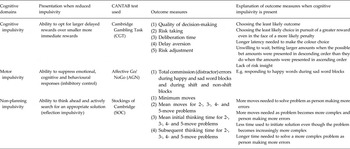
Impulsivity encompasses behaviours that are initiated rapidly, poorly planned, or focus on short-term outcomes despite potentially negative consequences in the longer term (Dawe & Loxton, Reference Dawe and Loxton2004) and has been proposed as a key component of several major psychiatric syndromes, including some personality disorders and drug dependence (Leland & Paulus, Reference Leland and Paulus2005). Exposure to opiates (naturally occurring opioid receptor ligands, such as morphine and semi-synthetic ligands such as heroin) and opioids (synthetic ligands, such as fentanyl or methadone) has been reported to be associated with a number of neuropsychological impairments during both active use and following a period of abstinence (Verdejo-Garcia & Pérez-García, Reference Verdejo-García and Pérez-García2007). One of the key domains associated with opioid abuse has been impulsivity. This, however, is a multiple component construct (Reynolds et al. Reference Reynolds, Ortengren, Richards and de Wit2006). Studies have attempted to fractionate this construct in order to investigate the underpinnings of different aspects of impulsive behaviour. Barratt (Reference Barratt, Spence and Izard1985) proposed three broad constructs of neuropsychological performance domains. These included motor, cognitive and non-planning impulsivity. These constructs are commonly used to investigate impulsivity (Stanford et al. Reference Stanford, Mathias, Dougherty, Lake, Anderson and Patton2009) and have shown face validity when tested on substance using populations (Potvin et al. Reference Potvin, Briand, Prouteau, Bouchard, Lipp, Lalonde, Nicole, Lesage and Stip2005; Ersche & Sahakian, Reference Ersche and Sahakian2007; Dougherty et al. Reference Dougherty, Mathias, Marsh-Richard, Furr, Nouvion and Dawes2009) (online Supplementary Table S1).
A recent meta-analysis of studies on neuropsychological functioning in mixed opioid users (heroin, methadone and other opioids) highlighted impairments, with moderate effect sizes, in the domains of cognitive impulsivity (risk taking), cognitive flexibility (verbal fluency) and verbal working memory compared to normal, healthy controls (Baldacchino et al. Reference Baldacchino, Balfour, Passetti, Humphris and Matthews2012). Meta-analysis of non-planning impulsivity was not performed because, to the best of our knowledge, only one study on this form of impulsivity has been reported (Ersche et al. Reference Ersche, Roiser, Clark, London, Robbins and Sahakian2005). Motor impulsivity, however, showed a non-significant mean effect size.
Individually, a series of studies have suggested that illicit substance-using populations show significantly higher rates of cognitive impulsivity compared to non-substance-using healthy controls (Petry, Reference Petry2002; Baker et al. Reference Baker, Johnson and Bickel2003; Kollins, Reference Kollins2003). Impaired cognitive impulsivity was also reported in opioid-dependent heroin-using (Clark et al. Reference Clark, Robbins, Ersche and Sahakian2006) and methadone-using (Rotherham-Fuller et al. Reference Rotherham-Fuller, Shoptaw, Berman and London2004) populations (online Supplementary Table S2). However, abstinent heroin users were also reported to be significantly impaired compared to controls (Mintzer et al. Reference Mintzer, Copersino and Stitzer2005). This is potentially relevant in suggesting that cognitive impulsivity may be conceptualized as trait-like and not simply a consequence of the direct pharmacological effects of opioids (Ersche et al. Reference Ersche, Turton, Pradhan, Bullmore and Robbins2010). By contrast, other studies have not reported impairments in motor impulsivity in either methadone users (Passetti et al. Reference Passetti, Clark, Mehta, Joyce and King2008), nor in abstinent heroin users (Verdejo-Garcia & Pérez-García, Reference Verdejo-García and Pérez-García2007).
In a study by Patton et al. (Reference Patton, Stanford and Barratt1995) opioid-dependent users scored higher on the non-planning impulsivity subscale of the Barratt Impulsiveness Scale-11 (BIS). Opioid-dependent users also significantly solved fewer problems correctly on the one-touch Tower of London task (ToL; Owen et al. Reference Owen, Sahakian, Semple, Polkey and Robbins1995), and needed more attempts in order to generate correct answers compared to non-substance-using controls (Ornstein et al. Reference Ornstein, Iddon, Baldacchino, Sahakian, London, Everitt and Robbins2000; Ersche et al. Reference Ersche, Clark, London, Robbins and Sahakian2006). Fishbein et al. (Reference Fishbein, Krupitsky, Flannery, Langevin, Bobashev, Verbitskaya, Augustine, Bolla, Zvartau, Schech, Egorova, Bushara and Tsoy2007) tested abstinent heroin users with the Stockings of Cambridge (SOC; Cambridge Cognition Ltd, UK) with similar results. In contrast, methadone users (Passetti et al. Reference Passetti, Clark, Mehta, Joyce and King2008) and abstinent heroin users (Brand et al. Reference Brand, Greco, Schuster, Kalbe, Fujiwara, Markowitsch and Kessler2002) tested on the ToL task did not show impairment in non-planning impulsivity compared to non-substance using healthy controls (online Supplementary Table S2).
Numerous methodological issues limit the conclusions that can be drawn from previous studies and meta-analyses. These include: (a) lack of specificity of definition of clinical cohorts, unrepresentative and small populations, failure to control for poly-substance use, see for example Ersche & Sahakian (Reference Ersche and Sahakian2007), (b) standardization of timing of assessments to control for potential confounds of drug withdrawal and/or intoxication (Davis et al. Reference Davis, Liddiard and McMillan2002), (c) ability to repeat testing within the same population to determine temporal stability or reversibility of observed impairments (Verdejo-Garcia et al. Reference Verdejo-Garcıa, López-Torrecillas, Gimenez and Pérez-García2004), (d) exposure to adulterants and the impact of the route of administration (e.g. injecting behaviour) (Gruber et al. Reference Gruber, Silveri and Yurgelun-Todd2007), (e) severity of the opioid-dependence syndrome (Bretteville-Jensen, Reference Bretteville-Jensen1999; Verdejo-Garcia et al. Reference Verdejo-Garcıa, López-Torrecillas, Gimenez and Pérez-García2004) and (f) confounds of age (Deakin et al. Reference Deakin, Aitken, Robbins and Sahakian2004) and co-morbid psychiatric illness (Jollant et al. Reference Jollant, Guillaume, Jaussent, Castelnau, Malafosse and Courtet2007). These have all contributed to the difficulties in attributing any robust cognitive impairment to chronic opioid use.
In summary, data derived from a variety of study designs suggests that chronic exposure to opioids is associated with cognitive impairment, specifically in the domain of cognitive impulsivity. However, it is not clear to what extent this might represent a ‘toxic’ effect of drug exposure, or an underlying trait for poorer quality of decision making that renders individuals more vulnerable to acquire opioid dependence.
The present study, therefore, aimed to extend our knowledge of neurocognitive performance among dependent and non-dependent opioid users. Employing an ambispective cohort design, we tested representative samples of male opioid-exposed participants (illicit and non-illicit) and non-substance-using healthy controls over a period of 6 months. Specifically, the study aimed to determine if performance on tasks measuring impulsivity was affected by (1) the type of opioid exposure (e.g. methadone, heroin and other opioids) at different stages of treatment; (2) the context (licit or illicit opioids); (3) the presence or absence of syndromal opioid dependence (opioid-dependent compared to non-opioid-dependent users) and (4) administration route – injection status (opioid-dependent and injecting compared to dependent and non-injecting participants).
Method
Participants
Ethical permission for the conduct of this study was provided by the East of Scotland Research Ethics Service (REC reference number: 06/S1401/32). Male participants aged 18–40 years were recruited from substance misuse and pain management services in Fife and Tayside, Scotland, UK. All participants enrolled in the study underwent detailed screening that included the collection of sociodemographic information, semi-structured interviews to ascertain detailed histories of drug and alcohol use and opioid-dependence status (Marsden et al. Reference Marsden, Gossop, Stewart, Best, Farrell, Lehmann, Edwards and Strang1998). The Clinical Opiate Withdrawal Scale (COWS) quantified the level of opioid withdrawal (Wesson & Ling, Reference Wesson and Ling2003). Mental health status and history was assessed using the Mini International Neuropsychiatric Interview (MINI Plus, version 5.0; Sheehan et al. Reference Sheehan, Lecrubier, Sheehan, Amorim, Janavs, Weiller, Hergueta, Baker and Dunbar1998). The National Adult Reading Test (NART; Nelson, Reference Nelson1982) was used to estimate general intellectual ability. Case records from the addiction, psychiatric and General Practitioner's services helped in the identification of overdose episodes, confirmed the absence of a history of epilepsy, other neurological phenomenon, hepatitis B, C and HIV status and whether there had been diagnoses of other personality disorders (e.g. borderline). These records also helped to validate medical and psychiatric histories, substance misuse career timelines and to quantify current drug and alcohol use. Online Supplementary Table S3 summarizes the data collection methods.
Exclusion criteria included lifetime or current histories of psychosis, post-traumatic stress disorder, neurological and neurodevelopmental disorders, antisocial and other personality disorders and/or head injury. Individuals with a lifetime history of non-fatal overdose episodes requiring medical attention (e.g. ambulance call out, cardio-pulmonary resuscitation), co-occurring benzodiazepine, psycho-stimulant and alcohol dependence were also excluded. Participants were required to be able to read and write English.
All treatment-seeking opioid-dependent individuals (N = 53) met DSM-IV criteria for opioid dependence (APA, 2000). The Heroin group (N = 24) were ‘first time’ referrals to a structured methadone maintenance treatment (MMT) programme. The Methadone group (N = 29) were participants in a MMT programme with objective confirmation of absence of illicit drug use for more than 6 months. The MMT group performed the neuropsychological tasks between 4–6 h of taking their last stable dose of methadone (baseline). Eighteen of 29 MMT group participants were retested 6 months after baseline testing. All opioid-dependent individuals had been taking between 120 mg and 360 mg of morphine equivalent opioids per day (Vieweg et al. Reference Vieweg, Lipps and Fernandez2005) and had, prior to entering the MMT programme, more than 3 years history of continuous and daily illicit opioid use. The two opioid-dependent groups (Heroin and MMT) were matched for lifetime drug use history, morphine equivalent dosages and drug use (including tobacco smoking) history 30 days prior to baseline testing.
To standardize the pharmacological status of the Heroin group at time of testing and to determine consistent stages of ‘withdrawal’ and the optimal subsequent MMT dose, an established clinical tolerance testing procedure was used (Baldacchino, Reference Baldacchino2001). Tolerance testing was a single-blind procedure that permitted the objective observation of individuals during stages of acute intoxication, acute withdrawal and subsequent stabilization on a fixed dose of methadone within a period of 7–14 days. In addition to the collection of subjective ratings of withdrawal, objective measurements of blood pressure, pupillometry, respiratory and pulse rates were acquired.
Heroin participants were assessed 3–5 h after their last illicit heroin administration to minimize the confounding cognitive effects of acute intoxication. The same participants were then retested (a) 10–15 h after the last heroin dose in a state of controlled opioid withdrawal and subsequently (b) following more than 2 weeks on a stable dose of MMT. This standardized tolerance testing offered an opportunity to perform repeated neuropsychological testing during periods when (a) illicit heroin was minimally present, (b) absent (i.e. in acute withdrawal) and (c) replaced by an alternative opioid (MMT). This approach offered the opportunity to test whether any impulsivity measures that differed from those of control participants represented a stable phenomenon, or could be modified by different opioid loading and switch to an alternative opioid (MMT).
A cohort of patients with chronic pain receiving treatment from specialist pain management services (N = 28) were recruited from local hospital and community-based clinics. Eligible participants were screened and confirmed as having no history of ‘illicit’ opioid use or methadone treatment and did not meet criteria for opioid dependence (APA, 2000). Healthy control participants (N = 28) were recruited from the general population residing in the same geographical areas as the Heroin and MMT participants. Both the Pain (P) and Healthy control (HC) participants were only tested once (Table 1).
Study procedures

†, Tested; —, not tested.
Instruments
Clinical
All subjects were screened using the MINI Plus v. 5.0 (Sheehan et al. Reference Sheehan, Lecrubier, Sheehan, Amorim, Janavs, Weiller, Hergueta, Baker and Dunbar1998), the Maudsley Addiction Profile (MAP; Marsden et al. Reference Marsden, Gossop, Stewart, Best, Farrell, Lehmann, Edwards and Strang1998), and the Fagerström Test for Nicotine Dependence (FTND; Fagerstrom & Schneider, Reference Fagerstrom and Schneider1989). Urine samples were collected from all participants to confirm history of recent opioid intake and to confirm the absence of any other illicit drugs throughout the study period. The COWS quantified the level of opioid withdrawal in the heroin group.
Neurocognitive
The neuropsychological tasks from the Cambridge Neuropsychological Test Automated Battery (CANTAB; Robbins et al. Reference Robbins, James, Owen, Sahakian, McInnes and Rabbitt1994) were selected on the basis of their known sensitivity to detect impairments in neurocognitive performance mediated by pathology of corticostriatal and medial-temporal systems that are proposed to mediate the pathophysiology of opioid dependence (Koob & Volkow, Reference Koob and Volkow2010). Testing was focused on impulsivity domains: Cognitive Impulsivity tested with the Cambridge Gambling Task (CGT), Motor Impulsivity tested with the Affective Go/NoGo (AGN) and Non-planning Impulsivity tested with the SOC (Table 2).
Impulsivity domains
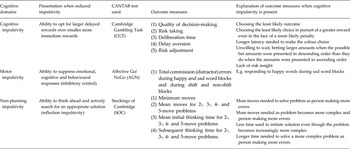
All participants were tested with the same neurocognitive test battery in a fixed order. Participants were allowed to smoke tobacco during breaks in order not to create a state of nicotine withdrawal during the testing period.
Data analysis
Analyses were conducted using SPSS for Windows v. 12 (SPSS Inc., USA). Data meeting assumptions of normality and homogeneity of variance were analysed using ANOVA and ANCOVA (Winer et al. Reference Winer, Brown and Michels1991). All other data were compared using appropriate non-parametric tests (e.g. Kruskal–Wallis and Mann–Whitney tests).
Preliminary analysis of all the experimental and control groups separately indicated that the samples did not come from normally distributed populations with the same standard deviation. A planned (a priori) contrasts analysis was therefore run to test for significant differences between the four independent study groups.
Kruskal–Wallis tests evaluated any differences between the four study groups with respect to sociodemographic variables. This was followed by Mann–Whitney U tests which established that NART, age, morphine equivalent dosage and previous alcohol use could be potential confounders and identified as covariates for further analyses.
An omnibus test was used to determine, if significant, whether pairwise comparison was indicated. In order to control for family-wise error, post-hoc Bonferroni-corrected pairwise comparison was used (Field, Reference Field2009). Results with p < 0.01 were considered significant. Those reported as between p < 0.05 and p > 0.01 are presented as non-significant trends when they are considered relevant to substantiate the interpretation of other significant results.
ANOVA was used to test for group differences with respect to impulsivity performance measures. The SOC outcomes did not meet assumptions of normality and were square-root-transformed prior to ANOVA. For those tasks requiring repeated-measures analyses which included incremental levels of difficulty within the testing session, the within-subject factor Difficulty was introduced, e.g. CGT (ratio of coloured boxes), SOC (2-, 3-, 4- or 5-problem moves). For the CGT an additional within–subject factor Direction (descending and ascending orders) was included. Homogeneity of variance was assessed using the Mauchly Sphericity test. Where datasets significantly (p < 0.05) violated this requirement, the Greenhouse–Geisser epsilon (ε) correction parameter for degrees of freedom was used to calculate a more conservative p value for each F ratio.
Finally, effect sizes were calculated using the methods of Cohen's d statistics (1988).
Results
Demographic, social and clinical data
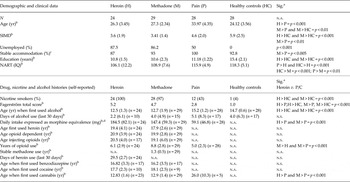
The Heroin and MMT groups differed significantly from the Pain and HC groups with respect to several demographic, social and clinical characteristics. Ninety-eight percent of opioid-dependent individuals compared to 43% in the Pain group and 4% in the HC group had smoked tobacco in the last 30 days (p < 0.001). Opioid-dependent participants started to drink alcohol approximately 2 years earlier than the other groups (p < 0.001). The mean morphine equivalent daily dose for the Pain group was significantly lower (59.1 mg) than the Heroin and MMT groups (165.9 mg) (p < 0.001). Urine drug screen analysis confirmed absence of recent amphetamine, benzodiazepine and cocaine use prior to every neuropsychological test session. Urine analysis also confirmed absence of heroin in the MMT group and the absence of methadone in the Heroin group. Table 3 summarizes the demographic, clinical and substance use data for the four groups.
Comparative demographic, clinical and substance use data for experimental and control groups

H, Heroin group; M, Methadone group; P, Pain group; HC, Healthy control group; N, total number in group; n.a., not applicable; SIMD, Scottish index of multiple deprivation; NART, National Adult Reading Test; IQ, Intelligence quotient; n.s., not significant; n, number of individuals analysed.
a Sig., Significance at p < 0.01 two-tailed; b mean total scores (±standard deviation); c stable accommodation, own house + rented accommodation + living with parents (excluded hostel, student and homeless); d opioid equivalence: Vieweg et al. (Reference Vieweg, Lipps and Fernandez2005).
When the participants from the Heroin group with a COWS score of between 8 and 14 (lowest-scoring eight) were compared with participants with scores of 18–25 (highest-scoring eight), there were no significant differences with respect to age (p = 0.88), Scottish index of multiple deprivation score (p = 0.75), years in education (p = 0.38), years when starting using alcohol (p = 0.07), alcohol amount used in last month (p = 0.87) or current level of nicotine dependence (Fagerström scores) (p = 0.96). Similarly, there were no significant group differences identified on these measures when comparing Heroin participants tested at baseline and those groups retested either during the tolerance testing protocol, or in the Methadone group 6 months later. There were no significant differences with respect to most sociodemographic and drug use characteristics when the 43 injecting participants were compared to the ten non-injecting participants. However, NART scores were significantly higher (p < 0.01) in the injecting group.
Profiling impulsivity
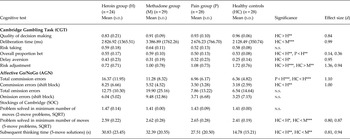
We compared the groups on each of the following three cognitive domains. Table 4 summarizes baseline neuropsychological findings.
Summary of baseline neuropsychological findings

n.s., No significant impairment in neuropsychological outcomes with p < 0.01; SQRT, square root transformation.
* p < 0.01, ** p < 0.005, *** p < 0.001.
Cognitive impulsivity
ANOVA on the core CGT outcomes at baseline revealed significant group differences in measures of cognitive impulsivity (deliberation time: F 3,102 = 4.3, p < 0.01; risk taking: F 9,196.89 = 6.4, p < 0.01; delay aversion: F 9,222.23 = 2.6, p < 0.01; risk adjustment: F 3,102 = 4.4, p < 0.01). There was a non-significant group trend for differences in quality of decision making (F 3,102 = 3.3, p = 0.02).
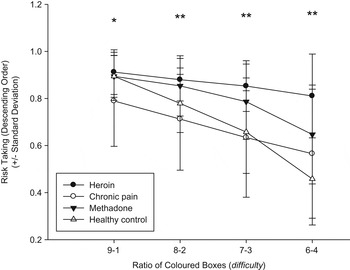
The Heroin group at baseline risked significantly more (risk taking: p < 0.001, d = 0.74), bet larger amounts when the task was presented in descending order than in ascending order (delay aversion: p < 0.01, d = 0.95) and significantly increased the percentage of available points put at risk in response to more favourable coloured box ratios – again in descending order (risk adjustment: p < 0.001, d = 1.36) compared to the HC group. Also, the Heroin group differed from the Pain group with respect to risk taking (p < 0.001, d = 0.74) (Fig. 1).
CGT risk taking. Across the four different levels of task difficulty, all participants placed larger bets when the more favourable ratios were presented (i.e. 9:1 > 6:4). Therefore, all groups adjusted their behaviour according to the probability of selecting correctly. Overall, participants placed significantly higher bets in descending order (F 9,195.19 = 7.85, p < 0.001). Post-hoc Bonferroni comparisons identified the Heroin group as having bet more at all levels of difficulty (other than the 9:1 ratio*) compared to the Healthy control and Pain (**p < 0.001) groups.

The MMT group differed from HC participants with respect to showing longer deliberation times (p < 0.01, d = 0.99) and increased risk adjustment (p < 0.001, d = 0.94) in both the descending and ascending orders.
The Heroin group differed from the MMT group at baseline in terms of increased risk taking (descending sequence) (p < 0.001) and increased delay aversion (more rapid responding at the 8:2, 7:3 and 6:4 box ratios) (p < 0.001).
Motor impulsivity
There was a significant group effect on commission errors (F 3,102 = 5.4, p < 0.01). Post-hoc comparisons revealed that the Heroin group made more commission errors compared to the HC group (p < 0.001, d = 1.10). Further analysis indicated significant group effects on commission errors when responding to happy words during sad word blocks (negative valence) (F 3,102 = 6.5, p < 0.001). Whereas the Heroin group (p < 0.001, d = 1.23) differed significantly from the HC group, there was a non-significant trend (p = 0.02) for the MMT group to differ from the HC group. There was also a significant group effect (F 3,102 = 7.6, p < 0.01) on commission errors in non-shift mode (when the response orientation of the participant remained the same between blocks). Post-hoc analysis showed the Heroin group (p = 0.01, d = 1.06) made more commission errors compared to the HC group.
Non-planning impulsivity
SOC outcomes revealed significant group differences in the minimum number of moves (F 3,107 = 6, p < 0.001) and subsequent thinking times (F 3,107 = 4.4, p < 0.0) to solve the complex 5-move problem stage. Post-hoc analysis showed that the Heroin group required significantly more moves (p < 0.01, d = 0.80) and took longer (p < 0.005, d = 0.81) to solve 5-move problems compared to the HC group. Also, the MMT group required significantly more moves (p < 0.001, d = 0.87) and the Pain group showed a non-significant trend (p = 0.02) to solve 5-move problems compared to the HC group.
Transition from Heroin group to MMT group
Repeated-measures ANOVA comparing the Heroin group at baseline with the same participants once established on MMT (following tolerance testing) showed a significant reduction in commission errors (F 2,46 = 6.1, p < 0.001, d = 0.87). This effect was observed in the non-shift error scores (F 2,44 = 7.8, p < 0.001, d = 0.56) with a non-significant trend in the same direction in the shift mode error scores (F 2,44 = 3.6, p = 0.03).
There were no significant changes on any of the measures from the CGT or the SOC. Analysis of performance on each measure after 6 months of MMT revealed no significant changes.
The influence of opioid dependence and injecting status
Comparing those meeting criteria for syndromal opioid dependence (MMT and Heroin participants) with those without (Pain and HC), there were significant differences in measures of cognitive impulsivity (shorter CGT deliberation times: F 1,104 = 7.2, p < 0.01, d = 0.27 and poorer CGT risk adjustment: F 1,104 = 9.5, p < 0.00, d = 0.53), and increased motor impulsivity in AGN commission errors (F 1,104 = 8.9, p < 0.005, d = 0.96) especially in the non-shift mode (F 1,104 = 6.9, p < 0.01, d = 0.75). Analysis by injection status revealed no significant effects on any measures (Table 5).
Summary of outcomes of opioid using groups and impulsivity when compared with healthy control group

CGT, Cambridge Gambling Task; AGN, Affective Go/NoGo task; SOC, Stockings of Cambridge; No impairment, no difference in impulsivity when compared to healthy controls.
Dependence group = Heroin and Methadone groups combined; Injecting group = subgroup of injecting cohort within both Heroin and Methadone groups.
* p < 0.01.
Discussion
Tests of specific hypotheses
The primary hypothesis tested in this study posited that, when compared with drug-naive controls, chronic exposure to both licit and illicit opioid drugs would influence measures of impulsivity. Although the subjects taking heroin or treated with MMT could be differentiated from the drug-naive (HC) control group with respect to cognitive, motor and non-planning impulsivity, there were no significant differences between the Pain and HC participants with respect to any of these measures.
The current study does not support the conclusion that the changes in these measures, reported here, are a simple pharmacological consequence of chronic exposure to opioid drugs. Instead, these results suggest that risk taking and delay aversion outcomes for cognitive impulsivity and commission errors (non-shift mode) for motor impulsivity were significantly impaired in the Heroin group when compared with the group stably maintained on methadone. Thus, chronic illicit exposure to heroin may elicit increases in impulsivity which is not apparent in subjects stably maintained on MMT. This conclusion is supported by the additional evidence that the deficit in commission errors seen in the Heroin group was attenuated when the subjects were transferred to MMT. However, the MMT participants differed from the HC group to the extent that they took longer to deliberate and showed increased risk adjustment on both the descending and ascending sequences of the CGT (Table 5). Thus, it seems reasonable to suggest that the specific changes in impulsivity evoked by chronic exposure to heroin, which are not shared by any of the other groups, reflect the illicit use of the drug, whereas those shared by the MMT and Heroin groups reflect either dependence upon opioids, or tolerance to the drugs. There were no detectable differences between injecting and non-injecting participants. Injecting behaviour was proposed as a crude measure of severity on opioid dependence.
The cognitive effects of heroin and other opioids are often seen as variants of the same disorder. Indeed, influential theories of addiction emphasize the shared psychological processes and neurobiological subStrates of different types of drug addiction. Our data suggest an alternative perspective. Although there are commonalities in the ways in which all opioids affect impulsive behaviour, much can be learned from considering the distinctive features of each type of opioid and its effect on impulsivity domains. In this study, we have described differences in the profile of impulsivity dependent upon current drug exposure with differences between heroin and MMT.
Since confounding variables such as mood state (Jollant et al. Reference Jollant, Guillaume, Jaussent, Castelnau, Malafosse and Courtet2007) and co-morbid personality disorder (Vassileva et al. Reference Vassileva, Petkova, Georgiev, Martin, Tersiyski, Raycheva, Velinov and Marinov2007) were largely controlled for in our study, it is unclear whether differences in impulsivity measures between the Heroin and Methadone cohorts are due to: (1) chronic illicit heroin users improving after being prescribed, for more than 6 months, a stable dose of licit MMT (Ersche et al. Reference Ersche, Clark, London, Robbins and Sahakian2006) and/or (2) opioid dependence (Ornstein et al. Reference Ornstein, Iddon, Baldacchino, Sahakian, London, Everitt and Robbins2000) and/or (3) a past history of substance abuse and associated lifestyle and/or (4) vulnerability to trait impulsivity (Kirisci et al. Reference Kirisci, Tarter, Reynolds and Vanyukov2006; Verdejo-Garcia et al. Reference Verdejo-Garcia, Lawrence and Clark2008; Audrain-McGovern et al. Reference Audrain-McGovern, Rodriguez, Epstein, Cuevas, Rodgers and Wyleyto2009; Ersche et al. Reference Ersche, Turton, Pradhan, Bullmore and Robbins2010; Odum & Bauman, Reference Odum, Bauman, Madden and Bickel2010) and its involvement in drug use experimentation, abuse and dependence (Koob & Volkow, Reference Koob and Volkow2010). A longitudinal ‘at risk’ study design would be required to address these unresolved questions.
Equally, it is unclear what contributory effects cannabis and nicotine use present to these cognitive functions. Significant impairments in cognitive, motor and non-planning impulsivity have been identified in separate cannabis (Grant et al. Reference Grant, Chamberlain, Schreiber and Odlaug2012) and nicotine (Chamberlain et al. Reference Chamberlain, Odlaug, Schreiber and Grant2012) non-treatment-seeking and young users compared to healthy controls. In our study the Methadone and Heroin cohorts where not significantly different in their recent nicotine (p = 0.6) and cannabis (p = 0.7) use.
This study recruited treatment-seeking males and thus results may not generalize to non-treatment-seeking and female populations. Drug use and risk factor histories of subjects were, by necessity, based upon self-report, and no blood, hair or saliva samples taken to validate accuracy of the information. However, self-report of illicit drug users has been demonstrated to have high degrees of validity and reliability (Best et al. Reference Best, Manning and Strang2007). This study also conducted urine drug screen analysis to confirm absence of recent amphetamine, opioids, benzodiazepine and cocaine use prior to every session. All opioid-dependent participants had a mean duration of 7.5 years heroin use and a daily dose of 165 mg morphine equivalent. The Pain group were, however, significantly older, more highly educated and had more consistent employment histories than the Heroin and Methadone cohorts. They also had a lower mean daily dose of 59.1 mg morphine equivalent. However, opioids can cause measurable cognitive impairment even at low doses and equi-analgesic doses of different opioids may have nonlinear and non-equivalent adverse cognitive effects (McMorn et al. Reference McMorn, Schoedel and Sellers2011). Notably, the Pain group had a much flatter risk adjustment function than the HC group, parallel but lower to the opioid-dependent groups. This might suggest that with larger and/or equi-analgesic doses, greater behavioural effects may have become evident within the Pain group. This merits further study.
One possible explanation for the heterogeneity of results between the Heroin and Methadone groups is that even though these two groups were categorically homogenous (i.e. both opioid dependent) there may have been an undetected ascertainment bias (Sackett, Reference Sackett1979). Clinically it may be that those who are more impulsive find it more difficult to engage with a highly structured methadone programme and, as a result, relapse into illicit heroin use and rendering them unavailable to participate as MMT group members. Conversely, individuals who have become stable on methadone in this MMT modality may be more behaviourally and cognitively skilled and may, therefore, be more able to meet the demands of stability (Drake et al. Reference Drake, McDonald, Kaye and Torok2012). However from a molecular pharmacological perspective, mu opioid (MOP) receptor agonist drugs such as heroin, methadone and others used in moderate to severe pain interact with a large number of μ receptor subtypes with different activation profiles for the different opioids. This results in subtle pharmacological differences in potency, effectiveness, tolerability and neurotoxicity (Pasternak, Reference Pasternak2012). Opioids also have variable agonist activity at both δ (DOP) and κ (KOP) opioid receptors (Pathan & Williams, Reference Pathan and Williams2012), with methadone having minimal binding affinity to both DOP and KOP. Active metabolites for heroin and methadone display multimodal subunit-dependent antagonism of 5-HT3 receptors (Deeb et al. Reference Deeb, Sharp and Hales2009) and methadone but not heroin display N-methyl-d-aspartate (NMDA) receptor antagonist properties (Davis & Inturrisi, Reference Davis and Inturrisi1999). These cellular and molecular variations might determine different neuropsychological impairments.
Neuropsychological research has shown that consumption of alcohol, benzodiazepines and psychostimulants, including nicotine, are potentially important confounding variables (Koob & Volkow, Reference Koob and Volkow2010). The present study used stringent criteria to exclude regular and dependent users of most psychoactive substances. The exception to this was lack of nicotine use in the healthy controls. We could not control for the effects of this psychostimulant and this may have influenced our results due to its known effects on impulsivity (Flory & Manuck, Reference Flory and Manuck2009). Concomitantly, due to the putative psychoactive properties of the adulterants (e.g. caffeine and paracetamol) present in many criminal justice heroin seizures, one is not certain what neuropsychological effects they may have had on the participants (Cole et al. Reference Cole, Jones, McVeigh, Kicman, Syed and Bellis2010).
The current study has potential clinical implications for the treatment of opioid dependence. Treatment providers should be aware that their patients may demonstrate impairment across a range of higher level cognitive functions, including ‘executive function’ tests. Such difficulties could manifest as increased behavioural disinhibition, risk-taking, poor problem-solving skills and poor learning. Heroin users might behave in a different manner to methadone users, even though both are poor in solving problems. Highly concrete, structured approaches for managing individuals with cognitive and behavioural difficulties arising from brain dysfunction may be appropriate (Hodgson et al. Reference Hodgson, McDonald, Tate and Gertler2005). There may also be implications for the general applicability of non-pharmacological treatments, including cognitive behavioural, relapse prevention techniques and motivational enhancement therapies together with the effects of social stability (Loeber et al. Reference Loeber, Kniest, Diehl, Mann and Croissant2008).
Supplementary material
For supplementary material accompanying this paper visit http://dx.doi.org/10.1017/S0033291714002189.
Acknowledgements
The authors thank NHS Fife Research and Development Department for assistance with the purchase of the CANTAB system. The authors also acknowledge the following services which utilized all their resources to identify eligible patients. Fife NHS Addiction Services, Tayside Pain Services, Tayside Arrest Referral Team (NCH), Fife Drug Treatment and Testing Order Team, Frontline Fife, Fife Intensive Rehabilitation Support Team, Fife NHS Clinical Psychology Service and a multitude of General Practitioner Practices and NHS Primary Care Health Centres in the Fife and Tayside areas. Finally to all individuals who gave up so much of their valuable time to participate in this study with the sole aim of helping in the better understanding of the ‘brain’ in addiction.
Declaration of Interest
A.B. has received unrestricted educational grants from Schering Plough, Merck Serono, Lundbeck and Reckitt Benckiser. D.J.B. has received research support from Vifor Pharma and a BBSRC Case award in collaboration with MSD and an honorarium from the Society for Research on Nicotine & Tobacco as Editor-in-Chief the Society's research journal, Nicotine & Tobacco Research. K.M. has chaired advisory boards for studies of deep brain stimulation for obsessive-compulsive disorder sponsored by Medtronic. He has received educational grants from Cyberonics Inc. and Schering Plough, and he has received research project funding from Merck Serono, Lundbeck and Reckitt Benckiser and also from St Jude Medical for a multi-centre clinical trial of deep brain stimulation for depression. He has received travel and accommodation support to attend meetings from Medtronic and St Jude Medical.