Introduction
Although entrepreneurial opportunity formation has been an area of intense interest in entrepreneurship research, it has recently been argued to be insufficient to understand the phenomenon of entrepreneurship. Venkataraman and Shane’s proposition of defining entrepreneurship as a nexus of enterprising individuals and lucrative opportunities (Venkataraman, Reference Venkataraman1997; Shane & Venkataraman, Reference Shane and Venkataraman2000) had found agreement among several researchers. However, it has also raised a hot debate (de Koning, Reference de Koning2003; Alvarez & Barney, Reference Alvarez and Barney2007, Reference Alvarez and Barney2013; Alvarez, Barney, & Young, Reference Alvarez, Barney and Young2010; Wiklund, Davidsson, Audretsch, & Karlsson, Reference Wiklund, Davidsson, Audretsch and Karlsson2011; Zahra & Wright, Reference Zahra and Wright2011). Recent discourse in the field has argued the opportunity construct as being controversial and elusive (Klein, Reference Klein2008; Dimov, Reference Dimov2011; Shane, Reference Shane2012; Eckhardt & Shane, Reference Eckhardt and Shane2013) and moved focus from examining entrepreneurship through the nature of opportunity that over-emphasised the individual entrepreneur to the exclusion of the environment (Dimov, Reference Dimov2007; McMullen, Plummer, & Acs, Reference McMullen, Plummer and Acs2007), to exploring opportunity shaping as a process and entrepreneurial action as the focal concept (Aldrich, Reference Aldrich2001; Ardichvili, Cardozo, & Ray, Reference Ardichvili, Cardozo and Ray2003; Holmquist, Reference Holmquist2003; Dimov, Reference Dimov2007; Bhowmick, Reference Bhowmick2011; Venkataraman, Sarasvathy, Dew, & Forster, Reference Venkataraman, Sarasvathy, Dew and Forster2012; Alvarez, Barney, & Anderson, Reference Alvarez, Barney and Anderson2013; McMullen & Dimov, Reference McMullen and Dimov2013). The phenomenon of entrepreneurship could therefore be gainfully examined through actions of the entrepreneur at their micro-foundations. It has also been emphasised that the micro-foundations of entrepreneurial action are relevant in the context in which the actions occur (Low & Abrahamson, Reference Low and Abrahamson1997; de Koning, Reference de Koning2003; Welter, Reference Welter2011; Zahra & Wright, Reference Zahra and Wright2011). Therefore, actions that entrepreneurs take towards shaping profitable outcomes within a market context seems the best way to understand how opportunities are shaped within that context. This paper does not debate the opportunity construct, but assumes, unarguably, that entrepreneurial action is inevitably made in pursuit of potentially profitable outcomes. Following Dimov’s (Reference Dimov2011) lament of the elusiveness of the opportunity construct and suggestion for empirical studies in entrepreneurial action instead, it focuses on the micro-foundations of entrepreneurial action in the context of high technology environment that is characterised by uncertainty and market volatility.
Following a conceptualisation of entrepreneurial opportunity as expressed in actions (Dimov, Reference Dimov2011), this paper tracks entrepreneurial action micro-foundations through the processes of effectuation and enactment. The concept of effectuation, propounded by Sarasvathy (Reference Sarasvathy2001, Reference Sarasvathy2008), is a processual logic of what action steps an entrepreneur is found to take under uncertainty, how the entrepreneur controls resources while aligning likeminded others in the pursuit of opportunity. Enactment, drawn from Weick’s sensemaking concept (Weick, Reference Weick1979, Reference Weick1995; Weick, Sutcliffe, & Obstfeld, Reference Weick, Sutcliffe and Obstfeld2005), on the other hand, lends a platform for understanding prospective action steps towards a preferred outcome that is only made sense of post facto. Effectuation may be described as led by actions to control the process of opportunity pursuit to the entrepreneur’s advantage; enactment as the actor’s initiative in a coming together without control of environmental factors, but made sense of retrospectively by the actor/entrepreneur. Therefore, it is argued that effectuation is ambiguity-mitigating action, whereas enactment is ambiguity-embracing action. This paper specifically draws out similarities and differences between the two, examining how a view of entrepreneurial enactment before sensemaking reconciles with entrepreneurial action that is driven by deliberate effectual control. Thus, it explores the dual nature of entrepreneurial action process: one, the entrepreneurial leap (Stevenson & Jarillo, Reference Stevenson and Jarillo1990; Gartner, Carter, & Hills, Reference Gartner, Carter and Hills2003) into the market that has the potential of success as well as failure, and the other of the effectual, non-predictive control action of the entrepreneur that Sarasvathy and colleagues posit as being the expert entrepreneurs’ preferred mode of action to start up a business (Sarasvathy, Reference Sarasvathy2001, Reference Sarasvathy2008; Dew, Read, Sarasvathy, & Wiltbank, Reference Dew, Read, Sarasvathy and Wiltbank2009).
The paper helps to develop concept elegance and parsimony in the entrepreneurship literature linking risk-taking and risk-mitigating notions of entrepreneurial action under uncertainty. Illustrative cases of opportunity pursuing entrepreneurial action are examined through the effectuation and enactment lenses to explore how entrepreneurs acting under uncertainty embrace as well as mitigate risk. In the next section, the concepts of effectuation and enactment are outlined before similarities and differences between them are drawn out, propositions developed and illustrative examples examined.
Effectuation: Resource-Dependent Action
In her seminal work, Sarasvathy (Reference Sarasvathy2001, Reference Sarasvathy2008) explains entrepreneurial opportunity formation under uncertainty by the effectuation logic of non-predictive control. She posits that because Knightian (or radical) uncertaintyFootnote 1 has unpredictability as its inherent characteristic, entrepreneurial opportunity pursuing action under such uncertainty conditions is an endogenous creation process that follows a non-predictive logic. She proposes such logic to be the inverse of prediction-based causation logic and calls it effectuation, where entrepreneurs build effectual control iteratively, thus acting to enhance chances of favourable outcomes, without attempting to predict what is theoretically unpredictable. She shows that expert entrepreneurs use effectuation action to get around this unpredictability more often than do novice entrepreneurs. Starting with a given set of means, the entrepreneur attempts to augment his or her means with those of other potential stakeholders and, in the process, iteratively adjusts the effects (i.e., goals/products) that can be created from the means. Sarasvathy (Reference Sarasvathy2001: 259) proposes that effectual action-seeking entrepreneurial opportunity for favourable outcomes is not based on prediction of those outcomes, but involves:
∙ affordable loss, rather than expected returns;
∙ strategic alliances, rather than competitive analysis;
∙ exploitation of contingencies, rather than pre-existing knowledge; and
∙ control of an unpredictable future, rather than prediction of an uncertain one.
The processual logic of effectual action revolves round the central tenet of non-predictive control that is summed up in the last of the four ‘principles’: control of an unpredictable future, rather than prediction of an uncertain one. Unpacking the hypotheses of affordable loss rather than expected return, strategic alliance rather than competitive analysis and exploitation of contingencies rather than pre-existing knowledge in terms of enhancing entrepreneurial control clarifies the process explanation of effectuation. If affordable loss is to enhance control over potential loss or gain, then the entrepreneur is likely to set in advance, at least as a rough limit, the loss she/he is prepared to take. That is possible only with making prior sense of the potential loss, and deciding to ‘bootstrap’ with minimal upfront external funding, for instance. The entrepreneur’s pre-commitment is a way to influence the environment by reducing risk of competition that is inevitable when greater information becomes available, lowering information isotropy in the environment. Pre-commitment from other stakeholders serve the same purpose, and when it comes from potential clients it has the highest possibility of enhancing potential for gain in terms of progressing towards a pre-validated marketable opportunity rather than a predicted one. Exploiting client contingencies, on the other hand, extends the entrepreneur’s influence over the potential client’s environment again limiting potential loss while strengthening potential gain, and leading to possible client pre-commitment. Strategic alliance and networking are also the entrepreneur’s attempt to advance a favourable outcome possibility by extending control over potential gains and reducing potential losses. Thus, effectual action by the entrepreneur is aimed at enhancing control over potential gains and losses in the attempt to form a profitable opportunity. In this sense, the entrepreneur’s effectual action with potential client differs from a large company’s foray with a product into a market segment with a high pre-commitment, but primarily confirming or disconfirming market size predictions by the extent of post-launch acceptance of the product. Entrepreneurial actions of networking, pre-commitment and bootstrapping (Sarasvathy, Reference Sarasvathy2001, Reference Sarasvathy2008) relate to the aspects of affordable loss, contingency exploitation and strategic alliance, and go towards controlling downside risk as well as upside potential. In a nutshell, therefore, in the non-predictive control logic of effectuation, all entrepreneurial actions that enhance the entrepreneur’s control of potential gains or losses should contribute to effectual control of the attempted opportunity formation process.
Enactment: Resource-Independent Action
In many circumstances, opportunities are enacted, that is, the salient features of the opportunity only become apparent through the ways that entrepreneurs make sense of their experiences. (Gartner, Carter, & Hills, Reference Gartner, Carter and Hills2003: 105)
The enactment of opportunity that Gartner, Carter, and Hills (Reference Gartner, Carter and Hills2003) propose above draws from Weick’s concept of sensemaking (Weick, Reference Weick1995, Reference Weick2001; Weick, Sutcliffe, & Obstfeld, Reference Weick, Sutcliffe and Obstfeld2005). It is useful to understand the concept of Weickian enactment, which is prospective in nature, as also the concomitant concept of sensemaking that is retrospective, in the context of Weick’s organising in enactable environments. Weick proposes ‘enactment’ as one of the four elements of the organising process: ecological change, enactment, selection and retention. ‘Ecological change provides the enactable environment’; selection ‘reduces equivocality’ of the enacted displays as enactment is not ‘directed’; and retention is the ‘relatively straightforward storage of the products of successful sensemaking, products of that we call enacted environments’ (Weick, Reference Weick1979: 131–145). It is enactment of bracketed ecological change perceived by the actor (entrepreneur) that is the most important concept in Weick’s sensemaking proposition, and the concept most relevant to this discussion of prospective action.
Weick maintains that information is ‘always equivocal’ and organising is a ‘natural consequence of equivocal information with fluid interdependencies’ (Weick, Reference Weick1979: 13, Reference Weick1995; Weick, Sutcliffe, & Obstfeld, Reference Weick, Sutcliffe and Obstfeld2005: 410, 414). In the context of entrepreneurial action, this provides the enactable environment for those who are perhaps more alert, as we know from Kirzner, i.e., the entrepreneur actor. The actor notices or ‘brackets’ a perceived change or ‘deviation’, and attempts to amplify the bracketed deviation, which could be to the actor’s advantage or disadvantage, and could result in either virtuous or vicious cycles (Weick, Reference Weick1979: 81); however, importantly, the actor makes sense of the enactment retrospectively (Weick, Reference Weick1979, Reference Weick1995; Weick, Sutcliffe, & Obstfeld, Reference Weick, Sutcliffe and Obstfeld2005). Thus, an important aspect of enactment is that people make sense retrospectively, that they construct their situation, their reality, retrospectively or ‘after the fact’ (Weick, Reference Weick1979: 5, 194). Weick explores the enactment concept in sensemaking along with an interdependence concept, i.e., the individual often enacts the environment and is a part of the situation she/he faces – because ‘means affect ends’ (Weick, Reference Weick1979: 86).
Weick’s concept of enactment emphasises that information is equivocal and presents many possibilities. This leads to the reiteration of the non-rationality in human action, often making prospective action appear illogical in an equivocal environment and hence risky to others; ‘… there’s a bit of absurdity in all of us’ (Weick, Reference Weick1979: 64). Voluntary, prospective action or enactment is what Weick has called ‘action before thought’ (Weick, Reference Weick1979, Reference Weick1995; Weick, Sutcliffe, & Obstfeld, Reference Weick, Sutcliffe and Obstfeld2005). Weick expounds on this in his later work, clarifying that ‘(micro-level) action is just a tiny bit ahead of cognition’ (Weick, Sutcliffe, & Obstfeld, Reference Weick, Sutcliffe and Obstfeld2005: 419); micro-action produces change that is made sense of over time. Such prospective action falls in the domain of the non-rational, thus requiring ‘retrospective sensemaking’ of actors constructing their reality retrospectively. As noted above, this is what Gartner, Carter, and Hills (Reference Gartner, Carter and Hills2003) posit in the context of entrepreneurial opportunities. Entrepreneurial action under uncertain environments of highly equivocal technology markets could then be considered as enactment processes of prospective action and retrospective sensemaking. This also resonates with the essence of entrepreneurship being ‘the willingness to pursue opportunity regardless of the resources under control’ (Stevenson & Jarillo, Reference Stevenson and Jarillo1990).
Enactment and Effectuation in Entrepreneurial Action: Similarities and Differences
Both enactment and effectuation seek to understand initial action. Both concepts recognise that linear causation is insufficient to explain human action in organisational or entrepreneurial processes. Both deal with uncertainty and the non-linear dynamic environment that does not yield to causal optimisation analyses, and both deal with a construction of initiative outcomes in the environment. Both accept the non-deterministic and creative nature of action processes, and the interdependencies across boundaries in the environment. Both also recognise the equivocal (Weick) and isotropic or dynamic contingent (Sarasvathy) nature of the environment, and consequently the need to recognise the multiplicity of ways that human entrepreneurial action responds to market environment. Both concepts theorise the existence of ‘small beginnings’, and emphasise the iterative nature of processes that evolve from small beginnings, with the process as the determining entity rather than the structures processes create. In Weick’s enactment conceptualisation, the actor is a part of the situation she/he faces and also constructs endogenously; in Sarasvathy’s effectuation conceptualisation, the entrepreneur is involved in endogenous goal creation where entrepreneurial opportunity creation contains within it the processes of (external) discovery and exploitation. In a fundamental way, both concepts give primacy to action over pre-planning in explicating organising and exploring.
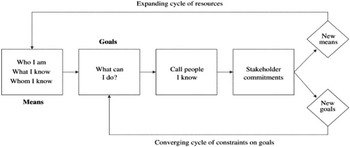
However, a difference between the two concepts lies in what may be called the directedness of action. As noted, Weickian environment is characterised by equivocality and interdependence and Weickian enactment by prospective action that are non-rational or, often to an observer, irrational. As prospective enactment action rejects the past to adapt to new situations or to ‘truths of the moment’ in non-rational ways, sensemaking retrospectively (Weick, Sutcliffe, & Obstfeld, Reference Weick, Sutcliffe and Obstfeld2005: 412), the enacted situation can lead to either a virtuous or a vicious circle. Sarasvathian effectuation, although also an endogenous goal/opportunity/advantage creating action concept, does not put such store by the equivocal prospective action that characterises Weickian enactment, except in that the entrepreneur, along with subsequent pre-committing stakeholders gathered, changes aim to a different modified end as new facts unfold in the environment. Effectuation takes the environment to have equivocal information, but emphasises the entrepreneur’s orchestration to gradually get more control of the environment. Although Sarasvathy (Reference Sarasvathy2001), Sarasvathy et al. (Reference Sarasvathy, Venkataraman, Dew and Velamuri2003) do not analyse the cognitive genesis of such gradually enhancing ‘control’ and keeps to a kind of phenomenology of entrepreneurial start-up action steps, there is an undeniable glimpse of action by design in the effectuation framework. The effectuation cycle is depicted in Appendix.
Apart from the directedness of action, the other difference between the two concepts lies in that effectuation has been expounded specifically on the entrepreneurial start-up process, whereas ‘enactment’ is wider in its scope. Both concepts seem to have ‘believing is seeing’ (Weick, Reference Weick1979: 187, 202) as the raison d’être of agentic action and, although both Weick and Sarasvathy propose equivocal environment or information isotropy, Weickian enactment has an element of equivocality in enactment outcome. On the other hand, action in Sarasvathian effectuation overcomes initial information isotropy and builds on the logic of controlling the means and, through that, the outcome shaped. This is seen in the context of ‘expert entrepreneurs’ where effectuation influences the outcome and directs towards success (Sarasvathy & Read Reference Sarasvathy and Read2005). Sarasvathy’s urn metaphor illustrates how effectual action by entrepreneurs changes the associated ambiguity and enhances control of the environment isotropy by changing the rules of the gameFootnote 2.
The literature on effectuation is clear on the two fundamental characteristics in the context of entrepreneurial action in the opportunity formation process: it describes the forming of opportunity through entrepreneurial action steps; and that the action of the entrepreneur aims to enhance ‘control’ of the entrepreneur’s own as well as the potential client’s environment. The action steps are depicted by Sarasvathy in the chart (see Appendix), which shows the cycles that an effectuating entrepreneur would go through. In the model, effectual opportunity formation is explained in terms of the entrepreneur’s control over own ‘given set of means’ and extending that control over the potential client’s environment/means gathering as much pre-commitments as can be mustered from self and from others. This pre-commitment can be considered as prospective action only to the extent that the outcome is not predictable. However, a major difference between effectual pre-commitment and prospective action in enactment is that effectuation considers (the entrepreneur’s own) pre-commitment to be within affordable loss limits. The pre-commitment in effectuation is done with full knowledge of the uncertainty of the outcome and emanating from the resources at hand, i.e., from means within affordable loss limits. Enactment, on the other hand, explicates prospective action before sensemaking and with little regard to the resources under control, as discussed above, and therefore is an act of risk-taking, or over-confidence to onlookers. Enactment considers no element of control; in fact, it is akin to the abandonment of control, which, in entrepreneurial start-up leap action, accounts for equivocality between success and failure in the process where the outcome coalesces, and is made sense of after the enacted step.
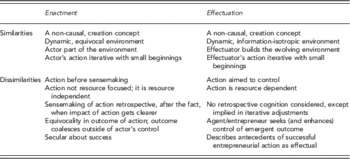
The similarities and differences between the enactment and effectuation aspects of entrepreneurial action in opportunity formation under uncertainty can theoretically be summarised in Table 1.
Enactment and effectuation: Analytical similarities and differences

It is pertinent to note that enactment and effectuation are practically inseparable in entrepreneurial action and understanding the differences analytically helps to understand entrepreneurial action as such. Propositions below are built to show how this theoretical understanding helps to analyse entrepreneurial action in light of a leap and control dynamic, and might lead to anticipating successful opportunity outcome under uncertainty conditions.
Proposition Building
Co-occurrence of enactment and effectuation actions
Entrepreneurial journeys have presented us with cautious forays of entrepreneurs as well as war stories of apparent recklessness in entrepreneurial start-ups. Control and leap actions seem to be different aspects of entrepreneurial start-up action and, it is argued below that, they co-occur in the face of uncertainty, high resource constraint and non-existent market visibility of entrepreneurial start-ups. It is argued here that all obstacles entrepreneurial start-ups face, including resource poverty and liabilities of newness in the market, would, as suggested by the effectuation principle, motivate entrepreneurs to seek to control whatever part of their unpredictable future they can. Effectuation suggests that the entrepreneur would do this through effectual control, i.e., by ‘pre-commitment’ within affordable loss limits, by making alliances and by exploiting client contingencies and getting others to pre-commit as stakeholders, iteratively. On the other hand, in the face of Knightian uncertainty of rapidly changing markets and technology, the paper argues that an entrepreneur would attempt to stay ahead of others in the race to market by taking action with incomplete information or understanding ‘before the market opportunity is known even probabilistically’ (Alvarez & Barney, Reference Alvarez and Barney2005) and with little regard to resources under control, i.e., a step in the dark, in the nature of Weickian enactment, before sensemaking. Thus, the tension the entrepreneur faces is between:
1. the need to act prospectively and often with little information or understanding – as ‘by the time an opportunity is investigated fully, it may no longer exist’ (Bhide, Reference Bhide1994), i.e., the need to ‘enact’; and
2. the need to control and minimise loss of resources committed upfront in a path that might require in-course correction, knowing that ‘a multistage commitment allows for responsiveness’ (Stevenson & Gumpert, Reference Stevenson and Gumpert1985: 90), i.e., the need to effectuate.
To understand this ‘controlled boldness’ (Mintzberg & Waters, Reference Mintzberg and Waters1982) or the need for adaptation and variation (Galvin, Rice, & Liao, Reference Galvin, Rice and Liao2014), it is therefore proposed that the entrepreneurial firm will take small steps as ‘small beginnings’ in prospective action, with such enacted steps accompanied by effectuation of the environment, by ensuring action is commensurate with ‘affordable loss’, attempting to complement resources at hand through alliances, exploiting possible client contingencies, towards enhancing control of the environment. With each cycle of small enacted steps, the entrepreneur will shape the opportunity further, making sense of previous action. This also affords the entrepreneur the best chance to deal with the ‘rapid pace of change’ through necessary ‘in-course corrections’ (Stevenson & Gumpert, Reference Stevenson and Gumpert1985: 90).
Thus, with prospective enactment being necessitated by time-to-market considerations in start-up action, and iterative and continuous control necessitated to limit exposure to risk from that action, it is argued that entrepreneurial behaviour encompasses these enactment and effectuation actions simultaneously and not sequentially, starting from small beginnings and growing in subsequent cycles. Therefore, it is proposed that entrepreneurial opportunity action should reflect simultaneous enactment and effectuation micro-processes:
Proposition 1: Entrepreneurial action in uncertain markets follows complementary and simultaneous processes of Weickian enactment and Sarasvathian effectuation action, i.e., entrepreneurs take probing action to explore market uncertainty through enactment and, simultaneously, they effectuate to limit risk exposure due to that enactment.
Successful enactment–effectuation action
The interplay of enactment and effectuation processes occurring in the entrepreneur’s start-up action could arguably be degenerative, just as it could be generative in nature. As both enactment and effectuation are necessary, as discussed above, this may explain successful opportunity formation as outcome of the entrepreneur’s enactment–effectuation action. It is argued here that the success of the enactment–effectuation action in yielding a specific favourable outcome/opportunity would depend upon how generative it is, i.e., how the enactment action and the effectual action are balanced or how effectual action enhances resource-cum-pre-commitment-backed control alongside resource-disregarding entrepreneurial enactment action that probes the ecological change for opportunity. Starting from small beginnings, entrepreneurial success therefore may depend upon how generative the pursued enactment–effectuation action cycles are. Although a level of enactment is necessary, as discussed earlier, if the prospective entrepreneurial action is to produce exploitable opportunity, it would need to be in step with the effectual control that the entrepreneur can muster through various means such as limiting loss, alliances and contingency exploitation. It is therefore proposed that:
Proposition 2: The success of entrepreneurial effort in uncertain markets depends upon the levels of both enactment and effectuation actions of the entrepreneur; higher levels of both enactment risk-taking and effectuation control actions together will increase the chances of a successful outcome.
The co-occurrence of enactment and effectuation is hypothesised to be generative and leading to favourable outcomes as successful opportunities at higher levels of both enactment and effectuation. Borrowing the metaphor of ‘dance’ from the performing arts to characterise this co-occurrence of enactment and effectuation, each leading the other by turn, the enactment–effectuation dance could aptly describe the micro-foundations of entrepreneurial start-up action. The following sections describe the methodology and the data collection done from cases as illustrations to examine the hypotheses.
Method: Design, Data Collection and Analysis
Micro-foundations of the actions of entrepreneurs as they pursue what they perceive as profitable opportunities are best examined through qualitative study, particularly where phenomena are intertwined as is proposed here. Such qualitative case study research, although not being suitable for making statistical generalisations, can be the basis for analytical generalisations (Yin, Reference Yin1994) and underpins the effort to seek deeper understanding of the entrepreneurial action in opportunity processes. It was suitable for identifying analytical distinctness of enactment and effectuation that are expected to be practically intertwined and occurring simultaneously in the start-up actions of the entrepreneurs. The coding scheme developed that would identify effectuation and enactment action in the data, the selection of the illustrative cases, the data collection process and the findings are detailed in the following sections.
Defining the qualitative study and coding scheme
Themes for enactment in entrepreneurial action
Under conditions of incomplete information and owing to a time-constrained race to market and also owing to the Knightian uncertainty facing the entrepreneur in new/dynamic markets or with new products where the future (demand and supply functions) is theoretically unknowable, the entrepreneur takes ‘prospective’ action in opportunity search, and sensemaking of this prospective action is done retrospectively (Weick, Reference Weick1979, Reference Weick1995, Reference Weick2001; Gartner, Carter, & Hills, Reference Gartner, Carter and Hills2003: 105). Weickian enactment, therefore, should be visible through prospective action and retrospective sensemaking by entrepreneurs pursuing market opportunity. Taking prospective action and retrospective sensemaking as the themes that show enactment in entrepreneurs’ actions, the verbal protocol was coded for them to reflect:
1. prospective action, i.e., action before sensemaking, action with incomplete information or action preceding planning; and
2. retrospective sensemaking, i.e., making sense of action already taken.
‘Prospective action’ that encapsulates the essence of Weickian enactment is the entrepreneurial agency in the face of insufficient information, and hence without sufficient planning, i.e., action preceding sensemaking. It is not based on causal reasoning as there is incomplete information. It is how the entrepreneur ‘takes a shot’ with little regard to resources and hence seen as a leap. The protocol was coded for themes showing enactment by the case entrepreneurs under two situations, i.e., of starting-up and approaching potential customers with insufficient information. ‘Retrospective sensemaking’ data were coded from entrepreneurs’ explanations of what they thought of, and how they viewed, their prospective action in terms of starting-up and approaching potential customers with insufficient information.
Themes for effectuation in entrepreneurial action
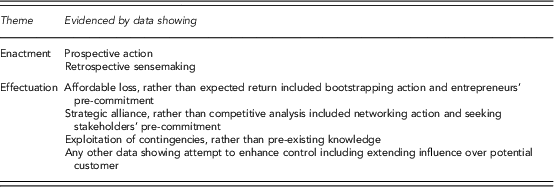
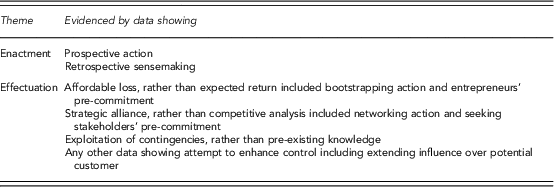
From the theoretical discussion, effectuation encompasses action within affordable loss, rather than action based on expected return; strategic alliance actions, rather than action driven by competitive analysis; exploitation of contingencies at the client’s end, rather than pre-existing knowledge of the client’s business requirements. It also encompasses entrepreneurial action in terms of networking, pre-commitment, bootstrapping, i.e., any action showing attempt to enhance control rather than to predict accurately. Each entrepreneur’s verbal protocol transcription was examined for the enactment and effectuation themes by coding the data on the following sub-themes.
Summary of themes and sub-themes
Three case illustrations
Data on three illustrative cases discussed in this section are drawn from in-depth, semi-structured interviews. The entrepreneurs E-A, E-B and E-C operated in the dynamic technology markets, which most closely resemble opportunity creation rather than opportunity discovery modes of start-up action. The entrepreneurs discussed details of their actions regarding a specific market opportunity initiative at start-up stage: Entrepreneur E-A in starting-up a data warehousing business, E-B in high speed marine internet and E-C in full-service web hosting. The entrepreneurs selected managed firms located in New Zealand that had less than 25 employees when met, and were all less than 10 years old and served different markets in the technology space. The entrepreneurs were also suitable to study the start-up processes illustrated through different outcome possibilities: one start-up initiative created a successful outcome shaping an opportunity, another failed to do so and the third failed initially but later succeeded.
Qualitative data collection
Given the nature of the data required to examine the propositions, a qualitative research method was adopted. A semi-structured, in-depth interview technique was selected in order to elicit rich data from the entrepreneurs who were the most relevant/expert informants for the propositions examined. Data on micro-level processes in start-up action were obtained through in-depth interviews and thick description (Geertz, Reference Geertz1973; Weick, Reference Weick2007). The in-depth interviews with the entrepreneurs offered insights into the action processes. For instance, one entrepreneur E-C first described as having ‘a “horses for courses” strategy’ and ‘an opportunistic perspective’ to target his initiative. However, later in the discussions he detailed how his initial upfront investment in infrastructure was made without enough information of several regulatory aspects of the Australian telecommunication market – in effect he did not know enough about the ‘course’ during start-up. Owing to the richness of the verbal data that the in-depth semi-structured interview method made possible, a high level of accuracy was attained by coding and analysis of the qualitative protocol, and nuances of entrepreneurial action. In-depth follow-up discussions lent what Lincoln and Guba (Reference Lincoln and Guba1985) call truth value to the qualitative data accessed. Words may be more ‘unwieldy than numbers but they also enable “thick description”’ (Miles & Huberman, Reference Miles and Huberman1984: 54), and as illustrated above, the words from the case entrepreneur’s thick description pointed to reliable conclusions. This was particularly critical in getting entrepreneurs to discuss their failed initiatives, something they were initially reluctant to do.
The entrepreneur was chosen as the unit of analysis and the informant, as it is the entrepreneur that takes action decisions in a small entrepreneurial firm (Scott & Rosa, Reference Scott and Rosa1997) and gives direction to it. Triangulation through interviews with people other than the entrepreneur in a firm was found to be unrewarding and potentially misleading for the kind of data that was being sought. The entrepreneurs’ accounts had much more relevance to the hypotheses being examined, were better in terms of information and were richer by far in terms of the firms’ ‘life history’ (Crotty, Reference Crotty1998: 5) that was important for start-up data in the study.
While the verbal protocol through in-depth semi-structured interviews with entrepreneurs detailing the steps involved at start-up was supplemented by published information on the entrepreneurial firms, the most important data for this study were derived from the in-depth interviews of the entrepreneurs. The data recording and interpretation was checked back with the interviewees much in the nature of ‘member checks’ (Lincoln & Guba, Reference Lincoln and Guba1985: 314–316), adding to the credibility of the data. This process helps to make the empirical project/fieldwork more democratic and inclusive by inviting an opportunity to informants to (a) give their ‘voice’ at different stages of the empirical project and (b) have the opportunity to critique the researchers’ interpretation and thematic analysis of the interview material (cf. Reinharz, Reference Reinharz1992).
Each of the three entrepreneurs was interviewed twice on the firm premises. Each interview lasted between an hour and an hour and a half without a strict standard duration, thus keeping true to a naturalistic inquiry mode, and adjusted to allow for a gradual drawing out of the entrepreneur when required and also to allow for a multitude of factors to be touched upon in the start-up stories for the richness in data. The second interviews were about more specific situations of entrepreneurial action protocol. These were particularly useful in discussing failure situations. All interviews were recorded, transcribed and reduced by coding them into the identifying themes.
Findings
This section is divided into reporting findings on enactment and on effectuation in the entrepreneurial action. As derived in the theme development discussion above, the first theme of enactment was subdivided to identify prospective action and retrospective sensemaking statements from the verbal protocol. The effectuation theme was identified by occurrence of the various sub-themes mentioned in Table 2, i.e., statements denoting setting affordable loss limits, strategic alliance attempts, networking and contingency exploitation at prospective clients’ end, or any statements indicating attempt to enhance control by the entrepreneur.
Enactment in entrepreneurial action
The data here were grouped into those that showed prospective action and those that showed retrospective sensemaking sub-themes.
Enactment as prospective action and retrospective sensemaking
Taking prospective action: Starting-up
E-A did not undertake any assessment of market or business possibility beyond the ‘2 or 3 months’ work’ he initially had when he left his salaried job with an American company in New Zealand to start up a new business. E-A’s explanation as to why they did not analyse the market further or seek more information was that: ‘You never have enough information’. In fact, he said seeking that was ‘a waste of time’ and that ‘leaving your job, leaving (employers’ name) at that time, starting up your own company – you’ve just got to do it’. E-A thus showed prospective action. So did the other entrepreneurs. E-B set-up business while the product was only at idea stage – of putting together different strands of technology in an unpatented agglomeration – and just went to market. Recounting the start-up speed, E-B said: ‘… one day we are sitting here next day we are on a plane … take a couple of boxes and let’s go … happened that quick’. Time to market in prospective action is evident in E-A’s and E-B’s comments.
Entrepreneur E-C also went to market with upfront investment with great speed and, what turned out later, with a lack of information and an understanding that came post facto with the experience: ‘During the early start-up days I tried to have a go at starting up a business in Sydney. Couldn’t get the cost structures right’. He went on to describe the reason as ‘And the regulation requirements for Australia were too difficult’. That led him to withdraw: ‘I abandoned ship basically. It was just too hard’. All three entrepreneurs showed high levels of prospective start-up action and, as we shall see below, of retrospective sensemaking.
Making retrospective sense: Of ‘starting-up’ with insufficient information
When E-A left his job to start up the software business with 2–3 months’ work, he did not plan for any further market assurances of income or indeed estimation of market potential. This, he explains, would have been ‘a waste’, and that it can provide you with ‘an excuse’ not to act. Further, he said, ‘at some point you have got to commit’. Talking specifically about risks of his prospective start-up decision, E-A made sense as: ‘if we failed, we could get a real job’, ‘you’ve just got to do it’, and so forth. E-B makes retrospective sense of the prospective start-up action as the team being ‘… a bunch of very young guys … bullet proof … we were naive … didn’t have any business sense’ and thus exposed themselves too early. E-C’s retrospective sensemaking about the start-up initiative made with too little information or understanding was that it was more of an ‘entrepreneurial throwing of dice’. Although this sensemaking often appeared like a justification of the prospective action, in his subsequent effort he changes his approach to ratchet up his control of the initiative, as we will see below.
Taking prospective action: Approaching potential customer
E-A again showed prospective action when he took the idea of his product to users of similar products in New Zealand and abroad. He approached a sizeable American company that was a user with a ‘half product, half idea’. This had the effect of capping losses on product development while ensuring market acceptance in advance – a typical path of the under-resourced small technology firm and was also effectual, as we shall see later. However, it started with prospective action with the attendant risk of potentially losing a first major future client.
E-B went into international markets immediately at start-up. Having bid on a tender, E-B and his team responded enthusiastically supplying a lot of details very quickly to a large potential client on the supply tender as his first major start-up initiative. Being pro-active led to a high level of enactment. E-B later lamented offering too much information too early to the potential client: ‘… just spilled the beans (to anyone from the customer’s end, even a consultant) all over the place. Next thing you know is that some guy is saying, gee we could do it ourselves’. E-B approached the potential customer too early with too much information on an unpatented product, responding to a tender, an avenue that typically offers little control, as we will see below.
E-C went into the Australian web hosting and internet services market and set up infrastructure first (‘I tried to have a go at … Sydney’). He approached retail market customers before learning of the telecom service providers’ cost structures and regulatory difficulties involved. We will see later that although this entrepreneur failed to convert his high enactment start-up initiative into a favourable opportunity outcome, he succeeded in entering the same market later with an enacted strategy, backed by higher effectual control action.
Making retrospective sense: Of approaching potential customers or market ‘too early’
E-A, speaking about finding out the kind of customers for their products, said: ‘We are only just figuring it out (the customer profile and the price-points)’. Sometimes, E-A and his team were also acting against a logic that was later made sense of: ‘Without admitting it, we were going after large companies (that they later found took too long to make decisions and where they also had less access to decision makers)’. E-B made retrospective sense of the initiative failure of rushing in with too much too quickly: ‘if we had not rushed into it …’, saying ‘we were naive … didn’t have any business sense’. He put it down to the inexperience of a young technical team. He envisaged his product ‘was ahead of its time’ for the commercial shipping sector and that ‘about five years down the road, things will change when the older people (i.e., captains of ships in marine client companies) move on … when the younger people come up’. E-C retrospectively explained his first entry into Australia as involving too much fixed cost incurred upfront and not doing it gradually, i.e., not effectuating the foreign market entry, as we will see below. He took the Australian initiative with insufficient understanding of ‘the regulation requirements’ that turned out ‘too difficult’ and he ‘abandoned ship basically’. E-C thought retrospectively that it was a gamble taken and now called it ‘a good learning experience’. We see that here too, as in the cases where things turn out to be advantageous, the entrepreneur makes retrospective sense of enacted prospective action.
The above data show strong prospective action through entrepreneurs’ start-up decisions, through early market action to explore a potential client before a product was market ready (‘half product, half idea’), through volunteering too much information (‘gave away too much’) or through making investments without sufficient understanding of a favourable impact on the business (‘throwing of dice’). The data also showed retrospective sensemaking instances to ‘explain’, or understand after the fact, the seemingly non-rational prospective action steps taken. This second aspect of enactment, i.e., retrospective sensemaking, emerges as a fairly complex phenomenon. Although the entrepreneurs, through retrospective sensemaking, often justified their prospective action in that such action was needed when they took it, they also seemed to show a desire to want to control the consequences of such action in future when they failed, as E-C did. This control aspect in their action is reflected in the data on effectuation, the second aspect in entrepreneurial opportunity action.
Effectuation in entrepreneurial action
This section presents the data on effectuation as coded for each entrepreneur rather than thematically, as that was found to be more cohesive and kept their narrative thread more accessible for the effectuation sub-themes to be identified.
Entrepreneur E-A
The fact that E-A had no product but only an idea (the product ‘wasn’t there, it didn’t work, it was a half product, half idea …’) meant that he could not have estimated the possible returns from the initial potential client, let alone from the market. The non-predictive logic of effectuation is seen as E-A ‘decided to do a bit of a check to see whether or not it was viable software to sell’ the product that was still not a proper prototype. The control over potential losses was attempted by approaching a specific potential user for feedback during product development, well before finalising the product. Control over the potential for gain was attempted by building a strategic alliance through product development feedback cycles with the possible client, rather than by estimating demand by market analysis. E-A worked with the potential client company’s feedback for a year to build the first product. Here the entrepreneur was also gathering the potential clients’ pre-commitment to add to his own to reduce or control potential loss as well as enhance potential gain.
There was no crisis or contingency to exploit at the potential clients’ end, but they did have a situation where they could anticipate problems with their large customer base if processes were not made more efficient. E-A used this situation to elicit feedback for over a year to develop the product. The entrepreneur did, however, take a sizeable risk in terms of losing the first major client (‘you ran a large chance of it not working because it wasn’t a proper product’) and may well have lost this prospect (‘They were interested, yeah, but they were hardly on tenterhooks waiting for our call. So we had to get back on their important list again. We hoped we wouldn’t lose them’). Other aspects of effectuation were also visible in E-A’s action. The entrepreneur’s effort all along was to network for market access: ‘The best way to do it, i.e., get a “lighthouse customer”, is networking’. In terms of funding the start-up, E-A always bootstrapped to self-fund the operations: ‘We funded ourselves in the beginning, in fact we still fund ourselves’; their on-site consulting work helped fund product development. They did not want to bring in venture capital funding to ‘buy customers’ too early because they wanted to build a price line along with a quality image (‘we are bootstrapping’).
E-A prospectively approached users or potential clients (in this case, a major corporation) without the product was enactment action. On the other hand, actions of keeping the same prospective client interested in a relationship while bootstrapping to keep potential loss – even on product development costs – within affordable limits, were all effectual action. E-A’s desire to control the situation is embodied in his remark ‘We will fail fast or make it work’.
Entrepreneur E-B
E-B’s protocol also showed considerable enactment mentioned above as he pursued an offshore initiative. However, the lack of effectual control action was evident as E-B’s technical team gave away control to the potential client by being too quick to disclose the critical technical details in a tender. This emphasises a case of high enactment and low effectuation on the part of the entrepreneur. E-B lacked the effectual control of the potential customer environment as is expected in a tendering situation. Evidently, he also lacked control of the means. E-B and his team ‘were not geared up’ to deal with the surge of enquiry from the market. He elaborated that they were lacking in business savvy and did not keep control of their resources or expertise, i.e., their means, which could have enhanced their effectual action. This is an example of failing to control enactment, to ‘build on it gradually’ and ‘not rush into it’ as E-B later put it, allowing a potential opportunity to spiral away owing to a lack of control. The intellectual property of an unpatented product being exposed in part led to the loss of control, and E-B thought they should have ‘re-engineered and developed our own patentable technology’. Here, control over the basic product, i.e., the means, was lost. In a tendering situation, that forestalled alliance building or client contingency exploitation possibilities and, to that extent, possibilities of high effectual control. This is a case of weak effectuation but high enactment that failed to form a favourable outcome.
Entrepreneur E-C
E-C’s is an interesting story of an initial failure, which he later pursued successfully. His first foray into the Australian market failed, as mentioned. His account of how he did it differently second time around was full of action in effectuation. His first attempt (breaking the Australia internet services market) failed because he made considerable infrastructure investment upfront and too early, but the start-up ‘couldn’t afford the cash flow burden’ only to find out more about the difficult regulatory aspects that hampered market entry. The second time around, 5 years later, he used his existing infrastructure in New Zealand to gradually test the market in Australia. He did not do a market estimate as he did not conceive of such estimates having any real utility in practice (‘It’s all rubbish …’) or a competitive analysis (‘No. You don’t have the cash flow’). Instead, it was done ‘customer by customer and build organically’, an effectual approach. This leads to controllable costs: ‘you grow when your cash flow (grows) … meet costs off that … so you reach your break-even point very quickly using that model. For a small business that is the only way you do it’. E-C’s statement confirms his effectual action in the second attempt at a new market raising his belief in effectuation: ‘Yeah … that’s what you do – you just basically start off with one person … for development … and off you go’, very much an effectual building of the market.
In his second attempt, he bootstrapped and put in the infrastructure in the Australian market after having got the initial cash flow going. His pre-commitment came from the existing New Zealand market infrastructure (servers, call centres and personnel) that can be used with modifications like ‘skinning’ the product to look like a local Australian service over the internet. The entrepreneur was ensuring that the initiative does not over-precommit beyond what he can effectually control and before he gets to know ‘how the market works organically’. He seemed to focus more on control of the pre-commitment, as other effectuation avenues of strategic alliance and exploitation of contingencies are much less available in the retail individual customer market he targets. This entrepreneur first failed while enacting to over-commit in advance, and seemed to gradually pull off the subsequent initiative in the same market with a more effectual approach, balancing prospective action with effectual control.
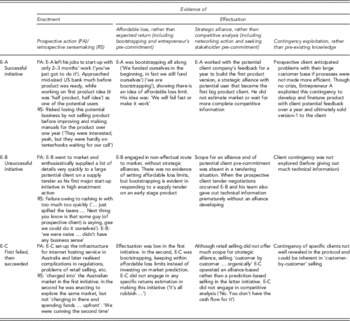
The verbal protocol of the entrepreneurs illustrates the micro-processes of enactment and effectuation in their start-up actions under uncertainty, and shows both prospective leap and control actions. However, diverse outcomes are associated with the differing extents of enactment and effectuation in the process. In the above cases, one entrepreneur’s actions led to a successful outcome, another failed to form an opportunity and a third failed at first but succeeded subsequently. The first showed high enactment and high effectuation, the second showed high enactment but low effectuation in his actions and the third was successful in creating a favourable outcome when his levels of effectuation control increased. Table 3 shows the enactment and effectuation action themes from the verbal protocol of the three entrepreneurs’ early market initiatives.
Enactment and effectuation highlighted in illustrated entrepreneurial initiatives

Discussion: Simultaneous Resource-Dependent and Resource-Independent Entrepreneurial Action
The illustrative study showed that under uncertainty, entrepreneurial actions have a non-causation basis. Entrepreneurs need to enact prospectively and with incomplete information in the race to market. The entrepreneurs also needed to control exposure to potential loss to keep it within affordable levels by effectual action. This dual action, i.e., prospective enactment and effectual control are necessarily simultaneous actions and are observable in the same entrepreneurial initiative as the case entrepreneurs’ protocols illustrate. Prospective enactment and effectual control are practically inseparable, but analytically distinct aspects of the entrepreneurial opportunity formation start-up action, witnessed in entrepreneurial action protocols.
The entrepreneur may or may not be able to manage the enactment–effectuation dance, i.e., prospectively enact as well as effectuate control to shape a favourable outcome owing either to lacking resources himself/herself or from stakeholder buy-ins, or again owing to lacking a tolerance of ambiguity to take the first prospective steps in the opportunity action. A low enactment initiative where the entrepreneur does not take action sufficiently in advance of other potential actors would hardly get off the ground and is a trivial case in the enactment–effectuation interplay. Entrepreneurial initiatives illustrated above were accompanied by high enactment signifying the importance of prospective action in the entrepreneurial opportunity-seeking action process. Prospective enactment may thus be considered a necessary condition for entrepreneurial opportunity formation. Without accompanying effectuation, however, the enacted openings may spiral out of control as in the case of E-C’s initial foray and of E-B’s limited scope to influence his environment through effectual control action. Effectual action along with prospective enactment may be sufficient to shape a favourable outcome.
The theoretical contribution of this descriptive paper lies in its proposition that underscore the need to integrate a process explanation of effectual control action with prospective enactment leap action from the sensemaking logic. Although effectuation and enactment are both non-causal concepts and have overlapping characteristics, the major difference highlighted here is that effectuation is based on the logic of control and is necessarily resource dependent or resource driven as it builds on the given set of means, and enactment is based on prospective action that is essentially resource independent. It is proposed that Weickian enactment before sensemaking specifically explains the leap aspect in entrepreneurial action pursuing opportunity, whereas effectuation that has control of given means as its central tenet explains the iterative progress of the entrepreneur’s actions gradually pushing towards a specific emergent opportunity.
Limitations
The small number of respondents in the study may be a limitation. However, the study is exploratory in nature with the three cases as illustrations. The study explores the analytical distinction of the leap and control actions the entrepreneur takes that are inseparable in practice. The detailed qualitative exploration of a few entrepreneurs’ action protocols gives a theoretical insight into the subtle differences between the two intertwined aspects of entrepreneurial action. Recall bias may also be working against reliability. However, given that two entrepreneurs described details of two of the four initiatives as failures, it is felt that the reliability or ‘truth value’ (Lincoln & Guba, Reference Lincoln and Guba1985) of the qualitative data was preserved.
Conclusions and Future Research
The proposition that successful entrepreneurial action micro-processes need both Weickian enactment and Sarasvathian effectuation to work in a complementary and simultaneous fashion is illustrated here through entrepreneurial action protocol. This view reduces the conflation brought about by the hitherto loose usage of the term enactment that has been differentiated here from effectuation. It provides a more comprehensive understanding of the practically intertwined but analytically distinct leap and control aspects in entrepreneurial action. It explains in micro-foundation action detail what Mintzberg and Waters (Reference Mintzberg and Waters1982) call ‘controlled boldness’. It also proposes that the chances of the enactment–effectuation dance shaping a successful entrepreneurial opportunity depends on both enactment and effectuation in the entrepreneurial action process, as with the case entrepreneurs illustrated. In unpacking the entrepreneurial start-up action as a co-occurrence of prospective leap and effectual control, the paper furthers the understanding of start-up action that has preoccupied entrepreneurship scholars. It may also have implications for venture capitalists as well as policy makers to facilitate new venture creation, where it may be more meaningful to follow closely the process of opportunity formation and venture creation over the start-up period and allow a favourable outcome possibility to emerge rather than a watertight business plan. Future research on the antecedents and outcomes of such co-occurrence would enhance clarity of the opportunity formation action of the entrepreneur, the central dynamic in entrepreneurship theory. The possibility of a deliberate enactment–effectuation strategy for start-up entrepreneurs also opens exciting avenues to enhance effectiveness of entrepreneurship education.
Acknowledgement
The author grateful to the editor and anonymous reviewers for thier helpful comments.
Appendix
Sarasvathy’s model of effectuation Source: Sarasvathy and Dew (Reference Sarasvathy and Dew2005: 391).