Introduction
With the inclusion of compulsive sexual behavior disorder (CSBD) in the upcoming International Classification for Diseases, 11th revision (ICD-11),1 there is an increasing public and professional interest in whether pornography use can have detrimental effects on its consumers. Although commonly cited CSBD estimates fall between 3% and 6%,Reference Derbyshire and Grant2, Reference Kraus, Voon and Potenza3 rates as they specifically apply for problematic pornography use (PPU) are poorly established. Nevertheless, high-speed internet pornography (HSIP) may be a prime conduit for the development of PPU given its affordability, anonymity, and unvetted access to sexual novelty.Reference Cooper4, Reference Love, Laier, Brand, Hatch and Hajela5 Therefore, it is likely that the prevalence of PPU has risen in recent years.
Many competing conceptualizations have been applied to porn-related CSBD, including models of behavioral addiction, hypersexuality, and sexual impulsivity or compulsivity.Reference Wéry and Billieux6, Reference Fernandez and Griffiths7 With the most appropriate theoretical perspective remaining elusive, the term PPU has been increasingly adopted to describe persistent difficulties reducing or controlling porn consumption despite negative consequences regarding personal, relational, social and/or occupational functioning.Reference Kor, Zilcha-Mano, Fogel, Mikulincer, Reid and Potenza8, Reference Stark, Klucken, Potenza, Brand and Strahler9 For example, pornography use has been linked with lower self-esteemReference Kor, Zilcha-Mano, Fogel, Mikulincer, Reid and Potenza8, Reference Leppink, Chamberlain, Redden and Grant10 and elevated levels of anxiety and depression,Reference Voon, Mole and Banca11 although it is unclear as to whether these effects are attributable to underlying or pre-existing issues, or whether PPU itself constitutes a primary pathology.Reference Leppink, Chamberlain, Redden and Grant10 Pornography consumption has also been linked with reduced enjoyment of romantic encountersReference Sun, Bridges, Johnson and Ezzell12 and reduced relationship satisfaction or stability over time,Reference Muusses, Kerkhof and Finkenauer13, Reference Perry and Davis14 perhaps by suppressing intimacy.Reference Štulhofer, Buško and Landripet15, Reference Weinstein, Zolek, Babkin, Cohen and Lejoyeux16
Intriguingly, members of online recovery forums often report a range of other adverse effects as consequences of PPU. These have previously been summarized into three domains: sexual functioning deficits with partners but not with pornography (termed porn-induced erectile dysfunction [PIED]), acute cognitive and affective deficits following masturbation to pornography (somewhat akin to a substance-induced “hang over”), as well as tolerance and escalation (which are well known markers of addiction) as reflected by consuming greater amounts of pornography and/or more intense sexual genres over time.Reference Cavaglion17–19 Although empirical assessment is generally lacking for the aforementioned symptom clusters, suggestions have emerged that porn-related tolerance and escalation may precipitate partnered sexual dysfunction and acute cognitive-affective issues following pornography use.Reference Cavaglion17, Reference Wilson18, Reference Kalman20 As such, these effects will be collectively referred to herein as “addiction-like” symptoms.
Although in its infancy, a growing empirical base supports the legitimacy of PIED, such as studies on clinical samplesReference Voon, Mole and Banca11 and treatment seekers.Reference Kalman20–24 Meanwhile, pornography use among students was found to inversely correlate with sexual desire,Reference Pizzol, Bertoldo and Foresta25 while a study on sexual functioning among healthy males (N = 25, mean age 29 years) found that almost half of the participants demonstrated no erectile response to conventional sexual genres even though such issues were overcome with self-selection of niche or more intense content.Reference Janssen and Bancroft26 It is possible, though, that PIED only emerges with increased pornography use, such as among clinical samplesReference Voon, Mole and Banca11, Reference Kalman20–24 and not in milder cases.Reference Grubbs and Gola27, Reference Landripet and Štulhofer28
PPU forum members also report a range of immediate nonsexual symptoms resulting from their porn use, including concentration difficulties, unexplained lethargy, social anxiety and depressive symptoms,Reference Cavaglion17, Reference Wilson18, Reference Wilson29 collectively referred to herein as “cognitive-affective symptoms.” Although CSBD is frequently associated with comorbid psychopathology such as depressive and anxiety disorders/symptoms,Reference Scanavino, Ventuneac and Abdo30, Reference Raymond, Coleman and Miner31 such presentations are not generally considered immediate consequences of sexual behavior itself, particularly in the hours post-orgasm, and the underlying mechanisms for the aforementioned cognitive-affective symptoms are currently unclear. Of note, it has been suggested that both cognitive-affective and sexual performance deficits arise with escalating use, and also dissipate with prolonged abstinence from internet pornography but not necessarily masturbation itself.Reference Wilson18, Reference Bronner and Ben‐Zion21, Reference Porto24
It is nevertheless unclear whether escalation and tolerance are necessarily pathological processes related to addiction, as many non-PPU individuals progress naturally to greater amounts and/or more intense pornographic genres over time.Reference Bőthe, Tóth-Király, Zsila, Griffiths, Demetrovics and Orosz32, Reference Wéry and Billieux33 Frequent use of pornography or progressing to new genres may simply reflect a strong libido or a healthy exploration of sexuality,Reference Ley, Prause and Finn34 while the relevance of tolerance and escalation in behavioral addictions has been refuted given the absence of an exogenous substance.Reference Kardefelt‐Winther, Heeren and Schimmenti35 Ultimately, tolerance and escalation have only been incorporated into the PPU literature in recent years, meaning more work is required to link such behavioral changes with problematic outcomes.Reference Fernandez and Griffiths7
A range of confounds have been discussed in the extant literature, such as moral and religious disapproval of pornography, comorbid psychopathology, and the individual’s history of sexual behaviors, all of which may influence self-reported PPU. For instance, despite contradictory findings,Reference Reid, Carpenter and Hook36, Reference Gola, Lewczuk and Skorko37 conservative or religious sentiments often condemn extramarital sexual activity, leading to a disapproval of pornography use, internal conflict, and distress, which may be misinterpreted as addiction.Reference Wilt, Cooper, Grubbs, Exline and Pargament38, Reference Grubbs, Exline, Pargament, Hook and Carlisle39 Similarly, psychological distress (e.g., heightened depressive or anxiety symptoms) may impair behavioral control as the user turns to pornography to self-medicate their mood, potentially as a substitute for real partners.Reference Bőthe, Tóth-Király, Zsila, Griffiths, Demetrovics and Orosz32, Reference Griffiths40, Reference Gola, Wordecha and Sescousse41 Although recent work refutes the substantial role of self-reported impulsivity and compulsivity in PPU,Reference Gola, Wordecha and Sescousse41, Reference Bőthe, Tóth-Király, Potenza, Griffiths, Orosz and Demetrovics42 impulsive individuals with high reward sensitivity may nevertheless also be drawn to internet pornography for its rewarding effects,Reference Laier, Pekal and Brand43 while compulsive tendencies may promote pornography use as a means to reduce negative affect.Reference Voon, Mole and Banca11, Reference Kafka44 Additionally, attention-deficit/hyperactivity disorder (ADHD) may be comorbid with CSBD in 20% or more of cases.Reference Kafka and Hennen45–47
Given the addiction-like symptoms and various potential confounds described above, the current study sought to assess whether PPU is characterized by a range of symptoms that currently lack empirical assessment. Based on the literature reviewed above, we hypothesized that PPU severity would be uniquely and positively associated with sexual dysfunction with partners (but not with pornography), heightened cognitive-affective symptoms following orgasm to pornography, and escalating patterns of use, after controlling for key confounds (i.e., psychopathology, moral and religious disapproval, and natural history elements).
Methods
Participants
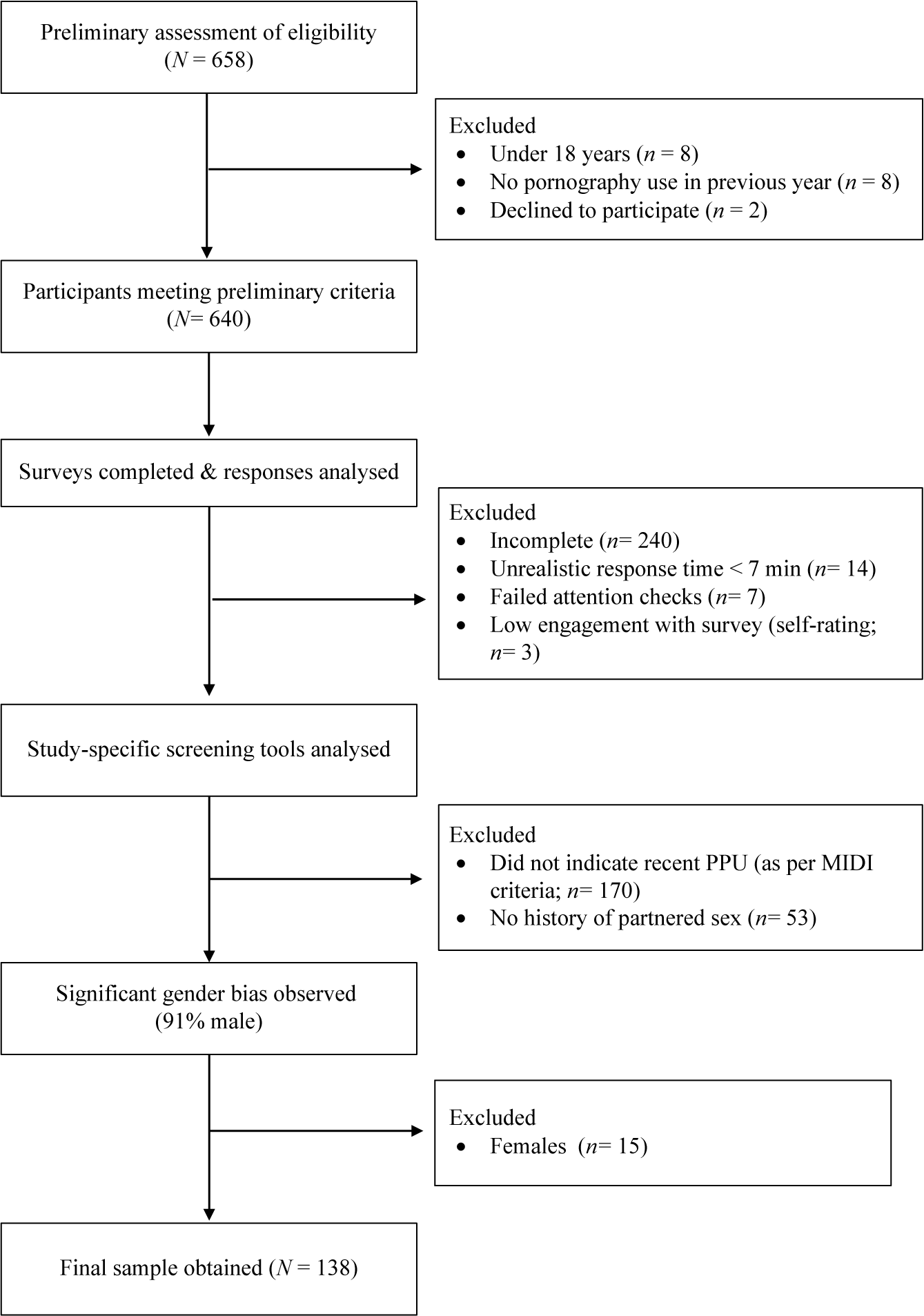
Participants were recruited online through pornography addiction recovery communities and Amazon Mechanical Turk (MTurk). Eligibility criteria were being ≥18 years of age and having used internet pornography within the previous 12 months, while MTurk users were required to have a 95% approval rating from ≥100 surveys.Reference Peer, Vosgerau and Acquisti48 MTurk participants were reimbursed 4USD for their participation. Details of the recruitment and screening process are provided in Figure 1.
Participant recruitment and screening process.

Participants were screened for PPU using the Compulsive Sexual Behavior module of the Minnesota Impulsive Disorders Interview (MIDI).Reference Odlaug and Grant49 The module largely aligns with the existing description of CSBD in ICD-11,Reference Kraus, Krueger and Briken50 has strong psychometric properties,Reference Chamberlain and Grant51 good diagnostic sensitivity and specificity among clinical populationsReference Grant, Levine, Kim and Potenza52 and has been used to screen for CSB elsewhere in the literature.Reference Leppink, Chamberlain, Redden and Grant10, Reference Odlaug, Lust and Schreiber53, Reference Derbyshire and Grant54 Two modifications were made to the module: first, words such as “sexual” were replaced with “pornography” as to enhance specificity toward PPU. Second, scoring was also modified to allow distinctions between current and past indications of PPU given that the trajectory of PPU is likely to be complex.Reference Graham, Young, Valach and Alan Wood55, Reference Kraus and Sweeney56 Although the MIDI has been used to assess presence or absence of symptoms (with ≥1 symptoms indicative of CSBD),Reference Leppink, Chamberlain, Redden and Grant10 response options were modified to 1 (“Yes, within the previous two weeks”), 2 (“Yes, but not within the past two weeks”), or 3 (“No”). Participants scoring 1 on any item were therefore considered as current PPUs and retained for analysis.
Given that sexual functioning with partners as well as pornography were key elements of our predictions, only individuals with a history of partnered sex were retained for analysis. Finally, a significant gender bias was observed among eligible respondents (91% male), leading to exclusion of female respondents for the final analysis. After the above screening processes, the final participant pool was N = 138 males (mean age = 31.75 years, standard deviation [SD] = 10.72, range = 18-76).
Measures
Participants provided sociodemographic information (including age, relationship, employment status, education, and sexual orientation) and completed a range of surveys (see Supplementary Material S1 for more information, including example items and scoring as well as attention checks included in the survey).
While PPU severity was measured with the Problematic Pornography Use Scale,Reference Kor, Zilcha-Mano, Fogel, Mikulincer, Reid and Potenza8 two versions of the Arizona Sexual Experiences Scale (ASEX)Reference McGahuey, Gelenberg and Laukes57 were administered to measure PIED: one pertaining to partnered sex (ASEXpartner) and the other regarding pornography use (ASEXporn).Reference Voon, Mole and Banca11 The reference period for the original ASEX (7 days) was modified such that participants who had not engaged in the associated sexual activity (partnered sex or pornography use) within the past week were to indicate their typical sexual functioning. Cognitive-affective issues were measured with two inventories: the Brunel Mood Scale (BRUMS),Reference Terry, Lane and Fogarty58 which is a shortened version of the Profile of Mood States,Reference McNair, Lorr and Droppleman59, Reference McNair, Lorr and Droppelman60 and the Social Interaction Anxiety Scale-6 (SIAS-6).Reference Peters, Sunderland, Andrews, Rapee and Mattick61 For these measures, participants rated each item with respect to how they typically feel in the hours following orgasm to pornography, scored as 1 (Strong decrease) to 5 (Strong increase). Tolerance and escalation regarding pornography use was measured with the Tolerance subscale from the Problematic Pornography Consumption Scale.Reference Bőthe, Tóth-Király, Zsila, Griffiths, Demetrovics and Orosz32
Psychological distress was measured with the Depression, Anxiety, and Stress Scales,Reference Lovibond and Lovibond62 impulsivity was assessed with the short version of the UPPS-P Impulsive Behavior Scale,Reference Cyders, Littlefield, Coffey and Karyadi63, Reference Lynam64 trait compulsivity was measured using the Cambridge–Chicago Compulsivity Trait Scale,Reference Chamberlain and Grant65 and ADHD was assessed with The World Health Organization Adult ADHD Self-Report Scale.Reference Kessler, Adler and Ames66 Participants also indicated if they had previously received an ADHD diagnosis from a trained mental health professional and the degree to which they experienced depression prior to problems with pornography (premorbid depression).
Four items assessed moral and religious disapproval of pornography (two items each), as per Grubbs et al.Reference Grubbs, Exline, Pargament, Hook and Carlisle39, Reference Grubbs, Wilt, Exline, Pargament and Kraus67 Participants also indicated their current quantity of pornography use in hours per week, the age at which they began using pornography regularly, their frequency of masturbation without pornography (1 = never, 8 = daily or almost daily), and whether they had experienced any sexually intimate relations with a partner (e.g., intercourse or oral sex; dichotomous “yes” or “no”).
Procedure
Advertisements were placed on online porn addiction recovery forums and MTurk between August and October 2019. The survey described under “Measures” was accessed via the Qualtrics survey platform.68 Prior to beginning the survey, participants were instructed to consider pornography as “material that creates or elicits sexual feelings or thoughts, which generally contains explicit exposure or descriptions of sexual acts involving the genitals, such as vaginal or anal intercourse, oral sex, or masturbation”.Reference Reid, Li, Gilliland, Stein and Fong69 All items were forced response such that no missing data was observed. Statistical analysis was conducted using Statistical Package for the Statistical Sciences (SPSS) version 25.0.
Statistical analysis
Multiple linear regression was conducted to identify the significant predictors of PPU severity, with the PPUS used as the dependent variable. Independent variables were those demonstrating a significant zero-order correlation with PPUS scores (see Supplementary Material Table S1). The required sample size to yield a medium effect size (f 2 = 0.15; α = 0.05, power of 0.80) using 14 variables was found to be N = 135. Power analysis was conducted using the program G*Power version 3.1. All statistical assumptions relating to multiple linear regression were met. Effect sizes for multiple regression were calculated using Cohen’s f2 values.Reference Cohen70
Ethics
Ethics approval was provided by the Monash University Human Research Ethics Committee (#19285) and the authors assert that all procedures contributing to this work comply with the ethical standards of the relevant national and institutional committees on human experimentation and with the Helsinki Declaration of 1975, as revised in 2008. All participants were briefed about the study and provided informed consent.
Results
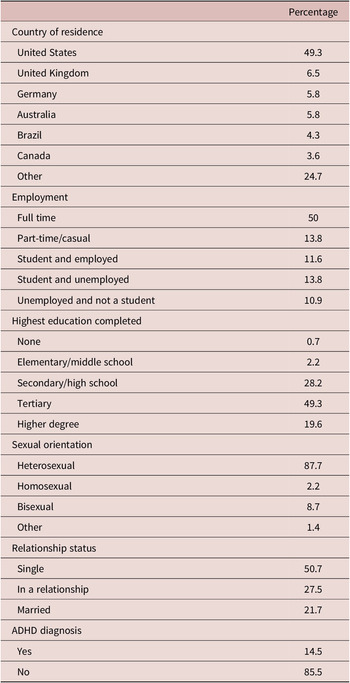
Participants were predominantly single, educated at secondary schooling or beyond, and a large majority were currently in the workforce and/or studying (see Table 1).
Participant Characteristics

Abbreviation: ADHD, attention-deficit/hyperactivity disorder.
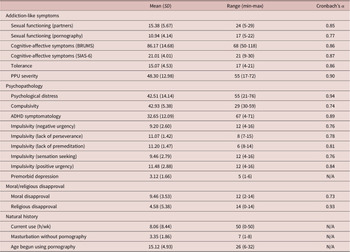
Descriptive statistics for the psychological measures are presented in Table 2 below. Sixty-six participants (48%) reported sexual dysfunction with partners as per the cut-offs presented by McGahuey et al,Reference McGahuey, Gelenberg and Laukes57 although only 13 participants (9%) met sexual dysfunction criteria for both pornography and partnered sex. Additional breakdown of ASEX scores are presented in Supplementary Material Table S2. Of the BRUMS subscales, “fatigue” and “depression” exhibited the highest average endorsement (M = 15.38, SD = 2.68, and M = 15.12, SD = 3.41, respectively), while anger and tension received the lowest average ratings (M = 13.32, SD = 3.47, and M = 13.51, SD = 3.31, respectively). Given the relatively similar distributions across the BRUMS subscales, only the BRUMS composite score was included in the regression model. Although less than 15% of participants had previously received a formal ADHD diagnosis, 38% of the sample met the ASRS cut-off score of ≥14 (six-item version).Reference Kessler, Adler and Ames66, Reference Daigre, Roncero and Rodríguez-Cintas71
Measurement Descriptive Statistics

Abbreviations: BRUMS, Brunel Mood Scale; SD, standard deviation; SIAS-6, Short version of the Social Interaction Anxiety Scale.
When participants were grouped by relationship status (single or in a relationship/married), few differences were observed for the above measures. Respondents who were single indicated greater psychological distress, partnered sexual dysfunction, cognitive-affective symptoms after pornography use, and were younger than those in a relationship (see Supplementary Material Table S3).
Multiple linear regression
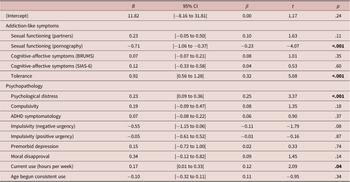
A significant regression equation predicted PPU severity (F(14,123) = 19.21, p < .001, R 2 = 0.69). As presented in Table 3, three variables significantly and positively predicted PPU severity: tolerance scores (medium effect size), psychological distress (small effect), and current use per week (small effect). Additionally, sexual dysfunction with pornography negatively predicted PPU severity (medium effect).
Multiple linear regression with PPU severity (PPUS) as the dependent variable

Abbreviations: BRUMS, Brunel Mood Scale; CI, confidence intervals; PPUS, Problematic Pornography Use Scale; SIAS-6, Short version of the Social Interaction Anxiety Scale.
Bold values indicate p < .05.
Discussion
The current work aimed to explore the clinical profile of PPU by assessing various symptoms that have gone largely unassessed to date. It was predicted that escalating use, sexual dysfunction with partners but not pornography, and heightened cognitive-affective complaints following pornography use would each be uniquely and positively associated with PPU severity after controlling for important confounds. The results partially supported these predictions.
Tolerance scores positively predicted PPU severity, corroborating previous demonstrations of porn-related tolerance and escalation among community samplesReference Bőthe, Tóth-Király, Zsila, Griffiths, Demetrovics and Orosz32, Reference Wéry and Billieux33 and clinical case studies,Reference Bronner and Ben‐Zion21–24 thereby aligning with substance addiction models.Reference Koob and Volkow19 In addition to patterns of escalation, current pornography use also predicted PPU severity, suggesting that protracted and recent consumption are important considerations for PPU.Reference Voon, Mole and Banca11, Reference Bőthe, Tóth-Király, Zsila, Griffiths, Demetrovics and Orosz32
We also found that sexual performance issues with pornography negatively predicted PPU severity, while sexual dysfunction with partners did not. Importantly, however, nearly half of the current sample indicated sexual dysfunction with partners while less than 10% met the same criteria for pornography use. On balance, this suggests that PPUs may respond increasingly robustly to pornographyReference Brand, Snagowski, Laier and Maderwald72 while sexual responsivity with partners diminishes, corroborating previous suggestions of PIED among clinical samplesReference Voon, Mole and Banca11 and PPU case studies.Reference Bronner and Ben‐Zion21–24 Although sexual dysfunction with partners did not statistically predict PPU severity, this may have occurred because the PPUS utilizes an addiction framework that does not directly relate to partnered sexual activity per se. Nevertheless, our results suggest that PIED may be elevated among PPU individuals and therefore warrants further exploration.Reference Hald73
A null result was also observed regarding cognitive-affective symptoms following pornography use, running counter to predictions. These symptoms have not previously been empirically assessed among PPU samples, making interpretations difficult; however, several explanations are plausible. For example, cognitive-affective complaints may not be primarily related to PPU itself and may be attributable to other factors such as comorbid psychopathology or moral or religious disapproval of pornography.Reference Ley, Prause and Finn34, Reference Grubbs, Exline, Pargament, Hook and Carlisle39 Alternatively, as with partnered sexual dysfunction, these effects may be distinct from the experience of addiction, meaning that other measures of PPU severity may yield different results.
Furthermore, significant variation in cognitive-affective symptom scores was observed, meaning that only a subset of PPUs may experience cognitive-affective symptoms severe enough to induce functional impairment, which potentially accounts for a lack of group-wide effect. Future work assessing the heterogeneity of cognitive-affective symptoms among PPUs (e.g., latent class analysis) may therefore be valuable. Comparison to a control group regarding post-orgasmic cognitive-affective symptoms might also inform whether these effects are elevated among PPU cohorts. Such elevations might represent hangover-like effects associated with PPU. Alternatively, these effects might arise as a function of quitting porn-assisted masturbation (which would be more indicative of addiction-like withdrawal).Reference Koob and Le Moal74 In either case, it is plausible that these effects contribute to pornography-related cravings as a means of self-medication.Reference Griffiths40 Future work assessing the time course of such cognitive-affective deficits, including their relationship with craving and withdrawal, will help to elucidate PPU’s most appropriate conceptual frameworkReference Bőthe, Tóth-Király, Zsila, Griffiths, Demetrovics and Orosz32, Reference Ballester-Arnal, Castro-Calvo, Giménez-García, Gil-Juliá and Gil-Llario75 and the degree to which PPU can represent a primary pathology.Reference Leppink, Chamberlain, Redden and Grant10
Our results also confirm the relevance of comorbid psychopathology toward PPU. The significant contribution of psychological distress supports previous evidence that depression and anxiety are related to PPU and pornography use in general.Reference Voon, Mole and Banca11, Reference Kühn and Gallinat76, Reference Levin, Lillis and Hayes77 More specifically, heightened distress over time is a likely consequence of self-reported PPU, as observed in other behavioral disorders.78-80 We also found that impulsivity and compulsivity scores did not significantly predict PPU severity, thereby aligning with previous publications.Reference Gola, Wordecha and Sescousse41, Reference Bőthe, Tóth-Király, Potenza, Griffiths, Orosz and Demetrovics42 Although such issues appear to play a role in broader constructs such as CSBD,Reference Leppink, Chamberlain, Redden and Grant10, Reference Miner, Raymond, Mueller, Lloyd and Lim81 their contributions specifically to PPU may in fact be less prominent compared to addiction-related processes such as tolerance and escalation.Reference Bőthe, Tóth-Király, Zsila, Griffiths, Demetrovics and Orosz32, Reference Gola, Wordecha and Sescousse41, Reference Bőthe, Tóth-Király, Potenza, Griffiths, Orosz and Demetrovics42
However, one domain of trait impulsivity (negative urgency) approached a statistical trend in the regression analysis. As such, this domain may have reached statistically significant with a larger sample size and associated statistical power. Although ADHD symptomatology did not statistically predict PPU severity, it is worth noting that close to 40% of the sample met the ASRS cut-off despite less than 15% having previously received a formal ADHD diagnosis. This potentially indicates that PPU and ADHD symptomatology may move together, which aligns with reports throughout PPU recovery forums of concentration deficits arising in parallel with escalating use.Reference Cavaglion17, Reference Wilson18 Alternatively, this may reflect a high rate of undiagnosed ADHD among individuals with PPU. Longitudinal work assessing the trajectory of ADHD symptomatology associated with PPU might therefore be informative.
Our results also refute the importance of religious and moral disapproval of pornography toward self-reported PPU, particularly among clinical samples. While such attitudes may contribute to the phenomenon in community samples,Reference Grubbs, Exline, Pargament, Hook and Carlisle39, Reference Grubbs, Kraus and Perry82 our results suggest that moral and religious disapproval of pornography may not be particularly pertinent for clinically-relevant populations.Reference Reid, Carpenter and Hook36, Reference Gola, Lewczuk and Skorko37
The present findings also support Reid’sReference Reid83 acknowledgement of the likely heterogeneity among hypersexual patients. While our results confirm the relevance of PIED in PPU, such issues are unlikely to apply for other cases of CSBD where the individual’s issues are not related to pornography use (e.g., paid escorts or extramarital affairs). This suggests that PPU, to some extent, may be a unique clinical disorder.Reference Duffy, Dawson and Das Nair84 Moreover, the variation of sexual dysfunction with intimate partners as well as pornography among the current sample was high, suggesting significant heterogeneity within the PPU sample itself,Reference Gola and Potenza85 thereby highlighting the need to investigate PPU’s aetiological underpinnings.Reference Gola and Potenza85, Reference Reid, Davtian, Lenartowicz, Torrevillas and Fong86
Strengths and Limitations
The current work is marked by several strengths and limitations. For one, our work had good theoretical specificity toward PPU as opposed to relying on broader frameworks such as CSBD. This was primarily achieved by recruiting attendees of PPU recovery forums and tailoring our screening tool specifically for pornography use. Another strength was that we operationalized various symptoms anecdotally observed among PPU recovery sites that so far lack empirical investigation; however, it is possible that the associated inventories did not adequately capture the experiences described online. As such, some cognitive-affective symptoms may have been inadequately described herein or even overlooked. Qualitative studies focussing on the subjective experience of PPU, including post-binge experiences, may offer more comprehensive insights that can inform future work.Reference Whitley and Crawford87, Reference Wordecha, Wilk, Kowalewska, Skorko, Łapiński and Gola88
Another limitation was that our list of covariates for PPU was not exhaustive. Future work should vie to include variables such as (but not limited to) shame regarding pornography use,Reference Sniewski and Farvid89 traumatic experiences,Reference Kor, Zilcha-Mano, Fogel, Mikulincer, Reid and Potenza8 suicidality,Reference Leppink, Chamberlain, Redden and Grant10 and other neurodevelopmental disorders that are frequently associated with ADHD (such as autism spectrum disorderReference Grant90). We also did not screen for comorbid addictive issues (i.e., other addictive behaviors or substance abuse), which have been shown to co-occur in parallel to CSBDReference Derbyshire and Grant2 and may therefore influence the clinical presentation of PPU. Although females were under-represented in our initial sample, replicating the current work with female populations is important.Reference Duffy, Dawson and Das Nair84
Fifty-four participants were excluded due to a lack of experience with partnered sex. It is possible that a reliance on pornography at the expense of partnered intimacy is itself indicative of PPU, meaning that valuable cases were potentially excluded from the analysis. Such reliance might also contribute to early onset PPU, even for individuals engaging in dyadic sexual activities, although longitudinal data is required to test this assertion. Indeed, the cross-sectional nature of this study is another important limitation as it prevents causal inferences. Longitudinal work is much needed across the CSBD domain, which is particularly important for understanding the course of PPU and its potential features such as PIED.Reference Grubbs and Gola27, Reference Piquet-Pessôa, Ferreira, Melca and Fontenelle91
Future Directions
As remarked by Gola and Potenza,Reference Gola and Potenza92 investigating brain responses during or immediately following sexual activity may also be valuable. Sexual activity elicits a significant neurochemical response at brain reward networks (such as the ventral striatum), particularly at the early stages of viewing preferred (relative to nonpreferred) or novel pornographic stimuli.Reference Brand, Snagowski, Laier and Maderwald72, Reference Georgiadis and Kringelbach93 Meanwhile, subcortical networks are strongly implicated in tolerance, escalation and withdrawal effects in substance abuse.Reference Koob and Volkow19, Reference Koob and Kreek94 Given that our findings reveal an association between PPU, tolerance and escalation, PIED, and psychological distress, it is possible that PPUs experience disruptions to reward-related networks attributable to porn-assisted masturbation that precipitates reduced behavioral control sexual performance issues, and/or the hang-over like effects indicated by some respondents. Escalation to more intense content and/or frequently moving between tabs in a single sitting to heighten or maintain arousal might underscore such brain activity during sexual activity,Reference Wéry and Billieux33, Reference Brand, Snagowski, Laier and Maderwald72, Reference Georgiadis and Kringelbach93 particularly given that we found greater sexual responsivity during pornography use was positively associated with PPU severity. However, neuroimaging data are required to test such assertions.Reference Gola and Potenza92
The current findings also suggest that retraining the sexual response itself may be a valuable intervention target. Our results suggest that PPU is largely influenced by factors directly relating to sexual activity (i.e., current amounts of use, patterns of escalation, and enhanced sexual functioning with pornography) as opposed to underlying factors such as impulsivity or compulsivity.Reference Gola, Wordecha and Sescousse41, Reference Bőthe, Tóth-Király, Potenza, Griffiths, Orosz and Demetrovics42 Consequently, retraining the user’s sexual response without the use of HSIP (or initially by only using mainstream content) may reverse addictive tendencies and/or sexual performance issues with partners, as observed in clinical case studies.Reference Bronner and Ben‐Zion21, Reference Porto24 This would be akin to agonist replacement therapy used for treating nicotine and opioid abuse.Reference Porto24, Reference Grabowski, Shearer, Merrill and Negus95
Our results also suggest that psychological distress is another intervention target that could be addressed in parallel (or even prior) to PPU-specific psychotherapy.Reference Sniewski and Farvid96, Reference Studer, Marmet, Wicki and Gmel97
Monitoring negative (and positive) outcomes associated with different patterns of pornography use (e.g., variations in content or volume) will help researchers and clinicians better understand the breadth, magnitude, and aetiological mechanisms that distinguish PPU from nonproblematic pornography consumption.
Finally, future work comparing the aetiology and clinical profile of PPU compared to other manifestations of compulsive Internet use (e.g., Internet gaming disorder) would help elucidate the commonalities and divergences between these problematic behaviors. Although PPU is commonly conceptualized under sexuality-related umbrella terms (e.g., CSBD) rather than internet-related alternatives (e.g., Internet addiction),Reference Ballester-Arnal, Castro-Calvo, Giménez-García, Gil-Juliá and Gil-Llario75, Reference Gola and Potenza85 further evidence would help to consolidate this shift.
Conclusions
The present study suggests that PPU is characterized by patterns of tolerance and escalation, greater amounts of recent pornography use, heightened sexual responsivity toward pornography, and greater psychological distress. Conversely, other symptoms such as trait impulsivity and compulsivity and moral or religious disapproval of pornography use did not contribute to PPU severity among our clinically relevant sample. On balance, our findings support the conceptualization of PPU as a behavioral addiction, although the disorder may exhibit unique problematic features such as sexual performance issues that are limited to intimate encounters.
Financial Support
This work was supported by grants from Monash University. Murat Yucel has received funding from Monash University, and Australian Government funding bodies such as the National Health and Medical Research Council (NHMRC; including Fellowship #APP1117188), the Australian Research Council (ARC), Australian Defence Science and Technology (DST), and the Department of Industry, Innovation and Science (DIIS). He has also received philanthropic donations from the David Winston Turner Endowment Fund, Wilson Foundation, as well as payment from law firms in relation to court, expert witness, and/or expert review reports. The funding sources had no role in the design, management, data analysis, presentation, or interpretation and write-up of the data.
Dr. Fontenelle is funded by the Conselho Nacional de Desenvolvimento Científico e Tecnológico (Grant number 302526/2018-8), Fundação de Amparo à Pesquisa do Estado do Rio de Janeiro, (Grant number CNE E-26/203.052/2017); the D'Or Institute of Research and Education (No grant number available); and the David Winston Turner Endowment Fund. (No grant number available). The funding sources had no role in study design, data analysis and result interpretation.
Disclosures
The authors report no financial or other relationship relevant to the subject of this article.
Authorship contributions
Concept and design, statistical analysis and data interpretation, and writing of the manuscript, C.I.; Analysis and interpretation of data and reviewing of the manuscript, L.A.; Study design, data interpretation and reviewing of manuscript, M.Y.; Study design, data interpretation, reviewing of manuscript, obtainment of funding, and study supervision, L.F.
Supplementary Materials
To view supplementary material for this article, please visit http://dx.doi.org/10.1017/S1092852920001686.