Introduction
For a long time, the relationships between human resource (HR) practices and organizational performance have been on the agenda of researchers (Guest, Reference Guest2011; Paauwe & Richardson, Reference Paauwe and Richardson1997). However, researching the links between HR practices and employee service performance (ESP) is a more current issue (Chao & Shih, Reference Chao and Shih2018). Researchers have provided a great amount of evidence revealing the fact that HR practices increase organizational (Piening, Baluch, & Salge, Reference Piening, Baluch and Salge2013; Wright, Gardner, & Moynihan, Reference Wright, Gardner and Moynihan2003) and individual (Kehoe & Wright, Reference Kehoe and Wright2013; Kuvaas, Reference Kuvaas2008) performance outcomes. However, there is less evidence on the links between HR practices and ESP (e.g., Hong, Jiang, Liao, & Sturman, Reference Hong, Jiang, Liao and Sturman2017; Wang & Xu, Reference Wang and Xu2017). The relationships (black box) between the two structures have not yet been fully elucidated. Comprehensive research is needed to show how the HR practices and ESP are linked and what are the key mediators and moderators in the chain. For this reason, the relationship between HR practices and ESP and the conditions affecting these relationships should be investigated further. Based on the Social Exchange Theory (SET) and the Attribution Theory, the current study examines a serial mediation model demonstrating that the service-oriented high-performance human resource practices (SOHPHRP) enhance ESP through HR attributions, trust in organization and affective commitment. In light of the Similarity-Attraction Theory and the Vocational Choice Theory, a moderator model that tests whether the relationship between SOHPHRP and ESP is contingent on the level types of person–environment (PE) fits is also examined in the scope of the current study.
The research context, that is the hotel industry, guides our perspective on HR practices. Strategic human resource management (SHRM) emphasizes that HR practices must be consistent with the organization's strategic orientation (Delery & Doty, Reference Delery and Doty1996). The hotel industry is a labor intensive industry and employees interact with customers intensively (Babakus, Yavas, Karatepe, & Avci, Reference Babakus, Yavas, Karatepe and Avci2003). For this reason, service or customer orientation is a fundamental strategy for hotel companies (Rust, Moorman, & Dickson, Reference Rust, Moorman and Dickson2002). The service quality-oriented strategy requires SOHPHRP in the configuration of HR architecture (Alfes, Truss, Soane, Rees, & Gatenby, Reference Alfes, Truss, Soane, Rees and Gatenby2013). Researchers have conceptualized high-performance HR practices from the viewpoint of customer service and service quality to establish a close relationship between HR practices and organizational strategies in the context of the service industry (Aryee, Walumbwa, Seidu, & Otaye, Reference Aryee, Walumbwa, Seidu and Otaye2016; Jiang, Chuang, & Chiao, Reference Jiang, Chuang and Chiao2015). Hong, Liao, Hu, and Jiang (Reference Hong, Liao, Hu and Jiang2013) have revealed that HR practices, which are designed to be consistent with a specific strategy, performance outcomes more than general HR practices. Therefore, this study focuses on SOHPHRP.
Various studies have addressed the relationships between SOHPHRP and ESP. In those studies, human capital (Liao, Toya, Lepak, & Hong, Reference Liao, Toya, Lepak and Hong2009), employee well-being (Clarke & Hill, Reference Clarke and Hill2012), collective customer knowledge (Jiang, Chuang, & Chiao, Reference Jiang, Chuang and Chiao2015), service-focused employee competency (Chao & Shih, Reference Chao and Shih2018), service orientation (Aryee et al., Reference Aryee, Walumbwa, Seidu and Otaye2016), customer- and employee-oriented organizational climate (Chuang & Liao, Reference Chuang and Liao2010), psychological empowerment (Aryee, Walumbwa, Seidu, & Otaye, Reference Aryee, Walumbwa, Seidu and Otaye2012), service climate (Jiang, Chuang, & Chiao, Reference Jiang, Chuang and Chiao2015), service skill, motivation and opportunity (Wang & Xu, Reference Wang and Xu2017), employee resilience (Nadeem, Riaz, & Danish, Reference Nadeem, Riaz and Danish2019), and work engagement (Luu, Reference Luu2019) are addressed as mediator variables. All of those studies have included a parallel mediation or a simple mediation model. However, none of them have focused on the serial mediation model. Serial meditation helps us to observe how HR practices and ESP are linked and what the fundamental mediators are in the chain. Therefore, the relationships (black box) between the two structures have not yet been fully revealed. To eliminate this shortcoming, the current research studies the relationships between SOHPHRP and ESP via the serial mediation model.
It is observed that the SHRM literature generally ignores the moderator variables in the human resource management (HRM)–performance relationship (Kim & Wright, Reference Kim and Wright2011). The current research focuses on the moderator role of the types of PE fits. How employees react to HR practices may depend on how well employees are matched with their environment (Boon, Den Hartog, Boselie, & Paauwe, Reference Boon, Den Hartog, Boselie and Paauwe2011). Although PE fit has been considered as one of the cornerstones of organizational psychology and HRM (Saks & Ashforth, Reference Saks and Ashforth1997), only a few studies have addressed them as a moderator variable (Astakhova & Porter, Reference Astakhova and Porter2015; Boon et al., Reference Boon, Den Hartog, Boselie and Paauwe2011; Erdogan & Bauer, Reference Erdogan and Bauer2005; Liu, Tang, & Yang, Reference Liu, Tang and Yang2015; Wei, Reference Wei2015). In this research, it is expected that the types of PE fits would change the level of relationship between SOHPHRP and ESP. To our knowledge, any previous studies have tested the moderator role of the types of PE fits. Such a test may contribute to the understanding of the variables affecting the relationships between HR practices and ESP.
The current study contributes to the literature in three different ways. First, it approaches to HR practices through from a service-oriented perspective. Second, it tests the relationships between SOHPHRP and ESP via the serial mediation model. Third, it tests the moderator role of the types of PE fit.
Theory
The Contingency Theory of SHRM emphasizes that HR practices should be designed in accordance with business strategies and industry conditions (Delery & Doty, Reference Delery and Doty1996; Paauwe & Boselie, Reference Paauwe and Boselie2005). Service companies need to follow a quality-oriented strategy to gain competitive advantage (Guthrie, Spell, & Nyamori, Reference Guthrie, Spell and Nyamori2002; Wang & Verma, Reference Wang and Verma2012). Therefore, this study focuses on SOHPHRP. According to the SET ‘one party tends to repay the good deeds of another party’ (Cropanzano, Anthony, Daniels, & Hall, Reference Cropanzano, Anthony, Daniels and Hall2017: 1). Accordingly, when organizations care about their employees with the help of HR practices, employees may repay with better performance, commitment and trust in organization (Dhar, Reference Dhar2015; Karatepe, Reference Karatepe2013). The Attribution Theory emphasizes that the way individuals handle the reasons underlying certain incidents determines their behaviors (Kelley & Michela, Reference Kelley and Michela1980). For this reason, employees can develop behaviors based on the purpose they perceive underlying the implementation of HR practices by the management (Sanders & Yang, Reference Sanders and Yang2016). Accordingly, employee perceptions toward the reasons behind HR practices can be a linking pin in the relationship between HR practices and performance outcomes (Fontinha, José Chambel, & De Cuyper, Reference Fontinha, José Chambel and De Cuyper2012). If employees believe that the HRM practices are designed to increase service quality and employee well-being, they will interpret the purpose of organizations in the implementation of HR practices positively and thus have a higher service performance (Shantz, Arevshatian, Alfes, & Bailey, Reference Shantz, Arevshatian, Alfes and Bailey2016). The Similarity Attraction Theory (Byrne, Reference Byrne1971) emphasizes that people are attracted to and enjoy working with individuals, groups, and organizations that shares similar values and perspectives with them (Boon & Biron, Reference Boon and Biron2016; Wells & Aicher, Reference Wells and Aicher2013). Drawing on the Similarity Attraction Theory (Byrne, Reference Byrne1971), it is possible to say that the relationship between SOHPHRP and ESP will increase as the similarity between the values of the employees and the values of the organization and supervisors increases. The Theory of Vocational Choice (Holland, Reference Holland1985) argues that individual's vocational success increase as the match between the individual's interests and vocation increases (Holland, Reference Holland1973, Reference Holland1996). Drawing on this perspective, the impact of SOHPHRP on service performance may depend on the level of person–vocation fit (Lam, Huo, & Chen, Reference Lam, Huo and Chen2018).
Hypotheses
Direct effect
In the service industry, employees are an integral part of service quality (Gürlek & Tuna, Reference Gürlek and Tuna2019). In particular, in the hotel industry, it is almost impossible to improve service quality and performance without the emotional labor of employees (Lam, Huo, & Chen, Reference Lam, Huo and Chen2018). Therefore, employees play a crucial role in improving the service quality and in retaining satisfied and loyal customers (Cairncross & Kelly, Reference Cairncross and Kelly2008; Kusluvan, Kusluvan, Ilhan, & Buyruk, Reference Kusluvan, Kusluvan, Ilhan and Buyruk2010; Yeşiltaş & Gürlek, Reference Yeşiltaş and Gürlek2020). High-performance HR practices are considered to be a useful tool to improve ESP (Clarke & Hill, Reference Clarke and Hill2012; Karatepe, Reference Karatepe2013). The presence of high-performance HR practices in the organization improves the knowledge, skills, and abilities of the existing employees and increases employee motivation and performance in the service delivery process (Karatepe & Vatankhah, Reference Karatepe and Vatankhah2014). In this respect, it is important to examine the high-performance HR practices in the context of the hotel industry.
The Contingency Theory of SHRM suggests that the success of HR practices is contingent on industry features and strategy orientation (Delery & Doty, Reference Delery and Doty1996; Paauwe & Boselie, Reference Paauwe and Boselie2005). Therefore, industry features should be taken into notice while designing HR practices (Datta, Guthrie, & Wright, Reference Datta, Guthrie and Wright2003). Service companies need to follow a quality-oriented strategy to survive in the long term (Guthrie, Spell, & Nyamori, Reference Guthrie, Spell and Nyamori2002; Wang & Verma, Reference Wang and Verma2012). This is because the low-cost pressure created by the cost-based strategy can lead to a vicious circle in which employees and customers are increasingly dissatisfied (Liao et al., Reference Liao, Toya, Lepak and Hong2009). In the service industry, production and consumption are the processes that are realized simultaneously. Therefore, service quality affects customer experiences. Such features of the services place a significant responsibility on employees because they are at the center of the customer experience (Grönroos, Reference Grönroos2006). Therefore, high-performance HR practices should be consistent with the service quality-oriented strategy (Hong et al., Reference Hong, Jiang, Liao and Sturman2017). In light of the argument above, this study focuses on SOHPHRP and adopts the following definition: SOHPHRP is ‘a system of HR practices that improves employees’ competencies, motivation, and performance to provide customers satisfactory services’ (Liao et al., Reference Liao, Toya, Lepak and Hong2009: 373).
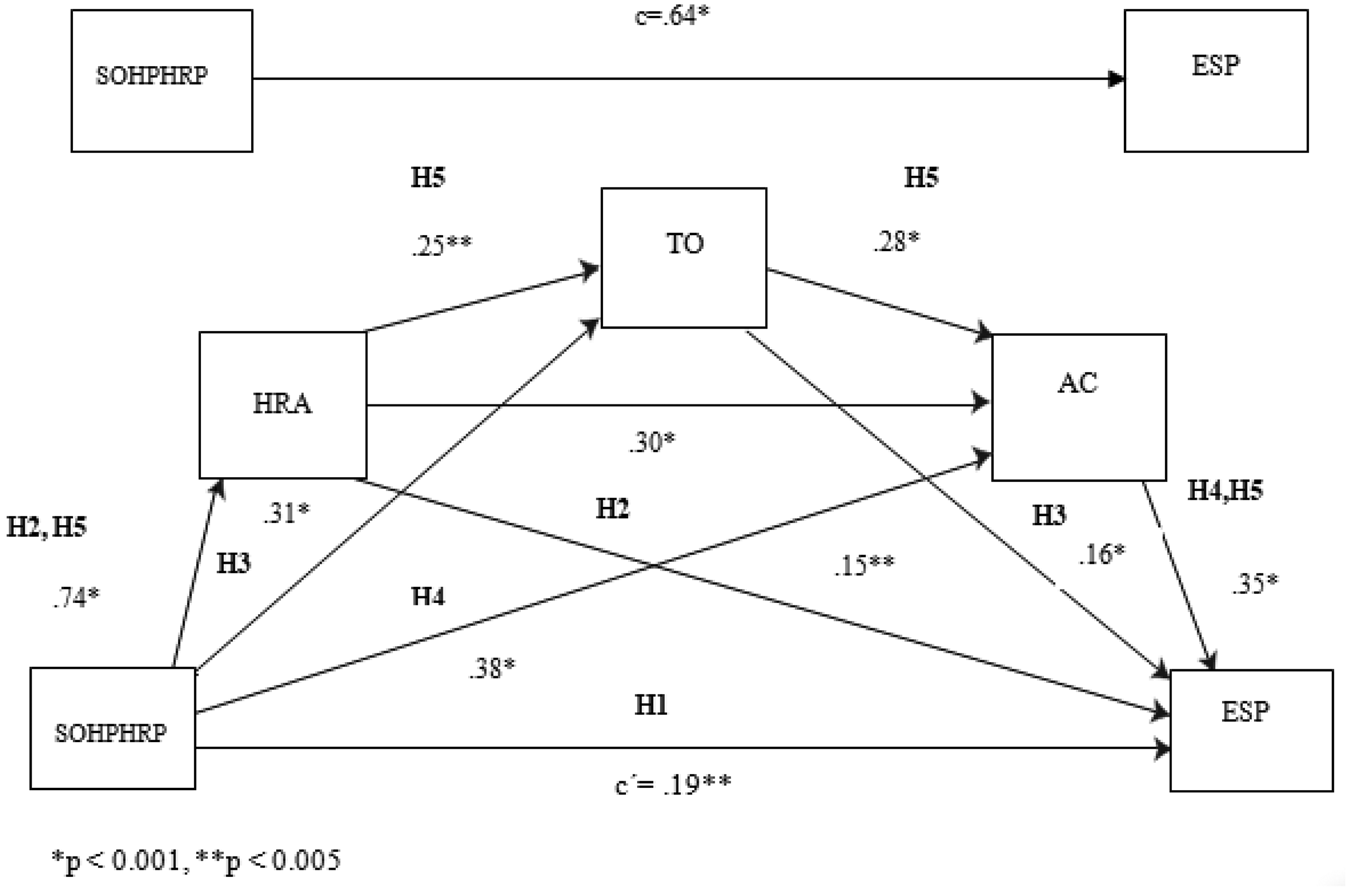
Researchers have focused on different versions of high-performance HR practices. For example, they have introduced innovation-oriented HR practices for the manufacturing industry (Agarwala, Reference Agarwala2003; Tannenbaum & Dupuree-Bruno, Reference Tannenbaum and Dupuree-Bruno1994), knowledge-oriented HR practices for knowledge-intensive industries (Donate & de Pablo, Reference Donate and de Pablo2015), and service or service quality-oriented HR practices for the service industry(Aryee et al., Reference Aryee, Walumbwa, Seidu and Otaye2016). Unlike traditional HRM systems (e.g., streams of high-commitment and high-involvement), HR practices need to be designed consistent with the service-oriented strategy to enable hotel employees to provide high-quality services (Liao et al., Reference Liao, Toya, Lepak and Hong2009). Such a strategic focus is of great importance for the design and operation of HR practices. Because service-oriented jobs bear unique characteristics such as close customer interaction, labor intensity, and abstraction, which require a certain form of human capital. Owing to these unique features, the nature of HR practices in the hotel industry is supposed to be different from traditional practices (Hong et al., Reference Hong, Jiang, Liao and Sturman2017). For example, the hotels adopting service-oriented HR practices rather than providing the employees with general training opportunities can encourage employees to participate in training programs that focus on customer knowledge and service skills. Similarly, in such hotels, the compensation and rewards of employees may depend on service quality, and the service quality is recognized as the most important criterion in performance appraisal. In addition, employees may be involved in service-related decision-making processes and may be allowed to resolve customer issues autonomously (Jiang, Chuang, & Chiao, Reference Jiang, Chuang and Chiao2015). A meta-analysis study (Hong et al., Reference Hong, Liao, Hu and Jiang2013) confirms this requirement by demonstrating that HR practices designed according to a specific strategic focus affect performance outcomes more than traditional HR practices. In this respect, companies applying SOHPHRP in the hotel industry may have a higher level of ESP. But there is a nuance here. Due to sectoral differences, the application of such practices in the manufacturing industry, for example, may not result in high-performance outputs (Bae & Yu, Reference Bae and Yu2005). Although the most important criterion for high performance in the manufacturing industry is to achieve production targets (Aguinis, Reference Aguinis2013), it is to improve service quality in the hotel industry. A positive relationship is expected between SOHPHRP and ESP. Essentially, this relationship mechanism operates based on a relationship of exchange. The SET (Blau, Reference Blau1964) explains the links between SOHPHRP and ESP. ‘Social exchange relationships tend to involve the exchange of socio-emotional benefits’ (Cropanzano, Rupp, & Byrne, Reference Cropanzano, Rupp and Byrne2003: 161). Especially, Cropanzano and Mitchell (Reference Cropanzano and Mitchell2005) emphasized that ‘social exchange relationships evolve when employers take care of employees, which thereby engenders beneficial consequences’ (p. 882). Accordingly, when organizations care about their employees by means of HR practices, employees may respond back with better performance outcomes (Dhar, Reference Dhar2015; Karatepe, Reference Karatepe2013). In other words, if organizations provide benefits to the employees via HR practices, employees will respond to these benefits with higher service performance (Messersmith, Patel, Lepak, & Gould-Williams, Reference Messersmith, Patel, Lepak and Gould-Williams2011). When SOHPHRP are applied together as a system, they may result in stronger performance outcomes by creating a synergistic effect (Wall & Wood, Reference Wall and Wood2005). In this way, companies that implement service-oriented high-performance HR practices offer the knowledge, skills, and opportunities needed to provide high-quality service, and employees can respond back with higher service performance (Lee, Lee, & Kang, Reference Lee, Lee and Kang2012). For example, service-oriented intensive training systems help employees deliver excellent service while improving their existing knowledge and skills. In contrast, service-oriented reward system increases the motivation of employees to provide high-quality service (Wang & Xu, Reference Wang and Xu2017). Finally, these practices highlight that employees are a valuable resource for the organization and that the organization intends to establish long-term relationships with employees (Sun, Aryee, & Law, Reference Sun, Aryee and Law2007). Thus, HR practices can improve service performance by establishing a social exchange relationship between the organization and the employee. A limited number of studies revealed that SOHPHRP positively and significantly affect service performance (Aryee et al., Reference Aryee, Walumbwa, Seidu and Otaye2016; Chuang & Liao, Reference Chuang and Liao2010; Hong et al., Reference Hong, Jiang, Liao and Sturman2017; Jiang, Chuang, & Chiao, Reference Jiang, Chuang and Chiao2015; Liao et al., Reference Liao, Toya, Lepak and Hong2009; Wang & Xu, Reference Wang and Xu2017). Accordingly, the following hypothesis is proposed. The research model is also presented in Figure 1.
Hypothesis 1: SOHPHRP has a positive effect on ESP.
Results of serial mediation model.

Mediation hypotheses
According to the Attribution Theory, individuals react to a specific event based not on the event itself but on their beliefs about why the event happened (Kelley & Michela, Reference Kelley and Michela1980). In working life, employees can develop behaviors based on the purpose they perceive underlying the implementation of HR practices by the management within the organization (Sanders & Yang, Reference Sanders and Yang2016). In other words, the perceptions of employees about the reasons underlying the HR practices within the organization can affect their behaviors positively or negatively (Nishii & Wright, Reference Nishii, Wright and Smith2008). Therefore, in the context of the relationship between HR practices and performance outcomes, employee perceptions toward the reasons behind HR practices can be a linking pin (Fontinha, José Chambel, & De Cuyper, Reference Fontinha, José Chambel and De Cuyper2012).
Nishii, Lepak, and Schneider (Reference Nishii, Lepak and Schneider2008) defined human resource attributions (HRA) as ‘employees’ causal explanations for HR practices to which they are exposed on an ongoing basis’ (p. 506). They introduced two basic HR attributions about the purpose of HR practices: (a) service quality and employee well-being HR attributions and (b) cost reduction and exploiting employees HR attributions. Since HR practices are designed to improve service quality, the current study addresses service quality and employee well-being HR attributions. Accordingly, we assert that employees should believe that HR practices are designed to improve service quality and employee well-being so that HR practices can lead to positive employee behaviors or higher service performance.
The Attribution Theory emphasizes that the way individuals process the reasons underlying certain behaviors and incidents determines their future behaviors and attitudes (Kelley & Michela, Reference Kelley and Michela1980). Accordingly, individuals can attribute different meanings to social stimuli (e.g., HRM practices) and engage in different attitudinal and behavioral responses based on the way they process the stimuli (Bowen & Ostroff, Reference Bowen and Ostroff2004). For example, an employee believing that HR practices applied by the management aim to exploit him/her may not engage in a positive reaction toward the organization (Nishii, Lepak, & Schneider, Reference Nishii, Lepak and Schneider2008). In this respect, HR attributions shape the behavior and attitudes of hotel employees toward the organization. The hotel industry is characterized by problems such as irregular work programs, low wages, long working hours, and heavy workloads (Karatepe & Uludag, Reference Karatepe and Uludag2007; Kuruüzüm, Anafarta, & Irmak, Reference Kuruüzüm, Anafarta and Irmak2008). It can be considered that the main reason leading to the emergence of these problems is the organization's aim to make more use of the labor force and sometimes to exploit it (Bird, Lynch, & Ingram, Reference Bird, Lynch and Ingram2002; Cave & Kilic, Reference Cave and Kilic2010). For this reason, employees further question the intentions behind the practices imposed on them (Karadas & Karatepe, Reference Karadas and Karatepe2019). Employees can engage in a positive reaction toward the organization when they perceive that the organization's main intention in HR practices is to create eligible conditions for them (Nishii, Reference Nishii2003). In contrast, when employees perceive that the underlying reason for HR practices is to increase (exploit) organizational performance by making more use of themselves, they may attribute negative meanings to HR practices and thus may not show positive reactions toward the organization (Van De Voorde & Beijer, Reference Van De Voorde and Beijer2015). For example, if employees find that HR practices are not motivated by management's concern to improve employee well-being and service quality, they may exhibit poor service performance (Nishii, Lepak, & Schneider, Reference Nishii, Lepak and Schneider2008). Conversely, when they observe that HR practices are applied to improve employee well-being and service quality, they can develop more positive attitudes toward the organization and have higher service performance.
The researchers suggest that the HR attribution is an important linkup or junction between the HR practices and the employees' attitudes or behaviors (Bowen & Ostroff, Reference Bowen and Ostroff2004; Nishii & Wright, Reference Nishii, Wright and Smith2008; Ostroff & Bowen, Reference Ostroff and Bowen2016; Wright & Nishii, Reference Wright and Nishii2006). This argument suggests that HR attributions should precede behavioral or attitudinal variables in the causality between the HR practices and performance outcomes (Fontinha, José Chambel, & De Cuyper, Reference Fontinha, José Chambel and De Cuyper2012). If employees believe that the HRM practices are designed to increase service quality and employee well-being, they will interpret the purpose of organizations in the implementation of HR practices positively and thus have a higher service performance (Shantz et al., Reference Shantz, Arevshatian, Alfes and Bailey2016). In the literature, a few studies have addressed the above-mentioned two HR attributions. For example, Van De Voorde and Beijer (Reference Van De Voorde and Beijer2015) found that service quality and employee well-being HR attributions act as mediator in the relationship between high-performance HR practices and organizational commitment. In addition, other studies concluded the same results in the scope of different research samples (Fontinha, José Chambel, & De Cuyper, Reference Fontinha, José Chambel and De Cuyper2012; Valizade, Ogbonnaya, Tregaskis, & Forde, Reference Valizade, Ogbonnaya, Tregaskis and Forde2016). Based on the above-mentioned theoretical discussion, it is expected that SOHPHRP increase service performance through service quality and employee well-being HR attributions.
Hypothesis 2: Service quality and employee well-being HR attributions mediate the effect of SOHPHRP on ESP.
Perceptions of the trust in organization are based on everyday experiences at the workplace (Kiefer, Reference Kiefer2005). HRM systems of the organizations are shaped in accordance with the general policies and decisions of the organizations and become a part of the daily experiences at the workplace (Tzafrir, Reference Tzafrir2005). Hence, it is necessary to approach the trust from a macro perspective (trust in organization) rather than a micro perspective (e.g., interpersonal trust and trust in supervisor) to comprehend the organizational consequences of HR practices (Alfes, Shantz, & Truss, Reference Alfes, Shantz and Truss2012). Although many studies revealed that the HR practices are the determinant of trust in organization (Farndale, Hope-Hailey, & Kelliher, Reference Farndale, Hope-Hailey and Kelliher2011; Zacharatos, Barling, & Iverson, Reference Zacharatos, Barling and Iverson2005), a group of studies emphasized that trust in organization can be a mediator variable between organizational practices and performance outcomes (Innocenti, Pilati, & Peluso, Reference Innocenti, Pilati and Peluso2011; Zhang & Morris, Reference Zhang and Morris2014). Accordingly, it is claimed that SOHPHRP increase ESP through trust in organization.
Hypothesis 3: Trust in organization mediates the effect of SOHPHRP on ESP.
The HRM literature generally focuses on affective commitment rather than other types of organizational commitments (Payne & Huffman, Reference Payne and Huffman2005; Wright, Gardner, & Moynihan, Reference Wright, Gardner and Moynihan2003). The theoretical models proposed to explain the HR practice–performance relationships suggested that affective commitment acts as a bridge between HR practices and performance outcomes (Al-Abbadi, Reference Al-Abbadi2018; Purcell, Kinnie, Hutchinson, Rayton, & Swart, Reference Purcell, Kinnie, Hutchinson, Rayton and Swart2003; ). HR practices may affect performance outcomes by way of creating affective commitment. In this study, it is expected that SOHPHRP increase ESP through affective commitment.
Hypothesis 4: Affective commitment mediates the effect of SOHPHRP on ESP.
In this study, a model is built to reveal the relationships between SOHPHRP and ESP (see Figure 1). According to the model in question, SOHPHRP increase ESP through HR attributions, trust in organization, and affective commitment. In other words, it is expected that HR attributions, trust in organization, and affective commitment mediate the relationships between SOHPHRP and ESP, respectively. The relationship process can be explained as follows. If employees believe that SOHPHRP are implemented with the purpose of increasing the service quality and employee well-being, they trust their organizations more. The increased trust toward the organization turns into affective commitment and results in the increase in ESP. Based on the above theoretical argument, we propose the following hypothesis.
Hypothesis 5: HR attributions, trust in organization, and affective commitment serially mediate the effect of SOHPHRP on ESP.
Moderation hypotheses
PE fit provides a basic framework that encompasses different environmental foci (e.g., organization, job, supervisor, and vocation) (Kristof-Brown & Guay, Reference Kristof-Brown, Guay and Zedeck2011). In the literature, there are five different types of PE fits: person–organization (PO), person–job (PJ), person–supervisor (PS), person–vocation (PV), and person–coworkers (PC) fits (Jansen & Kristof-Brown, Reference Jansen and Kristof-Brown2006). Although this study approaches PJ from demand–abilities fit perspective (complementary congruence), it discusses other types of PE (PO, PS, and PV fits) from supplementary congruence perspective (Muchinsky & Monahan, Reference Muchinsky and Monahan1987). The moderator role of the types of PE fits will be explained below.
Since the norms and values of the employees with a high level of PO fit match the norms and values of the organization to a great extent, they are able to better understand what the organization wants and needs (Binyamin, Reference Binyamin2018; Erdogan & Bauer, Reference Erdogan and Bauer2005). Employees with a high level of PO fit will easily understand what is intended and what is expected of them through HR practices, as the values of the organization are adopted. Besides, the harmony between employees and organizational values can provide a common understanding and interpretation framework that will facilitate the exchange of information, reduce the prevalence of misunderstandings, and clarify expectations. This common understanding can lead to higher HR practices to improve service performance (Hamstra, Van Vianen, & Koen, Reference Hamstra, Van Vianen and Koen2019). In contrast, value harmony between the organization and the person increases the motivation of the individual to make more effort for the organization by enabling him/her to perceive the organizational practices more positively (Firfiray & Mayo, Reference Firfiray and Mayo2017). For example, when employees perceive high-value compliance, they may think that HR practices create more value for themselves, and they can respond to HR practices with higher service performance.
As the value congruence between person and organization increases, employees show higher tendency to receive the messages sent by the organization (Wei, Reference Wei2015). Thanks to value congruence, the messages sent to employees via SOHPHRP are better understood and thus SOHPHRP may have a greater impact on employee behavior and attitudes (Anghel, Reference Anghel2012). The Similarity Attraction Theory (Byrne, Reference Byrne1971) emphasizes that people are attracted to and enjoy working with individuals, groups, and organizations that shares similar values and perspectives with them (Boon & Biron, 2016; Wells & Aicher, Reference Wells and Aicher2013). Based on The Similarity Attraction Theory (Byrne, Reference Byrne1971), it is possible to say that the relationship between SOHPHRP and ESP will increase as the similarity between the values of the employees and the values of the organization increases.
Hypothesis 6: PO fit moderates the effect of SOHPHRP on ESP, such that the effect of SOHPHRP on ESP is higher when PO fit is higher.
PJ fit refers to a match between one's abilities and job demands (Cable & DeRue, Reference Cable and DeRue2002). For employees with low job fit, it is challenging to be successful at work and show high performance (Rodgers, Reference Rodgers2000). The existence of HR practices in the organization can contribute to ensuring the match between job demands and employee abilities and thus facilitate employees with low PJ fit to improve their success. If HR practices targeting such employees are not present in the organization or if employees fail to perceive the existence of such practices, it is likely that they have low performance (Boon et al., Reference Boon, Den Hartog, Boselie and Paauwe2011). That is, the performance of employees with low PJ fit may improve when they perceive HR practices that will enable the match between job demands and their capabilities (Liu, Tang, & Yang, Reference Liu, Tang and Yang2015). In contrast, implementation of HR practices in organization may not be meaningful for employees who have high PJ fit (Boon & Biron, Reference Boon and Biron2016) because such employees already have the skills and abilities required for the job (Chhabra, Reference Chhabra2016). Therefore, SOHPHRP may have less impact on service performance of employees who have high level of PJ (Maden-Eyiusta, Reference Maden-Eyiusta2016). For example, Boon et al. (Reference Boon, Den Hartog, Boselie and Paauwe2011) found that employees with high level of PJ fit were less affected by HR practices. In summary, the higher level of impact of SOHPHRP on service performance depends on the low level of PJ fit. This assumption may be placed on a logical basis, given that employees with low PJ fit need more SOHPHRP (Takeuchi, Takeuchi, & Toshima, Reference Takeuchi, Takeuchi and Toshima2007; Wu, Wei, Zhang, & Han, Reference Wu, Wei, Zhang and Han2011). Individuals with low PJ fit need more SOHPHRP. Therefore, they increase their current performance when they detect SOHPHRP. Based on this theoretical discussion, we claim that the effect of SOHPHRP on ESP may depend on the level of PJ fit. That is, the effect of SOHPHRP on ESP can be higher when PJ fit is low.
Hypothesis 7: PJ fit moderates the effect of SOHPHRP on ESP, such that the effect of SOHPHRP on ESP is higher when PJ fit is low.
Supervisors play an important role in the HRM–performance relationship chain. Purcell and Hutchinson (Reference Purcell and Hutchinson2007) emphasized that supervisors should be included in any relationship chain that aims to explain and measure the relationship between HRM and performance. Dany, Guedri, and Hatt (Reference Dany, Guedri and Hatt2008) called for the inclusion of the concepts related to supervisors as a conditional variable into the HR–performance relationship chain. Bos-Nehles, Van Riemsdijk, and Kees Looise (Reference Bos-Nehles, Van Riemsdijk and Kees Looise2013) specified this proposal further and called for the inclusion of employee–supervisor interaction quality as a conditional variable into the relationship between HR practices and performance outcomes. Taking these calls into consideration, the fit between supervisor and employees was included in the research model in the current study as a conditional variable. The implementation of the practices designed by the HR department is largely the responsibility of the supervisors (Den Hartog, Boselie, & Paauwe, Reference Den Hartog, Boselie and Paauwe2004; Harney & Jordan, Reference Harney and Jordan2008). The relationship between supervisors and employees is remarkably important in transforming HR outcomes into behavioral outcomes (Lee, Park, & Baker, Reference Lee, Park and Baker2018; Purcell & Hutchinson, Reference Purcell and Hutchinson2007). At this point, the importance of PS fit comes to the forefront. PS fit refers to congruence or similarities between the leadership style, values, interests, and characteristics of an individual and the supervisor (Astakhova, Reference Astakhova2016; Chuang, Shen, & Judge, Reference Chuang, Shen and Judge2016). Supervisors who are compatible with their subordinates can better implement HR practices. In contrast, employees with having high level of compliance with their supervisors may react more positively to HR practices.
The Similarity Attraction Theory (Byrne, Reference Byrne1971) provides a theoretical basis for PS fit. The theory emphasizes that individuals are more interested in and willing to communicate others who have similarity with them (Byrne, Rasche, & Kelley, Reference Byrne, Rasche and Kelley1974). Accordingly, as the congruence or similarity between the supervisor and the employee increases, a harmonious working environment can emerge and thus the service performance of employees can increase (Maden & Kabasakal, Reference Maden and Kabasakal2014). Shared values are an important precursor to the quality of interaction between supervisor and employee and the high quality of interaction between the two sides enhances performance (Ashkanasy & O'connor, Reference Ashkanasy and O'connor1997). If employees experience harmony with their supervisors, they comprehend the supervisors' goals and expectations better and thus yield a higher service performance (Astakhova, Reference Astakhova2016). Therefore, high PS fit can strengthen the effect of SOHPHRP on ESP. Based on the theoretical discussion above, the following hypothesis is proposed.
Hypothesis 8: PS fit moderates the effect of SOHPHRP on ESP, such that the effect of SOHPHRP on ESP is higher when PS fit is high.
PV fit refers to the harmony between the interests, characteristics, and abilities of the individual and the characteristics and requirements of the profession (Vogel & Feldman, Reference Vogel and Feldman2009). Rather than focusing on the relationship between the person and the organization or work, PV fit, deals with the degree to which a person is generally in harmony with his or her profession (de Jager, Kelliher, Peters, Blomme, & Sakamoto, Reference de Jager, Kelliher, Peters, Blomme and Sakamoto2016; Erbaş & Şahin Perçin, Reference Erbaş and Şahin Perçin2016). PV fit is very important for service workers. For example, employees working in the hotel industry should be extroverted, cheerful, and prone to service and work as a team (Köşker, Unur, & Gursoy, Reference Köşker, Unur and Gursoy2019; O'Neill & Xiao, Reference O'Neill and Xiao2010). Individuals who do not have such characteristics have difficulty in meeting the requirements of the hotel profession. The Theory of Vocational Choice (Holland, Reference Holland1985: Reference Holland1996) establishes a link between the personality traits and individual values and the choice of vocation. For example, if a person with artistic personality traits chooses musicianship or interior architecture as a vocation, it is very likely that s/he will have a successful career (Greene-Shortridge, Reference Greene-Shortridge2008). Holland (Reference Holland1985) argues that individual's vocational satisfaction and success increase as the match between the individual's interests and vocation increases, and that people become happier and more successful when there is harmony between personal characteristics and vocation (Holland, Reference Holland1973, Reference Holland1996). From this perspective, the impact of SOHPHRP on service performance may depend on the level of PV fit (Lam, Huo, & Chen, Reference Lam, Huo and Chen2018). If one's personal characteristics are not suitable for the hotel profession, HR practices may not have an impact on her or his performance. SOHPHRP may not make any sense for individuals with low PV fit and hence their service performance may be low. Based on the argument above, it can be argued that the effect of SOHPHRP on ESP will be high when PV fit is high.
Hypothesis 9: PV fit moderates the effect of SOHPHRP on ESP, such that the effect of SOHPHRP on ESP is higher when PV fit is high.
Method
Sample and procedure
The study was carried out on five-star hotels operating in Antalya province of Turkey. The preference of the Antalya Province as the research context is because it is Turkey's most popular tourist destination and many enterprises are located in this region (Gürlek & Tuna, Reference Gürlek and Tuna2018). The sample of the study was selected randomly from the list of facilities with tourism certificate (Republic of Turkey Ministry of Culture & Tourism, 2018). There are 313 five-star hotels in Antalya Province (Ministry of Culture & Tourism, 2018). A total of 59 hotels agreed to participate in the survey. Empirical studies are often characterized by common method bias (CMB) (Gürlek & Tuna, Reference Gürlek and Tuna2018; Min, Park, & Kim, Reference Min, Park and Kim2016). To avoid CMB, the data were collected from different sources, taking the recommendation of Podsakoff, MacKenzie, Lee, and Podsakoff (Reference Podsakoff, MacKenzie, Lee and Podsakoff2003) into consideration. Two types of questionnaire forms were used in the study: employee questionnaire and manager questionnaire. Although the employee questionnaire included the scales of HR practices, HR attributions, trust in organization, affective commitment, PE fit, and demographic questions, manager questionnaire included the service performance scale. The reason for using two separate questionnaire forms is to ensure that the line manager evaluates the employee's service performance, not his or her own. A total of 50 employee questionnaires and 50 manager questionnaires were delivered to each hotel. Since it is planned to evaluate the service performance of each employee by the line manager, it is aimed to obtain data for 50 employees from each hotel. It was planned to collect data from 2,950 employees in total (59 × 50). In this research, a manager questionnaire was distributed to 295 line managers from five different departments. Each manager was expected to evaluate the service performance of a total of 10 employees. The data collection process started in December 2018 and ended in the last week of March 2019. The reason for collecting the data during this period is that the hotel occupancy rates are very high in the summer, so the period ranging from December, January, February to March is more suitable for such a large survey.
The following steps were followed in the process of collecting data from employees and line managers. First, the employees were asked to fill in the questionnaires, put them in an envelope for confidentiality, then seal the envelope and deliver the envelope to the line managers. Second, to avoid confusion, line managers were asked to give each employee a code and write it on the envelope handed in by the employee. Third, line managers were asked to evaluate the service performance of each employee without opening the envelope from employees. Fourth, the line managers were asked to put the service performance scale in the envelope and write the employee's code on the envelope. Finally, employee and manager questionnaires employees' code were matched. In a period of 4 months, 1,618 questionnaire forms returned and 93 ineligible questionnaire forms were excluded from the data set. There are two reasons why 93 questionnaire forms are ineligible. First, the codes given to employees were confused in the matching process of employee questionnaires and manager questionnaires. Second, some questionnaires had too many missing values. Eventually, a total of 1,525 eligible questionnaire forms were obtained. The return rate of the questionnaires is approximately 52%. The service performances of 1,525 employees were evaluated by their line managers. A total of 295 managers were surveyed. A total of 217 line managers participated in the research. The total participation rate of line managers is approximately 73%.
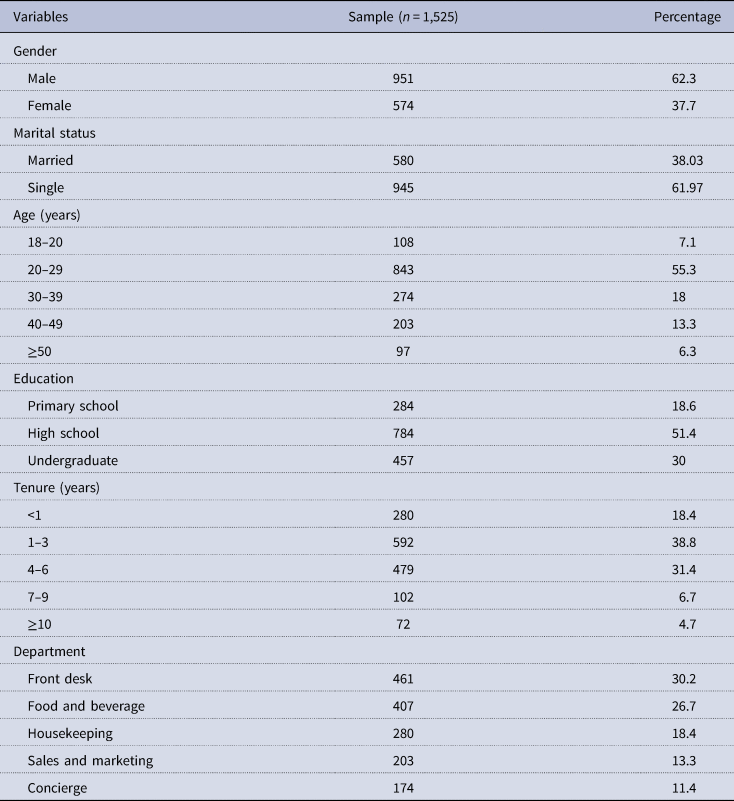
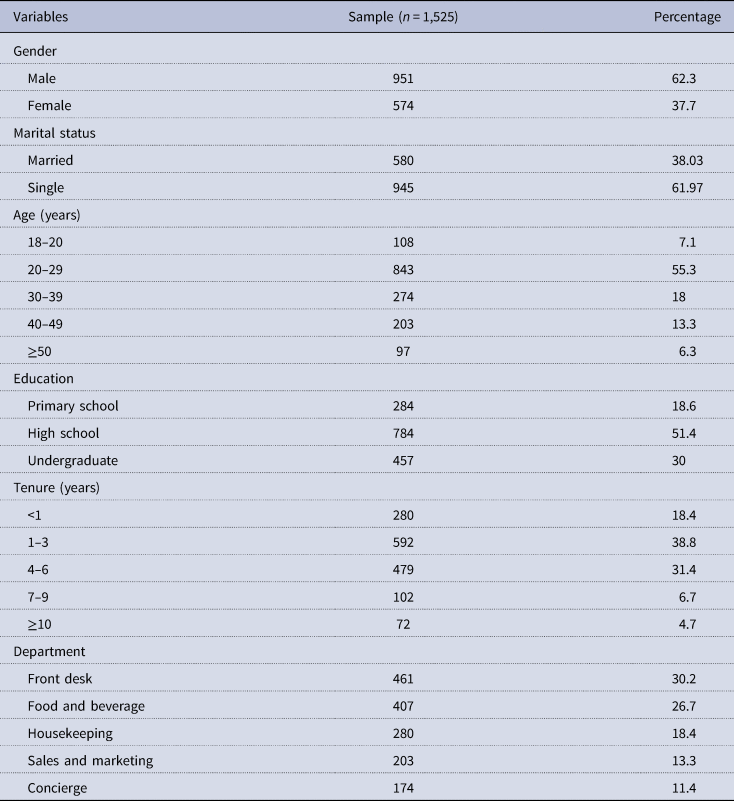
Demographic characteristics of the respondents are presented in Table 1. More than half of the respondents are composed of young, male, and single employees. In addition, the majority of the respondents received education at high school and undergraduate level. Approximately 43% of the respondents have been working in the same organization for more than 4 years. Finally, more than half of the respondents work in the front office and food and beverage departments.
Profiles of respondents
Measurements of variables
In this research, a 5-point Likert-type scale was used. The scales were obtained from English literature. Therefore, the linguistic validity was checked. The items were translated into Turkish by four bilingual (English and Turkish) translators. The back-to-translation method was followed for this procedure (Brislin, Reference Brislin1976). After the translation process, the questionnaire form was sent to practitioners (n = 12) and they were asked to check the items. In light of the suggestions, minor edits were made. Scales are provided in Appendix 1.
Service-oriented high-performance human resource practices
SOHPHRP were measured using a scale consisting of seven dimensions and 29 items. ‘In the absence of a clear consensus on practices that constitute an HR system’ (Piening, Baluch, & Salge, Reference Piening, Baluch and Salge2013: 932), the scale is adapted from the previous studies. Scale items were designed based on the service-oriented perspective. The reason for selecting seven practices is the broad consensus that these practices should be applied together to improve service performance (Aryee et al., Reference Aryee, Walumbwa, Seidu and Otaye2016; Chao & Shih, Reference Chao and Shih2018; Chuang & Liao, Reference Chuang and Liao2010; Hong et al., Reference Hong, Jiang, Liao and Sturman2017; Karatepe, Baradarani, Olya, Ilkhanizadeh, & Raoofi, Reference Karatepe, Baradarani, Olya, Ilkhanizadeh and Raoofi2014; Liao et al., Reference Liao, Toya, Lepak and Hong2009; Luu, Reference Luu2019; Wang, Xing, & Zhang, Reference Wang, Xing and Zhang2019). The reasons why seven practices were employed in this research are explained below.
With respect to staffing practice, selecting employees that best match the job requirement contributes to the creation of an employee pool that can provide quality services to customers (Karatepe et al., Reference Karatepe, Baradarani, Olya, Ilkhanizadeh and Raoofi2014). With regard to training, organizational success in the hotel industry depends on the social and technical skills of the personnel. Therefore, comprehensive training that improves employee skills is needed to meet changing customer needs and improve service quality (Babakus et al., Reference Babakus, Yavas, Karatepe and Avci2003; Beatson, Lings, & Gudergan, Reference Beatson, Lings and Gudergan2008; Budhwar, Chand, & Katou, Reference Budhwar, Chand and Katou2007). When hotel employees learn about the organization's service improvement and complaint processing strategies by participating in training programs, they can deliver better quality service and solve customer problems more quickly (Karatepe & Vatankhah, Reference Karatepe and Vatankhah2015).
Service performance and service quality should be the primary criteria for performance evaluation in the service industry to serve organizational objectives (Jiang, Chuang, & Chiao, Reference Jiang, Chuang and Chiao2015). Performance appraisal practice aims to provide employees with motivation to improve the quality of service (Tsaur & Lin, Reference Tsaur and Lin2004). In terms of empowerment, it is in close interaction with employees and customers in the service industry, and it is necessary to solve customer problems immediately by taking the initiative (Boshoff & Allen, Reference Boshoff and Allen2000). Empowerment contributes to customer satisfaction by providing employees with the responsibility and authority to deal with customer requests and problems without a long chain of command (Karatepe et al., Reference Karatepe, Baradarani, Olya, Ilkhanizadeh and Raoofi2014). From the point of information sharing, it is essential to provide employees with clear and regular information about business strategies, goals, and customer satisfaction (Choo, Reference Choo2016; Domínguez-Falcón, Martín-Santana, & De Saá-Pérez, Reference Domínguez-Falcón, Martín-Santana and De Saá-Pérez2016). Employees' higher-quality service depends on their knowledge of the strategy and customer outcomes that the organization follows.
With regard to the work–life balance, the hotel industry causes work–life imbalance due to its long working hours, irregular work programs, and working on holidays (Zhao & Ghiselli, Reference Zhao and Ghiselli2016). Therefore, the work–life balance should be part of the practices. Perry-Smith and Blum (Reference Perry-Smith and Blum2000) found that organizations performing work–life balance initiatives had a higher organizational performance than those which did not perform such initiatives, and stated that the work–life balance initiatives should be added to the HR practices list. With respect to the reward system, having appropriate reward policies is important for service-oriented jobs. Such jobs usually offer low-paid positions. Therefore, rewarding plays an important role in high service quality (Karatepe & Karadas, Reference Karatepe and Karadas2012). When employees are rewarded (e.g., bonuses and salary increases), they are motivated for excellent service delivery (Liao & Chuang, Reference Liao and Chuang2004).
Service-oriented staffing was measured with five items adapted from the previous studies in the service industry (Chuang & Liao, Reference Chuang and Liao2010; Domínguez-Falcón, Martín-Santana, & De Saá-Pérez, Reference Domínguez-Falcón, Martín-Santana and De Saá-Pérez2016; Hong et al., Reference Hong, Jiang, Liao and Sturman2017). Extensive service training was measured with five items adapted from Boshoff and Allen's (Reference Boshoff and Allen2000) study. Service-oriented performance appraisal was measured with four items adapted from the study of Liao et al. (Reference Liao, Toya, Lepak and Hong2009). Service-oriented empowerment was measured using the scale developed by Boshoff and Allen (Reference Boshoff and Allen2000). The scale includes four items. Information sharing was measured with six items adapted from previous studies (Domínguez-Falcón, Martín-Santana, & De Saá-Pérez, Reference Domínguez-Falcón, Martín-Santana and De Saá-Pérez2016; Liao et al., Reference Liao, Toya, Lepak and Hong2009). Work–life balance was measured with four items adapted from previous studies (Chuang & Liao, Reference Chuang and Liao2010; Thompson, Beauvais, & Lyness, Reference Thompson, Beauvais and Lyness1999). Service-oriented reward was measured with four items adapted from previous studies (Boshoff & Allen, Reference Boshoff and Allen2000; Chuang & Liao, Reference Chuang and Liao2010; Tang & Tang, Reference Tang and Tang2012). Due to the multidimensional nature of the scale, second-order confirmatory factor analysis (CFA) was performed. The CFA results supported the scale as a single general structure consisting of seven different sub-dimensions (χ2 = 411.094, df = 399, p < .01, χ2/df = 1.213, CFI = .98, NFI = .90, RMSEA = .029).
HR attributions
The scale was borrowed from Nishii, Lepak, and Schneider (Reference Nishii, Lepak and Schneider2008). The scale consists of two dimensions (service quality and employee well-being HR attributions) and 14 items. Employees were asked to indicate to what extent they agree with the reason behind each practice.
Trust in organization
The scale was borrowed from Robinson and Rousseau (Reference Robinson and Rousseau1994). The scale consists of one dimension and five items.
Affective commitment
Scale of affective commitment was borrowed from Allen and Meyer (Reference Allen and Meyer1990). The scale includes one dimension and eight items.
Employee service performance
An integration of customer-oriented task performance and customer-oriented extra role performance is the indicative of ESP (Prentice, Chen, & King, Reference Prentice, Chen and King2013). Therefore, two dimensions were combined in this study. Customer-oriented task performance scale was borrowed from Liao and Chuang (Reference Liao and Chuang2004). The scale includes seven items. Customer-oriented extra role performance was borrowed from Bettencourt and Brown (Reference Bettencourt and Brown1997). The scale includes four items.
Person–environment fit
PO fit and PJ fit scales were borrowed from Cable and DeRue (Reference Cable and DeRue2002). Each scale contains three items. PV fit was measured using the scale adapted from the Kennedy's study (Reference Kennedy2005). The scale includes five items. PS fit was measured using the scale developed by Chuang, Shen, and Judge (Reference Chuang, Shen and Judge2016). The scale includes six items.
Several methods were employed to control the CMB. First, CMB was controlled via Harman's one-factor test. According to this test, if a single factor constitutes more than 50% of the total variance, the CMB is a critical problem (Podsakoff et al., Reference Podsakoff, MacKenzie, Lee and Podsakoff2003). Test results indicated that the single factor model accounted for only 28.6% of the total variance. Accordingly, CMB is not a critical problem for this study. Second, the common latent factor (CLF) method was used to control CMB (Podsakoff et al., Reference Podsakoff, MacKenzie, Lee and Podsakoff2003). All items were connected to a CLF. Then, the model without CLF and the model with CLF were compared. The results showed that the difference between the factor loadings was less than .20. This indicates that the data were free from CMB. Third, variance inflation factors (VIFs) were examined. The values of VIF greater than 3.3 indicate CMB (Kock, Reference Kock2015). VIF values were checked using PLS and it was found that the values range from .1 to 2.95. Thus, data were deemed to be free from CMB. Fourth, ‘partialing out of general factor’ (POGF) technique (Tehseen, Ramayah, & Sajilan, Reference Tehseen, Ramayah and Sajilan2017: 155) was utilized. First, an unmeasured marker variable (UMV) was created using unrotated factor analysis and added as an exogenous variable to the baseline model. Then, R 2 values were compared between the model with UMV and the baseline model. The results show that the addition of UMV to the model does not lead to a major change in R 2. Therefore, CMB is not a problem for this study (Ghazali, Mutum, & Woon, Reference Ghazali, Mutum and Woon2019; Tehseen, Ramayah, & Sajilan, Reference Tehseen, Ramayah and Sajilan2017). In other words, no significant change was observed in R 2 values of human resource attributions (.464–.467), trust in the organization (.409–.411), affective commitment (.513–.519), and service performance (.561–.563).
Results
Measurement results
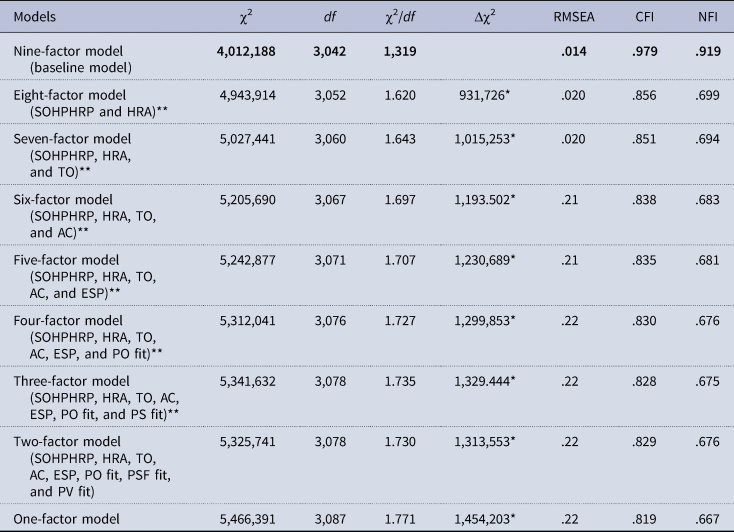
To compare the measurement model, CFA was performed and the distinctive features of nine variables were examined with AMOS-SEM. Due to their multidimensional nature, SOHPHRP, HR attributions, and service performance were included in the measurement model as the second order, and the other variables were included in the model as the first order. As shown in Table 2, the nine-factor model has better fit indices than the other models (χ2 = 4012.188, df = 3,042, p < .01, χ2/df = 1.319, CFI = .979, NFI = .919, RMSEA = .14). Therefore, it was decided to examine the research variables as separate structures.
Comparison of measurement models
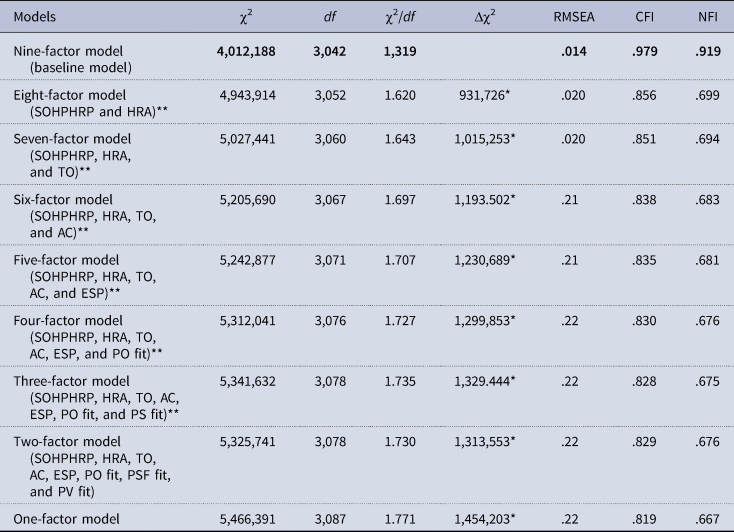
AC = affective commitment; ESP = employee service performance; HRA = human resource attributions; SOHPHRP = service-oriented high-performance human resource practices; TO = trust in the organization.
*p < .001; **variables were combined.
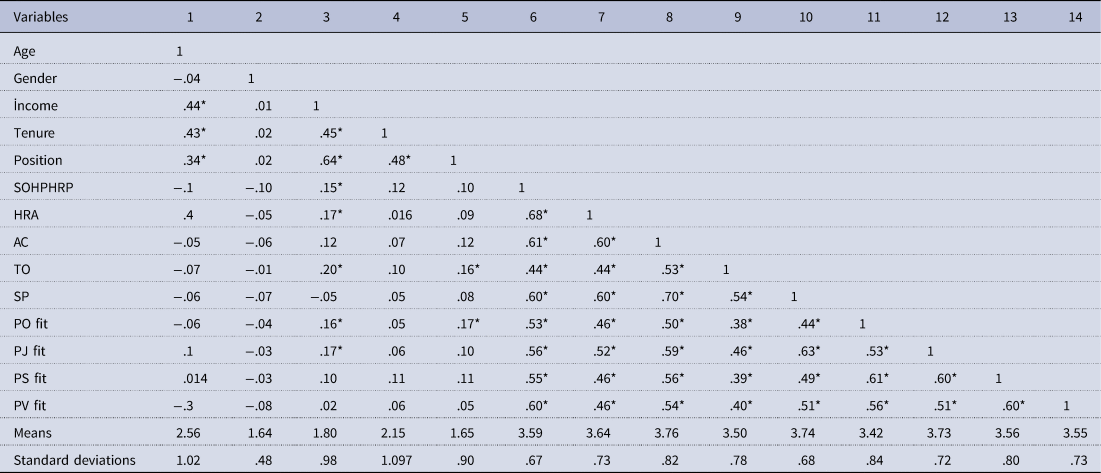
Based on the CFA results, an item of affective commitment was excluded from the measurement model. The remaining factor loadings of 83 items were statistically significant. The α coefficients of the scales ranged from .725 to .947. This result shows the internal consistency of all structures. Composite reliability values are higher than the threshold value of .70. This result shows that the construct reliability is met (Bagozzi & Yi, Reference Bagozzi and Yi1988). In addition, average variance extract values are greater than .50. This shows that the convergent validity is met (Fornell & Larcker, Reference Fornell and Larcker1981). As seen in Table 3, the correlations between the variables are less than .85. This result shows that there is no multicollinearity problem (Kline, Reference Kline2011). The outer loadings were compared with cross-loadings to check discriminant validity with PLS-SEM. As shown in Appendix 2, the values of the outer loadings are greater than the cross-loadings. Therefore, discriminant validity was achieved between all structures based on the cross-loading criterion (Barclay, Higgins, & Thompson, Reference Barclay, Higgins and Thompson1995).
Means, standard deviations, and correlations

*p < .01.
Hypotheses tests
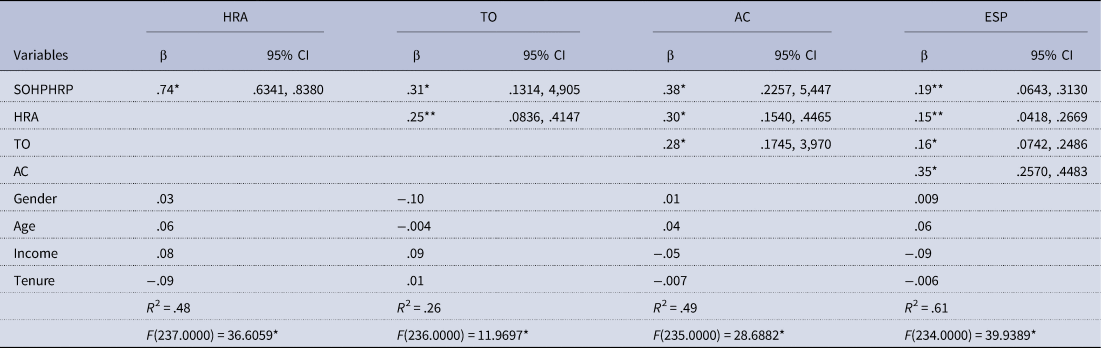
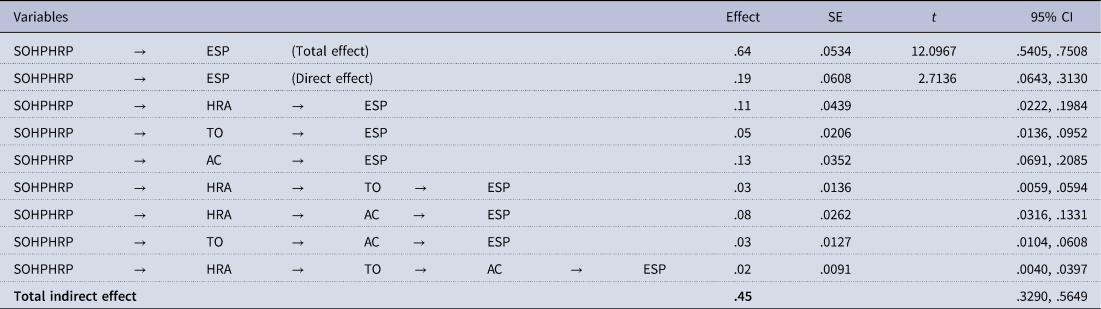
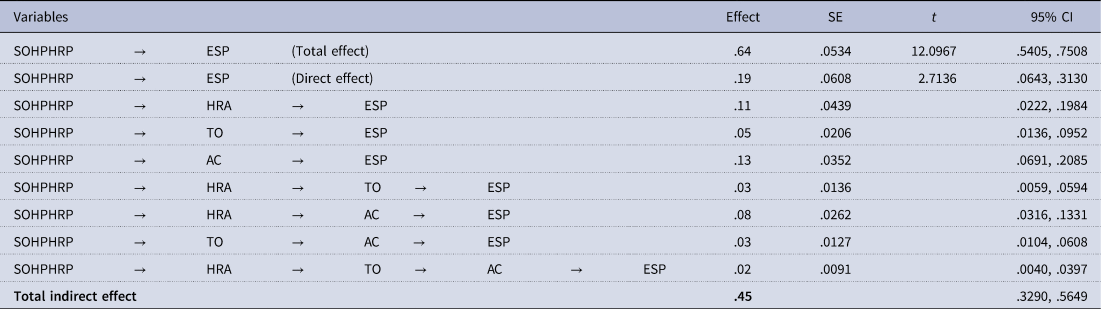
PROCESS macro Model 6 (serial mediation model) was used to test the mediation hypotheses. Following the analytical approach of Hayes (Reference Hayes2013; Reference Hayes2018), direct and indirect effects between SOHPHRP and ESP were tested. The results of the serial mediation model are shown in Table 4 and Figure 1. The total effect of SOHPHRP on ESP is positive and significant (β = .64, SE = .0534, 95% CI = .5405–.7508, p < .001). The direct effect of SOHPHRP on ESP is positive and significant (β = .19, SE = .0631, p < .005). Therefore, H1 is supported. Control variables (gender, age, income, and tenure) have no significant effect on the other variables.
Regression coefficients of serial mediation model

*p < .001, **p < .005.
As shown in Table 5, 95% confidence intervals (CIs) for all indirect effects (5,000 bootstrap samples) do not include zero. This finding confirmed the significance of indirect effects. According to the results of the mediation analysis, SOHPHRP increased ESP through HR attributions (β = .11, SE = .0439, p < .001). SOHPHRP increased ESP through trust in organization (β = .05, SE = .0206, p < .001). SOHPHRP increased ESP through affective commitment (β = .13, SE = .0352, p < .001). SOHPHRP increased ESP through HR attributions, trust in organization, and affective commitment (β = .02, SE = .0091, p < .001). That is, HR attributions, trust in organization, and affective commitment serially mediated the effect of SOHPHRP on ESP. The total indirect effect of SOHPHRP on service performance is .45 (SE = .0591, p < .001). According to these findings, H2, H3, H4, and H5 are supported. Since the direct effect of SOHPHRP on service performance is positive and significant (β = .19, SE = .0631, p < .001), it can be indicated that the mediating effect is partial (Baron and Kenny, Reference Baron and Kenny1986) or complementary (Zhao, Lynch, & Chen, Reference Zhao, Lynch and Chen2010).
Total, direct, and indirect effects
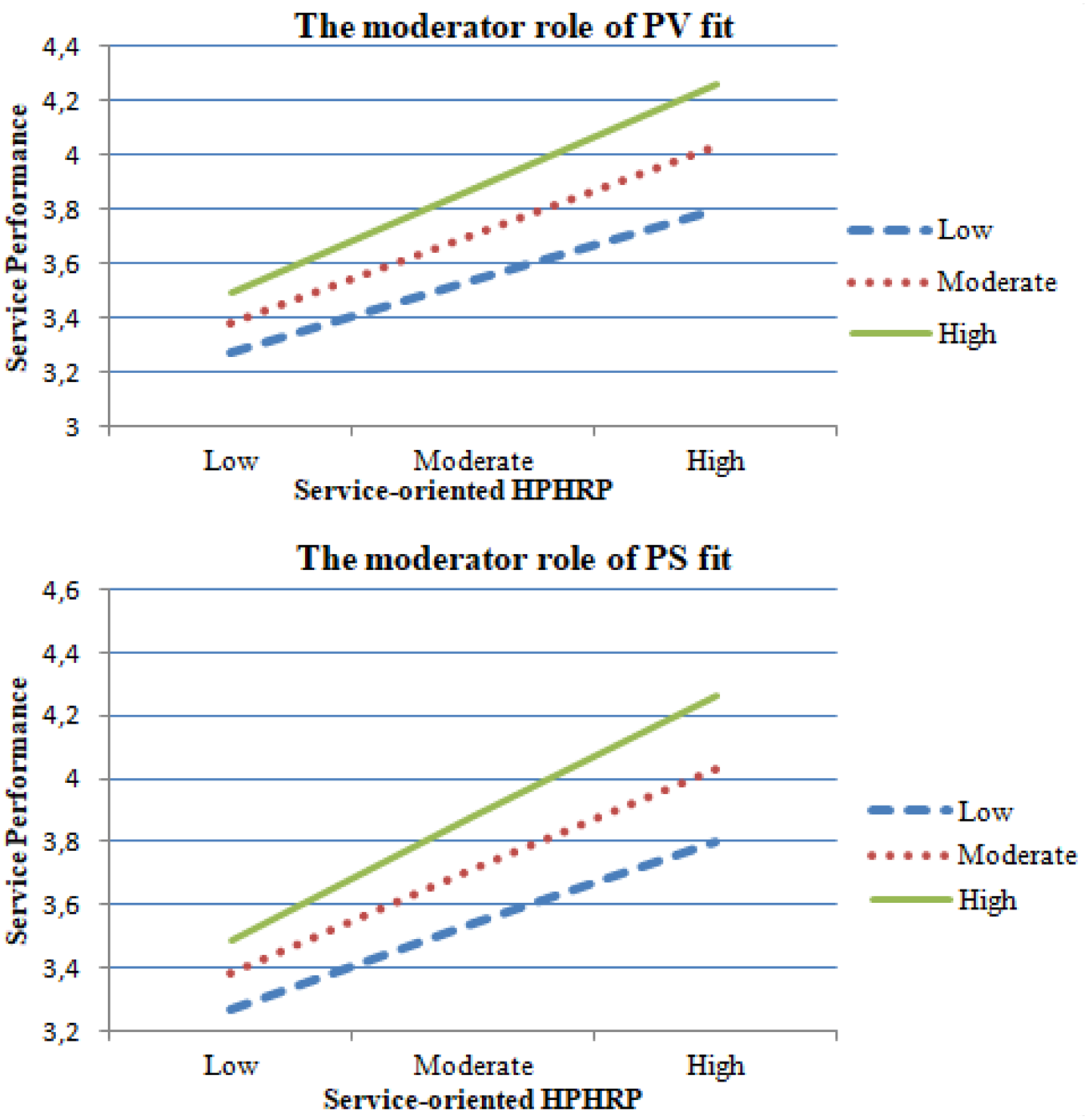
PROCESS macro Model 1 was used to examine the moderator role of the types of PE fits. Analysis results are provided in Table 6 and Figure 2. When the moderator role of PO fit was examined, it was observed that the interaction between SOHPHRP and PO fit had no significant effect on service performance (β = .07, SE = .0529, p > .001). Therefore, H6 is rejected. When the moderator role of PJ fit was examined, it was observed that the interaction between SOHPHRP and PJ had no significant effect on service performance (β = .008, SE = .0576, p > .001). Therefore, H7 is rejected.
Interaction diagrams showing moderating effects of PV fit and PS fit.

Moderator effect results of types of PE fits

*p < .001, **p < .05.
When the moderator role of PS fit was examined, it was revealed that the interaction between SOHPHRP and PS had a positive and significant effect on ESP (β = .07, SE = .1794, p < .05). When the moderator role of PV fit was examined, it was observed that the interaction between SOHPHRP and PV fit had a positive and significant effect on service performance (β = .016, SE = .2088, p < .05). The results of conditional effect and simple slope test (Aiken & West, Reference Aiken and West1991) showed that the effect of SOHPHRP on service performance was high when the PS fit was high (β = .57, SE = .1794, p < .001). Therefore, H8 is supported. Besides, when PV was high, the effect of SOHPHRP on service performance reached a high level (β = .60, SE = .0781, p < .001). Therefore, H9 is supported.
Discussion
Summary of findings
According to the findings, SOHPHRP increase the service performance by providing the employees with the skills, knowledge, and opportunities required to provide high-quality service (H1). Accordingly, this research has concluded that designing HR practices in line with business strategies and industry conditions increase ESP. This finding is consistent with The Contingency Theory of SHRM. This finding coincides with the previous studies revealing that high-performance human resource practices (HPHRP) are an important tool to improve service performance (e.g., Clarke & Hill, Reference Clarke and Hill2012; Karadas & Karatepe, Reference Karadas and Karatepe2019; Liao et al., Reference Liao, Toya, Lepak and Hong2009; Luu, Reference Luu2019; Nadeem, Riaz, & Danish, Reference Nadeem, Riaz and Danish2019; Wang & Xu, Reference Wang and Xu2017). In addition, this finding confirms the basic assumptions of the SET. That is, when organizations cared about their employees with the help of HR practices, employees repay with better performance. Contextually, the current research puts forward the fact that SOHPHRP generates desired effects on employee outputs in non-Western countries. As is known, the bundles of such practices have been developed in Western countries. Since the previous studies in Eastern countries have concluded complicated findings (Kim & Wright, Reference Kim and Wright2011; Kim, Wright, & Su, Reference Kim, Wright and Su2010), it is of great value to identify the validity of the relationship between HR practices and employee performance. Employees believing that SOHPHRP are implemented by the management in the organization with the aim of increasing the service quality and employee well-being have higher levels of service performance (H2). This finding confirms The Attribution Theory, which emphasizes that the way individuals handle the reasons underlying certain incidents determines their behaviors (Kelley & Michela, Reference Kelley and Michela1980). Besides, this finding broadens the flow of research revealing that HR attributions increase positive outcomes such as organizational commitment (Nishii, Lepak, & Schneider, Reference Nishii, Lepak and Schneider2008), job involvement (Shantz et al., Reference Shantz, Arevshatian, Alfes and Bailey2016), and job satisfaction (Tandung, Reference Tandung2016). Besides, the number of studies on HR attributions is very scarce, none of them have been conducted in the context of hotel industry. In the hotel industry where workforce utilization is intense and occasionally workforce exploitation is more common, employees are further skeptical about management's intentions (Bird, Lynch, & Ingram, Reference Bird, Lynch and Ingram2002; Volgger & Huang, Reference Volgger and Huang2019). Therefore, it is important to take into consideration employee views and the factors influencing the employee views to find out what intentions lay behind HR practices. SOHPHRP increase service performance by creating trust toward organization among employees (H3). SOHPHRP increase the affective commitment by providing employees with specific knowledge, skills, and opportunities. In contrast, affective commitment increases service performance by way of increasing the motivation of employees to work for the organization (H4). The findings on H3 and H4 go hand in hand with the literature which suggests that HPHRP improves performance outcomes through variables such as organizational commitment (Al-Abbadi, Reference Al-Abbadi2018; Innocenti, Pilati, & Peluso, Reference Innocenti, Pilati and Peluso2011) and trust (Farndale, Hope-Hailey, & Kelliher, Reference Farndale, Hope-Hailey and Kelliher2011). Furthermore, the findings point out that HR practices designed in accordance with service-oriented strategy create positive effects on employee behavior in Turkish hotel industry. These findings are novel in the context of Turkish hotel industry. Therefore, the current study contributes to understanding the behavioral consequences of SOHPHRP in a different cultural context.
HR attributions, trust in organization, and affective commitment partially mediate the effect of SOHPHRP on ESP, respectively (H5). Although previous studies examined the relationship between SOHPHRP and ESP (e.g., Aryee et al., Reference Aryee, Walumbwa, Seidu and Otaye2016; Jiang, Chuang, & Chiao, Reference Jiang, Chuang and Chiao2015), they did not put forward how SOHPHRP increases ESP. The current study differs from previous studies through determining the role of serial mediation of HR attributions, trust in organization, and affective commitment variables. Murphy, Torres, Ingram, and Hutchinson (Reference Murphy, Torres, Ingram and Hutchinson2018) stated that ‘the black box between HR practices and performance outcomes remains a mystery; thus, future studies can address this subject, develop models with various variables and empirically test for their effects’ (p. 380). However, as highlighted in previous sections, there is little evidence on the relationship chain between HR practices and ESP. Therefore, the main novelty of this research is to shed light on the black box between SOHPHRP and ESP.
Furthermore, the finding on H5 empirically validates the theoretical assumptions (Bowen & Ostroff, Reference Bowen and Ostroff2004; Fontinha, José Chambel, & De Cuyper, Reference Fontinha, José Chambel and De Cuyper2012; Hewett, Shantz, Mundy, & Alfes, Reference Hewett, Shantz, Mundy and Alfes2018; Nishii & Wright, Reference Nishii, Wright and Smith2008; Nishii, Lepak, & Schneider, Reference Nishii, Lepak and Schneider2008) suggesting that employees' attributions to HR practices should precede employee behaviors and attitudes in the relationship chain between HR practices base on The Attribution Theory, employee behaviors, and performance outcomes, revealing that HR attributions are the first mediating variable in the relationship chain. The aforementioned theoretical assumption needed verification. This study has empirically verified the position of HR attributions in the relationship chain in question and thus added new empirical evidence to the literature.
PO fit and PJ fit do not have a moderator role in the effect of SOHPHRP on ESP (H6 and H7). Failure to verify the moderator role of PJ fit may be due to the following reasons. Job opportunities at hotels are generally considered to be low-skilled positions (Baum, Reference Baum2002; Baum & Devine, Reference Baum and Devine2007). Therefore, high or low PJ fit may not differentiate between variables. In contrast, hotel staff generally works for low wages (Kusluvan et al., Reference Kusluvan, Kusluvan, Ilhan and Buyruk2010). Therefore, HR practices may not be of interest to the individuals with low PJ fit, and thus they may not show good service performance. In addition, individuals with low PJ fit often deal with heavier workload (Ashton, Reference Ashton2018; Lloyd & Mayhew, Reference Lloyd and Mayhew2010). HR practices for such individuals may not be meaningful. For these reasons, the rejection of the moderator role of PJ fit may be due to the characteristics of the hotel industry and may not be generalized to other industries. The reason why the moderator role of PO fit cannot be verified may be that employees take into consideration the values of their managers or supervisors rather than organizational values. In eastern societies such as Turkey, followers often care about the values of the supervisor or leader rather than the values of the organization. This phenomenon is referred to in the literature as leader-centered perspective (Bahadir Türk, Reference Bahadir Türk2017; Chan, Huang, Snape, & Lam, Reference Chan, Huang, Snape and Lam2013). Oh et al., (Reference Oh, Guay, Kim, Harold, Lee, Heo and Shin2014) concluded that PS fit is more important in eastern societies. The work environment in eastern societies tends to be not only more relational but also hierarchical. Therefore, relationships between employees and their supervisors are given more importance in such societies (Oh et al., Reference Oh, Guay, Kim, Harold, Lee, Heo and Shin2014). For the above-mentioned reasons, the evidence of PO fit can be generalized to eastern societies, such as Turkey.
This study revealed that PS fit and PV fit have a moderator role in the effect of SOHPHRP on ESP (H8 and H9). In this regard, SOHPHRP affect the service performance more as the congruence between the person and the supervisor increases. Moreover, the extent of the effect of SOHPHRP on ESP is strengthened when the congruence between person and vocation is high. Verification of the moderator role of the person– supervisor fit is consistent with the theoretical assumptions of HRM literature. The HRM literature emphasizes that the PS fit should be included in any relationship chain that wants aims to explain and measure the relationship between HRM and performance (Bos-Nehles, Van Riemsdijk, & Kees Looise, Reference Bos-Nehles, Van Riemsdijk and Kees Looise2013; Purcell & Hutchinson, Reference Purcell and Hutchinson2007). Besides, verification of the moderator role of PS fit confirms theoretical assumptions of The Similarity Attraction Theory.
The implementation of the practices designed by the HR department is largely the responsibility of the supervisors (Den Hartog, Boselie, & Paauwe, Reference Den Hartog, Boselie and Paauwe2004; Harney & Jordan, Reference Harney and Jordan2008). The relationship between supervisor and employees is of vital importance in improving HR–performance outcomes (Purcell & Hutchinson, Reference Purcell and Hutchinson2007). Supervisors who are in compliance with their subordinates are better able to implement HR practices. In contrast, employees having a high level of fit with their supervisors react more positively to HR practices.
Verification of the moderator role of the PV fit is consistent with theoretical assumptions of The Theory of Vocational Choice (Holland, Reference Holland1985). The finding is consistent with the theoretical perspective emphasizing that individuals perceive organizational practices more positively and thus perform better when there is harmony between personal characteristics and vocation (Boon et al., Reference Boon, Den Hartog, Boselie and Paauwe2011; Holland, Reference Holland1985, Reference Holland1996). In the service industry, especially in the hotel industry, PV fit is immensely important. ‘Hospitality industry cultivates a work environment that invites and perpetuates morale and criminal deviance, such as substance abuse, inappropriate sexual behavior, and even criminal offenses such as petty theft’ (Belhassen & Shani, Reference Belhassen and Shani2012: 1293). For conservative individuals, for example, the hotel industry may not be a suitable work environment. In addition, the hotel industry is labor-intensive and based on emotional labor (Lam, Huo, & Chen, Reference Lam, Huo and Chen2018). Employees are required to show outward, cheerful, and caring behaviors (Cetin & Okumus, Reference Cetin and Okumus2018). Individuals whose personality traits and personal values do not match the hospitality profession may not yield the performances required by the hotel industry. No matter how many HRM applications are applied to the individuals who do not have PV fit, they may not perform as expected. Individuals with high personal-vocation fit are more sensitive to HRM practices and deliver higher service performance.
As mentioned above, cultural differences may be one of the reasons why PJ fit and PO fit cannot be verified. In their meta-analysis study, Oh et al. (Reference Oh, Guay, Kim, Harold, Lee, Heo and Shin2014) examined the effects of PE fit on behavioral variables in eastern and western societies. The results showed that the effect of PO fit and PJ fit on behavioral variables was higher in western societies, and the effect of PS fit on behavioral variables was greater in eastern societies.
Theoretical implications
Various studies have been conducted to reveal the relationships between SOHPHRP and ESP. However, the relationship processes (black box) between the two structures have not yet been fully enlightened. To eliminate this shortcoming, this study examined the relationships between SOHPHRP and ESP using the serial mediation model. Therefore, the present research contributes to the literature. HR attributions of employees are a new research topic in the field of HRM. So far, only five studies have been conducted on this topic (Fontinha, José Chambel, & De Cuyper, Reference Fontinha, José Chambel and De Cuyper2012; Nishii, Lepak, & Schneider, Reference Nishii, Lepak and Schneider2008; Shantz et al., Reference Shantz, Arevshatian, Alfes and Bailey2016; Tandung, Reference Tandung2016; Van De Voorde & Beijer, Reference Van De Voorde and Beijer2015). None of these studies have examined the HR attributions as part of the serial mediation model. This study contributes to understanding the relationship between SOHPHRP and ESP by considering HR attributions as a key linking pin. With respect to previous studies, Nishii, Lepak, and Schneider (Reference Nishii, Lepak and Schneider2008) found that attribution of improving service quality and employee well-being increased job satisfaction and organizational commitment. Fontinha, José Chambel, and De Cuyper (Reference Fontinha, José Chambel and De Cuyper2012) put forward a similar finding. Van De Voorde and Beijer (Reference Van De Voorde and Beijer2015) revealed that HR attributions reduced job strain. Shantz et al. (Reference Shantz, Arevshatian, Alfes and Bailey2016) found that HR attributions increased job involvement. Tandung (Reference Tandung2016) concluded that the attribution of improving service quality and employee well-being increased job satisfaction and reduced turnover intention. As can be seen, none of these studies have addressed the role of HR attributions in the relationship between HR practices and performance outcomes. This study differs from previous studies by revealing the role of HR attribution in the relationship between HR practices and performance.
Furthermore, this study contributes to the literature by revealing the moderator roles of PV fit and PS fit in the SOHPHRP–ESP relationship. Considering that only a few studies have addressed PV fit and PS fit as a moderator variable (Astakhova & Porter, Reference Astakhova and Porter2015; Boon et al., Reference Boon, Den Hartog, Boselie and Paauwe2011; Erdogan & Bauer, Reference Erdogan and Bauer2005; Liu, Tang, & Yang, Reference Liu, Tang and Yang2015; Wei, Reference Wei2015), the theoretical contribution of the current study can be better understood. Erdogan and Bauer (Reference Erdogan and Bauer2005) examined the moderating role of PO fit in the impact of proactive personality on job satisfaction. Boon et al. (Reference Boon, Den Hartog, Boselie and Paauwe2011) revealed the moderating role of PJ fit in the impact of HR practice on job satisfaction and turnover intention. Liu, Tang, and Yang (Reference Liu, Tang and Yang2015) revealed the moderating roles of PO fit and PJ fit in the impact of public service motivation on job satisfaction. Wei (Reference Wei2015) investigated the moderating role of PO fit in the relationship between human capital and turnover intention. Astakhova and Porter (Reference Astakhova and Porter2015) revealed the moderating role of PJ fit in the relationship between work passion and work performance. As can be seen, the current study differs from previous studies remarkably.
Practical implications
This research has concluded that designing HR practices in line with business strategies and industry conditions increases ESP. If organizations in the service industry would like to have a high ESP, they should design the HR practices consistent with the service-oriented perspective. For example, organizations can use service-oriented criteria for rewarding and performance appraisal. In addition, this research reveals the mediating role of the HR attributions in the relationship processes mentioned in previous sections. For this reason, practitioners should explain intentions behind HR practices applied on the employees by the management in the organization. As employees believe that HR practices are designed for service quality and employee well-being, they show better service performance by feeling higher trust in and commitment to their organizations. This study revealed the moderator roles of PV fit and PS fit. If practitioners expect SOHPHRP to increase service performance further, they should take account of PS fit and PV fit in recruitment and selection processes.
Limitations and suggestions for future research
The research hypotheses were tested on the employees and line managers of five-star hotel companies. Future research can be carried out on the employees of other service company enterprises (e.g., banks and restaurants). This research is a cross-sectional study. Future research can collect longitudinal data. Within the scope of the research, serial mediation model and moderator model were examined separately. Future research can develop a moderated serial mediation by integrating two models. In contrast, this research focused on service quality and employee well-being HR attributions. Future research can focus on cost reduction and exploiting employees HR attributions. Finally, with the mediation model, future research may integrate different types of PE fits to predict behavioral variables taking into account the relationships between them.
Acknowledgements
The first author would like to thank his thesis advisor A. Uygur for help and support. This article is based on the doctoral thesis prepared by the first author under the supervision of the second author.
Mert Gürlek is an assistant professor at the School of Tourism and Hotel Management, Mehmet Akif Ersoy University, Turkey. He holds a BA and MA in tourism management. Moreover, he has a double doctorate degree. First, he earned his PhD in tourism management in 2018 from Gazi University, Turkey. Then he earned his second PhD in management and organization in 2019. His research interests include corporate social responsibility, green innovation, and organizational culture, and strategic human resource management. His research has been published in The Service Industries Journal, Social Responsibility Journal, and Tourism Management Perspectives. He can be contacted at: mertgurlek89@hotmail.com.
Akyay Uygur is a professor at the Department of Tourism Management, Ankara Hacı Bayram Veli University, Turkey. His areas of research interest are organizational psychology and human resource management. He obtained his MA in management department from Gazi University, Turkey. Later, he earned his PhD in management department from Hacettepe University, Turkey. His research has been published in national and international journals.
Appendix 1: Items

Appendix 2: Outer Loadings and Cross-Loadings