Introduction
Fetal programming of adult disease is a widely accepted paradigm linking the intrauterine environment (IUE) to future development of cardiovascular and renal disease.Reference Barker and Thornburg 1 – Reference Kelishadi and Poursafa 3 Preterm birth, preeclampsia (PE) and multiple gestation are examples of potentially adversarial IUE.Reference Mu, Wang and Sheng 4 , Reference de Jong, Monuteaux and van Elburg 5 Investigating the interplay between alterations in renal and vascular development in preterm infants could lend important insights into the development of arterial stiffness, vascular non-compliance and hypertension in adulthood.
Total kidney volume (TKV) is a surrogate for nephron mass and has been shown to correlate with estimated glomerular filtration rate in preterm infants.Reference Abitbol, Seeherunvong and Galarza 6 Decreased nephron mass due to early cessation of glomerulogenesis before completion of 36 weeks of gestation may play a role in the increased prevalence of chronic kidney disease and hypertension among individuals born preterm and low birth weight.Reference Brenner and Chertow 7 – Reference Luyckx and Brenner 10 Prematurity is also associated with an early interruption of vascular development and attenuation of elastin deposition, which is a major component of vascular muscle integrity.Reference Clough and Norman 11 – Reference Martyn and Greenwald 13 Umbilical arteries are a continuation of the iliac arteries that originate from the fetal descending aorta. Once the baby is delivered, the placenta, cord and membranes are expelled and can be examined by a perinatal pathologist without risk to mother or neonate. Umbilical cord histomorphometry is an underutilized and non-invasive means of assessing fetal vascular development.Reference Blanco, Vega and Giuliano 14 – Reference Raio, Ghezzi and Di Naro 16
Until recently, the process of the ‘vascularization’ of the glomerulus during nephrogenesis has remained an enigma. However, a number of laboratory observations augmented by recent regenerative medicine techniques indicate that the complex vascular development of the nephron involves both vasculogenesis (de novo vascular development in situ) as well as angiogenesis (branching of vessels from an existing vascular stalk such as the dorsal aorta).Reference Kitamoto, Tokunaga and Miyamoto 17 , Reference Del Porto, Mariotti and Ilardi 18 These developmental processes occur through a complex system of genetic and paracrine pathways that are critically anchored around a single mediator, the vascular endothelial growth factor (VEGF) and its receptors (FLK-1) and (FLT-1).Reference Kitamoto, Tokunaga and Miyamoto 17 Thus far, research into these mechanisms has been restricted to non-human investigations. We hope that these simple but strident observations linking large vessel vascular development with and without the presence of an adversarial or competitive IUE to the complex end product of nephrogenesis (i.e. kidney mass) will provide early insight into the developmental program of adult renal disease. Disruptions in VEGF expression in utero have been shown to increase vascular collagen, cause endothelial dysfunction and may interrupt glomerulogenesis.Reference Blanco, Vega and Giuliano 14 , Reference Blanco, Vega and Guerri-Guttenberg 19 , Reference Junek, Baum and Läuter 20 As the umbilical vessels are a direct extension of the infant’s central vascular tree (aorta) and provide a non-invasive means of studying in utero vascular development, we hypothesized that umbilical artery histomorphometry (UAH) would offer insight into the IUE and its effects on nephrogenesis as evaluated by neonatal kidney mass. To that end, we used digital imaging technology to analyze UAH and correlated these findings with demographic and structural measures of neonatal kidney mass.
Methods
Subjects
A cross-sectional cohort of 52 newborn infants comprised of 28 preterm singleton (⩽37 weeks of gestation), 14 preterm twins and 10 term (>37 weeks of gestation) singleton infants was enrolled at birth for evaluation of kidney size and function. Enrollment took place between July 2011 and June 2013 as part of the Gerber Infant Kidney Study (NCT02000895).Reference Abitbol, Seeherunvong and Galarza 6 Demographic and maternal data were recorded, including patient race and ethnicity and marital status. Gestational age (GA) was determined by fetal ultrasound and by best obstetrical assessment. The diagnosis of maternal PE was extracted from the obstetrical medical record at the time of entry into the study. Infants with known congenital anomalies, including those of the heart, genitourinary or gastrointestinal tract, were excluded. Preterm infants ⩽24 weeks of gestation and ⩽500 g were also excluded. Any infant who met criteria for acute kidney injury in the newborn period was also excluded.Reference Abitbol, Seeherunvong and Galarza 6 , Reference Carmody, Swanson and Rhone 21 The study was approved by the University of Miami Institutional Review Board and conforms to the ethical standards of the 1964 Declaration of Helsinki. Consent was obtained from all parents enrolled in the study, and patient and family privacy were assured under conditions of the Health Insurance Portability and Accountability Act.
Umbilical cord histomorphometry
Umbilical cord and placental handling by the obstetrical team was conducted per routine and sent to pathology for evaluation. Umbilical cord specimens were deemed adequate for evaluation and processed in 32 of the 52 infants (7 term, 15 preterm singleton and 10 preterm twins). The umbilical cord was cut 11–12 cm from the placental origin, which is a standard internal pathology protocol and thought to be representative of the entire cord. Transverse sections of the umbilical cords 5 mm in thickness were fixed in buffered formaldehyde, embedded in paraffin, serially sectioned at 3 μm and stained with Masson Trichrome. A single microscopic whole section of the arteries and vein was digitalized per infant and used for histomorphometry. The umbilical artery muscular area (stained red), collagenous area (stained blue) and total area (i.e. collagen+muscle area, excluding the vessel lumen) were measured in pixels and then converted to mm2 using the Image J 1.48q software.Reference Schneider, Rasband and Eliceiri 22 The percentages of muscle and collagen areas were then calculated by dividing the artery muscle area or the collagen area by the total area of the umbilical artery wall. If both umbilical arteries were available for evaluation, the average of the respective areas was used for analysis. Measurements were repeated between two investigators and found to have high inter-rater consistency (total area: mean difference −0.31±0.08 mm2; 95% CI −1.95→1.33 mm2; Pearson’s r=0.99).
TKV
Renal ultrasounds were performed by the pediatric nephrologists within 1 week of birth using a portable model 8000 4D diagnostic ultrasound system (Apogee Electronics Corp, Santa Monica, CA, USA) with a 7.5-MHz small parts probe. The kidney length, width and anteroposterior diameter (depth) were measured. Kidney volume was calculated in cubic centimeters (cm3) and expressed as milliliters (ml) with the equation for an ellipsoid: volume=length×width×depth×0.523.Reference Hricak and Lieto 23 Left and right kidney volumes were added for the TKV (ml).
TKV indexed to corporal indices
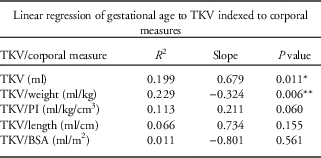
In this study, we sought to determine whether there was a link between the UAH and kidney mass that was independent of GA and reflective of the IUE. To determine the corporal index that was least reflective of gestational fetal growth a regression analysis was performed for each measure of TKV indexed by each of the corporal measures (Table 2). The corporal indices included weight (WT, kg), length (L, cm), ponderal index (PI=WT/L3, kg/cm3) and BSA (m2).Reference Du Bois and Du Bois 24
Paired analyses matched by GA
To assess the effects of the IUE independent of GA, infants were paired according to GA. The twins were considered to be reflective of a competitive IUE; whereas, the 6 preterm singleton infants of mothers with PE were considered an example of having an adversarial IUE. These infants were matched to preterm singletons of similar GA who had mothers without PE (non-PE).
Data analysis
All data sets were tested for normality with the D’Agostino and Pearson omnibus normality test. Intergroup comparisons were tested by one-way analysis of variance or by the Kruskal–Wallis test for non-parametric data with post-test comparisons by Sidak’s or Dunn’s multiple comparisons as appropriate. Differences between 2 continuous variables were analyzed by the Student’s t-test (parametric) or Mann–Whitney (non-parametric). The paired t-test was used to determine discordance between pairs of similar GA including the preterm twins and preterm singleton infants with and without maternal PE. Proportional differences were tested with Fisher’s exact test. Univariate correlations were performed with Pearson’s correlation coefficient (r). Multivariate linear regression models were used to test the predictive independent variables against a single continuous variable. Parametric data were expressed as the mean±standard deviation (s.d.) and non-parametric data as the median and interquartile range. Graph Pad Prism® and PAWS/SPSS® 18 were the statistical programs used to perform the statistical analyses and to construct the graphs. A P-value <0.05 was considered significant.
Results
Patient demographics
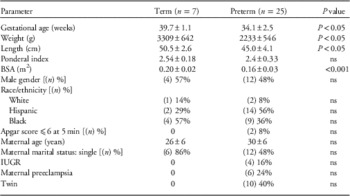
Baseline demographic data comparing term and preterm infants is shown in Table 1. Of the two groups, 17 of the 25 (68%) preterm infants compared with four of the seven (57%) full term infants were born via caesarian section. Six of the preterm infants (24%) were from pregnancies complicated by PE and 10 (40%) were from a twin gestation. Intrauterine growth restriction (IUGR), defined by fetal ultrasound as weight <10th percentile for GA, was noted in four (16%) of the preterm infants. Three of the four infants diagnosed with IUGR were twins. No infants born to mothers with PE had IUGR. None of the twin pairs was diagnosed with twin–twin transfusion syndrome.
Baseline demographics

BSA, body surface area; SES, socio-economic status; IUGR, intrauterine growth restriction.
TKV indexed to corporal measures
Consistent with normal fetal growth rates, absolute TKV correlated positively with GA (R 2=0.199; P=0.01)Reference Cohen, Cooper and Eisenberg 25 (Table 2). In an effort to individualize renal mass and to be able to distinguish kidney growth from fetal growth, TKV was factored by each of the corporal indices and correlated by regression analysis to GA (Table 2). The indices that did not correlate with GA were taken as being largely independent of fetal growth. Body length (L) and BSA were the only corporal indices that met this criterion with (TKV/L; R 2=0.07; P=0.16 and TKV/BSA; R 2=0.01; P=0.561). TKV/BSA was taken as the most independent measure for comparison to UAH.
The choice of a corporal index to be used to reference total kidney volume (TKV) was based on the index being independent of fetal growth by gestational age

PI, ponderal index; BSA, body surface area.
*P<0.05; **P<0.01 indicates significance.
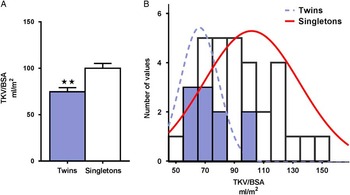
TKV/BSA for the 32 infants was normally distributed with a mean of 92±25 ml/m2 with a 95% confidence interval (95% CI) of 83→101 ml/m2. When TKV/BSA between term and preterm infants was compared, the preterm infants had a significantly greater kidney mass than the term infants (term: 85±16 v. preterm: 94±27 ml/m2; P=0.002). However, when compared with term and preterm singletons, the average TKV/BSA of twins was significantly less than that of the singletons (P=0.005) (Fig. 1a). This discrepancy is also demonstrated by the frequency histogram and Gaussian distribution curve of TKV/BSA showing a significant left shift of the curve in twins v. singletons (Fig. 1b). The superimposed Gaussian distribution curves showed that the mean TKV/BSA for twins (75±14 ml/m2 [95% CI 65→85 ml/m2) clustered at the lower 95% CI of the singletons (100±24 ml/m2 [95% CI 89→110 ml/m2]) (Fig. 1b).
Singletons versus twins-color. **Statistical significance at P<0.05.

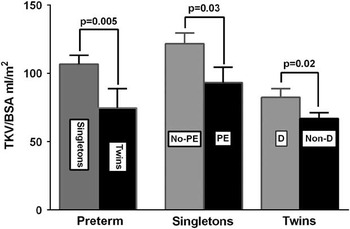
The preterm singletons from mothers with PE paired by GA to non-PE singletons showed a discordance in TKV/BSA (P=0.03) (Fig. 2). Similarly, twins demonstrated discordance in kidney size with one twin in each pair having a larger or ‘dominant’ kidney size when compared with their co-twin when factored by BSA (P=0.02) (Fig. 2).
Twins-D-ND & PE-vs-NonPE.

UAH: collagen v. muscular area
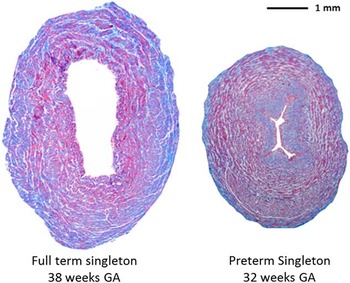
The umbilical artery total area was significantly greater in term v. preterm infants (9.3±1.3 v. 7.0±2.0 mm2; P=0.008) (Fig. 3). The total area increased with GA, with the muscular area and collagen area increasing proportionately (r=0.72; P=0.0002). However, the %muscular area and %collagen area did not correlate with GA. Among twins, one twin showed a ‘dominance’ of muscular area compared to the co-twin (4.8±0.3 v. 3.2±0.4 mm2; P=0.01). The %collagen area trended higher and %muscular area trended lower in singletons born to mothers with PE; however, this did not reach statistical significance.
Umbilical Artery Histomorphometry from full term and preterm infants depicting a smaller caliber umbilical artery in the preterm infant compared to the term infant. Trichrome stain - Blue (collagen) and red (muscular) components.

UAH linked to kidney mass
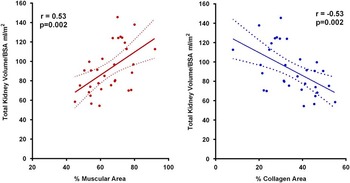
TKV/BSA was greater with increasing %muscular area and decreasing %collagen area (r=±0.53; P=0.002) (Fig. 4). The convergence of these regression equations at 50% muscular area corresponded to a TKV/BSA of 60 ml/m2. The TKV/BSA among all the infants ranged from 54 to 146 ml/m2 with a similar broad range in %muscular area of 42–93%.
Greater Total Kidney Volume/Body surface area (TKV/BSA) was associated with an increased umbilical artery muscular component and a decreased collagenous component which may indicate a relationship between nephrogenesis and vasculogenesis.

Univariate and multiple linear regression analyses
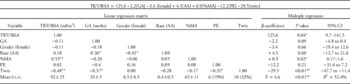
With TKV/BSA as the dependent variable by linear regression, the significant positive correlation was with %muscular area. On the contrary, the primary negative determinants of TKV/BSA were having maternal PE and twin gestation (R 2=52%; P<0.01) (Table 3).
Linear and multiple regression analyses

TKV/BSA, total kidney volume (ml)/body surface area (m2); GA, gestational age; AA, African American; %MA, percent muscular area; PE, preeclampsia.
*P<0.05; **P<0.01.
Discussion
In this preliminary cross-sectional cohort study we analyzed UAH by applying a unique digital imaging technique and established an important link between the IUE and kidney mass among a healthy cohort of singletons and twins. Subtle increases in the proportion of umbilical artery muscular density paralleled increased kidney mass and, therefore, a presumed advantage in nephron endowment. Conversely, a competitive (twin) or adversarial (maternal PE) IUE imposed significant deficits in TKV/BSA associated with increased vascular collagen. This discovery provides insight into the effect of a competitive and/or adversarial IUE in influencing components of the central vascular tree and nephron endowment, which may impact the individual’s health for a lifetime. This is the first study to our knowledge that has drawn associations between umbilical cord histology, the IUE and nephron mass. The umbilical vessels are a readily available source of tissue for studying the IUE that may lend important insight into the unanswered questions underlying the fetal origins of adult onset hypertension and cardiorenal disease. The results of this preliminary study demonstrate that distinct differences exist in kidney mass among infants experiencing an adversarial IUE that are independent of GA and not necessarily associated with growth restriction.
There is strong evidence that the majority of infants delivered before 36 weeks of gestation are in active phases of nephrogenesis, which can continue for up to 40 postnatal days.Reference Rodriguez, Gomez and Abitbol 26 – Reference Faa, Gerosa and Fanni 28 Extra-uterine nephrogenesis by autopsy studies has been shown to result in abnormal and insufficient numbers of glomeruli.Reference Rodriguez, Gomez and Abitbol 26 – Reference Crobe, Desogus and Sanna 29 Moreover, adults born preterm are at risk for developing subsequent chronic kidney disease believed to be due to oligonephronia and early renal senescence with the development of secondary focal glomerular sclerosis.Reference Chaturvedi, Ng and Mammen 30 – Reference Abitbol, DeFreitas and Strauss 32 Thus, in surviving individuals, a nephron deficit will impact their cardiovascular and renal health for a lifetime.Reference Brenner and Chertow 7 – Reference Luyckx and Brenner 10 Post-mortem studies in infants <3 months of age correlate kidney mass to glomerular number suggesting that the ‘nephrogenic potential’ should be reflected in the renal mass at birth.Reference Crobe, Desogus and Sanna 29 , Reference Zhang, Quinlan and Hoy 33 , Reference Goodyer, Kurpad and Rekha 34 As TKV alone parallels fetal growth and is directly related to GA, we sought to individualize assessment of nephron mass by factoring by each of four corporal indices including weight, length, ponderal index and BSA. In so doing, we determined that BSA was the most appropriate index for assessment of individual nephron mass. We found that it was largely independent of GA and consistent with other population studies.Reference Zhang, Quinlan and Hoy 33 – Reference Hoy, Hughson and Singh 35 Moreover, the Gaussian distribution of singletons against twins provided a true perspective of the potential nephron endowment if nephrogenesis were to continue to completion after birth.Reference Fanni, Gerosa and Nemolato 36
Importantly, UAH was able to differentiate the proportion of collagenous from the muscular area in the umbilical artery, which was also independent of GA and more reflective of the IUE. The normal umbilical artery structure has been described as having a well-developed intimal layer with variably arranged smooth muscle cells with remnants of an internal elastic lamina and a media layer being irregularly arranged with widened intermuscular spaces occupied by mucopolysaccharides.Reference Blanco, Vega and Guerri-Guttenberg 19 Several intrauterine conditions may alter the normal structure of the umbilical arteries, including PE.Reference Junek, Baum and Läuter 20 In this study, we found that an increase in %muscular area paralleled an increase in renal mass at birth, which infers an increase in nephron endowment and a more advantageous IUE. This would also be in concert with a more elastic and compliant vascular tree, as the umbilical vessels become an extension of the aorta. The converse was also observed, in that an increase in %collagen area was associated with an adverse IUE and less renal mass. Similarly, a ‘stiffer’ vascular tree would be projected for those individuals with denser collagen.Reference Burkhardt, Matter and Lohmann 37 – Reference Ligi, Simoncini and Tellier 42
Placental insufficiency is an important risk factor for fetal growth restriction and is a central component of PE.Reference Burkhardt, Matter and Lohmann 37 , Reference Lazdam, de la Horra and Pitcher 38 In this cohort, 24% of the preterm were affected by PE, which has previously been shown to adversely affect umbilical cord vessel development.Reference Togni, Araujo Junior and Moron 43 – Reference Peyter, Delhaes and Baud 45 We found that there was a trend towards increased %collagen deposition in the umbilical arteries of preterm infants exposed to maternal PE compared with GA-matched controls. Although functional measures of compliance were not performed, this study corroborates previous findings of increased collagen content in the umbilical arteries associated with PE.Reference Togni, Araujo Junior and Moron 43 – Reference Peyter, Delhaes and Baud 45 Others have associated this increased collagen with decreased compliance by functional measures which may account for the hypertension and stroke that is observed in these individuals in later life.Reference Dodson, Martin and Hunter 46 , Reference Davis, Lazdam and Lewandowski 47
Abnormal placental function with maternal PE has been associated with impaired nephrogenesis independent of overt fetal growth restriction.Reference Lazdam, de la Horra and Pitcher 38 , Reference Davis, Lazdam and Lewandowski 47 In this cohort, the preterm infants with maternal PE had significantly smaller TKV/BSA than their GA-matched controls. In addition, in multiple regression analysis, PE was inversely associated with TKV/BSA. Alterations in placental perfusion have previously been correlated with decreased nephron number.Reference Kooijman, Bakker and van der Heijden 48 , Reference Verburg, Geelhoed and Steegers 49 Abnormal fetal blood flow distribution is a marker of placental insufficiency and has been associated with smaller fetal and childhood kidney size.Reference Verburg, Geelhoed and Steegers 49
Twin gestation offers a venue for investigating the impact of a competitive IUE on kidney and vascular development. Twins had overall smaller TKV/BSA compared with preterm singletons of similar GA. Furthermore, one twin in the pair showed a ‘dominance’ of TKV/BSA as well as ‘dominance’ for %muscular area. These preliminary findings suggest a possible inherent competition for growth factors driving renal and vascular development that might be independent of placental nutrition. There was no superimposed PE or twin–twin transfusion syndrome to account for these differences.
Among twin pairs, a greater umbilical artery %muscular area was associated with a greater kidney size, further supporting the link between renal and vascular development. In addition, in multiple regression analyses, being a twin negatively impacted the TKV and umbilical artery muscular area. Twin studies have shown that twins with lower birth weight may have worse renal outcomes, as well as increased risk of cardiovascular disease.Reference RG, Stehouwer and Boomsma 50 – Reference Rajan, Barbour and White 53 Although the exact mechanism is unknown, it may be related to competition during vascular development and nephrogenesis in fetal life.Reference RG, Stehouwer and Boomsma 50 – Reference Rajan, Barbour and White 53 The convergence of TKV/BSA and umbilical artery %muscular area and %collagen area suggests that UAH could predict renal mass at birth.
Our study was limited by the small sample size and lack of functional measures of umbilical artery compliance. In addition, while the paraffin embedding process is known to cause some degree of shrinkage on tissue, the exact implication is unknown and as it applies universally to this application we believe the results remain generalizable. In addition, the applicability of the Du Bois formula to calculate BSA has been questioned in the pediatric population, specifically as it likely underestimates BSA in the group that would then result in a decreased TKV/BSA.Reference Pottel 54 However, the Du Bois formula was chosen, as it is the most commonly reference applied to TKV in the literature. In addition, although fat mass distribution in females varies from males and could lead to gender differences in the TKV/BSA, in the multivariate analysis performed the effect of female gender was not significant for TKV/BSA. Strengths of the study included recruitment of singletons and twins across GA groups and concurrent collection of umbilical cord specimens with clinical outcome measures including kidney size. Although this study is preliminary and exploratory, the differences noted in UAH suggest that subtle discordances exist that may be able to predict those infants who are at most risk of the long-term consequences of an adversarial IUE, such as being born preterm, twin, and/or exposed to PE. Risk stratification of these infants may allow for a more targeted approach to proactive screening for early onset cardiorenal disease, which has been previously proposed for the preterm population.Reference Abitbol and Rodriguez 55 , Reference Carmody and Charlton 56 Prospective longitudinal studies are needed to determine if the anatomical discordances in umbilical cord vessels and TKV/BSA observed in this study predispose to functional impairment in singletons and twins. UAH is a non-invasive means of evaluating the IUE and its effects on neonatal renal and vascular development, which may lend important insight into future vascular health and predisposition to cardiovascular and renal disease among the most at risk infant groups.
Acknowledgments
The authors acknowledge the kind support and assistance of the many neonatal nurses and neonatologists at the Holtz Children’s Hospital.
Financial Support
This study was funded primarily by a grant from the Gerber Foundation, The Mary Jane Mcmillen-Crowe Foundation which had no influence on (1) the study design; (2) the collection, analysis, and interpretation of data; (3) the writing of the report; or (4) the decision to submit the paper for publication.
Conflicts of Interest
None.
Ethical Standards
The authors assert that all procedures contributing to this work comply with the ethical standards of the relevant national guidelines on human experimentation including the Health Insurance Portability and Accountability Act and with the Helsinki Declaration of 1975, as revised in 2008, and has been approved by the University of Miami Institutional Review Board.