Introduction
According to Wagenitz (Reference Wagenitz and Rechinger1980) the genus Centaurea s.l. consists of 89 species in 28 sections of which 70 species are found in Iran. Twenty species, seven subspecies and two varieties are endemic to Iran.
Following on from our previous research on Centaurea L. (Asteraceae, Cardueae) in Iran (Ranjbar & Negaresh, Reference Ranjbar and Negaresh2012, Reference Ranjbar and Negaresh2013a, Reference Ranjbar and Negaresh2013b; Ranjbar et al., Reference Ranjbar, Negaresh and Karamian2012, Reference Ranjbar, Negaresh and Karamian2013a, Reference Ranjbar, Negaresh and Karamian2013b), and in the course of recent collecting activities in western Iran, we have identified two new interesting species from Centaurea sect. Cynaroides Boiss. ex Walp.
In addition, we designate a lectotype for Centaurea aziziana Rech.f. from Centaurea sect. Phalolepis (Cass.) DC., a small section in Iran with two species.
Species Descriptions
1. Centaurea shehbazii Ranjbar & Negaresh, sp. nov. (Sect. Cynaroides).
Centaureae regiae subsp. regiae affinis, sed foliis basalibus late lanceolatis, cartilagineodentatis (nec ovato-subcordatis vel raro lyratis), foliis caulinis superioribus oblongo-ellipticis (nec lanceolatis), involucri phyllis dense lanato-tomentosis (nec glabrescentibus), appendicibus magnitudine mediis, phyllorum ungues non omnino obtegentibus (nec magnis, phyllorum ungues omnino obtegentibus), phyllorum mediorum appendicibus ovato-triangularibus, 13–16 × c.18 mm, atropurpureis ad nigris in parte centrali (nec late ovatis, 20–25 × 20–25 mm, albidis), appendicibus exterioribus triangularibus, nigris (nec ovatis, albidis), ciliis utrinque 8–12 (nec 10–17), spinis terminalibus appendicum mediorum (3–)5–8 mm (nec (8–)9–14 mm) longa, pappo exteriore 15.5–16 mm (nec 10–13 mm) longo differt. – Type: Iran, Kermanshah, 5 km to Ravansar, Baveh Geh village, 1420 m, 30 v 2012, Ranjbar & Negaresh 28805 (holo BASU!).
Biennial with thick fleshy taproot, whole plant usually green, up to 60 cm tall. Stem erect, usually simple, c.12 mm in diam. at the base, cylindrical, with thick white striations, loosely leafy to median part, lower part reddish, subglabrous to sparsely hirsute-articulate hairy, up to 1.5 mm long, median part loosely covered with hirsute-articulate and sessile glandular hairs, upper part loosely arachnoid with a mix of hirsute-articulate and sessile glandular hairs, sometimes only with sessile glandular hairs. Leaves stiff, papyraceous (on drying), with prominent veins on both sides, almost covered with hirsute-articulate hairs, denser along midrib and veins, up to 0.7 mm long, and sessile glandular hairs, margins scabrous. Basal leaves simple, c.30 × 12 cm, broadly lanceolate, with a c.12 cm long petiole, acute at apex, cartilaginously dentate. Lower cauline leaves simple, 27–33 × 13–14 cm, broadly ovate or broadly ovate-lanceolate, with a 7.5–12.5 cm long petiole, acute at apex, entire or cartilaginously dentate. Median cauline leaves sessile, narrowly decurrent up to 1.8 cm along stem, oblanceolate or ovate-lanceolate, 15–20 × 6–10.5 cm, acute at apex, entire. Upper cauline leaves increasingly smaller, sessile, c.9.5 × 3.7 cm, oblong-elliptic, loosely covered with a hirsute-articulate mix of arachnoid hairs, obtuse at apex, narrowly decurrent up to 1.2 cm along stem. Capitula 5(–7), arranged in a raceme, peduncles naked, upper ones 9–16 cm long. Involucres ovoid-globose or ovoid, truncate at base, 40–45 × 30–40 mm. Phyllaries multiseriate, green (in dry state yellow-greenish), imbricate, coriaceous, densely covered with lanate-tomentose appressed hairs. Outer phyllaries oblong, 3.5–8 × 8.2–9.8 mm; appendages shortly ovate, c.9 × 15–16 mm (including cilia and spine), straw-coloured with purple striations or purple throughout. Median phyllaries oblong or rectangular, 12–17 × c.12 mm; appendages ovate-triangular, 13–16 × c.18 mm (including cilia and spine), deep purple to blackish in central part. Inner phyllaries lanceolate-oblong or lanceolate-linear, 21–36 × 10–14 mm; appendages triangular, 12–15 × 4–15 mm, blackish. Appendages medium-sized, concealing basal part of phyllaries, chartaceous, not decurrent; cilia narrowly triangular, white or white-purple, numerous, 8–12 on each side, 1–6 mm long; spines rigid, reddish or blackish, triangular, (3–)5–8 mm long, equal to or longer than the adjacent cilia. Flowers rose; central florets hermaphroditic, c.65 mm long, corolla c.19 mm long, 5-lobed, lobes ± 8.5 mm long; peripheral florets sterile, finely, not radiant, 4-lobed, limb lobes linear, c.9 mm long. Achenes oblong, 6.2–6.5 mm long, 2.2–3.2 mm wide, yellowish, glabrescent, hilum 0.8–1 mm long. Pappus persistent, double, multiseriate, scabrous, whitish or pale brown; outer pappus c.15.5–16 mm long; inner pappus shorter, c.6 mm long.
Etymology. This species is named in honour of Dr Ihsan Al-Shehbaz.
Phenology. Flowering in May and fruiting in May to June.
Distribution and habitat. Centaurea shehbazii is a rare endemic of western Iran and to our knowledge grows only on rocky slopes, roadsides and fallow fields at an altitude of 1350–1550 m around Baveh Geh village near Ravansar in Kermanshah province. It grows along with Avena barbata Pott ex Link subsp. barbata, Centaurea amadanensis Sch.-Bip. var. gymnoclada (Jaub. & Spach) Wagenitz, Centaurea behen L., Centaurea regia Boiss. subsp. regia, Phlomis olivieri Benth., Scabiosa rotata M.Bieb. and Zoegea leptaurea L.
2. Centaurea solitaria Ranjbar & Negaresh, sp. nov. (Sect. Cynaroides).
Centaureae regiae subsp. regiae affinis, sed foliis caulinis inferioribus rhombicis vel rhombico-lanceolatis, denticulatis, 4.3–4.4 cm latis (nec late lanceolatis, integris vel in parte inferiore pinnatilobatis, c.10 cm latis), capitulo solitari (nec capitulis pluribus, in racemis dispositis), involucro globoso-ovoideo, c.35 × 38 mm (nec subgloboso, 40–55 × 40–60 mm), involucri phyllis dense tomentosis (nec glabrescentibus), appendicibus exterioribus triangularibus (nec ovatis), appendicibus phyllorum mediorum triangularibus, 16–18 × 13–16 mm, brunneis (nec late ovatis, 20–25 × 20–25 mm, albidis), appendicibus interioribus anguste lanceolatis, brunneopurpureis (nec ovatis, albidis), ciliis utrinque 4–8 (nec 10–17), spinis terminalibus appendicum mediorum 5–9 mm (nec (8–)9–14 mm) longis differt. – Type: Iran, Kermanshah, Ravansar, 1380 m, 14 vi 2012, Ranjbar & Negaresh 28821 (holo BASU!; photo B).
Biennial plants, collar of fibrous petiolar remains present at base of stem, c.65 cm tall. Stem erect, always simple, yellowish, c.6 mm in diam. at the base, cylindrical, with thin white striations, sparsely leafy, lower part subglabrous to sparsely short hirsute-articulate hairy, median part sparsely covered with hirsute-articulate hairs, up to 0.8 mm long, and sessile glandular hairs, upper part sparsely arachnoid, sometimes a mix of scattered hirsute-articulate and sessile glandular hairs. Leaves rigid, papyraceous (on drying), smallish, rather densely covered with short hirsute-articulate hairs, especially along midrib and veins, up to 0.8 mm long, and sessile glandular hairs, margins subscabrous. Basal leaves unknown. Lower cauline leaves simple, sometimes withered when flowering, 18–23.5 × c.4.3–4.4 cm, rhombic or rhombic-lanceolate, narrowed at each end, petioles 6.5–11.5 cm long, acuminate at apex, denticulate. Median cauline leaves sessile, decurrent, up to 3 cm along stem, oblong, 7.7–14 × 1.5–2.8 cm, acuminate at apex, entire, rarely denticulate. Upper cauline leaves successively smaller, sessile, 2.7–3 × 0.3–0.65 cm, linear or bract-like, densely covered with a hirsute-articulate mix of scattered arachnoid hairs, narrowly decurrent up to 0.8 cm along stem. Capitula solitary, peduncle up to 3.7 cm long; involucres globose-ovoid, c.35 × 38 mm. Phyllaries multiseriate, green or reddish above, imbricate, coriaceous, densely covered with tomentose hairs. Outer phyllaries oblong, 3.5–5 × 5–6.5 mm; appendages triangular, 13–14 × c.12 mm (including cilia and spine), straw-coloured. Median phyllaries oblong-lanceolate, 7–11 × 8–9.5 mm; appendages triangular, 16–18 × 13–16 mm (including cilia and spine), brownish. Inner phyllaries lanceolate, 15–20 × c.10 mm; appendages narrowly lanceolate, 15–18 × 9–14 mm (including cilia and spine), brown to purple. Appendages medium-sized, concealing major part of phyllaries, chartaceous, not decurrent; cilia narrowly triangular, subreflexed, numerous, 4–8 on each side, 1.5–6.5 mm long; spines narrowly triangular, 5–9 mm long, longer or ± equal to the adjacent cilia. Flowers purple-rose; central florets hermaphroditic, 48–50 mm long, corolla c.16–17 mm long, 5-lobed, lobes 7.2–8 mm long, with yellow nerves; peripheral florets finely, not radiant, 4-lobed, limb lobes linear, c.8 mm long. Achenes oblong, 6.3–7.3 mm long, 3.2–3.8 mm wide, smooth and shiny, yellowish, rounded at apex, glabrescent, hilum 0.7–1 mm long. Pappus persistent, double, multiseriate, scabrous, whitish; outer pappus 13–14 mm long; inner pappus shorter, 5–7 mm long.
Etymology. The specific epithet solitaria means ‘capitule solitary’.
Phenology. Flowering in May to June and fruiting in June.
Paratypes. Iran, Kermanshah, 25 km to Ravansar, 1450 m, 25 vi 2012, Ranjbar & Negaresh 28848 (BASU!), 28842 (BASU!).
Distribution and habitat. Centaurea solitaria is a rare endemic of western Iran and to our knowledge grows only on clay slopes and in fallow fields around Ravansar in Kermanshah province. It grows along with Avena barbata Pott ex Link subsp. barbata, Centaurea behen L., Centaurea regia Boiss. subsp. regia, Echinops sp., Scabiosa rotata M.Bieb. and Zoegea leptaurea L.
Relationships
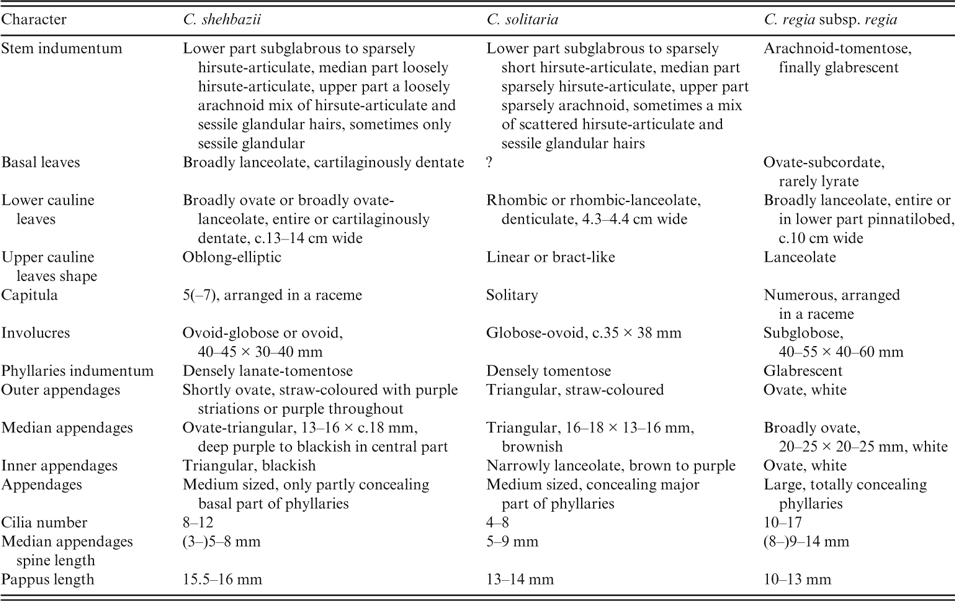
Centaurea shehbazii and C. solitaria belong to Centaurea sect. Cynaroides, which includes taxa that often have solitary capitula or racemose synflorescences, decurrent upper cauline leaves, subglobose involucres, triangular to ovoid or orbicular appendages which are not decurrent, usually ciliate and ending in a firm spine or spinule, and with rose or purple or yellow flowers (Ranjbar et al., Reference Ranjbar, Negaresh and Karamian2013b). Centaurea shehbazii is similar to C. regia subsp. regia in having decurrent upper cauline leaves and in the shape of the inflorescence, the colour of the flowers and the length of the achenes. Centaurea shehbazii differs from C. regia subsp. regia in the characters listed in Table 1.
Diagnostic morphological characters of Centaurea shehbazii, C. solitaria and C. regia subsp. regia

Centaurea shehbazii is also similar to C. haradjianii Wagenitz (Haradjian 615), endemic to Turkey, in characters such as the texture and indumentum of the leaves, the racemose inflorescence, and the appendages only partly concealing the basal part of the phyllaries, but differs from it by having lower cauline leaves broadly ovate or broadly ovate-lanceolate and entire or cartilaginously dentate (vs. oblong-cordate, entire), median cauline leaves oblanceolate or ovate-lanceolate (vs. lanceolate), upper cauline leaves oblong-elliptic (vs. linear-lanceolate), involucres 40–45 × 30–40 mm (vs. 25–28 × 17–25 mm), phyllaries indumentum densely lanate-tomentose (vs. glabrescent), median and inner appendages deep purple to blackish (vs. dark brown), cilia 8–12 (vs. 7–9) on each side, and also pappus 15.5–16 mm (vs. c.9 mm) long.
Centaurea solitaria is similar to C. regia subsp. regia in the indumentum of the leaves, the shape of the median cauline leaves, and the shape of the achenes and the pappus, but differs by the characters listed in Table 1.
Lectotypification
Centaurea aziziana Rech.f. (Sect. Phalolepis), Österr. Bot. Zeitschr. 97: 255 (1950). – Type: Iran, Prov. Mazandaran, Kojur, between Zonus and Kinch, 1300–1600 m, Rechinger 6576 (lecto W!, designated here; isolecto B!, BM!, E!, K!, MO!, NYBG!, S!, US!, photo BASU!).
Distribution. Iran (Mazandaran and Azerbaijan provinces). It has also recently been reported for Turkey (Armağan & Ünal, Reference Armağan and Ünal2009).
Specimens examined. Iran. Prov. Azerbaijan: Siah Rud toward Kaleybar, after Masan village, before Kalaleh village, 380 m, 25 v 2011, Ranjbar & Negaresh 26244 (BASU!); Ahar to Meshkin Shahr, 36 km to Meshkin Shahr, 1106 m, 25 vi 2012, Ranjbar & Negaresh 29352 (BASU!).
Acknowledgements
The hospitality and assistance of Dr Vitek, Dr Wallnöfer, Dr Till, Dr Sida, Dr Gautier and Mr Fumeaux during our visits to the herbaria W and WU in Vienna, PR in Prague and G in Geneva are much appreciated. The field work in Iran was supported by grants from the Bu-Ali Sina University.