


1. INTRODUCTION
The fundamental proposition of the distributive politics literature is that politicians manipulate the allocation of resources for their own gain. In South Korea (hereafter Korea), the presidency has often been described as an “imperial office” that remains relatively unconstrained by horizontal checks (Horiuchi and Lee Reference Horiuchi and Lee2008; O'Donnell Reference O'Donnell1994; Park Reference Park2003), and such political power naturally extends to budgetary decisions, as Korea's constitutional and political institutions vest presidents with disproportionate influence to strategically bias the distribution of government resources to achieve their political objectives.
In this article, I examine how the political interests of Korean presidents shape the distribution of the national subsidy, which is a form of annual transfers from the central government to municipalities—the main administrative districts in Korea—that makes up a considerable share of both the government's general accounts spending (around 15 percent) and municipal revenue (around 30 percent). For comparison, the budget for the national subsidy in 2018 was on par with the United States government's discretionary spending (around $61 billion) in healthcare in the same year (Congressional Budget Office 2019).Footnote 1 While the national subsidy is broadly designed to provide additional funding for the provision of basic services and the development of local projects, its distribution is controlled by the central government through an application-based process that is not tied to any predetermined formula, and has often been criticized for lacking transparency and being susceptible to political manipulation. Since many municipalities are highly dependent on transfers from the central government to maintain basic operations, even small systematic biases in the distribution of the national subsidy may accumulate and engender considerable inequality in the long run.
Who benefits from presidentially manipulated allocations of the national subsidy? To discern the targeting logic that drives observed patterns of subsidy allocations, I begin with the core-swing framework, which centers on uncovering what types of voters or districts receive a disproportionate share of politically motivated transfers (Cox and McCubbins Reference Cox and McCubbins1986; Dixit and Londregan Reference Dixit and Londregan1996). However, extant literature has largely neglected considerations of how broader political objectives could alter incentives and generate distinct patterns of core-swing targeting. Such objectives are especially critical for understanding the targeting behavior of Korean presidents who, given their position, can be expected to prioritize aggregate political outcomes over winning individual electoral contests that concern particular types of voters or districts.
The key political objective of interest in this article is the competition for majority control of the legislature. I argue that presidents seek to achieve control over the legislature by helping their co-partisans win a majority of the seats in legislative elections, and do not unequivocally prioritize core or swing municipalities, but strategically initiate divergent patterns of subsidy allocations conditional on their majority status, i.e., whether presidents (and their respective parties) currently control a majority of the seats in the legislature. Presidents who already enjoy a legislative majority are anticipated to select a majority-preserving targeting strategy that invests more subsidies in core municipalities to strengthen the foundations of their majority constituency, whereas those who face an opposition-controlled legislature are instead expected to opt for a majority-building targeting strategy that directs a higher share of subsidies to swing municipalities in an effort to increase their legislative seat shares and seize majority control. I also account for the impact of the electoral cycle, which has been shown to be an important predictor of patterns of government spending, and I suggest that presidents respond to the timing of elections by shifting subsidies from safer to riskier municipalities when elections approach and voters become more responsive to transfers. Using a novel data set on national subsidy allocations that spans three decades, I find evidence in favor of the hypotheses, and that presidents demonstrate the ability to flexibly utilize their strong budgetary powers to engage in complex and varied targeting strategies.
The remainder of the article is structured as follows. In Section 2, I outline the budgetary powers of Korean presidents, and contend that presidents strategically apportion the national subsidy to bolster their chances of obtaining majority control of the legislature, from which I build my hypotheses of conditional core-swing targeting. I discuss my empirical setup and results in Sections 3 and 4, before providing concluding remarks in Section 5.
2. PRESIDENTIAL TARGETING OF THE NATIONAL SUBSIDY AROUND LEGISLATIVE ELECTIONS
2.1 PRESIDENTIAL CONTROL OVER THE GOVERNMENT BUDGET
Korea's constitutional and political institutions ensure that the president's interests are incorporated into the government budget. The budget compilation process is highly centralized, and is overseen by the Presidential Office “in order to take the government's opinions into consideration” (Ministry of Strategy and Finance 2014). Kim and Yun (Reference Kim and Yun2002) find that 45.6 percent of bureaucrats and legislators who were questioned about their participation in the budget compilation process agreed (as opposed to 20.8 percent who disagreed) with the statement that the president's electoral commitments are directly reflected in the budget, while Park (Reference Park2003) notes that more than half of the budget committee members he surveys judge that their own influence over the budget is “weak” or “almost none.”
Although the Korean constitution grants the National Assembly, Korea's unicameral legislature, an opportunity to review and modify the budget proposal, its influence is limited due to a lack of time, resources, expertise, and a law that prevents the National Assembly from increasing the budget or introducing new budget items; net changes to the budget proposal rarely exceed 1 percent (Park Reference Park2003). Moreover, Korean parties are weakly institutionalized and tend to be electoral machines that are subservient to the whims of political leaders, as it is the leaders rather than the parties who possess a stable political support base and access to funding (Kim Reference Kim, Diamond and Kim2000; Wong Reference Wong, Hicken and Kuhonta2015). Since presidents are relatively unconstrained by other actors when determining the budget, observed patterns of subsidy allocations should accurately reflect the logic underlying the targeting strategies that presidents select.
Korean presidents have often flexed their budgetary powers, for better or worse. For example, Kwon (Reference Kwon2005) discusses how Roh Tae Woo, the winner of the inaugural democratic presidential election, fulfilled his campaign promise to build two million housing units by constructing three entirely new cities around Seoul, even though—according to Lawrence Krause, the then-director of the Korea-Pacific program at UC San Diego—this decision was a “serious policy mistake” that triggered an inflationary spiral (Jameson Reference Jameson1992). Likewise, Horiuchi and Lee (Reference Horiuchi and Lee2008) discuss how Kim Young Sam injected around $13.5 billion into the agricultural sector to combat the rapid erosion of his popularity due to the negative consequences of agricultural liberalization, and even introduced a special tax to support the restructuring of the agricultural sector.
2.2 THE NATIONAL SUBSIDY
Annual funding from the central government to municipalities come in two main forms—local allocation tax, and national subsidy—and each form of funding accounts for around 30 percent of municipal revenue on average. Many municipal governments are highly dependent on such transfers to maintain basic operations. From 1989 to 2018, revenues raised by municipal governments only account for around 30 percent of their total revenue on average, and Kim and Kim (Reference Kim and Kim2003) find that more than half of the municipal governments lack the fiscal capacity to cover their employee salaries with their own tax revenues.
Whereas the distribution of the local allocation tax is determined by the fiscal revenues and expenditures of municipal governments, the national subsidy is a discretionary grant that is not governed by any predetermined formula, and thus is regarded as being heavily influenced by the political interests of the central government (e.g., Jun Reference Jun2012; Kwon Reference Kwon2005; Park Reference Park1997; Yoo and Gu Reference Yoo and Gu2016). Municipal governments, who are better informed about the preferences of their own residents, apply for the national subsidy after assessing their needs, and the central government has the freedom to award the national subsidy to fund basic services and local projects across a wide variety of categories, as shown in Figure 1.
Overview of the 2018 National Subsidy Budget

Problems of credit-claiming are largely absent in Korea since institutions centralize power in the hands of the president, which makes presidents and their co-partisans the main beneficiaries of any good-will generated by improved flows of resources (Anderson Reference Anderson2007; Powell and Whitten Reference Powell and Whitten1993); numerous studies illustrate that Korean voters reward presidents and their respective parties for improved local economic performance (e.g., Choi and Park Reference Choi and Park2012; Hong and Park Reference Hong and Park2014; Kang Reference Kang2016; Lee Reference Lee2003; Park Reference Park2009). Hence, the national subsidy is a highly flexible and efficient budgetary tool that can be strategically disbursed to satisfy voter demands and bolster electoral support within municipalities; it has even been described as a “fertilizer in a ballot field” (Jun Reference Jun2012).
2.3 CORE-SWING TARGETING
Who benefits from presidentially manipulated allocations of the national subsidy? In the Cox and McCubbins (Reference Cox and McCubbins1986) and Dixit and Londregan (Reference Dixit and Londregan1996) theoretical models of distributive politics, two parties compete within a single district and deliver resources to voters with the goal of winning an election that follows plurality rule, and voters only support their less preferred party if it is expected to provide a transfer large enough to outweigh their attachment to their preferred party. Cox and McCubbins conclude that candidates will grant more resources to their core supporters who can be targeted more efficiently and are safer investments, whereas Dixit and Londregan deduce that swing voters will be advantaged since they are more likely to switch their votes in response to transfers.
These two models examine tactical redistribution within a single district whereas most of the empirical research on the core-swing debate is situated within multi-district contexts; naturally, since almost all electoral contests are multi-district. While such studies are tests of the core-swing district hypotheses rather than the core-swing voter hypotheses (Golden and Min Reference Golden and Min2013), the district level of analysis is nevertheless highly applicable to cases such as Korea in which a unitary actor—the president—possesses strong control over the budget, and a few votes can mean the difference between winning and losing a legislative seat (Cox Reference Cox, Shapiro, Stokes, Wood and Kirshner2009; Stokes et al. Reference Stokes, Dunning, Nazareno and Brusco2013). However, multi-district studies tend to be framed as empirical tests of competing hypotheses that are less concerned with developing ex ante rationale for why politicians might favor core or swing districts, instead relying on variants of the theories presented in the Cox–McCubbins and Dixit–Londregan models to justify their findings. This abrupt transition from the single-district theoretical models to multi-district empirical tests has come at the cost of theoretical oversight about how a multi-district setting can introduce additional incentives and generate varied targeting strategies. As a result, it is unsurprising that the empirical evidence appears to be contradictory.Footnote 2
The implicit assumption in the literature is that politicians manipulate resource allocations to “win” elections but, while winning an election within a single district is indeed an end in itself, what constitutes “winning” in a multi-district election depends on combined outcomes across all the districts. Stated otherwise: how presidents allocate resources to win obviously depends on how they win, and that in turn depends not only on how effectively resource allocations yield wins in individual contests, but also on how performance across these individual contests aggregate to overall winning at the system level.Footnote 3
As Cox (Reference Cox, Shapiro, Stokes, Wood and Kirshner2009) discusses, parties engage in both “electoral targeting (distributing benefits to optimize electoral outcomes)” and “legislative targeting (distributing benefits to optimize legislative outcomes).” It is reasonable to assume that presidents, who are both the leaders of their respective parties and the heads of government, aim to optimize outcomes across the two arenas, and that winning core or swing municipalities is a second-order concern. The logic of strategic targeting that I develop in the following section extends beyond considerations of district level characteristics by accounting for broader political objectives; I argue that presidents strategically target the national subsidy to “win” legislative elections by securing a majority of the seats (i.e., optimize electoral outcomes) so that they can establish control over the legislature (i.e., optimize legislative outcomes).
2.4 MAJORITY-PRESERVING VERSUS MAJORITY-BUILDING TARGETING STRATEGIES
The key assumption in my argument is that presidents seek to “win” legislative elections by helping their co-partisans win a majority of the seats in the legislature. Legislative elections for the National Assembly are held every four years, and presidents face at least one legislative election during their five-year term. Around 300 seats go up for election with approximately 80 percent of the seats filled via single member district plurality rule, and the remainder through closed party-list proportional representation at the national level. The benefits that come with majority control of the legislature are discussed extensively in the comparative politics literature,Footnote 4 and presidents are able to exert considerable influence over the legislature when their parties possess a legislative majority since party discipline is strong in Korea. Moreover, the difference between possessing majority control and facing an opposition-led legislature is likely to be even more pronounced for Korean presidents due to the propensity for Korean politicians to treat politics as a zero-sum game (Croissant Reference Croissant, Croissant and John2002; Park Reference Park, Diamond and Shin2000).
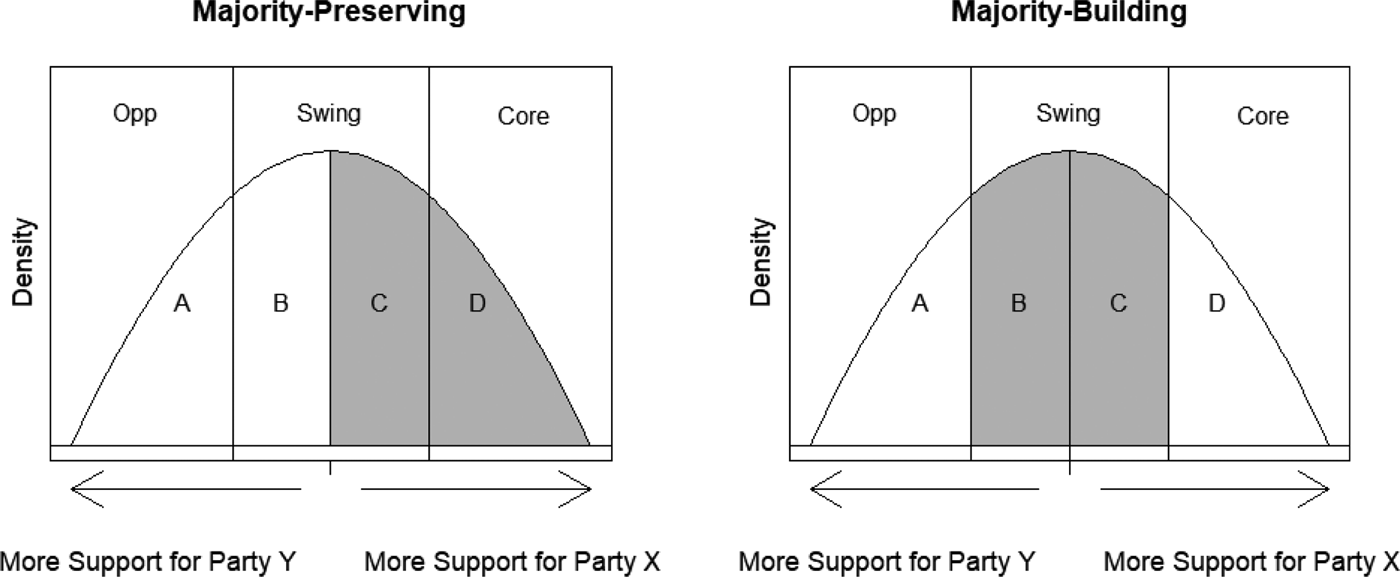
Given this objective of achieving a legislative majority, I hypothesize that presidents select targeting strategies conditional on their majority status. Let the incumbent president's party X be competing against opposition party Y in a legislative election. Assume that the president faces a budget constraint, and that the electoral responsiveness of municipalities to transfers from party X is positively related to their support for party X. Figure 2 represents a distribution of municipalities in terms of their relative support for the two parties, which are divided into core, swing, and opposition municipalities for party X based on some arbitrary boundaries,Footnote 5 and the two divergent targeting strategies discussed in this section: majority-preserving and majority-building. The two shaded areas represent the set of municipalities that each targeting strategy favors with resources.
Targeting Strategies

Presidents who already control a legislative majority face less electoral pressure to increase their seat share since, for the most part, their parties can retain a majority by holding onto as many of their seats as they can, while swaying a few municipalities to offset any losses. This mindset is likely to be reinforced as the marginal benefit of winning additional seats is normally insignificant for presidents who already possess a legislative majority, whereas losing a few seats could cause them to relinquish control of the legislature. Accordingly, an aggressive majority-expanding targeting strategy that aims to increase their seat shares by prioritizing swing municipalities may not be enticing. Rather, majority-holding presidents can be expected to opt for a more conservative majority-preserving targeting strategy that sets aside a portion of government resources for the subset of swing municipalities that are required to maintain a majority,Footnote 6 while investing the bulk of the remaining resources into core municipalities, i.e., municipalities in areas C and D. Cox presents a similar intuition when he notes that parties that engage in core-targeting may be attempting to secure a “vice-like grip on a small majority” (Cox Reference Cox, Shapiro, Stokes, Wood and Kirshner2009, 348) instead of aiming to increase their seat shares, but he does not explore when parties might choose the former strategy over the latter. I suggest that it is when presidents possess a legislative majority that they have incentives to divert more resources to core municipalities, which form the foundations of their majority constituency, rather than compete over many riskier swing municipalities.
It could be argued that the marginal benefit of winning an additional vote is greater in swing municipalities than in core municipalities, and thus presidents who pursue a legislative majority should uniformly concentrate subsidies in swing municipalities regardless of their majority status.Footnote 7 Such a logic would hold if core municipalities were indifferent to distributive benefits, or lack thereof. However, core municipalities are likely core in the present partly due to the distributive benefits that they have received in the past, and may expect such flows to persist in return for their continued loyalty.Footnote 8 As Cox and McCubbins (Reference Cox and McCubbins1986, 380) point out, “it seems irrational for any group (supportive or not) to be totally unresponsive to redistribution of welfare,” and core municipalities are unlikely to remain steadfast in their support if they are continually neglected in favor of other municipalities. Committing resources to core municipalities may be necessary to ensure that they stay core by not only rewarding and maintaining loyalty, but also mobilizing supporters and dissuading the entrance of potential competitors (Ansolabehere and Snyder Reference Ansolabehere and Snyder2006; Bickers and Stein Reference Bickers and Stein1996; Chen Reference Chen2013; Cox Reference Cox, Shapiro, Stokes, Wood and Kirshner2009; Diaz-Cayeros, Estévez, and Magaloni Reference Diaz-Cayeros, Estévez and Magaloni2016; Nichter Reference Nichter2008). Since the defection of core municipalities forces presidents to compensate by winning additional swing municipalities in order to cross the majority threshold, the risk of losing or failing to obtain majority control increases without the overwhelming backing of core municipalities. Thus presidents still have incentives to ensure that they receive the full support of core municipalities when they face less pressure to win seats held by competing parties, i.e., when they are majority-holders.
Contrarily, presidents who lack a legislative majority cannot accomplish their goal of seizing majority control from the opposition if their parties do not win seats held by opposition parties. To improve their prospects, majority-seeking presidents can choose a majority-building targeting strategy that bets on the existing electoral support in core municipalities that has been built up from past investments and channels more resources toward swing municipalities in an effort to sway their support—that is, those in areas B and C. Nevertheless, such a tactic is riskier, as the response of swing municipalities to transfers is less certain, and the support of core municipalities may erode in response to reduced transfers.
2.5 ELECTORAL CYCLE
Timing has also been shown to shape patterns of government spending (e.g., Tufte Reference Tufte1975; Nordhaus Reference Nordhaus1975; Rogoff Reference Rogoff1990). Kang (Reference Kang2015) applies this literature to analyze variations in the targeting of the national subsidy in Korea, and his findings indicate that presidents reward core municipalities for their support during off-election years when a legislative election is not imminent; but they shift to targeting swing municipalities in the year prior to legislative elections, or pre-election years, when voters become more responsive to transfers and electoral concerns come to the forefront. Thus, failing to account for the electoral cycle may lead to spurious conclusions about legislative-majority oriented targeting.
My argument can complement Kang's insight to produce a more nuanced understanding of strategic targeting that is conditional on both majority status and the electoral cycle. Rather than gaining prominence in pre-election years, I suggest that electoral concerns are always present for presidents given the political significance of majority control. I therefore hypothesize that presidents select a targeting strategy based on their majority status, but diversify its implementation over the course of the electoral cycle to enhance the efficiency of their selected targeting strategy. If, as Kang argues, voters become more responsive to transfers as elections approach, then the marginal benefit associated with targeting municipalities with relatively lower levels of support should increase prior to elections. Presidents could then use off-election years to focus on securing the safer subset of municipalities out of the larger set of municipalities that they choose to prioritize, but then take advantage of increased voter responsiveness in pre-election years by designating more subsidies to the riskier subset of municipalities.
2.6 HYPOTHESES
Based on the preceding arguments, presidents are expected to adopt divergent targeting strategies conditional on their majority status and the electoral cycle, which should produce empirically distinguishable patterns of subsidy allocations:
H1a: Presidents who control a legislative majority will choose a majority-preserving targeting strategy that targets more subsidies to core municipalities.
H1b: Presidents who lack a legislative majority will choose a majority-building targeting strategy that targets more subsidies to swing municipalities.
H2a: During off-election years, presidents who control a legislative majority will target more subsidies to core municipalities relative to swing municipalities, while presidents who lack a legislative majority will target more subsidies to swing municipalities relative to core municipalities.
H2b: During pre-election years, the distributive bias in favor of core municipalities will become weaker under presidents who control a legislative majority, while the distributive bias in favor of swing municipalities will become stronger under presidents who lack a legislative majority.
3. DATA AND EMPIRICAL STRATEGY
To test my hypotheses, I gather data from multiple official sources to construct a panel data set with observations from 345 municipalities from 1989 to 2018, which covers the terms of seven presidents and eight legislative assemblies.
3.1 DEPENDENT VARIABLE
The dependent variable is logged subsidy per capita. The data for the national subsidy are collected from the General Accounts summary in the Local Finance Yearbook, which is published annually by the Ministry of Interior and Safety. The mean annual subsidy and subsidy per capita are approximately $72.2 million and $669, respectively.
3.2 SUPPORT STATUS
Rather than using vote shares or margins from the most recent legislative election to measure the support status of municipalities (i.e., core, swing, or opposition), I construct a categorical Core-Swing-Opposition (CSO) variable that is derived from cumulative voting patterns. To calculate the CSO variable for a municipality in year t, I first determine the share of all past legislative elections that the municipality elected a candidate from the incumbent president's party.Footnote 9 From this value, I categorize a municipality as core (opposition) if it elected a candidate from the president's party in at least 75 percent (less than or equal to 25 percent) of all past elections respectively, and as a swing municipality otherwise. Thus, the measure is based on electoral outcomes rather than on specific values of vote shares or margins. Under this measure, core (opposition) municipalities for the incumbent president are those that have consistently—but not necessarily always, as municipalities may occasionally deviate from their traditional voting patterns in response to random shocks—supported (opposed) the president's party in the past, and swing municipalities are those that have exhibited no clear voting tendencies.Footnote 10
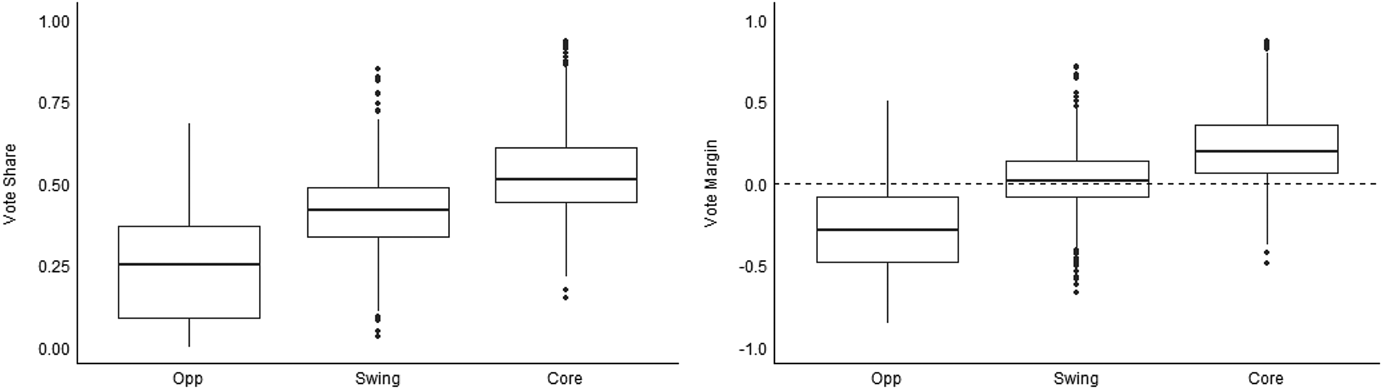
Figure 3 shows boxplots of vote shares and margins obtained by the president's party in the most recent legislative election over the CSO variable, and confirms that core municipalities generally provide higher vote shares and margins to co-partisans of the president than swing municipalities and swing more than opposition, and also that swing municipalities tend to be more competitive than core or opposition municipalities. Nonetheless, there are cases in which the most recent electoral results do not align with cumulative electoral behavior. Municipalities that have routinely supported or opposed the president's party can be competitive or even swayed, and elections in swing municipalities are not always close. If the ideological preferences of municipalities are thought to change slowly over time, then leveraging information about cumulative electoral behavior should provide a more accurate and robust measure of the support status of municipalities that is less sensitive to random shocks such as political scandals, party switching, the death of a senior legislator, or the number of candidates that choose to run in a given election. All election data are sourced from the National Election Commission.
Boxplot of Vote Share (left) by Support Status and Vote Margin (right) by Support Status

3.3 MAJORITY STATUS AND PRE-ELECTION YEARS
A president's majority status in year t is coded as a dichotomous variable that is determined by the number of seats that the president's party controls in the National Assembly at the beginning of the regular legislative session that year. It is assigned a value of 1 if the president's party controls more than half of the seats in the legislature, and 0 otherwise.Footnote 11 The data are sourced from the National Assembly Progress Report published by the National Assembly Secretariat. Presidents have majority control for 17 of the 30 years covered in the data set, and majority control of the legislature flips a total of 6 times. Following Kang (Reference Kang2015), the pre-legislative election year variable is coded as a dummy variable that indicates the year prior to a legislative election year.
3.4 OTHER VARIABLES
I also account for other political and socio-economic variables that could impact the distribution of the national subsidy. Senior legislators or the chairs and members of the budget committee may be able to exert some influence over the budget proposal to serve the interests of their own municipalities. The seniority variable is a count of the number of terms that the most senior legislator of a municipality has served in the National Assembly, and the budget committee chair and member dummy variables signal whether a legislator participates as a chair or a member of the budget committee in a given year. The National Assembly Progress Report also contains the relevant information about legislators and committees.
In addition, municipalities with greater fiscal capacity can be expected to receive fewer subsidies, as they will be less reliant on such transfers to maintain operations, and so I calculate the fiscal independence of municipalities by dividing their local tax and non-tax revenue by total revenue using the General Accounts summary in the Local Finance Yearbook. Lastly, municipalities with higher percentages of young and elderly populations may require more funding to cover their social welfare expenditures, and thus these variables are included to account for such needs. The data are available from the National Statistical Office.
3.5 MODEL
The model I estimate is as follows:
 $${\rm ln}(subsidy_{i,t}) = \gamma _0 + \rho \ln ( {subsidy_{i,t-1}} ) + {\beta }^{\prime}P_{i,t} + {\delta }^{\prime}Z_{i,t} + \; \tau ^{\prime}\lambda _t + \; \alpha _i + \epsilon _{i,t}$$
Subscripts i and t refer to municipality and year respectively. A lagged dependent variable (LDV) is incorporated into the model since subsidies received by municipalities are likely to be impacted by their past characteristics, and failure to model such a temporal process could induce omitted variable bias and result in standard errors that are too optimistic. Municipality fixed effects (α i) are also included to account for time-invariant characteristics of municipalities.Footnote 12
Pi,t is a vector of political variables that contains the majority status of presidents in year t, the support status of municipality i in year t, and their interaction. The swing category of the CSO variable is excluded to serve as the reference category. In a second model, I also interact the dummy variable that indicates a pre-election year with majority and support status to assess how the electoral cycle might also influence the distribution of the national subsidy.
Zi,t is a vector of variables that measure the seniority and budget committee membership of legislators, fiscal independence, and percentages of young and old people in the population. The latter three variables are included in the model in their logged forms given their skew.
λt is a vector of variables that accounts for time period influences over the budget of the national subsidy. Although including time-fixed effects would be preferable, they would likely absorb much of the variation in the slow-moving independent variables of interest.Footnote 13 Fortunately, a time trend control is appropriate for this case since the budget for the national subsidy has increased at an average annual rate of around 13 percent in accordance with the expansion of the government's fiscal capacity.Footnote 14 I thus include a time trend variable and its squared term in my model to mitigate the possibility of estimating spurious relationships.
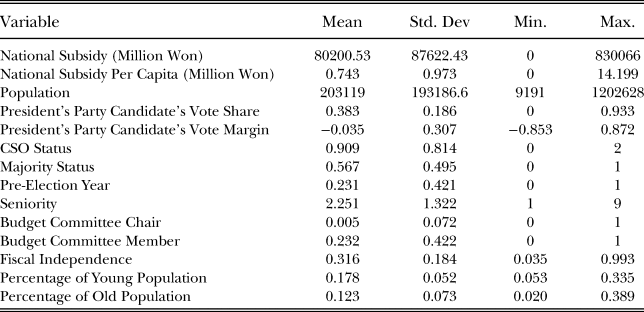
Descriptive statistics for all variables are provided in Table 1.
Descriptive Statistics

3.6 ESTIMATION METHOD
Given the panel structure of the data, a pooled OLS estimator will be inefficient as the assumption of spherical errors is likely to be violated (Beck and Katz Reference Beck and Katz1995), and failing to address concerns of unit heterogeneity could lead to biased and inconsistent estimates. Temporal dependence can be modeled through the inclusion of the LDV to mitigate serial correlation in the error terms, and a fixed effects estimator can control for unit heterogeneity. However, Nickell (Reference Nickell1981) shows that estimating an LDV model with a fixed effects estimator can bias estimates of the LDV, and Judson and Owen (Reference Judson and Owen1999) find that this can also bias other coefficient estimates of interest by up to 20 percent even when time dimensions are as large as 30. Furthermore, the fixed effects estimator is also likely to be inefficient since many of the variables in the data set, including the main independent variables of interest, change slowly over time (Plümper and Troeger Reference Plümper and Troeger2007). Therefore, I employ the Arellano-Bond system-GMM estimator to minimize bias, maximize efficiency, produce more robust estimates, and generate more accurate statistical inferences (Wawro Reference Wawro2002).Footnote 15 Bond (Reference Bond2002) and Roodman (Reference Roodman2009) point out that OLS and fixed effects estimates of the LDV are likely to be biased upwards and downwards respectively, and can serve as credible bounds for theoretically superior estimates. All estimates of the LDV using the system-GMM estimator fall within this range.
4. EMPIRICAL ANALYSIS
4.1 RESULTS
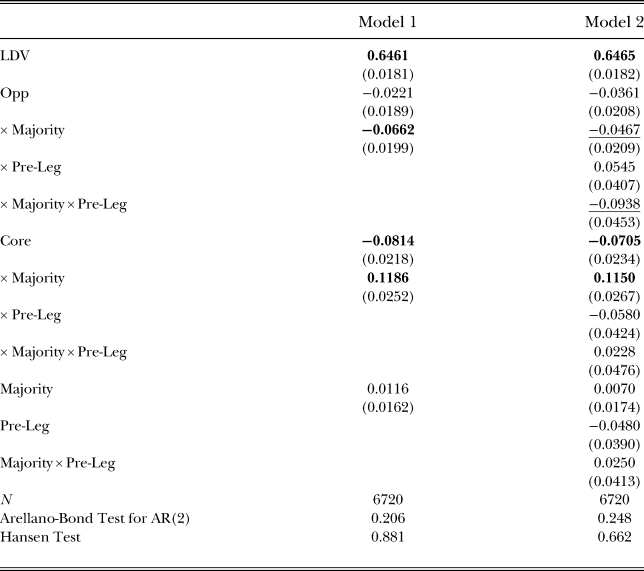
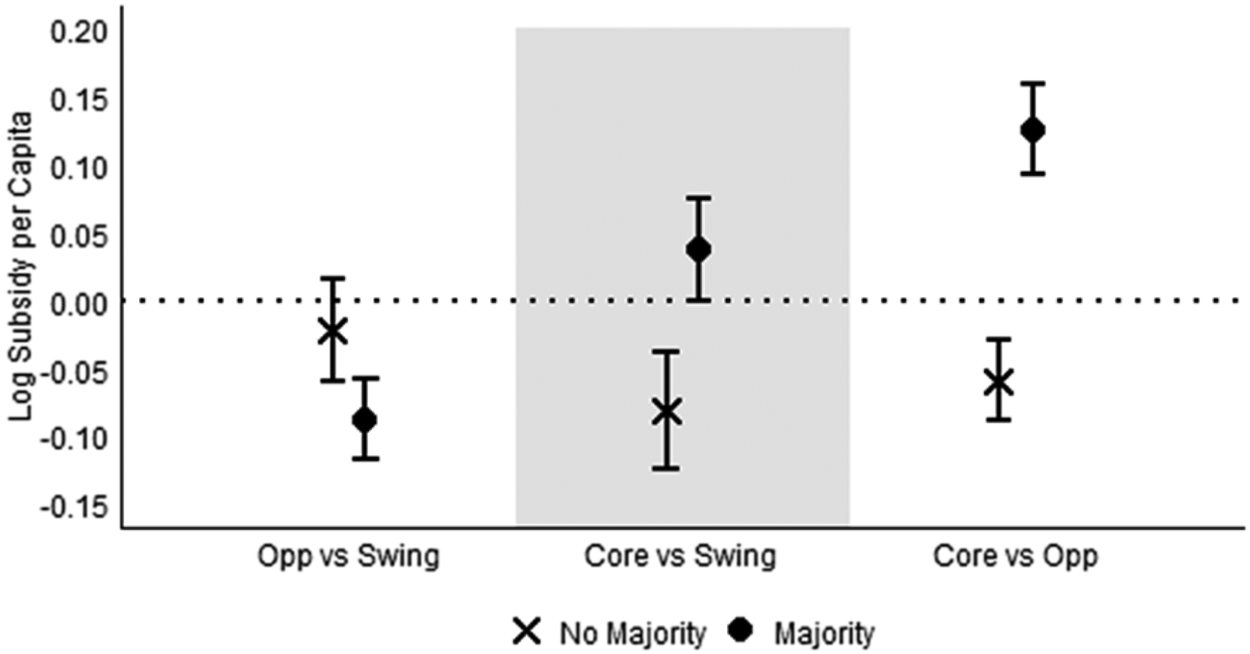
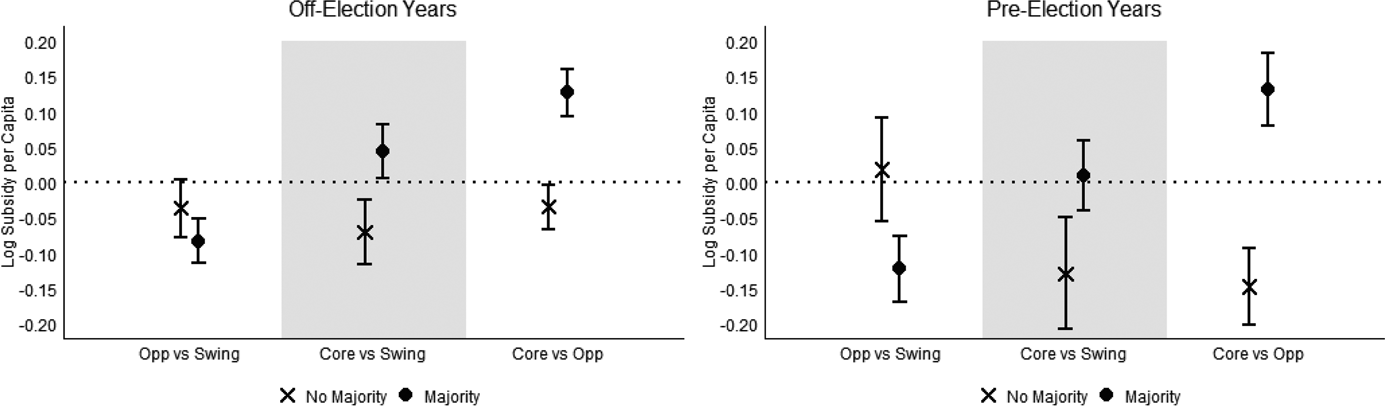
The estimated results are presented in Table 2.Footnote 16 To facilitate interpretation, I plot the predicted marginal differences in subsidy allocations between municipalities of differing support status with their corresponding 95 percent confidence intervals, holding other variables at their means. Since the dependent variable is log subsidy per capita, which makes it less straightforward to gauge the substantive implications of the marginal differences, I also calculate the difference in the predicted level of subsidy between municipalities of differing support status, also holding other variables at their means. This shows the extent to which the national subsidy received by the “average” municipality is predicted to change if it were assigned to another support status category.
Dependent Variable: Logged Subsidy per Capita (Million Won)

Note: robust standard errors are shown in the parentheses. Estimates for control and time trend variables are not shown. Full results are available in Appendix A. Bold = p < 0.01; Underlined = p < 0.05 (two-tailed).
Figure 4 plots the estimated results from Model 1, which examines the impact of majority status on core-swing targeting and reveals that presidents with and without a legislative majority do implement distinct patterns of subsidy allocations. Under majority-holding presidents, predicted subsidies increase monotonically with support status as core municipalities are estimated to be favored over swing municipalities (p = 0.050, difference≈$2.4 million), and swing municipalities over opposition municipalities (p = 0.000, difference≈$5.4 million). Conversely, when presidents are majority-seeking, swing municipalities are estimated to be more advantaged compared to core municipalities (p = 0.000, difference≈$4.9 million) and, interestingly, the predicted difference between swing and opposition municipalities is not as large as one might expect (p = 0.242, difference≈$1.4 million), as opposition municipalities are even predicted to receive more subsidies than core municipalities (p = 0.000, difference≈$3.5 million). Nevertheless, the electoral context provides an explanation to this puzzle as around 55 percent of municipalities are categorized as opposition when presidents lack majority status. That is, majority-seeking presidents could not capture a legislative majority without swaying some municipalities that had traditionally voted against their party, and they prioritized their objective to the extent of targeting these municipalities over core municipalities with subsidies.
Predicted Marginal Difference in Log Subsidy per Capita Conditional on Support and Majority Status

Figure 5 plots the estimated results from Model 2, which adds the pre-election year dummy variable that is interacted with majority and support status to identify how the targeting of municipalities differs by majority status in (1) off-election years, and (2) pre-election years. During off-election years, presidents with majority status are predicted to commit more subsidies to core municipalities than swing (p = 0.023, difference≈$2.9 million) and opposition (p = 0.000, difference≈$8 million) municipalities, while those without majority status are instead estimated to bias more subsidies toward swing municipalities over both core (p = 0.003, difference≈$4.3 million) and opposition (p = 0.083, difference≈$2.2 million) municipalities. These respective patterns of subsidy allocations shift in favor of riskier municipalities during pre-election years. Under majority-holding presidents, the difference between core and swing municipalities becomes negligible (p = 0.710, difference≈$0.6 million). On the other hand, under majority-seeking presidents, the swing bias over core municipalities increases in magnitude (p = 0.001, difference≈$7.3 million), while the swing bias over opposition municipalities becomes insignificant (p = 0.6183, difference≈$1.2 million).
Predicted Marginal Difference in Log Subsidy per Capita Conditional on Support Status, Majority Status, and Electoral Timing

4.2 ROBUSTNESS CHECKS
I conduct multiple robustness checks, and the full results along with the corresponding plots are presented in the Appendix. In Appendix B and C, I re-code the CSO variable using cutoff thresholds of 0.15 and 0.85, and 0.35 and 0.65, i.e., varying the original thresholds of 0.25 and 0.75 by ±10 percent.Footnote 17 In Appendix D, I re-construct the CSO variable based on district level electoral outcomes instead of municipal level electoral outcomes. In Appendix E, I use electoral outcomes from just the past four elections to calculate the CSO variable.Footnote 18 While a few of the predicted pairwise differences exhibit increases or decreases in magnitude and statistical significance in accordance with shifting thresholds and categorizations of support status, the hypothesized patterns of subsidy allocations that are observed in the main results are largely replicated.
In Appendix F and G, I replace the CSO variable using vote shares and vote margins from the most recent election, and also include their respective squared terms to identify the level of electoral support that produces the maximum, or “peak,” predicted level of subsidy. To summarize, the values of vote shares and margins associated with these peaks are greater under majority-holding presidents compared to those under majority-seeking presidents, and these respective values decrease in pre-election years. Such patterns align with the hypotheses and the main results. Nevertheless, the conceptual and empirical mismatch produced by measuring support status using vote shares and margins from just the most recent election precludes any definitive conclusions about core-swing favoritism, as recent voting behavior may not always be indicative of past electoral behavior or the underlying level of affinity that municipalities have for the president's party.Footnote 19
5. CONCLUSION
In this article, I argue that Korean presidents seek to obtain a legislative majority, and find evidence that presidents take advantage of their strong budgetary powers to achieve this political objective by implementing complex and varied targeting strategies. Presidents direct a higher share of subsidies to core and swing municipalities when they are majority-holders, but instead assign more subsidies to swing municipalities, and opposition municipalities to a certain extent, when they are majority-seekers. These patterns hold when the electoral cycle is also taken into account, as the evidence suggests that presidents determine the overall set of municipalities that they seek to win based on their majority status, but concentrate a higher share of subsidies to the comparably safer subset of municipalities during off-election years before shifting their attention to the riskier subset of municipalities in pre-election years. A framework that narrowly focuses on voter or district level characteristics cannot explain the meaningful variations in patterns of subsidy allocations observed in Korea.
Accounting for broader political features such as the competition for majority control of the legislature and the electoral cycle can help bridge the divide between existing empirical tests of the core-swing district hypotheses. It might not be a coincidence that evidence in favor of the core targeting hypothesis is usually associated with cases of majority control (e.g., Ansolabehere and Snyder Reference Ansolabehere and Snyder2006; Balla et al. Reference Balla, Lawrence, Maltzman and Sigelman2002; Case Reference Case2001; Costa-I-Font, Rodriguez-Oreggia, and Lunapla Reference Costa-I-Font, Rodriguez-Oreggia and Lunapla2003; Engstrom and Vanberg Reference Engstrom and Vanberg2010), or covers a longer time frame given that there are more off-election years than pre-election years (e.g., Ansolabehere and Snyder Reference Ansolabehere and Snyder2006; Larcinese, Rizzo, and Testa Reference Larcinese, Rizzo and Testa2006). Similarly, works that side with the swing targeting hypothesis tend to be based on cases in which parties did not have majority status and/or resource allocations took place close to an election (e.g., Bickers and Stein Reference Bickers and Stein1996; Dahlberg and Johansson Reference Dahlberg and Johansson2002; Denemark Reference Denemark2000; Herron and Theodos Reference Herron and Theodos2004).
The findings of this article also contribute to the understanding of distributive outcomes in other democracies in which a unitary actor, such as the president, can exert significant influence over the distribution of government resources. Much of the distributive politics literature is situated in regions with developing democracies such as Latin America and Africa, which are dominated by presidential systems, and future studies could examine how differences in institutional configurations free or constrain presidents from manipulating the government budget in pursuit of their own political objectives. A lack of accountability and transparency regarding national budgetary decisions could result in a disproportionate and inefficient distribution of resources that engenders economic inequality, political conflict, and social discontent.
Lastly, this study has implications for the debate about regionalism in Korea. Korean politics revolves around regional rivalries inherited from its authoritarian past. The emergence of regionalism in Korea is commonly attributed to the unequal allocation of government resources and offices during the authoritarian rules of Park Chung Hee, Chun Doo Hwan, and Roh Tae Woo, who all favored their hometown Gyeongsang provinces at the expense of the Jeolla provinces, which were purposefully deprived of such benefits since they backed Kim Dae Jung, who was the most powerful critic of the authoritarian regime (Kim Reference Kim2003; Hong and Park Reference Hong and Park2014). While Korea is often credited with having one of the most successful transitions to democracy among the third-wave democracies, regionalism and distributive favoritism have remained intricately intertwined in Korea as the lack of horizontal checks on the presidency has enabled presidents to engineer the government budget in ways that reinforce existing regional linkages (Horiuchi and Lee Reference Horiuchi and Lee2008), which has in turn undermined the development of trust and cooperation between parties and voters, and democratic consolidation in general (Im Reference Im2004). The strong budgetary powers of presidents may thus be subverting the types of political interactions and policies that are crucial for the proper functioning of democratic institutions.
The findings of this article suggest that increased electoral competition could lead to the weakening of regional cleavages in Korea. If the number of core electoral strongholds decreases in response to stronger competition from rival parties, then presidents may be forced to allocate more resources to swing municipalities in their efforts to secure a legislative majority. This could then generate more fluid electoral coalitions that cross regional divides, and curtail both incentives to engage in regional favoritism and distributive outcomes that are inimical to democracy. Nevertheless, electoral behavior typically changes incrementally, and the deep-rooted synergy between regionalism and distributive politics may further impede such change if the budgetary powers of presidents remain uncurbed. Although balancing the powers of the presidency with those of other political actors may not be a straightforward task, it is no secret that the design of the national subsidy makes it particularly susceptible to political manipulation. At the very least, establishing objective criteria for the national subsidy should have immediate repercussions by stifling the arbitrariness underlying its distribution.
SUPPLEMENTARY MATERIAL
The supplementary material for this article can be found at https://doi.org/10.1017/jea.2021.22
ACKNOWLEDGEMENTS
The author would like to thank the editor and two anonymous reviewers for their constructive comments, Robert J. Franzese, Jr., Allen Hicken, Woojin Kim, Iain Osgood, and participants at the Comparative Politics Workshop at the University of Michigan for their helpful feedback, Woo Chang Kang for sharing a data set that was used in earlier versions of the manuscript, and Jun Wook Choi, Sang Hun Kim, Chan Wook Park, and Dong Jun Shin for providing insight into the budget allocation process in South Korea.
FINANCIAL SUPPORT
The author would like to thank the Academy of Korean Studies and the Nam Center for Korean Studies at the University of Michigan International Institute for their generous financial support that supported this project.
CONFLICT OF INTERESTS
The author declares none.