INTRODUCTION
Natural disasters such as hurricanes, floods, and wildfires are increasing in frequency and intensity, highlighting the need for advanced planning by communities.1 , 2 Although many government, nonprofit, and private actors are involved in emergency preparedness planning, it is the preparedness knowledge and skills of individual families that form the foundation of a prepared community.3 The role of families and caregivers has garnered particular interest in the emergency management sector, because they are essential for the prevention of adverse disaster-related consequences among children who depend on them.Reference Dziuban, Peacock and Frogel4 , Reference Chung, Gardner and Schonfeld5
Children are often disproportionately impacted by public health emergencies due to their unique physiological, social, and physical characteristics (eg, faster respiratory rate).Reference Dziuban, Peacock and Frogel4 , Reference Peek, Abramson, Cox, Rodríguez, Donner and Trainor6 Further, children with special health care needs (CSHCN) may face additional difficulty in disasters, because they often require specialized equipment, medications, or other considerations distinct from typically developing peers.Reference Hipper, Davis and Massey7 In order to make informed decisions about child health and safety, parents and other primary caregivers often turn to the Internet as a resource.Reference Plantin and Daneback8 Likewise, community emergency planners and health systems use various risk communication channels to educate families about public health threats and harm mitigation strategies. Ensuring that families are able to understand available resources so that they can take action is paramount, particularly because public health emergencies can overwhelm jurisdictions’ standard communications systems.Reference Savoia, Lin and Viswanath9
Recent evaluations demonstrate a mismatch between the literacy demands (ie, cognitive skills necessary to process, understand, and act upon provided contentReference Pleasant, Rudd and O’Leary10 ) of available materials and the literacy levels of vulnerable populations, such as low-income people of colorReference James, Hawkins and Rowel11 ; pregnant and postpartum womenReference McDonough, Felter, Downes and Trauth12 ; and people who are deaf or hard-of-hearing.Reference Neuhauser, Ivey and Huang13 These populations may not be able to access standard resources offered in emergency preparedness, response, and recovery. They might also face barriers to appropriate action (eg, developing a family communication plan or emergency kit) even when information about hazards is made available.Reference Savoia, Lin and Viswanath9 Recent evidence suggests that caregivers can prepare for emergencies only if they both perceive threat and have the self-efficacy to use available resources to meet situational demands.Reference Ryan, Rohrbeck and Wirtz14 Therefore, it is critical for risk communication agencies to pay attention to more than the content of disseminated materials. Addressing factors that determine individuals’ ability to comprehend and effectively use information, such as literacy demands, might help ameliorate disparities in disaster-related morbidity and mortality.
Unfortunately, evaluation efforts have often only focused on a single dimension of the cognitive demands involved in literacy (eg, readability); not been specific to families or children; or used non-systematic methods to retrieve resources. Further, these assessments typically focus on government resources, even though families draw upon information from a range of trusted sources, including professional (eg, American Academy of Pediatrics) and non-profit organizations.Reference Plantin and Daneback8 In recognition of these gaps, we conducted a comprehensive evaluation of the online information environment for personal- or family-level preparedness. Enhanced understanding of the literacy requirements of these sources could guide the development of appropriate messaging prior to crises, help communities tailor risk communication interventions to better reach target audiences, and ultimately keep families safe during and after disasters.Reference Savoia, Lin and Viswanath9 , Reference Abrams, Klass and Dreyer15
METHODS
We conducted a cross-sectional evaluation of web-based risk communication materials using standard search engines that parents or caregivers in the United States would likely use to search for resources. For the purposes of this study, we defined “parents” or “caregivers” as the person(s) with primary responsibility for the day-to-day care and well-being of the child; this does not include professionals such as educators. We limited our focus to emergency preparedness for natural disasters, given the increasing frequency of these crises.
To address limitations of previous researchReference James, Hawkins and Rowel11 , Reference Neuhauser, Ivey and Huang13 and a lack of consensus on how to comprehensively assess literacy demands,Reference Pleasant, Rudd and O’Leary10 , Reference Kaphingst, Kreuter and Casey16 we used several evaluation instruments. We selected tools informed by 5 dimensions articulated in Brown et al.’s (2014)Reference Brown, Haun and Peterson17 disaster literacy framework to assess literacy demands: readability, complexity, suitability, web usability, and overall audience appropriateness. This approach leverages the unique strengths of each tool while offsetting their respective limitations, consistent with similar studies.Reference Whitten, Nazione and Lauckner18
Sampling Procedure
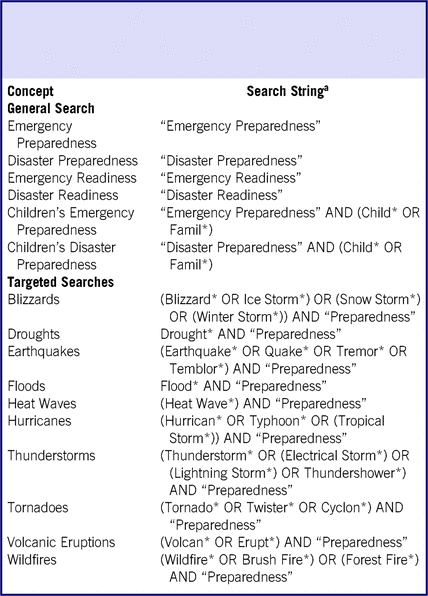
We performed searches on the 3 most frequently used search engines using SimilarWeb.com’s (New York, NY) Top Websites Ranking function in January 2018: Google (Mountain View, CA), Bing (Redmond, WA), and Yahoo! (Sunnyvale, CA). These search engines represent more than 95% of all searches conducted across the globe.Reference Whitten, Nazione and Lauckner18 To ensure comprehensiveness, we conducted (1) a general search for emergency preparedness and (2) targeted searches for specific natural disaster event types. We refined our search by including terms for children and families and using search strings for the 10 most common natural disasters in the United States. For each string, the disaster type query (eg, “hurricane”) was coupled with a query for preparedness (ie, “hurricane” AND “preparedness”), along with common synonyms (Table 1).
Search Strings Used for Evaluation of the Literacy Demands of Self-Directed Learning Resources on Emergency Preparedness for US Families

a Identical search strings were applied to Google.com, Yahoo.com, and Bing.com.
Inclusion Screening
For each search engine, we examined the first 30 results of each search because Internet users infrequently visit websites beyond the 30th result.Reference Morahan-Martin19 , Footnote a We excluded websites that predominantly or solely contained links to other websites but considered websites linked from these pages for exclusion screening and subsequent coding. This yielded 1430 websites. We did not use search engine optimization features, such as settings to match websites to the searcher’s geographic region. We excluded advertisements in search results.
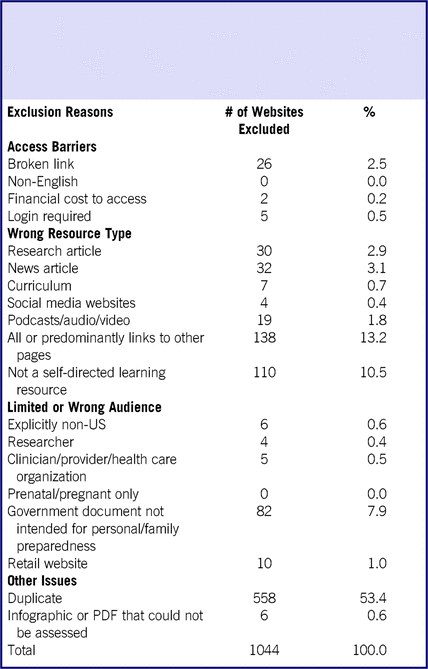
Two authors (MS and JLF) divided the list randomly and subjected each website to exclusion criteria within 4 categories (access barriers, wrong resource type, limited or wrong audience, and other issues) informed by previous studies.Reference Whitten, Nazione and Lauckner18 , Reference Dhillon, Coss and Hackney20 We focused on free, English-language, self-directed learning resources targeted to the general public in the United States (Table 2). We only included websites that received > 1 visit in the month before the evaluation (based on web traffic data from SimilarWeb.com). This process resulted in 386 unduplicated websites (27% of original sample).
Exclusion Criteria Used for an Evaluation of the Literacy Demands of Self-Directed Learning Resources on Emergency Preparedness for US Families, With Number of Websites Excluded for Each Criterion

Measures
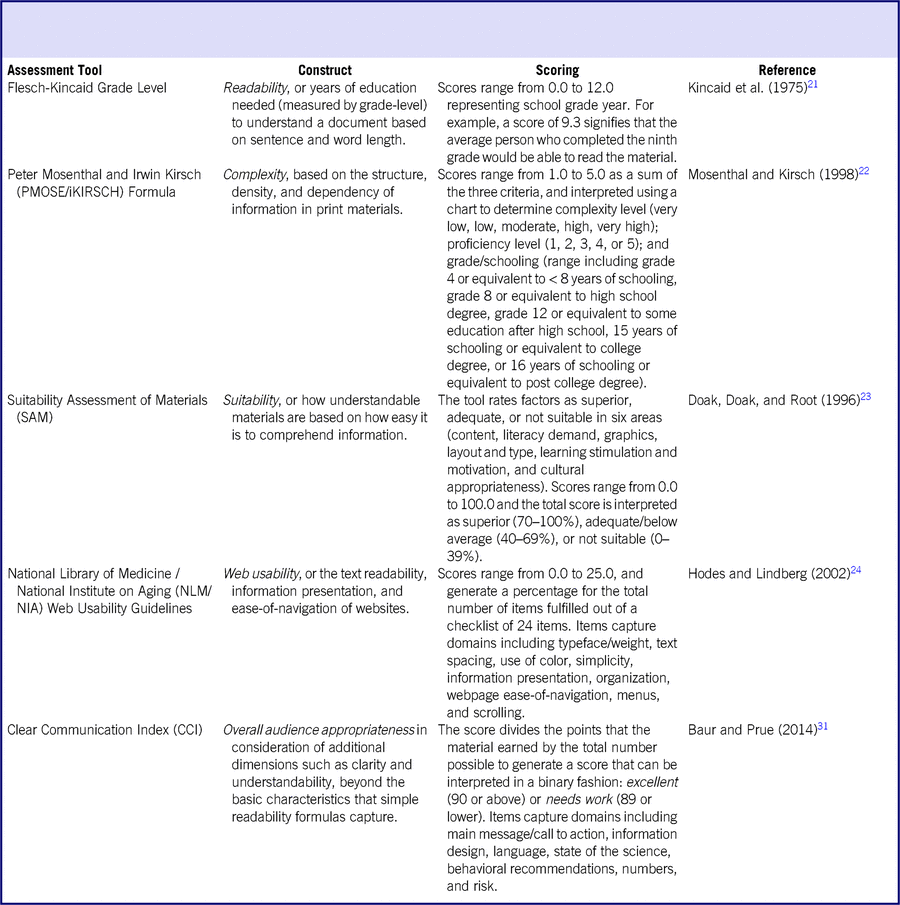
Five literacy assessment tools were used to examine distinct domains of literacy demands: (1) Flesch-Kincaid Grade LevelReference Kincaid, Fishburne, Rogers and Chissom21 for readability, (2) Peter Mosenthal and Irwin Kirsch (PMOSE/IKIRSCH) formulaReference Mosenthal and Kirsch22 for complexity (3) Suitability Assessment of Materials (SAM) instrumentReference Doak, Doak and Root23 for suitability, (4) National Library of Medicine and National Institute on Aging (NLM/NIA) Web Usability guidelinesReference Hodes and Lindberg24 for web usability, and (5) Centers for Disease Control and Prevention (CDC) Clear Communication Index (CCI)25 for overall audience appropriateness (see Table 3 for details on each tool’s scoring range and protocol). For each communication material, we also recorded information source type, audience type, and natural disaster type (see Supplemental Table 1 for protocol).
Constructs Measured and Scoring Protocols Used for 5 Assessment Tools Within an Evaluation of the Literacy Demands of Self-Directed Learning Resources on Emergency Preparedness for US Families

In certain instances, we needed to make modifications to the assessment tools’ criteria, or further operationalize items within tools in order to standardize the coding protocol across coders. We limited such changes to only those that were truly necessary; for example, the SAM includes a criterion for glossy versus matte-based paper, which is not pertinent to viewing resources on screens and was thus not included as an item when calculating scores for that tool. These decisions were applied in a manner consistent with previous literatureReference Neuhauser, Ivey and Huang13 , Reference Friedman, Tanwar and Richter26 and are available in Supplemental Table 2.
Literacy Assessment
MS and JLF independently coded a randomly selected 10% of websites, and inter-rater reliability was calculated via percent agreement and Scott’s PiReference Scott27 for every item on each assessment instrument. Scott’s Pi was deemed an appropriate measure because it accounts for expected versus observed agreement in the coding of nominal data by 2 coders. These scores were continuously monitored, with coders discussing discrepancies throughout. Before initiating data extraction, scores were deemed “satisfactory” (95% agreement on average, corresponding to Scott’s Pi of 0.85). MS and JLF divided the list of websites in half and coded every included website with each assessment tool using a coding form matrix (available upon request).
We only considered text that was clearly a component of the page’s content, effectively excluding irrelevant text concerning website navigation (eg, “return to top”), advertisements, or embedded social media content. If a website contained gadgets that segmented or hid portions of text to facilitate user comprehension (eg, collapsible modules, section tabs) coders included this content in its entirety, as long as the user was not directed to a new URL when expanding sections. We excluded materials that were solely images without usable text (eg, infographics).
Data Analysis
We tabulated descriptive statistics and non-parametric tests of association, upon determination of the data set’s non-normal distribution using quantile-quantile plots. We tested whether online information literacy assessment scores differed depending on source, targeted audience, and type of natural disaster covered, using Kruskal-Wallis and Wilcoxon rank-sum tests. To account for multiple comparisons, we controlled all tests for false discovery rates using Benjamini and Hochberg’s procedure.Reference Benjamini and Hochberg28 Differences were deemed significant at P < 0.05 after these adjustments. We used Stata 14.1 (College Station, TX) for all analyses. Because this was an evaluation of publicly available websites, human subjects’ approval was not necessary.
RESULTS
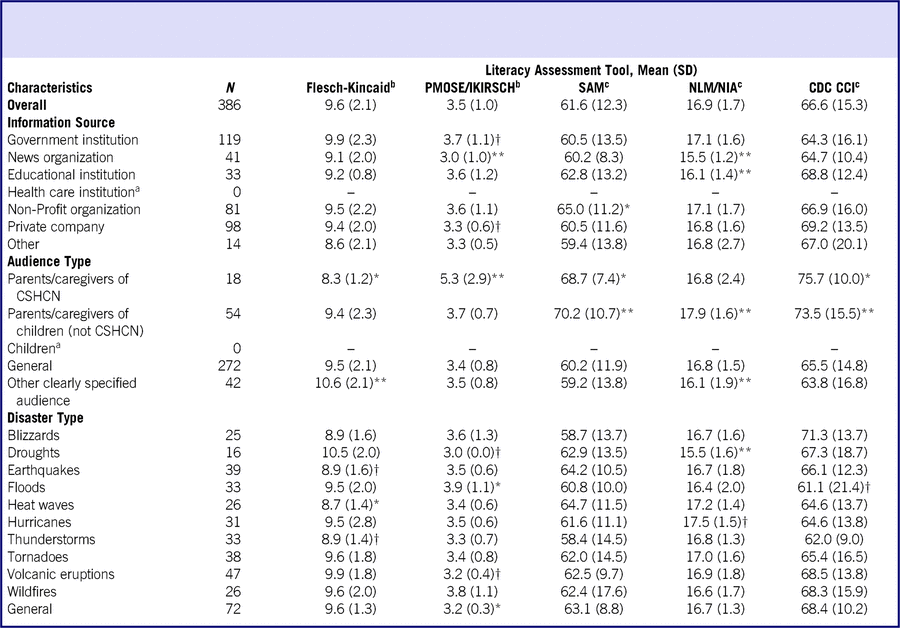
Assessment tool scores of included websites overall, by audience type, information source, and disaster type are depicted in Table 4.
Assessment Tool Scores for Evaluation of the Literacy Demands of Self-Directed Learning Resources on Emergency Preparedness for US Families, by Information Source, Audience Type, and Disaster Type

Notes: CSHCN: Children with Special Health Care Needs. SD: Standard Deviation. Flesch-Kincaid: Flesch-Kincaid Grade Level,Reference Kincaid, Fishburne, Rogers and Chissom21 Range: 0.0–12.0. PMOSE/IKIRSCH: Peter Mosenthal and Irwin Kirsch Document Complexity Level,Reference Mosenthal and Kirsch22 Range: 1.0–5.0. SAM: Suitability Assessment of Materials Score,Reference Doak, Doak and Root23 Range: 0.0–100.0. SAM: Suitability Assessment of Materials Score,Reference Doak, Doak and Root23 Range: 0.0–100.0. NLM/NIA: National Library of Medicine/National Institute on Aging Web Usability Guidelines Score,Reference Hodes and Lindberg24 Range: 0.0–25.0. CDC CCI: Centers for Disease Control and Prevention Clear Communication Index Score,25 Range: 0.0–100.0.
*P < 0.05, **P < 0.01, † P < 0.10.
a Although this category was explicitly indicated in searches, no websites were ultimately included in this category.
b A lower score for this tool is “better” (ie, has lower literacy demands).
c A higher score for this tool is “better” (ie, has lower literacy demands).
Website Characteristics
Of the 386 included websites, government institutions represented the largest group of information sources (119/386, 30.8%). Private (98/386, 25.4%) and non-profit organizations (81/386, 21.0%) each comprised more than 1/5 of the overall sample. Less common information source types included news organizations (41/386, 10.6%), educational institutions (33/386, 8.5%), and other sources (eg, individuals’ personal websites; 18/386, 4.7%). No websites classified as health care institutions were present in the final sample.
Nearly 3/4 of website content did not specify a clear audience or user (279/386, 72.3%). The number of websites targeted to caregivers of children outnumbered those targeted for caregivers of CSHCN by 3-fold (54/386 vs 18/386, respectively). There were no websites for which children (ie, individuals 0–18 years old) themselves were the target audience. Materials that were targeted to neither caregivers nor children, but did specify a clear target audience (eg, childcare providers, business owners), made up 10.8% of the sample (42/386).
Few websites specified a natural disaster type (72/386, 18.7%). Among those that focused on a specific type of disaster, volcanic eruptions were the most prevalent (47/386, 12.2%) and droughts were least prevalent (16/386, 4.1%).
Website Literacy Demand Scores
Flesch-Kincaid Grade Level
The mean Flesch-Kincaid score for resources was grade 9.6 (SD: 2.1), indicating that on average, available websites are readable to individuals who have reached the 9th grade.Reference Kincaid, Fishburne, Rogers and Chissom21
,
Footnote b
There were no significant differences in Flesch-Kincaid scores across categories of information sources. Materials targeted at parents or caregivers of CSHCN scored at a significantly lower reading level than materials overall (
 $\overline x$
: 8.3 grade levels, P = 0.013). Those intended for other clearly specified audiences scored at a significantly higher reading level (
$\overline x$
:10.6 grade levels, P = 0.005). Resources for heat waves were written at a significantly lower reading level (
$\overline x$
:8.7 grade levels, P = 0.042) compared with the average score for all materials in the evaluation. There were no other significant differences by disaster type.
PMOSE/IKIRSCH
Mean scores on the PMOSE/IKIRSCH complexity measure for included websites was 3.5 (SD: 1.0), indicating a “moderate” degree of complexity and a high school-level of education necessary for a person to use available materials.Reference Mosenthal and Kirsch22
We observed differences in scores by information source, audience type, and disaster type. News organizations evidenced significantly lower complexity scores (
$\overline x$
:3.0, P = 0.003) compared with materials overall. Materials for caregivers of CSHCN demonstrated significantly higher scores (
$\overline x$
:5.3, P < 0.001) compared with materials overall. Materials pertaining to floods also scored higher (
$\overline x$
:3.9, P = 0.038). Three other disaster type categories (droughts, volcanic eruptions, and general disaster resources) scored lower than the average complexity score for materials overall, but only scores for general resources reached significance (
$\overline x$
:3.2, P = 0.016).
SAM
The suitability of materials, as assessed by the SAM, scored 61.6 out of 100 (SD: 12.3) on average. This average score falls into the “adequate or below average” range of scores.Reference Doak, Doak and Root23
Across information sources, the only source that had a significantly different score than the average were non-profit organizations (
$\overline x$
:65.3, P = 0.029). When examining audience types, materials for parents of both children with and without special healthcare needs had significantly higher suitability scores than materials overall (
$\overline x$
:70.2, P < 0.001; and
$\overline x$
:68.7, P = 0.020 respectively). We found no differences in scores across disaster types.
NLM/NIA Guidelines
The NLM/NIA guidelines provide an indication of how usable materials are with regard to website characteristics. Overall, materials in this evaluation fulfilled 16.9/25 NLM/NIA guidelines (SD: 1.7). Among the different information sources, news organizations (
$\overline x$
:15.5, P < 0.001) and educational institutions (
$\overline x$
:16.1, P = 0.012) fulfilled significantly fewer guidelines. Materials for parents of children (not CSHCN) fulfilled significantly more of the guidelines (
$\overline x$
:17.9, P < 0.001), whereas those for other clearly specified audiences fulfilled fewer (
$\overline x$
:16.1, P = 0.006), compared with the average of materials overall. Drought materials were the only disaster type that met significantly fewer guidelines than materials overall (
$\overline x$
:15.5, P = 0.002).
CDC CCI
The CCI provides a multi-faceted indication of overall audience appropriateness. The mean CCI score we observed for all materials was 66.6 (SD: 15.3), which can be interpreted as “needs work” (as opposed to an “excellent” score of 90 or above) according to the assessment tool.25
(Information regarding the CDC CCI score range and domains covered is available in Table 3.) We did not see differences in scores by information source categories. Materials for parents scored significantly higher than all materials on average – inclusive of both parents of CSHCN (
$\overline x$
:73.5, P = 0.003) and those without special needs (
$\overline x$
:75.7, P = 0.017). We found no significant differences in scores by disaster type.
DISCUSSION
Communities that are prepared for emergencies begin with families who are prepared for emergencies.Reference Dziuban, Peacock and Frogel4 Increasingly, US families use free information on the Internet to understand children’s needs and inform their decisions regarding caregiving concerns, including emergency preparedness.Reference Plantin and Daneback8 We evaluated the literacy demands required for caregivers to comprehend the information contained in nearly 400 publicly available online resources. Findings indicate a mismatch between literacy demands and the general public’s literacy capabilities, suggesting that families may not have the appropriate information to be adequately prepared for natural disasters. As such, risk communication and public health organizations could consider modifications to available resources to address literacy demands in the areas of readability, complexity, suitability, web usability, and overall audience appropriateness.
Information Sources
Most available resources were materials issued by government agencies, underscoring the prominent role such institutions play as sources for risk communication to the public.Reference Abrams, Klass and Dreyer15 Notably, less than 1/10 of all resources examined were educational websites. Most children and adolescents spend the majority of their day in schools, which can also serve as family reunification points during emergencies. Thus, educational organizations represent an essential information source in community-level disaster preparedness and response.2 , Reference Dziuban, Peacock and Frogel4 Our searches also uncovered no resources from health care organizations. This is notable because pediatricians are credible, well-positioned sources for providing anticipatory guidance around emergency preparedness.2 Although educational and health care organizations likely possess risk communication materials that were not captured – or that did not otherwise meet inclusion criteria – our evaluation suggests that disseminating messages to families via these trusted sources remains an important gap in the online information environment.Reference Hipper, Davis and Massey7 , Reference Olympia, Rivera and Heverley29 Emergency preparedness agencies must engage with educational and health care partners in order to reach the whole community.Reference Chung, Gardner and Schonfeld5 , 30
Target Audiences
Nearly 3/4 of materials in the evaluation did not clearly specify a target audience. This may be a concern, because tailoring messages for intended audiences is a core pillar of risk communication.Reference Baur and Prue31 We acknowledge that inclusion of search terms tailored to specific audiences might have netted different results; however, this was beyond the scope of our evaluation given our goal to broadly understand literacy demands of materials for families in the United States.
Additionally, our evaluation highlights a lack of resources to help children directly contribute to family-level preparedness planning. Increasingly, researchers and practitioners have advocated for both expanded consideration of children in preparedness and meaningful integration of their perspectives directly into the planning cycle.Reference Peek, Abramson, Cox, Rodríguez, Donner and Trainor6 , Reference Hipper, Davis and Massey7 One promising resource is CDC’s Ready Wrigley campaign, which provides emergency preparedness information directly to children through media, including activity books, checklists, and a mobile application (https://www.cdc.gov/phpr/readywrigley/). Evaluating the impacts of Ready Wrigley and similar materials could help make the case for additional resources that speak directly to young people.
Literacy Demands
For the three assessment tools that offer an ordinal interpretation of continuous scores (PMOSE/IKIRSCH, SAM, CDC CCI), materials on average did not meet the optimal category specified for each respective tool. According to both the Flesch-Kincaid readability and the PMOSE/IKIRSCH complexity scores, the average required reading level of assessed materials was higher than the average US adult reading level of 8th grade.Reference Doak, Doak and Root23 , 32 This is also higher than the grade level recommended by prominent health organizations, including the National Institutes of Health33 (“Keep within a range of about a 7th or 8th grade reading level”) and American Medical AssociationReference Weiss34 (“Write at or below the 6th grade level”).Footnote c Thus, efforts to improve readability and reduce the complexity of extant materials could augment comprehension and appropriate utilization of these materials. Of note, that different grade levels were interpreted by the Flesch-Kincaid and the PMOSE/IKIRSCH measures highlights the value of employing multiple assessment tools as part of a comprehensive communication planning process.35
The suitability of existing resources, measured by the SAM, could also be improved from “adequate/below average” to “superior” through concerted focus on information content, graphics, layout/typography, and learning stimulation. Findings from the NLM/NIA guidelines are difficult to interpret because there is no established recommendation for what constitutes sufficient web usability; nonetheless, materials, on average, complied with < 70% of the recommendations, suggesting improvements could be made by focusing on domains targeted by this assessment tool (eg, ease-of-navigation, information presentation; see Table 3). For the CCI, materials scored in the 66th percentile, lower than the 90% criterion that the CDC considers adequately audience-appropriate. Fortunately, many resources are available to risk communication and public health specialists to better align materials’ literacy demands with the skill levels of the general public.33 , 35 , 36
No clear patterns in scores on literacy assessment tools emerged across information sources nor disaster type (see Table 4). For instance, although news organizations had lower complexity according to PMOSE/IKIRSCH (better), they scored lower with regard to web usability based on NLM/NIA guidelines (worse). When looking at audience type, materials targeted for a particular target audience did appear to fare better than the overall average, compared with those that were not tailored (ie, general audience message). Resources aimed at parents/caregivers of both CSHCN and those without generally had lower literacy demands compared with other materials – both groups demonstrated lower literacy demands than overall averages, for 3 of 5 assessment tools used. This finding is encouraging, because parents may share materials with their children as part of their family emergency planning process. In addition, parents of CSHCN specifically may require additional information to effectively prepare for their children’s disaster-related needs.Reference Hipper, Davis and Massey7 Relatedly, materials aimed at “other” specified audiences performed better for 2 of 5 tools (Flesch-Kincaid, NLM/NIA). These results are not wholly surprising because several tools contain items that probe directly about target audiences.
Although we are unaware of any evaluation that has examined this scope of websites using this range of tools, a 2008 study did identify that online emergency preparedness resources performed poorer with respect to the Flesch-Kincaid and SAM measures than our estimates for those tools.Reference Friedman, Tanwar and Richter26 This difference suggests that efforts to improve the readability and suitability of public materials may have improved in recent years, though we note the two evaluations are not directly comparable due to study design differences.
Strengths and Limitations
This study presents findings buoyed by several methodological strengths. With regard to our search strategy, we applied literature from the field of human-computer interactionReference Morahan-Martin19 , Reference Dhillon, Coss and Hackney20 to develop our approach and used a reproducible protocol within 3 common search engines to capture private and public websites (see Table 2). These strategies increase the likelihood that the materials assessed represent a reasonable approximation of what the public would encounter at the time of the study’s writing. We also adjusted for multiple comparisons to minimize the possibility of false-positive findings, augmenting our confidence in the differences observed. Further, intentional study design elements, including the use of 2 independent coders, 5 separate tools, and Brown et al.’s framework, Reference Brown, Haun and Peterson17 afford us a more comprehensive understanding of extant resources’ literacy demands, particularly in the context of this emerging science.
This evaluation is not without limitations. First, we focused solely on natural disasters. Although weather-related events are an increasing cause of morbidity and mortality,1 findings may not generalize to other disaster types (eg, human-induced disasters). Second, our search strategy may not have adequately captured the universe of resources that individuals might encounter on the Internet – such as social media and peer forums.Reference Plantin and Daneback8 , Reference Thomas, Schrock and Friedman37 Relatedly, conducting searches without localization to specific regions could have affected the websites retrieved in the search (eg, hurricane-related web pages might appear more often if user were to enter the affected region or hurricane name; local school district web pages might not have emerged without explicit mention of one’s county). Future work could broaden the scope of materials evaluated, target specific geographic areas, or expand upon our search terms to provide more complete insights. Third, although we sought to characterize the landscape of online resources by making comparisons with average scores of assessed materials overall, we did not make direct statistical comparisons with discrete cutoff points because recommended scores are not available for each tool.
Finally, although the use of multiple tools assessing varied dimensions of literacy enhances the validity of our findings, the comparability and psychometric properties of the tools merit further investigation.Reference Pleasant, Rudd and O’Leary10 , Reference Kaphingst, Kreuter and Casey16 For example, 1 study showed that materials revised via the CCI were perceived to be more comprehendible than materials that were not.Reference Baur and Prue31 However, the 90% benchmark for classifying a material as “Excellent” (vs “Needs Work”) was not developed as a validated cutoff score with an established sensitivity and specificity. Rather, the benchmark was intended as a practical starting point for identifying revisions; the CCI developers recognized that the content of materials is often the product of negotiations between scientists and communicators (C. Baur, e-mail communication, September 2018).
Future Directions
This study lays the foundation for additional work in this area to better prepare families and communities for natural disasters. When developing or evaluating materials, organizations may consider content-analyzing their materials to illuminate other factors that influence audience comprehension, or to assess other determinants of compliance with preventive behaviors (eg, messaging quality, credibility, accuracy).Reference Morahan-Martin19 , Reference Friedman, Tanwar and Richter26 Notably, the CDC’s Public Health Emergency Preparedness (PHEP) capability standards were developed to help state, local, tribal, and territorial programs advance preparedness capacity. These standards were recently refined to include elements for vulnerable populations (eg, children, individuals with disabilities).30 Assessing materials developed by programs receiving PHEP support to meet these priorities could help determine whether the needs of children are being effectively integrated for community preparedness and response.
Future efforts might also incorporate the perspectives of families and/or children themselves to elucidate whether findings hold by intended users, using techniques commonly employed within user experience research.Reference Neuhauser, Ivey and Huang13 , 35 , Reference Jaspers38 This would be particularly important because a paucity of literature regarding families’ online information-seeking behaviors about preparedness was available to guide our methodology. As others have argued, although guidelines help identify aspects of materials to be improved, their value is diminished without corresponding efforts to test usability with target audiences.Reference McDonough, Felter, Downes and Trauth12 , Reference Brown, Haun and Peterson17 Moving forward, communities’ actions toward improving the predisaster information environment can be evaluated for their success in effecting behavior change (both in real-time and following actual disasters) using emergent tools (see Reference Savoia, Lin and Gamhewage39 , Reference Bergeron and Friedman40 ).
CONCLUSIONS
As parents and caregivers continue to turn to the Web for resources on family emergency preparedness, their ability to apply such information when disaster strikes will depend on how understandable the information is. This evaluation offers a global view of English-language risk communication materials that the US general public would likely encounter when conducting Internet-based searches for family-level preparedness as of January 2018. We identified areas that could be addressed to lower the literacy demands of available materials and consequently strengthen their usefulness for families. Achieving national goals of improved health and disaster literacy will require sustained attention to ensuring resources are not only available to the public, but also appropriately matched to their literacy capabilities.36
Acknowledgments
The authors thank Josephine Lau, Melissa Jennings, and Joshua Petimar for their thoughtful guidance in improving the study design and manuscript; and Cynthia Baur for her insights on the Clear Communication Index. Preliminary findings of this research were presented at the 2018 National Association of County and City Health Officials Preparedness Summit (Atlanta, GA). The findings and conclusions in this article are those of the authors and do not necessarily represent the official position of the CDC.
Funding
This research was supported in part by an appointment to the Research Participation Program at the Centers for Disease Control and Prevention administered by the Oak Ridge Institute for Science and Education through an interagency agreement between the US Department of Energy and the CDC (MS, JLF).
Conflict of Interest
The authors have no conflicts of interest to declare.
Author Contributions
MS and JLF contributed equally to this work.
Supplementary material
To view supplementary material for this article, please visit https://doi.org/10.1017/dmp.2019.62