Veterans Health Administration (VHA) nursing homes, also called community living centers, provide a range of services including skilled nursing, rehabilitation, psychiatric, dementia, hospice and palliative care.Reference Tsan, Hojlo and Kearns 1 VHA nursing homes play critical roles in meeting both post-acute and long-term care needs of veterans. However, as in community-based nursing homes,Reference Dwyer, Harris-Kojetin and Valverde 2 infection is a common complication among VHA nursing home residents.Reference Tsan, Langberg and Davis 3
Estimates suggest that, on any given day, ~12% of the more than 1 million nursing home residents in the United States may have an infection.Reference Dwyer, Harris-Kojetin and Valverde 2 The most common of these is urinary tract infection (UTI), followed by pneumonia. While a point prevalence assessment in 2007 found a lower infection rate (5.3%) among VHA nursing homes, the most common infection was also UTI, and the infection rate was closer to 11% among veteran residents with indwelling devices, such as urinary catheters.Reference Tsan, Langberg and Davis 3 These estimates become even more concerning when the growing prevalence and risk of antimicrobial-resistant infections are taken into account.Reference Wang, Lansing and Symons 4 – Reference Shilo, Assous and Lachish 6 Additionally, studies suggest that knowledge about device care as well as antimicrobial stewardship may be lacking in both community-based and VHA nursing homes.Reference Mody, Saint, Galecki, Chen and Krein 7 – Reference Trautner, Greene and Krein 9
Recently, a large-scale collaborative initiative, the Agency for Healthcare Research and Quality (AHRQ) Safety Program for Long-term Care: Healthcare-Associated Infections (HAIs)/catheter-associated UTI (CAUTI), was shown to reduce CAUTI rates across a large group of community-based nursing homes.Reference Mody, Greene and Meddings 10 , Reference Krein, Harrod and Collier 11 The collaborative focused on professional development related to urinary catheter utilization, catheter care and maintenance, infection prevention, and antimicrobial stewardship as well as promoting resident safety culture, team building, and leadership engagement. Given the success of the program in the community nursing home setting, coupled with the similar success of national efforts to reduce CAUTI on medical-surgical units,Reference Saint, Greene and Krein 12 , Reference Zubkoff, Neily and King 13 we sought to evaluate the effectiveness of the program among VHA nursing homes. The VHA is a large integrated healthcare system, with a robust infection prevention infrastructure, and a system-wide CAUTI prevention initiative was implemented in 2011.Reference Mody, Greene and Saint 14 , Reference Clifton, Kralovic and Simbartl 15 Thus, this evaluation provides important information about the potential utility of large-scale collaborative efforts for facilities with an already heightened focus on infection prevention and more ready access to infection prevention resources.
METHODS
Study Setting
A nationwide cohort of 63 of 133 VHA nursing homes voluntarily enrolled in the “AHRQ Safety Program for Long-Term Care: HAIs/CAUTI” as part of a group of nursing homes that began the 12-month program in June 2015. At the start of this program, the VHA already had quality improvement efforts in place to prevent healthcare-associated infections, including CAUTI, in VHA nursing homes. These efforts, which originally targeted intensive care units starting in 2006, consisted of national teleconference calls, the dissemination of toolkits with criteria for defining infections, goal setting, senior leadership support, and site mentoring. The primary focus of the VHA program was on catheter insertion, including having an insertion order and indication for insertion, use of alternatives, aseptic insertion technique, and use of securement devices. The collection and reporting of catheter days and number of infections was also an important part of this initiative. These activities were facilitated through use of a web-based tool, managed by the VHA Inpatient Evaluation Center, and in 2011 reporting of CAUTI was required for all VHA settings, including nursing homes.Reference Clifton, Kralovic and Simbartl 15
The VA Ann Arbor Health System, University of Michigan and Health Research and Educational Trust institutional review boards reviewed the study and determined that it did not meet the regulatory definition of research involving human subjects.
AHRQ Safety Program Intervention
The intervention of interest for this analysis was the AHRQ Safety Program for Long-Term Care, which has been previously described.Reference Mody, Greene and Meddings 10 , Reference Mody, Meddings and Edson 16 Briefly, the program used a collaborative approach to enhance adoption of infection prevention practices in nursing homes with a specific focus on reducing CAUTI. The program included education about infection prevention practices (eg, reducing catheter utilization and improving catheter care and maintenance) as well as strategies for promoting resident safety culture, team building, and leadership engagement, which were provided through a series of virtual learning sessions, coaching calls, and webinars. This part of the program included learning sessions along with monthly content webinars and coaching calls led by an organizational lead and national project team faculty. Nursing home teams also had access to an implementation guide and other tools and resources via a program website or their organizational lead. Like the prior VHA initiative, the AHRQ program focused on appropriate indications for catheter insertion and regular assessment of catheter need. However, while the 2011 VHA initiative was aimed at both acute-care and long-term care settings, the AHRQ program was designed specifically for nursing homes, and it included incontinence care planning and assessing for CAUTI in nonverbal patients. The AHRQ program also provided specific content on antimicrobial stewardship in long-term care and the appropriate use of urine cultures.
Study Outcomes and Data Collection
The primary outcome was the CAUTI rate as defined by the CDC National Healthcare Safety Network (NHSN): the number of CAUTIs meeting long-term care surveillance criteria divided by the number of catheter days and multiplied by 1,000 (in accordance with the CDC NHSN protocol for tracking infections in long-term care facilities, January 2015).Reference Stone, Ashraf and Calder 17 Secondary outcomes included catheter utilization and appropriate urine testing. Catheter utilization was defined as the number of catheter days divided by the number of resident days, multiplied by 100 and reported as a percentage. Urine testing was defined as the number of urine culture orders for all residents while in the facility divided by the number of resident days and multiplied by 1,000. Participating VHA nursing homes collected data on the number of CAUTIs, catheter days, resident days, and urine culture orders for each month of the program. These data were entered into a system maintained by the VHA National Center for Patient Safety for subsequent extraction and analysis. In addition, as part of program start-up each facility was asked to complete a needs assessment questionnaire, which included questions about general facility characteristics and infection prevention resources.Reference Mody, Greene and Saint 14
Statistical Analysis
Nursing home characteristics, process data, and outcome data were assessed using descriptive statistics. We used multilevel mixed-effects negative binomial regression with facility level random intercepts to examine changes in rates of CAUTI, catheter utilization, and urine culture orders during the project period. The change in the NHSN CAUTI rate was modeled using the log of the number of catheter days as an offset variable. The log of the number of resident days was used as an offset for the catheter utilization and urine culture order models. Data were collected in aggregate every month for 12 months, and the first month was counted as time zero. To derive an incidence rate ratio (IRR), subsequent months or reporting periods were counted as the number of days from the first reporting period. The estimated IRRs reflect rate changes across the entire 12-month continuum. Participating nursing homes were included in the analysis if they reported at least 2 months of outcome data and device days. These criteria resulted in an analytic cohort of 55 VHA nursing homes. Statistical analyses were performed using Stata/MP version 13.1 software (StataCorp, College Station, TX).
RESULTS
Nursing Home Characteristics
Although 55 VHA nursing homes met the eligibility criteria for analyses of outcome data, only 39 facilities completed the program needs assessment questionnaire. As shown in Table 1, the mean number of beds for these facilities was 112 (±92.4 SD), with a mean number of current residents of 78 (±43.4 SD). Most facilities (89.7%) had an infection prevention contact with 3 or more years of infection prevention experience, and more than half of the facilities reported that this individual was certified in infection control. Moreover, during a normal 40-hour work week, an average of 33 hours was spent on infection prevention related activities. Nearly all facilities also reported conducting CAUTI surveillance and the presence of a committee that reviews healthcare-associated infections, including CAUTIs.
Characteristics of Participating Veteran Health Administration (VHA) Nursing Homes

NOTE. SD, standard deviation; CAUTI, catheter-associated urinary tract infection.
Change in CAUTI, Catheter Use and Urine Culture Orders
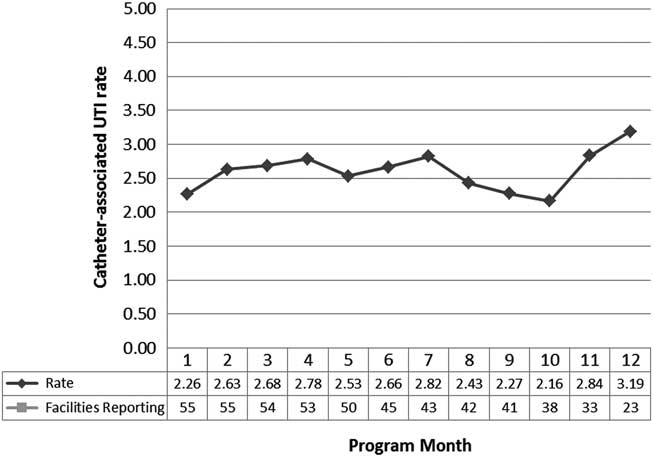
As shown in Figure 1, the CAUTI rate was 2.26 per 1,000 catheter days at month 1, 2.66 at month 6, and 3.19 at month 12. The rates in later months, especially month 12, should be interpreted with some caution, however, given the smaller number of facilities reporting. Nonetheless, over the course of the entire 12-month program, no significant changes in CAUTI rates were observed among participating VHA nursing homes (incidence rate ratio [IRR], 0.99; 95% confidence interval [CI], 0.67–1.44; P=.94). Similar results were observed for the population rate (ie, CAUTIs per 10,000 resident days), with rates of 2.49 at month 1 and 3.61 at month 12 (IRR, 0.99; 95% CI, .67–1.47; P=.95).
Catheter-associated urinary tract infection (UTI) rates, as defined by the National Healthcare Safety Network, among reporting facilities during the 12-month collaborative. Legend: Number of catheter-associated UTIs per 1,000 catheter days.

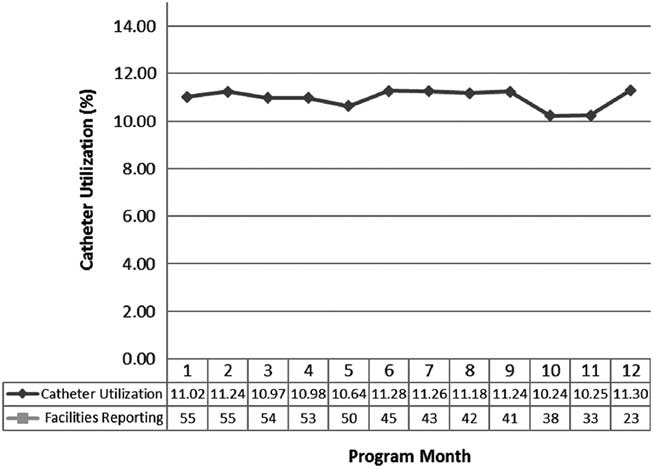
Catheter utilization rates also remained virtually unchanged during the program period, 11.02% at month 1, 11.28% at month 6, and 11.30% at month 12 (IRR, 1.02; 95% CI, 0.95–1.09; P=.64) (Figure 2). Likewise, the number of urine culture orders per 1,000 resident days remained steady at 5.27 in month 1 and 5.31 in month 12 (IRR, 0.93; 95% CI, 0.82–1.05; P=.25).
Catheter utilization among reporting facilities during the 12-month collaborative. Legend: Number of catheters used per 100 resident days.

DISCUSSION
Reducing infection risk and improving infection prevention are priorities for enhancing resident safety in nursing homes. Unlike the reductions in CAUTI rates observed among community-based nursing homes while participating in the AHRQ Safety Program for Long-Term Care,Reference Mody, Greene and Meddings 10 there was no change in CAUTI rates (or other measured outcomes) among participating VHA nursing homes. Several potential factors might help to explain the differing results between the VHA and community-based nursing homes: efforts to reduce infections, including CAUTI, initiated by the VHA several years prior to the AHRQ program; the more readily available infection prevention resources and infrastructure among VHA nursing homes, as part of a large integrated healthcare system; and differences in resident populations.
First, VHA nursing homes began the program with markedly lower baseline CAUTI rates than the non-VHA community-based nursing homes (2.26 VHA vs 6.78 non-VHA CAUTIs per 1,000 catheter days).Reference Mody, Greene and Meddings 10 Indeed, VHA nursing homes demonstrated a significant reduction in CAUTI rates, beginning in 2011, following nationwide implementation of the previously described program (41% annual reduction from 2011 through 2014 [P=.0001]).Reference Clifton, Kralovic and Simbartl 15 Thus, at the end of the 12-month AHRQ program, the average rate for participating community-based nursing homes (2.63 per 1,000 catheter days)Reference Mody, Greene and Meddings 10 was similar to the observed rate for the VHA cohort throughout the program period. This relatively low rate among VHA nursing homes does not mean that opportunities for additional improvement do not exist but rather suggests that more specific targeting of other prevalent safety concerns may be needed. For example, reducing catheter utilization rates in VHA nursing homes, which are currently ~11%, might provide a specific opportunity for further improvement by preventing noninfectious harms and potentially further reducing infectious complications as well.Reference Hollingsworth, Rogers and Krein 18 , Reference Leuck, Wright, Ellingson, Kraemer, Kuskowski and Johnson 19
Second, a fundamental aspect of a quality improvement collaborative involves providing expertise, resources, and support to participating facilities. Non-VHA nursing homes are required, by law, to have an infection prevention and control program in order to be reimbursed for resident care through the Centers for Medicare and Medicaid Services.Reference Collier 20 , Reference Ye, Mukamel, Huang, Li and Temkin-Greener 21 Nonetheless, nursing homes vary with respect to the resources allotted for infection prevention activities.Reference Mody, Greene and Saint 14 , Reference Stone, Herzig and Pogorzelska-Maziarz 22 For example, among participating community-based nursing homes, an average of 12 hours per week was allocated for infection prevention activities. While 79% indicated they had a committee that reviewed infection rates, including CAUTI, only 66% performed CAUTI surveillance.Reference Mody, Greene and Saint 14 In contrast, participating VHA nursing homes reported an average of 33 hours per week devoted to overall infection prevention activities, and nearly all had a committee that reviews infection rates and conducted CAUTI surveillance. This more robust infection prevention infrastructure is likely related to being part of a large integrated healthcare system and the fact that many VHA nursing homes are collocated or closely aligned with a VHA medical center.Reference Mody, Greene and Saint 14 Although difficult to measure directly, resources to support infection prevention activities in VHA nursing homes appear to be more readily available, and as a consequence, the expertise, education, and tools provided by the collaborative may have had less impact on these VHA facilities compared with their community-based counterparts.
Third, certain notable differences exist between resident populations in community-based versus VHA nursing homes.Reference Mody, Greene and Saint 14 Although no resident-specific data were collected as part of the collaborative, residents in VHA nursing homes are predominantly older men, whereas in community-based facilities, approximately two-thirds of residents are female.Reference Harris-Kojetin, Sengupta and P-L 23 While research suggests that females are at higher risk for developing urinary tract infections,Reference Foxman 24 use of indwelling devices (eg, urinary catheters, gastrostomy tubes, peripheral and central intravenous catheters) may be more prevalent among residents in VHA nursing homes.Reference Tsan, Langberg and Davis 3 This reflects, in part, the types of residents who receive care in these facilities, which includes residents with spinal cord injury as well as those with complex or special care requirements (eg, ventilator care and hospice or end-of-life care). Indeed, among nursing homes participating in the AHRQ collaborative, urinary catheter utilization among VHA nursing homes (11%) was substantially higher than in the non-VHA community-based nursing homes (4.5%).Reference Mody, Greene and Meddings 10 The lack of change in catheter utilization among community-based nursing homes suggests that a decrease in catheter use was likely not a primary reason for the reduction in CAUTI found among community-based nursing homes. This does not mean, however, that efforts to reduce catheter use, especially in VHA nursing homes, are not warranted.
This study has several limitations. First, participation in the collaborative was voluntary. Although nearly half of VA nursing homes (63 of 133) were initially enrolled, only 55 provided sufficient data for assessing outcomes, and this number dropped to just 23 during the final program month. As such, these findings may not be generalizable to all VHA nursing homes and may have been influenced by facility attrition. However, data collected by the VHA Inpatient Evaluation Center, independent of the AHRQ Safety program, confirm the relatively low CAUTI rate across the VHAReference Clifton, Kralovic and Simbartl 15 and that CAUTI rates among participating VHA nursing homes remained steady during the 12-month program period. Additional sensitivity analyses (not shown) also revealed no significant difference in CAUTI rates among those providing at least 2 months of data versus all expected data. Also, the extent to which each facility participated in collaborative activities, used the tools that were provided, or made specific practice changes was not tracked; therefore, whether facility engagement might affect the results could not be assessed. Finally, since this study was conducted as part of a quality improvement program, other potentially important factors, including patient characteristics and antimicrobial use, may have influenced the study findings but were not measured.
In summary, unlike the reduction in CAUTI observed among community-based nursing homes that participated in the AHRQ Safety Program for Long-Term Care,Reference Mody, Greene and Meddings 10 the current study found no significant changes in CAUTI, catheter use, or urine culture orders among participating VHA nursing homes. We identified several potential reasons for this finding, including lower baseline CAUTI rates, a more robust infection prevention infrastructure, and resident characteristics, which could account for the lack of influence of the collaborative initiative in the VHA nursing home setting. Indeed, the lack of change in CAUTI rates specifically might also be considered evidence of the success of prior VHA emphasis on CAUTI prevention and ongoing support for infection prevention. Furthermore, while broad-scale collaborative approaches may be effective in some settings, more specific targeting of higher prevalence safety issues may be warranted at sites already engaged in extensive infection prevention efforts.
ACKNOWLEDGMENTS
The authors would like to thank Sara E. McNamara, MPH, MT(ASCP), for her assistance throughout the program, Marianne Shaughnessy, PhD, CRNP, for her assistance and feedback during preparation of the manuscript and the work of HRET staff, and all members of the AHRQ Safety Program for Long-Term Care: Healthcare-Associated Infections/Catheter-Associated Urinary Tract Infection program. The findings and conclusions in this report are those of the authors and do not necessarily represent the official position of the Agency for Healthcare Research and Quality, the US Department of Health and Human Services, or the Department of Veterans Affairs.
Financial support: This study was supported by a contract from the Agency for Healthcare Research and Quality (AHRQ), US Department of Health and Human Services (contract no. HHSA 290201000025I). Other author funding was provided by the National Institutes of Health (grant no. R01 AG41780 to Mody; grant no. NIH DK092293 to Trautner); the University of Michigan Claude D. Pepper Older Americans Independence Center (grant no. NIA P30 AG024824 to Mody); the Department of Veterans Affairs (grant no. VA RRP 12-433 to Trautner); the Center for Innovations in Quality, Effectiveness and Safety at the Michael E. DeBakey VA Medical Center, Houston, Texas (grant no. CIN13-413 to Trautner); the VA National Center for Patient Safety Patient Safety Center of Inquiry (to Saint and Krein); and the VA Health Services Research and Development Research Career Scientist Award (RCS 11-222 to Krein).
Potential conflicts of interest: Dr Saint has received fees for serving on advisory boards for Doximity and Jvion. Dr Trautner has received honoraria for speaking from Baylor Scott & White, TX A&M Health Sciences Center. She has provided consultation for Zambon Pharmaceuticals and Paratek Pharmaceuticals. All other authors report no conflicts of interest.