

1 Introduction
‘Recent studies identify the colon cancer tumor suppressor protein adenomatous polyposis coli (APC) as a core organizer of excitatory nicotinic synapses’.
An important characteristic of scientific and technical literature is the abundance of long sequences of nouns that act as a single noun, known as noun compounds, e.g., bone marrow, web site design, internet connection speed test, etc.
While eventually mastered by domain experts, noun compounds and their interpretation pose major challenges for automated analysis. For example, what is the syntactic structure of the compound colon cancer tumor suppressor protein: is it [[colon cancer] [[tumor suppressor] protein]] or [[[colon cancer] [tumor suppressor]] protein] or [[[[colon cancer] tumor] suppressor] protein], etc.? Can colon cancer be paraphrased as cancer that occurs in the colon? Or as cancer in the colon? What is the relationship between colon cancer and tumor suppressor protein? Between colon and cancer? Is a tumor suppressor protein a kind/type of tumor suppressor? Is it a kind/type of suppressor?
Noun compounds (NCs) cannot just be ignored by natural language processing (NLP) applications since they are abundant in English written text. Baldwin and Tanaka (Reference Baldwin and Tanaka2004) found that 2%–4% of the tokens in various corpora are part of noun compounds: 2.6% in the British National Corpus (BNC), 3.9% in the Reuters corpus, and 2.9% in the Mainichi Shimbun Corpus. For example, there are 256K distinct noun compounds compared to 939K distinct wordforms in the 100M-word BNC. Noun compounds are even more frequent in some types of text, e.g., biomedical, since they form a large part of the terminology, and in titles and abstracts, since they serve as text compression devices and allow the author to say more with fewer words. More importantly, noun compounds are very productive: NC types in English follow a Zipfian distribution Ó Séaghdha (Reference Ó Séaghdha2008), e.g., over half of the noun compound types in BNC occur only once Kim and Baldwin (Reference Kim and Baldwin2006). A study on English new words over fifty years found that compounding is the most frequent word formation process, covering 68% of the new words; 90% of these new compounds are noun compounds Algeo (Reference Algeo1991). This high productivity means that compounds cannot be listed in a dictionary, e.g., even for relatively frequent noun compounds occurring ten times or more in the BNC, static English dictionaries provide only 27% coverage Tanaka and Baldwin (Reference Tanaka and Baldwin2003). Thus, noun compounds, unless lexicalized, have to be interpreted compositionally.
Understanding noun compound syntax and semantics is difficult but potentially important for many natural language applications (NLP) including but not limited to question answering, machine translation, information retrieval, and information extraction. For example, a question answering system might need to know whether protein acting as a tumor suppressor can paraphrase tumor suppressor protein, and an information extraction system might need to decide whether neck thrombosis and neck vein thrombosis could possibly co-refer when used in the same document. Similarly, a statistical machine translation system that faces the unknown noun compound WTO Geneva headquarters might benefit from being able to paraphrase it as Geneva headquarters of the WTO or as WTO headquarters located in Geneva. Given a query like migraine treatment, an information retrieval system could use paraphrasing verbs like relieve and prevent for page ranking and query refinement.
Below, we discuss noun compounds, as well as the general process of compounding, from a linguistic point of view; we focus on English, but occasionally we give examples from other languages. We then discuss the syntax and semantics of noun compounds, and we show how understanding them could help textual entailment.
2 Noun compounds in theoretical linguistics
In this section, we first describe the process of compounding in general – as a mechanism for producing a new word by putting two or more existing words together. Then, we focus on the special case of noun compounds.
This section is not meant to be an exhaustive overview of the vast volume of linguistic literature on compounding and noun compounds; we merely touch some of the most important definitions and properties of compounds in order to provide the reader with enough background before the computational discussion.
Those who would like to learn more about compounds from a theoretical linguistics viewpoint could start with an excellent short overview by Bauer (Reference Bauer2006); if more specific details are needed, there are a number of relevant longer readings, e.g., (Downing Reference Downing1977), (Levi Reference Levi1978), (Warren Reference Warren1978), (Bauer Reference Bauer1983), (Di Sciullo and Williams Reference Di Sciullo and Williams1987), (Liberman and Sproat Reference Liberman, Sproat, Sag and Szabolcsi1992), (Booij Reference Booij2005), and (Lieber and Stekauer Reference Lieber and Stekauer2009). The online Compound Noun Bibliography Footnote 1 is another excellent reference to consider; note, however, that it mixes theoretical and computational literature.
2.1 The process of compounding
The Dictionary of Grammatical Terms in Linguistics defines the process of compounding as follows (Trask Reference Trask1993):
‘The process of forming a word by combining two or more existing words: newspaper, paper-thin, babysit, video game’.
Since the process of compounding constructs new words, these words can in turn combine with other words to form longer compounds, and this process can be repeated indefinitely, e.g., orange juice, orange juice company, orange juice company homepage, orange juice company homepage logo, orange juice company homepage logo update, etc. Compounds of length longer than two are less frequent in general, and are more typical for technical and scientific texts.
In English, the process of compounding can combine together words belonging to various parts of speech, e.g., adjective+adjective (e.g., dark-green, light-blue), adjective+adverb (e.g., leftmost), adjective+noun (e.g., hot dog, shortlist, white collar, highlife), adjective+preposition (e.g., forthwith), adjective+verb (e.g., highlight, broadcast, quick-freeze, dry-clean), noun+adjective (e.g., trigger-happy, army strong, bulletproof, dog tired, English-specific, brand-new), noun+noun (e.g., silkworm, honey bee, bee honey, stem cell), noun+preposition (e.g., love-in, timeout, breakup), noun+verb (e.g., finger-point, taperecord), preposition+adjective (e.g., overeager, over-ripe), preposition+noun (e.g., underwater, indoor), preposition+preposition (e.g., within, without, into, onto), preposition+verb (e.g., overestimate, withdraw, upgrade, withhold), verb+adverb (e.g., tumbledown), verb+noun (e.g., pickpocket, cutthroat, know-nothing), verb+preposition (e.g., countdown, stand-by, cut-off, castaway), and verb+verb (e.g., freeze-dry). More complex structures are also possible, e.g., state-of-the-art, part-of-speech or over-the-counter eye drop. Note that not all of these compound types are productive in modern English.
The part of speech of an English compound is typically that of its last word, e.g., hot dog is a noun since its second word is the noun dog, while broadcast is a verb because it ends with the verb cast.Footnote 2 Some classes of compounds do not follow this rule though, e.g., noun+preposition and verb+preposition yield complex nouns instead of complex prepositions, e.g., timeout and countdown.
The most typical compounds in English are those composed of nouns only, known as noun compounds, and the most frequent among them are those of type noun+noun (because they are the shortest). Yet, not every sequence of nouns is considered to be a noun compound.
There is little agreement in the research community on how to define the notion of noun compound.Footnote 3 Different authors use different definitions, focusing on different aspects, and often use different terms in order to emphasize particular distinctions. Lauer (Reference Lauer1995) provides the following list of closely related notions used in the literature: compound nominal, nominal compound, compound noun, complex nominal, nominalization, noun sequence, compound, noun compound, noun–noun compound, noun+noun compound, noun premodifier. While some of these terms are broader and some are narrower in scope, most of them refer to objects that are syntactically analyzable as nouns (Chomsky and Halle Reference Chomsky and Halle1968; Jackendoff Reference Jackendoff1975).
One popular definition is that of Downing (Reference Downing1977), who defines the notion of a nominal compound as a sequence of nouns which function as a single noun, e.g., orange juice, company tax policy, law enforcement officer, colon cancer tumor suppressor protein, etc. This definition is both simple and relatively unambiguous, which makes it the preferred choice for linguists working on syntax as well as for computational linguists. The primary difficulty with using it as a decision criterion for extracting noun–noun compounds in the absence of a grammar is the arbitrariness of the adjective/noun distinction for some premodifiers, e.g., are adult and male nouns or adjectives in adult male rat? Or, if dental decay and tooth decay are synonymous, should we then think of tooth as an adjective in that context? See also Huddleston and Pullum (Reference Huddleston and Pullum2002) page 556 for a relevant discussion.
In view of these issues, some researchers have proposed a broader definition that threats some adjectival and noun modifiers alike. For example, Levi (Reference Levi1978) advocates the concept of complex nominals, which groups three partially overlapping classes: nominal compounds (e.g., doghouse, deficiency disease, apple cake), nominalizations (e.g., American attack, presidential refusal, dream analysis), and nonpredicate NPs Footnote 4 (e.g., electric shock, electrical engineering, musical criticism). She argues that these subclasses share important syntactic and semantic properties. For example, the nonpredicate NP linguistic difficulties is arguably synonymous with the nominal compound language difficulties.
Many alternative definitions exist, based on various criteria, including orthographic, phonological, morphological, syntactic and semantic, none of which can clearly distinguish between noun compounds and other nominal phrases, but each pointing to some important properties shared by most compounds. Below we will explore some of these criteria, focusing on noun compounds; still, we will occasionally discuss compounds whose elements belong to other parts of speech.
2.1.1 Orthographic criteria
One simple criterion is based on orthography: many compounds are at least partially lexicalized and as such are written as a single word or hyphenated, e.g., silkworm, snowball, steamboat, healthcare, cut-off, stand-by, coach-player.
While concatenated orthography is a very reliable indicator (but not criterion!) of compoundness, hyphenated spelling is less so, e.g., US-China is not a compound. In contrast, US-China relations is a compound despite involving a separate word.
Overall, orthography is not a good criterion for English since concatenation is rare, except for short and established lexicalizations such as textbook, newspaper, homework, Sunday, while hyphenated forms are mainly used for some special kinds of compounds (defined below), such as copulative (e.g., Bosnia–Herzegovina) and appositional (e.g., coach-player, member-state), as well as between two of the nouns (typically the first two nouns) in some noun compounds of length three or longer, e.g., law-enforcement officer.
Another reason for this criterion not being very reliable for English is variation in spelling: often the same compound can appear orthographically separated, connected with a hyphen, or concatenated, e.g., health care, health-care, healthcare. It would be inconsistent to believe that healthcare and health-care are noun compounds, while health care is not.
While the orthographic criterion is of some utility for English, even if limited, it is not applicable at all to languages where the writing system does not indicate the word boundaries, as in Chinese, Japanese, and Vietnamese, or for languages that have no writing system.
However, the criterion is quite useful for Germanic languages, where noun compounds are almost exclusively concatenated,Footnote 5 e.g., nagellackborttagningsmedel (Swedish, “nail polish remover”), sannsynlighetsmaksimeringsestimator (Norwegian, “maximum likelihood estimator”), Sprachgruppe (German, “language group”), kvindehåndboldlandsholdet (Danish, “the female handball national team”), wapenstilstandsonderhandeling (Dutch, “ceasefire negotiation”).
In these languages, orthography is quite consistent with compoundness, but problems could still arise, e.g., because some Dutch speakers tend to write compounds separately under English influence. Typos are another problem and can make a big difference in meaning, e.g., in Norwegian, the concatenated form lammekoteletter is a compound meaning ‘lamb chops’, while lamme koteletter is not a compound and means ‘lame, or paralyzed, chops’; similarly, the compound røykfritt means ‘no smoking’, lit. ‘smoke free’, while the noncompound røyk fritt has the opposite meaning of ‘smoke freely’.
2.1.2 Phonological criteria
Chomsky and Halle (Reference Chomsky and Halle1968) gave a phonological definition for noun compounds in English: the words preceding a noun will form a compound with it if they receive the primary stress. Therefore, blackboard is a compound (black gets the primary stress), but black board is not (equal stress).
Knowing whether a sequence of words represents a compound might be useful for a speech synthesis system, where using the wrong stress can convey a meaning that is different from what is intended. For example, using fronted stress would make French teacher a compound with the meaning of teacher who teaches French, while double stress would convey the noncompound meaning of teacher who is French (Levi Reference Levi1978). For compounds longer than two words, the correct pronunciation also depends on their internal syntactic structure, which makes a noun compound parser an indispensable component of an ideal speech synthesis system.
If the internal syntactic structure is known, the stress assignment algorithm of Chomsky, Halle and Lukoff (Reference Chomsky, Halle, Lukoff and Halle1956) can be used, which follows the constituent structure from the inside out, making the stress of the first constituent primary and reducing the rest by one degree. For example, if black board is not a compound, each word would get primary stress [black/1] [board/1], but if it is a compound the stress of the second word would be reduced: [black/1 board/2]. If [black/1 board/2] is a subconstituent of a longer compound, e.g., black board eraser, the rule would be applied one more time, yielding [[black/1 board/3] eraser/2], etc.
Chomsky and Halle's (Reference Chomsky and Halle1968) definition is appealing since it stems from a standard linguistic test of whether a sequence of lexemes represents a single word, and is consistent with the definition of Trask (Reference Trask1993) from Section 2.1, which views the process of compounding as a new word formation process.
However, it is also problematic for a number of reasons. First, stress could differ across dialects and even across speakers of the same dialect. It could also separate semantically parallel examples, e.g., according to stress patterns, apple cake would be a noun compound, while apple pie would not be. Moreover, the stress criterion is of limited use for most computational approaches to language analysis: they work primarily with written text, where no information about the stress is available.
It has been also pointed out that there are other factors involved. For example, Oxford Street has fronted stress, i.e., on Oxford, while Oxford Road gets stressed on Road. This is arguably due to the fact that Street is a common and expected term in the category of street names, and as such it carries little semantic information, while Road is a more specific and less expected term and is to be stressed (Ladd Reference Ladd, Gibbon and Richter1984).
More generally, it has been proposed that the fronted stress in compounds is merely a result of deaccenting the head noun, where the stress would go normally in noun phrases (Ladd Reference Ladd, Gibbon and Richter1984). The head is deaccented when the modifier subcategorizes the head, in which case the head provides only part of what is needed to identify the semantic category of the whole. For example, green house with stress on house means house that is green, which is merely a specification of the more general category house, while fronted stress yields a new category, and thus here the modifier green provides crucial new information, which justifies it being stressed.
However, nonfronted stress is also frequent for compounds. Liberman and Sproat (Reference Liberman, Sproat, Sag and Szabolcsi1992) find that 25% of the two-word noun compounds in their corpus have a main stress on the right. Most of them fall under particular semantic relations such as: (a) things made of/with something (as a part), e.g., steel plate, chicken soup, (b) place where something is found, e.g., garage door, mountain pass, city employee, (c) time when something is found, e.g., summer palace, fall weather, spring flowers, (d) proper name modifiers, e.g., US ambassador, Carlsberg beer, Napoleon brandy, (e) left-headed compounds, e.g., vitamin D, peach melba, planet Earth, and some other, e.g., barrier reef, child labor, World Bank.
Stress criteria can be applied to some other languages as well. For example, in Norwegian, the front-stressed form smørbrød means ‘sandwich’, while the normal stress form smør brød means ‘butter bread’ as a command.
2.1.3 Morphological criteria
Another criterion is based on the idea that noun compounds are single lexemes and should behave as such morphologically. For English, this means that a compound should inflect as a whole only, while compound-internal inflections should not be allowed. For example, apple cake can inflect for plural to become apple cakes, but it cannot inflect internally, i.e., *apples cake or *apples cakes are not possible. Moreover, being a single lexeme, the compound is often free to inflect in a way that is different from the way its last word would, e.g., sabre tooth (a type of pre-historic tiger) forms a plural as sabre tooths and not as *sabre teeth.
There are counter-examples though, e.g., compounds like suggestions poll, weapons treaty, students commission are readily composed with internal plural.
Counter-examples can be found in other languages as well. For example, in Bulgarian the definite article is a clitic that attaches to the first suitable word in a noun phrase (e.g., a noun, an adjective, a participle, etc.); this also applies to compounds such as kyshta-muzey (‘house museum’), which inflects for definiteness as kyshtata-muzey (lit. ‘house-the museum’, meaning ‘the house museum’).
In Russian, the inflection can be unstable, and could target one of the nouns only, as well as both nouns simultaneously, e.g., the prepositional case inflection for the noun compound vagon-restoran, (lit. ‘car-restaurant’, meaning ‘dining car in a train’) can be v vagone-restorane (preferred in writing), or v vagon-restorane (preferred in spoken language); it is not uncommon to find also v vagone-restoran.
There are some languages, however, for which the morphological criterion works very well. One example is Turkish, which has three types of noun compounds, two of which are marked morphologically by a special suffix. Type 1 shows ownership, e.g., Ayşe’nin kitabı (lit. ‘Ayshe-gen book-poss’, meaning ‘Ayshe's book’), where Ayşe is marked with a genitive case, and kitap takes a possessed suffix. As in English,Footnote 6 the modifier does not have to be a person's name, e.g., manavın merakı is formed out of manav (‘greengrocer’) + merak (‘curiosity’).
Type 2 includes noun compounds that do not involve possession: thus, there is no genitive, but the possessed suffix stays, e.g., göbek dansı (‘belly dance’) is formed out of göbek + dans. Type 3 includes noun compounds, where both nouns are in nominative, i.e., not inflected; such compounds can express what the second element is made of, e.g., cam bardak (‘glass tumbler’, lit. ‘tumbler glass’), or what it resembles, e.g., canavar adam (‘man-beast’, lit. ‘beast man’).
Other languages can sometimes, but not always, signal compounding morphologically with a special linking element, e.g., parohod in Russian (lit. ‘steam boat’, meaning ‘steamboat’), Tagebuch in German (lit. ‘day book’, meaning ‘diary’), and chemin-de-fer in French (lit. ‘way of iron’, meaning ‘railway’).
2.1.4 Syntactic criteria
Syntactic criteria check whether a compound is treated as a single unit in syntax, i.e., whether syntax can ‘see’ the individual words that form it. Bauer (Reference Bauer2006) suggests that one way to test this is by trying to construct a sentence where a pronoun would target the individual words in the compound instead of the compound as a whole. For example, we can say It's a plastic bag, not a paper one., where one refers to bag, not to plastic bag, which shows that plastic bag is transparent to syntax, and thus it should not be considered a compound, according to this criterion. On the other hand, we cannot produce similar kinds of sentences for compounds like headache, e.g., a sentence like *I have a headache, not a stomach one. is not possible, which means that headache should be considered a noun compound. This is not a bullet-proof criterion as people do sometimes generate “impossible” sentences.
This criterion is related to the morphological criterion in Section 2.1.3, e.g., the definiteness marker in the Bulgarian compound kyshtata-muzey, which involves an inflectional clitic that targets an individual word, demonstrates that this compound is transparent to syntax, since clitics are syntactic objects.
2.1.5 Semantic criteria
Various semantic criteria for compoundness have been proposed in the literature; here we will consider permanence, noncompositionality, and lexicalization.
The permanence criterion requires that the words forming a compound be in a permanent or at least habitual relationship, e.g., desert rat can only refer to a rat that is strongly associated with a desert, e.g., living in or around it. Unfortunately, this criterion rejects many arguably good noun compounds such as heart attack and birth trauma, which describe short episodic events, not permanent ones.
The noncompositionality criterion asks that compounds be at least partially noncompositional. Bauer (Reference Bauer2006) gives the examples of wheel-chair and push-chair: while both can have wheels and can be pushed, each of them has a particular specialization of meaning. Compositionality is a matter of degree, which makes it problematic as a criterion. Some noun–noun compounds are completely noncompositional, e.g., honeymoon has nothing to do with honey or moon. Other examples could be argued to be productively composed, e.g., orange peel.
Many other compounds lie in the continuum in between, e.g., boy friend and healthcare exhibit a lower degree of compositionality. Toward the other end are the metaphorical ladyfinger and birdbrain, which are highly compositional.
The last criterion, lexicalization, asks that noun compounds be at least partially lexicalized, i.e., that they tend to represent single lexical entries. This criterion is highly correlated with noncompositionality as noncompositional compounds tend to be also lexicalized, which is often signaled by the variation in spelling. For example, both health care and healthcare are commonly used, but the latter suggests a higher degree of lexicalization compared to the space-separated version. Similarly, the concatenated bathroom is more lexicalized than game room. In some cases, a high degree of lexicalization can be signaled by spelling changes in the compounded form, e.g., dough + nut = donut.
2.2 Types of compounds
The two most important types of noun compounds are endocentric and exocentric. The Lexicon of Linguistics Footnote 7 defines them as follows:
Endocentric compound. A type of compound in which one member functions as the head and the other as its modifier, attributing a property to the head. The relation between the members of an endocentric compound can be schematized as ‘AB is (a) B’. Example: the English compound steamboat as compared with boat is a modified, expanded version of boat with its range of usage restricted, so that steamboat will be found in basically the same semantic contexts as the noun boat. The compound also retains the primary syntactic features of boat, since both are nouns. Hence, a steamboat is a particular type of boat, where the class of steamboats is a subclass of the class of boats.
Exocentric compound. A term used to refer to a particular type of compound, viz. compounds that lack a head. Often these compounds refer to pejorative properties of human beings. A Dutch compound such as wijsneus ‘wise guy’ (lit. ‘wise-nose’) (in normal usage) does not refer to a nose that is wise. In fact, it does not even refer to a nose, but to a human being with a particular property. An alternative term used for compounds such as wijsneus is bahuvrihi compound.
There is a third category of compounds, known as copulative or coordinative (dvandva in Sanskrit). They form an entity that is the sum of the two nouns that form the compound and is also distinct from either of them. Copulative compounds are rare in English; examples include mostly hyphenated proper nouns, e.g., Austria–Hungary and Bosnia–Herzegovina, but also some common nouns, e.g., gerund-participle. However, they are very common in Indic languages (e.g., Sanskrit, Hindi, Urdu, Marathi, and Tamil), as well as in Chinese and Japanese.
Copulative compounds are often confused with a fourth category of compounds known as appositional, where each of the nouns denotes independently a different aspect of the entity that the compound represents, e.g., coach-player, sofa-bed, writer-director, learner-driver, and programmer analyst. For example, coach-player is somebody who is both a coach and a player.
Noun compounds can also be formed by reduplication. There are various kinds of reduplication in English such as exact (e.g., bye-bye), ablaut (e.g., chit-chat) rhyming (e.g., walkie-talkie, hokey-pokey), sh-reduplication (e.g., baby-shmaby), contrastive (e.g., I’ll make the tuna salad, and you make the salad-salad.), etc. Despite this variety, reduplication is not very common nor it is very productive in English, except probably for the last two categories. However, it is very common in some other languages, e.g., in Malay it is used, among many other things, for forming plural, e.g., ayam-ayam Footnote 8 ‘chickens’ is the plural of ayam ‘chicken’.
Finally, there are portmanteaux compounds, which are composed by blending the sounds of two or more words, while also combining their meanings. For example, brunch is formed from breakfast + lunch, while Eurasia blends together Europe and Asia. A more recent example is Merkozy, which blends Merkel and Sarkozy. Portmanteaux are frequent in Russian, where they used to be the preferred choice for Soviet-style communist and propaganda terms, e.g., komsomol is made of kommunisticheskiy soyuz molodyozhi, meaning ‘Young Communist League’, or sovkhoz, from sovetskoe khozyaistvo, meaning ‘Soviet farm’.
2.3 Properties of compounds
2.3.1 Headedness
An important characteristic of compounds is their headedness.
For example, in endocentric compounds such as birdcage, one member functions as the head and the other as its modifier, attributing a property to the head. In contrast, exocentric compounds such as birdbrain lack an overtly expressed semantic head, and are thus headless in semantic sense. Finally, copulative compounds such as Bosnia–Herzegovina and gerund-participle, as well as appositional compounds such as coach-player and sofa-bed have two semantic heads.
Endocentric noun compounds are predominantly right-headed in English, e.g., the head of birdcage is cage, which is the right noun: a birdcage is a kind of cage. However, some English compounds are left-headed, e.g., vitamin D, which is a kind of vitamin, not a kind of D. Other examples include constructions where the second word is an identifying name or a number, e.g., Cafe Vienna, interferon alpha, exit 15, Route 66, Linguistics 101, borrowings from languages like French, which is mostly left-headed, e.g., beef Julienne, and compounds where the first noun is a classifier, e.g., Mount Whitney, planet Earth, President Obama.
Thus, the order of the words that form a noun compound is very important for its semantics. Take for example birdcage, which is a kind of cage: if we switch the order of cage and bird, we get cagebird, which is a valid noun compound, but its meaning is quite different – it has bird as a head, i.e., a cagebird is a kind of bird. In some cases, switching the order might not even be possible, e.g., healthcare is a valid compound, but care health is harder to interpret.
Other languages can have a different pre-dominant order of the modifier and the head in endocentric noun compounds, which order typically follows the head–modifier order in the noun phrases of that language. For example, noun phrases in Romance languages are mostly left-headed, e.g., urânio enriquecido (Portuguese, lit. ‘uranium enriched’, i.e., ‘enriched uranium’). The same principle naturally extends from adjective–noun modification to noun compounds, e.g., estado miembro (Spanish, lit. ‘state member’, meaning ‘member-state’), or legge quadro (Italian, lit. ‘law framework’, meaning ‘framework law’).
2.3.2 Transparency
We have already discussed lexicalization as a semantic criterion in Section 2.1.5. A related property of compounds is transparency. For example, even though highly lexicalized, ladyfinger can be analyzed as ‘a pastry that resembles a lady finger’.
Levi (Reference Levi1978) arranges compounds on a transparency scale: (1) transparent, e.g., mountain village, orange peel, (2) partly opaque, e.g., grammar school, brief case, (3) exocentric, e.g., birdbrain, ladybird, (4) partly idiomatic, e.g., monkey wrench, flea market, and (5) completely idiomatic, e.g., honeymoon, duck soup.
Lexicalization and transparency are related, but different notions: nontransparent compounds such as honeymoon are necessarily lexicalized, but the converse is not true. For example, Sunday is highly lexicalized but partially transparent: one can easily see ‘sun + day’. Sunday is not fully transparent though since for full transparency the words have to be used in their usual way, and it is not evident to a modern speaker of English that there is any connection between Sunday and the sun, other than the word itself.
Another class of opaque compounds includes those borrowed from a foreign language as readily constructed, e.g., the English hippopotamus comes from the Greek hippopotamos, which is an alteration of hippos potamos, i.e., ‘river horse’.
2.3.3 Syntactic ambiguity
Noun compounds of length three or longer can have multiple interpretations due to structural ambiguity. For example, plastic water bottle is ambiguous between a left- and a right bracketing:
(1) [[plastic water] bottle]
(2) [plastic [water bottle]]
The correct interpretation is (2), meaning water bottle that is made of plastic, while in (1) we have a bottle that has something to do with ‘plastic water’.
In spoken English, the correct interpretation will be signaled by the stress pattern used by the speaker, as we have discussed in Section 2.1.2. Another possible way to signal the structure at speech time would be to add a pause at the appropriate position: plastic water __ bottle versus plastic __ water bottle.
Some languages have built-in mechanisms for eliminating most instances of such kinds of structural ambiguities. Let us take Turkish noun compounds of Type 2 (see Section 2.1.3) as an example. A noun compound like göbek dansı functions as a single noun and can be used as a modifier of another noun, e.g., kurs (‘course’), which yields the left-bracketed double-marked noun compound göbek dansı kursu (‘belly dance course’). In contrast, a right-bracketed noun compound like Ankara mangal partisi (‘Ankara BBQ party’) has only one possessed suffix. Its derivation first puts together mangal and parti to form the noun compound mangal partisi, which in turn is modified by Ankara. Note that parti does not acquire a second suffix in the process since Turkish does not allow double possessed suffixes on the same noun; in some cases, this can cause ambiguity for longer compounds, e.g., Ankara göbek dansı kursu is ambiguous between the following two bracketings:
(3) [[Ankara [göbek dansı]] kursu]
(4) [Ankara [[göbek dansı] kursu]]
2.3.4 Language-dependency
Noun compounds are inherently language-dependent: what is considered a compound in one language might not be a compound in another language for language-internal reasons. For example, we have seen that structures involving genitive modifiers such as Ayşe’nin kitabı are compounds in Turkish, but not in English, e.g., Ayshe's book is not a compound. This is because the genitive case in English is formed using a clitic rather than a suffix.
In many languages, the relationship between the modifier and the head is expressed using a variety of grammatical cases. For example, the Sanskrit tatpurusa compounds involved cases such as genitive (e.g., raja-putra, lit. ‘king-son’, meaning ‘son of a king’), accusative (e.g., jaya-prepsu, ‘victory-desiring’), dative (e.g., visnu-bali, lit. ‘Vishnu-offering’, meaning ‘offering to Vishnu’), instrumental (e.g., deva-datta, lit. ‘god-given’, meaning ‘given by the gods’), locative (e.g., purvahna-krta, lit. ‘morning-done’, meaning ‘done in the morning’), and ablative (e.g., svarga-patita, lit. ‘heaven-fallen’, meaning ‘fallen from heaven’).
Head–modifier structures parallel to those for Sanskrit are not considered compounds in Russian; they are called word combinations. As in Sanskrit, they can use a variety of cases such as genitive (e.g., kniga uchenika, lit. ‘book student-gen’, i.e., ‘student's book’), dative (e.g., pamyatnik partizanam, lit. ‘monument partisans-dat’, i.e., ‘monument to the partisans’), and instrumental (e.g., porez nozhom, lit. ‘cut knife-instr’, i.e., ‘cut with a knife’).
3 Noun compound syntax
Here we switch from theoretical discussion on the definition and properties of noun compounds to computational work on noun compound interpretation.
The semantic interpretation of noun compounds of length three or more requires that their syntactic structure be determined first. Consider for example the following contrastive pair of noun compounds:
(1) liver cell antibody
(2) liver cell line
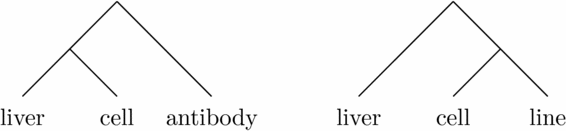
In example (1), there is an antibody that targets a liver cell, while example (2) refers to a cell line that is derived from the liver. In order to make these semantic distinctions accurately, it can be useful to begin with the correct grouping of terms, since choosing a particular syntactic structure limits the options left for semantics. Although parallel at the part-of-speech (POS) level, the above two noun compounds have different constituency trees, as Figure 1 shows.
Left versus right bracketing: constituency trees.
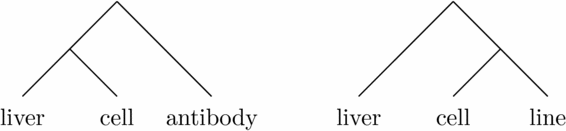
The trees on Figure 1 can be represented using brackets, which gives the name of the task, noun compound bracketing (we assume right-headedness in this section):
(1b) [[liver cell] antibody] (left bracketing)
(2b) [liver [cell line]] (right bracketing)
Instead, parsing long compounds like colon cancer tumor suppressor protein are rarely dealt with, probably because they are relatively rare in any case, with the exception of scientific texts. Instead, parsing them has typically been reduced to similar left/right-bracketing decisions for triples of nouns. For example, suppose we have decided that [colon cancer] and [tumor suppressor] are noun compounds used as subunits in the bracketing: [[colon cancer] [tumor suppressor] protein]. Assuming a noun compound behaves like its head, we end up with a bracketing problem for the compound cancer suppressor protein. If we decide on a right bracketing for that compound, we end up with the following overall structure:
[[colon cancer] [[tumor suppressor] protein]]
Noun compound parsing is a necessary step when performing semantic interpretation since the syntactic structure reveals the subparts between which relations need to be assigned, e.g., for the above example, we can have the following semantic representation:
[tumor suppressor protein] which is implicated in [colon cancer] (IN; LOCATION)
[protein] that acts as [tumor suppressor] (IS; AGENT)
[suppressor] that inhibits [tumor(s)] (OF; PURPOSE)
[cancer] that occurs in [(the) colon] (OF; IN; LOCATION)
The best known early work on automated unsupervised noun compound bracketing is that of Lauer (Reference Lauer1995), who introduced the probabilistic dependency model and criticized the previously used adjacency model (Marcus Reference Marcus1980; Pustejovsky, Anick and Bergler Reference Pustejovsky, Anick and Bergler1993; Resnik Reference Resnik1993). Given a three-word noun compound w 1w 2w 3, the adjacency model compares the strengths of association Assoc(w 1, w 2) and Assoc(w 2,w 3), while the dependency model compares Assoc(w 1, w 2) and Assoc(w 1, w 3).
3.1 Adjacency model
According to the bracketing representation introduced above, given a three-word noun compound w 1w 2w 3, the task is to decide whether w 2 is more closely associated with w 1 or with w 3. Therefore, it looks natural to compare the strength of association between the first two and the last two words, which yields an adjacency model (Lauer Reference Lauer1995):
• if Assoc(w 1, w w) < Assoc(w w, w w), predict right bracketing;
• if Assoc(w w, w w) = Assoc(w w, w w), make no prediction;
• if Assoc(w w, w w) > Assoc(w w, w w), predict left bracketing.
3.2 Dependency model
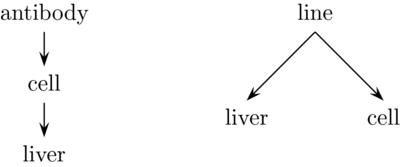
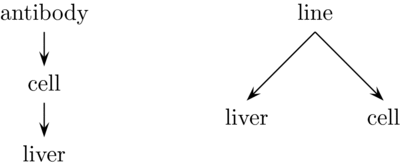
Lauer (Reference Lauer1995) proposed an alternative, syntactically motivated dependency model. It is illustrated in Figure 2, where arcs point from the heads to their modifiers.Footnote 9
Left versus right bracketing: dependency structures.

In this representation, both the left and the right dependency structures contain a link w 2 ← w 3, but differ because of w 1 ← w 2 and w 1 ← w 3, respectively.Footnote 10 Therefore, the dependency model focuses not on w 2 but on w 1:
• if Assoc(w w, w w) < Assoc(w w, w w), predict right bracketing;
• if Assoc(w w, w w) = Assoc(w w, w w), make no prediction;
• if Assoc(w w, w w) > Assoc(w w, w w), predict left bracketing.
3.3 Adjacency versus dependency
Figure 3 shows the dependency trees corresponding to the dependency structures from Figure 2. Note the structural difference from the constituency trees in Figure 1. First, the constituency trees contain words in the leaves only, while the dependency trees have words in the internal nodes as well. Second, the constituency trees are ordered binary trees: each internal node has exactly two ordered descendants, one left and one right, while there is no such ordering for the dependency trees.
Left versus right bracketing: dependency trees.
Consider also examples (3) and (4), which are both right-bracketed, but the order of the first two words is switched (we consider adult and male as nouns here).
(3) [adult [male rat]] (right bracketing)
(4) [male [adult rat]] (right bracketing)
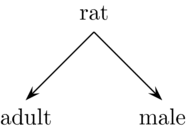
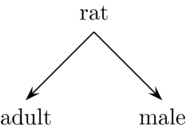
Despite (3) and (4) being different, the corresponding dependency structures are equivalent as Figures 4 and 5 show: there are no dependency arcs between adult and male, and therefore changing their linear order does not alter the dependency structure.
Dependency structures for adult male rat and for male adult rat.

Shared dependency tree for adult male rat and for male adult rat.
The adjacency and the dependency models target different kinds of right-bracketed structures. Consider for example home health care: health care is a compound, which in turn is modified by home as a whole, which can easily be seen in the concatenated spelling home healthcare, where the last two words are written without separating space.
This is different from adult male rat, where the order of the modifiers adult and male could be switched, which suggests that adult and male independently modify rat. We can conclude that, given a three-word noun compound w 1w 2w 3, there are two reasons it may be right-bracketed, [w 1[w 2w 3]]:
(a) w 2w 3 is a compound, which is modified by w 1;
(b) w 1 and w 2 independently modify w 3.
Let us now look closely at the adjacency and the dependency models:
• adjacency model: compare Assoc(w 1, w 2) and Assoc(w w, w w);
• dependency model: compare Assoc(w 1, w 2) and Assoc(w w, w w).
We can see that the adjacency model checks (a), i.e., whether w 2w 3 is a compound (a test for lexicalization), while the dependency model checks (b), i.e., whether w 1 modifies w 3 (a test for syntactic modification).
Note that there is only a modificational choice in case of left bracketing. If w 1 modifies w 2, then w 1w 2 is a noun compound, which now acts as a single noun to modify w 3. Consider for example law enforcement agent: law is a modifier of enforcement, together they form a noun compound law enforcement, which in turn, as a whole, modifies agent.
3.4 Frequency-based association scores
The simplest association score measures the strength of association as a bigram frequency in some corpus:
 \begin{equation}
Assoc(w_i,w_j) = \#(w_i,w_j)
\end{equation}
Another association score is based on conditional probability:
 \begin{equation}
Assoc(w_i,w_j) = \mathrm{Pr}(w_i \leftarrow w_j|w_j)
\end{equation}
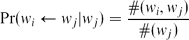 \begin{equation}
\mathrm{Pr}(w_i \leftarrow w_j|w_j) = \frac{\#(w_i,w_j)}{\#(w_j)}
\end{equation}
Other popular association measures, based on similar unigram and bigram statistics, include pointwise mutual information and Chi square. The n-gram statistics are typically collected from a large text corpus or from the Web.
For example, Lauer (Reference Lauer1995) collected n-gram statistics from Grolier's Encyclopedia,Footnote 11 which contained about eight million words (in 1995). To overcome data sparseness issues, he estimated the probabilities over conceptual categories ti in Roget's Thesaurus Footnote 12 rather than for individual words.
For evaluation, he created a dataset of 244 three-word noun compounds extracted from Grolier's Encyclopedia; this is the benchmark testset for the task of noun compound bracketing. Most compounds in this dataset are left-bracketed: 66.80%. Lauer achieved 68.90% and 77.50% accuracy with the adjacency and the dependency models, respectively. He further reported 80.70% with a better tuned system.
More recently, Lapata and Keller (Reference Lapata and Keller2004, Reference Lapata and Keller2005) estimated n-gram counts from the 100M-word BNC and from AltaVista, using page hit counts as a proxy for n-gram frequencies. They reported 68.03% accuracy with BNC and 78.68% accuracy with AltaVista.
Girju et al. (Reference Girju, Moldovan, Tatu and Antohe2005) used fifteen semantic features derived from WordNet (Fellbaum Reference Fellbaum1998), achieving 83.10% accuracy. Unlike the above approaches, their approach is supervised and requires that each noun be annotated with the correct WordNet sense, which is an unrealistic assumption.
Nakov and Hearst (Reference Nakov and Hearst2005a) used Web-derived surface features and paraphrases,Footnote 13 achieving 89.34% accuracy on the Lauer dataset, and 95.35% accuracy on their own biomedical dataset.Footnote 14 Their most important features include the following:
• Dashes: e.g., finding on the Web the dashed form law-enforcement officer suggests a left bracketing interpretation for law enforcement officer.
• Genitives: e.g., finding the genitive form math problem's solution indicates a left bracketing for math problem solution.
• Internal capitalization: e.g., finding on the Web Plasmodium vivax Malaria suggests left bracketing for plasmodium vivax malaria.
• Internal inflection variety: e.g., bone minerals density favors left bracketing for bone mineral density.
• Internal slashes: e.g., leukemia/lymphoma cell suggests right bracketing for leukemia lymphoma cell.
• Parentheses: e.g., finding on the Web growth factor (beta) indicates left bracketing for growth factor beta.
• Abbreviations: e.g., finding tumor necrosis factor (NF) signals right bracketing for tumor necrosis factor.
• Concatenations: e.g., finding on the Web healthcare reform favors left bracketing for health care reform.
• Word reordering: e.g., finding male adult rat indicates right bracketing for adult male rat.
• Paraphrases: They can indicate the bracketing structure by showing which two words would be kept together, e.g., cells in the bone marrow suggests left bracketing for bone marrow cell since it keeps the two left words together.
4 Noun compound semantics
We first present a brief overview of the representations of noun compound semantics in both theoretical and computational linguistics. Then, we describe the two main lines of research on automatic semantic interpretation of noun compounds in NLP.
4.1 Representation
Most work on noun compound semantics has focused on two-word noun compounds, or noun–noun compounds, which are the most common type. In terms of representation, in computational linguistics, the semantics of a noun compound has been typically expressed by an abstract relation like CAUSE (e.g., malaria mosquito), SOURCE (e.g., olive oil), or PURPOSE (e.g., migraine drug), drawn from a small fixed inventory. Such inventories were initially proposed by linguists, e.g., based on corpus studies, but they have become especially popular in computational linguistics.
Warren (Reference Warren1978) proposed a linguistic theory based on a study of the Brown corpus (Kucera and Francis Reference Kucera and Francis1967). In this theory, noun compounds are characterized by abstract semantic relations organized into a four-level hierarchy, where the top level is occupied by six coarse-grained relations, Possession, Location, Purpose, Activity-Actor, Resemblance, and Constitute, which are further subdivided into finer-grained relations. For example, Constitute is divided into three level-2 relations: Source-Result, Result-Source, or Copula. Copula in turn is subdivided into another three level-3 relations: Adjective-Like_Modifier, Subsumptive, and Attributive. Finally, Attributive is divided into two level-4 relations Animate_Head (e.g., girl friend) and Inanimate_Head (e.g., house boat).
In the alternative linguistic theory of Levi (Reference Levi1978), noun compounds (and complex nominals in general, see Section 2.1) can be derived by the following two processes:
(1) Predicate deletion.
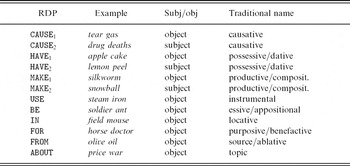
It can delete the 12 abstract recoverably deletable predicates (RDPs) shown in Table 1, e.g., pie made of apples → apple pie. In the resulting nominals, the modifier is typically the object of the predicate; when it is the subject, the predicate is marked with the index 2.
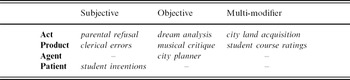
(2) Predicate nominalization. It produces nominals whose head is a nominalized verb, and whose modifier is derived from either the subject or the object of the underlying predicate, e.g., the President refused General MacArthur's request→ presidential refusal. Multi-modifier nominalizations retaining both the subject and the object as modifiers are possible as well. Therefore, there are three types of nominalizations depending on the modifier, which are combined with the following four types of nominalizations the head can represent: act, product, agent, and patient. See Table 2 for examples.
Levi's recoverably deletable predicates (RDPs). Column 3 shows the modifier's function in the corresponding paraphrasing relative clause: when the modifier is the subject of that clause, the RDP is marked with the index 2

Levi's nominalization types with examples

These linguistic theories have influenced the efforts to create similar inventories for computational linguistic purposes. For example, Ó Séaghdha (Reference Ó Séaghdha2007) revised the inventory of Levi (Reference Levi1978) based on six pragmatic criteria:
• the inventory of relations should have good coverage;
• relations should be disjunct, and should describe a coherent concept;
• the class distribution should not be overly skewed or sparse;
• the concepts underlying the relations should generalize to other linguistic phenomena;
• the guidelines should make the annotation process as simple as possible;
• the categories should provide useful semantic information.
This yielded an inventory of six semantic relations, which are further sub- divided into subcategories: BE (identity, substance-form, similarity), HAVE (possession, condition-experiencer, property-object, part-whole, groupmember), IN (spatially located object, spatially locatedevent, temporarily located object, temporarily located event), ACTOR (participant-event, participant-participant), INST (participant-event, participant-participant), ABOUT (topic-object, topic-collection, focus-mental activity, commodity-charge). E.g., tax law is topic-object, crime investigation is focusmental activity, and they both are also ABOUT.
The approach of Warren (Reference Warren1978) to organize fine-grained semantic relations into a multi-level hierarchy has been followed by Nastase and Szpakowicz (Reference Nastase and Szpakowicz2003) who designed an inventory of 30 fine-grained relations, grouped into five coarse-grained super-relations (the corresponding fine-grained relations are shown in parentheses): CAUSALITY (cause, effect, detraction, purpose), PARTICIPANT (agent, beneficiary, instrument, object_property, object, part, possessor, property, product, source, whole, stative), QUALITY (container, content, equative, material, measure, topic, type), SPATIAL (direction, location_at, location_from, location), and TEMPORALITY (frequency, time_at, time_through). For example, exam anxiety is classified as effect and therefore also as CAUSALITY, while blue book is property and therefore also PARTICIPANT.
This inventory of Nastase and Szpakowicz (Reference Nastase and Szpakowicz2003) is an extension of the flat, nonhierarchical inventory of 20 relations created by Barker and Szpakowicz (Reference Barker and Szpakowicz1998). It is also a superset of the 19-relation inventory of Kim and Baldwin (Reference Kim and Baldwin2006).
There have also been some independently developed inventories, which are not directly or indirectly derived from those of Levi (Reference Levi1978) and Warren (Reference Warren1978).
One such example is the inventory of Vanderwende (Reference Vanderwende1994), which classifies noun–noun compounds according to questions (mostly Wh-questions), which in turn correspond to 13 semantic relations: Subject (Who/what?), Object (Whom/what?), Locative (Where?), Time (When?), Possessive (Whose?), Whole-Part (What is it part of?), Part-Whole (What are its parts?), Equative (What kind of?), Instrument (How?), Purpose (What for?), Material (Made of what?), Causes (What does it cause?), and Caused-by (What causes it?). For example, alligator shoes is Material and answers the question Made of what?.
Another example is the inventory of Girju et al. (Reference Girju, Moldovan, Tatu and Antohe2005), which consists of 21 abstract relations: POSSESSION, ATTRIBUTE-HOLDER, AGENT, TEMPORAL, PART-WHOLE, IS-A, CAUSE, MAKE/PRODUCE, INSTRUMENT, LOCATION/SPACE, PURPOSE, SOURCE, TOPIC, MANNER, MEANS, THEME, ACCOMPANIMENT, EXPERIENCER, RECIPIENT, MEASURE, and RESULT. It is a subset of the 35-relation inventory of Moldovan et al. (Reference Moldovan, Badulescu, Tatu, Antohe and Girju2004), originally designed for the semantic interpretation of noun phrases in general.
Finally, there has been some work on trying to compare and consolidate existing inventories. Tratz and Hovy (Reference Tratz and Hovy2010) compared the inventories of Levi (Reference Levi1978), Warren (Reference Warren1978), Vanderwende (Reference Vanderwende1994), Barker and Szpakowicz (Reference Barker and Szpakowicz1998), Nastase and Szpakowicz (Reference Nastase and Szpakowicz2003), and Girju et al. (Reference Girju, Moldovan, Tatu and Antohe2005) and found them to cover a largely overlapping semantic space but to partition this space differently. Thus, they proposed a new two-level inventory of 43 fine-grained relations, grouped into ten coarse-grained super-relations; Tratz and Hovy obtained this inventory through iterative crowd-sourcing by maximizing inter-annotator agreement.
While the above abstract relation inventories were designed with broad-coverage text analysis in mind, there have been also proposals tailored to a specific domain. For example, Rosario, Hearst and Fillmore (Reference Rosario, Hearst and Fillmore2002) defined 38 abstract relations to characterize the semantics of biomedical noun–noun compounds, which includes domain-specific relations such as Produce_Genetically, Person_Afflicted, Attribute_of_Clinical_Study, and Defect. For example, hormone deficiency is Defect, and polyomavirus genome is Produce_Genetically.
Another interesting proposal is that of Lauer (Reference Lauer1995), who defined the problem of noun compound interpretation as predicting which among the following eight prepositions best paraphrases the target noun compound: of, for, in, at, on, from, with, and about. For example, olive oil is oil from olives, and war story is story about war. Lauer's approach is attractive since it is simple and allows direct extraction of prepositions from a large text corpus or from the Web (Lapata and Keller Reference Lapata and Keller2004, Reference Lapata and Keller2005). Moreover, prepositions are directly usable as paraphrases in NLP applications. The downside is that prepositions are polysemous: for example, in, on, and at can refer to both LOCATION and TIME, e.g., mouse in the field and flight in the morning express different relations, while flight in the morning, flight at night, and flight on Saturday express the same relation. Similarly, from can correspond to several of Levi's relations (see Table 1), e.g., tears from gas is CAUSE1, death from drugs is CAUSE2, cake from apples is HAVE1, peel from lemon is HAVE2, silk from worms is MAKE1, ball from snow is MAKE2, mouse from the fields is IN, and oil from olives is FROM. Note also that some noun–noun compounds cannot be paraphrased with prepositions, e.g., coach trainer; in contrast, empirical work suggests that most noun–noun compounds do fall into one of Levi's RDPs.
The interpretation of noun compound in terms of abstract semantic relations drawn from a small fixed inventory is also potentially problematic for a number of reasons. First, it is unclear which relation inventory is best to use in general and for a particular task. Second, being both abstract and limited, such relations capture only part of the semantics, e.g., classifying malaria mosquito as CAUSE obscures the fact that mosquitos do not directly cause malaria, but just transmit it. Third, in many cases, multiple relations are possible, e.g., in Levi's theory, sand dune is interpretable as both HAVE and BE. Still, despite these issues, the use of abstract relation inventories remains the mainstream approach in computational linguistics.
In theoretical linguistics, however, the feasibility of the idea has been subject to much criticism. For example, after having performed a series of psychological experiments, Downing (Reference Downing1977) concluded that no fixed and limited set of relations could adequately characterize noun compound semantics, a position held earlier by Jespersen (Reference Jespersen1942). To see this, consider a noun compound like plate length, which can be interpreted in some context as what your hair is when it drags in your food. Obviously, such fine-grained novel interpretations cannot be covered by a finite fixed inventory of abstract semantic relations. This has led some computational linguists such as Hobbs et al. (Reference Hobbs, Stickel, Appelt and Martin1993) to assume that the relationship between the nouns in a noun–noun compound can be anything.
Some researchers have proposed a partial solution based on finer-grained, and even infinite, inventories, e.g., Finin (Reference Finin1980) used specific verbs such as dissolved in for salt water. While this still cannot handle examples such as plate length, it offers much richer representation.
Inspired by Finin (Reference Finin1980), Nakov and Hearst (Reference Nakov, Hearst, Euzenat and Domingue2006) proposed that noun compound semantics is best expressible using paraphrases involving verbs and/or prepositions; this work was further extended in Nakov (Reference Nakov2008b). For example, bronze statue is a statue that is made of, is composed of, consists of, contains, is of, is, is handcrafted from, is dipped in, looks like bronze.
Nakov and Hearst (Reference Nakov, Hearst, Euzenat and Domingue2006) further proposed that selecting one such paraphrase is not enough to express the semantics of a noun compound and that multiple paraphrases are needed for a fine-grained representation. Finally, they observed that not all paraphrases are equally good (e.g., is made of is arguably better than looks like or is dipped in for Make), and thus proposed that the semantics of a noun compound should be expressed as a distribution over multiple possible paraphrases, e.g., malaria mosquito can be carry (23), spread (16), cause (12), transmit (9), etc. These verbs are fine-grained, directly usable as paraphrases, and using multiple of them for a noun compound approximates its semantics better.
It is easy to see that not only the semantics of individual noun compounds but also that of abstract relations such as Make can be represented in the same way, as a distribution over paraphrasing verbs and prepositions; this is an idea explored in Nakov and Hearst (Reference Nakov and Hearst2008). Note, however, that some noun compounds are paraphrasable by more specific verbs that do not necessarily support the target abstract relation. For example, malaria mosquito, which expresses Cause, can be paraphrased using verbs like carry, which do not imply direct causation. Similarly, while both wrinkle treatment and migraine treatment express Treatment-For-Disease, fine-grained differences can be revealed using verbs, e.g., smooth can paraphrase the former, but not the latter.
Finally, note that while verbs and prepositions are the most frequent ways to paraphrase a noun–noun compound, there are many other ways to express the explicit relationship between the two nouns, e.g., for onion tears, we could have: tears from onions, tears due to cutting onion, tears induced when cutting onions, tears that onions induce, tears that come from chopping onions, tears that sometimes flow when onions are chopped, tears that raw onions give you, etc. The exploration of such free paraphrases of noun–noun compounds was the focus of SemEval-2013 Task 4 (Hendrickx et al. Reference Hendrickx, Kozareva, Nakov, Ó Séaghdha, Szpakowicz and Veale2013).Footnote 15
4.2 Semantic interpretation
The semantic interpretation of noun compounds is complicated by their heterogeneous nature. Thus, it is often addressed using nonparametric instance-based classifiers like the k-nearest neighbor (kNN), which effectively reduce it to measuring the relational similarity between a testing and each of the training examples. The latter is studied in detail by Turney (Reference Turney2006b), who distinguishes between attributional similarity or correspondence between attributes, and relational similarity or correspondence between relations. Attributional similarity is interested in the similarity between two words, A and B. In contrast, relational similarity focuses on the relationship between two pairs of words, i.e., it asks how similar the relations A:B and C:D are. Measuring relational similarity is often done indirectly, and is modeled as a function of two instances of attributional similarity: (1) between A and C, and (2) between B and D.
Going back to semantic relations,Footnote 16 there is a similar split between two general lines of research. The first one derives the noun compound semantics from the semantics of the nouns it is made of (Rosario and Hearst Reference Rosario, Hearst, Lee and Harman2001; Rosario et al. Reference Rosario, Hearst and Fillmore2002; Girju, Badulescu and Moldovan Reference Girju, Badulescu and Moldovan2003; Moldovan et al. Reference Moldovan, Badulescu, Tatu, Antohe and Girju2004; Kim and Baldwin Reference Kim and Baldwin2005; Girju Reference Girju2006; Nastase et al. Reference Nastase, Sayyad-Shirabad, Sokolova and Szpakowicz2006; Ó Séaghdha and Copestake Reference Ó Séaghdha and Copestake2008; Tratz and Hovy Reference Tratz and Hovy2010), e.g., by generalizing them over a lexical hierarchy. This works for relations like Part-Whole, which are more permanent and context-independent, e.g., door-car. The second line of research models the relationship between the nouns directly (Vanderwende Reference Vanderwende1994; Lauer Reference Lauer1995; Lapata Reference Lapata2002; Turney and Littman Reference Turney and Littman2005; Kim and Baldwin Reference Kim and Baldwin2006; Nakov and Hearst Reference Nakov, Hearst, Euzenat and Domingue2006, Reference Nakov and Hearst2008; Turney Reference Turney2006a, Reference Turney2006b; Butnariu and Veale Reference Butnariu and Veale2008), e.g., using suitable patterns that can connect them in a sentence. This is useful for context-dependent relations like Cause-Effect, which are dynamic and often episodic, e.g., exam anxiety. These two lines are rarely combined; two notable exceptions are (Ó Séaghdha and Copestake Reference Ó Séaghdha and Copestake2009) and (Nakov and Kozareva Reference Nakov and Kozareva2011).
4.2.1 Attributional approaches
A major advantage of attributional approaches is that they can make use of rich pre-existing resources such as WordNet, e.g., to generalize the nouns forming the noun compound. Below we present representative research in that direction.
The descent of hierarchy was proposed by Rosario et al. (Reference Rosario, Hearst and Fillmore2002), motivated by the assumption that head–modifier relations reflect the qualia structure (Pustejovsky Reference Pustejovsky1995) associated with the head. Under this interpretation, the meaning of the head determines what can be done to it, what it is made of, what it is a part of, and so on. For example, a knife can be in the following relations:
• Used-in: kitchen knife, hunting knife
• Made-of: steel knife, plastic knife
• Instrument-for: carving knife
• Used-on: meat knife, putty knife
• Used-by: chef's knife, butcher's knife
Some relations are specific to narrow noun classes, while others, more general, apply to wider classes. Building on this idea, Rosario et al. (Reference Rosario, Hearst and Fillmore2002) proposed a semi-supervised characterization of the relation between the nouns in a bioscience noun–noun compound, based on the semantic category in a lexical hierarchy to which each of the nouns belongs.
For example, all noun–noun compounds in which the first noun (the modifier) is classified under the A01 (Body Regions) subhierarchy and the second one (the head) falls under the A07 (Cardiovascular System) subhierarchy were hypothesized to express the same relation. Examples include mesentery artery, finger capillary, leg vein, and forearm microcirculation.
In contrast, noun–noun compounds whose constituent nouns are assigned to the A01–M01 (Body Regions–Persons) categories are ambiguous, and a distinction is needed between different kinds of persons:
• M01.643 (Patients), e.g., eye outpatient
• M01.526 (Occupational Groups), e.g., eye physician
• M01.898 (Donors), e.g., eye donor
• M01.150 (Disabled Persons), e.g., arm amputee
Thus, one needs to descend one level down the M01 hierarchy in order to find the right level of generalization so that all of the corresponding noun–noun compounds express the same relation.
The idea of the descent of hierarchy is appealing and the accuracy is very high (about 90%), but there are limitations. First, the classification is not fully automated; human annotators decide where to cut the hierarchy. Second, the coverage is limited by the lexical hierarchy, most likely to narrow domains. Third, problems are caused by lexical and relational ambiguities. Finally, the approach does not propose explicit names for the assigned relations.
Iterative semantic specialization (Girju et al. Reference Girju, Badulescu and Moldovan2003) is similar but automated and restricted to a single relation, e.g., Girju et al. (Reference Girju, Badulescu and Moldovan2003) experimented with Part-Whole. The training data, annotated with WordNet senses and containing both positive and negative examples, are first generalized going from each positive/negative example up the WordNet hierarchy, and then these generalizations are iteratively specialized whenever necessary, to make sure that they are not ambiguous with respect to the semantic relation assigned. A set of rules is then produced based on these examples through supervised learning.
Semantic scattering (Moldovan et al. Reference Moldovan, Badulescu, Tatu, Antohe and Girju2004) implemented an idea along the same lines. It relies on the training data to determine a boundary (essentially, a cut) in a hierarchy – in particular, WordNet's hypernym–hyponym hierarchy – such that the sense combinations in a noun compound which can be mapped onto this boundary are unambiguous with respect to the relation within the compound. Sense combinations found above this boundary may convey different relation types.
The interpretation of noun–noun compounds can also be done using the semantics of the head and of the modifier implicitly, i.e., without explicitly assigning them word senses. For example, Rosario and Hearst (Reference Rosario, Hearst, Lee and Harman2001) generalized noun compounds over the MeSH hierarchy at various levels of generality, without trying to disambiguate them; they then used these generalizations as features for predicting 18 relations between biomedical noun–noun compounds in a supervised fashion. Similarly, Kim and Baldwin (Reference Kim and Baldwin2005) measured the similarity between two noun compounds as a linear interpolation of the WordNet similarity between the two heads and the two modifiers; then, they used this similarity in a kNN classifier.
Of course, nouns do not have to be generalized with respect to a hierarchy only; distributional information from a corpus might be equally useful. For example, Nastase et al. (Reference Nastase, Sayyad-Shirabad, Sokolova and Szpakowicz2006), in addition to noun generalizations using WordNet, also used grammatical collocates extracted from a large corpus that appear with the head/modifier in a grammatical relation, such as subject, object, and prepositional complement. Similarly, Ó Séaghdha and Copestake (Reference Ó Séaghdha and Copestake2008) measured similarity using collocates extracted from BNC and the Google Web 1T 5-gram corpus (Brants and Franz Reference Brants and Franz2006), which they used in distributional kernels.
Tratz and Hovy (Reference Tratz and Hovy2010) used another useful information source: morphological information such as noun prefixes and suffixes. Finally, Girju (Reference Girju2006) generalized arguments using cross-linguistic evidence from two bilingual sentence-aligned corpora: EUROPARL (Koehn Reference Koehn2005) and CLUVI.Footnote 17
4.2.2 Relational approaches
Relational approaches model the relationship between the nouns directly.
One way to do this is by using explicit paraphrases as a source of fine-grained semantic representation. We have already seen this in the work of Lauer (Reference Lauer1995), who expressed noun compound semantics using eight prepositions, as well as in (Nakov and Hearst Reference Nakov, Hearst, Euzenat and Domingue2006), who used a distribution over Web-derived verbs and prepositions. Butnariu and Veale (Reference Butnariu and Veale2008) also used paraphrasing verbs, but they extracted them as the intersection of possible head-verb and verb-modifier pairs. Using a distribution over verbs as a semantic interpretation was also carried out in a recent challenge: SemEval-2010 Task 9 (Butnariu et al. Reference Butnariu, Kim, Nakov, Ó Séaghdha, Szpakowicz and Veale2009, Reference Butnariu, Kim, Nakov, Ó Séaghdha, Szpakowicz and Veale2010).
Another way to model the relationship between the nouns in a noun compound is to use explicit paraphrases as features for predicting coarse-grained abstract relations. For example, Vanderwende (Reference Vanderwende1994) associated verbs extracted from definitions in an online dictionary with abstract relations. Kim and Baldwin (Reference Kim and Baldwin2006) used verbs from the textual definitions of abstract semantic relations, augmented with similar verbs based on WordNet::Similarity (Pedersen, Patwardhan and Michelizzi Reference Pedersen, Patwardhan and Michelizzi2004). Nakov and Hearst (Reference Nakov and Hearst2008) used Web-derived verbs, prepositions and coordinating conjunctions as features to predict Levi's RDPs.
Paraphrases as features to predict abstract relations do not have to be restricted to verbs, prepositions, conjunctions, or any part of speech: just about any pattern is fine, even patterns containing placeholders. For example, Turney (Reference Turney2006a) mined from the Web relation patterns such as “Y * causes X” for Cause (e.g., cold virus) and “Y in * early X” for Temporal (e.g., morning frost). These patterns do not have to be mined; they could be also fixed. For example, Turney and Littman (Reference Turney and Littman2005) characterized the relationship between the nouns forming a compound using the Web frequencies for 128 fixed phrases like “X for Y” and “Y for X” instantiated from a fixed set of 64 joining terms such as for, such as, not the, is *. These Web frequencies can be used for predicting abstract relations directly (Turney and Littman Reference Turney and Littman2005), or can be first mapped to vectors of lower dimensionality, e.g., using Singular Value Decomposition (Turney Reference Turney2006b).
A general problem with using paraphrases is that they suffer from data sparseness issues in the case of rare or rarely co-occurring nouns. This can be alleviated by combining relational features (e.g., verbs, prepositions, and coordinating conjunctions) with attributional features (e.g., hypernyms and co-hyponyms of the nouns). The potential has already been demonstrated by Ó Séaghdha and Copestake (Reference Ó Séaghdha and Copestake2009), who used convolution kernels. A combination was also used in (Nakov and Kozareva Reference Nakov and Kozareva2011).
5 Entailment
Below, we discuss what subparts of a noun compound are entailed by the whole, and how this relates to syntax, semantics, and type of compound. We then show how interpreting noun compounds could help solve textual entailment problems.
5.1 Semantic entailment
We have seen that for a right-headed endocentric compound n 1n 2, the relationship between the two nouns can be summarized as ‘n 1n 2 is a type/kind of n 2’, e.g., for lung cancer we have that ‘lung cancer is a kind/type of cancer’. We can interpret this paraphrase as a semantic entailment: that the compound n 1n 2 semantically entails n 2 in the sense that if we substitute n 2 in a statement containing n 1n 2, we will obtain a new statement that is entailed from the original one.
Of course, this does not hold for all noun–noun compounds, e.g., it fails for exocentric compounds (birdbrain is not a kind/type of brain; it is a kind of person), or for left-headed ones (vitamin D is not a kind/type of D; it is a kind of vitamin).
For a three-word right-headed endocentric noun compound n 1n 2n 3, it can be expected that the assertion ‘n 1n 2n 3 is a type/kind of n 3’ should be true, e.g., ‘lung cancer drug is a kind/type of drug’. If the compound is left-bracketed (n 1n 2)n 3, it can be further expected that the assertion ‘n 1n 2n 3 is a type/kind of n 2n 3’ would hold as well, e.g., ‘lung cancerdrug is a kind/type of cancer drug’. If the compound is right-bracketed n 1(n 2n 3), then it can be expected that the following two assertions would be true ‘n 1n 2n 3 is a type/kind of n 2n 3’ and ‘n 1n 2n 3 is a type/kind of n 1n 3’, e.g., ‘oxydant wrinkletreatment is a kind/type of wrinkle treatment’ and ‘oxydant wrinkle treatment is a kind/type of oxydant treatment’.
In other words, an endocentric right-headed nonlexicalized three-word noun compound n 1n 2n 3 is expected to entail n 3 and n 2n 3, but not n 1n 3, if left-bracketed, and all three n 3, n 2n 3, and n 1n 3, if right-bracketed. Therefore, noun compound bracketing could be used to predict semantic entailment. Unfortunately, it is hard for a computer program to distinguish left-headed versus right-headed compound, or left-bracketed versus right-bracketed compound; it is even harder to distinguish between a lexicalized and a nonlexicalized compound, the boundary between which is not clear-cut. The matter is further complicated due to idiomacity, lexicalization, transparency, world knowledge, nominalization, left headedness, and metonymy.
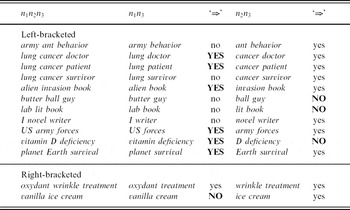
Table 3 shows sample three-word noun compounds, the corresponding bracketing and whether n 1n 3 and n 2n 3 are entailed or not. The entailments that are not predicted by the bracketing are shown in bold; we can easily explain some of them:
(1) Idiomacity. Idiomacity can interfere with semantic entailment by blocking the extraction of the head from a pair of bracketed words. This is the case with [butter ball] guy, where the idiomacity of butter ball (‘fat person’) does not allow the extraction of ball (i.e., here butter ball is not a kind of ball), and thus prevents the entailment of ball guy. The same applies to [lab lit] book, where lab lit, a literary genre, is idiomatic and blocks the extraction of lit (i.e., lab lit is not a kind of lit), and ultimately the entailment of lit book.
(2) Lexicalization. Another explanation for [butter ball] guy and [lab lit] book is lexicalization since idiomatic compounds are necessarily lexicalized. Lexicalization also explains the case of vanilla [ice cream], where ice cream does not allow the extraction of cream, thus blocking the entailment of vanilla cream.
(3) Transparency. Lexicalization cannot explain all examples in the table, most of which include subparts that are at least partially lexicalized. For example, [army ant] behavior includes the lexicalized compound army ant; still, this does not prevent the extraction of the head ant and thus the entailment of ant behavior. This extraction is possible since army ant is transparent. The same argument applies to compounds that contain even more highly lexicalized subparts, e.g., novel can be extracted from I novel, a kind of Japanese novel, so that novel writer can be entailed from [I novel] writer.
(4) World knowledge. The entailment of lung doctor from lung cancer doctor cannot be explained by the relatively low degree of lexicalization of lung cancer alone. The noun compound is left bracketed and this entailment is not predicted by the bracketing. Here, the semantics of the individual nouns and world knowledge come into play: doctor is likely to be modified by organs.
(5) Nominalization. Two problematic noun compounds are lung cancer patient and lung cancer survivor. While patient and survivor play similar role in the context of these compounds, lung patient is entailed, but lung survivor is not. Here survivor is a nominalization of the verb survive, which can easily take cancer, and therefore also lung cancer, but not lung, as a direct object. A similar argument applies to [Alien invasion] book and [planet Earth] survival.
(6) Left headedness. The actual entailments are completely reversed compared to what the bracketing predicts for vitamin D deficiency, which contains the left-headed noun compound vitamin D as a modifier.
(7) Metonymy. Due to metonymy, in the case of US army forces, all possible subsequences are entailed: not only US forces, army forces, and forces, but also US army, army and, in some contexts, even just US.
Semantic entailment and noun compound bracketing. The entailments that are not predicted by the bracketing are shown in bold

5.2 Application to textual entailment
In this section, we present some examples involving noun compounds from the development dataset of the Second Pascal Recognizing Textual Entailment (RTE2) Challenge.Footnote 18 We have chosen to illustrate the importance of understanding the syntax and semantics of noun compounds on this particular task since it requires generic semantic inference that could potentially help many natural language processing applications, including Question Answering (QA), Information Retrieval (IR), Information Extraction (IE), and (multi-)document summarization (SUM).
Given two textual fragments, a text T and a hypothesis H, the goal is to recognize whether the meaning of H is entailed (can be inferred) from T:
‘We say that T entails H if, typically, a human reading T would infer that H is most likely true. This somewhat informal definition is based on (and assumes) common human understanding of language as well as common background knowledge’. (RTE2 task definition)
Below, we give examples illustrating different kinds of phrase variability involving noun compounds that a successful inference engine for RTE might need to solve. Of course, recognizing that two phrases are variations of each other does not solve the RTE problem automatically (e.g., below we have both positive and negative examples with respect to RTE), but it could help the overall decision by allowing an RTE engine to focus on the remaining words rather than on the surface variability between noun compounds and their paraphrases/subparts.
5.2.1 Prepositional paraphrase
Here, we have a positive example from IR, where a noun compound has to be matched to a prepositional paraphrase:
‘paper costs’ ⇒ ‘cost of paper’
<pair id=”503” entailment=”YES” task=”IR”>
<t>Newspapers choke on rising paper costs and falling revenue.</t>
<h>The cost of paper is rising.</h>
</pair>
5.2.2 Verbal and prepositional paraphrases
Here we have a positive example from QA, which requires matching two different paraphrases, one verbal and one prepositional, of the same underlying three-word noun compound WTO Geneva headquarters:
‘Geneva headquarters of the WTO’ ⇒ ‘WTO headquarters are located in Geneva’
<pair id=”284” entailment=”YES” task=”QA”>
<t>While preliminary work goes on at the Geneva headquarters of the WTO,
with members providing input, key decisions are taken at the ministerial
meetings.</t>
<h>The WTO headquarters are located in Geneva.</h>
</pair>
5.2.3 Bracketing
Here is a positive example from summarization, where the hypothesis extracts the modifier of a three-word noun compound, which is consistent with a left bracketing:
‘[breast cancer] patients’ ⇒ ‘[breast cancer]’
<pair id=”177” entailment=”YES” task=”SUM”>
<t>Herceptin was already approved to treat the sickest
breast cancer patients, and the company said, Monday,
it will discuss with federal regulators the possibility
of prescribing the drug for more breast cancer patients.</t>
<h>Herceptin can be used to treat breast cancer.</h>
</pair>
5.2.4 Bracketing and paraphrase
The following negative example from IR involves a noun compound paraphrased prepositionally in a way that is consistent with left bracketing:
‘[ivory trade] ban’ ⇒ ‘ban on [ivory trade]’
<pair id=”117” entailment=”NO” task=”IR”>
<t>The release of its report led to calls for a complete ivory trade ban,
and at the seventh conference in 1989, the African Elephant was moved to
appendix one of the treaty.</t>
<h>The ban on ivory trade has been effective in protecting the elephant
from extinction.</h>
</pair>
5.2.5 Synonymy
Here is another IR example, this time positive, which involves two noun compounds with the same modifiers and with synonymous heads, which express the same implicit semantic relation:
‘marine plants’ ⇒ ‘marine vegetation’
<pair id=”65” entailment=”YES” task=”IR”>
<t>A number of marine plants are harvested commercially
in Nova Scotia.</t>
<h>Marine vegetation is harvested.</h>
</pair>
5.2.6 Hyponymy and prepositional paraphrase
The following positive example from IR involves a prepositional paraphrase and a noun compound, where the modifiers are the same and the heads are in a hyponymy relation, i.e., marijuana is a kind of drug:
‘legalization of marijuana’ ⇒ ‘drug legalization’
We could also see this as involving longer paraphrases for the noun compounds marijuana legalization benefits and drug legalization benefits:
‘benefits in the legalization of marijuana’ ⇒ ‘drug legalization has benefits’.
<pair id=”363” entailment=”YES” task=”IR”>
<t>One economic study will not be the basis of Canada's public policy
decisions, but Easton's research does conclusively show that there are
economic benefits in the legalization of marijuana.</t>
<h>Drug legalization has benefits.</h>
</pair>
5.2.7 Prepositional paraphrase, nominalization, and synonymy
The following example is yet another positive example for IR, which involves a combination of several phenomena. Here the verb enrich was substituted by its synonym enhance, which in turn was nominalized. On the other hand, the verbs enrich and feed are good paraphrases for the noun–noun compound soil enhancers, e.g., ‘enhancers that enrich/feed the soil’, and fertilizer is a synonym of enhancer:
‘enriches and feeds the soil’ ⇒ ‘soil enhancers’
<pair id=”192” entailment=”YES” task=”IR”>
<t>Organic fertilizer slowly enriches and feeds the soil. Fast acting synthetic fertilizers harm soil life.</t>
<h>Organic fertilizers are used as soil enhancers.</h>
</pair>
5.2.8 Nominalization, bracketing, and synonymy
The negative example from summarization below is another illustration of complex interactions. Here the modificational past participle damaged becomes the new noun compound head: injury. One possible interpretation is that damaged, which is a form of the verb to damage, has been substituted by the synonymous verb to injure, which has been nominalized and has become the new noun compound head:
‘damaged [spinal cord]’ ⇒ ‘[spinal cord] injury’
Note, however, that the verb to damage does not have to be analyzed as a synonym of to injure; it is also a good candidate for a verbal paraphrase of the noun compound spinal cord injury, e.g., as ‘injury which damaged the spinal cord’.
<pair id=”261” entailment=”NO” task=”SUM”>
<t>The new work went an extra step, suggesting that the connections that
the stem cells form to help bridge the damaged spinal cord, are key to
recovery.</t>
<h>The experiment, reported Monday, isn’t the first to show that stem
cells offer tantalizing hope for spinal cord injury.</h>
</pair>
6 Discussion
We have seen above that solving many textual entailment problems might require understanding the syntax and/or the semantics of the involved noun compounds. Some of the examples needed to check whether a particular verb or preposition is acceptable as a paraphrase for a given noun compound, others called for deciding whether semantic entailment would be possible after dropping one or more words from a noun compound. Additional factors come into play, e.g., inflectional and derivational morphological alternations and lexical relations such as synonymy and hyponymy, as well as complex combinations thereof.
An important observation to make is that noun compound interpretation techniques can extend to more complex expressions. For example, checking whether ‘Geneva headquarters of the WTO’ could entail ‘WTO headquarters are located in Geneva’ can be performed by understanding the semantics of the noun compound ‘WTO Geneva headquarters’ in terms of prepositional and verbal paraphrases.
Similarly, even without knowing that plant and vegetation are synonyms, we can still establish that marine plants textually entails marine vegetation since the implicit semantic head–modifier relations for these noun compounds are very similar, e.g., can be paraphrased using the same verbs and/or prepositions.
We should note that the task solved by RTE is probably more complex than many real-world applications would require.Footnote 19 For example, an IR engine would benefit directly from being able to recognize that ‘Geneva headquarters of the WTO’, ‘WTO headquarters are located in Geneva,’ and ‘WTO Geneva headquarters’ are all paraphrases, without the need for solving the RTE problem for full sentences.
Being able to generate such paraphrases by turning a noun compound into an explicit paraphrase and vice versa has been shown beneficial (Nakov Reference Nakov2008a) for statistical machine translation (SMT). For example, suppose that the phrase oil price hikes can be paraphrased as hikes in oil prices and hikes in the prices of oil. If an SMT system knows that oil price hikes can be translated into Spanish as alzas en los precios del petróleo,Footnote 20 then it can also use the same fluent Spanish translation for the two additional paraphrases.
One notable feature of the RTE task is that noun compounds are put into a sentential context, which is more realistic than out-of-context interpretation since the semantics of many noun compounds is context-dependent (Meyer Reference Meyer1993), e.g., museum book can mean a book about a museum, a book on display in a museum, a book published by a museum, a book showing a museum on its cover page, a book bought in a museum, etc. More importantly, compounds could get completely novel interpretations in a certain context, e.g., museum book could mean a book that I am planning to take with me when I go to the museum tomorrow; such novel interpretations are currently out of reach for computational approaches.
Context-dependency is generally somewhat less of an issue for the semantic relations that hold between the nouns forming a noun compound compared to general semantic relations between nouns. This is partly due to the two nouns mutually disambiguating themselves, e.g., in the interpretations of museum book above, book had the meaning of either (a) physical object or (b) information source, but not of (c) the number of tricks a cardplayer or side must win before any trick can have scoring value. It is also due to most noun compounds preferring a particular interpretation, e.g., for museum book this would be a book about a museum.
The general preference for one particular default interpretation is reflected in the available noun compound datasets, e.g., those of Levi (Reference Levi1978), Warren (Reference Warren1978), Vanderwende (Reference Vanderwende1994), Lauer (Reference Lauer1995), Barker and Szpakowicz (Reference Barker and Szpakowicz1998), Nastase and Szpakowicz (Reference Nastase and Szpakowicz2003), Girju et al. (Reference Girju, Moldovan, Tatu and Antohe2005), Kim and Baldwin (Reference Kim and Baldwin2006), Ó Séaghdha (Reference Ó Séaghdha2007), and Tratz and Hovy (Reference Tratz and Hovy2010), none of which provides context for the interpretation.
This tradition of out-of-context interpretation was also continued by evaluation campaigns on noun compound interpretation such as SemEval-2010 Task 9 (Butnariu et al. Reference Butnariu, Kim, Nakov, Ó Séaghdha, Szpakowicz and Veale2009, Reference Butnariu, Kim, Nakov, Ó Séaghdha, Szpakowicz and Veale2010), which asks for semantic interpretation using paraphrasing verbs as opposed to using abstract relations. It assumed that candidate paraphrasing verbs and prepositions have already been identified by some hypothetical system, and asked the task participants to rank a long list of such candidates for a given noun–noun compound by relevance in decreasing order. For example, cause and spread are good paraphrases for malaria mosquito, and thus should be ranked high, while be made up of is bad and thus should be ranked low.
This is in contrast to related tasks such as SemEval-2007 Task 4 (Girju et al. Reference Girju, Nakov, Nastase, Szpakowicz, Turney and Yuret2007, Reference Girju, Nakov, Nastase, Szpakowicz, Turney and Yuret2009) and SemEval-2010 Task 8 (Hendrickx et al. Reference Hendrickx, Kim, Kozareva, Nakov, Ó Séaghdha, Padó, Pennacchiotti, Romano and Szpakowicz2009, Reference Hendrickx, Kim, Kozareva, Nakov, Ó Séaghdha, Padó, Pennacchiotti, Romano and Szpakowicz2010), which asked for the classification of semantic relations between pairs of nominals in the context of a sentence. Context plays an important role in these tasks, e.g., while the noun compound apple basket can be only interpreted as Content-Container according to the inventory of semantic relations in SemEval-2010 Task 8, there are three possible context-dependent relations in that inventory between apple and basket when they do not form a compound, as the following examples show (illustrative made-up examples; not present in the task datasets):
Entity-Destination: ‘A girl entered the room, put three red <e 1>apples</e 1> in the <e 2>basket</e 2>, and left’.
Entity-Origin: ‘A few minutes later, a boy came along, took the biggest <e 1>apple</e 1> from the <e 2>basket</e 2>, and ate it’.
Content-Container: ‘When the girl returned, she found that there were only two <e 1>apples</e 1> left in the <e 2>basket</e 2>’.
We should note, however, that the datasets of SemEval-2007 Task 4 and SemEval-2010 Task 8 include some examples (8.2% and 5.1%, respectively, as Tables 4 and 5 show) that do ask for the interpretation of noun compounds. However, most of these noun compounds have their default interpretation and thus do not really need the sentential context, e.g. (this time, actual examples from the dataset):
The noun–noun compounds in the SemEval-2007 Task 4 datasets

The noun–noun compounds in the SemEval-2010 Task 8 datasets

Entity-Origin: ‘<e 1>Coconut</e 1> <e 2>oil</e 2> is extracted from the kernel or meat of matured coconut harvested from the coconut palm (Cocos nucifera)’.
Product-Producer: ‘The <e 1>police</e 1> <e 2>report</e 2> has cast a spotlight on America's self-help industry’.
Component-Whole: ‘To stand up to the wind, <e 1>umbrella</e 1> <e 2>frames</e 2> are strong yet flexible’.
Cause-Effect: ‘<e 1>Fatigue</e 1> <e 2>corrosion</e 2> and stress corrosion are similar, as both are caused by external stresses applied to the pipe and occur inside of the pipe’.
Other: ‘Tissue damage and <e 1>electrode</e 1> <e 2>corrosion</e 2> are both associated with high charge density stimulation’. The datasets of SemEval-2007 Task 4 and SemEval-2010 Task 8 are not the only ones asking for noun compound interpretation in context. There is also a dataset inspired by RTE, which asks specifically for resolving entailments between a paraphrase and a noun compound (Nakov Reference Nakov2008c); here is a positive example:
T: I have friends that are organizing to get more <e2>professors</e2> thatare <e1>women</e> and educate women to make specific choices on where to get jobs.
H: I have friends that are organizing to get more <e1>women</e1> <e2>professors</e2> and educate women to make specific choices on where to get jobs.
Here is a negative example with a bad paraphrasing verb in the first sentence:
T: As McMillan collected, she also quietly gave, donating millions of dollars to create scholarships and fellowships for black Harvard Medical School students, African filmmakers, and MIT <e2>professors</e2> who study <e1>women</e1> in the developing world.
H: As McMillan collected, she also quietly gave, donating millions of dollars to create scholarships and fellowships for black Harvard Medical School students, African filmmakers, and MIT <e1>women</e1> <e2>professors</e2> in the developing world.
This dataset is probably too small for practical uses, but it points to an interesting research direction with many potential practical applications, e.g., such sentence-level paraphrases have already been shown useful in SMT (Nakov Reference Nakov2008a).
7 Conclusion
We have presented a brief overview of noun compounds and their syntax and semantics from both theoretical and computational linguistics viewpoint with an emphasis on the latter. We have also shown how understanding noun compound syntax and semantics could potentially help solve textual entailment problems, both semantic entailment and RTE, which would be potentially useful for a number of NLP applications, and which we believe to be an important direction for future research.
Another important, but surprisingly under-explored, research direction we discussed is noun compound interpretation in context. While the importance of context and pragmatic considerations for noun compound interpretation are well understood in theoretical linguistics (Jespersen Reference Jespersen1942; Downing Reference Downing1977; Spärck Jones Reference Spärck Jones, Fallside and Woods1983; Meyer Reference Meyer1993), computational linguists have so far largely ignored context dependency,Footnote 21 even though they have modeled it for semantic relations in general. Facilitating research in this direction would require suitable datasets.
Exploring the relationship between fine-grained paraphrases, which are typically extracted in an unsupervised fashion, and abstract relations, which are used primarily with supervised models, is another promising research direction. This would be facilitated by datasets that have both kinds of annotations, e.g., SemEval-2010 Task 9 (Butnariu et al. Reference Butnariu, Kim, Nakov, Ó Séaghdha, Szpakowicz and Veale2009, Reference Butnariu, Kim, Nakov, Ó Séaghdha, Szpakowicz and Veale2010) provides verbal and prepositional paraphrases for Levi's examples, for which RDPs are also available; such datasets can also be automatically bootstrapped from the Web (Kim and Nakov Reference Kim and Nakov2011).
More generally, there is a need for better understanding of the limitations and the advantages of different representation schemes; while there are some initial attempts in that direction (Tratz and Hovy Reference Tratz and Hovy2010; Kim and Nakov Reference Kim and Nakov2011), much deeper analysis is necessary, which would compare different schemes in terms of expressiveness, potential for theoretical insight, usability for practical applications, etc.
Improved models for noun compound interpretation would require combining multiple knowledge sources (Tratz and Hovy Reference Tratz and Hovy2010), e.g., relational and attributional features (Ó Séaghdha and Copestake Reference Ó Séaghdha and Copestake2009; Nakov and Kozareva Reference Nakov and Kozareva2011), Web-scale statistics extracted dynamically as needed (Nakov and Hearst Reference Nakov and Hearst2008) or from static resources such as the Google Web 1T 5-gram corpus (Butnariu and Veale Reference Butnariu and Veale2008), linguistically motivated features and paraphrases (Nakov and Hearst Reference Nakov and Hearst2005a), pre-existing lexical resources such as WordNet (Kim and Baldwin Reference Kim and Baldwin2005) or Roget's thesaurus (Lauer Reference Lauer1995), cross-linguistic evidence (Girju Reference Girju2007), etc.
Moreover, in view of the recent advances in modeling distributional compositionality for word combinations (Baroni and Zamparelli Reference Baroni and Zamparelli2010; Mitchell and Lapata Reference Mitchell and Lapata2010; Socher et al. Reference Socher, Huval, Manning and Ng2012), we believe that this is another interesting research direction, which could offer important insights for noun compound interpretation.
Last but not least, there is a need for more applications. Fine-grained paraphrases of noun compounds in terms of verbs and prepositions have already been shown beneficial, e.g., for statistical machine translation, where they were used directly (Nakov Reference Nakov2008a), or for predicting abstract relations from a small fixed inventory, with paraphrases used as features (Kim and Baldwin Reference Kim and Baldwin2006; Nakov and Hearst Reference Nakov and Hearst2008); we have also suggested potential applications to information retrieval, question answering, and textual entailment. However, the usability of abstract semantic relations for practical applications still remains to be proved in practice.