Introduction
Advance directives have arisen in the context of an increasing need to respect and promote patient autonomy. In the context of dementia, international organizations such as Alzheimer Europe (2005) promote the use of advance directives for decisions covering a wide range of health-related issues, including treatment and care. To that effect the importance of early diagnosis is underlined, because this will offer people the possibility of exercising their right to self-determination and of writing an advance directive while they still have the necessary capacities to do so. However, although advance directives may seem useful instruments in decision-making regarding incompetent patients, their validity in cases of dementia has been a much debated subject in the ethical literature and little is known from empirical research about their effectiveness in practice. The issues of validity and effectiveness carry even more weight when the advance directive involves a request for euthanasia, which is a possibility in a small number of countries including the Netherlands.
In this paper we summarize the ethical debate on advance directives in cases of dementia and discuss how the issues of this debate relate to what is known from empirical research concerning the practice of advance directives in dementia care. We focus on advance non-treatment directives (NTDs) and advance directives for euthanasia (ADEs) in cases of dementia. Furthermore, with an occasional reference to relevant research conducted elsewhere, we focus mainly on the situation in the Netherlands because of the specific legal status allocated to both types of advance directives in this country. However, we believe the content of the paper is also relevant to other countries.
Advance directives
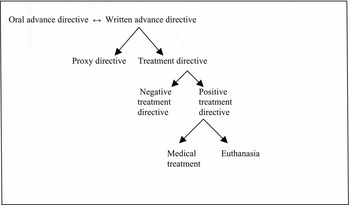
Advance directives can be described as statements that allow individuals, before they reach a stage of decisional incapacity, to give directions for future care and how medical decisions are to be made in the event of incapacity. In this way, respect for a person's autonomy is extended into future times when competence is lost (precedent autonomy). There are different types of advance directives to be distinguished (see Figure 1).
Types of advance directives

Advance directives can be given in oral or written form. Generally, written advance directives fall into two categories: treatment directives and proxy directives. A treatment directive (also called a “living will”) refers to a document that specifies what types of medical treatment the author desires under specific conditions in the event of incapacity. In the case of proxy directives, another person (e.g. health care proxy, durable power of attorney) is empowered to express the author's wishes and make decisions on his or her behalf. A person may also have a combination of a treatment directive and a proxy directive. Subsequently, treatment directives can be either positive or negative. In negative directives (non-treatment directives; NTDs) specified medical intervention(s) are refused, while in positive directives the author requests one or more specified (medical) interventions. In a few countries, for example the Netherlands and Belgium, a special type of positive directive is recognized: the “advance directive for euthanasia” (ADE). In these directives the author requests the responsible doctor to perform euthanasia in specified situations of incompetence. In the Netherlands, standard documents are generally used which are provided by societies such as the NVVE (Right to Die, Netherlands) and which involve the combination of an ADE and a NTD. The document is formulated in such a way that the NTD automatically replaces the ADE should the latter not be complied with.
Legal status
In many countries the use of negative treatment directives is legally permitted in their jurisdictions as a result of either judicial or statutory acceptance of the right to refuse treatment. However, the strength of the legal status differs among countries and statutes vary in terms of content (Vezzoni, Reference Vezzoni2005). The strongest legal status is found in a group of countries (Australia, Belgium, Canada, Denmark, England and Wales, New Zealand, Spain, the Netherlands and the U.S.A.) where treatment directives are binding on doctors, although in some of these countries limitations and formal requirements on the validity of directives are imposed. In a second group of countries (Austria, Germany, Norway, Sweden and Switzerland) the legal status can be called weak. This means that some official steps in the direction of recognition of treatment directives are taken but the legal status remains uncertain. A third group concerns countries such as France, Italy and Japan where treatment directives have no legal status at all. Since the publication of Vezzoni's report, Austria introduced a law regulating living wills in 2006, Switzerland is discussing a law which is expected to come into effect in 2010, and Germany has been discussing proposals/bills since 2007 (Brauer et al., Reference Brauer, Biller-Adorno and Adorno2008).
Legal differences regarding advance directives among countries are often found in regulations concerning euthanasia and assisted suicide. Most countries forbid the carrying out of any instructions for euthanasia. The Netherlands and Belgium are the only two countries in the world where laws specifically permit euthanasia. In February 2008, however, Luxembourg passed a law, yet to come into force, to permit euthanasia and assisted suicide. In Switzerland, euthanasia and assisted suicide are illegal but the latter is generally free from penalty if it is carried out without selfish interests (Brauer et al., Reference Brauer, Biller-Adorno and Adorno2008). In the Netherlands, negative treatment directives received legal recognition in 1995 in the Medical Treatment Contract Act (Wet op de Geneeskundige Behandelingsovereenkomst, WGBO, 1995). Doctors are now obliged to follow (advance) NTDs, unless they have legitimate reasons to deviate from this obligation. These documents have infinite validity, but signatories are advised to reread, rethink and resign them regularly.
Positive treatment directives in the Netherlands include both requests for euthanasia and directives requesting specific treatment(s), such as wish-to-live declarations. The euthanasia legislation in the Netherlands came into force in 2002 (Termination of Life on Request and Assisted Suicide Act, 2002). Under this law euthanasia and/or assisted suicide are not legalized, but an exception is laid down under which the physician who performs euthanasia and/or assisted suicide can go unpunished. Both acts remain criminal offences unless performed by a physician who follows the requirements of “due care” (summarized in Figure 2) and reports the case to a regional review committee.
Requirements of “due care” in the Dutch euthanasia legislation

According to the euthanasia legislation in the Netherlands, an advance directive can replace an oral request (first requirement). This means that physicians may carry out euthanasia or physician-assisted suicide following an advance directive as long as the remaining requirements (2–6 in Figure 2) of due care are also met. In principle, this new law gave people with incompetencies such as dementia the right to have their ADE complied with.
Ethical considerations on validity
The “complicating” factors of dementia
A diagnosis of dementia forms a complicating factor when it comes to compliance with advance directives. First of all, patients with dementia differ from incompetent patients such as comatose patients in the sense that dementia involves an often slow but progressive process resulting in slowly diminishing competence over the course of the disease. Secondly, even though people with dementia might (rightly) be labeled as incompetent, they remain alert, involved in their situation and able to interact with their environment. Thus, they can still have subjective experiences and they continue to have wishes and preferences. Consequently, a situation may arise where there is a conflict between the current wishes of the person with dementia (expressed in words or behavior) and their former preferences as stated in the advance directive. This results in the dilemma of how to respect the wishes and interests of the person with dementia and yet do justice to the wishes expressed in the advance directive. Behind this dilemma lies the philosophical question of the relationship between dementia and personal identity or (true) self, which raises questions about the validity of advance directives in cases of dementia.
The essence of ethical debate
In the debate on this subject one extreme point of view is held by Parfit who argues that psychological changes may cause the loss of individual identity (Parfit, Reference Parfit1984). He believes that psychological connectedness and continuity between different stages in life may decrease as a result of the dementia process, and claims that over time one body may house successive selves. Following this line of reasoning, the incompetent person with dementia is viewed as another person, in which case the moral force of an advance directive would be undermined. Dworkin (Reference Dworkin1986), who represents the other extreme in the debate, rejects the idea of loss of personal identity. He suggests there is in fact one person, becasue the demented “self” belongs to the pre-demented “self”. Dworkin argues that the former decisions of an incompetent person (e.g. someone with dementia), laid down in an advance directive, remain in force because the person now lacks the necessary capacity to exercise autonomy. Crucial to Dworkin's theory is that he distinguishes between a person's critical interests and experiential interests. Critical interests are those that reflect the person's determined goals and life-plans and refer to the hopes and aims that lend genuine meaning and coherence to our lives. Experiential interests deal with a person's quality of experiences and their state of mind; they entail experiencing pleasure, lack of pain, happiness, enjoyment and other feelings. Although incompetent people, such as those with dementia, may have these kind of experiential interests, Dworkin is of the opinion that critical interests deserve priority over experiential interests. He maintains that the decisions made by a competent individual as laid down in the advance directive represent the individual's appraisal of where his/her critical interests lie, and should therefore prevail above the preferences of the person with dementia. Thus, Dworkin argues for the primacy of what he calls “precedent autonomy”: “A competent person's right to autonomy requires that his past decisions about how he is to be treated if he becomes demented be respected even if they contradict the desires he has at a later point.”
Dworkin's theory has been appreciated and criticized by others (Dresser, Reference Dresser1995; Jaworska, Reference Jaworska1999). Dresser, for example, questions the importance people are thought to assign to critical interests in life. She believes many people take life one day at a time and don't differentiate sharply between critical and experiential interests. Furthermore, she stresses the fact that in cases of dementia experiential interests become more important at the expense of critical interests. Dresser believes that moral paternalism, in the sense of overriding an advance directive, is justified when dementia patients have a good quality of life based upon experiential interests.
Jaworska (Reference Jaworska1999), like Dresser, also wants to take seriously the current interests of patients with dementia, but not because they have become different persons as Parfit argued, but rather because they retain a “capacity to value”. By this she means “the capacity to originate the appropriate bases for one's decisions”. Jaworska states that people with dementia are still able to value activities and experiences in their lives, if they are able to give some rationale for the activities that are chosen. As long as people with dementia are able to value, current decisions on their behalf ought to take their present values seriously, which in practice could result in overriding an advance directive.
These different standpoints within the ethical debate on the validity of advance directives in cases of dementia have frequently been discussed in the Dutch literature (e.g. Widdershoven and Berghmans, Reference Widdershoven and Berghmans2001; van Delden, Reference van Delden2004; Hertogh et al., Reference Hertogh, de Boer, Dröes and Eefsting2007; Schermer, Reference Schermer, Rijpkema, van, Verbeek and Wijsbek2009). Despite the extensiveness of the ethical debate on these issues, which is reflected in the literature, their positions and arguments have not been substantiated by empirical research, apart perhaps from some summarily described casuistry. Therefore, it remains unclear if and to what extent the dilemmas discussed in the ethical debate have a bearing on actual practice. It also leaves unaddressed the question of the effectiveness of advance directives in cases of dementia in current practice. Or, in other words: “what is their actual influence in dementia care?” Empirical research is essential to answer these questions and to establish the (possible) role of advance directives in dementia care.
Empirical data from the literature
In order to retrieve empirical data from research conducted in the Netherlands on the validity and effectiveness of advance directives in dementia care, experts were consulted and asked to point out eligible publications. In addition, a PubMed search was conducted using combinations of multiple terms, both “controlled terms” and “free text terms”, in order to retrieve as many article as possible, and the reference lists of identified articles were searched for additional relevant articles. Despite this extensive search method, only nine studies were retrieved. With one exception, all of the research focused on the phase in which directives are supposed to take effect (implementation phase), rather than on the drafting phase.
Drafting phase
Although it is not known exactly how many people with dementia have an advance directive, the prevalence of advance directives among the general population of older people (61–92 years) in the Netherlands, as in other countries, appears to be low (10%) (Rurup et al., Reference Rurup, Onwuteaka-Philipsen, van der Heide, van der Wal and van der Maas2005a).
Empirical data about the phase of completing advance directives in the Netherlands were provided by a study into the social practice of treatment directives (Vezzoni, Reference Vezzoni2005). Data about the drafting phase were obtained from three different sub-studies: (i) questionnaires and telephone interviews with managers and (nursing home) doctors in a sample of 44 nursing homes; (ii) telephone questionnaires with notaries working in a sample of Dutch notarial offices; and (iii) both written and telephone questionnaires with family doctors. The general conclusion drawn by Vezzoni was that institutions, doctors and notaries have a passive attitude in informing patients about treatment directives. Information about advance directives to patients on their own initiative is seldom given, and assistance in drafting the directive was provided in only a minority of cases. This lack of a proactive program encouraging the use of treatment directives is regarded by Vezzoni as the most important factor for the existing gap between potential demand and actual use of treatment directives in the Netherlands. However, Vezzoni's study relates to quantitative data only, which makes it difficult to unravel the causal mechanisms of relations between, for example, the attitudes of doctors and the (relatively) low use of advance directives. The explanations provided by Vezzoni remain hypothetical in nature and are mainly based upon attitudinal research.
Another possibly relevant factor in the explanation of the limited numbers of people drafting advance directives, neglected by Vezzoni, is the competence of people with dementia to complete an adequate advance directive. No data from the Netherlands could be found. However, an indication is provided by a study from the U.K. in which on the first referral to specialist services, about one-fifth of those with early dementia were judged competent to complete advance directives, especially those with higher average premorbid intelligence (Fazel et al., Reference Fazel, Hope and Jacoby1999).
Data on how people with dementia think about (writing an) advance directive themselves could not be found.
Implementation phase
The Medical Treatment Contract Act (WGBO), which came into force in 1995 and regulates the doctor–patient contract, including the recognition of negative treatment directives, was evaluated in 2000 (Dute et al., Reference Dute2000). The focus of the evaluation was on the right of the patient to be informed and to give informed consent and on the way physicians provide the necessary personal information. Although empirical research was conducted for different parts of the evaluation, this research remained subjective in nature by reflecting mainly attitudes and opinions. Therefore, insight into the actual clinical practice was left neglected. Although legislation in the Netherlands is usually evaluated every five years, in this case the evaluation of 2000 remains the only one to date.
Vezzoni (Reference Vezzoni2005) also researched the compliance of physicians whose incompetent patients held treatment directives by assessing their attitudes towards hypothetical situations. He concluded that doctors have a low opinion of the effectiveness of advance directives and are inclined not to follow treatment directives in case the content of the directive differs from, or is opposed to, their medical judgment. Vezzoni believed it to be likely that the doctors’ negative opinion concerning compliance with treatment directives stemmed from their experience of treatment directives being of low medical quality. On the other hand, Vezzoni suggested that the low quality is partly produced by the low involvement of physicians themselves in the drafting phase of advance directives.
An ethnographic study into the practice of withholding the artificial administration of fluids and food from elderly patients with dementia also addressed the role of advance directives in the decision-making process of physicians in Dutch nursing homes (The et al., Reference The, Pasman, Onwuteaka-Philipsen, Ribbe and van der Wal2002). Despite a very small sample size, the researchers concluded that advance directives (living wills) played only a limited role in the decision-making process. Physicians did consider directives to represent the patients’ wishes, but in the end it was not the individual patient's advance directive, but the medical condition of the patient, the patient's quality of life as judged by the care providers and the wishes of the family that were the most important criteria in the decision-making process.
Several large nationwide studies have taken place concerning end-of-life practices in the Netherlands, with a focus on euthanasia (van der Maas et al., Reference van der Maas, van Delden and Pijnenborg1991; van der Wal and van der Maas, Reference van der Wal and van der Maas1996; van der Wal et al., Reference van der Wal, van der Heide, Onwuteaka-Philipsen and van der Maas2003; Onwutaeka-Philipsen et al., Reference Onwuteaka-Philipsen2007). In the study conducted in 2001/2002 (van der Wal et al., Reference van der Wal, van der Heide, Onwuteaka-Philipsen and van der Maas2003), specific attention was given to the situation of patients with dementia who had an ADE. Questions about this topic were presented to a representative sample of physicians, consisting of general practitioners, specialists and nursing home physicians. In this research it was estimated that physicians annually treat approximately 2200 persons with dementia until death who have an ADE. Nursing home physicians encountered patients in this situation more frequently than general practitioners or specialists. In most cases, physicians (GPs, specialist and nursing home physicians) discussed the directive with relatives of the patient.
As part of the nationwide study described above, additional retrospective interviews were held with 410 physicians in order to estimate compliance with the ADEs of patients with dementia and to gain knowledge about the experiences of physicians (Rurup et al., Reference Rurup, Onwuteaka-Philipsen, van der Heide, van der Wal and van der Maas2005a). Although compliance with the ADE was discussed in 76% of the cases in which a patient with dementia died after being treated by a physician who knew about the directive, euthanasia was seldom performed. Nursing home physicians were interviewed more extensively in this study and it was concluded that, although these physicians thought the suffering of patients with dementia could be unbearable and hopeless as a consequence of dementia, most of them did not consider dementia to be grounds for euthanasia, unless perhaps the patient had an additional illness. Nursing home physicians indicated that in about three-quarter of the cases it was the patient's family or representatives who asked them not to comply with the ADE. According to the physicians, in these cases the family wanted a restricted treatment policy instead. However, the perspective of the relatives themselves was not researched in this study. Nursing home physicians who had witheld treatment (n = 35) indicated that their decision was most strongly influenced by their personal attitude and the presence of a serious illness in addition to the dementia. The influence of the ADE in these decisions was less strong.
Another study from the same research group explored the attitudes of nursing home physicians, nurses and relatives towards medical end-of-life decisions concerning patients with dementia (Rurup et al., Reference Rurup, Onwuteaka-Philipsen, Pasman, Ribbe and van der Wal2005b). The study found that, in general, physicians, nurses and relatives were all guided by the best interests of the patient. Yet, relatives tended to attach more importance to advance directives than physicians, and to have more permissive attitudes towards hastening death. This apparent contradiction to the findings of the other study (Rurup et al., Reference Rurup, Onwuteaka-Philipsen, van der Heide, van der Wal and van der Maas2005a) is not discussed in the article. The researchers merely conclude that although physicians, nurses and relatives all agree on the importance and validity of advance directives, the outcomes of the decision-making may differ on account of differences in perspectives, beliefs and responsibilities.
Discussion
In countries with a strong legal status for advance directives, like the Netherlands, the legislation seems to follow Dworkin's argument, i.e. it is based upon the value of precedent autonomy, with NTDs being seen as valid documents that should be adhered to by doctors. However, the Dutch legislation does not provide any clues about how to act in situations where an incompetent person with dementia seems to accept the life that he/she formerly rejected by means of an NTD. This dilemma of how to appreciate the current wishes of the patient with dementia when his/her directive holds opposing wishes lies at the heart of the ethical debate. Interestingly, the dilemmas addressed in this debate are rooted in the patient's changing perspectives, yet the latter are not encountered nor approached in this way in the available empirical research. What we do know from this research is that it seems not so much the patient's perspective that is the main factor in the medical decision-making process, but the medical judgment of the physician and the influence of relatives, which in turn are factors mostly neglected by ethicists. Insight into the actual experiences and wishes of people with dementia themselves regarding advance directives is lacking altogether in empirical research.
Within the empirical research we encountered both research into actual practice and research into attitudes and opinions. This distinction is worth mentioning in the light of the ecological validity of the studies, as it seems that attitudinal research reflects a somewhat more positive approach among physicians and relatives towards respecting advance directives than does their compliance with these directives in practice. While they have a positive attitude towards the validity of advance directives, research into their practices shows that ADEs are seldom performed and NTDs seem to be of marginal importance in the decision-making process. This discrepancy might be the result of attitudinal research provoking more easily socially appropriate answers, which is something that should be taken into account when interpreting the data.
The available research into ADEs in the Netherlands is particularly interesting owing to the fact that ADEs are often combined with NTDs, so that the latter automatically replaces the ADE should the latter not be complied with. It seems that NTDs are more likely to be respected in cases where the person with dementia also has an ADE, which is either rejected or postponed. In this way, having an ADE positively influences the effectiveness of NTDs. The effectiveness of NTDs without the presence of an ADE seems marginal. These conclusions might be relevant to any country considering legislation on ADEs and/or NTDs.
Given the above, we conclude that advance directives in dementia do not presently achieve what they were intended to achieve, not withstanding the general opinion that advance directives are valid, which is in line with their legal status. Arguments relating to this hampered effectiveness can be found in both the ethical debate and empirical research, although these two “different worlds” are hard to bring together as they address different dilemmas.
A possible objection to our presentation of the ethical debate might be that we focused on the main authors in this field, which might explain the difficulties in bringing the “two worlds” together. In this respect, alternative approaches to advance directives are conceivable, of which one is provided by Moody (Reference Moody1988; Reference Moody1992). Moody suggests that rather than viewing advance directives as instructions to health care professionals and other caregivers, they should be seen as an aid to strengthening the communication between health care professionals, patients and proxies. As such, discussing an advance directive can be seen as an opportunity for professionals, families and patients to discover and share values and expectations with regard to end-of-life decisions (Tulsky, Reference Tulsky2005; Widdershoven and Berghmans, Reference Widdershoven and Berghmans2001). However, this approach ascribes a totally different role to advance directives, which would, at least in the Netherlands, also have consequences for their legal status and general administration.
Considering the current status and handling of advance directives in dementia care we could conclude that changes in the role of advance directives seem inevitable and that they should perhaps be given another, less central role in advance care planning (ACP) in dementia care. However, before drawing such far-reaching conclusions, we are of the opinion that some remaining questions still need to be answered. In this regard, we emphasize the relevance of the patient's perspective on advance directives and the patient's role in ACP (de Boer et al., Reference de Boer, Hertogh, Dröes, Jonker and Eefsting2008). Such research should also explore why, despite encouragement from non-governmental organizations (e.g. Alzheimer Europe and patient organizations), very few people actually write an advance directive. In addition, insight should be gained into the dilemmas encountered by relatives in the implementation phase of advance directives, including the motives underlying their behavior. Finally, the reluctance of physicians to follow advance directives of (incompetent) people with dementia should be further explored. Research on these aspects requires a more qualitative approach, which should provide further insight into the perspectives of all actors in the practice of advance directives in dementia. The results of this kind of research will provide the basis for taking new steps towards a more realistic approach to advance directives as part of ACP in dementia care.
Conflict of interest
None.
Description of authors’ roles
M. E. de Boer wrote the paper under the supervision of C. M. P. M. Hertogh. R. M. Dröes, C. Jonker and J. A. Eefsting assisted in writing the paper.