I. INTRODUCTION
As the first bulk metallic glass (BMG)-forming alloy was reported in the La-Ni-Al system,Reference Inoue, Kohinata, An-Pang and Masumoto1 La-based BMGs have attracted considerable attention from both scientific and technological perspectives because of their excellent glass-forming ability (GFA) and superior physical properties as compared to their crystalline counterparts.Reference Inoue, Nakamura, Sugita, Zhang and Masumoto2–Reference Saotome, Hatori, Zhang and Inoue9 For example, alloys La65Al14(Cu5/6Ag1/6)11Ni5Co5Reference Jiang, Zhang, Yang, Wang, Saksl, Franz, Wunderlich, Fecht and Jiang6 and (La0.7Ce0.3)65Al10Co25Reference Li, Pang, Ma and Zhang7 exhibit super-high GFA with the critical size (D c) of 1 inch; La60Al20Ni10Co5Cu5 BMG shows good thermoplasticity and imprintability at low temperatures and, therefore, facilitates its potential applications such as a micro- and nano-imprintable material.Reference Saotome, Hatori, Zhang and Inoue9 Up to date, La-based BMGs have been developed in many systems such as La-Cu-Al,Reference Inoue, Nakamura, Sugita, Zhang and Masumoto2, Reference Tan, Lu, Yao, Yao, Feng and Li10 La-Ni-Al,Reference Inoue, Kohinata, An-Pang and Masumoto1, Reference Inoue, Nakamura, Sugita, Zhang and Masumoto2, Reference Inoue, Zhang and Matsumoto11 La-Co-Al,Reference Li, Pang, Men, Ma and Zhang5, Reference Li, Pang, Ma and Zhang7 La-(Cu,Ni,Co)-Al,Reference Inoue, Nakamura, Sugita, Zhang and Masumoto2–Reference Tan, Zhang, Ma, Feng and Li4 (La,Ce)-(Cu,Ni,Co)-Al,Reference Li, Pang, Ma and Zhang7, Reference Li, Liu, Pang, Ma and Zhang8, Reference Jiang, Zhang, Chen, Zeng and Jiang12 and La-(Cu,Ni,Co)-Ag-Al.Reference Jiang, Zhang, Yang, Wang, Saksl, Franz, Wunderlich, Fecht and Jiang6 In all of them, the transition metals (TM) Co, Ni, and Cu are essential components and play a crucial role in the glass formation of La-based BMGs. However, the effect of various TM elements on glass formation unfortunately remains unclear.
In this article, we searched the best glass formers in La-TM-Al systems to illustrate the effect of these elements on the glass formation. The optimum alloys in La-TM-Al show close composition but significantly different GFA. Co is found to be the most effective element favoring the glass formation. These findings will be helpful to understand the mechanism of glass formation and develop the higher order multi-component BMGs in La-based and other TM-containing alloys.
II. EXPERIMENTAL
Raw materials (La, Co, Ni, Cu, and Al of more than 99% purity) were used for arc melting under an argon atmosphere on a water-cooled copper plate. Each ingot was flipped and remelted several times to ensure composition uniformity. The master alloy remelted in a tilting copper hearth was cast into the copper moulds with cylindrical cavities of diameters 4–16 mm and length 60 mm. The as-cast rods were then sectioned longitudinally, grinded, polished, etched, and finally observed by an Olympus PME 3 optical microscope. The degree of the amorphicity of the as-cast rods was also examined by x-ray diffraction (XRD) in a Bruker D8 diffractometer with Cu Kα radiation (λ = 0.154056 nm). The corresponding glass transition temperature T g, crystallization temperature T x, the onset melting temperature (T m), and the liquidus temperature (T L) were measured by a DSC 2920 Modulated DSC (TA Instruments) at a heating rate of 20 K/min.
III. RESULTS
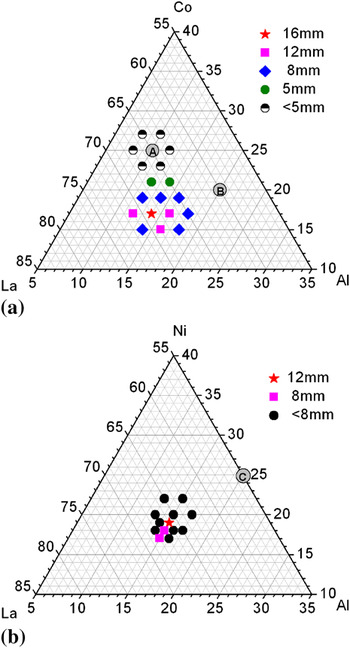
Figure 1 shows the composition maps of critical size for (i) La-Co-Al and (ii) La-Ni-Al ternary alloys. Different symbols represent the different critical sizes. In comparison, previously reported BMG formers La65Co20Al15,Reference Li, Pang, Men, Ma and Zhang5 La60Co20Al20Reference Li, Pang, Ma and Zhang7, and La55Ni25Al20Reference Inoue, Nakamura, Sugita, Zhang and Masumoto2, Reference Inoue, Zhang and Matsumoto11 are marked by A, B, and C, exhibiting critical sizes of 2–6 mm. In this study, by tuning composition at a small interval of 1 or 2%, the best glass formers are pinpointed at alloys La69Co17Al14 and La66Ni19Al15 (red stars in Fig. 1), with striking critical sizes of 16 and 12 mm, respectively. The GFA of new optimum alloys is superior to that of reported alloys A, B, and C. To the best of our knowledge, alloy La69Co17Al14 is the largest RE-based BMGs for simple ternary alloy systems to date. Note that La-Co-Al and La-Ni-Al systems both show strong composition dependence of GFA, which explains why previous work with a larger composition step of 5%Reference Inoue, Nakamura, Sugita, Zhang and Masumoto2, Reference Li, Pang, Men, Ma and Zhang5, Reference Li, Pang, Ma and Zhang7, Reference Inoue, Zhang and Matsumoto11 missed such extraordinary BMG formers. Similarly, 5 mm fully amorphous rods can be fabricated in alloy La66Cu20Al14, which also show better GFA than the previously reported alloy La55Cu25Al20 with a critical size of 3 mm2. A study on glass formation in the La-Fe-Al system has also been conducted, though no BMG-forming alloy was found.
Composition ranges for the formation of BMGs in (a) La-Co-Al and (b) La-Ni-Al ternary alloy studied. Different critical sizes are illustrated by different symbols. In comparison, the A, B, and C represent previously reported BMG-forming alloys La65Co20Al15,Reference Li, Pang, Men, Ma and Zhang5 La60Co20Al20Reference Li, Pang, Ma and Zhang7, and La55Ni25Al20,Reference Inoue, Nakamura, Sugita, Zhang and Masumoto2, Reference Inoue, Zhang and Matsumoto11 respectively.

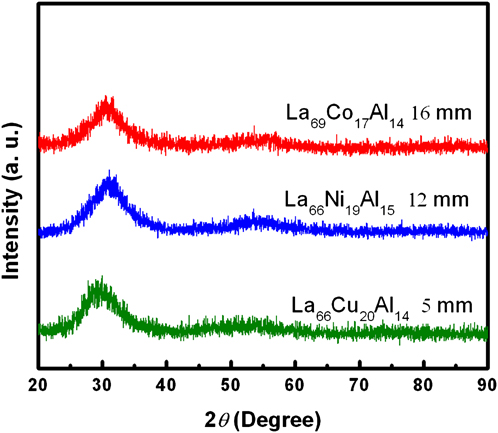
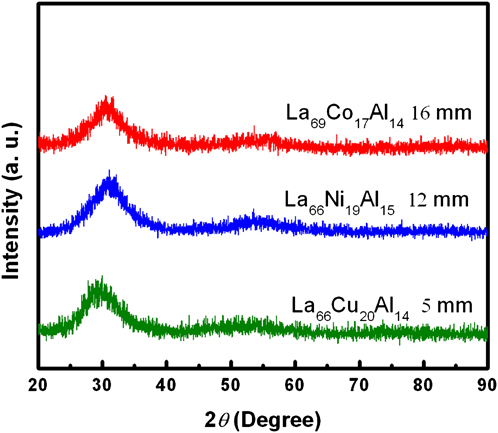
Figure 2 shows XRD patterns of the as-cast rods for La69Co17Al14, La66Ni19Al15, and La66Cu20Al14 with diameters of 16, 12, and 5 mm, respectively. All three alloys show a broad hump around 2θ = 30°, which is a characteristic for a fully amorphous phase. No any sharp peaks associated with crystalline phases are detectable within the x-ray diffractometer’s resolution.
XRD patterns of the as-cast rods for alloys La69Co17Al14, La66Ni19Al15, and La66Cu20Al14 with diameters of 16, 12, and 5 mm, respectively.
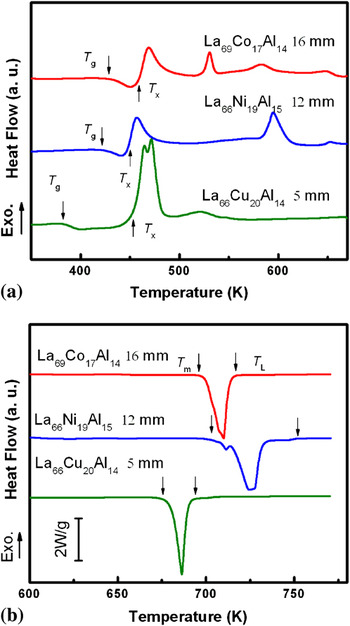
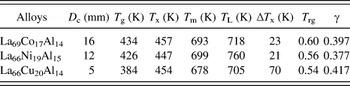
The corresponding DSC curves of the above three rods are displayed in Fig. 3(a). The glass transition temperature (T g) and crystallization onset temperature (T x) are marked by arrows in the DSC curves. In all cases, clear endothermic events associated with glass transition are observed, showing T g with low temperatures from 380 to 430 K, followed by the supercooled liquid region and then exothermic peak due to the crystallization of the amorphous phase. All the first crystallization events occur at low temperatures of about 450 K. Figure 3(b) shows the melting curves of alloys La69Co17Al14, La66Ni19Al15, and La66Cu20Al14. The T m and T L marked by arrows correspond to the solidus and the liquidus temperatures, respectively. La69Co17Al14 and La66Cu20Al14 exhibit one endothermic peak, indicating both alloys are located near eutectic composition. In contrast, alloy La66Ni19Al15 is off-eutectic as its melting behavior shows more than one event. Table I tabulates critical size (D c) and thermal characteristic parameters including T g, T x, T m, andT L, the width of supercooled liquid region ΔT x (=T x − T g), the reduced glass transition temperature T rg (=T g/T L)Reference Turnbull13, and indicator γ (=T x/(T g + T L))Reference Lu and Liu14 of optimum alloys La69Co17Al14, La66Ni19Al15, and La66Cu20Al14. Furthermore, it is expected that better glass-forming ability can be obtained if the higher order alloy system is used. One example is that, replacing La with Mischmetal could improve GFA as reported previously.Reference Li, Yang, Pang, Ma and Zhang15
(a) DSC curves and (b) melting events of as-cast rods for alloys La69Co17Al14, La66Ni19Al15, and La66Cu20Al14 with diameters of 16, 12, and 5 mm, respectively.

Critical size and thermal parameters of best glass formers in La-TM-Al (TM = Co, Ni, and Cu) systems.

IV. DISCUSSION
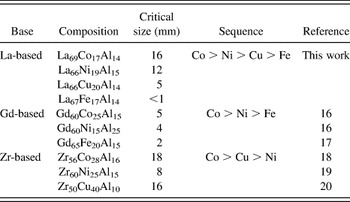
The GFA difference among three optimum alloys La69Co17Al14, La66Ni19Al15, and La66Cu20Al14 is distinct, exhibiting critical sizes of 16, 12, and 5 mm, respectively. No BMG-forming alloy is found in the La-Fe-Al ternary system. The degree of element effect of TM on the GFA (i.e., critical size D c for glass formation) is thereby in the sequence of Co > Ni > Cu > Fe. Co is found to be the most favorable element for the glass formation of La-TM-Al alloys. The similar effect of Co on glass formation is also reported in other BMG-forming alloys, as summarized in Table II. For example, the critical size of alloys Gd60Co25Al15, Gd60Ni15Al25, and Gd65Fe15Al20 is 5, 4, and 2 mm, respectively, exhibiting the order of Co > Ni > Fe.Reference Chen, Takeuchi and Inoue16, Reference Chen, Takeuchi and Inoue17 Also, alloy Zr56Co28Al16 is recently reported to be cast into glassy cylindrical rods with a diameter up to 18 mm,Reference Wada, Qin, Wang, Yoshimura, Inoue, Sugiyama, Ito and Matsushita18 larger than alloys Zr60Ni21Al19 with diameter 8 mmReference Jing, Zhang, Wang and Li19 and Zr50Cu40Al10 with diameter 16 mm.Reference Yokoyama, Yamasaki, Liaw, Buchanan and Inoue20
Summary of the effect of TM on glass-forming ability in various alloy systems.

Unfortunately, most of the current GFA-related criteria and indicators cannot explain the effect of various TM in the ease of glass formation. As shown in Table I, La66Cu20Al14 shows the largest values of ΔT x and γ with smallest D c, indicating that there is no correlation between GFA and the indicators ΔT x and γ.Reference Lu and Liu14 The values of T rg of alloys La69Co17Al14, La66Ni19Al15, and La66Cu20Al14 are 0.60, 0.54, and 0.52, respectively. They are in the order of Co > Ni > Cu, which exhibits the same trend as their D c. The heat of mixing of atomic pairs La-Co, La-Ni, and La-Cu is −17, −27, and −21 kJ/mol, respectively,Reference Takeuchi and Inoue21 which also cannot account for the different effects of TM elements on glass formation. The atomic radii of Co, Ni, and Cu is 0.128, 0.128, and 0.127 nm,Reference Miracle, Sanders and Senkov22 respectively. Based on current structure models such as Miracle’s efficient cluster packing (ECP)Reference Miracle23 or Ma models,Reference Sheng, Luo, Alamgir, Bai and Ma24 the similar atomic size should result in the similar dense packing structure. Therefore, no reasonable explanation for the different effect of TM can be found from a structure perspective.
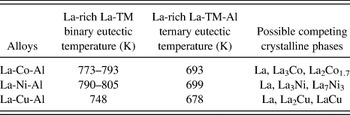
We also attempt to understand from the consideration of phase diagrams. The alloy with a lower melting temperature exhibits a more stable liquid phase and is thereby easier to form a glass. Some information on La-TM and La-TM-Al phase diagramsReference Gale and Totemeier25, Reference Riani, Arrighi, Marazza, Mazzone, Zanicchi and Ferro26 are summarized in Table III. Among the La-TM binary alloys, La-Cu shows the lowest eutectic temperature with a value of 748 K. The values of ternary La-TM-Al eutectic temperatures are 693, 699, and 678 K, exhibiting the order of Cu > Co > Ni. The GFA of La-Cu-Al is supposed to be superior to that of La-Co-Al and La-Ni-Al, which is contrary to our present result. The TM effect cannot be understood from a perspective of phase diagrams either. From the above analysis, none of the current GFA-related theories, except for T rg criteria, is able to explain the distinct effect of TM elements on glass formation. New parameters for GFA based on both topological and chemical considerations are thereby highly desired.
Summaries of the La-TM and La-TM-Al (TM = Co, Ni, and Cu) phase diagrams.Reference Gale and Totemeier25, Reference Riani, Arrighi, Marazza, Mazzone, Zanicchi and Ferro26

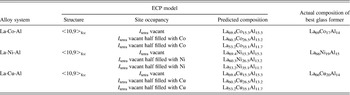
It is interesting to note that three optimum alloys La69Co17Al14, La66Ni19Al15, and La66Cu20Al14 are compositionally close. Recently, Miracle has proposed the ECPReference Miracle23, Reference Miracle27, Reference Miracle and Senkov28 model to depict the atomic structure of metallic glasses. This model provides an ability of predicting glass-forming compositions for a given multi-component alloy system. Table IV illustrates Miracle’s ECP model used on the alloy systems La-TM-Al. It assumes that α and β sites are fully occupied by Al and TM atoms, while γ sites are occupied by TM atoms with different percentage being occupied. Clearly, when γ sites are vacant, the glass-forming alloys La69.4TM15.3Al15.3 predicted can match actual compositions at a discrepancy of 5 at.%. This fact indicates that the ECP model can, to some extent, provide a shortcut in exploring BMGs with high GFA in La-TM-Al systems.
A comparison between the actual composition of best glass formers and predicted composition by Miracle’s ECP model in La-TM-Al (TM = Co, Ni, and Cu) systems.

At present, most of the studies on GFA focuses on the effect of concentration on GFA within a given alloy system. Although some research works are conducted on the GFA across alloy systems, there is still no clear conclusion as compared with the available studies on GFA within a particular alloy system. The observation of the distinct effects of various TM on glass formation is very important for designing the BMG-forming alloys and understanding underlying mechanisms of glass formation. New RE-Co-Al BMGs with high GFA, except La-Co-Al, are highly expected to be discovered by tuning composition at a small interval, as shown in Section III. Inoue summarized three empirical rulesReference Inoue29 as a guideline to select main component in the multi-component amorphous alloys. However, it is still not clear which main component, in particular, which secondary main component, is most favorable for glass formation. Furthermore, most previous efforts focused on the effect of the addition of minor elements,Reference Wang30, Reference Lu and Liu31 while little attention has been paid to the effect of the secondary main component. Our finding shows that many new BMGs with high GFA can possibly be discovered if there is careful reselection of the secondary main component in the reported BMG alloys.
V. CONCLUSIONS
In summary, we studied GFA of simple ternary systems La-TM-Al and scrutinized the effect of TM on glass formation. The best glass formers were pinpointed at new alloys La69Co17Al14, La66Ni19Al15, and La66Cu20Al14. The critical size of these optimum alloys is 16, 12, and 5 mm, respectively, which is much larger than that of La-TM-Al alloys reported previously. Among TM elements, Co has proved to be the most favorable element assisting glass formation in La-TM-Al alloys. The fact that three optimum alloys are compositionally close can be understood from a structure perspective. However, none of the current GFA-related theories, except for T rg criteria, is able to explain the distinct effect of TM elements on glass formation. The underlying mechanism of Co is unclear and the investigation is currently underway.