In recent years, economic historians have revived the old argument that Italy's fall from grace during the early modern period was rooted in the loss of its medieval liberties.Footnote 1 New estimates of economic performance and standards of living point to the early modern period as witnessing a reversal of fortunes within Europe: it is during this time, the figures suggest, that Italy fell behind and the North- Western economies forged ahead (Allen Reference Allen2001; Malanima Reference Malanima2011, 2Reference Malanima013; Broadberry Reference Broadberry2013). In the wake of the new institutional turn in economic history, the presence or absence of constitutional representation figures prominently as an alleged cause of this pattern. In this view, constitutional political systems played a key role in the “golden age” of the Dutch Republic and the rise of England after the Glorious Revolution. Southern Europe, by contrast, went in the opposite direction: starting in the Renaissance, the emergence and consolidation of absolutism implied that predatory rulers were no longer held to account and institutional quality worsened (North Reference North1981; De Long and Shleifer Reference Long, Bradford and Shleifer1993; Acemoglu, Johnson, and Robinson Reference Daron, Johnson and Robinson2005; Van Zanden, Buringh, and Bosker Reference Van, Jan, Eltjo and Maarten2011).Footnote 2
This article focuses on the cost of public borrowing in Italy, since this signals the extent to which rulers credibly committed to upholding property rights (North and Weingast Reference North and Barry1989), using a newly compiled data set of interest rates. While previous studies have generally supported the claim that absolutism implied a worsening of the quality of Italy's institutions, important questions remain unanswered. David Stasavage (Reference Stasavage2007, 2Reference Stasavage011), in particular, finds that in preindustrial Europe the cost of public borrowing was significantly lower for city-states than it was for principalities. However, he does not recognize that market yields on forced loans issued by Italian city-states in the Middle Ages were often much higher than official interest rates. Moreover, his heavy reliance on Italy for his sample of early modern autonomous cities may be problematic, too. Indeed, as Larry Epstein (Reference Epstein2000a) and Oscar Gelderblom and Joost Jonker (2Reference Gelderblom and Jonker004, 2Reference Gelderblom and Jonker011) argue, capital abundance and comparatively developed secondary markets could have produced low interest rates there, regardless of the political regime. Within early modern Italy, Luciano Pezzolo's (Reference Pezzolo1999, 2Reference Pezzolo, O'Brien and Yun-Casalilla012, 2Reference Pezzolo, Coffman, Leonard and Neal013) comparisons suggest that only some of the principalities borrowed at a higher cost than the republics, raising the question of what caused these differences?
This article focuses on Italy after 1500, when primary markets became widespread, and draws on emerging perspectives on the political economy of public debt.Footnote 3 Two lines of recent work offer particularly important hypotheses in this regard. First, a number of scholars stress how fiscal centralization reduces free-rider problems and improved revenues, thus reducing the risk of default (Velde and Weir Reference Velde and David1992; Dincecco Reference Dincecco2009, 2Reference Dincecco011; O'Brien Reference O'Brien2011, 2Reference O'Brien, O'Brien and Yun-Casalilla012). In this view, Italian republics were at a disadvantage, given that they offered their subjuridictions greater autonomy and more decentralized fiscal systems than principalities. A second set of scholars emphasizes the role of state monopolization of violence. Here the argument is that security has economies of scale, and since jurisdictional fragmentation hinders the development of impersonal rule, it significantly increased transaction costs (Volckart Reference Volckart2002; North, Wallis, and Weingast Reference North, John and Barry2009; Van Zanden Reference Van and Jan2009; Zuijderduijn Reference Zuijderduijn2009). Comparatively low levels of feudalism and clerical influence in the Italian republics should thus be associated with low interest rates.
The results presented here do not support the hypothesis that absolutism reduced the credibility of Italian public finances. The analysis of trends in financial and fiscal variables shows that in early modern Italy public borrowing tended to be high, but revenues stagnated and the growth of the public debts was rendered sustainable by rapid and widespread falls in interest rates. Yet there were significant differences in the cost of public borrowing across regional states. The panel analysis finds that feudalism and clerical interference increased the cost of borrowing, while the parliaments, wars, and centralized fiscal institutions mattered little. It also suggests that the constitutional representation of creditors may have meant significant markups for republican oligarchs.
THE COST OF BORROWING
The analysis is based on nominal interest rates paid on public annuities: the ratio of the annual payment on an annuity to its capital value—the nominal yield at issue. While one might want to have real interest rates to compare over time, this is not so important in cross-section. Even in the early modern period, price shocks were transmitted quickly across Italian markets, and inflation rates were similar across cities (Malanima Reference Malanima2002; Chilosi et al. Reference Chilosi, Tommy and Studer2013). Hence, the real interest rate paid on perpetuities is estimated as the nominal interest rate minus the long-term rate of inflation in Central-Northern Italy.Footnote 4
For the sake of comparability, I exclude short-term loans by professional moneylenders to princes.Footnote 5 Regardless of the identity of the borrower, publicly held debts commanded lower interest rates than such short-term loans. To give an example, in the 1540s the Apostolic Chamber of Rome borrowed from private bankers at 12 percent (Bruscoli Reference Bruscoli2007, p. xxiv), while issuing annuities at almost half that rate, at 7.5 percent.Footnote 6 Early modern princes often relied on short-term loans alongside long-term bonds to absorb transitory shocks and gain the loyalty of international financiers, who typically offered their expertise to help princes engineer their financial systems (Bruscoli Reference Bruscoli2007; Pezzolo Reference Pezzolo, O'Brien and Yun-Casalilla2012, pp. 278–79, 2013; Álvarez-Nogal and Chamley Reference Carlos and Chamley2014, pp. 198–201). High returns were also partly needed to compensate the lender for the taint of usury that was attached to short-term lending (Munro Reference Munro2003). While these features vitiate direct comparison with public annuities, the fast growth seen in the size of princes' long-term debts in early modern Italy suggests that constraints on long-term borrowing were loose.Footnote 7 Hence, in this context, the exclusion of private short-term loans is not expected to significantly bias the analysis against finding that republics were more reliable borrowers than princes. Indeed, if a reliance on short-term loans by foreign bankers signaled underdeveloped domestic financial markets, there could be an opposite bias even if only long-term bonds are used.
For similar reasons, I also only include annuities voluntarily bought on the public market, leaving out forced loans issued by city-states in the Middle Ages.Footnote 8 Direct comparison of secondary yields paid on forced loans and on public annuities is expected to produce a negative bias in the estimated creditworthiness of city-states, given that default on voluntary purchases was less likely, as it would jeopardize future sales (Tracy 1986, p. 110). That the inclusion of forced loans in previous studies has had the opposite effect reflects the faulty assumption that these were traded on the secondary market at par. In fact, available data from Florence, Genoa, and Venice show that the average price was 55 percent of par.Footnote 9 Matching average interest rates and average secondary prices suggests that the negative bias introduced by the assumption of par is almost 5 percentage points.Footnote 10 This figure compares with Stasavage's (Reference Stasavage2011, p. 85) estimation of city-states' advantage as 2 percentage points.
Both indirect and direct evidence shows that the assumption of par is much less demanding for publicly sold annuities than for forced loans. To begin with, coercion implied that forced loans could include both a loan and a tax, where the loan was the secondary market value of the certificates, and the tax was the difference between the market value and what the initial lender had to pay for it. There were also legal reasons for forced loans to carry low interest rates, as canon law jurists tended to place strict bounds on the interest rates forced loans could carry. In contrast, voluntarily bought annuities were considered usurious only if exorbitant rates were offered (Homer and Sylla Reference Homer and Richard2005; Munro Reference Munro2003, p. 523). One corollary of usury was that the incentive to conceal effective returns was stronger for forced loans than for public annuities.Footnote 11 In fact, unless primary yields on forced loans were often significantly higher than the official rates it is difficult to understand why states found public annuities easier to sustain. On the one hand, payments became much more regular after the advent of primary markets in the 1520s than they were for forced loans (Pezzolo Reference Pezzolo1995, 2Reference Pezzolo, Goetzmann and Rouwenhorst005). On the other hand, according to the official rates, in both Florence and Venice there were sudden and sustained significant increases in the rate of interest paid on the public debt, in the order of nearly twice as much.Footnote 12
Such conjectures are supported by direct evidence showing that secondary yields tended to be relatively close to the official rates for public annuities. Thus, from the 1520s the average of the available yearly secondary prices of Genoese, Florentine, Roman, and VenetianFootnote 13 annuities is 128 percent of par. If one excludes the exceptional case of Genoa, where specific institutions led to inelastic demand on the secondary market,Footnote 14 the figure is 98 percent of par.Footnote 15 The absolute difference between the yearly means of official rates divided by secondary prices and official rates is on average about 1 percentage point.Footnote 16 To be sure, from the later sixteenth century in both Genoa and Rome secondary prices were consistently above par by significant margins (on average, they were 156 percent and 123 percent of par, respectively). But there were also comparatively low interest rates in those cities, suggesting that if secondary yields were available for the whole sample, then the cross-sectional differences that I observe would be strengthened. This was the case in Palermo, too, where official rates tended to be comparatively high and in the late sixteenth century government securities were traded at 30 to 40 percent of par (Koenisberger 1Reference Koeningsberger969, p. 134).
In early modern Italy, direct evidence on the primary prices of public annuities is scant. However, interest rates should differ from primary yields less than from secondary yields, given that significant discounts of primary issues should also show up in the secondary market, authorities had an incentive to issue bonds when the secondary market was buoyant, and above par prices on the primary market are rarely seen. The available evidence is consistent with this argument. Thus, papal bonds were typically sold at below par on the primary market (Piola Caselli 2012, p. 292). In Genoa, the one documented purchase from the seventeenth century was at par, and primary short-term yields were closely aligned with interest rates on republican bonds (Peri Reference Peri1682, p. 97; Cuneo Reference Cuneo1842, pp. 309–11).Footnote 17 Discounts have been observed in Naples in 1678 on bonds backed by risky tax flows, but those backed by reliable ones were sold at par (Bulgarelli Lukacs Reference Bulgarelli1993, pp. 49–50).
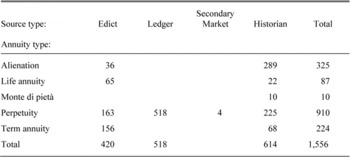
In short, nominal interest rates at issue are much better proxies of market yields for openly sold early modern bonds than they are for medieval forced loans. However, excluding private and forced loans takes care of only the most obvious source of heterogeneity: conditions of purchase also varied within the voluntary market for public annuities. Table 1 shows the sources and types of interest rates used in the analysis.
To ensure comparability, the interest rates on annuities have been normalized to perpetuity.Footnote 18 More often than not, life annuities were sold at around the same time as perpetuities, as, presumably, authorities sought to target different segments of the market. This makes it easy to normalize them.Footnote 19 Across Milan, Naples, Piedmont, and Venice, it was possible to compare sixteen yearly means of rates on tax alienations and perpetuities from the same year and place; there was a difference greater than 1 percentage point in only two cases. Given the close match, I made no adjustment to rates on tax alienations. The same rate of 5 percent was paid on the deposits of the Monte di Pietà of Florence (which allowed Cosimo I to borrow at the same rate) and the first perpetuities issued by the city in 1599, as well as on the Monte di Pietà perpetuities sold in 1616. Hence, no adjustment was made in this case, too. A shorter term was preferable for the lender than a longer one. Accordingly, rates on annuities with terms below 10 years, which were popular in Venice, are normalized on the basis of the average ratio between rates on long- and short-term annuities in those years when both of them were issued.Footnote 20
OBSERVATIONS BY ANNUITY TYPE AND SOURCE TYPE

Sources:
See the Online Appendix.
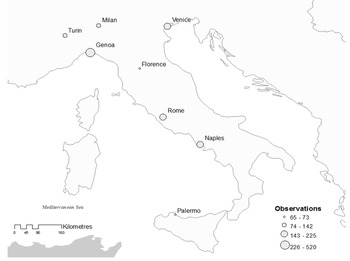
INTEREST RATES OBSERVATIONS, 1520–1796: SPATIAL DISTRIBUTION

About 60 percent of the interest rates I use were collected from primary sources. Figure 1 shows the geographical distribution of the observations. Although, unavoidably, the coverage is uneven, the data set is significantly broader than those used in previous studies (Pezzolo Reference Pezzolo1999, p. 242, 2Reference Pezzolo, Coffman, Leonard and Neal013, p. 280; Epstein Reference Epstein2000a, pp. 20–23; Stasavage Reference Stasavage2011, pp. 30–31). The new data detail Palermo for the whole period, Rome from the second half of the seventeenth century, eighteenth-century Milan, and significantly increase the coverage of Florence and Turin, and to a lesser extent, Naples.Footnote 21 Primary sources were especially helpful for filling in gaps for Rome, Florence, and Turin. Archival research also allowed improved precision for the republics: in Venice, as just seen, I take into account the term of the annuities; in Genoa, I rely on rates paid on republican bonds issued during the early modern period instead of the dividends of the S. Giorgio's shares, which were mostly issued between the fifteenth and the beginning of the seventeenth centuries and were in part forced loans.Footnote 22
To wash out noise, the analysis is based on decadal means.Footnote 23 As annuity issues tended to be clustered in certain years, to limit the overrepresentation of these years, decadal means are computed from yearly means.Footnote 24 This addresses, but falls short of solving, the problem that since, as mentioned earlier, polities had an incentive to issue annuities at tranquil times, reliance on rates paid at the time of issue may introduce a negative bias in yields. Still, market volatility should be greater for unreliable borrowers than for reliable ones. Thus, while this bias might dampen differences, it should not change the hierarchy indicated by the interest rates. This is confirmed by data from the papacy, Genoa, and Venice, which can be considered as reliable borrowers. Logistic regressions find that in Rome the probability that there was an issue a given year is actually greater when the secondary price was lower;Footnote 25 even if the probability of an issue was higher for Genoese and Venetian bonds, the marginal effects are very small: an increase in the secondary price by 10 percentage points increases the probability that there were issues by just around 0.5 percentage points.Footnote 26
Frequent defaults are particularly well-documented in Milan (Pugliese Reference Pugliese1924, pp. 339–76; Felloni Reference Felloni1971, p. 304), and in years with a default the probability that bonds were issued is indeed lower than at other times. Nevertheless, the coefficient is not statistically significant and again the marginal effect is small: a default decreases the probability of issues in that year by around 5 percentage points.Footnote 27 All in all, this type of selection bias does not emerge as a serious concern.
In addition, years when rates cannot be observed are non-randomly distributed because issues were more frequent where the debt was growing quickly. If fast growth implied dear borrowing, this would mean that the analysis is biased against finding that those principalities that were catching up with the republics could borrow cheaply. Nonetheless, I find no evidence that the size of the debt was a major determinant of the cost of public borrowing, suggesting that the capital supply was very inelastic.Footnote 28 Moreover, most decades are covered: over 28 decades, only 23 percent of the possible observations are missing; there are on average 21.5 observations per polity, ranging from a minimum of 16 in Florence and Turin to a maximum of 27 in Naples. As most principalities are present from the beginning, there is no fear of selection bias from endogenous entry (Stasavage Reference Stasavage2011, p. 88).Footnote 29 Having presented the sources, let us now compare trends in fiscal and financial variables across polities.
FINANCIAL EVOLUTION
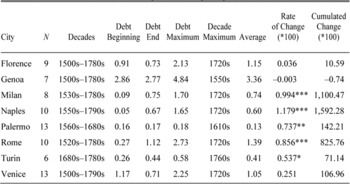
Let us start with the size of the debt.Footnote 30 Table 2 presents summary statistics on the development of the consolidated debt in early modern Italian polities. The nominal per capita figures have been normalized by the price of a consumption basket for one year in Central-Northern Italy; to smooth short-term fluctuations in these prices, I use decadal means for both figures. Hence, the unit of measure is number of consumption baskets per capita. To put this measure into context, the price of a consumption basket was equal to just over half the GDP per capita in Central-Northern Italy.Footnote 31 The first three columns show the capital city, the sample size, and the decades covered; the following four columns show the estimated values at the beginning and at the end, the estimated maximum, and the decade when this is observed; the final two columns present the yearly rate of change and the implied cumulated change.
SIZE OF THE CONSOLIDATED DEBTS IN EARLY MODERN ITALY (in consumption baskets per capita)

Notes:
* = Significant at the 10 percent level.
** = Significant at the 5 percent level.
*** = Significant at the 1 percent level.
Note:
N = sample size.
Sources:
See the Online Appendix.
Three main groupings can be distinguished. First, the financial pioneers, Genoa, Florence, and Venice, already had a large debt the beginning of the sixteenth century and it rose relatively little thereafter. Second, Milan, Naples, and Rome caught up with the pioneers over time. The period when their debts expanded most rapidly was the seventeenth century, while the eighteenth century saw stable nominal values in the face of expanding populations and rising prices. Finally, Turin and Palermo lagged behind, even if in Piedmont the real value of the debt continued to expand in the first half of the eighteenth century.
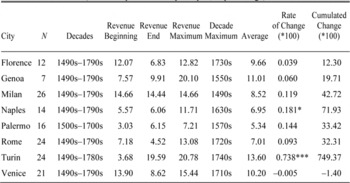
Overall, public debts tended to be comparatively large, though hardly huge. Genoa's debt was the largest. At its maximum in the 1550s it was in the order of 2.5 times the national income. In the mid-eighteenth century, Genoa's debt per capita (1.51 kg of silver) was about as large as England's (1.45 kg), but it was much smaller than the Dutch Republic's debt per capita (4.50 kg) (Carboni 2000, pp. 62, 103; Weingast Reference Weingast, Drobak and Nye1997, p. 235; McEvedy and Jones Reference McEvedy and Richard1985). Generally, the debts of most Italian states tended to be larger than those prevailing in elsewhere in Europe. For instance, by the 1740s the papacy owed almost twice as much silver per inhabitant as France: 0.69 kg as compared to 0.36 kg (Carboni 2000, pp. 77, 99; McEvedy and Jones Reference McEvedy and Richard1985). Turning to fiscal pressure, Table 3 shows summary statistics charting its development, in revenue per inhabitant, using the same approach used for the size of the debt.
FISCAL REVENUES IN EARLY MODERN ITALY (in consumption baskets per capita, in percentage)

Notes:
* = Significant at the 10 percent level.
** = Significant at the 5 percent level.
*** = Significant at the 1 percent level.
Note:
N = sample size.
Sources:
See the Online Appendix.
In sharp contrast to what was happening elsewhere in Europe, the growth of the public debts was not accompanied by similarly impressive rises in fiscal pressure. Although taxes were higher in the North of Italy than in the South and the maxima were reached in the early eighteenth century in half of the cases, overall the increases in fiscal pressure were moderate. The one exception to this rule is Piedmont, where, assisted by early fiscal centralization, revenues rose rapidly after the 1550s and overtook those of the other regional states. In fact, Piedmont and Milan were also the only states where fiscal pressure increased during the eighteenth century. Thus, differences within Italy were small in comparison to the widening gap between Italy and Western Europe. To be sure, fiscal pressure in Italy was initially high by European standards: at the beginning of the sixteenth century on average the fiscal revenue per capita was about 15.3 grams of silver, as compared to 11.4 in Castile, 4 in France, and 6 in England. However, by the later eighteenth century it had become much lower than elsewhere in Europe: the average figure was 49.8 grams, as compared to 92 grams in Piedmont, 75 grams in France, 188 grams in England, and 305 grams in the Dutch Republic (Carboni 2000, p. 62).
NOMINAL INTEREST RATES IN ITALY, 1520S–1790S

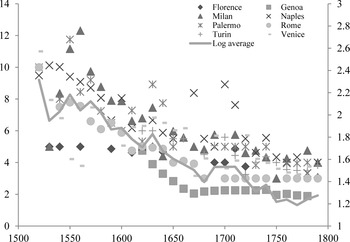
These trends in taxation raise the question of how were expanding debts serviced? The answer turns out to be rapidly falling interest rates. Figure 2 shows the decadal means of nominal interest rates normalized to perpetuity in the sample. The continuous line is the average in log-scale. The trend of this line is the yearly rate of change and takes into account that as interest rates become lower, progress becomes more difficult.
THE COST OF PUBLIC BORROWING IN EARLY MODERN ITALY: NOMINAL AND REAL INTEREST RATES (in percentage)

Notes:
N = sample size;
* = Significant at the 10 percent level.
** = Significant at the 5 percent level.
*** = Significant at the 1 percent level.
Sources:
See the Online Appendix.
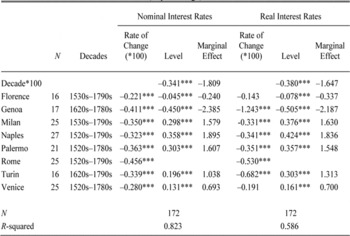
The figure shows the well-known and widespread long-term trend towards falling nominal interest rates in this period (Homer and Sylla Reference Homer and Richard2005). Still, there were clearly marked variations between regional states, with comparatively high rates in the Spanish territories (Milan, Naples, and Palermo) and singularly low rates for Genoa standing out. Table 4 compares trends and levels in nominal and real interest rates; for the levels, Rome is the baseline and I control for the secular decline in the variable. To facilitate interpretation, the table also reports the marginal effects implied by the coefficients for the sample average.
Table 4 shows that all cities saw rapid falls in interest rates; the pace of decline was very similar across cities for nominal interest rates, and similar to a lesser extent for real ones.Footnote 32 In comparison to nominal interest rates, real ones declined more slowly in the sixteenth century, and more rapidly in the eighteenth century. Yet there were significant differences in the level across places. Thus, the marginal effects show that on average the spread of the nominal interest rate between Naples and Genoa was over 4 percentage points. In between the extremes of the Spanish territories and Genoa, interest rates were relatively high in Turin and Venice and comparatively low in Florence and Rome. The coefficient of variation of the interest rates suggests that such differences did not significantly decrease over time: indeed, its yearly rate of change is positive, though small and statistically insignificant.Footnote 33
A quick comparison suggests that Italian interest rates tended to be low by international standards: on average, they were about 1 percentage point lower than in early modern France and eighteenth-century Britain, and about 0.5 percentage points lower than in early modern Spain and higher than in seventeenth-century Holland. Rates in Genoa were by far the lowest in Europe.Footnote 34 Hence, a “fiscal revolution” was not necessary for borrowing costs to be low. Indeed, the one Italian state that did experience it (Piedmont) was also characterized by a singularly slow growth in the public debt and relatively high interest rates. In fact, within Italy one fails to detect any strong effects of the size of the debts in pushing up interest rates. To the contrary, states that could borrow cheaply tended to borrow more. Thus, Genoa stands out in this fashion with a very large debt and low interest rates. The correlation coefficients between interest rates and the size of the debt are negative, both for nominal (−0.61) and real interest rates (−0.48). High fiscal revenues were also associated with low interest rates, in spite of the fact that these implied low expenditure, but the correlation is weak: the coefficients are −0.38 for nominal interest rates and −0.25 for real ones.Footnote 35 In short, fiscal variables are of little help in understanding why borrowing costs differed across Italian states.
POLITICAL REGIMES
To what extent were these differences determined by political regimes? To answer this question, I use panel data analysis where the dependent variable is the logarithm of the interest rate. The independent variables belong to three categories: financial development, war, and political regimes. There are six financial variables. Urban potential is the sum the population of Italian cities with at least 10,000 inhabitants weighted by distance to the polity of interest. Distances are weighted to take into account whether cities were connected by sea-, river-, or road-transport and were in the same state. This measure proxies for the supply of capital and I expect a higher Urban potential to reduce interest rates. Urban potential growth is the yearly growth in urban potential. It is aimed at capturing whether the economy is expanding or contracting, and thus the particular opportunity cost of investing in public bonds; hence, I expect its coefficient to be positively signed.Footnote 36 Decade is the time trend intended to capture the common factors behind the long-term decline in the interest rates; I expect its coefficient to be negative.Footnote 37 Financial pioneer is a dummy variable that takes the value of 1 for Florence, Genoa, and Venice. Liquidity premia and transaction costs should have been particularly low in these states since there was already a developed secondary market at the beginning of the sixteenth century. In consequence, at least in the early stages, the financial pioneers should enjoy an advantage and the coefficient of this variable is expected to be negatively signed. Inflation is the estimated long-term rate of inflation. It should have a positive effect on nominal interest rates insofar as price movements were anticipated by investors. Insofar as inflation was unanticipated, however, it should have a negative effect on real interest rates. Debasement measures the change in a currency's silver content in the present and past decade. Debasement could erode the real value of annuities, and the reputation of the currency was bound to influence perceptions of risk; so, I expect its coefficient to be negative.
War created sudden and inelastic demand for funds. Moreover, the uncertainty of the outcome created risk for investors. For these reasons, I expect the measures of warfare to be associated with higher interest rates. War pressure is an index that increases with the number of casualties per battle and populations of the adversaries; it decreases with their distance relative to the populations involved; it therefore allows the quantification of the pressure resulting from conflicts. It is nevertheless bound to be marred by non-negligible margins of errors. For robustness, as an alternative, War years is also used. By construction, their range is similar and therefore the size of their coefficients is more or less directly comparable.
There are six political variables. Both Republic (equal to 1 in Genoa and Venice) and Parliament (equal to 1 in Palermo and Naples until the 1630s) are expected to foster credible commitment and reduce borrowing costs. However, the effect of Parliament is expected to be lower than that of Republic: indeed, the Neapolitan and Sicilian parliaments were less cohesive and powerful than the republican councils in Genoa and Venice. Treasury is a dummy equal to 1 in Naples, Rome, Turin, Florence (from the 1740s), and Milan (from the 1750s). It signals the presence of an institution responsible for compiling an annual budget and centrally coordinating the various fiscal agencies; Fiscal reform (equal to 1 in Florence from the 1740s, Milan from the 1750s, and Turin from the 1720s) signals major fiscal reforms aimed at tightening the grip of centralized fiscal institutions during the “age of reason.” Since these dummies signal the presence of centralized fiscal institutions addressing coordination failure and fiscal free-riding, their coefficients are expected to be negative. Jurisdictional fragmentation is expected to increase transaction costs. Since clerics and feudal lords had judicial prerogatives, they limited the extent to which the state conformed to a monopoly. Church, which is equal to 0 in Rome and to the number of dioceses per 1 million inhabitants in c. 1700 elsewhere, and Feudalism, which is an estimate of the share of the population under feudal rule, are intended to capture these effects.
By construction Financial pioneer, Republic, and Church are time-invariant; Parliament and Feudalism change rarely, so that within estimation of their effects is imprecise; Treasury is a borderline case: this dummy changes twice over time. As key variables of interest are time-invariant, fixed-effects estimation can be used only for some of the variables, and difference-in-difference estimation is not a viable option. The fixed-effects vector decomposition model produces unbiased fixed-effects estimators of the effects of time-varying variables, and a less biased estimator of the time-varying ones than pooled ordinary least squares (Plümber and Troeger Reference Plümber and Vera2007, 2Reference Plümber and Vera011); it is therefore suitable for the task. The assumption that time-invariant variables, together with city-specific effects, explain all the cross-sectional differences due to factors unobserved by the time-variant variables is strong, but reasonable in a political economy context where institutional differences across polities are systematically controlled for, such as this one (Beck Reference Beck2011, pp. 121–22).
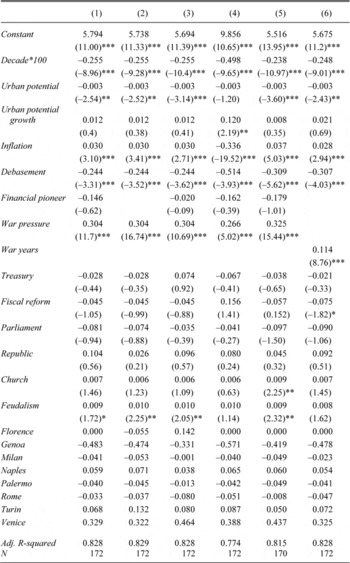
Table 5 shows the results of the panel data regression analysis. The second column reports the baseline results; the remaining five columns report robustness checks. The second specification addresses the high cross-sectional correlation between Republic and Financial pioneer by excluding the latter; the third specification addresses the high within correlation between Treasury and Fiscal reform by treating the former as time-invariant. The fourth and fifth specifications address potential errors in the measurement of the independent variable by using real, instead of nominal interest rates, and by using non-normalized rates for Venetian short-term annuities and excluding below par market rates from the same city, which may introduce a positive bias in the relative cost of public borrowing there. The last specification addresses potential measurement errors in the War pressure variable, by substituting it with War years.
The adjusted R-squared signals a good fit under all the specifications, particularly when the dependent variable is the nominal interest rate.Footnote 38 All the financial and geopolitical variables have the expected sign and are mostly significant across specifications. Still, there are a few notable differences. Firstly, the size of the Inflation coefficient on nominal and real interest rates signals that price changes were at best poorly anticipated. Thus, inflation was a powerful determinant of real interest rates, but only a weak influence on nominal ones. Secondly, the opportunity cost of capital, measured by Urban potential growth, had a significantly greater influence on real than on nominal interest rates. This is as expected. Thirdly, the size of the coefficient of the war variable decreases when War years is used. This suggests that, if anything, measurement error of War pressure adds a positive bias in the estimated significance of war.
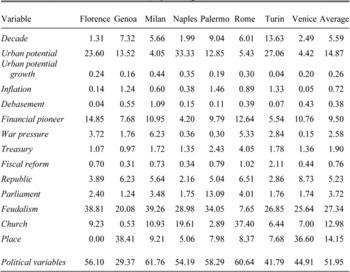
Among the political variables, only the jurisdictional variables are statistically significant at conventional levels in some of the specifications. Comparatively high standard errors are expected for the time-invariant variables, as the second stage of estimation is based on only eight cross-sections. Low statistical power means that there is a high risk of failing to reject a false hypothesis, and it is therefore advisable to check that statistical significance agrees with quantitative significance. At the same time, the little statistical precision with which the coefficients of the time-invariant variables are estimated implies that caution is needed in interpreting their sizes, too.Footnote 39 Table 6 presents the shares of the sum of the absolute values of the difference with the mean predicted by each independent variable.Footnote 40 The last line shows the overall contribution of political variables. Using absolute values makes it easy to compare the relative importance of the various factors since their effect often offset one another. The approach is analogous to that underlying the decomposition analysis of the variance. However, it has the advantages of allowing me to focus on the sources of cross-sectional difference and to compare the impact of the various factors across cities. The computations are based on the results of the baseline specification of the panel data analysis.
POLITICAL REGIMES AND THE COST OF PUBLIC BORROWING: PANEL DATA REGRESSION ANALYSIS

* = Significant at the 10 percent level.
** = Significant at the 5 percent level.
*** = Significant at the 1 percent level.
Notes:
N = sample size; Fixed-effects vector decomposition model estimation. Clustered standard errors allow for arbitrary within city correlation; the t-statistics are in parentheses.
Sources:
See the Online Appendix.
Reassuringly, there is substantive agreement between the estimated levels of statistical and quantitative significance: from both perspectives Feudalism and to a lesser extent Church emerge as the most important political variables. Thus, cross-sectional differences, the figures suggest, were to a large extent associated to jurisdictional fragmentation through feudalism and the church (40 percent, on average).Footnote 41 This help explain why interest rates were high in the Spanish territories: jurisdictional variables take particularly high values there. It is possible that to some extent these variables capture financial market underdevelopment in those states due to other factors. Yet the Spanish territories did not face the protracted difficulties in establishing liquid secondary markets sometimes seen elsewhere in early modern Europe. Secondary markets were facilitated by public banks: the Tavola di Palermo (1551), the Banco dei Poveri at Naples (1573), and the Banco di S. Ambrogio at Milan (1593) emerged at around the same time as public banks elsewhere in Italy and earlier than in North-Western Europe (De Marco Reference Demarco1988; Felloni Reference Felloni, Cova, Francesca and Moioli2008). Even in the provinces of the Kingdom of Naples increasingly thick secondary markets have been observed (Bulgarelli Lukacs Reference Bulgarelli, De Luca and Moioli2007, pp. 343–44). While precise figures for Palermo and Naples are lacking, in Milan a thick secondary market can be detected from the mid-sixteenth century: as much as 42 percent of the securities issued there in 1559 were sold in the secondary market within only five years, with similar figures obtaining for subsequent issues. In fact, at the time, the commissions paid for the exchange of bonds were lower in Milan than in Bologna and Rome (De Luca Reference Bulgarelli, De Luca and Moioli2007, p. 137). In short, liquidity premia should not have been particularly high in the Spanish territories.
POLITICAL REGIMES AND THE COST OF PUBLIC BORROWING: REGRESSION DECOMPOSITION ANALYSIS (in percentage)

Notes:
The average is weighted by the number of observations.
Sources:
See the Online Appendix.
Conversely, it makes sense to see the high return of their bonds as stemming primarily from high risk: even if little is known about when Palermo actually defaulted, frequent defaults are documented in both Milan and Naples from the seventeenth century (Pugliese Reference Pugliese1924, pp. 339–76; Felloni Reference Felloni1971, pp. 304–11; Calabria Reference Calabria1991, pp. 128–29). It is, of course, not possible to completely isolate the effect of Feudalism and Church on the risk of default via jurisdictional as opposed to fiscal fragmentation. Yet, in the South in particular, feudal lords only unofficially and indirectly controlled local taxation; their prerogatives were primarily judicial (Rao Reference Rao and Imbruglia2000, p. 100; Hanlon Reference Hanlon and Wilson2008, p. 309). Moreover, that differences in fiscal pressure between Italian states tended to be relatively low,Footnote 42 and that the presence of centralized fiscal institutions explained little of cross-sectional differences both also suggest that fiscal fragmentation was not the main channel. The modest contribution of war supports the point, too. It does not look as if particularly strong resistance of the local bodies to increased taxation was the main reason why bonds in the Spanish territories were so risky, as compared to those issued by the other Italian states.
The results of the panel are consistent with the new institutional perspective that feudal institutions, more markedly than those associated with the church, implied personal rule that was conducive to costly and unstable exchange relationships (Van Zanden Reference Van and Jan2009, pp. 56–57). They are also consistent with qualitative evidence. In the Spanish territories, the protection of the property rights of the investors in the public debts was uneven and personal: different interest rates were paid depending on the importance of the lender, and it was common in cases of partial defaults to treat different creditors differently. Only those creditors with strong ties to the ruling class could expect regular payments (Marsilio Reference Marsilio2008; Pezzolo Reference Pezzolo, O'Brien and Yun-Casalilla2012, pp. 278–79, 2Reference Pezzolo, Coffman, Leonard and Neal013, p. 199). By contrast, both in the republics and other Italian principalities, transparent and impersonal rules prevailed (Pezzolo Reference Pezzolo, O'Brien and Yun-Casalilla2012, 2Reference Pezzolo, Coffman, Leonard and Neal013; Piola Caselli 2012).
Republic does not have the expected sign. Moreover, the explanatory power of the model is comparatively low for the two republics, albeit for opposite reasons: interest rates were particularly low in Genoa, but unexpectedly high in Venice. These results suggest that constitutional representation of the creditors was not the main factor behind the very low cost of Genoese bonds. Rather, its financial specialization from the sixteenth century had produced a particularly high capital supply and liquid secondary market. The relatively low estimated contribution for parliaments in reducing the risk of Neapolitan and Sicilian bonds further supports this interpretation.
High returns on Venetian bonds can be partly traced to risk due to the conspicuous presence of foreign investors that obtained in the course of the seventeenth century: by 1673 the Genoese probably owned as much as almost a third of the Venetian debt. This share was much higher than in any other place and may have been even bigger than that owned by the local patricians. In the intervening period, Venetian bonds were also traded on the secondary market at par or below, as delays of payments and partial defaults increasingly put off the Genoese from further investing there (Felloni Reference Felloni1971, pp. 138–49). However, Venetian interest rates were also relatively high in the preceding period, when payments were regular (Pezzolo Reference Pezzolo, O'Brien and Yun-Casalilla2012, p. 279). In Genoa, the high prices of the S. Giorgio's shares reviewed earlier suggest that the local oligarchs enjoyed large profits on the secondary market.Footnote 43 Although secondary prices of the Venetian bonds are lacking for the sixteenth and most of the seventeenth centuries, the edicts of the time signal recurrent excesses in the demand (Pezzolo Reference Pezzolo1995, p. 309) and therefore markups for primary buyers.Footnote 44 The incentive faced by republican rulers to offer advantageous conditions to the local patricians is neatly captured by Frèdèric Lane (Reference Lane and Labrousse1973, p. 315) for sixteenth-century Venice: “the well-to-do paid less in taxes than they were paid in interest and redemption of the principal … its rulers work[ed] out a system of loans and taxes which tended to reinforce the wealth of the rich.”Footnote 45 Hence, constitutional representation of the creditors may have contributed to increase the cost of public borrowing for the republics, thus offsetting remaining advantages in terms of risk.Footnote 46
CONCLUSION
The case of early modern Italy does not support the claim that the growth of absolutism implied that the quality of institutions markedly deteriorated: at the time, constitutional representation did not significantly affect the risk of public debt repudiation and the capacity to raise long-term borrowing. Indeed, that cross-sectional differences in the risk of bonds were to a large extent associated with jurisdictional fragmentation suggests that the problem with Italian institutions was that some regional states had not become absolutist enough.Footnote 47 At the same time, there is evidence that the republics might have suffered from old vices: the hypothesis that a republican constitution implied particularly high markups for their oligarchs agrees with the old critique that the republics were less socially inclusive than the principalities.Footnote 48
This analysis also casts doubts on the extent to which low institutional quality in Italy was at the root of the peninsula's economic decline. Italy was not distinguished by faltering capital markets, but by stagnating fiscal revenues. This pattern also suggests that, in contrast to the predictions of the literature on the rise of the fiscal state (O'Brien Reference O'Brien2011, 2Reference O'Brien, O'Brien and Yun-Casalilla012) decentralized fiscal systems and low growth in taxation need not translate into poor protection of property rights. It is, however, consistent with the predictions that in the age of mercantilism fiscal policies were primarily determined by military rather than economic needs, and that low fiscal capacity was bound to make Italian capitalism increasingly ill-equipped to compete with those of the growing national states for international market shares.Footnote 49 From this angle, if “capital intensity” (Tilly Reference Tilly1992) and “good” institutions allowed the Italian states to survive military conflicts by developing large public debts without expanding their revenues much, their initial economic and political advantages hampered their long-term growth.Footnote 50
To what extent are these results representative of wider European trends? The political map of Italy in the early modern period, in sharp contrast to that of the Renaissance, was characterized by remarkable stability. Evidently, the conflicts of Renaissance Italy set the stage for financial development in the early modern principalities: proximity to the city-states pioneering financial innovations meant that unless the principalities had put their “house in order,” eventually they would have fallen prey to conquest and annexation. This survival bias implies that more marked differences in the cost of public borrowing between polities with constitutional representation and others can be expected in other contexts.
Another issue is that borrowing could act as a viable substitute for rises in fiscal revenue only because the early modern Italian states came to accept a peripheral role in the struggles for hegemony in early modern Europe. The political economy of early modern warfare (Hoffman and Rosenthal Reference Hoffman, Rosenthal, Drobak and Nye1997; Rosenthal Reference Rosenthal, Bates, Greif and Levi1998) predicts that the willingness to engage in risky military conflicts increases with the degree of control of the sovereign over fiscal revenues. This was conspicuously low in most Italian states, and the perspective is also consistent with the contrasting pattern observed in Piedmont, where a rigorous form of absolutism emerged. In short, the Italian results can be seen as the product of a peculiar blend of constitutional and financial developments and decentralized fiscal systems. One should therefore be wary of generalizing. At the same time, early modern Italy highlights that one should be equally careful to generalize from the experience of the “winners”: depending on the particular features of the broader institutional context the same institutions can produce very different outcomes.