Introduction
The choice of an oviposition site is crucial for solitary insects that do not provide parental care to immature instars, as it strongly influences the contribution of females to the next generation. As larvae are poor at dispersing, the quality of the environment in which they develop to maturity depends on maternal choice. Therefore, laying eggs at a site or in a host that is already being exploited may increase competition between larvae to such an extent that both competition for food and cannibalism is likely to reduce female fitness.
In response to the threat of competition, many insect species that exploit time and size limited resources have evolved the capacity of marking oviposition sites and avoiding marked sites (reviews by Roitberg & Mangel, Reference Roitberg and Mangel1988; Nufio & Papaj, Reference Nufio and Papaj2001). It includes insect predators (Chrysopidae (Ruzicka, Reference Ruzicka1996); Coccinellidae (Doumbia et al., Reference Doumbia, Hemptinne and Dixon1998; Magro et al., Reference Magro, Tene, Bastin, Dixon and Hemptinne2007; Ruzicka, Reference Ruzicka1997); Cecidomyiidae (Ruzicka & Havelka, Reference Ruzicka and Havelka1998)). Females of some species of solitary parasitoids are able to discriminate between hosts they have previously parasitized and those parasitized by other females (Vandijken et al., Reference Vandijken, Vanstratum and Vanalphen1992; Ueno, Reference Ueno1994; Agboka et al., Reference Agboka, Schulthess, Chabi-Olaye, Labo, Gounou and Smith2002; McKay & Broce, Reference McKay and Broce2004). However, the influence of kin discrimination on the assessment of oviposition sites is poorly studied in predatory insects (but see Faraji et al., Reference Faraji, Janssen, Van Rijn and Sabelis2000, for predatory mites).
Aphidophagous ladybirds exploit time and size limited resources in the form of short-lived aphid colonies, and female ladybirds refrain from laying eggs in the vicinity of aphid colonies where they detect the presence of tracks left by conspecific larvae (Doumbia et al., Reference Doumbia, Hemptinne and Dixon1998; Ruzicka, Reference Ruzicka1997; Yasuda et al., Reference Yasuda, Takagi and Kogi2000). For ladybirds, avoidance of competition for oviposition sites is crucial because of the high incidence of egg and larval cannibalism by non-sibling larvae, a phenomenon that is commonly observed in the field (Mills, Reference Mills1982; Osawa, Reference Osawa1989). Non-sibling egg cannibalism is a source of conflict between females and larvae; through non-sibling egg cannibalism, females lose reproductive investment when their eggs are cannibalized, but larvae gain access to a food rich in lipids and proteins (Sloggett & Lorenz, Reference Sloggett and Lorenz2008). Because of this high benefit, non-sibling egg cannibalism occurs even in the presence of aphids (Gagne et al., Reference Gagne, Coderre and Mauffette2002; Khan et al., Reference Khan, Khan and Hussein2003). As the percentage of eggs eaten by larvae can be very high, females have evolved the ability to assess the risk of intraspecific competition by reacting to larval tracks.
Larvae use their anal disc to adhere to substrates when foraging for aphids and in so doing leave a track used as a cue by females (Laubertie et al., Reference Laubertie, Martini, Cadena, Treilhou, Dixon and Hemptinne2006). The presence of these larval tracks deters ladybirds from laying eggs. This cue is incorrectly but widely referred to in the literature as an oviposition deterring pheromone. These larval tracks consist of a mixture of long chain hydrocarbons, mainly alkanes (Hemptinne et al., Reference Hemptinne, Lognay, Doumbia and Dixon2001; Magro et al., Reference Magro, Tene, Bastin, Dixon and Hemptinne2007).
On the surface of the elytra, in the composition of larval tracks and covering the surface of the eggs of each species of ladybird is a similar mixture of alkanes, which function, respectively, as cues in mate recognition, inhibition of oviposition and defence (Hemptinne et al., Reference Hemptinne, Lognay and Dixon1998, Reference Hemptinne, Lognay, Doumbia and Dixon2001). That is, in each case the alkanes are similar but fulfil different functions (Hemptinne et al., Reference Hemptinne, Lognay, Gauthier and Dixon2000). Both adults and larvae of ladybirds prefer to eat the eggs and larvae of conspecific unrelated individuals rather than related (Agarwala & Dixon, Reference Agarwala and Dixon1993; Joseph et al., Reference Joseph, Snyder and Moore1999). Although the molecules involved in mate recognition, inhibition of oviposition and defence are very similar to those that constitute larval tracks (Hemptinne et al., Reference Hemptinne, Lognay, Doumbia and Dixon2001), it is not clear whether the ability of females to differentiate between the alkanes of related and unrelated eggs translates into an ability to respond differentially to related or unrelated larval tracks. In this case, Martini et al. (Reference Martini, Haccou, Olivieri and Hemptinne2009) suggested that females should be more sensitive to larval tracks synthesized by their offspring. The objective of this paper is to test the hypothesis that females of the two spot ladybird Adalia bipunctata L. are more sensitive to tracks of their offspring rather than those of unrelated larvae. Furthermore, as the response to larval tracks depends on internal factors (Fréchette et al., Reference Fréchette, Dixon, Alauzet and Hemptinne2004), does female behaviour change with age and previous experience of larval tracks?
Materials and methods
Ladybird cultures
The two-spot ladybird, A. bipunctata, used in this study, came from two different laboratory cultures. The first was used to rear females for the experiment (hereafter referred to as ‘experimental culture’). It had originated from 20 adults collected at an overwintering site in Toulouse (southwest of France) three months before the beginning of the experiment. The second culture (hereafter referred as ‘laboratory culture’) had originated from 80 adults collected at a different overwintering site than the experimental culture, but had reproduced in the laboratory for one year before the beginning of the experiment. During the experimental period, the two cultures consisted of between 80 to 120 and 120 to 160 adults, respectively. The adults from the two cultures were reared in different incubators and were kept at 20 ± 1 °C, L:D 16:8 photoperiod, in 5-l plastic boxes which contained a piece of corrugated filter paper on which the females laid eggs. Three times per week the ladybirds were fed an excess of pea aphids, Acyrthosiphon pisum Harris. Two stems of broad bean, Vicia faba L., were added to each box to improve the survival of the aphids.
Ladybirds used in the experiments
The ladybirds used in the experiments were obtained by incubating eggs from the experimental culture in 175 cm3 plastic boxes under the same conditions as the two ladybird populations. The larvae were fed an excess of pea aphids three times per week until pupation. Freshly emerged adults were kept in a large plastic box for 48h and their sex was determined. Couples consisting of a male and a female were each placed in a 90mm Petri dish containing a piece of corrugated paper and kept at 20 ± 1 °C, L:D 16:8. Each day the couples were transferred to clean Petri dishes and fed pea aphids in excess. Eggs were counted and removed daily. Egg batches were isolated in Petri dishes, labelled and subsequently incubated to obtain fourth-instar larvae used to produce larval tracks. Ladybirds selected for the experiments had produced at least one batch of eggs daily over the previous five days. In order to standardize their hunger and oviposition drive, the females were deprived of food and isolated for 16h prior to the beginning of the experiment. The females that laid more than ten eggs during this 16h period were excluded from the experiment because it is unlikely they will lay eggs again within the next nine hours of the experiment. Females were used only once.
Filter paper contaminated with larval tracks
Contaminated filter papers had been obtained by placing a 90mm diameter Whatmann® filter paper at the bottom of a 90mm diameter Petri dish in which five fourth-instar ladybird larvae were kept for 24h with an excess of pea aphids at 20 ± 1 °C, L:D 16:8. After 24h, the larvae and pea aphids were removed, and the filter paper was carefully brushed to remove faeces and pea aphid remains. Subsequently, the filter papers were kept in the darkness at 20 ± 1 °C for a maximum of one month.
Experiment 1: The effect of relatedness on the response of females to larval tracks
Females used in this experiment were between 15 and 40 days old and never experienced larval tracks during the adult stage. At the start of the experiment, these females were either placed in a Petri dish containing a piece of: (i) clean filter paper (Control), (ii) filter paper contaminated with tracks from larvae that came from the laboratory culture (hereafter referred as ‘unrelated larval tracks’) or (iii) filter paper contaminated with larval tracks from their offspring (hereafter referred as ‘related larval tracks’). At the beginning of the experiment, a female was placed in a 90mm Petri dish lined with one of the three kinds of filter paper listed above. There were about 50 pea aphids of different instars in each Petri dish. Experiments were done at 20 ± 1 °C and started between 9 to 10 am (light switched on at 6 am). In the laboratory, females refrained from ovipositing in the presence of larval tracks for nine hours (Magro et al., Reference Magro, Tene, Bastin, Dixon and Hemptinne2007; Laubertie et al., Reference Laubertie, Martini, Cadena, Treilhou, Dixon and Hemptinne2006). Therefore, every hour for the initial period of nine hours, the Petri dishes were observed and which females had laid eggs recorded. There were 21 replications for each treatment.
Experiment 2: What is the effect of previous experience on the female's response to related larval track?
The females were similarly treated as in experiment 1, except that the day prior to the start of the experiment they were kept for 24h in a 90mm Petri dish containing a filter paper contaminated with unrelated larval tracks. The goal was to simulated a situation of high competition that is known to reduce inhibition of females to larval tracks (Fréchette et al., Reference Fréchette, Dixon, Alauzet and Hemptinne2004). There were 24 replications for each treatment.
Experiment 3: What is the effect of aging on the female's response to related larval track?
The aim of this experiment was to test if age may change response to related and unrelated larval tracks, as it has been showed that age decrease the female response to unrelated larval track (Fréchette et al., Reference Fréchette, Dixon, Alauzet and Hemptinne2004). The females were similarly treated as in experiment 1, except that females were between 45 to 70 days old. In our rearing conditions, ladybirds tend to live for about three months. They lay most of their eggs in the first third of their life. Therefore, 45 to 70 day old individuals are representative of old animals (Dixon & Agarwala Reference Dixon and Agarwala2002). There was 21 replications for the treatment with clean filter paper, 17 for the filter paper contaminated with unrelated larval tracks and 18 for filter paper contaminated with related larval tracks.
Statistical analysis
Statistical analyses were computed using statistical software R [v 2.11] (R Development Core Team, Vienna, Austria, http://www.R-project.org). For the three experiments, we compared for each of the nine hours the proportion of females that laid eggs with the Chi2 test. When a Chi2 test showed a significant difference at the P < 0.05 level, we performed a z-test with standardized residuals to know which treatment caused the difference.
Results
Experiment 1: The effect of relatedness on the response of females to larval tracks
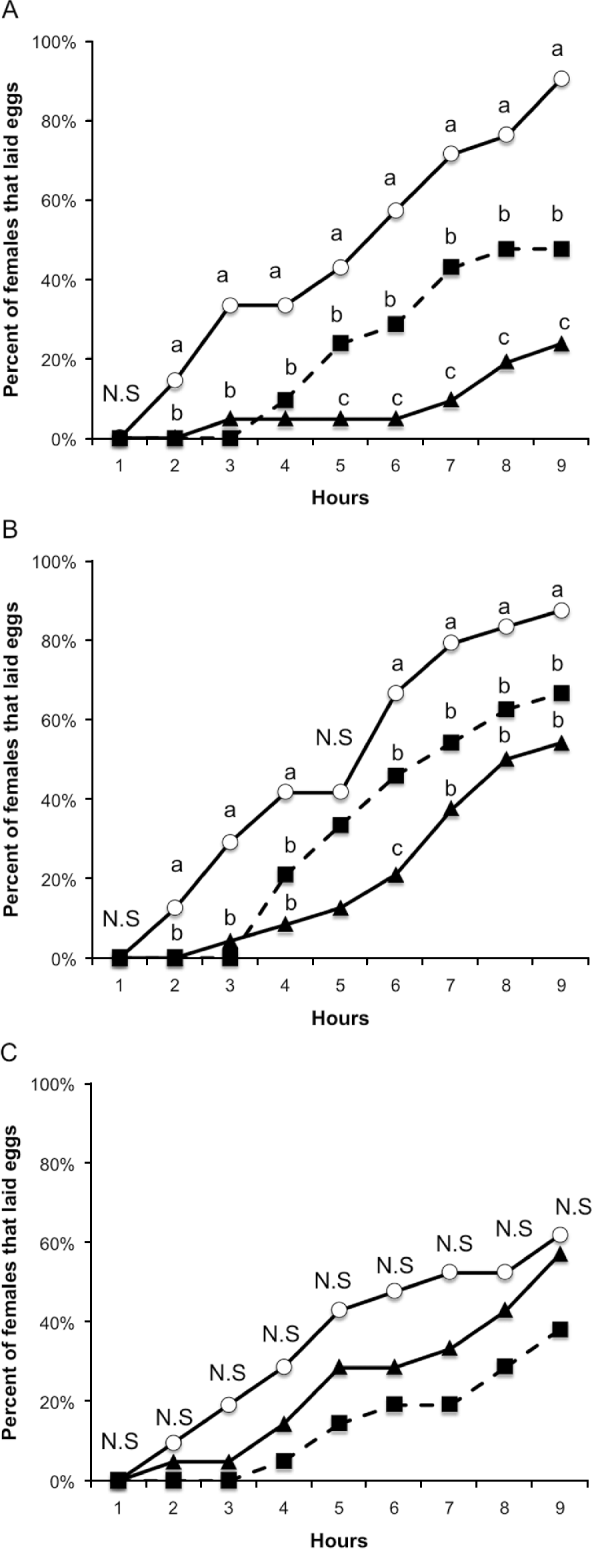
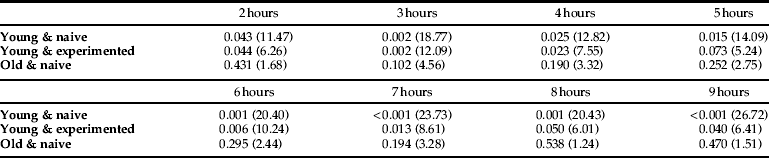
From the 2nd to the 9thhour, females on control filter paper laid eggs at a higher rate than those on filter paper with larval tracks. From the 5th to the 9thhour, we observed a significant reduction in the number of females that laid eggs on related larval tracks rather than on unrelated larval tracks (fig. 1a, table 1).
The cumulative percentages of (A) naïve, young females, (B) experienced, young females and (C) old, naive females that laid eggs during the first nine hours in a non-choice experiment during which they were presented with either control filter paper, filter paper contaminated with tracks of unrelated larvae or tracks of related larvae. Different letter indicate significant differences between treatments (--○--, Control; --▴--, Related larval tracks; --▪--, Unrelated larval tracks).

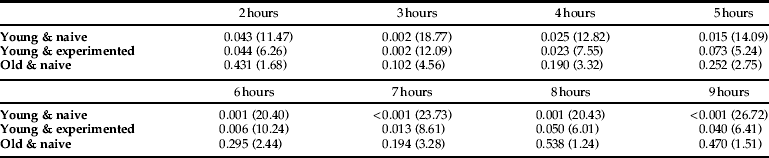
Results of the Chi2 tests performed on the proportion of young and naïve, young and experienced or old and naïve females that laid eggs hourly in the experiments. In these experiments, each type of female was kept in Petri dishes and offered either clean filter paper, filter paper contaminated by larval tracks of their offspring (related tracks) or tracks of other females offspring (unrelated tracks). The table shows P values (df = 2) and χ2 values in brackets.
Experiment 2: What is the effect of previous experience on the female's response to related larval track?
We observed a decrease in the number of females that laid eggs compared to the control between the 2nd and the 4thhour and between the 6th and the 9thhour. We only observed a significant difference between related and unrelated larval tracks at the 6thhour (fig. 1b, table 1).
Discussion
The choice of egg laying sites is important for those insects that do not tend their young. Aphidophagous ladybird should avoid ovipositing in patches of aphids that are already exploited by conspecific larvae. Laying eggs in such patches would greatly increase the risk of cannibalism. Conspecific larval tracks provide cues to females about the risk posed by cannibalism and are, therefore, indices of patch quality (Doumbia et al., Reference Doumbia, Hemptinne and Dixon1998; Laubertie et al., Reference Laubertie, Martini, Cadena, Treilhou, Dixon and Hemptinne2006). Females refrain from ovipositing and leave when they detect larval tracks in the vicinity of aphid colonies (Fréchette et al., Reference Fréchette, Alauzet and Hemptinne2003). By doing so, they protect their offspring from cannibalism.
This study indicates that relatedness between females and larvae influences the assessment of the quality of oviposition sites by aphidophagous ladybirds. Females were more likely to avoid patches marked by tracks left by their offspring than by unrelated larvae. It is noticeable that larval tracks mainly delayed the oviposition curve, but had not modified its slope. This had been also observed in other studies (Fréchette, Reference Fréchette, Dixon, Alauzet and Hemptinne2004; Magro et al., Reference Magro, Tene, Bastin, Dixon and Hemptinne2007). It indicates that after detecting the cue, females refrained from ovipositing. As they were confined to their Petri dishes and, therefore, unable to leave and search for good oviposition places, the females were finally forced to lay eggs despite the presence of larval tracks due to the egg loads in their oviducts. In addition, the effect of relatedness was only slightly conserved when females had previously experienced larval tracks. When females were aged, differences observed in response of different type of larval tracks were not significant. The most likely explanation of these results is that, in the case of a competitive environment or if the female is aged, the probability of finding an aphid patch without cue from ladybird larvae is low. Therefore, females should be less selective when choosing an egg laying site (Mangel, Reference Mangel1989; Fréchette et al., Reference Fréchette, Dixon, Alauzet and Hemptinne2004). As pointed out by Lacy & Sherman (Reference Lacy and Sherman1982), ‘recognition’ and ‘discrimination’ are not equivalent, and we acknowledge that our results concluded that females were more inhibited (i.e. more sensitive) to related larval tracks but not that they were able to discriminate related from unrelated larval tracks. To test this hypothesis, we should give a choice to the females between related and unrelated larval tracks. However, contrary to parasitoids, egg-laying sites of insect predators are not well spatially defined. The challenge of organizing a choice test in Petri dishes (Ruzicka, Reference Ruzicka2002, Reference Ruzicka2006) or any size limited arenas lies in the difficulty of setting an effective separation between related and unrelated larval track zones given that (i) the area occupied by an aphid colony is larger than a Petri Dish, and (ii) ladybirds lay eggs at distances that vary from 0 to 100cm from aphid colonies (Osawa, Reference Osawa2003).
To our knowledge, this is the first report of the effect of relatedness on a ladybird response to larval tracks. Two hypotheses can be offered to account for this result. First, stronger inhibition by related larval tracks evolved to allow females to avoid competition between siblings. This system is well known in solitary parasitoids where females can discriminate self parasitized hosts from hosts parasitized by other females (Vandijken et al., Reference Vandijken, Vanstratum and Vanalphen1992; Ueno, Reference Ueno1994; Agboka et al., Reference Agboka, Schulthess, Chabi-Olaye, Labo, Gounou and Smith2002; McKay & Broce, Reference McKay and Broce2004). Because self-super parasitism gives a lower fitness gain than adding eggs to a host parasitized by conspecifics, females should first accept host parasitized by another female before adding eggs to a self-parasitized host (van Alphen & Visser, Reference van Alphen and Visser1990). This hypothesis does not fit well in the ladybird case because, contrary to the case for superparasitism, there could be benefits as well as costs when a ladybird lays eggs on a patch already occupied by its offspring. The benefit of a new egg batch is the possibility for larvae to cannibalize it and have access to an additional food source. The cost is due to sibling competition that only occurs if the additional eggs and/or future larvae survive cannibalism. Therefore, females should avoid sites already occupied by its offspring if costs are higher than benefits, i.e. if their offspring already present are unlikely to eat most of the additional eggs or future larvae that they have laid. However, for predators such as aphidophagous ladybirds, assessment of costs and benefits is more difficult than for parasitoids. Costs and benefits of a new egg batch depend on highly variable factors, such as the density of prey and conspecific larvae, the probability of finding conspecific eggs or the size of aphid colonies.
The second hypothesis is proposed by Martini et al. (Reference Martini, Haccou, Olivieri and Hemptinne2009). Adding a new egg batch is beneficial for larvae already present in a patch because it is highly probable that old larvae will consume eggs or future young larvae that will hatch. The effect of related larval tracks on oviposition is first explained by a diversification of the signal from larvae to lowered female discrimination and secondly by a phenotype matching between females and larvae (Lacy & Sherman, Reference Lacy and Sherman1982).
Hydrocarbons, such as those present in larval tracks, are often used for kin discrimination in diverse insect taxa. In these cases, quantitative differences in the blend of hydrocarbons or fatty acids are often used for kin discrimination (van Zweden & d'Ettorre, Reference van Alphen and Visser2010). Therefore, our results tend to support the idea that females are able to recognize a mixture of hydrocarbons rather than a single molecule. It is likely that isolated molecules reported to inhibit oviposition are part of a broader and more complex message (Klewer et al., Reference Klewer, Ruzicka and Schulz2007).
Acknowledgements
This work has been done in the laboratory ‘Evolution et Diversité biologique’, part of the ‘Laboratoire d'Excellence’ (LABEX) TULIP (ANR-10-LABX-41).