Studies investigating specific language impairment (SLI) after childhood have generally concentrated on two questions. What is the prevalence of language impairment in individuals in their teens or early 20s who were diagnosed in (early) childhood for SLI, and which language domains are most likely to be affected in those individuals with continued language impairment? We propose here a complementary way of investigating language outcome after childhood SLI. Reasoning that language development with SLI is paralleled by development of compensatory strategies that result in avoidance of constructions likely to cause difficulties, we suggest that an illuminating way of studying SLI at adolescence is to concentrate on those aspects of language use that progress after early childhood in typically developing (TD) individuals. We report results of a study focusing on morphosyntactic complexity in spontaneous language samples of a group of French-speaking adolescents with childhood SLI that support this research strategy.Footnote 1
SLI AFTER CHILDHOOD
Studies of language after childhood in individuals with a childhood diagnosis of SLI have all shown that SLI persists for many, as determined by inferior performance compared to individuals having benefited from typical language development (Aram, Ekelman, & Nation, Reference Aram, Ekelman and Nation1984; Audollent & Tuller, Reference Audollent and Tuller2003; Billard, De Becque, Duvelleroy, Barthez, & Gillet, Reference Billard, De Becque, Duvelleroy, Barthez and Gillet1999; Billard, Loisel Dufour, Gillet, & Ballanger, Reference Billard, Loisel Dufour, Gillet and Ballanger1989; Conti-Ramsden, Botting, Simkin, & know, Reference Chevrie-Muller, Simon and Decante2001; Felsenfeld, Broen, & MacGue, Reference Felsenfeld, Broen and MacGue1992; Johnson et al., Reference Johnson, Beitchman, Escobar, Atkinson, Wilson and Brownlie1999; Rutter, Mawhood, & Howlin, Reference Rutter, Mawhood, Howlin, Fletcher and Hall1991; Snowling, Bishop, & Stohard, Reference Snowling, Bishop and Stothard2000; Stothard, Snowling, Bishop, Chipchase, & Kaplan, Reference Stothard, Snowling, Bishop, Chipchase and Kaplan1998; Tomblin, Freese, & Records, Reference Tomblin, Freese and Records1992). Persistent difficulties have been documented in both expression and reception, in the area of morphosyntax, but also in phonology; and written language has also been shown to be a source of long-term difficulty. A recent, large study by Conti-Ramsden and Durkin (Reference Conti-Ramsden and Durkin2008) illustrates all of these points. Results of testing of 118 16-year-olds, who had been identified for SLI and tested longitudinally beginning at age 7, showed that the vast majority of these adolescents (100/118 = 85%) continued to have language difficulties, defined as scores of at least 1 standard deviation below the mean on standardized tests of expressive and/or receptive language. Expressive and receptive skills were correlated with each other, and both of these were correlated with reading comprehension.
Another recent large-scale study (Miller, Leonard, & Finneran, Reference Miller, Leonard and Finneran2008) sought to determine whether the difficulty young English-speaking children with SLI have in detecting omission of tense marking continues at adolescence. One hundred eighty-one 16-year-olds, all part of an on-going study of language development begun when children were 5 years old, participated in this study, including 48 16-year-olds with SLI. The 16-year-olds with SLI were significantly less sensitive than TD 16-year-olds for all of the variables tested: tense omission, nontense omission, and tense intrusion, suggesting that mastery of key morphosyntactic features is not attained at adolescence. Tuller, Delage, Monjauze, Piller, and Barthez (Reference Tuller, Delage, Monjauze, Piller and Barthez2011) also proposed to explore a marker of SLI in young children after childhood. In a study of 37 French-speaking participants with SLI ranging in age from 11 years, 5 months (11;5) to 20;5 (M = 14;8, SD = 2;8), it was found that third person accusative clitics, a hallmark of SLI in French and other Romance languages, remained difficult for adolescents in an elicited production task (compared to both nominative and reflexive clitics).
These studies have shown that language difficulties do persist beyond childhood for most children identified as having SLI: for the majority of these young people, performance on standardized tests is below age norms and aspects of language that represent specific stumbling blocks to children with SLI continue to be sources of difficulty years later.
LANGUAGE AT ADOLESCENCE
The question of language performance at adolescence in individuals with SLI requires more general discussion of language performance at adolescence, or at least after early childhood, in individuals having benefited from typical development. In other words, thorough investigation of language outcome in SLI presupposes comparing this population with TD populations for those aspects of language that are known to develop after early/middle childhood.
A recurrent conclusion of studies investigating language performance in older children and in adolescents is that although no new syntactic structures emerge after early childhood, there are changes in how already-available constructions are used. These changes can be witnessed via the traditional measure of the mean length of utterance in words (MLUw) in the frequency of use of certain syntactic structures (e.g., passives) and, more generally, a gradual increase in the frequency of syntactic subordination (see Leadholm & Miller, Reference Leadholm and Miller1992, in Nippold, Reference Nippold and Nippold2007; Loban, Reference Loban1976; Nippold, Reference Nippold and Nippold2007; Scott, Reference Scott and Nippold1988, Reference Scott and Berman2004; Scott & Stokes, Reference Scott and Stokes1995; Scott & Windsor, Reference Scott and Winsor2000; Tolchinsky, Reference Tolchinsky and Berman2004).
DERIVATIONAL COMPUTATIONAL COMPLEXITY
One of the principle ways language at adolescence differs from language in childhood is an increase in the frequency of production of various syntactic constructions, which arguably involve greater complexity. In recent years a number of studies have been conducted with the aim of better understanding the relationship between syntactic complexity, as defined by linguistic theory, and acquisition sequences in young TD children and acquisition stumbling blocks in atypically developing children. Jakubowicz (Reference Jakubowicz2005) proposed that complexity can be measured by counting the number of instances of the syntactic operation merge (external merge, which is structure building due to lexical insertion, and internal merge, which is syntactic movement) that are involved in the derivation of a sentence, as in (1) (see also Jakubowicz & Strik, Reference Jakubowicz and Strik2008).
(1) Derivational complexity metric (Jakubowicz, Reference Jakubowicz2005):
a. merging αi n times gives rise to a less complex derivation that merging αi (n + 1) times and
b. internal merge (i.e., syntactic movement) of α gives rise to a less complex derivation than internal merge of α + β.
In our work (Delage, Monjauze, Hamann, & Tuller, Reference Delage, Monjauze, Hamann and Tuller2008; Hamann, Tuller, Monjauze, Delange, & Henry, Reference Hamann, Tuller, Monjauze, Delage, Henry, Caunt-Nulton, Kulatilake and Woo2007; Tuller, Delange, & Monjauze, Reference Tuller, Delage and Monjauze2006), we have argued that the intuitive idea behind (1) means that sentences containing a subordinate clause are also derivationally complex. Deriving such a sentence generally involves more instances of external merge (simply because there are more elements in the numeration, C in particular), but also very often involves internal merge as well (indirect questions and relatives clauses, e.g., both involve wh-movement in a language like French or English). However, subordinate clauses involve greater complexity not only because they contain more lexical material (a very long sentence without a subordinate clause also contains more lexical material than a shorter sentence without a subordinate clause or than a shorter sentence with a subordinate clause) or because they involve internal merge (some subordinate clauses do not necessarily imply internal merge: e.g., noninterrogative complement clauses), but also because they involve subordination. We argue that level of embedding is a key ingredient in the complexity of a derivation.
Levels of embedding between two subordinate clauses of the same type can be compared in the obvious way (see Loban, Reference Loban1976). Thus, the complementizer phrase (CP) that Max lives in Paris is more deeply embedded in (2) than in (3). In addition, (4), as an answer to a question about what Lea believes, is even less deeply embedded than this same clause is in (3).
(2) Lea believes [CP that everybody [VP thinks [CP that Max lives in Paris]]] Level 2
(3) Lea believes [CP that Max lives in Paris] Level 1
(4) [CP That Max lives in Paris] Level 0
The CP in (4) is not embedded at all (Level 0), whereas (3) is embedded a degree further (Level 1), and in (2), this CP is embedded to a yet further degree (Level 2).
Different kinds of subordinate clauses can also be compared for how deeply embedded they are. Thus, complement clauses are more deeply embedded than adjunct clauses. For example, the complement CP in (5) is embedded within a verb phrase (VP), which is itself embedded in an inflection phrase (IP), whereas the adjunct CP in (6) is adjoined to the matrix IP and therefore is not embedded within the sentence to the same degree.
(5) [IP Lea [VP believes [CP that Max lives in Paris]]]
(6) [IP [IP Lea will visit Max] [CP if she goes to Paris]]
Likewise, a relative CP is even more deeply embedded than the embedded complement clause CP in (5), as it is also embedded within a determiner phrase (DP):
(7) [IP Lea [VP knows [DP the man [CP that lives in Paris]]]]
That adjunct clauses emerge before other subordinate clausesFootnote 2 supports the link between syntactic complexity measured in terms of depth of embedding and acquisition sequences.
Further support for the idea that depth of embedding is a crucial component of syntactic complexity and that syntactic complexity determines acquisition sequences in TD children and predicts stumbling blocks in children with atypical development comes from relative clauses in French. We have argued in Hamann et al. (Reference Hamann, Tuller, Monjauze, Delage, Henry, Caunt-Nulton, Kulatilake and Woo2007) and Delage et al. (Reference Delage, Monjauze, Hamann and Tuller2008) that certain relative clauses involve shallower embedding. Specifically, in contrast to “genuine relatives,” which involve a CP embedded in a DP which is embedded in an IP, what we have grouped together under the term “pseudorelatives” do not involve embedding of a CP inside a DP, which is itself inside an IP. This shallower configuration obtains in Level 0 relative clauses, for example, the man that lives in Paris, as a response to “Which man are you talking about?”, but also in dislocated relative clauses in certain existential relatives introduced by y'a, in clefts, and in presentational c'est relatives. It has been found that precisely these types of relative clauses are predominant in younger children (De Cat, Reference De Cat2002; Delage et al., Reference Delage, Monjauze, Hamann and Tuller2008; Hamann et al., Reference Hamann, Tuller, Monjauze, Delage, Henry, Caunt-Nulton, Kulatilake and Woo2007; Labelle, Reference Labelle1990).
The intuitive idea behind (1) is that more operations mean greater derivational complexity. In other words, multiplicity of syntactic operations increases computational complexity. If this is the case, it might be supposed that not only merge but also other types of syntactic operations are pertinent in this calculation. Pursuing this hypothesis, in the above-cited work, we have argued that finite complement clauses, as in (8), entail greater computational complexity than infinitival complement clauses, as in (9), because they entail complementizer–tense agreement, subject–verb agreement, and mood and tense dependencies between the matrix and embedded clause (as well as an overt subject instead of an empty subject).
(8) Lea said [CP that Max would be there]
(9) Lea wants [CP PRO to be there]
This distinction correctly predicts that infinitival complement clauses appear earlier than finite complement clauses.Footnote 3
Another aspect of computational complexity has received attention recently. It is well known that subject relatives precede object relatives in acquisition, and various accounts have been advanced to explain this dichotomy, which also shows up in language processing in ordinary adults (see Gibson, Reference Gibson1998, among others, and Hamann & Tuller, Reference Hamann and Tuller2010, for a review). Friedmann, Belletti, and Rizzi (Reference Friedmann, Belletti and Rizzi2009) have argued that the difficulty observed for object relatives is because of the greater complexity caused by the intervening subject DP in the case of an object relative, which pushes children to use a stricter (but perhaps less demanding in terms of operative syntactic memory) version of relativized minimality, the universal grammar principle, which regulates movement dependencies, in effect disallowing many object relatives in the child grammar. The account proposed by Friedmann et al. (Reference Friedmann, Belletti and Rizzi2009) is based on the idea that, in constructions involving syntactic movement, young children (wrongly) count all subjects as interveners. According to this account, children behave this way because they have difficulty performing the operations involved in deciding whether the subject is an intervener, because this requires that each feature of the moved element must be compared with those of the target. To avoid this taxing operation, features are ignored/forgotten and thus relativized minimality rules out most object relatives.
Ideally, of course, these different aspects of computational complexity could all be derived from a unitary, general definition of computational complexity. This goal is certainly one of the major theoretical goals of work in psycholinguistics. Although a proposal for a unified definition is beyond the scope of this paper, we do believe that there are basically two kinds of computational complexity—the number of operations involved in a derivation (external and internal merge, as well as the feature calculations necessary for agreement and for relativized minimality) and level of embedding. These two properties both appear to be related to demands on memory: building syntactic structure while keeping in mind already built syntactic structure (particularly when a new clause is involved), linking antecedents and gaps, comparing features for agreement (see Hamann & Tuller, Reference Hamann and Tuller2010).
These various aspects of computational complexity derived from syntactic theory all make interesting predictions regarding the order of acquisition in TD children, but are also related to the increase in syntactic complexity observed in the language of adolescents compared to children. As we saw above, gradual increases in syntactic subordination and in the types of subordination used are characteristic of language at adolescence.
RESEARCH QUESTIONS AND HYPOTHESES
Our goal in this study was to explore complex language in adolescents with SLI. We wanted to see how aspects of language characteristic of language development after childhood fare in adolescents with SLI, and in particular, we were interested in seeing whether there is evidence that individuals with SLI avoid using structures whose syntactic derivation involves greater computational complexity. Because typical development of this aspect of language appears to manifest itself as increased frequency of production of such structures, we sought to find answers to our research questions via frequency measures on spontaneous language samples.Footnote 4 We also hypothesized that spontaneous language offers an environment favorable to use of compensatory strategies, and in particular, avoidance of syntactic complexity. Our expectation was that adolescents with SLI would differ from TD adolescents in how frequently they use syntactically complex constructions and in how frequently they produce utterances that show clear signs of avoidance of a syntactically more complex construction (aborted or ungrammatical attempts at subordination, direct discourse, juxtaposition of propositions in a clear relation of subordination, etc.).
METHOD
Participants
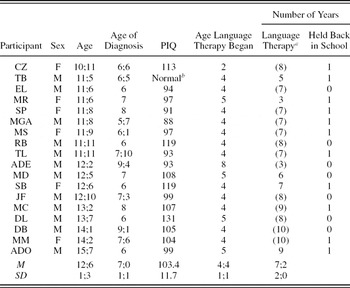
We report here on an analysis of spontaneous language samples recorded from 18 monolingual French-speaking adolescents (12 males, 6 females; a ratio typical for SLI; see Leonard, Reference Leonard1998), ranging in age from 10;11 to 15;7 (M = 12;6, SD = 1;3). We will refer to this group as SLI 11–16 in reference to this age range.Footnote 5 All 18 participants in the SLI 11–16 group had been diagnosed with SLI as children (between ages 6 and 9) in the same neuropediatric service at a university teaching hospital, following usual inclusionary and exclusionary criteria.Footnote 6 Severity and specificity of language impairment are ascertained at this diagnostic center via use of standardized tests and clinical examination. All areas of language are tested (articulation and phonology, Chevrie-Muller, Simon, & DeCante, Reference Chevrie-Muller, Simon and Decante1980; expressive lexicon and expressive morphosyntax, Khomsi, Reference Khomsi2001; receptive lexicon, Deltour & Humpkens, Reference Deltour and Hupkens1980; receptive morphosyntax, Lee, Reference Lee1971); a cutoff of 1.65 SD is used. Audiograms are made to ensure normal hearing, IQ is tested (all participants in this study have a performance IQ superior to 85), and a neuropediatric examination is performed to rule out any acquired source for language impairment and to direct any questionable children for psychiatric examination. Participants were recruited some years later from hospital records; to ensure some degree of group homogeneity, only individuals who had been identified as having expressive language impairment were recruited. General information on SLI 11–16 participants is given in Table 1.Footnote 7, Footnote 8
Adolescents in the specific language impairment 11–16 group

Note: Ages are in years;months. PIQ, performance IQ.
a The numbers in parentheses correspond to ongoing therapy, and those without parentheses correspond to when therapy has stopped. See Note 7.
b This participant had a normal nonverbal score on the Kaufman Assessment Battery for Children. The remainder of the nonverbal scores are PIQ from the Wechsler Intelligence Scale for Children. See Note 8.
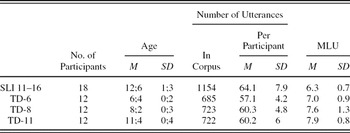
The SLI 11–16 group was compared to three groups of TD children and adolescents (see Table 2).Footnote 9 TD 6-year-olds, 8-year-olds, and 11-year-olds were randomly selected from classrooms in ordinary schools, after exclusion of children with bilingual homes, children behind grade level in school, and children with a history of speech–language therapy, consisted of a group of 6-year-olds, a group of 8-year-olds, and a group of 11-year-olds. We refer to these groups as TD-6, TD-8, and TD-11, respectively. The TD-11 group serves as a rough age match for the SLI 11–16 group (mean age = 12;6) and the TD-6 a rough MLU match. Although the MLU of the SLI 11–16 groups is lower than that of both the TD-11 (U = 18, p < .001) and the TD-8 (U = 43.5, p < .01) groups, it is comparable to that of the TD-6 group (U = 62, p = .51). The TD-8 group allows for a more complete developmental picture of TD after early childhood.
Age, size of language samples, and MLU for SLI 11–16, TD-6, TD-8, and TD-11

Note: Ages are in years;months. MLU, mean length of utterance; SLI, specific language impairment; TD, typically developing.
Language analysis
All participants with SLI were evaluated using three different types of instruments: standardized tests of various language components, an experimental probe eliciting production of pronominal clitics, and spontaneous language samples. This paper concentrates on the latter.Footnote 10
In order to ensure a certain degree of homogeneity in the spontaneous language samples, elicited production of a narrative based on a series of drawings (from a subtest evaluating narrative construction, taken from Khomsi & Nanty, Reference Khomsi and Nanty2001) was used to initiate a spontaneous interview in which various topics were introduced (extracurricular activities, school, family, past and future vacations) and, in which participants were also asked to tell the story of a book, movie, television program, or video game that interested them. The samples were transcribed, beginning at minute 5 of the recording, and coded in CHAT format (CHILDES system; MacWhinney, Reference MacWhinney2000). A total of around 60 utterances were transcribed for each subject. Utterances, following the criteria laid out in Rondal (Reference Rondal, Rondal and Seron1999, p. 395), were identified as syntactically and intonationally independent sentences (containing one or more propositions) and sequences that were not sentences, but which were separated from surrounding material by clear pauses. Ten percent of each corpus was independently transcribed by a second transcriber: concordance rates were calculated at 98.6%. Each sample was hand coded by a first coder and then verified by a second expert coder. Coding of all samples was then entirely reverified 6 months later.
Utterances were coded for whether they contained a verb or not, and in verbal utterances (the term we will use for these), all clauses were coded for level of embedding (as in Loban, Reference Loban1976): [0] for a subordinate clause not embedded in a root clause, as in (10); [1] for a subordinate clause embedded within a root clause, as in (11); [2] for a subordinate clause embedded within another subordinate clause, itself embedded within a root clause, and so forth, as illustrated in (12). We refer to these as Level 0, Level 1, and Level 2 embedding.
(10)

(11)
(12)

Clauses were also coded for type: root clause, finite complement clause, nonfinite complement clause, adverbial clause, relative clause, or coordinate clause. Relative clauses were further coded for whether they were subject, object, or adjunct relatives; whether they were “genuine relatives,” as in (13); or whether they had the structure of a “pseudorelative,” relatives argued in Hamann et al. (Reference Hamann, Tuller, Monjauze, Delage, Henry, Caunt-Nulton, Kulatilake and Woo2007) and Delage et al. (Reference Delage, Monjauze, Hamann and Tuller2008) to involve shallower embedding: Level 0 relatives, as in (14a); dislocated relatives, as in (14b); clefts, as in (4c); presentational c'est relatives, as in (14d); and presentational y'a relatives, as in (14e) (see above). In contrast to genuine relatives, illustrated in (7) above, these constructions do not entail structures in which a CP is embedded within a DP, which is itself embedded within an IP. Thus, for example, Level 0 relatives, such as that in (14a), are DPs that contain an embedded CP, but they are not themselves embedded within an IP. There is syntactic evidence that, in French, presentational focus constructions (with c'est and with y a), as well as contrastive focus clefts, contain clauses that, although deceptively similar to relative clauses, do not involve modification and thus are not syntactically embedded within a DP antecedent (for a detailed analysis of each of these constructions, see references cited, and Hamann & Tuller, Reference Hamann and Tuller2010).
(13)
(14)
All morphosyntactic errors were coded for syntactic category affected and type of error (omission, addition, substitution, word order).
A variety of measures were made in order to characterize language complexity. MLUw was measured as a base measure of complexity of language (see Table 2). A series of measures were made to try to quantify complexity in terms of clausal embedding. We calculated the rate of verbal utterances (total number of utterances containing a verb/total number of utterances), the rate of embedding (total number of subordinate clauses/total number of utterances containing a verb), the rate of complex utterances (total number of utterances containing one or more subordinate clauses/total number of utterances containing a verb), the rate of deep embedding (total number of of subordinate clauses with an embedding level of Level 2 or more/total number of subordinate clauses), and the rate of clause density (total number of subordinate clauses/total number of clauses). In order to take in account differences in complexity of different clause types, we calculated diversity of subordination (the relative proportions of the frequency of different embedded clauses); for relative clauses, we calculated the rates of different types (subject, object, adjunct relatives; genuine vs. pseudorelatives). Hypothesizing that relative syntactic complexity of a sentence might be linked to error production, with greater complexity entailing greater chances that an error will be produced, we calculated error rates, generally, and in simple sentences compared to complex sentences. If computational complexity is ultimately about taxing available memory resources, we reasoned that there should be a link between computational complexity and likelihood of production of errors in that using resources to produce a complex sentence (an utterance with an embedded clause) could entail that other aspects of this derivation that require calculation (such as matching the correct inflectional features, or calculating whether a pronoun is obligatory) may malfunction. Finally, we looked at a series of behaviors that we thought could be indicative of avoidance of complexity: aborted or ungrammatical attempts at subordination, direct discourse, and juxtaposition of propositions in a clear semantic relation of subordination.
RESULTS
Overview of clausal complexity
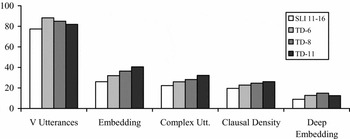
As can be seen in Figure 1, the adolescents with SLI performed below TD 6-, 8-, and 11-year-olds on various measures of clausal complexity in their spontaneous language production.
Rates of clausal complexity; SLI, specific language impairment; TD, typically developing; V, verbal.

First of all, the mean rate of verbal utterances (utterances containing a verb) produced, 77.4% (SD = 5.6), was significantly lower in the SLI 11–16 group than in the TD 11-year-olds (who produced 81.9%, U = 56.5, p < .05), in the TD 8-year-olds (85%, U = 42, p < .01), and in the TD 6-year-olds (88.2%, U = 24.5, p < .001). Examples of nonverbal utterances produced by participants with SLI are given in (15).
(15)
It is important to note that the utterances of this type were not necessarily ungrammatical or discourse infelicitous; it is just that the adolescents with SLI produced a higher proportion of utterances of this type than did age-matched or much younger children, including the MLU-matched TD 6-year-olds. The other measures of clausal complexity all point in the same direction. The adolescents with SLI had a lower rate of embedding (26.1%, SD = 10) than in the TD groups, which display a gradual increase with age (32%, 36.4%, and 40.5%, respectively). Although the difference between SLI 11–16 and TD-6 is not significant (U = 76, p = .176), the SLI 11–16 rate of embedding is significantly inferior to that found for the TD-8 group (U = 53, p < .05) and for the TD-11 group (U = 35.5, p < .01). Likewise, the mean rate of production of complex utterances was lower in the SLI 11–16 group than in each of the TD groups. This difference is significant between SLI 11–16 and the TD-11 groups (U = 42, p < .01). Clausal density was significantly lower in the SLI 11–16 than in the TD-8 (U = 60.5, p < .05) and than in the TD-11 (U = 44, p < .01). In addition, although no intergroup differences for deep embedding are significant due to small numbers and high standard deviations, the mean number of deeply embedded clauses (greater than level 1) over the groups was around 2.5 (2.3, 2.7, and 2.9, respectively) for the TD groups; it was only 1.3 (SD = 1.2) for the SLI 11–16 group. When converted to a rate over the total number of subordinate clauses, the differences are not significant (9% for SLI 11–16, and 12.8%, 14.9%, and 12.5% for TD-6, -8 and -11, respectively).
Relative clauses
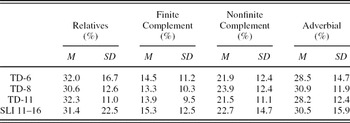
All of the groups tested were similar with regard to the proportion of major types of subordinate clauses produced (see Table 3). In other words, frequencies of the types of embedded clauses produced with respect to each other were similar in all four groups.
Relative frequencies of different types of embedded clauses over total embedded clauses produced

Note: TD, typically developing; SLI, specific language impairment.
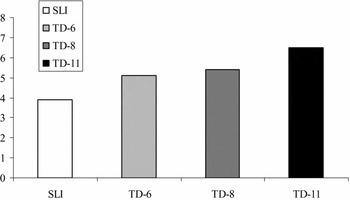
Although proportions of types of embedded clauses produced are similar, the SLI 11–16 group produced fewer subordinate clauses than the TD-8 and the TD-11, as was seen in the preceding section. Notably, participants in the SLI 11–16 group had a lower mean number of (all) relative clauses than the TD 11-year-olds (U = 60, p < .05; see Figure 2).
Mean number of relative clauses; SLI, specific language impairment; TD, typically developing.

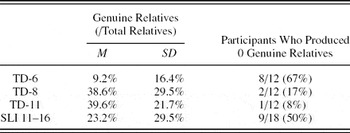
Furthermore, whereas adolescents in the SLI 11–16 group produced a significantly smaller proportion of genuine relatives compared to pseudorelatives (Z = 2.59; p < .01), as did TD 6-year-olds (p < .01), this was not the case for either the TD 8-year-olds (p = .17) or the 11-year-olds (p = .12; Table 4).
Production of “genuine” relative clauses

Note: TD, typically developing; SLI, specific language impairment.
Clefts and presentational relatives (y'a and c'est) were greatly preferred by adolescents with SLI (see examples in (16) and (17)), and by the TD 6-year-olds; whereas, much like the TD-6 group, half of the adolescents with SLI did not produce a single genuine relative, this was true for only a small minority of TD-8 (17%) and TD-11 (8%) participants. Because standard deviations are so high, it is useful to look at individual results. Only two participants with SLI produced less than 50% pseudorelatives: MS (25%) and DB (0%). However, these two participants produced very few relatives in general (four and two, respectively). If these two participants are excluded from this calculation, the mean proportion of genuine relatives per subject drops to 14%. Seven of the 18 participants with SLI (CZ, MR, SP, TL, JF, MM, ADO) produced exclusively pseudorelatives, which amounts therefore to 39% of the participants in this group, compared to 17% of the TD 8-year-olds and 8% of the TD 11-year-olds. ADO, for example, produced six relatives, but they are all pseudorelatives. TB produced seven pseudorelatives and one genuine relative, which was infinitival. Examples are given in (16) for TB and (17) for ADO.
- (16)
a. et puis c'est là [qu'elle travaille]
“And well it's there that she works”
b. y a un copain de l'école [qui en faisait aussi]
“There's a pal from school who did some too”
c. et puis y a les flics [qui essaient de les poursuivre]
“And well there's the police that try to follow them”
d. mais y en a un qui en a eu cinq cents pages [à lire]
“But there's a guy who had 500 pages to read”
- (17)
a. depuis quelques années y avait une équipe de filles [qui était en nationale deux]
“For the last few years there was a girl's team that made it to national two”
b. on peut jouer en réseau mais c'est un jeu sur internet [qui s'appelle Ogame]
“You can play on a network, but it's a web game that's called OGame”
Morphosyntactic errors and clausal complexity
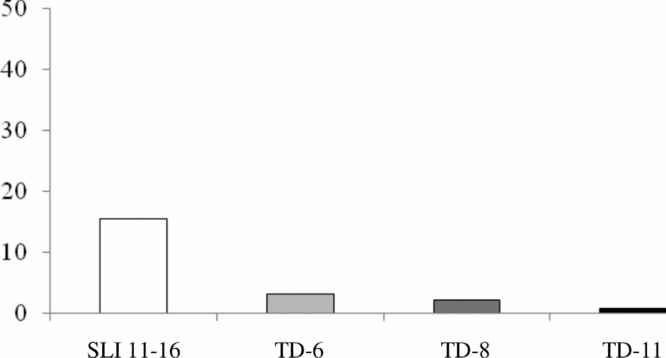
It is not surprising that erroneous utterances were much more frequent in language samples in the SLI 11–16 group than they were in each of the TD groups. Figure 3 presents the percentage of utterances containing one or more morphosyntactic errors (errors in inflectional features and syntactic errors, such as omission and substitution of functional categories or word order errors; lexical errors were very rare). The TD groups produced well under 5% ungrammatical utterances, although TD-6 and TD-8, at 2.9% (SD = 2.1) and 1.8% (SD = 1.7), produced significantly more ungrammatical utterances than the TD-11 (M = 0.7%, SD = 1.0). The SLI 11–16 group, however, had a mean rate of ungrammatical utterances at 15.5% (SD = 9.0), much higher than each of these groups (SLI 11–16 vs. TD-11, U = 15, p < .001; vs. TD-6, U = 15, p < .001; vs. TD-8, U = 7, p < .001; with TD-11, U = 1, p < .001).
The percentage of erroneous utterances; SLI, specific language impairment; TD, typically developing.
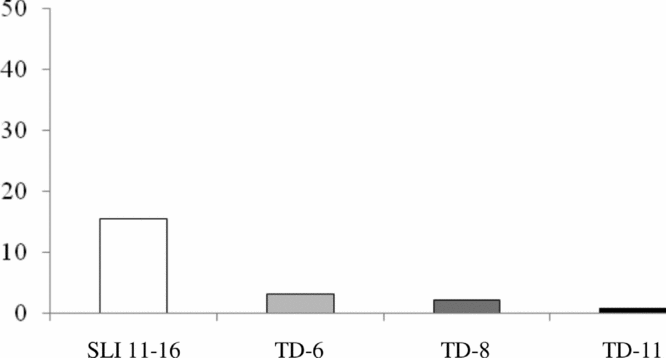
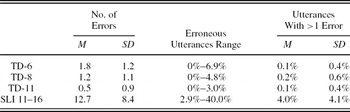
There was considerable intersubject variation in the SLI group: the range went from 2.9% to 40% erroneous utterances. Thus, although some young people produced very few erroneous utterances (TB had a rate of 4.3%; MS, 3.8%; JF, 2.9%; ADO, 4.9%), with rates falling within the range found in the TD populations, others produced very high proportions of ungrammatical utterances (CZ had a rate of 40%; TL, 25%; SB, 20%; and DL, 23.3%). Rates in the TD groups were well under 10%; and several TD children produced no erroneous utterances at all (2 of the 12 6-year-olds, 4 of the 12 8-year-olds, and 8 of the 12 11-year-olds). The mean number of errors produced in each group, presented in Table 5, is also revealing: the SLI group not only produced more erroneous utterances (U = 27.5, p < .001, for each comparison), but these also contained more errors.
Morphosyntactic errors

Note: TD, typically developing; SLI, specific language impairment.
Examples of utterances with multiple errors are given in (18)–(21).
(18)
(19)
(20)
(21)
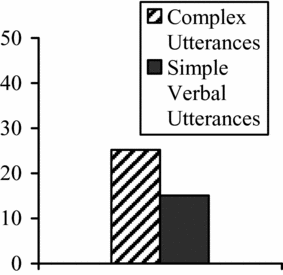
As we suggested above, if subordination is a component of computational complexity and if computational complexity contributes to the likelihood of morphosyntactic error, it is not surprising that a higher percentage of complex utterances were erroneous when compared to utterances containing no embedded clause (25.2% vs. 15.1%; Figure 4).Footnote 11 The difference almost reaches significance (Z = 1.85, p = .06).
Percentage of erroneous complex utterances and erroneous simple verbal utterances (specific language impairment 11–16).
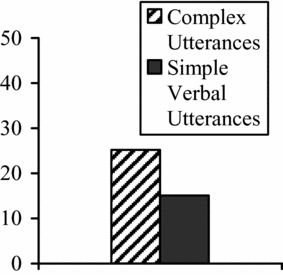
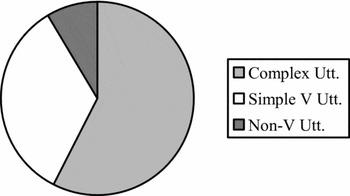
Likewise, errors were twice as likely to occur in a complex utterance as opposed to a simple verbal utterance or a nonverbal utterance (see Figure 5). This result is not simply related to the complex utterances tending to be longer and longer utterances providing more opportunities to make errors: no correlation is found between MLU and the number of errors (r s = −.02, p = .92).Footnote 12 We also note that the specific morphosyntactic errors produced were not necessarily related to subordinate syntax. Although there were complementizer omission and substitution errors and subordinate tense errors in embedded clauses, tense errors also occurred in simple sentences; and, more generally, tense, gender, and number errors occurred in both simple and complex utterances, as did errors on pronouns, prepositions, and auxiliaries. Errors were basically similar in different utterances types but were more likely to be found in complex utterances.
Percentage of errors occurring in complex utterances, in simple verbal utterances, and in nonverbal utterances (specific language impairment 11–16); V, verbal.

Another noteworthy result was found concerning erroneous utterances: a significant negative correlation between age and the number (r s = −.587) and the rate (r s = −.578) of erroneous relative clauses. In other words, older participants with SLI produced more grammatical relative clauses than younger participants with SLI. This result is particularly interesting because the only other spontaneous language measures correlated with age were the number (r s = .763) and the rate (r s = .659) of coordinated/juxtaposed clauses, a structure that often is indicative of avoidance of subordination (see below). In other words, although the syntax of the participants with SLI did not increase in complexity (as measured by rate or density of subordination, type of relative clause used, etc.) with age and although their sentences did not generally increase in grammaticality with age, older participants produced more grammatical relative clauses than younger participants—not more of them, but more grammatical ones.
A final result reinforcing the link between syntactic complexity and grammaticality was found when frequency of morphosyntactic errors was compared to frequency of coordinate/juxtaposed structures. A significant negative correlation was found between these scores.Footnote 13 In other words, participants who produced more coordinated/juxtaposed clauses also produced fewer morphosyntactic errors (and vice versa). This result is expected if, as we have argued, (depth of) embedding is a key component of syntactic complexity, because coordinated clauses do not involve deep embedding and therefore are not expected to be conducive to error production. That these clauses lower the chances of error production supports the idea that they serve as an efficient way of avoiding complexity. We directly address the topic of strategies for avoiding complexity in the following section.
Strategies for avoiding complexity
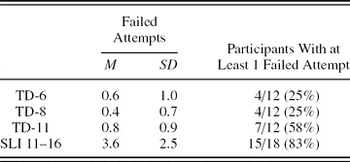
We have already seen that participants in the SLI 11–16 group avoided complexity in the sense that they produced complex sentences much less frequently than TD 8- and 11-year-olds, and we have seen they when they produced relative clauses, these were predominantly the least complex ones. Besides comparing relative frequencies of complex sentences, did adolescents with SLI show any evidence for more “active” avoidance of complexity? Globally, adolescents with SLI made more attempts at subordination that did not result in a full subordinate clause, because they produced juxtaposed clauses, they omitted or used an erroneous obligatory complementizer, or because of a self-interruption of the subordinate clause that was then abandoned. On average, they each produced 3.6 such attempts, where in the TD groups these means were 0.6 (TD-6), 0.4 (TD-8), and 0.8 (TD-11). Adding these attempts at subordination to the total number of subordinate clauses produced, shows that adolescents with SLI attempted and failed to subordinate in 20.6% (SD = 13.3) of contexts in which subordination was expected. This rate is significantly higher than that found in the TD-6 group, with only 2.8% (SD = 4.8) aborted/failed subordination (U = 25, p < .001), in the TD-8 group, which had only 2.4% (SD = 4.2; U = 24, p < .001), and in the TD-11 group, which had only 3.4% (SD = 3.6; U = 28.5, p < .001). No significant differences exist between the TD groups (Table 6).
Failed attempts at subordination

Note: TD, typically developing; SLI, specific language impairment.
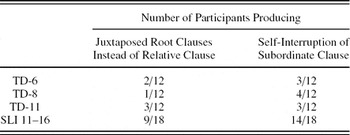
Among attempts, we included, for example, self-interruption of a subordinate clause as in (22) and avoidance of a relative clause by production of two separate root sentences as in (23).
(22)
(23)
Comparing the groups on these two strategies, we see that SLI 11–16 participants not only had a higher mean number of these, but they were also produced by a greater proportion of participants (Table 7).
Avoidance of a relative clause and self-interruption of a subordinate clause

Note: TD, typically developing; SLI, specific language impairment.
We also believe that it is relevant here to look at what appear to be individual avoidance strategies. One strategy of this type that we explored was direct discourse. The example in (24a), produced by DB, illustrates that using direct discourse provides the speaker with a way of avoiding production of a finite complement clause in (24b); thus, the processes of embedding, selection of the appropriate complementizer, and tense concord are all avoided.
(24)
Direct discourse is used at least once by 11 of the 18 SLI 11–16 participants (61%), and by 58% of TD-6, 33% of TD-8, and 25% of TD-11. Certain SLI 11–16 participants have frequent recourse to this strategy: for example, MR's sample contains seven occurrences; see examples in (25). Other participants use this strategy occasionally (JF and DB, three occurrences each). Other participants use this strategy only once or twice, or not at all, resembling in this way the TD participants, not one of whom produces more than two occurrences of direct discourse.
- (25)
a. elle a dit, “Oh, tu vas me faire grossir”
“She said, ‘Oh, you're going to make me get fat'”
b. parce que en fait il dit, “t(u) as [*] pas dû mettre ce bout de papier dans la coupe”
“Because in fact he said, ‘You should not have put this piece of paper in the cup’”
c. j'ai . . . il a dit, “Mais c'est pas moi”
“I . . . he said, ‘But it isn't me’”
Looking more closely at MR's production, we noticed that she is one of five participants with SLI who produced fewer than 10 embedded clauses, that she is also one of four participants with SLI who had a rate of complex utterances below 15% (only MR and MC had rates lower than 13%), and that her rate of clausal density is among the lowest. We take this to be an individual strategy, however, as MR's profile is very similar to MC's for these different complexity measures, yet there is not a single occurrence of direct discourse in his language sample.
DISCUSSION AND CONCLUSION
This study has sought to explore the hypothesis that investigation of morphosyntactic complexity in spontaneous language samples provides a useful way of bringing to light compensatory strategies used by individuals with SLI at adolescence. Although increasing complexity is the defining property of typical morphosyntactic development after childhood, we reasoned that adolescents with SLI would avoid it to compensate for their impaired ability to use language, known to persist at adolescence (and beyond). The 18 French-speaking adolescents (aged 11–16) whose language we examined in this study conformed to this picture, providing evidence for avoidance as an accurate characterization of language at this age in this population.
Analysis of spontaneous language samples of 60 to 70 utterances per participant revealed that adolescents with SLI produced sentences that were less complex than TD young people of roughly the same age (11-year-olds) and also than TD children with the same MLU (6-year-olds). Whereas measures of MLU, embedding, complex utterances, clausal density, and deep embedding gradually increased among the different TD age groups (6-, 8-, and 11-year-olds), adolescents with SLI not only performed below the TD groups, but also no correlation with age was found for them for these measures. Fine-grained analysis of relative clause production, the type of embedded clause that involves both syntactic movement and deep embedding, which we have suggested are key properties of computational complexity, showed that the adolescents with SLI produced fewer relatives than the TD participants their age (TD-11). Moreover, when the adolescents with SLI did produce relatives, they avoided precisely those that entail the greatest computational complexity (those involving longer dependencies or deeper embedding), producing significantly more “pseudorelatives” than “genuine” relatives, a difference also found in the TD-6 group, but not in either the TD-8 or the TD-11 groups.
In keeping with this last result was that, although means on the various complexity measures for the SLI 11–16 group were below those of each of the TD groups, the only significant difference with the youngest TD group, the 6-year-olds, was the rate of verbal utterances. Compared to the adolescents with SLI, the TD 6-year-olds did not produce significantly more subordinate clauses with respect to verbal utterances (embedding), they did not produce significantly more utterances containing a subordinate clause (complex utterances), they did not have a significantly higher rate of clauses that were subordinate (clausal density), and they did not produce significantly more relative clauses. This result is not surprising if 6-year-olds are true language matches (as their respective MLUs suggest) and if increasing complexity of utterances in typical language development occurs after early childhood. Although all of these measures were significantly higher in the TD-11 group compared to the SLI 11–15 group, the TD-8 group did turn out to show an intermediate developmental stage: although TD 8-year-olds had a significantly higher MLU compared to the SLI 11–16 and significantly higher rates of embedding and clausal density, they did not produce significantly more relative clauses, which we have argued to be the most complex subordinate clauses or (therefore) a higher rate of complex utterances. That both TD-8 and TD-6 groups had higher rates of verbal utterances than the SLI 11–16 might be taken to be indicative of a very basic avoidance strategy on the part of the latter: avoidance of clausal syntax.
Note furthermore that deep embedding did not prove to be a useful index in this study. This is doubtless because language samples contained only approximately 60 utterances, and thus the ranges of occurrences of deep embedding were quite similar (0–7 in the TD-11, 0–6 in the TD-6 and TD-8, and 0–5 in the SLI 11–16). Larger sample sizes might yield the expected result. However, frequency of use of embedding develops gradually throughout adolescence (see earlier), and thus perhaps deep embedding would only reveal significant differences at a later age. Monjauze (Reference Monjauze2007), using identical methodology, compared a group of TD 14-year-olds to the other TD groups reported on here and found that deep embedding increased significantly in this group (range = 1–10, mean = 4.8, SD = 2.9, compared to mean = 2.9, SD = 2.4, in the TD-11). We note that level of embedding did distinguish the types of relative clauses produced by the SLI 11–16 (and the TD-6): these were overwhelmingly pseudorelatives, those relatives whose structure entails less embedding.
We also note that the four major kinds of embedded clauses studied (adjunct clauses, nonfinite complement clauses, finite complement clauses, and relative clauses) occurred in similar proportions in each of the four groups we studied and therefore this calculation did not distinguish groups. There may be an effect of sample size here as well; many participants with SLI produced so few embedded clauses that comparing proportions of the major types of embedded clauses makes little sense (five participants produced fewer than 10). However, it must be emphasized that important differences were found between the SLI 11–16 and the older TD groups when the mean numbers and the subtypes of particular embedded clauses were examined (see above discussion on relatives). Although the SLI 11–16 group produced all four major types of embedded clauses, they produced fewer of them, and those they produced were less complex.
Morphosyntactic errors were negligible in the TD groups, but they were frequent in the language samples of the adolescents with SLI. Sentences having one or more subordinate clauses were more affected by errors than simple sentences (a difference that was independent from sentence length). This suggests that the increased computation required in the production of complex utterances uses resources that therefore are less likely to be available for other aspects of the computation, such as appropriate use and form of inflectional features and other functional categories. It is interesting in this regard to note that participants who produced more coordinated/juxtaposed clauses produced fewer erroneous utterances, suggesting that coordination or juxtaposition of root clauses is an efficient way of avoiding the ungrammaticality associated with subordination. Adolescents with SLI displayed avoidance not only by low frequency of complex structures, but also more actively via failed attempts at subordination measured in terms of self-interruption of a subordinate clause, which was then abandoned, juxtaposition of root clauses in place of a relative, a subordinate clause lacking an obligatory complementizer, and direct discourse. These were more frequent and used by a greater proportion of adolescents with SLI compared to the TD groups.
All of these behaviors observed in the adolescents with SLI go in the same direction: avoidance of syntactic complexity, calculated in terms of derivations entailing multiple syntactic operations and/or embedded clauses. Typical syntactic development at adolescence is characterized by increased complexity, as was confirmed by comparison of the TD groups in this study (11-year-olds overall had more complex syntax than 8-year-olds, and 8-year-olds than 6-year-olds). Only two links with age in the SLI 11–16 group were found: a negative correlation with frequency of erroneous relative clauses and a positive correlation with frequency of coordinated/juxtaposed clauses (which, not coincidently, is also negatively correlated with frequency of erroneous sentences). Although their syntax did not increase in complexity, and thus older participants did not produce more relative clauses, or proportionally more complex ones, it did begin to increase in grammaticality, at least in these constructions.
The ultimate goal of therapy for expressive language impairment is, of course, not to make individuals proficient on language exercises testing production of particular structures, but to help individuals be able to express themselves so that they are easily understood and so that they are not stigmatized by an abundance of target-deviant properties in their language. Infrequent use of subordination, and rarity or absence of the most complex types of subordinate clauses, from this point of view, can be interpreted as positive outcomes, given that these constructions are more likely to lead to ungrammaticality. Avoidance, then, might be a therapeutic goal, at least in older adolescents. The results we have reported here are typical of studies of language impairment in the high amounts of intersubject variation (as can be seen in the generally quite high standard deviations). At least some of this variation, we believe, could be because participants were not equally good at avoiding complexity. That is, just as participants showed variation in the type of strategies they used to avoid subordination (e.g., some using direct discourse), they varied in degree of overall avoidance. These considerations, we believe, lend support for the use of therapeutic strategies for adolescents involving explicit training in the use of grammatical alternatives to complex constructions.