For several decades following its identification in 1920, Creutzfeldt-Jakob disease (CJD) remained impossible to distinguish from a host of other neurodegenerative disorders. Its differential diagnosis was much improved in 1967 when it was shown to be experimentally transmissible, and in succeeding years this unique feature was used to generate a large series of transmitted cases for an analysis of clinical features.Reference Brown, Gibbs and Rodgers-Johnson 1 Typically, the illness begins weeks to a few months before a patient is first seen, and the two most common presentations are some form of progressive mental deterioration (85%) and/or cerebellar dysfunction (56%). Without experimental confirmation of transmissibility, however, these features are still insufficient to secure the diagnosis of CJD, and misdiagnosed cases continue to occur.
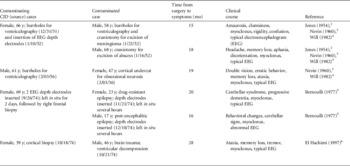
When such patients need surgical procedures, the potential exists for iatrogenic transmission of disease. We currently depend on both clinical and laboratory appraisals of the possibility of CJD before any operations are performed, together with the use of optimal decontamination protocols during and after operations to reduce infectivity to negligible levels. Six cases of iatrogenic CJD attributed to instrument cross-contamination during neurosurgical procedures have been reportedReference Jones and Nevin 2 – Reference El Hachimi, Chaunu, Cervenakova, Brown and Foncin 6 (Table 1), and new molecular prion profiling techniques have identified 2 cases of probable iatrogenic disease associated with neurosurgical procedures previously classified as sporadic.Reference Xiao, Yuan and Qing 7 , Reference Kobayashi, Parchi and Yamada 8 In 2 recent publications, the issue of surgical cross-contamination has been thoroughly reviewed.Reference Belay, Blase, Sehulster, Maddox and Schonberger 9 , 10 We now extend their recommendations to include (1) preoperative diagnostic tests on all patients with either mental deterioration or cerebellar symptoms and (2) the establishment of regional sets of dedicated instruments. The especially difficult diagnostic quandary in which clinical presentations can be explained by coexisting pathology from other diseases is illustrated by the following 3 cases, which occurred within the past 2 years, all in older adults.
The first patient presented with vertigo and an ataxic gait beginning several weeks before admission to the hospital; he was found to have a subdural cerebellar cyst that was surgically removed in an emergency procedure. However, during the following few weeks, myoclonus appeared in association with a progressive dementia. CJD was eventually considered and was supported by a positive 14-3-3 spinal fluid test. No special sterilization protocol had been used for the operative instruments.Reference Smyth, Farrell and Healy 11
Six cases of neuropathologically proven Creutzfeldt Jakob Disease (CJD) attributed to cross contamination by surgical instrumentsFootnote a

a Several more possible cases of neurosurgical iatrogenic CJD have been described, but with either unknown or ambiguous cross-contamination sources.
The second patient presented in status epilepticus and a history of cerebral trauma 30 years earlier requiring a craniotomy with debridement and insertion of a dural graft (unpublished case). A residual left hemiparesis was accompanied by mild cognitive impairment and occasional seizures. Radiologic studies revealed cystic encephalomalacia involving much of the left hemisphere, requiring an emergency parietal-occipital disconnection and resection. Subsequently, slides of the resected tissue showed spongiform change and positive staining for prion protein. Again, no special sterilization protocol had been used for the operative instruments.
The third patient presented with generalized weakness and right hemiparesis and had some years earlier been diagnosed with Hashimoto’s thyroiditis (unpublished case). After admission to the hospital, some observers at various times noted confusion, agitation, aphasia, and difficult coordination. An MRI revealed an abnormal signal in both cerebral hemispheres, unchanged from multiple earlier studies in past years. EEG showed mild diffuse slowing. The consensus diagnosis was an encephalitic process associated with Hashimoto’s thyroiditis, but because of continued uncertainty a brain biopsy was performed. No special sterilization protocol was followed. The biopsy subsequently showed typical spongiform change of CJD verified by the presence of misfolded prion protein.
Should similar patients come to medical attention in the future, the operative procedures would likely be handled in the same way because of the coincidental presence of non-CJD conditions that could account for their illnesses. Thus, even in the hands of astute clinicians, such situations will occasionally occur unless we improve our diagnostic approach and use optimal isolation and decontamination procedures during and after surgery.
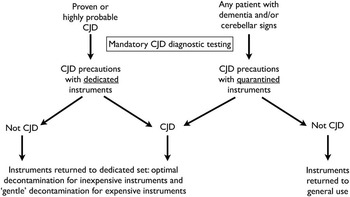
An important and inexpensive approach would include the routine examination of spinal fluid for 14-3-3 protein in every patient being considered for an invasive procedure, irrespective of the presumed diagnosis. In a large European multicenter study of more than 10,000 neurological patients, including >3,000 cases of CJD, the sensitivity and specificity of this test were ≥90% in symptomatic patients. The specificity (but not the sensitivity) would undoubtedly decrease when used as a screening test).Reference Stoeck, Sanchez-Juan and Gawinecka 12 Another very recently developed procedure that detects misfolded prion protein in nasal brushings has even higher values (96% sensitivity and 100% specificity in 51 patients with probable CJD, 20 patients with other neurodegenerative diseases, and 40 non-neurological controlsReference Orrú, Bongianni and Tonoli 13 (and personal communication, Prof. Giangi Zanusso). Although subject to ongoing research, the test could easily transition to a widely available diagnostic screening procedure. The routine use of at least 1 of these tests on every patient scheduled for an invasive procedure would virtually eliminate iatrogenic risk but might be judged excessive, considering the rarity of CJD. A less draconian approach could confine these investigations to adult patients with either dementia or cerebellar signs (ie, the signature presentations of CJD) even if alternative diagnoses were considered more likely (Figure 1).
General schema for invasive procedures in patients with probable or possible Creutzfeldt-Jakob Disease (CJD). Details for handling special cases are described in the text.

Diagnostic biopsies should never be undertaken unless at least one of the possible alternatives to CJD is a treatable disease, and in all such cases the instruments must be quarantined until CJD has been eliminated from consideration. Three situations involving invasive procedures need to be addressed:
(1) symptomatic patients with positive tests and a proven diagnosis of CJD; (2) symptomatic patients with negative tests but still suspected to have CJD; and (3) asymptomatic patients who carry a CJD mutation or who have been exposed to potentially contaminated materials such as human growth hormone, dural grafts, or blood from an individual at risk for variant CJD.
The ideal solution to eliminating cross-contamination risk is simply to discard and incinerate all materials coming into contact with any tissue other than skin. However, expensive instruments pose several problems: (1) hospitals are understandably reluctant to discard and replace them; (2) some expensive instruments cannot endure the harsh treatment that over several decades has been shown by a variety of research methods to ensure complete inactivation of prions (eg, 1 hour immersion in bleach or lye followed by 1 hour autoclaving at 132°C); and (3) the inactivation potency of more recently studied ‘gentle’ methods (eg, immersion in detergents and proteinases in an alkaline solution, or exposure to gaseous H2O2) still lacks verification in multiple independent laboratories.Reference Fichet, Comoy and Duval 14 If these methods are eventually found to be consistently effective, H2O2 exposure would be especially advantageous for endoscopic instruments because H2O2 is noncorrosive and does not require immersion in liquid.
In this situation, the best solution might be the establishment of regional centers with a set of instruments dedicated for use on patients with proven or highly probable CJD. These could be accessed as needed by participating hospitals, which could share the cost of their purchase, storage, and handling according to the average annual neurosurgical patient population of each hospital. After use, instruments would be returned to the centers and decontaminated using ‘harsh’ methods for durable instruments and 1 or more ‘gentle’ methods for fragile instruments.
Patients with proven or highly probable CJD would undergo invasive procedures conducted with appropriate isolation protocols and dedicated instruments. Patients with possible CJD, even if unlikely, would be operated using the same isolation protocols but with nondedicated instruments. The instruments would be labeled (important) and quarantined until a correct diagnosis had been established, and then either sent to the regional center for dedicated instruments or returned to hospital service, depending on the diagnosis.
Asymptomatic mutation carriers or individuals exposed to potentially infected materials pose an especially difficult problem because almost no infectivity data exist for the preclinical stage of disease in humans. The onset of illness in genetic forms of disease varies somewhat from mutation to mutation, but according to observations of hundreds of individuals with a variety of mutations, CJD is rare before the age of 50 years. The very rare long-delayed cases of CJD from earlier exposure to contaminated growth hormone or dural grafts are also occurring in middle-aged adults. Experimental studies in laboratory rodents have repeatedly shown that infectivity begins to appear early in the presymptomatic stage of disease, and 4 cases of iatrogenic blood transmissions in humans have been documented in which blood was infectious up to at least 3 years in advance of symptomatic disease.Reference Hewitt, Llewelyn, Mackenzie and Will 15
These individuals should not be denied the same care that would be given to anyone else seeking medical attention. A number of instances have occurred in which such care was denied and has resulted in some families hesitating to provide information about their genetic susceptibility to CJD (or history of exposure to growth hormone or dural grafts) both to insurance companies and physicians.
In view of the limited information about infectivity in presymptomatic disease, a prudent approach would be to treat as possibly infectious any individuals over the age of 40 who carry mutations or who have been exposed to potentially contaminated materials. This approach would require using operative CJD precautions and either discarding inexpensive instruments (CNS operations) or subjecting them to an optimal CJD decontamination protocol (non-CNS procedures). Dedicated instruments could not be used in this situation because, if contaminated from prior use, they might infect still healthy individuals.
The admittedly difficult decision regarding disposition of expensive instruments in this special situation would have to be made on a case-by-case basis. These instruments could be transferred to the regional center as dedicated instruments (ie, lost to the hospital for general use) or subjected to a commercially available ‘gentle’ CJD decontamination method and returned to service. Some expensive instruments (eg, intraoperative probes) are constructed such that the only parts coming into contact with tissue are removable and could be discarded, allowing the instrument to be reused without any special decontamination. Similar decisions would be needed following emergency surgery on patients in any of the above situations, and in every such case all instruments would be quarantined until a definitive diagnosis had been established.
If these guidelines are followed, ie, routine use of diagnostic testing on all patients admitted with symptoms of either dementia or cerebellar disease, and containment of infectivity commensurate with the degree of potential risk, the occurrence of iatrogenic disease due to cross-contamination during operative or other invasive procedures should be reduced to a level very close to zero.
Acknowledgment
Financial support: No financial support was provided relevant to this article.
Potential conflicts of interest: All authors report no conflicts of interest relevant to this article.