Palmer amaranth is one of the most common and problematic weeds in cotton and other agronomic crops in the southern United States (Webster Reference Webster2013). The biology of this weed, its impact on cotton yield, and the difficulty of controlling it in cotton have been reviewed previously (Culpepper et al. Reference Culpepper, Webster, Sosnoskie and York2010; Steckel Reference Steckel2007; Ward et al. Reference Ward, Webster and Steckel2013). Palmer amaranth can dramatically reduce cotton yield. Yield reductions of 38% to 65% have been reported with full-season interference of one plant per meter of row (MacRae et al. Reference MacRae, Webster, Sosnoskie, Culpepper and Kichler2013; Morgan et al. Reference Morgan, Baumann and Chandler2001; Rowland et al. Reference Rowland, Murray and Verhalen1999). It can also interfere with mechanical harvest (Morgan et al. Reference Morgan, Baumann and Chandler2001; Smith et al. Reference Smith, Baker and Steele2000).
Glyphosate-resistant cotton was commercialized in 1997, allowing growers to effectively and conveniently control Palmer amaranth with glyphosate (Culpepper and York Reference Culpepper and York1998, Reference Culpepper and York1999). However, with widespread planting of glyphosate-resistant crops and extensive reliance on glyphosate, resistant biotypes evolved. Palmer amaranth resistance to glyphosate has been confirmed in 27 states (Heap Reference Heap2017) and is widespread across the southeast and midsouth regions of the United States (Culpepper et al. Reference Culpepper, Webster, Sosnoskie and York2010). Palmer amaranth resistant to acetolactate synthase (ALS)-inhibiting herbicides is also prevalent, and multiple resistance to both glyphosate and ALS-inhibiting herbicides is common (Heap Reference Heap2017; Sosnoskie et al. Reference Sosnoskie, Kichler, Wallace and Culpepper2011; Ward et al. Reference Ward, Webster and Steckel2013). In North Carolina, for example, 95% of the Palmer amaranth populations contain at least some individuals resistant to both glyphosate and ALS-inhibiting herbicides (Poirier et al. Reference Poirier, York, Jordan, Chandi, Everman and Whitaker2014).
Herbicides for POST application in cotton to control biotypes of Palmer amaranth with multiple resistance are limited. Effective control of Palmer amaranth in cotton has been achieved with glufosinate-based systems (Culpepper et al. Reference Culpepper, York, Roberts and Whitaker2009; Gardner et al. Reference Gardner, York, Jordan and Monks2006; Whitaker et al. Reference Whitaker, York, Jordan and Culpepper2011), and cotton growers are increasingly relying on glufosinate to control glyphosate-resistant Palmer amaranth (Sosnoskie and Culpepper Reference Sosnoskie and Culpepper2014). Glufosinate must be applied to small Palmer amaranth for consistently effective control. It is generally recommended that Palmer amaranth be no more than 7.5 cm tall when treated with glufosinate (Culpepper Reference Culpepper2016; York Reference York2016). Producers often struggle to make timely applications because of the rapid growth rate of Palmer amaranth (Culpepper et al. Reference Culpepper, Webster, Sosnoskie and York2010), and this can result in inadequate control by glufosinate (Barnett et al. Reference Barnett, Culpepper, York and Steckel2013; Coetzer et al. Reference Coetzer, Al-Khalib and Peterson2002).
Transgenic cotton with tolerance to dicamba is commercially available (ISAAA 2015). Bollgard II® XtendFlexTM cotton, which is resistant to dicamba, glufosinate, and glyphosate, may be a tool that producers can use to manage Palmer amaranth in a rescue situation (when Palmer amaranth size exceeds that for which consistent control from glufosinate would be expected) (Cahoon et al. Reference Cahoon, York, Jordan, Everman, Seagroves, Culpepper and Eure2015; Merchant et al. Reference Merchant, Sosnoskie, Culpepper, Steckel, York, Braxton and Ford2013). Attempts to control Palmer amaranth in a rescue situation are not desirable because early-season competition occurring before application may impact yield (Burke et al. Reference Burke, Troxler, Askew, Wilcut and Smith2005; Culpepper and York Reference Culpepper and York1999), and treating large plants may lead to the evolution of resistance (Norsworthy et al. Reference Norsworthy, Ward, Shaw, Llewellyn, Nichols, Webster, Bradley, Frisvold, Powles, Burgos, Witt and Barrett2012). However, growers are desperate to find a more economical method than hand-weeding to control Palmer amaranth escapes and prevent seed production (Sosnoskie and Culpepper Reference Sosnoskie and Culpepper2014).
Dicamba co-applied with glufosinate was more effective on 10-cm Palmer amaranth than was glufosinate alone (Cahoon et al. Reference Cahoon, York, Jordan, Everman, Seagroves, Culpepper and Eure2015). Depending on dicamba rate, dicamba plus glufosinate was 15% to 20% more effective than glufosinate alone and 11% to 30% more effective than dicamba alone when applied to 15- to 20-cm Palmer amaranth (Merchant et al. Reference Merchant, Sosnoskie, Culpepper, Steckel, York, Braxton and Ford2013). Merchant et al. (Reference Merchant, Culpepper, Eure, Richburg and Braxton2014) also observed greater control of 20-cm Palmer amaranth by sequential applications of glufosinate plus 2,4-D than with sequential applications of 2,4-D alone.
Co-application of dicamba plus glufosinate may control Palmer amaranth in a rescue situation while reducing selection pressure on glufosinate. The objective of this experiment was to evaluate Palmer amaranth control, cotton growth, and cotton yield in a Palmer amaranth rescue situation created by delaying the first POST application of dicamba plus glufosinate.
Materials and Methods
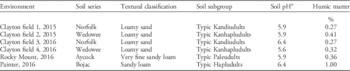
The experiment was conducted in two separate fields each year on the Central Crops Research Station in Clayton, North Carolina (35.67°N, 78.51°W) during 2015 and 2016. The experiment also was conducted at the Upper Coastal Plain Research Station in Rocky Mount, North Carolina (35.90°N, 77.68°W) and the Eastern Shore Agricultural Research and Extension Center in Painter, Virginia (37.59°N, 75.82°W) in 2016. The combination of location and year was considered an environment. Soils at each environment are described in Table 1. Each environment was in a conventional tillage system. All environments had natural glyphosate-resistant Palmer amaranth infestations exceeding 100 plants m−2. To ensure heavy Palmer amaranth densities for POST treatments, no PRE herbicides were applied. Some environments also had annual grasses, which were controlled as needed with clethodim (Select Max, Valent USA, Walnut Creek, CA).
Soil characteristics by environment.

a Soil pH and humic matter determined by the North Carolina Department of Agriculture and Consumer Services, Agronomic Division. Humic matter was determined photometrically according to the method described by Mehlich (Reference Mehlich1984).
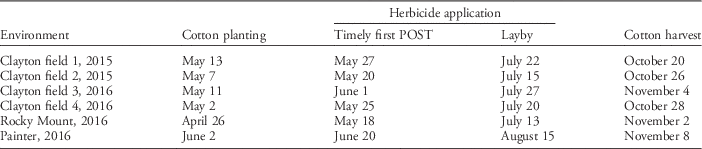
Cotton cultivar ‘DG 3385B2XF’ (Dyna-Gro, Loveland, CO) was planted in 2015 at both environments in Clayton. Cotton cultivar ‘DG 3526B2XF’ (Dyna-Gro) was planted in 2016 at both environments in Clayton and in Rocky Mount. Cotton cultivar ‘DP 1538 B2XF’ (Monsanto, Saint Louis, MO) was planted in 2016 at Painter. Cotton planting and harvest dates are shown in Table 2.
Cotton planting, herbicide application, and cotton harvest dates by environment.

The experimental design was a randomized complete block with treatments replicated four times at Clayton and Rocky Mount and three times at Painter. Plot size was four rows by 9.1 m at Clayton and Rocky Mount and four rows by 6.1 m at Painter. Row spacing was 97 cm at Clayton and 91 cm at Rocky Mount and Painter.
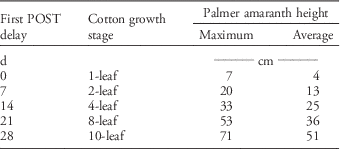
The first POST application of dicamba diglycolamine salt at 560 gaeha−1 (Clarity®, BASF Ag Products, Research Triangle Park, NC) plus glufosinate-ammonium at 880 g ai ha−1 (Liberty® 280SL, Bayer CropScience, Research Triangle Park, NC) was made in a timely manner (0-d delay) or delayed 7, 14, 21, or 28 d. Dates for the timely first POST application are shown in Table 2. Cotton growth stage and Palmer amaranth height for timely and delayed applications are listed in Table 3. A second POST application of dicamba plus glufosinate (560+590 g ha−1) was made 14 d after the first POST application. Glyphosate potassium salt (Roundup PowerMAX®, Monsanto) at 1,260 g ae ha−1 plus S-metolachlor (Dual Magnum®, Syngenta Crop Protection, Greensboro, NC) at 1,070 g ai ha−1 plus diuron (Direx® 4L, ADAMA, Raleigh, NC) at 1,120 g ai ha−1 were applied as a POST directed spray 72 d after planting (layby). The POST herbicides were applied using a CO2-pressurized backpack sprayer calibrated to deliver 140 L ha−1 at 165 kPa with flat-fan nozzles (TTI 110015 Turbo TeeJet® induction nozzles, TeeJet Technologies, Wheaton, IL). Layby herbicides were applied using a CO2-pressurized backpack sprayer calibrated to deliver 140 L ha−1 at 206 kPa with a single flood nozzle (TK-VS2 FloodJet® wide angle flat-spray nozzle, TeeJet Technologies) per row middle. A nontreated check was included.
Cotton growth stage and Palmer amaranth height at first POST application, averaged over environments.

Palmer amaranth control, cotton stunting, and cotton foliar necrosis were estimated visually using a 0 to 100 scale (Frans et al. Reference Frans, Talbert, Marx and Crowley1986) 14 d after the first POST application, 14 d after the second POST application, and 14 d after the layby application. The heights of 20 randomly selected cotton plants per plot were recorded at layby at each environment. Cotton height was again recorded 21 d after layby at Clayton and Rocky Mount. The number of cotton main stem nodes on 20 randomly selected plants per plot was recorded at layby at Clayton and Rocky Mount. Palmer amaranth aboveground fresh biomass was collected in September from three row middles in treated plots (17 to 25 m2) and from a 1 m2 area in the nontreated plots. In mid-September to early October, when approximately 60% of the bolls in plots with the 0-d delay in first POST application were open, 20 randomly selected cotton plants per plot at each environment were mapped to quantify harvestable bolls (green and open) by main stem node and sympodial fruiting position (Ritchie et al. Reference Ritchie, Whitaker and Collins2011). Percent open bolls, a measure of maturity, was calculated from the numbers of open and green bolls. Treated plots were mechanically harvested for seed cotton yield (Table 2). Cotton in nontreated checks could not be harvested due to the severe weed infestations, and thus the yield in these plots was assumed to be zero. A sample of harvested seed cotton was collected from each plot and ginned to determine lint percentage. This lint percentage was used to convert seed cotton yield to lint yield. Each lint sample was analyzed for fiber length, fiber length uniformity, fiber strength, and micronaire with high volume instrument analysis by Cotton Incorporated in Cary, NC.
Statistical analyses were performed using the PROC Mixed and PROC Reg procedures in SAS (version 9.3; SAS Institute Inc., Cary, NC). All data met model assumptions. Treatments were considered a fixed factor and replication and environment were considered random factors. Treatment and environment did not interact for cotton injury, percent open bolls, fiber strength, or Palmer amaranth biomass, and therefore combined analyses of six environments occurred. A treatment by environment interaction for Palmer amaranth control, cotton stunting, cotton height, cotton nodes, total boll load, fiber micronaire, fiber length, and cotton yield merited further investigation to ascertain if treatments were uniform over environments. The treatment mean square was at least 3-fold greater than the treatment by environment interaction mean square, providing justification to combine results over environments. The use of the method=type3 option in PROC Mixed allows for the evaluation of random by fixed interaction terms and provides better control of Type I error rates than does the default REML estimation (Moore and Dixon Reference Moore and Dixon2015; Stroup and Littell Reference Stroup and Littell2002). Additionally, environments were analyzed individually; similar trends existed among environments, further justifying combined analyses. Treatment means are reported using least square means. Linear regression of treatment on all dependent variables was conducted. Nontreated checks were excluded from all statistical analyses except for Palmer amaranth biomass.
Results and Discussion
Palmer Amaranth Control
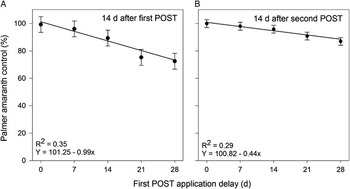
Delays in the first POST co-application of dicamba plus glufosinate affected Palmer amaranth control 14 d after first POST application and 14 d after second POST application (P=0.001 and 0.002, respectively). Palmer amaranth control 14 d after the first POST application decreased linearly with the delay in the first POST application (Figure 1A). Palmer amaranth was controlled 99% with the 0-d delay in dicamba plus glufosinate application. Excellent Palmer amaranth control has been observed with timely applications of dicamba plus glufosinate (York et al. Reference York, Culpepper, Sosnoskie and Bollman2012). Control declined to 96%, 89%, 75%, and 73% when dicamba plus glufosinate application was delayed 7, 14, 21, and 28 d, respectively. Control improved following the second POST application (Figure 1B). Palmer amaranth was controlled completely 14 d after the second application with the 0-d delay in first POST application and 98%, 95%, 91%, and 87% with the 7-, 14-, 21-, and 28-d timing delays, respectively. Merchant et al. (Reference Merchant, Culpepper, Eure, Richburg and Braxton2014) reported 86% to 99% control of 20-cm Palmer amaranth following two applications of glufosinate plus 2,4-D.
Palmer amaranth control 14 d after first POST (A) and 14 d after second POST (B) application as affected by delay in the first POST application of dicamba (560 g ha−1) plus glufosinate (880 g ha−1). Treatment means are combined across six environments and reported using least square means. Vertical lines are ±one standard error. P values characterize the linear relationship of delayed timing of first POST application on Palmer amaranth control 14 d after first POST (P<0.001) and 14 d after second POST application (P<0.001).

The layby application further improved control. At 14 d after layby application, Palmer amaranth was controlled 99%, 99%, 98%, 96%, and 94% with 0-, 7-, 14-, 21-, and 28-d timing delays, respectively (data not shown). Palmer amaranth biomass in nontreated plots was at least 10,200 kg ha−1 (data not shown). All treatments reduced late-season Palmer amaranth biomass by at least 98% compared with the nontreated check (data not shown).
Cotton Growth and Injury
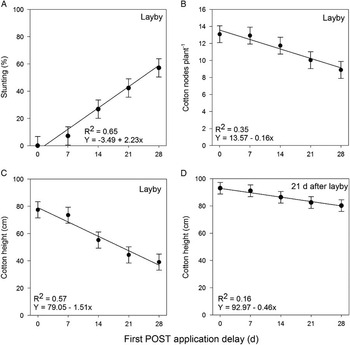
Prolonged competition from Palmer amaranth as the first POST application was delayed was reflected in a linear increase in cotton stunting, a measure of overall plant volume (P<0.001). Cotton at layby was stunted 7%, 26%, 42%, and 57% when the first POST application was delayed 7, 14, 21, and 28 d, respectively (Figure 2A). Similar results were noted previously where early season Palmer amaranth competition reduced cotton canopy volume (Morgan et al. Reference Morgan, Baumann and Chandler2001). Delays in the first POST application impacted the number of cotton main stem nodes at layby. Compared to the 0-d delay in first POST application, the number of main stem nodes was reduced 2%, 10%, 23%, and 32% as the first POST application was delayed 7, 14, 21, and 28 d, respectively (Figure 2B).
Cotton stunting at layby (A), cotton nodes at layby (B), cotton height at layby (C), and cotton height 21 d after layby (D) as affected by delay in the first POST application of dicamba (560 g ha−1) plus glufosinate (880 g ha−1). Treatment means are combined across six environments for cotton stunting and cotton height at layby and over five environments for cotton nodes at layby and cotton height 21 d after layby. Treatment means are reported using least square means. Vertical lines are ± one standard error. P values characterize the linear relationship of delayed timing of first POST application on cotton stunting (P<0.001), cotton height at layby (P<0.001), cotton nodes at layby (P<0.001), and cotton height 21 d after layby (P<0.001).

Cotton height data supported the stunting observations. A linear decrease in cotton height at layby (P<0.001) was observed as the first POST application was delayed (Figure 2C). Compared to the 0-d delay in first POST application, cotton height at layby was reduced 5%, 29%, 43%, and 50% as the first POST application was delayed 7, 14, 21, and 28 d, respectively. The impact of the delayed first POST application on cotton height was less severe 21 d after layby compared with the impact at layby (Figure 2D). This may be attributed to vegetative growth continuing later in the season because the delayed applications lead to an overall reduction in boll load, whereas timely applications allow more of the photosynthetic resources to be utilized for reproductive development.
Cotton injury, observed as foliar necrosis, was minimal (<5%) and transient following both the first and second co-applications of dicamba plus glufosinate (data not shown). Similar minimal cotton injury (foliar necrosis) and rapid recovery following application of dicamba plus glufosinate has been observed previously (Cahoon et al. Reference Cahoon, York, Jordan, Everman, Seagroves, Culpepper and Eure2015).
Cotton Boll Production, Maturity, Lint Yield, and Fiber Quality
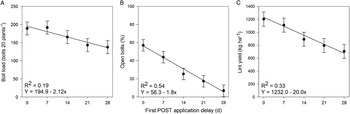
Total boll production, or boll load, decreased linearly as the first POST application was delayed (P<0.001). Boll load was reduced 7.6% for each 7-d delay in first POST herbicide application (Figure 3C). Further examination of plant mapping data revealed that early season weed competition resulting from delays in the first POST herbicide application reduced boll production uniformly over the fruiting zone (data not shown). Boll production on sympodia arising from both nodes four through eight and nodes eight and above was reduced as the first application was delayed. However, the percentage of total bolls in each node zone was unaffected.
Cotton boll load (A), percent open cotton bolls (B), and cotton lint yield (C) as affected by delay in the first POST application of dicamba (560 g ha−1) plus glufosinate (880 g ha−1). Treatment means are combined over six environments and reported using least square means. Vertical lines are ± one standard error. P-values characterize the linear relationship of delayed timing of first POST application on cotton boll load (P<0.001), percent open cotton bolls (P<0.001), and cotton lint yield (P<0.001).

Delays in first POST application also delayed cotton maturity, measured as percent open bolls. Percent open bolls decreased linearly as the first POST application was delayed (P<0.001). Each 7-d delay in first POST application reduced the percentage of open bolls 22% (Figure 3B). While there were 56% open bolls with the 0-d delay, only 7% of the bolls were open when the first POST application was delayed 28 d.
Cotton harvest was delayed until all harvestable bolls were open. Cotton lint yield followed the same trend as total boll load and decreased linearly (P<0.001) as the first POST application was delayed (Figure 3C). Lint yield was reduced 11.4% for each 7-d delay in first POST herbicide application. The greater reduction in lint yield than in boll load suggests a reduction in boll size with delayed first POST application. Delays in the first POST application did not impact fiber quality. Averaged over treatments and environments, fiber micronaire, fiber length, fiber strength, and fiber length uniformity were 4.9, 27.5 mm, 27.8 g tex−1, and 82.4%, respectively (data not shown).
Excellent Palmer amaranth control was achieved following sequential POST applications of dicamba plus glufosinate and a layby application of diuron plus MSMA, thus demonstrating that rescue Palmer amaranth control is possible in XtendFlexTM cotton. This gives growers an option to control Palmer amaranth when optimum timing of POST application cannot be achieved due to weather delays, equipment breakdowns, or failure of soil-applied residual herbicides. However, this practice should be discouraged except in salvage situations. Failure to apply the herbicides in a timely manner may reduce cotton yield and is not in keeping with a good resistance management strategy.