Introduction
Epidemiological data suggest that one-third of the overall global burden of disease among individuals aged ⩾15 years can be attributed to neuropsychiatric disorders, with depression the leading cause of disability for both men and women (WHO, 2008). It is important to have a life course perspective on mental illness because approximately half of all mental disorders have an onset in childhood or adolescence (Kessler et al. Reference Kessler, Amminger, Aguilar-Gaxiola, Alonso, Lee and Ustun2007). Earlier-onset mental disorders have been associated with a variety of adverse functional outcomes, including reduced educational attainment, increased marital instability and lower financial and occupational status (Kessler et al. Reference Kessler, Aguilar-Gaxiola, Alonso, Chatterji, Lee, Ormel, Ustun and Wang2009). Some cohort studies (e.g. Rao & Chen, Reference Rao and Chen2009) have also documented an increasing trend towards younger age at onset of major depressive disorder (MDD). Depression occurring during adolescence and early adulthood can disrupt the attainment of developmental milestones across biological, psychological, cognitive and social–emotional domains (Miller, Reference Miller2007; Guerry & Hastings, Reference Guerry and Hastings2011).
Several researchers have proposed that child- or adolescent-onset MDD is a more severe and chronic subtype of depression (Rush Reference Rush2007; Harald & Gordon, Reference Harald and Gordon2012) whereas findings from social neuroscience support the hypothesis that early-onset MDD represents developmental pathway characterized by a distinct set of neurobiological correlates (Kaufman et al. Reference Kaufman, Martin, King and Charney2001; Miller, Reference Miller2007). Prior cross-sectional and treatment-outcome studies have shown associations between early-onset MDD and a range of sociodemographic and clinical features, including younger age and female gender; higher rates of Axis I psychiatric co-morbidity, personality disorders and suicidality; longer duration of illness; greater number of prior episodes; more severe depressive symptoms; greater history of childhood maltreatment and greater family history of mood disorders (Fava et al. Reference Fava, Alpert, Borus, Nierenberg, Pava and Rosenbaum1996; Alpert et al. Reference Alpert, Fava, Uebelacker, Nierenberg, Pava, Worthington and Rosenbaum1999; Bernet & Stein, Reference Bernet and Stein1999; Klein et al. Reference Klein, Schatzberg, McCullough, Dowling, Goodman, Howland, Markowitz, Smith, Thase, Rush, LaVange, Harrison and Keller1999; Ramklint & Ekselius, Reference Ramklint and Ekselius2003; Zisook et al. Reference Zisook, Rush, Albala, Alpert, Balasubramani, Fava, Husain, Sackeim, Trivedi and Wisniewski2004, Reference Zisook, Rush, Lesser, Wisniewski, Trivedi, Husain, Balasubramani, Alpert and Fava2007b; Klein et al. Reference Klein, Arnow, Barkin, Dowling, Kocsis, Leon, Manber, Rothbaum, Trivedi and Wisniewski2009; van Noorden et al. Reference van Noorden, Minkenberg, Giltay, den Hollander-Gijsman, van Rood, van der Wee and Zitman2011). Adults with a history of early-onset depression report greater impairment in social and occupational functioning and quality of life when compared to patients with adult-onset depression (Zisook et al. Reference Zisook, Lesser, Stewart, Wisniewski, Balasubramani, Fava, Gilmer, Dresselhaus, Thase, Nierenberg, Trivedi and Rush2007a). Longitudinal studies also indicate that those with child- and adolescent-onset MDD are at risk for recurrent depressive episodes and worse functional outcomes (Kaufman et al. Reference Kaufman, Martin, King and Charney2001; Hammen et al. Reference Hammen, Brennan, Keenan-Miller and Herr2008; Rao & Chen, Reference Rao and Chen2009).
Although it does appear that early-onset MDD is associated with a more severe clinical picture and worse psychosocial functioning, it is unclear whether these differences translate into poorer treatment outcomes. Studies that examined treatment outcomes in depressed child and adolescent samples suggest a poorer response to tricyclic antidepressants whereas selective serotonin reuptake inhibitors appear to perform better in juvenile samples (Keller et al. Reference Keller, Ryan, Strober, Klein, Kutcher, Birmaher, Hagino, Koplewicz, Carlson, Clarke, Emslie, Feinberg, Geller, Kusumakar, Papatheodorou, Sack, Sweeney, Wagner, Weller, Winters, Oakes and McCafferty2001; Taurines et al. Reference Taurines, Gerlach, Warnke, Thome and Wewetzer2011). Treatment outcomes are not as clear-cut for adults who have a history of MDD onset at a relatively young age. For example, a retrospective study by Parker et al. (Reference Parker, Roy, Hadzi-Pavlovic, Mitchell and Wilhelm2003) found that adults who have non-melancholic MDD with onset prior to age 25 rated themselves as less likely to have benefited from any antidepressant medication or psychotherapy compared to adults with a later onset of MDD.
Despite these patient perceptions, prospective evidence does not support a differential response to single-agent antidepressant treatment for depressed adult out-patients who have a history of child- or adolescent-onset MDD (Harald & Gordon, Reference Harald and Gordon2012). For example, in a sample of 289 adult out-patients with chronic DSM-III-R MDD treated with 12 weeks of either sertraline or imipramine, Klein et al. (Reference Klein, Schatzberg, McCullough, Dowling, Goodman, Howland, Markowitz, Smith, Thase, Rush, LaVange, Harrison and Keller1999) reported no differences in acute treatment response for those with early-onset (prior to age 21) versus late-onset (age ⩾21) MDD. A similar pattern of results has been found for other classes of antidepressant medications. In an analysis of treatment moderators, Trivedi et al. (Reference Trivedi, Morris, Pan, Grannemann and John Rush2005) found early onset (prior to age 18) to be unrelated to response in a sample of 97 out-patients with DSM-IV MDD who were treated with nefazodone for up to 16 weeks. No differences were found for acute outcomes with citalopram for unipolar depressed out-patients with early onset (before age 18) and those with late onset (age ⩾18) in a sample of 2876 participants enrolled in the Sequenced Treatment Alternatives to Relieve Depression (STAR*D) trial (Trivedi et al. Reference Trivedi, Rush, Wisniewski, Nierenberg, Warden, Ritz, Norquist, Howland, Lebowitz, McGrath, Shores-Wilson, Biggs, Balasubramani and Fava2006).
Studies examining the relationship between pre-adult onset and antidepressant outcomes in patients with chronic MDD have focused on single agent treatment (e.g. Klein et al. Reference Klein, Schatzberg, McCullough, Dowling, Goodman, Howland, Markowitz, Smith, Thase, Rush, LaVange, Harrison and Keller1999). The extent to which age of onset is clinically useful for predicting differential response to combination antidepressant treatment for patients with chronic or recurrent MDD is unknown. It is possible that combining two types of antidepressant agents during first-step treatment would result in differential outcomes for patients with a history of child- or adolescent-onset MDD who experience a chronic or recurrent course of illness. To address this gap in the literature, the present study investigated differences in baseline demographic and clinical correlates, antidepressant safety/tolerability, and treatment outcomes for those with pre-adult versus adult-onset chronic or recurrent MDD treated with either a single antidepressant agent (escitalopram plus placebo) or one of two types of combined antidepressant treatment [bupropion sustained-release (bupropion-SR) plus escitalopram or venlafaxine extended-release (venlafaxine-XR) plus mirtazapine].
Method
Study overview
The Combining Medications to Enhance Depression Outcomes (CO-MED) trial (Rush et al. Reference Rush, Trivedi, Stewart, Nierenberg, Fava, Kurian, Warden, Morris, Luther, Husain, Cook, Shelton, Lesser, Kornstein and Wisniewski2011) was a prospective, randomized, single-blind, multi-center, placebo-controlled trial that compared the efficacy of escitalopram monotherapy with two antidepressant combinations as first-step treatment for chronic or recurrent MDD during acute (12 weeks) and long-term (28 weeks) treatment. From March 2008 to September 2009, the CO-MED study enrolled out-patients with non-psychotic MDD from six primary-care and nine psychiatric-care sites across the USA. The primary outcomes, study details and methodology have been described previously (Rush et al. Reference Rush, Trivedi, Stewart, Nierenberg, Fava, Kurian, Warden, Morris, Luther, Husain, Cook, Shelton, Lesser, Kornstein and Wisniewski2011). This report focuses on differences in clinical characteristics and outcomes between CO-MED participants with early-onset versus adult-onset MDD. The CO-MED study is registered at ClinicalTrials.gov under registration identification number NCT00590863. Additional study details can be found at www.clinicaltrials.gov/ct2/show/NCT00590863?term=CO-MED&rank=1.
Participants
Eligible participants were out-patients who were seeking treatment at a primary- or psychiatric-care site who met clinical criteria for non-psychotic chronic [current major depressive episode (MDE) lasting ⩾2 years] or recurrent (having had at least one prior MDE) MDD, as defined by a clinical interview and confirmed by the Mini-International Neuropsychiatric Interview (MINI; Sheehan et al. Reference Sheehan, Lecrubier, Sheehan, Amorim, Janavs, Weiller, Hergueta, Baker and Dunbar1998). Additional inclusion criteria were a score of ⩾16 on the 17-item Hamilton Rating Scale for Depression (HAMD17; Hamilton, Reference Hamilton1960) and clinical acceptability of treatment with antidepressant medication combinations. Patients with and without current suicidal ideation were included in the trial as long as out-patient treatment was deemed clinically appropriate by the study physician.
Exclusion criteria included lifetime history of psychotic depression, schizophrenia, bipolar disorder, schizo-affective or other Axis I psychotic disorders; current psychotic symptoms; history (within the past 2 years before study entry) of anorexia or bulimia; current primary diagnosis of obsessive–compulsive disorder; current substance dependence requiring in-patient detoxification or in-patient treatment; immediate need for hospitalization for a psychiatric disorder; presence of an unstable general medical condition that would be likely to require hospitalization or was deemed terminal; any current medication or general medical condition contra-indicated by study medications; and current or lifetime history of somatic antidepressant treatment (e.g. electroconvulsive therapy). Patients were excluded if they were currently taking antipsychotic or anticonvulsant medications, mood stabilizers, central nervous system stimulants or any of the study drugs; or if they were participating in depression-specific psychotherapy. Women who were pregnant, breastfeeding, planning to become pregnant over the 8 months following study entry or sexually active and not using adequate birth control were also excluded. See www.co-med.org for a full list of study exclusions.
The study protocol was approved by the institutional review boards of the CO-MED National Coordinating Center (University of Texas Southwestern Medical Center, Dallas), the Data Coordinating Center (University of Pittsburgh), all participating clinical sites, and the Data Safety and Monitoring Board of the National Institutes of Health (Bethesda, MD). Participation was entirely voluntary. A full description of the protocol was given to each participant prior to obtaining written informed consent for the full 28-week study period, which was required prior to initiating study procedures.
Antidepressant treatment
Allocation to treatment group was randomly assigned and stratified by clinical site using a web-based randomization system (Wisniewski et al. Reference Wisniewski, Eng, Meloro, Gatt, Ritz, Stegman, Trivedi, Biggs, Friedman, Shores-Wilson, Warden, Bartolowits, Martin and Rush2004). Dosing schedules were based on prior reports (Fava, Reference Fava2001, Reference Fava2009; McGrath et al. Reference McGrath, Stewart, Fava, Trivedi, Wisniewski, Nierenberg, Thase, Davis, Biggs, Shores-Wilson, Luther, Niederehe, Warden and Rush2006; Leuchter et al. Reference Leuchter, Lesser, Trivedi, Rush, Morris, Warden, Fava, Wisniewski, Luther, Perales, Gaynes and Stewart2008; Papakostas, Reference Papakostas2009) and doses were increased only in the context of acceptable side-effects. Participants could exit the study if unacceptable or intolerable side-effects occurred that could not be resolved with dose reduction or medication treatment of side-effects. Treatment visits were planned at baseline and on weeks 1, 2, 4, 6, 8, 10, 12, 16, 20, 24 and 28. Measurement-based care provided personally tailored and vigorous dosing (Trivedi et al. Reference Trivedi, Rush, Wisniewski, Nierenberg, Warden, Ritz, Norquist, Howland, Lebowitz, McGrath, Shores-Wilson, Biggs, Balasubramani and Fava2006, Reference Trivedi, Rush, Gaynes, Stewart, Wisniewski, Warden, Ritz, Luther, Stegman, Deveaugh-Geiss and Howland2007; Trivedi & Daly, Reference Trivedi and Daly2007). Dosage adjustments were based on scores on the 16-item Quick Inventory of Depressive Symptomatology – Clinician-rated (QIDS-C16; Rush et al. Reference Rush, Trivedi, Ibrahim, Carmody, Arnow, Klein, Markowitz, Ninan, Kornstein, Manber, Thase, Kocsis and Keller2003) and participant report of side-effect burden obtained at each visit. Dosing of any medication could only be increased if the QIDS-C16 score was >5 and side-effects were tolerable. Treatment was guided by the CO-MED Operations Manual (available at www.co-med.org).
Escitalopram plus placebo
Escitalopram was started at one tablet (10 mg) per day, to be increased to two tablets (20 mg) per day at 4 weeks. Pill placebo was started at week 2, with the option of increasing to two pills at week 4.
Bupropion-SR plus escitalopram
Bupropion-SR (150 mg/day) was started at baseline and increased to 300 mg/day at week 1. Escitalopram was started at 10 mg/day at week 2. At week 4, bupropion-SR could be raised to 400 mg/day and/or escitalopram could be raised to 20 mg/day. At week 6 and beyond, doses could be increased up to a maximum of bupropion-SR 400 mg/day (200 mg b.i.d.) and escitalopram 20 mg/day.
Venlafaxine-XR plus mirtazapine
Venlafaxine-XR was started at 37.5 mg/day for 3 days and then raised to 75 mg/day. At week 1, venlafaxine-XR could be raised to 150 mg/day. At week 2, mirtazapine could be added (15 mg/day). At week 4, venlafaxine-XR could be raised to 225 mg/day and/or mirtazapine could be increased to 30 mg/day. At week 6, mirtazapine could be raised to 45 mg/day (maximum dose). At week 8, venlafaxine-XR could be raised to 300 mg/day (maximum dose).
Medication blinding
The first medication given in each treatment group was open label (both participant and study personnel unblinded) and each second medication was blinded (participant only). In the escitalopram plus placebo group, the placebo medication was blinded; in the bupropion-SR plus escitalopram group, escitalopram was blinded; and in the venlafaxine-XR plus mirtazapine group, mirtazapine was blinded. Participants remained blinded to the second study medication during both the acute and the continuation phases of the study. Clinical research coordinators (CRCs) and physicians were not blinded to maximize safety and enable physicians to make informed flexible dosing decisions.
Age of onset
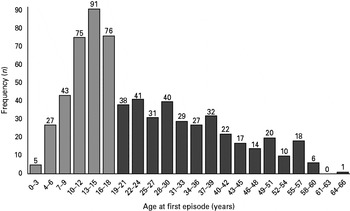
The age of onset for each participant's first MDE was recorded at study intake by the CRCs, who provided all participants with a description of MDD and asked them to estimate the age at which they first experienced persistent low mood and/or anhedonia along with other signs and symptoms of an MDE as defined by DSM-IV. This symptom constellation had to have lasted at least 2 weeks, had to be associated with clinically significant distress or impairment in functioning, and was considered to be the first full MDE regardless of whether the patient had sought treatment at that time. The distribution of participant age of onset is shown in Fig. 1. For the purposes of the present study, those patients reporting a depressive episode before 18 years of age were classified as having early onset of MDD and those reporting a first depressive episode after 18 years of age were classified as having adult-onset MDD.
Distribution of participants' age of onset.

Baseline characteristics
Sociodemographic and clinical characteristics were gathered at baseline for all participants. We used the Psychiatric Diagnostic Screening Questionnaire (PDSQ; Zimmerman & Mattia, Reference Zimmerman and Mattia2001a,Reference Zimmerman and Mattiab) to assess co-morbid Axis I psychiatric disorders and the Self-administered Comorbidity Questionnaire (SCQ; Sangha et al. Reference Sangha, Stucki, Liang, Fossel and Katz2003) to assess co-morbid medical conditions. The QIDS-C16 and the 16-item QIDS – Self-Rated (QIDS-SR16; Rush et al. Reference Rush, Trivedi, Ibrahim, Carmody, Arnow, Klein, Markowitz, Ninan, Kornstein, Manber, Thase, Kocsis and Keller2003; Trivedi et al. Reference Trivedi, Rush, Ibrahim, Carmody, Biggs, Suppes, Crismon, Shores-Wilson, Toprac, Dennehy, Witte and Kashner2004) were used to evaluate severity of depressive symptoms. Atypical and melancholic features were assessed using the 30-item Inventory of Depressive Symptomatology – Clinician-rated (IDS-C30; Trivedi et al. Reference Trivedi, Rush, Ibrahim, Carmody, Biggs, Suppes, Crismon, Shores-Wilson, Toprac, Dennehy, Witte and Kashner2004). We used the HAMD17 to assess anxious features. Risk of suicidal thoughts, plans and behaviors were measured using the Concise Health Risk Tracking – Self-Rated (CHRT-SR; Trivedi et al. Reference Trivedi, Wisniewski, Morris, Fava, Gollan, Warden, Nierenberg, Gaynes, Husain, Luther, Zisook and Rush2011) scale. Manic symptoms were assessed using the Altman Self-Rated Mania Scale (ADRMS; Altman et al. Reference Altman, Hedeker, Peterson and Davis1997). We used the Work and Social Adjustment Scale (WSAS; Mundt et al. Reference Mundt, Marks, Shear and Greist2002) and the Quality of Life Inventory (QOLI; Frisch et al. Reference Frisch, Clark, Rouse, Rudd, Paweleck, Greenstone and Kopplin2005) to assess psychosocial impairment and quality of life respectively. A series of self-report items was used to assess history of abuse or neglect before age 18.
Treatment measures
The Frequency, Intensity, and Burden of Side Effects Rating (FIBSER; Wisniewski et al. Reference Wisniewski, Rush, Balasubramani, Trivedi and Nierenberg2006) was collected at baseline and at each clinic visit. Additional measures included medication dosing, presence of serious adverse events (SAEs) and the Systematic Assessment for Treatment Emergent Events – Systematic Inquiry (SAFTEE-SI; Levine & Schooler, Reference Levine and Schooler1992).
Outcome measures
The primary treatment outcome of symptom remission was determined based on the final two consecutive QIDS-SR16 scores during the 12-week acute trial. We selected the QIDS-SR16 as the primary outcome measure for its ease of administration and clinical utility. Several studies have shown that scores are comparable to clinician ratings and are equally sensitive to treatment response (Trivedi et al. Reference Trivedi, Rush, Ibrahim, Carmody, Biggs, Suppes, Crismon, Shores-Wilson, Toprac, Dennehy, Witte and Kashner2004; Rush et al. Reference Rush, Carmody, Ibrahim, Trivedi, Biggs, Shores-Wilson, Crismon, Toprac and Kashner2006; Bernstein et al. Reference Bernstein, Rush, Carmody, Woo and Trivedi2007). To ensure that remission status was not falsely assigned due to 1 week of reduced symptom severity, one of these ratings had to be <6 and the other had to be <8. For participants who exited prior to 12 weeks, the score from their last study visit was used to determine remission status. Participants who exited before completing any post-baseline visits were deemed not remitted for the purposes of all analyses. Treatment response was defined as a ⩾50% reduction in the QIDS-SR16 score from baseline to study exit. Secondary outcomes included early termination, psychosocial functioning as measured by the WSAS, and quality of life as measured by the QOLI.
Statistical analyses
To examine the association of age of onset with participant sociodemographic and clinical characteristics, we used χ2 or Fisher's exact tests for categorical variables and t tests or Kruskal–Wallis tests for continuous variables. Regression models with age of onset as an independent variable (with early onset defined as first depressive episode prior to age 18) were used to examine response, remission and side-effect burden. Logistic regression models were computed for binary data and cumulative logistic regression models were computed for non-binary data. A treatment by age-of-onset interaction term was computed to examine differences in outcome between the three treatment conditions for those with early-onset versus adult-onset MDD. Outcome analyses were also conducted with adjustment for baseline characteristics that were independently associated with early age of onset. A stepwise logistic regression model was used to identify factors independently associated with age of onset, and those factors remaining in the model were included in all adjusted analyses. Because of the large number of statistical tests, we used a more stringent significance criterion of a p value <0.01.
Results
Enrolled sample
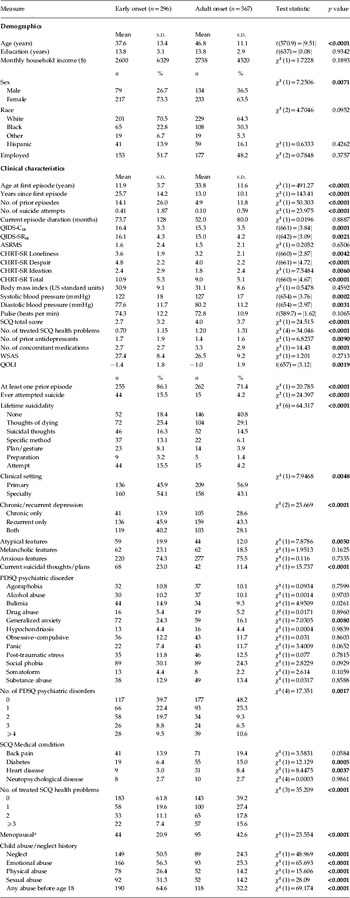
Of the 665 participants who were eligible and randomly assigned to one of the three treatment groups, 663 had complete data on all variables of interest. Of these, 22.0% (n = 146) met study criteria for chronic MDD, 44.5% (n = 295) met criteria for recurrent MDD and 33.5% (n = 222) met criteria for both chronic and recurrent MDD. Nearly half of the sample (44.7%, n = 296) met the definition for early-onset MDD (see Supplementary Fig. S1). Participants in the early-onset group reported an average age of onset of 11.9 ± 3.7 years and those with adult-onset MDD reported an average age of onset of 33.8 ± 11.6 years (Table 1).
Baseline sociodemographic and clinical characteristics by age of onset

ASRMS, Altman Self-Rated Mania Scale; CHRT-SR, Concise Health Risk Tracking – Self-Rated; PDSQ, Psychiatric Diagnostic Screening Questionnaire; QIDS-C16, QIDS-SR16 16-item Quick Inventory of Depressive Symptomatology – Clinician-Rated, Self-Rated; QOLI, Quality of Life Inventory; SCQ, Self-administered Comorbidity Questionnaire; WSAS, Work and Social Adjustment Scale; s.d., standard deviation.
χ2 for continuous measures indicates the Kruskal–Wallis test.
a Denominator is number of women.
A bold p value indicates statistical significance.
Baseline sociodemographic and clinical characteristics
Participants with early-onset MDD were younger (p < 0.0001) and more likely to be female (p = 0.0071). Nearly twice as many years had elapsed since their first depressive episode compared to the adult-onset group (p < 0.0001). Early-onset was more strongly associated with a history of at least one prior depressive episode (p < 0.0001), a greater number of prior episodes (p < 0.0001), the presence of atypical features (p = 0.0050), meeting criteria for both chronic and recurrent MDD (40.2% v. 28.1%, p < 0.0001), and slightly greater severity of clinician-rated (p = 0.0001) and self-rated (p = 0.0021) depressive symptoms. Participants with early onset were more likely to be seen in psychiatric specialty clinics (54.1%) whereas those with adult onset were more likely to be seen in primary-care settings (56.9%, p = 0.0048) (Table 1).
Significant group differences were also apparent with respect to suicide assessment measures. Participants with early onset were more likely to report a lifetime history of more severe suicidal ideation and behaviors (p < 0.0001), including having suicidal thoughts (16.3% v. 14.5%), considering specific methods for suicide (13.1% v. 6.1%), implementing a plan or engaging in self-injurious behavior (8.1% v. 3.9%), engaging in preparatory acts (3.2% v. 1.4%), and suicide attempt (15.5% v. 4.2%). The mean number of suicide attempts was significantly higher in the early-onset group (p < 0.0001). Early onset was also associated with approximately twice the rate of current suicidal thoughts and plans (p < 0.0001) and significantly higher scores for loneliness (p = 0.0042), despair (p < 0.0001), suicidal ideation (p = 0.0060) and total suicide risk (p < 0.0001) as measured by the CHRT-SR (Table 1).
A few group differences also emerged with respect to health status, co-morbid psychiatric and medical conditions, and quality of life. Participants with early onset had lower systolic (p = 0.0020) and diastolic (p = 0.0031) blood pressure, lower rates of self-reported diabetes (p = 0.0005) and heart disease (p = 0.0037), and fewer self-reported health problems for which they had sought treatment (p < 0.0001). Women with early onset were less likely to have reached menopause (p < 0.0001). By contrast, those with early-onset MDD were more likely to meet criteria for co-morbid generalized anxiety disorder (p = 0.0080) and to endorse either two (19.7% v. 9.3%) or three (8.8% v. 6.5%) co-morbid psychiatric disorders. Participants in the early-onset group also reported significantly lower quality of life than did those with adult-onset MDD (p = 0.0019) (Table 1).
Participants in the early-onset group reported a history of childhood maltreatment at approximately twice the rate of those with adult-onset MDD (p < 0.0001). This pattern was true for self-reported neglect, emotional abuse, physical abuse and sexual abuse occurring prior to age 18 (all p < 0.0001) (Table 1).
Treatment and outcome measures
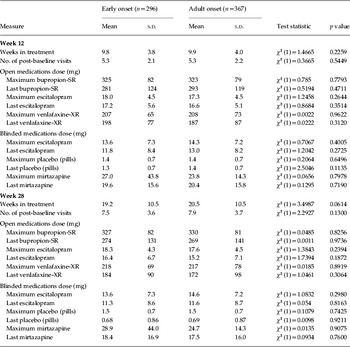
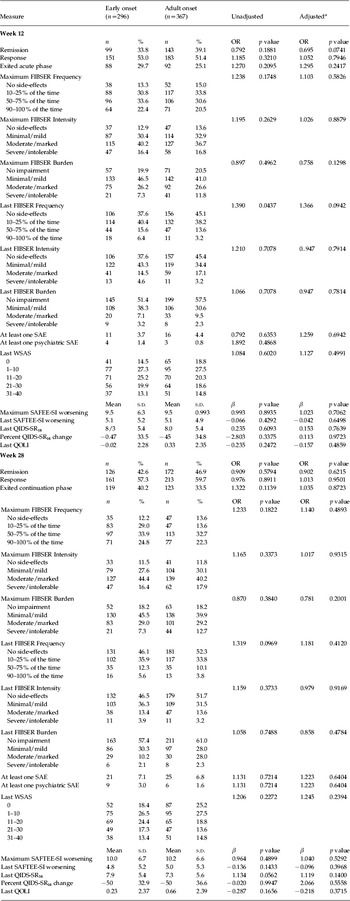
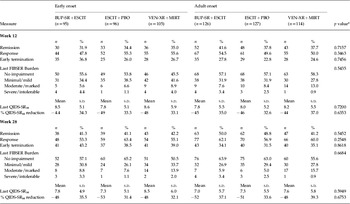
Comparisons between the early-onset and adult-onset groups indicated no significant differences in treatment duration or medication dosing (Table 2). The results from unadjusted and adjusted analyses showed no significant differences in rates of adverse events, side-effect profile, or rates of response and remission at either 12 or 28 weeks (Table 3). No significant interactions were found for selected outcomes by early-onset versus adult-onset MDD and treatment group at either 12 or 28 weeks (Table 4).
Treatment measures at 12 and 28 weeks by age of onset

SR, Sustained release; XR, extended release; s.d., standard deviation.
χ2 for continuous measures indicates the Kruskal–Wallis test.
Outcome measures at 12 and 28 weeks by age of onset

FIBSER, Frequency, Intensity, and Burden of Side Effects Rating; QIDS-SR16, 16-item Quick Inventory of Depressive Symptomatology – Self-Rated; QOLI, Quality of Life Inventory; SAE, Serious Adverse Event; SAFTEE-SI, Systematic Assessment for Treatment Emergent Events – Systematic Inquiry; WSAS, Work and Social Adjustment Scale; OR, odds ratio; s.d., standard deviation.
a Adjusted for treatment, age class, pulse, abused before age 18, generalized anxiety disorder, panic disorder, general medical condition burden, chronic/recurrent major depression, suicidal thought/plans.
Selected outcome measures at 12 and 28 weeks by age of onset and treatment group

BUP-SR, Bupropion sustained-release; ESCIT, escitalopram; FIBSER, Frequency, Intensity, and Burden of Side Effects Rating; PBO, placebo; MIRT, mirtazapine; QIDS-SR16, 16-item Quick Inventory of Depressive Symptomatology – Self-Rated; VEN-XR, venlafaxine extended-release; s.d., standard deviation.
* p value associated with the age of onset by treatment interaction term.
Discussion
The present study compared adults with early-onset chronic or recurrent MDD and those with adult-onset chronic or recurrent MDD with respect to baseline sociodemographic and clinical characteristics, antidepressant safety/tolerability and acute/continuation outcomes for three types of antidepressant treatment: escitalopram plus placebo, bupropion-SR plus escitalopram, or venlafaxine-XR plus mirtazapine. The results indicate a distinct pattern of sociodemographic and clinical features among participants with early-onset MDD. However, we found no evidence of differential antidepressant outcomes between these two groups. A history of child- or adolescent-onset MDD does not seem to be clinically useful for predicting either acute outcomes or differential treatment response in the continuation phase of single-agent or combined antidepressant treatment.
Approximately 45% of our sample reported a first depressive episode occurring before 18 years of age, with a mean onset in early adolescence (at approximately 12 years of age) and a greater prevalence of chronic and/or recurrent MDD. This suggests that early onset is a common characteristic of treatment-seeking out-patients who have chronic or recurrent MDD. These results are consistent with epidemiological data that show that nearly half of mental disorders begin in childhood and adolescence (Kessler et al. Reference Kessler, Amminger, Aguilar-Gaxiola, Alonso, Lee and Ustun2007). The rates reported here are also comparable to those found in other samples of out-patients with depression (Fava et al. Reference Fava, Alpert, Borus, Nierenberg, Pava and Rosenbaum1996; Alpert et al. Reference Alpert, Fava, Uebelacker, Nierenberg, Pava, Worthington and Rosenbaum1999; Zisook et al. Reference Zisook, Lesser, Stewart, Wisniewski, Balasubramani, Fava, Gilmer, Dresselhaus, Thase, Nierenberg, Trivedi and Rush2007a).
Similar to previous studies with non-psychotic depressed out-patients (Zisook et al. Reference Zisook, Rush, Albala, Alpert, Balasubramani, Fava, Husain, Sackeim, Trivedi and Wisniewski2004, Reference Zisook, Rush, Lesser, Wisniewski, Trivedi, Husain, Balasubramani, Alpert and Fava2007b), we found that early onset was associated with female gender, younger age at baseline and a greater likelihood of seeking treatment in psychiatric specialty settings. Clinical correlates in our chronic/recurrent sample included a longer duration of illness, greater number of prior episodes, greater likelihood of experiencing atypical features, higher rates of suicidality and psychiatric co-morbidity, poorer quality of life, and greater history of child abuse and neglect. Early onset was associated with fewer medical co-morbidities and lower rates of menopause, although these results may be better accounted for by age at intake than by age of onset. It is also possible that the longer duration of illness and greater number of prior episodes found in our early-onset group were artifacts of time since onset, which was longer in the early-onset group.
Of note, a large proportion of those with early-onset MDD reported a history of child abuse or neglect. These results are consistent with studies of depressed patients that show an earlier age of onset and a more chronic/recurrent course of illness in those who have a history of early adversity (Klein et al. Reference Klein, Arnow, Barkin, Dowling, Kocsis, Leon, Manber, Rothbaum, Trivedi and Wisniewski2009) and/or emotional and physical abuse (Bernet & Stein, Reference Bernet and Stein1999; Miniati et al. Reference Miniati, Rucci, Benvenuti, Frank, Buttenfield, Giorgi and Cassano2010). However, the measure used in the present study has yet to be widely validated, so our results should be interpreted as preliminary. Past history and current risk for suicidal thoughts, plans and behaviors were also elevated in patients who had early-onset MDD. These findings are fairly robust and have been reported in previous clinical (Zisook et al. Reference Zisook, Rush, Albala, Alpert, Balasubramani, Fava, Husain, Sackeim, Trivedi and Wisniewski2004, Reference Zisook, Lesser, Stewart, Wisniewski, Balasubramani, Fava, Gilmer, Dresselhaus, Thase, Nierenberg, Trivedi and Rush2007a,b; van Noorden et al. Reference van Noorden, Minkenberg, Giltay, den Hollander-Gijsman, van Rood, van der Wee and Zitman2011) and epidemiological studies (Thompson, Reference Thompson2008). The higher proportion of early-onset patients with atypical features found in our study is also broadly consistent with prior research showing an association between earlier age of onset and atypical features in samples of depressed out-patients (Stewart et al. Reference Stewart, McGrath, Fava, Wisniewski, Zisook, Cook, Nierenberg, Trivedi, Balasubramani, Warden, Lesser and Rush2010) and community-dwelling adults with at least one lifetime MDE (Blanco et al. Reference Blanco, Vesga-López, Stewart, Liu, Grant and Hasin2012).
Our results did not suggest a differential treatment effect based on age of onset, which is consistent with results from prior studies of single-agent antidepressant treatments with both chronic and non-chronic samples (Klein et al. Reference Klein, Schatzberg, McCullough, Dowling, Goodman, Howland, Markowitz, Smith, Thase, Rush, LaVange, Harrison and Keller1999; Trivedi et al. Reference Trivedi, Morris, Pan, Grannemann and John Rush2005, Reference Trivedi, Rush, Wisniewski, Nierenberg, Warden, Ritz, Norquist, Howland, Lebowitz, McGrath, Shores-Wilson, Biggs, Balasubramani and Fava2006; Harald & Gordon, Reference Harald and Gordon2012). However, our findings do have useful clinical and public health implications. The high prevalence of early-onset MDD, its association with suicidal thoughts and behaviors, and the likelihood that those with early onset will experience both chronic and recurrent course of illness all highlight the importance of identifying youth at risk. Early onset of MDD is a major public health concern because depression in early adolescence is prospectively associated with increased risk of completed suicide during later adolescence and early adulthood (Rao et al. Reference Rao, Weissman, Martin and Hammond1993). Screening and early intervention for youth at risk (particularly those who have experienced child abuse or neglect) may help to reduce the persistence or severity of MDD and prevent subsequent suicide attempts (Scott et al. Reference Scott, Wilcox, Schonfeld, Davies, Hicks, Turner and Shaffer2009; Calear & Christensen, Reference Calear and Christensen2010). Clinicians who are treating adult patients with a history of early-onset MDD should closely monitor these patients for the presence of suicide risk.
A potential limitation to our findings is the use of retrospective patient report to determine age at first MDE. Although this form of history taking is similar to the methods used in clinical practice and in prior treatment studies, retrospective reporting of age of onset may be subject to recall bias. For example, it is possible that patients with more severe MDD at baseline are more likely to describe an earlier age of onset. Other methods, such as obtaining collateral reports from family members or extracting age of onset from medical records, might have yielded different results. However, these methods are also limited because not all depressive symptoms are witnessed by others and many patients do not seek treatment during their first depressive episode. We also chose to examine age of onset as a binary rather than a continuous measure, and we set the cut-off for early onset at age 18, rather than age 21 as in some prior work (e.g. Klein et al. Reference Klein, Schatzberg, McCullough, Dowling, Goodman, Howland, Markowitz, Smith, Thase, Rush, LaVange, Harrison and Keller1999). In the absence of a DSM-IV definition for early-onset MDD, we chose to use these methods because they are consistent with the majority of prior studies in this area. However, our results may have differed if a different definition was used. Another limitation is that we lacked data regarding some clinical features that previous studies have found to be associated with early onset, such as the presence of personality pathology and family history of mood disorder. In addition, we attempted to address the issue of multiple comparisons by using a stricter threshold for statistical significance (p < 0.01). Even when using a more conservative α rate, with large sample size it is possible to obtain some statistically significant results that are not clinically meaningful. For example, we found that a roughly one-point difference in QIDS-SR16 scores at baseline was statistically significant, but this does not indicate a clinically significant difference in baseline severity of depressive symptoms for those with early-onset versus adult-onset MDD.
Broad inclusion criteria were used to increase the likelihood that our sample was representative of the larger population of unipolar depressed patients. However, this study included only patients with moderate-to-severe chronic and/or recurrent MDD. Our results may not be generalizable to out-patients who have minor depression or less persistent depressive episodes. It is also unclear whether these results are applicable to patients who reside outside of the USA or those with psychotic features, co-morbid eating disorders, obsessive–compulsive disorder, substance dependence or serious medical or psychiatric problems that require hospitalization.
In conclusion, history of a first depressive episode prior to age 18 is common in treatment-seeking out-patients who meet criteria for non-psychotic chronic or recurrent MDD. Depressed out-patients with child- or adolescent-onset MDD are no less likely than those with adult-onset MDD to respond or reach remission with either single or combined antidepressant treatment, and there are no differences in quality of life outcomes or retention in treatment. However, those with early-onset chronic or recurrent MDD are likely to present with greater baseline suicidality and depressive symptom severity. Clinicians should remain alert to an increased risk of suicidality in this population.
Appendix. The CO-MED Study Team
The following investigators participated in the CO-MED trial: National Coordinating Center: M. Trivedi, A. J. Rush, D. Warden, K. Shores-Wilson, D. Stegman, D. Morris, B. Kurian; Data Coordinating Center: S. Wisniewski, G. K. Balasubramani, H. Eng, J. Luther, J. Martin, T. Sax, M. Barna, C. Wang; Regional Centers: Tuscaloosa Veterans Affairs Medical Center, Tuscaloosa: L. Davis, C. Beall, S. Essary, J. McAlpine, J. Newell; University of California and Neuropsychiatric Institute, Los Angeles: A. Leuchter, I. Cook, M. Epstein, M. Abrams, B. Siegman, S. Rowe, D. Vince-Cruz, J. Cohen, J. Villalobos; Harbor-UCLA, Torrance: I. Lesser, D. Castro, M. Epstein, A. Rosales; University of California, San Diego: S. Zisook, G. Kallenberg, I. Di Toro, E. Solarzano; Northwestern University Medical School, Chicago: W. Gilmer, J. Gollan, W. McKinney, M. Meinel, J. Segal; Clinical Research Institute, University of Kansas, and Via Christi, Wichita: S. Preskorn, I. D'Empaire, A. Khan, K. Omo, S. Probert, J. Hubbard, A. Jerkovich; Massachusetts General Hospital and Family Doctors LLC, Boston: A. Nierenberg, M. Fava, P. Barker, A. Farabaugh, Y. Kaplan-Gatt, D. Johnson, L. Sinicropi-Yao, N. Iovieno, M. Candrian; University of Michigan, Ann Arbor: E. Young, K. Kerber, K. Bullard, F. Almani; New York State Psychiatric Institute and Columbia College of Physicians and Surgeons, New York: P. J. McGrath, J. Morley, D. O'Shea; University of North Carolina, Chapel Hill: B. Gaynes, D. Spencer, J. DeVeaugh-Geiss, A. Reilly, A. Ford, B. Pearson, S. Slatkoff; Laureate Healthcare System, Tulsa: J. Mitchell, W. Yates, B. Williams, L. Szabla, D. Hale, J. Kuehnert, R. Fears; University of Pittsburgh Medical Center, Pittsburgh: E. Friedman, M. Thase, R. H. Howland, L. Shutt, C. Spotts, L. Stupar; Vanderbilt University Medical Center, Nashville: R. Shelton, S. Hollon, T. Patton, B. Sirles; University of Texas Southwestern Medical Center at Dallas: M. Husain, D. Morris, A. Ali, S. McClintock; Virginia Commonwealth University, Richmond: S. Kornstein, R. Gray, M. Edwards.
Supplementary material
For supplementary material accompanying this paper visit http://dx.doi.org/10.1017/S0033291712001742.
Acknowledgments
We thank the clinical staff and all of the study participants who contributed to this project. We also acknowledge the editorial support of J. Kilner (Pittsburgh, PA, USA). This project was funded by the National Institute of Mental Health under Contract N01MH90003 to UT Southwestern Medical Center at Dallas (PIs A. J. Rush and M. H. Trivedi).
Declaration of Interest
S. Wisniewski has been a consultant for: Cyberonic Inc., ImaRx Therapeutics Inc., Bristol–Myers Squibb Company, Organon, Case-Western University, Singapore Clinical Research Institute, Dey Pharmaceuticals, Venebio, and Dey. B. Kurian has received research support from Pfizer Inc., Targacept, and Evotec. D. Warden has previously owned stock in Pfizer Inc. and Bristol–Myers Squibb. M. H. Trivedi has received research support from the Agency for Healthcare Research and Quality (AHRQ), Corcept Therapeutics Inc., Cyberonics Inc., Merck, National Alliance for Research in Schizophrenia and Depression, National Institute of Mental Health, National Institute on Drug Abuse, Novartis, Pharmacia & Upjohn, Predix Pharmaceuticals (Epix), Solvay Pharmaceuticals Inc., and Targacept. He has received consulting and speaker fees from Abbott Laboratories Inc., Abdi Ibrahim, Akzo (Organon Pharmaceuticals Inc.), AstraZeneca, Bristol–Myers Squibb Company, Cephalon Inc., Evotec, Fabre Kramer Pharmaceuticals Inc., Forest Pharmaceuticals, GlaxoSmithKline, Janssen Pharmaceutica Products, LP, Johnson & Johnson PRD, Eli Lilly & Company, Meade Johnson, Medtronic, Neuronetics, Otsuka Pharmaceuticals, Parke-Davis Pharmaceuticals Inc., Pfizer Inc., Sepracor, SHIRE Development, VantagePoint, and Wyeth-Ayerst Laboratories. A. John Rush has received consulting fees from the University of Michigan and Brain Resource, speaker fees from Otsuka Pharmaceuticals, author royalties from Guilford Publications and the University of Texas Southwestern Medical Center, and research support from the National Institute of Mental Health and Duke-NUS.