


The international politics of issue linkage is a venerable and extensive literature. Wallace famously labeled issue linkage “an ancient and accepted aspect of diplomacy.”Footnote 1 Similarly, Sebenius identified issue linkage as a “prominent and venerable practice,”Footnote 2 while Tomz calls it “central to international relations theory.”Footnote 3
Issue linkage—the simultaneous discussion of two or more issues for joint settlement—is considered a key instrument by which states secure agreement. Issue linkages create benefits for parties that will otherwise find a treaty to be of little value or make clear to concerned parties that signatories will remain committed to a final agreement.Footnote 4 As Putnam states “the possibility of package deals opens up a rich array of strategic alternatives for negotiators.”Footnote 5
This positive view of issue linkage is not without its detractors. MoravcsikFootnote 6 argues that the potential for strong domestic opposition reduces linkage offers to broad, symbolic statements with little substantive meaning. MorrowFootnote 7 highlights how linkage offers can be interpreted as a sign of weakness, thereby undermining their effectiveness. Thus, the theoretical claim that issue linkages can secure an otherwise unattainable level of cooperation may be well known, but it also might not be true.
The truth is that, beyond some suggestive case studies and a few indirect statistical tests, there exists no direct and systematic evidence that issue linkages actually help states secure agreement. As a result, it is not known if issue linkages do increase the probability of states reaching an agreement and, if so, by how much. Does issue linkage increase the probability of agreement marginally (by, for instance, 1 percent) or substantially (by, for instance, 50 percent)? The current literature cannot answer this question.
Case studies of issue linkage's effects include the U.S.–USSR arms control talks in McGinnis,Footnote 8 the numerous studies from security and international political economy featured in the special “Cooperation Under Anarchy” issue of World Politics,Footnote 9 and, more recently, Davis's account of the Anglo-Japanese alliance treaty talks between 1902 and 1923.Footnote 10 With respect to large-n tests, Davis's study of agricultural trade negotiations is the first (and perhaps only) study that attempts to see if issue linkage can clinch a negotiated agreement.Footnote 11 Using agricultural commodity negotiations between the United States and Japan or between the United States and the European Union (EU) from 1970 to 1999, Davis finds that higher levels of linkage are associated with higher levels of negotiated agricultural liberalization. However, Davis's linkage variable actually codes the institutional setting of the negotiation (since increased institutionalization is positively correlated with increased opportunities to link across trade products), not the direct presence of a linkage offer.Footnote 12 Consequently, though Davis shows that issue linkage and institutionalization appear to increase the probability of negotiated agreements, one cannot conclude from the study that the positive association between the linkage variable and agricultural liberalization is due exclusively and directly to linkage.
Failing to isolate linkage is just one reason no previous study directly measures issue linkage's impact on the probability of states reaching a negotiated agreement. A second reason is that data collection efforts focus almost exclusively on treaty negotiations that end in agreement. For example, the Alliance Treaty Obligations and Provisions (ATOP) database provides details on alliance treaties, some of which contain economic linkage provisions. However, identifying these provisions' effect on the probability of an alliance treaty negotiation ending in agreement requires also considering instances in which such provisions are offered, but fail to close the deal.
This article offers the first direct and systematic evidence that issue linkages help “seal the deal” on a negotiated agreement.Footnote 13 Drawing from diplomatic histories covering European relations prior to 1945, I create a data set of failed military alliance treaty negotiations involving at least one European state for the nineteenth and early twentieth centuries. I focus on European states prior to 1945 because these are the states and time period for which the diplomatic record is most complete. Combining this data with existing data on alliance treaty negotiations that end in agreement, I test if expanding military alliance negotiations along an economic dimension (specifically trade) raises the probability of agreement. Military alliances offer a useful window through which to test the claims of the issue linkage literature, largely because the explicit inclusion of a trade cooperation provision in a military alliance treaty is an obvious form of issue linkage. Also, since alliances address the essential concern of countering external threats, the state-by-state variation in the salience of alliance formation is much less than in negotiations over other treaties.
Applying matching techniques, I find that the effect is quite substantial: trade linkage raised the probability of agreement by 36 percentage points during the 1860 to 1945 period. Robustness tests reveal this result to be insensitive to omitted variable bias and the possibility of missing linkage offers. This confirms the ability of issue linkage to clinch agreements, but this article's research design and evidence also have far-reaching implications for the broader study of negotiations and alliances. The research design, by identifying both successful and failed negotiations, illustrates the value of considering the “dogs that didn't bark,” while the article's evidence may explain the high rate of alliance compliance first explored by Leeds.Footnote 14
In the next section I describe issue linkages and present the argument that they increase the probability of states reaching agreement. I also present dissenting views and argue that a lack of systematic quantitative evidence allows these contrarian views to persist. I then describe the two hurdles preventing scholars from quantitatively studying the effect of issue linkage: a difficulty identifying when unrelated issues are linked and a lack of data on failed negotiations. After discussing how data on military alliance negotiations can overcome both hurdles, I describe my empirical research design and present the results from my analysis, subjecting these results to a variety of sensitivity tests.
Issue Linkage in Theory
Issue linkage is a bargaining strategy.Footnote 15 SebeniusFootnote 16 defines issue linkage as the simultaneous discussion of two or more issues for joint settlement. Similarly, Haas defines issue linkage as bargaining involving more than one issue.Footnote 17 For example, states could have salmon-catch quotas negotiated in connection with the nutritional needs of consumers or have a nuclear-weapons-test ban negotiated along with limits on strategic weapons.Footnote 18
Issue linkage can be implicit or explicit. Implicit linkage means states agree to link agreement on separate issues, but sign individual treaties for each issue. When issues are explicitly linked, both are addressed in the final treaty text.Footnote 19 The practice of including all issues in the same treaty text is quite common and most anecdotal examples drawn from the literature focus on these instances. Moreover, empirically evaluating the impact of linkage is most feasibly done by focusing on instances of explicit linkage. For these reasons, the discussion will focus on explicit linkage.
Why Is Issue Linkage Important?
Issue linkages are part of a more general concept called side-payments. A side-payment occurs when policymakers use either direct monetary payments (for example, bribes) or material concessions on other issues (that is, issue linkages) to encourage concessions on a given issue.Footnote 20 Thus, the prevailing view is that issue linkages help states reach an otherwise unattainable level of cooperation.
To understand how issue linkages increase the probability of states reaching agreement, consider the two types of issue linkage identified by Haas: tactical and substantive.Footnote 21Tactical linkage occurs when the linked issues are in no intellectually coherent way related to one another.Footnote 22 This is arguably the most common conceptualization of linkage. As Tollison and Willett state, “most of the highly publicized cases of proposed issue linkages appear to have been motivated by attempts of individual countries or groups of countries to extend their dominant bargaining or veto power in one particular issue area into other areas.”Footnote 23 If used to provide a positive inducement, linking unrelated issues diminishes conflict during negotiations.Footnote 24 Wagner argues that even when issue linkage is used in a blatant power play, the linkage is still directed toward creating a cooperative arrangement that, without linkage, would not be possible.Footnote 25 Hence, Haas states that tactical linkage “is a cheap way to increase pay-offs because it expands the agenda of possible benefits to be derived. Since the issues are not inherently connected, the sacrifice of a peripheral demand poses no problem as long as what is really wanted is accomplished.”Footnote 26
In contrast to tactical linkages, substantive linkages result from the intellectual coherence of issues becoming evident. For example, engineers, scientists, economists, and civil servants in Latin America began to think of “technology transfer” as a single issue area covering a variety of issues such as foreign capital inflows, patent acquisition, and constructing factories. Thus, rather than each issue being an end in itself, they were considered a collective means toward a more complicated end.Footnote 27 Substantive linkages originate when new scientific and technical information reveal to the negotiation participants (perhaps through the persuasion of another participant) the coherence of previously disparate issues.Footnote 28
Though distinguishing substantive linkages from tactical linkages can explain how linkage is employed, it is unnecessary for understanding linkage's end goal. States use tactical linkages (whether as an inducement or as a powerplay) and substantive linkages to reach an otherwise unattainable level of cooperation. This point is echoed by Oye.Footnote 29 For Oye, linkages used to generate mutual gains (which Oye calls “exchange” linkage), to coerce (which Oye calls “extortion” linkage), or to draw attention to connections between functionally related issues (which Oye calls “explanation” linkage) are all directed toward a single objective: to increase the probability that states reach a level of cooperation that would otherwise be unattainable; “[If] the linker prefers that the linkee play Y … [then] extortion, exchange, and explanation are all undertaken to predispose the linkee toward choice Y.”Footnote 30
When Will States Use Issue Linkage?
States need issue linkage to overcome cooperation problems during negotiations, namely distribution problems, enforcement problems, and a large number of participants.Footnote 31
Distribution problems arise when actors have different preferences over alternative possible agreements. When the benefits of an issue accrue primarily to a few actors and the costs fall disproportionately on others, adding another issue to the negotiations can redistribute the benefits and allow all participants to experience some gain. The ability of linkage to overcome distribution problems is echoed by others in the literature. Sebenius holds that linkage is important because “what appears incontestably a bare minimum on one particular issue by itself may in fact be flexible when this issue is considered together with favorable settlements on other questions.”Footnote 32 Tollison and Willet argue that when the distribution of benefits from agreement is highly skewed toward one (or a few) countries, “linkage of issues with offsetting distributional patterns can help promote agreements which otherwise might go unconsumated because of distributional effects.”Footnote 33 For instance, during the Nuclear Nonproliferation Treaty talks, the five nuclear powers offered to transfer peaceful nuclear technology to smaller states to induce the small states to forgo nuclear weapons.Footnote 34
Morgan highlights how, even in crisis bargaining situations, “an agreement leading to the peaceful resolution of an international crisis often becomes possible when an issue, not originally in contention, is brought into the bargaining for linkage purposes.”Footnote 35 This is similar to Morrow's view of linkage: “a linkage deal requires two issues that the sides believe are of different importance. Each side receives concessions on the issue it believes is of greater relative importance…. [If] done properly, both sides prefer the linkage deal to going to war over the initial issue.”Footnote 36
Enforcement problems arise when one state believes a negotiating partner will renege on the agreement. Here an additional issue could encourage all parties to remain committed to the treaty.Footnote 37 Using linkage as an enforcement mechanism has been widely discussed by economists in the context of including environmental and labor standards in free trade agreements.Footnote 38 For example, the United States–Jordan Free Trade Agreement, the United States–Singapore Free Trade Agreement, and the Dominican Republic–Central American Free Trade Agreement all include labor standards provisions, including dispute settlement and sanctioning mechanisms for failure to adequately comply with these standards.Footnote 39
The third problem issue linkage can overcome is having a large number of participants in a negotiation. More participants means more preferences and, hence, the possibility these preferences will diverge. Though reaching agreement on a single issue could prove difficult, adding issues creates more opportunities for each actor to experience some gain.
With all three cooperation problems (distribution, enforcement, large number of participants), linking issues can generate additional benefits that either satisfy a reluctant party or give parties an incentive to remain committed to the final agreement. Hence, by overcoming these cooperation problems, linkage allows states to reach a level of cooperation that would not otherwise be possible.
Who Disagrees?
Whether to redistribute benefits or encourage commitment, much of the literature claims that expanding negotiations along a new issue dimension can secure an otherwise unattainable level of cooperation. This view, however, is not unanimously held. Some notable scholars question the ability of linkages to secure cooperative arrangements.Footnote 40
For Moravcsik, the major constraint on linkage strategies is their domestic distributional implications.Footnote 41 Though linkages may create benefits, they also create domestic losers who, if highly concentrated, tend to generate more political pressure than winners. This means linkage will be domestically viable only where adjustment costs are moderate and the potential for linkage is limited. Moravcsik expects to see issue linkage employed only when the costs are imposed on relatively diffuse, unorganized, or unrepresented groups (such as taxpayers or consumers). Since such circumstances are rare, this limits the ability of negotiators to effectively employ linkages; “On this logic, the potential for linkage is far more limited than the potential for concessions within issue-areas.”Footnote 42 As a result, Moravcsik argues that, when linkage does occur, it will likely take the form of “symbolic concessions,” rather than substantively meaningful trade-offs.Footnote 43
Morrow, focusing on crisis bargaining situations, provides reasons to expect infrequent and ineffective linkage offers.Footnote 44 Even if one assumes that the promise pertaining to the linkage issue is itself enforceable, states could fail to use linkage because of its signaling properties.Footnote 45 According to Morrow, offers of linkage will signal a party's resolve during a crisis. If the offer does not communicate a willingness to fight, the receiver may refuse linkage in hope of gaining a better bargain. Thus, even when a linkage deal could make both sides better off, the sides may abstain from offering linkage because the linkage offer could be interpreted as a sign of bargaining weakness.
A further reason that states might avoid employing linkage is that linkage is not costless. First, frivolous or extraneous use of linkage can create “brittle” agreements, whereby failure in one area can “unravel” an entire agreement.Footnote 46 Second, in addition to the “domestic losers” constraint highlighted by Moravcsik, the linkage provision could prove politically unpopular with domestic audiences. Morgan provides the example of Austria and Italy prior to the Seven Weeks War. Despite being desperate for funds, Austria refused cash payment from Italy and Prussia in exchange for Venice. Austrian Emperor Franz Joseph believed that accepting the Italian offer would inflict a serious blow to the prestige of the empire and be highly immoral (for “selling” people and their homes to foreigners).Footnote 47 Third, linking unrelated issues can be costly simply because it requires bureaucrats to ensure that the state is in compliance with the new provision. Thus, linkage may not work because it might prove too costly to implement.
Addressing the Debate: The Need for Empirical Evidence
Most of the literature holds that issue linkage increases the probability of agreement, but there are some prominent challengers. These scholars claim that issue linkage will be infrequent, merely symbolic, and/or completely ineffective. Though numerous studies provide anecdotal evidence of linkage's ability to increase the probability of states reaching agreement, the claim of issue linkage's beneficial impact has not been subjected to systematic quantitative analysis. Without such evidence, the counter arguments will remain. I therefore now turn to explaining why previous work has not systematically tested the effect of issue linkage on international negotiations.
Testing Issue Linkage with Military Alliance Negotiations
There are two major reasons scholars have not systematically measured the effect of issue linkage on the probability of reaching a negotiated agreement: (1) a difficulty identifying when unrelated issues are linked, and (2) a lack of data on failed negotiations. Regarding the first reason, when looking at a given treaty, it can be difficult to tell if the issues could have been addressed in separate negotiations. If it is not the case that the issues could have been addressed in separate treaties, then it is unlikely that the issues were linked for the purpose of achieving a cooperative outcome. Koremenos, Lipson, and Snidal make this point quite clearly:
One difficulty in analyzing scope is that the issues themselves are not clearly defined. Does trade in all commodities constitute an issue? Or should we distinguish agricultural goods from manufactures? … The problem is simplified when negotiations are expanded to cover items that could clearly be dealt with separately or were not previously linked.Footnote 48
The second reason no previous studies have directly measured issue linkage's impact on the probability of states reaching a negotiated agreement is that data collection efforts have focused almost exclusively on collecting information from treaties.Footnote 49 However, to properly identify the effect linkage provisions have on the probability of states reaching a negotiated agreement, one must consider instances in which such provisions are offered but fail to close the deal. This requires data on negotiations that end in nonagreement (and, hence, produced no treaty).
Observational data on military alliance treaties provide an ideal window through which to measure the effect of issue linkage because military alliances address both of the above hurdles that prevent direct and systematic investigation of issue linkage's effect.
Alliances and the Linking of Unrelated Issues
Military alliance treaties are formal agreements to (1) come to the defense of another state, (2) cooperate with another state in attacking a third state, or (3) abstain from attacking another state. There already exists, via the Alliance Treaties Obligations and Provisions (ATOP) database, a large amount of data on military alliance agreements. Most importantly, because ATOP codes the various provisions of each military alliance treaty from 1815 to the present, we know that some alliance treaties contain explicit economic cooperation provisions.Footnote 50 These provisions call for either the granting of foreign aid or for reducing trade restrictions between the parties (such as the granting of most favored nation [MFN] status).Footnote 51
Consider a few examples of these economic cooperation provisions.Footnote 52 Article 5 of the 1971 alliance between the Soviet Union and EgyptFootnote 53 states, “the parties shall expand trade and shipping between the two states on the basis of the principles of mutual advantage and most favored nation treatment.” Article 9 of the 1946 mutual defense pact between the United Kingdom and JordanFootnote 54 proclaims that “Neither High Contracting Party will extend to the nationals or commerce of the other treatment less favorable in any respect than that which he accords to the nationals and commerce of the most favoured foreign country.” Such trade provisions are of interest because, though some arguments insist on the benefits of economic and security linkages,Footnote 55 states quite frequently (if not primarily) negotiate alliance agreements and trade agreements separately from one other. For example, the United States and Canada are members of an alliance (the North Atlantic Treaty Organization) that was negotiated separately from and long before its current trade treaty (the North American Free Trade Agreement). Since there is no inherent reason that the two issues must be linked to one another, the explicit tying of trade cooperation to a military alliance is an obvious form of issue linkage. Stated differently, alliances with trade provisions are obvious instances in which the negotiations were “expanded to cover items that could clearly be dealt with separately or were not previously linked.”Footnote 56 Of course, one might argue that the above provisions are so general that they exemplify the “shallow linkage” that Moravcsik claims is the only plausible form of issue linkage. But if these relatively general provisions increase the probability of agreement, then one should expect the same of more precise provisions.
Alliances and Failed Negotiations
The ATOP data set is an outstanding source of information on alliance agreements, but there exists no comparable data on alliance negotiations that fail to end in agreement. Consequently, studies on alliance formation using ATOP split groups of states (typically state-to-state dyads) into those that formed alliances and those that did not.Footnote 57 This is problematic because the latter group conflates groups that actually began alliance negotiations but failed to reach an agreement and groups that never even attempted negotiations. Measuring the effect of economic linkage offers on the probability of alliance formation requires knowing which negotiations witnessed a failed attempt to form an alliance agreement and, of these failed negotiations, which witnessed the offer of an economic linkage provision.
The sources
Foreign ministry archives or collections of foreign diplomatic documents, such as the British Foreign and State Papers, provide a logical starting point for identifying failed negotiations. However, this amounts to looking for a needle in a barn (let alone a haystack) and is costly both in terms of money (for travel) and time. For instance, if one were to focus only on British foreign documents, failed attempts could be identified (assuming the ministry wished to keep documents of the failure), but the extensive time spent reading these documents will produce a list of failed negotiations for a single country only.
An alternative is to draw on the decades of archival research already conducted by historians by using published diplomatic histories. Highly prominent and widely used international relations data sets were created using such sources. For instance, diplomatic histories were used to identify cases of alliance formation by Leeds and her co-authors when constructing the ATOP data set and by Singer and SmallFootnote 58 when constructing the original Correlates of War listing of military alliances and wars. Another example includes the strategic rivals data set of Colaresi, Rasler, and Thompson.Footnote 59 They draw on diplomatic and political histories of individual state's foreign policy activities to determine when and with whom decision makers thought they were in rivalry relationships.
I draw from several diplomatic historical sources, such as European Alliances and Alignments by William Langer, A Diplomatic History of Europe Since the Congress of Vienna by Rene Albrecht-Carrié, The Transformation of European Politics, 1763 to 1848 by Paul Schroeder, The Struggle for Mastery in Europe, 1848 to 1918 by A.J.P. Taylor, and The Lights That Failed: European International History, 1919 to 1933 by Zara Steiner.Footnote 60 My selection of secondary sources is European centered, but this is reasonable given the composition of the ATOP data set. Specifically, nearly 76 percent of the alliances formed between 1815 and 1945 have only European powers. Thus, European countries were the most involved in forming military alliances during this period. I concentrate on identifying negotiations from 1815 to 1945 because the diplomatic historic record is most complete for this time.Footnote 61
The coding rule
I apply the following coding rule when using diplomatic histories to identify negotiations that attempted but failed to form an alliance treaty (as opposed to creating an informal coalition): evidence must exist of a meeting (correspondence of letters or physical meeting) at the diplomatic level (between ambassadors, heads of state, or foreign ministers) where a proposal of a formal (that is, written) alliance (mutual defense pact, offensive pact, neutrality pact, a military consultative agreement, or a nonaggression pact) is made and then rejected/refused (one side must decline forming the alliance).
When applying this coding rule, declining to form an alliance may not take the form of a simple “no” response. These are, after all, diplomats (and, hence, their response could be quite diplomatic)! Moreover, evidence of a meeting need not entail the two diplomats or heads of state being physically present in the same location. Instead, a “meeting” could entail an exchange of letters. Inevitably, using diplomatic histories as source material will involve making subjective judgments. Interpreting diplomatic histories lacks the strict objectivity associated with, for example, counting treaty texts. However, as Colaresi, Rasler, and Thompson state, “No phenomenon is so clearcut that counting it does not require some level of interpretation…. The point remains that measurement choices rarely boil down to interpreting the raw information versus allowing the facts to speak for themselves. Some interpretation of the raw information is inevitable.”Footnote 62
Applying the coding rule
I read these histories looking for evidence that meets my coding rule.Footnote 63 To illustrate how I applied the coding rule, consider the following account from Taylor of a failed alliance formation attempt:
[Russian Chancellor] Gorchakov said to [French President] Thiers: “We shall occupy ourselves later with uniting France to Russia,” and [Russian Tsar] Alexander II added: “I should much like to gain an alliance like that of France, an alliance of peace, and not of war and conquest.” These words, uttered on 29 September 1870, defined the Franco-Russian alliance as it was achieved twenty years later; they were of no use to Thiers in the circumstances of the moment. He returned to Paris empty-handed; and the French had to try to reverse the Prussian victories by their own efforts.Footnote 64
This excerpt shows that the Russian chancellor and the French president met, that there was discussion of creating an alliance between the two nations (“I should much like to gain an alliance like that of France, an alliance of peace, and not of war and conquest”), and that this attempt failed (He returned to Paris empty-handed). Another example comes from Schroeder:
Russian policy was not hostile to Britain, nor was it opposed to all reform of the Ottoman Empire…. In 1836 [Russian diplomat and foreign minister] Nesselrode began seeking an entente with Britain, for the sake of general peace and Russia's economic development. His feelers were ignored at London. Instead, from 1834 to 1838 [British foreign secretary] Palmerston considered various ideas for shoring up the Ottoman Empire against Russia.Footnote 65
Again, there is evidence that the Russian diplomat broached the idea of an alliance to the British diplomat (His feelers …), but this idea was rejected (… were ignored at London.). In addition to identifying failed alliance negotiations, I also code which failed negotiations witnessed the offer of economic linkage. In order to match as closely as possible the coding of economic cooperation provisions found in the ATOP data set, I code offers of economic cooperation as any identifiable offer of trade cooperation or foreign aid. For example, in 1816, Spain sought British assistance in suppressing rebellions within its colonies. However, the British made any assistance conditional on Spain opening its colonies to trade.Footnote 66 Spain rejected this demand. Another example involves the following account of Prussia and England in 1850: “[Prussian Ambassador] Radowitz was sent to London, more to console him than with any serious purpose. He was empowered to offer the British government reductions in the Zollverein tariff in exchange for an alliance … Radowitz had no success.”Footnote 67
Applying this coding rule, I identify 127 failed alliance negotiations from 1815 to 1945 involving at least one European state. For each negotiation, I code the following information: year of negotiation; states involved in the negotiation; type of alliance being negotiated (mutual defense pact, offensive pact, neutrality pact, a military consultative agreement, or a nonaggression pact); and whether or not the negotiation witnessed an offer of economic cooperation.
Research Design
Data
I have data on 127 failed alliance negotiations from 1815 to 1945 that involved at least one European country. ATOP has data on 181 alliances formed by at least one European country between 1815 to 1945. By assuming these 181 alliances represent 181 negotiations that ended in agreement, I have a complete data set of 308 alliance negotiations involving at least one European power from 1815 to 1945. Of these 308 negotiations, 181 ended in agreement, 127 ended in nonagreement, and 20 witnessed an offer to tie economic cooperation to the final treaty (12 with trade offers and 8 with aid offers). To give the reader a sense of the data, Table 1 reports the countries that conducted at least 10 negotiations during the 1815 to 1945 period, along with the “agreement rate” of these countries (that is, the number of negotiations that resulted in an alliance, divided by the total number of negotiations in which that country participated). It is notable that though the major European military powers (Russia, Germany, France, Austria, and Britain) are at the top of the list, their agreement rates range between only 41 and 54 percent. In contrast, the agreement rates of several minor military states (such as Serbia, Poland, Greece, and Bulgaria) are substantially higher.
Alliance negotiations by country, 1815 to 1945

Note: Table only lists a minimum of ten alliance negotiations.
Three points should be made clear regarding my data. First, several of the negotiations (both successful and unsuccessful) include more than two states. Following the recommendation laid out in Poast, I do not divide the negotiations with more than two members into dyadic observations.Footnote 68
Second, the rarity of linkage offers in my data set is consistent with the claims made by the critics of linkage (such as Morrow) that linkage offers will be infrequent. Given the small number of cases recorded as actually witnessing linkage offers, caution is appropriate when interpreting the substantive effect of linkage. In fact, such concerns motivate both my choice of analysis method and some of my sensitivity tests.
Third, because I assume the 181 alliance agreements from ATOP represent 181 negotiations that end in agreement, the absence of a linkage provision in the final agreement text may not suggest the absence of a linkage offer during the negotiation. For instance, for some negotiations ending in agreement, a linkage offer might have been made and accepted but not recorded in the final agreement. Alternatively, for some negotiations ending in agreement, a linkage offer might have been made and rejected. The former case is not worrisome as it will bias against finding a positive effect for linkage offers, thereby creating a more conservative test of the conventional view that linkage offers raise the probability of agreement.
The latter case is more troublesome because it suggests that linkage offers had no impact on the probability of agreement for these cases. Hence, failure to account for these rejected linkage offers will bias my test in favor of the conventional view that linkage offers raise the probability of agreement. Since linkage offers are intended to induce a higher level of cooperation, rejection of a linkage offer would not have necessarily prevented agreement on a relatively low level of security commitment, such as a nonaggression, consultative, or neutrality pact (rather than an offensive or defensive pact). I could not identify such instances in the diplomatic record, but they still might have occurred. Therefore, because this is a concern for negotiations ending in the formation of nonaggression, consultative, or neutrality pacts, I will test two data sets: the full sample of negotiations and a sample restricted to just negotiations over offensive/defensive alliance pacts.
Time Period Analyzed: 1860 to 1945
The analysis considers only negotiations between 1860 to 1945. This is for practical and substantive reasons. Practically, data is limited on several covariates for much of the early nineteenth century. Rather than impute these values, I focus on the time period for which I have confidence in the data. Substantively, 1860 is a reasonable starting year when concentrating on offers of trade cooperation. 1860 marks when free trade arrangements in general and the most-favored nation principle in particular became an accepted tool of European diplomacy.Footnote 69 It is widely recognized by political economists that the signing of the Cobden-Chevalier treaty between Britain and France in 1860—the first major free trade agreement between European powers—made open trade policies an acceptable practice throughout EuropeFootnote 70 and led to a subsequent explosion of international trade treaties.Footnote 71
Outcome Variable: agreement
The outcome variable, agreement, equals 1 if a negotiation ends in agreement, 0 if it does not end in agreement. I am interested only in whether agreement is reached. This variable does not indicate if the negotiations were “successful” in the sense that they resulted in a treaty that can be considered just, fair, or equitable. Also, the outcome variable does not code whether states remain committed to the treaty. Instead, the outcome variable captures only whether the parties formed the treaty.
Key Independent Variable: trade linkage
The key independent variable is trade linkage. This binary variable equals 1 if there is an offer to expand the negotiation along an economic dimension (specifically trade), 0 if there is not. I am focusing on trade because, between aid and trade, this issue is most clearly separable from an alliance. Aid provisions frequently call for money to be explicitly spent on strengthening the military of the other party. In this case, one cannot claim that the aid dimension of the negotiation is separable from the alliance dimension of the negotiation. I am also only interested in identifying if the offer to include a linkage provision increases the probability of agreement and, if so, the size of this effect. Answering this question does not require identifying which actor proposed the economic linkage provision and which state benefited most from the economic cooperation provision.Footnote 72
Contextual Covariates
An initial test of trade linkage's effect on the probability of agreement is a simple comparison of agreement rates between negotiations that witnessed trade linkage offers and negotiations that did not. However, there could very well exist, on average, highly systematic differences between negotiations with linkage offers and negotiations without linkage offers. Empirically measuring the effect of trade linkage offers on the probability of agreement requires accounting for these systematic differences. This ensures that, put simply, I am comparing comparable negotiations. This means identifying and operationalizing factors that are correlated with the presence of linkage and correlated with negotiation agreement.
Military capabilities of parties
The core security literature on alliance formation views relative and/or combined capabilities as key to determining whether a group will form an alliance.Footnote 73 However, military capabilities are also correlated with linkage offers. First, capabilities capture the distribution problem since debates can arise over who will contribute what and how much to the alliance. Second, capabilities indicate if the states face an enforcement problem. According to Morrow, states with large amounts of physical military capabilities (a major power) have high levels of security (ability to maintain outcomes) and autonomy (ability to pursue changes in outcomes), while states with small amounts of physical military capabilities (a minor power) have a high level of autonomy only.Footnote 74 Alliances between states with asymmetric capabilities will enable both states to achieve a more even mixture of autonomy and security because each member brings a high level of different abilities to the alliance. In contrast, an alliance between states with symmetric capabilities, where both states are more likely to have a high level of the same resource (say security) and a low level of the other, generates very little utility surplus. Thus asymmetric alliances are less likely to break in a given period than symmetric alliances because changes in the weaker power's capabilities will not greatly alter the autonomy for security tradeoff. This means symmetry in capabilities leads to defection, which, in turn, implies an enforcement problem.
When using data that has what Poast refers to as a k-adic structure (that is, data in which each observation represents the characteristics of two or more actors), there are several ways to capture the combined/relative capabilities of a group: the ratio of the largest k-ad member to all members in the k-ad; the ratio of the largest to smallest k-ad member; or the size of the smallest k-ad member (following a “weak link” argument).Footnote 75 In the results that follow, I apply the third of these metrics by using the number of military personnel held by the k-ad member with the smallest number of military personnel.Footnote 76
Presence of a buffer state
Buffer states are states located between two rivals. Poland is a classic example of a buffer state because it was located between Austria, Prussia, and Russia during the 1700s, between Russia and Germany during the 1920s, and between the Soviet Union and Western Europe during the Cold War. According to Fazal,Footnote 77 buffer states are especially prone to violent state death, which Fazal defines as “the formal loss of foreign policy control to another state” via military invasion.Footnote 78 The rivals on either side of the buffer state fear that its opponent will gain a strategic advantage by conquering the buffer state. Though maintaining the sovereignty of the buffer state is ideal for both rivals (it creates a barrier between the rivals that decreases the probability of war), both rivals know the other has an incentive to invade the buffer and gain the strategic advantage. This dilemma inevitably leads to the invasion of the buffer state.
With respect to alliances, Fazal argues that buffer states face a “catch 22” situation: the very factors that compel them to seek alliances also prevent them from forming alliances. According to Fazal, “States—especially threatened states—must balance to survive. But threatened states are unlikely to be able to balance precisely because they are threatened.”Footnote 79 Thus, buffer states can operationalize the existence of cooperation problems that could prevent agreement during a military alliance negotiation. In particular, if at least one of the states involved in the negotiation is a buffer state, it could be concerned that the other states will renege from their alliance obligations. Therefore, the binary variable buffer equals 1 if, in year t, negotiation i contains at least one buffer state as identified by Fazal, 0 otherwise.Footnote 80
Geographic distance between parties
Accounting for the distance between the negotiation partners is important for three reasons. First, alliances with neighboring states are easier to sustain than alliances with geographically distant states. Neighboring states find it easier to provide military support (as it is less logistically demanding to move forces) and have an incentive to maintain good relations (by not defecting from the alliance). Second, it is widely recognized in the theoretical and empirical alliance literature that distance plays a key role in determining alliance partners.Footnote 81 Third, distance is a key determinant, not just of alliance formation, but also trade agreement formation. Therefore, accounting for distance controls for the possibility that the negotiating states are already likely to form an alliance agreement and trade agreement and, therefore, simply want to place both agreements in the same treaty (to reduce transaction costs). For these reasons, I create a variable, contiguous, coded 1 if all the states in the negotiation are geographically contiguous, 0 otherwise.Footnote 82 The contiguity of the states is determined using the geographic distance data computed by the EUGene software of Bennett and Stam.Footnote 83
Number of parties in the negotiation
As mentioned, the number of states involved in a negotiation can both influence whether or not the negotiations witness a linkage offer and, as Sebenius points out, alter the dynamics of a negotiation.Footnote 84 Therefore, I account for the number of states involved in the negotiation using a variable indicating if two (the minimum number of states involved in a negotiation in my dataset), three, four, or five (the maximum number of states involved in a negotiation in my data set) states are involved in the negotiation.
Negotiating during a crisis period
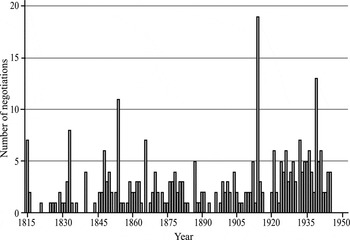
Figure 1 shows the number of negotiations by year from 1815 to 1945. Note the spikes in diplomatic activity around the time of the Crimean War (1853 to 1856), Franco-Prussian War (1870 to 1871), the start of World War I (1914), and the start of World War II (1939). These spikes reveal the tendency of states to seek out alliance partners during the lead-up to major international crises and confrontations. The upcoming crisis likely influenced both the probability of the negotiations ending in agreement (since states are more desperate to form an alliance) and the probability of negotiations witnessing a linkage offer (since, again, states will be more desperate to form an alliance). In fact, Langer states that “the great coalitions of modern history were almost always made just before the outbreak of war or during the course of the conflict itself.”Footnote 85 To account for these crisis periods, the variable peak year equals 1 if the negotiation took place during or one year prior (that is, in the lead-up) to the “peak” years in Figure 1 (1815, 1833, 1848, 1854, 1866, 1914, and 1940), 0 otherwise.
Number of military alliance negotiations, 1815 to 1945
First time negotiation
By “first time negotiation,” I mean the first time a particular group of states appeared in my data set as being involved in an alliance negotiation that either ended in agreement or nonagreement. The first time a particular group negotiates an alliance should have very different dynamics than if this group has been involved in past alliance negotiations. For instance, there will be more uncertainty about the intentions and motivations of states when they are involved in their first-ever alliance negotiations as a group. Additionally, if a group of states tried to form an alliance in the past but failed, one could reasonably suspect that the group will have different incentives for reaching an agreement compared to a group of states that never previously attempted to form an alliance.
The variable prior negotiation equals 1 if a group of states is not engaged in their first negotiation as a group, 0 otherwise. For example, if a group of three states has never engaged in negotiations as a triad, then this is considered a first negotiation (even if two of the members had engaged in a prior negotiation).
Offensive/defensive alliance negotiation
The variable offensive/defensive alliance equals 1 if a negotiation is focused on the formation of an offensive or defensive alliance, 0 otherwise. Because offensive and defensive alliances require actionable obligations, many scholars consider the circumstances leading to their creation to be distinct from consultation, neutrality, and nonaggression pacts.Footnote 86 Stricter obligations can also make it more difficult to reach agreement and more likely that a state will renege on a commitment.
Democratic participants
Some critics of issue linkage, particularly Moravscik, argue that domestic political considerations constrain the ability of states to use issue linkage.Footnote 87 My own reading of the historical record of alliance negotiations suggests that domestic political pressure played little role in the formation of alliances during much of the pre-1945 time period (as leaders sought to form alliances based on considerations of power politics and that many countries during this time period were not liberal democracies). Nevertheless, I attempt to account for the possibility of domestic political influence. Since one can reasonably assume that democracies are more vulnerable to domestic political pressures than autocratic regimes, I operationalize the potential influence of domestic political pressure by measuring the presence of democratic states in the negotiation.
Again, because my data has a k-adic structure, there are several approaches for capturing the presence of democratic states in a negotiation. One approach is to create a joint democracy variable, which equals 1 if all the participants in the negotiation are democracies, 0 otherwise. However, a major drawback of this variable is that it treats a negotiation with four democracies and one nondemocracy as equivalent to a negotiation with one democracy and five nondemocracies. Therefore, I instead create the variable proportion democracies. This variable captures the percentage of states in a negotiation that are democracies, where a state is considered a democracy if it has a score of 6 or higher on the 21-point Polity IV scale.Footnote 88
Empirical Analysis
Why Matching
I have a binary key independent variable (offer of trade linkage or no offer of trade linkage), a binary outcome variable (alliance agreement reached or no alliance agreement reached), and a variety of covariates that account for contextual factors. Scholars typically analyze such data using a structural model such as a logit or probit where contextual covariates are included as control variables. However, my data has three features that make applying structural models problematic.
First, linkage offers are rare in my data set. This could lead to perfect separation of the data (for example, linkage offers might correspond perfectly with negotiation agreement). Second, I have a small number of overall cases. This means identification in a logit or probit will be driven primarily by the parametric structure imposed on the data, not by the data itself. Moreover, the large number of control variables will dramatically reduce the power of my statistical test. Third, linkage offers are not randomly assigned. Groups of states negotiating an alliance choose to incorporate a linkage provision. Stated simply, I want to account for this selection bias by ensuring that I am comparing comparable observations.
For these reasons, I turn to matching. Matching, as developed and described by CochranFootnote 89 and Rubin,Footnote 90 is a pre-analysis procedure that uses minimal structural or parametric assumptions to separate treatment effects from shared background characteristics.Footnote 91 It consists of pairing each subject in a treatment group with a subject in a control group that has similar (though perhaps not identical) values for a series of covariates. For example, suppose the covariates are gender and age. Then a perfect match for a male that is thirty-seven years old in the treatment group would be a thirty-seven-year-old male in the control group.Footnote 92 The goal of this process is to minimize (if not eliminate) all systematic differences between the treated and control groups other than exposure to the treatment. In short, matching ensures that I am comparing relatively similar negotiations.
Though I cannot manipulate the presence of a linkage offer in a negotiation, trade linkage can be conceptualized as a treatment if one has matched on the proper covariates. In other words, I assume that with two groups of states that are similar on a variety of characteristics (the distribution of military power within each group, the presence of a buffer state within each group, etc.), the strategic interactions and nature of the negotiations within these two groups will be similar, if not identical (that is, the presence of negotiation strategies such as ultimatums and brinksmanship will be similar between the two groups). When this is the case, the only observable difference between the two groups will be the presence of a linkage offer.
I implement the nearest neighbor matching algorithm developed by Abadie and Imbens, which matches the treated and control subjects that are the closest match (rather than requiring an exact match).Footnote 93 The determination of a match is made in three steps. First, one identifies those variables on which matches should be based. Call these variables X. Second, one determines the probability of each observation receiving the treatment by regressing the treatment on X.Footnote 94 This probability is called the propensity score. Third, the propensity score is then used to match observations to one another. The Abadie and Imbens procedure also allows cases to be used as a match more than once. Compared to matching without replacement, matching with replacement generally lowers the bias but increases the variance.Footnote 95 Once matches are made, one can estimate the average effect of the treatment, or average treatment effect (ATE). This is computed by using a simple difference of means t-test between the treated observations and control observations in each pair.Footnote 96
Before presenting the average effect of trade linkage offers on the probability of an alliance negotiation ending in agreement, I provide statistics that evaluate the balance (that is, the extent to which the control and treated groups are similar) achieved via matching. Though evaluating balance prior to computing the treatment effect is useful, one cannot be certain he or she has fully minimized unobserved heterogeneity between treated and control groups in observational studies. Therefore, I end the section with sensitivity analysis on the estimated treatment effects.
Evaluating Balance
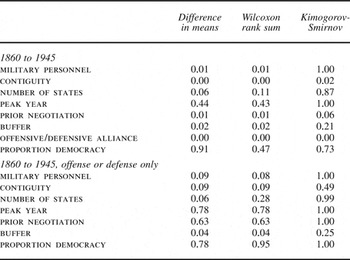
Since there are no standard practices for evaluating balance in observational tests,Footnote 97 I present p-values from several tests: t-tests (which assess means and variances relative to a t-distribution), Wilcoxon rank-sum tests (which assess the difference in medians across the groups), and Kimogorov-Smirnov (KS) tests (which assess the similarity in all moments of the distributions). In a matched sample, p-values do not refer to a formal hypothesis test,Footnote 98 but high p-values suggest that the samples are similar to one another (which is desirable when conducting matching). In particular, the more a p-value is above .10 (the highest standard critical value for t-tests), the more confidence the researcher has that balanced is achieved.
The KS test is an especially strict test since it is sensitive to the location and shape of the cumulative distribution functions of the populations.Footnote 99 Therefore, I give primacy to its results. Table 2 shows that balance is not achieved for several variables, most notably the offensive/defensive alliance variable. Since the alliance literature argues that offensive and defensive alliances are much different than neutrality pacts and nonaggression pacts (due to offensive and defensive pacts calling for actionable security obligations) and, as I discussed, negotiations that ended in the formation of a neutrality, consultative, or nonaggression pact may have witnessed rejected offers of linkage that are not captured in my data, I restrict the sample to negotiations in which an offensive or defensive alliance is being negotiated (that is, set offensive/defensive alliance = 1). After making this restriction, I rerun the matching algorithm on the restricted sample. Table 2 shows that p-values from the KS tests are now all well above the .10 confidence level, suggesting excellent balance on these covariates.
Balance summary statistics p-values
To make this discussion of balance concrete, consider an actual match made by the matching algorithm. In this particular match, the “treated” negotiation is between Austria-Hungary and Serbia in 1881, while the “control” negotiation is between Prussia and Italy in 1862. As it turns out, these are very comparable negotiations. They were between rather asymmetric military powers (Austria-Hungary and Prussia being the major powers, Serbia and Italy being the minor powers) and these were the first negotiations ever between these countries. The only real difference between the negotiations is that Austria offered to include a provision to reduce duties on foodstuffs from Serbia, while no such offer was made in the case of Prussia and Italy. As it turns out, the Prussian-Italian negotiation ended without an agreement, while the Austrian-Hungary-Serbia negotiation ended in agreement.
Estimated Effect of Trade Linkage
After minimizing, to the extent possible, the differences across negotiations that witnessed linkage and negotiations that did not witness linkage, what causal effect does an offer of trade linkage have on the probability of agreement? Table 3 reports the ATE for each sample after the observations are matched using the above variables.
Effect of trade linkage on alliance formation, 1860 to 1945

Notes: Covariates on which observations are matched: military size, buffer, contiguity, crisis period, proportion democracy, offensive/defensive alliances, and prior negotiation.
* Only negotiations on offensive or defensive alliances.
Looking at the results in the Effect of trade linkage column of Table 3, one can see that the effect of trade linkage is strongly positive. This is true for both the restricted and unrestricted samples (note that the difference in the ATE estimates between the restricted and unrestricted samples indicates the extent to which the lack of balance in the unrestricted samples biases the results). Specifically, it appears that an offer of trade linkage increases the probability of agreement by 28 percentage points in the unrestricted sample, with .95 confidence intervals showing that the effect is statistically significant. For the restricted sample, an offer of trade linkage is estimated to increase the probability of agreement by 36 percentage points, with the effect once again statistically significant. The difference between the two results shows that including the negotiations over nonaggression and neutrality pacts mitigates the effect of linkage. Overall, both results suggest that issue linkage does increase the probability of agreement and that the magnitude of the effect is quite substantial.
Sensitivity Analysis
Results from two forms of sensitivity analysis show that the identified positive results are quite robust. In addition to the two sensitivity tests discussed below, I also analyze the data using a probit model. Like the matching analysis, the probit model identifies a positive effect for trade linkage offers, but the substantive effect is smaller (30 percentage points) and the effect is statistically significant at only the .90 confidence level. This weaker support for the positive effect of issue linkage is, however, unsurprising, given the features of the data mentioned earlier that make usage of structural models problematic.Footnote 100
Result driven by omitted confounder?
It is plausible that the effect from an unobserved confounder could alter the substantive meaning of the estimated positive ATE. Conducting such analysis is especially important since matching is based on an unconfoundedness assumption, which states that the researcher should observe all variables simultaneously influencing the participation decision and outcome variables. Because this is a strong identifying assumption, one should check the sensitivity of the estimated results with respect to deviations from this identifying assumption. Rosenbaum bounds are a standard procedure for conducting this form of sensitivity analysis. Specifically, letting P i be the probability that individual i receives the treatment and letting P i /(1 − P i) be the odds that individual i receives the treatment, Rosenbaum shows that the bounds on the odds ratio of  is given byFootnote 101

It is common to let e γ = Γ.Footnote 102 Equation (1) says that both matched individuals i and j have the same probability of participating in the treatment group if Γ = 1. However, if, for example, Γ = 2, then individuals who appear to be similar (in terms of covariate X) could differ in their odds of receiving the treatment by as much as a factor of 2. Thus, if the two individuals are identical on matched covariates, then the estimated treatment effect will still hold even if some unobserved covariate makes one individual twice as likely as the other individual to receive the treatment. In this sense, Γ is a measure of the degree of departure from a study that is free from hidden bias.Footnote 103
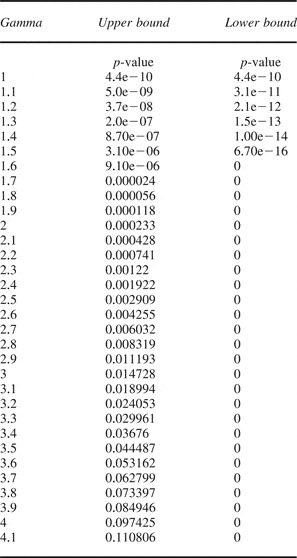
Table 4 reports the results from estimating the Rosenbaum bounds. Note the upper bound p-value. This captures the extent to which my estimated ATE over-reports the positive impact of trade linkage. If the p-value is significant at a particular level of Γ, then this means the effect would still hold even if an unobserved covariate were to increase the odds of witnessing an economic linkage offer by Γ times. According to KeeleFootnote 104 typical studies using observational data have a Γ value between 1 and 2. Table 4 shows that even if the odds of a group of states witnessing an economic linkage offer were four times higher because of the effect of an unobserved covariate, my inference regarding the effect of economic linkage still holds at the .1 confidence level. In other words, the effect of an unobserved confounder must be quite large to alter my results. Since I matched on the major factors that influence alliance formation and linkage offers, as identified by the alliance literature and the historic diplomatic record, it seems unlikely that an unobserved confounder would have such a large effect.
Rosenbaum bounds sensitivity analysis
Result contingent on missing treatment data?
Though the sources from which I identify failed alliance negotiations may have accurately and fully captured all instances of negotiation, it is very plausible that the historians generating these sources overlooked offers of economic linkage (since, to these historians, making note of such offers may have been of minor importance) or, perhaps even more likely, such offers were never mentioned in the actual diplomatic record. In other words, my data collection approach may under-report the prevalence of economic linkage offers in failed alliance negotiations. This could, in turn, impact estimates of the magnitude of the ATE.
Under-reporting the prevalence of economic issue linkage in failed negotiations means issue linkage is more closely associated with failures than what is reported in the data. Molinari offers an approach for estimating treatment effects in observational studies with missing treatment data.Footnote 105 In the basic setup (details of which are in the online appendix) the sharp bounds on the treatment effect, Pr[y(1) = 1|d = 0] − Pr[y(1) = 1|d = 0], are

which are not informative. In order to have stronger identifying power and create narrower bounds on the treatment effect, Molinari makes assumptions on the treatment response and on the treatment selection rule. Following Manski, Molinari suggests assuming monotonicity in the response functions as a means of improving the identification of the treatment effect bounds.Footnote 106 In particular, one can make the weak Monotonicity Treatment Response (MTR) assumption—the treatment has no negative/positive effect—and the weak Monotonicity Treatment Selection (MTS) assumption—if one divides the population into two groups according to the received treatment, then average outcomes of the group without the treatment are less/more than the average outcomes of the group with the treatment. The assumptions can be either positive or negative. It is important to note that 0 is the sharp upper bound on the treatment effect when weakly negative monotonicity is imposed and is the sharp lower bound on the treatment effect when weakly positive monotonicity is imposed. I will assume that missing treatment data can reduce the size of the identified positive effect, but not flip the sign from positive to negative. Thus, the key is to determine the extent to which the effect is reduced.
Computing the bounds under weakly positive monotonicity produces

which indicates that, under weakly positive monotonicity, offering trade linkage can increase the probability of agreement by up to 22 percent percentage points. Thus, the effect can still be quite substantial. Though this robustness check suggests that the estimated ATE slightly overstates the effect of trade linkage (36 percentage points, compared to 22 percentage points), recall that by “missing treatment” I suspect that I am under-reporting the prevalence of economic linkage offers in failed negotiations. Hence, one should expect that allowing more trade linkage offers on the failed negotiations should reasonably result in a lower estimated effect.
Conclusion
Over the years, much ink has been spilt describing issue linkage's role in negotiations. Other than a few notable detractors, the literature views issue linkage as a key mechanism by which states secure negotiated agreements. However, these claims have not been subjected to direct and systematic analysis. Using data on alliance negotiations involving European states from 1860 to 1945, I find that offering to include trade linkage in an alliance treaty increases the probability of agreement by approximately 36 percentage points.
Besides confirming the positive role of issue linkage in international negotiations, these results and evidence matter for three additional reasons. First, for the time period under consideration, I found that more than 40 percent of alliance negotiations end in nonagreement—an exceptionally high rate of failure. Besides being worthy of further exploration in its own right, this finding may shed insight into the high rate of alliance compliance identified by Leeds, Long, and Mitchell.Footnote 107 They found that, contrary to prior work by Sabrosky,Footnote 108 alliance members failed to comply with their alliance commitments only 25 percent of the time. As they state, “In this study, we simply identify reliable and unreliable alliances. A clear next step is to explain why some alliances are reliable and others are not.”Footnote 109 Leeds, drawing from Downs, Rocke, and Barsoom,Footnote 110 begins this work by conjecturing that, “under most conditions, leaders are reluctant to make promises that they or their partners are unlikely to uphold” and, therefore, leaders carefully select the agreements that they are willing to make.Footnote 111 This claim is consistent with the finding that a high percentage of alliance negotiations end in nonagreement: a high negotiation failure rate suggests that states are indeed selective in choosing alliance partners.
Second, the results suggest that linkage offers are exceptionally costly. Though the study reveals that issue linkage works, it also finds that linkage is rarely used. This is surprising given the high rate of alliance negotiation failure. It could be that the participants attempted other forms of issue linkage (though, as discussed with foreign aid offers, it is debatable whether such offers could indeed be classified as linkage). Even so, this leaves a substantial number of failed negotiations that never witnessed a linkage offer. I highlighted the costs associated with linkage, but the rarity of linkage offers suggests that these costs are quite prohibitive.
Third, the analysis shows that scholars should rethink how alliance formation is analyzed. The high rate of alliance negotiation failure suggests that states decide whether or not to begin alliance negotiations and only then determine if the negotiations will result in an agreement. Presently, scholars view factors such as threat perceptions and relative capabilities as important determinants of alliance formation. The evidence here suggests these factors may play a secondary role to the bargaining tactics (such as linkage offers) employed at the negotiating table.
Since these results pertain to a specific type of treaty (alliances) during a specific time period (pre-1945), what relevance do they have for nonalliance negotiations today? Arguably, the stakes are higher for alliance negotiations than for any other treaty (with the exception of perhaps peace agreements). Alliance negotiations deal with something as fundamental as countering external threats to the survival of a state. Concerns over state survival were particularly acute prior to 1945, when states were more likely to experience violent invasion and occupation.Footnote 112 Hence, the willingness of states to accept compromises (be it in the form of accepting a linkage proposal or otherwise) would perhaps be its lowest in pre-1945 military alliance negotiations. Thus, if issue linkage can secure agreement during pre-1945 alliance negotiations (where the stakes were exceptionally high), it should work for a whole host of negotiations.
Extending the analysis to the modern era requires a few changes in research design. First, the creation of the General Agreement on Trade and Tariffs in 1949 and the World Trade Organization in 1994 means one will have to account for membership in these organizations when evaluating offers of trade cooperation after 1945. Second, aid offers have become more prominent in alliance agreements since 1945. Thus, in contrast to this study, work on alliances after 1945 should focus on aid offers (though this still faces the complication of aid negotiations and alliance negotiations being separable).
Regardless of the direction of future research, the contribution of this study remains clear: it finally provides direct and systematic evidence that issue linkage can increase the probability of states reaching agreement and that linkage increases the probability by a substantial amount.



