An unexpected finding in the physical stature of nineteenth-century African American male slaves is that their heights increased during the antebellum period.Footnote 1 If, however, Southern planters and overseers rationally allocated slave nutrition and medical allotments to maximize their own wealth, slave heights would have increased with antebellum slave prices and probably decreased—at least temporarily—with slavery's elimination.Footnote 2 Although the antebellum slave stature increase has been well documented, a postbellum black stature diminution deserves more attention. Furthermore, not all nineteenth-century blacks lived in the South, and while much has been written on their legal and socio-economic status between the Civil War and World War I, less is known about black conditions elsewhere in the United States over this period. This article addresses nineteenth-century African American stature, its relationship to Southern institutions, and offers a new spatial explanation for regional black stature variation.
The use of height data to measure living standards is now a well-established method in economics.Footnote 3 A population's average stature reflects the cumulative interaction between nutrition, disease exposure, work, and the physical environment.Footnote 4 By considering average versus individual stature, genetic differences are mitigated, leaving only influences of the socioeconomic variety and the physical environment on stature. When diets, health, and physical environments improve, average stature increases. It decreases when diets become less nutritious, disease environments deteriorate, or the physical environment places more stress on the body. Thus, stature provides considerable insights into understanding historical processes, augmenting other welfare measures for nineteenth-century blacks that may otherwise remain undiscovered.
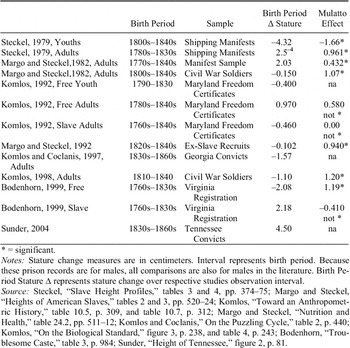
A generation of scholars has considered processes associated with nineteenth-century African American stature variation (Table 1), and a few patterns have come into focus. Among the first unexpected findings was that slave children were abysmally short relative to modern growth profiles, yet black statures experienced a period of catch-up growth as slave children entered the slave labor forces.Footnote 5 Other studies demonstrate the black secular trend for slaves increased during the last years of the antebellum period, while the statures of free blacks mirrored those of market-dependent whites.Footnote 6 Black stature has also been linked to pigmentation. Lighter colored nineteenth-century blacks were consistently taller than blacks with darker complexions.Footnote 7 A common explanation for this pattern is that nineteenth-century social and economic forces favored fairer complexions over darker complexions, and lighter colored blacks benefited from these social and economic institutions.Footnote 8 Nonetheless, a more complete explanation for taller mulatto statures may be rooted elsewhere in biology.
STUDIES OF NINETEENTH-CENTURY AFRICAN AMERICAN STATURE VARIATION AND THE MULATTO EFFECT

* = significant.
Notes:
Stature change measures are in centimeters. Interval represents birth period. Because these prison records are for males, all comparisons are also for males in the literature. Birth Period Stature Δ represents stature change over respective studies observation interval.
Source:
Steckel, “Slave Height Profiles,” tables 3 and 4, pp. 374–75; Margo and Steckel, “Heights of American Slaves,” tables 2 and 3, pp. 520–24; Komlos, “Toward an Anthropometric History,” table 10.5, p. 309, and table 10.7, p. 312; Margo and Steckel, “Nutrition and Health,” table 24.2, pp. 511–12; Komlos and Coclanis,” On the Puzzling Cycle,” table 2, p. 440; Komlos, “On the Biological Standard,” figure 3, p. 238, and table 4, p. 243; Bodenhorn, “Troublesome Caste,” table 3, p. 984; Sunder, “Height of Tennessee,” figure 2, p. 81.
This article uses a new data source from several U.S. state prison records to address two paths of inquiry into the statures of African Americans born between 1800 and 1899. The first path considers how black stature varied by nativity. Southern blacks were taller than Northern blacks, even though both were subject to overt forms of discrimination, which resulted in material and biological disparity, and free Northern blacks may not have fared as well as their Southern counterparts.Footnote 9 This suggests an influence, as yet unconsidered, on black stature. The second path considers the biological relationships between black stature, socioeconomic status, and birth period.
GEOGRAPHY, MARKET VALUATIONS, AND HUMAN BIOLOGY
An unexplored source for taller Northern black statures may be related to biology, especially its relation to geography.Footnote 10 Calcium and vitamin D are required throughout life for healthy bone and teeth formation; however, their abundance is most critical for healthy skeletal development at younger ages.Footnote 11 Calcium generally comes from dairy products, and vitamin D is produced by the synthesis of cholesterol and sunlight in the epidermis' stratum basale, granulosum, and spinosum.Footnote 12 Greater direct sunlight (insolation) produces more vitamin D, and vitamin D is related to adult terminal stature.Footnote 13 However, vitamin D production also depends on melanin in the stratum corneum.Footnote 14 Greater melanin (skin pigmentation) in the stratum corneum interferes with cholesterol's synthesis into vitamin D in the stratum granulosum, and darker pigmentation filters between 50 to 95 percent of the sunlight that reaches the stratum granulosum.Footnote 15 Therefore, darker skin is considerably less efficient than lighter skin at producing vitamin D, and darker skin is more common in Southern latitudes where more hours of direct sunlight offset inefficient vitamin D production.Footnote 16 In the United States, Southern states are closer to the equator and receive more insolation, while Northern states are farther from the equator and receive less direct sunlight.Footnote 17
A considerable body of evidence demonstrates that nineteenth-century mulattos were taller than darker blacks, and Richard Steckel and Howard Bodenhorn point to nineteenth-century Southern social practices to explain the difference.Footnote 18 An additional explanatory variable for taller mulatto statures may be biological. Lighter colored blacks were taller than darker blacks because less melanin in the stratus corneum allowed more sunlight to penetrate the stratum granulosum, producing more vitamin D, leading to taller mulatto statures. Furthermore, the fifteenth through eighteenth centuries' black Diaspora from Africa to North American latitudes placed blacks into geographic regions where they received less direct sunlight and produced less vitamin D; therefore, the growth of blacks in the North may have been affected.Footnote 19 Consequently, hours of direct sunlight are used here to explain black stature variation.
DATA
Prison Records
The data used to study black stature are drawn from a large nineteenth-century U.S. prison sample. All state prison record repositories were contacted and available intake records were acquired and entered into a master data set.Footnote 20 These prison records are from Arizona, California, Colorado, Idaho, Illinois, Kansas, Kentucky, Missouri, New Mexico, Ohio, Oregon, Pennsylvania, Texas, and Washington state penitentiaries. Because we focus on black male statures, females, whites, and immigrants are excluded from the analysis.Footnote 21 Between 1830 and 1920, prison officials routinely recorded the dates inmates were received, age, complexion, nativity, stature, pre-incarceration occupation, and crime. All records with complete age, stature, occupations, and nativity were included. Physical descriptions were recorded with great care by prison enumerators at the time of incarceration as a means of identification, and therefore reflect pre-incarceration conditions. For example, any inmates' statures were recorded at quarter-, eighth-, and even sixteenth-inch increments.
All historical height data have selection biases, and military and prison records are the most common sources for historical height data. One common shortfall of military samples is a truncation bias imposed by minimum stature requirements.Footnote 22 Fortunately, prison records do not suffer from such a constraint and the subsequent truncation bias observed in military samples. However, prison records are not above scrutiny. One potential bias inherent in prison records is they may be drawn from lower socioeconomic groups, although this may itself be an advantage, because lower socioeconomic groups are more vulnerable to the health, and therefore, stature consequences of economic change.Footnote 23 Arrests and prosecution patterns associated with different state legal regimes or differential application of state laws and regulations may have resulted in various selection biases that may affect the results of this analysis. However, black stature variation within U.S. prisons is consistent with other nineteenth-century black stature studies.Footnote 24
Fortunately, inmate enumerators were quite thorough when recording inmate complexion and occupation. For example, enumerators recorded inmates' race in a complexion category, and African Americans were recorded as black, light-black, dark-black, and various shades of mulatto.Footnote 25 While mulatto inmates possessed genetic traits from both European and African ancestry, they were treated as blacks in the nineteenth-century United States and are grouped here with blacks. However, when appropriate, mulattos are distinguished from blacks in the analysis that follows. Enumerators recorded a broad continuum of occupations and defined them narrowly, recording over 200 different occupations, which are classified here into four categories: merchants and high-skilled workers are classified as white-collar workers; light manufacturing, craft workers, and carpenters are classified as skilled workers; workers in the agricultural sector are classified as farmers; and laborers and miners are classified as unskilled workers.Footnote 26 Unfortunately, inmate enumerators did not distinguish between farm and common laborers. Because common laborers probably faced less favorable biological conditions, later regression results likely overestimate the biological benefits of being a common laborer and underestimate the advantages of being a farm laborer.
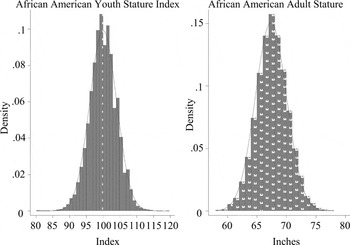
Because the youth height distribution is itself a function of the age distribution, a youth height index is constructed that standardizes for age to determine black youth stature normality. First, each youth age category's average stature is calculated. Second, each observation is then divided by the average stature for the relevant age group.Footnote 27Figure 1 demonstrates an approximately normal distribution for black statures.
NINETEENTH-CENTURY AFRICAN AMERICAN STATURE DISTRIBUTIONS

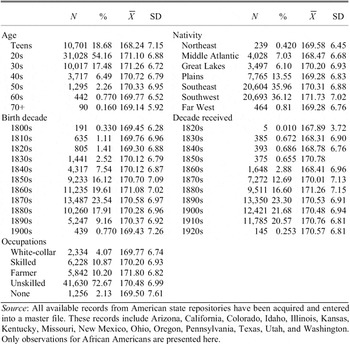
Table 2 presents the proportions for black inmates' age, birth decades, occupations, and nativity. Although average statures are included, they are not reliable because of possible compositional effects, which are accounted for in the regression models presented later. Age percentages demonstrate that black inmates were incarcerated at young ages, and most prisoners were born in the late nineteenth century. Occupations reflect socioeconomic status, and while prison inmates typically come from lower working classes, there was a sizable share of inmates from white-collar and skilled occupations. Most of the black inmates in the sample were born in the lower South and were incarcerated in the late nineteenth century.Footnote 28
NINETEENTH-CENTURY BLACK U.S. STATE PENITENTIARY INMATE DEMOGRAPHICS, OCCUPATIONS, AND HEIGHT

Source:
All available records from American state repositories have been acquired and entered into a master file. These records include Arizona, California, Colorado, Idaho, Illinois, Kansas, Kentucky, Missouri, New Mexico, Ohio, Oregon, Pennsylvania, Texas, Utah, and Washington. Only observations for African Americans are presented here.
U.S. Insolation
To account for the relationship between vitamin D and black stature, a measure is constructed that accounts for solar radiation. Insolation is the incoming solar radiation that reaches the earth, its atmosphere, and surface objects. Insolation is also the primary source of vitamin D.Footnote 29 Before their forced migration to North America, these Africans were exposed to considerable insolation, which was significantly greater than the insolation received by their progeny in the United States. Because of its size, Africa has a large insolation variation, and because of its proximity to the equator, its average insolation is greater than the insolation received in the United States. For example, from a random sample of western African sites, West Africa receives approximately 5.6 hours of direct insolation per day with a standard deviation of 0.53 hours; however, the United States only receives 4.10 hours of direct sunlight per day with a standard deviation of 0.61 hours, and the difference is significant at acceptable levels.Footnote 30
Because U.S. historical insolation is unavailable, a modern insolation index (1993–2003) is constructed, and monthly insolation values are measured from January through June. The insolation index measures statewide average insolation levels across each of the states based on the hours of direct sunlight per day at county centroids in each state.Footnote 31 Each state estimate was determined by summing the average hours of direct sunlight for each county (at its centroid), weighted by the proportion of the county's total land area (in square miles) to the state's total land area (in square miles). While this index is a rough approximation for historical insolation, it provides sufficient detail to capture state latitudinal insolation variation and consequently, vitamin D production. Predictably, Southern states have greater insolation than Northern states. For example, Texas receives 1.43, or 29 percent, more hours of direct sunlight per day than New York. It is also difficult to interpret insolation's net direct effect on human health, because greater insolation reduces calories required to maintain body temperature and produces more vitamin D, but greater insolation also warms surface temperatures, which may have made disease environments less healthy from waterborne diseases, especially in the South.Footnote 32
SOCIOECONOMIC STATUS, GEOGRAPHY, INSOLATION, MIGRATION, AND AFRICAN AMERICAN STATURE
Nineteenth-century black biological conditions were related to age, socioeconomic status, birth cohorts, and nativity; they may have also been related to insolation, which determined vitamin D production. We will test which of these variables were associated with the height of nineteenth century African Americans. To start, stature for the i th individual is related to age, socioeconomic status, birth period, nativity, and insolation.

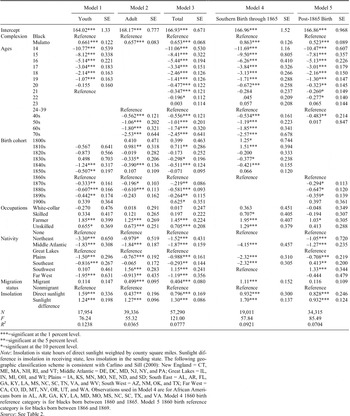
Dummy variables for individual youth ages are from 14 through 20; adult age dummies are for ten-year age categories from the 40s through the 70s. Birth decade dummies are in ten-year intervals from 1800 through 1899. Occupation dummies are for white-collar, skilled, farmers, and unskilled workers. Nativity dummy variables are included for birth in Northeast, Middle Atlantic, Plains, Southeast, Southwest, and Far West regions. A dummy variable accounts for migration status, and continuous insolation and insolation difference variables between receiving and sending location are added to account for insolation and vitamin D production. Table 3 presents five models that regress black stature on age, birth cohorts, occupations, nativity, and insolation. Models 1 and 2 present separate youth and adult stature regressions on dummy variables to account for these characteristics. Model 3 pools both youth and adult samples and presents stature regression models on the same characteristics. Model 4 restricts the sample to only blacks born in the South before emancipation. Model 5 considers all blacks born after emancipation.
NINETEENTH-CENTURY AFRICAN AMERICAN ADULT AND YOUTH STATURE

*** =significant at the 1 percent level.
** =significant at the 5 percent level.
* =significant at the 10 percent level.
Note:
Insolation is state hours of direct sunlight weighted by county square miles. Sunlight difference is insolation in receiving state, less insolation in the sending state. The following geographic classification scheme is consistent with Carlino and Sill (2000): New England = CT, ME, MA, NH, RI, and VT; Middle Atlantic = DE, DC, MD, NJ, NY, and PA; Great Lakes = IL, IN, MI, OH, and WI; Plains = IA, KS, MN, MO, NE, ND, and SD; South East = AL, AR, FL, GA, KY, LA, MS, NC, SC, TN, VA, and WV; South West = AZ, NM, OK, and TX; Far West = CA, CO, ID, MT, NV, OR, UT, and WA. Observations used in Model 4 are for African Americans born in AL, AR, GA, KY, LA, MD, MO, MS, NC, SC, TX, and VA. Model 4 1860 birth reference category is for blacks born between 1860 and 1865. Model 5 1860 birth reference category is for blacks born between 1866 and 1869.
Source:
See Table 2.
The positive coefficients on insolation variables illustrate that blacks born in states that received more insolation were taller than blacks who lived in areas that received less insolation (Table 3). Therefore, insolation and vitamin D probably influenced nineteenth-century black stature, which is supported by modern population studies.Footnote 33 An additional hour of direct sunlight was associated with nearly one centimeter taller black statures, indicating that part of shorter black statures in Northern latitudes may have been attributable to their physical presence in Northern latitudes where, due to higher melanin levels in their skin, they were less likely to produce enough vitamin D and grow as tall.Footnote 34
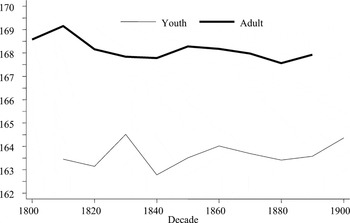
For several other categories, expected patterns hold. Consistent with the Komlos-Rees hypothesis, black inmate statures increased during the antebellum period and temporarily declined during the postbellum period (Tables 3 and Figure 2).Footnote 35 Between 1840 and 1890, black youth statures increased by nearly two centimeters, while adult statures remained approximately constant throughout the period, though adult statures also increased during the antebellum era.Footnote 36 Both youth and adult statures in the late nineteenth century probably increased with higher black incomes, and blacks in the postbellum period devoted a higher share of their incomes to food acquisition.Footnote 37
NINETEENTH-CENTURY U.S. BLACK ADULT AND YOUTH STATURE OVER TIME

Farmers were taller than nonfarmers, and farmers benefited from their close proximity to nutritious diets and mild disease environments; average black unskilled and field hand workers were taller than household servants and skilled slaves.Footnote 38 Workers in occupations with greater exposure to direct sunlight may have also grown taller because they were exposed to greater insolation as children and produced more vitamin D, which contributed to healthy bone formation.Footnote 39 Talat Islam et al. demonstrate that children exposed to more direct sunlight produce more vitamin D, and if there was little movement away from parental occupation, nineteenth-century occupations may also be a good indicator for the occupational environment in which individuals came to maturity.Footnote 40
Black statures also varied regionally, and Southwestern blacks reached the tallest statures. During the antebellum period, slaves were shielded from income and price variation, and although Southwestern slavery was arduous and demanded many calories for work, Southwestern slaves lived in more recently settled and productive farmlands.Footnote 41 After slavery, Southwestern blacks were exposed to greater income variation and were unprepared for economic activity beyond slavery, either in terms of experience or human capital. Southern wages were, in general, lower than Northern wages. However, West South Central laborers' wages were comparable to those in the middle Atlantic region, and after emancipation Southwestern black wages were higher than elsewhere, which may have improved Southern black material and biological conditions.Footnote 42
The relative price of dairy and calcium were lowest in dairy producing regions, such as the Great Lake states, but nineteenth-century blacks were overwhelmingly native to the South, and the South was notoriously low in dairy production.Footnote 43 Northeastern blacks, especially youth, encountered adverse biological environments, and contemporary reports of rickets—a result of childhood vitamin D deficiency—may have contributed to shorter Northeastern black statures.Footnote 44 Migrants are typically taller than nonmigrants, and nineteenth-century black migrants—both before and after emancipation—were taller than nonmigrants.Footnote 45
CONCLUSION
This article identifies an underexplored source for nineteenth-century black regional stature variation—insolation—and confirmed several others. Insolation is a measure for solar radiation and direct sunlight, which is necessary for vitamin D production, and vitamin D is related to both stature and skin pigmentation. Slavery facilitated the migration of millions of Africans to Northern latitudes where they may not have been biologically adapted to reach taller statures. For example, Africans are biologically adapted for taller statures on or near the equator, and while it is not possible to identify each slave's origin, African insolation was significantly greater than North American insolation.Footnote 46
The insolation variable also adds greater understanding to the long noted difference for why lighter pigmented African Americans were taller than darker pigmented African Americans. Mulattos had less melanin in their stratus corneum than darker blacks, which filtered out less sunlight and allowed mulattos to produce more vitamin D. However, after controlling for insolation and lighter complexions, mulattos were consistently taller than blacks with darker complexions, and this article suggests a mulatto effect of a little over half a centimeter, which is similar to that observed by Robert Margo and Steckel.Footnote 47 Therefore, after controlling for insolation, the mulatto stature advantage persists, but part of the explanation for taller mulatto statures may have been biologically based.