Introduction
The directors of the English East India Company (EIC) could not quite believe it. In 1757, on appointing James Mace as an engineer, they had ordered him to produce a plan to improve Bombay's fortifications while “most strongly” recommending frugality.Footnote 1 Now, in 1760, they discovered that Mace's fortification plan was so ambitious and expensive that it was “highly absurd.”Footnote 2 Not only that, but Mace had persuaded Bombay Council to commence works immediately, going against express orders to wait for London's approval. What was incomprehensible about the situation was that the company was stuck in a cycle. The previous engineer had similarly proposed projects of unviable expense, to the point where Mace had been sent out to solve the problem. “Our Engineers when they get abroad,” the directors mused, “seem Infatuated, or suffer themselves to be grossly misled.”Footnote 3
Perhaps the directors should not have been surprised, since the EIC had spent a century struggling with and avoiding engineers. This article examines the tense relationship between expert and company, questioning the assumption that early modern engineers acted as unproblematic agents. In Eric H. Ash's definition, the early modern expert not only controlled and deployed their expertise at will, but also transferred this control upward. They were able to place their knowledge and skill “at the beck and call of patrons and employers.” This was vital in colonial contexts, where experts acted “as trusted and reliable mediators” for the metropole.Footnote 4 While this was true in certain contexts, this article demonstrates that some colonial institutions struggled to incorporate experts and turn them into reliable mediators.
This new perspective is drawn from a distinct case study. Most work on early modern experts is focused on Europe and its American colonies.Footnote 5 By considering a long-distance trading corporation in India, this article demonstrates the tensions and pitfalls in deploying experts. The EIC was constantly engaged in an internal conflict over keeping “sunk costs”—expenditure on armed forces, the built environment, and political relations—to a minimum.Footnote 6 An engineer proposing expensive projects was exactly what the EIC's authorities wanted to avoid. Sometimes such projects were necessary, but costs and accountability were less easily managed than in Atlantic colonial institutions. Unlike the Portuguese Estado da India and the Dutch East India Company, the EIC had no central authority in Asia. The company was governed from London by the Court of Directors.Footnote 7 The journey from England to India averaged six months, meaning that it took a year for a letter to be sent and a reply received.Footnote 8 This situation was managed through the partial devolution of decision-making to councils of company employees (called servants or factors). These operated through the principle of consultative government. This was intended to prevent abuses of authority and make servants accountable to the directors. Collective decision-making was essential in the EIC's operation.Footnote 9 In this context, the presence of an expert could be profoundly disruptive. Their knowledge granted them an authority which could be used to overturn collective decision-making and flout orders from London.
The realities of a long-distance trading network, therefore, strained the patron-expert relationship to its limits. This has not been recognised in the existing literature, though historians have acknowledged conflicts over early modern expertise. Ash himself has described the problems of managing experts: when authorities were ill-informed or had no means to supervise and assess experts’ work, they could hold too much power.Footnote 10 The problems with managing experts in colonial contexts is less well studied. Karen Ordahl Kupperman has described tension within colonies—with resentment over engineers’ large salaries and distrust of their expertise and outsider status—rather than between colony and metropole.Footnote 11 Pedro Luengo-Gutiérrez and Gene Allen Smith, meanwhile, have recently characterised colonial engineers as fluid “in-betweeners” who “had to deal with the tensions between local concerns and European imperial designs.”Footnote 12 However, this article argues that far from resolving tensions, experts could bring them to the fore, straining the relationship between principals in the metropole and agents in the periphery. This article therefore aims to broaden our understanding of the dynamics of expertise in colonial contexts. Early modern experts could play more roles than trusted agents or in-betweeners.
In addition to problematising our understanding of engineers as colonial agents, this article explores how the EIC coped with their absence. In the almost 150-year history of the EIC before 1746, the directors only employed and sent to India five men who they directly endowed with the authoritative title “Engineer.”Footnote 13 Despite this, the EIC built several forts and numerous smaller fortifications and buildings throughout Asia, and created three urban centres (Madras, Bombay, and Calcutta). Who undertook this building? This article highlights the informal knowledge networks that powered the company's built environment.Footnote 14 Recent studies have emphasised the EIC's role in facilitating knowledge networks, but largely in relation to scientists and scholars.Footnote 15 The EIC also relied on a network of individuals who knew (or learned) how to construct and maintain built environments. In the absence of engineering appointments from London, people who had been sent from Europe as soldiers, marine officers, or even merchants found themselves designing and supervising construction projects. Indians were entrusted with complex engineering schemes. Steven A. Walton has described how, in Tudor England, the state often had to resort to “experts-in-context”: individuals who did not have any practical experience in fortifications, but who qualified as experts given the dearth of available expertise.Footnote 16 In the Indian Ocean region, the definition of “expert” was even more fluid. There was an extensive pool of experts-in-context in the eighteenth century, and they collectively sustained the EIC's built environment.
There was no clear dividing line between an expert and an expert-in-context. Rather, there was a scale of authority. At the top was an appointment from London, where the directors directly conferred the title “engineer.” In India, individuals could acquire this title unofficially by claiming or demonstrating expertise. This was possible because in this period the term “engineer” did not refer to a well-defined profession or specific qualifications. Rather, it served as shorthand for “expert in the mechanical arts.” The engineer was expected to understand practical mathematics, geometry, architecture, and machinery. These skills were closely associated with a military background, and EIC engineers often doubled up as artillery officers. They were called upon to demonstrate a range of skills: gunnery, military and civil architecture (the term “architect” is rare in the EIC's records), surveying, and managing construction (as clerk of the works).Footnote 17 We cannot identify an individual as an engineer based on objective measurements of expertise. Rather, anyone was an engineer if they were accepted as such. What was significant was who applied the title and how it was manipulated to confer authority.
This article traces the treatment of both experts and experts-in-context by the early modern EIC. It takes Bombay as its central case study, though wider developments are also considered. Bombay, acquired in 1668, replaced Surat as the headquarters of the EIC's Western Presidency in 1687. It was also a small territory, with a built environment which increasingly called for engineering expertise. The article begins by considering the EIC's attitude to engineers in the decades after Bombay's acquisition. It then describes the growth of an informal network of experts-in-context in the first half of the eighteenth century. Finally, it examines the EIC's attempt to use professional engineers during the Carnatic Wars of 1746–63. Throughout this period, engineers were problematic agents whom the EIC struggled to control.
(Dis)trusting Engineers in the Late Seventeenth Century
Founded in 1600, the EIC initially operated by maintaining minimal on-shore establishments in Asia. Over the course of the seventeenth century the company became increasingly invested in overseas built environments. It began to transition to a fortified settlement model, and built Fort St. George at Madras in 1639. In 1668 the company acquired Bombay, an archipelago on the west coast of India. This small territory (approximately ten miles long and four miles broad) included several minor fortifications and a partially constructed fort called Bombay Castle.Footnote 18 It represented a major extension of the EIC's engagement with built environments. The challenges of managing and improving this territory revealed tensions within the company over the necessity and impact of engineers.
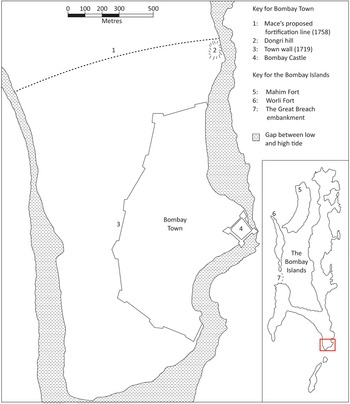
Bombay Town and the Bombay Islands.

The directors were determined to make their new possession secure, prosperous, and able to project maritime power. They instructed their servants to fortify and lay out a new town.Footnote 19 Securing and improving Bombay in this manner required substantial investment and expertise. Chiefly, Bombay Castle had to be completed. This was a fortified house which the English Crown had started to expand into a fort in 1665. The company's servants, faced with this challenge, requested that “an able, experienced, skillfull engineer . . . excellent in experimentall knowledge” be sent from Europe.Footnote 20
London refused to send anyone. Professional engineers were still relatively rare in mid-seventeenth-century Europe. Domestic fortification experts had only recently emerged in England, and the directors claimed that engineers were difficult and expensive to acquire.Footnote 21 In addition, modern artillery forts were ruinously expensive and their necessity in Asia was debatable. Often, such as in the building of Fort William at Calcutta, the directors did not desire forts built for European-style artillery warfare.Footnote 22 Building projects in Asia, they assumed, did not need experts. This attitude was not shared by company servants, who desired artillery forts to protect against other European powers. Servants were far less frugal with built environments. They lived in crumbling buildings and longed for the expertise to maintain and expand them. As the decades wore on, they saw with their own eyes the effect of amateur building. Walls proved structurally unsound due to shallow foundations, and forts were built too close to high-water level, leading to collapse.Footnote 23 Building projects, therefore, were largely driven by servants and resisted by their superiors.Footnote 24
This conflict may explain why, in addition to questioning their necessity, the directors were openly hostile to engineers. Such experts were “usually very wilfull in their waies, in putting persons upon extravagant, & unecessary charge.” Instead, the directors urged their servants “to enquire, amongst our Factors and Soldiers whether some of them are not skilfull as Engineers,” since a “person not soe much conceited of his owne Abillities, but will be consulted with, will bee much more suiteable to our affaires.”Footnote 25 An engineer, in short, was not seen as a reliable agent for the company. As a conceited expert, he would destabilise the EIC's system of consultative government by “putting” councils “upon extravagant” charges. Far away from the directors’ oversight, an engineer would go against their wishes and increase the cost of building unnecessarily. Far better to seek informal expertise. This would be possible, the directors reasoned, since fortifications were “now more gennerally understood then formerly.” To help, they sent their servants books on fortification.Footnote 26
In the meantime, and not yet knowing of this refusal, the Western Presidency sourced expertise as best it could. In 1669 Bombay Council commandeered two captains of East Indiamen, William Whitehorne and Samuel Smith, to produce a plan for Bombay Castle and survey and map the archipelago.Footnote 27 Naval officers were frequently called upon for such service in the seventeenth and eighteenth centuries. During the construction of Fort William in the first decade of the eighteenth century, London advised Bengal Council to use the services of any ship's captain that came their way, since “Gunnery and Fortification is part of the study of an ingenious Mariner.”Footnote 28
Whitehorne left after surveying the islands. Smith stayed and was appointed “Chiefe Engineer,” but died some months later.Footnote 29 This left Robert Barbor, a factor, to carry on Bombay Castle's construction. He was assisted by Smith's plan and a captain “who, wee understand, hath some knowledge in that art.”Footnote 30 This amateur situation ended in 1671 with the arrival of Herman Bake. Bake was not an employee of the company. He had requested passage on an East Indiaman to Persia in 1670.Footnote 31 His intention is unknown, but his plans failed and he instead offered his services to the Presidency. Surat Council “discovered his abillitys” and appointed him Bombay's “Ingeneer and Surveighor Gennerall.”Footnote 32
The extent of Bake's training is unclear, but both Bake and the Council invested him with as much authority as possible. They lambasted his predecessors, indirectly criticising the directors’ encouragement of amateurs. Bombay Council wished that the directors “could your owne eyes be witness how much money hath been improvidently expended in this your present fortification through pure ignorance of the art in those your servants, who pretended themselves Ingeneers.” This criticism was designed to justify Bake's expensive proposals for Bombay Castle: the line of the fort, he argued, had been drawn too small and needed to be extended.Footnote 33 Bake was therefore acting exactly as the directors feared an engineer would: drawing their servants into extravagant charges. Arguably, their policy of not sending out experts backfired. The Presidency sourced their own, endowed him with the authority of “Engineer,” then used him to argue for increased spending. Rather than having a servant loyal to them, the directors had created a situation where the engineer answered to President Gerald Aungier, the head of the Western Presidency.
Bake was put to work planning the future, and in December 1672, London was sent a plan of the castle, recommendations for various out-forts, and a plan of the proposed town and town wall.Footnote 34 Work began in earnest. The cost of this soon shocked the directors, and in 1674 they repeated their warning that engineers “contrive Curiossities that are very expensive.” They ordered that expenses be kept lower than revenues, and the following year they banned all fortification work aside from that “necessary for safety.”Footnote 35 In the meantime, however, Bake and Aungier's ambitions only grew. They planned to undertake extensive land reclamation. Bake produced a map of the archipelago and decided to present this to the directors in London personally, since “noe advise or instruction in writing can possibly be made soe demonstrable to your Honours in a case of this nature as he might doe by a personall appearance & discourse before you touching each particular place.”Footnote 36 Aungier hoped that Bake's expertise as an engineer would convince the directors to loosen the purse strings. Bake was in London between June 1675 and March 1676, during which time he had “severall Conferences” with the directors and his plans were scrutinised by the Surat Committee.Footnote 37 He came out of it well. His salary was raised and he was allowed to bring back an assistant to train as an engineer.Footnote 38 The directors tightly constrained Bake's ambitions, however, by instructing Aungier to severely limit Bombay's expenditure. Bake's schemes were left to Aungier's discretion, but the directors “againe recommend to you Seriously to Consider of any projects he may put you upon (to which ingenious Ingeneers are often too Subject) before you enter thereon.”Footnote 39 This was not put to the test, since Bake died of a fever in January 1677, shortly after returning to Bombay.Footnote 40
Bake's death marked the end of Bombay's building programme. In 1679 the directors banned all building unless it was expressly permitted from London.Footnote 41 By 1684 they estimated that a vast sum—three hundred thousand pounds—had been invested in the colony.Footnote 42 Bake's presence was hardly to blame for this. The directors were completely unaware of how much a town and fort would cost when they ordered them built in 1669. Nevertheless, Bake's actions conformed to the directors’ expectations of how engineers acted abroad. The fact that they sent Bake back in 1676 shows that they were not entirely hostile to engineers. They had a laissez-faire attitude to expertise: they would not supply experts, but nor would they suppress them if they emerged, as long as they were kept in check. By sending Bake back, the directors trusted that their president and council would restrain this unreliable agent through consultation.
After Bake's death, a series of disruptions ensured that Bombay received little investment. A soldiers’ rebellion seized control of Bombay in 1683–4, disrupting plans for improving the colony. Far more devastating was a Mughal invasion in 1689–90, which Bombay took years to recover from. It was elsewhere that the EIC began to experiment with engineers. In 1681 Josiah Child became Governor of the EIC. He attempted to remodel the company along the lines of the Dutch East India Company. As well as having numerous fortified outposts, the Dutch expected settlements to match their expenditure through revenue generation. This model relied on a secure built environment, and to support this the directors appointed an engineer for the first time. Edward Fowle was sent to the Madras Presidency in 1683, chiefly to assist in building a new fort in Sumatra.Footnote 43 Fowle went to Sumatra in 1685. He lined out the ground for the fort (called York Fort) and produced a plan before dying in October.Footnote 44 The company did not benefit from sending an engineer: soon after York Fort's completion an observer called it the “most irregular piece I ever saw.”Footnote 45 It was also poorly located and its foundations vulnerable to earthquakes, and was abandoned after only twenty-three years.Footnote 46
Other experiences of construction were similarly negative. In the 1690s a huge amount of money was squandered in building a fort at Anjengo (Anchuthengu) on the Malabar Coast. Anjengo needed to be a modern artillery fort to fend off attacks from the Dutch, the main power in the region. Characteristically, however, London did not offer to send any expertise. Their servants therefore relied on the services of a gunner who had experience in overseeing fort construction. The gunner could not produce an estimate of the cost, “having never been privy to the Expences.” Pressed for a sum, Anjengo Council estimated six to seven thousand pounds.Footnote 47 Predictably, this proved to be wildly inaccurate. Costs soared to the point where, three years after construction began, the directors ordered that it be halted.Footnote 48 This experience hardly pushed the company away from amateurs, however, since at the same time the perils of professionals were being highlighted in the Madras Presidency. In 1696 the directors appointed another engineer for Madras: Frederick Mathew von Werlinhoffe. Werlinhoffe was sent to Fort St. David at Cuddalore to fortify the town, but seems to have achieved little despite spending years there, and in 1702 the Madras Council dismissed him “since [he] has been a great charge to the company to no purpose.”Footnote 49
In the seventeenth century, therefore, the EIC's encounters with engineers were largely negative. Those appointed by the directors did not meet expectations, while Bake demonstrated the dangers of an expert's presence. Expertise was more easily wielded by company servants than by the directors in London. The benefits of expertise were not transferred smoothly up the hierarchy; instead, all London received was the bill for expenditure it deemed unnecessary. The directors reacted against this in the eighteenth century, but demands for expertise only grew.
Bombay's Experts-in-Context, 1700–1746
After the experiences of York Fort and Anjengo, the directors attempted to assert greater control over investment in building. They were increasingly cynical of their servants’ claims, and attempted to prevent them from entering into any more substantial investments. This is best characterised by their outburst in 1728, when they complained that servants had increased expenses “on one pretence or another” for many years, and that now “every notice of laying out our money in dead stock and Reparations or new Buildings is irksome to us.”Footnote 50 Reform was needed to demystify the built environment. Poor planning and inaccurate estimates needed to be eliminated, and projects needed to be nipped in the bud before costs spiralled out of control. To this end, the directors sought to reform the way that building was authorised. All new projects needed to be sent to them for approval, with cost estimates and detailed plans “describing the length heighth [sic] & other dimensions . . . with what built and of what thickness the walls and any other proper notices about them.” Even repair works needed a report and cost estimate entered into Bombay Council's books.Footnote 51 The intention behind these orders was for the directors to insert themselves into the decision-making process, preventing unnecessary or deficient building before it was begun.
Despite their increasing demands for information, the directors continued to refuse to send out people trained in surveying and construction. Architects and military engineers were more common in Britain by the eighteenth century, with a regular corps of royal engineers created in 1716. However, there was perhaps less reason for a parsimonious company to trust them than fifty years earlier. The late seventeenth century saw numerous instances where engineers working on royal fortifications “hopelessly underestimated the cost and, more particularly, the time these works would take.”Footnote 52 Reflecting this, the directors continued to expect their servants to source adequate expertise from those sent to India for other purposes. They attempted to help by sharing knowledge available in London. For example, they sent instructions and suggestions regarding land reclamation: embankment walls should be built sloped, not upright; sea walls must be carefully maintained, as “our River of Thames hath taught.” The directors also pontificated about buildings, reminding their servants (despite constant instructions to limit costs) to build houses “substantiall and durable,” “for once well don is twice don.”Footnote 53
There was a limit to how much could be managed from afar, and London did send out the occasional engineer. From their first appointment in 1683 to the beginning of the First Carnatic War in 1746, the directors drip-fed engineers to Madras and Bombay in roughly ten-year intervals. In 1715—after ignoring Bombay's requests for engineers in 1705 and 1711—the directors decided that Bombay needed a town wall and appointed George Vane as Engineer to complete the task.Footnote 54 Some years later they sent out John Hayes, “a young man who has been bred up under experienced Officers to understand the Theory of Fortification Gunnery & other useful parts of Ingineering,” to apprentice under Vane.Footnote 55 There is no more record of Hayes, but Vane served until his death in 1722. The directors did not provide Bombay with a replacement until they appointed John Brown in 1736, but they did supply Madras with an engineer (James Johnson) in 1719.Footnote 56 In 1742 they sent Major Charles Knipe to Madras. They did not grant him the title Engineer, but he was sent to improve the fortifications since “he has been employed in that way in Flanders.”Footnote 57
This handful of engineers was insignificant when diluted across half a century and the EIC's dispersed network. Moreover, the need to manage the company's built environment was greater than ever. Not only were the directors imposing new bureaucratic demands that had to be met, but the early 1700s saw an unprecedented amount of building and engineering work take place in Bombay. There was large-scale land reclamation in 1709–28. A wall was built around the town in 1716–19, and various small fortifications across the islands were built or rebuilt. Bombay's maritime facilities were also extensively overhauled. In the absence of professionals, Bombay Council had to undertake these projects through less formal channels. The result was a remarkable testament to colonial knowledge networks. Bombay's population of Europeans was tiny. It reached a new low of seventy-six in 1702 due to a lengthy plague outbreak, and though this rose substantially in the eighteenth century, it is unlikely that there were more than five hundred Europeans resident in Bombay at any one time in the first half of the century.Footnote 58 However, Bombay's need for expertise and London's unwillingness to supply it had created a vacuum. In this situation, any ambitious man “who pretends to some knowledge” of “Gunnery, Matthematticks, and Fortifications” could free themselves from the limited opportunities available in the company's employment in the hope of greater rewards.Footnote 59 This drew in expertise from across the EIC's network.
First and foremost were Bombay's military personnel. The officers of Bombay's soldier companies were the group most often called upon to plan and supervise construction work, since they had a rudimentary knowledge of fortifications. One of the earliest and longest-serving of these men was Captain Euclid Baker, who was appointed Clerk of the Works—the post in charge of all company building projects in Bombay—in 1696, and served until his death in 1714. Another example is Captain James Hanmer, who was placed in charge of Bombay's ambitious reclamation works from 1709 to 1715. Some officers found themselves in charge of construction as part of their regular duties: Lieutenant William Shaw, the commander of Mahim Fort (an out-fort in Bombay), supervised its rebuilding in 1701–3. There were also numerous lower-ranked officers who found building or surveying work in Bombay. John Burnell, an ensign, was employed under Baker to survey and map the island in 1710–11.Footnote 60 Some rose through the ranks until they were in charge of Bombay's building. Daniel Christie was an ensign who became Clerk of the Works in 1722; Joseph Smith was a bombardier (artillery officer) who worked under Engineer John Brown and who was formally appointed Engineer by the directors in 1744.Footnote 61
Most of the people involved in Bombay's built environment had been originally posted to Bombay, but some were either recruited from elsewhere by the council or were attracted there by the EIC's patronage. Transient expertise was sought when it was available. Ships’ captains conducted surveys and offered their advice during their brief sojourns on the archipelago.Footnote 62 Sometimes they could be persuaded to stay: Archibald Campbell, a marine lieutenant, was drawn in to be Clerk of the Works in 1734 due to his “good notion of architecture.”Footnote 63
These figures stepped forward and offered their service because there were rewards to be had. The EIC famously offered low pay: in 1710 the Bombay garrison paid its ensigns thirty-six and its lieutenants forty-eight pounds a year.Footnote 64 Potentially, ingenious experts could be formally appointed Engineer, as Smith was in 1744. This offered a higher salary, especially as the eighteenth century wore on.Footnote 65 More realistic was the potential of rewards for good results. Burnell, for example, took his surveying experience and sought his fortune in mapping. In 1714, now in Bengal, he produced a map of the world as a present from the EIC to the Mughal Emperor, and was rewarded with two hundred rupees and free passage back to England.Footnote 66
Such small rewards were even more tempting for company servants, who were generally paid less than officers. New recruits were paid five pounds per year. This rose to forty pounds as a senior merchant, but this rank was only attainable after eleven years’ service.Footnote 67 It is well known that EIC employees supplemented this meagre pay with private trade, but serving the company's built environment was a further opportunity.Footnote 68 Servants could be tempted to claim expertise, despite having no military rank to confer authority. For example, John van Duren was a servant employed in managing the customs duties at Mahim who involved himself in Mahim Fort's construction. By 1704 he was being called “Chief Ingineer and Master of the Workes,” and was given a fifty pound gratuity on the fort's completion.Footnote 69 John Myngs was a writer on a five pound salary who persuaded Bombay Council in 1721 that he had “a good Genius for Building.”Footnote 70 He was reappointed as a gunner and put in charge of rebuilding Gombroon Factory (at Bandar Abbas in the Persian Gulf).
Perhaps the best example of the opportunities that Bombay offered to experts-in-context was the project to reclaim the large areas of Bombay that were overflown with the tides. This land reclamation involved the construction of multiple embankments with sluices to drain water.Footnote 71 It required considerable engineering expertise, but Bombay Council was not lost for people claiming they could do the work. Van Duren offered to do it in exchange for rights to the reclaimed ground, but “mett with no Encouragement.”Footnote 72 John Harvey, a factor, claimed that he could recruit people from Karwar to undertake the reclamation.Footnote 73 His promises proved unfounded, so in 1709 Bombay Council decided to undertake the work themselves. They put James Hanmer in charge, who left for England in 1715 with a two thousand-rupee reward for his service.Footnote 74 The work was unfinished, with the largest sea inlet called the Great Breach still incomplete. Captain Elias Bates (whose origins are unclear) submitted a proposal for this in 1720. He asked for ten thousand rupees on completion, but settled for six thousand.Footnote 75 Bates presided over the embankment's construction between 1720 and 1728. He also served as Engineer in 1723–6, taking charge of the fortifications on the condition that the council petition London to make him a senior factor.Footnote 76 Though the embankment was successful, it took far longer and cost far more than Bates had promised. Nevertheless, Bates demanded his six thousand rupees. The council not only refused to pay, but declared that “Bates deserved a Mulct rather than a Gratuity,” and sent him a bill for the full cost (320,423 rupees) of the embankment.Footnote 77
Bates demonstrates that there were risks as well as rewards to be had in engineering for the company. In fact, Hanmer left in October 1715 with his reward at just the right time. A new president, Charles Boone, arrived in December along with a new engineer: George Vane. Vane savaged the work of his predecessor. He declared that the four finished embankments were already in need of extensive repairs, and he abandoned Hanmer's unfinished work at the Great Breach entirely. Hanmer “did not understand the work,” and Bombay Council “wisht the Company had sent out a Person fitt to undertake it.”Footnote 78 This reveals the tensions inherent in ascertaining expertise far from Europe. With official sanction from London rare, individuals had to build their own credibility. Some, such as Euclid Baker, adopted the title Engineer. Doing so was a mixed blessing since it increased the demands of their superiors. In 1708 Bombay Council ordered Baker to produce a map of Bombay.Footnote 79 They unwisely promised this to the directors, who pressed them to send the map four times between 1710 and 1714.Footnote 80 The council responded to these demands by writing that they “Cant yet get a Person capable to Survey the Island, so cant send a draught [i.e. map], [and] want a good Engineer.”Footnote 81 This riled the directors, who queried “what Captain Baker is fit for if he cant perform it.” By the early eighteenth century surveying expertise was far more common in England, and the directors could not see “any difference between Surveying the Island & a Gentleman's Estate here in England.” Had they given Baker “the bare name” of Engineer simply for him to go to his country house in the day and repair to the fort at night, all the while collecting his fifty pound salary?Footnote 82
This vivid picture of an idle engineer perfectly encapsulates the directors’ fear of experts whom they could not vet or monitor. They themselves had created the situation where their servants had to source expertise, but the directors distrusted engineers who had not been officially appointed. The fear persisted that experts would disrupt the EIC's consultative governance. In principle, collective decision-making (monitored from London through correspondence and diaries) would effectively manage experts. A good example of this is the proposal to build a fort at Durmapatam (Dharmadom), an island off the Malabar Coast acquired in 1735. The local servants proposed an extensive fortification to protect the island from the Dutch, and Bombay Council responded by sending their own expert: Archibald Campbell, Clerk of the Works. Campbell produced a plan for a fort that would cost 950,000 rupees, which shocked the council. He was ordered to plan a smaller fort, which he estimated at 338,000 rupees.Footnote 83 The deliberation on these matters was extensive, with lengthy consultations within Bombay Council and correspondence with the local factors debating the fortification. The council believed that fortifying Durmapatam would allow them to dominate the pepper trade, but they were perfectly aware that London would disapprove of the investment. They did what they could to push their experts to reduce costs and persuade their superiors of Durmapatam's advantages. Predictably, however, the directors blocked this “Extravagant Enterprize.”Footnote 84
With Durmapatam, everything worked as intended: the expert-in-context produced an honest estimate, Bombay Council waited for London to respond, and the work was cancelled. In contrast, disaster—and the directors’ admonishment—beckoned when due diligence was not practised. In 1722 Ramji Purvoe was put in charge of strengthening a small out-fort at Bombay with four new bastions. It emerged that Ramji had designed the fort “irregular,” and it had to be restarted.Footnote 85 Ramji was not blamed, however. Rather, the fault lay in the fact that the company's consultative practices had not been adhered to. Ramji undertook the work without William Phipps, the president, attending the site, and without any real oversight from the council. Phipps blamed himself and personally reimbursed the company; the council then viewed the site “in Company of several Officers and Artists” and collectively agreed on a plan.Footnote 86
Ramji Purvoe stands out as an Indian who was entrusted with fortification work. His career demonstrates the extent to which Bombay was a dynamic market for engineering expertise. Though Ramji first appears in the record in 1723, he had already “for a long time been employ'd on the Works”—“works” meaning all EIC construction projects in Bombay.Footnote 87 A nineteenth-century Marathi account states that Ramji, who spoke English, was the engineer entrusted with constructing the Great Breach embankment.Footnote 88 This was not officially the case, but Ramji, with his valuable “influence . . . over the Working people,” may well have been effectively in charge on a day-to-day basis.Footnote 89 In 1728 his expertise was sought regarding Bombay's decaying pier, which he recommended be rebuilt.Footnote 90 In 1733 Bombay Council sent him to oversee the construction of a fortified house at Bandar Abbas.Footnote 91 Having built a house that “in Beauty Exceeds everything on this side of India,” Ramji returned to Bombay in 1737.Footnote 92 Here he immediately began work on a new project. Drawing on his 1720s embankment experience, he developed a private reclamation initiative: a new sea wall in the north of the islands.Footnote 93 This came to nothing since the directors disapproved, but Ramji was still active in 1741, when he was consulted regarding improving an existing embankment.Footnote 94 He was therefore a respected expert in the mechanical arts who utilised the EIC's patronage. Though it is impossible to ascertain how Ramji built up his expertise, technical transfer was clearly taking place in eighteenth-century Bombay—as Pedro Luengo has demonstrated in a similar context in Southeast Asia.Footnote 95
Despite being active in the Presidency for decades, Ramji is hard to trace in the archive. His employment by the company was not mentioned in any letters to London. This reflects a broader problem that the full influence of Indian expertise on the company's built environment is underplayed in the official archive. Company servants in Bombay were used to being reliant on foreign expertise, but they obscured the extent of this reliance to the directors, avoiding making reference to Indians in charge. In reality, the Europeans discussed here had limited planning and overseeing roles in a built environment that was constructed and maintained by Indian knowledge and labour. Bombay Council's frequent requests for European artisans were invariably ignored by the directors, so they had to attract skilled stonecutters, bricklayers, and carpenters from Maharashtra and Gujarat. Such artisans were in any case better suited to working with local materials unfamiliar in Europe, such as chunam (a cement made from shell-lime and sand). Bombay Council also needed Indian overseers to muster and supervise labourers, which seems to have been how Ramji began his career.
Overall, therefore, the absence of professionals produced a dynamic market of experts-in-context jostling for the company's patronage. In a sense this was exactly as the directors wanted: rather than sourcing rare and expensive expertise in London, the EIC's settlements were self-sufficient. The authority of these individuals was limited by their lack of appointment from London, constraining their disruption of the EIC's consultative governance. Amateurism, of course, had its price. Poor building and inaccurate estimates bedevilled Bombay Council. But it was only the crisis of war that would convince the directors to turn decisively to experts.
Incorporating Professionals, 1746–1764
The EIC had largely managed without professional engineers until the mid-eighteenth century, but in the meantime the context in Europe had changed. Military academies became increasingly common across Europe, although the first military school in England was not established until 1741 (the Royal Military Academy in Woolwich).Footnote 96 This created a larger pool of educated officers from which engineers could emerge, and engineering became more formalised as a profession.Footnote 97 The EIC's European competitors forced it to respond to this changed context. In the 1740s the French East India Company became much more assertive. The two companies clashed in the Carnatic Wars between 1746 and 1763. This placed a great strain on the EIC. The shortcomings of the company's existing fortifications were dramatically revealed with the French capture of Fort St. George (Madras) in 1746 and the Mughal capture of Fort William (Calcutta) in 1756. Both had been built by experts-in-context. The capture of Fort St. George shocked the directors, creating a sense of crisis that led them to abandon their parsimonious policies. For the first time, they comprehensively turned to engineers as company agents. The need to secure the EIC's possessions was so great that consultative governance was thrown out the window. Instead, the engineer stepped forward as an expert who had the final say over fortification matters. The directors hoped that engineers would directly serve them. Perhaps finally they would act as “trusted and reliable mediators.”Footnote 98
This transition began immediately after the directors heard of Madras’ capture. In 1748 they appointed Alexander Delavaux Chief Engineer of all their settlements. This role was new. Delavaux was not posted to any one location; instead, it was intended that he move across the EIC's network and make fortification recommendations. He was not granted the authority to undertake works independently: all his plans were to be sent to London for approval.Footnote 99 The EIC's councils were effectively cut out of the decision-making process. The directors would gather information and proposals directly from their expert in order to make decisions.
This initial appointment did not go well: within eleven months of arriving in India Delavaux deserted to the French.Footnote 100 Unperturbed, the directors immediately replaced Delavaux with Benjamin Robins. Robins was employed to undertake a four-year tour of the EIC's possessions. He was instructed to generate plans and schemes for the directors’ approval, and to send them as much information about their settlements as he could.Footnote 101 Robins only spent a year in India before his death in July 1751.Footnote 102 The directors responded by sending a successor with even more sweeping powers: Frederick Scott in December 1752. This was their third Chief Engineer, and with each appointment the role took on more power. Scott was entitled to sit in on any councils when military matters were being discussed. Securing Fort William was the priority, and the directors ordered Bengal Council to provide Scott with money, workmen, and materials.Footnote 103 They also intended Scott to regulate the existing amateur system: Bombay Council were banned from appointing engineers without his approbation.Footnote 104
Scott died even sooner than his predecessor, only being in India between August 1753 and May 1754.Footnote 105 Scott and Robins reveal a hidden advantage of informal expertise: amateur engineers were recruited from veteran employees whose longevity in India was already proven. The logistics of the EIC's network were much more challenging than in Atlantic contexts. Relying on individual experts left much to chance. Unexpected events led to years of delay. The directors wrote that Scott's death “almost totally disconcerted our Designs,” and they decided to abandon the Chief Engineer position.Footnote 106
However, this did not mean the end of the director's plan to utilise experts. Instead of investing their hopes in one individual, they adopted a new model where each Presidency (Madras, Bombay, and Calcutta) had its own Chief Engineer, with no overarching authority. The first such appointment was for Bombay. Jacques de Funck was appointed Chief Engineer of the Western Presidency, subordinate to the Bombay president. The directors charged him with improving Bombay's defences in case of a French attack. His proposals were to be transmitted to London with Bombay Council's comments.Footnote 107 Councils were therefore brought back into the decision-making process, but only partially. Engineers had an ambiguous position in the company's hierarchy. Though technically answerable to councils, they derived authority from—and directly communicated with—the directors.
The impact of this imperfect incorporation of experts can be seen in de Funck's career in Bombay in 1753–8. The new Chief Engineer position clashed with the administrative structures that had organically developed alongside Bombay's experts-in-context. De Funck complained that he was not given the full authority of Chief Engineer by Bombay Council. President Richard Bourchier limited the engineer's role to producing plans and lining out the works. The Land Paymaster barred de Funck from supervising construction and withheld important information from him, such as the cost of materials. When he attempted to intervene, de Funck found himself treated “as another overseer” by the workmen “and not as Engeneer. . . . I am immediately reprimanded as a person that has nothing to do with it.” In contrast, the Clerk of the Works Hugh Cameron was treated as an engineer, “tho Captain Cammeron understands nothing in the least in the Engenering way.”Footnote 108 Cameron was one of Bombay's experts-in-context who had been at Bombay since at least 1746.Footnote 109
De Funck therefore found himself working alongside, rather than commanding, Bombay's experts-in-context. He found this threatening to his authority and expertise. Lashing out, he claimed that he alone in Bombay understood engineering, and was “always Interrupted by them, that not understands, the nature thereofe.”Footnote 110 This conflict climaxed in 1756, when de Funck was arrested, court marshalled, and acquitted for disobeying Bourchier's orders. De Funck was charged with ignoring commands from Cameron to survey the town. These orders had come directly from Bourchier, though de Funck claimed not to know this. This conflict can be partly attributed to personal acrimony between de Funck and Bourchier, but it is also clear that the new Chief Engineer position sat uneasily on top of Bombay's existing command structure. De Funck, perhaps used to a European context, found these blurred lines between professional and amateur unacceptable, arguing that “it is well known, that the Power I now desire, is always lodged in an Engineer.”Footnote 111 He wrote to the directors, asking them to order Bombay Council to give him the authority to carry out his role.Footnote 112
In addition to his authority, de Funck also found himself fighting to preserve his integrity as an expert. Charged with producing proposals for improving the defences of both Bombay and Durmapatam, he worked more slowly than Bombay Council expected (citing illness) and continually missed deadlines to send plans to London. While Bombay Council described de Funck as “dilatory,” de Funck claimed that the council's expectations were divorced from the reality of engineering work.Footnote 113 The council had worked with experts-in-context, who produced plans and cost estimates on demand, for decades. De Funck had more exacting standards, writing that adhering “to the Rules of Art” “requires more Consideration & Time than you seem to imagine.”Footnote 114 Predictably, the rules of art were not compatible with the company's rules of spending. Bombay Council knew that the directors would baulk at de Funck's extensive plan for fortifying Durmapatam, and ordered him to rework it to reduce the expense. Even the second plan was estimated to cost £112,000.Footnote 115 Bombay Council had to force this calculation from de Funck, who criticised the notion that engineers could magically produce accurate estimates. In order to do so, an engineer needed huge amounts of information specific to the area.Footnote 116 He described his estimate for the first plan of Durmapatam as “a Random Guess.”Footnote 117 Bombay's experts-in-context had been operating on guesswork for decades, but admitting this disrupted the decision-making of the council. Bombay Council therefore struggled to incorporate professional expertise into a system where authority was dispersed amongst multiple experts-in-context.
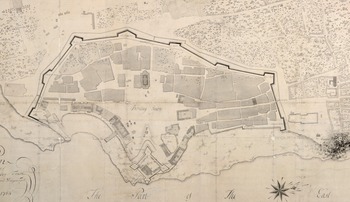
Despite these conflicts, Chief Engineer de Funck's words carried weight. His report on Bombay's defences, submitted alongside the first detailed map of the area surrounding Bombay Town (figure 2), eloquently criticised the existing fortifications. He recommended extensive works: upgrading much of the castle, extending the town fortifications, and razing numerous buildings.Footnote 118 The report laid out in painful detail that Bombay was open to attack, and was presented by an individual who had been endowed with the authority of “Chief Engineer” by the directors. Bombay Council read it with the cautionary tale of Madras—and the directors’ subsequent orders to put Bombay “in the best Posture of Defence possible”—in their minds.Footnote 119 They bowed to the expert's authority, ordering that the works which de Funck considered most pressing be begun.Footnote 120
Jacques de Funck, Plan of Bombay Town, Castle, and Dungaree Fort (1756).Footnote 121

This order demonstrates that experts, when operating far from their patrons’ oversight, wielded an authority that was hard to resist. On de Funck's appointment the directors expressly told Bombay Council that all his schemes were to be sent to them for approval, with the exception of “Works absolutely necessary and not attended with large Expence.”Footnote 122 Such cheap and necessary works were left undefined, and this was the loophole which Bombay Council used to commence works. However, de Funck's conception of what was absolutely necessary went far beyond what was acceptable to the directors. In 1757 they turned on de Funck. His plan for Durmapatam was “so very Distant from our Intentions,” and Bombay Council should not have approved his works for Bombay.Footnote 123 This was a transformation: in 1754 the directors had praised themselves for “sending you such an able Engineer last Season as Captain de Funck,” and in 1756 they again expressed their confidence in him.Footnote 124 Distance, however, had erased the understanding between the directors and their agent, and de Funck was now an enemy to their intentions.
The directors decided to solve the problem of one expert with another expert. In 1757 they appointed James Mace as the new Engineer of Bengal. They ordered him to stop at Bombay on the way, during which time he was to have authority over de Funck. He was to produce his own fortification plan, which was expressly ordered to be sent to London before any expensive works be started.Footnote 125 Mace's arrival in December proved the last straw for de Funck, who resigned the next month. From de Funck's perspective, he understood the company's intentions perfectly and had carried out their orders to the letter. His plans were as cheap as possible while remaining “agreeable to the Rules of Defence.” He “wish[ed] my Plans and Projects had been examined by a Person in the Engineering Way,” since “it cannot be done for so little as may be imagined.”Footnote 126
His replacement would have the exact same dilemma. Before leaving for India, the directors had emphasised frugality to Mace. At the same time, he thought “it incumbent upon me to propose and recommend whatever” he deemed necessary for Bombay's safety.Footnote 127 He quickly concluded that Bombay was defenceless in its current state. His plans were much more radical than de Funck's, and he stayed in Bombay to carry them out. Whereas de Funck's proposals essentially amounted to a reinforcement of the existing fortifications, Mace argued that since the town could be commanded by a hill called Dongri, the town fortifications would need to be extended to encompass it. Faced with an earnest engineer who argued that his works needed to be carried out “without any Delay whatever,” Bombay Council once again ordered work to commence without permission from London.Footnote 128 The rituals of consultation were adhered to: Mace was called into the council room to explain his reasoning and present his drawing of the works. But the council did not have the knowledge to assess the plan. It was “examined and Approved, as far as our Judgment will enable us to judge of it”—which was not very far at all.Footnote 129
Mace's actions bewildered the directors. They condemned his plans as unnecessary and accused Bombay Council of breaching orders by permitting them.Footnote 130 The tone of their orders rapidly changed, undermining Bombay Council's actions retrospectively. Whereas in 1756 the directors had written that “The very Being of the Company will in a great measure depend upon our several Settlements being in the best Posture of Defence circumstances will admitt of,” they now suggested that only “some precautions were necessary” to render Bombay defensible against a European enemy.Footnote 131 The fact that the directors could see this truth from London but their engineers on the ground could not was confounding.
The directors offered a solution: rather than spending vast amounts on fortification, Bombay simply needed to clear the houses that clustered around the castle and town wall.Footnote 132 Such buildings blocking the fort's line of fire had been the chief reason for Fort William's capture in 1756. In actual fact, both de Funck and Mace had been busy razing buildings, but Bombay Council renewed its efforts in response to this order. The directors were entirely wrong to think that this was a cheap solution. Demolition was expensive since inhabitants needed to be compensated, and the directors furiously reacted to this in 1762:
It is Evident if an immediate Stop is not put to these Expences, The Engineers will be ever, on the least opening given them, forming new Projects, so that our money will be buried in Stone Walls, Chunam and Expensive Operations, while our Mercantile Concerns languish.Footnote 133
Mace was ordered to leave Bombay for Calcutta (in actual fact he had already died in Bombay in August 1761). Bombay reverted to its traditional reliance on military officers: Lieutenant Andrew Werner, who had been assisting Mace, was made Clerk of the Works.Footnote 134 He was not given the engineer title, and when London heard of Mace's death they decided that the office should “remain Vacant for the present.”Footnote 135 This looked like the end of the company's flirtation with engineers: the Seven Years’ War had just ended, reducing the need for fortification. However, the war had greatly increased the EIC's possessions and military establishment. The company had entered a new era, one in which engineers were a necessity. In April 1764 the directors appointed a new engineer for Bombay, Thomas Keating, but they couched his appointment in significant terms: “Captain Keating having no separate Instructions or Powers from us as Engineer he is to act under your directions, you are therefore to give him the necessary Orders from time to time.”Footnote 136 There was no more talk of engineers as agents of the directors. This endowed them with too much authority. Instead, they would have to be managed by consultative governance, despite the fact that councils were themselves distrusted for their proclivity to overspend.
What had gone so wrong with de Funck and Mace? Both moved from a position of personal trust to being accused of “infatuation.” In truth, rendering the EIC's settlements defensible against European enemies was expensive. Bombay's informal knowledge network had maintained the company's built environment piecemeal, working just within what the directors regarded as acceptable expenditure. Military engineers sent from England with instructions to prepare settlements for attack were quite a different matter. They presented the EIC with the true cost of European-style defence. Since this was incompatible with the directors’ limits on expenditure, the early modern EIC never successfully resolved the problems inherent in incorporating experts into its organisation.
Conclusions
This article has demonstrated the difficulties which faced certain colonial regimes when using experts. Far from transferring their expertise upwards, engineers were agents whose impact was far less predictable. Their knowledge and authority made them hard to integrate into the EIC's consultative system. Councils could be victims to this, bowing to greater expertise, but they could also utilise this authority for their own purposes. An engineer who had been appointed from London could, across the seas and in the intervening years, become an agent for servants who wanted to drive greater investment in the built environment.
It would be easy to conclude from this that the EIC was chaotic and inefficient, and that its inability to utilise expertise was a weakness. Erik Odegard has put forward a similar argument in relation to the Dutch West India Company (WIC). Odegard charts the planning and construction of a new African fort in the 1770s. He concludes that the WIC's “decision-making process was deeply flawed,” leading to fatal delays which Odegard characterises as “institutional paralysis.” He connects this case study to a wider period of Dutch colonial decline.Footnote 137 All of the institutional failures highlighted by Odegard—the extensive consultation between multiple councils, the referral of decisions further up the chain of command, the revision of plans, the delaying of construction—were also present in the EIC in the eighteenth century. But while the WIC was experiencing decline, the EIC was quickly becoming the dominant European power in India.
The institutional paralysis which Odegard describes could more generously be seen as the deliberations of a consultative system attempting to manage experts. Such a process was slow, but kept expenditure at a viable level, which was essential for the EIC's continued existence. This article has demonstrated how the company maintained a built environment at a minimal expense through an informal network of experts-in-context. These individuals were not bestowed with the aura of the “expert” (though they attempted to develop such a persona). This meant that they were more easily integrated into the councils’ consultative system, and were more likely to conduct smaller projects that stayed within (or at least did not wildly contravene) what the EIC considered permissible expenditure.
Though it has not been charted in this article, the EIC's network of experts-in-context continued (and expanded) after 1748. Indeed, the informal knowledge network eventually fed into, and was integral to, the EIC's new engineering establishment in the late eighteenth century. From 1769 the EIC's engineers were reorganised into a more formal military corps, but the number of fully trained engineers sent directly from Europe remained low.Footnote 138 The company continued to rely on individuals who attempted to transform themselves into experts. These individuals, and the EIC's early built environment generally, have been largely absent in the literature. By highlighting them, this article demonstrates how expertise was managed and built environments maintained in colonial contexts.