Implications
Improvements in reproductive rate in domestic animals have profound positive effects on overall efficiency of production. There is a need for managers of food animal enterprises, related veterinarians and agribusiness companies to have deep knowledge of the effective strategies for reproductive management. Reproductive function can be modulated by the body nutritional status of animals. This study tried to determine the stimulatory effects of the oral treatment of a nutritional supplement on ovarian function in cattle.
Introduction
It is well known that nutritional status modulates reproductive function by influencing blood-borne nutritional signals in domestic animals. Several lines of evidence have suggested that the level of blood glucose and its associated factors correlated with the body energy status influence reproductive endocrine system and ovarian function in ruminant species. For example, changes in the concentrations of blood glucose, insulin and non-esterified fatty acid (NEFA) are associated with the post-partum energy balance (Butler et al., Reference Butler, Pelton and Butler2004; Tanaka et al., Reference Tanaka, Arai, Ohtani, Uemura, Kuroiwa, Kim and Kamomae2008), and they influence the pulsatile LH secretion during the periparturient period (Canfield and Butler, Reference Canfield and Butler1990) in cows. The reduction of the energy balance after parturition decreased the plasma concentration of progesterone during the oestrous cycle (Villa-Godoy et al., Reference Villa-Godoy, Hughes, Emery, Chapin and Fogwell1988), which gave rise to a decline of the conception rate in dairy cows (Folman et al., Reference Folman, Kaim, Herz and Rosenberg1990).
Propylene glycol is a glucogenic compound often used to treat ketosis during the post-partum period in cattle. When administered orally, propylene glycol is partly absorbed and mainly metabolized to propionate for utilization as a glucogenic precursor in the rumen (Emery et al., Reference Emery, Burg, Brown and Blank1964). A previous study showed that propylene glycol drenching for 35 days during the period of early lactation increased blood levels of glucose and insulin, and decreased NEFA level in dairy cows (Miyoshi et al., Reference Miyoshi, Pate and Palmquist2001). Moreover, in that study, propylene glycol treatment to dairy cows under the condition of negative energy balance shortened the duration between parturition and first post-partum ovulation (Miyoshi et al., Reference Miyoshi, Pate and Palmquist2001), suggesting that the long-term supplementation of propylene glycol may have positive influences on follicular function via the stimulation of glucose availability in post-partum dairy cows.
In our recent studies on small ruminants, short-term nutritional supplementation from the luteal phase to the follicular phase was found to promote gonadotropin secretion (Haruna et al., Reference Haruna, Kuroiwa, Lu, Zabuli, Tanaka and Kamomae2009; Zabuli et al., Reference Zabuli, Tanaka, Lu, Kuroiwa and Kamomae2009) and ovulation rate (Zabuli et al., Reference Zabuli, Tanaka, Lu and Kamomae2010) accompanied by increases in the plasma concentrations of glucose and insulin in cycling goats. To our knowledge, there is little information regarding the effects of short-term treatment of propylene glycol drenching on ovarian function in cattle. The purpose of this study was to determine whether short-term treatment of propylene glycol drenching before and after luteolysis stimulates ovarian function in cattle. Our approach was to use heifers as experimental animals to exclude the influences of a variation of body energy status that are seen under post-partum conditions such as lactation and suckling stress. This study deals with ovarian and hormonal responses to short-term treatment of propylene glycol before and after luteolysis in heifers.
Material and methods
Animals
Five heifers (1 year of age, 278 to 427 kg of body weight; four Holstein and one Holstein × Japanese black) maintained at the dairy farm of Tokyo University of Agriculture and Technology were confirmed to have at least one normal oestrous cycle before the start of the experiment, and used twice (as control and treatment) with crossover design. The animals for control and treatment groups were assigned in parallel in consideration of the seasonal effect, and at least one normal oestrous cycle was allowed to elapse after the propylene glycol treatment when animals were assigned as the control group after the treatment group. During the experiment (January to September), the heifers were kept at an in- or outdoor paddock with a free stall system and fed a diet based on Sudan hay, alfalfa hay cubes and concentrate supplements according to Japanese feeding standards for cattle. All procedures were approved by the University Committee for the Use and Care of Animals at Tokyo University of Agriculture and Technology (no. 22-66).
Experimental design
After ovulation (day 0, first ovulation) detected by palpation per rectum and ultrasonography, the heifers in the treatment group received 225 ml of propylene glycol (Neornogen, KAWASAKIMITAKA Ltd, Tokyo, Japan) before morning feed (0700 to 0900 h) on days 6, 7 and 8 as an oral drench (total volume = 250 ml of 90% propylene glycol). On day 10 (0700 to 0900 h), prostaglandin F2α (PGF2α), 15 mg per head of dinoprost (Panacelan Hi, MEIJI SEIKA KAISHA Ltd, Tokyo, Japan), was administered intramuscularly to induce luteal regression followed by the follicular phase. Then, propylene glycol was again administered twice daily (250 ml before morning and evening (1700 to 1800 h) feeds, 500 ml/day in total) on days 10, 11 and 12. Drenching level of propylene glycol was chosen as the recommended maximum level (250 to 500 ml/day) when it was administered to cows with ketosis according to the manufacturer's instructions. Palpation per rectum and ovarian ultrasonography were performed every other day from days 0 to 10, and daily after PGF2α administration until the subsequent ovulation (second ovulation) for analysis of follicular and luteal dynamics. Blood samples were also collected every other day from days 0 to 9, and then at 6-h intervals after PGF2α administration until the second ovulation. In consideration of the effects of feeding and treatment, blood samples were collected before the morning feed or the administration of propylene glycol. After the second ovulation, palpation per rectum, ultrasonographic examination and blood sampling were continued for 1- to 3-day intervals until the third ovulation.
Ultrasound examination and blood sampling
For ovarian ultrasonography, a B-mode scanner (Aloka Super Eye SSD-500 or Honda HS-101V, Fujihira Industry Co. Ltd, Tokyo, Japan) equipped with a 5-MHz transducer was used and the follicles and corpus luteum that grew to >5 mm were recorded. For analysis of the sizes of follicles and corpus luteum, mean values of the long and short maximum diameters on the images were measured as the follicular and luteal diameters. Blood samples (20 ml) were collected using jugular venipuncture with heparinized vacuum tubes. Samples were centrifuged at 3000 r.p.m. for 20 min at 4°C within 1 h of collection, and plasma was harvested and stored at −20°C until assayed for progesterone, oestradiol and glucose.
Assays
Glucose was quantified using the glucose oxidase method (Wako Pure Chemical Industries Ltd, Osaka, Japan). Plasma concentration of oestradiol was measured using radioimmunoassay as described previously (Taya et al., Reference Taya, Watanabe and Sasamoto1985). The sensitivity of assays was 0.16 pg/ml. Intra- and interassay coefficients of variation were 9.0% and 7.4%, respectively. Plasma concentrations of progesterone were measured using double-antibody enzyme immunoassay as described previously (Prakash et al., Reference Prakash, Meyer, Schallenberger and van de Wiel1987) with small modification. The sensitivity of assays for progesterone was 0.12 ng/ml, and the intra-assay coefficient of variation was 1.6%.
Statistical analysis
Data are expressed as mean ± s.d., and the intergroup differences were determined using Student's t-test or two-way (between = group, within = time) ANOVA for repeated measures. P < 0.05 was considered to be statistically significant.
Results
Glucose profiles
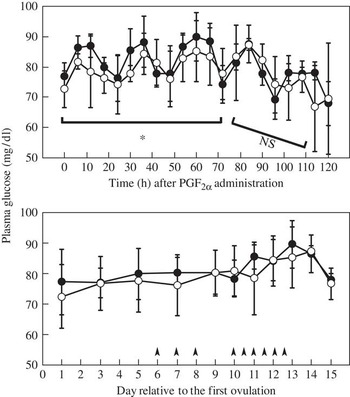
The changes in the plasma concentrations of glucose during the experiment are shown in Figure 1. Significant changes in daily profiles of glucose concentrations (Figure 1, bottom panel) were not shown before and after the treatment.
Changes in blood glucose concentrations (mean ± s.d.) in the treatment (solid circles) and the control (open circles) groups throughout the experiment. Changes in glucose concentrations in samples collected at 6-h intervals during the follicular phase are presented in the upper panel (*P < 0.05 v. control group; NS = not statistically significant).

For the samples taken at 6-h intervals after PGF2α administration, the concentrations of glucose showed clear daily fluctuations in both groups (Figure 1, upper panel). Changes in the plasma concentration of glucose in the treatment group were significantly (P < 0.05 using two-way (between = group, within = time) ANOVA for repeated measures) higher than those of the control group during the period between 0 and 72 h after PGF2α administration, whereas a significant difference in the changes in glucose concentrations was not detected in the period between 78 and 110 h after PGF2α administration.
Follicular and luteal dynamics
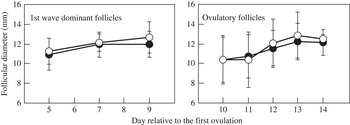
The growth of the dominant follicles of the first follicular wave and ovulatory follicles for the second ovulation during the treatment are shown in Figure 2. Two and one heifers showed twin ovulation after PGF2α administration in the treatment and control groups, respectively. No significant difference was detected in the growth of dominant follicles, maximum diameter of the ovulatory follicles, the day of the second ovulation and the ovulation rate between treatment and control groups (Table 1). The maximum diameters of corpus luteum after the first and second ovulations were not significantly affected by the treatment.
Changes in the diameter (mean ± s.d.) of the first wave dominant follicles (left panel) and ovulatory follicles (right panel) in treatment (solid circles) and control (open circles) groups.

Characteristics of follicular and luteal dynamics

Data are presented as mean ± s.d.
Changes in ovarian steroid hormones
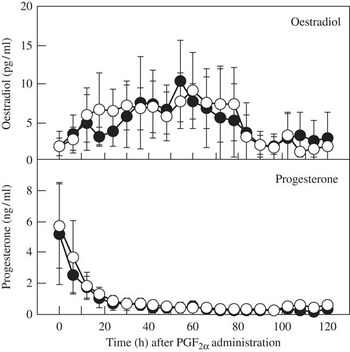
Changes in the plasma concentrations of oestradiol (upper panel) and progesterone (bottom panel) after PGF2α administration are shown in Figure 3. The concentrations of progesterone rapidly decreased, and then gradual increases in the oestradiol concentrations were observed in both groups. There was no significant difference in the changes in oestradiol and progesterone after PGF2α administration between the control and treatment groups.
Changes in the plasma concentrations (mean ± s.d.) of oestradiol (upper panel) and progesterone (bottom panel) during the follicular phase induced by PGF2α administration 10 days after the first ovulation in treatment (solid circles) and control (open circles) groups.

Discussion
There are contradictory results regarding the response of blood glucose concentration to oral propylene glycol administration in dairy cows. Some previous studies showed a rise of blood glucose concentration in dairy cows given propylene glycol orally (Studer et al., Reference Studer, Grummer, Bertics and Reynolds1993; Grummer et al., Reference Grummer, Winkler, Bertics and Studer1994; Miyoshi et al., Reference Miyoshi, Pate and Palmquist2001; Rizos et al., Reference Rizos, Kenny, Griffin, Quinn, Duffy, Mulligan, Roche, Boland and Lonergan2008). In contrast, others did not observe any changes in blood glucose concentration after propylene glycol administration (Chagas et al., Reference Chagas, Gore, Meier, Macdonald and Verkerk2007; Moallem et al., Reference Moallem, Katz, Lehrer, Livshitz and Yakoby2007). In this study, the analysis of daily changes in blood glucose supports the latter studies, and that of blood glucose concentration in samples collected at 6-h intervals supports the former studies. Daily fluctuation of blood glucose concentration was observed in lactating cows (Plaizier et al., Reference Plaizier, Fairfield, Azevedo, Nikkhah, Duffield, Crow, Bagg, Dick and McBride2005), whereas its variation seemed to be smaller than those of the present results. This study showed clear daily fluctuations in the blood glucose concentration at 24-h intervals in heifers regardless of the treatment, and significant increases in the blood glucose concentration were only observed until 72 h after the propylene glycol administration with frequent blood sampling analysis. Grummer et al. (Reference Grummer, Winkler, Bertics and Studer1994) examined optimal doses of propylene glycol by checking the changes in propionate production and NEFA concentration after the administration of different doses of propylene glycol in dairy cows. They concluded that 296 ml/day is the most effective dose to stimulate metabolic condition, suggesting that the dose that we used is an optimal dose for cattle to stimulate gluconeogenesis. A previous study reported that the basal level of plasma concentration of glucose in heifers tended to be higher than that of lactating cows (Abeni et al., Reference Abeni, Calamari, Stefanini and Pirlo2000). Clear daily fluctuations in the blood glucose concentration after propylene glycol might be a heifer-specific phenomenon associated with the differences in the body metabolic status between lactating cows and heifers. On the other hand, the present finding that stimulatory effects of propylene glycol drenching on blood glucose concentration were not detected in daily blood samples indicates that the present treatment was inappropriate to support a sustained rise of blood glucose concentration beyond 24 h in heifers. The present results also indicate that frequent blood sampling (more frequently than at 24-h intervals) is required for the evaluation of the effect on glucose concentration in heifers.
Under such metabolic conditions induced by administration of oral propylene glycol drenching that was adapted for ketosis therapy, no significant effect on ovarian function such as follicular growth and the development of corpus luteum was observed after the treatment. Previous study reported that long-term treatment with propylene glycol promoted the onset of first post-partum ovulation in dairy cows (Miyoshi et al., Reference Miyoshi, Pate and Palmquist2001; Chagas et al., Reference Chagas, Gore, Meier, Macdonald and Verkerk2007). In contrast, the present results appear to support another observation in dairy cows that post-partum ovarian dynamics and the first ovulation were not influenced by the treatment of propylene glycol (Rizos et al., Reference Rizos, Kenny, Griffin, Quinn, Duffy, Mulligan, Roche, Boland and Lonergan2008). A daily rise of blood glucose concentration was induced by the treatment of propylene glycol drenching, whereas no stimulatory response of hormonal concentration (e.g. oestradiol concentration during the follicular phase) to the treatment was observed in this study. Differences in physiological conditions (post-partum cows v. heifers) and/or methods (long-term v. short-term treatments) might be related to these contradictory results of response to propylene glycol drenching. Although the number of ovarian follicles (Viñoles et al., Reference Viñoles, Forsberg, Martin, Cajarville, Repetto and Meikle2005; Somchit et al., Reference Somchit, Campbell, Khalid, Kendall and Scaramuzzi2007) and ovulation rate (Zabuli et al., Reference Zabuli, Tanaka, Lu and Kamomae2010) increased when blood glucose concentrations were stimulated by the high-energy diet treatment during the oestrous cycle in small ruminant species, it is possible that the efficacy of a rise in blood glucose levels on ovarian function might be limited in mono-ovular species such as cattle.
The lack of positive influences of blood-borne nutrients other than glucose might be directly and/or indirectly related to the present findings. Propylene glycol is mainly metabolized to propionate for utilization as a glucogenic precursor in the rumen (Emery et al., Reference Emery, Burg, Brown and Blank1964). Studer et al. (Reference Studer, Grummer, Bertics and Reynolds1993) have reported that absorbed propionate metabolized from propylene glycol in the rumen might stimulate pancreatic insulin secretion or propylene glycol and interproduct might play a role as stimulatory substances for insulin secretion. Several lines of evidence suggested that insulin-dependent glucose availability involves the modulation of pulsatile LH secretion in sheep (Ohkura et al., Reference Ohkura, Tanaka, Nagatani, Bucholtz, Tsukamura, Maeda and Foster2000; Tanaka et al., Reference Tanaka, Nagatani, Bucholtz, Ohkura, Tsukamura, Maeda and Foster2000). A previous study reported that an increase in the insulin secretion induced by the administration of propylene glycol for a relatively long time (∼150 days) during the post-partum period is associated with a rise of the LH pulse frequency in dairy cows (Chagas et al., Reference Chagas, Gore, Meier, Macdonald and Verkerk2007). In sheep, direct action of metabolic factors such as insulin and insulin-like growth factor (IGF-1) to ovary, for example, at the follicular level, on the productive ability of oestradiol from the follicle is associated with the levels of insulin and IGF-1. Insulin (Poretsky and Kalin, Reference Poretsky and Kalin1987; Stewart et al., Reference Stewart, Spicer, Hamilton and Keefer1995) and IGF-1 (Zulu et al., Reference Zulu, Sawamukai, Nakada, Kida and Moriyoshi2002) stimulated the production of ovarian steroid hormones from the follicle by promoting the expression of LH receptors in granulose cells. Further provision of supplemental feed and/or materials promoting a long-term rise in blood glucose level and other metabolic factors such as insulin and IGF-1 might be necessary for producing positive effects on ovarian function in heifers.
In conclusion, this study showed clear daily fluctuations and stimulatory changes in blood glucose concentration at 24-h intervals during the short-term treatment of propylene glycol drenching in heifers. However, follicular growth, formation of corpus luteum and blood oestradiol concentrations during the follicular phase were not affected under such metabolic conditions.
Acknowledgments
We thank Dr Gordon D. Niswender, Colorado State University, for providing reagents used in the oestradiol radioimmunoassay. This study was supported partly by a Grant-in-Aid for Scientific Research from the Japan Society for the Promotion of Science.