From the preschool years when children start to engage in extensive peer interactions, aggression is a salient issue because it may inflict harm on others and undermine group functioning (Dodge, Coie, & Lynam, Reference Dodge, Coie, Lynam, Eisenberg, William and Lerner2006). Children who display aggressive behavior are likely to be rejected by peers, to be perceived as incompetent by adults, and to have learning difficulties (Coie, Terry, Lenox, Lochman, & Hyman, Reference Coie, Terry, Lenox, Lochman and Hyman1995; Rubin, Bukowski, & Parker, Reference Rubin, Bukowski, Parker, Eisenberg, William and Lerner2006). From a developmental perspective, childhood aggression is a significant phenomenon because of its high stability and its association with pervasive and long-term negative outcomes such as juvenile delinquency, low educational and occupational status, and poor quality of social relationships (e.g., Caspi, Elder, & Bem, Reference Caspi, Elder and Bem1987; Coie et al., Reference Coie, Terry, Lenox, Lochman and Hyman1995; Kokko, Tremblay, Locourse, Nagin, & Vitaro, Reference Kokko, Tremblay, Locourse, Nagin and Vitaro2006).
In Chinese and perhaps many other group-oriented societies, aggressive behavior is strictly prohibited, and there are many social constraints imposed on this prohibition (Chen & French, Reference Chen and French2008; Luo, Reference Luo1996; Trommsdorff & Rothbaum, Reference Trommsdorff, Rothbaum, Vandekerckhove, von Scheve, Ismer, Jung and Kronast2008). Maintaining social harmony is the primary concern in both traditional and contemporary Chinese societies. To achieve this goal, individual behaviors that threaten the well-being of others and the group are clearly not allowed; almost all types of undercontrolled behaviors including aggression and disruption are viewed as highly problematic and “abnormal” (Cen, Gu, & Li, Reference Cen, Gu and Li1999; Chang, Reference Chang2004; Ho, Reference Ho and Bond1986; Luo, Reference Luo1996). During socialization, children are required to learn to control their frustration, anger, and impulsive and defiant behaviors from the early years (Chen, in press). Aggression and other externalizing problems in children have been a particular concern in recent years since China implemented the “one child per family” policy in late 1970s, because it is believed that only children may have more negative behavioral qualities including impulsiveness, selfishness, and lack of constraint (e.g., Fong, Reference Fong2004; Tao & Chiu, Reference Tao, Chiu, Tseng and Wu1985).
Empirically, it has been found that aggressive children in China display a variety of social, school, and psychological problems (Chen, Rubin, & Li, Reference Chen, Rubin and Li1997; Chen, Rubin, Li, & Li, Reference Chen, Rubin, Li and Li1999; Russell, Hart, Robinson, & Olsen, Reference Russell, Hart, Robinson and Olsen2003). Specifically, aggressive children are likely to acquire a low status in the peer group and be viewed as poor in social and academic areas. Moreover, unlike their North American counterparts who tend to overestimate their social competence and develop biased self-perceptions (Asher, Parkurst, Hymel, & Williams, Reference Asher, Parkhurst, Hymel, Williams, Asher and Coie1990; Boivin, Hymel, & Bukowski, Reference Boivin, Hymel and Bukowski1995; Rubin, Chen, McDougall, Bowker, & McKinnon, Reference Rubin, Chen, McDougall, Bowker and McKinnon1995), aggressive children in China perceive themselves negatively and report higher levels of loneliness, social dissatisfaction, and depression than nonaggressive children (Chen, Rubin, & Li, Reference Chen, Rubin and Li1995a; Chen et al., Reference Chen, He, De Oliveira, Lo Coco, Zappulla and Kaspar2004). This may be because children's social behavior and performance are regularly and publicly evaluated by teachers, peers, and self in Chinese schools, which makes it difficult for aggressive children to develop inflated or “inaccurate” self-perceptions of their social status. Finally, it has recently been found that despite the dramatic social, economic, and cultural changes in China that have affected the functional meaning of some other social behaviors such as shyness, aggressive behavior continues to be associated with extensive adjustment problems in Chinese children today (Chang, Reference Chang2004; Chen, Cen, Li, & He, Reference Chen, Cen, Li and He2005).
There are several noticeable limitations in exiting research on the relations between aggression and adjustment. Most of the studies have been cross-sectional and thus do not allow for inference about causal directions. The existing longitudinal studies are based largely on assessments at two time points, with aggression predicting later adjustment outcomes. This design does not control for stability effects and concurrent links between aggression and adjustment, which may at least partly explain predictive relations. Moreover, the influence of aggression is likely a continuous, long-term process, varying across different developmental periods. Two waves of data provide limited information about the developmental pattern of aggression. In addition, the influence may occur in direct as well as indirect manners. Researchers have focused on one-to-one relations between aggression and other variables, with little attention to indirect effects of aggression on one aspect of adjustment through the mediation of another aspect or other aspects.
The developmental significance of aggression may be understood according to the cascade model (e.g., Burt, Obradović, Long, & Masten, Reference Burt, Obradović, Long and Masten2008; Cicchetti & Toth, Reference Cicchetti, Toth, Renninger, Sigel, Damon and Lerner2006; Dodge, Greenberg, Malone, & Conduct Problems Prevention Research Group, 2008; Masten et al., Reference Masten, Roisman, Long, Burt, Obradović and Riley2005). According to this model, the negative effects of aggression may spread to various domains of individual functioning progressively over time. The progressive cascade process is reflected in both direct and indirect or mediated effects of aggression on adjustment. Despite its theoretical strengths, the cascade model has not been adequately examined in empirical research, largely because of methodological difficulties. According to Masten et al. (Reference Masten, Roisman, Long, Burt, Obradović and Riley2005), longitudinal panel data collected from at least three assessment points are important for the study of cascade effects with cross-time continuity controlled.
In the present study, we sought to investigate how aggression contributed to the development of social competence and academic achievement in a sample of Chinese elementary school children. Panel data on aggressive behavior and social and school adjustment were collected in each of Grades 2 to 6. Although we tested in the study reciprocal cross-lagged effects among aggression, social competence, and academic achievement based on the full cascade model, our focus was on how aggression affected social and academic outcomes. In addition to its direct effects, we were interested in whether aggression had indirect effects on later social and academic variables, especially over multiple lags (i.e., from Grade 2 to Grades 4, 5, and 6).
Our interest in the cascade effects of aggression is derived mainly from the belief that aggression is likely to exert a considerable negative influence on social and academic performance (e.g., Cicchetti & Toth, Reference Cicchetti, Toth and Cicchetti1991; Dodge et al., Reference Dodge, Coie, Lynam, Eisenberg, William and Lerner2006). It has been consistently found that children's aggressive behavior may elicit negative social evaluations and responses from peers and adults, especially in Chinese schools (Chen, Reference Chen and Bond2010). As a result, aggressive children may have few opportunities to obtain leadership status and to form positive social relationships, although they may establish support networks with similarly aggressive children (e.g., Cairns & Cairns, Reference Cairns and Cairns1994; Chen, Chang, Liu, & He, Reference Chen, Chang, Liu and He2008). At the same time, aggressive behaviors may disrupt the processes of learning and create a classroom environment that is detrimental to instruction and learning (Wentzel, Reference Wentzel, Elliot and Dweck2005). Moreover, the unfavorable social evaluations including public humiliation that aggressive children in China receive regularly may facilitate the development of a negative attitude toward the school milieu, which in turn, leads to a decline in academic interest and achievement (e.g., Coie et al., Reference Coie, Terry, Lenox, Lochman and Hyman1995; Dodge & Pettit, Reference Dodge and Pettit2003; Hinshaw, Reference Hinshaw1992; Risi, Gerhardstein, & Kistner, Reference Risi, Gerhardstein and Kistner2003).
We focus on the effects of aggression, to a large extent, because we believe that how different aspects of individual functioning contribute to each other is likely to be domain specific. The transactional processes in human development may depend on specific domains involved. The dispositional nature of aggressive behavior (e.g., Dodge et al., Reference Dodge, Coie, Lynam, Eisenberg, William and Lerner2006; Rothbart & Bates, Reference Rothbart, Bates, Eisenberg, William and Lerner2006), for example, suggests that this behavior may be less susceptible than social competence and academic achievement to the influence of other factors. Aggressive behavior may be established earlier than peer relationships and academic achievement in school. Thus, it is possible that the contributions of aggression to later social and school adjustment are more evident than those of social competence and academic achievement to the development of aggression. Nevertheless, we believe that social and academic problems contribute to aggression, perhaps in indirect ways, especially in late childhood to adolescence. For example, children who display social and academic problems tend to be affiliated with deviant peer groups that endorse antisocial and destructive activities (e.g., Chen et al., Reference Chen, Chang, Liu and He2008; Cairns & Cairns, Reference Cairns and Cairns1994). Group organization based on antisocial norms may reinforce and exacerbate children's aggressive behavior (e.g., Chen et al., Reference Chen, Chang, Liu and He2008; Dishion, Piehler, & Myers, Reference Dishion, Piehler, Myers, Prinstein and Dodge2008). Thus, it is conceivable that social competence and academic achievement predict later aggression.
The transactional processes among social, behavioral, and cognitive attributes may be not only domain-specific but also developmentally variant. Specifically, we believe that cascade effects may be stronger in younger ages because the greater malleability of individual characteristics in the early years allows for higher permeation of influence. The effects may decline or weaken with increasing age as social and cognitive characteristics become more coherently organized and steadily established and as different aspects develop in a more distinct manner, driven by their intrinsic forces that are formed cumulatively during development. Nevertheless, the influence of aggression on social and academic achievement and vice versa in the early years is an important part of the developmental process. The early influence may be reflected in direct as well as long-term indirect effects on developmental outcomes. In keeping with our interest in the impact of aggression, we focused in the present study on the examination of indirect effects of aggression on social and academic variables.
Therefore, based on the literature (e.g., Chen et al., Reference Chen, Rubin, Li and Li1999; Masten et al., Reference Masten, Roisman, Long, Burt, Obradović and Riley2005) and our speculations, we made the following hypotheses:
1. Aggression would be more stable over time than social competence and academic achievement.
2. The effects of aggressions on social competence and academic achievement would be stronger than those of social competence and academic achievement on aggression.
3. The effects would be stronger in younger ages.
4. Aggression would have significant indirect effects on social competence and academic achievement over time and across domains.
Method
Participants
The original sample consisted of 1,140 second-grade children (585 boys, 555 girls) in ordinary elementary schools in Beijing, P. R. China. Unlike a small number of “key” schools in the city in which students were often selected from different areas on the basis of their school performance, students in ordinary schools came from the residential areas in which the school is located. There were 30 classes, with approximately 40 students in each class. The mean age of children was 8 years, 4 months. The core curriculum, which was identical within the region, consisted of Chinese, mathematics, English, and physical education. The structure and organization of elementary schools are similar in China. Students are encouraged to participate in a variety of extracurricular social and academic activities in school, which provides extensive opportunities for children to interact with each other. One teacher is designated to be in charge of a class. This head teacher often teaches one major course and takes care of the social and daily activities of the class. Students are not allowed to switch classrooms. Students spend roughly the same amount of time in the classroom. The schedule of courses and other activities is typically identical for students in the same class.
Almost all of the children (98%) were from intact families. Because of the one child per family policy that was implemented in the late 1970s, 92% of the children were the only children in the family; others had one or more siblings. Nonsignificant differences were found between the different types of families on the variables or relations of interest in the study. The sample was representative of school children in urban China.
The follow-up data were collected each year in the same schools for Grades 3 to 6. From the original sample, 1,053 or 91.6% participated in the follow-up studies, and a total of 118 additional students who did not participate initially were included in the follow-up studies. Nonsignificant differences were found on the variables and relations of interest between children who participated in all waves and those who did not. The data were collected near the end of the school year (May and June) at each time.
Procedure
At each time, we group administered to the children a peer assessment measure of social behaviors and a sociometric nomination measure. Teachers were requested to complete a rating scale for each participant concerning his/her school-related social competence, academic performance, behavioral problems, and learning problems. Data concerning children's leadership and academic achievement were obtained from school records.
The members of our research team carefully examined the items in the measures, using a variety of formal and informal strategies (e.g., repeated discussion in the research group, interviews with children and teachers, psychometric analysis). The measures have proved valid and appropriate in Chinese as well as some other cultures (e.g., Casiglia, Lo Coco, & Zappulla, Reference Casiglia, Lo Coco and Zappulla1998; Chen et al., Reference Chen, Cen, Li and He2005). Extensive explanations of the procedure were provided during administration. No evidence was found that the children had difficulties understanding the procedure or the items in the measures. The administration of all measures was carried out by a group of psychology teachers and graduate students at Peking University. Written consent was obtained from all children and their parents through the school. The participation rate was approximately 95% at each time.
Measures
Peer assessments of social behaviors
We administered a peer assessment of social behaviors to the children, The Revised Class Play (Masten, Morison, & Pelligrini, 1985). During administration, the research assistant read each of the behavioral descriptors (e.g., “Someone who is a good leader”), and children were requested to nominate up to three classmates who could best play the role if they were to direct a class play. Children were asked to nominate students in their own class. When all children completed their nominations, they turned to the next item, until nominations for all items were obtained. Subsequently, nominations received from all classmates were used to compute each item score for each child. The item scores were standardized within the class to adjust for differences in the number of nominators.
The original Class Play measure consisted of items in broad areas of social functioning (Masten et al., Reference Masten, Morison and Pellegrini1985). Only aggression–disruption and sociability–leadership were of interest in the present study. Items on aggression–disruption were concerned with physical and verbal aggressive behaviors (e.g., “gets into a lot of fights,” “picks on other kids”). The items on sociability–leadership tapped several aspects of social competence (e.g., “makes new friends easily,” “helps others when they need it”). Factor analysis indicated that the items represented the corresponding factors. Previous studies have shown that the measure is reliable, valid, and appropriate in Chinese children (see Chen, Rubin, & Li, Reference Chen, Rubin and Li1995b, for test–retest reliabilities). Internal reliabilities were .91 to .93 for aggression and .96 to .98 for sociability in Grades 2 to 6 in the present study.
Teacher ratings
The head teacher in each class was asked to complete the Teacher–Child Rating Scale (based on Hightower et al., Reference Hightower, Work, Cohen, Lotyczewski, Spinell and Guare1986) for each participant in his/her class. Teachers were asked to rate, on a 5-point scale, how well each of the items described the child. Three factors were identified through factor analysis: (a) Aggression/Acting-Out (e.g., “overly aggressive to peers (fights),” “disruptive in class”), (b) School-Related Social Competencies (e.g., “participates in class discussion,” “comfortable as a leader”), and (c) Learning Problems (“having problems in learning academic subjects,” “poorly motivated to achieve”). Accordingly, three variables were formed on the basis on the corresponding items. The total scores on each subscale were standardized within the class to allow for appropriate comparisons. The Teacher–Child Rating Scale has proved reliable and valid in Chinese children (e.g., Chen et al., Reference Chen, Rubin and Li1995b, Reference Chen, Rubin and Li1997). Internal reliabilities were .81 to .83 for aggression/acting-out, .94 to .96 for school-related social competence, and .82 to .84 for learning problems in Grades 2 to 6 in this study.
In addition, teachers were asked to rate each child for academic performance on language, math, and English on a 5-point scale (1 = very poor, 5 = excellent). The internal reliabilities of this measure were .94 to .96. A single index of teacher-rated academic performance was formed based on the scores and standardized within the class.
Sociometric nominations
Each child was asked to nominate up to three classmates with whom he/she most liked to be and three classmates with whom he/she least liked to be (positive and negative nominations). As suggested by other researchers (e.g., Coie et al., Reference Coie, Terry, Lenox, Lochman and Hyman1995), both same-sex and cross-sex nominations were allowed. The nominations received from all classmates were totaled and then standardized within each class to permit appropriate comparisons. The measure has been proved to be reliable and valid in Chinese children (e.g., Chen et al., Reference Chen, Rubin and Li1995b). Following Coie, Dodge, and Coppotelli's procedure (Reference Coie, Dodge and Coppotelli1982), an index of social preference, which indicates likeability of the child in the class, was formed by subtracting negative nomination scores from positive nomination scores.
Leadership
There are various formal student organizations, which are often hierarchical in nature, in Chinese schools. “Leaders” of these organizations, elected by peers and teachers, are usually believed to be good students, especially in social and moral aspects. Leadership at a higher level such as school level is considered indicating greater competence than that at a lower level such as the class or within-class group level. Data on student leadership were collected from school records in the present study. Leadership was coded as follows: students who were group leaders within the class received a score of 1; students who held leadership positions at the class level and at the school level received scores of 2 and 3, respectively. Students who did not hold leadership positions were given a score of 0. This information has proved to be a useful and reliable indicator of school competence in Chinese children (e.g., Chen et al., Reference Chen, Rubin and Li1995b). The validity of the measure has been demonstrated in several studies in predicting Chinese children's social and psychological adjustment (e.g., Chen et al., Reference Chen, Rubin and Li1997).
Academic achievement
Information concerning academic achievement in Chinese, mathematics, and English was obtained for all participants from the school records. The scores of academic achievement were based on objective examinations conducted by the school. The maximum score for each of Chinese, mathematics and English was 100; a test score of 60 is usually considered the cutoff between a pass and a failure in a course. Grades in these subjects have been found to be a valid measure of school academic achievement in Chinese children (e.g., Chen et al., Reference Chen, Rubin and Li1997). In the present study, scores on Chinese, mathematics and English were averaged to form a single index of academic achievement.
Results
Data treatment and descriptive statistics
We used the full information maximum likelihood method to deal with the missing data for the children who did not have complete data, as recommended by other authors (e.g., Duncan, Duncan, & Li, Reference Duncan, Duncan and Li1998; Graham, Reference Graham2009; Schafer & Graham, Reference Schafer and Graham2002). We then conducted a confirmatory factor analysis to test the measurement model of latent constructs. Following the literature (Bandalos & Finney, Reference Bandalos, Finney, Marcoulides and Schumacker2001; Marsh, Hau, Balla, & Grayson, Reference Marsh, Hau, Balla and Grayson1998), we used multiple informants and item parcels to form indicators for the latent constructs in confirmatory factor analyses and all the subsequent structural equation modeling analyses. The two indicators of the aggression construct were aggression/acting-out scores based on peer and teacher assessments. These two indicators representing different informants were formulated by parceling the peer nomination and teacher rating items. Social competence was extracted from four indicators: peer-assessed sociability, social preference, teacher-rated social competence, and leadership. Academic achievement was extracted from three indicators: the academic examination scores, teacher rated academic performance, and teacher-rated learning problems (reversed scores). Confirmatory factor analysis results showed high to moderate factor loadings ranging from 0.58 to 0.89. The standard errors were low (<0.02), suggesting robust model estimation. The goodness of fit measures were satisfactory, χ2 (866) = 3623.01, χ2/df = 4.18; comparative fit index (CFI) = 0.93, Tucker–Lewis index (TLI) = 0.92, root mean square error of approximation (RMSEA) = 0.047, standardized root mean square residual = 0.078.
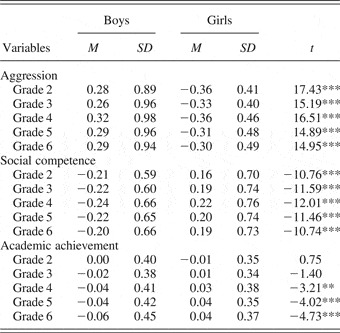
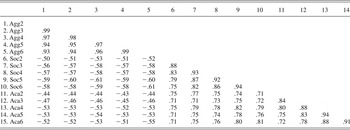
A multivariate analysis of variance revealed a significant overall effect of gender on all the variables, Wilks F (15, 1414) = 25.53, p < .001, partial η2 = 0.21. Follow-up univariate analyses indicated that boys had higher scores on aggression, and lower scores on social competence (partial η2 = 0.18 and 0.10, p < .001 and .001, respectively). In addition, boys had lower scores on academic achievement than girls in Grades 4 to 6 (partial η2 = 0.01, p < .01). Means and standard deviations and t tests comparing boys and girls are presented in Table 1. Intercorrelations among the variables are presented in Table 2. The magnitudes of the autocorrelations were generally high. Correlations across the domains were mostly moderate.
Means and standard deviations of the latent variables for boys and girls

**p < .01. ***p < .001.
Correlations among the latent variables

Note: Agg2 to Agg6, aggression in Grades 2 to 6; Soc2 to Soc6, social competence in Grades 2 to 6; Acad2 to Acad6, academic achievement in Grades 2 to 6. All correlations were significant at p <. 001.
Relations among aggression, social competence, and academic achievement
We conducted structural equation modeling analyses using Mplus 5.0 (Muthén & Muthén, Reference Muthén and Muthén1998–2006). The full information maximum likelihood was used in Mplus for estimation. Residuals of the same variable across different time points were allowed to correlate, as suggested by other authors (Marsh & Hau, Reference Marsh and Hau1996).
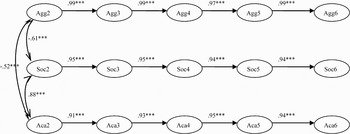
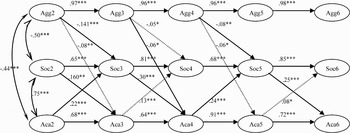
The estimates based on the stability model, without correlation across different latent variables are presented in Figure 1. We examined the model with and without correlating the residuals of the latent variables within time. The results were virtually identical, indicating that the stability coefficients were all significant. Then, we tested the full model to estimate all cross-lagged paths from one grade to the next (e.g., Grade 2 to Grade 3, Grade 3 to Grade 4) among aggression, social competence, and academic achievement. There was a significant difference between the stability model and the full model, χ2 (24) = 423.39, p < .001, although other fit indexes were similar for the two models (CFI = 0.91 and 0.92, TLI = 0.91 and 0.92, RMSEA = 0.05 and 0.05, respectively). The results based on the full model are shown in Figure 2. Aggression in Grades 2, 3, and 4 had significant and negative direct effects on the social and academic variables in the following year. Aggression in Grade 5 did not have significant effects on later social and academic variables. Social and academic variables did not have significant effects on later aggression. In addition, social and academic variables in most grades had time-lagged effects on each other. The pattern of the results based on the full model with correlated residuals of the latent variables within time was largely similar, although some of the initially significant cross-lagged paths became nonsignificant (e.g., aggression on academic achievement from Grade 2 to Grade 3 and from Grade 4 to Grade 5) as indicated by the dashed lines in the figure. As suggested by other researchers (Ge, Conger, Lorenz, Shanahan, & Elder, Reference Ge, Conger, Lorenz, Shanahan and Elder1995), we tested a concurrent reciprocal effect model that specified reciprocal effects among the variables within each grade without cross-lagged paths. The analysis indicated that the results were similar to those based on the cross-lagged effect model. Aggression had significant concurrent effects on social and academic variables in all grades except Grade 6. Social and academic variables had concurrent reciprocal effects on each other mainly in junior grades, but no significant effects on aggression. Because the cross-lagged model was more interesting and produced more conservative estimates, we focused on the results from the cross-lagged model in this study.
Estimates based on the stability model.

Significant estimates based on the five-wave full cross-lagged model (paths represented by the dashed line were nonsignificant when the residuals of latent variables were correlated within time).

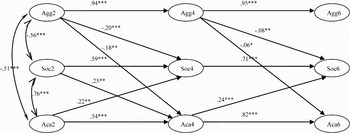
To examine whether the results were different with less frequent waves and a longer period of intervals, we tested the full model with Waves 2 (Grade 3) and 4 (Grade 5) dropped. The results for the three-wave model were similar to those for the five-wave model. There was a significant difference between the stability model and the full model, although other fit indexes were similar for the two models, χ2 (12) = 191.77, p < .001, CFI = 0.89 and 0.90, TLI = 0.89 and 0.89, RMSEA = 0.07 and 0.06, respectively. The estimates, virtually identical with and without correlating the within-time residuals in the model, are presented in Figure 3. Aggression had significant effects on social competence and academic achievement from Grade 2 to Grade 4 and from Grade 4 to Grade 6, but social and academic variables did not have significant effects on later aggression. Academic achievement had significant effects on social competence from Grade 2 to Grade 4 and from Grade 4 to Grade 6, and social competence had a significant effect on academic achievement from Grade 4 to Grade 6. Again, the results based on a three-wave concurrent reciprocal effect model were similar to those based on the cross-lagged model.
Significant estimates based on the three-wave full cross-lagged model.

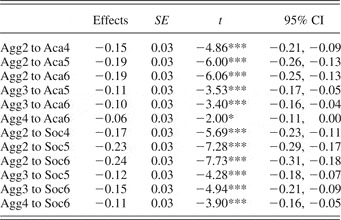
Finally, we examined indirect effects of aggression and social and academic variables based on the five-wave full model without correlating the within-time residuals in Figure 2. All indirect effects of aggression were significant. The results are presented in Table 3. The indirect effects were mediated by stability, social competence in predicting academic achievement, and academic achievement in predicting social competence; almost all effects of the specific paths were significant. The indirect effects of social competence on later academic achievement and of academic achievement on later social competence were all significant, mediated by the stability. Finally, the indirect effects of the social and academic variables on aggression were not significant.
Indirect effects of aggression on social and academic variables based on the full model

Note: CI, confidence interval.
*p < .05. ***p < .001.
Group invariance analyses were conducted to examine potential gender differences. There were significant differences in the factorial estimates but not in the factorial patterns between boys and girls. There were no significant gender differences in either the structural patterns or structural estimates.
Discussion
Aggressive behavior may be a universal characteristic of the human species (Chen & French, Reference Chen and French2008; Dodge et al., Reference Dodge, Coie, Lynam, Eisenberg, William and Lerner2006; Eisenberg et al., Reference Eisenberg, Ma, Chang, Zhou, West and Aiken2007; Whiting & Edwards, Reference Whiting and Edwards1988). The expression of anger and frustration in an aggressive and explosive manner appears in infancy (e.g., Cameras et al., Reference Camras, Oster, Campos, Campos, Ujiie and Miyake1998; Gartstein et al., Reference Gartstein, Gonzalez, Carranza, Ahadi, Ye and Rothbart2006; Stenberg & Campos, Reference Stenberg, Campos, Stein, Leventhal and Trabasso1990; Trommsdorff & Rothbaum, Reference Trommsdorff, Rothbaum, Vandekerckhove, von Scheve, Ismer, Jung and Kronast2008; Zahn-Waxler, Friedman, Cole, Mizuta, & Hiruma, Reference Zahn-Waxler, Friedman, Cole, Mizuta and Hiruma1996) and increases in frequency and intensity during toddlerhood and early childhood (Richman, Stevenson, & Graham, Reference Richman, Stevenson and Graham1982; Tremblay et al., Reference Tremblay, Japel, Perusse, McDuff, Bolvin and Zoccolillo1999). Aggression in middle and late childhood is a major concern to researchers, parents, and professionals because of the potential harm it may cause to others and the group as well as its cascade or spreading effects on other domains of development (Chang, Reference Chang2004; Chen, Reference Chen and Bond2010; Masten et al., Reference Masten, Roisman, Long, Burt, Obradović and Riley2005; Rubin et al., Reference Rubin, Bukowski, Parker, Eisenberg, William and Lerner2006). The cascade effects of aggression may be indicated by its direct contributions to later adjustment and indirect contributions to long-term outcomes through stability and/or other mediators. The results of the present study in Chinese children, such as those concerning the unreciprocal direct and indirect effects between aggression and social and academic performance and different effects in junior and senior grades, helped us further understand the nature of aggressive behavior and its significance for social and academic development.
The effects of aggression on social competence and academic achievement
In this paper, we argued that the contributions of aggression, social competence, and academic achievement to each other might depend on specific domains involved and be developmentally variant. Childhood aggression is viewed as a robust phenomenon, highly resistant to the influence of other factors (e.g., Dodge et al., Reference Dodge, Coie, Lynam, Eisenberg, William and Lerner2006). Moreover, aggressive behavior is believed to exert a considerable impact on various social behaviors, school performance, and psychological adjustment (e.g., Coie et al., Reference Coie, Terry, Lenox, Lochman and Hyman1995; Rubin et al., Reference Rubin, Bukowski, Parker, Eisenberg, William and Lerner2006). Thus, we expected that the effects of aggressions would be more evident on social competence and academic achievement than those of social competence and academic achievement on aggression. Consistent with the expectation, our results indicated that, in general, aggression contributed to the development of social competence and academic achievement, especially in the junior grades. However, social competence and academic achievement, although predicted each other, did not have significant effects on later aggression.
The processes of the influence of aggression on social and academic performance may involve interpersonal judgments and attitudes in interaction. As indicated earlier, aggressive behavior likely elicits negative social evaluations and responses, particularly in group-oriented societies such as China, which in turn lead to difficulties in social relationships (Chen & French, Reference Chen and French2008; Trommsdorff & Rothbaum, Reference Trommsdorff, Rothbaum, Vandekerckhove, von Scheve, Ismer, Jung and Kronast2008). The negative social experiences of aggressive children (e.g., public humiliation) in school may impede the development of self-confidence and facilitate the development of negative attitudes toward others and the school. As a result, aggressive behavior creates an adverse social and classroom environment that is destructive to the social interaction and learning processes (e.g., Chang, Reference Chang2003; Hinshaw, Reference Hinshaw1992; Risi et al., Reference Risi, Gerhardstein and Kistner2003; Wentzel, Reference Wentzel, Elliot and Dweck2005) and makes aggressive children to eventually suffer in social and school performance.
From a different perspective, the unbalanced influences between aggression and social and academic achievement were also reflected by the different stabilities in the baseline and full models. Aggression, social competence, and academic achievement were all highly stable over time in the continuity model. However, the stability coefficients were virtually the same for aggression, but substantially lower for social competence and academic achievement during almost all the intervals in the full model that included cross-lagged paths. The results again indicate that aggression is a highly stable and robust behavior and its development can be predicted, to a large extent, by the behavior itself in the early years. The high stability of aggression is likely to be contributed to by dispositional factors such as poor abilities to exert self-control in provocative and frustrating situations (e.g., Rothbart & Bates, Reference Rothbart, Bates, Eisenberg, William and Lerner2006). Social forces such as the “reputation effect” (e.g., Hymel, Bowker, & Woody, Reference Hymel, Bowker and Woody1993) may also play an important role in maintaining the continuity of the behavior. Thus, comprehensive efforts to help children improve their social–cognitive abilities as well as social conditions may be needed to reduce aggressive behavior. Relative to the stability of aggression, the high “raw” stabilities of social and academic variables are somewhat “spurious,” maintained in part by aggressive behavior. The stabilities decline when the contribution of aggressive behavior is controlled.
We found that aggression in Grades 2 to 4, but not in Grade 5, had significant direct effects on later social and academic outcomes. Although aggression in each grade had significant effects on later social and academic variables in the three-wave model, the effect was stronger from Grade 2 to Grade 4 than from Grade 4 to Grade 6. The mutual contributions of social competence and academic achievement also appeared to be more evident in the junior than senior grades. These results were consistent with our expectation that the cascade effects across the domains would be more salient in younger than older children. As children's social interaction and learning styles are more established with age, it is possible that their social and academic performance becomes more internally coherent and organized and thus is less receptive and responsive to the influence of other factors. Our results underline the importance of the developmental perspective in understanding the transactional processes among different aspects of individual functioning.
We were interested in indirect effects of aggression on social competence and academic achievement. Our results clearly indicated significant and indirect effects of aggression on social and academic outcomes over 2 or more years. The longitudinal indirect effects of aggression on social and academic variables were almost all significant, mediated by stability and the variable in a different domain. According to the cascade model (Dodge et al., Reference Dodge, Greenberg and Malone2008; Masten et al., Reference Masten, Roisman, Long, Burt, Obradović and Riley2005), indirect effects represent an important process in maladaptive development. Children and adolescents' problems are not necessarily produced by immediate or proximal antecedents, but instead are rooted in early deviant behavior and related adverse conditions. Our results suggest that in addition to its direct contributions to social and academic problems in the following year, aggression in middle childhood exerts negative influence on long-term social and school adjustment through indirect pathways. Therefore, the detection and remediation of early maladaptive behavior are critical to the prevention of broad and prolonged symptoms in childhood and adolescence.
Conclusions, Limitations, and Future Directions
The impact of aggression on social competence and academic achievement has long been an important issue in developmental research. Because existing studies in this area are mostly cross-sectional or longitudinal based on an incomplete, nonpanel design (i.e., aggression predicting later social and academic outcomes), however, it is difficult to clarify issues concerning causal directions and confounding factors such as the stability effect. The multiwave, longitudinal panel design used in this study allowed us to analyze cross-lagged direct and indirect effects of aggression on social and academic variables at varying time points with the stability effect taken into account. The results demonstrated the significant role of aggression in social and academic development in middle to late childhood.
We found in this study that social competence and academic achievement had cumulative reciprocal effects on each other, although they did not have significant effects on later aggression after its stability was controlled. Moreover, the literature has indicated that social competence and academic achievement may have an impact on adjustment in various domains such as deviant peer group affiliation and internalizing problems (e.g., Chen et al., Reference Chen, He, De Oliveira, Lo Coco, Zappulla and Kaspar2004; Dishion et al., Reference Dishion, Piehler, Myers, Prinstein and Dodge2008; Masten et al., Reference Masten, Coatsworth, Neemann, Gest, Tellegen and Garmezy1995). Thus, researchers, parents, and professionals need to pay attention to children's problems in social and academic areas.
There are several weaknesses and limitations in this study. First, we focused in the study on relations among aggression, social competence, and academic achievement, particularly the contributions of aggression to social and academic development. The influence of one aspect of individual functioning on another often occurs in social contexts. In China, for example, parents and teachers are encouraged to be involved in children's social interaction and school performance (Chang, Reference Chang2003; Chang et al., Reference Chang, Liu, Wen, Fung, Wang and Xu2004; Chen, Liu, & Li, Reference Chen, Liu and Li2000). Adult attitudes and reactions toward children's behavior may affect their motivation and performance in different areas. Thus, it will be important to investigate how social contexts including parent–child and teacher–student relationships play a role in children's social, behavioral, and academic development.
Second, the present study was concerned with contributions of aggression and social and academic performance from middle to late childhood. Our results indicate that the contributions are unbalanced with aggression having greater effects than social and academic achievement. One needs to be careful in generalizing the results to other developmental periods. It is possible that the relations are different in adolescence. As academic achievement becomes increasingly more important in high school in China (Chang, Reference Chang2004), children who are academically poor may “strike out” their frustration and develop deviant and antisocial behaviors. It will be interesting to examine the relations among aggression, social competence, and academic achievement in high school students.
Third, the present study was conducted in Chinese children. Although we used the Western literature (e.g., Masten et al., Reference Masten, Roisman, Long, Burt, Obradović and Riley2005) as a background for the discussion of aggression and its impact on social and school performance, some specific cultural features, such as emphasis on self-control and group harmony in Chinese schools, should be noted for the understanding of the results. The direct and indirect effects of aggression found in the study might, in part, because of the constant negative social evaluations of aggressive and other undercontrolled behaviors in the group-oriented society (e.g., Chen & French, Reference Chen and French2008). It will be interesting to study whether the results are similar or different in societies where aggressive behavior is not as negatively perceived as in China. Despite the weaknesses and limitations, the present study provided valuable information about the developmental significance of aggression in Chinese children.