

When Argentine president Mauricio Macri announced in March 2018 that he supported a “responsible and mature” national debate regarding the decriminalization of abortion, many were surprised. After all, in 2015, he was the first conservative president elected in Argentina in more than a decade, and no abortion debate had emerged under prior center-left governments. Moreover, Argentina is a Catholic country, which has, if anything, seen an uptick in religiosity over the past decade and little recent movement in public support for abortion rights preceding Macri's announcement. Extant scholarship indicates that public discussions regarding abortion decriminalization appear on the political agenda when countries become more secular, play host to supportive public opinion, and have a left majority in both the executive and the legislature; therefore, the timing and intensity of the abortion rights movement in Argentina poses an intriguing puzzle.
In light of recent legislative debates regarding abortion in other countries in Latin America, this article addresses the following question: Why did the abortion debate surface in Argentina when it did, in spite of a litany of factors that suggest it would be an unlikely case for decriminalization? To answer this question, we focus on the social movements literature and a nascent Argentine feminist movement that has achieved unprecedented scope and influence: Ni Una Menos (Not one [woman] less). Emerging in Argentina in the aftermath of several grisly murders of young women in 2015, Ni Una Menos transformed into an international movement against femicide and gender violence and eventually served as a platform for mobilization around abortion rights, helping feminist activists overcome traditional barriers to collective action. In a country where protest participation has effectively normalized (Moseley Reference Moseley2018), the massive number of women advocating for abortion rights made the issue impossible for policy makers to ignore.
We argue that the Ni Una Menos movement drew on its newly interconnected component organizations to mobilize women for abortion rights and persuaded Argentine citizens to take up their cause by framing abortion decriminalization as an issue of social justice, intrinsically connected to their claims regarding gender violence. Feminist activists argued that as long as abortion was illegal, Ni Una Menos would be a misnomer, given that clandestine abortions constitute one of the leading causes of maternal mortality. We maintain that without the existing platform for mobilization supplied by Ni Una Menos, it is highly unlikely that Argentina's abortion debate would have gotten off the ground. Even though abortion decriminalization has not yet been passed in the country, the sudden change in its salience as a crucial political issue is a testament to the growing strength of feminist mobilization within the country. In sum, rather than emphasizing long-term trends in public opinion or religiosity or the policy priorities of the incumbent government, we maintain that the abortion debate in Argentina was a consequence of strengthening feminist mobilization, which brought the issue to the forefront of the political agenda.
To evaluate our argument, we marshal evidence from (1) multiple surveys carried out before, during, and after the legislative debate regarding abortion legalization in Argentina and (2) in-depth interviews and media reports that shed light on the sources of abortion rights movements in an unlikely context. The quantitative component of our analysis is drawn from the 2012–19 AmericasBarometer national surveys of Argentina, which reveal a spike in female protest participation beginning in 2015, with shifting public opinion regarding abortion following (rather than prior to) mobilization surrounding the legislative debate in 2018. We complement these survey data with excerpts from in-depth interviews conducted in Buenos Aires in 2018 and 2019, which offer initial support for the argument that the Ni Una Menos movement supplied the organizational structures necessary for building the abortion rights movement and the social movement framing devices that won many Argentines over to the side of decriminalization.
EXISTING EXPLANATIONS OF ABORTION POLITICS IN LATIN AMERICA
Scholarship shows that public discussions about abortion decriminalization appear on the political agenda when a country grows increasingly secular, plays host to supportive public opinion, and has a left majority in both the executive and the legislature (Blofield Reference Blofield2013; Htun Reference Htun2003; Kreitzer Reference Kreitzer2015; Lopreite Reference Lopreite2012; Morgenstern Reference Morgenstern2012; Sutton and Borland Reference Sutton and Borland2013; Tabbush et al. Reference Tabbush, Díaz, Trebisacce and Keller2016). Examining recent changes in abortion policies in Latin America, Blofield and Ewig (Reference Blofield and Ewig2017, 482) highlight an additional factor: “the type of left party in power.”Footnote 1
The emphasis on declining religiosity in explaining movements for abortion rights would seem to find support in modern-day Latin America. Though Catholicism remains the dominant religion in Latin America, with a growing Evangelical minority, church attendance has been on the decline (Pew Research Center 2014, 4). Further, “widespread reports of sexual abuse scandals and their cover-up by Catholic authorities has reduced trust in an institution that had previously been seen as untouchable” (Blofield and Ewig Reference Blofield and Ewig2017, 485–86). Notably, the only two countries in Latin America where abortion is fully decriminalized are also two of the least religious, Cuba and Uruguay. These cases also share some of the contextual factors that the literature has recognized as key in decriminalizing abortion: a relatively weak local presence of the Catholic Church, a president who is not opposed to abortion decriminalization, and a strong partisan left.Footnote 2 Mexico City—the only subnational jurisdiction in Mexico with legalized abortion—is far less pious than other regions, lending credence to the notion that flagging religiosity paves the way for the abortion debate (LAPOP 2004–17). It also highlights the importance of taking subnational variation into account when studying the politics of reproductive rights (Lopreite Reference Lopreite2014) and of abortion decriminalization in particular.
Public opinion data regarding support for abortion decriminalization from a handful of Latin American countries show that a majority of citizens (from 64% in Nicaragua to 84% in Chile) support women having abortions in cases in which there is risk to their lives; support is also above 50% for cases of fetal deformity and lower than 50% for cases of rape only in Nicaragua (36%). Support for total decriminalization varies significantly, from 56% in Uruguay to 14% in Nicaragua (for a full report, see Blofield and Ewig Reference Blofield and Ewig2017, 492). The fact that Uruguay is the only democratic country in the region that has fully legalized abortion throughout its territory, and where public opinion has shifted to the point that a majority of the population favors legalized abortion, offers evidence for the importance of changing societal norms in placing the abortion debate on the public agenda.
Partisan politics also seem to matter in determining whether or not countries debate abortion laws. Reflecting on the effects that the recent “left turn” in Latin American politics has had on gender issues, Blofield, Ewig, and Piscopo (Reference Blofield, Ewig and Piscopo2017, 358) observe “improvement in the less-contentious outcome areas of political representation and violence against women, and mixed results in the more-contentious areas of women's economic autonomy (especially that of poor women), indigenous women's political empowerment, and reform of abortion laws.” Focusing on abortion decriminalization, the authors find that “left governments only liberalize abortion when strong, mobilized feminist organizations can back them up in confrontations with opposed groups” (361). Moreover, the authors recognize that abortion is a policy area in which there is significant variation in outcomes—from full legalization to total prohibition. “Abortion liberalization succeeded, but slowly, under the institutionalized partisan lefts of Uruguay and Chile, but was rejected in populist Ecuador and even saw regression in the populist machine case of Nicaragua” (361).
AN ABERRANT CASE? PUTTING ARGENTINA IN COMPARATIVE PERSPECTIVE
Dating back to 1921, abortion is illegal in Argentina except under two conditions: risk to the life of the mother and rape. In 2012, the Supreme Court issued a ruling ratifying the right to abortion for victims of rape with an affidavit, without the need for a police report or the judicialization of the case. The court urged the nation and the provinces to publish hospital protocols for their effective compliance. Nonpunishable abortions (i.e., legal interruptions of pregnancies) have had only partial compliance throughout the national territory. In 2019, only 10 of the 24 jurisdictions had nonpunishable abortion care protocols that correspond to the requests of the Supreme Court. In other words, more than half of the provinces in the country do not have a regulation that ensures compliance with the rights granted in 1921, which makes abortion effectively inaccessible even under the two conditions when it is technically legal (see Ruibal Reference Ruibal2018).Footnote 3
The timing of the recent legislative debate in Argentina challenged the received wisdom regarding abortion liberalization in comparative perspective, as discussions about abortion decriminalization began in a country represented at the maximum church authority in the Vatican. According to the Pew Research Center (2014), 71% of Argentines continued to identify as Catholic in 2014, and 91% of them held favorable views of the pope—his highest favorability score in Latin America. That said, Argentines tend to be more liberal than other Latin American populations in terms of their attitudes toward birth control, divorce, and allowing priests to marry (Pew Research Center 2014), and Argentina exhibits low rates of church attendance compared with other South American countries (LAPOP 2017). But religiosity (based on a question about the importance of religion in one's life) increased steadily from 2010 to 2017 in Argentina, according to the AmericasBarometer, which seems to undermine the notion that Argentina's abortion debate is the result of it becoming less devout (LAPOP 2017). Nor have we observed obvious trends in public opinion toward a wider societal embrace of abortion rights. In Ireland, for example, there was a steady softening in public attitudes toward abortion in the lead-up to legalization in 2018 (Loscher Reference Loscher2018). In Argentina, again based on data from the AmericasBarometer, no such trend was evident in public opinion data leading up to the abortion decriminalization debate (LAPOP 2017).
Another perplexing feature of the abortion debate in Argentina is its political timing. After three terms under the leftist governments of the Kirchners, Néstor and Cristina, the country's debate about abortion only began to take place under the conservative government of Mauricio Macri, whose most high-profile copartisans, in addition to the majority of his party, would eventually vote against the bill in Congress. The fact that a real debate regarding abortion rights only emerged following the election of a conservative government seems to contradict much of the literature, as well as regional trends. In 2012, Uruguay became the second country in the region after Cuba to fully decriminalize abortion, and it did so under the leftist government of Pepe Mujica's Frente Amplio, which also managed to legalize marijuana and same-sex marriage (Fernandez Anderson Reference Fernandez Anderson2017). While abortion is illegal throughout the rest of the country, Mexico City allows abortions up to 12 weeks into pregnancy—not coincidentally, leftist parties have held political control of the capital city since the late 1990s.
Organizations of Argentine women have advocated for abortion since the country transitioned to democracy in 1983. La Comisión por el Derecho al Aborto (Commission for the Right to Abortion) was founded in 1988. As Sutton and Borland (Reference Sutton and Borland2013) document in their detailed analysis of the abortion rights movement in Argentina, annual Encuentros—national women's meetings—have advanced reproductive rights since the mid-1990s, which led to the 2005 launch of the National Campaign for the Right to Legal, Safe, and Free Abortion. But mobilization for abortion rights has often provoked a strong backlash from conservative groups in the country, most notably those affiliated with the Catholic Church. Moreover, previous attempts at placing the issue on the legislative agenda all failed before they could get off the ground: “After the return of democracy in Argentina, several bills to liberalize abortion were presented in Congress, but none were discussed in commission or within political parties” (Htun Reference Htun2003, 152). In 1998, Alberto Maglietti, a former Radical Party senator who authored a bill to decriminalize abortion, said, “No one has demonstrated interest in considering this bill, it is an impolitic issue for the political environment of our country. To speak publicly in favor of abortion is impolitic” (quoted in Htun Reference Htun2003, 152).Footnote 4
Abortion rights have thus largely been viewed by Argentine politicians as politically untouchable. But other issues related to women's reproductive rights have found their way onto the legislative agenda in the democratic era. On the heels of sustained mobilization, particularly in the capital city, and drawing on framing devices borrowed from the transnational women's movement, Argentina adopted a federal plan for the distribution of contraception and other reproductive health services in 2003 (Lopreite Reference Lopreite2012). Yet advocates for universal access to contraception argued that providing impoverished citizens with reproductive services was critical to preventing abortions, thus constraining the debate to what was politically feasible and leaving the controversial issue of abortion legalization for another day (Lopreite Reference Lopreite2012).
MASS MOBILIZATION IN ARGENTINA AND THE DAWN OF NI UNA MENOS
The visibility and magnitude of feminist mobilization in the streets since 2015—amplified by mass media coverage and social media activity—might help demystify the timing of the public discussion of abortion decriminalization in Argentina. Over the past two decades, protest participation has effectively normalized in Argentina (Moseley Reference Moseley2018). It is a country characterized by high levels of citizen engagement in politics and relatively weak political institutions (Levitsky and Murillo Reference Levitsky, Murillo, Levitsky and Murillo2005; Machado, Scartascini, and Tommasi Reference Machado, Scartascini and Tommasi2011), which has produced some of the highest rates of participation in street protests in Latin America, a region characterized by widespread contention (LAPOP 2008–19). Mass demonstrations have emerged in Argentina during times of crisis, such as the cacerolazos (organized banging of pots and pans) and lootings that occurred during the debt default in 2001, triggering multiple presidential resignations (Auyero Reference Auyero2007), but also during times of plenty, such as the 2008 mobilization by farmers against an unpopular export tax on soy (Mangonnet and Murillo Reference Mangonnet and Murillo2020). Ni Una Menos clearly tapped into this tradition of contention, and borrowed from the well-developed repertoire of a country that is frequently suffused with protests.
Protests have been common in Argentina, and there have been several high-profile examples of street mobilizations having demonstrable successes in achieving movement goals. The 2008 protests against a planned export tax hike on soy producers eventually derailed the government's plans when President Cristina Fernández de Kirchner's own vice president cast the tie-breaking vote against the measure in the Argentine Senate. Previously, the incorporation of social movement leaders in Néstor Kirchner's government was widely credited for the social policy expansion that occurred throughout his term as president, which responded to the demands of groups that had been adversely affected by the country's 2001–02 economic crisis (Garay Reference Garay2016). Protest is not always effective in Argentina, but there are enough prominent examples of government responsiveness to street activism to justify civil society's continued reliance on the tactic.
The Ni Una Menos movement began as a massive march of more than 200,000 women in Buenos Aires on June 3, 2015, in front of the Argentine National Congress. The goal of the mobilization was to make visible the need to address femicide—or the killing of women for being women—in the country. Following the femicide of Chiara Páez, a group of female journalists, writers, and activists organized the mobilization. Páez was 14 years old and three months pregnant (during the autopsy, doctors discovered that she had tried to have an abortion) when her boyfriend killed and buried her in his grandparents' backyard. Though it was this particular murder that lit the match, there were a series of femicides before and after the Páez case that contributed to building and sustaining the movement. One day before the initial Ni Una Menos demonstration, 51% of Argentines said they intended to participate, and 71% were aware of the mobilization's stated goals (Buscaglia Reference Buscaglia2015).
The diverse throng of attendants surprised not only the organizers but also politicians and social movement leaders who had not experienced a massive women's movement since the Madres and Abuelas de la Plaza de Mayo (Mothers and Grandmothers of the Plaza de Mayo).Footnote 5 While those previous human rights–focused movements had been organized by women, they had never adopted an overtly feminist posture as in the case of Ni Una Menos. Explanations of Ni Una Menos's success are largely anchored in the motivating grievance—at the time, crime data reported that a woman was killed by a man every 36 hours in Argentina—and the opportunity social media provided to organize large numbers of people to take to the streets. Facebook and Twitter played a crucial role in disseminating the message and slogan (Terzian Reference Terzian2017).
The Ni Una Menos movement has proven remarkably resilient since its emergence in 2015. Each subsequent year, on June 3, hundreds of thousands of activists have congregated to commemorate the anniversary of the movement's origin. On other occasions, typically following high-profile cases of femicide, movement organizers have quickly mobilized their followers to hold the government to account. As we will elaborate in the following section, numerous social movement organizations that originated during the initial mobilization have remained active since. However, assessing the accomplishments and remaining challenges confronting Ni Una Menos reveals a mixed bag. While the movement obtained significant concessions from Congress—including a pledge to provide more women's refuges across the country, to officially report femicides as such, and to guarantee universal access to legal representation for victims of abuse—the government has only created a small percentage of the promised refuges, and the femicide rate actually increased in 2019 compared with 2018 (CNN Español Reference Español2019). Nevertheless, Ni Una Menos is now inscribed in Argentine women's historic struggle to defend and expand their rights.
HOW NI UNA MENOS FUELED THE ABORTION RIGHTS DEBATE
Our dependent variable in this study is the months-long national debate around abortion decriminalization, which began in earnest with Macri's announcement in March 2018 and carried on through the vote in the Chamber of Deputies in June (where it passed 129–125) and in the Senate in August (where it was rejected 38–31). During those months, abortion dominated the public conversation, as politicians were forced to weigh in on the issue for the first time in their careers and as activists filled the streets of Buenos Aires and other cities to voice their support for or opposition to the bill. The mobilization for abortion decriminalization was massive and diverse.Footnote 6 Beyond the high turnout, women who participated varied in terms of color, social class, and age. Indeed, scholars, journalists, and demonstration participants frequently highlighted the presence of high school and college students as a signal of changing times, a fact that the feminist scholar and activist Luciana Peker (Reference Peker2019) examines in her book The Revolution of the Daughters. As a well-known feminist activist told the authors the day of the vote in the Chamber of Deputies, “I looked around me and I knew we won. Most of those around me were teenagers.”Footnote 7
Yet how did the push for decriminalization get to that point? Abortion laws had not been updated in years, and nevertheless, Argentines, who are used to taking to the streets to make claims for social justice and economic rights, had not had mobilized massively before. What explains the recent emergence and sustainability of the mobilization for abortion rights in Argentina—the transition from “impolitic” to politics?
Our answer traces the emergence of the abortion rights movement to continued feminist mobilization since Ni Una Menos, beginning in 2015. Women's groups involved in Ni Una Menos formed a natural social movement “base” (Zald and Ash Reference Zald and Ash1966) for abortion decriminalization. Participants in Ni Una Menos were mobilized through social networks that provided the necessary information and organizational structure for overcoming the collective action barriers that had prevented abortion rights activism from emerging previously—echoing the key theoretical takeaways from resource mobilization theory (McCarthy and Zald Reference McCarthy and Zald1977). Once feminist issues were visible and feminist groups were activated, discussing abortion decriminalization became a possibility. Yet, we argue that it was the framing of the issue as a question of social justice—the approach long used by advocates for reproductive rights in Argentina (Lopreite Reference Lopreite2012; Sutton and Borland Reference Sutton and Borland2013)—and intrinsically connected to the claims made by Ni Una Menos that explains the possibility to persuade and activate larger and more diverse audiences who had not been previously mobilized toward this goal. In short, our argument is that the emergence of a feminist movement for abortion rights in Argentina is the result of two key mechanisms: (1) the co-optation of recently established Ni Una Menos mobilization networks and (2) the strategic utilization of familiar collective action framing that grew the movement's following.
Mechanism 1: The Organizational Base of Ni Una Menos
The success of feminist groups in putting abortion on the agenda resulted in part from their ability to leverage existing organizational structures supplied by Ni Una Menos, which linked women to one another based on a common feminist identity. Abortion activists drew on the social movement “base” constructed by Ni Una Menos—that is, “movement organizations, networks, participants and the accumulated cultural artefacts, memories, and traditions that contribute to social movement campaigns” (Tarrow and Tilley Reference Tarrow, Tilly, Boix and Stokes2007, 114)—to overcome collective action problems and articulate their shared claims. With the requisite feminist organizational structure in place, shifting focus to abortion rights and framing the issue as one directly relevant to the motivating claims aired by Ni Una Menos became a real possibility.
The Ni Una Menos movement drew on a diverse array of feminist organizations to articulate their claims—some of which were established women's advocacy groups, and others that emerged as the movement gained traction. Among the more traditional social movement organizations on the front lines of Ni Una Menos, the Fundación para el Estudio y la Investigación de la Mujer (FEIM; Foundation for the Study and Research of Women) was founded in 1989 and has advocated for access to contraceptives and against gender violence for decades. FEIM has formally supported abortion decriminalization since 2005 (Uranga Reference Uranga2018). On the other hand, the organization Mala Junta was established in 2015 amid the rise of Ni Una Menos and represents the embodiment of “popular feminism,” focused on combating neoliberal policies more broadly, including Argentina's prohibition on abortion, which disproportionately penalizes poor women. Other groups, such as MuMaLá (Mujeres de la Matría Latinoamericana), are formally tied to political parties—in this case, the leftist Libres del Sur—and have deep roots in existing social movements.
The aforementioned social movement organizations offer examples of groups that were deeply involved in mobilizing followers during Ni Una Menos and have also protagonized the abortion rights movement. In the case of Mala Junta and MuMaLá, the organizations initially mobilized against gender violence and then eventually pivoted to include abortion rights in their platform. Many of the constituent feminist groups framed their advocacy in terms of social justice—that it is impossible to separate wage inequality, gender violence, and Argentina's prohibition on abortion, as they all contribute to a fundamentally unequal and patriarchal society, and they all affect poor women most acutely. The feminist social movement organizations that appeared in concert on June 3, 2015 for the initial Ni Una Menos demonstration almost uniformly became part of the mobilization for abortion rights in the following years.
While Ni Una Menos built on existing networks of feminist activists, it also contributed to the mobilization of women who had never participated in politics before. Journalistic accounts noted that young women, many of whom were high school students, were particularly visible in the demonstrations for Ni Una Menos. In our view, this mobilization constituted an entry point for many women, or, in the words of one of our interviewees, “a wakeup call” to the political world—and their nascent feminist identity. Many of these young women would eventually become key actors in the mobilization for abortion rights, while also changing understandings about abortion within their own families and communities. For many of these women, then, Ni Una Menos represented a feminist call to action, and facilitated their eventual transformation into advocates for reproductive justice.
As countless social movements scholars have noted, constructing a successful movement depends as much on organization as it does the motivating grievance (see Jenkins Reference Jenkins1983). Women have died for decades from clandestine abortions in Argentina, but only when their capacity to organize was expanded did the movement for decriminalization gain traction. Established social movement organizations partnered with new collectives to bring attention to gender violence, and in the months and years to come shifted their focus to abortion rights—the organizational base for the abortion decriminalization movement was thus already in place thanks to Ni Una Menos. What old and new organizations had in common extended beyond a concern for gender violence itself—rather, most of the groups active during Ni Una Menos adopted overtly feminist philosophies, which facilitated the inclusion of abortion rights in their platforms. Yet mobilizing extant organizations to pursue decriminalization was only part of the story. In the next section, we address how activists framed the issue to persuade the Argentine public to take up their cause.
Mechanism 2: Expanding the Ni Una Menos Frame to Include Abortion Rights
The second mechanism that we argue explains the emergence of a powerful abortion rights movement in Argentina is the effort that activists made to frame abortion as a social justice issue, not dissimilar from gender violence. Collective action frames are “schemata of interpretation” (Goffman Reference Goffman1974) that are “intended to mobilize potential adherents and constituents, to garner bystander support, and to demobilize antagonists” (Snow and Benford Reference Snow and Benford1988, 198; see also McAdam Reference McAdam2017; Pedriana Reference Pedriana2006; Snow Reference Snow, Snow, della Porta, Klandermans and McAdam2013). Instead of arguing about the origins of life and the viability of the fetus, or legal justifications regarding the right to privacy, Argentine feminists framed the discussion in terms of social equality and justice—particularly economic justice. By emphasizing that mostly poor women die because of clandestine abortions, feminists succeeded in changing the conversation. Instead of broaching a philosophical discussion about whether abortions should be legal, the movement has relentlessly argued that women who want to have an abortion are still going to have one regardless of what law is on the books, but in unsafe conditions.
In Latin America, restrictive laws regarding reproductive rights coexist with high levels of clandestine abortions. These abortions pose serious public health questions. “In countries where abortion is illegal, many women undergo the procedure in clandestine circumstance at great risk to their health. Complications from botched abortions are a leading cause of maternal mortality in many countries and produce a major drain on the public health system” (Alcaraz Reference Alcaraz2018, 142). This point was echoed by virtually every affiliated social movement organization that advocated for decriminalization, including the collective Actrices Argentinas (Argentine Actresses), politicians, writers, social media influencers, and celebrities who were in favor of legalization and appeared daily on television, radio, and social media, as well as traveling across the country, transmitting the message.
As one of the most repeated cantitos (songs) during the mobilization explains, "aborto legal, en el hospital" (legal abortion, in hospitals), feminists wanted abortions to be legal and safely performed in public hospitals. By framing abortion as a social justice issue, anti-abortion activists had a more difficult time justifying their position. First, some of those who supported abortions in cases of rape or when the mother's health is compromised had to explain the internal contradiction of their argument: if abortions imply the murder of innocent human beings, abortion should be criminalized in all circumstances. Second, pro-life activists did not have a good response to statistics indicating how many women, who were mostly poor, died because of illegal abortions—the same Argentines who are anti-abortion often oppose the types of policies related to sex education and poverty reduction that might ameliorate this particular public health problem. Third, abortion rights activists reiterated that punitive laws on abortion are hardly ever enforced.
Our argument focuses on the effectiveness that framing abortion as a social justice issue had in broadening the support for abortion decriminalization. Grounding their claims in this framework, feminists focused on the prevalence of clandestine abortions and the disparity in access to safe (although illegal) abortions for women based on their social class. Many women, including journalists and celebrities, publicly shared their experience as well as trauma after having experienced illegal abortions, contributing to making the issue more visible and less taboo. Social movement organizations highlighted the connection between abortion rights and other daily forms of injustice suffered by poor women in particular, including domestic violence and wage inequality.
Public testimonies opened conversations about the reality of abortion while also making visible how differences in class translated into differences in access to health care, and ultimately in differences between life and death. Whereas 54% of low-income women are likely to have an unsafe abortion, the numbers are significantly smaller for higher-income (1%), and upper-middle-income women (5%) (Singh et al. Reference Singh, Remez, Sedgh, Kwok and Onda2018). Much of the solidarity that emerged in the feminist movement was anchored in this injustice, and Argentina has a long history of street-based activism in the name of economic justice. In framing abortion as a social justice issue, women from all classes built a sense of community that contributed to constructing solidarity—which “makes it easier to face the risks and uncertainties of collective action” (della Porta and Diani Reference Della Porta and M2020, 95). Everyone should have a right to have a safe abortion, as written on the green handkerchiefs used to symbolize the pro-choice movement—aborto legal, seguro, y gratuito (legal, safe, and free abortions).Footnote 8
The framing devices that emerged during the mobilization for abortion rights in Argentina were not entirely novel. Lopreite (Reference Lopreite2012) notes in her article about the debate in the late 1990s and early 2000s surrounding access to reproductive services that advocates for the 2003 sexual health law borrowed framing devices from transnational women's movements that zeroed in on the economic ramifications of unequal access to contraception (see also Piscopo Reference Piscopo2014). “The rationale for adopting new contraceptive policies was framed primarily as a way to help poor women . . . In countries with a weak tradition of civil rights, the focus on health, poverty and inequality may provide a strategic option for seeking [abortion] reforms, especially as they face strong organized opposition” (Lopreite Reference Lopreite2012, 124). The chair of the Senate health commission at the time of the sexual health policy debate, Mercedes Oviedo, argued that access to contraception would “save the lives of our sisters who do not have access to information and, when they become pregnant, perform abortions on themselves” (quoted in Piscopo Reference Piscopo2014, 116).
Notably, the collective action frame chosen by feminist activists leading up to and during the abortion debate in Argentina eschewed arguments familiar to the U.S. context related to individuals' right to privacy or the viability of the fetus. Sutton and Borland's (Reference Sutton and Borland2013) analysis reveals that dating back to the 1990s, abortion rights groups were far more likely to frame their advocacy for abortion rights in terms of economic/social justice or as a public health issue, rather than one grounded in civil rights. According to one of Lopreite's interviews with a female legislator who supported abortion, “There is no way that abortion would be passed in Congress using the argument of privacy rights. This is not something that would help us gain support from other legislators” (Reference Lopreite2012, 121). Thus, feminist activists were utilizing an inherited collective action frame that had developed over years in response to Argentina's unique political and cultural milieu (Ferree Reference Ferree2003).
What was new, ultimately, was that the social justice frame represented a natural “bridge” (Benford and Snow Reference Benford and Snow2000) between Ni Una Menos and abortion rights. By emphasizing the public health dimension of clandestine abortions, thus connecting the Ni Una Menos moniker to maternal mortality and highlighting how poor women in particular suffer under conditions of abortion prohibition, the abortion decriminalization movement was able to leverage its built-in social movement base to capture the attention of policy makers and make inroads in changing public opinion regarding abortion rights. By grounding their advocacy for legal abortion in the social justice language of Ni Una Menos, while arguing that reproductive rights were vital to protecting poor women from unsafe clandestine abortions, activists constructed a particularly resonant frame for the Argentine context, echoing the dynamics of abortion rights movements in other regimes where “discursive opportunity structures” necessitate a focus on the socioeconomic dimensions of abortion (see Ferree Reference Ferree2003).
Three years after the beginning of Ni Una Menos, the possibility to discuss abortion decriminalization became a reality. Following a massive demonstration in favor of abortion decriminalization on February 19, 2018, newspapers reported that President Macri had decided to open up the debate in the new legislative session. One of the two most important Argentine newspapers, Clarín, published on its front page that Macri had “given the green light to discuss abortion in the Congress” (Braslavsky Reference Braslavsky2018). In La Nación, the other venerable national newspaper, an article published on March 2 speculated that “it wasn't just that the President was motivated by calls from within his party in the legislature . . . [it was that] feminism, through massive mobilizations and growing public adhesion to its demands, had provided a roadmap” (Ini Reference Ini2018).
From this theoretical discussion, we derive three observable implications of our argument for which we intend to provide evidence. First, we expect that Argentina experienced an unprecedented uptick in protest participation by women, beginning with the dawn of Ni Una Menos in 2015. This mobilization aimed at drawing attention to gender violence would eventually translate into mobilization surrounding reproductive rights. Second, we expect that public opinion regarding abortion began to shift after this surge in female mobilization, rather than before it. In other words, the abortion debate was not a consequence of evolutionary change in terms of public opinion regarding abortion in Argentina—rather, public opinion only began to move once feminist mobilization was well underway. Third, we argue that framing abortion as an issue of social justice—intrinsically connected to the claims advanced by Ni Una Menos—was a particularly effective and culturally resonant tool for appealing to new supporters of decriminalization.
DATA AND METHODS
The empirical portion of this article proceeds in two stages. First, drawing on survey data from the AmericasBarometer national surveys of Argentina from 2012, 2014, 2017, and 2019, we provide evidence for the significant uptick in female participation in protest participation during the lead-up to the abortion legalization debate and report results from three predictive models of abortion justification. Second, we draw on recent in-depth interviews from Argentina and secondary sources to support our claim that Argentine women were converted from Ni Una Menos sympathizers into advocates for abortion decriminalization in 2018.
Evidence from the AmericasBarometer: Feminist Mobilization and Abortion Attitudes in Argentina
The AmericasBarometer surveys are conducted by the Latin American Public Opinion Project (LAPOP) based at Vanderbilt University. LAPOP carries out nationally representative surveys of more than 25 countries on the American continent on a biennial basis. The surveys of Argentina are nationally representative on key demographic variables and stratified by region—Capital Federal, Greater Buenos Aires, Buenos Aires Province, the Center, the Northeast, the Northwest, Cuyo, and Patagonia are all represented in the sample according to their percentage of the total national population in the most recent census. We utilize four rounds of the AmericasBarometer—2012, 2014, 2017, and 2019—each of which includes our key dependent variables of interest.
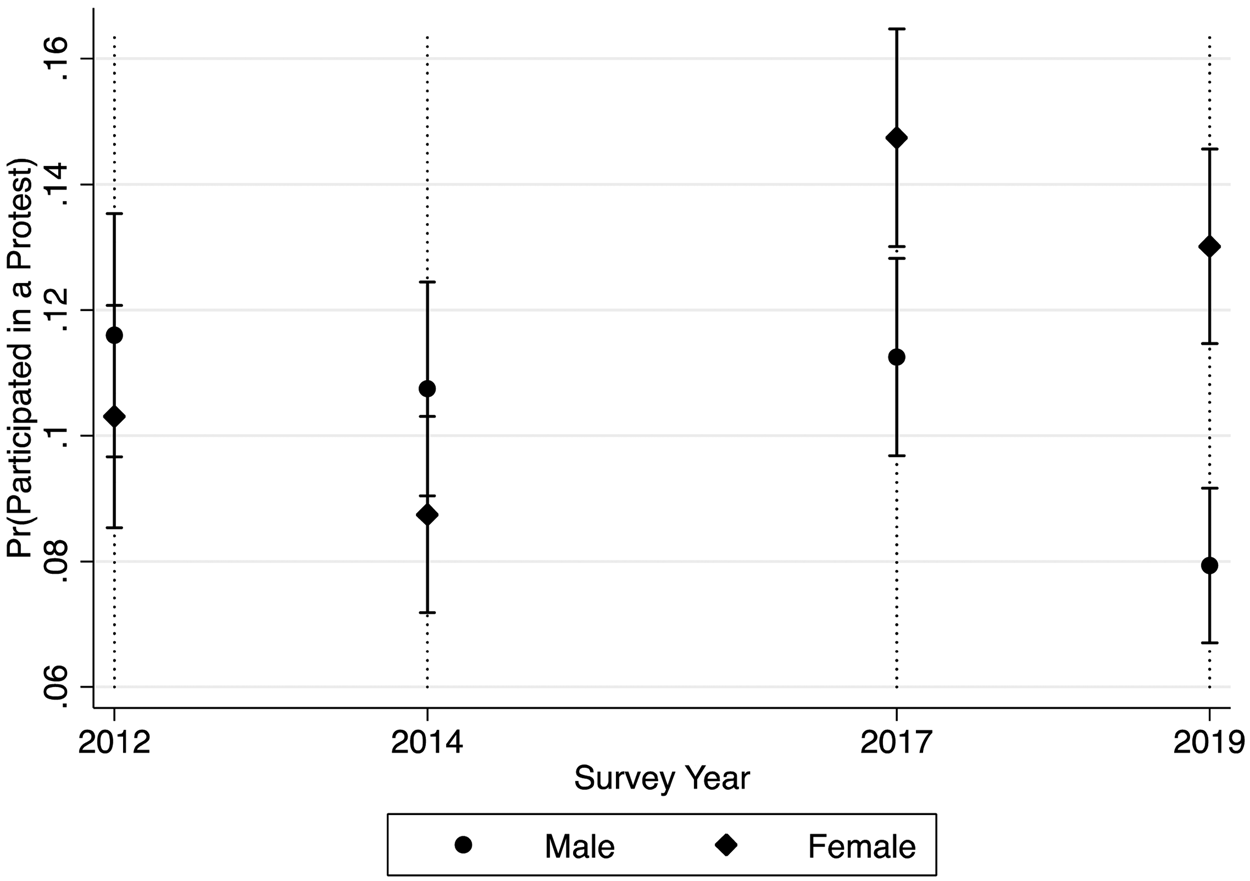
Our first dependent variable is drawn from a question that has been utilized in numerous studies of protest across Latin America (e.g., Machado, Scartascini, and Tommasi Reference Machado, Scartascini and Tommasi2011; Moseley Reference Moseley2018): “In the past twelve months, have you participated in a demonstration or public protest?” Response options were yes or no, necessitating logistic regression models of reported participation. Overall rates of protest participation increased from about 8% and 9% in 2012 and 2014, respectively, to 14% in 2017 and 13% in 2019, in keeping with our expectation that the Ni Una Menos movement produced higher rates of street mobilization throughout the country, particularly among women. In our models of protest participation, we also include a number of control variables, such as socioeconomic status, education, and community activism, in addition to other demographic predictors commonly referenced in the protest literature.Footnote 9 We expect to see a spike in protest activity among women in 2017 and 2019.
We begin by presenting the results for two predictive models of protest participation in Argentina in Table 1. Model 1 constitutes a baseline model, whereas Model 2 includes data from all four rounds of the AmericasBarometer and features an interaction between gender and survey year, illustrating how the effect of the former changes over time. Specifically, we find that the interaction terms for Female * 2017 and Female * 2019 are significant, indicating that gender exerted a more powerful effect on participation in 2017 and 2019 compared with 2012.
Logistic regression models of protest participation in Argentina, 2012–19

Note: Standard errors in parentheses.
*** p < .01; ** p < .05; * p < .1.
We graph the predicted probabilities of protesting in Figure 1 to illustrate the substantive strength of this finding. Whereas being female had a slight negative effect on protest participation in previous iterations of the AmericasBarometer, that trend reversed in 2017 with the Ni Una Menos movement, as women were about 40% more likely to have protested compared with the corresponding predicated probability for men (holding other variables in the model at their means). The significant effect of being female remains in 2019, with women nearly twice as likely to have protested as men. Given that this runs counter to regional patterns in terms of the relationship between gender and protest (Moseley 2018), this constitutes a significant finding and suggests that Ni Una Menos had a fairly unprecedented impact on female mobilization in Argentina.
Predicted probabilities of protest by gender and year.

Women participated in protests at unprecedented rates in 2017 and 2019. But what kind of change did the mobilization of women effect in terms of attitudes regarding abortion? For our second dependent variable, we again draw on a question from the AmericasBarometer, which asked individuals whether abortion is justified when the mother's health is at risk (0 = “no,” 1 = “yes, it is justified”). This measure is, admittedly, imperfect. Because we do not have a measure for support for abortion decriminalization over time, we must instead rely on “abortion justification” (Cohen and Evans Reference Cohen and Evans2018), which has been asked in the AmericasBarometer surveys since 2012. While this item asks about circumstantial support for abortion rights rather than full legalization, we believe any significant shifts in opinion as measured by this question are meaningful with respect to the decriminalization debate.
Figure 2 displays a clear uptick in the percentage of Argentines who justified abortion from 2017 to 2019—the first statistically significant change in abortion attitudes in Argentina since the AmericasBarometer included the item in 2012. Prior to 2019, men had actually become slightly less supportive of abortion when the mother's health is at risk over time, while women remained fairly consistent in their attitudes over the three preceding rounds of the AmericasBarometer surveys (LAPOP 2012–19). Attitudes only changed substantially after 2018, when feminist social movements took to the streets in pursuit of legalization and the decriminalization bill was hotly debated in the Chamber of Deputies and Senate.
Abortion justification over time in Argentina, 2012–19.

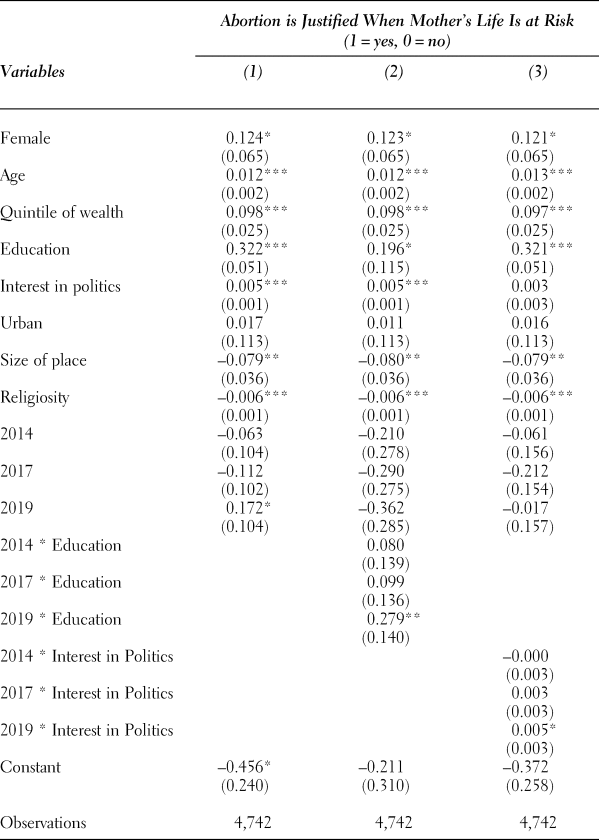
Next, we examine the determinants of abortion justification to shed some light on the process by which attitudes changed in 2019. Our expectation is that individuals who were exposed to social justice messaging during the debate were persuaded to support decriminalization, and that shift in public opinion only occurred during and after mobilization, rather than beforehand. Table 2 reports results from three logistic regression models of abortion justification. All three models include dummies for the year of the survey: 2014, 2017, and 2019. We also included a number of variables that we suspect might be related to abortion attitudes: gender, age, wealth, education, interest in politics, urban, size of place, and religiosity.Footnote 10 As expected, being a woman generally has a positive effect on the justification of abortion when the mother's life is in danger. Other variables such as religiosity, level of education, and socioeconomic status have the predicted effect on abortion attitudes, though age actually has a slight positive effect on abortion justification, contrary to the journalistic narrative in Argentina. Digging deeper, it appears that middle-aged people report the highest levels of support for abortion when mothers experience complications, rather than the oldest age cohorts.
Logistic regression models of abortion justification in Argentina, 2012–19

Note: Standard errors in parentheses.
*** p < .01; ** p < .05; * p < .1.
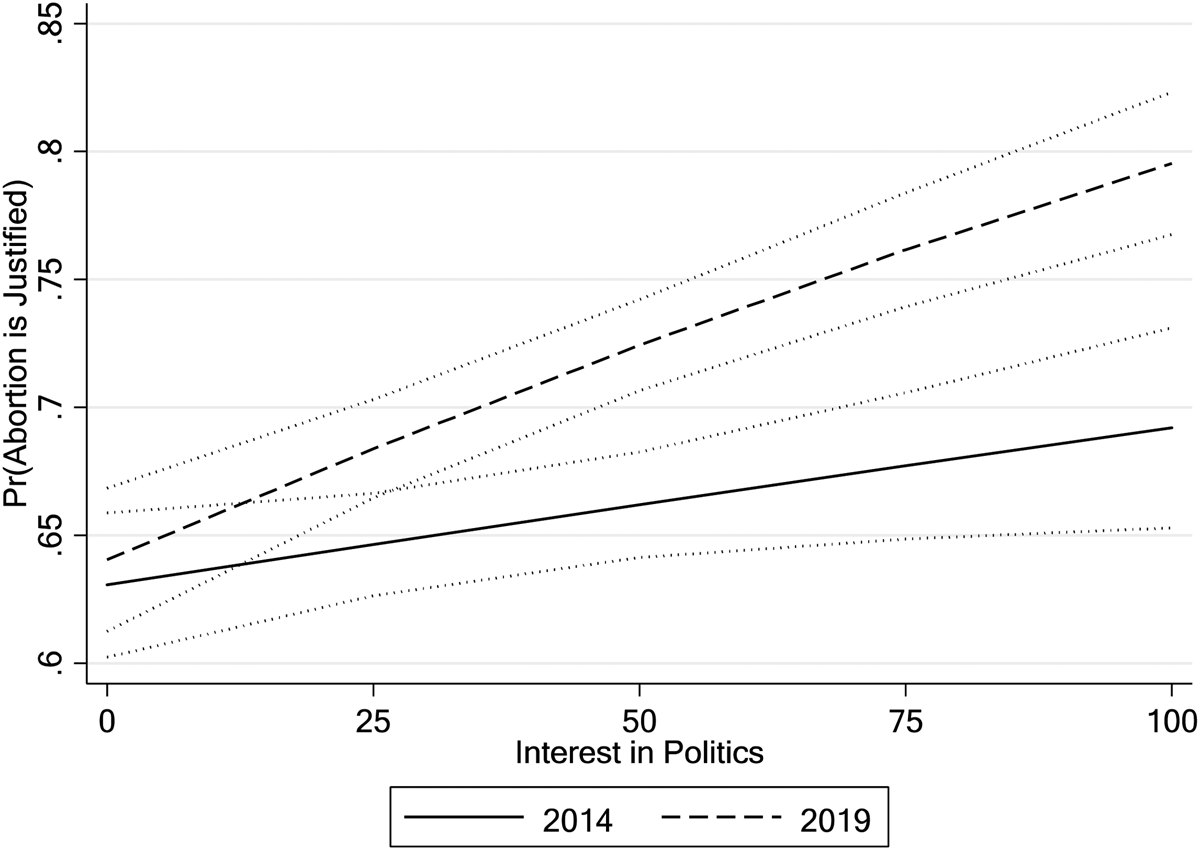
The most important results are those for the interactions between survey year and education and interest in politics. If feminist mobilization, and the accompanying coverage in social media and the news, were what shifted attitudes, models of opinion change would suggest that educated and politically interested citizens were the most likely to respond to the changing environment through updating their attitudes regarding abortion (Zaller Reference Zaller1992). This is indeed the case. While education and interest in politics were both correlated with abortion justification in each prior survey year, that relationship became stronger in 2019. In other words, politically aware citizens were more likely to support (in this case, limited) abortion rights in 2019 than prior. There were no statistically significant differences among respondents with low levels of education and political interest across survey years—this cross-time variation only occurred among the politically engaged. Figure 3 illustrates this result—clearly interest in politics was more strongly related to abortion attitudes in 2019 than in 2014, as the ongoing debate won over politically aware citizens who might not have considered the issue before or had never associated abortion with social justice.
Predicted probabilities of abortion justification by interest in politics and year.

In this section, we have provided two pieces of evidence that support our account of the abortion debate in Argentina: first, female mobilization experienced a significant uptick before the movement emerged, and second, abortion justification rose during and following that mobilization, and was most pronounced among individuals paying close attention to politics. Mobilization, then, would seem to have acted as the catalyst in putting abortion rights on the agenda, preceding a significant shift in public opinion, and generating a real debate regarding the issue for the first time in years. However, this evidence is merely suggestive, as we lack the type of quantitative data that would allow us to directly test for the causal relationship between feminist mobilization and the abortion debate. To shed light on that relationship, we look to qualitative data from in-depth interviews carried out as the decriminalization debate transpired.
Evidence from the Field: The Origins of an Abortion Rights Movement
We argue that Ni Una Menos provided feminist movements with organizational tools and a sizeable following to advocate for abortion mobilization. By framing abortion as a social justice issue, feminists succeeded in translating the demands to end violence against women into demands for abortion decriminalization. In this section, we look to qualitative evidence to trace the process by which Ni Una Menos activists were converted into abortion decriminalization supporters. Drawing on direct observations that took place in feminist group meetings, in-depth interviews, recorded testimonies, and lengthy conversations, we illustrate some of these linkages.
We gathered evidence by attending meetings of social movements that participated in the campaign for abortion decriminalization in 2017, 2018, and 2019. We also interviewed female high school and college students from private and public schools and colleges. Both of us have been conducting interviews with social movements for more than a decade, and discussions about abortion decriminalization have been ubiquitous in our recent fieldwork in the city and province of Buenos Aires and Mendoza province. One of us was in the field conducting a survey in poor neighborhoods while these events were taking place, and several interviewees, most of them women, referred to these issues in open-ended questions.
Our field diary notes from 2018 and 2019 registered a total of 47 conversations, 15 with feminist scholars and journalists and 32 with activists. Given the dynamic nature and the horizontal organization of the feminist movement for abortion legalization, we were unable to build a random sample of activists and participants. Instead, we used a snowball technique to conduct our interviews (Handcock and Gile Reference Handcock and Gile2011; Noy Reference Noy2008). The challenge of using this technique is missing influential activists that are not part of these networks. However, this shortcoming is not particularly challenging for our purposes, given that we are only focusing on networks that favor abortion legalization.
Beyond our observations in local meetings in poor neighborhoods in the province of Buenos Aires and meetings with a diverse group of neighbors in a cultural center in the city of Buenos Aires, we relied on the constant and comprehensive coverage of the movement in social and mainstream media. We followed more than 50 accounts on Twitter, Facebook, and Instagram, in addition to articles and testimonies from Argentina's most prominent national newspapers: Clarín and La Nación.Footnote 11 The combination of our conversations with activists, organizers, and participants in organizational meetings, in conjunction with published accounts in mainstream media and social media, contributes to support our argument.
Constructing Feminist Consciousness through Ni Una Menos
The feminist movement for abortion rights in Argentina comprises a plurality of women from all ages, classes, and political affiliations. This diversity can be easily observed on the streets—during street mobilizations—and online, where many members of the movement actively participate. Ni Una Menos contributed to changing the ways in which many women self-identify. Thinking about her participation in Ni Una Menos, Lucía, an upper-middle-class teenager, described how the movement enabled her to identify as a feminist:
It was very powerful. We were all there. The woman who works in my parents' house had the “Ni Una Menos” decal. It was all so powerful. It was then that everything changed . . . when I began to change. It was then that I began to think that maybe I was a feminist. (Lucía, 18 years old)
María, a lower-income resident from Greater Buenos Aires, who cleaned houses in the city, also began thinking critically about domestic violence after participating in the mobilizations. The women in the house she cleaned were attending Ni Una Menos demonstrations, and the mother and two daughters asked her to join them. Participating in the mobilizations enabled María to begin questioning the status quo of domestic violence in her life and community.
We had always lived with violence. Maybe before I wouldn't have called it violence, but for me it was nothing new . . . Ni Una Menos made me think: “Maybe it doesn't have to be the way it's always been? Maybe I could have a better husband.” Someone who didn't beat me and take my money. (María, 46 years old)
The construction of a movement that encompassed women from different ages, classes, religions, and geographies carried enormous power. Several testimonies from those who participated in the movement for abortion rights described a sense of connection and empowerment that led them to feel acompañadas (less alone). We argue that Ni Una Menos contributed to building an “imagined community” of women (Anderson Reference Anderson1983) that the abortion rights movement successfully mobilized. The linkage between Ni Una Menos and abortion rights and the construction of this imagined community of women becomes clear in the case of high school students. Female high school students became key political actors in the movement for abortion legalization by wearing the green handkerchief on their school backpacks, displaying publicly their support for abortion rights, and participating in every mobilization, which contributed to changing the minds of their parents and legislators.
Official statistics concerning violence against women show that homicides of women between 16 and 20 years old quadrupled between 2014 and 2016 and tripled for those aged 11 to 15 years old (Alcaraz Reference Alcaraz2018, 109). The most visible cases of femicide that fed the Ni Una Menos movement were young women—a fact that had a direct effect on the mobilization of high school students:
Before what happened with Anahí [Benitéz, another victim at 16 years old] I never considered myself a feminist—admitted Sofía Montenegro—After living through so much though, there wasn't any other option. And, I love all that this movement has accomplished when we are altogether. (Testimony cited in Alcaraz Reference Alcaraz2018, 110)
This testimony, which connects the occurrence of femicide with the recognition of feminism as a personal identity, was repeated in several interviews. Reading through journalistic and scholarly accounts, Alcaraz (Reference Alcaraz2018) observes a clear trend of women discovering and self-identifying as feminist. The testimony also shows the importance of togetherness, which became immortalized in one of the songs that is repeated in every mobilization and that illustrates the coming together—“now that we are together”—and the visibility that the movement of women has won—“now that you can see us.”
We observed this sense of community in meetings we attended, at which college students from Universidad Torcuato Di Tella, an elite university, came together with college students from public universities such as the Universidad de Buenos Aires, San Martín, and General Sarmiento. Beyond a common age and social status as college students, these women did not have much in common in terms of class background. Yet they all shared a commitment to the cause of abortion decriminalization.
I can tell you a thousand things, but I was shocked to think so similarly as someone so different [ . . . ] If you were blind [and could not see differences in the way they were dressed] you would not know who had money and who didn't. I'm fascinated to have found this sisterhood.Footnote 12
Inside the meeting we are all equal, but you go out and I have to take the train and two buses to get home, and one of the girls was driving an Audi.Footnote 13
The intersectional nature of the movement, spanning generations and social classes as well as the feminist imagined community, was described by Rosana Fanjul, a member of the National Campaign for the Right to a Legal, Safe, and Free Abortion, and it was evident in every mobilization in which one could observe the diversity of activists:
I don't know if I can describe what I've experienced. Out on the street, I thought about my grandmother, who I would have liked to have lived through what I was living . . . how happy she would have been to see me and her granddaughter supporting her on this journey. (Testimony cited in Alcaraz Reference Alcaraz2018, 9–10).
A female activist told us that participating in this movement reminded her of the sense of community she had experienced when attending soccer games with her family. Beyond their support for the team, she and her family did not have much in common with other game attendees. Yet every time her team scored a goal, she could hug anyone because she believed the feeling was universal among those in the community.Footnote 14
From Ni Una Menos to ¡Aborto Legal Ya! (Legal Abortion Now!)
When activists marched to commemorate the first anniversary of Ni Una Menos, there was a notable shift in terms of the extent to which leaders mentioned abortion rights in the lead-up to the event. The issue first appeared in an official Ni Una Menos manifesto on May 9, 2016, weeks before the annual march. In the communiqué, activists made explicit the connection between abortion laws and gender violence, using the case of a girl in Tucumán Province who had been imprisoned after having a miscarriage:
When a young woman is imprisoned in Tucumán, condemned to eight years in prison for homicide when she had a miscarriage, in a fraudulent case, it obligates us to reiterate the claim that without legalized abortion, there is no “Ni Una Menos,” and go back to the streets with more resolve than ever before. To machista violence and those who would perpetrate it, we say: Ni Una Menos, and against our bodies, Never Again.
The construction of a transversal abortion rights movement also took place in politics, where several female legislators formed a bloc to support abortion legalization, which highlighted the power of women working together. This was expressed in the words of Silvia Lospennato, a deputy from the PRO (the president's political party), whose speech was one of the most powerful, memorable, and emotional, as she mentioned every single woman—from different political parties, human rights movements, organizations, and judges, some dead and some alive—who had dedicated her career to the expansion of rights for girls and women:
I came to politics for that reason—to address real problems. For the sisterhood, the multi-partisan group of women who came to Argentine politics to stay . . . united in our differences, always supporting women. For the women in our homes, our mothers and daughters . . . we want abortion to be legal, safe, and free. That it be law.
The most high-profile case of Ni Una Menos changing public opinion regarding abortion rights was undoubtedly that of former president Cristina Fernández de Kirchner. In explaining her change of position from being against to being in favor of abortion decriminalization, the former president recognized the importance of the massive mobilizations that took place in the country:
If you want to know who it was that made me change my mind, it was the thousands of girls who took over the streets. It was seeing them become true feminists. (speech, August 8, 2018)
Our qualitative evidence shows how participating in Ni Una Menos provided women with a sense of community that empowered them. Several testimonies echoed the one from former President Fernández de Kirchner. In our conversations, many interviewees pointed out the relationship between Ni Una Menos and the campaign for abortion liberalization. When we were sharing our thoughts with a female activist about the visibility of the mobilization for abortion decriminalization a couple of days after the positive vote in the lower chamber, she was utterly surprised that we did not mention Ni Una Menos. As we were talking, she interrupted us and said, “Wait, women have been mobilizing in this country for a while now,” and to our surprise, she did not mention Madres de Plaza de Mayo, which we had explicitly referred to minutes before, but she did talk about the Ni Una Menos movement. She had a clear point: “We cannot think about abortion rights without thinking about the mobilizations for Ni Una Menos.”Footnote 15
The transformation from a feminist movement against gender violence into a full-fledged abortion rights movement could also be observed in mainstream media. Two cases stand out. First, during the summer of 2018, Intrusos (Intruders) paused its 19 consecutive years of coverage of entertainment gossip to discuss feminism and abortion legalization. It all began with an interview with the actress Aracelí Gonzalez, who said that she did not think of herself as a feminist because she “had a wonderful husband and a beautiful son.” The response on the internet was intense, as activists highlighted what they viewed as a common misunderstanding of feminism. The show then booked a feminist scholar to explain the concept the following day, and the ratings were, surprisingly, excellent. Jorge Rial, the host of the program, self-defined as a “machista in recovery,” decided to open up his program to discuss feminism. The program's placard read “Feminism: the debate that began in Intrusos.” The guests saw a unique opportunity to discuss abortion decriminalization, and on Friday, February 2, Rial opened his program wearing the green handkerchief on his right wrist (he later got a green handkerchief tattoo).Footnote 16
Second, in an editorial published February 1, 2019, in La Nación, editors praised two cases of 13-year-old girls who had become mothers. In both cases, the mothers of the young girls, one of whom had been sexually abused, asked their daughters to have an abortion. Titled “Teen Mothers with Capital Letters” (Niñas madres con mayúsculas), the editors celebrated the girls' maternal instinct. The editorial provoked a backlash, represented by the hashtag #niñasnomadres (#girlsnotmothers) that trended on Twitter. The editorial was repudiated by politicians, feminists, human rights groups, celebrities, and even the employees of the newspaper. Hours after the editorial was published, a large number of La Nación employees took a picture in the newspaper's newsroom, holding signs with the hashtag to express their rejection of their publication's position. Nora Bár, a known contributor to the newspaper for 30 years, wrote that she “did not agree with the editorial about teenage mothers published in the newspaper.” Several writers and human rights activists used the editorial to highlight that in their effort to defend abortion prohibition, the editorial overshadowed the fact that the girls had been raped.Footnote 17
The surprising discussion of feminism and abortion legalization on a celebrity gossip television show, and the severe backlash a national newspaper received for supporting abortion criminalization, highlight the extent to which advocacy for abortion decriminalization had become mainstream. The media's response to the abortion debate, on the heels of several years of feminist mobilization, reflects the depth of the changes in public opinion and the strength of feminist social movements in Argentina.
Linking Ni Una Menos and Abortion Rights through a Common Frame
Once abortion decriminalization had been absorbed into the set of claims articulated by Ni Una Menos, activists made a conscious decision to frame the issue in terms of social justice, consistent with framing devices used previously in Argentina to advocate for reproductive justice, rather than employing the rights-based frames familiar to observers of the abortion debate in the United States. Numerous civic organizations emphasized the socioeconomic aspects of abortion in Argentina, providing data to support the notion that women from marginalized groups are the most likely to die during clandestine abortions. From the Centro de Estudios Legales y Sociales (Center for Legal and Social Studies):
Middle- and upper-class women are able to access relatively high-quality sanitary conditions and rarely suffer post-abortion complications. Poor women, and in many cases teenagers, are the ones who must expose themselves to precarious facilities and practices. The highest rates of maternal mortality caused by illegal abortions are found in the Northeast and Northwest of the country . . . the regions characterized by the highest poverty rates in the country.
Ensuring that abortion was free and accessible to women across the socioeconomic spectrum became an important feature of the movements' evolving demands. In an official manifesto on the Ni Una Menos website from September 25, 2017, titled “Ni Una Menos Por Aborto Inseguro” (Not One Less Because of Unsafe Abortion), the movement's leaders outlined clearly the economic ramifications of abortion remaining illegal:
Even more so among those with less economic resources, illegality hits them the hardest . . . what kills is not abortion, but the insecurity that characterizes the practice when it's illegal.
According to this framing of the issue, abortions will occur regardless of whether the practice is legal—however, when women die from clandestine procedures, they are almost always poor women. While recent abortion decriminalization movements in countries such as Ireland and South Korea have focused on the dangers of clandestine abortions, in Argentina, that argument has been linked directly to socioeconomic status in a way that builds on previous claims regarding gender violence made by Ni Una Menos, but also appeals to a society where political fault lines have long been drawn around class. For this reason, the central claim voiced by activists has become not only that abortion be legal, but that it also be safe and free—a resonant framing device in the context of Argentina (Ferree Reference Ferree2003). As one demonstration participant succinctly put, “Ni Una Menos, legal, safe and free abortion, and the fight against machismo. For me all of these causes are one and complementary. They are a revolution against the patriarchy.”Footnote 18
CONCLUSION
This article represents a first attempt at explaining why the Argentine abortion debate gained traction in an unlikely context. Despite relatively stable public opinion regarding abortion rights, increasing religiosity, and a conservative party in government, Argentina experienced unprecedented rates of activism for abortion decriminalization in 2018. We argue this unexpected turn in Argentine politics is explained by the existing mobilization structures supplied by the Ni Una Menos movement and a framing device for claim-making that emphasized how abortion prohibition deepens social inequities in Argentina.
We find that women's participation in protests reached unprecedented levels between 2014 and 2017 in Argentina. Whereas traditionally, men are more likely to take part in street demonstrations in Latin America, that trend was reversed in 2017 on the heels of Ni Una Menos's emergence. The groups that mobilized in Ni Una Menos then provided a platform for expanding their claims to encompass abortion rights, based on evidence that underprivileged women were more likely to suffer fatal consequences from under-the-table abortions than affluent ones. Activists thus adopted abortion decriminalization as part of their overarching struggle for social justice, and convinced many women, media members, and politicians of its importance along the way.
Our article suggests that messaging grounded in social justice is more persuasive than rights-based arguments in Argentina—if so, this would have significant implications for numerous countries engulfed in debate regarding one of politics' most contentious issues. Increasingly, abortion decriminalization is becoming a topic of conversation in traditional Catholic countries like those found in Latin America. And even in countries that already have legalized abortion, such as the United States, conservative parties have found recent success in rolling back abortion rights. How feminist movements frame their arguments seems paramount to understanding the political future of abortion rights in all of these contexts.