INTRODUCTION
Located on the intersection that constitutes the territory between the Black and Caspian Seas, Georgia is one of the oldest Christian countries. Christianity became the state religion as early as the fourth century, and it significantly shaped the country’s cultural development. The Orthodox Church provided the basis for an emerging national unity and gave rise to distinct artistic and architectural forms based on a deep national tradition. Churches, monasteries, and religious complexes make up a significant majority of Georgia’s tangible cultural heritage today. Due to the frequent armed conflicts and natural disasters, these monuments have suffered from much destruction. Although, as their survival testifies, they were continuously repaired and restored in relatively peaceful periods. After abolishing the Georgian Church’s autocephalous status in the nineteenth century and following the years of Soviet occupation, the country regained its independence in 1991. Just a year later, still in a state of economic and political unrest and struggling with the process of nation building, Georgia initiated cooperation with the international heritage organizations by ratifying the World Heritage Convention in November 1992.Footnote 1
Bagrati Cathedral under the same nomination as Gelati Monastery, was one of the first nominations and inscriptions from Georgia on the United Nations Educational, Scientific and Cultural Organization’s World Heritage List. The nominations for both buildings came under Criteria (iv)—active monastery complex of Gelati and the half-ruined Bagrati Cathedral, which are located some ten kilometers from each other.Footnote 2 Although the wish to reconstruct Bagrati Cathedral had long existed in religious communities, submitting the nomination for inscription in the World Heritage List meant agreeing on international legislation and conservation principles, which allow for reconstruction only in exceptional circumstances.Footnote 3 The Operational Guidelines for the Implementation of the World Heritage Convention as well as the influential Venice Charter, which has been one of the primary references in the field of heritage conservation, emphasize the material authenticity of the heritage and architectural integrity of the monuments and do not encourage the reconstruction of ruined properties.Footnote 4 Thus, in 1994, when Bagrati Cathedral entered the World Heritage List, the state party of GeorgiaFootnote 5 should have been well informed that any significant intervention on the monument was to be avoided in order to keep its outstanding universal value and authenticity.
Alternatively, as a symbolic monument and a religious site, which, despite its ruined condition, had not lost its sacred meaning among religious communities, Bagrati Cathedral required a more holistic approach, which would have expanded the scope of the term “authenticity” by including the use, traditions, and spirit of the site,Footnote 6 and this placed the continuity of the cathedral’s original function in the core of its conservation.Footnote 7 When the Georgian Orthodox Church, which also is the legal owner of all ecclesiastical buildings located in the country,Footnote 8 initiated the full-scale reconstruction of the cathedral, restoring the regular religious services was stated to be the principal justification for the rebuilding.Footnote 9 And not long afterwards, the cathedral’s reconstruction also became one of the priorities of the country’s political agenda, as the president of Georgia by that time—Mikheil Saakashvili, who was actively involved in the process—chose the cathedral for his inauguration ceremony and linked its rebuilding to the recovery of Georgia’s territorial unity.Footnote 10
Despite representing a rather complex and unique case,Footnote 11 the Bagrati Cathedral’s reconstruction and delisting process still has not been thoroughly explored. So far, it has been analyzed by drawing attention to the issues of the authoritative and dominant political interests behind the reconstructionFootnote 12 and by reflecting on the consequences of the arbitrary decision-making against the International Council on Monuments and Sites’s (ICOMOS) advice.Footnote 13 However, studies tend to look at the issues explicitly from the heritage experts’ perspective and echo ICOMOS’s mission reports that the full-scale reconstruction of the ruined monument resulted in the loss of its outstanding universal value and authenticity, so that the cathedral no longer deserved to be included in the World Heritage List.Footnote 14
The aim of this article is to set the case in a relevant cultural and historical context and offer a closer look at the conservation and restoration decisions and exchanges between the state party of Georgia and UNESCO/ICOMOS, considering issues from the world heritage designation to the reconstruction and eventual delisting of the site. It reveals the tensions between the values of the monument that each stakeholder, at the local and international level, strove to bring forward and preserve.
HISTORICAL BACKGROUND: BAGRATI CATHEDRAL BEFORE THE WORLD HERITAGE INSCRIPTION
The Cathedral of the Dormition of the Mother of God, or the Bagrati Cathedral, as it is commonly known, stands on a hill overlooking the ancient town of Kutaisi in western Georgia. Its construction was commissioned in 1003 by King Bagrat III (978–1014), a monarch who united the country and entered history as the king of the first united Georgian kingdom. Reflecting the geopolitical situation of that time, Bagrati Cathedral soon became a symbol of a united and prosperous Georgia. With its architectural developments including decorative stonework, a monumental and dynamic appearance, and elaborate engravings, Bagrati Cathedral arose as a prominent representative of the medieval ecclesiastical architecture of the Caucasus region. For six centuries, the cathedral stood as one of the main worshipping centers of the country and as a place for the coronation and burial of several Georgian kings. Archaeological research conducted prior to its reconstruction revealed the remains of two churches beneath the eleventh-century cathedral: a fourth-century basilica, which had been replaced by another basilica in the late sixth century.Footnote 15 These findings indicate the sacred significance and continuous use of this place for religious purposes.
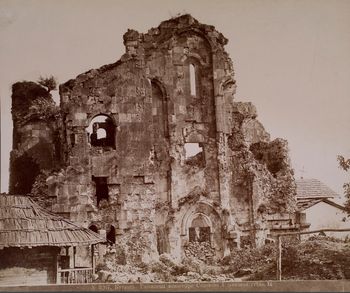
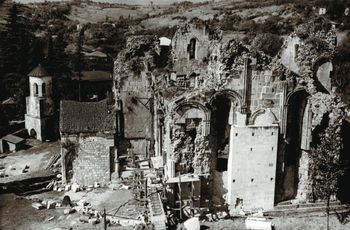
In 1691, a gunpowder explosion during the Turkish-Russian war, followed by Russian troops’ shelling in 1770, destroyed the cupola, the dome, and upper parts of the walls, which collapsed and left the cathedral in ruins. Between the eighteenth and early nineteenth centuries, during one of the gravest periods in the country’s history, the cathedral’s remaining walls were covered with vegetation, and the fallen stones were scattered in the yard (Figure 1).Footnote 16 Following its destruction, Bagrati Cathedral underwent several transformations, which included attempts to restore its original image, although the work never progressed due to the complexity of the task and the large number of missing architectural components (Figure 2).Footnote 17 However, some written sources of that period indicate that religious communities tried to use the cathedral for religious ceremonies, despite its ruined condition. One such record was made in 1833 by a Swiss traveller and scholar, Marie-Frédéric Dubois de Montpéreux. The author mentions an incident of falling stones that almost killed a priest performing a service inside the cathedral.Footnote 18 Possibly because it was dangerous to be inside the ruined building, the local bishop commissioned in 1911 to modify the south entrance of the monument to accommodate a small chapel for regular services (Figure 1).Footnote 19 Following this request, this area of the monument was cleaned and enclosed with a fence, and, by the 1930s, external supporting walls were built in order to prevent the remaining building from collapsing (Figure 2). Although the work was performed without regard for basic conservation principles, these interventions saved the monument from total deterioration and helped the connected communities to maintain the religious functionality of the cathedral while altering the building according to their needs.
Western façade of Bagrati Cathedral by the turn of the twentieth century. The south entrance, which was modified to accommodate a small chapel, is visible on the right edge of the photograph (photo taken by D. Ermakov, courtesy of the Georgian National Museum).

Bagrati Cathedral during the consolidation works in the 1930s. Supporting structure is built for the eastern wall. Portico on the south side is rebuilt using non-traditional material (courtesy of the National Agency for Cultural Heritage Preservation of Georgia).

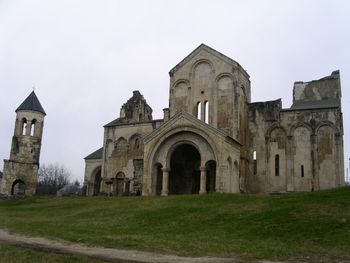
Another important phase in the history of Bagrati Cathedral began in 1951, when active scientific research and conservation work resulted in the restoration of the basic structure of the building. The work was performed in different stages and generally involved anastylosis, whereby fallen components and decorative fragments were placed back in their original place, incorporating reinforced concrete and cement where necessary, but not intervening when there was no evidence provided. In 1993, when the ICOMOS mission visited Bagrati Cathedral for evaluation, the walls had been raised to almost full height, and external decorations as well as the portico structures on three sides of the monument, had also been rebuilt. However, segments of the western section and the upper part of the building—the vaults, drum, and cupola—were not restored, which gave the cathedral the appearance of a monumental archaeological ruin (Figure 3).
Bagrati Cathedral after almost 40 years of restoration. This is how the monument looked when it was inscribed on the World Heritage List in 1994 (courtesy of Yasuhiro Kojima).

As commonly agreed today, due to insufficient material evidence as well as limited financial resources, the conservation work performed from 1951 to the 1980s did not intend to reconstruct the cathedral completely but, rather, aimed at giving the ruins stability and preventing further deterioration.Footnote 20 The decision to leave the monument in a half-ruined condition without rebuilding a dome and a roof ideally conformed to the internationally approved principles of conservation, but it did not provide the cathedral with a functional continuity because the ruined condition of the church limited regular services and lessened the community’s care and connection to the sacred site. One may argue that, given the country’s sociopolitical background at that time, restoring the cathedral’s intangible heritage expressions should not have been in the reconstruction agenda. Under Soviet governance and following many years of an anti-religious campaign,Footnote 21 ecclesiastical buildings remained mostly closed or had been converted to other uses and defined as secular objects. Heritage restoration in Soviet Georgia, as elsewhere in the Soviet Union, aimed at preserving the original fabric and architectural characteristics of the building rather than restoring the monument’s functional continuity and intangible dimensions.Footnote 22
The adverse impact of anti-religious agitation, which caused the symbolic and associative values of religious monuments to decline and forced the suppression of church authorities, became more evident in post-Soviet Georgia. In the process of reclaiming the nation’s suppressed spiritual life, the Georgian Orthodox Church acquired full ownership of all religious monuments in the country, including those in ruins. The challenges of protecting the original fabric and artistic-architectural values of the churches and monasteries while maintaining their functional continuity and living dimensions have continuously emerged since then.
WORLD HERITAGE INSCRIPTION: TRACING THE ROOTS OF THE CONFLICT
Georgia ratified the World Heritage Convention in November 1992, just a year after it broke away from the Soviet Union and was reemerging as a democratic country, and was motivated to reveal its distinctive heritage and culture to the world. Shortly thereafter, a nomination for the site comprising the Bagrati Cathedral and the Gelati Monastery was submitted to UNESCO and was given an inscription on the World Heritage List at the World Heritage Committee’s (WHC) eighteenth session in 1994.Footnote 23 It was the first nomination and inscription (along with the Historical Monuments of Mtskheta) from Georgia and the South Caucasus region in general. Evaluation by ICOMOS stressed that Bagrati Cathedral alone was not of sufficient importance for inclusion in the World Heritage List and was accepted as a serial property under Criteria (iv), which stated that “Bagrati Cathedral and Gelati Monastery represent the highest flowering of the architecture of medieval Georgia. … By virtue of the location of this country, it developed its own distinctive stylistic idiom. The two properties are the highest expressions of this idiom, in the context of the royal capital.”Footnote 24
Although the monument had already gone through several restoration works by 1994, the ICOMOS mission pointed out that, regarding its authenticity, “Bagrati Cathedral is ruined and may be considered ipso facto to be completely authentic.”Footnote 25 The mission also highly praised the earlier works performed on the building: “[T]he authenticity of the monument is beyond doubt, and recent conservation work has not obscured the fundamental surviving elements of the structure.”Footnote 26 Nevertheless, ICOMOS did not recommend continuing the reconstruction. The following passage from the mission report can be read as a warning in regard to the site’s future development: “The proposal, powerfully supported by the Metropolitan bishop is that the building should be repaired structurally and restored to use as a church. It is difficult to see how this could be achieved since the destruction preceded the age of photography and there will, therefore, be no evidence as to the exact proportions of the drum and cupola.”Footnote 27 Although the intention for a full-scale reconstruction by the Georgian Orthodox Church is highlighted in the site evaluation report, Criteria (iv) denotes the outstanding architectural or aesthetic values of the sites and, therefore, eliminates the possibility of any significant interventions to the fabric of the buildings. ICOMOS remained set on this matter throughout the conflictive process, stressing that “the monument was not inscribed as ‘a symbol of national identity and unity’ but as an achievement of medieval Georgian architecture, in a half-ruined condition.”Footnote 28
The fact that the monument was “not inscribed as a symbol of national identity and unity” and not even as a sacred site of the living religion, despite being recognized as such,Footnote 29 may seem somewhat surprising, particularly because living heritage sites are rarely evaluated based only on their tangible values. In fact, even if the religious connotations of Bagrati Cathedral were not taken into account due its ruined condition, another monument on the property—Gelati Monastery—was and still is the most prominent example of living heritage, where religious-educational activities and associated monastic communities had never ceased to exist.Footnote 30 Moreover, the world heritage nomination/inscription process of Georgia’s sites took place when the debates on the core values of living heritage and the concept of functional continuity were starting to emerge.
From the mid to late 1990s, following the adoption of the famous Nara Document of Authenticity and the “Global Strategy,” retaining intangible dimensions of properties started to be considered as crucial as preserving their historic fabric.Footnote 31 This new approach stressed that the state parties should “move away from a purely architectural view of the cultural heritage of humanity towards one which was much more anthropological, multi-functional, and universal.”Footnote 32 These modifications allowed several sites to satisfy the requirements for authenticity and integrity and acquire the World Heritage title, even if only under Criteria (vi), which emphasizes the symbolic and associative values of a given site and is generally recommended to be used in combination with other criteria.Footnote 33 Underlining the sacred values and living dimensions of the Bagrati Cathedral and Gelati Monastery in the nomination documents may have left the room for the cathedral’s reconstruction. However, given that the outstanding universal value and authenticity of both sites were decided based only on their physical characteristics, the idea of reconstruction clearly did not comply with UNESCO’s proposal that the reconstruction should be “ruled out ‘a priori.’”Footnote 34
Omitting the living religious dimensions of the site in the nomination dossiers can be related to the state party’s insufficient involvement in the designation process as well as to the lack of information on how to correctly implement the World Heritage Convention and the recommendations of the advisory bodiesFootnote 35, including the “Global Strategy.” The idea that Georgia may have not fully comprehended its responsibilities as a state party and the notions of conservation as defined by the Operational Guidelines is also demonstrated by the fact that all three world heritage sites of the country have had issues in meeting the preservation and conservation requirements right after their nomination and listing. Historical Monuments of Mtskheta was on the List of World Heritage in Danger for seven years due to inappropriate interventions in the construction of the medieval buildings, unclear protection zones, and sharing the responsibilities between the Georgian Church and the state agencies.Footnote 36 The third property, comprising the Upper Svaneti cultural space with its vernacular tower-houses, is still facing preservation issues due to the nonexistence of a long-term management plan and monitoring.Footnote 37
In the designation process, ICOMOS’s mission to Georgia casually expressed concerns about the numerous issues related to incomplete management plans, imprecise buffer zones, ownership, and even the language of the provided documents—Georgian or Russian, neither of which is a working language of the World Heritage Convention. Typically, such nomination dossiers are often deemed inadequate, and the sites are recommended for deferral with a substantial revision of the documents. However, UNESCO’s generous attitude towards the newly independent country, which also reflected the organization’s desire to fill the gap in the World Heritage List for the relatively underrepresented region of Caucasus, turned out to be both reward and punishment for the state party of Georgia in the years to come.
THE ROAD TO THE LIST OF WORLD HERITAGE IN DANGER AND THE EVENTUAL DELISTING
After Bagrati Cathedral and Gelati Monastery entered the World Heritage List in 1994, no maintenance works were carried out on either of these monuments, primarily due to the unstable political and economic situation in the country, which resulted in the decline of their state of conservation. The Bagrati Cathedral Restoration Fund, which was created soon after its inscription on the World Heritage List, did not succeed in initiating any significant consolidation works. Starting in 2002, as the one thousandth anniversary of Bagrati Cathedral was approaching, the Ministry of Culture and Monuments Protection of Georgia renewed research activities. The geological and seismic survey and analysis of the cathedral’s physical state revealed uneven foundations and structural instability, and it was decided to create a preliminary project for its rehabilitation.Footnote 36 However, the State of Conservation Report, which was submitted to the WHC in 2003 made no specific mention of any major plan for reconstruction.Footnote 39
According to paragraph 172 of the Operational Guidelines, all state parties are required to inform the WHC of their intention to undertake any restorations or new constructions on the property. The notice should be given as soon as possible and before making any decisions. This did not occur in the case of Bagrati Cathedral. In 2003, while being on mission to monitor another world heritage site—the Historical Monuments of Mtskheta—ICOMOS representatives also visited Bagrati Cathedral, where the rehabilitation works had already started prior to discussion with the international experts. The mission reported that there was a determination from the Georgian authorities to reconstruct the cathedral in order to restore its initial religious function and use. ICOMOS, however, considered that, in order to maintain its authenticity, it would have been more appropriate to retain the site as a ruin.Footnote 37 Given that the outstanding universal value of Bagrati Cathedral was associated with its elaborate medieval architecture and that material evidence for the reconstruction was also limited, there was a high risk that the reconstructed monument might not pass the “test of authenticity.”
In 2005, the National Agency for Cultural Heritage Preservation of Georgia reported that, as a result of ongoing archaeological research, additional artifacts had been discovered, allowing the restorers to “carry out structural reinforcement and reconstruct apparent parts of the building.”Footnote 38 In addition, in 2007, with the hope of being allowed to continue the reconstruction, the state party of Georgia submitted a report to the WHC, proposing the re-nomination of both Bagrati Cathedral and Gelati Monastery under two additional criteria: Criteria (i) and (ii).Footnote 39 The committee rejected the proposal, noting that “justification as well as a statement of authenticity/integrity were not fully in compliance with the Operational Guidelines,” and it again discouraged the idea of reconstruction.Footnote 40
Nevertheless, in 2008, a full-scale reconstruction plan for the monument was announced. The initial proposal, entitled “Executive Summary of the Rehabilitation Project of Bagrati Cathedral (Justification of the Selected Methodology)” was submitted to the WHC in 2009. It was designed and planned by Georgian architect Ivane Gremelashvili, a member of the scientific research team in the 1950s and 1970s, when a considerable portion of the monument was restored. His project proposed anastylosis in the areas where original material still existed, except the western facade, sections of the interior, and the dome. These parts were to be rebuilt using new stones and imitating the presumable historical look of the cathedral. This approach was supported by the idea that Bagrati Cathedral, according to its chronological and architectural appearance and proportions, fell in the particular group of Georgia’s monumental religious architecture of the eleventh century. This fact made it possible to rely on comparative, look-alike studies of “several other monuments contemporaneous to Bagrati Cathedral.”Footnote 41 The proportions and design of the cupola, including the number of windows on the drum, were also determined according to comparative analyses and by drawing parallels with topologically similar churches. Despite these efforts, the decision on reconstruction at the thirty-fourth meeting of the WHC was negative, based on ICOMOS’s report, which stressed the interdependence of keeping the monument in a ruined condition and maintaining its authenticity:
The proposed reconstruction project aims to give back to the ruin of Bagrati Cathedral its authentic function as a Cathedral and to create a new national symbol through the reconstruction. However, this will destroy much of its existing authentic substance as well as the authentic craftsmanship present in the ruin. This process will also destroy the authentic spirit and the “breath of history,” which future visitors will no longer be able to experience. Therefore, the project must be rejected on the grounds of being a severe threat to the outstanding universal value of the World Heritage property and its authenticity.Footnote 42
Nevertheless, while the preliminary project was under the WHC’s review, work had already started and was progressing on the cathedral. In 2010, when a reactive monitoring mission revisited the site, several interventions, such as an underground ring of reinforced concrete around the foundations of the building, reinforced concrete columns, and the use of stone slabs to cover the original masonry, were stated to be threatening the values for which the property was inscribed on the World Heritage List. As a result, the mission recommended placing the site (including Gelati Monastery) on the List of World Heritage in Danger. It was also underlined that if the reconstruction works did not stop, the property would eventually be deleted from the World Heritage List.Footnote 43 The committee advised the state party to organize a consultation with international conservation engineers and architectural conservators to reverse the interventions that had already been carried out.
During the same period, a public campaign initiated by several heritage professionals and members of ICOMOS Georgia started to actively protest the reconstruction by means of the “Save Bagrati Cathedral” campaign. The group, which succeeded in attracting several thousand members, claimed that the proposed reconstruction was challenging the monument’s architectural values and demanded the immediate suspension of the work.Footnote 44 As a result of these developments, the reconstruction process halted. The project resumed a year later in 2011 when an international expert, Italian architect Andrea Bruno, was appointed to advise on the cathedral’s further conservation, and one of the key figures in the modern conservation and heritage management field, Jukka Jokilehto, was invited to consult on a new rehabilitation strategy.Footnote 45
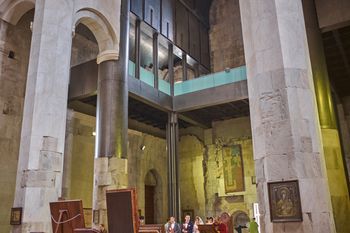
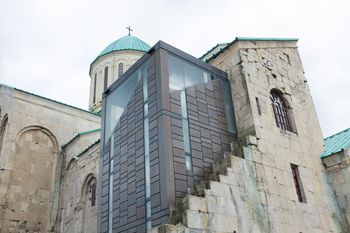
Andrea Bruno serves as a special architectural consultant to UNESCO and is renowned for his original preservation styles, such as contemporary additions to historic buildings and their adaptive reuse. He considered that reversing what had already been built on the cathedral was impossible and that a lightweight roof would have been a solution for the monument’s current situation.Footnote 46 As for the western section, for which no secure archaeological data and documentary evidence existed, Bruno’s plan intended to take down all of the structures inside the main nave, which were built according to the previous project, and reconstruct the area using modern, but structurally and visually compatible, structures.Footnote 47 This included the construction of steel pillars and beams and an intermediate floor at the same level as the original matroneumFootnote 48 with a new vault also made of stainless steel (Figure 4).Footnote 49 Bruno’s idea was to establish a museum of the cathedral in the matroneum, which would house the archaeological artifacts as well as the illustrative material of the different phases in the history of the monument. The museum was thought to be accessible via a new staircase and elevator attached to the facade of the cathedral on the northwest side (Figure 5).Footnote 50
Wedding ceremony inside the newly reopened Bagrati Cathedral. West section interior in glass and steel as designed by Andrea Bruno. The second floor, which was going to house a museum, is now inaccessible to the public (courtesy of T. Meladze).

External staircase in glass and steel as designed by Andrea Bruno. View from the northwest (courtesy of T. Meladze).

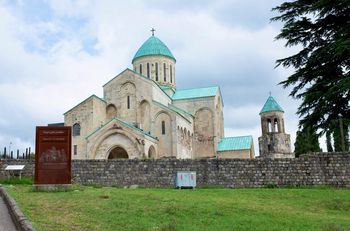
Though the intervention with modern materials was limited to the western part of the building, the idea of a site museum with metal structures, a glass railing, and an external staircase, which would also include an elevator, received an adverse reaction from the church authorities, and, in 2012, all work at Bagrati Cathedral had to halt again. The patriarchate of Georgia, while being one of the main advocates of reconstruction, took the modern transformation of the church as an offense to Orthodox belief and requested that the historic appearance of the monument be retained as much as possible.Footnote 51 The proposal to build a lightweight roof or an open frame with modern materials was also rejected on the grounds of being radical and non-traditional to Georgian ecclesiastical architecture.Footnote 52 The work could only resume after the parties settled on abandoning the idea of the site museum, elevator, and a modern cupola. As a result of the compromise between the patriarchate and international expert, only the reconstruction of the western interior and an external staircase in glass and steel continued according to Bruno’s project. The work on whole central section, drum and cupola, however, followed the initial project of Gremelashvili. Because of the rather heavy roof, this work necessitated substantial intervention with reinforced concrete on the original walls, and despite reusing the existing authentic stones, a new cupola covered with mint-green copper sheets markedly altered the overall appearance of the monument (Figure 6).Footnote 53
Reconstructed Bagrati Cathedral, viewed from the west. Copper sheets cover the newly constructed roof. Some of the original stones (darker in color) can be spotted in the structure (courtesy of T. Meladze).

The reconstruction of Bagrati Cathedral was completed in September 2012. The representatives of almost all of the political parties of the country and believers from different regions of Georgia attended and celebrated the official inauguration day.Footnote 54 Soon after the religious activities in the roofed cathedral were restored, architects Andrea Bruno and Ivane Gremelashvili were awarded Georgian state gold medals for their role in the cathedral’s recovery. Moreover, Bruno’s reconstruction project received the Domus Restoration and Preservation Prize from the University of Ferrara, which highlighted the success of the architect “in restoring the original arrangement of volumes” and his commitment to placing “the complex relationship between old and new with the original interpretation of reintegration.”Footnote 55
Conversely, in 2013, at its thirty-seventh session, the WHC expressed “its deep regret that despite previous decisions the re-building of Bagrati Cathedral has been completed” and considered “that the Bagrati Cathedral has been altered to such an extent that its authenticity has been irreversibly compromised and that it no longer contributes to the justification for the criterion for which the property was inscribed.”Footnote 56 The state party of Georgia was advised to prepare and submit the significant boundary modification of the property, which would have allowed Gelati Monastery alone to justify the criteria. In 2017, at its forty-first session in Krakow, the WHC approved the significant boundary modification “to exclude Bagrati Cathedral, to become Gelati Monastery, Georgia.”Footnote 57
DISCUSSION AND CONCLUSION
Bagrati Cathedral’s reconstruction and subsequent removal from the World Heritage List is arguably one of the most controversial and interesting cases in the history of heritage conservation, and it most vividly demonstrates the complexity of accommodating the multiple heritage values in the process of reconstruction. This article has aimed to spark debate on the conflicting interpretations of the former world heritage site by highlighting the interests and needs of the religious communities as opposed to the conservation experts and state authorities of Georgia. As a result, it may be argued that two major factors account for why the case turned out to be so controversial. First, inscribing the property under Criteria (iv) alone led to the omission of functional continuity and living heritage values of both Bagrati Cathedral and Gelati Monastery. This also did not allow the changes in the original fabric, separating the ruined cathedral from broader social and religious connotations. Second, the contradictory viewpoints on the monument’s fundamental values and uses further contributed to developing the conflicting opinions on the method of reconstruction favored by each stakeholder respectively.
In her presentation discussing the recent ICOMOS approaches to the reconstruction of world heritage properties, Susan Denyer, a world heritage advisor and secretary of ICOMOS-UK, notes: “ICOMOS was not against bringing Bagrati Cathedral back into use, but given its architectural value, we considered that the work should respect the original materials and form.”Footnote 58 While there can be various ways of bringing ruined religious heritage back into use, in Bagrati Cathedral’s case, the Georgian Orthodox Church and religious communities sought to place a complete dome and cupola on the building, which would also have been as close to the traditional look as possible. This proposal, in turn, required significant reinforcing interventions on the existing, original material and, since no primary documental evidence existed, a certain amount of guesswork as well.
One approach towards ecclesiastical monuments, which does not believe that a house of worship should be left in ruins but, instead, sees the reconstruction of churches as an act of resurrection, is related to the well-established principles of orthodox dogmatism and is rather common in Georgia.Footnote 59 It is different from the prevalent Western European principles influenced by one of the most acknowledged English conservation theorists, John Ruskin, who explains that “it is impossible, as impossible as to raise the dead, to restore anything that has ever been great or beautiful in architecture.”Footnote 60 Frequent armed conflicts and natural disasters in Georgia and Caucasus region throughout the centuries have necessitated extensive repair and, in some cases, complete reconstruction of the sacred buildings to make them functional again. In a country where religious monuments account for a significant majority of its tangible cultural heritage, there are very few churches that have not been restored at some point in history, including when the work has had to involve reconstructing the roof and dome.Footnote 61 Ancient alterations and repairs that put emphasis on restoring the religious features while repeating the original material, building techniques, and masonry style of the given monument, can be easily observed in many medieval churches, even today.Footnote 62 In this light, then, although overwhelmingly extensive, the reconstruction of Bagrati Cathedral can be viewed as a continuity of cultural tradition and, through this, the preservation of the religious faith of the country. Besides, under the principles of the living heritage approach, which emphasizes the importance of continuity of community connections and of conserving the purposes for which the monument was originally built, changes in the physical attributes of the property could have even be justified.Footnote 63
Indeed, more than once, ICOMOS has supported the reconstruction of world heritage sites when it was essential for the preservation and continuation of their “spirit” and “feeling” or when it was done with the aim of “healing” war-torn societies.Footnote 64 The listing of the Historic Centre of Warsaw, the Rila Monastery in Bulgaria, and the Mostar Bridge in Bosnia-Herzegovina are just a few examples of this compromise.Footnote 65 Despite the large amount of new material used, ICOMOS determined that the reconstructed sites had “a kind of truthfulness, even though in strictly material terms a considerable portion was not of identical or original pieces.”Footnote 66 The WHC’s recent shift from opposing reconstruction to supporting and even encouraging it for the sake of religious and cultural continuity begs a legitimate question: why did the idea of rebuilding Bagrati Cathedral, a symbol of united Georgia and a sacred site destroyed in the armed conflict, fail to be inscribed in a post-war reconstruction scenario?Footnote 67
When comparing Bagrati Cathedral’s case to other reconstructions in the world heritage context, the first seemingly noticeable difference is the long gap between the cathedral’s rupture and reconstruction. Being in a ruined state for more than 300 years, and, in ICOMOS’s words, having “taken on a life and a history as a ruin,”Footnote 68 the monument did not provide enough surviving documental or material evidence for a faithful restoration. Nor did this reconstruction meet the criterion of “exceptional circumstances” as the need to rebuild the monument was not a nationwide determination. The opinion that the half-ruined, roofless Bagrati Cathedral more strongly manifested its historical and cultural value commemorating the resilience of the country throughout the centuries prevailed among those citizens who did not seek the religious continuity of the monument and prioritized its ruinous, somewhat romantic appearance with all of its “scars” and “wounds.”Footnote 69 Conflicting interpretations of heritage values and disagreement on which “past” to preserve did not allow for the creation of a positive story about peace building or a symbolic reunification of Georgia. This is also because the territories of the country remain occupied to date.Footnote 70
No less significant is the fact that, unlike other cases, Bagrati Cathedral’s reconstruction started without prior consultation with the international experts. It should not be surprising that it received a radically different reception from the heritage organizations. UNESCO’s strictly fixed position regarding the Bagrati project demonstrated how the arbitrary decision making by the state parties and violating the Operational Guidelines are not to be tolerated, however nationally significant these decisions may be.
Finally, the most critical aspect in the story of Bagrati Cathedral concerns the issues on its material authenticity, which turned out to be determinant in keeping the site’s world heritage worthiness. Considering that the limits and conditions of reconstruction remain largely undefined in the world heritage context, and that the word “authenticity” means many different things in different contexts, how much of the current Bagrati Cathedral can be regarded as authentic is also debatable. ICOMOS representatives considered the property’s authenticity to be entirely compromised by the inappropriate interventions on the fabric and by creating a pastiche of the original structure.Footnote 71 Contrary to this assessment, the state party of Georgia reported that the monument’s authenticity and existing architectural qualities were augmented rather than diminished as a result of harmoniously integrating the original stones and modern additions “instead of using imitation.”Footnote 72 This view is also supported by the rehabilitation strategy that was prepared by the invited expert Jukka Jokilehto, in which the construction of new foundations and reinforcement in concrete was justified by the necessity for structural stability. Although admitting the loss of some original material, Jokilehto did not consider the reconstruction to have any negative impact on the cathedral’s authenticity: “Rather, the new knowledge and improved understanding of the building’s history and architectural qualities will improve the appreciation of its significance.”Footnote 73 In his articles “Reconstruction in the World Heritage Context” and “Questions of Authenticity,” Jokilehto links the property’s delisting to the “lack of communication” between the involved parties rather than to the loss of its authenticity per se.Footnote 74 , Footnote 75
The contrasting opinions on the ambiguous concept in the conservation field, such as authenticity, are not uncommon. They emerge each time there is a dilemma of whether to rebuild a ruin or retain the damaged and incomplete structure as a memorial to what was lost.Footnote 76 What is noteworthy, however, is that the opinions tend to differ sharply not only among state parties and international organizations but also among the experts, sometimes even within the same institution. In some unfortunate cases (such as Bagrati Cathedral, as it turned out), it is more the experts’ personal views and political interests that decide the fate of the heritage site and the ways of interpreting the past, rather than the social and cultural background of the given monument.
Despite the complexity of the case and especially in light of the current intense debates on reconstruction in the world heritage context, Bagrati Cathedral’s delisting remains a subject that researchers rarely address. Unlike the case of the Dresden Elbe Valley, another site removed from the World Heritage List against the state party’s consent, hardly anyone has questioned the credibility of revoking Bagrati Cathedral’s world heritage status. Due to its political context and complicated ownership status, the debates over the monument’s architectural versus religious values are sensitive inside the country as well. Although it reflects the increasing considerations on how to reconcile international and national, different, and sometimes opposing values of world heritage sites, Bagrati Cathedral’s story is an illuminating case and a lesson to be learned, especially in the midst of recent conflicts and heritage destruction taking place all over the world. It most vividly demonstrates that “heritage properties must be considered and judged within the cultural contexts to which they belong” and that re-establishing values of sacred world heritage through the process of reconstruction can only be achieved through extensive dialogue between the different stakeholders on the local and international levels who are seeking to preserve either its tangible or intangible dimensions.Footnote 77