Introduction
Day care centers for patients with dementia (PWD) provide a structured program offering “. . .therapeutic activities, health monitoring, socialization, and medical care” (Durand et al., Reference Durand, James, Ravishankar, Bamrah and Purandare2009, p. 414), as well as temporary relief from caregiving duties for the caregiver, while enabling the PWD to continue living at home. Positive outcomes, such as reductions in behavioral and psychological symptoms (e.g. Mossello et al., Reference Mossello2008), have been documented for patients. The cognitive stimulation provided in day care has also been shown to have a positive effect on the patient's cognition (Woods et al., Reference Woods, Aguirre, Spector and Orrell2012). Caregivers in turn benefit from lower caregiving stress and burden (Zarit et al., Reference Zarit, Stephens, Townsend and Greene1998; Mossello et al., Reference Mossello2008).
Nevertheless, like other dementia support services, day care services are under-utilized. The worldwide proportion of caregivers using day care varies from 9.7% to 18% (Weber et al., Reference Weber, Pirraglia and Kunik2011). Caregivers typically initiate day care late into the care trajectory, when the care recipient's condition has worsened, or when the caregiver is experiencing a greater level of distress (e.g. Cox, Reference Cox1997).
Factors found to influence a caregiver's decision to seek services include service delivery characteristics, such as suitable hours of operation, cost, and accessibility of the services (Kosloski et al., Reference Kosloski, Montgomery and Youngbauer2001), and the caregiver's awareness of services (e.g. Robinson et al., Reference Robinson2012). Caregivers’ own beliefs about the value of such programs are key to their decisions, for example, those who view services to be of low value to their needs are more likely to be non-users (Phillipson and Jones, Reference Phillipson and Jones2012).
In addition, if caregivers feel that they are able to cope and have sufficient informal support (from family, etc.), the perceived need to engage formal services is low (Toseland et al., Reference Toseland, McCallion, Gerber and Banks2002; Brodaty et al., Reference Brodaty, Thomson, Thompson and Fine2005). Care recipient factors, such as their level of functioning (Lévesque et al., Reference Lévesque, Cossette, Potvin and Benigeri2000) and their perception of service utility, which has been found to influence refusal (Durand et al., Reference Durand, James, Ravishankar, Bamrah and Purandare2009), are also considerations in the use of services. The relationship between the caregiver and the care recipient also affects service use patterns, e.g. spousal caregivers are less likely to use day centers and other respite services (Lévesque et al., Reference Lévesque, Cossette, Potvin and Benigeri2000; Robinson et al., Reference Robinson, Buckwalter and Reed2005).
Care recipients may be unwilling to use day care due to a perceived loss of dignity and embarrassment (Robinson et al., Reference Robinson2012). Notably, stigma has been identified consistently as a barrier to service utilization in culturally and linguistically diverse (CALD) communities (e.g. Liu et al., Reference Liu, Hinton, Tran, Hinton and Barker2008). Core values such as familism or filial piety (e.g. in Asian or southern European cultures) and culturally based beliefs about dementia (Gallagher-Thompson et al., Reference Gallagher-Thompson2012) can hinder service use. However, most research on culturally based beliefs and how they impact service use is derived from CALD communities living in Western societies, with few studies from Asia.
The only published study of dementia service use in Singapore found similarly low utilization of formal care services, even though caregivers experienced significant levels of burden and strain (Lim et al., Reference Lim, Goh, Chionh and Yap2012). Day care was found to be the most commonly used service (Lim et al., Reference Lim, Goh, Chionh and Yap2012), but fewer than 20% of caregivers sampled used it. Consistent with the literature, Lim et al. (Reference Lim, Goh, Chionh and Yap2012) reported that the perceived lack of need and lack of knowledge of services were the main reasons for non-use of services for patients (which included day care) yet these accounted only for 16% of the variance for non-utilization suggesting that factors other than ones measured in this study are at play.
The Singapore government is actively developing the aged care service sector in Singapore to support the rapidly aging population (Ministry of Health Singapore, 2012). More programs have been put in place to meet the needs of both patients and caregivers (Teo, Reference Teo2016). Revisiting the topic using qualitative methodology thus allows greater exploration and understanding of caregivers’ perspectives related to non-utilization decisions, particularly cultural expectations in family caregiving, and other social factors relevant to the Singapore context that can help to inform service delivery.
This study aims to gain an in-depth understanding of the reasons for non-use of day care services by caregivers of PWD in Singapore, as well as their impressions of available day care services. It is hoped that the findings can contribute to improving day care service design and delivery to increase utilization of services in Singapore and beyond.
Methods
Design
This study employed qualitative research data collection methods (e.g. semi-structured interviews) and analytic methods based on the Interpretative Phenomenological Analysis (IPA) approach, which can “enrich the literature of an area previously only studied quantitatively” (Smith, Reference Smith1996, p.264).
Participants
Participants were recruited from caregivers of PWD who were being followed-up at an outpatient geriatric dementia care clinic in a tertiary hospital in Singapore. Purposive sampling was used to maximize diversity in terms of gender, ethnicity, socioeconomic status, relationship to the person with dementia, as well as to the characteristics of the patient (e.g. type of dementia and severity of dementia, etc.). Eligible participants had to meet the following inclusion criteria: primary caregiver (defined as the person who assumes main caregiving responsibility) of a community-dwelling patient diagnosed with dementia according to the Diagnostic and Statistical Manual of Mental Disorders (4th ed., text rev.; DSM-IV-TR; American Psychiatric Association, 2000), had never accessed day care services, able to communicate verbally in English or Mandarin, and consented to being audio-recorded for the interviews. Caregivers of patients living in a residential care facility (e.g. nursing home), first-visit patients, and patients currently using day respite services were excluded.
Ethics approval had been obtained from the Domain Specific Review Board (DSRB) of the National Healthcare Group and written consent was obtained from all participants.
Materials
An interview guide was developed based on the aims of the study, extant literature, and discussion with the study team (see Appendix). The interview guide was targeted at exploring reasons behind the caregiver's decision not to access day care services (e.g. “Why did you decide not to use day care?”), their current care situation (e.g. “What is your role in providing care for your relative?”), and their knowledge and perception of services (e.g. “What is your experience with using day care?”). The questions acted as prompts while allowing the interviews to take their own course. It was first piloted on one volunteer who was a caregiver to a recently deceased patient to ensure that the questions were pitched at the appropriate level. No further refinements were required and the questionnaire was subsequently used on the sample.
Procedure
Caregivers who met the inclusion criteria were invited to participate in the study by the patient's attending physician, who also took into consideration caregivers’ demographic profile to capture a more representative sample. Participants were given an information sheet and the requirements of the study were explained to them. Written consent from the participants was obtained prior to data collection. If participants were available at the point of recruitment, the interviews were conducted straightaway in the clinic. Participants who could not make the time arranged to meet with the investigator at an alternative time and location most convenient for them. Participants were given a reimbursement of $20 for their time following the interview.
The semi-structured interviews were conducted in English or Mandarin by the first author who is bilingual in English and Mandarin. These were digitally recorded and transcribed verbatim for analysis to include pauses, laughs, and other significant non-verbal information. Interviews conducted in Mandarin (n = 5) were translated into English by the interviewer before transcription and data analysis.
Demographic information about the caregiver, such as age, gender, ethnicity, marital status, employment status, education level, and relationship to PWD, was collected prior to the interviews using a questionnaire. Information about the care recipient was also collected from the patient's medical records for the purpose of understanding the caregiving situation of the participant. The information collected about the PWD included the date and nature of diagnosis, and the most recent scores on routinely administered scales such as the global Clinical Dementia Rating (CDR) scale (Morris, Reference Morris1993), and Mini-Mental State Examination (MMSE; Folstein et al., Reference Folstein, Folstein and McHugh1975).
The CDR (Morris, Reference Morris1993) is a staging tool for dementia that is administered as semi-structured interview with the patient and an informant. Clinicians rate patients on a five-point scale of impairment, ranging from 0 indicating no impairment, to 0.5 (very mild), 1 (mild), 2 (moderate), up to 3 (severe), on six domains: memory, orientation, judgment and problem solving, home and hobbies, community affairs, and personal care. A global CDR rating reflecting the patient's overall level of impairment is derived from the ratings on the six domains.
The MMSE (Folstein et al., Reference Folstein, Folstein and McHugh1975) is a screening test of cognitive function in the following areas: orientation, immediate and short-term recall, language, and visual construction and ability to follow simple written and verbal commands. It is short and easy to administer and thus widely used in both clinical and research settings. The maximum score that can be achieved is 30.
Data analysis
IPA was applied as the framework for data analysis, as it seeks to understand in detail the participant's experience and how they make sense of it, but also acknowledges that there is an interpretative element on the researcher's part, which enables this understanding (Smith, Reference Smith1996; Biggerstaff and Thompson, Reference Biggerstaff and Thompson2008). The researcher attempts to understand the participants’ experiences through a repetitive process of reading and re-reading transcripts, while making note of insights that arise, and eventually drawing out significant themes that capture the key elements of the experiences of the participants.
Verbatim transcripts of the semi-structured interviews were read for first impressions and re-read to identify preliminary themes, which were annotated in the right-hand margin of the transcripts by the interviewer. Another member of the study team separately reviewed these preliminary themes. These themes were tabulated in a summary table and clustered into higher order themes or categories (Biggerstaff and Thompson, Reference Biggerstaff and Thompson2008). The findings were then discussed with the study team (which comprised a clinician researcher specializing in geriatric medicine and a health psychology researcher), who collaboratively examined and refined these themes in relation to the research aim.
Findings
Study sample
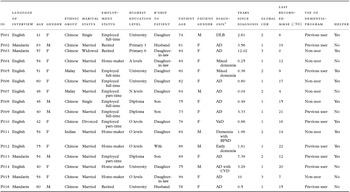
Eighteen caregivers were approached and consented to the study. One caregiver withdrew as he could not make time for the interview and another was excluded as it was established that she was not the primary caregiver over the course of the interview. The final study sample comprised 16 caregivers of patients who had never attended day care. Slightly more than half (56.25%) of the caregivers were those of patients who had previously participated in short-term dementia care programs such as cognitive stimulation therapy or physiotherapy offered in the hospital (see Table 1). The mean age of the caregivers was 54.81 (±13.75) years, and the majority of the sample were Chinese (81.25%), female (68.75%), and married (75%), with most being either the daughter or daughter-in-law of the patient (62.5%). More than half engaged a helper (56.25%) to care for the patient. The caregivers were looking after PWD who were mainly female (68.75%) with a mean age of 81.56 (±5.93) years and mean MMSE score 13.19 (±6.49) and CDR rating of 1.56 (±0.73).
Demographic details of caregivers and patients with dementia.

*Note: DLB =Dementia with Lewy Bodies; AD = Alzheimer's disease; VaD = Vascular dementia; BPSD = Behavioral and psychological symptoms of dementia; CVD = Cardiovascular disease.
Themes
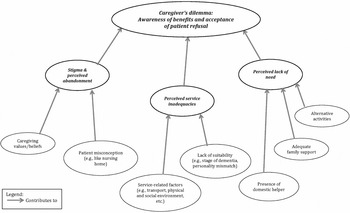
A superordinate theme that emerged from the interviews was the dilemma of balancing the caregiver's awareness of the benefits and acceptance of the patient's refusal. Other subordinate themes such as stigma and perceived abandonment, perceived service inadequacies, and a lack of perceived need also emerged. Pieced together, these themes provided a deeper understanding of reasons behind the caregivers’ decision not to use day care. The interactions between the themes are depicted in a pictorial representation shown in Figure 1. Each theme is illustrated below with quotes derived from the transcripts as expressed by the caregivers in colloquial English or Mandarin.
Non-use of dementia day care services in Singapore – a dilemma for caregivers.

The caregivers’ dilemma: awareness of benefits and acceptance of refusal
A consistent and overarching theme voiced by all caregivers was the dilemma they faced where they had to balance their awareness of the need and importance for engagement and stimulation for their care recipients with the patient's refusal to attend day care.
Awareness of need for engagement and stimulation
It is important to highlight that caregivers recognized the need for the patient to be engaged cognitively, physically, and socially. They were aware that long hours spent alone at home or with only the domestic helper for company were not beneficial for the patient. The caregivers discussed the value of providing opportunities for interactions, in terms of improving the patient's mood and outlook, and engaging their cognitive faculties to ameliorate decline:
I felt that for her problem with the mind. . .the mind must not stop. (P016)
Patient refusal
Caregivers were aware that opportunities for activities and stimulation could be provided at day care services. Nonetheless, the primary barrier for non-use of day care services reported by the majority of the caregivers was the refusal by the patient:
She said that she doesn't really want to [use day care]. (P008)
Caregivers reported that patients objected to attending day care as they had misgivings about it, an issue that will be explored further in the sections below. Generally, caregivers acquiesced to patients’ refusal in line with cultural and social expectations, despite recognizing the benefits of day care:
Yeah, but I think. . . we all have some sort of. . . some sense of responsibility, maybe because of the society that we are in. Maybe this is part of the culture, because we were all brought up that way. (P001)
This revealed a paradoxical “yes but” position of the caregivers, an ambivalence whereby the acknowledgement of the potential value of day care was counterbalanced by the caregivers’ sense of obligation to prioritize the patients’ wishes, in this case, their refusal, and opt for the status quo (home-care).
Stigma and perceived abandonment
Several sub-themes related to stigma and perceived abandonment emerged in the caregivers’ elaboration on their reasons for non-utilization. It is likely that these contributed to the caregivers’ decision not to force the patient to attend day care.
Misconception of day care
Caregivers shared that PWD had perceived day care as akin to a nursing home, which is associated with separation and permanency. From the caregivers’ account, patients appeared to be unfamiliar with the concept of day care and thought their families were sending them away for good:
So she say no no no no. Maybe she thought I am sending her to the old folks’ home. (P005)
Caregivers explained that despite attempts to clarify the misconception, their care recipients remained reluctant to consider day care. It is possible that limited cognitive capacity in PWD coupled with deeply rooted beliefs may explain this reluctance. There is still stigma attached to the nursing home, mostly shared by the older generation in Singapore: “. . . every old people one nightmare is going to old folk's home” (P005).
Perceived abandonment
While caregivers reported that the misconceptions and associated feelings of abandonment arose from the patients, it is important to note that such concerns also appeared to reflect the caregivers’ own worry of how the use of day care would be perceived by the patients. As caregivers were already aware of the patients’ negative perceptions of day care, they did not attempt to persuade the patients to attend it for fear of exacerbating the patients’ feelings of abandonment. Caregivers also expressed the desire to let the patient live at home as much as possible, where it is familiar and comfortable, and recognized that the patients might prefer this:
I think nobody like to have the feeling that you know you are kicked out of the house and go to a [day care]. . . (P009)
It is highly plausible that cultural values and norms regarding caregiving underlie these responses. There was an unspoken understanding that since the PWD was a part of the family, there was an obligation to take care of him/her, regardless of how difficult the situation was. Participants acknowledged this responsibility in a matter-of-fact manner:
We are [his] children. . .we have to [take care of him]. . . (P011)
Of course lah, he's my husband what, I have to look after him. (P012)
In a few cases, the caregivers articulated that there was pressure from other family members to make sure the patient was cared for at home, by family members.
And we also promised him [P003’s father-in-law], that we won't bring her there, to the nursing home or what. We will- we will take care of her ourselves until she's old lah. (P003)
Even when family pressure was openly discussed, caregivers expressed strong beliefs on importance of managing illness within the family unit. These views could reflect underlying stigma about seeking help externally. Caregivers did not want to be perceived by others as being unable to care for the care recipient, and felt that it was better to keep the issue within the family, instead of seeking help from “outsiders”:
. . . [Other] people [may] see how we. . . [have] got so many children [within the family], [but we] never take care of father. . . (P011)
It should be noted that this theme had to be elicited with prompts, such as by asking participants the question, “Do you feel you are responsible for taking care of your relative because of your personal values?” This suggests that the sense of duty to care is innate and conditioned to the point where it is not consciously reflected upon until specifically targeted.
Perceived service inadequacies
The perception of service inadequacies was another subordinate theme that emerged in the discussion on reasons for non-use of day care. This cluster encompasses sub-themes such as the caregivers’ perception of the patients’ suitability for day care, as well as practical and logistical service factors, such as transport, operation hours, cost, and the ambience of day care centers.
Lack of suitability
Some caregivers felt that the patient with mild dementia would not benefit from day care. Implicit in their sentiments was the perception that day care was meant for those with more advanced disease:
. . . she hasn't reached a state where she really needs full-time observation or care yet. So we don't mind putting her when the need arises. (P006)
Caregivers noted that the patients themselves also shared this perspective as they viewed themselves as “better,” and not having reached the point where they needed day care. Caregivers explained that going to a day care center thus carried negative connotations for the patients and could be emotionally upsetting as it appeared to imply that they had deteriorated significantly and needed full-time care:
She say no lah. . . don't want lah. . . I'm not so bad yet. (P004)
For the caregivers of patients who had prior experience with activity-based therapies, a similar reason was given for the discontinuation of such programs. The caregivers shared that these patients held the view that the activities were too simple and were meant for those with more advanced dementia:
She feels that it's not very beneficial. . . and she can do the exercises at home on her own. . .They are very simple exercises. (P013)
On the other hand, there was a caregiver of a patient with severe dementia (CDR = 3), who felt that the patient would not benefit as she could hardly understand what was happening:
There's just no need lah. There's no use. . .when she goes there. . .she doesn't know anything now, now she goes there, it will be of no use. (P003)
Other caregivers reported that the patient's personality would not suit the day care environment. They anticipated that a particular patient's strong and independent personality, or on the other end of the spectrum, introverted nature, would mean he/she would not engage well with other patients at the center:
. . .also she doesn't like to interact with others. She has always been more introverted. (P015)
Some caregivers were concerned about possible strong emotional reactions from the patient at the prospect of being separated from their caregivers. As these patients had previously displayed similar separation anxiety, it was perceived that they would not adjust well to day care:
When she doesn't see her own family, she will panic. (P015)
Service-related factors
The availability of transport was a key consideration in determining whether caregivers utilized day care. Caregivers felt that the transport resources of day care centers were limited. Not all patients could be offered transport services due to issues with service boundaries and timing, which proved to be major deterrents:
It's [transportation] very critical. If you cannot pick the patient up from where she is or. . .and return the patient back, it doesn't help. (P006)
The operating hours of day care was another issue, with some caregivers indicating a preference for the timing to be matched with office hours. This would imply that caregivers did not have to take time off work to pick up or drop off patients:
I suppose if the timing is more like working hours, then maybe it's easier? (P001)
Financial concerns were expressed by some caregivers such as one who related that finances would be heavy if only one family member bore it, but not if it was shared. In another instance, a caregiver had the impression that day care was costly from hearsay, and held on to this perception even though she had no personal experience: “But I don't know how much they cost, what's the payment. . . I heard some people say that it's quite expensive” (P011). Overall, financial considerations did not feature strongly in the study probably because caregivers did not encounter first-hand the cost of the service as they had never utilized it, or it was deemed a sensitive issue to address.
Caregivers who had visited day care centers shared that the cramped and non-conducive environment was a significant let-down: “Very messy, very cluttered” (P010). Others felt that the location could be improved and suggested that it should be situated where the well-being of the PWD could be enhanced:
. . .Maybe the location ah. . . should be somewhere in the bungalow you know. . . not in a HDB void deck [referring colloquially to an open space on the ground floor of apartment blocks in Singapore built by the Housing and Development Board (HDB, which is the government statutory board responsible for public housing)]. (P010)
Caregivers also gave suggestions to improve the quality of day care programs. They felt that eldercare should take reference from childcare, where generic approaches are inadequate and each patient's uniqueness and differing abilities are taken into account:
. . .Day care doesn't mean one pool of people looking after one big pool of old people. It doesn't help. . .They should like go for level 1, level 2, level 3, like you know, like nursery, kindergarten that kind? (P006)
Perceived lack of need
Another cluster of themes pertained to the caregivers’ perceived lack of need. This was largely due to the presence of alternative care arrangements, such as a domestic helper or family support. Such factors are likely to have reduced the need for day care, and further strengthen the caregivers’ decision not to use.
Presence of foreign domestic helper
The majority of the caregivers interviewed employed a live-in domestic helper to assist in caring for the PWD. The presence of a domestic helper eliminated the need for day care services, as the helper could provide round-the-clock care for the patient, and reduce the burden of the family caregiver:
Eventually when we don't have a helper, then the day care will be become a necessity for us. (P008)
A few caregivers reported that their domestic helpers had prior experience taking care of older adults or PWD. In one instance, the caregiver suggested that her helper could replicate the activities at day care. Nonetheless, there were more caregivers who were aware that although the domestic helper could provide care in terms of attending to the patient's daily custodial needs, the level of engagement would not be similar to day care. While paradoxical, this underscores the caregivers’ awareness of the need for engagement and stimulation. It is likely that the convenience of having a helper still takes priority amid other barriers to day care such as service-related factors, and the patients’ refusal:
Yeah, so a maid is a must. But, the maid cannot replace day care. Cannot. (P006)
Adequate family support
In some families, the caregiver was able to care for the patient without a helper as they had alternative arrangements that enabled the care recipient to remain at home. Some had siblings who could contribute to the care of their relative with dementia. For example, the patient would spend the day in the home of one of the children before returning to the home of the main caregiver. Others were supported by their spouses or children (P015): “. . .with my husband to support me, I can take care lah.”
Alternative activities and programs to day care
Given that most caregivers were aware of the importance of keeping the PWD engaged and active, some attempted to arrange their own activities, for example, by bringing the patient out of the house as much as possible or lining up various activities for them (e.g. mahjong and dance). Another caregiver tried to get her care recipient to engage with other older adults. Some caregivers were keen to explore other activity-based programs instead of day care. They felt that short enrichment programs (e.g. 2 to 3 hours in duration), group therapy sessions, and home-based elder companions were options they could consider, which reduced the need to attend a full day care program. Caregivers reported that patients were more receptive to such programs as compared to day care:
So what we are trying to do is to try to find avenues for him to attend. . . but maybe not the full scale like what the doctor has suggested, like day care. (P001)
But since [day care is] not working and elder ‘sister’ [sitter] is working, so I thought of continuing [the elder sitter service]. . . (P005)
Discussion
The findings from this study provided a more nuanced understanding of the reasons for non-use of day care services by caregivers of PWD in Singapore, as well as their impressions of day care.
Central to the decision for non-use was the refusal on the part of the PWD, which is consistent with the findings of published studies (e.g. Durand et al., Reference Durand, James, Ravishankar, Bamrah and Purandare2009). Yet, the caregivers accepted the PWD's refusal, which outweighed their own awareness of the importance of engaging the patient in cognitively stimulating settings outside of the home environment. This is in contrast to the findings of Lim et al. (Reference Lim, Goh, Chionh and Yap2012), where a lack of knowledge was cited by caregivers as one of the key factors for non-use of dementia services. As the relevance and purpose of day care services were known to caregivers in this study, understanding and unravelling the considerations surrounding their dilemma is the essence of their experience.
As the majority of the caregivers interviewed in this study were children or children-in-law, their compliance with the patients’ refusal could be a culturally-bound reflection of filial piety, where the elders’ decisions are respected, obeyed, and not disputed. It has been shown in prior research that older Asian adults who are in poorer health tend to expect more filial care from their children (Dong et al., Reference Dong, Zhang and Simon2014).
For the few caregivers who were spouses, their reactions to the care recipients reflect a commitment to caring for their lifelong partner. Interestingly, little mention was made by participants of how gender roles shaped caregiving values. It was clear though that the presence of adequate family support for some caregivers reduced the need to use day care. This is likely a reflection of the strong familistic values held by caregivers, where the family network plays an important role in long-term care for the older person, and family members are willing partners in care (Chan, Reference Chan2010).
Evident from this study were negative perceptions of day care held by caregivers, who also shared their understanding of patient perceptions, which was that day care was not suitable for them. A commonly held perception was that day care was a service for those in the more advanced stages of dementia, implying a preference for caregivers to consider day care use only when the functioning of the patient has declined, as has been demonstrated in another study (Cox, Reference Cox1997). On the other hand, from the caregivers’ accounts, patients who considered themselves “too well” for day care may suffer from a lack of insight and awareness of their own condition (Zanetti et al., Reference Zanetti1999). It is likely that caregivers respected the PWDs’ refusal to attend day care to avoid giving PWD the impression that they were unwanted or uncared for, especially in the light of their understanding of the PWD's perceptions of day care.
Other negative perceptions that contributed to and perhaps maintained the caregivers’ decision not to use day care pertained to service issues, such as transport and the physical environment. The image projected by day care centers currently is one of no-frills functionality and lacks appeal, suggesting a diminished “pull” factor. This calls for an image makeover and improving enabling factors such as transport, cost, and operation hours which will undoubtedly impact service utilization (Toseland et al., Reference Toseland, McCallion, Gerber and Banks2002).
The theme of the perceived lack of need by caregivers in this study has been a consistent barrier to day care utilization reported in several studies (Brodaty et al., Reference Brodaty, Thomson, Thompson and Fine2005; Durand et al., Reference Durand, James, Ravishankar, Bamrah and Purandare2009; Lim et al., Reference Lim, Goh, Chionh and Yap2012). The findings from this study allow for better understanding of the underlying subtleties in the Singapore context. The presence of alternative care arrangements, such as the employment of a domestic helper, which was cited as a reason for refusal in the Lim et al. (Reference Lim, Goh, Chionh and Yap2012) study, negates the need to use day care services. Employing a domestic helper is attractive as the helper can provide full-time care for the PWD and also assist with other household responsibilities, at a greater economic benefit (Chong et al., Reference Chong2013). More importantly, caregivers can remain in the workforce without the restrictions imposed by day care (e.g. timing and logistic arrangements). For some Singaporeans, employing a helper may even be a symbol of attaining a middle-class lifestyle both ideologically and materially (Yeoh and Huang, Reference Yeoh and Huang2010).
These interpretations were made through the lens of the researcher which was guided by a native understanding of Singapore's cultural and social norms, and also the extant literature available. It was also influenced by the experience and understanding of the workings of the dementia care sector of the last author.
Implications for services
The findings from the study have provided an understanding of reasons for non-use of day care in Singapore, which in turn have implications on improving service design and delivery.
While the caregivers in our study are cognizant of the need for stimulation and engagement, their account of the PWD's misconceptions about day care emphasize the need to educate PWD. This is particularly helpful for those with mild dementia, who in many instances retain awareness and insight, and stand to gain most from cognitive stimulation therapies at day care, given that these can ameliorate disease progression and maintain quality of life (Woods et al., Reference Woods, Aguirre, Spector and Orrell2012).
Day care centers also need to be re-imagined as vibrant and attractive places where the patients will be keen to go, e.g. akin to a “club” where seniors gather. To enhance the physical surroundings, the use of novel spaces, such as parks and over waterways, can be explored as has been done in designing pre-schools (Davie, Reference Davie2014). A non-institutional look-and-feel of the facility, with extension to green outdoor areas, can provide a therapeutic touch (Day et al., Reference Day, Carreon and Stump2000) and make day care centers more appealing to both patients and the public.
The overall approach to dementia day care also needs to be more holistic. Besides attending to the patient's physical and safety needs, care should focus on the patient's cognitive and emotional well-being. Generic one-size-fits-all care models need to evolve into person-centered programs tailored to the patient's background, preferences, and level of ability.
Service providers could also consider scaling up home-based therapeutic activities. This can bridge the gap between the caregivers' preference for the patients to remain at home, and their desire to provide the patients with more opportunities to be engaged socially and mentally. Such activities would complement the basic care already provided by either a domestic helper or family member. While there have been initiatives to bring day care activities to the homes of patients, for example, the iPAL (integrated Promoters of Active Living) program, these are not widely available at present (Temasek Cares, 2012).
Nonetheless, there are limitations in this study that should be noted. Although the sample interviewed was representative and diversified in terms of relationship to care recipient, education level of the caregiver, diagnosis, and stage of dementia of the patient, the sample was small and primarily made up of participants of Chinese ethnicity. Selection bias was present as the caregivers who consented to being interviewed were likely to be more committed to caring well as they had made time to bring the patient for clinic visits. Hence, the findings of the study cannot be generalized to all PWD and their caregivers. Future research could consider ways to reach out to PWD and caregivers who default medical appointments to understand their barriers in accessing services. Given the multi-racial makeup of the society in Singapore, a larger study with a bigger sample could be considered so that ethnic differences can be more clearly delineated. It will also be helpful to include previous users of day care (i.e. those who have used and stopped) to better understand their reasons for stopping day care.
In the interview process, most of the caregivers were forthcoming in their sharing. Most themes, apart from the themes related to perceived abandonment that touched on the caregivers’ beliefs and values, were generated with little prompting. Nonetheless, the extensive literature may have subtly guided the interviewer's questioning during data collection and subsequent analysis of the data, possibly limiting the scope of the findings. Furthermore, the translation of a small number of interviews from Mandarin to English may have resulted in the loss of conceptual equivalence of terms used by the participants (Squires, Reference Squires2008), which could affect the interpretation of the results.
Although caregivers were interviewed for this study, some of the themes that emerged reflected concerns of the patients. It might be useful to interview the patients directly in future studies, particularly those with mild dementia, to gain a deeper understanding of their concerns and needs. Surveying service providers may be a possible follow-up to better understand the profile of patients at day care, as well as the nature of programs and activities offered. This can provide clarity on the misperceptions commonly associated with day care and identify areas of improvement needed.
This study has provided a deeper appreciation of the key reasons for non-utilization of day care services in Singapore. Caregivers generally understand the value of day care, but several factors tip the balance in favor of non-use. The findings provide a basis to improve service design and delivery to reverse the trend of low utilization rates of day care. This is pertinent not only in the Singapore context, but in developing dementia services around the world, so that more PWDs and their caregivers can reap the benefits of day care services.
Conflict of interest
S Huang, K Griva, and P Yap report no conflicts of interests. C Bryant is a deputy editor of International Psychogeriatrics, so the review process was undertaken by another member of the editorial team.
Description of authors’ roles
S Huang designed the study, collected the data, analyzed the data and wrote the paper. K Griva contributed to the design of the study, supervised data collection, analyzed the data, and edited the paper. C Bryant contributed to the design of the study and editing of the paper. P Yap designed the study, supervised the data collection, analyzed the data, and edited the paper.
Acknowledgments
This research was supported by the National University of Singapore Department of Psychology Thesis Fund for graduate students, which was awarded to S Huang.
APPENDIX
INTERVIEW GUIDE
A. INTRO BY FACILITATOR
Interviewerd to introduce herself and outline purpose of interview – (emphasis on confidentiality).
B. INTERVIEW QUESTIONS