According to To Err is Human, a report published by the Institute of Medicine, ∼44,000–98,000 people die annually as a result of injuries caused by medical errors, among which 53–58% have been considered preventable (Kohn, Corrigan, & Donaldson, Reference Kohn, Corrigan and Donaldson2000). Statistics show that ∼8.0–11.7% of patients have experienced adverse events (Vincent, Reference Vincent1997; Vincent, Neale, & Woloshynowch, Reference Vincent, Neale and Woloshynowch2001). That led to ∼187,000 deaths and 61,000 injuries (Goodman, Villarreal, & Jones, Reference Goodman, Villarreal and Jones2011). These findings show that adverse events are essential issues. Medical institutions should encourage staff to establish an internal voluntary incident reporting system to increase their intention to report unpredictable incidents. The disclosure of errors enables medical institutions to analyze the cause and reduce the risk of future incidents by adjusting the system.
In medical or other high-risk industries, incident reporting has been considered an effective tool. By elucidating the cause of errors, an organization can educate staff and implement changes to avoid or mitigate the negative effects of recurring errors (Reason, Reference Reason2000). However, numerous studies have shown that the majority of institutions experience difficulty learning from previous errors because employees do not actively report errors, even in circumstances that could hinder the development of the group or organization (Carroll, Rudolph, & Hatakenaka, Reference Carroll, Rudolph and Hatakenaka2002; Uribe, Schweikhart, Pathak, Dow, & Marsh, Reference Uribe, Schweikhart, Pathak, Dow and Marsh2002; Tucker & Edmondson, Reference Tucker and Edmondson2003; Edmondson, Reference Edmondson2004). Other research showed that 50–96% of adverse events remain unreported (Barach & Small, Reference Barach and Small2000). Most crucially, errors could prolong the hospitalization of patients and increase the medical costs (Vincent, Reference Vincent1997). Medical errors incur ∼US$17.1 billion in medical costs (Van Den Bos, Rustagi, Gray, Halford, Ziemkiewicz, & Shreve, Reference Van Den Bos, Rustagi, Gray, Halford, Ziemkiewicz and Shreve2011) and US$393 billion to US$958 billion in social costs every year, which accounts for 18–45% of all health care expenses in the United States (Goodman, Villarreal, & Jones, Reference Goodman, Villarreal and Jones2011). Therefore, for medical institutions, failing to report incidents hinders the development of patient safety mechanisms and substantially increases any associated medical costs (Uribe et al., Reference Uribe, Schweikhart, Pathak, Dow and Marsh2002).
Previous studies have identified numerous factors affecting a person’s intention to report incidents, including the time-consuming process of writing a report (i.e., time-consuming paperwork), the additional tasks associated with reporting the incident, the fear of punishment or being considered unprofessional, peer pressure, and an unsupportive work environment (Barach & Small, Reference Barach and Small2000; Uribe et al., Reference Uribe, Schweikhart, Pathak, Dow and Marsh2002; Kingston, Evans, Smith, & Berry, Reference Kingston, Evans, Smith and Berry2004; Chiang & Pepper, Reference Chiang and Pepper2006; Zhao & Olivera, Reference Zhao and Olivera2006). Other studies have asserted hypothesized that an organizational culture emphasizing the quality management would influence the incident-reporting behavior of employees (Sexton, Thomas, & Helmreich, Reference Sexton, Thomas and Helmreich2000; Blegen et al., Reference Blegen, Vaughn, Pepper, Vojir, Stratton, Boyd and Armstrong2004). Previous studies focused primarily on the barriers that hinder incident reporting; however, few studies have proposed a comprehensive theoretical framework (Karsh, Escoto, Beasley, & Holden, Reference Karsh, Escoto, Beasley and Holden2006). In this study, we investigate the factors that determine the clinical medical staffs’ intention to report error incidents. Previous studies also showed that people have volitional control over their incident-reporting behavior (Barach & Small, Reference Barach and Small2000; Uribe et al., Reference Uribe, Schweikhart, Pathak, Dow and Marsh2002; Kingston et al., Reference Kingston, Evans, Smith and Berry2004; Chiang & Pepper, Reference Chiang and Pepper2006; Zhao & Olivera, Reference Zhao and Olivera2006). Thus, this study applies a psychological perspective to identify barriers that affect the intention to report incidents. Although prior research applied the theory of reasoned action and the technology acceptance model to examine the determinants of the intention to report incidents (Wu, Shen, Lin, Greenes, & Bates, Reference Wu, Shen, Lin, Greenes and Bates2008), the discussion was limited to the investigation of the intention to use an information system to report incidents, rather than examining the psychological factors affecting incident-reporting behavior. A study applied the theory of reasoned action to explain the attitude toward incident-reporting behavior by integrating psychological concepts that address people’s attitudes toward errors, and organizational characteristics that foster incident-reporting behavior (Pfeiffer, Manser, & Wehner, Reference Pfeiffer, Manser and Wehner2010). However, the researchers did not support their findings with empirical evidence. The theory of reasoned action emphasizes the relationship between a person’s attitude and their actual behavior, which is insufficient for explaining their intentions. Therefore, in addition to the effects of attitude toward incident-reporting behavior and subjective norms (SNs), we also adopt the theory of planned behavior (TPB) to consider the influence of perceived behavioral control (PBC). PBC refers to situations when a person perceives that they cannot execute a decision because they feel restricted by either their physical environment or the availability of resources (Ajzen, Reference Ajzen1985).
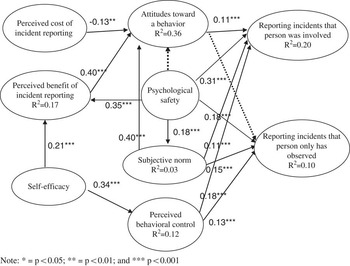
First, Pfeiffer, Manser, and Wehner (Reference Pfeiffer, Manser and Wehner2010) considered that individual perceptions of incident reporting system characteristics include knowledge of the report and knowing which incidents to report, and that reporting skills are crucial topics of discussion concerning reporting intentions. We propose that in addition to a person’s voluntary attitude, their opportunity and resource control ability requirements require consideration. A person’s intentions to report an incident are not only affected by either their attitude toward the behavior or SNs, but also by the resources required to report an incident (knowledge and skill, accessibility to the reporting channel and self-determination ability). Therefore, we adopt the TPB to analyze the intention to report incidents (Ajzen, Reference Ajzen1985; Ajzen, Reference Ajzen1991). Second, Pfeiffer, Manser, and Wehner (Reference Pfeiffer, Manser and Wehner2010) stated that both the assumption that one can learn from errors and the extent to which one perceives strain when errors occur influence the positive attitude of individuals towards reporting errors. This indicates that individual attitudes towards reporting are influenced by the perceived benefit (PB) or costs of incident reporting. We assert that prior to reporting, people consider the potential risks and benefits. Previous research showed that people tend to not report an incident if the associated risk is greater than the benefit (Morrison & Phelps, Reference Morrison and Phelps1999). On the basis of social exchange theory, we employ cost–benefit evaluations to explain specific behaviors. Third, we considered that incident-reporting behaviors are influenced by perceived self-efficacy and expected behavioral outcome. Despite recognizing the learning benefits that can be obtained from reporting incidents, a person may not necessarily engage in such behavior because they will first assess their ability and confidence to execute such tasks. Thus, reporting behaviors are influenced by both expected outcomes and self-efficacy. Previous studies have demonstrated that self-efficacy influences behavioral intentions (Taylor & Todd, Reference Taylor and Todd1995; Pavlou & Fygenson, Reference Pavlou and Fygenson2006). Therefore, we propose that self-efficacy influences a person’s reporting behaviors. Finally, Pfeiffer, Manser, and Wehner (Reference Pfeiffer, Manser and Wehner2010) maintained that psychological safety can reveal a person’s expectations of fair treatment after reporting an error and, therefore, proposed that psychological safety influences reporting intentions. We argue that just culture in an organization affect the intention to report incidents. We evaluate the results of this study from the perspective of psychological safety (Edmondson, Reference Edmondson1999). We propose a theoretical model (Figure 1) based on factors that affect the intention to report incidents, and provide empirical evidence that supports the proposed model. This study contributes to the literature by increasing the knowledge and quality of medical service science, thereby improving patient safety in medical institutions.
The influence path of variables.

Intention
Intention is the subjective probability that a person contemplates executing a certain behavior. The stronger the intention, the greater the possibility the behavior will be performed. Sheppard, Hartwick, and Warshaw (Reference Sheppard, Hartwick and Warshaw1988) researched 87 studies that have investigated the correlation between intention and behavior, Sheppard found that the correlational strength was 0.53, which indicates that actual behavior can be evaluated based on intention rather than by applying the TPB (Sheppard, Hartwick, and Warshaw, Reference Sheppard, Hartwick and Warshaw1988). Therefore, in this study, we examine the only the intention to report an incident.
Previous studies have shown that the obstacles to incident-reporting behavior include a fear of being considered unprofessional and incurring the revenge of their colleagues (Karadeniz & Cakmakci, Reference Karadeniz and Cakmakci2002; Uribe et al., Reference Uribe, Schweikhart, Pathak, Dow and Marsh2002; Chiang & Pepper, Reference Chiang and Pepper2006; Zhao & Olivera, Reference Zhao and Olivera2006; Pfeiffer, Manser, & Wehner, Reference Pfeiffer, Manser and Wehner2010). These studies also discussed how the nature of an incident affected whether it was reported. For example, when self-reporting an incident, people feared being considered unprofessional or incompetent, having their career development hindered, or more seriously, being punished (Karadeniz & Cakmakci, Reference Karadeniz and Cakmakci2002). When reporting other people’s incidents, people feared social exclusion or revenge. Specifically, it was associated with how reporting an incident might damage their interpersonal relationships and affect their friendships with colleagues (Uribe et al., Reference Uribe, Schweikhart, Pathak, Dow and Marsh2002). Therefore, we argue that the intention to report an incident should be considered based on the relationship between the reporting person and the incident circumstances. For example, we examine (a) whether people with a positive attitude toward reporting incidents have any pre-existing motives for reporting their incidents and those of others, and (b) whether a positive attitude increases the tendency to report an incident. Additionally, previous research reported that SNs are the most crucial factors motivating medical staff to implement reporting systems (Wu et al., Reference Wu, Shen, Lin, Greenes and Bates2008). However, when deciding to report an incident, it is uncertain whether people admitting to their own incidents results in punishment or affects their professional reputation. It is also possible that reporting other people’s errors might incur revenge or affect their interpersonal relationships. Therefore, we examine various psychological motivations associated with reporting incident made by different people. The results provide insights into employee incident-reporting behavior, and enable managers to improve reporting procedures.
Attitude toward Behavior (ATB)
ATB is a person’s positive or negative evaluation of people, events, objects or behaviors, and it reflects their personal preferences (Fishbein & Ajzen, Reference Fishbein and Ajzen1975). A person’s ATB correlates directly with the occurrence of that behavior; a positive ATB corresponds with the strength of their intention to perform that behavior. Previous studies have indicated that nursing staff are unwilling to report incidents because they are either uninterested or they question the necessity of reporting the incident (Uribe et al., Reference Uribe, Schweikhart, Pathak, Dow and Marsh2002; Waring, Reference Waring2005). Several previous studies have shown that certain nursing staff have failed to recognize the importance or the objectives of reporting incidents, and have even perceived that reporting incidents lacks benefits, which diminishes their intention to report incidents (Osborne, Blais, & Hayes, Reference Osborne, Blais and Hayes1999; Uribe et al., Reference Uribe, Schweikhart, Pathak, Dow and Marsh2002; Chiang & Pepper, Reference Chiang and Pepper2006). Therefore, the intention for nursing staff to report an incident increases in conjunction with how positive their attitude is toward incident reporting (Kingston et al., Reference Kingston, Evans, Smith and Berry2004). In other words, attitudes toward the behavior of reporting affect the intentions to report (Pfeiffer, Manser, & Wehner, Reference Pfeiffer, Manser and Wehner2010). We hypothesize that ATB is the positive or negative evaluation of incident-reporting behavior, and that this evaluation affects their behavioral intentions (BIs). Therefore, we propose the following hypotheses:
Hypothesis 1: ATB has a positive effect on a person’s intention to report incidents that person was involved (ITS).
Hypothesis 2: ATB has a positive effect on a person’s intention to report incidents that person only has observed (ITO).
SNs
SNs refer to a condition under which a person first subjectively determines whether critical reference groups recognize and accept a behavior before performing that behavior. In other words, a person perceives social pressures from other people or groups (Fishbein & Ajzen, Reference Fishbein and Ajzen1975). Occasionally, the influence of social referents on a person’s behavior can become more substantial than that person’s attitude (Ajzen & Fishbein, Reference Ajzen and Fishbein1980). According to organizational behavior theory, group pressures influence a person’s behavior, thereby prompting that person to alter his or her behaviors to conform to the group. The pressure to accept group norms induces and is consistent with ‘the bandwagon effect’ (Kiesler & Kiesler, Reference Kiesler and Kiesler1969). Therefore, when peers consider people who report mistakes to be ‘whistleblowers,’ this pressure influences a person’s willingness to report mistakes. Previous studies have indicated that ∼63–84% of nurses have not reported incidents because they feared adverse responses from colleagues and supervisors (Osborne, Blais, & Hayes, Reference Osborne, Blais and Hayes1999). In addition, 53% of nurses expressed anxiety because of potential reprisal, and 63% were concerned regarding the negative responses of colleagues and supervisors (Karadeniz & Cakmakci, Reference Karadeniz and Cakmakci2002). These behaviors have been attributed to the fear of reproach or censure following the reporting of incidents, and the effect it might have on career development. In severe cases, nurses have reported being fearful of peers exacting revenge, or that they might lose interpersonal support if they reported certain incidents (Uribe et al., Reference Uribe, Schweikhart, Pathak, Dow and Marsh2002; Chiang & Pepper, Reference Chiang and Pepper2006; Zhao & Olivera, Reference Zhao and Olivera2006; Wu et al., Reference Wu, Shen, Lin, Greenes and Bates2008; Pfeiffer, Manser, & Wehner, Reference Pfeiffer, Manser and Wehner2010).
This discussion shows that people may be unwilling to report incidents because of the influence of peers and supervisors. Therefore, we contend that the BI of nurses to report incidents is influenced by SNs. Nurses judge whether their incident-reporting behavior is supported by others. For example, if nursing peers were to consider the reporting of incidents as meaningful and significant, they would be more willing to file reports, and would exhibit higher intentions accordingly. Conversely, if nursing peers were to disapprove of reporting incidents, nurses would be concerned about social pressures, and they might worry that (a) they could be evaluated as incompetent for reporting incidents they have involved, or (b) they might incur revenge and be isolated for reporting incidents they only have observed.
Thus, we propose the following hypotheses:
Hypothesis 3: SNs have a positive effect on a person’s intention to report incidents that person was involved.
Hypothesis 4: SNs have a positive effect on a person’s intention to report incidents that person only has observed.
In addition, previous research highlighted the effect of SNs on behavioral attitudes (Ryu, Ho, & Han, Reference Ryu, Ho and Han2003). In this study, we assume that SNs affect a person’s attitude toward reporting incidents. When managers encourage incident-reporting behaviors, and peers are supportive of reporting incidents, a person is influenced by these attitudes, and they tend to develop a positive attitude toward reporting adverse incidents. Conversely, if a person were to perceive that the group is unsupportive of reporting anomalous incidents, that person might fear censure or revenge in response to incident-reporting behaviors; consequently, that person might develop negative attitudes toward incident-reporting behavior. Accordingly, we hypothesize the following:
Hypothesis 5: SNs have a positive effect on attitudes toward incident-reporting behavior.
Perceived Behavioral Control
PBC indicates how a person evaluates the opportunities and their capacity to control necessary resources when adopting a certain behavior. In other words, the execution of a specific behavior is determined by whether the required opportunities, skills and resources are available. Therefore, in addition to attitudes and SNs, a person’s PBC also influences his or her intention to adopt certain behaviors. If people perceive that they are capable of executing a behavior, and that they possess the required knowledge and they have access to relevant resources, their PBC is strengthened. Conversely, if a person perceives that performing a certain behavior is difficult, he or she exhibits a weak intention to perform the behavior (Ajzen, Reference Ajzen1985).
Several studies have indicated that a lack of individual reporting knowledge and skills might influence incident-reporting behavior. For example, a person might be unaware of how or where to report an incident, and their knowledge on which types of incidents should be reported might be insufficient (Osborne, Blais, & Hayes, Reference Osborne, Blais and Hayes1999; Uribe et al., Reference Uribe, Schweikhart, Pathak, Dow and Marsh2002; Evans et al., Reference Evans, Berry, Smith, Esterman, Selim, O’Shaughnessy and DeWit2006; Pfeiffer, Briner, Wehner, & Manser, Reference Pfeiffer, Briner, Wehner and Manser2013). In addition, if a reporting system were complex and difficult to use, it would have a negative effect on reporting intentions (Wu et al., Reference Wu, Shen, Lin, Greenes and Bates2008). Consequently, if insufficient resources (e.g., reporting channels) are provided, the PBC of nurses who report incidents would decrease to a level that hinders their incident-reporting behavior. For reporting, this study defines PBC as a person’s evaluation of his or her ability to control the resources required for reporting incidents(e.g., reporting skills, knowledge, and resources) when reporting incidents. Hence, we propose the following hypotheses:
Hypothesis 6: Perceived behavioral control has a positive effect on a person’s intention to report incidents that person was involved.
Hypothesis 7: Perceived behavioral control has a positive effect on a person’s intention to report incidents that person only has observed.
Cost–Benefit Evaluations for Reporting
Previous studies have emphasized that each person exerts rational self-serving behavior regarding the intention to share knowledge. A person must sense or perceive that the benefits obtained by performing a certain behavior are greater than the required cost to engage in that behavior (Kelly & Taibaut, Reference Kelly and Taibaut1978). Accordingly, people evaluate the potential risks and benefits when deciding whether to execute a behavior (Morrison & Phelps, Reference Morrison and Phelps1999). Thus, cost–benefit evaluations affect the decision of whether to report incidents (Zhao & Olivera, Reference Zhao and Olivera2006). When deciding whether to report an anomalous incident, a person first evaluates the self-cost, then perceives the pressures resulting from the incident, and finally exhibits concern regarding the negative outcomes that could result from reporting the incident, and whether a substantial time cost is involved. Subsequently, the PB is evaluated to determine whether the incident can yield learning benefits (Uribe et al., Reference Uribe, Schweikhart, Pathak, Dow and Marsh2002).
The TPB states that behavioral attitude is influenced by behavioral belief and outcome evaluations generated during behavioral implementation (Ajzen, Reference Ajzen1985). Behavioral belief represents the belief that a person anticipates that performing a specific behavior generates a certain outcome. Outcome evaluations indicate value responses or reactions regarding behavior-based outcomes. Behavioral belief and outcome evaluations are similar to the evaluations of cost (i.e., behavioral belief) and benefit (i.e., outcome evaluations) that are generated when a person assesses incident-reporting behavior. Consequently, we derive the following two variables from this study: (a) perceived cost (PC) of reporting an incident; and (b) PB of reporting an incident.
Several previous studies have indicated that reporting channels are ineffective, their procedures are complex, and a substantial amount of time is required to complete various charts and forms (Wakefield, Wakefield, Uden-Holman, & Blegen, Reference Wakefield, Wakefield, Uden-Holman and Blegen1996; Figueiras, Tato, Fontaiñas, Takkouche, & Gestal-Otero, Reference Figueiras, Tato, Fontaiñas, Takkouche and Gestal-Otero2001; Uribe et al., Reference Uribe, Schweikhart, Pathak, Dow and Marsh2002). The material costs, potential damage to personal image, and effort costs associated with reporting are barriers to the reporting of incidents because of personal considerations related to various cost factors (Zhao & Olivera, Reference Zhao and Olivera2006). Thus, we contend that when people determine that the cost of reporting an incident high (e.g., it is a time-consuming process that requires the completion of multiple forms), they tend to develop a negative attitude toward incident-reporting behavior. Hence, we propose the following hypothesis:
Hypothesis 8: The perceived cost of reporting an incident has a positive effect on ATB.
Attitudes toward incident-reporting behavior are determined by the PBs derived from reporting an incident, including self-concept, attaining or stimulating organizational learning, and minimizing the harm to potential victims. Previous research stated that these are critical evaluation factors that influence the decisions and assessments on whether to report an incident (Zhao & Olivera, Reference Zhao and Olivera2006). Other studies have indicated that the unwillingness to report is caused by the perception that little value or feedback can be attained by reporting an incident (Beasley, Escoto, & Karsh, Reference Beasley, Escoto and Karsh2004), there are no perceived advantages of reporting an incident (Figueiras et al., Reference Figueiras, Tato, Fontaiñas, Takkouche and Gestal-Otero2001), and the perception that reporting cannot improve quality (Uribe et al., Reference Uribe, Schweikhart, Pathak, Dow and Marsh2002). Consequently, a person would develop a positive attitude toward incident-reporting behavior if they were to conclude that reporting an incident can (a) yield personal or organizational learning opportunities or benefits, (b) improve personal or self-image (e.g., honesty), and (c) reduce feelings of guilt. Accordingly, we propose the following hypothesis:
Hypothesis 9: The PB of reporting an incident has a positive effect on the attitude toward incident-reporting behavior.
Psychological Safety
To alleviate health care workers’ fear of reprisal or punishment, and to increase their intention to report incidents, their employers must create a safe environment that promotes the intention of health care workers to report medical errors (Kingston et al., Reference Kingston, Evans, Smith and Berry2004; Taylor et al., Reference Taylor, Brownstein, Christakis, Blackburn, Strandjord, Klein and Shafii2004; Waring, Reference Waring2005). When a person engages in ‘risky’ behavior in a group or team setting where the collective or shared beliefs of the members in the work team make the behavioral risk acceptable, that person feels psychological safety. For example, when the interpersonal risks of a group make an individual member feel safe, workers can express their thoughts and questions without concern. The level of psychological safety within a work team affects the intentions of members to report incidents (Edmondson, Reference Edmondson1999). Previous research indicated that in an environment with a high level of psychological safety, employees are not isolated or punished for publically discussing mistakes, taking risks, or asking questions, and they cooperate with team members to develop solutions (Kahn, Reference Kahn1990). Therefore, members of a team with a high level of psychological safety do not fear the potential risks associated with reporting incidents; rather, the fear decreases and there coworkers are encouraged to openly discuss the incidents. Thus, we propose the following hypothesis:
Hypothesis 10: Psychological safety has a positive effect on a person’s intention to report incidents that person was involved.
Hypothesis 11: Psychological safety has a positive effect on a person’s intention to report incidents that person only has observed.
Previous research stated that psychological safety is a factor influencing the incident-reporting behaviors and attitudes of medical staff (Pfeiffer, Manser, & Wehner, Reference Pfeiffer, Manser and Wehner2010). Consequently, higher levels of individual psychological safety increase the intentions of workers to question, discuss, and share incidents with others, thereby facilitating positive attitudes toward the reporting of anomalous incidents. In addition, previous studies have indicated that psychological safety influences SNs (Pfeiffer, Manser, & Wehner, Reference Pfeiffer, Manser and Wehner2010). When a person’s perceived level of psychological safety is high, a work team possesses common beliefs and can accept the risks associated with reporting incidents. This type of non-punishing culture establishes a sense of justice and increases a person’s intention to report incidents (Braithwaite, Westbrook, & Travaglia, Reference Braithwaite, Westbrook and Travaglia2008; Weiner, Hobgood, & Lewis, Reference Weiner, Hobgood and Lewis2008). Therefore, if a person perceives a high level of psychological safety among a team, this indicates that the team has developed a safe environment where colleagues and staff feel protected from the risks associated with reporting incidents. This also increases the identification with and recognition of incident-reporting behaviors by surrounding groups. Thus, we propose the following hypotheses:
Hypothesis 12: Psychological safety has a positive effect on attitude toward incident-reporting behavior.
Hypothesis 13: Psychological safety has a positive effect on the SNs of incident reporting.
In the health care industry, errors create crucial and necessary learning opportunities. Therefore, establishing a psychologically safe environment is critical. Psychological safety is based on a culture of justice in which a person expects to be treated fairly when reporting incidents they cause. Previous research has indicated that psychological safety can create a climate of organizational learning and increase the intentions of employees to discuss incidents they cause, thereby fostering an environment where mistakes are seen as learning opportunities (Edmondson, Reference Edmondson2004). Thus, we contend that psychological safety influences the PBs associated with reporting incidents. A high level of psychological safety encourages employees to accept that reporting incidents can facilitate learning from mistakes, thereby enhancing overall knowledge of the team, and stimulating a team learning. Hence, we propose the following hypothesis:
Hypothesis 14: Psychological safety has a positive effect on the PBs of reporting incidents.
Self-Efficacy
Self-efficacy is indicative of a person’s ability and belief regarding their performance of a certain task, including the self-perception of whether he or she is capable of performing a specific behavior. People with high self-efficacy tend to embrace difficult challenges, whereas people with low self-efficacy lack confidence, and they are more likely to be hindered by difficulties; furthermore, they tend to be passive, experience anxiety, and exhibit other negative emotions. Numerous studies have indicated that self-efficacy is a dimension of PBC (Bandura, Reference Bandura1977; Taylor & Todd, Reference Taylor and Todd1995; Ajzen, Reference Ajzen2002). We assert that when an individual person exhibits confidence while working, that person possesses high self-efficacy; thus, he or she is more able and knowledge on reporting incidents, and has greater control of the resources required to do so. Accordingly, we propose the following hypothesis:
Hypothesis 15: Self-efficacy has a positive effect on perceived behavioral control.
Previous research showed that self-confident people are less likely to disguise their errors; rather, they approach these circumstances with a learning attitude (Kirkpatrick & Locke, Reference Kirkpatrick and Locke1991). Consequently, people with high self-efficacy experience fewer negative emotions as a result of their errors. Moreover, compared with people with low self-efficacy the effect of errors on personal image is lower for people with high self-efficacy. This is primarily because people with high self-efficacy tend to be more self-confident in their career successes, and they anticipate being able to create positive PBs after reporting an incident (Zhao & Olivera, Reference Zhao and Olivera2006). Therefore, people with high self-efficacy are not fearful of the negative consequences associated with errors; rather, their perceptions are positive perceptions and they address errors with a learning attitude. For example, people with high self-efficacy believe that reporting incidents can create learning benefits for or improve the effectiveness of the organization. Hence, we contend that high self-efficacy has a positive influence the PBs associated with reporting incidents. Accordingly, we propose the following hypothesis:
Hypothesis 16: Self-efficacy has a positive effect on the PBs of reporting incidents.
Methods
Sample
According to Tuttle, Holloway, Baird, Sheehan, and Skelton (Reference Tuttle, Holloway, Baird, Sheehan and Skelton2004), nurses reported only ∼73% of all safety incidents, which is consistent with official statistics provided by National Patient Safety Agency (UK) and Patient Safety Reporting System (TPR, Taiwan), indicating that nurses tend to report the majority of safety incidents. Moreover, previous studies have indicated that factors of perceived reporting barriers between doctors and nursing staff members are distinct (Uribe et al., Reference Uribe, Schweikhart, Pathak, Dow and Marsh2002; Pfeiffer et al., Reference Pfeiffer, Briner, Wehner and Manser2013). Thus, we recruited nurses as our research subject. Since 2005, through government policies and hospital evaluation system requirements, hospital reporting system policies in Taiwan have generally been similar. In our study, all the sample hospitals allowed anonymity in the incident reporting systems. All reports are sent to trusted independent operating units for them to investigate and review these events and make relevant improvements. The procedures that were used to process reported events are based on voluntary, blameless, confidential, and mutual learning principles. We collected data from 649 nurses in 40 large hospitals in Taiwan, including two medical centers and 38 regional hospitals. First, we obtained permission and support from each hospital’s managers to collect the data. The managers collected the completed surveys during work hours. To reduce the possibility of social desirability (Podsakoff & Organ, Reference Podsakoff and Organ1986), each participant was given a questionnaire packet containing a cover letter that detailed the purpose of the study and assured the participants that their responses would be anonymous and confidential.
From the 1,200 mailed surveys, 733 were returned, 84 of which were incomplete and discarded. Consequently, we analyzed 649 completed questionnaires (response rate=54%). Among the total of 649 staffs participating in this research, 35.1 and 64.9% of the respondents were currently employed at medical centers and regional hospitals, respectively, 30.6% of were aged from 26 to 30 years, and 24.7% were aged from 31 to 35 years. The male-to-female ratio was ∼4 : 96. The majority of the respondents had 1–6 years of organizational tenure, comprising 22.5% of the sample, and 21.7% had 5–10 years of organizational tenure.
Measures
To ensure the content validity of the questionnaire scales, the construct items were adopted from previous research. The survey instrument comprised the following two sections: (a) demographic items (gender, age, years of seniority, job position, and department); and (b) items to measure the theoretical constructs of ATB, SNs, PBC, BI, the PBs and PCs of reporting incidents, psychological safety, and self-efficacy.
The adopted construct items were contextualized to fit the purpose of this study. To measure the BI toward reporting incidents, we modified the TPB questionnaire proposed by Ajzen (Reference Ajzen1985). The BI toward reporting incidents comprised the following four constructs: (a) ATB comprised three items that measured the participants’ positive or negative perceptions toward incident-reporting behavior (e.g., ‘I feel that incident reporting is good, valuable, and beneficial’); (b) SNs comprised four items that assessed whether the participants’ colleagues and supervisors approved and supported incident reporting (e.g., ‘I report incidents because my colleagues support me’ and ‘I report incidents because my supervisors support such behavior’); (c) PBC comprised five items that assessed whether a person had the required skills, knowledge, resources, and self-determination to report incidents (e.g., ‘I think I am capable of reporting incidents’); and (d) intention to report incidents was measured using six items (e.g., ‘I am willing to report incidents that I am involved in the future’ and ‘I will continue to report incidents that I only has observed in the future’).
To assess the PC and PB of reporting incidents, we employed 4- and 5-item scales adapted from Uribe et al. (Reference Uribe, Schweikhart, Pathak, Dow and Marsh2002) and Zhao and Olivera (Reference Zhao and Olivera2006) for the respondents to respectively indicate their perceptions on the PC of reporting incidents (e.g., ‘I believe that reporting incidents will not cause additional work’), and on the value obtained from reporting incidents (e.g., ‘I believe that reporting incidents motivates learning in the team or organization’).
To measure the respondents’ psychological safety, we adapted the 5-item scale employed by Edmondson (Reference Edmondson1999). The respondents were requested to assess the extent to which they would be excluded or punished at work for publicly discussing work-related incidents, and whether they have the courage to express their opinions and resolve problems (‘My team encourages staff to question anything related to patient safety’ and ‘My team facilitates learning from other people’s errors’). To assess self-efficacy, we employed a 4-item scale adapted from research by Riggs, Warka, Babasa, Betancourt, & Hooker (Reference Riggs, Warka, Babasa, Betancourt and Hooker1994) for the respondents to indicate their self-efficacy at work (e.g., ‘I am very proud of my job skills and abilities’ and ‘I have confidence in my ability to do my job’).
The respondents indicated their agreement or disagreement with the above items using a 7-point Likert scale (1=‘exceptionally disagree,’ 7=‘exceptionally agree’).
Data analysis
This study used AMOS 6.0 and SPSS 12.0 for the data analysis. Before verifying the research hypothesis, this study used confirmatory factor analysis to examine whether the questions in the questionnaire satisfied the unidimensionality, convergent validity, and discriminate validity requirements. Regarding the scale reliability, this study used the coefficient Cronbach’s α for examining the reliability of the scale. Finally, structural equation modeling was used to verify the causality between the research models.
Results
Common method variance
Due to the way our data were collected, the errors associated with common method variance may generate. To mitigate this concern, we adopted procedural and statistical remedies proposed by Podsakoff, MacKenzie, Lee, and Podsakoff (Reference Podsakoff, MacKenzie, Lee and Podsakoff2003). First, to decrease social desirability bias, we informed the respondents on the precautions taken to ensure their anonymity. Furthermore, we assured the respondents that there were no correct or incorrect answers to the survey questions to alleviate evaluation apprehension. Moreover, we employed Harman’s one-factor test (Podsakoff et al., Reference Podsakoff, MacKenzie, Lee and Podsakoff2003) by conducting a principal component factor analysis by entering all of the scales used in this study to determine whether one general factor accounted for a majority of the variance among the scales. The results indicate that nine factors (Eigenvalues>1) explained 81.78% of the total variance. The first factor accounted for 27.6% (<50%) of the variance, which failed to explain most of the variance (Podsakoff & Organ, Reference Podsakoff and Organ1986). These results show that common method bias is not a major concern in this study.
Instrument validation
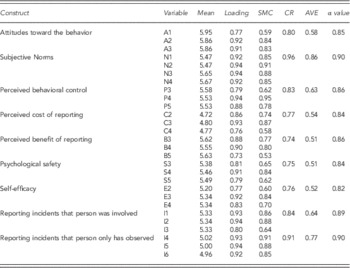
In this study, the scale reliability and validity were assessed using confirmatory factor analysis. The convergent validity of the scale items was estimated based on reliability, composite reliability (CR), and average variance extracted (Fornell & Larcker, Reference Fornell and Larcker1981). Fornell and Larcker (Reference Fornell and Larcker1981) indicated that convergent validity evaluations comprise three criteria: (a) all completely standardized factor loadings must be >0.5 and reach a level of significance; (b) CR must be >0.7; and (c) average variance extracted must be >0.5. The results of this study indicated that a majority of the standardized factor loadings reached 0.5, the CRs were between 0.74 and 0.91, and the AVEs were between 0.51 and 0.77. Table 1 shows that the dimensions used in this study had convergent validity.
Confirmatory factor analysis for the assessment model

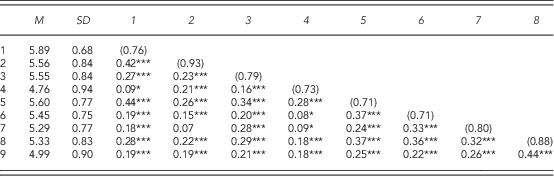
To examine the discriminant validity, we compared the shared variance among factors with the AVE from each factor (Fornell & Larcker, Reference Fornell and Larcker1981). The results show that the shared variance among factors was less than the AVE from each factor, which demonstrates discriminant validity. Thus, the item scales achieved a satisfactory level of reliability, convergent validity, and discriminant validity (Table 2).
Correlation analysis for every construct
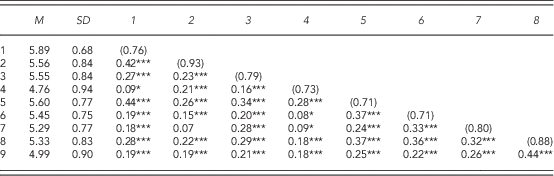
Notes: 1: Attitudes toward the behavior; 2: Subjective norms; 3: Perceived behavioral control; 4: Perceived cost of reporting; 5: Perceived benefit of reporting; 6: Psychological safety; 7: Self-efficacy; 8: Reporting incidents that person was involved; and 9: Reporting incidents that person only has observed.
*p<.05; **p<.01; and ***p<.001.
Structural model estimation and hypotheses testing
We employed structural equation modeling to test the fit of research data to the research model (Figure 1). This tool was selected for its ability to simultaneously examine a series of dependence relationships, especially when direct and indirect effects exist among the model constructs (Hair, Anderson, Tatham, & Black, Reference Hair, Anderson, Tatham and Black1998). We employed Amos 6.0 to conduct the structural equation modeling estimation procedure by using the maximum likelihood estimation. A similar set of fit indices was applied to examine the structural model. The goodness-of-fit was calculated to show the overall acceptability of the hypothesized model. A comparison of the fit indices with their corresponding recommended values shows that the model fit is acceptable (χ2/df=2.74, GFI=0.91, CFI=0.96, IFI=0.96, NFI=0.94, and RMSEA=0.05). Subsequently, we examined the significance and strength of the hypothesized relationships in the research model (Figure 1).
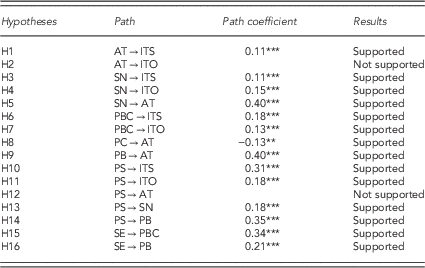
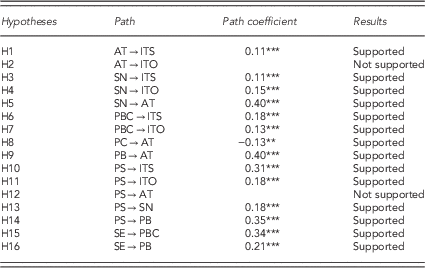
Figure 1 shows the path coefficients of the proposed research model. Overall, the analysis results supported 14 of the 16 hypotheses. The results show that ATB had a significant effect on ITS (β=0.11, p<.001) but not on ITO; thus, H1 is supported, whereas H2 is unsupported. SNs had a significant effect on ITS (β=0.18, p<.001), ITO (β=0.15, p<.001), and ATB (β=0.40, p<.001), thereby supporting H3, H4, and H5. PBC had a significant effect on ITS (β=0.18, p<.001) and ITO (β=0.13, p<.001); thus, H6 and H7 are supported. PC had a significant effect on ATB (β=−0.13, p<.01), thereby supporting H8. PB had a significant on ATB (β=0.40, p<.001), supporting H9. PS had a significant effect on ITS (β=0.31, p<.001), ITO (β=0.18, p<.001), SN (β=0.18, p<.001), and PB (β=0.35, p<.001), although the effect on ATB was non-significant. Therefore, H10, H11, H13, and H14 are supported, whereas H12 is unsupported. SE had a significant effect on PBC (β=0.34, p<.001) and PB (β=0.21, p<.001), thus, H15 and H16 are supported.
ATB, PS, SN, and PBC were statistically significant determinants of ITS (R 2=0.20). This result implies that ATB, PS, SN, and PBC account for 20% of variance for ITS. Furthermore, PS, SN, and PBC were statistically significant determinants of ITO (R 2=0.10), which implies that PS, SN, and PBC explain 10% of variance for ITO. SN was significantly determined by PS (R 2=0.03), PBC was significantly determined by SE (R 2=0.12), and PB was significantly determined by SE (R 2=0.17). Finally, PC, PB, and SN were statistically significant determinants for ATB (R 2=0.36), implying that the PC, PB, and SN explain 36% of variance for ATB. Table 3 shows a summary of the hypotheses testing results.
Hypotheses testing results
Discussion and Conclusions
Previous literature has focused on the barriers to employee incident-reporting behaviors (Uribe et al., Reference Uribe, Schweikhart, Pathak, Dow and Marsh2002; Kingston et al., Reference Kingston, Evans, Smith and Berry2004; Chiang & Pepper, Reference Chiang and Pepper2006; Zhao & Olivera, Reference Zhao and Olivera2006). Although they have integrated the theory of reasoned action to propose a framework that predicts incident-reporting behavior (Pfeiffer, Manser, & Wehner, Reference Pfeiffer, Manser and Wehner2010), the framework lacks empirical evidence and verification. In this study, we have explained incident-reporting behavior by applying the TPB, and have derived four variables (i.e., PCs, PBs, psychological safety, and self-efficacy) to verify the proposed theoretical model for the factors influencing the intention to engage in incident-reporting behavior. The overall goodness-of-fit of the proposed theoretical model indicates that the model is acceptable, and that a causal relationship exists among the dimensions. The proposed framework could assist in furthering knowledge on service science for the medical professionals, elucidating approaches to developing incident-reporting behaviors (for anomalous incidents), and facilitating the establishment of a safety culture in health care institutions.
The findings of this study indicate that behavioral attitudes, SNs, and PBC correlate positively with the intention to engage in incident-reporting behavior. This confirms that the TPB can be applied to behavioral patterns or models for the reporting of adverse events. We determined that a person’s attitude toward incident-reporting behavior could affect their intention to report incidents. Several previous studies have attained similar conclusions (Osborne, Blais, & Hayes, Reference Osborne, Blais and Hayes1999; Uribe et al., Reference Uribe, Schweikhart, Pathak, Dow and Marsh2002; Chiang & Pepper, Reference Chiang and Pepper2006).
However, the findings of this study show a non-significant effect of behavioral attitude on the reporting of adverse incidents that person only has observed, indicating that positive or negative assessments concerning a persona’s behavioral attitude do not influence their behavior of reporting incidents that person only has observed. Conversely, psychological safety, SNs, and PBC had a more substantial effect when reporting incidents that person only has observed. This was primarily because the report was not about the reporter. Consequently, although a person might exhibit a positive attitude toward incident-reporting and consider it beneficial, he or she might prioritize considerations based on whether interpersonal conflicts (e.g., revenge, threats, fear of forcing punishment onto others) would increase as a result of reporting an incident that person only has observed. Previous studies have indicated that 63–84% of nurses choose not report incidents because they are concerned about the responses of their managers, supervisors, or colleagues (Osborne, Blais, & Hayes, Reference Osborne, Blais and Hayes1999; Karadeniz & Cakmakci, Reference Karadeniz and Cakmakci2002). This indicates that nurses assess whether the atmosphere in the workplace allows for the open discussion of mistakes prior to reporting incidents that person only has observed. Peer or supervisor support, appropriate knowledge, and access to resources associated with an incident-reporting system are the next-most critical factors influencing incident-reporting behaviors.
Previous studies have indicated that the responses of managers, supervisors, or peers affect the intention of nurses to report incidents. For example, workers might fear that criticism or censure from a supervisor could hinder their career development, or that they might lose interpersonal support of their peers, or provoke revenge (Karadeniz & Cakmakci, Reference Karadeniz and Cakmakci2002; Uribe et al., Reference Uribe, Schweikhart, Pathak, Dow and Marsh2002; Chiang & Pepper, Reference Chiang and Pepper2006; Zhao & Olivera, Reference Zhao and Olivera2006). This study confirms that SNs influence the intention to engage in incident-reporting behaviors. Additionally, in concurrence with the conclusions of previous studies, our findings show that the responses of managers, supervisors, or peers influenced the nurses’ behavioral attitudes toward reporting incidents (Ryu, Ho, & Han, Reference Ryu, Ho and Han2003; Pfeiffer et al., Reference Pfeiffer, Briner, Wehner and Manser2013).
Furthermore, PBC influenced the intention to perform incident-reporting behaviors. When people perceive that they possess sufficient abilities, resources, and knowledge to report incidents, their intention to engage in this behavior increases accordingly. Conversely, a lack of incident reporting knowledge and skills or the perception that reporting incidents involved excessively complex procedures has a negative effect on the intention to report incidents. This finding corresponds with those of previous studies, in which reporting procedures for errors and the individual understanding thereof influenced the intention of health care personnel to report errors (Osborne, Blais, & Hayes, Reference Osborne, Blais and Hayes1999; Lawton & Parker, Reference Lawton and Parker2002; Uribe et al., Reference Uribe, Schweikhart, Pathak, Dow and Marsh2002; Evans et al., Reference Evans, Berry, Smith, Esterman, Selim, O’Shaughnessy and DeWit2006; Pfeiffer et al., Reference Pfeiffer, Briner, Wehner and Manser2013). This study confirms that high levels of psychological safety causes high BIs to report adverse incidents. Moreover, the effect of psychological safety on intention to report incidents was stronger than that of behavioral attitudes, SNs, and PBC.
In contrast to previous studies that have considered only a single type of BI for incident reporting (Uribe et al., Reference Uribe, Schweikhart, Pathak, Dow and Marsh2002; Chiang & Pepper, Reference Chiang and Pepper2006; Zhao & Olivera, Reference Zhao and Olivera2006; Pfeiffer, Manser, & Wehner, Reference Pfeiffer, Manser and Wehner2010), based on the findings of this study, we assert that incident-reporting behaviors differ depending on whether a person was involved or reporting incidents that person only has observed. The path coefficients show that psychological safety exerted the most significant effect on both reporting person was involved and that person only has observed. Furthermore, the effect on reporting a person was involved was more significant than the effect on reporting incidents that a person only has observed. In addition, this study shows that when an individual decides to report incidents that a person only has observed, SNs exert a significant influence. A person evaluates whether (a) colleagues and supervisors support incident-reporting behaviors, (b) reporting an incident might provoke revenge or peer pressure, and (c) others may be punished as a result of reporting an incident. However, when self-reporting incidents, PBC exerts a more substantial influence. A person evaluates whether he or she possesses sufficient resources, knowledge, and abilities to report the incident, including considerations on whether the incident-reporting system is excessively complex and difficult to use (Wu et al., Reference Wu, Shen, Lin, Greenes and Bates2008), they lack the knowledge or skills required to report an incident, they lack the knowledge regarding how and where to report incidents, and if their knowledge is insufficient concerning which errors require reporting (Uribe et al., Reference Uribe, Schweikhart, Pathak, Dow and Marsh2002). These factors all influence the BI to self-report incidents. The results indicate that the factors influencing incident-reporting BIs differ depending on whether they are self-reporting or reporting incidents that they only have observed.
In the proposed research framework, several antecedent variables influencing the BIs of incident-reporting were proposed. We confirmed that the behavioral attitudes toward incident-reporting were influenced by a person’s PCs and PBs for reporting; when the PBs exceed the PCs, a person develops a positive attitude toward reporting. In addition, when the organization develops a culture in which incident-reporting behavior is supported, and a high level of psychological safety is established, employees can publicly discuss work-related incidents, and supervisors and peers exhibit greater support and approval regarding the reporting of adverse incidents. Consequently, workers or individual are less fearful of social pressures following the reporting of adverse incidents. This finding corresponds with those of previous studies, in which psychological safety influenced the SNs on reporting incidents (Pfeiffer, Manser, & Wehner, Reference Pfeiffer, Manser and Wehner2010). However, we show that psychological safety does not have a direct and significant effect on behavioral attitude, which differs from the framework proposed by Pfeiffer, Manser, & Wehner, (Reference Pfeiffer, Manser and Wehner2010). Our results indicate that psychological safety influenced behavioral attitudes, although this was mediated by PBs of incident-reporting behaviors and the associated SNs. The higher a person perceived the level of psychological safety to be, the less a team worried about the risks that following the reporting of incidents. Moreover, a high level of psychological safety encouraged colleagues to discuss incidents openly, and to share their thoughts and the incidents they experienced with other people. This behavior influences peer and supervisor approval and recognition of incident-reporting behaviors, and increases the PBs of incident reporting, thereby having an indirect effect on behavioral attitudes toward incident-reporting. This study also shows that people with high self-efficacy tended to approach incidents with a learning attitude. Accordingly, high self-efficacy increased understanding and control regarding the abilities and resources required to report incidents. In other words, high self-efficacy had a positive influence on PBC. Simultaneously, because people with high self-efficacy are typically self-confident at work, they tend to generate positive PBs following the reporting of incidents (Zhao & Olivera, Reference Zhao and Olivera2006). Additionally, psychological safety influenced the PBs of incident-reporting behavior. When psychological safety is established and enhanced, employees find it easy to learn from errors, and the PBs associated with reporting incidents increases. This result is identical to that of previous research (Edmondson, Reference Edmondson2004).
First, the results obtained in this study suggested that the medical industry should enhance the knowledge of incident reporting through education (e.g., what types of incidents should be reported and how should incidents be reported), provide employees with adequate information related to the mechanisms for reporting errors, establish training targets for enhancing the attention paid to and the familiarity of reporting by the employees, and induce medical professionals to understand the importance of error reporting. When nurses understand the importance of error reporting and the learning effectiveness brought by incident reporting and consider incident reporting as beneficial, the positive attitude toward and the willingness for incident reporting can be enhanced.
Second, the willingness for incident reporting is influenced by psychological safety; therefore, this study suggested that a just culture with no punishment system should be established to elevate the psychological safety climate of employees and to create an environment with high psychological safety. When the employees have an increased understanding that they are encouraged to express their ideas with ease as well as discuss about errors and mistakes, they will thus not worry about the negative outcomes associated with error reporting. Furthermore, an appropriate feedback system should be established to enable the employees to understand how error reporting can actually contribute to their learning; such outcomes include the positive results gained from reviewing and improving error reporting (Benn et al., Reference Benn, Koutantji, Wallace, Spurgeon, Rejman, Healey and Vincent2009). Consequently, understanding the behavior toward reporting can improve the quality of the healthcare, safety of the patients, and willingness of healthcare professionals for reporting errors.
When the psychological safety climate is established, the healthcare professionals do not need to worry about the risks of incident reporting, and the employee identity toward error reporting can thus be elevated. Therefore, the positive effects of SN can be increased. An increased support for error reporting by the employees increases the individual willingness for reporting errors. Finally, to elevate the individual perceived behavioral control, this study suggested that the procedures for and the complicated documents related to incident reporting should be simplified. Developing an information system can increase the accessibility of incident reporting, shorten the procedures for paper works, reduce the time costs required for incident reporting, improve the individual skills for incident reporting, and increase the individual willingness for reporting errors.
This study has considered only nurses as part of a preliminary investigation. However, the health care industry comprises multiple professions; thus, the proposed model is no generalizable for the entire industry. Future studies should extend the participant sample to discuss various hospitals and health care professionals (e.g., physicians). Although the goodness-of-fit for the proposed theoretical model was acceptable, the explained variance was comparatively low. Other influential factors should be examined in future studies. For example, a person tends to use external attribution to influence situational evaluations of incidents, and they establish notions that incidents cannot be controlled. Hence, a person might deny causing an incident by attributing the blame to other people (Zhao & Olivera, Reference Zhao and Olivera2006), thereby denying individual errors (Sellen, Reference Sellen1994). If no mistakes are perceived or accepted, incident-reporting behavior is not performed. Therefore, attribution may influence the latent cost–benefit evaluations of incident-reporting behavior (i.e., whether a person is punished because of errors, or if an organization attains any advantages through learning from errors). In addition, people generate negative emotions when encountering their errors, and how they perceive these emotions affects their behavior (Forgas, Reference Forgas1995). Previous studies have shown that various negative emotions, such as guilt, shame, and fear engender differing judgments (Lee & Allen, Reference Lee and Allen2002), which could increase the perceived risks associated with reporting incidents (Lerner & Keltner, Reference Lerner and Keltner2001). We intend to consider and investigate these aspects in our ongoing research.
Acknowledgments
We wish to thank the two anonymous reviewers for their helpful comments on the manuscript. We thank the hospital staff who participated in the project and committed substantial time and effort to complete the questionnaire.