Francis Robinson (1910–80; Figure 1) fell in love with opera the day that a lady wearing a tailored suit, pince-nez, and a bird hat came from the Victor Company to his school to demonstrate the Victrola. That was the day he first heard Enrico Caruso sing. Later, still a schoolboy and never having heard the tenor in person, Robinson mourned Caruso's death.Footnote 1 The beauty and magnificence of opera entranced him, and the celebrity of opera personalities intrigued him. He found his dream home in the Metropolitan Opera. The correspondence, photographs, clippings, programs, memorabilia, and other materials that he received, wrote, and collected during his many decades with the Met reside at Vanderbilt University Special Collections and provide a rich resource for opera scholars.
Francis Robinson in his office at the Metropolitan Opera. All rights reserved. © Fred Sher 2010.

Robinson's route to the Met would not necessarily have been predicted. He worked in journalism while he was in high school, at the Mount Pleasant Record. When he was at Vanderbilt University in Nashville, he worked as an usher at the Ryman Auditorium, where all the major touring performers came. There he became right-hand man to the indomitable Lula C. Naff, who managed the Ryman, bringing opera singers, theatre actors, dancers, vaudevillians, and musicians as well as the occasional temperance speaker and polar explorer and, later, the Grand Ole Opry. Her philosophy was that big names brought in money, and evidently she was proven right; supposedly the Ryman never operated at a deficit under her management.Footnote 2 Naff introduced Robinson to the field of performing arts management, and he did not forget what he owed her, calling her “the greatest showman of them all.”Footnote 3 Their voluminous correspondence (500 pieces) covers Ryman Auditorium business and artists, Robinson's work as a theatrical press agent, his navy service during World War II, his work with the Metropolitan Opera, and discussion and reminiscences about many artists that one or both knew.
During Robinson's years at Vanderbilt and in Nashville, a few of the performers who appeared at the Ryman included Maude Adams in The Merchant of Venice, Ethel Barrymore in The Love Duel, and singers Marian Anderson, James Melton, and Lily Pons.Footnote 4 The Ryman job and his earlier newspaper experiences proved useful for Robinson in his work as a reporter for The Nashville Banner as well as in several capacities, including producer, at famed Nashville radio station WSM-AM. In 1938, he left the Banner to work for William Fields as a theatrical press agent for such stars as Katharine Cornell, Cornelia Otis Skinner, Alfred Lunt and Lynn Fontanne, and others. The Robinson Collection is rich in materials that document this arena of his life, including personal and professional correspondence, photographs, memorabilia, and pieces such as a Jo Mielziner design for Cornell's production of The Barretts of Wimpole Street.
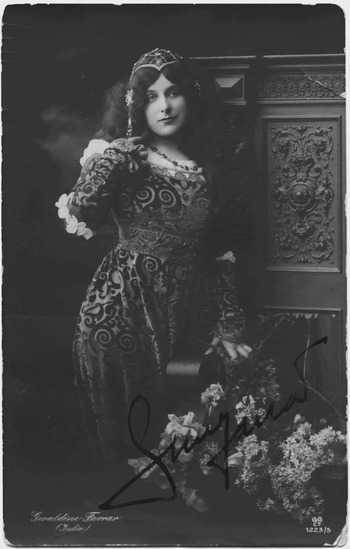
Yet Robinson had not forgotten about opera. On the contrary, as early as 1936, while still at the Banner, he was corresponding with soprano Geraldine Farrar (Figure 2), who had retired from the Met in 1922. Early communications from Farrar are brief—thanks for his “kind thought of Xmastide” and the “delectable holiday package,”Footnote 5 but later letters reveal more substance in her opinions of the current state of musical affairs at the Met (“the last two radio performances of ‘Otello’, show our opera house in an unfortunate shadow!”)Footnote 6 or the state of opera in general (“the welitsch ‘salome,’ and a flagstad concert … have gladdened my soul in the present arid expanses of dubious offerings. melchior in his corsets, and traubel … sparring with fred allen, make me wonder … many things”).Footnote 7 Farrar reminisces about Italian opera impresario Giulio Gatti-Casazza, who was manager during most of her time at the Met, and about the venues to which they toured. These memories, while charming and nostalgic, also provide invaluable insights for the opera historian. For instance, Farrar provides wonderful first-hand information about the acoustics of the Auditorium Building in Chicago where the Met appeared on tour.Footnote 8 For more than twenty years, Farrar called Robinson “Mr. Robinson,” until she relaxed to “Dear Friend” and then finally to “‘Sir’ Francis.” Late in their correspondence, she began to sign her letters as the notes G and high F on a treble music staff.
Autographed photograph of Geraldine Farrar. Box 82, “Geraldine Farrar,” Robinson Collection. Courtesy of the Francis Robinson Collection, Vanderbilt University Special Collections and University Archives.

While Robinson loved opera in general, the Metropolitan Opera in particular was his great love. He once said, “The Metropolitan Opera is not just a living, it's my life.”Footnote 9 Robinson entered the world of the Metropolitan Opera through the auspices of impresario Sol Hurok, who hired him to manage the Met's annual tours. In 1948, Robinson joined the Metropolitan organization to continue the tour work he had been doing for Hurok, and he had that responsibility until his death. The Metropolitan Opera annual tours to Atlanta, Boston, Cleveland, Dallas, Detroit, Memphis, and Minneapolis as well as abroad were both operatic and social events. Moving the Met Opera on the road was a massive logistical endeavor. As Robinson described it,
On tour the Metropolitan more nearly resembles an army on the march than a band of strolling players. We take everything but the opera house. The performances beside Lake Erie or the Mississippi are as near as humanly possible (sometimes inhumanly) to those by the Hudson. This means the entire company of 311, the actual count of the latest tour roster, joins the caravan–orchestra of ninety-four, chorus of seventy-seven, ballet of twenty-three, seventy-three principal artists, four conductors, technical staff, and administration plus scenery, properties, and electrical effects for seven productions, one for each of six evenings and one matinee a week, 180 tons of equipment in all! In the trunks are 1,500 costumes, 500 pairs of shoes, 600 wigs.Footnote 10
The tour was also a major diplomatic effort since the stars often did not want to endure the discomforts of travel, especially when they could get other singing engagements elsewhere. However, the Met Opera administration believed in the importance of the tour and believed that the Met was indeed the national opera company; thus, it was critical that the singers who performed in New York also sing their roles on tour. Rudolf Bing, Met Opera general manager from 1950 to 1972, felt that the underlying reason for Maria Callas's reluctance to honor her 1958–9 contract with the Metropolitan Opera was that she intended to pull out of the tour included in the contract, an unacceptable situation to Bing, who “simply could not go to our tour cities … and say they would have to do without our most publicized star.”Footnote 11 Indeed, Robinson told the story of the impact of hearing his first opera performance—the Met in Atlanta with Rosa Ponselle, Giovanni Martinelli, and Lawrence Tibbett in Il trovatore—many times. His story of experiencing great singers on tour was repeated after his death in a 1982 news article to highlight the current problems of touring the Met with the “Met at Lincoln Center and the Met that tours [being] significantly different companies”; that is, star casts in New York and different casts on tour.Footnote 12 Certainly there were other problems—the size and complexity of the sets, the growth of regional opera companies, the sheer cost of touring—but the issue of the reluctance or refusal of opera stars to tour was a factor in the demise of the Met tour in 1986.
Bing knew and valued Robinson's worth. He said, “Francis's overriding quality was his ability to make friends with people, to tell always the right story at the right moment.”Footnote 13 He acknowledged that “I would travel back and forth as necessary but Francis Robinson stayed out for the entire tour, much to the delight of the company and the sponsors.”Footnote 14 Robinson's papers document the Met's tours with itineraries, rosters, programs, and press clippings as well as invitations and menus. In addition, Robinson's extensive correspondence with numerous people provides insights into both professional and social aspects of the tour.
Robinson's portfolio at the Met soon expanded to include head of the box office and the subscription department as well as tour director. In 1954, recognizing that Robinson “was the ideal person for handling public relations,”Footnote 15 Bing made Robinson an assistant manager of the Metropolitan Opera with additional responsibility for the press department and all publicity activities connected with the New York season, the tour, and any and all other initiatives that the Metropolitan Opera might decide to undertake, including radio and television activities.Footnote 16 Because of his multiple roles, Robinson was aware of all the Met's initiatives and activities, so the documentation in the collection is extensive, covering press and publicity relating to all aspects of the company as well as documentation in specific areas such as the opera house, performance-related activities, personnel, media activities, affiliated organizations, financial information, tours, and labor negotiations.
Materials on both the old and the new Metropolitan Opera house include photographs, clippings, publicity materials, press releases, dinner menus, annual reports, budget estimates, and in-house memos regarding Lincoln Center. Affiliated organizations such as the Metropolitan Opera Guild, the Metropolitan Opera National Council, the Metropolitan Opera Studio, and others are documented. There are materials related to performances, including libretti, programs, and souvenir programs. Galas, benefits, and opening nights are documented. Robinson collected materials related to the Met before his tenure there, so the programs and libretti date back to the early years of the company, starting in the nineteenth century. Financial records include prospectuses, white papers, annual reports, financial statements, performance-related statements, and public relations proposals. Robinson also maintained files on Metropolitan Opera staff, including managers and assistant managers, artists, and directors.
Robinson's documentation of Metropolitan Opera labor negotiations covers 1948 to 1977, but it also covers earlier disputes: we learn, for example, that during the time Giulio Gatti-Casazza was general manager (1908–35), the entire company (with the exception of tenor Beniamino Gigli) agreed to take a voluntary 10 percent cut in pay during the Depression.Footnote 17 During Robinson's time at the Met, there were major labor disruptions. For instance, in 1961, U.S. Secretary of Labor Arthur J. Goldberg intervened to mediate at the request of Mrs. John F. Kennedy through the president. Goldberg justified involving the Department of Labor in this particular dispute when other disputes regarding airlines, nuclear submarines, and automobile manufacture required attention, saying “that the Metropolitan Opera is our only national opera company” and “without the arbitration settlement reached in December 1961, the net result might well have been the end of the Metropolitan Opera, a national cultural asset.”Footnote 18 The area of labor negotiations has been a difficult problem for Metropolitan Opera general managers and was certainly a challenge for Robinson. As head of public relations, his job was to keep the operagoing public engaged and sympathetic during strikes.Footnote 19
The Metropolitan Opera has a long history of recording and broadcasting opera in various ways, and Robinson's collection reflects those activities, especially as they touched on his own involvement. The media materials include broadcast scripts, advertising, program guides, press releases, clippings, program proposals, drafts, and work notes. Robinson began appearing on the popular “Texaco Opera Quiz” in the 1950s, which aired during radio broadcasts of Met performances, but on 27 February 1960, he came into his own on the Metropolitan Opera broadcast with a musical biography of Enrico Caruso. Using his own extensive collection of Caruso recordings and materials, Robinson put together a twenty-minute program honoring the great tenor. He wrote to his mother a few days later that he “was so unnerved I actually hardly knew where I was, or what I was doing,” but it was a huge success, and he received mail from all over the country, including a telegram from Geraldine Farrar, who had sung with Caruso at the Met.Footnote 20 That broadcast was the impetus for a series by Robinson called “Biographies in Music” that took place during the third intermission of the Met's Saturday broadcasts. In introducing Robinson and the series, Milton Cross, host of the Metropolitan Opera broadcast, said that the musical biography of Enrico Caruso was “so moving and brought so many requests for more musical biographies that we have persuaded Mr. Robinson to do a series of such broadcasts for us.”Footnote 21 Robinson's first choice was Ezio Pinza, and he soon added biographies on Geraldine Farrar, Amelita Galli-Curci, Rosa Ponselle, and others. He was able to draw on his own extensive collection for research materials on the opera stars covered in his biographies. In 1978, Robinson became host for the Live from the Met telecast series, continuing to reach out to opera audiences around the country. The Robinson Collection holds television and radio scripts, advertising, clippings, press releases, program guides, program proposals, drafts, and Robinson's notes.
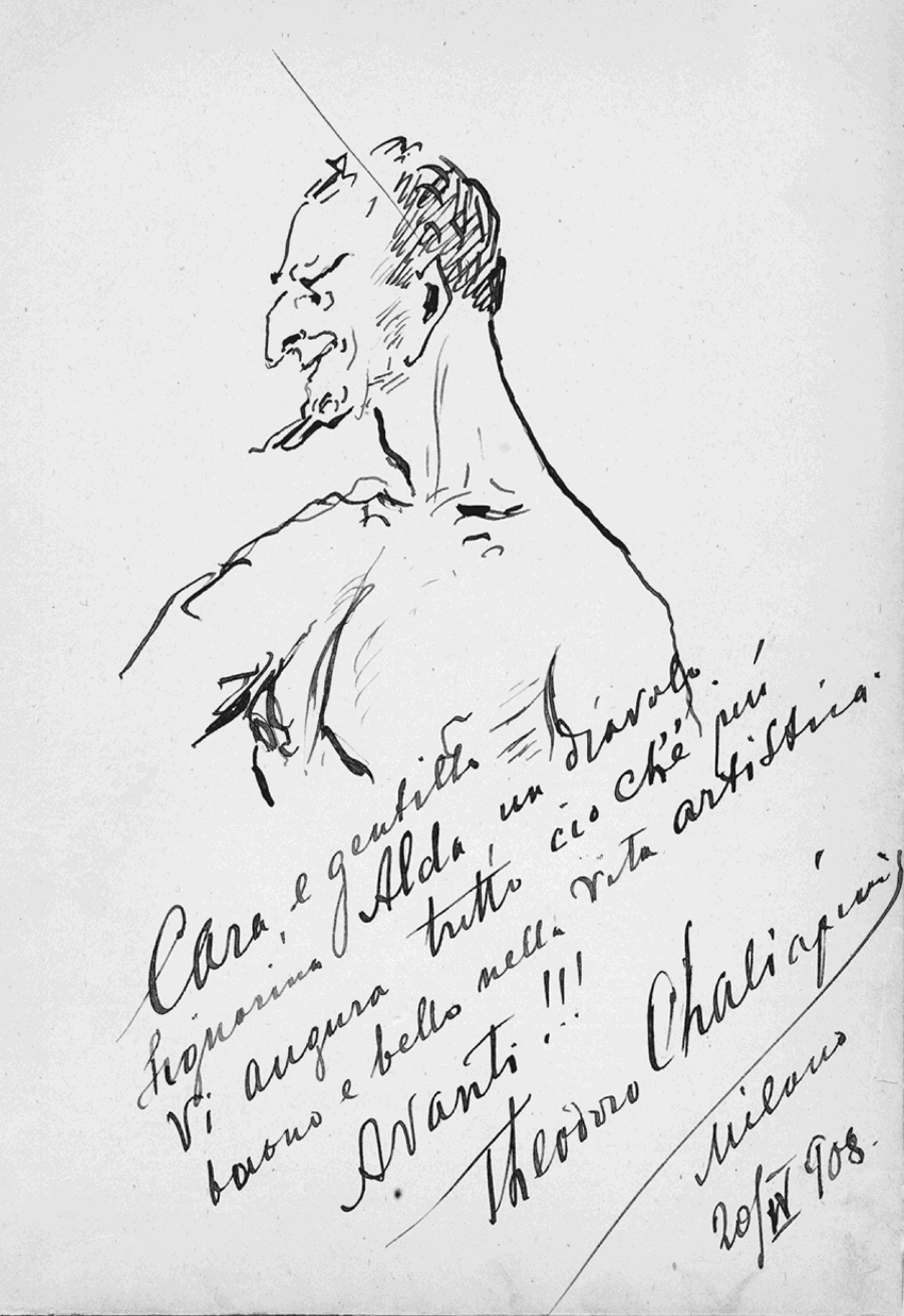
In addition to the substantial documentation that Robinson collected in the course of his work as assistant manager of the Metropolitan Opera, he also assembled materials on great opera personalities. He had met some of them during his work, some he knew after they had retired, and some he never had the opportunity to meet. His collection included not only singers but also conductors, composers, and musicians. The Robinson collection is rich with photographs, programs, correspondence, and memorabilia that he acquired related to such artists as Feodor Chaliapin (Figure 3), Amelita Galli-Curci, Giulio Gatti-Casazza, Beniamino Gigli, Ezio Pinza, Rosa Ponselle, Lily Pons, Nellie Melba, Emma Calvé, Ernestine Schumann-Heink, Mary Garden, Giacomo Puccini, and Arturo Toscanini. Probably his most prized material was his Caruso collection, which includes correspondence; a fascinating set of postcards Caruso apparently sent to document where he had been; correspondence and other material from Caruso's private secretary, Bruno Zirato; photographs; programs, including a 1914 souvenir program for a benefit for Belgian women and children, with Caruso's famous drawings and his signature; calling cards; sheet music; a patchwork quilt made of squares of fabric from Caruso's costumes; and the singer's last checkbook.
Drawing (self portrait) of bass Feodor Chaliapin inscribed to soprano Frances Alda. Box 47, “Frances Alda,” Robinson Collection. Courtesy of the Francis Robinson Collection, Vanderbilt University Special Collections and University Archives.

The correspondence in the Robinson collection is unique and provides a fascinating window into the world of opera—the business, the art, and the temperaments of artists as well as administrators. An October 1956 memo from Rudolf Bing to Robinson asked him to meet Callas at the airport and take with him one of the Met's legal representatives. Bing was concerned that Edgar Richard Bagarozy, who claimed to have a contract with Callas as her sole representative and had served her with a warrant following a 1955 performance with the Lyric Opera of Chicago, would possibly be there and create an unpleasant scene. Given that the diva was arriving on a Saturday, when it would be difficult to reach a lawyer, Bing thought it best to have legal representation on hand just in case. The memo is a straightforward request that Robinson look out for the best interests of the Metropolitan Opera and the singer. At least it is until the final paragraph, when Bing says he is sending flowers to the hotel, adding, “For your personal information the Diva hates carnations so I have asked [Fausto] Cleva [the Met conductor] to send her a bunch of Carnations!”Footnote 22
Robinson's correspondence with his mother (more than 600 items) is a treasure trove of personal and professional insights into the world of opera. The death of the baritone Leonard Warren onstage on 4 March 1960 while appearing as Don Carlo in Verdi's La forza del destino continues to be a topic of discussion and dispute—what the last words he sang were, what Bing said to the audience, which critics were there, and how their stories were written. In a 2004 New York Times article, David W. Dunlap revisits the multiple versions of the night of Warren's death.Footnote 23 While Robinson's letter to his mother on 11 March 1960 does not answer every question, it perhaps clarifies some issues, such as where the Times critic was (he phoned his story from Robinson's desk), and it certainly conveys the disbelief, emotion, and irony of the evening. The Warrens had planned a supper party after the opera that night, and Warren had called Robinson that afternoon to confirm. Robinson thought afterward that it was an amazing coincidence that Warren's own doctor would happen to be in attendance as well as priests and that Agatha Warren would be close by in the wings rather than in the audience when her husband fell. Instead of going home from the theatre, Robinson went to the Warrens' home to take care of things there for the party that would not happen: “I knew they would have done th[a]t for me. There was the lovely party table, the plates stacked on a lace cloth.”Footnote 24
Robinson left the rich documentation of the operatic life he had lived and loved to his alma mater, Vanderbilt University, where it resides in Special Collections and University Archives, in company with other significant collections related to the performing arts, including the papers of actor John Lark Taylor and film director Delbert Mann.Footnote 25