Introduction
Environmental conservation scientists and managers increasingly recognize that humans are not only drivers of ecological change, but also receive benefits from nature and have reciprocal relationships with it (Mace Reference Mace2014). Consequently, a socio-ecological systems paradigm of environmental research and conservation is consolidating at academic (Anderson et al. Reference Anderson, Pizarro, Estévez, Sapoznikow, Pauchard, Barbosa, Moreira-Múñoz and Valenzuela2015a) and institutional levels (e.g., the Inter-Governmental Science-Policy Platform for Biodiversity and Ecosystem Services (IPBES Reference Rice, Simão Seixas, Zaccagnini, Bedoya, Arroyo, Bennett, Bustamante, Cavender-Bares, Diaz-de-León, Fennessy, García Marquez, Garcia, Helmer, Herrera, Klatt, Scarano, Ometo, Schill, Anderson and Rodriguez Osuna2018) and the United Nations Agenda 2030 for Sustainable Development (United Nations General Assembly 2015)). Today, one could argue that there is even consensus on the need to integrate conservation’s human and natural dimensions (e.g., conservation biology; Teel et al. Reference Teel, Anderson, Burgman, Cinner, Clark, Estévez, Jones, McClanahan, Reed, Sandbrook and John2018), but there is still work to be done on developing the methods to better incorporate diverse human values and worldviews into plural valuations and public and private decision-making (Anderson et al. Reference Anderson, Seixas, Barbosa, Fennessey, Díaz-José and Herrera2019, Díaz et al. Reference Díaz, Pascual, Stenseke, Martín-López, Watson, Molnár, Hill, Chan, Baste, Brauman and Polasky2018, Millennium Ecosystem Assessment 2005, Norgaard Reference Norgaard2010, Pascual et al. Reference Pascual, Balvanera, Díaz, Pataki, Roth, Stenseke, Watson, Dessane, Islar, Kelemen and Maris2017).
Protected areas (PAs) are one of the most successful environmental conservation policies in the Americas (IPBES Reference Rice, Simão Seixas, Zaccagnini, Bedoya, Arroyo, Bennett, Bustamante, Cavender-Bares, Diaz-de-León, Fennessy, García Marquez, Garcia, Helmer, Herrera, Klatt, Scarano, Ometo, Schill, Anderson and Rodriguez Osuna2018). As early as the 1970s, some PA strategies encompassed both social and ecological dimensions. For example, UNESCO’s Man and the Biosphere Programme put forward an environmental management strategy, known as biosphere reserves, that integrates biodiversity conservation with local development and human well-being via use zoning and stakeholder participation (Araya Rosas & Clüsener-Godt Reference Araya Rosas and Clusener-Godt2007). In the 1990s, an ecosystem approach to biodiversity conservation was consolidated, and PAs began to tackle the complex task of achieving a more holistic vision of conservation by looking beyond PA boundaries and also utilizing participatory methodologies (Convention on Biological Diversity 1992, Crofts Reference Crofts2008, Grumbine Reference Grumbine1994, Jax & Rozzi Reference Jax, Rozzi, Nelson and Callicott2008). These efforts challenged dichotomies between nature versus culture and wilderness areas versus cultural landscapes, which have characterized much of traditional Western conservation thought, particularly in North America (Callicott Reference Callicott2008, Jax & Rozzi Reference Jax, Rozzi, Nelson and Callicott2008). Current environmental conservation efforts seek to institutionalize socio-ecological perspectives of humans and nature, which now are conceived of as having reciprocal and diverse relationships (Anderson et al. Reference Anderson, Pizarro, Estévez, Sapoznikow, Pauchard, Barbosa, Moreira-Múñoz and Valenzuela2015a, Chan et al. Reference Chan, Balvanera, Benessaiah, Chapman, Díaz, Gómez-Baggethun, Gould, Hannahs, Jax, Klain and Luck2016, Díaz et al. 2015, Mace Reference Mace2014).
Consequently, PA management can benefit from further attention to expanding historical preservationist goals to better include philosophical, political, cultural, social and economic dimensions (Jax & Rozzi Reference Jax, Rozzi, Nelson and Callicott2008). In this context, socio-cultural evaluation approaches to nature (see Scholte et al. Reference Scholte, van Teeffelen and Verburg2015) allow the eliciting of values from diverse user groups, which can help PAs face emerging socio-political challenges like changing visitor expectations or new demands made by expanding adjacent communities (Venter et al. Reference Venter, Naiman, Biggs and Pienaar2008). Visitors to PAs bring their own moral attitudes towards humans and nature (Jax & Rozzi Reference Jax, Rozzi, Nelson and Callicott2008), and they hold diverse values that affect their appraisal of the ecosystem services that parks provide (Maestre-Andrés et al. Reference Maestre-Andrés, Calvet-Mir and van den Bergh2016). At the same time, environmental scientists and managers, who frequently are responsible for PA decision-making, may only represent a subset of the broader suite of values held by a community (Zagarola et al. Reference Zagarola, Anderson and Veteto2014). Furthermore, the tourism sector comprises an array of stakeholders, ranging from neighbouring communities to large-scale operators and from international travel agencies to local guides, even in remote places like Tierra del Fuego (TDF) in southern Patagonia (Raya Rey et al. Reference Raya Rey, Pizarro, Anderson and Huettmann2017), and a nuanced understanding of tourists and their relationship to nature – vis-à-vis PAs – could provide information to better administer parks based on place-based models and concomitantly provide more enriching visitor experiences (Frost & Hall Reference Frost and Hall2009). Therefore, adequately representing the diverse understandings and interests of PA visitors is germane for inclusive planning processes, which are frequently the responsibility of centralized national park agencies (Jamal & Stronza Reference Jamal and Stronza2009).
Socio-cultural evaluations of nature and its contributions to people convey the importance individuals or groups assign to the components of nature (e.g., biodiversity, landscape features) and its effect on their well-being (e.g., uses, preferences) (Scholte et al. Reference Scholte, van Teeffelen and Verburg2015). In addition to socio-demographic characteristics (e.g., age, gender, income, education or membership in environmental organizations) (Martín-López et al. Reference Martín-López, Iniesta-Arandia, García-Llorente, Palomo, Casado-Arzuaga, Del Amo, Gómez-Baggethun, Oteros-Rozas, Palacios-Agundez, Willaarts and González2012), distinct academic fields such as human geography, environmental psychology and tourism have shown that connections with nature and place are a key factor in ascribing value to a landscape (Brown & Raymond Reference Brown and Raymond2007), in mediating pro-environmental behaviours (Gosling & Williams Reference Gosling and Williams2010) and in perceiving benefits of PAs (Kil et al. Reference Kil, Holland, Stein and Ko2012). Similarly, factors that shape risk assessments, including the perception of threats to nature, also are affected by social characteristics that go beyond demographics and social structure and also encompass personal values, spiritual beliefs and worldviews, as well as the conditions of the environmental problem itself (Slimak & Dietz Reference Slimak and Dietz2006).
In this context, we conducted a socio-cultural evaluation of nature in Tierra del Fuego National Park (TFNP), Argentina. Specifically, a representative sample of Park users was surveyed to determine: (1) their valuation of how the Park contributes to people (i.e., benefits); and (2) their assessment of disturbances that impact the Park (i.e., threats). We compared perceptions between: (1) local Ushuaia residents; (2) national visitors from other Argentine provinces; and (3) international tourists. We predicted that valuations would differ between these groups, hypothesizing that increasing distance from TFNP (resident < national < international) would decrease relationships to this place (e.g., decreased knowledge of local biodiversity) and decrease the valuation of the Park’s benefits and threats (Kil et al. Reference Kil, Holland, Stein and Ko2012). Finally, we discuss the values perceived by different users of TFNP in relationship to the goals of its management plan to provide relevant information to managers regarding potential synergies and gaps between these stakeholders’ perceptions and managers’ planning instruments. These data should also provide new insights into the human dimensions of Patagonia, a region often thought of as a pristine wilderness area in the Western social imaginary (Mittermeier et al. Reference Mittermeier, Mittermeier, Brooks, Pilgrim, Konstant, Da Fonseca and Kormos2003), but that in fact for millennia has been the stage for human activities and complex social relationships with nature (McEwan et al. Reference McEwan, Borrero and Prieto2014, Moss Reference Moss2008).
Methods
Study site
TFNP, Argentina, was established in 1960 (Argentine Law #15 554) to preserve 63 000 ha (enlarged to 68 909 ha in 1966) of the Sub-Antarctic Forest Biome (Administración de Parques Nacionales 2007a). Listed as an International Union for Conservation of Nature (IUCN) category II PA, only 2000 ha (c. 3%) are open to the public; the remainder is a restricted natural reserve. Ecologically, this biome hosts the world’s southernmost forests, and TFNP’s landscape consists of a diverse mosaic of forests (Nothofagus spp.) and peat bogs (Sphagnum spp.) within a highly variable topography of coastline, mountains, valleys, rivers and lakes. Paradoxically, this ecoregion has the greatest number of invasive exotic mammal species in the Southern Cone (Ballari et al. Reference Ballari, Cuevas, Cirignoli and Valenzuela2015), and the TDF Archipelago has 24 exotic terrestrial and freshwater vertebrate taxa, outnumbering natives approximately 2:1 (Valenzuela et al. Reference Valenzuela, Anderson, Fasola and Cabello2014).
Geopolitically, TDF is divided between Argentina and Chile, with the archipelago’s Argentine portion experiencing exponential population growth in the past 30 years (Van Aert Reference van Aert and Baldacchino2013). The Park is c. 15 km west of Ushuaia, capital of the Argentine TDF Province. In 2016, Ushuaia had c. 60 000 residents, but received more than 400 000 tourists (Secretaría de Turismo Municipalidad de Ushuaia 2017). The total number of registered visitors went from 66 536 in 1996 to 210 870 in 2015, including local residents of TDF Province (n = 48 067), Argentine visitors from other provinces (n = 53 854) and international tourists (n = 108 949) (Administración de Parques Nacionales 2007a, Universidad Nacional de Tierra del Fuego 2015). This number of visitors ranks TFNP as the fourth most visited national park in Argentina (Ministerio de Turismo 2017). During the 2018–2019 summer season, visitors paid entrance fees based on the following adult rates: general admission c. US$13; Argentine citizens c. US$4.25; TDF residents c. US$1.88; Argentine retirees = free (US$1 = 37.50 Argentine pesos, 1 January 2019).
Sampling strategy and design
We conducted face-to-face surveys by randomly sampling visitors during January–April 2016 within TFNP and in the city of Ushuaia. Participants were selected by approaching every third person encountered to take the survey. Based on 2015 user demographics, we surveyed 563 individuals (122 residents, 147 Argentines, 294 internationals), which exceeds the 383 surveys needed to obtain a 95% confidence level and a ±5% confidence interval for this population. Field collection of data occurred in key visitor locations that reflected varied park uses. We conducted a weekly synthesis of participant demographics to orientate the next week’s efforts by targeting specific user groups in order to obtain the final representative proportions and ensure gender and age parity. A non-response bias check (n = 410) found no significant differences between respondents and non-respondents based on gender, age, origin or mode of transport. We did find a slight over representation of respondents travelling with family, but we know of no literature that has identified this as a determining factor of value assessments.
Surveys consisted of 13 closed questions about the perceived benefits of TFNP, 9 questions regarding the perceived threats and 12 about native and exotic species from TDF (see Appendix S1, available online). Respondents were asked to evaluate each question based on a Likert-type scale of 0 (none), 1 (a little), 2 (some), 3 (quite a bit) and 4 (a lot). Respondents were also given the option to say they did not know. To assist with comprehension during interviews in the field, a visual representation of the 0–4 scale was shown as a prompt. Potential benefits used in the survey were obtained from the Park’s management plan and complemented by the ecosystem services literature to cover material, non-material and regulating benefits (see Díaz et al. Reference Díaz, Pascual, Stenseke, Martín-López, Watson, Molnár, Hill, Chan, Baste, Brauman and Polasky2018). The final list also was developed to include the three nature-value types described by Chan et al. (Reference Chan, Balvanera, Benessaiah, Chapman, Díaz, Gómez-Baggethun, Gould, Hannahs, Jax, Klain and Luck2016): (1) instrumental values (providing potable water; other human needs, such as food, firewood, etc.; economic resources; regulation of natural phenomena, such as hydrological cycles, erosion, etc.); (2) relational values (observing nature; recreation and picnicking; historical and cultural values; education and science; local identity; spiritual values; border protection); and (3) intrinsic values (biodiversity; existence). The list of threats was also synthesized from the Park’s management plan and includes globally recognized problems (climate change, urban sprawl from Ushuaia, trash), tourism-related issues (concentration and quantity of tourists, impacts of other non-native species) and locally specific topics (use by the residents from Ushuaia, horses and dogs loose in the Park (i.e., semi-feral or free-range), speeding and dust from the dirt road) (Administración de Parques Nacionales 2007a).
The third section of the survey tested interviewees’ local biodiversity knowledge. Photographs and Spanish/English common names were shown for 12 species (the first six in the following list being native and the last six being introduced) that inhabit the Park: guanaco (Lama guanicoe), huillín/river otter (Lontra provocax), zorro colorado/culpeo fox (Pseudalopex culpaeus lycoides), anfípodo/amphipod (Amphipoda), puyen/common galaxias (Galaxias maculatus), murciélago orejudo/long-eared bat (Histiotus magellanicus), visón/mink (Neovison vison), conejo/rabbit (Oryctolagus cuniculus), trucha/trout (Oncorhynchus mykiss), zorro gris/grey fox (Pseudalopex griseus), castor/beaver (Castor canadensis) and caballo/horse (Equus ferus). Respondents were asked whether the species was present or absent in TDF, or they could say they did not know. Finally, interviewee demographics were recorded, including reported gender, highest education level, age and residence.
Interviews lasted c. 20 minutes and were conducted in either English or Spanish, depending on the preference of the interviewee. Interviews were usually conducted by a dual team with one native speaker of each language or a single bilingual member of the research team. Before the data collection phase, field assistants received training in human subjects research and practised the interview to standardize the manner in which surveys were administered. Participants were given detailed information about the study to orally provide their informed consent to participate. The study was authorized by the Northern Arizona University Institutional Review Board, which provided exempt status to project 874887-1, and was conducted under the aegis of permit 070-CPA-2015 from the Argentine National Parks Administration’s Southern Patagonia Coordination Office.
Data analysis
Some respondents did not complete the entire series of questions due to time constraints, which led to varying sample sizes for different sections (benefits: n = 528; threats: n = 527; local biodiversity knowledge: n = 453). Descriptive statistics analysed user groups’ overall assessment of whether they perceived any benefits from or any threats to TFNP. Then, we ranked and compared the highest and lowest mean perceived benefits from and threats to TFNP per group. Because data were skewed either low or high for every data set analysed and could not be normalized, a non-parametric Wilcoxon signed-rank procedure with a Dunn method for joint ranking post hoc test (p < 0.05) (Zar Reference Zar2010) was used to identify differences between groups’: (1) mean valuation of each benefit; (2) sum of all benefit valuations; (3) mean valuation of the values categories proposed by Chan et al. (Reference Chan, Balvanera, Benessaiah, Chapman, Díaz, Gómez-Baggethun, Gould, Hannahs, Jax, Klain and Luck2016); (4) mean valuation of each threat; and (5) sum of all threat valuations. Mean values for each benefit or threat ranged from 0 to 4, while summed values were from 0 to 52 and from 0 to 36 for benefits and threats, respectively. When interviewees did not know or when they skipped questions, the response was coded as 0. Finally, to develop explanatory relationships, we performed linear models to test if local biodiversity knowledge affects benefit and threat evaluations. Local biodiversity knowledge was measured as the percentage of correct responses regarding the 12 species present on TDF. All statistical analyses were conducted in JMP (version 13.2.1; SAS Institute 2015).
Results
Overall perception of benefits and threats
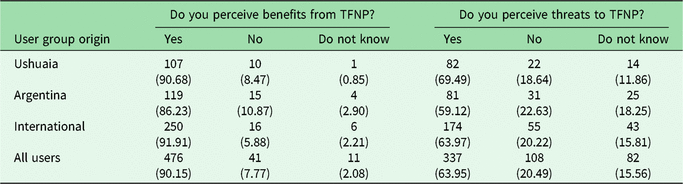
The majority (86–92%) of respondents in all user groups reported receiving personal benefits from TFNP; only c. 10% of all users felt they did not obtain any benefits or were not sure (Table 1). Similarly, a majority of all users perceived threats to the Park, but this proportion was less than for perceived benefits, at 59–70% (Table 1). Likewise, the mean valuation of specific benefits among all user groups exceeded the mean valuation of threats (benefits mean = 2.39; threats mean = 1.61, both on a 0–4 scale).
Overall assessment of the benefits from and threats to Tierra del Fuego National Park (TFNP) perceived by three user groups. Data are presented as the total number of responses, with their percentages in parentheses.

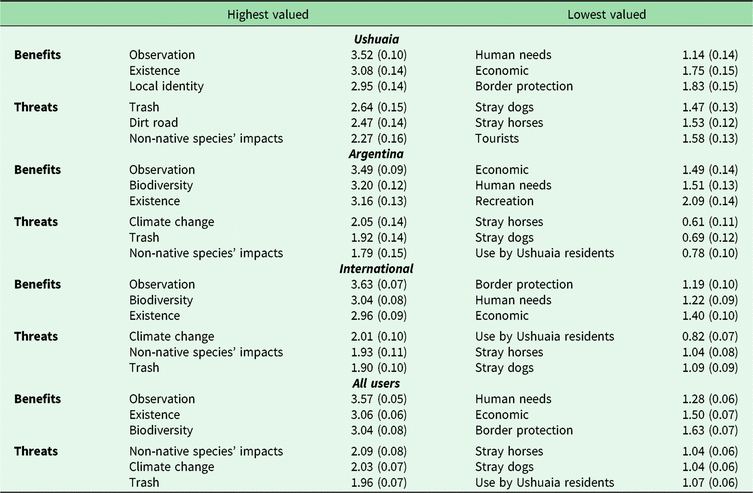
The most highly valued benefits were observation of nature, existence value and biodiversity (Table 2). National and international Park users had the same ranking of the top three benefits, which were relational (observation) and intrinsic values (biodiversity, existence), while local residents’ most valued benefits included both observation and existence, but also added the relational value of local identity. The benefits with the lowest value averages among all respondents were other human necessities, economic value and border protection.
Highest and lowest assessed benefits and threats perceived by user groups of Tierra del Fuego National Park. The values associated with each represent the mean assigned by the respective user group from 0 (no benefit or threat) to 4 (a lot of benefit or threat). Standard errors are in parentheses.

The three greatest threats to TFNP for all respondents were impacts of other non-native species, climate change and trash (Table 2). As with benefits, national and international visitors perceived the same top three threats, but in the orders of climate change, trash and impacts of other non-native species; and climate change, non-native species and trash, respectively. Ushuaia residents viewed trash, the dirt road and non-native species as the Park’s greatest threats. Among all respondents, the least perceived threats were stray horses, stray dogs and use by local residents.
Perception of benefits by user groups
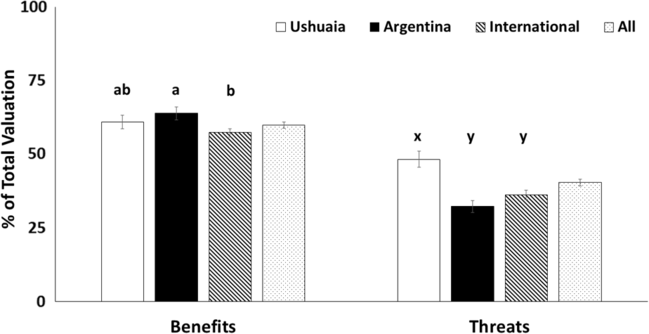
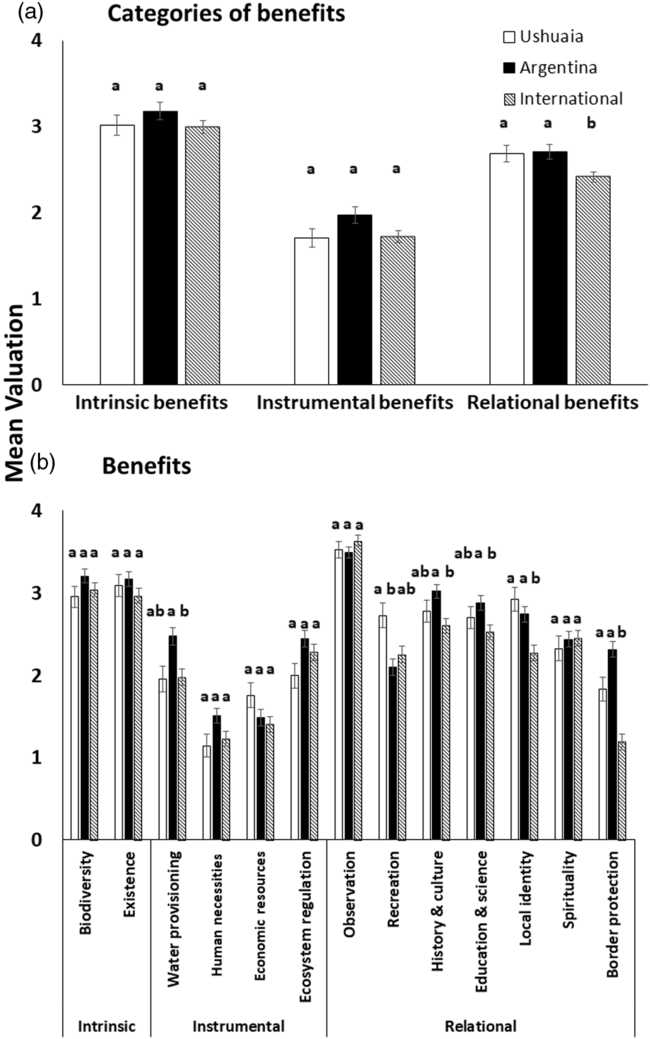
Argentine nationals reported significantly higher overall valuation of benefits than international tourists, while residents of Ushuaia were similar to both groups (Fig. 1). In addition, all three groups more highly evaluated benefits that were intrinsic values compared to the other two categories (Fig. 2(a)). Existence and biodiversity had the second and third highest-rated mean benefit valuations, respectively (Table 2). In contrast, instrumental benefits were the least valued by all respondents (Fig. 2(a)). Only one specific benefit within this category showed a significant difference among users; Argentine nationals had a greater perception of water provisioning than international tourists, while residents of Ushuaia were similar to both groups. Each of the other instrumental benefits (human necessities, ecosystem regulation and economic resources) showed no statistical difference between user groups (Fig. 2(b)).
Percentages of overall evaluations (sum of individual values/total possible evaluation) of benefits and threats perceived by user groups of Tierra del Fuego National Park. Results are shown for Wilcoxon signed-rank procedures with a Dunn method for joint ranking post hoc test (p < 0.05); significant differences among user groups are denoted by different letters (a and b for benefits; x and y for threats). See also Supplementary Table S1.

Significant differences in mean valuation of benefits (Likert-type scale from 0 (none) to 4 (a lot)) among user groups of Tierra del Fuego National Park determined using the Wilcoxon signed-rank procedure with a Dunn method for joint ranking post hoc test (p < 0.05, indicated by different letters above columns) for (a) the specific benefits assessed by the survey and (b) the categories of benefits based on the nature values typology of Chan et al. (Reference Chan, Balvanera, Benessaiah, Chapman, Díaz, Gómez-Baggethun, Gould, Hannahs, Jax, Klain and Luck2016). See also Supplementary Table S2.

Significant differences were detected between groups for 6 of the 13 benefits assessed, with 5 of those differences existing in the relational benefits category. Ushuaia residents and Argentine visitors valued the relational benefits of TFNP significantly more than international tourists. While there were no significant differences in perceived values between user groups for observing nature and spiritual benefits, local residents and national visitors valued the Park significantly more for its contribution to local identity and border protection. Argentines reported significantly higher perceived values as well for both history and culture and education and science than international tourists. Lastly, local residents reported higher perceived values for recreation than Argentine nationals (Fig. 2(b)).
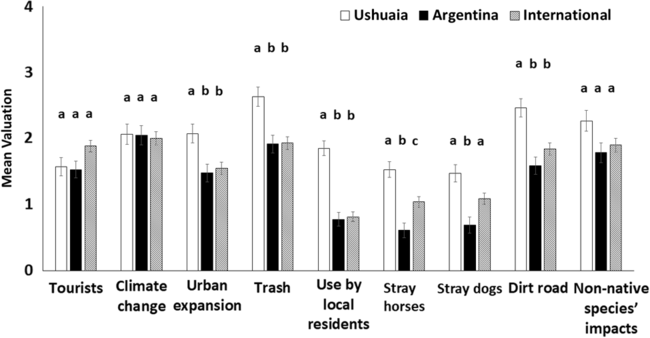
Perception of threats by user groups
Significant differences were found among user groups regarding their assessment of perceived threats to TFNP. When averaging all surveyed threats, Ushuaia residents considered the Park to be at greater risk than national and international tourists (Fig. 3). At the level of specific disturbances, residents reported significantly higher values than the other groups regarding the threats of trash, dust and danger from the dirt road, urban expansion from Ushuaia and use by local residents. In turn, both Ushuaia residents and international tourists perceived a greater threat than Argentine visitors from stray dogs in the Park. There were also significant differences among all groups in the perceived threat from stray horses. Local residents felt this to be the highest, while national tourists perceived it to be the lowest threat. There were no statistical differences among user groups regarding the threats of other non-native species impacts and climate change, and these were the highest and second highest perceived threats overall.
Significant differences in mean valuations of threats (Likert-type scale from 0 (none) to 4 (a lot)) among user groups of Tierra del Fuego National Park determined using the Wilcoxon signed-rank procedure with a Dunn method for joint ranking post hoc test (p < 0.05, indicated by different letters above columns). See also Supplementary Table S3.

Relationship between local biodiversity knowledge and valuation
Linear models of user valuation of both benefits and threats as a function of biodiversity knowledge failed to produce conclusive results across user groups. However, significant positive relationships were found between local biodiversity knowledge and valuation of benefits for Ushuaia residents (p = 0.0002) and international tourists (p = 0.03), but not for Argentine nationals (p = 0.75) (Table 3). Similarly, assessment of threats was positively influenced by increases in knowledge for residents (p = 0.004) and international tourists (p = 0.005), but not for Argentine nationals (p = 0.10) (Table 3).
Linear models used to explore the relationship between benefit and threat assessments by park user groups as a function of their knowledge of local biodiversity. Significant models are denoted with bold (p < 0.05). BK = biodiversity knowledge; SB = sum of benefits; ST = sum of threats.

Discussion
Relevance for plural valuations of nature
Our research advances socio-cultural evaluations of nature (Scholte et al. Reference Scholte, van Teeffelen and Verburg2015), and in doing so, we seek to better link ecological aspects of nature with their contributions to human well-being (e.g., health, livelihoods, cultural continuity and traditional knowledge; Anderson et al. Reference Anderson, Seixas, Barbosa, Fennessey, Díaz-José and Herrera2019). Our approach explicitly incorporated a broad spectrum and depth of nature values, including relational (e.g., local identity) and intrinsic values (e.g., existence), which are difficult to put into ecological or economic terms, and therefore are challenging to include in traditional environmental management plans. We demonstrated that the specific valuation of PAs by different user groups is partially related to the types of relationships they have to this place. For example, for all users of TFNP, nature was highly appreciated for its intrinsic values, but local residents and Argentine nationals also highlighted relational values, such as local identity, border protection and recreation. Similarly, local residents perceived more local problems (e.g., dust in the road) that are not apparent to visitors with a more distant connection to this place. At the same time, however, place-based relationships did not lead local residents to value the instrumental values that the Park provides them on a daily basis, such as water or economic resources.
These findings regarding the importance of intrinsic and relational values over instrumental values, particularly economic benefits, go against some development or political decision-making truisms that consider stakeholders to be motivated predominantly by financial gains and support the need to mainstream the environment across development sectors (Anderson et al. Reference Anderson, Seixas, Barbosa, Fennessey, Díaz-José and Herrera2019). In fact, our data suggest that if decisions were made based principally on monetary considerations, it would not be because those are the values expressed by the Park’s primary users, but rather it would demonstrate underlying power dynamics that allow those values to be expressed in decision-making (Pascual et al. Reference Pascual, Balvanera, Díaz, Pataki, Roth, Stenseke, Watson, Dessane, Islar, Kelemen and Maris2017, IPBES Reference Rice, Simão Seixas, Zaccagnini, Bedoya, Arroyo, Bennett, Bustamante, Cavender-Bares, Diaz-de-León, Fennessy, García Marquez, Garcia, Helmer, Herrera, Klatt, Scarano, Ometo, Schill, Anderson and Rodriguez Osuna2018). By using a socio-ecological perspective, interdisciplinary research can also aid in addressing some of the power asymmetries between Western science and local knowledge, and even among the diverse disciplines within academia (natural and social sciences, the arts and humanities), making research outcomes more equitable and theoretically more likely to be incorporated into policy and management (Diaz et al. Reference Díaz, Pascual, Stenseke, Martín-López, Watson, Molnár, Hill, Chan, Baste, Brauman and Polasky2018).
Ultimately, knowledge dialogue between different stakeholders, including between science and society (Anderson et al. Reference Anderson, Monjeau and Rau2015b), can be enhanced by socio-cultural evaluations. For example, our findings illuminate the underlying motivations of people visiting Ushuaia and TDF from elsewhere, which largely respond to social imaginaries related to being at the ‘end of the world’ and in a remote, untouched wilderness area (Moss Reference Moss2008, Raya Rey et al. Reference Raya Rey, Pizarro, Anderson and Huettmann2017). This is especially true for Argentine tourists and international visitors, but TDF should also embody different meanings for residents who call the island home. Overall, the results of this study provide the first empirical information regarding the different ways that natural PAs in southern Patagonia are important to local, national and international users not only as biodiversity reservoirs, but also for purposes relating to sense of place, recreation, culture and other relational values.
Managing protected areas for their plural values
TFNP’s current management plan was developed in 2007 and explicitly identifies both social (e.g., protect cultural patrimony, promote natural and social scientific research, provide tourism and recreation opportunities, contribute to the development of the region’s tourism potential and support public understanding about the PA’s importance and functions) and ecological conservation objectives (e.g., conserve a representative portion of the world’s southernmost forests, conserve the headwaters of watersheds that contribute to the maintenance of regional water cycles) (Administración de Parques Nacionales 2007a). While many of these goals were supported by our findings of user perceptions, some discrepancies were discovered. For example, the Park seeks to contribute to developing the province’s tourism potential through public-use areas and plans to improve and maintain trails and points of interest, which in turn provide opportunities to view and enjoy the Park, as well as being an economic sector (Administración de Parques Nacionales 2007a). From our results, we see that the Park’s activities (e.g., creating trails, signs, interpretive centres) are crucial for people to experience the benefits they most highly value (e.g., nature observation, biodiversity), but at the same time, there is less appreciation by Park visitors that these same conservation actions are important for tourism as part of the island’s broader economic development, even though tourism is the island’s second most important source of private-sector employment (Ministerio de Producción y Trabajo 2019).
Furthermore, our study suggests that the Park has unexplored opportunities to enhance the communication of values that are not currently reflected in its management plan, such as benefits obtained from spiritual experiences; in developing a sense of place, particularly by locals; or by incorporating the value of narratives related to nature’s existence in TFNP for people in other parts of Argentina and the world. Conversely, while geopolitical objectives are often not explicit in conservation strategies, they can be very important in Patagonia and elsewhere (see Fall Reference Fall2005). Yet, the fact that they were not reflected in the benefits highly perceived by users of TFNP means that the Park has an untapped opportunity to highlight its socio-ecological context and the history of PAs in Patagonia, including information on their importance in establishing sovereignty over this region in the 20th century (Bandieri Reference Bandieri2005).
Regarding threats to nature and the Park, we found important space for dialogue between the extant management plan and user perceptions. Climate change has yet to become a major issue for Patagonian environmental managers and is not reflected in national planning documents by the Argentine National Parks Administration (Administración de Parques Nacionales 2007b). Nonetheless, this issue is on the minds of visitors and provides an educational and experiential opportunity. Plus, respondents reported perceiving trash as a problem. In point of fact, managers promote personal responsibility (i.e., “pack it in; pack it out”) and have removed trash cans in the Park. In turn, these decisions successfully eliminated a previous problem of attracting scavenger birds, which are principal predators of waterfowl nests (Liljesthröm et al. Reference Liljesthröm, Fasola, Valenzuela, Rey and Schiavini2014), to areas of high tourist concentration. Since both climate change and trash were the second and third highest perceived threats to the Park overall, it would behove managers to incorporate these problems not only into their policies, but also into their information to visitors in order to increase awareness about these topics as they relate to nature and PAs in Patagonia.
In addition, the fact that instrumental values were not valued as highly as other benefit categories is consistent with studies on visitor valuation of public lands elsewhere (e.g., Casado-Arzuaga et al. Reference Casado-Arzuaga, Madariaga and Onaindia2013, Maestre-Andres et al. Reference Maestre-Andrés, Calvet-Mir and van den Bergh2016). Of the four instrumental benefits tested in the survey, it is reasonable that human necessities (food, firewood, etc.) were considered of little importance, since extractive activities are outlawed in the Park. However, other instrumental benefits have significant implications for local human well-being (ecosystem regulation, drinking water provisioning and economic resources), and therefore their low evaluation indicates a general lack of awareness regarding major contributions of nature to society that are emanating from this Park. While it is common for many stakeholders to not perceive regulating ecosystem services as useful (Maestre-Andres et al. Reference Maestre-Andrés, Calvet-Mir and van den Bergh2016), the importance of these benefits is undeniable, and therefore could be appropriately enhanced in the Park’s communication strategy. Perhaps more distressing, though, is the fact that all of Ushuaia’s drinking water comes from rivers whose headwaters begin in the Park, and thus we would expect this benefit to be highly valued, especially by local residents. Yet, in general, communities in southern Patagonia, including Ushuaia, are unaware of their drinking water’s origin (Zagarola et al. Reference Zagarola, Anderson and Veteto2014). It is plausible, then, that a general education campaign regarding this topic to all Park visitors would not only increase understanding of the water source, but also place greater value on the contribution of PAs as reservoirs that contribute directly to human health and social well-being.
Likewise, while there are no formal assessments of the economic value of the Park, tourism is reported to contribute more than US$50 million annually to Ushuaia (Secretaría Municipal de Turismo 2019) and is the province’s fourth most important economic sector (Ministerio de Producción y Trabajo 2019). Therefore, numerous businesses (e.g., guide services, transport, souvenirs) and supporting activities (e.g., gas stations, restaurants, accommodations) receive direct and indirect economic benefits from the Park and the nature it protects, and this fact could be better communicated to the users of this Park and all citizens of TDF to place this PA in a broader socio-ecological context. One concrete suggestion in this respect would be to conduct an economic impact analysis of the Park to demonstrate its importance to the overall economic development of TDF (see World Commission on Protected Areas 1998).
Conclusion
Visitors to TFNP are aware of a wide range of Park-related issues, but allocate different levels of importance and concern to specific benefits and threats, as expected from theory regarding the relationships between place connections and values (e.g., Brown & Raymond Reference Brown and Raymond2007, Gosling & Williams Reference Gosling and Williams2010, Kil et al. Reference Kil, Holland, Stein and Ko2012). The socio-cultural evaluation approach proved useful as a tool that can help orientate management decisions to better align with public perceptions and needs, which in turn can improve management plans’ success and favour the well-being of both the natural environment and humans. Through this study, the underappreciated benefits that users receive from TFNP were highlighted, and also we provided information about the problems visitors perceived that threaten the maintenance of these benefits. Tourism constitutes a major force that links TDF to the region and the world (Raya Rey et al. Reference Raya Rey, Pizarro, Anderson and Huettmann2017), and Ushuaia particularly positions itself to tourists as a unique destination at the ‘end of the world’ (Giucci Reference Giucci2014, Horlent & Salemme Reference Horlent, Salemme, Herrero and Roseman2015). Yet, we show that TFNP also provides other benefits beyond this marketing slogan, demonstrating that Ushuaia is more than simply a location on a global list of places to visit, but also a home to residents and a site that provides multiple benefits to diverse users. If benefits and threats are managed well, these values can be perpetuated and even enhanced into the future. While various factors, such as trust (Stern Reference Stern2008), can explain conflicts between park managers and other PA users, this study shows that these three user groups largely share values and perceptions that also coincide with many of the objectives stipulated in the Park’s management plan.
Supplementary Material
To view supplementary material for this article, please visit https://doi.org/10.1017/S0376892919000250.
Acknowledgements
We thank the staff at TFNP for their collaboration. OSARA coordinated PRESS interns, and the Grupo Socio-Eco coordinated UNTDF undergraduate assistants (Y Álvarez, F Zuliani, E Arona).
Financial Support
This study was supported by the PRESS Project (US National Science Foundation OISE 1261229), two PEININ grants (Universidad Nacional de Tierra del Fuego – Administración de Parques Nacionales) and PIDUNTDF-A 2/16 (Universidad Nacional de Terra del Fuego).
Conflict of Interest
None.
Ethical Standards
Northern Arizona University authorized Institutional Review Board 874887-1 and the Argentine National Parks Administration’s Southern Patagonian Coordination Office approved permit 070-CPA-2015.