Misuse of antibiotics is a public health crisis resulting in emergence of antibiotic-resistant pathogens. Inappropriate use of antibiotics, especially broad-spectrum agents, can lead to adverse outcomes including Clostridioides difficile infection, drug toxicities, and increased healthcare costs. Nearly 80% of antibiotic use in the United States occurs in the outpatient setting, accounting for 60% of antibiotic expenditures, and many of these antibiotic prescriptions are for pediatric patients.Reference Sanchez, Fleming-Dutra, Roberts and Hicks1, Reference Hicks, Bartoces and Roberts2 Approximately 20% of all pediatric outpatient visits in the United States result in an antibiotic prescription, yielding an annual average of 49 million pediatric antibiotic courses.Reference Hersh, Shapiro, Pavia and Shah3, Reference Fleming-Dutra, Hersh and Shapiro4 In 2015, the Obama administration published the National Action Plan for Combating Antibiotic-Resistant Bacteria (CARB), which includes a goal to reduce inappropriate antibiotic use in the outpatient setting by 50% by 2020.5
Within the United States, antibiotic prescribing rates are highest in the Southeast region.Reference Fleming-Dutra, Hersh and Shapiro4, Reference Hersh, Shapiro, Pavia, Fleming-Dutra and Hicks6 Tennessee ranked the sixth-highest state in outpatient antibiotic prescribing in 2016, with ∼1,169 prescriptions written per 1,000 population compared to a national rate of 836.7 There is an urgent need to improve appropriate antibiotic prescribing, especially in high-prescribing states, through the implementation of outpatient antimicrobial stewardship programs.
We sought to determine patient and provider characteristics associated with higher volume and rate of overall and broad-spectrum pediatric antibiotic prescribing. We aimed to identify target provider populations for antimicrobial stewardship interventions to improve overall and broad-spectrum outpatient antibiotic use for pediatric patients in Tennessee.
Methods
We conducted a cross-sectional, descriptive study of patients included in the IQVIA Xponent database (formerly QuintilesIMS, Durham, NC). We queried the database for children, defined as all patients <20 years of age, who had an antibiotic prescription filled in an outpatient pharmacy in Tennessee between January 1, 2016, and December 31, 2016. The age cutoff of <20 years was chosen based on predefined age categories within the IQVIA database. We evaluated the rate of overall and broad-spectrum antibiotic prescriptions per 1,000 population. Broad-spectrum antibiotics were defined as amoxicillin-clavulanate, third-generation cephalosporins, and fluoroquinolones (Supplemental Table 1online). We also evaluated associations between antibiotic prescribing rates and provider type (ie, nurse practitioner, physician assistant, physician or dentist), patient age group, patient sex, physician specialty, physician years of practice (estimated by decade of medical school graduation), and rural, suburban or urban classification of the county in which the prescription was filled.
The 2016 IQVIA Xponent database captures ∼90% of outpatient oral antibiotic prescriptions dispensed in the United States. Using a patented projection methodology, retail pharmacy sales data from nonfederal community pharmacies are reconciled to wholesale deliveries to project 100% coverage of dispensed medications, producing estimated prescription counts for nonparticipating pharmacies.Reference Hicks, Bartoces and Roberts2, Reference Scarsbrook, Ganeshan and Statham8 The database used for this study excludes prescriptions filled by mail-order pharmacies, hospital-incorporated outpatient pharmacies, and prescriptions filled at inpatient healthcare facilities, but does include both public andprivate insurers. We excluded all antifungal, antiviral, nonantibacterial, non–orally administered prescriptions, and the urinary analgesic methenamine. Antibiotics were grouped into 12 categories (Supplemental Table 1 online).
The IQVIA Xponent database included 182 self-reported prescriber specialties, which we assigned to 17 specialty groups (Supplemental Table 2 online). Within the IQVIA dataset, nurse practitioners, physician assistants, and trainees were categorized as separate specialty types and not included in other specialty groupings. We defined high-prescribing providers as providers whose rate of antibiotic prescribing was >1 standard deviation (SD) above the mean prescribing rate for overall antibiotics. We excluded trainees from high-prescriber analyses because it is common in Tennessee for multiple trainees to practice under an institutional license.
Population data from 2016 for Tennessee and each individual county, used to tabulate population by age group, county and sex, were obtained from the Tennessee Department of Health, Communicable and Environmental Diseases and Emergency Preparedness (CEDEP) based on interpolated data from the US Census Annual Estimates of the Resident Population. The 2013 National Center for Health Statistics (NCHS) urban–rural classifications were used to classify each county as follows: (1) large, central metropolitan (inner cities); (2) large, fringe metropolitan (suburban cities); (3) medium metropolitan (counties in metropolitan statistical areas [MSAs] of populations 250,000–999,999); (4) small metropolitan (counties in MSAs of populations <250,000);(5) micropolitan (growing population centers in the United States that are removed from larger cities, in some cases by ≥100 miles); or (6) noncore areas (nonmetropolitan counties that did not qualify as micropolitan).Reference Ingram and Franco9
The patient’s reported county, defined as the location of the pharmacy where the prescription was filled in the IQVIA Xponent database, was used for all analyses, except when analyzing antibiotic prescribing by provider characteristics, when the provider’s reported county of practice was used. Patient and provider counties were discrepant in <0.05% of prescription records.
Antibiotic prescribing rates for children were calculated as the total number of prescriptions divided by total population within the described patient characteristic multiplied by 1,000. For prescriptions per provider, analyzed for highest-prescribing providers, we summed all antibiotic prescriptions written by the specified group and divided by total number of providers in that group within the dataset.
This study was approved by the Vanderbilt University Institutional Review Board.
Statistical analyses
The Student t test was used to compare means between 2 groups, Kruskal-Wallis statistics were used to compare medians, andanalysis of variance (ANOVA) was used to compare means between 3 or more groups. We compared median values for provider type because data were not normally distributed. We performed a multivariable logistic regression to compare high-prescribing general pediatricians to non–high-prescribing general pediatricians because these groups likely had a comparable number of pediatric encounters per year. A simple logistic regression was performed for each independent variable of prescriber gender, practice NCHS code, physician year of graduation from medical school, patient gender, and age group. These variables were then included in the multivariable logistic regression model. All analyses were performed using SAS version 9.4 software (SAS Institute, Cary, NC) and Stata version 15.1 software for Mac (StataCorp, College Station, TX). IQVIA is not responsible for additional calculations with the data.
Results
An average of 1,165 antibiotic prescriptions were written per 1,000 Tennessee children in 2016. Of the 1,940,011 prescriptions, 475,414 (25%) were for broad-spectrum antibiotics, a rate of 286 prescriptions per 1,000 children. The number of prescriptions (% of total) for the 5 most commonly prescribed antibiotics were as follows: amoxicillin, 654,816 (34%); azithromycin, 292,540 (15%); cefdinir, 251,212 (13%); amoxicillin-clavulanate, 212,725 (11%); and cephalexin 119,542 (6%).
Influence of patient characteristics on antibiotic prescribing rates
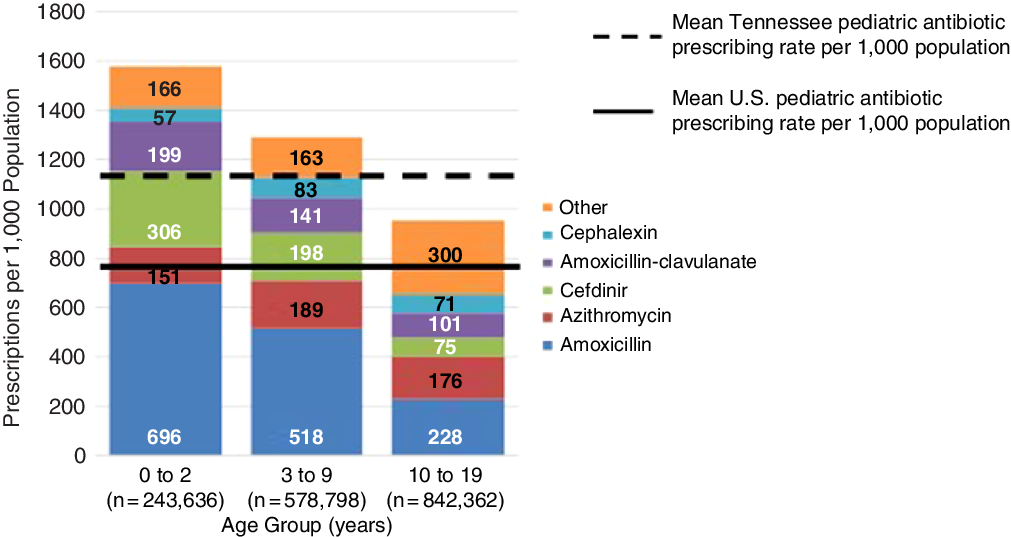
We evaluated age and location of residence as patient factors that might influence antibiotic prescribing. In 2016, a total of 1,664,796 children lived in Tennessee; 815,548 (49%) were female; 243,636 (15%) were aged 0–2 years, 578,798 (35%) were aged 3–9 years, and 842,362 (50%) were aged 10–19 years. Overall and broad-spectrum antibiotic prescribing rates varied significantly by patient age. The prescribing rate for children 0–2 years of age was 1,575 prescriptions per 1,000 population, and 20% of all pediatric antibiotic prescriptions were written for children in this age group (Fig. 1). The prescribing rate declined with increasing age (P ≤ .001) (Fig. 1). Broad-spectrum antibiotic prescribing showed similar trends, with rates per 1,000 population of 533 for children 0–2 years, 359 for children 3–9 years, and 200 for children 10–19 years (P ≤ .001). Amoxicillin was the most commonly prescribed antibiotic for each age group but accounted for less overall antibiotic use as children aged: 44% of all prescriptions in the youngest children versus 24% in the >10-year age group (Fig. 1).
Antibiotic prescribing rate for children in Tennessee, 2016, by patient age group. Rate of most commonly prescribed antibiotics by patient age group. Dashed line indicates mean Tennessee pediatric antibiotic prescribing rate of 1,165 prescriptions per 1,000 population. Solid line indicates mean US pediatric antibiotic prescribing rate of 790 prescriptions per 1,000 population. Source: IQVIA Xponent.

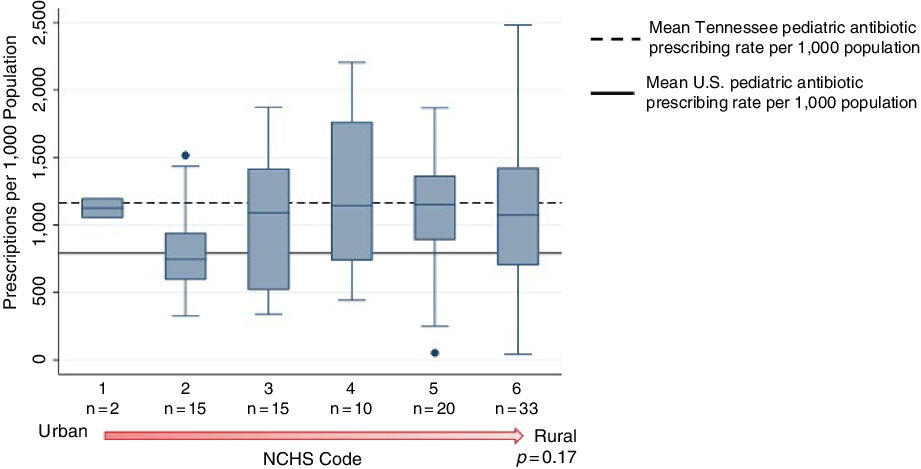
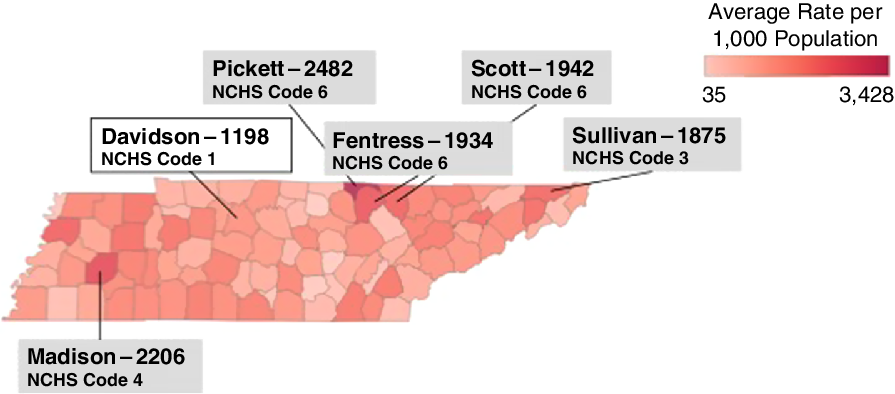
More than half of the 95 counties in Tennessee (56%) are considered rural, as shown by the distribution of NCHS code classifications, ranging from 1 (most urban) to 6 (most rural), (Fig. 2). There was substantial variation in antibiotic prescribing rates by county, even between adjacent counties, with rates ranging from 39 to 2,482 prescriptions per 1,000 population (Fig. 3). Antibiotic prescribing rates varied greatly within NCHS county classification. The largest variation occurred in counties with NCHS class 6, where prescribing rate per 1,000 population ranged from 39 to 2,482. Although prescribing rates were lowest in suburban counties (NCHS classification 2), the mean antibiotic prescribing rate was not significantly different based on NCHS county classification (P = .17) (Fig. 2).
Pediatric antibiotic prescribing rate by urbanversus rural county classification. Note. NCHS, National Center for Health Statistics. Dashed line indicates mean pediatric prescribing rate for Tennessee (1,165 prescriptions per 1,000 population). Solid line indicates mean pediatric prescribing rate for United States (790 prescriptions per 1,000 population). (ANOVA P = .17). Source: IQVIA Xponent.

Pediatric antibiotic prescribing rate by county. Note. NCHS, National Center for Health Statistics. Lighter shade indicates lower rate, and darker shade indicates higher rate. Rates for the 5 highest prescribing counties are highlighted, and Davidson county (location of the capitol) is also highlighted for reference. The mean antibiotic prescribing rate per 1,000 pediatric population in the cohort was 1,165. Source: IQVIA Xponent.

Influence of prescriber characteristics on antibiotic prescribing rates
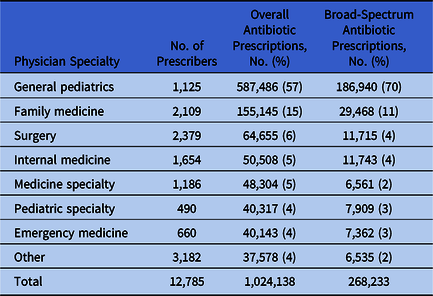
We investigated prescriber type, specialty, and years in practice as prescriber factors that might influence antibiotic prescribing. The 21,789 providers included in the 2016 IQVIA Xponent dataset who prescribed an antibiotic for children <20 years represent 51% of the 42,471 licensed prescribers in Tennessee in 2016 (Mary Katherine Bratton, email communication, March 2019). Of the 21,789 prescribers in the dataset, there were 12,812 physicians (59%), 5,270 nurse practitioners (24%), 2,440 dentists (11%), and 1,267 physician assistants (6%). More antibiotic prescriptions were written by physicians (1,043,030, 54%) than by nurse practitioners (635,957, 34%), physician assistants (169,070, 8%) or dentists (54,913, 3%). A similar trend was observed for broad-spectrum antibiotic prescriptions: 272,707 prescriptions (57%) were written by physicians, 167,063 (35%) were written by nurse practitioners, 34,559 (7%) were written by physician assistants, and 1,085 (2%) were written by dentists. Among prescriptions written by a physician, pediatricians accounted for 587,486 overall prescriptions (57%) and 189,940 broad-spectrum prescriptions (70%) (P < .001) (Table 1).
Frequency of Antibiotic Prescriptions for Children in Tennessee, 2016, by Physician Specialty

The number of pediatric prescriptions written in Tennessee in 2016 varied by individual provider. Most prescribers (11,048, 51%) wrote <10 antibiotic prescriptions for children. Of the 11,048 providers who wrote <10 prescriptions, physicians accounted for 65%: 1,113 surgeons (14%), 1,141 internal medicine physicians (15%), and 1,296 physicians in a medicine specialty (17%). In 2016, 1,712 providers (8%) each wrote >300 antibiotic prescriptions. Of these, 360 providers were in the highest-prescribing group and were each responsible for >300 broad-spectrum antibiotic prescriptions (24% of all broad-spectrum antibiotic prescriptions filled in 2016). In addition, 207 general pediatricians (58%), 119 nurse practitioners (33%), 14 physician assistants (4%), and the remaining 20 (5%) were from other physician specialties. The mean overall antibiotic prescribing rate for these highest-prescribing general pediatricians was 1,385 prescriptions per provider (SD, 711). Among the other highest-prescribing provider types, mean prescribing rates per provider were as follows: 1,129 (SD, 415) for nurse practitioners, 1,128 (SD, 419) for physician assistants, and 1,506 (SD, 848) for other physician specialties. Nearly 20% of the 360 highest-prescribing providers were from a single county that included 16% of the state’s pediatric population. The other 80% of highest-prescribing providers were spread throughout the remaining 94 counties, and each contributed to <5% of prescriptions.
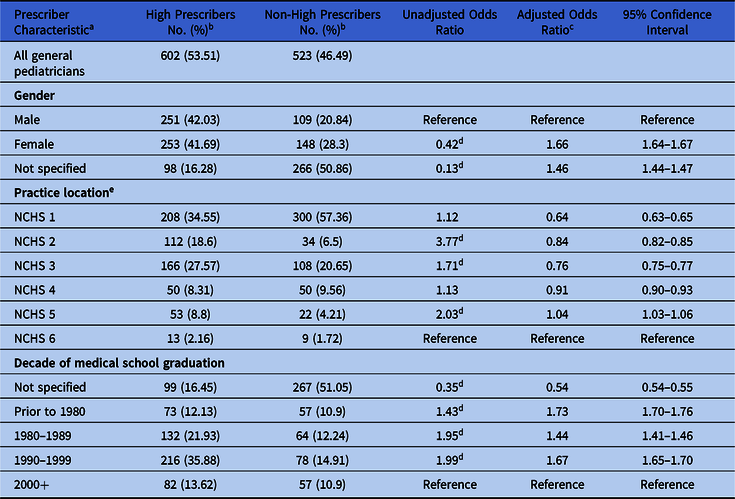
Of the 1,712 providers who each wrote >300 antibiotic prescriptions in 2016, 602 (35%) were general pediatricians. Results from the multivariable logistic regression comparing the 602 high-prescribing general pediatricians to the 523 non–high-prescribing general pediatricians demonstrated that female pediatricians and pediatricians graduating from medical school prior to 2000 were most likely to be among high prescribers, whereas pediatricians in more urban locations were less likely to be high prescribers compared to those in rural locations (Table 2).
Comparison of High Prescribing General Pediatricians to Non–High-Prescribing General Pediatricians by Prescriber Gender, Practice Urban-Rural Classification, Medical School Graduation Decade, and Patient Gender and Age

a Source: IQVIA Xponent.
b Percentage of prescribers in that characteristic group that are high prescribers and are not high prescribers, respectively.
c Unadjusted odds ratios were statistically significant with P < .001.
d All adjusted odds ratios were statistically significant with P < .001.
e County classifications based on the 2013 National Center for Health Statistics (NCHS) urban-rural classifications.
Discussion
In 2016 in Tennessee, the outpatient antibiotic prescribing rate for children was 1,165 per 1,000, representing >1 prescription per child that year. Cefdinir and amoxicillin-clavulanate, both broad-spectrum antibiotics, were among the 5 most frequently prescribed antibiotics. Overall frequency and rates of antibiotic prescribing varied by many factors, including county where the prescription was filled, patient age, provider type, physician specialty, and physician year of graduation from medical school. Interestingly, a relatively small number of prescribers accounted for a disproportionate number of antibiotic prescriptions.
We found no significant differences in prescribing rates across counties classified into 6 categories by rural or urban status, but we found considerable variation within these categories. However, our multivariable regression model revealed that general pediatricians practicing in more urban locations were less likely to be high prescribers than those practicing in rural locations. A recent study in the Carolinas, using an electronic health record database, found that providers seeing patients in an urban setting prescribed more antibiotics than those in rural settings.Reference Schmidt, Spencer and Davidson10 This result differs from our study and may be due to regional differences or incomplete capture of prescriptions using the IQVIA Xponent database, which does not include prescription information from hospital-affiliated outpatient pharmacies. The variation we observed within the 6 NCHS categories may reflect true differences in provider prescribing practices or could reflect the fact that smaller counties containing fewer pharmacies were classified as lower prescribing counties because the IQVIA Xponent database uses pharmacy location as a surrogate for patient county.
General pediatricians prescribed the most overall and broad-spectrum antibiotics compared to other physician specialties. Those who graduated medical school prior to 2000 were more likely to be high prescribers than those who graduated after 2000 in our multivariable analysis, similar to prior studies where older physicians were more likely than younger physicians to prescribe more antibiotics for longer durations of therapy.Reference Schmidt, Spencer and Davidson10, Reference Fernandez-Lazaro, Brown, Langford, Daneman, Garber and Schwartz11 A small portion (n = 360) of all 21,762 providers were responsible for 24% of overall and broad-spectrum prescriptions in the dataset. Most of these providers were general pediatricians and 20% practiced in a single county in the state. These data indicate that pediatricians, especially those high-prescribing providers in a specific county, are excellent focal points for future antimicrobial stewardship interventions. Peer comparison of antibiotic prescribing rates may be a particularly effective intervention for outlier, high-prescribing providers.
Our study had several strengths, including large sample size and ability to capture data from the entire state of Tennessee, which includes a variety of community and academic-affiliated outpatient practices of various sizes and types, enhancing generalizability. A key strength is the ability to identify where the most concerning prescribing behavior is occurring that might be amenable to antimicrobial stewardship interventions.
Our study also had several limitations. Our findings may not be generalizable to other states with demographics different from Tennessee. The county-level data in our study reflects the location of the pharmacy where the antibiotic prescription was filled and provider’s reported location of practice but does not necessarily reflect the antibiotic prescribing practices of the county where the patient lives. Also, the dataset accounts for 90% of prescriptions nationwide but could have more variability at the local level and may incorrectly estimate rates at the county level, especially because some counties in our state contain few pharmacies. Although the database includes information onprovider’s reported county of practice, this information may not be updated on a regular basis, and providers who practice in multiple locations have only 1 location attributed to them in the dataset. Data regarding practice type, such as private practice versus urgent care, were unavailable, which limited our ability to describe which practice settings would be optimal targets for antimicrobial stewardship interventions. Case-mix differences in these settings could be key drivers of differential rates of antibiotic prescribing. Similarly, patients seen in Tennessee may have had their prescriptions filled in a neighboring state, or vice-versa, resulting in inaccuracies in our prescribing rates. Appropriateness of antibiotic use could not be quantified because the dataset does not include information about antibiotic indication. The dataset also does not include prescriptions filled at hospital-affiliated pharmacies. Additionally, the dataset does not provide any information on the number of pediatric patient encounters per provider during the year. Some of the providers with a higher prescribing volume may have cared for more pediatric patients and written an appropriate amount of antibiotic prescriptions. Our dataset only included information on antibiotics dispensed by pharmacies, which may not reflect antibiotics dispensed during an encounter or the actual amount of medication taken by patients. Finally, 33% of medical school graduation year data were missing, which has the potential to skew the results, especially because we do not know whether those missing from the dataset were distributed similarly to those included in the dataset. It is reassuring, however, that the group of physicians with missing medical school graduation year had the lowest rates of overall and broad-spectrum antibiotic prescriptions per provider. Additionally, most prescribers in our dataset (51%) wrote <10 antibiotic prescriptions in the year, which might reflect adult providers infrequently writing antibiotics for older pediatric patients or could represent inaccuracies in the number of prescriptions attributed to each provider.
Despite these limitations, our statewide assessment of antibiotic prescribing in Tennessee found that the 2016 antibiotic prescribing rate for children was 1.5-fold higher in Tennessee than nationally and identified many potential targets for outpatient antimicrobial stewardship interventions. Based on our findings, interventions to reduce the rate of overall and broad-spectrum pediatric antibiotic prescribing in Tennessee should target general pediatricians, specifically engaging those physicians who graduated medical school before 2000, and those practicing in the highest prescribingcounties in the state. Qualitative studies to assess knowledge, attitudes and beliefs about antibiotic prescribing in our region are ongoing and, along with the results from this study, will further inform design and implementation of future antimicrobial stewardship interventions. These results and interventions may be generalizable to other high antibiotic-prescribing states in the Southeast region of the United States.
Supplementary material
To view supplementary material for this article, please visit https://doi.org/10.1017/ice.2019.338
Acknowledgments
This content is solely the responsibility of the authors and does not necessarily represent the official views of the National Institutes of Health.
Financial support
S.K. received grant support from the National Institute of Allergy and Infectious Diseases Childhood Infection Research Program (ChIRP), National Institute of Health (grant no. 1T32AI095202-07). M.S. received initial grant support from the Centers for Disease Control and Prevention as a recipient of the Leadership in Epidemiology, Antimicrobial Stewardship and Public Health (LEAP) fellowship, sponsored by Society for Healthcare Epidemiology of America (SHEA), Infectious Diseases Society of America (IDSA) and Pediatric Infectious Diseases Society (PIDS). M.S. subsequently received support from the Office of Academic Affiliations, Department of Veterans’ Affairs, VA National Quality Scholars Program, with use of the facilities at the VA Tennessee Valley Healthcare System, Nashville, TN. Y.O, C.E., and M.K. received grant support from the Centers for Disease Control and Prevention through the Epidemiology and Laboratory Capacity Cooperative Agreement (Federal grant no. 5 NU50CK000386-05-00).
Conflicts of interest
All authors report no conflicts of interest relevant to this article.