Introduction
Horseweed is a winter/summer annual weed that is native to North America and is a problematic weed across southern Ontario (Budd et al. Reference Budd, Soltani, Robinson, Hooker, Miller and Sikkema2017; Weaver Reference Weaver2001). Horseweed is highly prolific, one plant can produce up to 500,000 seeds (Davis et al. Reference Davis, Kruger, Stachler, Loux and Johnson2009). Horseweed seed dispersion is assisted by its small seed size (1- to 2-mm long) and the attachment of a pappus that aids with wind dispersal (Weaver Reference Weaver2001). While most seeds land within 100 m of the mother plant, seeds have been found in the planetary boundary layer, with potential to travel hundreds of kilometers (Shields et al. Reference Shields, Dauer, VanGessel and Neumann2006; Steckel et al. Reference Steckel, Main and Mueller2010). Horseweed seedlings emerge from a maximum burial depth of 0.5 cm, making them adapted to reduced-, strip-, and no-till crop production systems (Weaver Reference Weaver2001).
In Ontario, the first incidence of glyphosate-resistant (GR) horseweed was confirmed in Essex County from seed collected in 2010 (Byker et al. Reference Byker, Soltani, Robinson, Tardif, Lawton and Sikkema2013). Control of GR horseweed is difficult, as there are few POST herbicide options in identity-preserved (IP, non-GMO) and GR soybean (Byker et al. Reference Byker, Soltani, Robinson, Tardif, Lawton and Sikkema2013; VanGessel Reference VanGessel2001). The preplant (PP) application of saflufenacil + metribuzin (25 + 400 g ai ha−1) is currently the most efficacious and consistent option for GR horseweed control in IP and GR soybean (Budd et al. Reference Budd, Soltani, Robinson, Hooker, Miller and Sikkema2016a). Glyphosate/dicamba + saflufenacil (1,200/600 + 25 g ai ha−1) is considered the best PP herbicide option in glyphosate/dicamba-resistant (GDR) soybean (Hedges et al. Reference Hedges, Soltani, Robinson, Hooker and Sikkema2018).
Weed control in soybean is crucial for producers to maximize yield and net returns. Soltani et al. (Reference Soltani, Dille, Burke, Everman, VanGessel, Davis and Sikkema2017) found that in North America, if no weed management tactics were implemented, a 52% reduction in soybean yield would occur on account of weed interference. Van Acker et al. (Reference Van Acker, Swanton and Weise1993) described the critical weed-free period (CWFP) to be from emergence (VE) to the fourth node (V2), with yield loss <2.5% when there was no weed interference throughout this period in soybean. In Ontario, GR horseweed has been reported to decrease soybean yield 53% to 73% (Budd et al. Reference Budd, Soltani, Robinson, Hooker, Miller and Sikkema2016a; Hedges et al. Reference Hedges, Soltani, Robinson, Hooker and Sikkema2018; Soltani et al. Reference Soltani, Shropshire and Sikkema2020). The utilization of burndown plus residual herbicides applied before soybean emergence provides the most consistent control of both fall- and spring-emerged GR horseweed in IP and GR soybean (Davis and Johnson Reference Davis and Johnson2008). Therefore, PP burndown applications are key to controlling GR horseweed through the CWFP to minimize soybean yield loss.
Metribuzin is a photosystem II–inhibiting herbicide commonly used as a mix partner before planting soybean (Budd et al. Reference Budd, Soltani, Robinson, Hooker, Miller and Sikkema2016a; Eubank et al. Reference Eubank, Poston, Nandula, Koger, Shaw and Reynolds2008; Kapusta Reference Kapusta1979; Soltani et al. Reference Soltani, Shropshire and Sikkema2020). The inclusion of metribuzin (400 and 420 g ai ha−1) with saflufenacil, glufosinate, 2,4-D ester, pyraflufen-ethyl/2,4-D, or S-metolachlor/dicamba improved the control of GR horseweed (Budd et al. Reference Budd, Soltani, Robinson, Hooker, Miller and Sikkema2016a; Eubanks et al. Reference Eubank, Poston, Nandula, Koger, Shaw and Reynolds2008; Soltani et al. Reference Soltani, Shropshire and Sikkema2020).
Tiafenacil is a new protoporphyrinogen IX oxidase (PPO)-inhibiting, nonselective, contact herbicide that is a member of the pyrimidinedione family developed by FarmHannong Co., Ltd., Korea (Anonymous 2020; Park et al. Reference Park, Ahn, Nam, Hong, Song, Kim and Sung2018). PPO inhibitors stop the production of protoporphyrin IX (PPIX) from protoporphyrinogen IX (PPGIX), thereby preventing chlorophyll and heme biosynthesis. The increase in PPIX in the cytoplasm results in an increase in singlet oxygen leading to lipid peroxidation, cell membrane destruction, and ultimately plant death (Shaner Reference Shaner2014). Tiafenacil has recently been proposed for registration in the United States and Canada (U.S. Environmental Protection Agency 2020; Health Canada 2018). Tiafenacil can be applied PP or PRE in corn (Zea mays L.), cotton (Gossypium hirsutum L.), wheat (Triticum aestivum L.), and soybean for the control of emerged annual grass and broadleaf weeds (Anonymous 2020). In the United States, tiafenacil is registered for use in soybean at the PP application timing at a maximum rate of 75 g ai ha−1 (Anonymous 2020). Preliminary research by Park et al. (Reference Park, Ahn, Nam, Hong, Song, Kim and Sung2018) found tiafenacil to have activity on weed species such as waterhemp [Amaranthus tuberculatus (Moq.) Sauer] and arabidopsis [Arabidopsis thaliana (L.) Heynh.], as well as crop species including soybean and rapeseed (Brassica napus L.). A half-maximal inhibitory concentration (IC50) was reported to be similar to those of other pyrimidinediones, such as saflufenacil and butafenacil, ranging from 22 to 28 nM. Park et al. (Reference Park, Ahn, Nam, Hong, Song, Kim and Sung2018) concluded that tiafenacil doses of <85 g ai ha−1 are sufficient for the control of selected monocot and dicot weeds. Haring and Hanson (Reference Haring and Hanson2020) reported that tiafenacil at 25, 50, and 75 g ai ha−1 controlled GR horseweed 71% to 73%, at 7 d after treatment (DAT), control declined to 20% to 29% at 31 DAT.
Little published information exists on the utilization of tiafenacil, applied alone or mixed with metribuzin, for GR horseweed control in soybean. The objective of this study was to determine the biologically effective dose (BED) of tiafenacil and tiafenacil + metribuzin applied PP for the GR horseweed control in soybean in Ontario.
Materials and Methods
Experimental Methods
Five field trials were conducted in 2019 and 2020 in commercial soybean fields located in southern Ontario with confirmed GR horseweed. Trial application information and site-specific soil characteristics are listed in Table 1. Two trials were conducted at one site in 2020 and were separated in space and time with applications occurring on different days. Each trial was set up as a randomized complete block design with four replications. The trials comprised 18 treatments, including a nontreated control, metribuzin (400 g ai ha−1), tiafenacil (3.125, 6.25, 12.5, 25, 50, 100, and 200 g ai ha−1), tiafenacil + metribuzin (3.125 + 400, 6.25 + 400, 12.5 + 400, 25 + 400, 50 + 400, 100 + 400, and 200 + 400 g ai ha−1), saflufenacil + metribuzin (25 + 400 g ai ha−1), and glyphosate/dicamba + saflufenacil (1,200/600+ 25 g ai ha−1) applied PP. Saflufenacil + metribuzin (25 + 400 g ai ha−1) and glyphosate/dicamba + saflufenacil (1,200/600 + 25 g ai ha−1) were included as the current industry standards for the control of GR horseweed in IP and GR soybean and GDR soybean, respectively (Budd et al. Reference Budd, Soltani, Robinson, Hooker, Miller and Sikkema2016a; Hedges et al. Reference Hedges, Soltani, Robinson, Hooker and Sikkema2018). Methylated seed oil (MSO) was included in all tiafenacil and tiafenacil + metribuzin treatments in 2020 at a rate of 1% v/v. Merge® (oil-surfactant blend; BASF Canada Inc., Mississauga, ON, Canada) was include in all treatments with saflufenacil at a rate of 0.5% v/v. Glyphosate (Roundup WeatherMax®, Bayer Cropscience Inc., Calgary, AB, Canada) was included in all treatments at a rate of 900 g ai ha−1, with the exception of glyphosate/dicamba + saflufenacil (1,200/600 + 25 g ai ha−1; glyphosate is in this preformulated mixture at 1,200 g ai ha−1). All treatments were applied PP when the average horseweed reached 10 cm in height or canopy diameter. A CO2-pressurized backpack sprayer was used for all applications and was calibrated to deliver 200 L ha−1 of water at a pressure of 260 kPa. The spray boom was equipped with four ULD 11002 nozzles (Pentair, New Brighton, MN, USA), spaced 50 cm apart, producing a spray width of 2.0 m.
Year, location, application information, soil characteristics, and crop information for five field trials conducted in Ontario, Canada, in 2019 and 2020.

a Size measured on application date with a mean of eight measurements per trial.
b Mean density based on eight stand counts among the nontreated controls of each trial.
c Based on soil test of the upper 15 cm of the soil profile.
GDR soybean (‘DKB12-16’) was planted using a no-till planter at a seeding rate of approximately 416,000 seeds ha−1 with planting dates listed in Table 1. Soybean was planted 1 to 10 d after herbicide application. Soybean row spacing was 76 cm apart with plots measuring 2.25-m wide by 8-m long. Glyphosate (450 g ha−1) was applied POST in all trials to eliminate all other weed species, including glyphosate-susceptible horseweed.
Weed control assessments were completed at 2, 4, and 8 wk after application (WAA). Treatments were assessed visually on a scale of 0% to 100%, with 0% being no control and 100% being complete control. Crop injury assessments were completed visually at 1, 2, and 4 wk after soybean emergence (WAE). Crop injury was assessed on a scale of 0% to 100%, with 0% being no soybean injury and 100% being complete soybean death. At 8 WAA, horseweed plants were counted in two 0.25-m2 quadrats representative of each plot. The horseweed plants within the two 0.25-m2 quadrats were then cut at the soil surface, placed in paper bags, dried in a kiln to a constant moisture, and weighed. Soybean yield was collected from each plot by combining the center two rows at harvest maturity. Soybean moisture was adjusted to 14.5% before statistical analysis.
Statistical Analysis
Environment (year and location combinations) and replication (block within environment) were considered random effects. The fixed effect was the herbicide treatment. Although MSO was included in 2020 and not in 2019, the data across all 5 site-years were pooled for analysis, as no statistically significant treatment by year interactions were found. For GR horseweed control at 2, 4, and 8 WAA, the P-values for treatment by year interaction were 0.128, 0.178, and 0.263, respectively; for GR horseweed density and biomass and soybean yield, the P-values were 0.61, 0.189, and 0.456, respectively.
Nonlinear Regression—Rectangular Hyperbola
Percent GR horseweed control at 2, 4, and 8 WAA was regressed against tiafenacil or tiafenacil + metribuzin dose using the NLIN procedure in SAS v. 9.4 (SAS Institute, Cary, NC) with the rectangular hyperbola equation (Equation 1) (Cousens Reference Cousens1985). Yield was expressed at a percent of the industry standard (glyphosate/dicamba + saflufenacil = 1,200/600 + 25 g ai ha−1) within each replicate and was regressed against tiafenacil or tiafenacil + metribuzin dose (Equation 1). The effective dose (ED) for 50%, 80%, and 95% horseweed control for each assessment timing was calculated using the parameter estimates generated from the regression analysis. An inverse exponential equation (Equation 2) was used to regress density (plants m−2) and dry biomass (g m−2) against tiafenacil or tiafenacil + metribuzin doses. Similar to control, the ED of tiafenacil and tiafenacil + metribuzin was calculated for 50%, 80%, and 95% reduction in density and dry biomass.
 ${\rm Rectangular \;hyperbola}: y = (i*dose)/[1 + (i^\ast;dose/a)] $
where a is the upper asymptote, and i is the initial slope.
 ${\rm Inverse \;exponential}: y = a + b (e^{-c {\rm \;dose}}) $
where a is the lower asymptote, b is the reduction in y from intercept to asymptote, and c is the slope.
Least-Square Means Comparisons
PROC GLIMMIX was used in SAS v. 9.4 (SAS Institute) to perform a generalized linear mixed-model ANOVA comparing tiafenacil, metribuzin, tiafenacil + metribuzin, saflufenacil + metribuzin, and glyphosate/dicamba + saflufenacil. Similarly, all rates of tiafenacil and tiafenacil + metribuzin were compared. Variance was partitioned into the random effects of environment, replication within environment, and the treatment by environment interaction. Herbicide treatment was considered a fixed effect. Control and soybean grain yield data were fit to normal distribution with the identity link function. GR horseweed density and biomass data were fit to a lognormal distribution with an identity link; the data were back-transformed using the omega method for presentation purposes (M Edwards, Ontario Agricultural College Statistician, University of Guelph, personal communication). Least-square means of each parameter were separated using the Tukey-Kramer test (P = 0.05).
Interaction—Tiafenacil and Metribuzin
Colby’s equations were utilized to determine whether the interaction between tiafenacil and metribuzin was antagonistic, additive, or synergistic (Colby Reference Colby1967). Expected values were calculated for each dose of herbicide combination by block for horseweed control at 2, 4, and 8 WAA (Equation 3) and for density and biomass (Equation 4). The expected and observed values were compared using a PROC TTEST in SAS v. 9.4 at P < 0.05 and P < 0.01. The tiafenacil with metribuzin mixture at specific rates was considered to be: (1) additive if the expected values were nonsignificant and numerically similar to the observed, (2) synergistic if the observed values were greater than the expected values, and (3) antagonistic if the observed values were less than the expected values.
 ${{\rm Colby's \;equation-GR \;horseweed \;control}: E = X + Y - (XY/100)} $
where E is the expected control with tiafenacil + metribuzin, X is the observed control with tiafenacil, and Y is the observed control with metribuzin.
 ${\rm Colby's \;equation-GR \;horseweed \;density \;and \;dry \;biomass}: {E = (XY/Z)} $
where E is the expected density or biomass with tiafenacil + metribuzin, X is the observed density or biomass with tiafenacil, Y is the observed density or biomass with metribuzin, and Z is the density or biomass of the nontreated control.
Results and Discussion
Soybean Injury
No soybean injury was observed at 1, 2, and 4 WAE (data not presented). Budd et al. (Reference Budd, Soltani, Robinson, Hooker, Miller and Sikkema2016b) found that saflufenacil, another PPO-inhibiting herbicide and member of the pyrimidinedione family, caused less than 10% soybean injury when applied PP at 200 g ai ha−1. Miller et al. (Reference Miller, Soltani, Robinson, Kraus and Sikkema2012) tested 12 GR soybean cultivars and reported the majority of soybean cultivars were tolerant to saflufenacil PRE, although sensitivity varied, with 52 and 59 g ai ha−1 of saflufenacil causing 10% soybean injury in two cultivars. Injury was influenced by environmental conditions shortly after application.
Biologically Effective Dose of Tiafenacil and Tiafenacil + Metribuzin for the Control of GR Horseweed
Tiafenacil Applied Alone
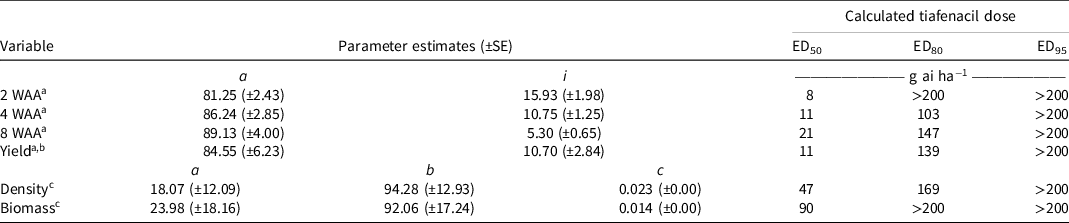
Based on the regression analysis, the calculated dose of tiafenacil for 50% GR horseweed control was 8 g ai ha−1, with no dose ≤200 providing 80% or 95% control at 2 WAA (Table 2). At 4 and 8 WAA, 50% GR horseweed control could be achieved with 11 and 21 g ai ha−1 of tiafenacil, respectively. The calculated doses of tiafenacil for 80% GR horseweed were 103 and 147 g ai ha−1 at 4 and 8 WAA, respectively. The doses of tiafenacil calculated for 80% control were higher than the proposed use rate for PP burndown in soybean of 25 to 75 g ai ha−1 (Anonymous 2020). The increases in calculated doses at later assessment timings are attributed to the partial desiccation of the horseweed plants shortly after application. As the horseweed plants recovered from the herbicide application, biomass accumulation increased, resulting in overall lower control and increased calculated doses at 8 WAA. Budd et al. (Reference Budd, Soltani, Robinson, Hooker, Miller and Sikkema2016a) and Westerveld et al. (Reference Westerveld, Soltani, Robinson, Hooker and Sikkema2021) reported similar regrowth occurrences when utilizing metribuzin and bromoxynil, respectively, for the control of GR horseweed. At 4 and 8 WAA, the tiafenacil dose for 95% GR horseweed control was >200 g ai ha−1 and could not be calculated based on the doses evaluated in this study.
Parameter estimates and calculated effective doses of tiafenacil applied preplant for glyphosate-resistant horseweed control, reduction in biomass and plant density, and soybean yield from five trials completed in 2019 and 2020 in Ontario, Canada.

a Regression parameters: y = (i*dose)/[1 + (i*dose/a)], where a is the upper asymptote, and i is the initial slope. WAA, weeks after application.
b Expressed as percent of yield in the industry standard (glyphosate/dicamba + saflufenacil = 1,200/600 + 25 g ai ha−1) among replications.
c Regression parameters: y = a + b (e –c dose), where a is the lower asymptote, b is the reduction in y from intercept to asymptote, and c is the slope.
Higher doses of tiafenacil were required to provide 50% and 80% reduction density and biomass compared with the aforementioned levels of visual control at 8 WAA. The calculated tiafenacil doses for 50% control and reduction in density and biomass were 21, 47, and 90 g ai ha−1, respectively. For 80% reduction in GR horseweed density and biomass, the calculated doses of tiafenacil were 169 and >200 g ai ha−1, respectively; similarly, the calculated dose of tiafenacil for a 95% reduction in density and biomass was >200 g ai ha−1. The calculated doses of tiafenacil that would result in 50%, 80%, and 95% of the soybean yield of the industry standard (glyphosate/dicamba + saflufenacil at 1,200/600 + 25 g ai ha−1) were 11, 139, and >200 g ai ha−1, respectively.
With limited research on tiafenacil, comparisons to saflufenacil are appropriate, as they are both pyrimidinedione herbicides with similar use patterns (Park et al. Reference Park, Ahn, Nam, Hong, Song, Kim and Sung2018). Research on the BED of saflufenacil found that lower doses are required for GR horseweed control compared with tiafenacil. Budd et al. (Reference Budd, Soltani, Robinson, Hooker, Miller and Sikkema2016b) found that saflufenacil at 25 and 36 g ai ha−1 controlled GR horseweed 90% and 95%, respectively, at 8 WAA, while glyphosate (900 g ai ha−1) + saflufenacil at doses of 25, 34, and 47 g ai ha−1 controlled GR horseweed 90%, 95%, and 98%, respectively. Similar to tiafenacil, increased doses of saflufenacil were required for biomass reduction when compared with density reduction. The calculated saflufenacil doses for a 90% GR horseweed biomass and density reduction were 26 and 16 g ai ha−1, respectively. Other research has found that the addition of an adjuvant(s) decreases the required dose of saflufenacil for horseweed control. Knezevic et al. (Reference Knezevic, Datta, Scott and Charvat2009) found that the required doses of saflufenacil compared with saflufenacil + MSO for 90% horseweed control were 217 and 78 g ha−1, respectively, at 4 WAA. Mellendorf et al. (Reference Mellendorf, Young, Matthews and Young2013) found that as horseweed height increased at the time of application, there was decreased control with saflufenacil (50 g ai ha−1). Mellendorf et al. (Reference Mellendorf, Young, Matthews and Young2015) also found that spray-solution pH, adjuvant, inclusion of glyphosate, and light intensity all affected the efficacy of saflufenacil on horseweed. Further research should be conducted to determine whether GR horseweed density and height and application variables impact tiafenacil efficacy. Overall, higher doses of tiafenacil were required to provide equivalent levels of control when compared with saflufenacil.
Tiafenacil + Metribuzin
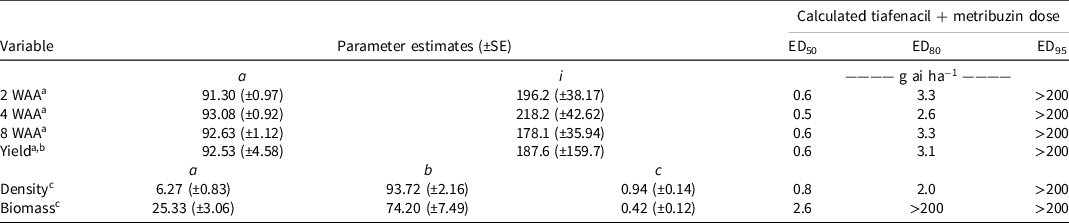
The addition of metribuzin (400 g ai ha−1) to tiafenacil decreased the calculated doses of tiafenacil for all GR horseweed parameters assessed (Table 3). The calculated doses of tiafenacil when co-applied with metribuzin for 50% GR horseweed control were 0.6, 0.5, and 0.6 g ai ha−1 and the calculated doses for 80% GR horseweed control were 3.3, 2.6, and 3.3 g ai ha−1 at 2, 4, and 8 WAA, respectively. The calculated dose for 95% GR horseweed control was >200 g ai ha−1 at all assessment timings.
Parameter estimates and calculated effective doses of tiafenacil + metribuzin applied preplant for glyphosate-resistant horseweed control, reduction in biomass and plant density, and soybean yield from five trials completed in 2019 and 2020 in Ontario, Canada.

a Regression parameters: y = (i*dose)/[1 + (i*dose/a)], where a is the upper asymptote, and i is the initial slope. WAA, weeks after application.
b Expressed as percent of yield in the industry standard (glyphosate/dicamba + saflufenacil = 1,200/600 + 25 g ai ha−1) among replications.
c Regression parameters: y = a + b (e –c dose), where a is the lower asymptote, b is the reduction in y from intercept to asymptote, and c is the slope.
The calculated doses of tiafenacil when co-applied with metribuzin at 8 WAA for 50% and 80% decreases in GR horseweed density were 0.8 and 2.0 g ai ha−1, respectively, similar to the doses required for 50% and 80% control at the same timing. The calculated dose for a 95% decrease in GR horseweed density was >200 g ai ha−1. The calculated dose for a 50% decrease in GR horseweed biomass was 2.6 g ai ha−1; >200 g ai ha−1 of tiafenacil + metribuzin was required for 80% and 95% reduction in biomass. For yield, the calculated doses of 0.6 and 3.1 g ai ha−1 of tiafenacil + metribuzin resulted in 50% and 80% of the yield of the industry standard, respectively (glyphosate/dicamba + saflufenacil at 1,200/600 + 25 g ai ha−1); >200 g ai ha−1 was required for 95% soybean yield relative to the industry standard.
Tiafenacil, Metribuzin, Tiafenacil + Metribuzin Compared with Industry Standards
Least-square means were used to compare metribuzin (400 g ai ha−1), tiafenacil (25 and 50 g ai ha−1), tiafenacil + metribuzin (25 + 400 and 50 + 400 g ai ha−1), saflufenacil + metribuzin (25 + 400 g ai ha−1), and glyphosate/dicamba + saflufenacil (1,200/600 + 25 g ai ha−1).
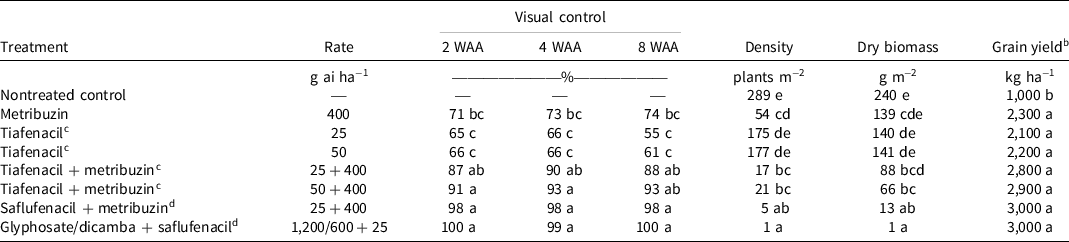
Tiafenacil (25 and 50 g ai ha−1) provided 65% to 66% control of GR horseweed at 2 and 4 WAA (Table 4). Metribuzin (400 g ai ha−1) controlled GR horseweed 71% to 73%, similar to tiafenacil. Tiafenacil + metribuzin (25 + 400 and 50 + 400 g ai ha−1) controlled GR horseweed 87% to 93%, which was greater than tiafenacil applied alone. The co-application of tiafenacil + metribuzin (25 + 400 g ai ha−1) controlled GR horseweed 87% and 90% at 2 and 4 WAA, respectively, similar to tiafenacil + metribuzin (50 + 400 g ai ha−1), saflufenacil + metribuzin, and glyphosate/dicamba + saflufenacil.
Glyphosate-resistant horseweed control 2, 4, and 8 wk after application (WAA), density and dry biomass at 8 WAA, and soybean yield from five field trials conducted in Ontario, Canada in 2019 and 2020. a

a Means followed by the same letter within a column are not significantly different from one another according to Tukey-Kramer’s multiple range test at P < 0.05.
b Soybean moisture adjusted to 14.5%.
c Included methylated seed oil (1% v/v) in 2020.
d Included Merge® (0.5% v/v).
At 8 WAA, tiafenacil at 25 and 50 g ai ha−1 provided 55% and 61% GR horseweed control, respectively, similar to metribuzin. Tiafenacil + metribuzin at 25 + 400 and 50 + 400 g ai ha−1 provided 88% and 93% control, respectively, which was greater than tiafenacil but similar to metribuzin. Tiafenacil + metribuzin (25 + 400 and 50 + 400 g ai ha−1), saflufenacil + metribuzin, and glyphosate/dicamba + saflufenacil provided 88% to 100% control of GR horseweed.
Tiafenacil (25 and 50 g ai ha−1) did not reduce GR horseweed density (Table 4). Metribuzin, tiafenacil + metribuzin, saflufenacil + metribuzin, and glyphosate/dicamba + salflufenacil reduced GR horseweed density 81%, 93% to 94%, 98%, and 100%, respectively, at 8 WAA. Tiafenacil and metribuzin applied alone did not reduce GR horseweed biomass. Tiafenacil + metribuzin, saflufenacil + metribuzin, and glyphosate/dicamba + salflufenacil reduced GR horseweed biomass 63% to 73%, 95%, and 100%, respectively, at 8 WAA.
GR horseweed interference reduced soybean yield up to 67% in this study. No difference in soybean yield was found among the herbicide treatments in this study.
Interaction—Tiafenacil, Metribuzin Compared with Tiafenacil + Metribuzin
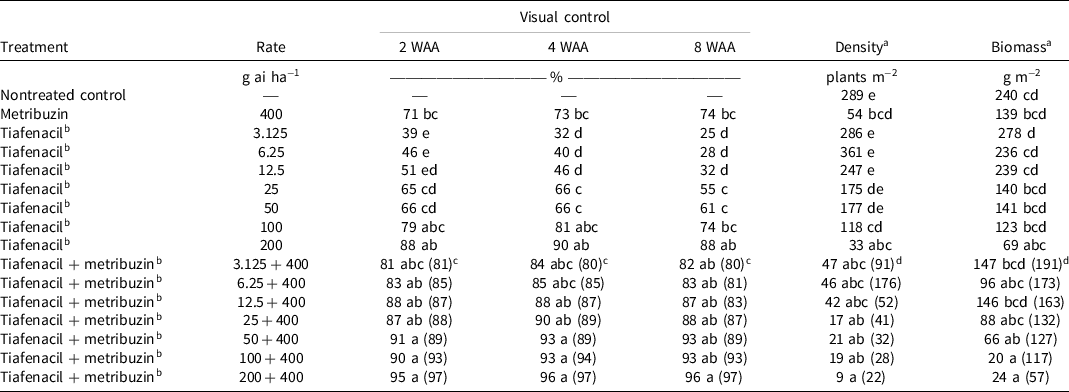
Additive increase in GR horseweed control and decrease in density and biomass were found with the co-application of tiafenacil with metribuzin (Table 5). There were no synergistic or antagonistic interactions with the co-application of tiafenacil and metribuzin for GR horseweed control and reductions in density and biomass.
Glyphosate-resistant horseweed control at 2, 4, and 8 wk after application (WAA), plant density and dry biomass at 8 WAA with metribuzin, tiafenacil and tiafenacil + metribuzin applied preplant from five field trials conducted in Ontario, Canada in 2019 and 2020. a

a Means followed by the same letter within a column are not significantly different from one another according to Tukey-Kramer’s multiple range test at P < 0.05.
b Included methylated seed oil (1% v/v) in 2020.
c Expected values for herbicide combinations are shown in parentheses following observed values based on Colby’s equation (Equation 3).
d Expected values for herbicide combinations are shown in parentheses following observed values based on Colby’s equation (Equation 4).
This study concludes that the calculated doses of tiafenacil for 50% and 80% GR horseweed control were 21 and 147 g ai ha−1, respectively, and the calculated doses of tiafenacil when co-applied with metribuzin (400 g ai ha−1) were 0.6 and 3.3 g ai ha−1, respectively, at 8 WAA. Tiafenacil at 25 and 50 g ai ha−1 and metribuzin (400 g ai ha−1) controlled GR horseweed 55%, 61%, and 74%, respectively, at 8 WAA. Tiafenacil + metribuzin at 25 + 400 and 50 + 400 g ai ha−1 controlled GR horseweed 88% and 93%, respectively, which was similar to the industry standards of saflufenacil + metribuzin (25+ 400 g ai ha−1) providing 98% control and glyphosate/dicamba + saflufenacil (1,200/600 + 25 g ai ha−1) providing 100% control at 8 WAA. The co-application of tiafenacil with metribuzin resulted in an additive increase in GR horseweed control and an additive decrease in density and biomass. This study found that tiafenacil alone did not control GR horseweed, while tiafenacil + metribuzin controlled GR horseweed similar to the current industry standards.
Acknowledgments
We would like to thank Chris Kramer for his technical support and Dr. Michelle Edwards for her advice on the statistical analysis. Funding for this research program was provided by the Grain Farmers of Ontario (GFO), the Ontario Agri-Food Innovation Alliance Research Program (Ontario Ministry of Agriculture, Food and Rural Affairs), and herbicide manufacturers. No conflicts of interest have been declared.