1 Introduction
By definition, the uncountability of
 ${\mathbb R}$
deals with arbitrary mappings from
 ${\mathbb R}$
to
 ${\mathbb N}$
. In our opinion, this principle is therefore best studied in a language that has such mappings as first-class citizens. Thus, we adopt the language of higher-order arithmetic and shall study the logical and computational properties of the uncountability of
 ${\mathbb R}$
, the latter formulated in full generality using third-order objects. This study is therefore part of higher-order Reverse Mathematics and Kleene’s higher-order computability theory, as explained in detail in the next sections.
1.1 Summary
In a nutshell, we study the logical and computational properties of the uncountability of
 ${\mathbb R}$
, established in 1874 by Cantor in his first set theory paper [Reference Cantor17], in the guise of the following natural principles:
-
•
 ${\mathsf {NIN}}$
: there is no injection from
$[0,1]$
to
${\mathbb N}$
,
-
•
${\mathsf {NBI}}$
: there is no bijection from
$[0,1]$
to
${\mathbb N}$
.


In this paper, principle generally refers to a statement of ordinary mathematics,Footnote
1
and our aim is to investigate the logical and computational properties of these. The principle
 ${\mathsf {NIN}}$
will take centre stage, while
 ${\mathsf {NBI}}$
will be shown to have some interesting properties as well. Now, a central and important aspect of mathematical logic is the classification of principles and objects in hierarchies based on logical or computational strength. A natural question would therefore seem to be where
 ${\mathsf {NIN}}$
is located in the well-known hierarchies of logical and computational strength, generally based on comprehension and discontinuous functionals.
We provide an answer to this question in this paper and explain why this answer (and question) is unsatisfactory. Intuitively speaking,
 ${\mathsf {NIN}}$
is a very weak principle, yet we need rather strong comprehension axioms to prove it. Moreover,
 ${\mathsf {NIN}}$
is equivalent to restrictions of itself involving natural function classes, like semi-continuity and bounded variation (see Remark 3.3). Thus, the logical properties of
 ${\mathsf {NIN}}$
are not due to the quantification over arbitrary
 ${\mathbb R}\rightarrow {\mathbb N}$
-functions in
 ${\mathsf {NIN}}$
.
Similarly, we need strong (discontinuous) comprehension functionals to compute the real numbers claimed to exist by
 ${\mathsf {NIN}}$
in terms of the data, in Kleene’s higher-order framework. The reason for this paradox is that we are comparing two fundamentally different classes. Indeed, a fundamental division here is between normal and non-normal objects and principles, where the former give rise to discontinuous objects and the latter do not (see Definition 2.10 for the exact formulation). For reference,
 ${\mathsf {NIN}}$
and
 ${\mathsf {NBI}}$
are non-normal as they do not imply the existence of a discontinuous function on
 ${\mathbb R}$
. In this paper, all principles are part of third-order arithmetic, i.e., ‘non-normal vs normal’ refers to the existence of a discontinuous function on
 ${\mathbb R}$
. The associated computations are one type-level higher.
In fact, the ‘normal vs non-normal’ distinction yield two (fairly independent) scales for classifying logical and computational strength: the standard one is the ‘normal’ scale based on comprehension and discontinuous objects, like the Gödel hierarchy, Reverse Mathematics, and Kleene’s quantifiers (see Section 2). However, we have shown in [Reference Normann and Sanders84–Reference Normann and Sanders88] that the normal scale classifies many intuitively weak non-normal objects and principles as ‘rather strong’. We establish the same for
 ${\mathsf {NIN}}$
in Theorem 3.2. These observations imply the need for a ‘non-normal’ scale based on (classically valid) continuity axioms and related objects, going back to Brouwer’s intuitionistic mathematics. The non-normal scale, and its connection to second-order arithmetic, is explored in [Reference Sanders98], and is discussed in Section 1.3.
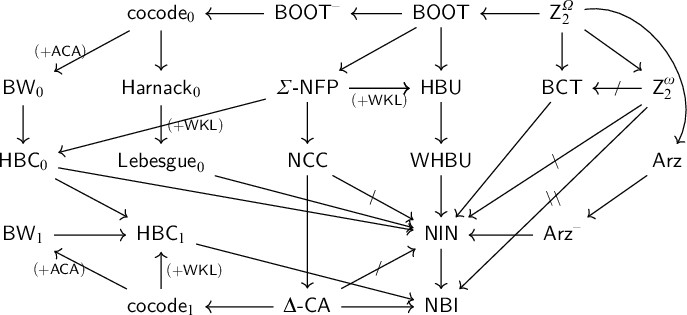
In Figure 1, we provide a classification of
 ${\mathsf {NIN}}$
and
 ${\mathsf {NBI}}$
relative to other non-normal principles. We exhibit numerous basic theorems that imply these principles, including Arzelà’s convergence theorem for the Riemann integral ([Reference Arzelà2], 1885) and central theorems from Reverse Mathematics (see Section 2.1) formulated with the standard definition of ‘countable set’ based on injections/bijections to
 ${\mathbb N}$
(Definition 3.14). Some of these connections are made into computational results. As it turns out,
 ${\mathsf {NIN}}$
is among the weakest principles (in terms of logical and computational properties) on the non-normal scale. In this way, our results on
 ${\mathsf {NIN}}$
‘reprove’ many of the results in [Reference Normann and Sanders84–Reference Normann and Sanders88], a nice bonus. Put another way, this paper encompasses and greatly extends [Reference Normann and Sanders84–Reference Normann and Sanders88] based on perhaps the most basic property of
 ${\mathbb R}$
known to anyone with a modicum of knowledge about mathematics.
Our main results in Reverse Mathematics.

We also show that theorems about countable sets can be ‘explosive’, i.e., they become much stronger when combined with discontinuous functionals. We show that the Bolzano–Weierstrass theorem for countable sets in Cantor space gives rise to
 $\Pi _{2}^{1}\text {-}\textsf {CA}_{0}$
when combined with higher-order
 $\Pi _{1}^{1}\text {-}\textsf {CA}_{0}$
, i.e., the Suslin functional (Theorem 3.25). The system
 $\Pi _{2}^{1}\text {-}\textsf {CA}_{0}$
is the current upper limit for RM, previously only reachable via topology (see [Reference Mummert78–Reference Mummert and Simpson80]). Moreover, according to Rathjen [Reference Rathjen95, Section 3], the strength of
 $\Pi _{2}^{1}\text {-}\textsf {CA}_{0}$
dwarfs that of
 $\Pi _{1}^{1}\text {-}\textsf {CA}_{0}$
, where the latter constitutes our previously ‘best explosion’ (see Remark 3.26). Note that the associated Bolzano–Weierstrass theorem for sequences in Cantor space is equivalent to
 ${\mathsf {ACA}}_{0}$
, and the formulation using countable sets does not go beyond
 ${\mathsf {ACA}}_{0}$
in isolation. We list a number of theorems about openFootnote
2
sets from [Reference Normann and Sanders87] with similar ‘explosive’ properties.
While the aforementioned results are interesting to any audience of mathematicians, we also attempt to explain the underlying techniques to non-specialists, in particular Kleene’s higher-order computability theory based on S1–S9 and the associated Gandy selection. We sketch the historical background to this paper in Section 1.2, while a more detailed overview of our results is in Section 1.3.
1.2 Background: Cantor and the uncountability of the reals
Georg Cantor is the pioneer of the field set theory, which has evolved into the current foundations of mathematics
 ${\mathsf {ZFC}}$
, i.e., Zermelo–Fraenkel set theory with the Axiom of Choice; Cantor also gave us the Continuum Hypothesis, the first problem on Hilbert’s famous list of 23 open problems [Reference Hilbert48, Reference Hilbert49], which turned out to be independent of
 ${\mathsf {ZFC}}$
, as shown by Gödel and Cohen [Reference Cohen23, Reference Cohen24, Reference Gödel39]. The interested reader can find a detailed account of Cantor’s life and work in [Reference Dauben and Cantor26].
Our interest goes out to Cantor’s first set theory paper [Reference Cantor17], published in 1874 and boasting a Wikipedia page [127]. This short paper includes the following:
Furthermore, the theorem in §2 presents itself as the reason why collections of real numbers forming a so-called continuum (such as, all the real numbers which are
 $\geq 0$
and
 $\leq 1$
), cannot correspond one-to-one with the collection
 $(\nu )$
[of natural numbers].
This quote may be found in [Reference Cantor17, p. 259] (German) and in [Reference Ewald32, p. 841], [Reference Gray41, p. 820], and [Reference Dauben and Cantor26, p. 50], translated to English. Cantor’s observation about the natural and real numbers may be formulated as the uncountability of
 ${\mathbb R}$
, taking into account that Cantor only introduced the notion of cardinality some years later in [Reference Cantor18].
Dauben provides an explanation in [Reference Dauben and Cantor26, pp. 68–69] of why Cantor only mentions the uncountability of
 ${\mathbb R}$
in passing, as a seemingly unimportant fait divers, in the development of a new proof of Liouville’s theorem (on the existence of transcendental numbers). According to Dauben, Cantor wrote [Reference Cantor17] in its existing form so as to avoid rejection by Kronecker, one of the editors and well-known for his extreme stance against infinitary mathematics. Weierstrass seems to have played a similar, but more moderate role, according to Ferreirós [Reference Ferreirós34, p. 184]. In a nutshell, while results like the uncountability of
 ${\mathbb R}$
took centre stage for Cantor at the time, he deliberately downplayed them in [Reference Cantor17], so as to appease Kronecker and Weierstrass.
Next, in the above quote, Cantor deduces the uncountability of
 ${\mathbb R}$
from another theorem, and the latter essentiallyFootnote
3
expresses the following.
Theorem 1.1. For any sequence of distinct real numbers
 $(x_{n})_{n\in {\mathbb N}}$
and any interval
 $[a,b]$
, there is
 $y\in [a,b]$
such that y is different from
 $x_{n}$
for all
 $n\in {\mathbb N}$
.
As it happens, a lot has been written about Theorem 1.1, its constructive status in particular. We refer to [Reference Gray41] for a detailed discussion and overview of this matter. We mention that [Reference Gray41] includes an efficient computer program that computes the number y from Theorem 1.1 in terms of the other data; a proof of Theorem 1.1 in a weak logical system (expressing ‘computable mathematics’) can be found in [Reference Simpson108, Sec. II.4.9], while a proof in Bishop’s Constructive Analysis is found in [Reference Bishop9, p. 25].
In conclusion, we may safely claim that Theorem 1.1 has a constructive proof, for the various interpretations the latter term has. Since Cantor uses Theorem 1.1 to conclude the uncountability of
 ${\mathbb R}$
in [Reference Cantor17], it is a natural question what the logical and computational properties of the latter are, as formalised by
 ${\mathsf {NIN}}$
and
 ${\mathsf {NBI}}$
. While of independent historical and conceptual interest,
 ${\mathsf {NIN}}$
and
 ${\mathsf {NBI}}$
shall be seen to take a central place in our ongoing project on the logical and computational properties of the uncountable, as may be gleaned from Figure 1. We will observe that
 ${\mathsf {NIN}}$
is the most natural object of study, while (some) interesting results pertaining to
 ${\mathsf {NBI}}$
can be obtained.
1.3 Logical and computational properties of the uncountability of
${\mathbb R}$

We sketch the results to be obtained in this paper in some detail.
1.3.1 Introduction:
${\mathsf {NIN}}$
and its variations.

In this section, we provide detailed (but standard) definitions of
 ${\mathsf {NIN}}$
and
 ${\mathsf {NBI}}$
as well as some conceptual discussion. We shall then sketch the to-be-obtained logical and computational properties of these principles relative to the ‘normal’ scale based on comprehension and discontinuous functionals (Section 1.3.2), as well as relative to the ‘non-normal’ scale (Section 1.3.3) as summarised in Figure 1.
First of all, we stress that the aforementioned notions ‘normal’ and ‘non-normal’ have a specific technical meaning detailed in Definition 2.10. Intuitively speaking, the normal scale is the well-known (conventional) comprehension hierarchy, while the non-normal scale is a new and independent scale.
Secondly, to be absolutely clear, the uncountability of
 ${\mathbb R}$
is a statement about arbitrary mappings with domain
 ${\mathbb R}$
. Hence, the principles
 ${\mathsf {NIN}}$
and its ilk are inherently third-order, i.e., the below should be interpreted in classical
Footnote
4
higher-order arithmetic, namely Kohlenbach’s higher-order Reverse Mathematics [Reference Kohlenbach61]. Similarly, computational properties are to be interpreted in Kleene’s higher-order computability theory provided by S1–S9 [Reference Kleene58, Reference Longley and Normann68]. These frameworks are discussed in some detail in Section 2.
Thirdly, in light of the logical and computational properties of Cantor’s Theorem 1.1 from [Reference Cantor17] and all the attention this has received, one naturally wonders about the logical and computational properties of Cantor’s corollary from [Reference Cantor17], namely the uncountability of
 ${\mathbb R}$
. To this end, we shall study the following principles and associated functionals as in the next section.
Principle 1.2 (
${\textsf {NIN}}$
).

For any
 $Y\!:[0,1]\rightarrow {\mathbb N}$
, there are
 $x, y\in [0,1]$
such that
 $x\ne _{{\mathbb R}} y$
and
 $Y(x)=_{{\mathbb N}}Y(y)$
.
Principle 1.3 (
${\textsf {NBI}}$
).

For any
 $Y\!:[0,1]\rightarrow {\mathbb N}$
, either there are
 $x, y\in [0,1]$
such that
 $x\ne _{{\mathbb R}} y$
and
 $Y(x)=_{{\mathbb N}}Y(y)$
, or there is
 $N\in {\mathbb N}$
such that
 $(\forall x\in [0,1]) (Y(x)\ne N)$
.
Finally, we stress that by Theorem 3.4,
 ${\mathsf {NIN}}$
can be proved without the Axiom of Choice, i.e., within
 ${\mathsf {ZF}}$
set theory. Hence, it is a natural question which (comprehension) axioms imply
 ${\mathsf {NIN}}$
, as discussed in Section 1.3.2.
1.3.2 The uncountability of
${\mathbb R}$
and comprehension.

We discuss the logical and computational properties of
 ${\mathsf {NIN}}$
relative to the ‘normal’ scale based on comprehension and discontinuous functionals. As noted in Section 1, this is only a stepping stone towards a better picture, discussed in Section 1.3.3 and summarised by Figure 1.
First of all, the logical hardness of a theorem is generally calibrated by what fragments of the comprehension axiom are needed for a proof. Indeed, the very aim of the Reverse Mathematics program is to find the minimal (set-existence) axioms that prove a theorem of ordinary mathematics. We discuss Reverse Mathematics (RM hereafter) in some detail in Section 2.1 and note that RM-results fit in the medium range of the Gödel hierarchy [Reference Simpson109], where this medium range is populated by fragments of second-order arithmetic
 ${\mathsf {Z}}_{2}$
.
Now, Simpson studies Theorem 1.1 in [Reference Simpson108, Sec. II.4.9], suggesting that it and
 ${\mathsf {NIN}}$
qualify as ordinary mathematics. This reference also establishes that Theorem 1.1 is provable in a weak system involving only ‘computable’ comprehension. By contrast, there are two ‘canonical’ conservative extensions of second-order arithmetic
 ${\mathsf {Z}}_{2}$
, called
 ${\mathsf {Z}}_{2}^{\omega }$
and
 ${\mathsf {Z}}_{2}^{\varOmega }$
, such that
 ${\mathsf {NIN}}$
cannot be proved in
 ${\mathsf {Z}}_{2}^{\omega }$
and
 ${\mathsf {NIN}}$
can be proved in
 ${\mathsf {Z}}_{2}^{\varOmega }$
(see Theorems 3.2 and 3.4). Moreover,
 ${\mathsf {Z}}_{2}^{\omega }$
is based on third-order functionals
 ${\mathsf {S}}_{k}^{2}$
that can decide (second-order)
 $\Pi _{k}^{1}$
-formulas, while
 ${\mathsf {Z}}_{2}^{\varOmega }$
is based on Kleene’s fourth-order axiom
 $(\exists ^{3})$
. We refer to Section 2 for further details and definitions.
Secondly, Turing’s famous ‘machine’ model introduced in [Reference Turing124], provides an intuitive and convincing formalism that captures the notion of ‘computing with real numbers’. This formalism does not apply to, e.g., arbitrary
 ${\mathbb R}\rightarrow {\mathbb R}$
-functions and Kleene later introduced his S1–S9 schemes which capture ‘computing with higher-order objects’ [Reference Kleene58, Reference Longley and Normann68]. With this framework in mind, studying the computational properties of
 ${\mathsf {NIN}}$
means studying functionals N satisfying the specification
 $$ \begin{align} (\forall Y\!:[0,1]\rightarrow {\mathbb N})( N(Y)(0)\ne_{{\mathbb R}} N(Y)(1)\wedge Y(N(Y)(0))=Y(N(Y)(1)) ). \end{align} $$
In a nutshell,
 $N(Y)=(x, y)$
computes the real numbers claimed to exist by
 ${\mathsf {NIN}}$
. As to precedent, the functional N is a special case of Luckhardt’s continuity indicators from [Reference Luckhardt69, p. 243] which have the same functionality.
Interpreting ‘computation’ as in Kleene’s S1–S9 [Reference Kleene58, Reference Longley and Normann68], we show that N as in
 ${\mathsf {NIN}}(N)$
cannot be computed by any of the aforementioned ‘comprehension’ functionals
 ${\mathsf {S}}_{k}^{2}$
that give rise to
 ${\mathsf {Z}}_{2}^{\omega }$
. By contrast, the number y in Theorem 1.1 is outright (and efficiently) computable from the other data [Reference Gray41, Reference Simpson108]. Our negative result is fundamentally based on a techniqueFootnote
5
called Gandy selection (see Section 2.2.4).
In light of the above, the logical and computational properties of
 ${\mathsf {NIN}}$
expressed in terms of comprehension are rather unsatisfactory. Indeed, the systems
 ${\mathsf {Z}}_{2}^{\omega }$
and
 ${\mathsf {Z}}_{2}^{\varOmega }$
are both conservative extensions of
 ${\mathsf {Z}}_{2}$
, but the former cannot prove
 ${\mathsf {NIN}}$
while the latter can. A similar phenomenon occurs for the computational properties of
 ${\mathsf {NIN}}$
as captured by the functional N satisfying
 ${\mathsf {NIN}}(N)$
in Kleene’s higher-order framework. It would be desirable to have a scale in which an intuitivelyFootnote
6
‘weak’ principle like
 ${\mathsf {NIN}}$
also falls into the formal ‘weak’ category, and the same for the functional N as in
 ${\mathsf {NIN}}(N)$
. The latter is strongly non-normal following Definition 2.10.
The reason for this discrepancy is that we are comparing two fundamentally different categories. Indeed, the functionals
 ${\mathsf {S}}_{k}^{2}$
from
 ${\mathsf {Z}}_{2}^{\omega }$
and
 $\exists ^{3}$
from
 ${\mathsf {Z}}_{2}^{\varOmega }$
are ‘normal’, i.e., they imply the existence of (and even compute) a discontinuous function (say on
 $2^{{\mathbb N}}$
). By contrast,
 ${\mathsf {NIN}}$
and the functional N from
 ${\mathsf {NIN}}(N)$
are ‘non-normal’, implying that they do not yield the existence of (let alone compute) discontinuous functions. It is an empirical observation (see [Reference Normann and Sanders84–Reference Normann and Sanders88]) that measuring the strength of non-normal objects and principles via normal objects and principles always leads to the same unsatisfactory picture as in the previous paragraph based on
 ${\mathsf {Z}}_{2}^{\omega }$
and
 ${\mathsf {Z}}_{2}^{\varOmega }$
in which intuitively ‘weak’ principles are not assigned the formal ‘weak’ category. We provide a solution to all these problems in the next section.
1.3.3 The uncountability of
${\mathbb R}$
and the non-normal world.

In this section, we sketch part of the non-normal world from [Reference Sanders98], and the place of
 ${\mathsf {NIN}}$
within it.
First of all, the following figure provides an overview of some of our results for
 ${\mathsf {NIN}}$
and
 ${\mathsf {NBI}}$
. Further definitions can be found in Section 2.1.4 while implications not involving
 ${\mathsf {NIN}}$
or
 ${\mathsf {NBI}}$
are in [Reference Normann and Sanders86–Reference Normann and Sanders88, Reference Sanders98].
Secondly, we point out that
 ${\mathsf {Arz}}$
is Arzelà’s convergence theorem for the Riemann integral, published in 1885 [Reference Arzelà2], i.e., ordinary mathematics if ever there was such. Curiously,
 ${\mathsf {Arz}}^{-}$
, i.e.,
 ${\mathsf {Arz}}$
formulated with Tao’s metastability in the conclusion, still implies
 ${\mathsf {NIN}}$
. Moreover, Figure 1 is only the tip of the proverbial iceberg: Section 6 contains more than a dozen basic theorems that imply
 ${\mathsf {NIN}}$
or
 ${\mathsf {NBI}}$
.
Thirdly, we single out
 ${\mathsf {cocode}}_{i}$
from Figure 1 as it expresses that the word ‘countable’ has the same meaning in RM and in mainstream mathematics, i.e., this ‘coding principle’ seems crucial to anyone seeking to interpret the results of RM in a more general context. For instance,
 $\textsf {Harnack}_{0}$
states a countable set has Lebesgue measure zero (Harnack, 1885 [Reference Harnack44]), while
 ${\mathsf {Lebesgue}}_{0}$
is the Lebesgue criterion for Riemann integrability restricted to countable sets. A similar observation can be made for the RM of topology [Reference Mummert78–Reference Mummert and Simpson80], based as it is on countable bases (see Example 6.5).
Fourth,
 ${\mathsf {HBC}}_{i}$
captures the well-known Heine–Borel theorem for countable coverings, where ‘countable’ has its usual/original definition as used by Borel (see Sections 3.2.4 and 3.3.2). Curiously, these ‘countable’ results are proved using
 ${\mathsf {HBU}}\rightarrow {\mathsf {NIN}}$
, where the antecedent is the uncountable Heine–Borel theorem. Similarly,
 ${\mathsf {BW}}_{i}$
is the Bolzano–Weierstrass theorem providing suprema for countable sets in
 $[0,1]$
. At the very least, these observations call for a thorough investigation of the role of ‘countable set’ in RM. This is all the more so in light of Theorem 3.25 which shows that the Bolzano–Weierstrass theorem for countable sets in
 $2^{{\mathbb N}}$
yields
 $\Pi _{2}^{1}\text {-}\textsf {CA}_{0}$
when combined with higher-order
 $\Pi _{1}^{1}\text {-}\textsf {CA}_{0}$
, i.e., the Suslin functional. As discussed in Remark 3.26,
 $\Pi _{2}^{1}\text {-}\textsf {CA}_{0}$
seems to be the current ‘upper bound’ of RM.
Fifth, the negative results in Figure 1 do not change if we add countable choice as in
 ${\mathsf {QF\text{-}AC}}^{0,1}$
to
 ${\mathsf {Z}}_{2}^{\omega }$
, except for the arrow that is crossed out twice. We stress that the functionals
 ${\mathsf {S}}_{k}^{2}$
used to define
 ${\mathsf {Z}}_{2}^{\omega }$
are third-order objects and that
 ${\mathsf {NIN}}$
and
 ${\mathsf {NBI}}$
are part of the language of third-order arithmetic. By contrast, Kleene’s
 $\exists ^{3}$
used to define
 ${\mathsf {Z}}_{2}^{\varOmega }$
, is fundamentally fourth-order in nature.
Sixth, we discuss the non-normal nature of
 ${\mathsf {BOOT}}$
,
 ${\mathsf {HBU}}$
, and other principles. To this end, consider the following implications, some of which are well-known:
 $$ \begin{align} \kern-7pt{\mathsf{ACA}}_{0}\rightarrow {\mathsf{WKL}}_{0}\rightarrow {\mathsf{WWKL}}_{0}\rightarrow {\mathsf{RCA}}_{0} \textrm{ and } {\mathsf{BOOT}}\rightarrow {\mathsf{HBU}}\rightarrow {\mathsf{WHBU}} \rightarrow {\mathsf{RCA}}_{0}^{\omega}, \end{align} $$
where we note that
 ${\mathsf {BOOT}}$
is an example of unconventional
Footnote
7
comprehension.
Recall that the
 ${\mathsf {ECF}}$
-translation is the canonical embedding of higher-order into second-order arithmetic, as discussed in Remark 2.3. The following crucial metamathematical properties (a) and (b) about (
P
) and
 ${\mathsf {ECF}}$
are shown in [Reference Sanders98]:
-
(a) The
${\mathsf {ECF}}$
-translation maps the implications on the right of (
P
) to the implications on the left of (
P
). -
(b) Under
${\mathsf {ECF}}$
, equivalences to principles on the right of (
P
) are mapped to equivalences to principles on the left of (
P
).


Thus, item (a) establishes that the right-hand side consists of non-normal principles, as
 ${\mathsf {ECF}}$
maps the existence of discontinuous functions to ‘
 $0=1$
’. An example of item (b) is as follows:
 ${\mathsf {BOOT}}$
is equivalent to a certain monotone convergence theorem for nets;
 ${\mathsf {ECF}}$
translates this equivalence to the well-known equivalence between
 ${\mathsf {ACA}}_{0}$
and the monotone convergence theorem for sequences [Reference Simpson108, Sec. III.2].
In light of (
P
) and items (a) and (b), the second-order world (involving
 ${\mathsf {ACA}}_{0}$
and weaker principles) is a reflection of the non-normal world under
 ${\mathsf {ECF}}$
. Similar results hold for
 ${\mathsf {ATR}}_{0}$
and
 $\Pi _{1}^{1}\text {-}\textsf {CA}_{0}$
, as proved in [Reference Sanders98, Section 4]. As expected,
 ${\mathsf {Z}}_{2}^{\omega }$
cannot prove
 ${\mathsf {BOOT}}$
as in (
P
), but
 ${\mathsf {Z}}_{2}^{\varOmega }$
can. The non-normal world as in (
P
) is (a small part of) a hierarchy based on the neighbourhood function principle (
 ${\mathsf {NFP}}$
; see [Reference Sanders98, Section 5] and Section 3.3), a classically valid continuity axiom from Brouwer’s intuitionistic mathematics [Reference Troelstra and van Dalen121]. For the purposes of this paper,
 ${\mathsf {BOOT}}$
and (
P
) are sufficient.
Finally, we believe the topic of this paper, namely what are the logical and computational properties of the uncountability of
 ${\mathbb R}$
, to be of general interest to any audience of mathematicians as we identify surprising results about a very well-studied topic in the foundations of mathematics, namely the genesis of set theory. Beyond this, we have formulated the below proofs in such a way as to appeal to an as broad as possible audience. In particular, the below is meant to showcase the techniques used to establish the results in [Reference Normann and Sanders86–Reference Normann and Sanders88], which are part of our ongoing project on the logical and computational properties of the uncountable.
Furthermore, by Figure 1,
 ${\mathsf {NIN}}$
is implied by most of the (third-order) principles we have hitherto studied, e.g., the Lindelöf lemma and the Heine–Borel
 $({\mathsf {HBU}})$
, Vitali
 $({\mathsf {WHBU}})$
, and Baire category (
 ${\mathsf {BCT}}$
) theorems. Our results for
 ${\mathsf {NIN}}$
and
 ${\mathsf {NBI}}$
, namely that they are provable in
 ${\mathsf {Z}}_{2}^{\varOmega }$
and not in
 ${\mathsf {Z}}_{2}^{\omega }$
and extensions, imply that all stronger principles behave in the same way, thus reproving many results from [Reference Normann and Sanders84–Reference Normann and Sanders88].
2 Two frameworks
We discuss Reverse Mathematics in Section 2.1 and introduce Kohlenbach’s generalisation to higher-order arithmetic, and the associated base theory
 ${\mathsf {RCA}}_{0}^{\omega }$
. We introduce higher-order computability theory, following Kleene’s computation schemes S1–S9, in Section 2.2. Based on this framework, we obtain some model constructions (Section 2.2.5) that are essential to our independence results in Section 3.
2.1 Reverse Mathematics
We discuss Reverse Mathematics (Section 2.1.1) and introduce—in full detail—Kohlenbach’s base theory of higher-order Reverse Mathematics (Section 2.1.2). Some essential axioms, functionals, and notations may be found in Sections 2.1.3 and 2.1.4.
2.1.1 Introduction.
Reverse Mathematics (RM hereafter) is a program in the foundations of mathematics initiated around 1975 by Friedman [Reference Friedman36, Reference Friedman37] and developed extensively by Simpson [Reference Simpson108]. The aim of RM is to identify the minimal axioms needed to prove theorems of ordinary, i.e., non-set theoretical, mathematics.
We refer to [Reference Stillwell114] for a basic introduction to RM and to [Reference Simpson107, Reference Simpson108] for an overview of RM. We expect basic familiarity with RM, but do sketch some aspects of Kohlenbach’s higher-order RM [Reference Kohlenbach61] essential to this paper, including the base theory
 ${\mathsf {RCA}}_{0}^{\omega }$
(Definition 2.1).
First of all, in contrast to ‘classical’ RM based on second-order arithmetic
 ${\mathsf {Z}}_{2}$
, higher-order RM uses
 ${\mathsf {L}}_{\omega }$
, the richer language of higher-order arithmetic. Indeed, while the former is restricted to natural numbers and sets of natural numbers, higher-order arithmetic can accommodate sets of sets of natural numbers, sets of sets of sets of natural numbers, et cetera. To formalise this idea, we introduce the collection of all finite types
 $\mathbf {T}$
, defined by the two clauses:
 $$ \begin{align*} \textrm{(i) }0\in \mathbf{T} \textrm{ and (ii) If } \sigma, \tau\in \mathbf{T} \textrm{ then } ( \sigma \rightarrow \tau) \in \mathbf{T}, \end{align*} $$
where
 $0$
is the type of natural numbers, and
 $\sigma \rightarrow \tau $
is the type of mappings from objects of type
 $\sigma $
to objects of type
 $\tau $
. In this way,
 $1\equiv 0\rightarrow 0$
is the type of functions from numbers to numbers, and
 $n+1\equiv n\rightarrow 0$
. Viewing sets as given by characteristic functions, we note that
 ${\mathsf {Z}}_{2}$
only includes objects of type
 $0$
and
 $1$
.
Secondly, the language
 ${\mathsf {L}}_{\omega }$
includes variables
 $x^{\rho }, y^{\rho }, z^{\rho },\dots $
of any finite type
 $\rho \in \mathbf {T}$
. Types may be omitted when they can be inferred from context. The constants of
 ${\mathsf {L}}_{\omega }$
include the type
 $0$
objects
 $0, 1$
and
 $ <_{0}, +_{0}, \times _{0},=_{0}$
which are intended to have their usual meaning as operations on
 ${\mathbb N}$
. Equality at higher types is defined in terms of ‘
 $=_{0}$
’ as follows: for any objects
 $x^{\tau }, y^{\tau }$
, we have
 $$ \begin{align} [x=_{\tau}y] \equiv (\forall z_{1}^{\tau_{1}}\dots z_{k}^{\tau_{k}})[xz_{1}\dots z_{k}=_{0}yz_{1}\dots z_{k}] \end{align} $$
if the type
 $\tau $
is composed as
 $\tau \equiv (\tau _{1}\rightarrow \dots \rightarrow \tau _{k}\rightarrow 0)$
. Furthermore,
 ${\mathsf {L}}_{\omega }$
also includes the recursor constant
 $\mathbf {R}_{\sigma }$
for any
 $\sigma \in \mathbf {T}$
, which allows for iteration on type
 $\sigma $
-objects as in the special case (2.2). Formulas and terms are defined as usual. One obtains the sub-language
 ${\mathsf {L}}_{n+2}$
by restricting the above type formation rule to produce only type
 $n+1$
objects (and related types of similar complexity).
2.1.2 The base theory of higher-order Reverse Mathematics.
We introduce Kohlenbach’s base theory
 ${\mathsf {RCA}}_{0}^{\omega }$
, first introduced in [Reference Kohlenbach61, Section 2].
Definition 2.1. The base theory
 ${\mathsf {RCA}}_{0}^{\omega }$
consists of the following axioms:
-
(a) Basic axioms expressing that
$0, 1, <_{0}, +_{0}, \times _{0}$
form an ordered semi-ring with equality
$=_{0}$
; -
(b) Basic axioms defining the well-known
$\Pi $
and
$\Sigma $
combinators (aka K and S in [Reference Avigad and Feferman3]), which allow for the definition of
$\lambda $
-abstraction; -
(c) The defining axiom of the recursor constant
$\mathbf {R}_{0}$
: for
$m^{0}$
and
$f^{1}$
, (2.2)
$$ \begin{align} \mathbf{R}_{0}(f, m, 0):= m \textrm{ and } \mathbf{R}_{0}(f, m, n+1):= f(n, \mathbf{R}_{0}(f, m, n)); \end{align} $$
-
(d) The axiom of extensionality: for all
$\rho , \tau \in \mathbf {T}$
, we have (Eρ,τ)
$$\begin{align} (\forall x^{\rho},y^{\rho}, \varphi^{\rho\rightarrow \tau}) \big[x=_{\rho} y \rightarrow \varphi(x)=_{\tau}\varphi(y) \big]; \end{align}$$
-
(e) The induction axiom for quantifier-free formulas of
${\mathsf {L}}_{\omega }$
; -
(f)
${\mathsf {QF\text{-}AC}}^{1,0}$
: the quantifier-free Axiom of Choice as in Definition 2.2.


Note that variables (of any finite type) are allowed in quantifier-free formulas of the language
 ${\mathsf {L}}_{\omega }$
: only quantifiers are banned. Recursion as in (2.2) is called primitive recursion; the class of functionals obtained from
 $\mathbf {R}_{\rho }$
for all
 $\rho \in \mathbf {T}$
is called Gödel’s system T of all (higher-order) primitive recursive functionals.
Definition 2.2. The axiom
 ${\mathsf {QF\text{-}AC}}$
consists of the following for all
 $\sigma , \tau \in \textbf {T}$
:
 $$\begin{align} (\forall x^{\sigma})(\exists y^{\tau})A(x, y)\rightarrow (\exists Y^{\sigma\rightarrow \tau})(\forall x^{\sigma})A(x, Y(x)), \end{align}$$
for any quantifier-free formula A in the language of
 ${\mathsf {L}}_{\omega }$
.
As discussed in [Reference Kohlenbach61, Section 2],
 ${\mathsf {RCA}}_{0}^{\omega }$
and
 ${\mathsf {RCA}}_{0}$
prove the same sentences ‘up to language’ as the latter is set-based and the former function-based. This conservation results is obtained via the so-called
 ${\mathsf {ECF}}$
-interpretation, which we now discuss.
Remark 2.3 (The
${\mathsf {ECF}}$
-interpretation).

The (rather) technical definition of
 ${\mathsf {ECF}}$
may be found in [Reference Troelstra120, Section 2.6, p. 138]. Intuitively, the
 ${\mathsf {ECF}}$
-interpretation
 $[A]_{{\mathsf {ECF}}}$
of a formula
 $A\in {\mathsf {L}}_{\omega }$
is just A with all variables of type two and higher replaced by type one variables ranging over so-called ‘associates’ or ‘RM-codes’ (see [Reference Kohlenbach60, Section 4]; the latter are (countable) representations of continuous functionals. The
 ${\mathsf {ECF}}$
-interpretation connects
 ${\mathsf {RCA}}_{0}^{\omega }$
and
 ${\mathsf {RCA}}_{0}$
(see [Reference Kohlenbach61, Proposition 3.1]) in that if
 ${\mathsf {RCA}}_{0}^{\omega }$
proves A, then
 ${\mathsf {RCA}}_{0}$
proves
 $[A]_{{\mathsf {ECF}}}$
, again ‘up to language’, as
 ${\mathsf {RCA}}_{0}$
is formulated using sets, and
 $[A]_{{\mathsf {ECF}}}$
is formulated using types, i.e., using type zero and one objects.
In light of the widespread use of codes in RM and the common practice of identifying codes with the objects being coded, it is no exaggeration to refer to
 ${\mathsf {ECF}}$
as the canonical embedding of higher-order into second-order arithmetic.
Finally as noted above, Theorem 1.1 is provable in the base theory.
Theorem 2.4 [Reference Simpson108, Sec. II.4.9].
The following is provable in
 ${\mathsf {RCA}}_{0}$
. For any sequence of real numbers
 $(x_{n})_{n\in {\mathbb N}}$
, there is a real y different from
 $x_{n}$
for all
 $n\in {\mathbb N}$
.
2.1.3 Notations and the like.
We introduce the usual notations for common mathematical notions, like real numbers, as also introduced in [Reference Kohlenbach61].
Definition 2.5 (Real numbers and related notions in
${\mathsf {RCA}}_{0}^{\omega }$
).

-
(a) Natural numbers correspond to type zero objects, and we use ‘
$n^{0}$
’ and ‘
$n\in {\mathbb N}$
’ interchangeably. Rational numbers are defined as signed quotients of natural numbers, and ‘
$q\in {\mathbb Q}$
’ and ‘
$<_{{\mathbb Q}}$
’ have their usual meaning. -
(b) Real numbers are coded by fast-converging Cauchy sequences
$q_{(\cdot )}:{\mathbb N}\rightarrow {\mathbb Q}$
, i.e., such that
$(\forall n^{0}, i^{0})(|q_{n}-q_{n+i}|<_{{\mathbb Q}} \frac {1}{2^{n}})$
. We use Kohlenbach’s ‘hat function’ from [Reference Kohlenbach61, p. 289] to guarantee that every
$q^{1}$
defines a real number. -
(c) We write ‘
$x\in {\mathbb R}$
’ to express that
$x^{1}:=(q^{1}_{(\cdot )})$
represents a real as in the previous item and write
$[x](k):=q_{k}$
for the k-th approximation of x. -
(d) Two reals
$x, y$
represented by
$q_{(\cdot )}$
and
$r_{(\cdot )}$
are equal, denoted
$x=_{{\mathbb R}}y$
, if
$(\forall n^{0})(|q_{n}-r_{n}|\leq {2^{-n+1}})$
. Inequality ‘
$<_{{\mathbb R}}$
’ is defined similarly. We sometimes omit the subscript ‘
${\mathbb R}$
’ if it is clear from context. -
(e) Functions
$F:{\mathbb R}\rightarrow {\mathbb R}$
are represented by
$\varPhi ^{1\rightarrow 1}$
mapping equal reals to equal reals, i.e., extensionality as in
$(\forall x , y\in {\mathbb R})(x=_{{\mathbb R}}y\rightarrow \varPhi (x)=_{{\mathbb R}}\varPhi (y))$
. -
(f) The relation ‘
$x\leq _{\tau }y$
’ is defined as in (2.1) but with ‘
$\leq _{0}$
’ instead of ‘
$=_{0}$
’. Binary sequences are denoted ‘
$f^{1}, g^{1}\leq _{1}1$
’, but also ‘
$f,g\in C$
’ or ‘
$f, g\in 2^{{\mathbb N}}$
’. Elements of Baire space are given by
$f^{1}, g^{1}$
, but also denoted ‘
$f, g\in {\mathbb N}^{{\mathbb N}}$
’. -
(g) For a binary sequence
$f^{1}$
, the associated real in
$[0,1]$
is
${\mathbb r}(f):=\sum _{n=0}^{\infty }\frac {f(n)}{2^{n+1}}$
. -
(h) Sets of type
$\rho $
objects
$X^{\rho \rightarrow 0}, Y^{\rho \rightarrow 0}, \dots $
are given by their characteristic functions
$F^{\rho \rightarrow 0}_{X}\leq _{\rho \rightarrow 0}1$
, i.e., we write ‘
$x\in X$
’ for
$ F_{X}(x)=_{0}1$
.


For completeness, we list the following notational convention for finite sequences.
Notation 2.6 (Finite sequences).
The type for ‘finite sequences of objects of type
 $\rho $
’ is denoted
 $\rho ^{*}$
, which we shall only use for
 $\rho =0,1$
. Since the usual coding of pairs of numbers goes through in
 ${\mathsf {RCA}}_{0}^{\omega }$
, we shall not always distinguish between
 $0$
and
 $0^{*}$
. Similarly, we assume a fixed coding for finite sequences of type
 $1$
and shall make use of the type ‘
 $1^{*}$
’. In general, we do not always distinguish between ‘
 $s^{\rho }$
’ and ‘
 $\langle s^{\rho }\rangle $
’, where the former is ‘the object s of type
 $\rho $
’, and the latter is ‘the sequence of type
 $\rho ^{*}$
with only element
 $s^{\rho }$
’. The empty sequence for the type
 $\rho ^{*}$
is denoted by ‘
 $\langle \rangle _{\rho }$
’, usually with the typing omitted.
Furthermore, we denote by ‘
 $|s|=n$
’ the length of the finite sequence
 $s^{\rho ^{*}}=\langle s_{0}^{\rho },s_{1}^{\rho },\dots ,s_{n-1}^{\rho }\rangle $
, where
 $|\langle \rangle |=0$
, i.e., the empty sequence has length zero. For sequences
 $s^{\rho ^{*}}\!, t^{\rho ^{*}}$
, we denote by ‘
 $s*t$
’ the concatenation of s and t, i.e.,
 $(s*t)(i)=s(i)$
for
 $i<|s|$
and
 $(s*t)(j)=t(|s|-j)$
for
 $|s|\leq j< |s|+|t|$
. For a sequence
 $s^{\rho ^{*}}$
, we define
 $\overline {s}N:=\langle s(0), s(1), \dots , s(N-1)\rangle $
for
 $N^{0}<|s|$
. For a sequence
 $\alpha ^{0\rightarrow \rho }$
, we also write
 $\overline {\alpha }N=\langle \alpha (0), \alpha (1),\dots , \alpha (N-1)\rangle $
for any
 $N^{0}$
. By way of shorthand,
 $(\forall q^{\rho }\in Q^{\rho ^{*}})A(q)$
abbreviates
 $(\forall i^{0}<|Q|)A(Q(i))$
, which is (equivalent to) quantifier-free if A is.
2.1.4 Some axioms and functionals.
As noted in Section 1, the logical hardness of a theorem is measured via what fragment of the comprehension axiom is needed for a proof. For this reason, we introduce some axioms and functionals related to higher-order comprehension in this section. We are mostly dealing with conventional comprehension here, i.e., only parameters over
 ${\mathbb N}$
and
 ${\mathbb N}^{{\mathbb N}}$
are allowed in formula classes like
 $\Pi _{k}^{1}$
and
 $\Sigma _{k}^{1}$
.
First of all, the following functional is clearly discontinuous at
 $f=11\dots $
; in fact,
 $(\exists ^{2})$
is equivalent to the existence of
 $F:{\mathbb R}\rightarrow {\mathbb R}$
such that
 $F(x)=1$
if
 $x>_{{\mathbb R}}0$
, and
 $0$
otherwise [Reference Kohlenbach61, Section 3]. This fact shall be repeated often.
 $$\begin{align} (\exists \varphi^{2}\leq_{2}1)(\forall f^{1})\big[(\exists n)(f(n)=0) \leftrightarrow \varphi(f)=0 \big]. \end{align}$$
Related to
 $(\exists ^{2})$
, the functional
 $\mu ^{2}$
in
 $(\mu ^{2})$
is also called Feferman’s
 $\mu $
[Reference Avigad and Feferman3].
 $$\begin{align} (\exists \mu^{2})(\forall f^{1})\big[ (\exists n)(f(n)=0) \rightarrow [f(\mu(f))=0&\wedge (\forall i<\mu(f))(f(i)\ne 0) ]\\ & \wedge [ (\forall n)(f(n)\ne0)\rightarrow \mu(f)=0] \big]. \notag \end{align}$$
We have
 $(\exists ^{2})\leftrightarrow (\mu ^{2})$
over
 ${\mathsf {RCA}}_{0}^{\omega }$
and
 ${\mathsf {ACA}}_{0}^{\omega }\equiv {\mathsf {RCA}}_{0}^{\omega }+(\exists ^{2})$
proves the same sentences as
 ${\mathsf {ACA}}_{0}$
by [Reference Hunter52, Theorem 2.5].
Secondly, the functional
 ${\mathsf {S}}^{2}$
in
 $({\mathsf {S}}^{2})$
is called the Suslin functional [Reference Kohlenbach61].
 $$\begin{align}(\exists{\mathsf{S}}^{2}\leq_{2}1)(\forall f^{1})\big[ (\exists g^{1})(\forall n^{0})(f(\overline{g}n)=0)\leftrightarrow {\mathsf{S}}(f)=0 \big]. \end{align}$$
The system
 $\Pi _{1}^{1}\text {-}\textsf {CA}_{0}^{\omega }\equiv {\mathsf {RCA}}_{0}^{\omega }+({\mathsf {S}}^{2})$
proves the same
 $\Pi _{3}^{1}$
-sentences as
 $\Pi _{1}^{1}\text {-}\textsf {CA}_{0}$
by [Reference Sakamoto and Yamazaki97, Theorem 2.2]. By definition, the Suslin functional
 ${\mathsf {S}}^{2}$
can decide whether a
 $\Sigma _{1}^{1}$
-formula as in the left-hand side of
 $({\mathsf {S}}^{2})$
is true or false. We similarly define the functional
 ${\mathsf {S}}_{k}^{2}$
which decides the truth or falsity of
 $\Sigma _{k}^{1}$
-formulas from
 ${\mathsf {L}}_{2}$
; we also define the system
 $\Pi _{k}^{1}\text {-}\textsf {CA}_{0}^{\omega }$
as
 ${\mathsf {RCA}}_{0}^{\omega }+({\mathsf {S}}_{k}^{2})$
, where
 $({\mathsf {S}}_{k}^{2})$
expresses that
 ${\mathsf {S}}_{k}^{2}$
exists. We note that the operators
 $\nu _{n}$
from [Reference Buchholz, Feferman, Pohlers and Sieg16, p. 129] are essentially
 ${\mathsf {S}}_{n}^{2}$
strengthened to return a witness (if existant) to the
 $\Sigma _{n}^{1}$
-formula at hand.
Thirdly, full second-order arithmetic
 ${\mathsf {Z}}_{2}$
is readily derived from
 $\cup _{k}\Pi _{k}^{1}\text {-}\textsf {CA}_{0}^{\omega }$
, or from
 $$\begin{align} (\exists E^{3}\leq_{3}1)(\forall Y^{2})\big[ (\exists f^{1})(Y(f)=0)\leftrightarrow E(Y)=0 \big], \end{align}$$
and we therefore define
 ${\mathsf {Z}}_{2}^{\varOmega }\equiv {\mathsf {RCA}}_{0}^{\omega }+(\exists ^{3})$
and
 ${\mathsf {Z}}_{2}^{\omega }\equiv \cup _{k}\Pi _{k}^{1}\text {-}\textsf {CA}_{0}^{\omega }$
, which are conservative over
 ${\mathsf {Z}}_{2}$
by [Reference Hunter52, Corollary 2.6]. Despite this close connection,
 ${\mathsf {Z}}_{2}^{\omega }$
and
 ${\mathsf {Z}}_{2}^{\varOmega }$
can behave quite differently, as discussed in, e.g., [Reference Normann and Sanders86, Section 2.2]. The functional from
 $(\exists ^{3})$
is also called ‘
 $\exists ^{3}$
’, and we use the same convention for other functionals.
Fourth, the Heine–Borel theorem states the existence of a finite sub-covering for an open covering of certain spaces. Now, a functional
 $\Psi :{\mathbb R}\rightarrow {\mathbb R}^{+}$
gives rise to a canonical cover
 $\cup _{x\in I} I_{x}^{\Psi }$
for
 $I\equiv [0,1]$
, where
 $I_{x}^{\Psi }$
is the open interval
 $(x-\Psi (x), x+\Psi (x))$
. Hence, the uncountable covering
 $\cup _{x\in I} I_{x}^{\Psi }$
has a finite sub-covering by the Heine–Borel theorem; in symbols:
Principle 2.7 (
${\textsf {HBU}}$
).

 $\!(\forall \Psi :{\mathbb R}\rightarrow {\mathbb R}^{+})(\exists y_{0}, \dots , y_{k}\kern-1pt\in\kern-1pt I){(\forall x \kern-1pt\in\kern-1pt I)}(\exists i \kern-1pt\leq\kern-1pt k) (x \kern-1pt\in\kern-1pt I_{y_{i}}^{\Psi }).$
Note that
 ${\mathsf {HBU}}$
is almost verbatim Cousin’s lemma (see [Reference Cousin25, p. 22]), i.e., the Heine–Borel theorem restricted to canonical covers. This restriction does not make a difference, as studied in [Reference Sanders100]. Let
 ${\mathsf {WHBU}}$
be the following weakening of
 ${\mathsf {HBU}}$
:
Principle 2.8 (
${\textsf {WHBU}}$
).

For any
 $\Psi :{\mathbb R}\rightarrow {\mathbb R}^{+} $
and
 $ \varepsilon>_{{\mathbb R}}0$
, there are pairwise distinct
 $ y_{0}, \dots , y_{k}\in I$
with
 $1-\varepsilon <_{{\mathbb R}}\sum _{i\leq k}|J_{y_{i}}^{\Psi }| $
, where
 $J_{y_{i+1}}^{\Psi }:= I_{y_{i+1}}^{\Psi }\setminus (\cup _{j\leq i}I_{y_{i}}^{\Psi }) $
.
Note that
 ${\mathsf {WHBU}}$
expresses the essence of the Vitali covering theorem for uncountable coverings; Vitali already considered the latter in [Reference Vitali125]. By [Reference Normann and Sanders86, Reference Normann and Sanders88, Reference Normann and Sanders91],
 ${\mathsf {Z}}_{2}^{\varOmega }$
proves
 ${\mathsf {HBU}}$
and
 ${\mathsf {WHBU}}$
but
 ${\mathsf {Z}}_{2}^{\omega }+{\mathsf {QF\text{-}AC}}^{0,1}$
cannot. Basic properties of the gauge integral [Reference Muldowney77, Reference Swartz115] are equivalent to
 ${\mathsf {HBU}}$
while
 ${\mathsf {WHBU}}$
is equivalent to basic properties of the Lebesgue integral (without RM-codes [Reference Normann and Sanders91]).
We note that
 ${\mathsf {HBU}}$
(resp.
 ${\mathsf {WHBU}}$
) is the higher-order counterpart of
 ${\mathsf {WKL}}$
(resp.
 ${\mathsf {WWKL}}$
), i.e., weak König’s lemma (resp. weak weak König’s lemma) from [Reference Simpson108, Secs. IV and X] as
 ${\mathsf {ECF}}$
maps
 ${\mathsf {HBU}}$
(resp.
 ${\mathsf {WHBU}}$
) to
 ${\mathsf {WKL}}$
(resp.
 ${\mathsf {WWKL}}$
), i.e., these are (intuitively) weak principles.
Finally, the aforementioned results suggest that (higher-order) comprehension as in
 $\Pi _{k}^{1}\text {-}\textsf {CA}_{0}^{\omega }$
is not the right way of measuring the strength of
 ${\mathsf {HBU}}$
. As a better alternative, we have introduced the following axiom in [Reference Sanders98].
Principle 2.9 (
${\textsf {BOOT}}$
).

 $(\forall Y^{2})(\exists X \subset {\mathbb N})(\forall n^{0})\big [ n\in X \leftrightarrow (\exists f^{1})(Y(f, n)=0) \big ]. $
By [Reference Sanders98, Section 3],
 ${\mathsf {BOOT}}$
is equivalent to convergence theorems for nets, we have the implication
 ${\mathsf {BOOT}}\rightarrow {\mathsf {HBU}}$
, and
 ${\mathsf {RCA}}_{0}^{\omega }+{\mathsf {BOOT}}$
has the same first-order strength as
 ${\mathsf {ACA}}_{0}$
. Moreover,
 ${\mathsf {BOOT}}$
is a natural fragment of Feferman’s projection axiom
 $\textsf {(Proj1)}$
from [Reference Feferman33]. Thus,
 ${\mathsf {BOOT}}$
is a natural axiom that provides a better ‘scale’ for measuring the strength of
 ${\mathsf {HBU}}$
and its ilk, as discussed in [Reference Sanders98] and Section 1.3.3.
2.2 Higher-order computability theory
2.2.1 Introduction.
As noted above, some of our main results will be proved using techniques from computability theory. Thus, we first make our notion of ‘computability’ precise as follows:
-
(I) We adopt
${\mathsf {ZFC}}$
, i.e., Zermelo–Fraenkel set theory with the Axiom of Choice, as the official metatheory for all results, unless explicitly stated otherwise. -
(II) We adopt Kleene’s notion of higher-order computation as given by his nine clauses S1–S9 (see [Reference Longley and Normann68, Chapter 5] or [Reference Kleene58]) as our official notion of ‘computable’.

Similar to [Reference Normann and Sanders84–Reference Normann and Sanders88], one main aim of this paper is the study of functionals of type 3 that are natural from the perspective of mathematical practice.
We refer to [Reference Longley and Normann68] for a thorough and recent overview of higher-order computability theory. We provide an intuitive introduction to S1–S9 in Sections 2.2.2 and 2.2.3. We also sketch one of our main techniques, called Gandy selection, in Section 2.2.4. Intuitively speaking, this method expresses that S1–S9 computability satisfies an effective version of the Axiom of Choice. Using this technique, we construct a number of models in Section 2.2.5 that establish our independence results in Section 3.
Finally, we mention the distinction between ‘normal’ and ‘non-normal’ functionals based on the following definition from [Reference Longley and Normann68, Section 5.4]. We note that
 $\exists ^{n}$
is essentially just
 $\exists ^{3}$
from Section 2.1.4 with all types ‘bumped up’ to level n.
Definition 2.10. For
 $n\geq 2$
, a functional of type n is called normal if it computes Kleene’s
 $\exists ^{n}$
following S1–S9, and non-normal otherwise.
Similarly, we call a statement about type n objects (
 $n\geq 2$
) normal if it implies the existence of
 $\exists ^{n}$
over Kohlenbach’s base theory from Section 2.1, and non-normal otherwise. We also use ‘strongly non-normal’ for type
 $3$
functionals that do not compute
 $\exists ^{3}$
relative to
 $\exists ^{2}$
. The realiser N of
 ${\mathsf {NIN}}$
from Section 1.3.2 is a natural example of a non-normal functional, as discussed in Section 4.
In this paper, all principles we study are part of third-order arithmetic, i.e., ‘non-normal vs normal’ refers to
 $\exists ^{2}$
in this case. The associated realisers are fourth-order, i.e., ‘non-normal vs normal’ then refers to
 $\exists ^{3}$
. Note that by [Reference Kohlenbach61, Section 3],
 $(\exists ^{2})$
is equivalent to the existence of a discontinuous function on
 ${\mathbb R}$
.
2.2.2 Kleene’s computation schemes.
For those familiar with Turing computability, Kleene’s S1–S9 in a nutshell is as follows: the schemes S1–S8 merely introduce (higher-order) primitive recursion, while S9 essentially states that the recursion theorem holds. In this section we will provide a slightly more detailed introduction to Kleene computability. All further details can be found in [Reference Longley and Normann68, Section 5.1.4].
Definition 2.11. A type structure
 ${ \mathsf {Tp}}$
is a sequence
 $\{\mathsf {Tp}[k]\}_{k \in {\mathbb N}}$
as follows:
-
•
$\mathsf {Tp}[0] = {\mathbb N}$
. -
• For all
$k \in {\mathbb N}$
,
$\mathsf {Tp}[k+1]$
is a set of functions
$\varPhi :\mathsf {Tp}[k] \rightarrow {\mathbb N}$
.


We note that
 $\mathsf {Tp}$
involves only total objects. As we will see, the Kleene schemes can be interpreted for all type structures. One of our applications of type structures is that they will serve as models for fragments of higher-order arithmetic, structures for the language
 ${\mathsf {L}}_{\omega }$
. While the Kleene schemes are defined for pure types, the language
 ${\mathsf {L}}_{\omega }$
is over a richer set of types, known as the finite types. However, assuming some modest closure properties of a type structure
 $ \mathsf {Tp}$
, the extension to the finite types is unique (see [Reference Longley and Normann68, Section 4.2]). This is the case when
 $\mathsf {Tp}$
is Kleene closed as in Definition 2.13.
The following main definition is [Reference Longley and Normann68, Definition 5.1.1] adjusted to a type structure
 $\mathsf {Tp}$
. We assume a standard sequence numbering over
 ${\mathbb N}$
: variables a, b, c, x, y, q, e, and d denote elements of
 ${\mathbb N}$
, while f,
 $g, \dots $
denote elements of
 $\mathsf {Tp}[1]$
. We let
 $\varPhi _{i}^{k_{i}}$
stand for an element of
 $\mathsf {Tp}[k_{i}]$
. The index ‘e’ in (
K
) serves as a Gödel number denoting the e-th Kleene algorithm. We use the notation ‘
 $\{e\}_{{\mathsf {Tp}}}$
’ if we need to specify the particular type structure
 $\mathsf {Tp}$
.
Definition 2.12 (Kleene S1–S9 schemes relative to
${\mathsf {Tp}}$
).

Let
 ${\mathsf {Tp}} = \{\mathsf {Tp}[k]\}_{k \in {\mathbb N}}$
be a type structure. Over the latter, we define the relation
 $$ \begin{align} \{e\}(\varPhi_{0}^{k_{0}} , \ldots , \varPhi_{n-1}^{k_{n-1}}) = a \end{align} $$
by a monotone inductive definition as follows. We omit the upper indices for the types whenever they are clear from context.
-
S1 If
$e = \langle 1 \rangle $
, then
$\{e\}(x,\vec \varPhi ) = x+1$
. -
S2 If
$e = \langle 2,q\rangle $
, then
$\{e\}(\vec \varPhi ) = q$
. -
S3 If
$e = \langle 3 \rangle $
, then
$ \{e\}(x,\vec \varPhi ) = x$
. -
S4 If
$e = \langle 4 , e_{0} , e_{1}\rangle $
, then
$\{e\}(\vec \varPhi ) = a$
if for some b we have that
$\{e_{1}\}(\vec \varPhi ) = b$
and
$\{e_{0}\}(b,\vec \varPhi ) = a$
. -
S5 If
$e = \langle 5 , e_{0} , e_{1} \rangle $
then-
–
$\{e\}(0, \vec \varPhi ) = a$
if
$\{e_{0}\}(\vec \varPhi ) = a$
, -
–
$\{e\}(x+1 , \vec \varPhi ) = a$
if there is some b such that
$\{e\}(x,\vec \varPhi ) = b$
and
$\{e_{1}\}(b, \vec \varPhi ) = a$
.
-
-
S6 If
$e = \langle 6 , d , \pi (0) , \ldots , \pi (n-1)\rangle $
, where
$\pi $
is a permutation of
$\{0 , \ldots , n-1\}$
, then
$\{e\}(\varPhi _{0} , \ldots , \varPhi _{n-1}) = a$
if
$\{d\}(\varPhi _{\pi (0)} , \ldots , \varPhi _{\pi (n-1)}) = a$
. -
S7 If
$e = \langle 7 \rangle $
, then
$\{e\}(f,x,\vec \varPhi ) = f(x)$
. -
S8 If
$e = \langle 8, d\rangle $
, then
$\{e\}(\varPhi ^{k+2}, \vec \varPhi ) = a$
if there is a
$\phi ^{k+1} \in \mathsf {Tp}[k+1]$
such that
$\varPhi (\phi ) = a$
and for all
$\xi ^{k} \in \mathsf {Tp}[k]$
we have that
$\{d\}(\varPhi , \xi , \vec \varPhi ) = \phi (\xi )$
. -
S9 If
$e = \langle 9,m+1\rangle $
and
$m \leq n$
,
$\{e\}(d,\varPhi _{0} , \ldots , \varPhi _{n}) = a$
if
$\{d\}(\varPhi _{0} , \ldots , \varPhi _{m}) = a$
.


Intuitively speaking,
 $\{e\}(\vec \varPhi ) = a$
represents the result of a terminating computation, where S1–S3 and S7 provide us with the initial computation, S4 is composition, S5 represents primitive recursion, and S6 represents permutations of arguments. Finally, S8 represents higher-order-composition with two requirements: that the computation of
 $\{d\}(\varPhi , \xi , \vec \varPhi )$
must terminate for all
 $\xi \in \mathsf {Tp}[k]$
and that the functional
 $\phi $
thus computed must be an element of
 $\mathsf {Tp}[k+1]$
. In the original definition from [Reference Kleene58], the schemes are interpreted over the maximal type structure and the latter requirement is vacuous. This requirement is essential to our development, as will become clear below.
Definition 2.13 (Kleene computability).
-
(a) Let
$\mathsf {Tp}$
be a type structure, let
$\phi :\mathsf {Tp}[k] \rightarrow {\mathbb N}$
, and let
$\vec \varPhi $
be in
${\mathsf {Tp}}$
as above. We say that
$\phi $
is Kleene computable in
$\vec \varPhi $
(over
${\mathsf {Tp}}$
) if there is an index e such that for all
$\xi \in \mathsf {Tp}[k]$
we have that
$\{e\}(\xi , \vec \varPhi ) = \phi (\xi )$
. -
(b) The type structure
${\mathsf {Tp}}$
is Kleene closed if for all k and all
$\phi :\mathsf {Tp}[k] \rightarrow {\mathbb N}$
that are Kleene computable in elements in
${\mathsf {Tp}}$
, we have that
$\phi \in \mathsf {Tp}[k+1]$
.


When a type structure
 ${\mathsf {Tp}}$
is Kleene closed, it will have a canonical extension to an interpretation
 $\mathsf {Tp}[\sigma ]$
for all finite types
 $\sigma $
as in the language
 ${\mathsf {L}}_{\omega }$
. This is folklore and is discussed at length in [Reference Longley and Normann68, Section 4.2]. We use
 ${\mathsf {Tp}}^{*}$
to denote this unique extension. What is important to us is that if
 ${\mathsf {Tp}}$
is Kleene closed, then
 ${\mathsf {Tp}}^{*}$
is a model of
 ${\mathsf {RCA}}_{0}^{\omega }$
and all terms in Gödel’s T have canonical interpretations in
 ${\mathsf {Tp}}^{*}$
.
Finally, we motivate our choice of framework as follows.
Remark 2.14 (Church–Turing–Kleene).
First of all, there is no ‘Church–Turing thesis’ for higher-order computability theory: there are several competing concepts based on
 $\mu $
-computability, fixed point constructors, partial functionals, and so forth. We refer to [Reference Longley and Normann68] for a detailed overview. We have primarily used Kleene’s concept because it has proved to be useful in the construction of structures for extensions of
 ${\mathsf {RCA}}_{0}^{\omega }$
, proving theorems of logical independence.
Secondly, as a kind of ‘dichotomy phenomenon’, we have observed that when we prove that one object of interest is computable in another object of interest, we can usually do this within Gödel’s T, or even with a weaker notion of relative computability. By contrast, when we prove a non-computability result, we can do this for the (relatively strong) concept of Kleene computability, but not necessarily for stronger concepts.
In the next sections, we discuss some aspects of Kleene computability essential to this paper while foregoing a full introduction. For instance, we will not prove that being computable in is transitive, while we freely use this fact.
2.2.3 Basic results in Kleene computability theory.
We discuss two folklore results (Lemmas 2.15 and 2.16) and one important theorem (Theorem 2.17).
As to the first folklore result, since the relation
 $\{e\}(\vec \varPhi ) = a$
is defined by a positive inductive definition, all such computation tuples
 $\langle e , \vec \varPhi , a \rangle $
will either stem from one of the schemes S1, S2, S3, or S7, or there will be a unique base of other such computation tuples. The elements of this base are called the immediate sub-computations and the transitive closure of this relation gives us the well-founded relation of being a sub-computation. The ordinal rank of a terminating computation is, by definition, the rank of the corresponding computation tuple in this well-founded relation. The list of arguments in a sub-computation may contain more objects, but as they are only added through the use of S8, they will only be two type levels (or more) below the maximal type in the original list. In particular this means that if all arguments in a computation
 $\{e\}(\vec \varPhi ) = a$
are of type 2 or lower, all extra arguments in the sub-computations will be integers. This further means that in a computation like this, say of the form
 $\{e\}(\vec F , \vec f , \vec a) = b$
, where each
 $F_{i}$
is of type 2, whenever we use the value
 $F_{i}(g)$
in a sub-computation based on S8, g itself will be computable in the argument list. For the sake of notational simplicity, we often order the arguments of a computation according to their types.
Lemma 2.15 (Restriction).
Let
 $A \subseteq {\mathbb N}^{\mathbb N}$
and consider
 $F:{\mathbb N}^{\mathbb N} \rightarrow {\mathbb N}$
with its restriction to A denoted
 $F_{A}$
. If all f computable in F and elements in A are in A, then for all indices e, for all
 $\vec f$
from A and all
 $\vec a$
we have that
 $$ \begin{align*}\{e\}(F,\vec f , \vec a) \simeq \{e\}(F_{A} , \vec f , \vec a)\end{align*} $$
where ‘
 $\simeq $
’ is the Kleene-equality: both sides are either undefined or both sides are defined and equal.
We also have the following lemma, combining the observation of Lemma 2.15 with the transitivity of the relation computable in.
Lemma 2.16 (Sandwich).
Let
 $F,G:{\mathbb N}^{\mathbb N} \rightarrow {\mathbb N}$
and assume that there is a partial functional
 $H \subseteq G$
that is partially computable in F and total on the set of functions computable in F. Then all functions computable in G are computable in F.
As to the second folklore result, the following theorem shows that we have a high degree of flexibility when defining type structures from sets of functionals.
Theorem 2.17. Let
 $A \subseteq {\mathbb N}^{\mathbb N}$
and let B be a set of functionals
 $F\!:A \rightarrow {\mathbb N}$
. Assume that all f computable in a sequence from B and A are in A. Then there is a Kleene closed type structure
 ${\mathsf {Tp}}$
such that
 $A = \mathsf {Tp}[1]$
and
 $B \subseteq \mathsf {Tp}[2]$
.
Proof We define
 $\mathsf {Tp}[k]$
by recursion on k as follows:
-
•
$\mathsf {Tp}[0] = {\mathbb N}$
. -
•
$\mathsf {Tp}[k+1]$
is the set of functionals
$\varPhi :\mathsf {Tp}[k] \rightarrow {\mathbb N}$
that are computable over
$\{\mathsf {Tp}[i]\}_{i \leq k}$
in a finite sequence from A and B.


Since sub-computations only involve extra arguments of lower types, computability over
 $\{\mathsf {Tp}[i]\}_{i \leq k}$
will be the same as computability over
 ${\mathsf {Tp}}$
, and since computable in is transitive,
 ${\mathsf {Tp}}$
will be Kleene closed.
The fan functional is a non-normal object computing a modulus of uniform continuity for continuous inputs [Reference Longley and Normann68, Section 8.3].
Corollary 2.18. There is a Kleene closed type structure
 ${\mathsf {Tp}}$
such that
 $\mathsf {Tp}[1]$
satisfies
 ${\mathsf {ACA}}_{0}$
, but with no fan functional in
 $\mathsf {Tp}[3]$
.
Proof Let A be the set of arithmetically defined functions and B be empty. Since the fan functional is not Kleene computable in any function [Reference Longley and Normann68, Section 8.3], the type structure derived from the proof of Theorem 2.17 will have this property.
All elements in
 $\mathsf {Tp}[2]$
in the proof are continuous with an associate in
 $\mathsf {Tp}[1]$
. Moreover, there is a Kleene closed type structure
 ${\mathsf {Tp}}^{\prime }$
containing all of
 ${\mathbb N}^{\mathbb N}$
, but not the fan functional, by the same argument. In this case,
 $\mathsf {Tp}^{\prime }[2]$
are exactly the continuous functionals, implying that the fan functional is total, but not in
 $\mathsf {Tp}^{\prime }[3]$
.
2.2.4 Advanced Kleene computability theory.
We discuss Gandy selection, a technique expressing that Kleene computability satisfies a kind of ‘computable Axiom of Choice’. This technique is based on stage comparison, discussed next.
Now, given a type structure
 ${\mathsf {Tp}}$
, Kleene computations are defined by a positive inductive definition and the set of computations
 $\{e\}(\vec \varPhi ) = a$
are equipped with ordinal ranks. For the latter, we refer to [Reference Longley and Normann68, Section 5.1.1] and the first folklore result in Section 2.2.3. Moreover, if the elements of
 $\vec \varPhi $
have types
 $\leq 2$
, this ordinal rank is countable, which holds for any Kleene closed type structure.
Definition 2.19 (Norm of a computation).
If
 $\{e\}(F , \vec f , \vec a)$
terminates, we let the ordinal
 $||\langle e, F , \vec f , \vec a\rangle ||$
denote the norm. If the computation does not terminate, we set the norm to
 $\infty $
, or equivalently in this context, to
 $\aleph _{1}$
.
Recall the functional ∃2
introduced in Section 2.1.4. A functional F of type 2 is called normal if
 $\exists ^{2}$
is computable in F, a definition that works for all Kleene closed type structures. If F is normal, we can use
 $\exists ^{2}$
and the recursion theorem to prove the following theorem, originally due to Gandy [Reference Gandy38].
Theorem 2.20 (Stage comparison).
If
 $F^{2}$
is normal, there is an F-computable function P such that if
 $\{e\}(F, \vec f , \vec a)$
and
 $\{d\}(F , \vec g , \vec b)$
are two alleged computations, then
 $P(\langle e , \vec f , \vec a , d , \vec g , \vec b\rangle ) $
terminates if and only if at least one of the two alleged computations terminates, and then P decides if
 $||\langle F , \vec f , \vec a\rangle || < ||\langle F , \vec g , \vec b \rangle ||$
or not.
A ‘soft’ consequence of stage comparison is Gandy selection, first proved in [Reference Gandy38]. We only state the version we need in this paper. Intuitively,
 $\lambda f.\{d\}(F, f)$
is a (partial) choice function with the biggest possible domain.
Theorem 2.21 (Gandy Selection).
Let
 $F^{2}$
be normal. Let
 $A \subset {\mathbb N} \times {\mathbb N}^{\mathbb N}$
and e be such that
 $(a,f) \in A$
if and only if
 $\{e\}(F,f,a)$
terminates
 $(A$
is semi-computable in
 $F)$
. Then there is an index d such that
 $\{d\}(F,f)$
terminates if and only if there exists
 $a\in {\mathbb N}$
such that
 $(a,f) \in A$
, and then
 $\{d\}(F,f)$
is one of these numbers.
Proof The proof makes use of the recursion theorem, and the idea is first to select the nonempty computable set of those a leading to a computation
 $\{e\}(F,f,a)$
of minimal ordinal rank, and then to select the least a among those. We omit further details and refer to [Reference Longley and Normann68, Section 5.4] instead.
Most of our applications of Gandy selection are based on the following corollary. Intuitively speaking, the functional G computes an F-index for f.
Corollary 2.22. Let
 $F^{2}$
be normal. Then there is a partial functional G computable in F which terminates if and only if the input f is computable in F, and such that we have
 $G(f) = e\rightarrow (\forall a)(f(a) = \{e\}(F,a))$
.
Proof When F is normal, the relation
 $(\forall a \in {\mathbb N})(f(a) = \{e\}(F,a))$
is clearly semi-computable, and we can apply Gandy Selection.
Note that the functional G is always injective. Of course, these results are equally valid for all Kleene closed type structures, and we may replace
 ${\mathbb N}^{\mathbb N}$
in Theorem 2.21 with any finite product of
 ${\mathbb N}$
and
 ${\mathbb N}^{\mathbb N}$
.
2.2.5 Two type structures.
In this section, we define two Kleene closed type structures
 $\mathbf {P}$
and
 $\bf Q$
that are crucial for the below independence results involving
 ${\mathsf {Z}}_{2}^{\omega }$
. Moreover, the construction of
 $\mathbf {Q}$
unifies constructions from earlier work that were used to prove, e.g., [Reference Normann and Sanders84, Theorem 3.4], [Reference Normann and Sanders88, Theorem 4.9], and [Reference Normann and Sanders87, Theorem 3.5].
We note that
 $\mathbf {P}$
is constructed under the set-theoretical assumption that
 $\textsf {V = L}$
. There is no harm in this, since what is of interest is the logic of the structure, which statements are true and which are false, and our results will not depend on the assumption that
 $\textsf {V = L}$
; they are proved within
 ${\mathsf {ZF}}$
. For the unfamiliar reader, the axiom
 $\textsf {V = L}$
, which expresses that every set is constructible, was used by Gödel to show that the Continuum Hypothesis is consistent with
 ${\mathsf {ZFC}}$
(see [Reference Devlin27] for details).
Recall the functionals
 ${\mathsf {S}}^{2}_{k}$
from Section 2.1.4. We use the assumption
 $\textsf {V = L}$
motivated by the following fact from set theory.
Lemma 2.23 (
$\textsf {V = L}$
).

Let
 $A \subseteq {\mathbb N}^{\mathbb N}$
be closed under computability relative to all
 ${\mathsf {S}}^{2}_{k}$
. Then all
 $\Pi ^{1}_{n}$
-formulas are absolute for A for all n.
Proof For
 $n \leq 2$
, this is a general fact independent of the assumption V = L, and for
 $n> 2$
it is a consequence of the existence of a
 $\Delta ^{1}_{2}$
-well-ordering of
 ${\mathbb N}^{\mathbb N}$
.
Definition 2.24 (
$\textsf {V = L}$
).

Let
 ${\mathsf {S}}^{2}_{\omega }$
be the join of all the functionals
 ${\mathsf {S}}^{2}_{k}$
, and let
 $\mathbf {P}$
be the Kleene closed type structure, as obtained from Theorem 2.17, where
 $\mathbf {P}[1]$
is the set of functions computable in
 ${\mathsf {S}}^{2}_{\omega }$
and the restriction of
 ${\mathsf {S}}^{2}_{\omega }$
to
 $\mathbf {P}[1]$
is in
 $\mathbf {P}[2]$
.
The model
 $\mathbf {P}$
, under another name, has been used to prove [Reference Normann and Sanders88, Theorem 4.3]. Recall the unique extension
 ${\mathsf {Tp}}^{*}$
of
 ${\mathsf {Tp}}$
introduced below Definition 2.13.
Lemma 2.25.
 $\mathbf {P}^{*}$
derived from
 $\mathbf {P}$
as defined above is a model for
 ${\mathsf {Z}}_{2}^{\omega } + {\mathsf {QF\text{-}AC}}^{0,1}$
.
Proof We assume that
 $\textsf {V = L}$
, which implies that all
 $\Pi ^{1}_{n}$
-formulas are absolute for
 $\mathbf {P}[1]$
. Since
 $\mathbf {P}[1]$
is closed under computability relative to each
 ${\mathsf {S}}^{2}_{k}$
, we have that
 $\mathbf {P}[1]$
satisfies all
 $\Pi ^{1}_{n}$
-comprehension axioms. Now assume that
 $(\forall n^{0}) (\exists f^{1}) Q(n,f,\vec \varPhi )$
is true in
 $\mathbf {P}$
, where Q is quantifier-free and
 $\vec \varPhi $
is a list of parameters from
 $\mathbf {P}$
. Since all functionals in
 $\vec \varPhi $
are computable in
 ${\mathsf {S}}^{2}_{\omega }$
, the set
 $$ \begin{align*} R=\{(n, e)\in {\mathbb N}^{2} : (\exists f^{1})[ Q(n,f,\vec \varPhi)\wedge (\forall a^{0})(f(a) = \{e\}({\mathsf{S}}_{2}^{\omega},a))] \} \end{align*} $$
is semi-computable in
 ${\mathsf {S}}^{2}_{\omega }$
. Moreover, we have that
 $(\forall n^{0}) (\exists e^{0})[(n,e) \in R]$
. By assumption and Gandy selection, there is a function g computable in
 ${\mathsf {S}}^{2}_{\omega }$
such that
 $R(n,g(n))$
for all
 $n^{0}$
. If
 $G(n)$
is the function f computed from
 ${\mathsf {S}}^{2}_{\omega }$
with index
 $g(n)$
, we have that
 $G^{0\rightarrow 1} \in \bf P$
witnesses this instance of quantifier-free choice.
For the rest of this section, we fix some notation. We let
 $A \subseteq {\mathbb N}^{\mathbb N}$
be a countable set such that all
 $\Pi ^{1}_{n}$
formulas are absolute for
 $(A, {\mathbb N}^{\mathbb N}) $
for all n. We let
 $A = \{g_{k} : k \in {\mathbb N}\}$
and we let
 $A_{k}$
be the set of functions computable in
 ${\mathsf {S}}^{2}_{k}$
and
 $g_{0} , \ldots , g_{k-1}$
. For the sake of unity, we put
 ${\mathsf {S}}^{2}_{0} = \exists ^{2}$
, so
 $A_{0}$
is the set of hyperarithmetical functions.
Lemma 2.26. Each
 $A_{k}$
is a subset of A. Moreover, for each k,
 $A_{k}$
is a proper subset of
 $A_{k+1}$
and
 $A_{k+1}$
contains an element
 $h_{k}$
that enumerates
 $A_{k}$
.
Proof This follows from the choice of A and the fact that the relation
 $$ \begin{align*}\{e\}({\mathsf{S}}^{2}_{k} , g_{0} , \ldots , g_{k-1}, \vec a) = b\end{align*} $$
is
 $\Pi ^{1}_{k+1}$
(for
 $k> 0$
even
 $\Delta ^{1}_{k+1}$
) and that
 ${\mathsf {S}}^{2}_{k+1}$
computes an enumeration of all functions computable in
 ${\mathsf {S}}^{2}_{k}$
relative to any fixed list of type 1 arguments.
Now fix
 $F:A \rightarrow {\mathbb N}$
. We intend to use Theorem 2.17 and let
 $F \in B_{0}$
if there is a
 $k_{0}$
such that for all
 $k \geq k_{0}$
, the restriction of F to
 $A_{k}$
is partially computable in
 ${\mathsf {S}}^{2}_{k}$
and
 $g_{0} , \ldots , g_{k-1}$
. Note that the join of finitely many functionals from
 $B_{0}$
is in
 $B_{0}$
.
Lemma 2.27. If
 $F \in B_{0}$
and f is computable from F and elements
 $\vec f$
in A, then
 $f \in A$
. Moreover
 ${\mathsf {S}}^{2}_{k}$
restricted to A is in
 $B_{0}$
.
Proof For the first item, choose
 $k_{0}$
for F and
 $k \geq k_{0}$
so large that
 $\vec f$
is a sequence from
 $A_{k}$
. By Lemma 2.16 we have that
 $f \in A_{k}$
. For
 $l \geq k$
we have that
 ${\mathsf {S}}^{2}_{k}$
restricted to
 $A_{l}$
is computable in
 ${\mathsf {S}}^{2}_{l}$
. This shows the second item.
Definition 2.28. We define
 ${\textbf {Q}}$
to be the Kleene closed typed structure obtained by applying Theorem 2.17 to A and
 $B_{0}$
as given above.
Recall the unique extension
 ${\mathsf {Tp}}^{*}$
of
 ${\mathsf {Tp}}$
introduced below Definition 2.13. The type structure
 $\mathbf {Q}^{*}$
is then a model for
 ${\mathsf {Z}}_{2}^{\omega }$
since all
 $\Pi ^{1}_{k}$
-statements are absolute for A for all k. In the next section, we show that
 $\mathbf {Q}^{*}$
does not satisfy
 ${\mathsf {QF\text{-}AC}}^{0,1}$
, while we use
 $\bf Q$
to show that
 ${\mathsf {Z}}_{2}^{\omega }$
is consistent with
 $\neg {\mathsf {NBI}}$
(see Theorem 3.28).
3 The uncountability of
${\mathbb R}$
in Reverse Mathematics

3.1 Introduction
In this section, we study
 ${\mathsf {NIN}}$
and
 ${\mathsf {NBI}}$
in higher-order RM, as sketched in Section 2.1. Our results are summarised by the following list:
-
• We calibrate how much comprehension and/or choice proves
${\mathsf {NIN}}$
and
${\mathsf {NBI}}$
in higher-order RM (Sections 3.2.1 and 3.3.1). -
• We curate a large collection of third-order principles T such that
$T \rightarrow {\mathsf {NIN}}$
where T is a weak theorem of ordinary mathematics, like Arzela’s convergence theorem for the Riemann integral (Sections 3.2.2 and 3.2.3). -
• We explore different notions of countability, namely higher-order definitions of countability closely related to
${\mathsf {NIN}}$
(Definition 3.14) and to
${\mathsf {NBI}}$
(Definition 3.32), as well the definition from second-order RM. This includes a study of the ‘coding principles’
${\mathsf {cocode}}_{i}$
for
$i=0,1$
which connects the second- and third-order notions of countability (Sections 3.2.4 and 3.3.2). -
• We identify an ‘explosive’ third-order principle; the latter looks harmless when formulated in a second-order setting, but is extremely strong when combined with higher-order comprehension functionals. In particular, the combination of the Bolzano–Weierstrass theorem for countable sets and the Suslin functional together results in a blow-up to
$\Pi ^{1}_{2}{\mathsf {-CA}}_{0}$
(Section 3.2.5).


Independence results shall be proved using the models from Section 2.2.5.
Finally, we mention a little ‘trick’ that is convenient when proving
 ${\mathsf {NIN}}$
or
 ${\mathsf {NBI}}$
. First observe that
 ${\mathsf {NBI}}$
and
 ${\mathsf {NIN}}$
are trivial if all functions on
 ${\mathbb R}$
are continuous everywhere. Now, the latter statement in italics is equivalent to
 $\neg (\exists ^{2})$
, which follows from Theorem 3.1 by contraposition (and classical logic).
Theorem 3.1 [Reference Kohlenbach61, Propositioin 3.12].
The following are equivalent over
 ${\mathsf {RCA}}_{0}^{\omega}$
:
-
• The axiom
$(\exists ^{2});$
-
• There exists a function
$F:{\mathbb R}\rightarrow {\mathbb R}$
that is not continuous at some
$x\in {\mathbb R}$
.


Now, in light of the law of excluded middle as in
 $(\exists ^{2})\vee \neg (\exists ^{2})$
, we may always assume
 $(\exists ^{2})$
when proving
 ${\mathsf {NIN}}$
or
 ${\mathsf {NBI}}$
. Indeed, in case
 $\neg (\exists ^{2})$
,
 ${\mathsf {NIN}}$
and
 ${\mathsf {NBI}}$
are trivial. In the sequel, we will often do so without any further comment.
3.2 The principle
${\mathsf {NIN}}$

We establish the properties of
 ${\mathsf {NIN}}$
summarised in Figure 1. In terms of comprehension and normal functionals, we show that
 ${\mathsf {NIN}}$
is not provable in
 ${\mathsf {Z}}_{2}^{\omega }$
but provable in
 ${\mathsf {Z}}_{2}^{\varOmega }$
, where the latter two are both conservative extensions of
 ${\mathsf {Z}}_{2}$
(see Section 3.2.1). On the other hand,
 ${\mathsf {NIN}}$
already follows from rather basic (non-normal) mathematical facts, including the following list, while another dozen of basic theorems implying
 ${\mathsf {NIN}}$
are listed in Section 6:
-
• Covering theorems (Heine–Borel, Lindelöf, and Vitali) about uncountable coverings (Section 3.2.2),
-
• A basic version of the Baire category theorem (Section 3.2.2),
-
• Basic properties of the Riemann integral (Theorem 3.6, Arzelà 1885 [Reference Arzelà2]),
-
• Basic properties of metric spaces (Section 3.2.3),
-
• Basic theorems from RM about countable sets (Sections 3.2.4 and 3.2.5).
By the first two items, the negative results concerning, e.g.,
 ${\mathsf {HBU}}$
and
 ${\mathsf {WHBU}}$
from [Reference Normann and Sanders86, Reference Normann and Sanders87, Reference Normann and Sanders91] follow from the properties of
 ${\mathsf {NIN}}$
proved in this paper, i.e., we reprove many of our previous results in one fell swoop. Regarding the final item, the Bolzano–Weierstrass theorem for countable sets in
 $2^{{\mathbb N}}$
is weak but gives rise to
 $\varPi _{2}^{1}\text {-}\textsf {CA}_{0}$
when combined with higher-order
 $\varPi _{1}^{1}\text {-}\textsf {CA}_{0}$
, i.e., the Suslin functional (see Theorem 3.25).
We stress the results in [Reference Kohlenbach61, Section 3] which establish the equivalence over
 ${\mathsf {RCA}}_{0}^{\omega }$
between
 $(\exists ^{2})$
and the existence of a discontinuous function on
 ${\mathbb R}$
. Since
 ${\mathsf {NIN}}$
is trivial if all functions on
 ${\mathbb R}$
are continuous, we have
 $\neg {\mathsf {NIN}}\rightarrow (\exists ^{2})$
by contraposition, a fact we will often make use of without further comment.
3.2.1 Comprehension and
${\mathsf {NIN}}$
.

In this section, we show that
 ${\mathsf {NIN}}$
relates to comprehension as follows. Recall that
 ${\mathsf {Z}}_{2}^{\omega }$
and
 ${\mathsf {Z}}_{2}^{\varOmega }$
are conservative extensions of
 ${\mathsf {Z}}_{2}$
.
Theorem 3.2.
 ${\mathsf {Z}}_{2}^{\omega } + {\mathsf {QF\text{-}AC}}^{0,1}$
cannot prove
 ${\mathsf {NIN}}$
, while
 ${\mathsf {Z}}_{2}^{\varOmega }+{\mathsf {QF\text{-}AC}}^{0,1}$
can.
Proof For the negative result, we use the model
 $\mathbf {P}$
from Definition 2.24. This model satisfies
 ${\mathsf {Z}}_{2}^{\omega } + {\mathsf {QF\text{-}AC}}^{0,1}$
. We observe that
 $\mathbf {P}[2]$
contains a functional
 $G:A \rightarrow {\mathbb N}$
that is injective, which is a direct consequence of Corollary 2.22 using
 ${\mathsf {S}}^{2}_{\omega }$
for F.
For the positive result, fix
 $Y:[0,1]\rightarrow {\mathbb N}$
and consider the following formula, which is trivial under classical logic:
 $$ \begin{align} (\forall n\in {\mathbb N})(\exists y\in [0,1])\big[ (\exists x\in [0,1])(Y(x)=n)\rightarrow Y(y)=n \big]. \end{align} $$
Note that
 ${\mathsf {QF\text{-}AC}}^{0,1}$
applies to (3.1) (modulo
 $\exists ^{3}$
) and let
 $\varPhi ^{0\rightarrow 1}$
be the resulting sequence, which obviously lists the range of Y. Using [Reference Simpson108, Sec. II.4.9], let
 $y\in [0,1]$
be a real number such that
 $y\ne _{{\mathbb R}}\varPhi (n)$
for all
 $n\in {\mathbb N}$
. For
 $n_{0}:=Y(y)$
, we have
 $y\ne _{{\mathbb R}} \varPhi (n_{0})$
while
 $Y(y)=n_{0}=Y(\varPhi (n_{0}))$
, i.e.,
 ${\mathsf {NIN}}$
follows.
An elementary argument allows us to replace
 $(\exists ^{3})$
by
 ${\mathsf {BOOT}}$
and restrict to the Axiom of unique Choice in the previous, but we obtain a much sharper proof in Theorem 3.4; the theorem holds if we restrict
 ${\mathsf {NIN}}$
to measurable functionals. The proof also establishes that the Axiom of Countable Choice suffices to prove
 ${\mathsf {NIN}}$
, while the same holds for (many?) other fragments, like HR35 and HR38 from [Reference Howard and Rubin50].
We finish this section with a remark on the (very recent) RM of
 ${\mathsf {NIN}}$
.
Remark 3.3 (Equivalences for
${\mathsf {NIN}}$
).

The higher-order RM of
 ${\mathsf {NIN}}$
has recently been studied in [Reference Sanders103], yielding two kinds of results, over a suitable base theory.
-
• The principle
${\mathsf {NIN}}$
is equivalent to the statement that there is no injection from X to
${\mathbb N}$
, for X equal to
${\mathbb R}, 2^{{\mathbb N}},$
or
$ {\mathbb N}^{{\mathbb N}}$
. -
• The principle
${\mathsf {NIN}}$
is equivalent to
${\mathsf {NIN}}_{{\mathsf {Y}}}$
, i.e., the statement that there is no injection
$Y:[0,1]\rightarrow {\mathbb Q}$
with Y in a certain function class Y.


While the first item is fairly basic/technical in nature, the second item is established in [Reference Sanders103] for the function classes
 ${\mathsf {Y}}$
based on the notion of bounded variation, semi-continuity, the cliquishness, and Borel, all formulated in the language of third-order arithmetic. In this light, the hardness of
 ${\mathsf {NIN}}$
as in Theorem 3.2 is not due to the quantification over arbitrary
 ${\mathbb R}\rightarrow {\mathbb N}$
-functions in
 ${\mathsf {NIN}}$
.
3.2.2 Ordinary mathematics and
${\mathsf {NIN}}$
.

In this section, we derive
 ${\mathsf {NIN}}$
from weakFootnote
8
theorems of ordinary mathematics, including Arzelà’s convergence theorem
 ${\mathsf {Arz}}$
. We also note that countable choice as in
 ${\mathsf {QF\text{-}AC}}^{0,1}$
is not needed to prove
 ${\mathsf {NIN}}$
.
Let
 ${\mathsf {BCT}}$
be the Baire category theorem for open sets given by characteristic functions as in [Reference Normann and Sanders87, Section 6]. The following proof still goes through if we further restrict
 ${\mathsf {BCT}}$
to open sets with at most finitely many isolated points in the complement.
Theorem 3.4. The system
 ${\mathsf {RCA}}_{0}^{\omega }$
proves
 ${\mathsf {WHBU}}\rightarrow {\mathsf {NIN}}\leftarrow {\mathsf {BCT}}$
.
Proof For the first result, let
 $Y:[0,1]\rightarrow {\mathbb N}$
be an injection, i.e., we have that
 $(\forall x, y\in [0,1])(Y(x)=_{0}Y(y)\rightarrow x=_{{\mathbb R}} y)$
. Now consider the uncountable covering
 $\cup _{x\in [0,1]}B(x, \frac {1}{2^{Y(x)+3}})$
of
 $[0,1]$
. Since Y is an injection, we have
 $\sum _{i\leq k}|B(x_{i}, \frac {1}{2^{Y(x_{i})+3}})|\leq \sum _{i\leq k} \frac {1}{2^{i+2}} \leq \frac {1}{2}$
for any finite sequence
 $x_{0}, \dots , x_{k}$
of distinct reals in
 $[0,1]$
. In this light,
 ${\mathsf {WHBU}}$
is false and we obtain
 ${\mathsf {WHBU}}\rightarrow \textsf {NIN}$
, as required.
For the second part, let
 $Y:[0,1]\rightarrow {\mathbb N}$
again be an injection. Now define
 $O_{n} = \{x\in [0,1] : Y(x)> n\}$
and note that since the complement of each
 $O_{n}$
is finite, each
 $O_{n}$
is open and dense. Moreover,
 $\{(n,x) : x \in O_{n}\}$
is definable from Y by a term in Gödel’s T, so this is a countable sequence of dense, open sets in
 $[0,1]$
. The intersection is empty and
 ${\mathsf {BCT}}$
thus fails;
 ${\mathsf {BCT}}\rightarrow {\mathsf {NIN}}$
now follows.
We note that the Heine–Borel and Vitali theorems for countable coverings similarly imply
 ${\mathsf {NIN}}$
, as shown in Section 3.2.4. Since
 ${\mathsf {BCT}}$
for open sets given as countable unions (aka RM-codes) is provable in
 ${\mathsf {RCA}}_{0}$
([Reference Simpson108, Sec. II.4.10]),
 ${\mathsf {NIN}}$
also follows from the ‘coding principle’ that expresses that a sequence of open sets given by characteristic functions as in [Reference Normann and Sanders87, Section 6] can be expressed as a sequence of RM-codes of open sets. Moreover, the second part of this proof can be combined with Lemma 2.16 to yield a simpler proof of [Reference Normann and Sanders87, Theorem 6.6] as done in Theorem 4.4.
As noted above and in [Reference Normann and Sanders91],
 ${\mathsf {WHBU}}$
constitutes the combinatorial essence of the Vitali covering theorem. The former is equivalent to fundamental properties of the Lebesgue measure, like countable additivity, over a slight extension of
 ${\mathsf {RCA}}_{0}^{\omega }$
to accommodate basic measure theory [Reference Normann and Sanders91]. In Section 6, we list some very basic properties of the Lebesgue measure and integral that imply
 ${\mathsf {NIN}}$
. A much more basic ‘integral’ theorem that implies
 ${\mathsf {NIN}}$
is provided by Arzelà’s convergence theorem for the Riemann integral, first published in 1885 [Reference Arzelà2] and discussed in (historical) detail in [Reference Hawkins46, Reference Luxemburg70]. The proof in [Reference Thomson119] readily yields
 ${\mathsf {Arz}}$
in
 ${\mathsf {Z}}_{2}^{\varOmega }$
, using
 ${\mathsf {HBU}}$
, while Yokoyama studies
 ${\mathsf {Arz}}$
for continuous functions in second-order RM in [Reference Yokoyama128, Theorem 3.33].
Principle 3.5 (
${\textsf {Arz}}$
).

Let f and
 $(f_{n})_{n\in {\mathbb N}}$
be Riemann integrable on the unit interval and such that
 $\lim _{n\rightarrow \infty }f_{n}(x)=f(x)$
for all
 $x\in [0,1]$
. If there is
 $M\in {\mathbb N}$
such that
 $|f_{n}(x)|\leq M+1$
for all
 $n\in {\mathbb N}$
and
 $x\in [0,1]$
, then
 $\lim _{n\rightarrow \infty }\int _{0}^{1}f_{n}(x)dx=\int _{0}^{1}f(x)dx$
.
As is clear from its proof, the following theorem does not change if we require a modulus of convergence for
 $\lim _{n\rightarrow \infty }f_{n}=f$
, (universal) moduli of Riemann integrability, or if we assume the sequence
 $\lambda n.\int _{0}^{1}f_{n}(x)dx$
to be given.
Theorem 3.6. The system
 ${\mathsf {RCA}}_{0}^{\omega }$
proves
 ${\mathsf {Arz}}\rightarrow {\mathsf {NIN}}$
.
Proof Let
 $Y:[0,1]\rightarrow {\mathbb N}$
be an injection, define f as the constant
 $1$
function, and define
 $f_{n}(x):=\sum _{i\leq n}g_{i}(x)$
, where
 $g_{i}(x)=1$
if
 $Y(x)=i$
and
 $0$
otherwise. Note that
 $f_{n}(x)$
can only be
 $0$
or
 $1$
due the injectivity of Y. Moreover
 $f_{n}(x)=1$
for
 $n\geq Y(x)$
, i.e.,
 $\lim _{n\rightarrow \infty }f_{n}(x)=f(x)$
for all
 $x\in [0,1]$
(with a modulus of convergence). Clearly, f is Riemann integrable on the unit interval, while the same holds for
 $f_{n}$
for fixed n. Indeed,
 $g_{i}$
is either identical
 $0$
or zero everywhere except at (the unique by assumption)
 $x_{0}\in [0,1]$
such that
 $Y(x_{0})=i$
, where
 $g_{i}(x_{0})=1$
. Hence,
 $f_{n}(x)$
has at most
 $n+1$
points of discontinuity. Clearly, we have
 $\int _{0}^{1}f_{n}(x)dx=0$
and
 $\int _{0}^{1}f(x)dx =1$
. All conditions of
 ${\mathsf {Arz}}$
are satisfied, yielding
 $0=\lim _{n\rightarrow \infty }\int _{0}^{1}f_{n}(x)dx=\int _{0}^{1}f(x)dx=1$
, a contradiction.
The following theorems yield
 ${\mathsf {NIN}}$
in the same way as for
 ${\mathsf {Arz}}$
in the previous proof:
-
• Arzelà’s lemma, called ‘Theorem B’ in [Reference Luxemburg70] and ‘item 2’ in [Reference Gordon40, Theorem 4].
-
• Luxemburg’s Fatou’s lemma for the Riemann integral as in [Reference Luxemburg70, p. 977].
-
• Thomson’s monotone convergence theorem for the Riemann integral [Reference Thomson119].
-
• The Carslaw and Young term-by-term Riemann integration theorems (see [Reference Carslaw22, Theorem II] and [Reference Young129]).
-
• Kestelman’s Cauchy–Riemann convergence theorem [Reference Kestelman56, Theorem 2].
-
• The above formulated using ‘continuous almost everywhere and bounded’ by Lebesgue’s criterion for Riemann integrability (see also Section 3.2.4).
-
• Helly’s convergence theorem for the Stieltjes integral [Reference Helly47, VIII, p. 288].
As discussed in [Reference Hawkins46, Section 4.4] in the context of Fourier series, Ascoli, Dini, and du Bois Reymond already made use of term-by-term integration for the Riemann integral involving discontinuous functions as early as 1874. Moreover, if one requires in Helly’s selection theorem that the sub-sequence exhibits pointwise convergence (like in the original [Reference Helly47, VII, p. 283]) and
 $L_{1}$
-convergence (like in HST in [Reference Kreuzer65]), then this version, which can be found in, e.g., [Reference Barbu and Precupanu6], implies
 ${\mathsf {NIN}}$
in the same way as in the theorem. By contrast, Helly’s selection theorem involving codes (called
 $\textsf {HST}$
in [Reference Kreuzer65]) is equivalent to
 ${\mathsf {ACA}}_{0}$
.
The previous theorem has a rather remarkable corollary. Indeed, Tao’s notion of metastability generally has nicerFootnote
9
logical/computational properties than ‘usual’ convergence to a limit [Reference Kohlenbach62, Reference Tao116]. The situation is rather different for
 ${\mathsf {Arz}}$
.
Corollary 3.7. The theorem remains valid if we change the conclusion of
 ${\mathsf {Arz}}$
to:
-
• The limit
$\lim _{n\rightarrow \infty }\int _{0}^{1}f_{n}(x)dx$
exists. -
• The sequence
$\lambda n.\int _{0}^{1}f_{n}(x)dx$
is metastable.Footnote
10
$({\mathsf {Arz}}^{-})$


Proof Let
 $Y:[0,1]\rightarrow {\mathbb N}$
be an injection and let
 $g_{i}(x)$
and
 $f(x)$
be as in the proof of the theorem. Now define
 $f_{n}(x)$
as follows:
 $$ \begin{align*} f_{2n+1}(x):= \!\begin{cases} 1, & 0\leq x\leq \frac{1}{4},\\ \sum_{i=0}^{2n+1} g_{i}(x), & \textrm{otherwise}, \end{cases} \textrm{ and } f_{2n}(x):= \!\begin{cases} 1, & \frac{7}{8}\leq x\leq 1,\\ \sum_{i=0}^{2n} g_{i}(x), & \textrm{ otherwise}. \end{cases} \end{align*} $$
In the same way as in the proof of Theorem 3.6, we have
 $\lim _{n\rightarrow \infty }f_{n}=f$
(with a modulus of convergence),
 $\int _{0}^{1}f_{2n+1}(x)dx =\frac {1}{4}$
, and
 $\int _{0}^{1}f_{2n}(x)dx =\frac {1}{8}$
. Hence, any one of the conditions of the corollary leads to a contradiction, and
 ${\mathsf {NIN}}$
follows.
The previous proof goes through for g in the definition of metastability restricted to constant functions (see, e.g., [Reference Kohlenbach62, p. 499] for such results ‘in the wild’). Moreover, the above results have clear implications for the ‘coding practice’ of RM, which we shall however discuss elsewhere in detail.
Finally, on a conceptual note, a number of early critics (including Borel) of the Axiom of Choice actually implicitly used this axiom in their work (see [Reference Ferreirós34, p. 315]). A similar observation can be made for
 ${\mathsf {NBI}}$
and
 ${\mathsf {NIN}}$
as follows: around 1874, Weierstrass seems to have held the beliefFootnote
11
that there cannot be essential differences between infinite sets (see [Reference Ferreirós34, p. 184]), although basic compactness results, pioneered in part by Weierstrass himself, imply the uncountability of
 ${\mathbb R}$
.
3.2.3 Metric spaces and
${\mathsf {NIN}}$
.

In this section, we derive
 ${\mathsf {NIN}}$
from a most basic separability property of metrics on the unit interval.
Now, the study of metric spaces in RM proceeds—unsurprisingly—via codes, namely a complete separable metric space is represented via a countable and dense subset ([Reference Simpson108, Sec. II.5.1]). It is then a natural question how hard it is to prove that this countable and dense subset exists for the original/non-coded metric spaces. We study the special case for metrics defined on the unit interval, as in Definition 3.8 and
 ${\mathsf {STS}}$
below, which implies
 ${\mathsf {NIN}}$
by Theorem 3.12.
Definition 3.8. A functional
 $d: [0,1]^{2}\rightarrow {\mathbb R}$
is a metric on the unit interval if it satisfies the following properties for
 $x, y, z\in [0,1]$
:
-
(a)
$d(x, y)=_{{\mathbb R}}0 \leftrightarrow x=_{{\mathbb R}}y$
, -
(b)
$0\leq _{{\mathbb R}} d(x, y)=_{{\mathbb R}}d(y, x), $
-
(c)
$d(x, y)\leq _{{\mathbb R}} d(x, z)+ d(z, y)$
.


We use standard notation like
 $B_{d}(x, r)$
to denote
 $\{y\in [0,1]: d(x, y)<r\}$
.
Definition 3.9 (Countably compact).
The metric space
 $([0,1], d)$
is countably compact if for any sequence
 $(a_{n})_{n\in {\mathbb N}}$
in
 $[0,1]$
and sequence of rationals
 $(r_{n})_{n\in {\mathbb N}}$
such that
 $[0,1]\subset \cup _{n\in {\mathbb N}}B_{d}(a_{n}, r_{n})$
, there is
 $m\in {\mathbb N}$
such that
 $[0,1]\subset \cup _{n\leq m}B_{d}(a_{n}, r_{n})$
.
We note that Definition 3.10 is used in constructive mathematics (see [Reference Troelstra and van Dalen122, Chapter 7, Definition 2.2]). Our notion of separability is also implied by total boundedness as used in RM (see [Reference Simpson108, Sec. III.2.3] or [Reference Brown14, p. 53]). According to Simpson [Reference Simpson108, p. 14], one cannot speak at all about non-separable spaces in
 ${\mathsf {L}}_{2}$
.
Definition 3.10 (Separability).
A metric space
 $([0,1], d)$
is separable if there is a sequence
 $(x_{n})_{n\in {\mathbb N}}$
in
 $[0,1]$
such that
 $(\forall x\in [0,1], k\in {\mathbb N})(\exists n\in {\mathbb N})( d(x, x_{n})<\frac {1}{2^{k}})$
.
Principle 3.11 (
${\textsf {STS}}$
).

A countably compact metric space
 $([0,1], d)$
is separable.
Theorem 3.12. The system
 ${\mathsf {RCA}}_{0}^{\omega }$
proves
 ${\mathsf {STS}}\rightarrow {\mathsf {NIN}}$
.
Proof Recall that by [Reference Kohlenbach61, Section 3],
 ${\mathsf {NIN}}$
trivially holds if
 $\neg (\exists ^{2})$
as in the latter case all functions on
 ${\mathbb R}$
are continuous. Thus, we may assume
 $(\exists ^{2})$
for the rest of the proof.
Suppose
 $Y:[0,1]\rightarrow {\mathbb N}$
is an injection and define
 $d(x, y):=|\frac {1}{2^{Y(x)}}-\frac {1}{2^{Y(y)}}|$
in case
 $x, y\in [0,1]$
are non-zero. Define
 $d(0, 0):=0$
and
 $d(x, 0)= d(0, x):= \frac {1}{2^{Y(x)}}$
for non-zero
 $x\in [0,1]$
. The first item in Definition 3.8 holds by the assumption on Y, while the other two items hold by definition.
The metric space
 $([0,1], d)$
is countably compact as
 $0\in B_{d}(x, r)$
implies
 $y\in B_{d}(x, r)$
for
 $y\in [0,1]$
with only finitely many exceptions (due to Y being an injection). Let
 $(x_{n})_{n\in {\mathbb N}}$
be the sequence provided by
 ${\mathsf {STS}}$
, implying
 $(\forall x\in [0,1](\exists n\in {\mathbb N})( d(x, x_{n})<\frac {1}{2^{Y(x)+1}})$
(by taking
 $k=Y(x)+1$
). The latter formula implies
 $(\forall x\in [0,1](\exists n\in {\mathbb N})( |\frac {1}{2^{Y(x)}}-\frac {1}{2^{Y(x_{n})}}|<\frac {1}{2^{Y(x)+1}})$
by definition. Clearly,
 $|\frac {1}{2^{Y(x)}}-\frac {1}{2^{Y(x_{n})}}|<\frac {1}{2^{Y(x)+1}}$
is only possible if
 $Y(x)=Y(x_{n})$
, implying
 $x=_{{\mathbb R}}x_{n}$
. Hence, we have shown that
 $(x_{n})_{n\in {\mathbb N}}$
lists all reals in the unit interval. By [Reference Simpson108, Sec. II.4.9], there is
 $y\in [0,1]$
such that
 $y\ne x_{n}$
for all
 $n\in {\mathbb N}$
(in
 ${\mathsf {RCA}}_{0}$
). This contradiction implies
 ${\mathsf {NIN}}$
.
Corollary 3.13. The theorem still goes through upon replacing ‘separable’ in
 ${\mathsf {STS}}$
by any of the following:
-
(a) total boundedness as in [Reference Simpson108, Sec. III.2.3] or [Reference Brown14, p. 53];
-
(b) the Heine–Borel property for uncountable covers;
-
(c) the Lindelöf property for uncountable covers;
-
(d) the Vitali covering property as in
${\mathsf {WHBU}}$
for uncountable Vitali covers.

Proof For item (b), fix an injection
 $Y:[0,1]\rightarrow {\mathbb N}$
and let d be the metric as in the proof of the theorem. Then
 $B_{d}(x, r)=\{x\}$
for
 $r>0$
small enough and
 $x\in (0,1]$
. In particular, the uncountable covering
 $\cup _{x\in [0,1]}B_{d}(x, \frac {1}{2^{Y(x)+1}})$
of
 $[0,1]$
cannot have a finite (or countable) sub-cover, and
 ${\mathsf {NIN}}$
follows.
For item (d) (and item (c)), let Y and d be as in the previous paragraph and note that
 $\cup _{x\in [0,1]}B_{d}(x, \frac {1}{2^{Y(x)+1}})$
is a Vitali cover. By the above, no finite sum can be larger than
 $1/2$
, and we are done.
It should also be straightforward to derive
 ${\mathsf {NIN}}$
from the non-separability of, e.g., the sequence space
 $\ell ^{\infty }$
or the space
 $\textsf {BV}$
of functions of bounded variation.
3.2.4 Countable sets versus sets that are countable.
We derive
 ${\mathsf {NIN}}$
from basic theorems about countable sets where the latter has its usual meaning, namely Definition 3.14 taken from [Reference Kunen67]. Among others, we study the Lebesgue criterion for Riemann integrability for countable sets, as well as central theorems from RM concerning countable sets as in items (i)–(viii).
First of all, we use the usual definition of countable set, as follows. By item (h) in Definition 2.5, sets
 $A\subset {\mathbb R}$
are given by characteristic functions, as in [Reference Hunter52, Reference Kreuzer66, Reference Normann and Sanders87, Reference Normann and Sanders91].
Definition 3.14 (Countable subset of
${\mathbb R}$
).

A set
 $A\subseteq {\mathbb R}$
is countable if there exists
 $Y:{\mathbb R}\rightarrow {\mathbb N}$
such that
 $(\forall x, y\in A)(Y(x)=_{0}Y(y)\rightarrow x=_{{\mathbb R}}y)$
.
This definition is from Kunen’s textbook on set theory [Reference Kunen67, p. 63]; we could additionally require that
 $Y:{\mathbb R}\rightarrow {\mathbb N}$
in Definition 3.14 is also surjective, as in, e.g., [Reference Hrbacek and Jech51]. This stronger notion is called ‘strongly countable’ (see Definition 3.32) and studied in Section 3.3. If we replace ‘countable’ by ‘strongly countable’, all the below proofs go through mutatis mutandis for
 ${\mathsf {NIN}}$
replaced by
 ${\mathsf {NBI}}$
.
Now, a cursory search reveals that the word ‘countable’ appears hundreds of times in the ‘bible’ of RM [Reference Simpson108]. Sections titles of [Reference Simpson108] also reveal that the objects of study are ‘countable’ rings, vector spaces, groups, et cetera. Of course, the above definition of ‘countable subset of
 ${\mathbb R}$
’ cannot be expressed in
 ${\mathsf {L}}_{2}$
. Indeed, all the aforementioned objects are given by sequences in
 ${\mathsf {L}}_{2}$
(see also [Reference Simpson108, Sec. V.4.2]). Thus, the followingFootnote
12
‘coding principle’
 ${\mathsf {cocode}}_{0}$
is crucial to RM if one wants the results in [Reference Simpson108] to have the same scope as third-order theorems about countable objects as in Definition 3.14. This is particularly true for the RM of topology from [Reference Mummert78–Reference Mummert and Simpson80], as this enterprise is based on countable bases at its very core.
Principle 3.15 (
${\textsf {cocode}}_{0}$
).

For any non-empty countable set
 $A\subseteq [0,1]$
, there is a sequence
 $(x_{n})_{n\in {\mathbb N}}$
in A such that
 $(\forall x\in {\mathbb R})(x\in A\leftrightarrow (\exists n\in {\mathbb N})(x_{n}=_{{\mathbb R}}x))$
.
Coding principles for continuous functionsFootnote
13
are used or studied in, e.g., [Reference Kohlenbach60, Reference Normann and Sanders87, Reference Sanders102]. As it happens, a version of
 ${\mathsf {cocode}}_{0}$
for representations has been studied in the context of Weihrauch reducibility in the form of List and wList from [Reference Kihara, Marcone and Pauly57, Section 6]. By Theorem 3.19, a lot of comprehension is needed to prove
 ${\mathsf {cocode}}_{0}$
, but then the latter is clearlyFootnote
14
non-normal. We also discuss the following basic theorems, which have fairly trivial proofs when formulated in
 ${\mathsf {L}}_{2}$
. Around 1885, Harnack proves the following in [Reference Harnack44, p. 243] (see [Reference Bressoud13, Reference Stillwell112, Reference Stillwell113] for a critical discussion).
Principle 3.16 (
$\textsf {Harnack}_{0}$
).

A countable set
 $A\subset [0,1]$
has measure zero.
Tao formulates a pigeon hole principle for measure spaces in [Reference Tao117, p. 91] and Principle 3.17 is a special case for
 $[0,1]$
. To ensure that the union in
 ${\mathsf {Pohm}}$
exists, we always assume
 $(\exists ^{2})$
. Note that
 ${\mathsf {Pohm}}$
is a special case of
 $\textsf {CUZ}$
from [Reference Normann and Sanders91].
Principle 3.17 (
${\textsf {Pohm}}$
).

For a sequence of sets
 $E_{n}\subset [0,1]$
, if
 $A=\cup _{n\in {\mathbb N}}E_{n}$
has positive measure, then there is
 $n_{0}\in {\mathbb N}$
such that
 $E_{n_{0}}$
has positive measure.
Note that these principles can be formulated withoutFootnote
15
mentioning the Lebesgue measure, like was done for
 ${\mathsf {WHBU}}$
, and, e.g., by Harnack himself in [Reference Harnack44]. The following is a special case of the Lebesgue criterion for the Riemann integral; the latter was discovered before 1870 [Reference Hankel42, p. 92] with a correct proof in [Reference du Bois-Reymond11, Reference Dini30, Reference Harnack43]. Smith studies
 ${\mathsf {Lebesgue}}_{0}$
for a sequence of exceptional points in [Reference Smith110], motivated by [Reference Hankel42].
Principle 3.18 (
${\textsf {Lebesgue}}_{0}$
).

A bounded function
 $f:[0,1]\rightarrow {\mathbb R}$
which is continuous outside a countable set
 $A\subset [0,1]$
, is Riemann integrable.
Now, the weakest comprehension principle that can prove
 ${\mathsf {cocode}}_{0}$
seems to be
 ${\mathsf {BOOT}}^{-}$
from [Reference Normann and Sanders87], which is a weakening of
 ${\mathsf {BOOT}}$
via the following extra condition:
 $$ \begin{align*} (\forall n\in {\mathbb N})(\exists \textrm{ at most one } f\in {\mathbb N}^{{\mathbb N}})(Y(f, n)=0). \end{align*} $$
As discussed below,
 ${\mathsf {BOOT}}^{-}$
follows from basic theorems on open sets as in [Reference Normann and Sanders87].
Theorem 3.19. The system
 ${\mathsf {RCA}}_{0}^{\omega }+{\mathsf {WKL}}$
proves
 $$ \begin{align} {\mathsf{BOOT}}^{-}\rightarrow {\mathsf{cocode}}_{0}\rightarrow {\mathsf{Harnack}}_{0} \rightarrow{\mathsf{Lebesgue}}_{0}\rightarrow {\mathsf{NIN}} \end{align} $$
with
 ${\mathsf {WKL}}$
only used in the third implication
 $; {\mathsf {ACA}}_{0}^{\omega }$
proves
 ${\mathsf {Pohm}}\rightarrow {\mathsf {Harnack}}_{0}$
.
Proof We note that all principles in (3.2) (as well as
 ${\mathsf {Pohm}}$
and
 ${\mathsf {Harnack}}_{0}$
) are outright provable in
 ${\mathsf {RCA}}_{0}^{\omega }+{\mathsf {WKL}}$
if all functions on
 ${\mathbb N}^{{\mathbb N}}$
and
 ${\mathbb R}$
are continuous. Since the latter is the case given
 $\neg (\exists ^{2})$
by [Reference Kohlenbach61, Section 3], we may assume
 $(\exists ^{2})$
for the rest of the proof. The functional
 $\exists ^{2}$
allows us to (uniformly) convert between real numbers and their binary or decimal representations, which we will tacitly do.
First of all, we show
 ${\mathsf {BOOT}}^{-}\rightarrow {\mathsf {NIN}}$
; repeating the proof with
 $[0,1]$
replaced by countable
 $A\subset [0,1]$
, one obtains
 ${\mathsf {BOOT}}^{-}\rightarrow {\mathsf {cocode}}_{0}$
. Let
 $Y:[0,1]\rightarrow {\mathbb N}$
be an injection and use
 ${\mathsf {BOOT}}^{-}$
to define
 $X\subset {\mathbb N}^{2}\times {\mathbb Q}$
such that for all
 $n, m\in {\mathbb N}$
and
 $q\in {\mathbb Q}\cap [0,1]$
, we have
 $$ \begin{align}\textstyle (n, m, q)\in X\leftrightarrow (\exists x\in B(q, \frac{1}{2^{m}})\cap [0,1])(Y(x)= n ). \end{align} $$
Since Y is an injection, the following condition, required for
 ${\mathsf {BOOT}}^{-}$
, is satisfied:
 $$ \begin{align*}\textstyle (\forall n, m\in {\mathbb N}, q\in {\mathbb Q}\cap [0,1])(\exists \textrm{ at most one } x\in B(q, \frac{1}{2^{m}})\cap [0,1])(Y(x)= n ). \end{align*} $$
We now use X from (3.3) and the well-known interval-halving technique to create a sequence
 $(x_{n})_{n\in {\mathbb N}}$
. For fixed
 $n\in {\mathbb N}$
, define
 $[x_{n}](0)$
as
 $0$
if
 $(\exists x\in [0, 1/2))(Y(x)=n)$
, and
 $1/2$
otherwise; define
 $[x_{n}](m+1)$
as
 $[x_{n}](m)$
if
 $(\exists x\in \big [[x_{n}](m), [x_{n}](m)+\frac {1}{2^{m+1}}\big )\big )(Y(x)=n)$
, and
 $[x_{n}](m)+\frac {1}{2^{m+1}}$
otherwise. By definition, we have
 $$ \begin{align*} (\forall n\in {\mathbb N})\big[(\exists x\in [0,1])(Y(x)=n)\leftrightarrow Y(x_{n})=n \big]. \end{align*} $$
Now use [Reference Simpson108, Sec. II.4.9] to find
 $y_{0}\in [0,1]$
not in the sequence
 $(x_{n})_{n\in {\mathbb N}}$
. Then
 $n_{0}=Y(y_{0})$
yields a contradiction as
 $x_{n_{0}}\ne _{{\mathbb R}} y $
and
 $Y(y_{0})=n_{0}=Y(x_{n_{0}})$
.
Secondly, for the implication
 ${\mathsf {cocode}}_{0} \rightarrow {\mathsf {Harnack}}_{0}$
, given a countable set A and a sequence
 $(x_{n})_{n\in {\mathbb N}}$
listing its elements, consider
 $I_{n}:= (x_{n}-\frac {\varepsilon }{2^{n+2}}, x_{n}+\frac {\varepsilon }{2^{n+2}})$
, which are as required to show that A has measure
 $0$
.
Thirdly, for the implication
 $ {\mathsf {Harnack}}_{0}\rightarrow {\mathsf {Lebesgue}}_{0}$
, one uses (the proof of) [Reference Kohlenbach60, Proposition 4.7] to show that a function
 $f:[0,1]\rightarrow {\mathbb R}$
as in
 ${\mathsf {Lebesgue}}_{0}$
has a continuous modulus of continuity outside of A. This yields an open covering of
 $[0,1]\setminus A$
, while
 ${\mathsf {Harnack}}_{0}$
provides an open covering of A. Both coverings are given by sequences. The proof of [Reference Sanders and Yokoyama104, Theorem 10] is now readily adapted to yield that f is Riemann integrable, as required by
 ${\mathsf {Lebesgue}}_{0}$
.
Fourth, let
 $Y:[0,1]\rightarrow {\mathbb N}$
be an injection and note that
 $A\equiv [0,\frac {1}{2}]$
is countable by Definition 3.14. Define
 $f:[0,1]\rightarrow {\mathbb R}$
as
 $2$
if
 $x\in (\frac 12, 1]$
and the indicator function of
 ${\mathbb Q}$
otherwise. By
 ${\mathsf {Lebesgue}}_{0}$
, this function is Riemann integrable, a contradiction.
Fifth, assume
 ${\mathsf {Pohm}}$
and suppose
 $E\subset [0,1]$
is countable and not measure zero. For
 $Y:[0,1]\rightarrow {\mathbb N}$
an injection on E, define
 $E_{n}:=\{x\in E:Y(x)=n\}$
and let
 $n_{0}$
be such that
 $E_{n_{0}}$
has positive measure. By the definition of measure zero, there must be at least two distinct
 $x, y\in E_{n_{0}}$
, a contradiction as
 $Y(x)=n_{0}=Y(y)$
.
We now formulate a nice corollary involving
 ${\mathsf {cocode}}_{0}$
and its ilk restricted to closed sets as used in RM. Now, open sets are given in RM by unions
 $\cup _{n\in {\mathbb N}}(a_{n}, b_{n})$
[Reference Simpson108, Sec. II.5.6], while closed sets are complements thereof. We refer to such sets as ‘RM-open’ and ‘RM-closed’. By the following corollary,
 ${\mathsf {Z}}_{2}^{\omega }+{\mathsf {QF\text{-}AC}}^{0,1}$
cannot prove that countable RM-closed sets are given by a sequence.
Corollary 3.20. The restriction of
 ${\mathsf {cocode}}_{0}$
,
 ${\mathsf {Harnack}}_{0}$
,
 ${\mathsf {Pohm}}$
, or
 ${\mathsf {Lebesgue}}_{0}$
to RM-closed sets A still implies
 ${\mathsf {NIN}}$
.
Proof Assume
 ${\mathsf {cocode}}_{0}$
for RM-closed sets and let
 $Y:[0,1]\rightarrow {\mathbb N}$
be an injection. The set
 $[0,1]$
is clearly RM-closed, as well as countable in the sense of Definition 3.14. Hence, there is a sequence
 $(x_{n})_{n\in {\mathbb N}}$
listing all elements of
 $[0,1]$
. By [Reference Simpson108, Sec. II.4.9], there is
 $y\in [0,1]$
such that
 $(\forall n\in {\mathbb N})(x_{n}\ne _{{\mathbb R}}y)$
, a contradiction. The other results follow in the same way.
One can show that
 ${\mathsf {Arz}}$
implies the restriction of
 ${\mathsf {Pohm}}$
to RM-closed sets, while the latter restriction makes elementhood for
 $A=\cup _{n\in {\mathbb N}}E_{n}$
in
 ${\mathsf {Pohm}}$
decidable.
One can push the previous corollary even further as follows:
 ${\mathsf {NIN}}$
follows from the statement an RM-closed and countable subset of
 ${\mathbb R}$
has measure
 $<+\infty $
. Other theorems that imply
 ${\mathsf {NIN}}$
in the same way are as follows, where ‘countable’ is always interpreted as in Definition 3.14:
-
(i) Heine–Borel theorem for countable collections of open intervals.
-
(ii) Vitali’s covering theorem for countable collections of open intervals.
-
(iii) Riemann integrable functions differing on countable sets have equal integral.
-
(iv)
$|b-a|$
is the measure of:
$[a,b]$
plus a countable set (cf. Footnote 3.2.4). -
(v) Convergence theorems for nets in
$[0,1]$
with countable index sets. -
(vi) For a countable set, the Lebesgue integral of the indicator function is zero.
-
(vii) Ascoli–Arzelà theorem for countable sets of functions (see, e.g., [Reference Fréchet35]).
-
(viii) Bolzano–Weierstrass: a countable set in
$[0,1]$
has a supremum. -
(ix) Topology formulated with countable bases as in Example 6.5.


Regarding item (i), Borel in [Reference Borel12] uses ‘countable infinity of intervals’ and not ‘sequence of intervals’ in his formulationFootnote 16 of the Heine–Borel theorem. Vitali similarly talks about countable and uncountable ‘groups’ of intervals in [Reference Vitali125].
As a corollary to Theorem 3.4, we now derive
 ${\mathsf {NIN}}$
from item (i) as follows. The Heine–Borel theorem for different representations of open coverings is studied in RM [Reference Shafer105], i.e., the motivation for
 ${\mathsf {HBC}}_{0}$
is already present in second-order RM.
Principle 3.21 (
${\textsf {HBC}}_{0}$
).

For countable
 $A\subset {\mathbb R}^{2}$
with
 $(\forall x\in [0,1])(\exists (a, b)\in A)(x\in (a, b))$
, there are
 $(a_{0}, b_{0}), \dots , (a_{k}, b_{k})\in A$
with
 $(\forall x\in [0,1])(\exists i\leq k)(x\in (a_{i},b_{i} ))$
.
Corollary 3.22. The system
 ${\mathsf {RCA}}_{0}^{\omega }$
proves
 ${\mathsf {HBC}}_{0}\rightarrow {\mathsf {NIN}}$
.
Proof Let
 $Y\!:[0, 1]\rightarrow {\mathbb N}$
be an injection and note that
 $[0,1]$
is now countable as in Definition 3.14. Fix
 $\Psi :[0,1]\rightarrow {\mathbb R}^{+}$
and defineFootnote
17
A as the countable set
 $\{ (x-\Psi (x), x+\Psi (x)):x\in [0,1] \}$
. Applying
 ${\mathsf {HBC}}_{0}$
, there is a finite sub-cover and
 ${\mathsf {HBU}}$
follows. Since
 ${\mathsf {HBU}}\rightarrow {\mathsf {WHBU}}$
, Theorem 3.4 yields
 ${\mathsf {NIN}}$
, a contradiction.
If
 ${\mathsf {BW}}_{0}$
denotes item (viii) above, the ‘usual’ proof yields
 ${\mathsf {BW}}_{0}\rightarrow {\mathsf {HBC}}_{0}$
, as expected. The following corollary is immediate and shows the limitations of
 ${\mathsf {L}}_{2}$
.
Corollary 3.23. The system
 ${\mathsf {Z}}_{2}^{\omega }+{\mathsf {QF\text{-}AC}}^{0,1}$
cannot prove
 ${\mathsf {HBC}}_{0}$
or
 ${\mathsf {BW}}_{0}$
.
Finally, we study the RM of
 ${\mathsf {BW}}_{0}$
,
 ${\mathsf {HBC}}_{0}$
, etc. in [Reference Normann and Sanders90]. We do establish the aforementioned ‘explosion’ involving
 $\Pi _{2}^{1}\text {-}\textsf {CA}_{0}$
and the Bolzano–Weierstrass theorem (for countable sets) in the next section.
3.2.5 An explosive result.
In this section, we establish Theorem 3.25 which expresses that the Bolzano–Weierstrass theorem for countable sets in
 $2^{{\mathbb N}}$
, namely
 ${\mathsf {BW}}_{0}^{C}$
as in Definition 3.24, is highly explosive: it yields
 $\Pi _{2}^{1}\text {-}\textsf {CA}_{0}$
when combined with higher-order
 $\Pi _{1}^{1}\text {-}\textsf {CA}_{0}$
, i.e., the Suslin functional
 ${\mathsf {S}}^{2}$
.
First of all, we briefly motivate the importance of Theorem 3.25 as follows: the results in [Reference Normann and Sanders90–Reference Normann and Sanders93] establish equivalences between
 ${\mathsf {BW}}_{0}^{C}, {\mathsf {cocode}}_{0}$
, and the Jordan decomposition theorem over a suitable base theory. The latter theorem does not mention countable sets and has been classified at the level of
 ${\mathsf {ACA}}_{0}$
in second-order RM [Reference Kreuzer65, Reference Nies, Triplett and Yokoyama81], i.e., the third-order version behaves quite differently. We discuss the further implications of Theorem 3.25 in Remark 3.26 and the details of the formalisation of
 ${\mathsf {BW}}_{0}^{C}$
in Remark 3.27.
Secondly, we shall use the following version of the Bolzano–Weierstrass theorem.
Principle 3.24 (
${\textsf {BW}}_{0}^{C}$
).

For any countable
 $A\subset 2^{{\mathbb N}}$
and
 $F:2^{{\mathbb N}}\rightarrow 2^{{\mathbb N}}$
, the supremum
 $\sup _{f\in A}F(f)$
exists.
Note that
 ${\mathsf {BW}}_{0}^{C}$
amounts to item (viii) for Cantor space and is provableFootnote
18
in a conservative extension of
 ${\mathsf {WKL}}_{0}$
. By contrast, over
 ${\mathsf {RCA}}_{0}^{\omega }$
,
 ${\mathsf {ACA}}_{0}$
is equivalent to the existence of
 $\sup _{n\in {\mathbb N}}F(f_{n})$
for sequences
 $(f_{n})_{n\in {\mathbb N}}$
in
 $2^{{\mathbb N}}$
and any
 $F:2^{{\mathbb N}}\rightarrow 2^{{\mathbb N}}$
(via the usual interval-halving proof). Nonetheless,
 ${\mathsf {BW}}_{0}^{C}$
is quite explosive when combined with the Suslin functional by the following theorem, a computational generalisationFootnote
19
of which may be found in Theorem 4.6.
Theorem 3.25. The system
 $\Pi _{1}^{1}\text {-}\textsf {CA}_{0}^{\omega }+{\mathsf {BW}}_{0}^{C}$
proves
 $\Pi _{2}^{1}\text {-}\textsf {CA}_{0}$
.
Proof The proof consists of two steps: we first show that
 ${\mathsf {BW}}_{0}^{C}\rightarrow {\mathsf {BOOT}}^{-}_{C}$
and then show that
 $\Pi _{1}^{1}\text {-}\textsf {CA}_{0}^{\omega }+{\mathsf {BOOT}}^{-}_{C}$
proves
 $\Pi _{2}^{1}\text {-}\textsf {CA}_{0}$
. Here,
 ${\mathsf {BOOT}}^{-}_{C}$
is the statement that for all
 $Y^{2}$
such that
 $(\forall n^{0})(\exists \textrm {at most one } f\in 2^{{\mathbb N}})(Y(f, n)=0)$
, we have
 $$ \begin{align} (\exists X\subset {\mathbb N})(\forall n\in {\mathbb N})(n\in X\leftrightarrow (\exists g\in 2^{{\mathbb N}})(Y(g, n)=0)). \end{align} $$
Note that
 ${\mathsf {BOOT}}^{-}_{C}$
is essentially the restriction to C of
 ${\mathsf {BOOT}}^{\kern1pt-}$
.
First of all, let
 $Y^{2}$
be as in
 ${\mathsf {BOOT}}_{C}^{-}$
. Define
 $G(w^{1^{*}}, k^{0})$
as
 $1$
if we have
 $(\exists i<|w|)(Y(w(i), k)=0)$
, and
 $0$
otherwise. Define
 $f_{w}$
as
 $\lambda k.G(w, k)$
and define the set
 $A=\{ g\in 2^{{\mathbb N}} :(\exists k^{0})(Y(g, k)=0)\}$
. This set is countable via an obvious injection defined in terms of Y. The set
 $B=\{w^{1^{*}}: (\forall i<|w|)(w(i)\in A)\}$
is similarly countable, as follows by considering
 ${\mathbb r}$
from Definition 2.5. Modulo coding and
 $\exists ^{2}$
, B can be viewed as a subset of
 $2^{{\mathbb N}}$
. Define
 $F:2^{{\mathbb N}}\rightarrow 2^{{\mathbb N}}$
as
 $F(w):=f_{w}$
if
 $w\in B$
, and
 $00\dots $
otherwise. Let g be the supremum
 $\sup _{w\in B}F(w)$
and note that
 $$ \begin{align*} (\forall n^{0})\big(g(n)=1\leftrightarrow (\exists f\in 2^{{\mathbb N}})(Y(f, n)=0)\big), \end{align*} $$
as required for
 ${\mathsf {BOOT}}^{-}_{C}$
and (3.4).
Secondly, to show that
 $\Pi _{1}^{1}\text {-}\textsf {CA}_{0}^{\omega }+{\mathsf {BOOT}}^{-}_{C}$
proves
 $\Pi _{2}^{1}\text {-}\textsf {CA}_{0}$
, we make use of the uniformisation result for
 $\Pi _{1}^{1}$
-formulas, provable in
 $\Pi _{1}^{1}\text {-}\textsf {CA}_{0}$
(see [Reference Simpson108, Sec. VI.2]). As noted in [Reference Mummert and Simpson80, p. 530], for a
 $\Sigma _{2}^{1}$
-formula
 $(\exists X\subset {\mathbb N})\psi (n, X)$
in
 ${\mathsf {L}}_{2}$
, we may assume
 $$ \begin{align} (\forall n \in {\mathbb N})(\exists \textrm{ at most one } X\subset {\mathbb N})\psi(n, X) \end{align} $$
due to the aforementioned uniformisation result. Moreover, since
 $\psi (n, X)$
is
 $\Pi _{1}^{1}$
, we may assume it has the normal form
 $(\forall g^{1})(\exists m^{0})(f(\overline {g}m, \overline {X}m, n)=0)$
. In particular, the latter formula is decidable given
 ${\mathsf {S}}^{2}$
and (3.5) becomes
 $(\forall n^{0})(\exists \textrm {at most one } X\subset {\mathbb N})(Y( X, n)=0)$
where
 $Y(X, n)$
is
 $1-{\mathsf {S}}(\lambda \sigma ^{0^{*}}.f(\sigma , \overline {X}|\sigma |, n))$
. Applying
 ${\mathsf {BOOT}}^{-}_{C}$
, the set
 $\{n\in {\mathbb N}: (\exists X\subset {\mathbb N})(Y(X, n)=0) \}$
is exactly
 $\{ n\in {\mathbb N}: (\exists X\subset {\mathbb N})\psi (n, X)\}$
, and
 $\Pi _{2}^{1}\text {-}\textsf {CA}_{0}$
follows immediately.
We discuss the implications of the previous theorem in the following remark.
Remark 3.26 (Explosions and upper limits).
First of all, we have previously shown that the Lindelöf lemma for Baire space yields
 $\Pi _{1}^{1}\text {-}\textsf {CA}_{0}$
when combined with
 $(\exists ^{2})$
[Reference Normann and Sanders86, Reference Normann and Sanders88]. We called this an ‘explosion’ since the combination is quite strong compared to the components, which do not go beyond
 ${\mathsf {ACA}}_{0}$
in isolation. Similar results exist for
 ${\mathsf {HBU}}$
and
 $(\exists ^{2})$
, which reach up to
 ${\mathsf {ATR}}_{0}$
in combination but are weak in isolation [Reference Normann and Sanders87], namely not going beyond
 ${\mathsf {ACA}}_{0}$
. These results should be contrasted with ‘folklore’ second-order results like that no true
 $\Pi _{2}^{1}$
-sentence implies
 $\Pi _{1}^{1}\text {-}\textsf {CA}_{0}$
, even given
 ${\mathsf {ATR}}_{0}$
(see [Reference Aharoni, Magidor and Shore1, Prop. 4.17], which is titled ‘Folklore’).
Secondly,
 $\Pi _{1}^{1}\text {-}\textsf {CA}_{0}^{\omega }$
is a conservative extensionFootnote
20
of
 $\Pi _{1}^{1}\text {-}\textsf {CA}_{0}$
for
 $\Pi _{3}^{1}$
-formulas by [Reference Sakamoto and Yamazaki97, Theorem 2.2] and according to Rathjen in [Reference Rathjen95, Section 3], the strength of
 $\Pi _{2}^{1}\text {-}\textsf {CA}_{0}$
dwarfs that of
 $\Pi _{1}^{1}\text {-}\textsf {CA}_{0}$
. Thus, Theorem 3.25 constitutes a new and more impressive explosion. Moreover,
 $\Pi _{2}^{1}\text {-}\textsf {CA}_{0}$
seems to be the current upper limit of RM, previously only reachable via rather abstract topology [Reference Mummert78–Reference Mummert and Simpson80]. By contrast, the Bolzano–Weierstrass theorem has much more of an ‘ordinary mathematics’ flavour.
Thirdly, as to similar explosions, the topic of [Reference Normann and Sanders87] is the study of the logical and computational theorems of ordinary mathematics pertaining to open sets, where the latter are represented by characteristic functions. Now follows a list of such theorems that imply
 ${\mathsf {BOOT}}^{-}$
, where ‘open’ or ‘closed’ set is to be interpreted as in [Reference Normann and Sanders87]. In light of its proof, Theorem 3.25 then applies to the following theorems too.
-
(a) The perfect set theorem.
-
(b) The Cantor–Bendixson theorem.
-
(c) Any non-empty closed set
$C\subseteq {\mathbb R}$
is located. -
(d)
${\mathsf {open}}$
: any non-empty open set in
${\mathbb R}$
is a union of basic open balls. -
(e) The Urysohn lemma for
${\mathbb R}$
.


In general, many theorems about open or closed sets as in [Reference Normann and Sanders87] would imply the coding principle
 ${\mathsf {open}}$
. Assuming
 ${\mathsf {NCC}}$
from Section 3.3.1, this also seems to be the case for the Tietze extension theorem, as discussed in [Reference Normann and Sanders89, Section 3]. Moreover, we could restrict
 ${\mathsf {Harnack}}_{0}$
to closed sets and generalise
 ${\mathsf {WHBU}}$
to coverings of closed sets; after this modification, the latter would imply the former.
Finally, we discuss why
 ${\mathsf {BW}}_{0}^{C}$
does indeed constitute a fragment of the ‘Bolzano–Weierstrass theorem for countable sets’. We recall that subsets of
 $2^{{\mathbb N}}$
are studied in second-order RM via representations [Reference Simpson108, Sec. I.6.8]. Thus, ‘
 $A_{0}\subset A_{1}$
’ is interpreted as
 $(\forall f\in 2^{{\mathbb N}})(\varphi _{A_{0}}(x)\rightarrow \varphi _{A_{1}}(x) )$
for certain
 $\varphi _{A_{i}}\in {\mathsf {L}}_{2}$
where we think of
 $A_{i}$
as being the set
 $\{f\in 2^{{\mathbb N}}: \varphi _{A_{i}}(f) \}$
, although such sets
 $A_{i}$
are not part of the language
 ${\mathsf {L}}_{2}$
.
Remark 3.27 (On formalisation).
When interpreted in
 ${\mathsf {ZFC}}$
,
 ${\mathsf {BW}}_{0}^{C}$
expresses that
 $F(A):=\{g\in 2^{{\mathbb N}}:(\exists f\in A)(F(g)=A) \}$
has a supremum for countable
 $A\subset C$
and
 $F:C\rightarrow C$
, where
 $F(A)$
is countable because A is, Thus,
 ${\mathsf {BW}}_{0}^{C}$
clearly deals with the supremum of countable sets, namely
 $F(A)$
, from the point of
 ${\mathsf {ZFC}}$
. It is a natural (and somewhat subtle) RM-question whether the latter insight is still valid when working in weak systems instead of
 ${\mathsf {ZFC}}$
.
Towards an answer, we first note that
 $F(A)$
as above does not always exist as a set in
 ${\mathsf {Z}}_{2}^{\omega }$
. Indeed, the existence of
 $\{n\in {\mathbb N}: (\exists f\in 2^{{\mathbb N}})(Y(f)=n) \}$
for any
 $Y^{2}$
is already equivalent to
 ${\mathsf {BOOT}}$
[Reference Sanders, Artemov and Nerode99]. Hence, we cannot hope to prove ‘
 $F(A)$
is a countable set’ in
 ${\mathsf {Z}}_{2}^{\omega }$
because the latter does in general not even prove that
 $F(A)$
is a set, in the sense of being given by a characteristic function.
Despite the previous, we can view
 $F(B)$
from the proof of Theorem 3.25 as a subset of a countable set, where ‘inclusion’ is interpreted in the ‘comparative’ second-order sense mentioned just above. Indeed, one readily proves ‘
 $F(B)\subset D$
’, where
 $D=\{f \in 2^{{\mathbb N}} : (\exists n\in {\mathbb N})(f=_{1}\sigma _{n}*00\dots ) \}$
and where
 $\sigma _{n}$
is the n-th finite binary sequence. The set D exists and is countable (following Definition 3.14) given
 ${\mathsf {ACA}}_{0}^{\omega }$
. To be absolutely clear, ‘
 $F(B)\subset D$
’ means the following:
 $$ \begin{align*} (\forall f\in 2^{{\mathbb N}})\big[ (\exists w\in B)(F(w)=_{1}f) \rightarrow f\in D \big]. \end{align*} $$
In light of the above, we can restrict
 ${\mathsf {BW}}_{0}^{C}$
to A and F such that
 $F(A)\subset D$
for some countable
 $D\subset 2^{{\mathbb N}}$
. This formulation is however far less elegant.
3.3 The principle
${\mathsf {NBI}}$

In this section, we establish the results pertaining to
 ${\mathsf {NBI}}$
as summarised in Figure 1. Some of these results are variations of results about
 ${\mathsf {NIN}}$
, while others are genuinely new.
3.3.1 The Axiom of Choice and
${\mathsf {NBI}}$
.

We connect
 ${\mathsf {NBI}}$
to choice principles, some of which provable in
 ${\mathsf {ZF}}$
. On a foundational note, we establish that
 ${\mathsf {Z}}_{2}^{\omega }+\neg {\mathsf {NBI}}$
is a rather strong (consistent) system in which
 ${\mathbb R}$
can be viewed as a potential infinity.
First of all, given countable choice, there is the following obvious proof of
 ${\mathsf {NBI}}$
.
Theorem 3.28. The system
 ${\mathsf {RCA}}_{0}^{\omega }+{\mathsf {QF\text{-}AC}}^{0,1}$
proves
 ${\mathsf {NBI}}$
, while
 ${\mathsf {Z}}_{2}^{\omega }$
does not.
Proof For the first part, suppose
 $Y:[0,1]\rightarrow {\mathbb N}$
is a bijection. Apply
 ${\mathsf {QF\text{-}AC}}^{0,1}$
to
 $(\forall n\in {\mathbb N})(\exists x\in [0,1])(Y(x)=n)$
to obtain a sequence
 $(x_{n})_{n\in {\mathbb N}}$
such that
 $Y(x_{n})=n$
for all
 $n\in {\mathbb N}$
. Now use [Reference Simpson108, Sec. II.4.9] to obtain
 $y\in [0,1]$
such that
 $y\ne _{{\mathbb R}} x_{n}$
for all
 $n\in {\mathbb N}$
. For
 $n_{0}=Y(y)$
, we have
 $Y(x_{n_{0}})=Y(y)$
, a contradiction.
For the second part, we show that the model
 $\mathbf {Q}^{*}$
from Definition 2.28 contains a bijection from
 $\mathbf {Q}[1]$
to
 ${\mathbb N}$
. Using the notation from this definition, we construct a functional
 $F\!:A \rightarrow {\mathbb N}$
that will be both injective and surjective; we show that
 $F \in B_{0}$
. Intuitively, F is the limit of the increasing sequence of partial functionals
 $F_{k}:A_{k} \rightarrow {\mathbb N}$
, while each
 $F_{k}$
is partially computable in
 ${\mathsf {S}}^{2}_{k}$
. In this way, element-hood in
 $B_{0}$
is guaranteed, as required for the theorem. We define
 $F_{k}$
by recursion on k, and since
 $\exists ^{2}$
is available, we may freely check equality between functions. We assume, in this proof, that the pairing function
 $\langle \cdot , \cdot \rangle $
is surjective.
Let
 $F_{0}(f) = \langle 0 , e\rangle $
where e is an index for computing f from
 $\exists ^{2}$
, obtained using Gandy selection as in Theorem 2.21 and Corollary 2.22. Now assume that
 $F_{k}$
is constructed such that if
 $F_{k}(f) = \langle i,d\rangle $
then
 $i \leq k$
. Let
 $h_{k} \in A_{k+1}$
enumerate
 $A_{k}$
. Let
 $\{h_{k,n}\}_{n \in {\mathbb N}}$
be a 1–1 enumeration of all functions
 $h^{\prime }$
that equal
 $h_{k}$
except for a finite set of arguments. Note that no such function
 $h^{\prime }$
will be in
 $A_{k}$
. Since the range of
 $F_{k}$
is computable in
 ${\mathsf {S}}^{2}_{k+1}$
, we can split the definition of
 $F_{k+1}$
in three cases (with case distinction decidable by
 ${\mathsf {S}}^{2}_{k+1}$
) as follows:
-
(i) Put
$F_{k+1}(f) = F_{k}(f)$
if
$f \in A_{k}$
. -
(ii) Let
$C_{k}$
be the (infinite by the definition of
$F_{k}$
) set of
$c\in {\mathbb N}$
such that
$\langle k,c \rangle $
is not in the range of
$F_{k}$
and let
$\{c_{k,n}\}_{n \in {\mathbb N}}$
enumerate
$C_{k}$
in increasing order. Let
$F_{k+1}(h_{k,n}) = \langle k , c_{n} \rangle $
. Then
$F_{k+1}$
fills in holes in the range left by
$F_{k}$
. -
(iii) Suppose
$f \in A_{k+1}$
,
$f \not \in A_{k}$
, and
$f \neq h_{k,n}$
for all n. Put
$F_{k+1}(f) = \langle k+1 , e\rangle $
, where e is an index for computing f from
${\mathsf {S}}^{2}_{k+1}$
and
$g_{0} , \ldots , g_{k}$
, obtained using Gandy selection (see Theorem 2.21 and Corollary 2.22).


Item (ii) secures that the limit functional F is surjective as well as injective.
Since
 ${\mathsf {NIN}}$
implies
 ${\mathsf {NBI}}$
, there is a proof of the latter in
 ${\mathsf {ZF}}$
and much weaker fragments. Towards the latter kind of (elementary) proof, the following ‘weak’ choice principle
 ${\mathsf {NCC}}$
, provable in
 ${\mathsf {Z}}^{\varOmega }_{2}$
, was introduced in [Reference Normann and Sanders89].
Principle 3.29 (
${\textsf {NCC}}$
).

For
 $Y^{2}$
and
 $A(n, m)\equiv (\exists f\in 2^{{\mathbb N}})(Y(f, m, n)=0)$
:
 $$ \begin{align} (\forall n \in {\mathbb N})(\exists m \in {\mathbb N})A(n,m)\rightarrow (\exists g:{\mathbb N}\rightarrow {\mathbb N})(\forall n\in {\mathbb N})A(n,g(n)). \end{align} $$
The principle
 $\Sigma $
-
 ${\mathsf {NFP}}$
is similarFootnote
21
to
 ${\mathsf {NCC}}$
and the former immediately implies the latter, and
 ${\mathsf {HBU}}$
together with
 ${\mathsf {WKL}}$
, as shown in [Reference Sanders98, Section 5]. To obtain
 ${\mathsf {HBC}}_{0}$
, one applies
 $\Sigma $
-
 ${\mathsf {NFP}}$
to the formula expressing that the countable set
 $A\subset {\mathbb R}^{2}$
from
 ${\mathsf {HBC}}_{0}$
provides a covering of
 $[0,1]$
;
 ${\mathsf {WKL}}$
then implies that the resulting choice function has an upper bound on
 $[0,1]$
.
The motivation for [Reference Normann and Sanders89] and
 ${\mathsf {NCC}}$
was as follows: most results in [Reference Normann and Sanders86–Reference Normann and Sanders88, Reference Sanders98] that use
 ${\mathsf {QF\text{-}AC}}^{0,1}$
, go through with the latter replaced by
 ${\mathsf {NCC}}$
; of course,
 ${\mathsf {Z}}_{2}^{\omega }$
does not prove
 ${\mathsf {NCC}}$
. The latter also does the job for
 ${\mathsf {NBI}}$
and Theorem 3.28, as follows.
Theorem 3.30.
 ${\mathsf {RCA}}_{0}^{\omega }+{\mathsf {NCC}}$
proves
 ${\mathsf {NBI}}$
, while
 ${\mathsf {Z}}_{2}^{\omega }+{\mathsf {NCC}}$
cannot prove
 ${\mathsf {NIN}}$
.
Proof The second part is immediate by Theorem 3.2. For the first part, let
 $Y:[0,1]\rightarrow {\mathbb N}$
be a bijection and note that we have
 $(\exists ^{2})$
due to [Reference Kohlenbach61, Section 2]. The functional
 $\exists ^{2}$
allows us to convert real numbers in
 $[0,1 ]$
to binary representation. Consider the following (trivial) formula:
 $$ \begin{align} (\forall n\in {\mathbb N})(\exists q\in {\mathbb Q}\cap [0,1])\big[ (\exists x\in [0,1])(Y(x)=n \wedge [x](2n+4)=q \big]. \end{align} $$
Modulo obvious coding, the square-bracketed formula in (3.8) has the right form for applying
 ${\mathsf {NCC}}$
. Let
 $(r_{n})_{n\in {\mathbb N}}$
be the resulting sequence of rationals. We now consider the proof of [Reference Simpson108, Sec. II.4.9]. The latter expresses that for every sequence
 $(x_{n})_{n\in {\mathbb N}}$
of real numbers, there is
 $y\in [0,1]$
such that
 $y\ne x_{n}$
for all
 $n\in {\mathbb N}$
. The real y is defined as the limit
 $\lim _{n\rightarrow \infty }a_{n}$
where
 $(a_{0}, b_{0})=(0,1)$
,
 $[x_{n}]=q_{n, k}\in {\mathbb Q}$
, and
 $$ \begin{align}\textstyle (a_{n+1}, b_{n+1}):= \begin{cases} (\frac{a_{n}+3b_{n}}{4} , b_{n}), & q_{n, 2n+3} \leq (a_{n}+b_{n})/2, \\ (a_{n }, \frac{3a_{n}+b_{n}}{4}), & \textrm{otherwise}. \end{cases} \end{align} $$
The crux now is to observe that in (3.9), one only uses finitely much information about each
 $x_{n}$
, namely the approximation
 $q_{n, 2n+3}$
. Hence, using
 $r_{n}$
instead of
 $q_{n, 2n+3}$
, (3.9) provides a real
 $y\in [0,1]$
which is such that if
 $Y(x)=n$
, then
 $x\ne _{{\mathbb R}} y$
, for any
 $x\in [0,1]$
and
 $n\in {\mathbb N}$
. Now for
 $n_{0}:= Y(y)$
, there is
 $z\in [0,1]$
such that
 $Y(z)=n_{0}$
, but
 $z\ne _{{\mathbb R}} y$
by construction, a contradiction.
The previous proof is quite illustrative:
 ${\mathsf {QF\text{-}AC}}^{0,1}$
is often used to produce a sequence of reals; if the subsequent argument only needs finitely much information about each element in the sequence (which is often the case), then
 ${\mathsf {NCC}}$
suffices. Let
 ${\mathsf {NCC}}_{{\mathsf {w}}}$
be
 ${\mathsf {NCC}}$
with g in (3.6) only providing an upper bound on the m-variable.
Corollary 3.31. The theorem remains valid if we replace
 ${\mathsf {NCC}}$
by
 ${\mathsf {NCC}}_{{\mathsf {w}}}$
.
Proof We assume
 $\neg {\mathsf {NBI}}$
and therefore have
 $(\exists ^{2})$
. The latter allows us to find a bijection
 $F\!:{\mathbb N}^{{\mathbb N}}\rightarrow {\mathbb N}$
. Now consider the following formula
 $A(n, m)$
:
 $$ \begin{align*}\textstyle (\exists w^{1^{*}})\big[|w|=n+1\wedge (\forall i<|w|)(F(w(i)) = i-1) \wedge m =( \sum_{i = 1}^{n} w(i)(n)) + 1], \end{align*} $$
and note that
 $(\forall n\in {\mathbb N})(\exists m\in {\mathbb N})A(n, m)$
. Let
 $g:{\mathbb N}\rightarrow {\mathbb N}$
be such that
 $(\forall n\in {\mathbb N})(\exists m\leq g(n))A(n, m)$
as provided by
 ${\mathsf {NCC}}_{{\mathsf {w}}}$
(modulo obvious coding). By definition, the function g dominates all other functions, which yields a contradiction.
3.3.2 Countable sets versus sets that are countable II.
In this section, we derive
 ${\mathsf {NBI}}$
from basic theorems about countable sets where the latter has its usual meaning, namely Definition 3.32 taken from [Reference Hrbacek and Jech51]. Corollary 3.36 suggests an elegant base theory in which (theorems about) strongly countable sets behave ‘as they should’.
First of all, we generalise Corollary 3.22 to a stronger definition of ‘countable set’, as can, e.g., be found in [Reference Hrbacek and Jech51]. We note that Borel uses this definition in [Reference Borel12].
Definition 3.32 (Strongly countable).
A set
 $A\subseteq {\mathbb R}$
is strongly countable if there is
 $Y\!:{\mathbb R}\rightarrow {\mathbb N}$
with
 $(\forall x, y\in A)(Y(x)=Y(y)\rightarrow x=y)\wedge (\forall n\in {\mathbb N})(\exists x\in A)(Y(x)=n)$
.
Let
 ${\mathsf {HBC}}_{1}$
be
 ${\mathsf {HBC}}_{0}$
from Section 3.2.4 restricted to strongly countable sets.
Theorem 3.33.
 ${\mathsf {RCA}}_{0}^{\omega }$
proves
 ${\mathsf {HBC}}_{1}\rightarrow {\mathsf {NBI}}$
while
 ${\mathsf {Z}}_{2}^{\omega }+{\mathsf {HBC}}_{1}$
cannot prove
 ${\mathsf {NIN}}$
.
Proof The negative result follows from Theorem 3.2 as
 ${\mathsf {QF\text{-}AC}}^{0,1}$
yields a sequence enumerating a strongly countable set, i.e.,
 ${\mathsf {Z}}_{2}^{\omega }+{\mathsf {QF\text{-}AC}}^{0,1}$
proves
 ${\mathsf {HBC}}_{1}$
. For the positive result, let
 $Y:[0, 1]\rightarrow {\mathbb N}$
be a bijection and note that
 $[0,1]$
is strongly countable as in Definition 3.32. Fix
 $\Psi :[0,1]\rightarrow {\mathbb R}^{+}$
and define A as the strongly countable set
 $\{ (x-\Psi (x), x+\Psi (x)):x\in [0,1] \}$
. Applying
 ${\mathsf {HBC}}_{1}$
, there is a finite sub-cover and
 ${\mathsf {HBU}}$
follows. Since
 ${\mathsf {HBU}}\rightarrow {\mathsf {WHBU}}$
, Theorem 3.4 yields
 ${\mathsf {NIN}}$
, which contradicts our assumption
 $\neg {\mathsf {NBI}}$
.
In the same way as in the previous proof, items (i)–(viii) from Section 3.2.4 formulated with Definition 3.32 all yield principles that imply
 ${\mathsf {NBI}}$
but not
 ${\mathsf {NIN}}$
. This shall follow from the below results pertaining to
 $\Delta {\mathsf {-CA}}$
from Principle 3.34.
Next, it is a natural question what the weakest comprehension axiom is that still proves
 ${\mathsf {NBI}}$
. As it happens, we have a candidate, namely
 $\Delta $
-comprehension as in Principle 3.34. We discuss the importance of
 $\Delta {\mathsf {-CA}}$
in Remark 3.37.
Principle 3.34 (
$\Delta {\textsf {-CA}}$
).

For
 $i=0, 1$
,
 $Y_{i}^{2}$
, and
 $A_{i}(n)\equiv (\exists f \in {\mathbb N}^{\mathbb N})(Y_{i}(f,n)=0)$
:
 $$ \begin{align*} (\forall n\in {\mathbb N})(A_{0}(n) \leftrightarrow \neg A_{1}(n))\rightarrow (\exists X\subset {\mathbb N})(\forall n\in {\mathbb N})(n\in X\leftrightarrow A_{0}(n)). \end{align*} $$
As shown in [Reference Normann and Sanders89, Section 3.1],
 ${\mathsf {NCC}}$
implies
 $\Delta {\mathsf {-CA}}$
, but the following proof is interesting.
Theorem 3.35.
 ${\mathsf {RCA}}_{0}^{\omega }$
proves
 $\Delta {\mathsf {{-}CA}}\rightarrow {\mathsf {NBI}}$
, while
 ${\mathsf {Z}}_{2}^{\omega }+\Delta {\mathsf {{-}CA}}$
cannot prove
 ${\mathsf {NIN}}$
.
Proof For the second part,
 ${\mathsf {RCA}}_{0}^{\omega }+{\mathsf {QF\text{-}AC}}^{0,1}$
proves
 $\Delta {\mathsf {-CA}}$
by [Reference Sanders, Artemov and Nerode99, Theorem 3.5]. This is done by applying
 ${\mathsf {QF\text{-}AC}}^{0,1}$
to
 $(\forall n\in {\mathbb N})(\neg A_{1}(n)\rightarrow A_{0}(n))$
. Hence,
 ${\mathsf {Z}}_{2}^{\omega }+\Delta {\mathsf {-CA}}$
cannot prove
 ${\mathsf {NIN}}$
by (the second part of) Theorem 3.2. Alternatively,
 ${\mathsf {NCC}}\rightarrow \Delta {\mathsf {-CA}}$
by [Reference Normann and Sanders89, Theorem 3.1] and use Theorem 3.30.
For the first part, assume
 $\Delta {\mathsf {-CA}}$
and let
 $Y:[0,1]\rightarrow {\mathbb N}$
be a bijection. Recall we have access to
 $(\exists ^{2})$
. Let
 $(q_{n})_{n\in {\mathbb N}}$
be an enumeration of the rationals in
 $[0,1]$
. Consider the following equivalence for
 $n, m\in {\mathbb N}$
and
 $r\in {\mathbb Q}^{+}$
:
 $$ \begin{align} (\exists x\in B(q_{m}, r)\cap [0,1])(Y(x)=n)\leftrightarrow (\forall y\in [0,1]\setminus B(q_{m}, r))(Y(y)\ne n). \end{align} $$
Note that the reverse implication in (3.10) only holds because Y is a bijection. Modulo coding,
 $\Delta {\mathsf {-CA}}$
yields
 $X\subset {\mathbb N}^{2}\times {\mathbb Q}$
such that for all
 $n, m\in {\mathbb N}$
and
 $r\in {\mathbb Q}^{+}$
:
 $$ \begin{align} (n,m, r)\in X\leftrightarrow (\exists x\in B(q_{m}, r)\cap [0,1])(Y(x)=n). \end{align} $$
We now use X and the well-known interval-halving technique to create a sequence
 $(x_{n})_{n\in {\mathbb N}}$
as follows. For fixed
 $n\in {\mathbb N}$
, define
 $[x_{n}](0)$
as
 $0$
if
 $(\exists x\in [0, 1/2))(Y(x)=n)$
, and
 $1/2$
otherwise; define
 $[x_{n}](m+1)$
as
 $[x_{n}](m)$
if
 $(\exists x\in \big [[x_{n}](m), [x_{n}](m)+\frac {1}{2^{m+1}}\big )\big )(Y(x)=n)$
, and
 $[x_{n}](m)+\frac {1}{2^{m+1}}$
otherwise. By definition, we have
 $Y(x_{n})=n$
for all
 $n\in {\mathbb N}$
; use [Reference Simpson108, Sec. II.4.9] to find
 $y_{0}\in [0,1]$
not in the sequence
 $(x_{n})_{n\in {\mathbb N}}$
. Then
 $n_{0}=Y(y_{0})$
yields a contradiction as
 $x_{n_{0}}\ne _{{\mathbb R}} y $
and
 $Y(y_{0})=Y(x_{n_{0}})$
.
The previous proof inspired us to formulate Example 6.10 in Section 6. For the next corollary, let
 ${\mathsf {cocode}}_{1}$
be
 ${\mathsf {cocode}}_{0}$
restricted to strongly countable sets.
Corollary 3.36.
 ${\mathsf {RCA}}_{0}^{\omega }$
proves
 $\Delta {\mathsf {-CA}}\rightarrow {\mathsf {cocode}}_{1}$
and
 $[{\mathsf {cocode}}_{1}+{\mathsf {WKL}}]\rightarrow {\mathsf {HBC}}_{1}$
.
Proof In the final part of the proof of the theorem, replace ‘
 $[0,1]$
’ by ‘A’ and note that
 $\Delta {\mathsf {-CA}}\rightarrow {\mathsf {cocode}}_{1}$
follows. The second implication is by [Reference Simpson108, Sec. IV.1.1].
As argued in Remark 3.37 and [Reference Sanders, Artemov and Nerode99, Reference Sanders101],
 $\Delta {\mathsf {-CA}}$
yields a good base theory for a purpose rather unrelated to our current enterprise. Another argument in favour of this axiom is that
 ${\mathsf {RCA}}_{0}^{\omega }+\Delta {\mathsf {-CA}}$
proves
 ${\mathsf {WKL}}\rightarrow {\mathsf {HBC}}_{1}$
by Corollary 3.36, a very desirable catharsis in light of Theorem 3.28. Similarly,
 ${\mathsf {ACA}}_{0}\rightarrow {\mathsf {BW}}_{1}$
given
 $\Delta {\mathsf {-CA}}$
, where the former is
 ${\mathsf {BW}}_{0}$
restricted to strongly countable sets.
Remark 3.37 (Lifting proofs).
As suggested by its structure,
 $\Delta {\mathsf {-CA}}$
is the ‘higher-order’ version of
 $\Delta _{1}^{0}$
-comprehension, where the latter is included in
 ${\mathsf {RCA}}_{0}$
. Using
 $\Delta {\mathsf {-CA}}$
, one can almost verbatim ‘lift’ second-order proofs to more general and interesting proofs in third-order (and higher) arithmetic. As an example, we consider the proof that the monotone convergence theorem implies
 ${\mathsf {ACA}}_{0}$
from [Reference Simpson108, Sec. III.2.2] based on Specker sequences. As explored in detail in [Reference Sanders98, Reference Sanders, Artemov and Nerode99, Reference Sanders101], one can use this same proof with no essential modification to establish that the monotone convergence theorem for nets implies
 ${\mathsf {BOOT}}$
based on Specker nets. In this ‘lifted’ proof, one uses
 $\Delta {\mathsf {-CA}}$
instead of
 $\Delta _{1}^{0}$
-comprehension. A proof of this implication not using
 $\Delta {\mathsf {-CA}}$
is also given in [Reference Sanders98, Section 3], but the point is that second-order proofs can be ‘recycled’ as interesting proofs in third-order (and higher) arithmetic. Many examples are discussed in [Reference Sanders, Artemov and Nerode99, Reference Sanders101].
We suspect a connection between
 $\Delta {\mathsf {-CA}}$
and
 $\Delta _{1}^{1}$
-comprehension (see [Reference Simpson108] for the latter), but no evidence can be offered at this point in time.
Finally, we note that
 ${\mathsf {Harnack}}_{1}$
, i.e.,
 ${\mathsf {Harnack}}_{0}$
restricted to strongly countable sets, satisfies
 ${\mathsf {cocode}}_{1}\rightarrow {\mathsf {Harnack}}_{1}\rightarrow {\mathsf {NBI}}$
. In the same way as for Corollary 3.20,
 ${\mathsf {Z}}_{2}^{\omega }$
cannot prove that strongly countable RM-closed sets are given by a sequence.
Corollary 3.38. The restriction of
 ${\mathsf {cocode}}_{1}$
or
 ${\mathsf {Harnack}}_{1}$
to RM-closed sets
 $A\subset {\mathbb R}$
still implies
 ${\mathsf {NBI}}$
.
One can push the previous corollary further as follows:
 ${\mathsf {NBI}}$
follows from the statement an RM-closed strongly countable subset of
 ${\mathbb R}$
has measure
 $<+\infty $
.
In conclusion, we note that the above results (mainly) pertain to analysis, but
 ${\mathsf {NBI}}$
even follows from the original graph-theoretical lemma by König from [Reference König64], as discussed in Example 6.21.
4 The uncountability of
${\mathbb R}$
in computability theory

We establish the computational properties of
 ${\mathsf {NIN}}$
following Kleene’s framework introduced in Section 2.2.
4.1 Comprehension and fan functionals
We show that N as in
 ${\mathsf {NIN}}(N)$
is hard to compute, relative to the usual scale of comprehension functionals
 ${\mathsf {S}}_{k}^{2}$
.
 $$ \begin{align}(\forall Y:[0,1]\rightarrow {\mathbb N})( N(Y)(0)\ne_{{\mathbb R}} N(Y)(1)\wedge Y(N(Y)(0))=Y(N(Y)(1)) ). \end{align} $$
We again stress that this should be interpreted as support for the study of non-normal functionals of type 3, as in, e.g., Corollary 4.2. In fact, we shall study strongly non-normal functionals, i.e., functionals that do not compute
 $\exists ^{3}$
even relative to
 $\exists ^{2}$
, as defined in Section 2.2.1. The type of N as in
 ${\mathsf {NIN}}(N)$
is written ‘
 $3$
’ for simplicity.
Theorem 4.1. A functional
 $N^{3}$
as in
 ${\mathsf {NIN}}(N)$
is not computable from any type two functional.
Proof Let F be of type 2; without loss of generality we may assume that F is normal. Let G be the partial functional obtained from F as in Corollary 2.22. Let H be any total extension of G. If N as in
 ${\mathsf {NIN}}(N)$
is computable in F, then
 $N(H) = (x,y)$
such that
 $H(x) = H(y)$
for
 $x\ne y$
. However, by Lemma 2.16 both x and y are computable in F, so
 $H(x)\ne H(y)$
by the choice of G.
While the proofs in the previous section are by contradiction, we now show that a realiser for
 ${\mathsf {WHBU}}$
also computes N as in
 ${\mathsf {NIN}}(N)$
. As to the former, a
 $\Lambda $
-functional (or: weak fan functional) is a type three functional such that
 $\Lambda (Y, \varepsilon )$
outputs the finite sequence
 $y_{0}, \dots , y_{k}$
of distinct reals as in
 ${\mathsf {WHBU}}$
. Slightly different definitions are used in, e.g., [Reference Normann and Sanders84, Reference Normann and Sanders85] for ‘realisers for
 ${\mathsf {WHBU}}$
’, but all are equivalent up to a term of Gödel’s T. The following is officially a corollary to Theorem 3.4.
Corollary 4.2. Any
 $\Lambda $
-functional computes N as in
 ${\mathsf {NIN}}(N)$
.
Proof To define
 $N(Y)$
, define
 $\Psi _{0}(x):=\frac {1}{2^{Y(x)+3}}$
and consider
 $\Lambda (\Psi _{0}, \frac {1}{2})=(y_{0}, \dots , y_{k})$
, where the
 $y_{i}$
are assumed distinct. Note that since
 $\frac {1}{2}<_{{\mathbb R}}\sum _{i\leq k}| J_{y_{i}}^{\Psi _{0}}|$
by definition, we cannot have that all
 $Y(y_{i})$
are distinct, similar to the proof of Theorem 3.4. Thus, let
 $N(Y)$
output any two
 $y_{i}, y_{j}$
in
 $\Lambda (\Psi _{0}, \frac {1}{2})$
such that
 $Y(y_{i})=Y(y_{j})$
.
Next, we show that realisers for
 ${\mathsf {BCT}}$
cannot be computed by any type-two functional, based on (the proof of) Theorem 3.4 and Lemma 2.16. This yields a simpler proof of [Reference Normann and Sanders87, Theorem 6.6], which has the same content as Theorem 4.4. We recall that open sets (here and in [Reference Normann and Sanders87]) are given by characteristic functions.
Definition 4.3 (Realiser for
${\mathsf {BCT}}$
).

A Baire-realiser is a total functional
 $\zeta $
that takes as input a sequence
 $ \{X_{n} : n \in {\mathbb N}\}$
of subsets of
 $[0,1]$
, and outputs a real
 $\zeta (\{X_{n} : n \in {\mathbb N}\}) \in \bigcap _{n \in {\mathbb N}}X_{n}$
whenever each
 $X_{n}$
is open and dense.
Theorem 4.4. No Baire realiser is computable in any type two functional.
Proof We take the (computational) connection between
 $[0,1]$
and
 $2^{\mathbb N}$
to be known. Let F be a normal functional of type 2, and assume that a Baire realiser
 $\zeta $
is computable in F. By Corollary 2.22 there is a partial and injective functional G with integer values and defined on all reals in
 $[0,1]$
computable in F. Let
 $x \in X_{n}$
if x is not computable in F, or if x is computable in F and
 $G(x)> n$
. Each
 $X_{n}$
is open and dense, and the sequence
 $\{X_{n} : n \in {\mathbb N}\}$
is partially computable in F on the set of reals computable in F. By Lemma 2.16 and the assumption on
 $\zeta $
, we must have that
 $\zeta (\{X_{n} : n \in {\mathbb N}\})$
is computable in F, contradicting the fact that
 $\cap _{n}X_{n}$
contains no reals computable in F.
Finally, we obtain a computational generalisation of Theorem 3.25, where item (b) in Theorem 4.6 corresponds to the former theorem.
Definition 4.5. Let
 $\varOmega _{{\mathsf {BW}}}(A^{2},Y^{2},F^{2}) = \sup \{F(f) : f \in A\}$
whenever
 $A \subseteq 2^{{\mathbb N}}$
,
 $Y:2^{{\mathbb N}} \rightarrow {\mathbb N}$
is total on
 $2^{{\mathbb N}}$
and injective on A, and
 $F:2^{{\mathbb N}} \rightarrow 2^{{\mathbb N}}$
.
By definition,
 $\varOmega _{{\mathsf {BW}}}$
is a fixed partial object of type 3 that is not countably based, but with some surprising computational properties.
Theorem 4.6.
-
(a) If
$f:{\mathbb N}\rightarrow {\mathbb N}$
is computable in
$\varOmega _{{\mathsf {BW}}}$
and
$\exists ^{2}$
, then f is hyperarithmetical. -
(b) The functional
${\mathsf {S}}^{2}_{2}$
is computable in
$\varOmega _{{\mathsf {BW}}}$
and the Suslin functional
${\mathsf {S}}^{2}$
. -
(c) If V = L, then
$\exists ^{3}$
is computable in
$\varOmega _{{\mathsf {BW}}}$
and the Suslin functional
${\mathsf {S}}^{2}$
.


Proof For item (a), let A, Y, F be computable in
 $\exists ^{2}$
, and such that
 $\varOmega _{{\mathsf {BW}}}(A,Y,F)$
is defined. If
 $g \in A$
, let
 $n = Y(g)$
. Then
 $\{g\} = \{f \in C : f \in A \wedge Y(f) = n\}$
, so g is hyperarithmetical. Using Gandy selection and the boundedness theorem for computations relative to
 $\exists ^{2}$
, we can find an enumeration of A computable in
 $\exists ^{2}$
uniformly computable in the indices for A and Y. From this, we obtain an index for the hyperarithmetical least upper bound of
 $\{F(f) : f \in A\}$
. The recursion theorem (relative to
 $\exists ^{2}$
) then yields a primitive recursive function
 $\rho $
such that
 $$ \begin{align*} \{e\}(\varOmega_{{\mathsf{BW}}},\exists^{2},\vec f , \vec a) = b \rightarrow \{\rho(e)\}(\exists^{2},\vec f , \vec a) = b. \end{align*} $$
For item (b), let
 $B\subset {\mathbb N}$
be given as follows:
 $n \in B\leftrightarrow ( \exists f \in 2^{{\mathbb N}})P(f,n)$
where
 $P \in \Pi ^{1}_{1}$
(and in
 ${\mathsf {L}}_{2}$
) and where for all n there is at most one
 $f\in 2^{{\mathbb N}}$
with
 $P(f,n)$
. This is a normal form for
 $\Sigma ^{1}_{2}$
thanks to the well-known
 $\Pi _{1}^{1}$
-uniformisation theorem. Now define the set
 $A\subset 2^{{\mathbb N}}$
as follows:
 $f \in A$
if
 $(\exists n\in {\mathbb N}) P(f,n)$
and define
 $G(f) = \{n : P(f,n)\}$
. The set A is countable which can be seen by selecting the least
 $n\in {\mathbb N}$
with
 $P(f,n)$
if there is one, and
 $0$
otherwise. This injection on A is computable in
 ${\mathsf {S}}^{2}$
. Using
 $\varOmega _{{\mathsf {BW}}}$
, we obtain
 $B = \cup \{G(f) : f \in A\}$
, as required.
For item (c), let Y be the constant 1 function and let F be the identity function on
 $2^{{\mathbb N}}$
. Now assume that V = L. Since we also assume the Suslin functional
 ${\mathsf {S}}^{2}$
(and hence
 $\exists ^{2}$
), it suffices to compute
 $\kappa _{0}^{3}$
from [Reference Normann and Sanders84] defined as
 $$ \begin{align} (\forall Y^{2})\big[ \kappa_{0}(Y)=0\leftrightarrow (\exists f\in 2^{{\mathbb N}})(Y(f)=0 ) \big]. \end{align} $$
Given
 $g \in 2^{{\mathbb N}}$
, the following relation is
 $\Pi _{1}^{1}$
:
 $$ \begin{align} \textit{f} \textrm{ is a code for an initial segment }(L_{\alpha},<_{\alpha}) \textrm{ of }(L,<) \textrm{ with }g \in L_{\alpha}. \end{align} $$
By the proof of item (b), i.e., using
 $\Pi ^{1}_{1}$
-uniformisation, there is a function
 $H^{2}:2^{{\mathbb N}} \rightarrow {\mathbb N}$
computable in
 ${\mathsf {S}}^{2}$
and
 $\varOmega _{{\mathsf {BW}}}$
such that
 $H(g)$
is a code f as in (4.2). Now, given
 $Z \subseteq C$
, we let
 $Z^{*}$
be the set of ‘minimal’
 $g \in Z$
, in the sense that for
 $h < g$
in the well-ordering of L, we have that
 $h \not \in Z$
. Then
 $Z^{*}$
consists of at most one element and is arithmetically definable using Z and H. Applying
 $\varOmega _{{\mathsf {BW}}}$
to
 $(Z^{*},Y,F)$
yields
 $$ \begin{align*} (\exists g \in 2^{{\mathbb N}} )(g \in Z) \leftrightarrow \varOmega_{{\mathsf{BW}}}(Z^{*},Y,F) \in Z, \end{align*} $$
which gives us
 $\kappa _{0}^{3}$
as in (4.1), and hence
 $\exists ^{3}$
.
While item (b) shows that
 $\varOmega _{{\mathsf {BW}}}$
is rather powerful when combined with
 ${\mathsf {S}}^{2}$
, item (a) shows that
 $\varOmega _{{\mathsf {BW}}}$
is rather tame in the presence of
 $\exists ^{2}$
, as
 $f:{\mathbb N}\rightarrow {\mathbb N}$
is hyperarithmetical if and only if it is computable from
 $\exists ^{2}$
. This leads to the following corollary, where a Pincherle realiser (PR for short) is any functional that outputs an upper bound on the length of the finite sub-cover from
 ${\mathsf {HBU}}$
. A detailed study of PRs may be found in [Reference Normann and Sanders88].
Corollary 4.7. No PR can be computable in
 $\varOmega _{{\mathsf {BW}}}+\exists ^{2}$
.
Proof By [Reference Normann and Sanders88, Corollary 3.8], the combination of any PR and
 $\mu ^{2}$
can compute functions
 $f\!:{\mathbb N}\rightarrow {\mathbb N}$
that are not hyperarithmetical.
Similar to the previous corollary, we believe that
 ${\mathsf {Z}}_{2}^{\omega }+{\mathsf {BW}}_{0}^{C}$
cannot prove
 ${\mathsf {HBU}}$
, but do not have a proof at the moment.
Finally, we should mention Hartley’s results [Reference Hartley45] where it is shown that, assuming
 $\textsf {CH}$
, a functional of type 3 that is not countably based will compute
 $\exists ^{3}$
relative to some functional F of type 2. Surprisingly, in case that V = L holds and
 $\varOmega _{BW}$
is given, we may chose the Suslin functional
 ${\mathsf {S}}^{2}$
for this functional
 $F^{2}$
.
4.2 Computing de dicto and de re
In this section, we discuss some subtle variations of the concept of ‘realiser for open-cover compactness’, and how this ‘trickles down’ to realisers for
 ${\mathsf {NIN}}$
.
Now, the counterpart of
 $\Lambda $
-functionals for
 ${\mathsf {HBU}}$
are called
 $\Theta $
-functionals, i.e., realisers for
 ${\mathsf {HBU}}$
that return the finite sub-cover from the latter (see, e.g., [Reference Normann and Sanders84–Reference Normann and Sanders86, Reference Normann and Sanders88]). Closely related, a Pincherle realiser (PR for short) is a functional
 $M^{3}$
that returns an upper bound
 $M(\Psi )$
on the length of finite sub-covers from
 ${\mathsf {HBU}}$
(see, e.g., [Reference Normann and Sanders88]). Hence,
 $\Theta $
-functionals provide some finite sub-cover, while PRs provide a natural number (only) such that a finite sub-cover of this length (or shorter) exists. In this spirit, we define a weak variation of
 ${\mathsf {NIN}}(N)$
as follows.
Principle 4.8 (
${\textsf {NIN}}_{0}(N_{0})$
).

 $$ \begin{align*} (\forall Y:[0,1]\rightarrow {\mathbb N})(\exists x, y\in [0,1])( x\ne y\wedge Y(x)=Y(y)\wedge Y(x)\leq N_{0}(Y) ). \end{align*} $$
Similar to a PR,
 $N_{0}(Y)$
satisfying
 ${\mathsf {NIN}}_{0}(N_{0})$
does not return two real numbers that map to the same natural number, but only an upper bound for the latter. We still have the following property.
Theorem 4.9. A functional
 $N_{0}^{3}$
as in
 ${\mathsf {NIN}}_{0}(N_{0})$
is not computable from any type two functional.
Proof We modify the proof of Theorem 4.1. Let F and G be as in the proof of the latter. Let
 $H_{n}$
be the extension of G that is constant n outside the domain of G. If
 ${\mathsf {NIN}}_{0}(N_{0})$
we must have that
 $N_{0}(H_{n}) \geq n$
. On the other hand, if
 $N_{0}$
is computable in F we must have that
 $N_{0}(H_{n})$
is independent of n, by Lemma 2.15. Thus,
 $N_{0}$
is not computable in F and we are done.
A number of ‘weak’ functionals do compute
 $N_{0}$
as in
 ${\mathsf {NIN}}_{0}(N_{0})$
. It is interesting to note that even very weak statements of measure theory yield functionals that are hard to compute as in Theorem 4.9. Indeed, recall Tao’s pigeon hole principle
 ${\mathsf {Pohm}}$
from Section 3.2.4 and let
 ${\mathsf {Pohm}}(T^{3})$
be the statement that for a sequence
 $(E_{n})_{n\in {\mathbb N}}$
of sets in
 $[0,1]$
,
 $T(\lambda n.E_{n})=n_{0}$
is such that
 $E_{n_{0}}$
has positive measure if the union
 $\cup _{n\in {\mathbb N}}E_{n}$
has positive measure and is RM-closed (see Corollary 3.20).
Theorem 4.10. Any
 $T^{3}$
as in
 ${\mathsf {Pohm}}(T)$
computes
 $N_{0}$
as in
 ${\mathsf {NIN}}_{0}(N_{0})$
. Any PR computes
 $N_{0}$
as in
 ${\mathsf {NIN}}_{0}(N_{0})$
.
Proof For the second part, fix
 $Y:[0,1]\rightarrow {\mathbb N}$
, let M be a PR, and consider
 $k_{0}:=M(\Psi _{0})$
for
 $\Psi _{0}(x):= \frac {1}{2^{Y(x)+2}}$
. By the definition of PR, there are distinct
 $y_{0}, \dots , y_{k_{0}}\in [0,1]$
such that
 $\cup _{i\leq k_{0}}I_{y_{i}}^{\Psi _{0}}$
covers
 $[0,1]$
. In particular, we have
 $1<_{{\mathbb R}}\sum _{i\leq k}| J_{y_{i}}^{\Psi _{0}}|$
. However, if
 $Y(y_{i})\ne Y(y_{j})$
for all
 $i, j\leq k_{0}$
, then
 $\frac {1}{2}>_{{\mathbb R}}\sum _{i\leq k}| J_{y_{i}}^{\Psi _{0}}|$
by the definition of
 $\Psi _{0}$
. Hence, for some
 $i, j\leq k_{0}$
we must have
 $Y(y_{i})=Y(y_{j})$
and define
 $N_{0}(Y):=M(\Psi _{0})$
, which satisfies
 ${\mathsf {NIN}}_{0}(N_{0})$
For the first part, let
 $T^{3}$
satisfy
 ${\mathsf {Pohm}}(T)$
. Fix
 $Y:[0,1]\rightarrow {\mathbb N}$
and define
 $E_{n}:= \{ x\in [0,1]:Y(x)=n \}$
. Clearly
 $[0,1]=\cup _{n\in {\mathbb N}}E_{n}$
has positive measure and let
 $T(\lambda n. E_{n})=n_{0}\in {\mathbb N}$
be such that
 $E_{n_{0}}$
has positive measure. There must be at least two reals in
 $E_{n_{0}}$
as the empty set and singletons have measure zero by definition. Define
 $N_{0}(Y)$
as this number
 $n_{0}$
and note that
 ${\mathsf {NIN}}_{0}(N_{0})$
.
Note that the previous proof still goes through if we require that the coverings from the definition of ‘
 $\cup _{n\in {\mathbb N}}E_{n}$
has positive measure’ are given as input for
 $T^{3}$
. Moreover, combined with
 $\mu ^{2}$
, the functional
 $\pmb {\lambda }$
as in Example 6.13 computes
 $N_{0}$
as in
 ${\mathsf {NIN}}_{0}(N_{0})$
in the same way as realisers for
 ${\mathsf {Pohm}}$
do.
In light of the previous, we offer the following conjecture.
Conjecture 4.11. No PR can compute any N as in
 ${\mathsf {NIN}}(N)$
. No
 $T^{3}$
as in
 ${\mathsf {Pohm}}(T)$
can compute any N as in
 ${\mathsf {NIN}}(N)$
.
Finally, we have previously discussed inductive definitions [Reference Normann82, Reference Normann and Sanders87] and the following amusing observation illustrates the power of non-monotone induction; it brings us nothing new with respect to known relative computability. Fix some
 $F:{\mathbb N}^{{\mathbb N}}\rightarrow {\mathbb N}$
and define
 $G_{F}(A) := A \cup {F(A)}$
for
 $A\in 2^{{\mathbb N}}$
. Non-monotone inductive definitions yield the existence of A such that
 $G_{F}(A)\subseteq A$
. In fact, this induction stops exactly when we have found
 $A \ne B$
such that
 $F(A) = F(B)$
, so this induction is thus a simple
 ${\mathsf {NIN}}$
-realiser.
5 Acknowledgments
We thank Anil Nerode and Pat Muldowney for their helpful suggestions and Jeff Hirst and Carl Mummert for suggesting the principle
 ${\mathsf {NBI}}$
to us. Our research was supported by the John Templeton Foundation via the grant a new dawn of intuitionism with ID 60842 and by the Deutsche Forschungsgemeinschaft via the DFG grant SA3418/1-1. Opinions expressed in this paper do not necessarily reflect those of the John Templeton Foundation.
6 Appendix. Principles related to the uncountability of
${\mathbb R}$

In this appendix, we list some results related to
 ${\mathsf {NIN}}$
and
 ${\mathsf {NBI}}$
. We only sketch the results as introducing the extra technical machinery (say in
 ${\mathsf {RCA}}_{0}^{\omega }$
) would be cumbersome or take too much space. All but the first result are positive in nature.
Example 6.1 (Well-ordering the reals).
Assuming sub-sets of
 $[0,1]$
are given as characteristic functions,
 ${\mathsf {Z}}_{2}^{\omega }+{\mathsf {QF\text{-}AC}}^{0,1}+{\mathsf {WO}}([0,1])$
does not imply
 ${\mathsf {NIN}}$
, where
 ${\mathsf {WO}}([0,1])$
expresses that the unit interval can be well - ordered. Indeed,
 $\neg {\mathsf {NIN}}$
readily implies
 ${\mathsf {WO}}([0,1])$
by noting that
 $x\preceq y \equiv Y(x)\leq _{0}Y(y)$
yields a well-order in case
 $Y:[0,1]\rightarrow {\mathbb N}$
is an injection. Similarly, the latter observation establishes that
 $\neg {\mathsf {NBI}}$
is equivalent to the statement there is a total order
 $\trianglelefteq $
of
 $[0,1]$
such that
 $([0,1], \trianglelefteq )$
is order - isomorphic to
 $({\mathbb N}, \leq _{{\mathbb N}})$
.
Example 6.2 (Ramsey’s theorem).
It is well-known that (infinite) Ramsey’s theorem for two colours and pairs, abbreviated
 ${\mathsf {RT}}_{2}^{2}$
, does not generalise beyond the countable. This failure is denoted ‘
 $2^{\aleph _{0}}\not \rightarrow (2^{\aleph _{0}})_{2}^{2}$
’ and can be found in [Reference Katz and Reimann54, Proposition 2.36], going back to Sierpiński [Reference Sierpiński106]. Assuming that
 ${\mathbb R}$
has a total order
 $\preceq $
in which each
 $a\in {\mathbb R}$
has a unique successor
 $S(a)\in {\mathbb R}$
, one can use the aforementioned proof by Sierpiński to show that
 $2^{\aleph _{0}}\rightarrow (2^{\aleph _{0}})_{2}^{2}$
implies
 $\neg {\mathsf {NIN}}$
.
Example 6.3 (Cantor–Schröder–Bernstein theorem).
An early theorem of set theory that implies
 ${\mathsf {NIN}}$
when combined with
 ${\mathsf {NBI}}$
is the Cantor – Schröder – Bernstein theorem, originally published without proof by Cantor in [Reference Cantor20] (see [Reference Cantor21, p. 413]). This theorem states that if there is an injection
 $f:A\rightarrow B$
and an injection
 $g:B\rightarrow A$
, then there is a bijection between A and B. Thus, assuming
 $\neg {\mathsf {NIN}}$
, there would be a bijection between
 $[0,1]$
and
 ${\mathbb N}$
, contradicting
 ${\mathsf {NBI}}$
.
Example 6.4 (Perfect sets).
Cantor proves the following in [Reference Cantor19, Section 16] around 1879:
 $$ \begin{align*} \mathit{If\ a\ subset\ A}\ \subset {\mathbb R}^{n}\ \mathit{is\ countable,\ then\ it\ cannot\ be\ perfect.} \end{align*} $$
The restriction of this theorem to
 $[0,1]$
(rather than
 ${\mathbb R}^{n}$
) readily implies
 ${\mathsf {NIN}}$
, where ‘perfect’ means ‘closed without isolated points’, like in RM [Reference Simpson108, Sec. VI.1.4].
Example 6.5 (RM of topology).
The RM of topology is developed in, e.g., [Reference Mummert78–Reference Mummert and Simpson80], working in second-order arithmetic. Topological spaces are represented via countable bases and Hunter has investigated the existence of the latter in higher-order RM [Reference Hunter52], with some striking results. Indeed, countable bases are intimately connected to
 $(\exists ^{3})$
by [Reference Hunter52, Proposition 2.15]. Our results are more modest, but significant nonetheless: countable bases in second-order RM are given by a sequences. Hence, one seems to need
 ${\mathsf {cocode}}_{0}$
(or
 ${\mathsf {cocode}}_{1}$
) to guarantee that the scope of the second-order RM of topology is the same as the RM of topology for (strongly) countable bases when formulated with Definition 3.14
, i.e., as usual.
Example 6.6 (Baire category theorem).
We have studied the connection between
 ${\mathsf {NIN}}$
and
 ${\mathsf {BCT}}$
in Theorem 3.4. One can also formulate
 ${\mathsf {BCT}}^{\prime }$
which states that for a countable collection of dense RM-open sets in
 ${\mathbb R}$
, there is at least one real in all the members of this collection; one readily proves that
 ${\mathsf {BCT}}^{\prime }\rightarrow {\mathsf {NIN}}$
. We note that Baire used terms like ‘infinité dénombrable d’ensembles’ (=countable infinity of sets) in the formulation of (what we now call) the Baire category theorem (see [Reference Baire4, p. 65]). In this way,
 ${\mathsf {BCT}}^{\prime }$
is actually quite close to the historical original.
Example 6.7 (Baire classes).
One can derive
 ${\mathsf {NIN}}$
from basic properties of Baire classes on the unit interval. Now, Baire classes go back to Baire’s 1899 dissertation [Reference Baire5]. A function is ‘Baire class
 $0$
’ if it is continuous and ‘Baire class
 $n+1$
’ if it is the pointwise limit of Baire class n functions. Each of these levels is non-trivial and there are functions that do not belong to any level, as shown by Lebesgue (see [Reference Kleiner59, §6.10]). Baire’s characterisation theorem [Reference Baire5, p. 127] expresses that a function is Baire class
 $1$
iff there is a point of continuity of the induced function on each perfect set. Using the latter formulation of Baire class 1,
 ${\mathsf {NIN}}$
follows from either of the statements Baire class
 $2$
does not contain all functions and any Baire class 2 function can be represented by a double sequence of continuous functions.
Example 6.8 (Uncountable sums).
The concept unordered sum is a device for bestowing meaning upon ‘uncountable sums’
 $\sum _{x\in I}f(x)$
for any index set I and
 $f:I\rightarrow {\mathbb R}$
. Whenever
 $\sum _{x\in I}f(x)$
exists, it must be a ‘normal’ series of the form
 $\sum _{i\in {\mathbb N}}f(y_{i})$
(see, e.g., [Reference Tao118, p. xii]); when the antecedent is formulated using the Cauchy criterion of convergence, this fact implies
 ${\mathsf {NIN}}$
. This is of historical interest as Kelley notes in [Reference Kelley55, p. 64] that Moore’s study of unordered sums (see [Reference Moore73–Reference Moore75]) led to the concept of nets with his student Smith [Reference Moore and Smith76]. Unordered sums can be found in basic or applied textbooks [Reference Hunter and Nachtergaele53, Reference Sohrab111, Reference Tao118] and can be used to develop measure theory [Reference Kelley55, p. 79]. Tukey develops topology in [Reference Tukey123] based on phalanxes, a special kind of net with the same structure on the index set as uncountable sums.
Example 6.9 (Topology).
The following topological results formulated in third-order arithmetic (see [Reference Sanders100]) are connected to
 ${\mathsf {HBU}}$
and the Lindelöf lemma and therefore imply
 ${\mathsf {NIN}}$
, though we do not have a direct proof of the latter.
-
(1) The topological dimension of
$[0,1]$
is at most
$1$
. -
(2) The Urysohn identity for the dimensions of
$[0,1]$
. -
(3) The paracompactness of
$[0,1]$
formulated with uncountable coverings. -
(4) The existence of partitions of unity for uncountable coverings of
$[0,1]$
.


Presumably, many topological notions pertaining to
 ${\mathbb R}$
depend on its uncountability.
Example 6.10 (Separation).
Separation axioms of the following kind play an important role in RM (see, e.g., [Reference Simpson108, Sec. I.11.7]):
 $$ \begin{align*} (\forall n\in {\mathbb N})(\neg \varphi_{0}(n)\vee \neg\varphi_{1}(n)) &\rightarrow (\exists X\subset {\mathbb N})(\forall n\in {\mathbb N})(\varphi_{0}(n)\\ & \rightarrow n\in X\wedge \varphi_{1}(n)\rightarrow n\not\in X). \end{align*} $$
One readily proves that
 ${\mathsf {HBU}}$
is equivalent to this schema for
 $\varphi _{i}(n)\equiv (\exists f\in 2^{{\mathbb N}})(Y(f, n)=0)$
. Moreover, this schema readily implies
 ${\mathsf {NIN}}$
as in the proof of Theorem 3.35. Indeed, for an injection
 $Y:[0,1]\rightarrow {\mathbb N}$
, we cannot have
 $(\exists x\in A)(Y(x)=n)$
and
 $(\exists y\in [0,1]\setminus A)(Y(y)=n)$
at the same time, for any
 $A\subset [0,1]$
.
Example 6.11 (Connectedness).
A space is connected if it is not the sum of two open disjoint sets. This notion is considered in RM in [Reference Simpson108, Sec. X.1.5] and [Reference Brown, Giusto and Simpson15, p. 193]; the unit interval is mentioned as being connected. The connectedness of
 $[0,1]$
implies
 ${\mathsf {NIN}}$
for a general enough notion of open set that includes (i) uncountable unions, and (ii) Boolean combinations of uncountable unions that are again open (according to the usual definition).
The following two examples pertain to the (fourth order) Lebesgue integral/measure and establish that its very basic properties cannot be proved in
 ${\mathsf {Z}}_{2}^{\omega }+{\mathsf {QF\text{-}AC}}^{0,1}$
.
Example 6.12 (Lebesgue integral).
The Lebesgue integral is well-known and one can derive
 ${\mathsf {NIN}}$
from the former’s axiomatic formulation as an operator
 $I:([0,1]\rightarrow {\mathbb R})\rightarrow {\mathbb R}$
satisfying the following rather basic properties (assuming
 ${\mathsf {ACA}}_{0}^{\omega }$
):
-
• For
$a, b, c\in {\mathbb R}$
,
$I(B_{a, b, c})=a\times b$
where
$B_{a, b, c}$
is a ‘box’ with height b, width a, and bottom left corner
$(c, 0)$
such that
$a+c\leq 1$
. -
• Finite additivity for finite sums of non-overlapping ‘box’ functions.
-
• Dominated convergence theorems for functions as in the previous item.


We may replace the third item by the monotone convergence theorem. In fact, the dominated and monotone convergence theorems for the Lebesgue integral, as formulated in Bishop’s constructive framework [Reference Bishop9, Chapter 6], also imply
 ${\mathsf {NIN}}$
.
Example 6.13 (Lebesgue measure).
The Lebesgue measure is well-known and one can derive
 ${\mathsf {NIN}}$
from the former’s axiomatic formulation as an operator
 $\pmb {\lambda }:([0,1]\rightarrow {\mathbb R})\rightarrow {\mathbb R}$
satisfying the following rather basic properties (assuming
 ${\mathsf {ACA}}_{0}^{\omega }$
). Note that we view ‘subsets of
 $[0,1]$
as characteristic functions’ as in [Reference Kreuzer66, Reference Normann and Sanders87, Reference Normann and Sanders91].
-
• For any
$x\in [0,1]$
,
$\pmb {\lambda }(\emptyset )=\pmb {\lambda }(\{x\})=0$
and
$\pmb {\lambda }([0,1])=1$
. -
• We have
$\pmb {\lambda }(\cup _{n\in {\mathbb N}}E_{n})=0$
if
$(\forall n\in {\mathbb N})(\pmb {\lambda }(E_{n})=0)$
.


The same result follows if we take the last item together with
 $\pmb {\lambda }([a,b])=|a-b|$
for
 $[a, b]\subseteq [0,1]$
and
 $\pmb {\lambda }(E)\leq \pmb {\lambda }(E\cup [c,d] )$
for
 $E\cup [c, d]\subseteq [0,1]$
. We could also replace the last item by disjoint countable additivity, a property provable in
 ${\mathsf {RCA}}_{0}$
for the second-order approach [Reference Simpson108, Sec. X.1.6]. Another suitable property is the ‘continuity from below’ of the Lebesgue measure.
Example 6.14 (Lebesgue integral II).
The monotone convergence theorem for the Lebesgue integral is well-known. The following special case implies
 ${\mathsf {NIN}}$
but does not involve the bound from
 ${\mathsf {Arz}}$
; the conclusion can be stated as in
 ${\mathsf {WHBU}}$
.
For a monotone sequence of Riemann integrable functions
 $(f_{n})_{n\in {\mathbb N}}$
suppose that
 $\lim _{n\rightarrow \infty }f_{n}(x)=f(x)$
for all
 $x\in [0,1]$
and
 $\lim _{n\rightarrow \infty } \int _{0}^{1}f_{n}(x)dx$
exists. Then the Lebesgue integral
 $\int _{[0,1]}f$
exists.
In particular, define
 $g_{n}(x)$
as
 $1/x$
if
 $Y(x)=n$
and
 $x\ne 0$
, and
 $0$
otherwise. Then
 $\lim _{n\rightarrow \infty } f_{n}(x)=\frac {1}{x}$
for
 $x\ne 0$
and
 $f_{n}(x):=\sum _{i=0}^{n}g_{i}(x)$
, as for Theorem 3.6.
Example 6.15 (Probability theory).
Kolmogorov’s three axioms [Reference Kolmogorov63] of a probability measure P on events E in a sample space
 $\varOmega $
are as follows:
-
• Any event E has a probability in
$[0,1]$
, i.e.,
$0\leq P(E)\leq 1$
. -
• The sample space
$\varOmega $
satisfies
$P(\varOmega )=1$
. -
• For
$(E_{n})_{n\in {\mathbb N}}$
mutually exclusive events, we have
$P(\cup _{n\in {\mathbb N}}E_{n})=\sum _{n=0}^{\infty }P(E_{n})$
.


In case
 $\varOmega =[0,1]$
and
 $P(\{x\})=0$
for all
 $x\in [0,1]$
,
 ${\mathsf {NIN}}$
follows by noting that for
 $E_{n}=\{x\in [0,1]:Y(x)=n\}$
, we have
 $1=P([0,1])=P(\cup _{n}E_{n})=\sum _{n}P(E_{n})=0$
.
Example 6.16 (Borel–Cantelli lemma).
The Borel–Cantelli lemma is formulated in, e.g., [Reference Royden and Fitzpatrick96, p. 46] as follows:
Let
 $(E_{k})_{k\in {\mathbb N}}$
be a countable collection of measurable sets with
 $\sum _{k=0}^{\infty } m( E_{k}) <\infty $
. Then almost all
 $x\in {\mathbb R}$
belong to at most finitely many of the
 $E_{k}$
’s.
By applying this lemma to
 $E_{k}=\{x\in [0, 1]: Y(x)=k\}$
, we can show that
 $Y:[0,1]\rightarrow {\mathbb N}$
is not an injection.
Example 6.17 (Measure and RM-closed sets).
The previous examples pertain to measure theory formulated using higher types, while the following statement is formulated exclusively using ‘second-order’ measure theory. In fact, the only higher-order object is the countable collection A, as RM-closed sets are represented as sequences of intervals with rational end-points.
For a countable collection A of RM-closed sets in
 $[0,1]$
with measure zero,
 $\cup A$
also has measure zero.
Note that ‘
 $x\in \cup A$
’ if
 $x\in E$
for some element E of A. The previous principle readily implies
 ${\mathsf {NIN}}$
using the previous arguments.
Example 6.18 (Universal theorems).
It is a commonplace that theorems on
 ${\mathbb R}\rightarrow {\mathbb R}$
-functions generally only deal with a sub-class, e.g., all continuous or differentiable functions. There are ‘universal’ theorems that apply to all
 ${\mathbb R}\rightarrow {\mathbb R}$
-functions. It is easy to show that
 ${\mathsf {NIN}}$
follows from [Reference Blumberg10, Theorem III] as follows:
With every function
 $f( x, y )$
there is associated not uniquely, however a dense set D of the
 $XY$
plane such that
 $f(x, y)$
is continuous, if
 $(x, y)$
ranges over D.
There are of course more examples of similar, but less basic, theorems. We believe that Moore’s general analysis [Reference Moore71, Reference Moore72] contains the first universal theorems.
Example 6.19 (Weak covering lemmas).
There are numerous covering lemmas and related results that imply
 ${\mathsf {HBU}}$
or
 ${\mathsf {LIN}}({\mathbb R})$
, as discussed in [Reference Normann and Sanders86]. The following principle is among the weakest covering lemmas that imply
 ${\mathsf {NIN}}$
:
There are non-identical
 $a, b\in [0,1]$
such that for any
 $\Psi :[0,1]\rightarrow {\mathbb R}^{+}$
there is a sequence
 $(x_{n})_{n\in {\mathbb N}}$
such that
 $[a,b]\subset \cup _{n\in {\mathbb N}}I_{x_{n}}^{\Psi }$
.
One readily derives the latter from the former, which has no first-order strength.
Example 6.20 (Weak convergence).
Banach’s weak convergence theorem from [Reference Diestel and Swart29, Theorem 1.2, p. 405] states the following:
Let
 $(f_{n})_{n\in {\mathbb N}}$
be a uniformly bounded sequence of scalar-valued functions defined on a set S. Then
 $f_{n}$
converge weakly to zero in the space
 $B(S)$
of bounded functions on S under the supremum norm iff for any sequence
 $(s_{k})_{k\in {\mathbb N}}$
of points in S we have
 $\lim _{n\rightarrow \infty }\lim _{k\rightarrow \infty }f_{n}(s_{k})=0$
.
One derives
 ${\mathsf {NIN}}$
from this theorem in the same way as for Theorem 3.6.
Finally, a lot can be said about various lemmas due to König from [Reference König64].
Example 6.21 (König’s lemmas).
As is well-known,
 ${\mathsf {ACA}}_{0}$
is equivalent to the statement every infinite finitely branching tree has a path [Reference Simpson108, Sec. III.7.2]. We shall refer to the latter as König’s tree lemma; Simpson refers to [Reference König64] as the original source for König’s tree lemma in [Reference Simpson108, p. 125], but [Reference König64] does not even mention the word ‘tree’ (i.e., the word ‘Baum’ in German). In fact, the formulation involving trees apparently goes back to Beth around 1955 in [Reference Beth8], as discussed in detail [Reference Weaver126]. König’s original lemmas from [Reference König64], formulated there both in the lingo of graph theory and set theory, imply
 ${\mathsf {NBI}}$
.
Example 6.22 (Non-monotone inductive definitions).
The first author has studied the computational properties of the Heine–Borel theorem and the Lindelöf lemma in relation to non - monotone inductive definitions in [Reference Normann82, Reference Normann83]. The latter notion expresses the iteration of functionals along countable ordinals, which is not easily expressed in weak systems like
 ${\mathsf {RCA}}_{0}^{\omega }$
. The following principle expresses a weak property of non-monotone inductive definitions, namely that there is a fixed point of the operation
 ${\mathsf {I}}(F, A):=A\cup F(A) $
that is reached ‘from below’, as follows:
 $$ \begin{align*} (\forall F:2^{{\mathbb N}}\rightarrow 2^{{\mathbb N}})(\exists B\subseteq {\mathbb N})\big[F(B)\subseteq B\wedge (\forall n\in B)[ n\in B \rightarrow (\exists A\subsetneq B)(n\in F(A))\big]. \end{align*} $$
It is straightforward to derive
 ${\mathsf {NIN}}$
from the previous sentence.