IN the late twentieth and early twenty-first centuries, democratic transitions, international agreements, and societal mobilization led states around the world to reform constitutions and adopt legislation to expand citizen rights. To promote equality and expand opportunities, many countries (though far from all) advanced women's rights in the workplace, in the family, at schools and in higher education, and in health care. Reforms intended to combat violence against women (vaw)—a comprehensive concept including intimate partner abuse, rape, harassment, stalking, and female genital mutilation, among others—has been an area of intensive legislative activity. By 2018, some 75 percent of countries worldwide had adopted specialized laws to prevent these forms of abuse, to punish perpetrators, and to protect women.Footnote 1
Although a significant amount of research has examined the conditions giving rise to vaw-related legal and policy reform,Footnote 2 there is less understanding of the effects of new violence-against-women laws on social practices.Footnote 3 To what extent have legal changes been associated with social change? What mechanisms connect legal reform with evolving attitudes and behavior regarding violence against women?
There are reasons to believe that violence-against-women legislation and other rights enacted by transitioning and consolidating democracies, have little impact. These states adopted many new laws quickly to look good abroad and to gain legitimacy at home, without developing the bureaucratic infrastructure required for effective enforcement.Footnote 4 The problem is not just low state capacity. Many social groups lack the resources to compel state actors to enforce the laws,Footnote 5 while groups with resources, such as politicians and upper classes, often have little interest in abiding by legal rules or in imposing the law on others.Footnote 6 In addition, sticky social norms that uphold power hierarchies and inequality among groups and individuals also reduce compliance with equal rights laws.Footnote 7 In much of the Global South there is a large gap between the letter of the law and behavior on the ground.Footnote 8
In this article, we propose that violence-against-women legislation, even when weakly enforced and unevenly implemented, may change social relations through the mechanism of normative expression. We build on a rich body of theory about the expressive power of the law, which maintains that laws affect society not only through threats and control but also by communicating information about new norms.Footnote 9 By sharing information about norms—standards of desirable and appropriate conduct—laws help to motivate people to act in some ways and not others. People's desire to conform to norms induces them voluntarily to comply with the law. Expressive law theory implies that legal changes will be associated with changes in social norms to align with the law.
To measure the norm changes associated with legal changes, we operationalize Richard McAdams's proposed conditions for the emergence of a new norm.Footnote 10 We argue that if norm change on violence against women is occurring, we should see it in four patterns: a gradual reduction in experiences of violence, a decline in shares of people with attitudes that condone violence, a rise in shares of women who speak about their experiences to public authorities and to people in the local community, and widespread knowledge of women's rights.
We put our approach into practice by analyzing four waves of the Mexican national survey on the Dynamics of Household Relations (the 2003, 2006, 2011, and 2016 endireh surveys). The survey data are based on detailed interviews with thousands of women, and the timing of the four waves coincides with a period of intense societal debate and state action on violence that culminated in the enactment of the 2007 General Law for Women's Access to a Life Free from Violence (henceforth, the 2007 vaw law). In contrast to skepticism about vaw laws as “window dressing” institutions that look good but are otherwise inconsequentialFootnote 11 and to the view that the problem of violence is getting worse, affirmed by frightful accounts in the Mexican media of femicides and nationwide strikes by women against violence, the data reveal a sharp decline in abuse by intimate partners.
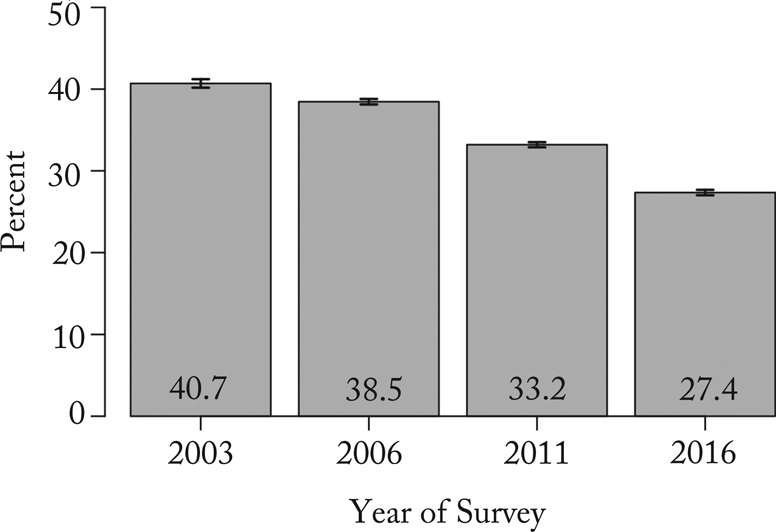
Between 2003 and 2016, the two end points of our data, the share of women who say they had experienced some form of domestic abuse during the previous year drops from 40.7 percent to 27.4 percent. In the same period, there is a sharp reduction in the share of women who say that a man has the right to hit his partner, that a woman must obey her spouse, and that the violence they have experienced is unimportant. The share of women victims who report episodes of violence to the authorities increases, there is growth in the share of women who speak about their experiences with friends or family, and most women claim familiarity with the 2007 vaw law.
Our findings support a cautiously optimistic assessment of current trends on violence against women in Mexico, the ability of laws on violence to change norms, and the law's power to undermine societal resistance to the egalitarian principles upheld by consolidating democracies. Our argument does not exclude the possibility that laws affect society in other ways, such as through enforcement and implementation by state actors. Neither do we rule out that economic growth and the global diffusion of ideas contribute to the changes we observe over the four waves of survey data. But by comparing the empirical implications of our argument with the implications of alternative explanations, we show that these other explanations do not, on their own, seem to account for the major behavioral and attitudinal changes we see across the survey waves.
We contribute to scholarship on law and society, social norms, and the drivers of public attitudes and behavior by theorizing the expressive power of vaw legislation and developing an empirical approach to assess norm change with survey data. Although expressive law theory implies that legal changes will be associated with changes in social norms, little of the extensive literature on expressive law uses public opinion data to relate actual legal changes to changes in society.Footnote 12 In addition, we advance discussions about expressive law by theorizing how vaw law is communicated to the population. Laws do not advertise themselves. Feminist activists, politicians, and journalists work to raise awareness about the need to enact new laws, and then, once adopted, about the law's normative expressions.Footnote 13 We therefore conceptualize the legal changes that took place in Mexico and the activism and media coverage accompanying them as a bundle of mutually reinforcing processes occurring over a multiyear period that combined to generate expressive power.
The article proceeds as follows. First, we describe the expressive function of laws and the norms that vaw laws embody. Second, we sketch a brief history of the legal change/feminist activism/media coverage bundle in Mexico. Third, we introduce the survey data and present our empirical approach to studying changes in social norms. Fourth, we explore evidence of shifting social norms by looking at changes in experiences of violence, in attitudes toward violence, and in reporting patterns, and how these trends vary by knowledge of the law. Fifth, we explore alternative explanations for the trends in the data, including gdp growth, nongender violence, and age-related time trends. We also consider the role of global diffusion and overall change in gender-related attitudes. We conclude that although severe problems persist, decades of feminist struggles appear to have produced a notable effect on violent cultures and practices.
Social Change and the Law
How do laws affect society and how do legal changes relate to social changes? Historically, many legal and political theorists maintained that the law deters certain behaviors through threats of punishment. Yet it is costly to monitor everyone and to enforce the law. As a result, systems of rule tend to seek voluntary compliance. Max Weber argues that the central motivation behind voluntary compliance is perception of legitimacy, which in the modern world stems from the belief that laws and regulations are just and rational; people obey the law because they believe it is the right thing to do.Footnote 14
There is another mechanism by which the law induces compliance, however. Through its expressive power and expressive functions, the law shares information about societal values and standards of desirable behavior.Footnote 15 As Mary Ann Glendon writes, the law tells a story “about who we are, where we came from, and where we are going.”Footnote 16 Sometimes the point of the law is to make statements, not just control people. And by using the law to make statements, lawmakers intend to alter social norms.Footnote 17
A crucial way the law shapes behavior, then, is by expressing new social norms.Footnote 18 Social norms are “perceptions about what is typical or desirable in a group or situation.”Footnote 19 The classic sociological view attributes norm compliance to internalization or habit; others argue that people comply because they otherwise would feel guilty.Footnote 20 People may also conform to norms because they want to earn and maintain the esteem of others. By complying with norms backed by a broad social consensus, people gain, and avoid losing, esteem.Footnote 21 According to Richard McAdams's esteem theory, norms spread as more people engage in the condoned behavior because the esteem costs of avoiding the behavior rise for the remaining holdouts. Losses and gains in esteem are realized only when there is a risk of detection, in other words, when noncompliance is likely to be reported and noticed by others.
Laws can induce people to change their behavior by altering their perceptions of norms, that is, by modifying people's beliefs about what behaviors are seen as desirable or obligatory.Footnote 22 Because most people are not social scientists, they do not have data on how many people approve or disapprove of certain courses of actions. The enactment of a new law thus sends a powerful signal about actual patterns of public approval and disapproval (provided that lawmakers tend to respond to majority opinion). Put another way, a new law publicizes the extent of societal consensus backing a norm and may increase perceptions that violations of the norm will be detected.Footnote 23 In response to legal changes, people often update their beliefs about standards of respectable behavior.Footnote 24
As this discussion suggests, laws potentially exert a substantial effect on society by upholding new norms. Even if few people actually get punished, the enactment of a law expresses growing consensus about the desirability of certain types of behavior and induces people to adjust their actions accordingly to avoid losing esteem and social status. As Catharine MacKinnon writes, “The real point of law is not incarceration or damage awards but voluntary compliance, otherwise known as legal socialization or education.”Footnote 25
How VAW Laws Express New Norms
Legislation intending to prevent, punish, and eradicate violence against women is a good example of expressive law. Adopted in the wake of global conferences and agreements about human rights, second-generation vaw laws are framed in feminist terms and connect gender violence to principles of equality, nondiscrimination, and human rights, among others. These laws recognize multiple forms of violence including physical, psychological, sexual, economic, institutional, and community, and include femicide as well as family violence.Footnote 26 Contemporary laws acknowledge that violence occurs in multiple sites of women's lives, including the home, the workplace, the street, schools, and public institutions.Footnote 27
vaw laws build on decades of research that finds that gender violence is not only attributable to individual risk factors like family trauma, aggression, and alcoholism, but also to unequal gender relations and women's low social status. Social norms that subordinate women to men are a major factor behind rates of violence. Studies from around the world show that norms condoning male authority are strongly related to societal endorsement of domestic abuse and the perpetration of violence.Footnote 28
In thirty sub-Saharan African countries, Demographic and Health Surveys (dhs) find that geographic variation in the prevalence of women's beliefs that violence is justified when a woman argues with her partner, neglects children, burns food, or refuses to have sex is closely associated to variation in rates of violence.Footnote 29 In Nepal, perceptions that prevailing social norms endorse male dominance, family honor, and tolerance of violence correspond to perpetration of physical and sexual domestic violence.Footnote 30 Analysis of the first wave of Mexico's endireh survey (2003) shows that women who say their male partners exert coercive control over their behavior are also more likely to suffer physical abuse.Footnote 31 Qualitative research in Mexico affirms that family members often see violence inflicted by men on women as an acceptable response to women's failure to comply with traditional gender roles.Footnote 32
This body of research implies that ending violence involves shifting gender power asymmetries and modifying hierarchical social norms. Laws on violence contribute to such a process. vaw laws signal that society disapproves of violent behavior against women and that even actions that are seen as private or justified are in fact violations that should be reported to public authorities. Violent acts against women should be condemned and called out, not tolerated or hidden. By bringing about changes in norms that endorse men's control over women, vaw laws change the behavior of individuals.
To be sure, vaw laws have other ways of effecting change. They create mechanisms, such as shelters and protective orders, that provide support to victims and make it easier for women to exit from abusive relationships. vaw laws mandate that the state engage in certain behaviors, such as training of law enforcement, gathering of data, and coordinating violence prevention across multiple agency sites.Footnote 33 And vaw laws stipulate how perpetrators should be punished, though punitive laws often produce negative and unintended consequences for women.Footnote 34
In light of the problems with punitive strategies, not to mention chronic underfunding of shelters and support services, the broadest value of anti-violence laws may consist in their expression of new norms. Marcela Lagarde, one of the authors of Mexico's gender violence law writes, “the law that we present is not punitive; it's a law that proposes a political reordering to address the causes of violence.”Footnote 35 By communicating the idea that intimate-partner violence and sexual violence are not acceptable, laws attempt to shift norms to prevent violence from occurring in the first place.
As we note in the introduction, the norms embodied in new laws on violence do not communicate themselves to the population on their own. And laws defending citizen rights, especially aspirational laws that attempt to guide but do not yet align with dominant societal understandings, may be distant from most people's lived experiences.Footnote 36 Feminist activists and other civic groups help to close the gap between the law and lived reality, often in alliance with progressive state actors. Activist networks bring the law to bear on society through education; provision of resources and other supports; training of police, judges, and health care practitioners; and by calling attention to enforcement failures, among other things.Footnote 37 In these ways, societal mobilization often helps to vernacularize legal rights, or convert formal law into meanings and practices that are salient and appropriate in local communities.Footnote 38
Law and Policy to Combat VAW in Mexico
Activism by feminist movements drove the creation of public institutions to combat vaw in countries around the world, including Mexico. Feminist groups worked at federal and state levels to raise awareness, lobby government officials, and combat opposition, both to get vaw legislation enacted and its legal provisions implemented.Footnote 39 Allies in the media often helped. Through sustained coverage of atrocities as well as of protests, strikes, and lobbying campaigns, journalists kept the public informed and stoked outrage at official inaction to violent crimes. The pattern of societal organization, media-triggered outrage, and state response is evident in both waves of violence-against-women legislation in Mexico.
The first push began in the 1970s, around the time of the UN-designated International Women's Year and the global women's conference held in Mexico City in 1975. Feminists demanded legal reforms to typify different forms of sexual violence and to provide targeted services to victims, and some states established centers to receive victims of violence.Footnote 40 But it was only after the revelation that bodyguards working in the Mexico City Attorney General's office had perpetrated dozens of rapes that a coalition of feminist ngos and women in Mexico's congress succeeded in achieving changes in legislation, including reform of the criminal code to provide broader definitions of rape and sexual harassment, to increase penalties for rapists, as well as to eliminate sexist phrases in the law, such as characterizations of raped women as “honest” and “chaste.”Footnote 41
In the 1990s, activist efforts to promote legislation on violence coincided with the emergence of more competition between parties for control of the federal and state governments, which created opportunities as well as obstacles. In the state of Jalisco, for example, home to the country's second-largest city (Guadalajara) and run by the right-wing Partido de Acción Nacional (pan), feminist groups organized around a bill to criminalize and combat domestic violence, but faced opposition from Catholic officials, who argued that the bill's notion of family contradicted ecclesiastical principles.Footnote 42 After building alliances with a broad range of groups, including prodemocracy organizations and academic institutions, the feminists eventually prevailed, gaining forty thousand signatures on a popular-initiative petition to compel the state legislature to vote on the bill and campaigning through the media. In addition, feminist groups made a strategic decision to table a comprehensive bill based on feminist analysis of violence against women and to replace it with more narrow proposals for reform of administrative, civil, and criminal statutes to address intrafamily violence.Footnote 43
Between 1996 and 2006, twenty-nine of thirty-two Mexican states adopted legislation to combat violence. The changes in this legislation marked major advances over previous provisions, although as the Jalisco story shows, controversy motivated activists to refocus most first-generation legal reforms on domestic or intrafamily violence exclusively and did not include the range of phenomena we today think of as violence against women.Footnote 44 The modification of codes in Mexico City in 1997, which criminalized marital rape, affirmed women's right to be free from violence, and included violence as a ground for divorce, were also controversial, as they challenged the idea that sexual relations were part of a woman's marital obligation.Footnote 45
The crisis of feminicidios (femicides, or more specifically the murder of thousands of women),Footnote 46 particularly in the northern state of Chihuahua, helped to propel a second wave of legislative changes at the beginning of the twenty-first century. Feminist activism and the mobilization of victims’ families combined with coverage of femicides by local and international journalists brought worldwide attention to the broader problem of violence against women in Mexico.Footnote 47 Global human rights organizations condemned the state's failure to properly investigate crimes, tendency to blame murder victims for their plight, lack of transparency and accountability, and poor treatment of victims’ families.Footnote 48 Family members of victims appealed to the Inter-American Commission of Human Rights and then to the Inter-American Court, which found that the government's negligence contributed to a climate of impunity that encouraged more violence.Footnote 49
In the early 2000s, multiple state agencies at the federal and state levels began to take more aggressive action to investigate, to raise awareness, and ultimately, to combat femicide and other forms of violence against women. For example, the National Women's Institute, the National Public Health Institute, and the National Statistical Agency launched studies (including the endireh survey we analyze in this article) to study gender violence, and the national congress created a series of commissions to investigate and reduce impunity for femicides in Chihuahua and nationwide.
Thanks to the work of politician-activists in three congressional committees, these efforts culminated in the enactment of the landmark 2007 federal vaw law, the General Law for Women's Access to a Life Free from Violence. The 2007 vaw law builds on the United Nations Convention on the Elimination of All Forms of Discrimination Against Women (ratified by Mexico in 1981) and the Inter-American Convention on Violence Against Women (endorsed by member states in 1994), and directly responds to more than forty requests by international organizations and foreign governments for the Mexican state to take greater action to combat gender and sexual violence. The law was approved almost unanimously by both houses of the legislature (with only one vote against in the Senate) and signed by the presidential administration of Felipe Calderón, a member of right-wing pan.Footnote 50
The federal 2007 vaw law guarantees women the right to a life free from violence as a matter of human rights. It proposes eliminating the underlying causes of gender oppression including inequality, injustice, and gender hierarchies, and states that men who commit violence need to be reeducated and resocialized. The law also lays out a plan to coordinate and support efforts to prevent, punish, and eradicate vaw across different states and local governments.Footnote 51 As Lagarde writes, “The law creates normative conditions for the State to stop being part of the problem and to transform itself into the promoter and protagonist of solutions to violence against women.”Footnote 52
The 2007 vaw law requires states to revise their criminal legislation within a six month window and establishes a system to monitor their progress. By 2010, all states had issued new legislation, although far fewer had issued legislation to implement it (reglamento) or had revised related bodies of law, such as the civil and criminal codes and codes of civil and criminal procedure, to ensure consistent application.Footnote 53
Despite the uneven response from state authorities, activists and the media helped keep violence against women on the political agenda. In the 2010s in Veracruz, for example, media coverage incited public outrage over numerous episodes of gender and sexual violence and the state government's inaction. Feminist groups petitioned the federal government to issue an alerta de violencia de género (gender violence alert), a mechanism created by the 2007 vaw law to publicly announce episodes of nonenforcement and to put local and state authorities on notice.Footnote 54 With the Veracruz alert, the federal Interior Ministry (Secretaría de Gobernación) commanded regional authorities to take measures to combat violence, including increasing security patrols in public spaces and public transport, video surveillance, better lighting, more services for victims, and longer-term strategies to promote cultural change.Footnote 55 In these and other ways, activists used laws on violence against women to gain legitimacy for and call attention to their work, and at the same time raised public awareness of the norms expressed in the law.Footnote 56
Empirical Approach
To see whether vaw-related legislation has been accompanied by changes in social norms, we look at data from the endireh surveys from 2003, 2006, 2011, and 2016. These surveys were designed and implemented by National Institute of Statistics and Geography (inegi) in collaboration with the National Women's Institute (inmujeres), to learn more about the prevalence of and attitudes toward violence against women in the home, at work, and in the street. The forms of violence covered in the 2011 and 2016 surveys correspond to the different types of violence contemplated by the 2007 vaw law, including physical, psychological, sexual, and economic violence. We draw on questions that are the same across surveys to explore changes over time.
All four surveys sample households from across Mexico. In 2003, the sample includes 57,230 households from across the country's thirty-two states. For the 2006 and 2011 surveys, 128,0000 households were sampled (4,000 in each state). In the 2016 survey, there are 142,363 households. The samples were chosen to be representative of each state and to include urban and rural areas within each state.Footnote 57 In each household, the enumerators identified women age fifteen years or older, and interviewed at least one of them individually about her work, living conditions, and personal life, with an emphasis on experiences of different forms of violence.
The 2006, 2011, and 2016 surveys categorize women as single, in a relationship, and divorced or widowed, and include responses from women in each category. In 2003, the enumerators interviewed only women who were currently living with a husband or partner. To make the data comparable across the four surveys, we therefore reduce the samples from the other three surveys to women who were in a relationship at the time of the survey—either married or living with a partner. The resulting samples include 34,148 interviewed women in 2003; 80,086 in 2006; 87,169 in 2011; and 70,585 in 2016. We provide further information about the surveys and summary statistics of key variables in section A of the supplementary material.Footnote 58
Observable Implications of Changes in Social Norms
The observational nature of our data, the slow-moving processes we are studying, the latent nature of our main outcome of interest, and the bundling of legal change with feminist activism make it impossible to cleanly identify causal effects of anti-violence legislation. It is extremely challenging to separate the real-world effects of anti-violence laws from the effects of societal mobilization surrounding these laws.Footnote 59 To increase confidence in our claims, we generate and test as many observable implications of our theoretical argument as possible, and we consider the observable implications of a series of nonlegal alternative explanations as well.Footnote 60
Whereas earlier papers using the endireh data have focused on accounting for variation in women's experiences of violence,Footnote 61 our main concern is to look for evidence of changes in norms around the time the 2007 vaw law and related state laws were enacted. Our argument, that the bundling of legal change, feminist activism, and media coverage accounts for the law's expressive power, implies that we should expect to see changes in norms even before the 2007 vaw law was formally adopted. It is not merely the enactment of a new law, but the social process of proposal-making, advocacy, and debate surrounding the law that makes people aware of evolving norms. Since the endireh surveys do not ask women about their perceptions of norms directly, we explore evidence for changes in norms indirectly by asking about experiences and attitudes.Footnote 62
We first look at changes in how many women respond affirmatively to survey questions about having experienced domestic abuse in the previous year. The answers to these questions are important but only offer a tenuous indicator of social norm change, since experiences of violence could be driven by numerous other factors (more on this below). To look for additional evidence of norm change, we turn to McAdams's three conditions for the emergence of a new norm: a growing consensus about desirable behavior, a growing risk of detection of violations, and more widespread knowledge of the consensus and the risk of detection.Footnote 63
We look for evidence of the first condition by exploring aggregate attitudes toward violence among the surveyed women, which gives us a good sense of whether people believe that committing violence should lead to a loss of esteem.Footnote 64 We examine the second condition—detection risk—by looking at the share of abused women who say they reported violence to public authorities or talked about it to friends and family. Growth in reporting rates increases the risk that violations of the norm will be known by others, including state officials. When women talk with friends and family about the violence they experience, they share information about men's norm-violating behavior, which heightens the chance that violators will lose esteem in the local community.
We assess the third condition for norm emergence through knowledge of the 2007 vaw law and how this knowledge is correlated with the other indicators. As McAdams explains, one mechanism through which the law affects behavior is by clarifying actual patterns of public approval and disapproval of certain actions.Footnote 65 We can therefore infer that when people know about the 2007 vaw law, they are aware of a societal consensus condemning violence and the risk that violations of the law will be detected. Michael Chwe refers to this third condition as “common knowledge.”Footnote 66
How likely are we to tap into norm change with these four sets of indicators? There is disagreement among experts on whether we should measure norms with attitudes. Elizabeth Paluck, Laurie Ball, Chloe Poynton, and Sarah Sieloff advise against using attitudes as indicators of norm perceptions because the former tend to change more slowly than the latter.Footnote 67 Indeed, a study by Donald Green, Anna Wilke, and Jasper Cooper on the effects of an anti-violence social norms marketing intervention in Uganda found that attitudes did not change, but that violence perpetration and reporting behavior did.Footnote 68 Lori Heise and Emma Fulu, by contrast, argue that aggregate attitudes can be used as a reasonable proxy for prevailing norms.Footnote 69 Our approach of examining a constellation of attitudes alongside observable behavior should thus be characterized as conservative. If we see changes in attitudes as well as in behavior, it is even more likely that norms have shifted.
Evidence of Changes in Social Norms
The endireh surveys show that violence is common in Mexico. The 2016 survey finds that 66 percent of the women interviewed had experienced some form of violence at some point in their lives,Footnote 70 which appears similar to the 67 percent of women who say they had experienced some form of violence in the 2006 survey and the 63 percent saying likewise in the 2011 survey.Footnote 71 But these percentages tell us little about whether there has been change over time because they are based on aggregates of all the women interviewed and all the questions about experiences of domestic abuse in each survey, both of which differ somewhat across the surveys.Footnote 72 Recollections about experiences of violence over the course of a lifetime, even across surveys in the same country, do not tell us much about whether women's likelihood of suffering violence has increased or decreased within a short period of time.
In this article, we look at how many women say they experienced domestic abuse in the previous year.Footnote 73 To facilitate comparison across surveys, we look at the twenty-eight questions about experiences of physical, sexual, psychological, and economic violence that are worded the same across the four surveys.Footnote 74
Within these parameters, the data show a clear reduction in the share of women saying they experienced domestic abuse (see Figure 1). In 2003, 40.7 percent of the women surveyed say they experienced domestic abuse during the previous year. This goes down more than two percentage points to 38.5 percent in 2006. There is a drop of more than five percentage points, to 33.2 percent, in the 2011 survey, and then another five-percentage-point decline, to 27.4 percent, in the 2016 survey.Footnote 75 As we can see from the narrow confidence intervals at the top of each bar, these are fairly precise estimates and all the drops are highly statistically significant. The gradual drop in incidents before 2007 and the more rapid drop after 2007 is consistent with the argument that legal changes and mobilization produced an effect on norms related to violence.Footnote 76
Percentage of Women Saying They Experienced Domestic Abuse in the Previous Yeara
a 95 percent confidence intervals at the top of each bar.

How women experience domestic abuse depends on their positions in society. Women are more likely to say that they experienced abuse in the previous year if they have little education, worked in the previous week, are unmarried (but living with a partner), or are living in an urban area.Footnote 77 However, the change over time in the share of women experiencing abuse is not driven by changes in the profile of the women surveyed, which is very similar across the surveys (see Table A.1 in the supplementary material), and the drop is large for women across the socioeconomic spectrum (see Figure B.1 in the supplementary material).
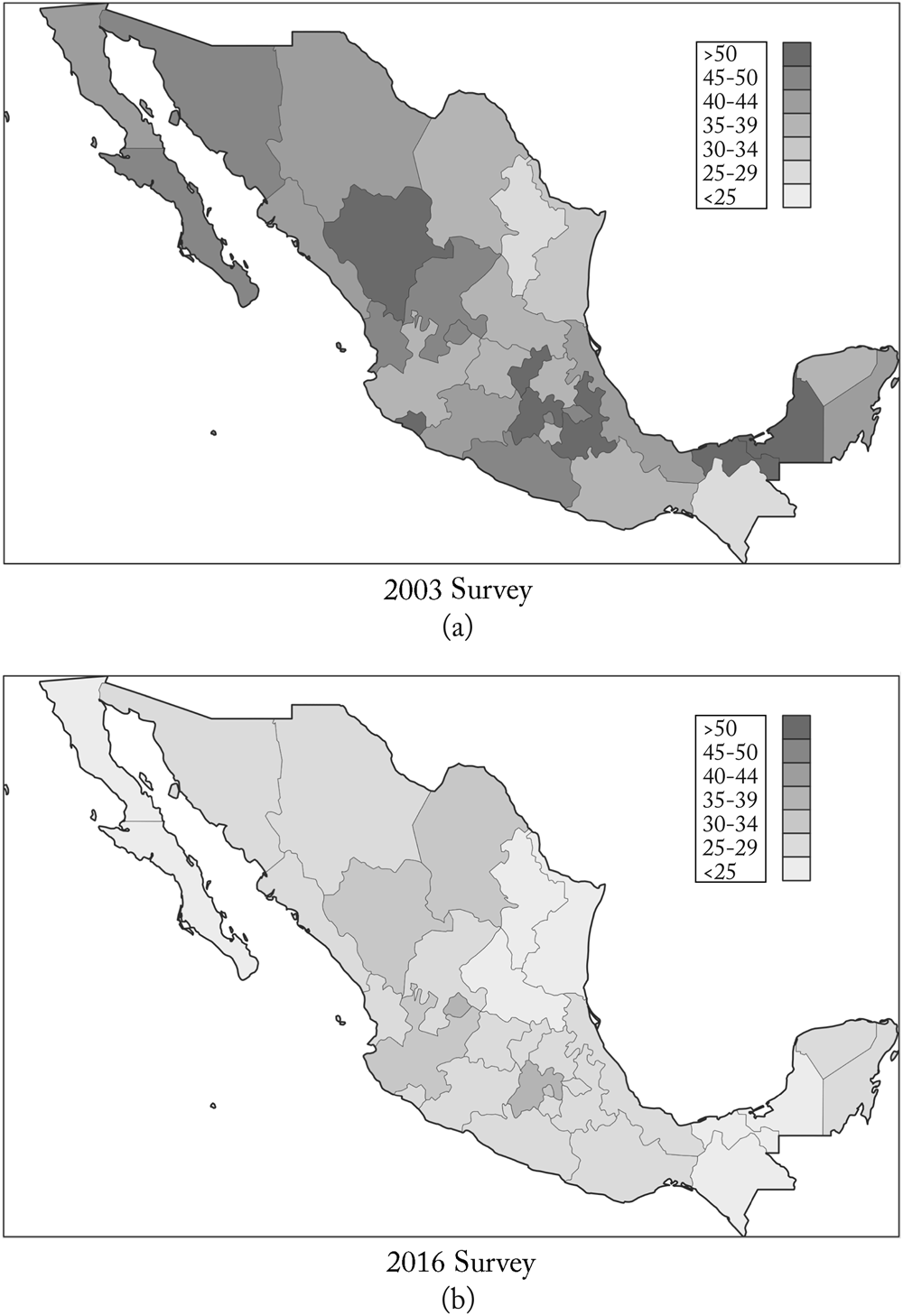
There is considerable geographical variation in the share of women who say they experienced domestic abuse in the previous year. In the 2003 survey, Colima is the state with the highest percentage—59 percent of women say they had experienced abuse in the previous year—followed by Querétaro, Durango, and Estado de México each with 56 percent. However, by the 2016 survey, the percentage drops across all states, as shown in Figure 2. Panel (a) shows the statewide percentage of women experiencing domestic abuse in the year preceding the 2003 survey and panel (b) illustrates the same for the 2016 survey. The biggest changes occur in Tabasco and Colima (–31 percentage points), and in Baja California Sur and Campeche (–28 percentage points). Since the largest changes happened in some of the states with highest rates of domestic abuse, there is less statewide variation in the 2011 and 2016 surveys than in the earlier surveys.Footnote 78
Percentage of Women Saying They Experienced Domestic Abuse during the Year Preceding the 2003 and 2016 ENDIREH Surveys

Data presented in this section reveal that between 2003 and 2016, there was a large reduction in intimate partner violence across regions and groups of women. Given that there were approximately thirty million women older than fifteen in a relationship in Mexico during this period, the five-percentage-point drop in incidents of violence we observe between 2006 and 2011 implies that after the 2007 vaw law was enacted, 1.5 million fewer women experienced intimate partner abuse in the previous year. A similar reduction occurred between 2011 and 2016. In the sections below, we present evidence that these major changes in women's experiences of violence coincide with changes in women's attitudes and other practices related to violence, such as rates of reporting to authorities and disclosure to friends and family.
Growing Societal Consensus against Domestic Abuse
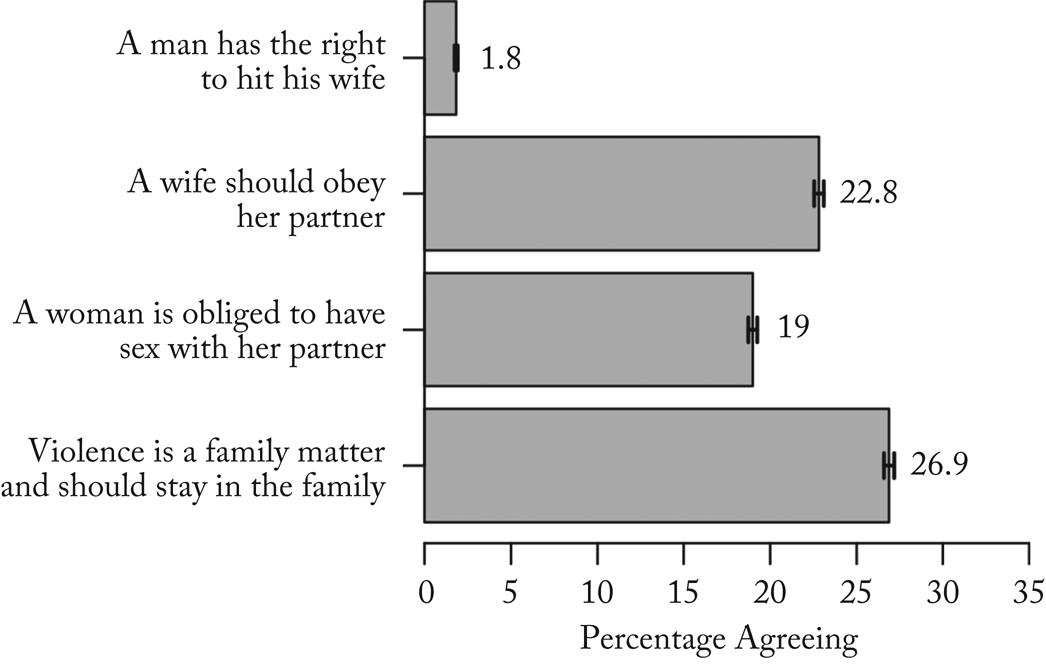
According to McAdams's esteem theory, the first condition that implies norm change is a societal consensus that certain behaviors are worthy of gaining or losing esteem.Footnote 79 Consider whether a man should lose respect if he hits his partner. Anti-violence legislation in Mexico combined with feminist efforts to raise awareness of domestic laws and international human rights principles make it abundantly clear that such behavior constitutes a crime. The 2011 endireh survey asks respondents whether a husband has the right to hit his wife, and, as shown in Figure 3, only 1.8 percent of the women interviewed for the 2011 survey answer this question affirmatively, which implies that attitudes are almost completely aligned with the law.
Yet larger numbers of women express attitudes that imply less condemnation and even tacit support for violence and the conditions conducive to violence, such as marital power and women's obedience.Footnote 80 In the 2011 survey, for example, 22.8 percent of women agree with the statement that a wife should obey her husband and 19 percent say that a woman is obliged to have sex with her partner. A large share (26.9 percent) of women also agree that domestic abuse is a private matter that should stay within the family.Footnote 81
Percentage of Women Agreeing with Statements about Male Control in the 2011 ENDIREH Surveya
a 95 percent confidence intervals at the tip of each bar.

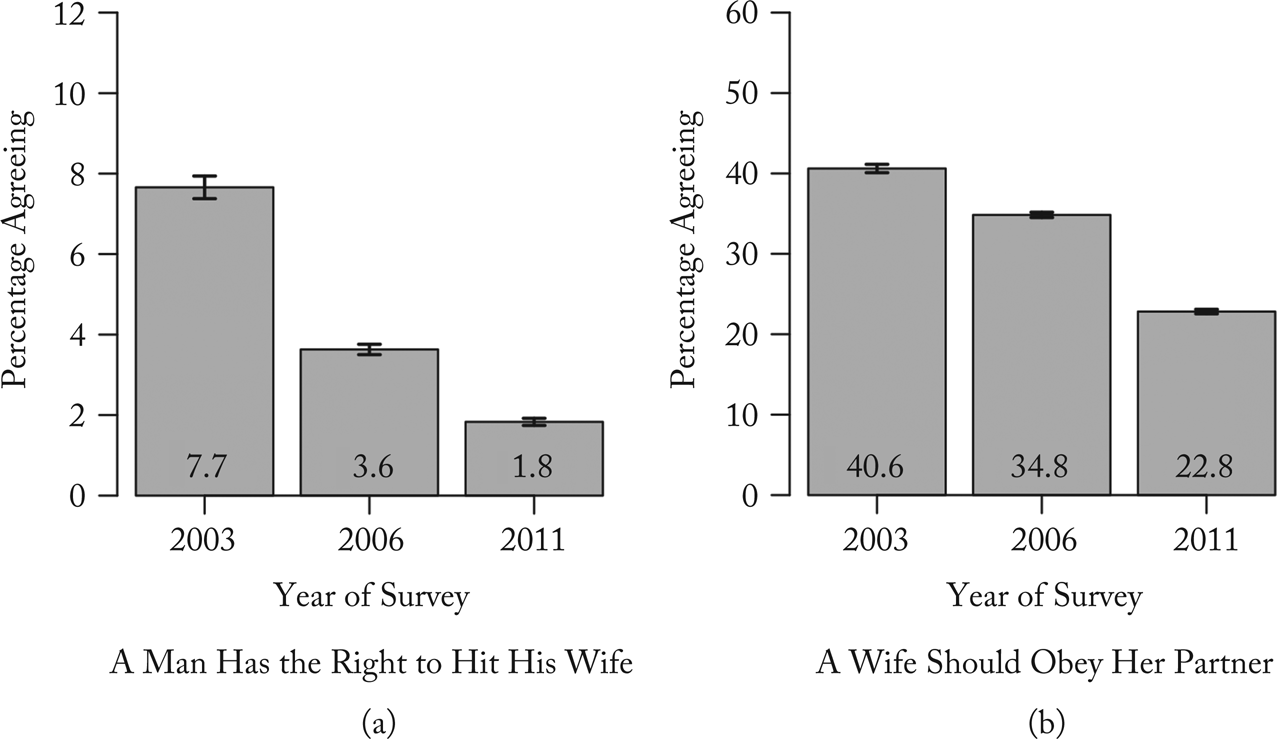
The first two of these questions—about a man's right to hit his wife and whether a woman should obey her partner—are asked consistently across the four endireh surveys, permitting us to look at changes over time. As shown in Figure 4, there are dramatic changes in the responses between 2003 and 2011. The share of women who say that a man has the right to hit his wife declines from 7.7 percent in the 2003 survey, to 3.6 percent in the 2006 survey, and to 1.8 percent in the 2011 survey. When it comes to the idea that a wife should obey her partner, 40.6 percent agree to this in 2003, 34.8 percent in 2006, and 22.8 percent in 2011. This is an impressive reduction in a short period of time in the share of women endorsing male control and women's subordination in marriage.
Attitudes toward Male Control Changing over Time, in the 2003, 2006, and 2011 ENDIREH Surveysa
a 95 percent confidence intervals at the top of each bar.

Increased Risk that Violations Will be Detected
The second condition proposed by McAdams implying the emergence of a new norm is the risk that norm violations will be detected.Footnote 82 Since intimate-partner violence often happens within the boundaries of the home, it may be hard to know about unless a woman chooses to speak of her experiences or neighbors or family overhear the conflict. When women report violence to public authorities or to friends and family, it is more likely that others in the community will learn about the violations and who perpetrated them. Women's tendency to report, alongside evolving public attitudes, thus implies a greater probability that men who abuse women will suffer a loss of social esteem.
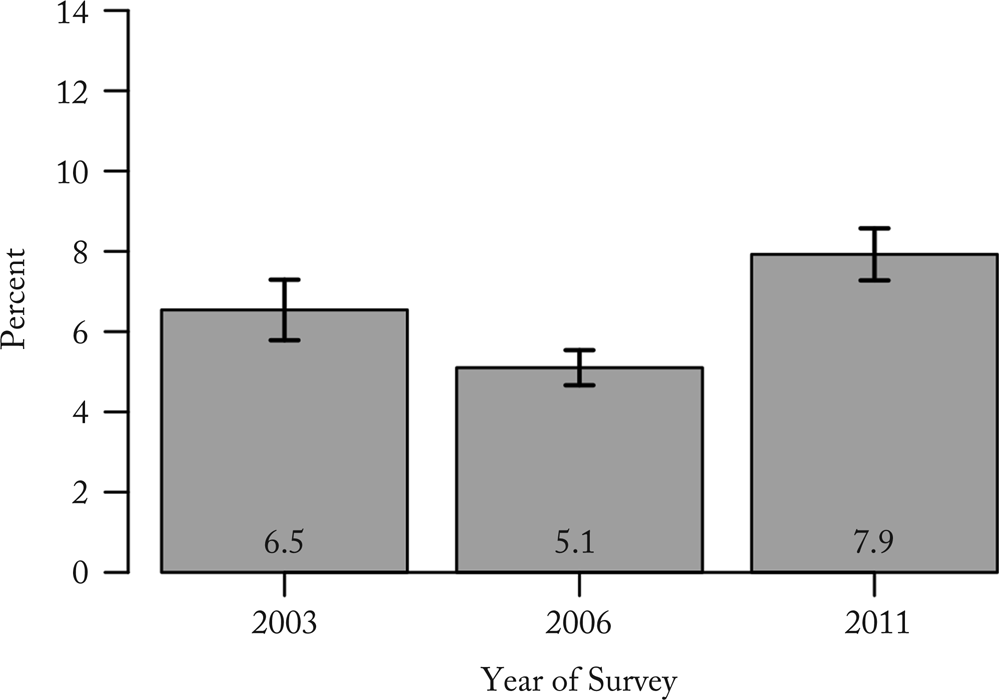
The endireh surveys show that only a small share of women talk to public authorities about the abuse they experience but that this share is growing. Figure 5 illustrates the share of women experiencing physical domestic abuse in the year preceding the 2003, 2006, and 2011 surveys who say they had reported the abuse in that same year.Footnote 83 We see an increase in reporting rates from 6.5 percent and 5.2 percent in the 2003 and 2006 surveys, respectively, to 7.9 percent in the 2011 survey.Footnote 84 What is more, a large and increasing share of women who reported say they were treated well by the organizations or institutions they approached.
The 2016 survey changed the format of questions regarding reporting to authorities, which precludes a direct comparison with survey responses in the previous waves. For example, it adds additional, detailed questions about the types of reports, the reporting process, and the response of public authorities. Notwithstanding these differences, the responses to the most comparable of these questions suggest further increases—to approximately 9 percent of abused women—in reporting violence in the 2016 survey.Footnote 85
Percentage of Women Experiencing Physical Domestic Abuse during the Year Preceding the Survey Who Say They Reported it to the Authoritiesa
a 95 percent confidence intervals at the top of each bar.

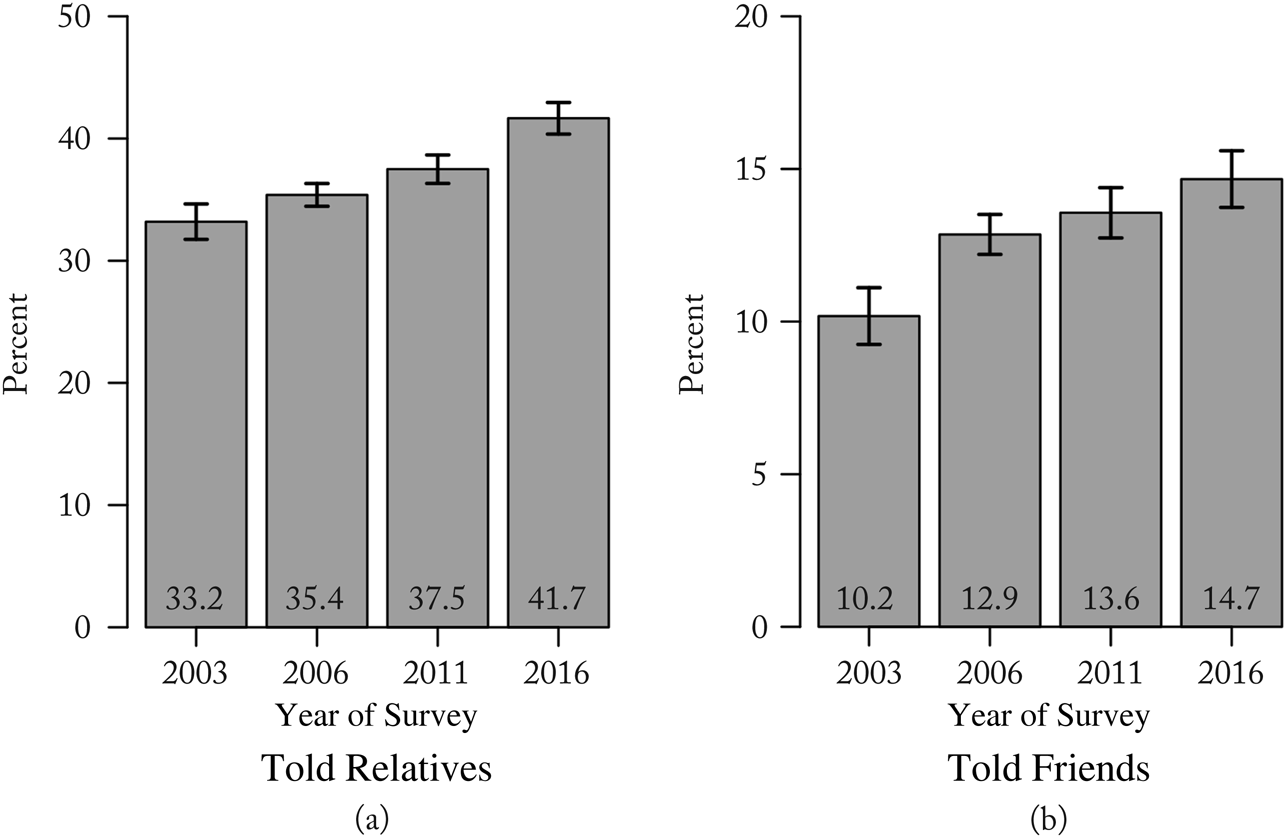
The pattern of increased reporting to authorities is consistent with another observable implication of norm change related to violence: women's greater willingness to speak out about abuse. Figure 6 shows that women victims become more likely to speak about their experiences with family and friends over time. There is an increase in the share of victims who spoke to family from 33 percent in 2003 to about 42 percent in 2016, and an increase from some 10 percent who say they told friends about domestic abuse in 2003 to about 15 percent in 2016.Footnote 86
Percentage of Women Experiencing Domestic Abuse during the Year Preceding the Survey Who Say They Told Someonea
a 95 percent confidence intervals at the top of each bar.

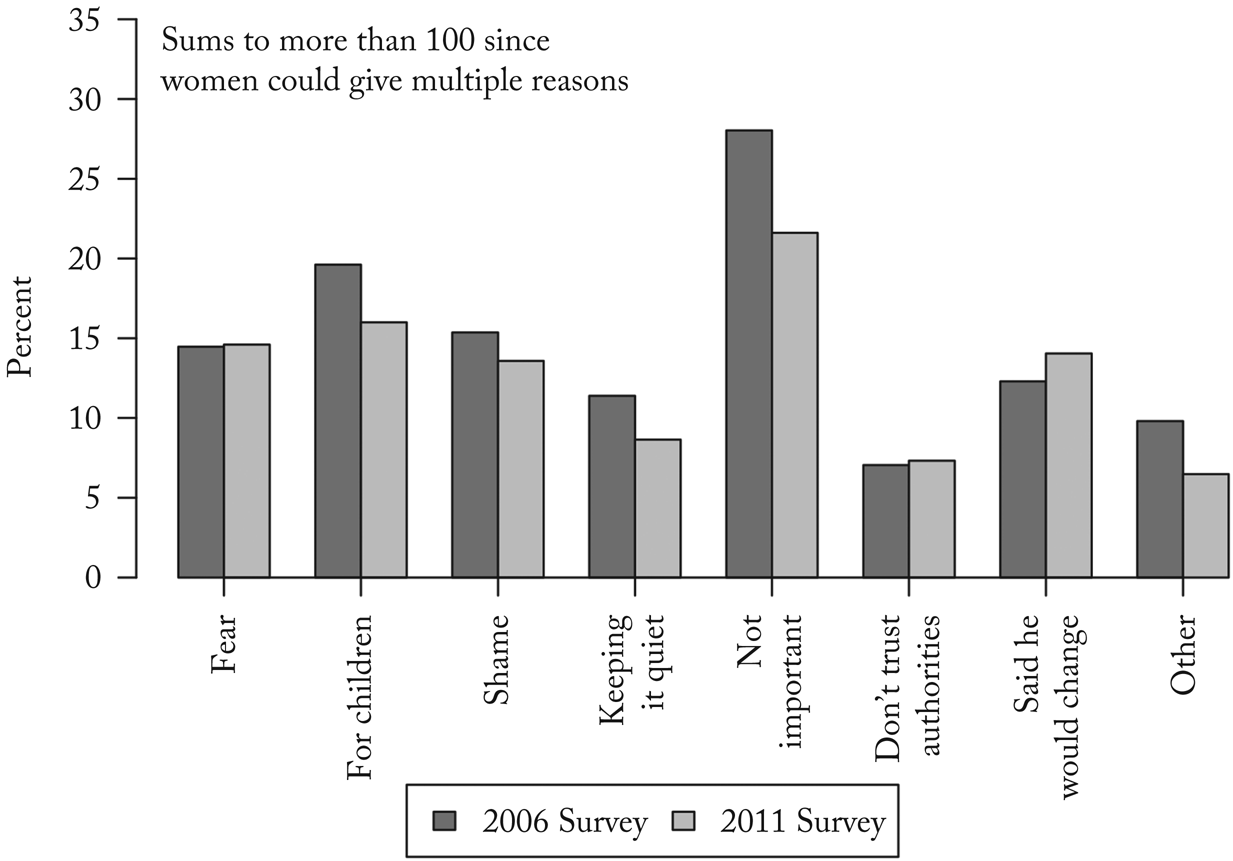
Evidence for norm change can also be found in women's reasons for not reporting abuse, as shown in Figure 7. When asked why they did not report physical domestic abuse in the previous year, a large share of the respondents in the 2006 survey say that it was for their children, out of shame, to keep the incident quiet, or because it was not important, which reflects the power of beliefs that privatize and normalize violence. In the 2011 survey, far fewer women give not important, their children, or that they wanted to keep it quiet as reasons for not reporting. However, a greater share of women say that they chose not to report out of fear, which suggests that many women perceive reporting to incur significant personal risk. These responses are consistent with the patterns in the attitudinal questions reported above.
Reasons for Not Reporting Domestic Abuse in the Previous Year

Common Knowledge
The third condition of a new norm, according to McAdams, is the extent to which members of the community are aware of a consensus condemning violence and the risk that violations will be detected,Footnote 87 or what Chwe refers to as common knowledge.Footnote 88 As mentioned above, we operationalize this condition by exploring knowledge of the 2007 vaw law. Among the 87,169 women in a relationship when interviewed for the 2011 endireh survey, 73,547 (84 percent) say that they had heard about the law guaranteeing the right to a life without violence. This share is high nationwide, ranging from 78 percent to 89 percent at the state level, with differences among differently situated women. Women with no education are much less likely to say they know about the law (60 percent) compared to women with a university degree (94 percent), women in urban areas are more likely to know about the law (86 percent) than women in rural areas (77 percent), and women speaking an indigenous language are less likely to know the law (69 percent) than women who do not speak an indigenous language (85 percent).
Knowledge of the 2007 vaw law is associated with attitudes toward violence, and also with experiencing and reporting abuse. Among women who know about the law, some 19 percent say that women have to obey their husbands, compared to 43 percent of those who do not know the law. And only 1.4 percent of those who know the law say that a man has the right to hit his partner, compared with 4 percent among those who do not know the law. Knowing the law remains a significant predictor of attitudes, reporting, and experiencing abuse even when we control for other individual and state-level attributes (see Table B.2 in the supplementary material).
But not knowing the 2007 vaw law does not imply that a woman doesn't know she has rights—indicated, for example, by the fact that many women who are unaware of the law say that they have reported abuse. These women may know of older laws or, without being sure exactly what the law says, may know that a man is not permitted to abuse his partner. That we see large differences in the experiences and attitudes of women knowing and not knowing the law—even controlling for many other attributes—provides evidence that the norm changes we observe are indeed driven by the 2007 vaw law and accompanying societal mobilization.Footnote 89
Alternative Explanations for Changes in Social Norms
In the sections above, we presented evidence of large-scale changes in social norms related to violence against women in Mexico between 2003 and 2016 and we argued that these changes demonstrate the expressive power of the 2007 vaw legislation. Would these norm changes have occurred if the law had not been enacted? Could the patterns in our over-time data be attributed to changes in research design across surveys, overall rates of societal violence, economic growth, generational change, or the global diffusion of ideas? In this section, we explore competing explanations. Although we cannot fully rule out the alternatives, we show that our findings are more consistent with our expressive law approach than with rival, nonlegal explanations.Footnote 90
As noted, the patterns in our data do not seem to be driven by changes in the profiles of the women sampled and interviewed for the surveys. Social characteristics of the women respondents are very similar across the survey waves (see Table A.1 in the supplementary material). Neither are changes in experiences and attitudes associated with overall changes in violence, such as the homicide rate, in Mexican states (see Figure B.3 in the supplementary material). Although the drug war in Mexico exacerbates certain forms of gender violence, such as femicides, it appears to have had little relation to other, more pervasive forms of gender violence, such as domestic abuse.
What about socioeconomic development? Cross-nationally, economic growth tends to be associated with a reduction in women's economic vulnerability to men. Heise and Andreas Kotsadam, for example, show an inverse relationship between gdp per capita and the perpetration of intimate partner violence globally and Ronald Inglehart and Pippa Norris find a close association between economic development and views supportive of gender equality.Footnote 91 Economic growth may produce mixed effects, however. Although women's access to jobs may give them greater power to bargain for more equitable relations with their partners,Footnote 92 women's rising status may also trigger men's insecurity and produce a violent backlash.Footnote 93
In our data from Mexico, there is a negative correlation between growth in state-level gdp from 2005 to 2010 and changes in experiences of domestic abuse between 2006 and 2011, but this association is not statistically significant. And when we look at the change in gdp from 2010 to 2015 and changes in violence from 2011 to 2016, the direction of the correlation is reversed (positive, although also insignificant). What is more, state-level gdp growth is not significantly associated with changes in reporting patterns or in attitudes (see Figure B.2 in the supplementary material). Although women with higher social status are less likely to be victims of intimate parter violence—a pattern also reported by Yu Liu and Thomas FullertonFootnote 94—the reduction in abuse that we observe as well as changes in attitudes and reporting happen among women from across the socioeconomic spectrum (see figures B.1, B.10, and B.11). Overall, we find no evidence that the patterns we observe are driven only by socioeconomic factors.
Often, changes in responses across survey waves reflect a time trend of younger generations with more progressive views replacing older generations with more conservative views from one survey sample to the next. But generational change does not seem to explain our findings. Although our data show that women over fifty hold more conservative views than do younger women, our data also present changes in attitudes within all age groups (see figures B.4 and B.5). Furthermore, that we see changes in attitudes within all birth cohorts implies that patterns are driven by changes at the individual level and not by less-conservative women in their forties growing older and joining the more conservative over-fifty group (see figures B.6 and B.7). Changes in women's experiences of domestic abuse and willingness to report it also occur across all birth cohorts (see figures B.8 and B.9).
Global diffusion is another important factor affecting social norms. Rachel Pierrotti attributes the decline in women's acceptance of intimate partner violence as a form of marital control in twenty-three of the twenty-six countries she studies to the spread of global cultural scripts by transnational feminist activists and international organizations.Footnote 95 Her work theorizes that global diffusion shapes individual attitudes through the mechanism of change in domestic laws and other institutions.Footnote 96 As we note above, the enactment of violence-against-women laws in most countries resulted from a combination of transnational and domestic civic activism. Feminists mobilize within and across borders to raise awareness, to frame violence against women in globally and locally compelling ways, and to build coalitions backing the adoption of laws to combat violence.Footnote 97 In other words, by studying the effects of a domestic legal change we are already taking the global diffusion of ideas into account.
Still, it is possible that the spread of ideas could produce direct effects on norms as individuals engage with international news media and entertainment—effects not mediated through domestic legislation. We see little evidence for such direct effects in our data, however, because we see similar changes in experiences and attitudes among women from all strata of society, not only or even primarily among more educated women with the best access to international discourse (see figures B.1, B.10, and B.11). Furthermore, the fact that knowledge of the 2007 vaw law is a clear predictor of all of our main outcomes, even when we control for a host of other factors (see the section above), lends support to our claim that legal expressive power, and not only nonlegal global or domestic cultural influences, contribute to norm change.
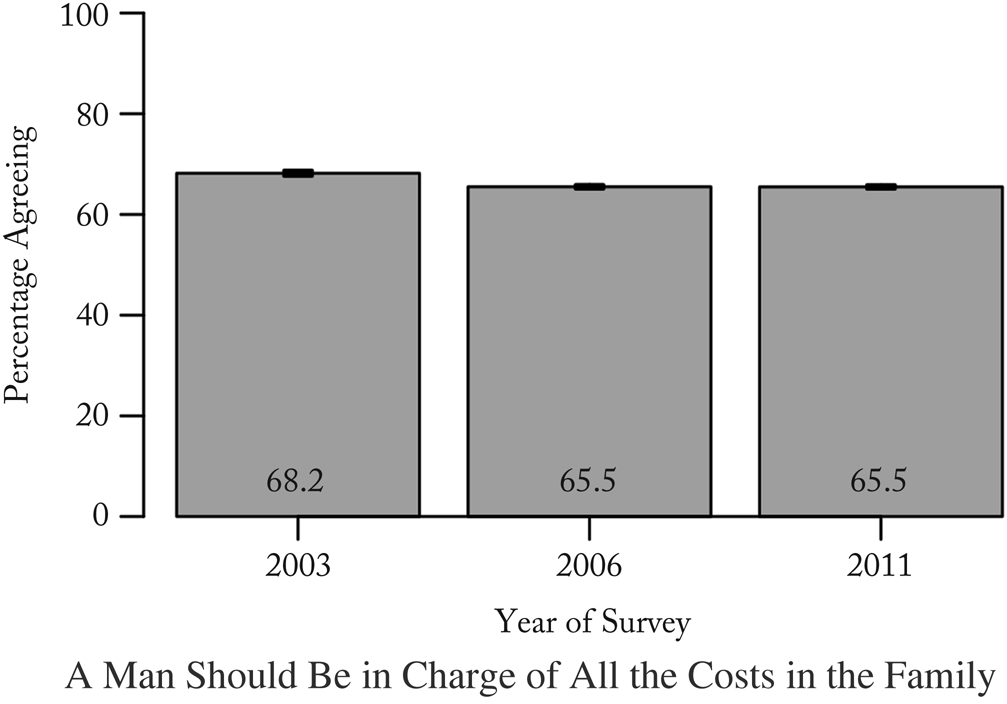
Last, a critical test of the impact of violence against women laws is to compare attitudes on violence with attitudes on other aspects of gender roles. Inglehart and Christian Welzel find that public opinion around the world has become more supportive of gender equality in recent decades.Footnote 98 Since vaw legislation is likely primarily to affect attitudes related to violence, looking at changes in attitudes related to other aspects of gender relations can be a placebo test for effects of the vaw laws.Footnote 99 The endireh surveys ask mostly questions about violence, although answers to a question about whether men should be in charge of all the costs of the family, which indicates adherence to traditional gender roles, may serve as a placebo test. As Figure 8 shows, a large majority of women endorse men's financial authority and responsibility and there is almost no change on this across the survey waves. This observation suggests that views on violence are changing faster than views on other women's rights.
Attitudes Toward Non-Violence Related Gender Roles over Time, in the 2003, 2006, and 2011 ENDIREH Surveysa
a 95 percent confidence intervals at the top of each bar.

Conclusion
Laws have expressive power. They signal right and wrong and communicate messages about what is considered socially acceptable. In this article, we develop a theory about the expressive power of violence against women legislation, analyze various mechanisms through which vaw laws are expressed, and, using survey data from Mexico, propose a novel way to operationalize and test our theoretical propositions about norm change. Although the nature of our data does not allow us to cleanly identify a causal relationship between the laws on violence and the norm changes we observe, the trends in the data are consistent with McAdams's three conditions for the emergence of a new norm.Footnote 100 At the very least, and regardless of its cause, we show that intimate partner violence—the most common form of violence experienced by women—has declined, reporting of such episodes has increased, and social attitudes about the acceptability of violence have changed dramatically.
To be sure, there is a long road ahead. Grave problems remain in the area of violence, as physical and psychological abuse of women is still widespread and reporting is uncommon.Footnote 101 Men's loss of jobs and status due to civil conflicts, globalization, economic changes, and the Covid-19 pandemic exacerbates risk factors for violence.Footnote 102 In Mexico, although rates of domestic abuse have declined, a large majority of women still say they experienced at least one form of intimate partner violence, and many also suffer violence and harassment in workplaces, schools, public institutions, and even while giving birth.Footnote 103 Reporting is still risky and many perpetrators are never investigated or punished.
Activists in Mexico and all over the world have worked for decades to forge global agreements, enact national laws, and create local institutions to reduce violence and to help victims. It is easy to get discouraged when viewing headlines about atrocities and to wonder if all the efforts have been in vain. Our study provides some evidence that feminist efforts are paying off. Our findings strongly imply that the bundling of new anti-violence laws with societal mobilization and media coverage help to propel major changes in women's experiences of and attitudes toward violence. Even weakly enforced vaw laws may contribute to the transformation of norms toward a more egalitarian society.
Supplementary Material
Supplementary material for this article can be found at https://doi.org/10.1017/S0043887121000186.
Data
Replication files for this article can be found at https://doi.org/10.7910/DVN/QHCTDX.
Acknowledgements
We are grateful for comments from Sergio Ascensio; Karla Hoff; Andreas Kotsadam; Jane Mansbridge; Rik Peeters; Camila Reuterswärd; Øyvind Skorge; Annie Watson; and participants in panels and seminars at Arizona State University, Harvard University, University of California-Berkeley, and University of Bergen.
Funding
This research was conducted with support from the Andrew Carnegie Corporation and the Norwegian Research Council (project no. 250753).