1. Introduction
A commons is a resource that is non-excludable in use and rival in consumption (Ostrom et al., Reference Ostrom, Gardner and Walker1994). Such resources tend to be overused, a phenomenon known as the tragedy of the commons (Hardin, Reference Hardin1968). Ostrom (Reference Ostrom1990) shows the tragedy is not inevitable, and this experiment follows that line of thinking.
‘Picture a pasture open to all …’ With these words, Hardin (Reference Hardin1968) begins his highly influential argument for the tragedy of the commons. A vast literature has grown up in support of his argument.Footnote 1 More recently, Gardner et al. (Reference Gardner, Ostrom and Walker1990), Ostrom (Reference Ostrom1990) and Ostrom et al. (Reference Ostrom, Walker and Gardner1992, Reference Ostrom, Gardner and Walker1994) argued that the tragedy is not inevitable, and in fact in many field settings has been avoided.
Fisheries are a standard example of commons, and provide examples of both tragic (e.g., the collapse of North Atlantic cod) and non-tragic (e.g., Maine lobsters) outcomes. Fisheries exhibit three types of externalities: appropriation, technological and assignment. Of these, appropriation externalities are hard to solve, but the literature analyzes rules aimed at solving the other two externalities (Wilson, Reference Wilson1982; Cárdenas and Ostrom, Reference Cárdenas and Ostrom2004). The Maine lobster industry stands out as a commons success story (Acheson, Reference Acheson1988). Acheson and Gardner (Reference Acheson and Gardner2004) present a two-harbor model of the Maine lobster industry, where a fairly efficient outcome is achieved through the division of the fishery into exclusive harbors (so only fishermen from nearby settlements can use a particular harbor) with harbor defense methods available. Lobstermen communities are very tight and date back more than a century. As Cárdenas (Reference Cárdenas2003) shows, a homogenous community of users can make more efficient choices, à la Folk Theorem for repeated games. Similar results appear in Bardhan and Dayton-Johnson (Reference Bardhan and Dayton-Johnson2002) and Heintzelman et al. (Reference Heintzelman, Salant and Schott2009), the latter using a two-stage game to identify a good equilibrium.
In addition to research addressing commons in the field, there is also extensive experimental evidence on commons (Ostrom et al., Reference Ostrom, Walker and Gardner1992, Reference Ostrom, Gardner and Walker1994). Experiments show that net yield, while below 50 per cent, increases with experience; repeated communication increases net yield, which is consistent with theoretic predictions (e.g., Coase, Reference Coase1960). Additionally, monetary sanctions have the potential to further increase the yield, but may lower the net efficiency by decreasing the earnings of both the punisher and the punished. These results suggest a modification of the sanctioning mechanism, such that subjects can express their opinions of the others' behavior without immediate monetary consequences. Masclet et al. (Reference Masclet, Noussair, Tucker and Villeval2003) show that informal (non-monetary) sanctions can increase the level of contributions in voluntary contribution games, with a behavioral effect comparable to that of monetary sanctions.
A number of factors may help to avoid the tragedy of the commons: a small number of appropriators, communication between appropriators, a conservation ethic among appropriators, and territoriality (Acheson and Gardner, Reference Acheson and Gardner2004). A policy maker can create potentially efficiency-improving conditions by dividing a larger commons into smaller areas (separation) and limiting the appropriators' ability to switch between the areas (enforcement). This enforcement does not have to come as a direct property rights assignment or reallocation restriction or, in fact, be performed by the policy maker (co-managing users can act as enforcers).
The experiment reported below was inspired by the Maine lobster fishery. In this fishery, small groups of appropriators (harbor gangs), utilize well-defined areas and design rules to help avoid the tragedy of the commons. We explore the extent to which the factors described above do indeed contribute to the efficiency on the commons. We analyze the effects of splitting a commons into smaller areas, limiting the appropriators' incentives to move between the areas, communication, and sanctioning, both formal (monetary) and informal (warning).
2. Experimental design and hypotheses
This section describes the major elements of the experimental design. Experimental instructions and specific procedure information are available from the first author upon request.
2.1. Production functions, payoff functions, Nash equilibria and social optimum
Each round of this experiment represents a two-stage game. In the first stage, eight players choose the fishing area from the two commons Alpha and Beta. In the second stage they decide how to allocate their time endowment (15 hours per person, adding up to 120 per group per round) between fishing, which provides a potentially high – but uncertain – return, and construction (a safe alternative), which provides a relatively low but guaranteed return. Based on their decisions, subjects earned points. The point return to an hour of fishing is determined by the production and payoff functions described below, and the point return to construction is set at 12 points per hour. This low payoff to construction ensures that there is an incentive for the subjects to increase their effort level above the socially optimal level described below.
The negative common-pool resource (CPR) externality, where an increase in one appropriator's effort decreases the productivity of another player's effort, is incorporated into the design through both production functions on the commons and individual payoff functions. We use quadratic production functions, exhibiting diminishing marginal returns, and an individual payoff function that utilizes average rather than marginal product on the commons.
The commons production functions in this experiment were designed to make one of the areas more productive so that an ‘intuitive’ equal split of subjects across areas was not a part of either the social optimum or the subgame perfect Nash equilibrium (SPNE). The exact production functions for areas Alpha and Beta are described by equations (1) and (2) respectively,
 $$Q_A=24\ast H_A-0.2\ast H_A^2\comma$$
 $$Q_B=24\ast H_B-0.12\ast H_B^2$$
where Q i represents the total output in the area and H i represents the total number of hours allocated to fishing by all the subjects in area i. Since allocating an hour of effort to fishing implies the sacrifice of 12 points from construction, a routine maximization analysis shows that the socially optimal total fishing effort on commons Alpha is 30 hours, and on commons Beta it is 50 hours. In this case areas Alpha and Beta generate 540 and 900 points respectively, and the remaining 40 hours spent by the group on construction generate 480 points, for the total group point yield equal to 1,920.
The players are assumed to be maximizing the individual payoff functions that follow the logic of Ostrom et al. (Reference Ostrom, Gardner and Walker1994). Suppose player j has chosen commons i, from the set {Alpha, Beta} with the production functions described by (1) and (2). Then the player's payoff function π j is given by
 $$\pi_j={Q_i\over H_i} h_j+12\ast \lpar 15-h_j\rpar -m_j\comma$$
where π j is the player's payoff, Q i /H i is the average return to fishing in area i, and h j is the player's fishing effort level. Thus, in the RHS of equation (3), the first component represents the player's earnings from fishing, and the second component represents the player's earnings from construction. Based on (1) and (2), the average product in each area depends on the choices of all players in the area, and is strictly decreasing in the total effort. Therefore (unless a player chooses not to fish at all), each individual's payoff depends on his effort as well as the effort of the others. The third RHS component, m j , represents the player's moving cost (a proxy for the separation enforcement policy) and is either zero or 24 points depending on a setting as described in the next subsection.
Equations (1), (2) and (3) combined determine the socially optimal and SPNE outcomes of this game. First, consider the social optimum. With eight players, the following distributions of players across areas Alpha and Beta respectively have the potential of generating 1,920 points: three–five, two–six, and four–four. However, a simple exercise demonstrates that only the three–five split is sustainable in a repeated game unless the players are prohibited from changing the areas between rounds. In the other two cases, the players in the ‘overcrowded’ area will have an incentive to switch the area before the next round to increase their payoff. Thus, focusing on the symmetric social optimum, we claim:
In the socially optimal outcome of this game, three players choose area Alpha, five players choose area Beta, and each player sets his fishing effort level to 10 hours.
However, the social optimum is not a Nash equilibrium. Each player has an incentive to increase his fishing effort as long as the average payoff from fishing exceeds the average payoff from construction. Setting the average products on each commons equal to 12 points yields a total fishing effort of 45 and 75 hours on commons Alpha and Beta, respectively – both corner solutions, with all possible effort going to the commons, and the same number of players on each of the commons as in the social optimum. As in the case of the social optimum, payoff differences will make the players switch areas in any split other than three–five, and once it is reached, no player has an incentive to spend fewer than 15 hours fishing. The total number of points achieved on both commons is 1,800. Considering that this finite sequential game clearly has the characteristic of the Prisoners' Dilemma we conclude that:
In the symmetric SPNE of this game, three players choose area Alpha, five players choose area Beta, and each player sets his fishing effort level to 15 hours.
If neither of the commons is utilized at all, the total payoff is (subjects)(hours)(12) = (8)(15)(12) = 1,440. Using this value as the benchmark for efficiency, we obtain:
 $$\eqalign {\hbox{Efficiency of SPNE} &={\lpar \hbox{SPNE payoff}-\hbox{benchmark}\rpar \over \lpar \hbox{optimum}-\hbox{benchmark}\rpar }\cr \quad &={\lpar 1800-1440\rpar \over \lpar 1920-1440\rpar }={360\over 480}=0.75}$$
In this experiment, 75 per cent efficiency can be thought of as a lower bound, against which the effect of various treatments can be compared. Notice that at both the social optimum and SPNE, no moving costs are incurred.
2.2. Experimental procedures and hypotheses
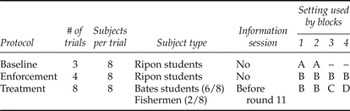
This experiment involves three protocols: Baseline, Enforcement and Treatment. The subject pool consisted of students recruited from Bates College and Ripon College as well as professional fishermen (eight lobstermen and eight groundfishermen in two separate trials). Each subject participated in only one trial. Points earned in each round (a total of 20 rounds in baseline protocol, and 40 rounds in other protocols) were added to determine the final payoff. Subjects were paid in cash, in private, at the end of a trial, at a defined exchange rate from points to dollars. The exchange rate was provided in the experimental instructions. Subjects had the experimental instructions, payoff tables and a running total of their points available at all times. Each trial, depending on the protocol, utilized one or more of the settings (A, B, C, D) in ten-round blocks.
2.2.1. Setting A. Baseline
In this setting, in the beginning of each block, the subjects were told they would play the game described in the previous subsection for 10 rounds. The subjects were given the production functions for both commons in tabular form and were informed about the payoff from construction. They were also shown how to calculate their payoffs in every round using the table.
In the beginning of each round subjects were asked to choose in which area they wanted to fish, and provide this choice in writing to the experimenter. Next, the number of subjects on each commons was made public. Subjects then chose their effort level, and indicated it to the experimenter using action cards. By default the rest of the hours were spent in construction.
Once all the action cards for the round were turned in, the round ended, and the total number of hours spent fishing and the per-hour payoff from fishing in every area were announced to the subjects in addition to the earlier information. Subjects also individually received a card indicating the number of points they had earned in that round. Then the next round began, until round 10, which ended the baseline setting.
In all rounds, changing the location (commons) choice between rounds carried no cost. At both social optimum and SPNE, discussed above, no moving is observed. Thus, moving is evidence of out-of-equilibrium behavior and has the potential to complicate policy decisions.
2.2.2. Setting B. Enforcement
The design of this setting is identical to setting A with the exception of the moving cost. Location choice was costless in the first round of the block. In subsequent rounds, any change of location between rounds incurred a cost of 24 points. This setting suggests the following hypothesis:
Hypothesis 1
With enforced separation subjects will be able to solve the coordination problem and efficiency of commons appropriation will increase with round number.
2.2.3. Setting C. Communication
The goal of this setting was to examine whether communication enhances efficiency. Subjects were allowed to communicate within their commons (no inter-commons communication allowed) if they wished to do so for up to 3 minutes in each round after making their area choice, but before making their effort decision. Otherwise, the allocation decisions in this setting were made in the same way as in the previous settings. The communication was recorded using a voice recorder for later analysis. This setting allows us to test the following hypothesis:
Hypothesis 2
Communication improves efficiency as compared to that of the previous settings.
2.2.4. Setting D. Communication with sanctioning
In this setting, subjects were able to learn the individual decisions of others and express their attitude towards those decisions. The communication design is the same as in setting C, but in addition each subject was given an opportunity to ‘sanction cheating’. The first two instances of sanctioning were costless for the sanctioned player, but the third and subsequent sanctions carried a 50-point penalty. Punishing carried no direct cost for the punisher, but included potential indirect cost as each person had to identify the reason for punishment. We hypothesize:
Hypothesis 3
The introduction of a sanctioning mechanism improves efficiency by decreasing the rate of defection on group agreements.
2.2.5. Information session
This session was used as a substitute for experiential learning. During this session subjects were asked a series of questions about what kind of behavior may result in the most efficient outcome. At the end of the session subjects were informed about the efficient level of total effort in each area but were not told the SPNE.
Table 1 provides the summary information on each of the protocols. The baseline protocol allows us to obtain a picture of the behavioral and efficiency patterns in a situation where subjects are able to move between areas with no restrictions. The enforcement protocol addresses the primary question of whether enforcing the separation of a commons into two areas is an efficiency-improving factor. It allows us to study whether the subjects will be able to solve the coordination problem on the commons and arrive at the three–five split as well as maintain its stability. Previous experiments in a related setting (Zhosan, Reference Zhosan2009) demonstrated that the opportunistic behavior of some subjects may interfere significantly with the equilibrium stability. Another question addressed in the enforcement protocol is what kind of learning process and efficiency outcomes are observed as the trial progresses. If the subjects are able to solve the coordination problem and generate a (relatively) stable allocation, will their behavior be closer to the social optimum or the SPNE predictions?
Summary of the protocols used in the experiment

While the treatment protocol primarily addresses the hypotheses above, an interesting question is raised with the information session. The information session speeds up the learning process, but also allows us to analyze whether there exists an ‘informational (or learning) tipping point’. Is it possible that, if enough subjects know the socially optimal result, the number of cooperators will increase and provide enough pressure for the group to behave in a socially optimal manner? For hypothesis 2, we analyze if the subjects' ability to communicate, and in that manner directly inform the others of their intentions (or transfer the knowledge and experience) as well as establish a group identity, will affect their behavior enough so that they would be willing to cooperate in achieving the social optimum even when their private decisions are unknown to others and thus the defectors cannot be sanctioned? For hypothesis 3, we study if the introduction of a sanctioning mechanism strengthens the effects of communication as predicted by Zhosan (Reference Zhosan2009) and has the effects in the commons game similar to the results obtained in the VCM experiments (Masclet et al., Reference Masclet, Noussair, Tucker and Villeval2003).
In all protocols, each trial was run in one day, with a 10-minute break between blocks. Subjects received general instructions and examples of earnings and payoff calculations before the experiment began and then setting-specific instructions before the beginning of each setting.
Trials in the baseline protocol lasted approximately 90 minutes each; trials in the other protocols lasted approximately 180 minutes each. In the baseline protocol the average payoff to the subjects was US$18.87. In the other two protocols, the average payoff to the student subjects was UD$43.56 and the average payoff to the fishermen and lobstermen subjects was US$246.42 (including US$5 and US$50 show-up fee respectively).
3. Experimental results
For ease of reading, the results reported are separated by protocol with inter-protocol comparisons discussed where appropriate.
3.1. Baseline protocol results
As expected, there was minimal stability of user allocation observed in these trials. Subjects clearly followed the higher payoff, and a difference of 0.04 of a point in per-hour fishing payoff turned out to be a sufficient incentive for some subjects to move into the higher paying area. Across all trials 15/60 rounds ended up in the three–five split, and of these only three were consecutive rounds with the same group composition in each area. An outcome with seven people in the previously more productive area was only marginally less common, occurring in 12/60 rounds. A simple look at the efficiencies does not provide the complete picture of the situation as those ranged from 0.688 to 0.988, so an inquiry into individual decisions is warranted.
Based on the individual data, in each of the three trials a single (same) subject reacted to a large number of users in an area by significantly decreasing the effort level (often to no fishing at all, especially in the early rounds), indicating a significant degree of risk aversion, which allowed the achievement of relatively high efficiencies even as the others exerted up to the maximum effort. Since this was an individual's reaction, and not group conservation effort, this behavior was not sustained for extended periods of time and, as the trials progressed, the effort level of all subjects increased (with average effort levels going up by up to 40 per cent between rounds 1 and 10) and correspondingly the efficiencies decreased. It is not difficult to see how these behavioral patterns may complicate policy decisions on the commons, as neither the number of appropriators nor the composition of the appropriator group in a specific area can be predicted in advance, thus creating difficulties for both government regulation and self-regulation by the appropriators.
3.2. Enforcement protocol results
Not surprisingly, the introduction of the moving cost restricted the subjects' incentives to move, and increases the equilibrium allocation stability as compared to the baseline protocol, leading to the following result:
Result 1
Subjects solve the coordination problem, and efficiency rises towards the end of a setting.
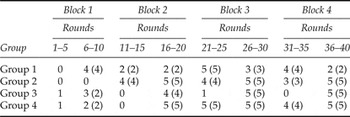
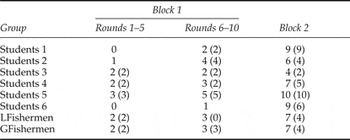
Table 2 provides evidence in support of the first part of this result, presenting the number of rounds that ended in the three–five split in each block for each subject group in the enforcement protocol. The information is also separated by the first and the second five rounds of each block. The largest number of consecutive rounds with the three–five split for each group is shown in parentheses.
Number of rounds with the three–five split in the enforcement protocol trials

In three out of the four groups a similar tendency is observed: the number of rounds (including consecutive) with the three–five split significantly increases in the second half of each block (p-value of the two-tailed Wilcoxon signed-rank test is 0.022), suggesting that the subjects are in fact able to figure out the efficient number of users in each area and act accordingly, thus making the SPNE allocation of users the modal allocation over all rounds and quite stable across all trials. Any movement of subjects between areas was purely payoff maximizing (caused by the fishing payoff differential) and history dependent with no evidence of opportunistic behavior observed earlier (Zhosan, Reference Zhosan2009). At the same time, the differences in payoffs needed to generate movement were significantly higher than those in the baseline protocol.
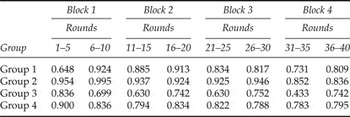
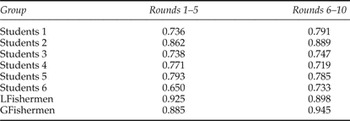
Table 3 presents the average net efficiencies in a manner identical to that of table 2. For the groups that had a significant user allocation improvement between the first and second five rounds in a block, the efficiencies between those segments increased quite noticeably, providing support for the second part of Result 1 and, correspondingly, Hypothesis 1. The mean efficiency in the rounds where the three–five split was observed was 0.839, while only being 0.772 in the other rounds, and the KS test suggests normality of the underlying distribution of the per-round net efficiencies (p-values of 0.232 and 0.326 respectively). The test for difference in means of the net efficiencies above produced a significant result (t = 2.771, p-value = 0.007), further indicating the efficiency-improving potential of enforcing the geographic separation. This confirms that the subjects' ability to solve the coordination game on the commons increases the efficiency in the two-harbor CPR experiment, and provides an argument in favor of enforcing the separation either by means of formal assignment or traditional arrangement.
Average net efficiencies in the enforcement protocol
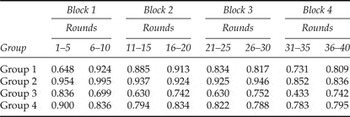
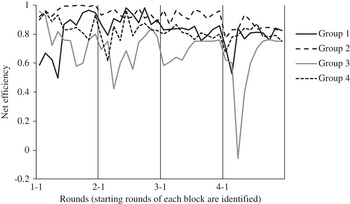
The numbers in table 3 also indicate that across the trials the average net efficiencies tend to decrease as the trial progresses with efficiencies of above 0.9 being quite common in the first two blocks and nearly disappearing in the last two. This observation is illustrated in figure 1 where, even though some efficiencies increase in the early rounds of a trial, over time each group shows a decreasing trend in efficiencies.
Net efficiencies in the enforcement protocol sessions

This decrease in efficiency, although seemingly conflicting with the effects of separating the commons is, in fact, not unexpected. Recall that the SPNE prediction described above has an efficiency level of 0.75. Efficiency values for groups 3 and 4, which were able to establish long sequences of rounds with the three–five split in the later settings, clearly demonstrated a trend of converging to the 0.75 benchmark. This happened as subjects in these groups increased their effort level from the overall average of 11.8 hours per person in the first five-round segment of the first block to the overall average of 14.725 hours per person in the last five-round segment of the fourth block. Groups 1 and 2 demonstrated a similar trend in the effort levels for the subjects (9.875 hours per person to 13.925 hours per person), though they produced higher efficiencies than the other two groups primarily due to lower starting points. Across all groups, the Wilcoxon signed-rank test allows rejection of the null hypothesis of no difference in the effort levels between the first and last five rounds of the trials (p-value = 0).
In groups 1 and 2 one subject consistently chose a level of effort significantly lower than the SPNE level or even the socially optimal level described above (altruistic subject in one case and slow learner in the other). It is possible that, if these two groups were allowed to continue the trials for a longer period of time, group 2 would have followed the path of groups 3 and 4, converging to the symmetric SPNE, with group 1 converging to a different equilibrium accommodating the altruistic behavior. The above observations on the effort levels explain why groups that did not achieve a significant increase in the number of rounds with the three–five split exhibited little to no improvement in efficiency levels and, combined with Result 1, provide support for the following learning result:
Result 2
Subjects discover the symmetric SPNE and behave according to their equilibrium strategies.
While the above result suggests the tragedy of the commons-type outcome over time, each of the enforcement protocol groups had at least one subject who was able to figure out the efficient outcome of restricting effort and tried to signal their willingness to cooperate with the others at some point during the trial. Since the signals were not followed by the rest of the subjects, the cooperators increased their effort levels to the SPNE levels. Treatment protocol allows for communication to enhance this sort of signaling.
3.3. Treatment protocol results
Tables 4 and 5 provide evidence in support of result 1 described earlier. Table 4 lists the number of rounds that ended in a three–five split in the first two blocks for each subject group in the treatment protocol similarly to table 2. Blocks 3 and 4 are not included for this protocol as, after communication and sanctioning were introduced, efficient allocation of users was quickly (generally in round 2 of block 3) achieved in most trials and remained stable. In fact, most subjects chose to stay in the same group (commons) in both blocks 3 and 4, suggesting that subjects self-selected into more cooperative groups and preferred to stay with the people whose behavior they could predict based on past patterns. Only the group of groundfishermen failed to achieve the efficient allocation of users in the third setting, a result that will be described later.
Number of rounds with the three–five split in the first 20 rounds of the treatment protocol

Average net efficiencies in the first 10 rounds of the treatment protocol

For all groups, their behavior is consistent with hypothesis 1 – the number of rounds with the efficient allocation of subjects on commons does not decrease in the second five rounds of block 1. Moreover, for 7/8 groups the number of rounds with symmetric SPNE allocation of users increased noticeably between the first and the second block – clearly a result of the accelerated learning during the information session.
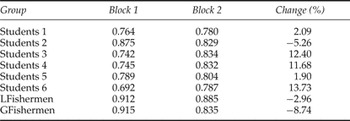
Table 5 shows that net efficiency rises for 5/8 groups, thus providing mixed support for hypothesis 1, consistent with the observations and discussion in the enforcement protocol. Notice that, by the end of block 1, 6/8 groups had achieved or exceeded the SPNE lower-bound efficiency of 75 per cent, and the other 2 were very close.
When it comes to efficiencies between blocks 1 and 2, the effect of the information session on efficiencies is, however, not as pronounced. Table 6 summarizes this effect, with efficiency rising in 5/8 groups. Evidently, providing additional information aided most of the groups in increasing the number of rounds with the three–five split. Once it was achieved, most subjects tried to maximize their payoff by varying (generally increasing) their effort levels rather than trying to move to a different area.
Average net efficiencies in the first 20 rounds of the treatment protocol

Still, the fact that 3/8 groups exhibited a decrease in average efficiencies does not support the expectation that providing information about the efficient effort levels to all the users will be enough to change group behavior in an efficient manner. Comparing the net efficiencies of all groups between the first and the second blocks using the Wilcoxon signed-rank test yields a p-value of 0.401, further indicating no significant change in the efficiencies between the blocks for all of the trials combined, thus suggesting no effect of information on efficiencies.
While the efficiency increased for 5/8 groups, only in three cases can the increase actually be regarded as substantial. Among those groups, two (Students4 and Students6) exhibited a large increase in the number of consecutive rounds with efficient user allocation. At the same time another group, Students1, experienced a seven-round improvement in solving the coordination problem between the two blocks, and yet did not achieve increased efficiency.
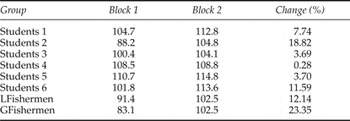
An analysis of individual effort in these two settings provides a picture that is consistent with the learning results from the enforcement protocol and explains the efficiency effects observed. Limiting the appropriation effort was a common behavior pattern in all subject groups in the first block as subjects were trying to learn how many hours they could spend fishing before their payoff started to decrease. After the information session, some subjects behaved in a cooperative manner, and tried to signal their willingness to cooperate in achieving the social optimum by limiting their effort; others did not. As the second block progressed, most subjects from the former category increased their commons effort when signaling failed to achieve the desired effect. Table 7 presents a comparison of average (across rounds) joint effort levels in the first and the second blocks for all subject groups. The observation of a significant increase in the joint effort level between the two blocks for all eight subject groups is confirmed by the p-value of 0.008 of a two-tailed Wilcoxon signed-rank test.
Average joint effort level in both areas in the first 20 rounds of the treatment protocol

This result clearly questions the existence of an ‘informational (learning) tipping point’ as, even with every subject knowing the efficient effort level, individual behavior still indicated convergence to the SPNE effort levels rather than the efficient effort levels. This behavior is consistent with the learning observations in the enforcement protocol trials as well as findings in the field, where appropriators keep increasing their effort level for a while after they start using the commons as they acquire a better knowledge of the resource's capacity.
The above results suggest that, while separating the commons into smaller areas with some kind of separation enforcement policy may create conditions for efficiency improvement on the commons, these conditions are not sufficient by themselves and additional mechanisms may be needed to promote cooperation between the appropriators and increase the efficiency on the commons. Communication between group members discussed below can certainly be one of these additional mechanisms.
Result 3
Communication increases efficiency.
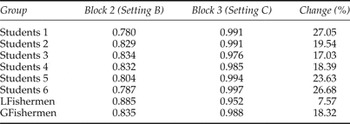
Strong evidence in support of this result is contained in table 8. For all eight groups, efficiency increased in block 3. In most cases, the efficiency increase was substantial. Using a Wilcoxon signed-rank test to compare the average efficiencies for the eight groups between blocks 2 and 3 results in a p-value of 0.008 of a two-tailed test, suggesting that this increase in efficiency due to communication is highly significant. Since this kind of result was not observed in the enforcement protocol sessions, we conclude that this increase was in fact due to communication, and not learning. While the increase in CPR appropriation efficiency as a result of communication in an experimental setting is not new per se (Ostrom et al., Reference Ostrom, Gardner and Walker1994), the extent of this increase (with groups achieving the efficiency of 1 in multiple rounds) as well as low defection rates on group agreements indicates that the subjects are more willing to cooperate if they do not have to give up ‘too much’, and is consistent with the predictions of Zhosan (Reference Zhosan2009).
Average net efficiencies before and after the introduction of communication

All student groups were able to reach the three–five split very fast and remained there for the entire setting. At that point communication in those groups became limited to agreeing on the individual effort levels and discussing the reaction to people deviating from the group agreements. While most of the groups simply discussed what they should be doing to achieve the social optimum, one of the groups came up with a trigger strategy. They agreed to limit their effort to 10 hours each and to fish for 15 hours until the end of the block if at least one person deviated from this agreement. Needless to say, there were no deviations in this group in either the third or the fourth setting. Since communication was not mandatory, groups that achieved high cooperation rates ceased all communications after making sure everyone followed the agreement. Others communicated for the entire block, some more successfully than others, but still the rate of defection on group agreements was relatively low.
As we see in table 8, communication allowed all subject groups to achieve an average efficiency of at least 0.95, with the students slightly outperforming the professionals, although the difference is hardly meaningful. While the data on the professionals' behavior is limited to only two trials, the following two stories describe the underlying behaviors that led to this result.
The lobstermen started the third setting with seven subjects in the more productive area, and then moved to the three–five split in the second round. In that and subsequent rounds, subjects varied effort levels on each commons. Indeed, the group kept ‘experimenting’ (their description), by changing the number of subjects in the areas, which resulted in a total of five (including the first one) rounds with an off-equilibrium number of users in each area in the third block. While they were relatively successful at cooperating and maintaining the total effort levels as close to the socially optimal as possible, a large number of moves and off-equilibrium rounds resulted in lower efficiencies for this group. Since one group does not make a data set, we do not lay great store in this observation.
The groundfishermen group also demonstrated an unexpected result. This group started the first round of the third block with four subjects in each area, and never changed the distribution of subjects across areas in the setting. One non-cooperative subject openly declared that he would not communicate or cooperate with anyone because ‘we keep it all secret in real life’. In response to this, subjects in the less productive area came up with a rotation scheme allowing them to fish for 30 hours total in each round and still assure that everyone in the area gets the same payoff, rather than have someone move into an area with a non-cooperative subject. The other subjects in the more productive area also cooperated on devising the strategies to efficiently accommodate the non-cooperative subject's choices. This suggests that communication and cooperation has a significant intrinsic value for the subjects as they were willing to sacrifice monetary payoff just to stay in the more predictable and cooperative group, consistent with Zhosan (Reference Zhosan2009). As seen in table 8, the cooperating subjects in this group were quite successful at bringing the efficiency up to a much higher level than in the previous block.
Result 4
The sanctioning mechanism was effective.
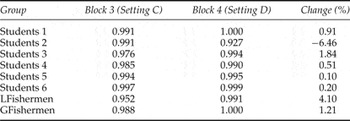
Support for this result, answering hypothesis 3, is presented in table 9. In all but one of the groups the average per-round net efficiencies increased. The sanctioning mechanism resulted in a large increase in efficiency in the groundfishermen group by forcing the non-cooperative subject to behave cooperatively before losing any points. The only group in which the sanctioning mechanism had a negative effect was a student group in which a ‘war’ of defection and sanctioning broke out in response to an ‘undeserved’ sanction. While this last point suggests that sanctioning should be used carefully in order not to repeat this situation, overall data testifies in favor of hypothesis 3, especially in games that are infinite or are perceived by the players as infinite. Statistically the large decrease in efficiency for one of the groups combined with quite small increases in efficiency of the others does not allow us to conclude that the efficiency in the fourth setting increased as compared to that in the third setting across all trials at a less than 0.1 significance level (p-value of 0.098 in a one-tailed Wilcoxon signed-rank test).
Average per-round net efficiencies in settings C and D of the treatment protocol

While not highly significant numerically, the introduction of a sanctioning mechanism clearly had an effect on the subjects' behavior. For example, three subjects who defected on group agreements in the third block never defected in the fourth one, indicating a very strong aversion to any kind of sanctions. Overall, none of the 64 subjects in the treatment protocol completely ignored the sanctioning and defected sufficiently often to ‘deserve’ losing points, which would have indicated a failure of the sanctioning system.
The pattern of defections provides a better insight into which type of sanctions affected the subjects' behavior. It reveals that, out of the 24 subjects who deliberately defected on group agreements in the third block, 16 subjects either never defected in the fourth setting or designed their pattern of defection to receive no more than one informal sanction (warning), suggesting that informal sanctioning was effective for them. The other eight subjects designed their defection behavior to avoid the formal (monetary) sanctioning, but seemingly disregarded the informal sanctions. While this suggests the failure of the informal sanctioning mechanism for some types of subjects, the proportion of these subjects was quite low.
The behavior of the defecting subjects is similar to the behavior observed by Masclet et al. (Reference Masclet, Noussair, Tucker and Villeval2003), who found that the effects of formal and informal sanctions were very close in the early rounds but formal sanctions became more effective than informal ones as the experiment progressed. At the same time, in the experiment described above, the small group size and personal in-group communication (which allowed a group identity to be established) were the two factors that strengthened the effect of the informal sanctioning and extended its duration. In an infinitely repeated game, informal sanctioning has the potential of being even more efficient since the decline in the significance of the informal sanctions' effects may not demonstrate itself.
Hardly anyone would argue that appropriators' experience matters in a commons situation and can potentially result in a significant difference in efficiencies. While the limited number of trials with professionals in our experiment does not provide us with a lot of conclusive evidence, one final result on subject pools can be stated:
Result 5
Professionals play better than students.
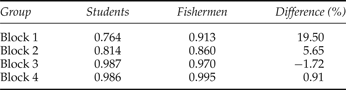
Data in table 10 show that fishermen were noticeably more efficient than students in the first two blocks. In these two blocks, the institutions were very limited and the experience of fishermen played a large role is determining efficiency. As institutions became more complex, the role of experience decreased and fishermen and students began to perform closer together, thus suggesting that more well-defined rules of the game can substitute for experience. This provides support for government intervention in commons. While full government control may not necessarily be the best option, some form of co-management where the government establishes certain institutions, provides missing knowledge and data and affects appropriators' behavior may prove to be more efficient.
Average net efficiencies by occupation

In addition to efficiencies, information on the number of defections shows that, while the groundfishermen group had the highest occurrence of defections among all the groups, these all came from the same person, as opposed to the student groups where there were multiple people defecting in each of the groups. Conceivably, a group with one person defecting constantly may have a better chance of achieving higher efficiency than a group in which several members defect in an unpredictable manner, as the former may come up with a second-best arrangement to accommodate the predictable behavior of the non-cooperator. The same argument applies to the lobstermen group where all the deviations from efficient user allocation were caused by the same subject and, to a degree, approved by the group. Thus, fishermen groups did have a smaller number of subjects defecting than students, and lobstermen had fewer cases of defection than groundfishermen. Even with the defecting subjects, others were able to accommodate their behavior, still resulting in high efficiency.
4. Policy conclusions
The experimental results above demonstrated that separating a larger commons into smaller areas with some kind of appropriation rights assignment or movement restriction policy may in fact create conditions that will lead to an efficient use of the commons. The ability of appropriators to communicate in these areas to establish common behavioral rules and enforcement mechanisms pushes the efficiency even higher, reaching 100 per cent efficiency in a multiplicity of cases. The introduction of informal sanctioning is sufficient to improve the efficiency of cooperation, without imposing the costs associated with the monetary sanctions.
The results of this experiment suggest a change in government regulation, from one aimed at limiting the actions available to appropriators (maximum allowable catch, maximum days at sea, etc.), to one allowing appropriators to work only in a specific part of the commons and set up their own rules, rewards and penalties on this area. Such a policy may change the appropriators' incentives as they will work in smaller groups to cooperate and preserve the resource since the option of depleting one area and moving to another will no longer exist. Additionally, their return to conservation efforts will be higher when appropriation restrictions are in place due to the fact that the others will not be able to directly free ride on those efforts. It may also turn out to be cost efficient, as groups will be responsible for enforcing the rules rather than having the government provide the enforcement on an individual level.
The potential for the success of enforced geographic separation is not limited to smaller commons or smaller appropriator groups. As long as different groups of appropriators with similar interests, traditions, etc. within a commons can be identified (or self-identified) and a commons can be formally separated into smaller areas, the probability that it will be used efficiently increases. One problem that may arise on a larger scale is formal assignment of some kind of property rights; however, this condition is not necessary for success. As experimental evidence and the lobster industry history show, even with no formal property rights in place, over time appropriators are able to come up with an arrangement in which tradition replaces formal property rights. Within this arrangement all of the areas in the commons are used simultaneously, and the appropriation efficiency increases. Zhosan (Reference Zhosan2009) presents a model which generates this result with no direct government intervention.