The principal models of Olivier Messiaen's musical imagination are well known: Mozart, Chopin, Debussy, and Stravinsky figure at the heart of his personal canon. Messiaen openly admired and commented upon their music for the length of his career, from his early work as a journalistFootnote 1 to his Traité de rythme, de couleur et d'ornithologie, the posthumously published compilation of his philosophy of music, his analyses, and teachings.Footnote 2 Although mentioned less frequently by the composer and all but forgotten by those who studied him, other figures caught Messiaen's attention on a regular or occasional basis. Broadening established genealogies to include these composers – as we do here with Jules Massenet – has the potential to reveal the true breadth and depth of Messiaen's creative universe.
This article explores Messiaen's interest in Massenet on three fronts, demonstrates the composer's conscious reuse of Massenet's music and, in doing so, proposes a technique for uncovering previously unknown examples of what we call his borrowing technique.Footnote 3 First, a survey of the composer's writings and interviews shows that Massenet, once presented by Messiaen as an important model, disappeared from statements made after the early 1950s. Some possible reasons for this suppression are considered. We then examine borrowings from the operas Werther and Manon in pedagogical materials written by Messiaen during the 1930s and 1940s. These borrowings are considered in parallel with Messiaen's analyses of his own music which, on the surface, seem to mention Massenet's music only as a point of comparison. Knowledge of other examples of Messiaen's musical borrowing along with his earlier teaching-driven borrowings from Massenet allows for an informed re-reading of his analysis of ‘Amen du Désir’, confirming that one of the movement's love themes is a programmatic reference built from material found in Manon. To close, we consider Messiaen's borrowings from Massenet within the larger context of his borrowing technique. Taken together, these findings underline the common ground that existed between Messiaen's composing and his activity as a teacher. More importantly, they broaden our previous knowledge of Messiaen's creative canon in an unexpected direction and suggest that music taken from his favourite operatic sources may sometimes underpin his extra-musical programmes.
Massenet in Messiaen's writings and interviews
On the eve of the Second World War, Messiaen explicitly volunteered Massenet as a key compositional model, an element of what Pierre Boulez would later describe as the ‘strict eclecticism’ of his creative palette.Footnote 4
My models have been: Debussy first of all, and then plainchant, and finally the admirable Hindu rhythmician of the thirteenth century, Çârngadeva. Certain pages of Schoenberg and Jolivet, and certain French and Russian folksongs have also influenced me. Add that I like Massenet, because he is tonal and well harmonized, and you will have some idea of my style.Footnote 5
It should be pointed out that a citation of this declaration is the only moment at which Massenet's name is mentioned in Peter Hill and Nigel Simeone's influential biography of Messiaen, currently the most comprehensive publication on his life.Footnote 6 This observation is not intended as a criticism. Rather, it serves to underline how Massenet, a potentially important source for Messiaen's music, has remained largely absent from studies of Messiaen and his creative process.
In Reference Baudrier1945, Messiaen's eclecticism and his interest for Massenet were also mentioned by the composer Yves Baudrier, who, with Messiaen, was one of the co-founders of Jeune France:
We can affirm that Messiaen has a truly original temperament only through the French and musical humanism in which he is so thoroughly steeped. His God is Christian but Debussyste, his loves include Massenet and extend to Ravel, and although they pass from India, to Béla Bartók and Stravinsky, they only flourish in the harmonic climate of our deep-rooted tradition.Footnote 7
These lesser-known lists of Messiaen's creative models have, however, had far less impact on studies of Messiaen's music than the 1944 preface to Technique de mon langage musical (from which Massenet's name is absent).Footnote 8
But Messiaen had not lost interest in Massenet. In a 1952 interview given on the occasion of the 2000th performance of Manon at the Opéra de Paris, the composer reaffirmed his earlier statements, this time framing his words as a confession of difference. The tone of this interview is also quite different from the earlier suggestion that Massenet might be a suitable compositional model:
You'll turn my colleagues against me if you make me say how highly I think of him! Massenet's music shows its age, but it is still with us. It's trivial, but sincere. And sincerity excuses everything! Besides, in the end, it's beautiful music and excellent theatre. It's very well harmonized; he has a melodic gift composed more of sentimentalism than of love. There are some grotesque things in Manon, of course: the father's advice, etc. But the duets between Des Grieux and Manon are, in any case, delightful.Footnote 9
To close this chronological survey, it should also be mentioned that Messiaen refers to Massenet twice in the Traité de rythme, de couleur et d'ornithologie.Footnote 10 Beyond these evocations of the composer, Messiaen also makes direct use of Massenet's music, notably in two of the Vingt leçons d'harmonie of Reference Messiaen1939.Footnote 11 When encountered in isolation, these references do not seem to amount to much. But when considered in sequence, and studied in context, Messiaen's regular evocations of Massenet create meaning and remind us that he knew and liked Massenet's music. Moreover, the place of Massenet's music in Messiaen's teaching materials and analyses allows us to prove that Massenet's music played an active role in Messiaen's compositional process.
A closer look at the context of Messiaen's remarks on Massenet helps to explain why his interest in the composer of Manon has gone largely unnoticed. Apart from the posthumous Traité, Messiaen's references to Massenet were made in periodicals with small, local readerships. Furthermore, Massenet's name is absent from the influential book-length interviews published by Antoine Goléa, Claude Samuel, and Brigitte Massin.Footnote 12 The important role these interviews have played in shaping the composer's public image since the 1960s may explain Massenet's absence from previous publications. On the rare occasions that Massenet is mentioned in Messiaen studies (e.g., in connection with the titles of the Vingt leçons d'harmonie in the work of Harry Halbreich and Jean Boivin), his name is met with incomprehension.Footnote 13 Those who elevated Messiaen as prophet and mentor of post-war modernity opposed the composer with his traditional Conservatoire education rooted in the harmonic styles of late nineteenth-century French composers, making it inconceivable that Massenet might be legitimately considered alongside Debussy and Stravinsky in Messiaen's artistic genealogy. A further example of this phenomenon is found in Alain Périer's ambiguous citation of Messiaen's commentary on the melody from the second movement of Ravel's Piano Concerto (Ravel ‘Massenetizes a phrase by Fauré on a bad day’).Footnote 14 In this early passage of the book, which serves to highlight the author's position of authority as a former Messiaen student, Périer presents Messiaen's remark in a medley of other witty judgements that give the impression he is recalling remarks made in class by a mature Messiaen (Périer was enrolled in Messiaen's class from 1956 to 1960).Footnote 15 It is just as likely, however, that Périer takes the remark from Messiaen's first published interview, given at the age of twenty-two in October 1931.Footnote 16 In any case, the impression left by this citation is that Messiaen held neither Massenet nor Fauré in high esteem. This vision is symptomatic of a historiography that has constructed Messiaen's teachings in opposition to dominant narratives of Conservatoire traditions, here via Jules Massenet and Gabriel Fauré, two of the institution's iconic figures.
According to Antoine Goléa in 1957, it was Messiaen himself who was accused by unnamed ‘defenders of musical innovation’ of dressing up Massenet melodies in modernist clothing:
The guardians of tradition see in Messiaen a dangerous demolition man, a revolutionary, to whom nothing in the music of the past is sacred, an absurd visionary, an incorrigible dreamer who disdains European music, particularly French, and who seeks his sources of inspiration in incomprehensible Asian civilizations. But the defenders of musical innovation, of tomorrow's music, are no kinder. To them, he is the very portrait of a false revolutionary, he who clothes melodies à la Massenet in gratuitous, uselessly dissonant harmonies.Footnote 17
Messiaen already hinted at this opposition in the 1952 interview for Opéra cited above (‘You'll turn my colleagues against me if you make me say how highly I think of him!’). The post-war years saw the emergence of two opposing criticisms of Messiaen's musical style, likening it on one extreme to the young avant-garde (Pierre Boulez at its head) and on the other to the tonal, melodic, and sentimental music of Massenet. In this tense climate, Messiaen not only became aware of the dangers of admitting his interest in Massenet's music, but also found himself the target of criticisms similar to those he had levied against Ravel's Piano Concerto just a few decades earlier.Footnote 18 Messiaen's efforts to weather post-war conflicts between composers of the young serial school and those writing in more traditional idioms are likely the reason that Massenet does not appear in his later interviews, and as a result, in studies of his works.
Massenet: an enduring pedagogical model
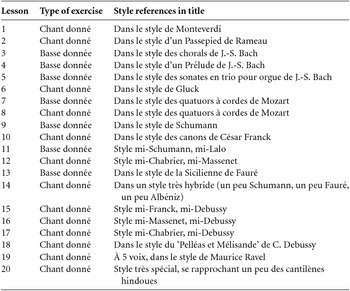
Educated at the Paris Conservatoire during the 1920s, Messiaen came into contact with the music of Massenet from an early age. The student of a student of Massenet,Footnote 19 Messiaen later learned to read, reduce, and transpose scores in the accompaniment class of César Abel Estyle in large part by studying nineteenth-century French operatic repertoire. The accompaniment class was destined, among other things, for students who might one day become rehearsal pianists in opera houses. As one of the iconic figures of the French lyric repertoire and a former composition professor at the Conservatoire (from 1878 to 1896), Massenet's operas formed a central part of this instruction.Footnote 20 In the 1930s, Messiaen himself wrote melodies and figured bass for accompaniment class evaluations. Some of these were later reused in his Vingt leçons d'harmonie, begun in the mid-1930s and published in 1939. This collection is based on a harmonic canon dominated by the late nineteenth-century French harmonic styles typical of harmony instruction at the Conservatoire as Messiaen knew it. The full title of Messiaen's collection accurately describes its contents: Vingt leçons d'harmonie: Dans le style de quelques auteurs importants de ‘l'histoire harmonique’ de la musique depuis Monteverdi jusqu’à Ravel: précédées d'une note de l'auteur et de remarques sur la réalisation de chaque leçon en particulier (Twenty harmony lessons: In the style of a few important authors of ‘harmonic history’ of music from Monteverdi to Ravel: preceded by a note from the author and remarks upon the realization of each lesson).
Re-using a periodization of music history inherited from earlier French models,Footnote 21 Messiaen places Monteverdi at the head of a ‘harmonic history of music’ that unfolds in a series of lessons based upon ‘the style of a few important authors’ (see Table 1). Arranged in a chronological ‘harmonic history’, the harmonic languages of composers evolve generation by generation over the course of four centuries, giving rise to increasingly enriched harmonies. The complex harmonic language of the twentieth and final lesson bears particular contemporary traits: this chant donné ‘dans un style très spécial’ is in fact a thinly disguised exercise in a watered-down version of Messiaen's own style.Footnote 22
Contents of the Vingt leçons d'harmonie.

A few composers’ styles – those of Bach, Mozart, Massenet, Franck, and Debussy – are imitated in more than one lesson, whereas other composers such as Haydn, Beethoven, and Brahms, typically found at the heart of the European canon, are conspicuously absent. The Massenet lessons are part of a series of lessons based on the styles of French composers that include Lalo, Chabrier, Franck, Fauré, and Debussy. Furthermore, many of the lessons in the second half of the volume are presented as stylistic hybrids. Lesson 11, for example, is a bass described as ‘half Schumann, half Lalo’.
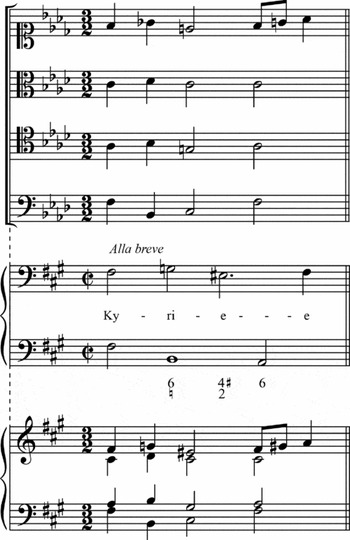
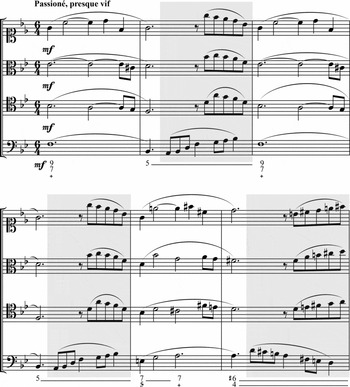
Pierre Boulez's harmony homework from the Messiaen class, conserved at the Paul Sacher Foundation, has given further perspective on Messiaen's harmony class.Footnote 23 Of particular interest are the seventy-one formules d'harmonie (harmony formulas) that Messiaen created for his students. The young Boulez carefully recopied these formulas and attributed them to Messiaen. Notated in open score on four staves with movable C-clefs in the style of Conservatoire harmony lessons, these formulas are, for the large part, based on works from the repertoire. Most are only a few bars long, although some are considerably more elaborate. They seem to illustrate specific harmonic situations and techniques, such as the Neapolitan sixth in Example 1.
Olivier Messiaen, Harmony Formula 3, ‘Neapolitan sixth (Bach, Kyrie, Mass in B minor)’ compared to J. S. Bach, Mass in B minor, Kyrie II, b. 1. Messiaen's original formula is reduced and transposed to F♯ minor to facilitate comparison. ‘Formules d'harmonie’, Pierre Boulez collection, Paul Sacher Foundation (Mappe A, Dossier 2a, 2–5); Bach Gesellschaft-Ausgabe, (Leipzig: Breitkopf & Härtel, 1856), 41.Footnote 24

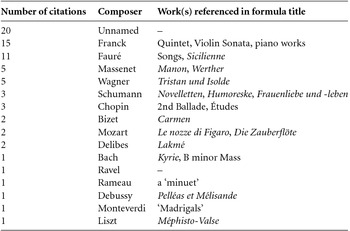
Like the Vingt leçons d'harmonie, but in greater detail, the seventy-one harmonic formulas also reveal something of the Conservatoire's canon of models for harmonic instruction, one probably received by Messiaen through his studies with Jean Gallon (see Table 2). Alongside names also present in the Vingt leçons (César Franck, Édouard Lalo, Gabriel Fauré) figure other composers such as Léo Delibes and Georges Bizet. The music of these French composers formed a musical bedrock for students in composition at the Paris Conservatoire during the early twentieth century.
Summary of the composers and works cited as models in Messiaen's seventy-one harmony formulas.

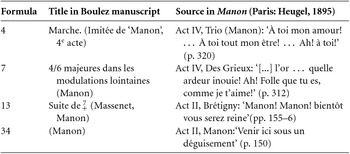
Apart from a lengthy example based upon the celebrated ‘Pourquoi me réveiller, ô souffle du printemps’ from Massenet's Werther (see Example 2), Manon is the only source for Messiaen's four other formulas in the style of Massenet (see Table 3).
Olivier Messiaen, Harmony Formula 40, ‘See Werther’. ‘Formules d'harmonie’, Pierre Boulez collection, Paul Sacher Foundation, Basel, Mappe A, Dossier 2a, 2–5.

The four formulas based on passages of Massenet's Manon from Messiaen's seventy-one harmony formulas indicating their placement in the opera.

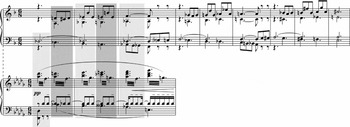
For each of the four formulas ‘imitating’ Manon, Messiaen indicates the opera as his model. In contrast, some of the other formulas are only labelled with a composer's name and not a particular work.Footnote 25 Messiaen's precision allowed us to focus our attention on a single score by Massenet in lieu of his entire production and made it somewhat simpler to identify the origins of all four Manon formulas. The first of these, Formula 4, appears on the first page of the Boulez manuscript under the heading ‘Marche (imitée de Manon, 4e acte)’ (‘Sequence (imitating Manon, fourth act)’). As seen in Example 3, Messiaen's formulas often retain the harmonies of their models at pitch.
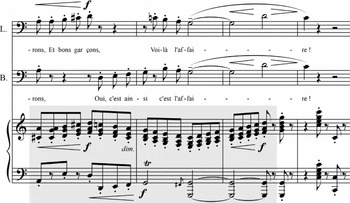
Comparison of Formula 4, ‘Sequence. Imitating Manon, Act IV compared to the Prélude to Manon, bb. 61–3 (this music is heard again in the act IV trio). ‘Formules d'harmonie’, Pierre Boulez collection, Paul Sacher Foundation, Basel, Mappe A, Dossier 2a, 2–5; Jules Massenet, Manon, piano score (Paris: Heugel, n.d.), 4.

In Formula 4, Messiaen adapts a series of five chords first heard in the Prélude to Manon, and again in the Act IV trio between Des Grieux, Manon, and Guillot. These are first heard at pitch and then sequenced up a major third (with some pitches spelled up a diminished fourth). The sequence is one of the key processes Messiaen uses to transform and develop borrowed materials, as described in Technique de mon langage musical.Footnote 26 Here the compositional tool of sequence is put to work on borrowed harmonies in the context of harmonic instruction. There are also changes in the relationship between melody and its supporting harmonies. In Formula 4, Messiaen's new melody for Massenet's harmonies begins over the second harmony, ornamenting the initial D with a chromatic lower neighbour before building upon the pitches heard in Massenet's tremolos (E♭ and B♭, followed by E and B). Messiaen also transforms Massenet's bass line to favour continuous, chromatically inflected, stepwise motion. This style of writing is found in many of his harmony formulas and seems to respond to an institutional standard. Boulez's harmony exercises are full of these long, chromatic bass lines, the likes of which were commented upon favourably by the juries of the year-end concours.Footnote 27 The odd tonal setting of Messiaen's formula, beginning in D♭ major like its model, but written with a single flat in the key signature, merits further consideration. This discrepancy reveals Messiaen lifting formulas from their original tonal context and successfully grafting them into new settings that employ different compositional strategies and discourses. The harmonic sequence created by Messiaen in Formula 4 further facilitates this transplant.
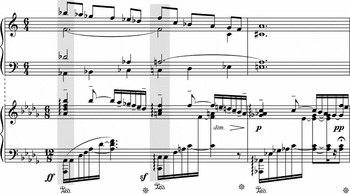
Formula 7 (based on music first heard in the Prelude and then in Act IV) is constructed in a comparable manner. As shown in Example 4, without transposition, Messiaen borrows Massenet's movement from a second inversion tonic triad to a second inversion borrowed mediant (D♭ major to F major). Instead of using the F major chord as parenthetical colour change that delays the movement from the tonic in second inversion to the dominant seventh as Massenet does, Messiaen creates a rising bass line that highlights the lowered seventh degree, transforming the tonic into a dominant of the subdominant which, enharmonically, is heard as the German sixth of the F major chord on the fourth beat. This typically Franckian movement is treated in a sequence of major thirds (D♭ major, F major, A major) that, if continued, would return to D♭ major. Messiaen chooses to end his formula on an A major triad. In the title of his formula, Messiaen describes the exceptional resolution of the dominant of the subdominant to the major mediant as technique for ‘modulating’ to a distant key. In creating a stepwise chromatic line similar to the bass in the previous example, but not present in the Massenet model, Messiaen adapts Massenet's music to conform to the stylistic norms of Conservatoire harmony instruction.
Comparison between Formula 7 ‘Second inversion triads and distant modulations (Manon)’ with the Prélude to Manon, bb. 53–5. ‘Formules d'harmonie’, Pierre Boulez collection, Paul Sacher Foundation, Basel, Mappe A, Dossier 2a, 2–5; Jules Massenet, Manon, piano score (Paris: Heugel, n.d.), 3.

The two remaining formulas were drawn from the same passages of Manon that were also used to create the twelfth of the Vingt leçons, described as ‘half-Chabrier half-Massenet’.Footnote 28 This is a strange title indeed for an exercise whose primary harmonic elements are all derived from Manon. We have not been able to discern Chabrier's mark upon this lesson, if it exists at all. Without further clues from Messiaen, it is difficult to know why his name figures in its title. Still, like Massenet before him, Chabrier might also be an overlooked part of Messiaen's creative universe.
To ease comparison, Example 5 aligns harmonic parallels between Messiaen's Formula 34, Lesson 12, and, between them, the passage from Act II of Manon that the formula and lesson are modelled after (‘Venir ici sous une déguisement’). Formula 34 is closer to its model excerpt than the previous two examples, nearly a harmonic double. Messiaen only departs from the underlying structure heard in Manon at its end, cadencing three bars earlier than Massenet. Nevertheless, the details of Formula 34 incorporate a number of minor variations. After opening with beat-to-beat parallelism, Messiaen compresses the supertonic harmony so that it occupies two beats instead of four before proceeding to a half cadence in which the leading tone is approached by an appoggiatura. Messiaen also builds the melody of Formula 34 differently. Rhythmically speaking, the triplet semiquaver opening anticipates a similar figure used in the Werther-based Formula 40 (see Example 1), suggesting that Messiaen associated the pattern with Massenet's style. More importantly, Messiaen's adaptation introduces tension not present in the original melody. Whereas Massenet's f♯1 accompanies leading-tone-to-tonic movement in parallel sixths, Messiaen's f♯1 enters on the downbeat, an unprepared appoggiatura of the ninth (g1) heard against an unprepared appoggiatura of the leading tone in the tenor. In Lesson 12, Messiaen's melodic writing places less emphasis upon the added sixth (d2) than Massenet's. However, because his lesson is a chant donné for which the student had to find appropriate harmonies, Messiaen also leaves some teacherly hints, underlining the harmonies implied by the melody by passing through three chord tones: the ninth (g1), which rises to c2 (the fifth degree of the dominant), which is then left via an added sixth échappée that leaps to the root of the dominant (f1) on beat 6. In reworking Massenet's melody, Messiaen adds details to help students deduce the ‘ideal’ original harmonization.
Comparison of Formula 34, ‘Massenet (Manon)’ with Manon, Act II (Paris: Heugel, p. 150) and Lesson 12, ‘Leçon mi-Chabrier mi-Massenet’, bb. 1–4. ‘Formules d'harmonie’, Pierre Boulez collection, Paul Sacher Foundation, Basel, Mappe A, Dossier 2a, 2–5; Jules Massenet, Manon, piano score (Paris: Heugel, n.d.), 150; Olivier Messiaen, Vingt leçons d'harmonie (Paris: Leduc, 1940), 28.

Example 6 shows how Messiaen used Manon to generate Formula 13 and the secondary material of Lesson 12. Although the common harmonic construction of the three excerpts is immediately apparent, here again, Messiaen has invented a new, more complicated but also more explicit, melody as a teaching tool. He retains the expressive intervals sung by Brétigny (g–e♭1, g–d1, c1–f) but shifts and ornaments them. In Manon the melodic e♭1 is approached from the chord-tone g. It is heard first as part of an E♭ chord, is held over through a G dominant seventh chord and then resolves directly to d1. Messiaen's formula introduces the e♭2 as an appoggiatura over a G dominant seventh chord, and then dips down to g1 instead of resolving to d2. In doing so, he draws out the melody's tension, returning to the note of resolution, d1, only after the chord has changed. No longer a point of resolution, d1 becomes the ninth of a dominant harmony on C. The ornamental figure that follows is entirely absent from Massenet's music. With a few rhythmic variations, Messiaen creates Formula 13 using very similar strategies.
Comparison of Formula 13, ‘Series of dominant seventh chords (Massenet, Manon)’ with Manon, Act II (Paris: Heugel, pp. 155–6) and Lesson 12, ‘Leçon mi-Chabrier mi-Massenet’, bb. 13–15. ‘Formules d'harmonie’, Pierre Boulez collection, Paul Sacher Foundation, Basel, Mappe A, Dossier 2a, 2–5; Jules Massenet, Manon, piano score (Paris: Heugel, n.d.), 155–6; Olivier Messiaen, Vingt leçons d'harmonie (Paris: Leduc, 1940), 29.

In closing, it should also be remarked that Messiaen's Lesson 12 draws from a larger zone of existing material than his formula, adopting the contrary motion found in the second act of Manon, not far from the source of the lesson's harmonic material. Comparison of bars 2, 4 and 6 of lesson 12 with p. 146 of the piano score of Manon (Act II) (Example 7) underlines these similarities.
Olivier Messiaen, Lesson 12, ‘Leçon mi-Chabrier mi-Massenet’, bb. 1–6. Olivier Messiaen, Vingt leçons d'harmonie (Paris: Leduc, 1940), 28.

Jules Massenet, Manon, Act II, (Paris: Heugel, p. 146). Jules Massenet, Manon, piano score (Paris: Heugel, n.d.), 146.

Manon as a source of creative material
Thus far, we have shown that Massenet's music was an important model in Messiaen's harmony class. In this setting, Messiaen turned to Massenet to create both discrete elements of harmonic grammar (the five harmonic formulas) as well as complete forms (the two lessons in the style of Massenet). During his time as a harmony teacher, Messiaen also drew creative fodder from the sources he used to create his pedagogical materials, transforming them with comparable techniques – rhythmic alteration, harmonic sequence, and contrapuntal enrichment – but for very different ends.Footnote 29 In this section we provide evidence of this process and discuss how Messiaen used borrowed and transformed material from Manon in ‘Amen du Désir’.
Messiaen's prefatory note for the ‘Amen du Désir’ alludes to two opposing ‘themes of desire’: ‘The first, slow, ecstatic, an aspiration of profound tenderness: already the calm perfume of Paradise. The second, extremely passionate; the soul is drawn by a terrible love which expresses itself in a carnal manner (see the “Song of Songs”); but nothing here is carnal, just a paroxysm of the thirst for Love.’Footnote 30 Messiaen based these themes on music connected to contrasting operatic characters: Susanna from Mozart's Le nozze di Figaro, and Manon from Massenet's eponymous opéra comique.
In the analysis of ‘Amen du Désir’ published in the Traité de rhythme, de couleur et d'ornithologie, Messiaen refers to these opposing themes as the ‘ecstatic and tender theme’ and the ‘passionate theme’, identifying the origin of the former's melody in Le nozze di Figaro, but only referring obliquely to Manon as the source of certain harmonies heard in the latter (‘one finds this progression in Massenet's Manon’).Footnote 31 He does not indicate where the harmonies from Manon are to be found in the opera as a whole, and twice affirms that a ‘cry of passion cannot be analysed’.Footnote 32 Transformed versions of both the Mozart and the Massenet materials reused in ‘Amen du Désir’ are also present in the harmonic formulas transcribed by Pierre Boulez, allowing us to trace the origins of this second theme of desire back to a particular passage of Manon.
It should be mentioned that Messiaen's evocation of Massenet in his analyses of Visions de l'Amen is just one in a constellation of references to other composers including Stravinsky, Honegger, Ravel, Debussy, Schoenberg, Jolivet, Grieg, and Bartók. In his analyses, Messiaen almost invariably frames these references to other composers as loose analogies that seem to highlight coincidental similarities. But these intertextual allusions indicate more than resemblance; indeed, they often reveal conscious musical borrowing. In such cases, Messiaen frequently employs the phrase ‘fait penser à’ (‘makes one think of’), which our previous research has revealed to be an invariable understatement. Although Messiaen almost never speaks of these references in terms of compositional models, they are in fact the trace of borrowed and transformed musical material.
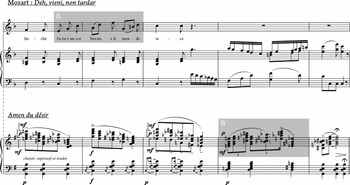
‘Amen du Désir’ is built from the imaginary confrontation of two operatic moments: Susanna's teasing, but pure ‘Deh, vieni, non tardar’ and the torrid trio closing Des Grieux's aria ‘Manon! Sphinx étonnant!’ from Act IV of Manon in which Manon passionately sings, ‘À toi mon amour! . . . À toi tout mon être!’ Messiaen's reason for borrowing Massenet's harmonies is clearly tied to their use in Act IV, where Des Grieux (now an ordained priest) erupts in uncontrolled passion for Manon. The opposition of borrowed materials in ‘Amen du Désir’ illustrates the intertextual frame of mind adopted by Messiaen in composing his music and is further echoed in the details of his score.
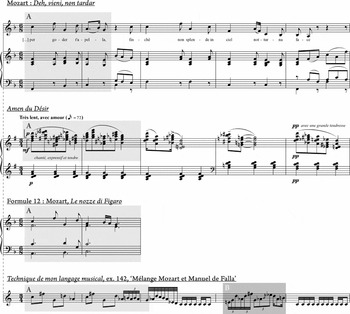
Example 8 shows how two melodic segments of the Mozart aria, labelled A and B, in turn generate two melodic segments of the ‘ecstatic and tender’Footnote 33 love theme that Messiaen refers to in his sketches as the ‘joli thème à la Mozart’.Footnote 34 In the opening phrase of ‘Amen du Désir’, the two segments are altered using the transformative matrix of Messiaen's modes of limited transposition, a process described in Chapter 11 of Technique de mon langage musical with startling frankness:
all these borrowings [. . .] will be passed through the deforming prism of our language, will receive from our style a different blood, an unexpected melodic and rhythmic colour in which fantasy and research will be united to destroy the least resemblance to the model.Footnote 35
Comparison of the aria ‘Deh, vieni, non tardar’ from Le nozze di Figaro with three transformations of two of its melodic contours in the music of Messiaen: ‘Amen du Désir’, Harmony Formula 12, and Technique de mon langage example 142. Mozart, ‘Deh, vieni non tardar’, Le nozze di Figaro (Act IV, scene 10, no. 27) Wolfgang Amadeus Mozarts Werke, Serie V, Opern, Bd. 8, no. 17 (Leipzig: Breitkopf & Härtel, 1879) 345–8; Olivier Messiaen, ‘Amen du Désir’, Visions de l'Amen (Paris: Leduc, 1943); Olivier Messaien, ‘Formules d'harmonie’, Pierre Boulez collection, Paul Sacher Foundation, Basel, Mappe A, Dossier 2a, 2–5; Olivier Messiaen, Technique de mon langage musical (Paris: Leduc, 1944).


The image of a ‘deforming prism’ provides an evocative metaphor for describing the range of processes Messiaen uses to integrate borrowed materials into his musical language, be they this use of his modes, or the sequences and melodic alterations used to create his harmony formulas.
The Mozartian model in ‘Amen du Désir’ is purely melodic, limited to the contours of short segments that Messiaen refers to as ‘neumes’. In the Traité, Messiaen speaks of a ‘contour’ that ‘recalls’ Susanna's aria, whereas his previous analysis of the same phrase in Technique de mon langage musical made a far weaker connection, characterizing the melody with a vague reference to Mozart not mentioning any particular work.Footnote 36 The differences between these two allusions underline the importance of comparing and studying as many intertextual references as possible before embarking upon an attempt to reconstruct the composer's creative processes that might otherwise be based on the comparison of scores alone.
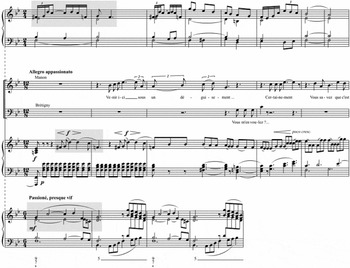
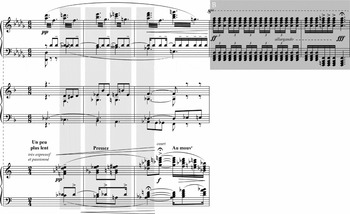
The harmonies of this passage also provide the foundation for a sequence of ten bars in ‘Amen du Désir’.Footnote 37 Example 9a shows how harmonic material from the end of ‘Manon! Sphinx étonnant!’ already seen in Formula 4 is also used in ‘Amen du Désir’. Messiaen's mention of Massenet in his analysis of the movement combined with the strong harmonic parallels between the two passages confirm beyond doubt the common paternity of these passages.
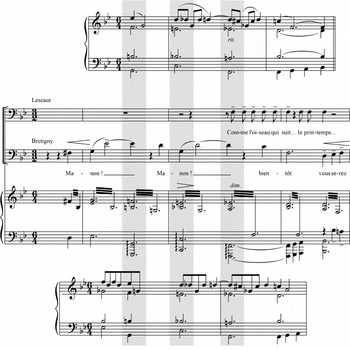
Jules Massenet, Prélude, Manon, bb. 61–3; Olivier Messiaen, Harmony Formula 4 ‘Marche imitée de ‘Manon’, 4e acte’; Olivier Messiaen, ‘Amen du Désir’, p. 35.

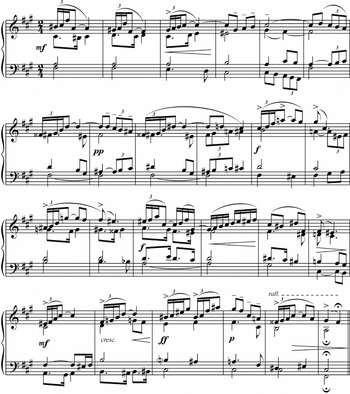
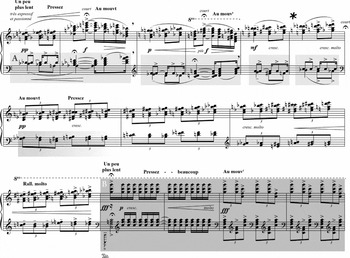
Messiaen reproduces Massenet's harmonies at pitch and conserves the tension created by Massenet's accented and syncopated tenor pedal, building upon this model by superposing a new chromatic line over the top of Massenet's harmonies. In his analysis, Messiaen clearly indicates that the ‘series of minor seconds in the upper voices’ are an addition. Comparing the Massenet excerpt to the corresponding passage of Messiaen's music in Example 9a shows that adding this new line was the first step of ‘Messiaenizing’ the borrowed passage. The following step, seen in Example 9b was to develop the transformed harmonic progression by sequence (as is also done in Formula 4, see Example 3), beginning on the original c♭, then moving upwards by major thirds to e♭ and finally g. Messiaen's fleeting and ambiguous identificationFootnote 38 of material that ‘one finds’ ‘in Manon’ in the last bar of page 35 of Visions de l'Amen is evasive (this is the passage marked by an asterisk in Example 9b): only six bars earlier, the same harmonies are used at the pitch level of Massenet's score and in a rhythmic setting much closer to Massenet's.Footnote 39 The sequence of ‘Amen du Désir’ (Example 9b) is composed in twelve steps. As it is transposed upward, the sequenced unit is progressively shortened. After six bars, it is homogenized into a steady pulsation of triplet crotchets (see the shaded area A in Example 9b). The three initial harmonies are progressively liquidated in an upward gesture of crescendo and accelerando climaxing at the ‘cri d'amour’ of Manon and Des Grieux (see shaded area B in Example 9a). The parallel paroxysms of Messiaen and Massenet's phrases are realized in the same pianistic texture, an extension of Manon’s presence in ‘Amen du Désir’ which would have gone unnoticed had Messiaen not drawn attention to his harmonic borrowing. Although Messiaen does not employ the same harmonies as Massenet for his climax (preferring a second inversion F major chord with added ninth to Massenet's root position D♭ major triad), the pianistic model and its sonorous effect are identical.Footnote 40 This confirms that Messiaen's knowledge and creative reuse of Manon was mediated through study of the piano reduction, the topography of the keyboard, and the particular sound of the piano: here through a pounding fortissimo climax on rapidly repeated block chords. Beyond the examples of melodic and harmonic borrowing explored above, a more complete vision of Messiaen's borrowing includes his reuse of instrumental gesture and dramaturgical content. The directional discourse and climax reused here can be understood as the vestige of a nineteenth-century dramatic practice strikingly reframed in the score of a consecrated master of mid-century musical modernity.Footnote 41
Olivier Messiaen, ‘Amen du Désir’, Visions de l'Amen, pp. 35–6. Jules Massenet, Manon, piano score (Paris: Heugel, n.d.), 4; Olivier Messiaen, ‘Formules d'harmonie’, Pierre Boulez collection, Paul Sacher Foundation, Basel, Mappe A, Dossier 2a, 2–5; Olivier Messiaen, ‘Amen du Désir’, Visions de l'Amen (Paris: Leduc, 1943), 35–6.

Some context concerning Messiaen's borrowing technique
Our exploration of Messiaen's borrowing from Massenet has focused on a very local level of his scores and has not given us an occasion to underline the extent to which the borrowing technique described here was a determining factor in the creation of his music, particularly of the 1940s. To understand Messiaen's borrowings from Massenet in context, it is important to briefly flesh out the precepts of his borrowing technique as we have elaborated it elsewhere.Footnote 42
Two findings in the early stages of our research laid the groundwork for our approach to Messiaen's borrowing technique. In his study of the surviving sketches for the Visions de l'Amen, Yves Balmer remarked upon abbreviated notes making reference to the names of composers that turned out to be from composers from which Messiaen borrowed. Given that there are very few other Messiaen sketches currently available to researchers, it was necessary to continue with other materials. Notably, we extrapolated the teachings of the Visions de l'Amen sketches through a new reading of the passages of Technique de mon langage musical that describe melodic and harmonic borrowing. These can be understood as a sort of cross between a compositional treatise and a sketchbook. Beyond Technique, Messiaen left thousands of clues in the myriad texts he produced on his music and the music of others. By combing through his scores, the scores from which he borrowed and his writing on his own music and the music of others, it is possible to piece together the origins of many of his compositions of the 1940s, and to retrace the steps of his compositional process even in the absence of his sketches.
The potential of this approach is demonstrated on a small scale in this article: to know that Messiaen selects a passage from Manon, adds a new melodic line to the top of that passage, develops it in a sequence leading to an adapted version of a Romantic climax, also borrowed from Manon, is just one example of what can be deduced from the comparison of micro-details gathered from across a broad variety of sources, many of them seemingly unrelated to the act of composition, let alone to Visions de l'Amen.
A proviso concerning this approach is necessary however. Although we often speak of intertextuality, our analyses do not create an intertextuality of interpretation, reception, or perception, but seek to reconstruct a particular, specific, and concrete creative intertextuality that describes the composer's use of an existing text at the moment of the compositional act. Messiaen's analyses of his own music often seem to discuss his music in terms of influence, suggesting a mode of intertextual interpretation; yet this language usually hides acts of intentional creative intertextuality. It follows that our goal has not been to remark upon similarities between Messiaen's works and other musics, but rather to understand in concrete terms how Messiaen selected, transformed, and knitted together specific passages of specific works in a conscious and original act of composition.Footnote 43 If the relationship between a composer and their models may lead them to retain any number of the model's aspects in their own music, Messiaen notably retains concrete melodic, harmonic, and rhythmic materials, transforming them using identifiable operations that mean his borrowings are traceable. This has in turn opened new inroads towards understanding his compositional processes.
Messiaen's process of composing with existing music begins in the scores that he knew and loved. Pelléas et Mélisande is a classic example. Messiaen's analyses of these scores are a key moment in his compositional process. Remarking upon rhythms, melodies, or harmonies that he found particularly attractive or interesting, the composer might re-copy them into notebooks, the ‘dictionaries’ he mentions in his sketches (cahiers rouges) and in recommendations to his students.Footnote 44 Although we have not had access to these documents, it seems clear that they existed and may, in some ways, have resembled the birdsong notebooks that have yielded valuable information about the construction of Messiaen's works from the 1950s onward.Footnote 45 These formulas might have been put to immediate use, kept as is, or developed and transformed using the various ‘deforming prisms’ of Messiaen's musical language discussed above. We consider many of the examples in Technique de mon langage musical to be more or less the transcription of Messiaen's ‘dictionaries’, and have shown that entire series of examples from Technique are in fact formulas derived from existing music. Many of the harmonic and melodic examples in Technique show up in later works, others seem to have never made it beyond the pre-compositional stage. But when the time came to compose a work, Messiaen could draw upon these pre-composed formulas, further developing them or integrating them into larger textures which, to varying degrees, were carefully arranged mosaics composed of musical borrowings. This process – analysis, selection, transformation, and, critically, the careful montage of borrowed materials – is most easily observable in the composer's works of the 1940s. Although the subject of this article does not provide an occasion to explore the remarkable, ingenious care with which the composer crafts his music out of materials with multiple, disparate origins, our forthcoming book focuses on this process and analyses several of his works in terms of their construction from existing resources.Footnote 46
Conclusions
Identifying borrowed tonal harmonies in Messiaen's music is complicated because his harmonic style, composed in large part of enriched traditional harmonies, was entirely capable of absorbing transformed tonal progressions. As the composer emphasizes in the opening chapter of Technique de mon langage musical, ‘We shall not reject the old rules of harmony and form’.Footnote 47 The result is that, without Messiaen's help, it is nearly impossible to know which passages might come from existing works. We have already underlined how Messiaen's borrowing from Massenet would have been impossible to identify had the composer not left scattered clues concerning his interest for Massenet and particular passages of his operas in his writings, teaching materials, and sketches. In the absence of sketch materials, these sorts of clues are needed to confirm that suspected instances of borrowing were intentionally conceived as such by the composer. This is where the crossing of historical and analytical approaches has been tremendously helpful. The careful rereading of Messiaen's writings allowed us to collect a critical mass of examples and reconstitute the transformational processes of Messiaen's ‘deforming prism’. In turn, as the constants of his method became clearer, it became possible to confirm further examples of musical borrowing. Considered as a whole, this evidence underlined the importance of borrowing to Messiaen's compositional process.
The current state of our research, dominated by examples of harmonic borrowing from Debussy and Ravel, suggests two possible hypotheses concerning Messiaen's harmonic borrowings: a) that the nature of Messiaen's harmonic language made him far more likely to borrow harmonic material from composers such as Debussy and Ravel or b) that we have simply been more successful in identifying borrowed passages from early twentieth-century composers because they require less alteration to be integrated into the texture of Messiaen's music and are therefore easier to notice. Our observations regarding the negative connotations associated with Massenet by the middle of the twentieth century suggest that Messiaen might have been less likely to bring up comparable models in analyses of his own music, making it harder to locate sites of their eventual reuse. The nature of our method, which requires confirmation of Messiaen's intentional borrowing from sources beyond the comparison of scores means that silences in the composer's discourse have an impact on the kinds of musical borrowing we are currently able to identify.
Although Messiaen's harmonic borrowing from a nineteenth-century figure like Massenet may seem unusual, it is certainly not exceptional. Olivier Latry and Loïc Mallié have identified a passage from the Liebestod of Tristan und Isolde that Messiaen uses in his organ work ‘Les Enfants de Dieu’, an example we would argue is recurrent and potentially programmatic in the same sense as the Massenet and Mozart borrowings seen here.Footnote 48 Although Latry and Mallié were the first authors to identify this borrowing, they only demonstrate its presence in ‘Les Enfants de Dieu’. The same harmonies are put to programmatic use at the end of the third movement of the Trois petites Liturgies, in a passage that climaxes upon the text ‘Mais le face à face et l'Amour’ as well as in Turangalîla-Symphonie (three passages of the eighth movement, ‘Développement de l'amour’, rehearsal figures 15, 27, and 42), where the music is qualified by the composer as an ‘explosion of the love theme’ (‘explosion du thème d'amour’).Footnote 49
The present study of Messiaen's relationship to Massenet offers several important findings: it renews our understanding of how Messiaen composed; it illustrates the persisting influence and presence of Massenet's oeuvre at the Paris Conservatoire well into the twentieth century (notably in the homework of Pierre Boulez); and it shows how Massenet's music participated in the instruction and construction of French harmonic grammar in that elite educational setting. We have also seen that the ‘formules d'harmonie’ of Messiaen's harmony class constituted a fertile source of materials, a veritable harmonic dictionary whose uses we are only beginning to comprehend. Beyond affording evidence of the interconnections between Messiaen's teaching and composing, his list of harmonic formulas also provides an opportunity to contemplate the breadth of Messiaen's vision of tonality, the tonal abstractions the composer created to teach harmony, and the ways in which his pedagogical references resurface in his compositions.Footnote 50 We demonstrate that Massenet's music had an enduring creative influence on the music of Olivier Messiaen and that a central passage of Visions de l'Amen contains a suggestive dialogue involving one of the most celebrated pages of Manon. We have further shown that Messiaen's use of Massenet's music is not an isolated incident: he also sought out and borrowed the musical content he associated with the ineffable notions of desire and passion from the operas of Mozart and Wagner. These findings suggest that Messiaen's favourite operatic repertoire – a corpus essential to his instruction of harmony, aesthetics, and analysis – may have also played an important role in the composition of both his music and the elaboration of his extra-musical programmes. Even after our argument has been presented piece by piece, these elements of conclusion remain surprising in the degree to which they change what we know about how Messiaen composed.
A final glimpse of Messiaen's relationship to Massenet can be found in commentaries by his close friend, the film composer and dedicatee of Technique de mon langage musical, Guy Bernard Delapierre. This passage does not concern the sort of harmonic examples the present article is based upon, but rather a melodic affinity, a common ‘désir de chanter’ which leads Delapierre to declare Messiaen ‘a great lyric composer’:
Although, technically, he is an extraordinary harmonist, Messiaen always gives priority to the melody, which must ‘speak’, ‘however complicated the rhythms and harmonies’. The harmony must always be ‘true’, ‘that which exists in a latent state within the melody and which has always been issue from the melody’. For this reason, Messiaen is above all else a great lyric composer (some critics have even gone so far as to compare him, in his desire to sing, to Massenet)!Footnote 51
Our study has shown that direct connections resulting from intentional compositional decisions link the works of Olivier Messiaen and Jules Massenet on a harmonic level. Indeed, until now, the implications of Messiaen's remark ‘Add [. . .] that I like Massenet, because he is tonal and well harmonized, and you will have some idea of my style’,Footnote 52 had never been fully understood. Given that Messiaen's first statement indicating his creative interest in Massenet dates to Reference Messiaen1939, it is probable that new, equally convincing ties between Massenet and Messiaen, perhaps expanded to include the melodic sphere evoked by both his friends and his critics, will be unearthed by future researchers. From now on, Massenet should be included in surveys of Messiaen's creative universe.