In the United States, Brazil, and many other countries, children often learn the names of the letters of the alphabet from an early age. For example, in a recent study of letter name acquisition by English speakers in the United States and Portuguese speakers in Brazil, 4- and 5-year-olds knew, on average, the names of about two-thirds of the letters (Treiman, Kessler, & Pollo, Reference Treiman, Kessler and Pollo2006). Given children's knowledge of letter names (see Worden & Boettcher, Reference Worden and Boettcher1990, for additional evidence from US children), it is not surprising that children use the names of letters in their early explorations of print (e.g., Chall Reference Chall1967; McBride-Chang, Reference McBride-Chang1999; Treiman & Kessler, Reference Treiman and Kessler2003).
Letter-name knowledge influences young children's understanding of print in several ways (Foulin Reference Foulin2005). Letter names may promote learning about the sounds and functions of letters because the names of many letters contain their sounds. For example, both the English name of b, /bi/, and the Portuguese name, /be/, contain the phoneme that the letter represents. (A complete list of Portuguese letter names appears in Appendix A; for an explanation of the phonetic symbols used in this paper see International Phonetic Association, 1999.) Letter names may also help children link the spelling of a word to the word's pronunciation. For example, knowing the name of the letter b may help children read a word such as beach, in which the entire name of the letter is heard in the word's pronunciation (Treiman & Rodriguez, Reference Treiman and Rodriguez1999). Last, and the focus of interest here, letter names may influence the letters that children choose to spell words.
The most basic letter name strategy in spelling is to take a letter as spelling its entire name. Phonemes and phoneme sequences that are the names of letters can be heard in the pronunciations of certain words and, when children spell these words, they may symbolize that phoneme or phoneme sequence with the corresponding letter. In this way, English-speaking kindergartners may spell car as cr or kr, in which r stands for the entire sequence /֓r/, or tell as tl, in which l stands for the whole phoneme sequence /ɛl/. Indeed, young children in the United States often adopt a letter-name strategy in their attempts to spell consonants (Treiman Reference Treiman1993; Reference Treiman, Weatherston and Berch1994; Treiman & Tincoff, Reference Treiman and Tincoff1997). For example, Treiman (Reference Treiman1994) found that a nonword such as /var/ was frequently spelled as vr, where r stands for the name of the letter, /ar/; vowel omissions were less common when the vowel did not form part of a letter name with an adjacent sound.
Use of letter names in the spelling of consonants is not confined to English. Martins and Silva (Reference Martins and Silva2001) demonstrated that Portuguese-speaking 5- and 6-year-olds were more likely to use a phonetically accurate letter when the letter's full name occurred in the word to be spelled than when it did not. For example, children were more likely to use z, whose Portuguese name is /ze/, when spelling zebra / Èzebra/ (zebra) than when spelling zinco / Èziݱku/ (zinc). Similarly, Cardoso-Martins and Batista (Reference Cardoso-Martins and Batista2005) showed that Brazilian Portuguese-speaking preschoolers were more likely to use phonetically plausible letters in spelling a word-initial sound sequence that corresponded to a consonant letter name than in spelling a sound sequence that did not form the name of a letter. For example, children were more likely to spell the initial t, named /te/ in Portuguese, in /teleÈfõni/ (telephone) than in /tahtaÈruɡa/ (turtle). Similar results have been found in Hebrew (Levin, Patel, Margalit, & Barad, Reference Levin, Patel, Margalit and Barad2002).
This tendency to symbolize whole letter names with the corresponding letter, which we have discussed so far in the case of consonants, also appears in children's spelling of vowels. Read (Reference Read1986) found that the most frequent spellings of English-speaking preschoolers for the sounds /e/, /i/, /aɪ/, /O/, and /ju/ were the letters that these sounds name: a, e, i, o and u, respectively. Treiman (Reference Treiman1993) observed that children were less likely to omit vowels in their spellings when the vowel was a letter name than when it was not a letter name. Similar findings have been reported in Portuguese. Pollo, Kessler, and Treiman (Reference Pollo, Kessler and Treiman2005) showed that Portuguese-speaking children found it easier to spell words like fila / Èfila/ (line), which contains the names of i and a, than to spell words like sopa / ÈsOpa/ (soup), which contains the name of only one letter, a. For these Portuguese-speaking children, as for the comparison group of English speakers, words with more letter names were spelled with more vowels and elicited more spellings that were phonologically plausible than words with fewer letter names. These results showed that children often used the strategy of spelling sounds with the letters whose names completely matched those sounds.
The emphasis in the literature has been on children making connections between the name of a letter and the corresponding phoneme or phoneme sequence in a word. As we have seen, children's tendency to use letters to represent whole letter-name strings seems to be robust in English and other languages, for both vowels and consonants. Particularly for consonants, however, a whole letter-name strategy may not yield substantial effects, because entire consonant letter names are not very common in the vocabulary of many languages. Contrary to vowel letter names that usually have only one phoneme (e.g., /e/ for a in English), consonant letter names have at least two phonemes (e.g., /ti/ for t) and sometimes more than two (e.g., /ʃis/ for x in Portuguese, / Èdْblju/ for w in English). Consequently, entire consonant letter names are less commonly heard in words. In fact, most words in English and Portuguese do not contain any consonant letter names. An analysis looking at letter names in words from children's books revealed that English and Portuguese have, on average, only 0.15 consonant letter names per word (Pollo et al., Reference Pollo, Kessler and Treiman2005). Full consonant letter names seem to be even less common in the words of Hebrew, with its long letter names (Levin et al., Reference Levin, Patel, Margalit and Barad2002). Therefore, many letter-name systems do not have the right structure to enable children to use entire consonant letter names in their spelling. If children are limited to exact matches between letter names and phoneme sequences, which is what has been emphasized in the literature, effects of consonant letter names would be restricted to a small number of words.
In the present study, we go beyond the focus on whole letter names to ask whether children are influenced by partial or inexact matches between letter names and sound sequences. If so, letter-name effects may be broader and more influential than if only exact matches are used. By partial match, we mean the use of a letter-name strategy when only part of a letter name is heard in a word. For example, Portuguese-speaking children may spell gado / Èɡadu/ (cattle) as hdu because they can hear part of the name, as opposed to the full name, of the letter h /aÈɡa/ in the word. By inexact match, we mean the use of letter names that are similar but not identical to those in the word being spelled. For example, Portuguese-speaking children may spell gueto / Èɡetu/ (ghetto) with a q because the name of the letter q /ke/ is similar to the phoneme sequence /ge/. Our study focuses on consonant letter names because whole consonant names are infrequent in words, and therefore partial and imperfect matches become particularly relevant.
Little is known about whether beginning spellers select letters on the basis of partial or inexact matches between letter names and words being written. English-speaking children do appear to spell vowel sounds using imperfect vowel name matches. An example of an inexact match is that children sometimes spell /ɛ/ with a because /ɛ/ and the letter name /e/ are both mid front vowels; they differ only in that tongue height is lower for /ɛ/ than /e/ (Beers Reference Beers, Henderson and Beers1980; Read Reference Read1975, Reference Read1986; Treiman Reference Treiman1993). An example of a partial match is the case of /u/, which in English is most frequently spelled as oo or o. Children know that u is named /ju/; therefore, they may spell u for /u/ more often than otherwise expected, such as in pul for pool (Treiman Reference Treiman1993). In this case, children appear to match not the whole name of the vowel letter, but only part of it. Imperfect and partial matches between vowel letter names and sounds may be particularly useful for English-speaking children because vowel letter names are less common in the words of this language than the words of other languages, such as Spanish and Portuguese.
Partial and inexact letter-name matches may occur for English vowels, but do they occur for consonants? We know that children sometimes spell an entire letter-name sequence with the corresponding consonant, and we also know that they can eventually use a more sophisticated strategy that recognizes that a consonant usually spells the first phoneme of its name. This latter strategy becomes apparent when, for example, English-speaking children spell /w/ with y because the name of the name of the letter y /wai/ starts with /w/ (Treiman, Weatherston, & Berch, Reference Treiman, Weatherston and Berch1994). However, the intermediate level between spelling in a way that is influenced by the full name of the letter and spelling in a way that is influenced by the initial phoneme of a letter name has been little studied.
The few studies that have examined children's use of this intermediate strategy for consonants have produced mixed results. Data reported by Levin et al. (Reference Levin, Patel, Margalit and Barad2002) suggest that Hebrew-speaking kindergartners do take advantage of partial matches between consonant letter names and phoneme sequences in words. Two types of partial matches appeared to influence Hebrew-speaking children. In the first type, children spelled words that matched consonant letter names in their consonants but not in their vowels or stress patterns. For example, children used the correct initial letter, ג, which is named / Èɡimɛl/, more often when spelling /ɡaÈmal/ (camel), which matches all the consonants of the initial letter name, than when spelling /ɡaÈnav/ (thief), which shares only the first consonant with the letter name. Children also showed a benefit for words that shared multiple initial phonemes with a letter name. As an example of this latter type of partial match, children more often correctly used the initial letter ת, named /taf/, when spelling words that begin with the first two phonemes of that letter name, such as /talÈmid/ (student), than when spelling words that begin with /t/ but not /ta/. In contrast, Cardoso-Martins and Batista (Reference Cardoso-Martins and Batista2005) did not find evidence that Portuguese-speaking children use partial letter names when spelling. Children were no better at spelling the initial l, named / Èɛli/, in a word like limão /liÈmãw/ (lime), which begins with the final syllable of l, than in a word like laranja /laÈrã٘a/ (orange). As Levin et al. suggested, Hebrew has unusually long letter names, and therefore offers fewer possibilities for exact matches and more possibilities for partial matches. If these differences between Hebrew and Portuguese spellers are confirmed, one possible explanation could be that letter names are shorter in Portuguese.
The present study was designed to further explore the role of partial and inexact letter-name matches in young children's spelling of Brazilian Portuguese. We wished to follow up on the results of Cardoso-Martins and Batista (Reference Cardoso-Martins and Batista2005) with Portuguese-speaking children, and to determine whether these children indeed fail to take advantage of partial letter names. Clearly, it is important to collect further evidence on this question before concluding that children learning to spell in Portuguese use letter names in different ways from children learning to spell in Hebrew. A further reason for studying Portuguese is that it is representative of a language that uses the Latin alphabet but that nonetheless has letter names sufficiently different from those of English and some other languages that use this alphabet to provide interesting ways to test the role of partial matches of consonant letter names in children's spelling. To show how Brazilian Portuguese provides a good test case for the study of partial and inexact consonant matches, we now briefly discuss its letter-name system.
As in English, most of the letter names in Brazilian Portuguese include phonemes that stand for the sounds that the letter represents (see Appendix A). Many consonant letters, such as b /be/, contain two phonemes, of which the first is a sound represented by that letter, and the second is usually /e/. Most of the other consonant letter names, such as that of f / Èɛfi/, are disyllabic, containing three phonemes. For these letters, the first phoneme is usually stressed /ɛ/ or /ẽ/, the second is a sound represented by the letter, and the last is usually unstressed /i/. One disyllabic letter name, /aÈɡa/ h, does not contain any sound represented by its letter. The letter h by itself is silent in Portuguese; with a preceding l it represents /ٔ/, and with a preceding n it represents /ئ/. The phoneme /ɡ/ is usually spelled with g, named /٘e/. Any systematic use of the letter h to spell /ɡ/ or phonemes similar to /ɡ/ by children is likely due, therefore, to a letter-name strategy. This may provide a better test case than comparing the proportion of correct spellings for words that start with a partial letter name and control words that do not start with a part of a letter name, as Cardoso-Martins and Batista (Reference Cardoso-Martins and Batista2005) did when comparing use of l, named / Èɛli/, for /liÈmãw/ and /laÈrã٘a/. In that case, it can be hard to disentangle the letter-name strategy from a letter-sound strategy. Children who knew that l spells /l/ would not show more use of l for /liÈmãw/ than /laÈrã٘a/ because they could use their knowledge of the phoneme-grapheme correspondences when spelling both words. In the case examined here, conventional phoneme-grapheme correspondences yield a different result (g) than a letter-name strategy (h).
In Experiment 1, we asked whether Brazilian Portuguese-speaking children actually use the letter h when spelling words with /g/. Previous studies suggest that these children do sometimes use the letter name when selecting letters that correspond to individual sounds. When Corrêa, Cardoso-Martins, Lemos, and Souza (Reference Corrêa, Cardoso-Martins, Lemos and Souza2003) asked Brazilian 5-year-olds which letter (out of f, g, h, x, and z) made the sound /g/, they found that children chose h even more often than the correct g. Initial findings reported by Corrêa et al. suggest that 4- and 5-year-old Brazilian children may use h for /g/ when spelling words, but that study involved very few subjects. Of particular interest to us, and a question not addressed by Corrêa et al., was whether children use h to spell any /g/ or whether they are most likely to use h when /g/ is in a similar phonological context to the letter name. Specifically, we asked whether children are particularly likely to use h to spell /g/ followed by /a/ because /ga/ is the stressed syllable of the letter name h, /aÈga/. If so, this would suggest that similarity to the letter name is important that children are not following a general rule that /g/ is spelled h. Such a result would further suggest that Portuguese-speaking children take advantage of partial matches between letter names and phonemes in the words, contrary to the findings of Cardoso-Martins and Batista (Reference Cardoso-Martins and Batista2005).
We were also interested in children's use of inexact matches between letter names and phoneme sequences. To examine this, we studied children's use of h to represent /ka/, which differs from /ga/ in voicing but is like it in place of articulation (velar) and manner of articulation (stop). Research shows that young speakers of English sometimes make mistakes on consonants that differ only in voicing (e.g., Rack, Hulme, Snowling, & Wightman, Reference Rack, Hulme, Snowling and Wightman1994; Read Reference Read1986; Treiman Reference Treiman1993; Treiman, Broderick, Tincoff, & Rodriguez, Reference Treiman, Broderick, Tincoff and Rodriguez1998). For example, young children sometimes misspell /k/ as g. Portuguese-speaking children might use h to represent /ka/ if they treat the voiceless consonant /k/ as the voiced /g/ and then use a letter-name strategy to spell the phoneme sequence with the letter named /aÈga/.
Effects of letter names on spelling would be expected only among children who are familiar with the letter names. We thus screened potential participants for their knowledge of h by asking them to write the letter /aÈga/.
EXPERIMENT 1
Method
Participants Children from two classrooms in a private school in Belo Horizonte, Brazil, were assigned to the /g/ condition. Children from two other classrooms at the same school were assigned to the /k/ condition. We analyzed data from 32 children in the /g/ condition and 36 in the /k/ condition. Data from seven additional children who did not perform successfully in the letter-name screening task were not included. The children were in preschool classes normally attended by 5-year-olds, 2 years before the beginning of elementary school. Children are enrolled in classes not just on the basis of their age, however, but also on the basis of their social and intellectual development and their previous educational experiences. The learning environment at this level is informal, with primary emphasis on promoting children's social, motor, and emotional development. However, teachers do teach children how to spell their names, and children participate in literacy-related activities such as storytelling and learning the names of the alphabet letters. The children were monolingual native speakers of Portuguese and were from upper middle-class backgrounds. Their exact ages were not available.
Stimuli In each of the /g/ and /k/ conditions, children spelled 24 disyllabic words with first-syllable stress. The stimuli are listed in Appendix B. Both of the /g/ and /k/ conditions had four sets of words. Each set had similar frequencies in texts designed for preschool children, as computed from data in Pinheiro (Reference Pinheiro1996). Two sets of words (experimental words) were different in the two conditions, and two sets of words (control words) were the same in both conditions. The syllable of interest, the critical syllable, was in the initial position in the word in all conditions. The experimental words in the /g/ condition started with /g/. Six began with /ga/ and six began with /g/ followed by other vowels. Children in the /k/ condition spelled words that began with /k/. Six of the words had /a/ after the /k/ and the other 6 had other vowels. Of the control words, 6 were conventionally spelled with initial h. Because h by itself is silent in Portuguese, as mentioned previously, all the words in this group began with a vowel sound. Another 6 control words, fillers, began with phonemes other than /g/ or /k/. None of the words had phoneme strings that formed the full or partial name of a consonant letter other than the ones investigated in the study. None of the stimuli had /ٔ/ or /ئ/ because these sounds are spelled with sequences containing h.
Procedure Children were tested in their classrooms, each classroom tested as a group. Children in the /g/ and /k/ conditions received the same instructions. The words were dictated in random order by a native speaker of Brazilian Portuguese. The speaker said the word, used it in a sentence, and repeated the word again. She then asked the children to spell the words. Children used pencil and a blank sheet of paper to do the task. No feedback was given. If children said they did not know how to spell a word, the experimenter instructed them to try their best. After children spelled all the words, they were asked to write the letter /aÈga/ (h). This letter-name screening task was given after the spelling task to avoid influencing the children's spellings.
Results and discussion
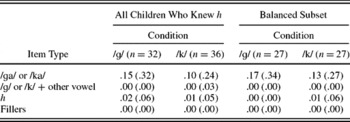
We first examined the results for children in the /g/ condition. Because our critical syllable was in the initial position of the word, we examined the first letter that children used to spell each item. The children used the appropriate letter g 47% of the time. Of most interest are spellings that begin with h, which reflect use of a letter-name strategy. As Table 1 shows, children used an initial h for words that begin with /ga/ 15% of the time and only rarely in the other conditions, even when h was the conventional initial consonant in the spelling. We performed a by-subjects analysis of variance (ANOVA; F 1) with item type (/ga/, /g/ followed by other vowels, h items, and fillers) as a within-subject factor and a by-items ANOVA (F 2) with item type as a between-subjects factor. The effect of item type was significant, F1 (1, 33) = 6.05, p = .018; F 2 (3, 23) = 216.76, p < .001. Post hoc analyses revealed that words with /ga/ led to significantly more initial hs than words starting with /g/ followed by another vowel (p = .01). Words that started with /ga/ also gave rise to significantly more initial hs than words with other initial phonemes and words for which the standard spelling includes h (p < .05 for both comparisons).
Mean proportion (standard deviationsns) of initial h in spellings of various types of words in Experiment 1

Children in the /k/ condition used the phonologically appropriate letters c and q 37% of the time. As Table 1 shows, they used an initial h for words that began /ka/ 10% of the time, but only rarely in the other conditions. The main effect of item type was significant, F 1 (1, 39) = 5.35, p = .023; F 2 (3, 23) = 49.29, p < .001. Words with /ka/ led to significantly more initial hs than words starting with /k/ followed by other vowels, words with other initial phonemes, and words for which the standard spelling requires h (p < .001 for all comparisons).
To determine whether the results from the /g/ and /k/ conditions could be straightforwardly compared, we asked whether the children in the two conditions were similar in their spelling skills. To do this, we looked at whether children spelled the initial consonant of the filler words, which were the same across conditions, and which contained a variety of initial consonants, with a phonologically appropriate letter. Appendix B shows the initial consonants that were scored as appropriate for each stimulus. Children in the /g/ condition did better (58% plausible spellings) than children in the /k/ condition (37% plausible spellings). Although the children attended the same school, the teachers of the classrooms that were assigned to the /g/ condition appeared to place more emphasis on letter knowledge than the teachers of the classrooms assigned to the /k/ condition. To equate the children in the two conditions for overall spelling ability, we excluded the 5 children in the /g/ condition who produced the most plausible initial spellings for the filler words, and we excluded the nine children in the /k/ condition who produced the fewest plausible filler spellings, yielding two groups of 27 children each. In this balanced subset, the rate of plausible initial spellings for the fillers was 51% in the /g/ condition and 49% in the /k/ condition.
The results for the balanced subset, shown in Table 1, are very similar to the results just described. As before, there was a main effect of item type, F 1 (1, 54) = 12.90, F 2 (3, 20) =160.35, p < .001 for both. Post hoc analysis revealed that words starting with /ga/ and /ka/ led to significantly more initial hs than words starting with /g/ and /k/ followed by another vowel (p < .001). Words that started with /ga/ and /ka/ also gave rise to significantly more initial hs than words with other initial phonemes (p < .001) and words in which the standard spelling requires an h (p = .001). It appeared that H spellings are more common for /ga/ than /ka/. However, the interaction between item type and condition was significant by items, F 2 (3, 20) = 12.00, p < .001, but not by subjects, F 1 (1, 54) = 0.25, p = .625, and the main effect of condition did not reach significance in either analysis, F 2 (1, 20) = 4.00, p = .059; F 1 (1, 52) = 0.09, p = .770.
Closer inspection of the data revealed that only some children used the letter-name strategy. In the /g/ condition, 30% of the children who knew the letter h used this letter at least once to spell words starting with /ga/. Of those children, 62% used h on half or more than half of the stimuli beginning with /ga/. In the /k/ condition, 19% of the children used the letter h at least once to spell words starting with /ka/. Of these, 79% used it to spell more than half of the words in the words starting with /ka/. Thus, not all children used the letter-name strategy. For those who did use it, however, the majority did so for more than half of the stimuli.
We did a post hoc inspection to investigate any other types of spellings that could be explained by the use of partial or inexact letter names. It is striking that children misspelled gueto /Ègetu/ (ghetto) with an initial q 19% of the time. This is surprising because q never represents /g/ in Portuguese, but only /k/ and the opposite mistake, using g, which normally spells /g/, for words starting with /k/, was rare. In addition, q is an infrequent letter in Portuguese, occurring as less than 1 letter out of 1,000 in preschool books (as computed from the word frequency list of Pinheiro Reference Pinheiro1996). The only reasonable explanation for the high usage of q in gueto is that children were using a letter-name strategy. The name of the letter q in Portuguese is /ke/, which matches the initial phoneme sequence /ge/ in all respects except consonant voicing. This is similar to the use of h for /ka/. However, Experiment 1 included only one word that began with /ge/, so no strong conclusions can be drawn.
The results of Experiment 1 corroborate findings that children's spellings in Portuguese are influenced by letter names (e.g., Cardoso-Martins & Batista, Reference Cardoso-Martins and Batista2005; Pollo et al., Reference Pollo, Kessler and Treiman2005). However, in contrast to the study of Cardoso-Martins and Batista, the present results suggest that children use letter names even when the match with the target word is partial or inexact. Children used the letter h, named /aÈga/, to spell words beginning with /ga/ and /ka/. For other letters it may be difficult to disentangle use of sounds from use of letter names, but this possibility is excluded here because h /aÈga/ never spells /g/ or /k/. The results suggest that the effects of consonant letter names on children's spellings are relatively broad. Children use letter-name knowledge even when the match between a letter name and a phoneme sequence is inexact. Moreover, partial letter name matches do not seem to be specific to the unusual letter-name system of Hebrew, contrary to the suggestion of Levin et al. (Reference Levin, Patel, Margalit and Barad2002).
Experiment 2 was carried out to replicate and extend the findings of Experiment 1. One shortcoming of Experiment 1 involves the between-subject design. Even though children were matched post hoc on spelling ability in some of our analyses, condition (/g/ or /k/) was confounded with the classroom that children were in. Also, the children spelled real words. We used real words because we were not sure how children would react if asked to spell pseudowords, and because we wanted to make the task as natural as possible. With real words, however, we could not control all relevant linguistic features. To overcome these limitations, Experiment 2 used a within-subject design and more linguistically controlled items.
EXPERIMENT 2
Experiment 2 had three goals. The first goal was to provide a direct comparison between children's use of h to spell /ga/ and /ka/. To accomplish this goal, each child spelled both /g/ and /k/ items, and we used nonwords matched across conditions on all sounds except the initial consonant (e.g., /Ègafa/ and /Èkafa/). The second goal was to determine whether children would make similar kinds of imperfect matches between letter names and phoneme sequences with other letters of the alphabet. Therefore, we examined not only h but q. As noted earlier, some children in Experiment 1 had used the letter q, which is named /ke/, to represent the initial phoneme of gueto /Ègetu/. This is an indication that children may make imperfect matches between letter name and phoneme sequences for letters other than h. To examine this, Experiment 2 included /ge/ and /ke/. A third goal was to examine in more detail the different linguistic features that may influence children's spelling. For example, in matching /ka/ with h /aÈga/, what was the role of the consonant /k/ and the vowel /a/? The vowel match seems to be important, because children in Experiment 1 did not use h when the target consonant was followed by a different vowel (e.g., /gO/). An exact match of the consonant appeared to be of minor importance, because children did use h for words starting with /ka/. However, it is not clear whether children would show a similar pattern of spellings if the consonant in the word differs from the target (in this case /g/) not in voicing, but in another aspect such as place of articulation. Such items were included in Experiment 2.
Method
Participants We analyzed data from 30 children who demonstrated knowledge of both h and q in a letter-name screening task. Data from 16 additional children who did not pass the screening were not included in the analyses. The children were enrolled in the same private preschool and in the same preschool year as the children in Experiment 1. As before, they were monolingual native speakers of Portuguese from upper middle-class backgrounds. The average age was 5 years, 5 months (5;5), with a range from 4;11 to 5;11.
Stimuli Children spelled 60 pseudowords, which are provided in Appendix C. The 48 critical pseudowords were two-syllable items with a consonant-vowel-consonant-vowel structure and stress on the first syllable. There were also 12 filler pseudowords that varied in their syllabic structures and stress patterns. The 48 critical items were divided in eight categories of 6 items each. In the first three categories, items began with /g/ followed by either /a/, /e/, or other vowels. In three other categories, the items started with the voiceless phoneme /k/ followed by /a/, /e/, or other vowels. Another category had pseudowords that started with /b/ or /d/ (differing from /ga/ only in place of articulation) followed by /a/. A last category of critical items, designed for comparison with q /ke/, comprised pseudowords beginning with a variety of other consonants followed by /e/. As in Experiment 1, we avoided items that had phoneme strings that formed the full or partial name of a consonant letter other than the ones investigated in the study. For this reason, we could not have pseudowords that differed from /ke/ only in the consonant's place of articulation, as we did with /ga/, because the only candidates, /pe/ and /te/, are the names of p and t, respectively. Therefore, the only criterion for the initial consonant in this last category was that the consonant followed by /e/ could not form a name of a letter. None of the pseudowords had /ٔ/ or /ئ/ in their pronunciation because this sound typically requires h in its spelling.
Procedure Children were tested in groups of two or three in a quiet room in the school by a native speaker of Brazilian Portuguese. Each child participated in three sessions on different days. The sessions were approximately 1 week apart. The spelling task was divided into three parts, and children spelled 20 pseudowords in each session.
For the spelling task, the experimenter explained that children would be asked to spell funny words that they probably never saw or heard before and that she wanted them to listen carefully to each word, repeat it, and try to spell the word. If the children said they did not know how to spell a word, the experimenter instructed them to try to spell the funny words to the best of their abilities. Children used pencil and paper to do the task. No feedback was given as to the appropriateness of the children's responses. The pseudowords were presented in the same randomized order to all children.
The letter-name task screening was performed after the spelling task to avoid influencing the children's spellings. Letters were presented orally by name, and the children were instructed to write the letter that the experimenter said. Children were first asked to write l and t as practice items, to ensure that children knew that the task was to write individual letters rather than to spell out the names, such as eli. Feedback was provided on these practice items. Children were then asked to write h and q, in this order.
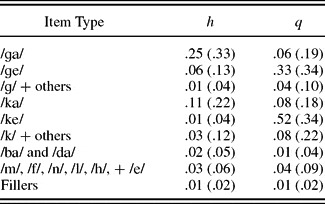
Mean proportions (standard deviations) of initial h and q in spellings of various types of items in Experiment 2

Results and discussion
We were particularly interested in spellings that began with h /aÈga/ or q /ke/. The first column of data in Table 2Table 2 shows the proportion of initial h in children's spellings of each type of item. Children sometimes used an initial h for items that began with /ga/ and to a lesser extent for items that began with /ka/; initial h was less common in the other conditions. ANOVAs using the factors of initial consonant voicing (voiced, /g/, or voiceless, /k/) and identity of following vowel (/a/, /e/ or other) showed a main effect of voicing, F 1 (1, 29) = 5.31, p = .029; F 2 (1, 15) = 17.73, p = .001. Pseudowords that started with /g/ led to significantly more initial hs than pseudowords starting with /k/. There was also a main effect of vowel, F 1 (1, 37) = 15.84; F 2 (2, 15) = 65.93; p < .001 for both; pseudowords with /a/ led to significantly more initial hs than pseudowords with any other vowel (p < .001). There was no significant difference between items with /e/ and items with other vowels. In addition, voicing of the consonant interacted with identity of the vowel, F 1 (1, 43) = 6.50, p = .007; F 2 (2, 15) = 11.99, p = .001. The interaction arose because the combination of the consonant /g/ and the vowel /a/ elicited the greatest use of h. The results of this analysis largely agree with those of Experiment 1. Here, however, the difference between /ga/ and /ka/ was statistically significant.
As in Experiment 1, children were quite variable in the strategies they used, with only some children using the letter-name strategy. Forty-four percent of the children used h at least once to spell items starting with /ga/. Of those children, 63% used initial h to spell half or more of the stimuli beginning with /ga/. Thirty percent of children used h at least once to spell items starting with /ka/, and 16% of these children used h to spell the initial phoneme of more than half of the items beginning with /ka/.
The results presented so far suggest that both the consonant and the vowel are important determinants of children's use of h. Further analyses are needed, however, to determine to what extent different consonants determine use of h. We therefore conducted ANOVAs to compare three types of items that contained a consonant followed by /a/: /ga/ items, /ka/ items (which differ only in voicing from /ga/), and /ba/ and /da/ items (which differ from /ga/ in place of articulation). The analyses revealed a main effect of consonant similarity, F 1 (2, 46) = 11.61, F 2 (2, 17) = 48.52, p < .001 for both. Post hoc comparisons revealed that /ga/ items yielded significantly more h spellings than all other items (ps < .01) and /ka/ items yielded significantly more h spellings than /ba/ and /da/ items (p < .001). Thus, the presence of /a/ is not enough to elicit h spellings. The initial consonant must be identical to the consonant found in the name of h or different from it only in voicing.
We were also interested in children's use of the letter q /ke/ in spelling /k/ and /g/. We expected children to use q when it matches completely its name /ke/. We also expected children to sometimes use q for /ge/, as in the errors like qtu for gueto that were observed in Experiment 1. The second column of data in Table 2 shows the proportion of initial qs in children's spelling of the pseudowords. Children sometimes used q for pseudowords starting with its name /ke/ and for items starting with /ge/. Children did not use q nearly as often for other pseudowords, even for the other pseudowords starting with /k/, in which a q spelling would be phonologically plausible. (The digraph qu spells /k/ in Portuguese before the letters e or i.) ANOVAs with the factors of voicing of the initial consonant (/k/ or /g/) and identity of the following vowel (/e/, /a/, or others) confirmed a main effect of voicing, F 1 (1, 29) = 7.25, p = .012; F 2 (1, 15) = 14.46, p = .002. Pseudowords that started with /k/ led to significantly more initial qs than pseudowords that started with /g/. There was also a main effect of vowel, F 1 (1, 40) = 42.82; F 2 (2, 15) = 79.12; p < .001 for both. Items with /e/ led to significantly more initial qs than items with other vowels (p < .001), but there was no significant difference between /a/ and other vowels (/O/, /u/, /ɔ/). The ANOVAs also showed an interaction between consonant voicing and vowel, F 1 (1, 41) = 4.81, p = .023; F 2 (2, 15) = 6.39, p = .010. The combination of the consonant /k/ and the vowel /e/ elicited the greatest proportion of q spellings.
As in the analysis of h spellings, we were interested in clarifying the role of the consonant in eliciting q spellings. We therefore analyzed pseudowords in three categories: /ke/, /ge/, and some other consonant plus /e/ (e.g., /ne/). The factor of consonant similarity had a significant effect on the proportion of q spellings, F 1 (2, 58) = 30.03, F 2 (2, 17) = 44.37, p < .001 for both. Pseudowords beginning with /ke/ yielded significantly more q spellings than other pseudowords (ps < .02), and /ge/ pseudowords showed significantly more q spellings than pseudowords beginning with other consonants such as /n/ (p < .001). These results support the idea that children find phonemes that differ only in voicing to be very similar: children only used a letter-name strategy when the letter name and the sounds to be represented matched in all respects expect voicing.
GENERAL DISCUSSION
Many previous studies have shown that young children select letters to spell words on the basis of letter names. However, previous studies have focused either on children matching the whole letter name with a phoneme string (e.g., spelling car as kr, when r stands for /ar/) or just a single, usually initial, phoneme of a letter name with a phoneme in the word (e.g., spelling the word where with y because the name of the letter y /wai/ starts with /w/). The intermediate level (here called partial match) between spellings that are influenced by the full name of the letter and spellings that are influenced by the initial phoneme of a letter name has received little attention. In fact, there is debate about whether children use units bigger than a single phoneme and shorter than the full letter name in their spellings. Several researchers have failed to find evidence that partial matches between letter names and phoneme strings are important in writing systems such as English and Portuguese (Cardoso-Martins & Batista, Reference Cardoso-Martins and Batista2005; Levin et al., Reference Levin, Patel, Margalit and Barad2002). Results from Experiments 1 and 2 provide impressive evidence that, in addition to being influenced by entire letter names when reading and spelling, children are influenced by letter names when the match between the sounds and the letter name is partial or imperfect. The existence of such an intermediate level is particularly important given that full matches between letter names and phoneme sequences are very rare for consonants in languages such as Portuguese and English (Pollo et al., Reference Pollo, Kessler and Treiman2005).
The results of the present study show four different ways in which letter names influence children directly in their spelling. First, although the experiments were not formally set up to test for whole letter-name spellings (when there is an exact match between the complete letter name and a phoneme sequence in the word), we found evidence for spellings that can only be explained in such terms. This is a robust finding in the literature. For both Portuguese and English, children are influenced by exact matches between the phoneme strings being written and entire vowel and consonant letter names (e.g., Cardoso-Martins & Batista, Reference Cardoso-Martins and Batista2005; Pollo et al., Reference Pollo, Kessler and Treiman2005; Treiman Reference Treiman1994). For Portuguese, this evidence has come exclusively from the spelling of real words. In the present study, we extended this investigation to pseudowords, finding that children were much more likely to use initial q for pseudowords starting with /ke/ than for pseudowords starting with /k/ followed by /O/, /ɔ/, or /u/. It is important to note that que is the orthographically appropriate spelling for /ke/. It is conceivable, but not very likely, that children's spellings were influenced by the standard orthography. However, the children in the present study were prereaders spelling pseudowords that they had never seen. It is unlikely that such young children were spelling q for /ke/ because they had seen such spellings; q is uncommon in Portuguese words, particularly at the preschool level, and children almost never used the full spelling que. The most plausible explanation for the finding that children spelled q for /ke/ is that they were directly using the letter for its full letter-name value.
Second, letter names influence young spellers when they take advantage of a match between a phoneme string in the word and part of a letter name (partial match). The results from our study are clearly not attributable to orthographic knowledge, because we looked at h /aÈga/ spellings for words starting with /ga/. As mentioned previously, h never spells /g/ in Portuguese. Children used h spellings for /ga/ but rarely for /g/ followed by other vowels, providing evidence for a partial match between words and letter names that is intermediate between the single-phoneme match (using h for /g/ regardless of the following vowel) and the full letter-name match (using h only for /aÈga/).
Our results seem to conflict with those of Cardoso-Martins and Batista (Reference Cardoso-Martins and Batista2005), who did not find that Portuguese-speaking children take advantage of partial matches between letter names and phoneme sequences. Cardoso-Martins and Batista suggested that that the children in their study may not have used partial consonant letter names because the critical syllables in their stimuli, such as /li/, matched two letter names simultaneously. In addition to a partial match with consonant names such as /Èɛli/ l, they all contained the full name, /i/, of the vowel letter i; perhaps children found this full letter name more salient. However, the children in our experiments used partial letter names even though a vowel letter name occurred in the same syllable (/ga/ is part of the letter name h /aÈga/ but it also contains the name of the letter a /a/). A second suggestion proposed by Cardoso-Martins and Batista is that the part of the letter name children were expected to match in their study was the unstressed part, such as the unstressed /li/ of /Èɛli/ l. Whether the stimuli contained the syllable in a stressed position or not, children may have found the unstressed part of the letter name less salient and therefore more difficult to match with the stimuli. This seems to be the most reasonable explanation for the difference between our results and those of Cardoso-Martins and Batista: our stimuli always contained the stressed syllable of the letter name (/Èga/ of h /aÈga/). It is true that Levin et al. (Reference Levin, Patel, Margalit and Barad2002) found evidence for partial matches in Hebrew even though the partial letter names did not occur in the stressed syllable of the word (e.g., /talÈmid/ is stressed on the second syllable and not on the syllable that contains part of the name of the letter /taf/). In Portuguese, however, vowels in final unstressed syllables tend to be reduced—often shortened and more centralized—and so children may have had more difficulty equating them with the unreduced vowels in the target spellings. Our results show than in Portuguese, as in Hebrew (Levin et al., Reference Levin, Patel, Margalit and Barad2002), children take advantage of partial letter names in words, at least when a sequence is the stressed syllable of the letter name.
Third, a way in which children were influenced by letter names, and one that has not been reported before, was when they matched a phoneme sequence in a word that was similar to a consonant letter name in all aspects except in voicing (inexact match). Children in our experiments sometimes used q /ke/ to spell items that started with /ge/. In this case, children could not be using their knowledge of the conventional writing system, because q is never a standard spelling of /g/ or /ge/.
Fourth, a way in which letter-name knowledge was shown to be influential in children's spelling was a combination between partial and inexact matches. Children sometimes matched a phoneme sequence in a word with a letter for which part of the name imperfectly matched the target sequence. In our study, this was demonstrated by children spelling h /aÈga/ for items beginning with /ka/. This result shows how powerful a letter-name strategy can be to young spellers.
Young children in Brazil, as in many other countries, often learn the names of some letters before formal reading and spelling instruction begins. Our study provides new information about how children put their knowledge of letter names to use in inventing spellings. In particular, it shows us how children match letters to phoneme sequences. Children preferred to use letters when consonant-vowel sequences from the letters’ names matched the target, for which purpose exact matches of the vowel and the stress pattern were of paramount importance, but voicing of the consonant was of minor importance. In addition, matching the vowel is not sufficient: children matched consonant letter names to phoneme sequences that differed in voicing only, but did not match letter names to phoneme sequences that differed in other aspects such as place of articulation. Stress also seems to be important in children's use of partial letter names. Children seem to take advantage of stressed syllables of letter names but not unstressed syllables of letter names.
The present results corroborate previous findings that voicing is a less salient feature for young children than place of articulation (e.g., Rack et al., Reference Rack, Hulme, Snowling and Wightman1994; Read Reference Read1986; Treiman, Tincoff, Rodriguez, Mouzaki, & Francis, Reference Treiman, Tincoff, Rodriguez, Mouzaki and Francis1998). We have extended these findings from English to a new language. In addition, we have shown that children find the matching of a following vowel to be more salient than the voicing of the consonant, matching /ka/ and /ga/ more readily than /ka/ and /ke/. This tendency to ignore voicing may be exacerbated when children subvocalize or whisper a word to themselves when trying to write it, in which case the contrast between voiced and unvoiced consonants would be lost. Here, though, the experimenter clearly dictated the words to the children. Adults, like children, sometimes disregard voicing. This is suggested by the structure of most syllabaries, forms of writing where a single symbol stands for an entire consonant-vowel sequence. In the Japanese syllabaries, to take one example, /ka/ *** and /ga/ *** are very similar—distinguished only by a diacritical mark, which was added only in modern times. The syllable /ke/ ***, on the other hand, which contains a different vowel, looks completely different from /ka/. Throughout the Japanese syllabaries, voicing is relegated to this secondary status, less important than other features of the consonant and vowel—the same precedence given to these features by the Brazilian children in our experiments.
Children who do not know how to spell certain sounds sometimes invent their own spellings for those sounds, and many of these inventions reflect phonology (e.g., Read Reference Read1975, Reference Read1986; Treiman Reference Treiman1993). For example, children may spell words that start with tr with ch instead, writing truck as chrac. Children create these spellings because, before /r/, the phoneme /t/ is phonetically similar to the initial sound of chat. Children may also use their knowledge of letter names, if they possess such knowledge, to invent spellings for sounds. The present results add to our knowledge of invented spelling by showing that children sometimes combine different types of information they possess, in this case phonological knowledge and letter-name knowledge. This can make children's spelling less comprehensible to adults, as in the use of h for /ka/ in Portuguese. Parents and teachers need to be aware of possible reasons behind children's spellings so they can better understand the processes that children use when spelling words and help children move to more advanced spellings.
Even though many children in our experiments used their letter-name knowledge quite often when spelling words, some children did not use it at all and others used it inconsistently. This was expected, considering the inherently variable nature of children's spellings. Some of the children who did not demonstrate letter-name strategies in the present experiment may have used them earlier or later in their development, but some children may never use these strategies. The present experiments were designed not to study the course of development of letter-name strategies but to uncover new types of knowledge and combinations of knowledge that children use to invent spellings. Longitudinal studies are now needed to investigate the development of the letter-name strategies uncovered by this paper and the abilities that underlie those strategies.
Children who learn the names of letters before formal literacy instruction begins use this knowledge in their early attempts to read and spell, but there are debates about whether the effects are beneficial (see Treiman & Kessler, Reference Treiman and Kessler2003). At the same time that letter names help children to spell certain phoneme sequences like q for /ke/, letter-name strategies sometimes cause children to deviate from conventional spellings, as when Portuguese-speaking children use h for /ga/ or /ka/. Is children's tendency to spell by letter names positive or negative? In our opinion, it does more good than harm. Children's self-taught strategies often lead them to produce spellings that are relatively close to conventional ones. Even when the spellings are not close to conventional ones, the strategies are valuable because they allow children to produce reasonable, albeit incorrect, representations for words, not simply omitting the phonemes altogether. Letter-name knowledge helps children grasp the idea that writing represents spoken language, and this is one of the most important achievements in early literacy development.
APPENDIX A: NAMES OF LETTERS OF THE ALPHABET IN BRAZILIAN PORTUGUESE
a /a/, b /be/, c /se/, d /de/, e /ɛ/, f /Èɛfi/, g /٘e/, h /aÈɡa/, i /i/, j /È٘ɔta/, k* /ka/, l /Èɛli/, m /Èẽmi/, n /Èẽni/, o /ɔ/, p /pe/, q /ke/, r /Èɛhi/, s /Èɛsi/, t /te/, u /u/, v /ve/, w* /Èdabliw/, x /ʃis/, y* /ÈipisilOݱ/, z /ze/
Note that the letters with asterisks are not part of the core alphabet of Portuguese.
APPENDIX B: WORDS USED IN EXPERIMENT 1
Experimental words
Note that the plausible initial letter is in parentheses.
/g/ condition (g)
/ga/: gado /Ègadu/ (cattle); gafe /Ègafi/ (gaffe); gala /Ègala/ (gala); galo /Ègalu/ (rooster); garra /Ègaha/ (claw); gaze /Ègazi/ (gauze)
/g/ + other vowel: gole /Ègɔli/ (mouthful); goma /Ègõma/ (gum); gude /Ègudi/ (marble); guerra /Ègɛha/ (war); gueto /Ègetu/ (ghetto); gula /Ègula/ (greed)
/k/ condition (c/k/q)
/ka/: cabo /Èkabu/ (cable); caça /Èkasa/ (hunting); calo /Èkalu/ (callus); capa /Èkapa/ (cover); cara /Èkara/ (face); caro /Èkaru/ (expensive)
/k/ + other vowel: cone /Èkõni/ (cone); copa /Èkɔpa/ (breakfast room); copo /Èkɔpu/ (glass); coro /ÈkOru/ (chorus); cubo /Èkubu/ (cube); quibe /Èkibi/ (kibbeh)
Control words
Initial h: harpa (h/a) /Èahpa/ (harp); haste (h/a) /Èasti/ (pole); hino (h/i) /Èinu/ (hymn); hoje (h/o) /ÈO٘i/ (today); hora (h/o) /Èɔra/ (hour); horta (h/o) /Èɔhta/ (vegetable plot)
Fillers: barro (b) /Èbahu/ (clay/mud); bife (b) /Èbifi/ (beef); jato (j/g) /È٘atu/ (jet); moto (m) /Èmɔtu/ (motorcycle); serra (s/c) /Èsɛha/ (mountain); vale (v) /Èvali/ (voucher)
APPENDIX C: STIMULI FOR EXPERIMENT 2
/ga/: /Ègafa/, /Ègapa/, /Ègabu/, /Ègafu/, /Ègapi/, /Ègadi/
/g/+ /e/: /Ègeba/, /Ègeda/, /Ègefu/, /Ègepi/, /Ègeri/, /Ègevu/
/g/ + /ɔ/, /O/, /u/: /ÈgOfa/, /ÈgOba/, /Ègɔdu/, /Ègɔfu/, /Ègupi/, /Èguti/
/ka/: /Èkafa/, /Èkaba/, /Èkadu/, /Èkafu/, /Èkapi/, /Èkadi/
/k/+ /e/: /Èkeba/, /Èkeda/, /Èkefu/, /Èkepi/, /Èkeri/, /Èkevu/
/k/ + /O/, /ɔ/, /u/: /ÈkOfa/, /ÈkOba/, /Èkɔdu/, /Èkɔfu/, /Èkupi/, /Èkuti/
/ba/ or /da/: /Èbafa/, /Èdapa/, /Èbadu/, /Èdafu/, /Èbapi/, /Èdati/
/m/, /f/, /n/, /l/, /h/+/e/: /Èmeba/, /Èfeda/, /Ènepi/, /Èleri/, /Èmevu/, /Èhefu/
Fillers: /fɔ/, /lɛ/, /ni/, /mɔs/, /has/, /tis/, /saÈvɔtu/, /mOÈpifu/, /tuÈriba/, /vaÈbu/, /heÈlɔ/, /maÈzO/
ACKNOWLEDGMENTS
This work was supported in part by Grants BCS-0130763 and HD051610. We are grateful to the faculty, parents, and children from the Colégio Marista Dom Silvério for their cooperation, and to Cláudia Cardoso-Martins for comments on a previous version of the manuscript.